CATTLEYA DOWIANA AUREA. [Plate 84.] Native of Colombia.
Reading edition
CATTLEYA DOWIANA AUREA. [Plate 84.] Native of Colombia.
Epiphytal. Stems stout, clavate, furrowed, eight to ten inches high, monophyllous. Leaves evergreen, broadly oblong, obtuse, coriaceous, nearly a foot long. Scape terminal, about four-flowered, emerging from a compressed bluntish leafy spathe. Flowers very large, about six inches across and seven inches deep, with a superbly-coloured lip; sepals linear-lanceolate, plane, recurved at the tip, four inches long and about three-fourths of an inch wide, the dorsal one somewhat shorter and broader, all pale or primrose-yellow; petals ovate, apiculate, about three inches long and two and a half inches broad, of the same colour as the sepals; lip obcordate, very large, four inches long and nearly three inches wide, obscurely three-lobed: lateral lobes erect, and meeting over the column, purple-crimson, closely veined with deep golden-yellow: front lobe very large, deeply emarginate, with the edge undulated, closely and finely crisped, rich velvety purple-crimson throughout, with about three golden lines down the centre, extending to within about one-third of the apex, from the outer of which branch off curving towards the margin a close series of golden reticulations, the sides being also marked by irregular blotches of gold. Column pale yellow, clavate, curved down, and almost covered by the lateral lobes of the lip.
Cattleya Dowiana aurea, supra.
Cattleya aurea, Linden, Catalogue (1872); Id. L’Illustration Horticole, 1881, 80.
The species of Cattleya are great favourites with all growers of the gorgeous race of Orchids. It is no less gratifying than surprising to see the many new forms that are being brought home by our energetic collectors, and great praise is due to them for their indefatigable exertions in this matter. There is no doubt that the Cattleyas rank amongst the richest-coloured of the genera of Orchids, and many of them even when not in blossom, if well grown, form attractive specimens, their foliage being of a beautiful dark green and their growth compact.
The plant we now illustrate is one of the most distinct and beautiful of the family. Our drawing was taken from a fine specimen in the grand collection of R. P. Percival, Esq., Clevelands, Birkdale, Southport, who has one of the largest and best grown collections of Cattleyas to be found; many of his plants have been imported within the last few years, and are wonderfully well grown, as, indeed, will appear when the number of flower sheaths showing on the different specimens is stated; thus, of Cattleya Mendelii there are 80, of C. Mossiæ 250, of C. Trianæ 369, and many others. We may add that a lesson may be learnt from Mr. Percival and his gardener respecting the growth of the Cattleyas. No doubt 73 Southport has great advantages over some other districts as regards purity of atmosphere and abundance of light and fresh air, but there are many persons having houses of the same kind, and a position equally advantageous, who would not obtain the same results. The rule we always lay down for the cultivation of these plants is to secure for them all the bright light possible. The only way to be successful in growing them is to give them plenty of light, air, and moisture in their growing season; and even in their resting season they require all the available light. There is no doubt that the main reason why these plants are grown so well is that Mr. Percival perseveres in getting to know the wants of the various species, many of which require treatment differing from their fellows, some, for example, liking more moisture than others, while others require more heat. All this may be learned by studying the altitudes to which the plants ascend in their native country—information which is to be obtained partly by reading, and partly from collectors and growers. There are many other Orchids grown in the collection besides Cattleyas, and Mr. Percival is building separate houses for the different classes—houses constructed of good size, and so that they afford plenty of air and light. Small houses suit Odontoglots, but Cattleyas require more room.
Cattleya Dowiana aurea is an evergreen plant, with clavate stems about eight inches in height, bearing broad dark green foliage, it being after the style of C. gigas in its growth. It comes from a different country from C. Dowiana, which is a Costa Rica species, but is so much like it that we cannot separate the two, the chief difference being in the colour of the flowers, which in the variety aurea is of a lighter yellow than in the type. There is a wonderfully fine illustration of C. Dowiana in Warner’s Select Orchidaceous Plants, series 2, t. 27, which was taken from one of the finest plants of that species which we have yet seen. In C. Dowiana aurea the sepals and petals are of a primrose-yellow, while the broad lip is of a fine magenta, richly veined and blotched with golden-yellow. It is altogether a charming flower, blooming during the summer and autumn, according as it makes its growth, the flowers being produced before the growth is completed. They last three weeks or more in beauty if they are kept free from damp; if, therefore, they are placed in a dry warm house they will keep fresh until the last, for it is dampness which is the cause why these and other Orchid flowers often become spotted with decay. It is better to have a flowering house for those plants which are in blossom.
We find this variety requires the heat of the Cattleya house, and should be grown close to the light, being planted in good fibrous peat, with abundant drainage, so that a good supply of moisture at the roots may be given without risk during the growing season. When the plants are at rest a more limited supply will suffice. The plants should be suspended from the roof of the Orchid house.
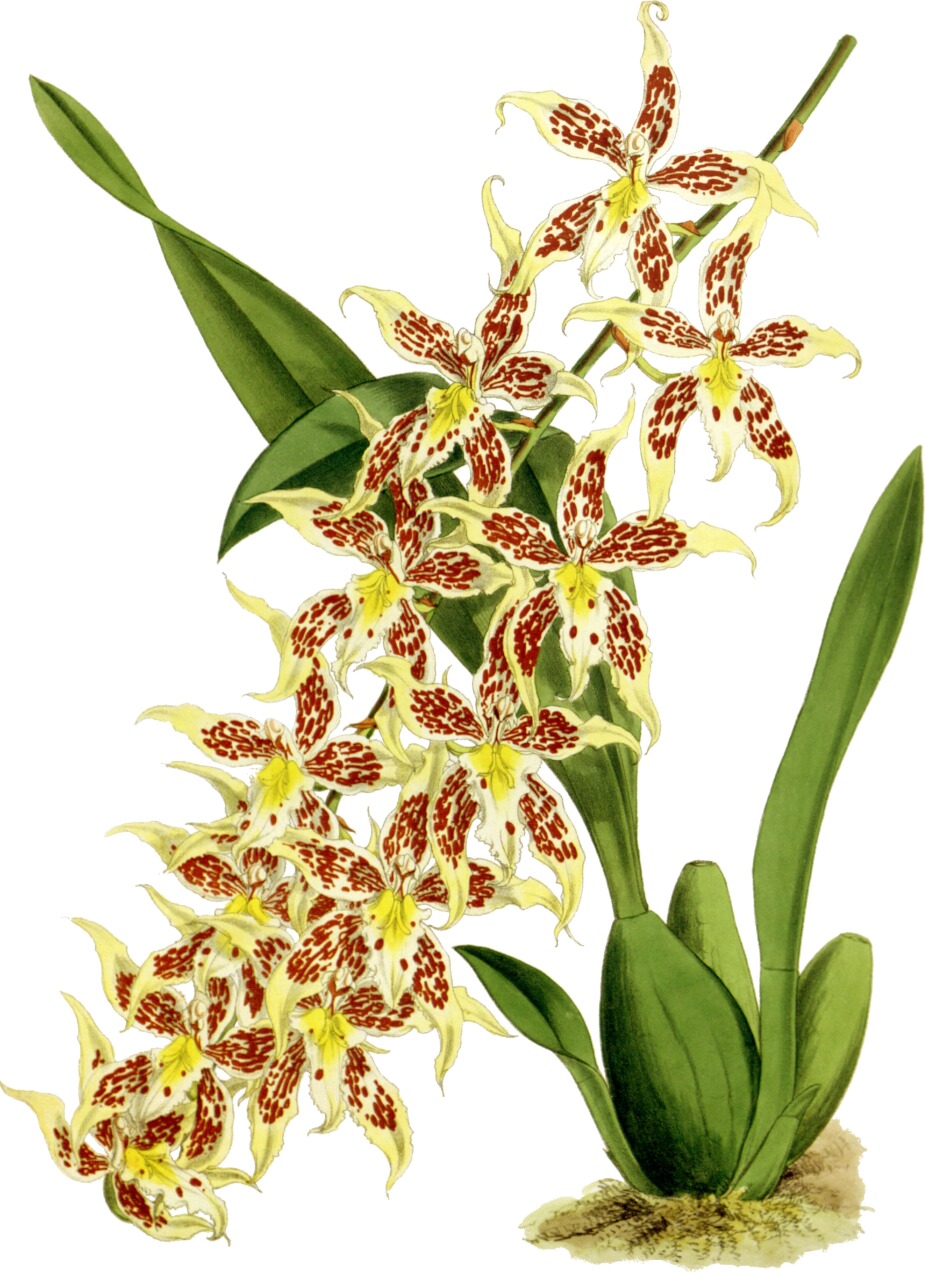
PL. 85. ODONTOGLOSSUM HEBRAICUM LINEOLIGERUM.
74