PORTUGAL.*
Reading edition
PORTUGAL.*

I.—GENERAL ASPECTS.
ORTUGAL, one of the smallest states of Europe, was nevertheless during a short epoch one of the most powerful.
It might appear at the first glance that Portugal ought to be a member of a state including the whole of the Iberian peninsula; but it is neither to chance nor to events purely historical that Portugal owes its separate existence. The country is one by its climate, fauna, and vegetation, and the inhabitants dwelling within it naturally adopted the same sort of life, nourished the same ideas, and joined in the same body politic. It was by advancing along the coast, from river to river, from the Douro to the Minho and Tejo, from the Tejo to the Guadiana, that Portugal constituted itself an independent state.
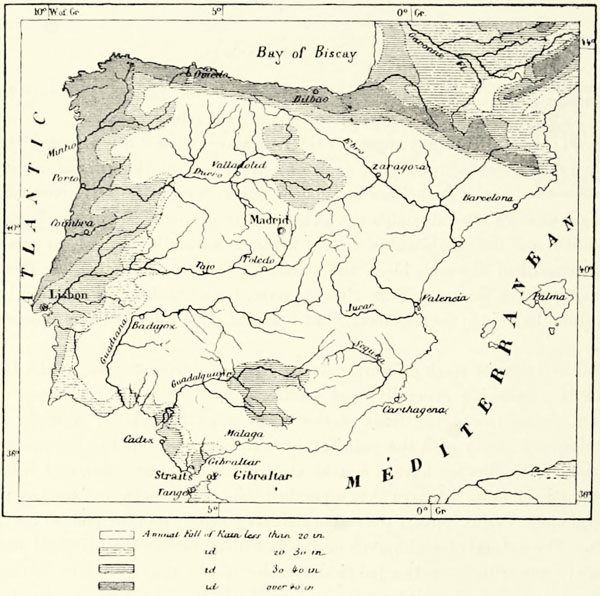
Soil and climate mark off Portugal very distinctly from the rest of the Iberian peninsula. Speaking generally, that country embraces the Atlantic slopes of the plateau of Spain, and the limit of the heavy rains brought by westerly winds coincides very nearly with the political boundary between the two countries. On one side of the line we have a humid atmosphere, frequent rains, and luxuriant forests; on the other a brazen sky, a parched soil, naked rocks, and treeless plains. These abundant rains convert the feeble streams flowing from the plateau into great rivers. The natural obstacles, such as rapids, which obstruct the principal amongst them, are met with near the political frontier of the country. The harbour of Lisbon was the kernel, as it were, around which the rest of the country has become crystallized. Its power of attraction proved equal to that which caused the rest of the peninsula to gravitate towards Madrid and Toledo.
As frequently happens where neighbouring nations obey different laws and are made to fight each other at the caprice of their sovereigns, there is no love lost between Spaniards and Portuguese. The former, being the stronger, sneer at “Portugueses pocos y locos” (small and crack-brained). The Portuguese are far more demonstrative in giving expression to their aversion. Formerly “Murderer {470} of the Castilians” was a favourite sign-board of houses of entertainment, and the national poetry breathes passionate hatred of the Spaniard. This animosity must interfere with the Iberian union, advocated only by a handful of people.
Μ
Fig. 191.—RAINFALL OF THE IBERIAN PENINSULA.
According to Jelinek and Hann. Scale 1 : 10,300,000.
Ancient Lusitania was inhabited by Celtic and Iberian tribes, who resisted for a considerable time the conquering arms of Rome. Those dwelling near the coast had been subjected to the influence of Greek, Phœnician, and Carthaginian colonists; but the influence exercised by the Romans, who forced their language and form of government upon the people, was far more durable. Suevi and Visigoths have left but few traces of their presence. The Mohammedans of various races have largely modified the blood and manners of the inhabitants, especially in Algarve, where they maintained themselves to the middle of the thirteenth century. The numerous ruins of fortresses existing throughout the country bear witness to the severe struggles which took place between these races before uniformity of government and religion was established.
The Kings of Portugal, taking the advice of the Inquisition, expelled all heretics. The persecution of the Moors was pitiless, but the Jews were occasionally granted a respite. The Spanish Jews settled near the frontier, having outwardly embraced {471} the Christian religion, were permitted to remain; but the more conscientious Jews kept true to their faith, and carried the knowledge they possessed to other countries of Europe and to the East. At the time of their exile they were engaged in literature, medicine, and law, as well as in commerce; at Lisbon they had founded an academy of high repute; it was a Jew who introduced the art of printing into Portugal; and Spinoza, that noble and powerful thinker, was a Jew of Portuguese extraction.
But the Portuguese have not only the blood of Arabs, Berbers, and Jews in their veins, they are likewise much mixed with negroes, more particularly in the south and along the coast. The slave trade existed long before the negroes of Guinea were exported to the plantations of America. Damianus a Goes estimated the number of blacks imported into Lisbon alone during the sixteenth century at 10,000 or 12,000 per annum. If contemporary eye-witnesses can be trusted, the number of blacks met with in the streets of Lisbon equalled that of the whites. Not a house but had its negro servants, and the wealthy owned entire gangs of them. The immunity of Portuguese immigrants who face the deadly climates of the tropics is sometimes ascribed to this infusion of negro blood, but erroneously as we think. Most of these immigrants come from the mountains of the north, where the race is almost pure; and if the Portuguese become acclimatized more rapidly than individuals of other nations, they owe it to their sobriety.
At the present day it is the Galicians who exercise most influence upon the population of Lusitania. They immigrate in large numbers to Lisbon and other towns, where they gain their living as bakers, porters, doorkeepers, and domestic servants. Being ridiculed on account of their uncouth language and rustic manners, they mix but little with the rest of the population. Their numbers, however, are ever increasing, and their thrift and industry soon place them in a position of ease.
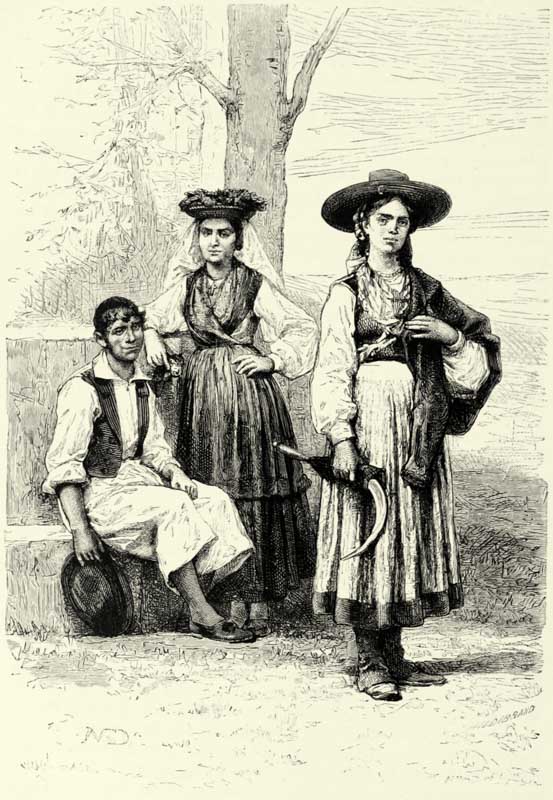
The mixture of these diverse elements has not produced a handsome race. The Portuguese possess but rarely the noble mien of the Spaniard. Their features, as a rule, are irregular, the nose is turned up, and the lips are thick. Cripples are rare amongst them, but so are tall men. Squat and short, they are inclined to corpulency. The women cannot boast the fiery beauty of the Spaniards, but have brilliant eyes, an abundance of hair, animated features, and amiable manners.
Fig. 192.—PORTUGUESE TYPES: PEASANT OF OVAR; WOMAN OF LEÇA; PEASANT WOMAN OF AFFIFE.
Travellers speak highly of the manners, civility, and kindness of the peasantry not yet contaminated by commerce. The cruelties committed by Portuguese conquerors in the Indies and the New World have given the nation a bad reputation, though, as a rule, the Portuguese has compassion for all sorts of suffering. He is a gambler, but never quarrels; he is fond of bull-fights, but takes care to wrap up the bull’s horns in cork, in order that the animal may be saved for future contests; and he is exceedingly kind to domestic animals. In their intercourse the Portuguese are good-tempered, obliging, and polished. To tell a Lusitanian that he has been “brought up badly” is to offend him most seriously. Their oratory is elegant, though ceremonious. Even the peasants express themselves with a facility and command of words remarkable in a people so badly educated. Oaths {472} and indecent expressions scarcely ever pass their mouth, and, though great talkers, and even boasters, they are most guarded in their conversation. Portugal has {473} produced great orators, and one of her poets, Camões, is amongst the most illustrious the world has ever seen. On the other hand, Portugal has given birth to no great artist, for Gran Vasco is a mythical personage. Camões himself avows this when he says, “Our nation is the first because of its great qualities. Our men are more heroic than other men; our women better-looking than other women; and we excel in all the arts of peace and war, excepting in the art of painting.”
Portuguese is very much like Castilian as far as root-words and general construction are concerned, but is far less voluminous and sonorous. Nasal and hissing sounds, which a foreigner finds it difficult to pronounce, abound, but there are no gutturals. Arab words are less numerous in Portuguese than in Castilian, but the Lusitanians, as well as the Spaniards, still swear by the god of the Mohammedans—Oxala (Ojalà); that is, “If Allah wills it.”
The Portuguese cannot compare in numbers with the other nations of Europe, and their influence upon the destinies of the world is consequently small. At one time of their history, however, they surpassed all other nations by their maritime enterprise. The Spaniards certainly shared in the great discoveries of the fifteenth century, but it was the Portuguese who made them possible by first venturing to navigate the open ocean. It was a Portuguese, Magalhães, who undertook the first voyage round the world, terminated only after his death. A similar pre-eminence amongst nations will never be met with again, for the increased facilities of communication exercise a levelling influence upon all. Portugal, therefore, can never again hope to resume the national status which she held formerly, but her great natural resources and favourable geographical position at the extremity of the continent must always insure her an honourable place amongst them.
II.—NORTHERN PORTUGAL. THE VALLEYS OF THE MINHO, DOURO, AND MONDEGO.
The mountains of Lusitania are a portion of the great orographical system of the whole peninsula; but they are not mere spurs, gradually sinking down towards the sea, for they rise into independent ranges; and the individuality of Portugal is manifested in the relief of its soil quite as much as in the history of its inhabitants.
The mountains rising in the north-eastern corner of Portugal, to the south of the Minho, may be looked upon as the outer barrier of an ancient lake, which formerly covered the whole of the plains of Old Castile. From the Pyrenees to the Sierra de Gata this barrier was continuous, and the breaches now existing date only from a comparatively recent epoch, and are due to the erosive action of torrents. The most considerable of these breaches, that of the Douro, could have been effected only by overcoming most formidable obstacles.
The most northern mountain mass of Portugal, that of the Peneda of Gavieiro (4,727 feet), rises abruptly beyond the region of forest, and commands the Sierra Peñagache (4,065 feet) on the Spanish frontier to the east, as well as the hills of Santa Luzia (1,814 feet) and others near the coast. Another mountain mass rises {474} immediately to the south of the gorge through which the Limia passes after leaving Spain. This is the Serra do Gerez (4,815 feet), a range of twisted, grotesquely shaped mountains, the only counterpart of which in the peninsula is the famous Serranía de Ronda. This range, together with the Larouco (5,184 feet), to the east of it, must be looked upon as the western extremity of the Cantabrian Pyrenees, and like them it consists of granitic rocks.
The flora of these northern frontier mountains of Portugal much resembles that of Galicia, and on their slopes the botanist meets with a curious intermingling of the vegetation of France, and even Germany, with that of the Pyrenees, Biscay, and the Portuguese lowlands. On the southern summits, however, and more especially on the Serra de Marão (4,665 feet), which forms a bold promontory between the Douro and its important tributary the Tamega, and shelters the wine districts of Oporto from north-westerly winds, the opportunities for examining into the arborescent flora are but few, for the forests which once clad them have disappeared. The schistose plateaux to the east of them and to the north of the Douro have likewise been robbed of their forests to make room for vineyards. Most wild animals have disappeared with the forests, but wolves are still numerous, and are much dreaded by the herdsmen. The mountain goat (Capra ægagrus), which existed until towards the close of last century in the Serra do Gerez, has become extinct. The Serra da Cabreira (4,196 feet), to the east of Braga, is probably indebted for its name to these wild goats.
If the Serra do Gerez may be looked upon as the western extremity of the Pyrenean system, the magnificent Serra da Estrella (6,540 feet), which rises between the Douro and Tejo, is undoubtedly a western prolongation of the great central range of Spain which separates the plateaux of the two Castiles. These “Star Mountains” are attached to the mountains of Spain by a rugged table-land, or mesa, of comparatively small height. The great granitic Serra da Estrella rises gently above the broken ground which gives birth to the Mondego. It can easily be ascended from that side, and is hence known as the Serra Mansa, “the tame mountain.” On the south, however, above the valley of the Zezere, the slopes are abrupt and difficult of access, and are known for that reason as Serra Brava; that is, “wild mountain.” Delightful lakelets, similar to those of the Pyrenees and Carpathians, are met with near the highest summit of the range, the Malhão de Serra. The tops of the Serra da Estrella remain covered with snow during four months of the year, and supply the inhabitants of Lisbon with the ice required for the preparation of their favourite sherbet. The orographical system of the Estrella ends with the Serra de Lousão (3,940 feet), for the hills of Estremadura, which terminate in the Cabo da Roca, a landmark well known to mariners, belong to another geological formation, and consist for the most part of Jurassic strata overlying the cretaceous formation.
The mountains of Beira and Entre Douro e Minho are exposed to the full influence of the moisture-laden south-westerly winds, and the rainfall is considerable. The rain does not descend in torrents, as in tropical countries, but pours down steadily. It is more abundant in winter and spring, but not a month passes {475} without it. Fogs are frequent at the mouths of valleys and along the coast as far south as the latitude of Coimbra. At that place as much as sixteen feet of rain has fallen in a single year, an amount only to be equalled within the tropics.
Μ
Fig. 193.—THE VALLEY OF THE LIMIA, OR LIMA.
Scale 1 : 300,000.
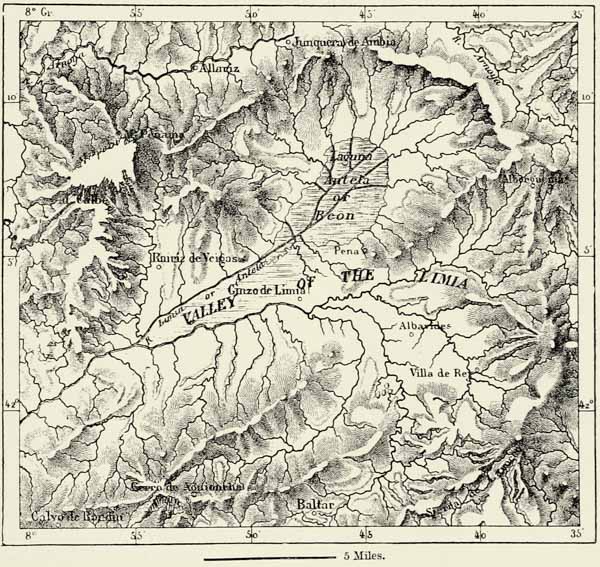
The humidity of the air accounts for the great equability of the climate of Northern Portugal. At Coimbra the difference between the coldest and warmest month amounts to but 20° F. Frosts are severe only on the plateaux exposed to the north-easterly winds, and the heat becomes unbearable in deep valleys alone, where the air cannot circulate freely.173 At Penafiel, where the rays of the sun are thrown back by the rocky precipices, the heat is almost that of a furnace. This, however, is an exception, and the climate generally can be described as temperate.
Running water is abundant. Camões has sung the beauties of the fields of Coimbra watered by the Mondego, the charms of cascades sparkling amidst foliage, and the purity of the springs bursting forth from rocks clad with verdure. The Vouga, the affluents of the Douro, the Ave, Cavado, and Lima, likewise take their {476} devious courses through smiling landscapes whose beauties are set off by rocks and mountains. The Lima, whose delights might well cause Roman soldiers to forget the rivers of their own country, is the only river of the peninsula still in a state of geological transition. All others have drained the lakes which gave birth to them, but in the case of the Lima that old lake basin is still occupied by a swamp, known as Laguna Beon, or Antela, the only remains of a mountain-girt inland lake as large as that of Geneva.
Μ
Fig. 194.—DUNES OF AVEIRO.
Scale 1 : 400,000.
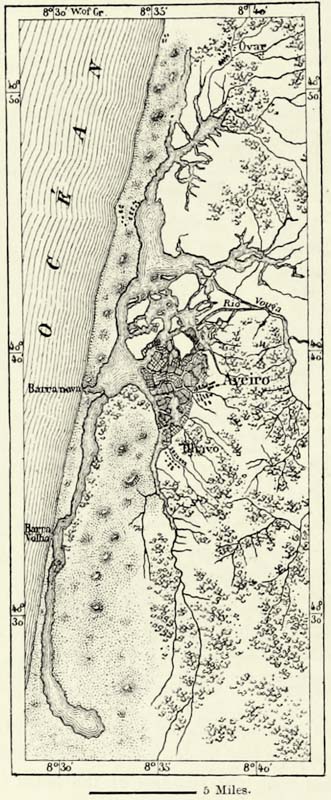
The current of the rivers of Northern Portugal is too great to permit of their being utilised as high-roads of commerce. They have ports at their mouths, but the Douro, which drains nearly a sixth of the Iberian peninsula, is the only one amongst them which facilitates access to an inland district. Mariners dread to approach the coast when the wind blows on shore. Between the Minho and Cabo Carvoeiro, a distance of 200 miles, the coast presents features very much like those of the French landes. Its original indentations and irregularities have been obliterated by barriers of sand. The lower valley of the Vouga was formerly an inlet of the sea extending far inland. The basin of Aveiro resembles geologically that of Arcachon. Its waters abound in fish, but the Douro is the southernmost river of Europe visited by salmon. The abundance of life in certain localities of it is figuratively expressed by a Spanish proverb, which says, “The water of the Douro is not water, but broth.”
The rectilinear beach of Beira-mar is lined for the most part with dunes, the old gulfs behind which are gradually being converted into insalubrious swamps, fringed by heath, ferns, strawberry-trees, and broom, whilst the neighbouring forests consist of oaks and pines. Formerly these dunes invaded the cultivated portions of the country, as they still do in France, where like geological causes have produced like results. But long before a similar plan was thought of in France these Portuguese dunes were planted with pines, and as early as the reign of King Diniz “the Labourer,” at the beginning of the fourteenth century, they had ceased to “march.” {477}
The population of the cultivable portions of the basins of the Minho and Douro is very dense, and in order to maintain themselves the inhabitants are forced to work zealously. Their country is the most carefully cultivated of the peninsula. In a large measure this industry is due to the fact of the peasantry being the owners of the land they cultivate, or at least affarádos—that is, copyholders—who only pay a few shillings annually to the lords of the manors. Many of the peasants are wealthy, and the women are fond of loading themselves with jewellery, amongst which necklaces made in the Moorish taste are most prominent. The cultivation of the fields is attended to with scrupulous care; and the most ingenious methods are employed for the irrigation of the upper slopes of the hills, which are frequently cut up into terraces, or geios. These Northern Portuguese are as distinguished for moral excellence as they are for industry. Their sweetness of disposition, gaiety and kindliness are the theme of universal praise, and as regards their love of dancing and music they are veritable Theocritan shepherds. Challenges in improvised verses form one of the amusements of young men. Nor is the population devoid of physical beauty. The women of Aveiro, though often enfeebled by malaria, have the reputation of being the prettiest in all Portugal.
The cultivation of the vine and the making of port wine constitute the principal branch of industry of the country. The chief vine-growing district, ordinarily known as Paiz do Vinho, lies to the north of the Douro, between the Serra de Marão and the Tua, and is exposed to the full force of the rays of the summer sun. In the middle of the seventeenth century the cultivation of this district had hardly begun. The English had not then learnt to appreciate these growths, and were content with the various Portuguese wines shipped from Lisbon. It was only after the treaty concluded by Lord Methuen in 1702 that the cultivation of the vine assumed certain dimensions in the district of the Douro, and ever since the reputation of port has been on the increase. The Marquis of Pombal founded a company for the production of wine, and the small town of Pezo da Regoa, on the Corgo, then became famous for its wine fairs, at which fortunes were lost and won, and a town of wine cellars and stores sprang up opposite the town of Porto, or Oporto, near the mouth of the Douro. For more than a hundred years port and sherry have kept their place on the tables of English gentlemen, and nearly all the wine produced on the banks of the Dóuro finds its way to England or to British colonies. Indeed, up to 1852 the best quality, known as “factory wine,” could be exported to England alone. Next to the English the Brazilians are the best customers of Oporto: they receive nearly 1,000,000 gallons of wine annually.174
The breeding of mules and fattening of Spanish cattle for the London market yield considerable profit. Early vegetables are forwarded not only to London but also to Rio de Janeiro. Manufactures were already of some importance in the {478} Middle Ages, and have recently been much developed by enterprising English capitalists. Oporto has cotton, linen, silk, and woollen mills, foundries and sugar refineries, and its jewellers and glove-makers enjoy a good repute. But agriculture, industry and legitimate commerce, and even the smuggling carried on in the frontier district of Bragança, do not suffice to support the ever-increasing population, and thousands emigrate annually to Lisbon and Brazil.
Μ
Fig. 195.—OPORTO AND THE PAIZ DO VINHO.
Scale 1 : 1,000,000.
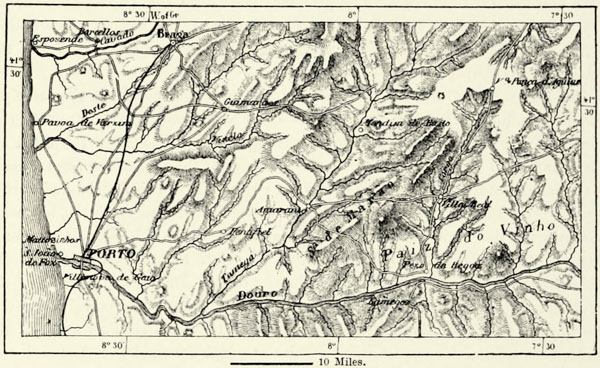
Northern Portugal may be described as the cradle of the existing kingdom, and it was Porto Cale, on the site of Villanova de Gaia, the southern suburb of Oporto, which gave a name to all Lusitania. At Lamego, to the south of the Douro, the Cortes met, according to tradition, in 1143, and constituted the new kingdom of which Oporto became the capital. When the country recovered its independence after the short dominion of Spain, the Dukes of Bragança were invested with the regal power. Though Lisbon occupies a more central position than Oporto, the latter frequently takes the initiative in political movements, and the success of any revolution is said to depend upon the side taken by the energetic population of the north. If we may accept the estimate of the Portuenses, they are morally and physically the superiors of the Lisbonenses. They alone are the true sons of the great people whose vessels ploughed the ocean during the age of discoveries, and there can be no doubt that their gait is more determined, their speech and their glance more open, than those of the inhabitants of the capital. In vulgar parlance, people of Oporto and Lisbon are known as tripeiros and alfasinhos; that is, tripe and lettuce eaters.
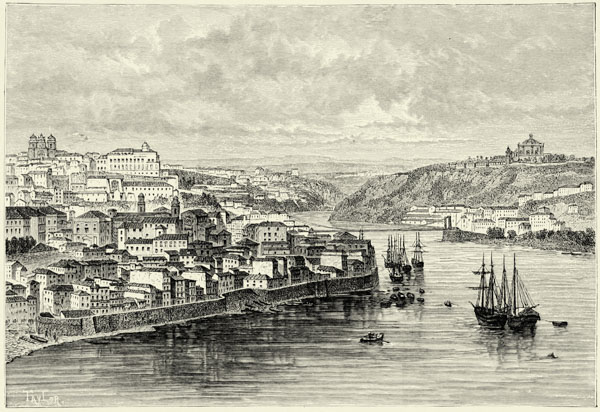
OPORTO.
Porto, or O Porto, the “Port” par excellence, is the natural capital of Northern Lusitania, the second city of Portugal on account of its population and commerce, the first in manufactures. As seen from the banks of the Douro, here hardly {479} more than 200 yards in width, and spanned by a magnificent railway bridge, it rises like a double amphitheatre, whose summits are crowned by the cathedral and the belfry dos Clerigos, and the narrow valley separating them covered with houses. The lower town has broad streets, intersecting each other at right angles, but the streets climbing the hills are narrow and tortuous, and even stairs have frequently to be ascended in order to reach the more elevated quarters of the town. Cleanliness is attended to throughout, and the citizens are most anxious in that respect to insure the praises of their numerous English visitors. Gaia, a long suburb, occupies the opposite side of the river. It abounds in factories and storehouses, and its vast cellars are stated on an average to contain 80,000 pipes of wine. Beautiful walks extend along the river bank and its terraces, and the long reaches of the stream are covered with shipping, and fringed with gardens and villas. The hills in the distance are crowned with ancient convents, fortifications, and villages half hidden amongst verdure. Avintes, famous for the beauty of its women, who supply the town daily with broa, or maize bread, is one of them. Suburbs extend along both banks of the river in the direction of the sea. The river at its mouth is only two fathoms in depth during low water, and dangerous of access when the wind blows from the west. Even at Oporto vessels of 400 or 500 tons are exposed to danger from sudden floods of the river, which cause them to drag their anchors. The port of the Douro has therefore to contend with great difficulties in its rivalry with Lisbon.175
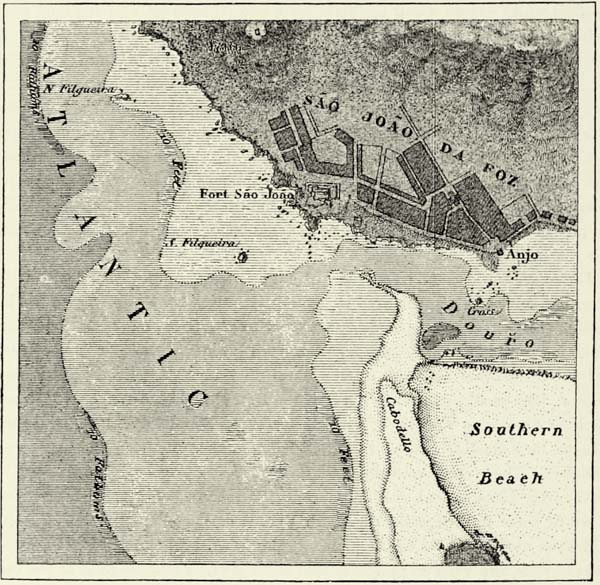
The small town of São João da Foz, at the mouth of the Douro, has a lighthouse, but carries on no commerce. Near it are Mattozinhos and Leça, the latter of which boasts of an ancient monastery resembling a fortress, and is much frequented on account of its fine beach and refreshing sea breezes. Espinho, to the south of the Douro, is another favourite seaside resort, in spite of the all-pervading smell of sardines. The small ports to the north of the Douro are frequented only by coasting vessels or by seaside visitors. The entrance to the Minho is defended by the castle of Insua, on a small island, as its name implies, and by the insignificant fortress of Caminha. The river is accessible only to vessels drawing less than six feet. The mouth of the Lima, though even more difficult of access, is nevertheless occupied by a town of some importance—coquettish Vianna do Castello, beautifully ensconced amidst the verdure of its fertile plain. Other towns are Espozende, at the mouth of the Cávado, and Villa do Conde, at that of the Ave. Formerly most of the vessels engaged in the slave trade and those employed in the great maritime enterprises of the Portuguese were built here, and it still boasts of a few ship-yards.
Amongst the inland towns of Entre Douro e Minho are Ponte de Lima, famous for the beauty of the surrounding country; Barcellos, overhanging the shady banks of the Cávado; and Amarante, celebrated for its wines and peaches, and proud of a fine bridge spanning the Tamega. But the only towns important on account of their population are Braga and Guimarães, both placed on commanding heights overlooking a most fertile country. Braga (Bracara Augusta), an ancient Roman colony, the capital of the Galicians, then of the Suevi, and later on the residence of {480} the Kings of Portugal, became the primatial city of the whole of the peninsula when the two kingdoms were temporarily united under the same sovereign. But Braga is not only a town of the past, it is even now a bustling place, where hats, linens, arms, and beautiful filigree are manufactured for exportation to the rest of Portugal and the Portuguese colonies. Guimarães is equally as interesting as Braga on account of its monuments and mediæval legends. Visitors are still shown the sacred olive-tree which sprang from a seed placed in the soil by King Wamba, when still a common labourer; and Affonso, the founder of the Portuguese monarchy, was born in the old castle. Guimarães is a busy manufacturing town; it produces cutlery, hardware, and table-linen, and English visitors never fail to purchase there a curiously ornamented box of prunes. Near it are much-frequented sulphur springs, known to the Romans as Aquæ Levæ. But the most famous mineral springs of modern Portugal are the Caldas do Gerez, in a tributary valley of the Upper Cávado.
Μ
Fig. 196.—SÃO JOÃO DA FOZ AND THE MOUTH OF THE DOURO.
The towns of Traz os Montes and Beira Alta are too far removed from highways to have attracted a considerable population. Villa Real, on the Corgo, is the busiest place of Traz os Montes, owing to the vineyards in its neighbourhood. {481} Chaves, an old fortress near the Spanish frontier, boasts of one of those Roman bridges which have rendered the century of Trajan famous: it was formerly noted for its mineral springs (Aquæ Flaviæ). Bragança, the old provincial capital, has a commanding citadel, and, owing to its geographical position, is an important place for smugglers, the legitimate exports fluctuating regularly with the customs tariff. It is the most important place in Portugal for the production of raw silk. Lamego, a picturesque town to the south of the Douro, opposite the Paiz do Vinho, enjoys a great reputation for its hams; Almeida, which keeps in check the garrison of Spanish Ciudad Rodrigo, was anciently one of the strongest fortresses of Portugal; and Vizeu is an important station between the Douro and the Mondego. Its fairs are more frequented than any others in Portugal, and in its cathedral may be seen the famous masterpiece painted by the mythical Gran Vasco. The herdsmen around Vizéu are noted for their strength and beauty. Their uncovered heads and bare legs give them an appearance of savagery, but their manners are as polished and dignified as those of the rest of their countrymen.
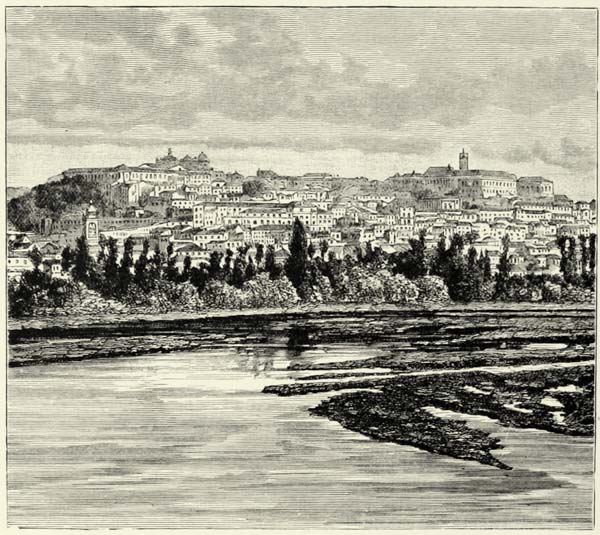
Coimbra (Æminium), in Beira-mar, is the most populous town between Oporto and Lisbon. It is known more especially for its university, whose professors and students impart to it the aspect of a mediæval seat of learning. The purest Portuguese is spoken there. The environs are delightful, and in the botanical garden the plants of the tropics mingle with those of the temperate zones. From the banks of the Mondego, upon which the city is built, visitors frequently ascend to the Quinta das Lagrimos (“house of tears”), the scene of the murder of the beauteous Inez de Castro, whose death was so cruelly revenged by her husband, Peter the Judge.
Few countries in the world can rival the beautiful valley of the Mondego, that “river of the Muses” held dear by all the Lusitanians, because it is the only one which belongs to them exclusively. Condeixa, a town near Coimbra, fully deserves to be called the “Basket of Fruit,” for its gardens produce most exquisite oranges. In the north the ruins of the monastery of Bussaco occupy a mountain terrace covered with a dense forest of cypresses, cedars, oaks, elms, and exotic trees. This delightful place and the hot springs of Luso, near it, are a favourite summer residence of the citizens of Lisbon and Coimbra.
Figueira da Foz, the port of Coimbra, is well sheltered, but, like most other ports of Northern Portugal, is obstructed by a bar of sand. It is nevertheless much frequented by coasting vessels, and amongst its exports are the wines of Barraida. Ovar and Aveiro, in the “Portuguese Netherlands,” on the banks of a lagoon separated by a series of dunes from the high sea, are the two other ports of this part of the coast. They were important places during the Middle Ages, but the shifting bars, which render access to them difficult, have put a stop to their prosperity. The seamen of these two places have a high reputation for daring. They engage in sardine-fishing, oyster-dredging, and the manufacture of bay-salt.176 {482}
III.—THE VALLEY OF THE TEJO (TAGUS).
The lower course of the Tejo, called Tajo in Spain, separates Portugal into two portions differing much in their general aspect, climate, and soil. The valley itself is a sort of intermediary between the north and south, and the vast estuary into which the river discharges itself.
Fig. 197.—COIMBRA.
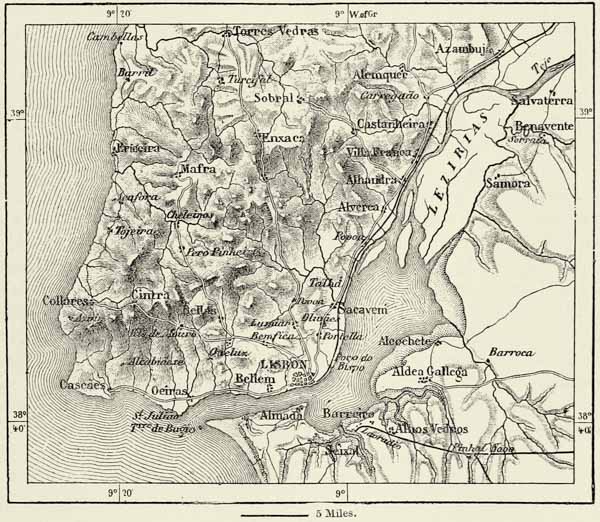
Where the Tejo enters Portugal, below the magnificent bridge of Alcántara, it is still hemmed in between precipitous banks, and is neither navigable nor available for purposes of irrigation. Having traversed the defile of Villa Velha do Rodão, its valley gradually widens, and after having received its most considerable tributary, the Zezere, it becomes a tranquil stream, abounding in islands and sand-banks, and is navigable during the whole of the year. Below Salvaterra the river bifurcates, its two branches enclosing the marshy island of Lezirias. The vast estuary which begins below this island is an arm of the sea rather than a river; its waters are saline, and between Sacavem and Alhandra there are {483} salt-pans. The Tejo affords one of the most striking instances of a river encroaching upon its western bank, which is steep and hilly, whilst the left bank is low.
Μ
Fig. 198.—ESTUARY OF THE TEJO (TAGUS).
Scale 1 : 580,000.
The irregular range of hills which forms the back-bone of the peninsula enclosed by the Lower Tejo and the ocean is attached to the mountain of Estrella by a ravined plateau of trifling elevation, crossed by the railway connecting Coimbra with Santarem. From the summit of the Serra do Aire (“wind mountain,” 2,222 feet) we look down upon the verdant valley of the Tejo and the reddish-hued plains of Alemtejo beyond it. Monte Junto (2,185 feet), farther south, is another commanding summit. The rocky promontory of Carvoeiro is joined to the mainland by a sandy beach. Upon it stands the little fortress of Peniche, whose inhabitants lead a life of seclusion, and are engaged in the manufacture of lace. A submarine plateau connects this promontory with Berlinga Island, with an old castle now used as a prison, and with the Farilhãos, dreaded by mariners.
The hills on the narrow peninsula to the north of Lisbon are of small height, but, owing to their rugged character, they present great obstacles to intercommunication. It was here Wellington constructed the famous lines of Torres Vedras, which converted the environs of Lisbon into a vast entrenched camp. To the south of these rise the beautiful heights of Cintra, celebrated for their palaces, shady valleys, delightful climate, and historical associations. Sheets of basalt, {484} ejected from some ancient volcano, cover the hills between Lisbon and Sacavem, and the great earthquakes of 1531 and 1755 prove that subterranean forces were then not quite extinct. The second of these earthquakes was probably the most violent ever witnessed in Europe. The very first shock destroyed 3,850 houses in Lisbon, burying 15,000 human beings beneath the ruins; a minute afterwards an immense wave, nearly forty feet in height, swept off the fugitives who crowded the quay. Only one quarter of the town, that anciently inhabited by the Moors, escaped destruction. The Marquis de Pombal erected a gallows in the midst of the ruins to deter plunderers. From the focus of vibration the oscillations of the soil were propagated over an immense area, estimated at no less than 1,000,000 square miles. Oporto was destroyed in part, the harbour of Alvor in Algarve was silted up, and it is said that nearly all the large towns of Morocco tumbled into ruins.
The gully which connects the open ocean with the inland sea of Lisbon, and through which the Tejo discharges its waters, separates the cretaceous hills of Cintra from the isolated Serra da Arabida (1,537 feet), to the west of Setúbal, which belong to the same geological formation. These two groups of hills were probably portions of one range at a time when the Tejo still took its course across what are now the tertiary plains of Alemtejo, and reached the sea much farther to the south, through the estuary of the Sado.
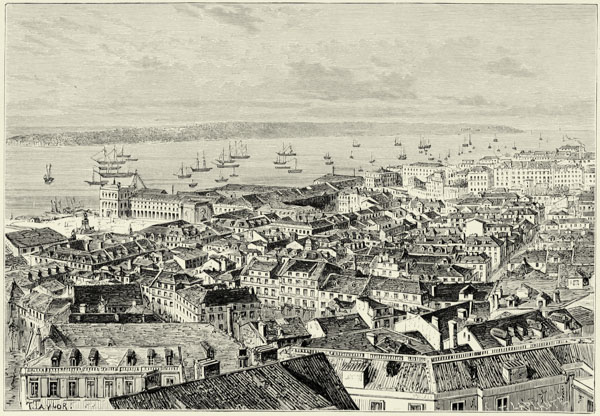
Lisbon (Lisbõa), though the number of its inhabitants is less than half what it was in the sixteenth century, exhibits no trace of the havoc wrought in 1755. Even the central portions of the town have risen from the ruins, and huge blocks of houses, imposing by their size, if not by their architecture, have taken the places of the older structures. The present city extends four miles along the Tejo, but including its suburbs, between Poco do Bispo and the Tower of Belem, its extent is nine miles. The city stretches inland a distance of two or three miles, and, like Rome, is said to be built upon seven hills. A beautiful promenade connects it with Belem. As seen from the Tejo, or from the hills opposite, Lisbon, with its towers, cupolas, and public walks, certainly presents a magnificent spectacle, and there is some truth in the proverb which says―
“Que não tem visto Lisbõa, Não tem visto cosa bõa !”
(“Who has not seen Lisbon has not seen a thing of beauty.”)
Unfortunately the interior of the superb metropolis does not correspond with the imposing beauty of its exterior. Lisbon has a noble square, called Largo do Comercio; it has all the various buildings which one expects to meet with in the capital of a kingdom and an important maritime town; but, with the exception of the chapel of São João Baptista, not one amongst them is remarkable for its architecture. The only important structure outside the city is the famous aqueduct Os Arcos das Agoas, which was built by João V., the Rei Edificador, in the beginning of the eighteenth century, and sustained no injury during the earthquake of 1755. On approaching the city it crosses a valley on a superb marble bridge of thirty-five arches, the highest of which is 246 feet in height.
LISBON.
Lisbon is relatively poor in interesting monuments, but few towns can rival it in natural advantages of soil, climate, and geographical position. Its situation is {485} most central; its harbour, at the mouth of a navigable river, is one of the most excellent in the world; and its entrance can be easily defended, the principal works erected for that purpose being Fort São Julião and the Tower of Bugio.
Μ
Fig. 199.—PENICHE AND THE BERLINGAS.
Scale 1 : 142,860.
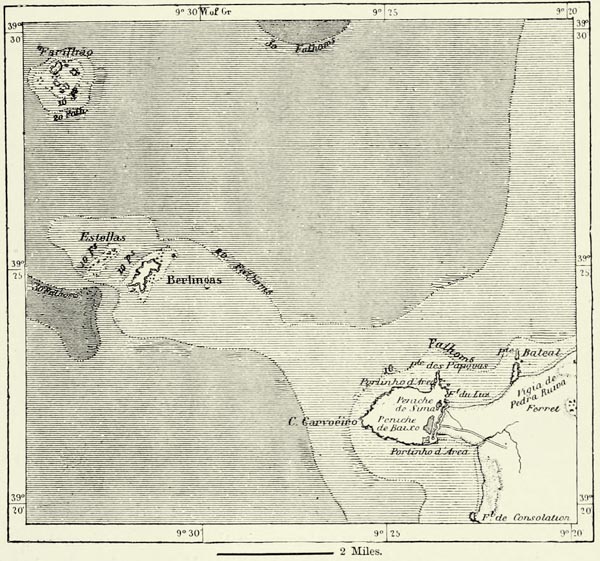
Lisbon is important not only as regards Portugal, but also, on account of its position, with reference to the rest of Europe—nay, of the entire world. As long as the Mediterranean was the theatre of human history it remained in obscurity, but no sooner had mariners ventured beyond the columns of Hercules than the beautiful harbour at the mouth of the Tejo became one of the principal points of departure for vessels starting upon voyages of discovery. Lisbon became the most advanced outpost of Europe on the Atlantic, for it offered greater facilities than any other port for voyages directed to the Azores, Madeira, the Canaries, and the western coasts of Africa. The achievements of Portuguese mariners have passed into history. Vast territories in every quarter of the globe became tributary to little Portugal, and it needed the epic force of a Camões to celebrate these wonderful conquests.
That age of glory lasted but a short time, for proud Lisbon, which had become known to Eastern nations as the “City of the Franks,” as if it were the capital of Europe, lost its pre-eminent position towards the close of the sixteenth century. {486} Portugal capsized suddenly, like a small barge overcrowded with sails. Crushed by the terrible reign of Philip II., enervated by luxury, and grown disdainful of honest labour, as slaveholders always will, Lisbon was constrained to see much of its commerce and most of its valued colonies pass into the hands of Spaniards and Dutchmen. But, in spite of these disasters, Lisbon is still a commercial port of great importance, although as yet no direct line of railway connects it with Madrid and the rest of Europe. England occupies the foremost position amongst the customers of the town, and the Brazilians, whose severance from the mother country was at first looked upon as an irremediable disaster, follow next.177 Spain, though it borders upon Portugal for several hundred miles, scarcely enters into commercial relations with it. Civil wars have, however, driven many Spanish exiles to Lisbon, and these have already exercised a considerable influence upon manners. Formerly only men were to be seen in the streets of Lisbon, the women being confined almost with the same rigour as in a Mohammedan city, but the example set by Spanish ladies has found many imitators amongst their Portuguese sisters. The towns in the immediate vicinity of Lisbon are celebrated for their picturesque beauties.
Μ
Fig. 200.—MOUTH OR THE TEJO (TAGUS).
Scale 1 : 162,400.
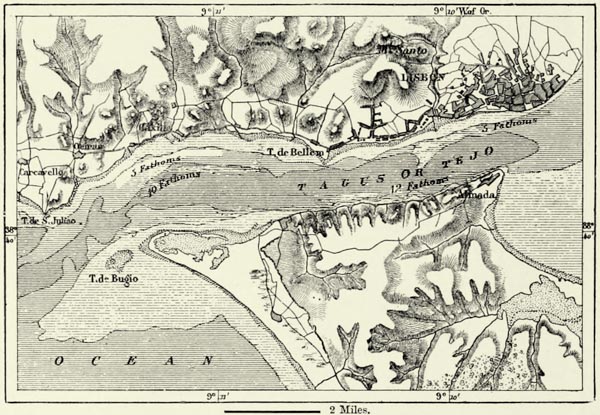
Portuguese Estremadura, which neither suffers from northern frosts nor from fogs and aridity, can boast of a climate approaching that of the fabled Islands of the Happy. At Lisbon snow, or “white rain,” as it is called, falls {487} rarely, but it may be seen glittering on the summits of the Serras da Estrella and de Lousão. Its fall near the sea-coast is looked upon as an evil omen, and a heavy snow-storm, as recently as last century, frightened the inhabitants of Lisbon to such an extent that they fancied the day of judgment had come, and rushed into the churches.
The regular alternation between land and sea breezes is likewise an advantage possessed by the neighbourhood of Lisbon. From the beginning of May throughout the fine season the wind blows from the land in the morning, by noon it has shifted to the south, in the evening it blows from the west and north-west, and during the night from the north. Hence its name of viento roteiro; that is, “rotary wind.” As to the winds forming part of the regular system of atmospheric circulation, they blow with far less regularity. The polar winds, stopped by the transversal mountain ranges of the country, either follow the direction of the coast or are diverted to the plateaux of Spain, and make their appearance in Portugal as easterly winds. It is these latter which render the summer oppressively hot. At Lisbon the thermometer rises occasionally to 100° F., and in 1798 even 104° were observed. Experience has taught us that although the heat at Rio de Janeiro is in excess of that of Lisbon, the dog-days at the latter place are more unbearable.178
The vegetation of the happy district where the climate of North and South intermingle is twofold in its aspect. The date-palm makes its appearance in the gardens of Lower Estremadura; the dwarf palm grows in the open air along the coast; the agave raises its candelabra-like branches as on the coast of Mexico; the camellias are more beautiful than anywhere else in Europe; and the hedges are composed of prickly cacti (Nopal), as in Sicily and Algeria. The fruits of the Mediterranean ripen to perfection; and even the mango of the Antilles, only recently introduced, has found a congenial climate. Oranges are known as portogalli in several countries as far as Egypt, as if the inhabitants of Portugal had been the first to whom these golden apples were known; and even the word chintarah, or chantarah, by which the orange is known in some parts of India, is supposed to be a corruption of the name of the Portuguese town of Cintra.
Belem (Bethlehem) is the nearest of the suburban towns of Lisbon, being separated from it merely by a rivulet named Alcántara, after an old Moorish bridge. It is the first place beheld by a mariner approaching Lisbon, and its square tower, built by King John the Perfect, is seen from afar. It was hence Vasco da Gama started upon the memorable expedition which taught the Portuguese the road to India, and a magnificent monastery, now converted into an educational institution, was built in commemoration of this glorious event.
Oeiras, at the mouth of a small rivulet coming down from the heights of Cintra, defends the entrance to the Tejo by means of Fort São Julião; Carcavellos, noted for its wines, lies farther on; and Cascães, with a small harbour defended by a citadel, brings us to the open ocean. The coast beyond this is protected by {488} towers, but there are no inhabitants. The hills of Cintra, however are one of the most populous districts of the country, and they are much frequented by foreigners. Whether we follow the carriage road or the tramroad from Lisbon, we pass the castles and villas of Bomfica, the royal palace of Queluz, and the country seats of Bellas, the fountain of which supplies the capital with water. Cintra itself is surrounded by hotels and gardens. On a hill to the south of it stands the sumptuous Castle de la Penha, whose eccentricities of architecture are softened down by luxuriant masses of vegetation. Strangers likewise visit the ruins of an old Moorish castle and the caverns of the “Monastery of Cork,” thus named because its walls are covered with cork as a protection against damp. The prospect from all the surrounding heights is magnificent, and most so from the cliffs terminating in the famous Cabo da Roca, the westernmost point of continental Europe.
Μ
Fig. 201.—ZONES OF VEGETATION IN PORTUGAL.
Scale 1 : 6,000,000.
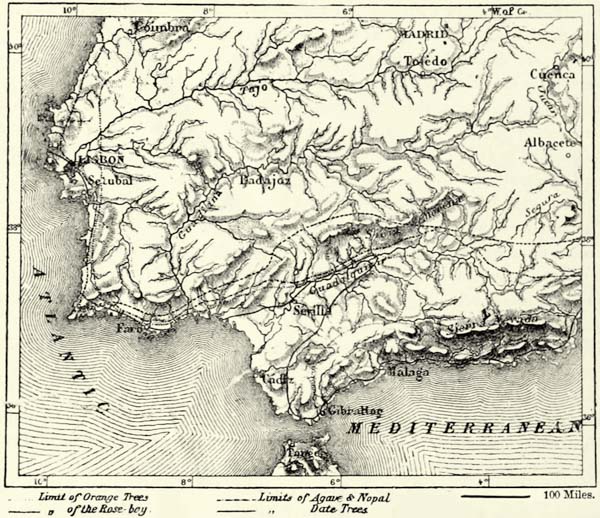
The city of Mafra occupies a sterile plateau not far from the seaside resort of Ericeira. Like Cintra, it boasts of an immense palace, the Escorial of the kings of the house of Bragança, now used as a military school. João V., who erected this structure, with its numerous churches, chapels, and cells, expended for that purpose all the coin he could command, and when he died there was not enough money left in the treasury to pay for a mass for the repose of his soul. Far more {489} curious than this immense barrack, with its 5,200 windows, is the forsaken monastery of Alcobaça, about sixty miles farther north, which was built in the twelfth century to commemorate the victories over the Moors. Near it stands the monastery of Batalha, which recalls the defeat of the Castilians in the plain of Aljubarrota in 1385. The portals, cloisters, chapel, and chapter-room abound in sculptures of marvellous finish, though of doubtful taste.
Fig. 202.—CASTLE DE LA PENHA DE CINTRA.
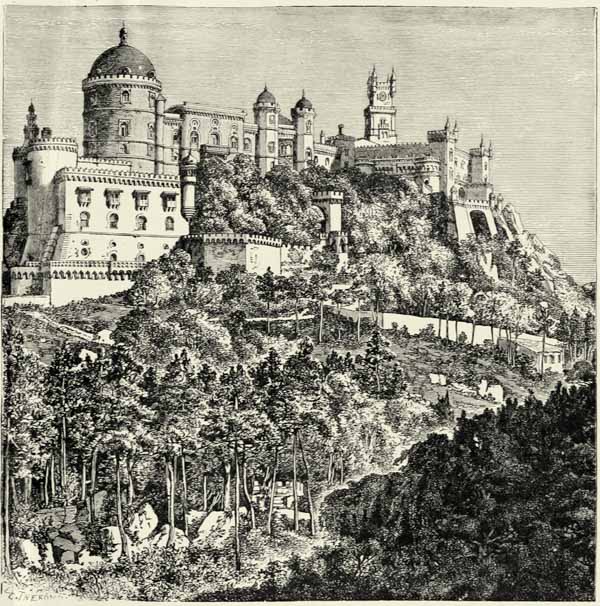
Leiria, the town nearest to Batalha, occupies a fine site at the confluence of the rivers Liz and Lena, and is commanded by a Moorish castle, the old residence of King Diniz the “Labourer,” who planted the pinhal of Leiria, the finest forest in Portugal. After a long period of decadence this portion of the country has entered upon a new epoch of activity. At Marinha Grande, near it, there are large glass-works, which communicate by rail with the circular harbour of Concha (shell) de São Martinho.
Thomar, formerly famous on account of its monastery, stands on the eastern {490} slope of the hills commanding the plains of Batalha and Alcobaça. It is the capital of the Knights of Christ, to whom was conceded the privilege of conquering the Indies and the New World. They performed great deeds, but in the end their rapacity led to the decadence of their native country. Thomar is a town of cotton-mills now, but commerce is more active in the places on the Tejo, and notably at Santarem, which, from its “marvellous” hill, looks down upon the verdant isles of the river and the plains of Alemtejo. Santarem and the neighbouring fortress of Abrantes supply Lisbon with vegetables and fruit, and the country around them is a veritable forest of olive-trees.
The sandy soil and shallow rivers bounded by marshes of the country to the south of the Tejo oppose serious obstacles to the establishment of important towns, and if it were not for the vicinity of Lisbon it would probably be uninhabited. Almada, opposite Lisbon, Seixal, Barreiro, Aldea Gallega, and Alcochete are mere suburbs of the capital, and share in its prosperity or adversity. Setúbal, or St. Ives, however, which lies farther to the south, on the estuary of the Sado, and which has an excellent harbour, suffers from too great a proximity to Lisbon, for Portugal is not rich enough to feed two ports so close to each other. Cezimbra, on the steep coast which terminates in Cape Espichel, to the west of Setúbal, is likewise a decayed place, and Troja, which preceded Setúbal as the emporium of the Sado, now lies buried beneath the dunes. Excavations recently made on its site have led to the discovery of Roman mosaics and of a street laid out, perhaps, by the Phœnicians; and Link, the botanist, who visited the spot at the end of last century, still found there the ruined courts of Moorish houses.
Setúbal, though its commercial activity is very much inferior to that of Lisbon, still exports muscat wines, delicious oranges, and salt procured from the ponds in its vicinity.179 The sea near Setúbal and Cezimbra abounds in fish and other marine animals, and in comparison with it the Mediterranean and Bay of Biscay may almost be described as deserts. Long before scientific men explored the bottom of the sea the fishermen of Setúbal hauled up from a depth of 300 fathoms immense sharks. Ordinary fish are caught in myriads, and the inhabitants of Cezimbra feed their pigs upon sardines. When Portugal was at the height of its commercial prosperity it supplied a considerable portion of Europe with fish, and almost enjoyed a monopoly in cod, which was exported even to Norway.180
IV.—SOUTHERN PORTUGAL. ALEMTEJO AND ALGARVE.
The mountains beyond the Tejo rarely assume the aspect of chains. For the most part they rise but little above the surrounding plateau. This region is the least attractive of all Portugal, and between the Tejo and the mountains of Algarve there are only plains, monotonous hills, woods, and naked landes. Human habitations are few and far between. The lowlands along the Tejo and {491} the coast are covered with a thick layer of fine sand resting upon clay, and they still exhibit clumps of maritime pines and holm-oaks, the remains of the ancient forests which formerly covered the whole of the country. Farther inland we reach the great landes, or charnecas, covered with an infinite variety of plants. There are heaths growing sometimes to a height of six feet, rock-roses, juniper-trees, rosemary, and creeping oaks. But the general aspect of the country is dreary, in spite of the white and yellow flowers which cover it until the middle of winter, for there are hardly any cultivated fields. The hills consist for the most part of micaceous schists, and are covered with a monotonous growth of labdanum-yielding rock-roses. This is a western extension of the zone of jarales, which covers so many hundred square miles of the Sierra Morena and other mountain regions of Spain.
Fig. 203.—MONASTERY OF THE KNIGHTS OF CHRIST AT THOMAR.
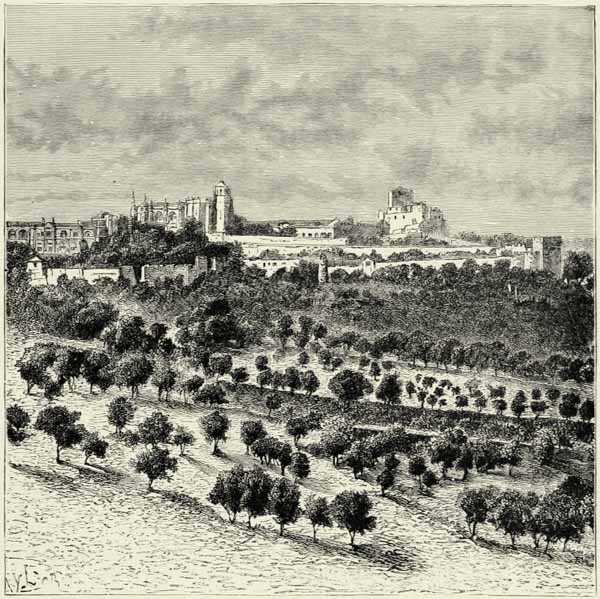
The Serra de São Mamede (3,363 feet), on the confines of Portugal, between the valleys of the Tejo and Guadiana, is the highest mountain mass of Southern Portugal; but its granitic ridges, enclosing narrow valleys between them, hardly {492} rise 1,500 feet above the general level of the plateau. A second granitic mountain mass rises to the south of the depression crossed by the railway from Lisbon to Badajoz. This is the Serra de Ossa (2,130 feet). An undulating tract of country joins it to other serras, forming steep escarpments towards the valleys of the Guadiana and Sadão, and the monotonous plain known as Campo de Beja (870 feet). The famous Campo de Ourique (700 feet), upon which 200,000 Moors, commanded by five kings, were defeated by the Portuguese in the middle of the twelfth century, forms a southern continuation of that plain. This battle, and the massacres which succeeded it, converted the plains to the south of the Tejo into deserts.
Μ
Fig. 204—ESTUARY OF THE SADO.
Scale 1 : 350,000.
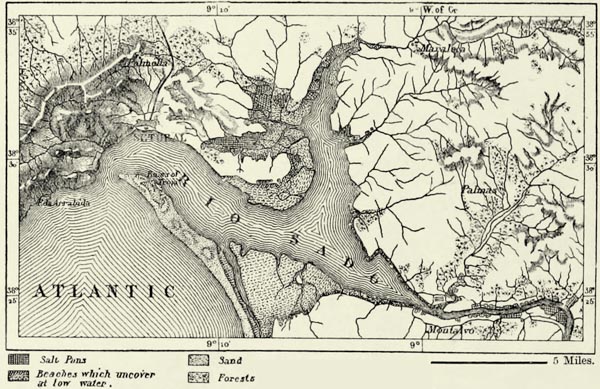
The hills of that portion of Alemtejo which lies to the east of the Guadiana belong to the system of the Sierra Morena of Spain. The river, which separates them from the hills and plateaux of the west, is confined in a deep and narrow gorge. At the Pulo do Lobo (“wolf’s leap”) it still descends in cataracts, and becomes navigable only at Mertola, thirty-seven miles above its mouth.
The hills of Southern Alemtejo and Algarve, to the west of the Guadiana, are at first mere swellings of the ground known as cumeadas, or “heights of land,” but in the Serra do Malhão (1,886 feet) and the Serra da Mezquita they attain some height. A plateau, traversed by the upper affluents of the Mira, joins the range last mentioned to the Serra Caldeirão (1,272 feet), supposed to be named after some ancient crater, or “caldron,” which terminates, to the north of Cape Sines, with the Atalaya, or Sentinel (1,010 feet). The principal range continues towards the west, and in the Serra de Monchique (2,963 feet), a mountain mass filling up the {493} south-western corner of Portugal, it attains its culminating point. A steep ridge, known as Espinhaço de Cão (“dog’s back”), extends from the latter in the direction of the Capes of St. Vincent and Sagres.
The latter was selected by Henry the Navigator as the seat of the naval school founded by him, and from its heights he watched for the return of the vessels which he dispatched on exploratory expeditions. Associations such as these are far more pleasurable than those connected with the neighbouring Cape St. Vincent, where Admiral Jervis, in 1797, destroyed a Spanish fleet.
Μ
Fig. 205.—SERRA DE MONCHIQUE AND PROMONTORY OF SAGRES.
Scale 1 : 500,000.
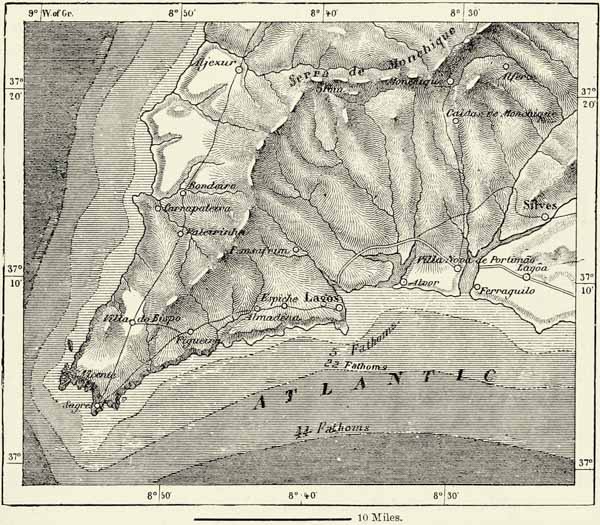
The hills of Sagres are of volcanic origin, and the subsidence of portions of the coast of Algarve appears to prove that subterranean forces are still active. Wherever this subsidence has been observed the coast is fringed by sand-banks, thrown up by the waves of the sea, the channel separating them from the mainland being navigable for small vessels.
If a traveller ascend one of the culminating points of the mountains of Algarve, he cannot fail to be struck with the remarkable contrast existing between the districts to the north and south of him. On the one side he looks down upon vast solitudes resembling deserts; on the other he perceives forests of chestnut-trees, numerous villages, towns bordering the seashore, and fleets of fishing-boats rocking upon the blue waves. The contrasts between the inhabitants of these two districts {494} are scarcely less striking. The inhabitants of Alemtejo are the most solemn of Portuguese, and even object to dancing. Very thinly scattered over the landes which they inhabit, they either engage in agriculture or follow their herds of pigs and sheep into the forests of holm-oaks and thickets of rock-roses. In summer they cross the Tejo with their pigs, and pasture them in the mountains of Beira. The population of Algarve, on the other hand, is thrice as dense as that of Alemtejo, and not only are fields, vineyards, and orchards carefully tended, but the sea likewise is made to yield a portion of its food. The contrast between the two provinces is partly accounted for by the fact that most of the great battles were fought on the undulating plains of Alemtejo. When the Romans held the country Alemtejo supported a numerous population, as is proved by the large number of inscriptions found.
Μ
Fig. 206.—GEOLOGY OF ALGARVE.
Scale 1 : 1,500,000.
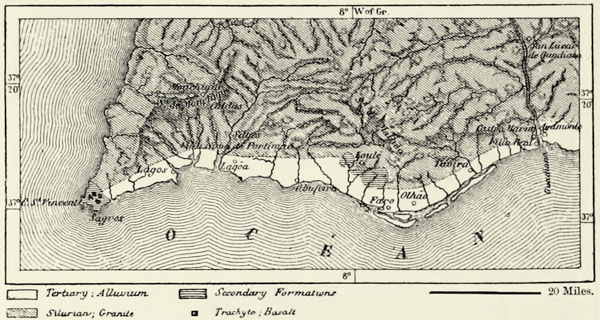
Differences of altitude and geographical position sufficiently account for the differences of climate existing between the two provinces. Alemtejo, with its monotonous plains and stunted vegetation, is almost African in its aspect, whilst Algarve, with its forests of olive-trees, groves of date-palms, agaves, and prickly cacti, presents us with tropical features. The mean temperature near the coast is probably no less than 68° F. The Serra de Monchique bars the cool winds of the north, whilst the sandy islands fringing a portion of the coast keep off refreshing sea breezes. The hottest wind of all is that which blows from the east. It is often laden with fever-breeding miasmata, and a proverb says, De Espanha nem bom vento nem bom casamento: “Neither good winds nor good weddings are bred in Spain.”
Villanova de Portimão, to the south of the Serra de Monchique, has long been looked upon as the hottest place in Europe; there are, however, several localities in Spain which rival it in that respect. Thus much is certain, that Algarve, with {495} the lower valley of the Guadalquivir and the southern coasts of Andalusia and Murcia, constitutes the most torrid portion of Europe. The Arabs were quite right when they designated Southern Lusitania and the opposite shore of Morocco by the same name of “el Gharb;” that is, the two Algarves, or “eastern districts.” Portuguese Algarve, in spite of the conversion of its inhabitants to Christianity, has retained its ancient Moorish name; and the Berber and Semitic blood is very conspicuous there.
In Upper Alemtejo there are but few towns, and these would be altogether insignificant if it were not for the overland commerce carried on with Spain. Crato, which is the most considerable station on the railway which joins the Tejo to the Guadiana, and its neighbour Portalegre, were formerly important stages on the great overland route. Elvas, farther to the south, is surrounded by orchards, and defended by forts which were looked upon in the last century as masterpieces of military architecture. It faces the Spanish fortress of Badajoz, as well as Olivença, which was assigned to Portugal by the treaty of Vienna, but never surrendered by Spain. Estremoz, on a spur of the Serra de Ossa, is famous throughout Portugal for its búcaros—elegantly modelled earthen jars which diffuse a sweet odour. Montemor looks down from its hill upon vast landes and monotonous woods. Evora, likewise built on a hill, commands an extensive plain. It was a populous place during the dominion of the Romans, and in the Middle Ages became the second residence of the Kings of Portugal. There exist now only a Roman aqueduct, the ruins of a temple of Venus, Corinthian columns, and the remains of mediæval castles to remind us of its ancient splendours.
Beja, the ancient Pax Julia or Colonia Pacensis of the Romans, has likewise lost its former importance, but Minas de São Domingos, on the peninsula formed by the confluence of the Guadiana and the Chanza, is rapidly increasing, thanks to its mines of pyrites of copper and other minerals, which are being worked by an English company. The ore is conveyed by rail to Pomarão, on the Guadiana, and thence on barges to Villa Real de Santo Antonio, at its mouth, formerly a mere fishing village, but now a busy port. Castro Marim, where the expeditions against the Moors used to be fitted out, is close to it.
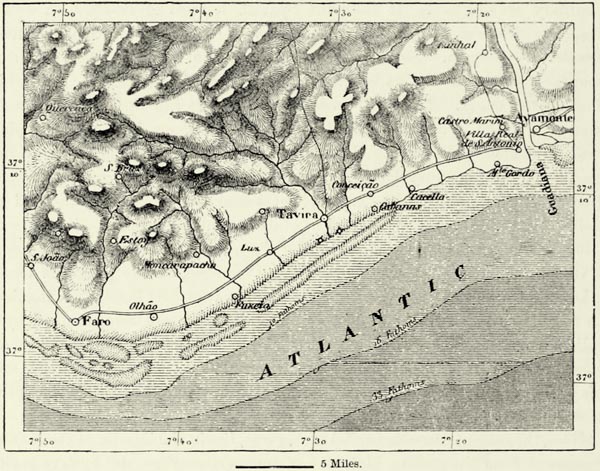
Silves, the ancient Moorish capital of Algarve, lies in the interior of the country, far removed from the present highways of commerce. Faro, the modern capital, has the advantage of lying on the seashore, and of possessing a secure harbour, whence small coasters are able to export fruit, tunny-fish, sardines, and oysters. Tavira possesses the same advantages, and exports the same articles: it is said to be the prettiest town of Algarve. Loulé, in a delightful inland valley, is a pretty place, and, when invalids have learnt the road to Algarve, may obtain some importance as a winter resort. The Caldas (warm baths) de Monchique (600 feet) enjoy a world-wide reputation even now, not only because of their efficacy, but also on account of the delicious climate and charming environs. This district is said to produce the best oranges in Portugal.181 {496}
Μ
Fig. 207.—FARO AND TAVIRA.
Scale 1 : 500,000.
V.—THE PRESENT AND FUTURE OF PORTUGAL.
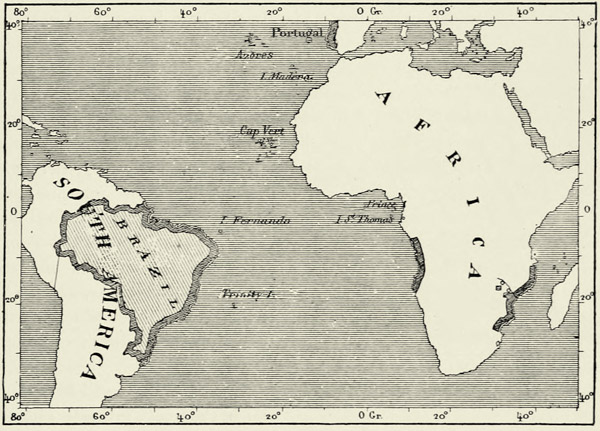
Little Portugal no longer shares with her neighbour, Spain, in the dominion of the world, as in the fifteenth century. The secrecy observed with a view to the retention of the monopoly of trade with countries newly discovered proved in the end most injurious to Portugal. Other nations appeared upon the stage which the Portuguese had dreamt of occupying for ever, and though the latter still hold colonies vastly superior in area to the mother country, this is nothing in comparison with what has been irretrievably lost. Vasco da Gama discovered the ocean high-road to India, but the few settlements which Portugal still holds there she owes to the favour of England. In the Malay Archipelago Portugal has been supplanted almost completely by the Dutch, and Macao, at the entrance of the Canton River, was hardly more than a slave market until quite recently, from which Chinese “emigrants” were exported to Peru. In Africa Portugal holds vast possessions, if we are to believe in official documents and maps, but in reality only a very small tract of territory is under the dominion of the Portuguese, and most of the commerce is carried on through Dutch and other foreign houses. As to Brazil, it now surpasses the mother country in population and wealth. Madeira and the {497} Azores, the first conquests made by Lisbon navigators, are looked upon as integral portions of Portugal; they enjoy the same rights, and are quite equal to it in wealth.182
Μ
Fig. 208.—GEOGRAPHICAL EXTENT OF THE PORTUGUESE LANGUAGE.
When Brazil was lost to Portugal that small country found itself in a position of lamentable prostration. Exhausted by foreign and internecine wars, its finances utterly ruined, and without roads to enable it to export its produce, it might have disappeared from our maps without any interests, except those of a few English vine-growers and Spanish smugglers, being affected. Even in 1851 there only existed a single carriage road in the country, namely, that which connected Lisbon with the royal palace at Cintra. No attention whatever was paid to education, and about a generation ago a girl able to read was a phenomenon. At the same time we must not forget that these illiterate Portuguese knew how to discuss a subject without quarrelling, had great command of their language, and were able even to improvise verses of great poetical merit, in all of which respects they contrasted favourably with the peasantry of Northern Europe.
In the course of the last generation education has made much progress in Portugal;183 and in other respects, too, the country has gradually assimilated with the rest of Europe. Roads and railways have been constructed,184 and the latter connect Lisbon not only with the leading provincial towns, but also with Spain. The commerce with the latter country increases regularly with the occurrence of civil war, when Portugal profits at the expense of the Spanish ports of the Mediterranean. {498} Much of the ordinary commerce with Spain never appears in the customs registries, for it is carried on by smugglers, who glory in evading the vigilance of the frontier police.
Μ
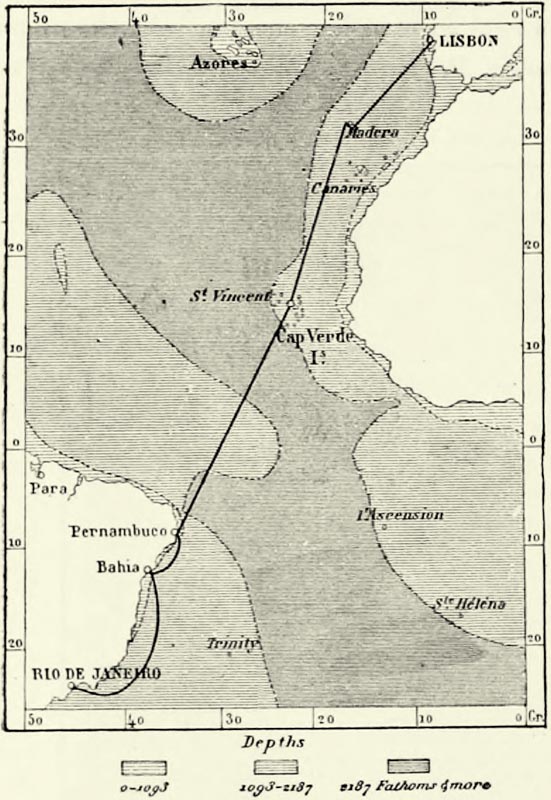
Fig. 209.—TELEGRAPH FROM LISBON TO RIO DE JANEIRO.
The commerce of Portugal has increased very much in the course of the last thirty years. More than half of it falls to the share of Great Britain, a circumstance not to be wondered at when we bear in mind the relative geographical position of the two countries, for Portugal lies upon the direct route followed by English steamers proceeding to the Mediterranean, Western Africa, or Brazil. The assistance which England rendered Portugal during the peninsular war has cemented these commercial bonds.
The commercial relations with Brazil, now joined to Lisbon by a submarine cable, are likewise the natural result of the relative positions of the two countries and of the common origin of their populations. Portugal, in fact, participates in every progress made by its old colony, and its commerce will assume immense proportions when slavery is abolished in Brazil, when the solitudes of the Amazonas resound with the stir of industrious populations, and the coasts of the Pacific are joined to the Atlantic by means of railways crossing the Andes.185
But, after all, it will be Spain with which the most intimate commercial relations must finally be established, in spite of national prejudices and dynastic interests. The two nations will in the end become one, as the Aragonese and Castilians, the Andalusians and Manchegos, have become one. It is merely a question of time; but who can doubt that community of industrial and social relations will lead to a political union. We only trust that this union may be brought about without a resort to brute force, and with due regard to special interests.
VI.—GOVERNMENT AND ADMINISTRATION.
Portugal is an hereditary and constitutional monarchy. In accordance with the Carta de Ley of 1826, as revised in 1852, the King is charged with the executive, {499} and shares the power of making laws with two chambers. He receives a civil list of £144,000, enjoys the income from certain Crown lands, and possesses magnificent Crown jewels, amongst which the “diamond of Bragança” is the most famous. In default of male heirs the crown descends in the female line. “His most faithful Majesty” still claims to be “King of the two Algarves, Lord of Guinea and of the Conquests.” The seven ministers of the Crown are responsible for the King’s actions; they may be impeached by the Chamber of Deputies, and are judged by the Chamber of Peers. A Privy Council of an indefinite number of members, appointed for life, advises the King in all questions of administration. The heir presumptive takes part in its deliberations on attaining his eighteenth year.
The Chamber of Peers consists of about a hundred members, some of them hereditary and others appointed by the King. Its meetings are presided over by the Patriarch of Lisbon. The Chamber of Deputies is elective, and the discussion of the budget and granting of supplies are specially reserved to it. All males more than twenty-five years of age are entitled to the franchise if they pay 4s. 6d. in direct taxes, or 22s. from real estate. Graduates of universities, certified teachers, officers, and priests are not required to possess any property qualification, and they, as well as all married men, become enfranchised on completing their twenty-first year. All electors are eligible as deputies if they pay 18s. in direct taxes, or 90s. from real estate. Every 25,000 inhabitants are represented by a deputy. The President of the Chamber is selected by the King from five candidates presented by the deputies. The latter are entitled to remuneration.
For judicial purposes the country is divided into twenty-six districts, or comarcas, with eighty-five courts. There are courts of appeal at Lisbon and Oporto, and a supreme court at Lisbon. Parish judges (juiz eleito), elected by the people, exercise the inferior jurisdiction. Juries give their verdict on questions of fact in civil as well as in criminal cases. The principal codes still in force are the “Codigo Alfonsino” of the fifteenth century, the “Codigo Manoelino” (1513), and the “Codigo Filippino,” introduced by Philip IV. of Spain. A Commercial Code was published in 1833.
The Roman Catholic religion is that of the State, but Protestant places of ship are suffered to exist in the seaports. The hierarchy includes a patriarch residing at Lisbon, two archbishops at Braga and Evora, and fourteen bishops. The Inquisition was abolished in 1821, and the monasteries, 750 in number, as well as most of the convents, were suppressed in 1834, and their revenues confiscated for the benefit of the State.
The army numbers 1,650 officers and 38,000 men, of whom about two-thirds are under colours during peace. On a war footing it is to be raised to 2,418 officers and 70,687 men. All men are obliged to serve either in the army or in the reserve, and exemption can no longer be purchased. The fortresses are numerous, but only a few of them are capable of being defended against modern artillery. The most important are Elvas, Abrantes, and Valença, near the Spanish frontier, the fort of São Julião and the citadel of Peniche on the coast. The navy no longer numbers a thousand vessels, as it did when King Sebastian started for {500} the invasion of Morocco. It consists now of twenty-seven steamers, including an ironclad corvette, and eleven sailing vessels, manned by 3,000 men and armed with 171 guns.
The public revenue approaches £6,000,000 sterling, and ever since 1834 there has been annually a deficit, which has resulted in a national debt of more than £80,000,000, a burden almost too heavy for a small country like Portugal. The revenue is, however, increasing, a balance between income and expenditure has been established within the last year or two, and the wretched expedient of deducting from 5 to 30 per cent. of the salaries of Government officials could be dispensed with for the first time in 1875.
P
OLITICAL
D
IVISIONS,
A
REA,
AND
P
OPULATION.
Provinces. Districts. Area, Sq. Miles. Population, 1874. Density.
Entre Douro e Minho Vianna 864 221,049 256
Braga 1,054 346,429 329
Porto 903 451,212 500
Traz os Montes Villa Real 1,718 239,591 140
Bragança 2,573 177,170 ―
Beira Alta Aveiro 1,216 272,763 69
Vizeu 1,922 398,477 207
Coimbra 1,500 305,237 203
Beira Baixa Guarda 2,148 234,912 109
Castello Branco 2,559 178,703 69
Estremadura Leiria 1,348 194,944 145
Santarem 2,651 217,316 82
Lisbon 2,936 491,205 168
Alemtejo Portalegre 2,497 109,192 44
Évora 2,740 112,477 41
Beja 4,198 154,327 37
Algarve Faro 1,875 193,877 104
Continental Europe 34,702 4,298,881 124
C
OLONIAL
P
OSSESSIONS.
Area, Sq. Miles. Population. Density.
Azores 921 60,072 65
AFRICA:―
Madeira 310 118,609 383
Cape Verde Island 1,487 90,704 61
Senegambia 27 9,282 344
St. Thome and Principe 417 31,692 75
Fort Ajuda 13 700 54
Angola, Benguela, and Mossamedes 312,000 2,000,000 6
Moçambique and Sofala 40,000 300,000 8
ASIA:―
Goa, &c. 1,395 474,234 339
Damão 30 40,980 1336
Diu 12 12,303 1025
Timor and Kambing 5,527 250,000 45
Macao 1½ 71,834 47·223
Colonies 362,140 3,460,410 10
Total, Portugal and Colonies 396,842 7,759,291 20