SPAIN.* (continued 3)
Reading edition
Three of the principal inland towns of Galicia—viz. Lugo, Orense, and Tuy—rise on the banks of the Miño. The old Roman city of Lugo (Lucus Augusti) is enclosed within mediæval walls, and has warm sulphur springs. Orense, with its superb old bridge, is likewise celebrated for its hot springs, or burgas, which are {460} said to raise sensibly the temperature of the plain in winter, and supply the whole town with water for domestic purposes. Tuy, opposite the Portuguese town of Valença do Minho, is important only as a frontier fortress. Santiago de Compostela, the famous old capital of Galicia, on a hill near the winding banks of the Saria, is the most populous town of North-western Spain. It was here the grave of St. James the apostle was discovered in the ninth century. The attraction which it formerly exercised upon pilgrims was immense.168
IX.—THE PRESENT AND FUTURE OF SPAIN.
Contemporaneous Spain is full of disorder. The political, financial, and social machinery is out of joint, and civil war, active or latent, is carried on almost in every province. The ruin wrought by these incessant domestic wars is incalculable.
Μ
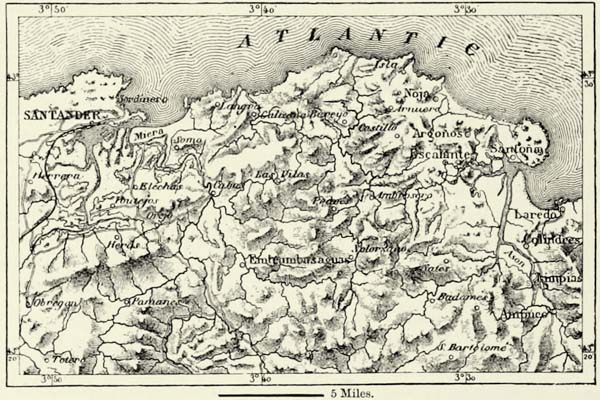
Fig. 184.—SANTOÑA AND SANTANDER.
Scale 1 : 360,000.
Successive Governments have had recourse to miserable expedients without being able to disguise the bankrupt condition of the country. The creditors of the State, no less than the Government officials, remained unpaid, and even schools had to be closed because the pittance due to the schoolmaster was not forthcoming.
But in spite of this apparent ruin real progress has been made. In order to fairly judge Spain we must remember that the period when the Inquisition was permitted to commit its judicial murders is not very remote. In 1780 a woman of Seville was burnt at the stake for “sorcery and witchcraft.” At that time the greater part of Spain was held in mortmain, and the cultivation of the remainder {461} was very indifferently attended to. Ignorance was universal, more especially at the universities, where science was held in derision.
The great events in the beginning of the nineteenth century have roused the Spaniards from their torpor, and the country, in spite of temporary checks, has increased in population and wealth. Labour is more highly respected now than it was formerly, and whilst monasteries and convents have been emptied, the factories are crowded with workmen. For much of this progress Spain is indebted to foreigners. Millions have been invested by them, and, though the expected profits have scarcely ever been realised, the country at large has permanently profited from this inflow of capital. The English have given an immense impetus to agriculture by buying the wines of Andalusia, the corn and flour of the Castilians, and the cattle of the Galicians. They have likewise developed the mining industry of Huelva, Linares, Cartagena, and Somorrostro. The French have vastly aided the manufacturing industry. Foreign capitalists and engineers have established steamboat lines and railways. The small towns of the interior are awakening from their lethargy, and modern life is beginning to pulsate through their veins.169
In intellectual matters Spain has made even greater progress. Ignorance is still a great power, especially in the Castiles, where schoolmasters are little respected, populous towns are without libraries, and catechisms and almanacs are the only literature of the peasantry. But the position which Spain now holds in literature and the arts sufficiently proves that the country of Cervantes and Velasquez is about to resume its place amongst the other countries of Europe. In science, however, Spain lags far behind, and Michael Servetus is the only Christian Spaniard whose works mark an epoch in the progress of human knowledge. But the spirit of inquiry at one time alive amongst the Moors of Andalusia may possibly revive amongst their descendants.
It is very much to be desired that intellectual progress should mollify the manners of the people.170 It is a scandal that the “noble science of bull-baiting” should still meet with so large a measure of support in Spain. These bull-fights, as well as the cock-fights so popular in Andalusia, are sports unworthy a great nation, and should be put down, just as autos da fé have been put down.
Μ
Fig. 185.—OVIEDO AND GIJON.
Scale 1 : 300,000.
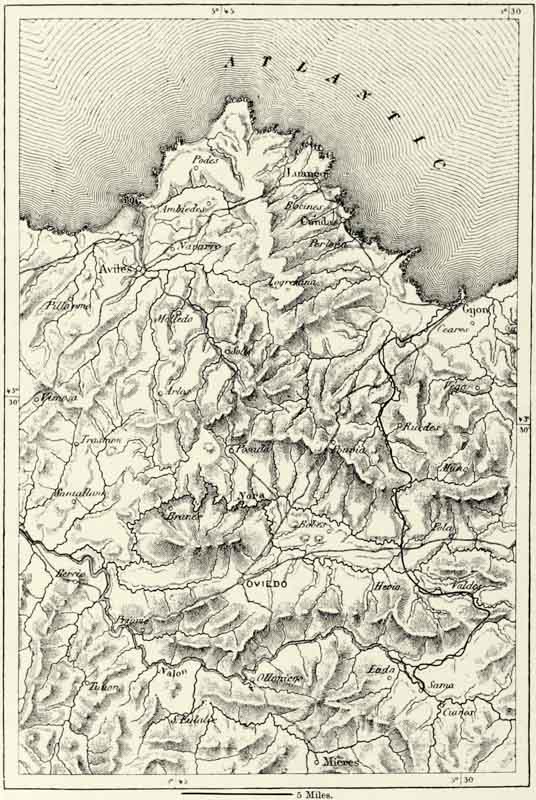
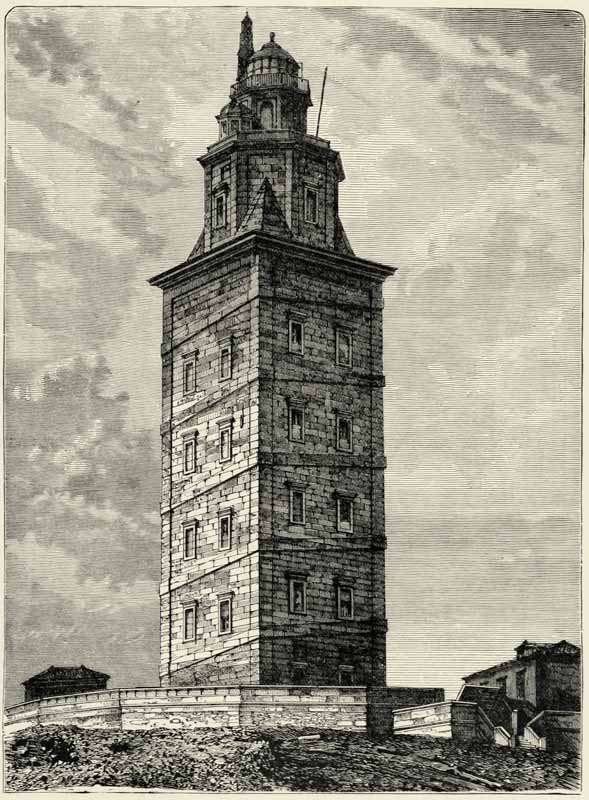
Fig. 186.—TOWER OF HERCULES (LIGHTHOUSE), CORUÑA.
Since a generation or two Spain has got rid of most of her colonies, which only {462} hindered her moral and material progress. The metropolis is no longer called upon to uphold slavery, the Inquisition, commercial monopolies, and similar institutions, “devised to insure the happy government of these colonies.” These {463} latter certainly have had their revolutions and counter-revolutions, but they have made some progress in population and wealth. Unfortunately the entire colonial empire was not lost. Cuba and the Philippine Islands are frequently represented {464} as adding to the wealth of Spain, and large sums have certainly been paid by them into the treasury. But these results have been achieved at the cost of fearful suffering and demoralisation to governors and governed, and unless Spain adopts the colonial system of England, by granting self-government to colonies, it will to a certainty lose the last shreds of its colonial empire, after having exhausted its strength in vain efforts to maintain it.
Μ
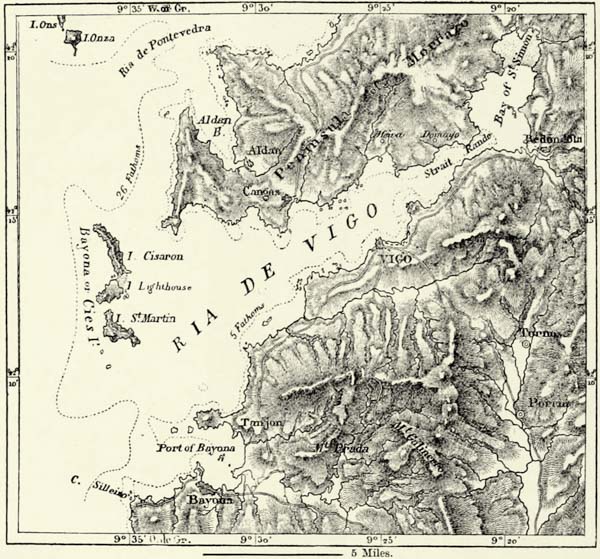
Fig. 187.—RIA DE VIGO.
Scale 1 : 280,000.
But though the colonies be lost, the influence of Spain upon the rest of the world will endure for centuries. Spain has impressed her genius upon every country subjected at one time or other to her power. Sicily, Naples, Sardinia, and even Lombardy still exhibit traces of Spanish influence in their architecture and customs. In Spanish America we find towns inhabited by Indians which are quite Spanish in their aspect, and almost resemble detached portions of Badajoz and Valladolid. The Indians themselves have adopted the Castilian tongue, and with it Castilian manners and modes of thought. A vast territory, twice the size of Europe, and capable of supporting millions of inhabitants, is occupied now by Spanish-speaking peoples. {465}
X.—GOVERNMENT AND ADMINISTRATION.
Since September, 1868, when a revolution upset the Government of Isabella II., Spain has passed through a series of revolutions and convulsions, terminating in December, 1874, in the accession of Alfonso XII., a son of Isabella. Soon afterwards the revolt in the Basque provinces raised by Don Carlos, the “legitimate” king of the country, was suppressed, and the work of internal organization could begin. The legislative power is vested in the King and the Cortes. These latter include a Senate and a House of Deputies. The Senate consists of hereditary members (such as royal princes and grandees), of life members chosen by the King, and of senators elected by corporations. The members of the House of Deputies are elected for five years. The President and Vice-President of the Senate are appointed by the King, who enjoys the right of dissolving the Cortes on condition of fresh elections being ordered within three months.
Μ
Fig. 188.—RAILROADS OF THE IBERIAN PENINSULA.
Scale 1 : 10,300,000.
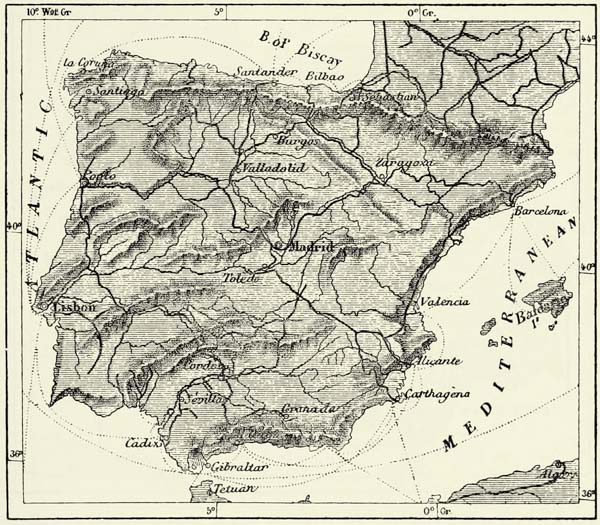
These governmental revolutions scarcely affected the administration of the country. The treasury is always empty, the annual receipts do not suffice to pay the interest upon the national debt, taxes have increased, the conscription demands more men than ever, and the schools diminish in numbers.171 {466}
The political and administrative divisions of the country have remained the same since 1841. Spain is divided into forty-nine provinces, including the Canaries. Each province is subdivided into districts, and has its civil governor. The communes are governed by an alcalde, or mayor, assisted by an ayuntamiento, or municipal council, of from four to twenty-eight members. The judicial administration is modelled on that of France. There are 9,400 justices of the peace (one for each commune), about 500 inferior courts, 15 courts of appeal, and a supreme court sitting at Madrid.
Μ
Fig. 189.—FOREIGN COMMERCE OF THE IBERIAN PENINSULA.
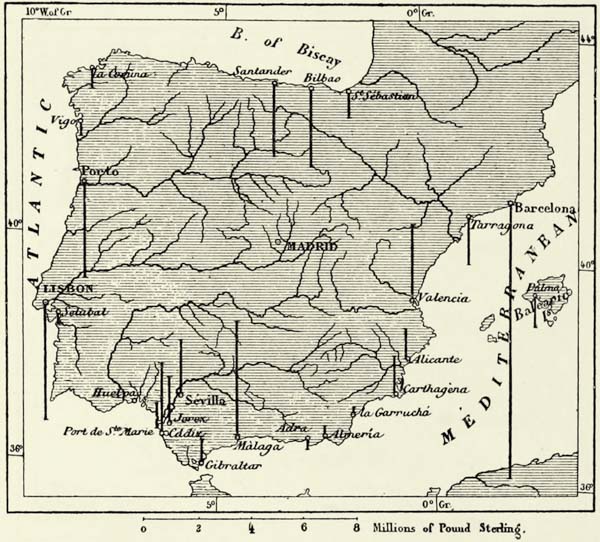
For military purposes continental Spain is divided into twelve districts, each under a captain-general. These are New Castile, Catalonia, Aragon, Andalusia, Valencia with Múrcia, Galicia, Granada, Old Castile, Estremadura, Burgos, Navarra, and the Basque provinces. The Balearic Isles, the Canaries, Cuba, Puerto Rico, and the Philippines constitute five additional districts. Military service is compulsory, but substitutes are admitted on payment of a heavy ransom. The annual levy varies exceedingly, and as many as 80,000 men are officially stated to have been levied in a single year, though 60,000 would appear to be the utmost the population can supply. The term of service is seven years in the cavalry and artillery, eight years in the infantry, of which three are passed in the “provincial militia.” About 100,000 men are supposed to be actually under arms in the {467} peninsula, 130,000 are on furlough, and 70,000 men are stationed in the colonies, mostly in Cuba, where about one-fourth of the total strength perish annually.
The principal fortresses are St. Sebastian, Santoña, and Santander, on the Bay of Biscay; Ferrol, La Coruña, and Vigo, on the rias of Galicia; Ciudad Rodrigo, on the Portuguese frontier; Cádiz and Tarifa, at the entrance of the Strait of Gibraltar; Málaga, Cartagena, Alicante, and Barcelona, on the Mediterranean; Figueras, Pamplona, and Zaragoza, at the foot of the Pyrenees.
The navy consists of 123 steamers, propelled by engines of 24,694 horse-power, armed with 755 guns, and manned by 14,000 sailors and 5,500 marines. Six of these vessels are ironclad frigates. The number of superior officers is exceedingly large, and their salaries weigh heavily upon the treasury.
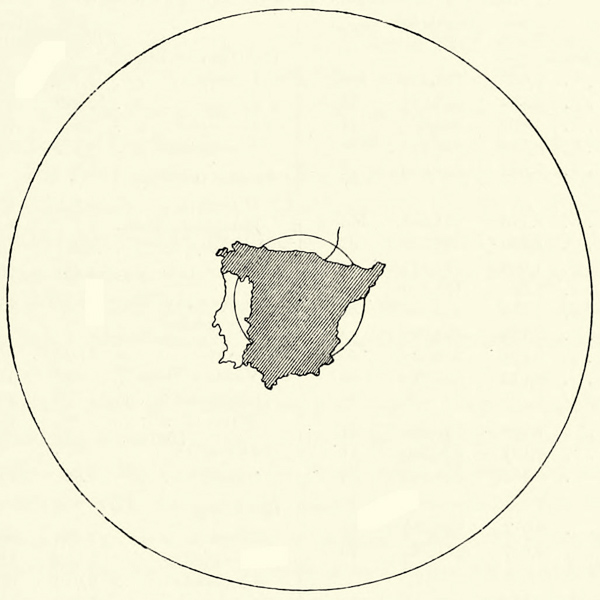
Fig. 190.—DIAGRAM EXHIBITING THE EXTENT OF THE CASTILIAN LANGUAGE.
Scale 1 : 36,000,000.
Officially the privileges of the nobility have been abrogated. The number of “noblemen” is, perhaps, larger in Spain than anywhere else in Europe, for the population of entire provinces, such as the Vascongadas and the Asturias, claims to have “blue blood” in its veins. In 1787 no less than 480,000 “gentlemen” were enumerated, not including minors, and if the proportion is the same now, there must exist at the least 3,000,000 Spaniards who claim to be hidalgos, or “sons of somebody.” About 1,500 grandees are privileged by custom to remain covered in the presence of the King, and about 200 of these belong to the highest rank. All of these do not, however, owe their rank to birth, for many plebeians, taking advantage of the financial miseries of the country, have succeeded in getting themselves ennobled. The order of the Golden Fleece, founded in 1431 by Philip the Good, is one of the distinctions most coveted by princes and diplomatists. {468}
The Roman Catholic religion is that of the State, and its prelates enjoy great privileges, but all other confessions are supposed to be tolerated. The schools, unfortunately, still remain in the hands of ecclesiastics, who likewise exercise a censorship with respect to pieces to be produced on the stage. Formerly Spain was the most priest-ridden country in Europe. At the close of last century there were 144,000 priests, 71,000 monks, and 35,000 nuns, but only 34,000 merchants. War and revolutions played havoc with the conventual institutions, but as recently as 1835 they still harboured 50,000 inmates. Subsequently the whole of them were suppressed, and in 1869 the last Spanish monk retired from the Carthusian monastery of Granada to find a refuge in Belgium. Since then, however, the laws of the land have again been relaxed in favor of monks and priests. There are 9 archbishops and 54 bishops.
AREA AND POPULATION OF SPAIN AND ITS COLONIES.
Area. Sq. m. Population (1870). Density.
NEW CASTILE (Castilla):―
Madrid 2,997 487,482 162
Toledo 5,586 342,272 61
Guadalajara 4,870 208,638 41
Cuenca 6,725 238,731 35
Cuidad Real 7,840 264,649 34
OLD CASTILE:―
Santander 2,113 241,581 114
Burgos 5,650 353,560 62
Logroño 1,945 182,941 94
Ávila 2,981 175,219 60
Segovia 2,714 150,812 53
Soria 3,836 158,699 41
Palencia 3,126 184,668 59
Valladolid 3,043 242,384 80
LEON:―
Salamanca 4,940 280,870 57
Zamora 4,135 250,968 61
Leon 6,167 350,992 56
ESTREMADURA:―
Cáceres 8,013 302,455 34
Badajoz 8,687 431,922 49
ANDALUSIA:―
Almería 3,302 361,553 110
Cádiz 2,809 426,499 152
Córdova 5,190 382,652 73
Granada 4,937 485,346 98
Huelva 4,122 196,469 48
Jaen 5,184 392,100 75
Málaga 2,824 505,010 180
Seville 5,295 515,011 97
VALENCIA:―
Castellon de la Plana 2,446 296,222 121
Valencia 4,352 665,141 153
Alicante 2,098 440,470 210
MURCIA:―
Albacete 5,972 220,973 37
Murcia 4,478 439,067 98
BALEARIC ISLES:―
Baleares 1,860 289,225 155
CATALONIA (Cataluña):―
Lérida 4,775 330,348 69
Gerona 2,272 325,110 143
Barcelona 2,985 762,555 256
Tarragona 2,451 350,395 143
ARAGON:―
Huesca 5,878 274,623 47
Zaragoza (Saragossa) 6,607 401,894 61
Teruel 5,491 252,201 46
NAVARRA AND BASQUE PROVINCES (Vascongadas):―
Navarra 4,046 318,687 80
Vizcaya (Biscay) 849 187,926 221
Guipúzcoa 728 180,743 248
Alava 1,205 103,320 86
ASTURIAS:―
Oviedo 4,091 610,883 152
GALICIA:―
Orense 2,739 402,796 147
Pontevedra 1,739 480,145 282
La Coruña 3,079 630,504 210
Lugo 3,787 475,836 126
TOTAL SPAIN 192,959 16,835,506 87
AFRICA:―
Canaries 2,808 283,859 101
West Coast 850 35,000 41
AMERICA:―
Cuba 45,983 1,400,000 30
Puerto Rico 3,596 625,000 173
OCEANIA:―
Philippines 65,870 6,000,000 91
Carolines 534 18,800 35
Pelew Islands 345 10,000 29
Marianas 417 8,000 19
TOTAL COLONIES 120,403 8,380,659 70
SPAIN AND COLONIES 313,362 25,216,165 80
