ITALY.* (continued 5)
Reading edition
Μ
Fig. 127—LA GIARA.
Scale 1 : 308,640.
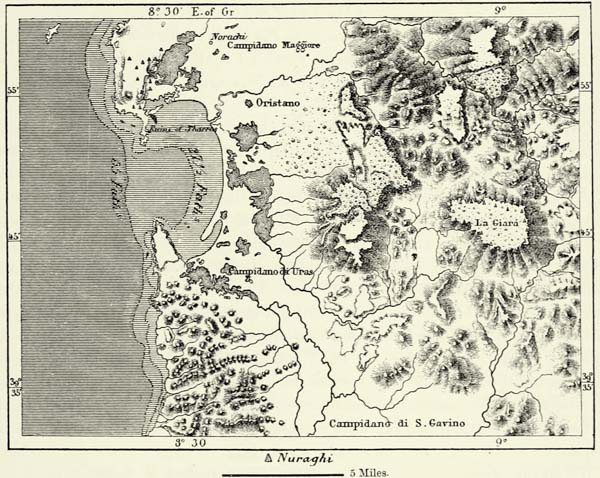
The rubbish which accumulated in these nuraghi has yielded a multitude of objects which throw light upon the daily life of the inhabitants, and bear witness to their relative civilisation. The lower strata only contain hand-made utensils, stone arms, and pottery, but in the upper and more recent layers many articles of bronze have been found. Other monuments of cyclopean structure stand near these ancient dwellings. They are popularly known as “giants’ tombs,” and Signor {346} Sapi, who has examined a large number of them, has discovered in every instance the ashes of human beings.
Though very superstitious, the Sardinians have no legends respecting these dwellings of the aborigines, and at most attribute them to the devil. This absence of traditions is no doubt traceable to the almost total annihilation of the inhabitants by successive conquerors. The Carthaginians showed no mercy to the aborigines, and during the first centuries of Roman rule massacres and forcible emigration were the order of the day, and the gaps thus created were filled up by Italian colonists and exiles.
The ancient Sards were most likely Iberians. They are of low stature, and the climate, which has stunted the growth of wild and domesticated animals, appears to have influenced man likewise; but they are well proportioned and muscular, have an abundance of black hair and strong beards, and scarcely ever grow bald. There are minor differences in the Sards of the two provinces. Those of the north have generally oval features and an aquiline nose, whilst those near Cagliari, who are probably more mixed, have irregular features and prominent cheek-bones.
The inhabitants of the interior of the island are, perhaps, of purer race than any other Europeans. Their ancestors, no doubt, were of the most diverse origin, but most invasions which took place after the Roman era stopped short at the coast. The Vandals paid a visit to Sardinia, but all the other Germanic tribes, who ravaged nearly every other country of Western Europe, spared that island, and its inhabitants were thus able to preserve their manners and language. The Moors, Pisans, Genoese, Catalonians, and Spaniards, who successively invaded the island, never penetrated beyond the coast. There is only one exception to this rule, viz. that of the Barbaricini, who inhabit the mountain district of Barbagia, in the very centre of the island, and who are supposed to be the descendants of Berbers expelled from Africa by the Vandals. When they came to the island they were still pagans, and they intermarried with their neighbours, the Ilienses, an aboriginal tribe, pagans like themselves. They were converted to Christianity in the seventh century, and the sombre dress worn by their women reminds us of Barbary.
Of all the idioms derived from the Latin, that spoken in Sardinia has most resemblance to the language of the ancient Romans. More than five hundred words are absolutely identical. There are likewise a few Greek words not met with in any other Latin idiom, as well as two or three words which have no affinity with any other European tongue, and which are, perhaps, derived from the language spoken by the aborigines. The two leading dialects, those of Logoduro, in the north, and of Cagliari, are directly derived from the Latin, and are, perhaps, most nearly related to Spanish. At Sassari, and in some of the neighbouring coast districts, an Italian dialect is spoken which is very much like that of Corsica or Genoa. At Alghero the descendants of the Catalonian immigrants who settled there about the middle of the fourteenth century still speak their old Provençal. The Maurelli, or Maureddus, in the environs of Iglesias, who are probably Berbers, {347} and can be recognised by their narrow skulls, make use of a few African words. Maltzan looks upon the inhabitants of the fertile district of Millis as the purest representatives of African immigrants, and it was they who introduced the cultivation of the orange into Sardinia.
The Sardinians of the interior not only retain their ancient language, but likewise many of their ancient customs. Their dances are still the same as in the time of Greece. In the north the steps are regulated by the human voice, the chanters occupying the centre of the ring. In the south a musical instrument, the launedda, is used, which is nothing but an ancient flute, made of two or three reeds. The customs observed at christenings, weddings, and funerals are likewise of remote date. Marriage, as amongst nearly all the ancient inhabitants of Europe, is preceded by a feigned abduction of the bride. The latter, after she has entered the house of her husband, must not stir from her place during that day, nor speak a single word. Mute as a statue, she is no longer a sentient being, but a “thing,” the property of her husband. She is not permitted to see her relatives during three days, and in the south many women partly conceal their features.
The mountaineers likewise observe the lugubrious ceremony of a wake, called titio or attito. Women, who are either the friends of the deceased or are engaged for the purpose, penetrate the mortuary chamber, tear their hair, howl, and improvise hymns of mourning. These old pagan ceremonies become truly terrific when the deceased has been the victim of assassination, for in that case the mourners swear to take the life of the murderer. Up to the beginning of this century the practice of the vendetta annually cost the lives of hundreds of young men. At the present day it is confined to the most secluded parts of the island, and in the mountain districts of Nuoro and La Gallura it is customary at christenings to place a few bullets in the swaddling-clothes of the infants, these consecrated bullets being supposed never to miss their mark. Another custom still more barbarous has ceased to be observed since the beginning of the last century. Women, called “finishers” (accabadure), were employed to hasten the end of dying persons, a practice which often led to the most atrocious deeds.
The peasant of Sardinia, though not the proprietor of the soil, is nevertheless permitted to enjoy the result of his labour. The feudal system existed up to 1840, and many traces of it still survive. The great barons, most of them of Spanish extraction, were almost the absolute masters of the country, and up to 1836 they administered the law, had their prisons, and erected gallows as a symbol of their power. The peasants, however, were not tied to the land, but could migrate at pleasure, and custom granted them a fair share of the produce of the soil. By virtue of an ademprivio they were permitted to cut wood in the forests, to pasture their sheep on the hills, and to bring into cultivation the waste lands of the plains. Agriculture was carried on in the most primitive fashion, for the great lords of the land usually resided abroad, and the management of their estates was left to bailiffs. Government has now become the proprietor of most of the unenclosed {348} land, 80,000 acres of which have been ceded to the Anglo-Italian Company, which has undertaken to provide the island with a network of railways.
Μ
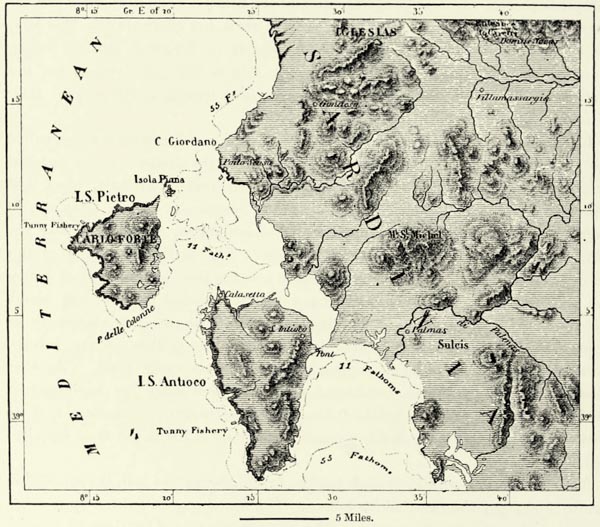
Fig. 128.—DISTRICT OF IGLESIAS.
Scale 1 : 420,800.
In the more densely populated districts the division of the land is exceedingly minute, and this subdivision is still progressing at a most disastrous rate. The nomad herdsmen, on the other hand, possess no land of their own, though, if inclined, they are at liberty to enclose a plot. But vague proprietary rights like these render the careful cultivation of the soil impossible. It has been seriously proposed to expropriate the whole of the land, and to sell it to a few enterprising capitalists, but this would simply amount to a restoration of the old feudal times, and poverty, which is great even now, would become greater. There are villages in the district of Ogliastra where the peasants eat bread made of the acorns of Quercus ilex, the dough being kneaded with water containing a fatty clay. This is, perhaps, the only instance of earth-eating in Europe. The Spaniards, too, eat acorn bread, but they use the fruit of Quercus ballota, which is really edible, and are careful not to mix its flour with earth.
The Sardinians, even when they are the owners of pasture-grounds or of fields, never live in the country. Like the Sicilians, they are concentrated in towns or large villages, and neither hamlets nor isolated farmhouses are met with. Even {349} the shepherds in the mountains build their huts in groups called stazzi, and combine for mutual protection into cussorgie. Members of these associations, when they lose their cattle from disease or any other cause, may claim one or more beasts from every one of their comrades living within the same district or canton. In other parts of the island—as, for instance, near Iglesias—the produce of the orchards is looked upon as common property. The mountaineers, though poor, practise the ancient virtue of hospitality, and though the dwellings are rude, they find means of making a stranger staying amongst them comfortable.
The products of Sardinia form but a small proportion of those of all Italy. Most of the peasants only work by fits and starts, and hardly more than a fourth of the area of the island has been brought under cultivation. It sometimes happens that the crops are destroyed by the scorching heat of the sun, or eaten up by locusts, which come in swarms from Africa. Except near Sassari no attempt is made to improve the produce. The olive-tree alone is cultivated with some care, for the grower of a certain number of these trees may claim political privileges, and even the title of “Count,” and thousands of proprietors have converted their sterile steppes into productive olive groves. The millions of oranges grown in the gardens of Millis and elsewhere are taken entirely for home consumption. Commercially these oranges are of less importance than the saline plants collected in the marshes of the coast districts, and the ashes of which are exported to Marseilles to be converted into soda.
The working of granite and marble quarries yields some profit, but the mines, which were of such importance in the time of the Romans, are hardly touched now. There is only one iron mine, that of San Leone, where work has been carried on seriously by a French company since 1822. It yields about 50,000 tons of ore annually, and the oldest railway of the island connects that mine with Cagliari. The district of Iglesias, where the Romans founded Plumbea and Metalla, and the Pisans searched for silver, has recently regained some of its ancient importance on account of its lead and zinc mines. The waste of the old mines is likewise being scientifically treated by French, English, and Italian companies, to whom mining claims have been ceded, and a curious stalactite cavern which traverses the hill near Domus Novas has been utilised in gaining access to the scoriæ. Iglesias is rapidly growing into a city of modern aspect, the village of Gonessa is already a respectable town, and the little harbour of Porto Scuso, until recently almost deserted, is now crowded with small craft employed in carrying annually 900,000 tons of lead and zinc ore to the roadstead of Carlo-Forte. Unfortunately the miners, especially those from abroad, frequently succumb to the climate.
The fisheries, being for the most part carried on in the bays exposed to the sea breezes, are not attended by the same dangers. Certain portions of the coast abound in fish, such as the Bay of Cagliari, and the narrow arms of the sea in the archipelago of the Maddalena, which the ancients searched for purple shells. Anchovies and “sardines” periodically visit the coasts, and as many as 50,000 tunny-fish are sometimes caught in a single season. The swamps or lagoons likewise yield fish, which are caught in nets spread at the openings of the channels {350} communicating with the sea. The swamp of Cagliari abounds in shad, that of Oristano in mullets and eels, and that of Alghero in pike and gold fish. The fisheries of Sardinia are consequently of much importance, but most of their profits are reaped by strangers. Corsicans fish near La Maddalena, Genoese around San Pietro, and Italians monopolize the coral fisheries. These latter, too, collect the Pinna nobilis, a shell, the silky byssus of which is converted into stuff for garments. Nor do the Sardinians take to the sea as sailors, and the commerce of the island is carried on almost exclusively in Genoese and other Italian vessels. Out of 2,400 proverbs collected by Spano, only three refer to the sea ! 118
Fig. 129—CAGLIARI, AS SEEN FROM THE PASS OF BONERIA.
The inhabitants of the northern “Cape” of Sassari, or di Sopra, claim to be more intelligent and civilised than those of the southern “Cape” of Cagliari, or di Sotto. The former do not call themselves Sardinians at all, but apply that name, which to them is synonymous with barbarians, to the inhabitants of the {351} interior and of the south. In former times these two sections of the population hated each other, and the spirit of the vendetta, which set family against family, village against village, made its influence felt all over the island. This old animosity has not yet completely died out; but the people of Sassari can no longer claim to be the superiors of their southern neighbours. They certainly are better agriculturists and more industrious, but the southerners possess the richest mines, their portion of the island is most productive, and it is the seat of the capital.
Μ
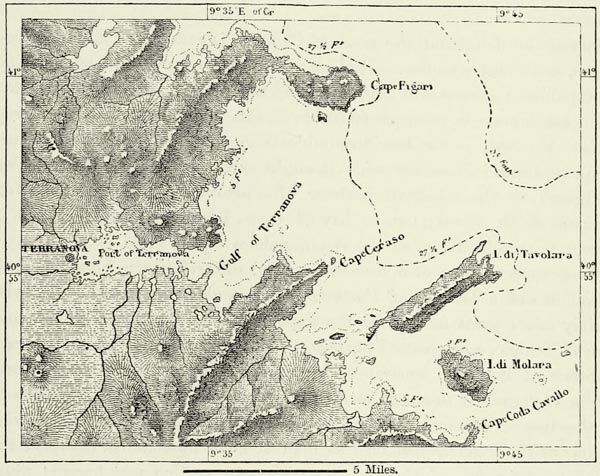
Fig. 130.—THE PORT OF TERRANOVA.
Scale 1 : 250,000.
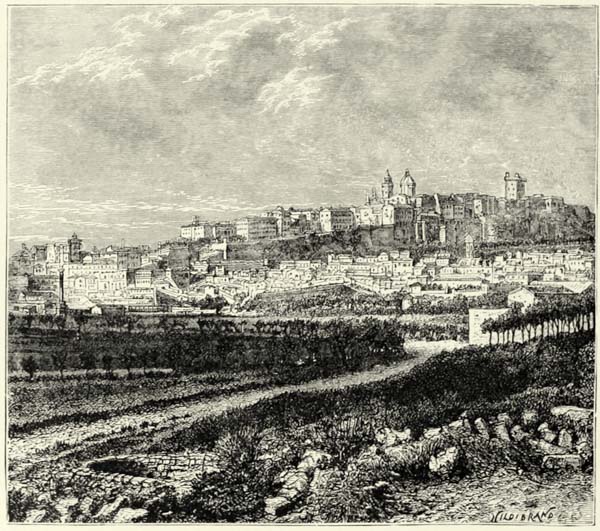
Cagliari, the ancient Caralis, has remained the great emporium of the island since the days of Carthage. Only a few idols, sepulchral chambers, the ruins of an aqueduct, and an amphitheatre excavated in the rock, recall the dominion of Carthaginians and Romans, but it could not be deprived of its excellent harbour and magnificent roadstead. The town was only a short time under the rule of the Moors, but its physiognomy is almost more oriental than that of any city in Europe, many of its houses being provided with cupolas and balconies overhanging the streets. Its position as a place of commerce is most favourable, for it lies on the ocean highway connecting Sicily with the Balearic Islands, and the coast of Africa is within a day’s sail. It is sure to prosper, especially if a serious effort is made to drain the marshes and to transform the plain of the Campidano into a fertile garden. The latter, an ancient arm of the sea, extends to the south-east towards Oristano, the “town of potters.” During the Middle Ages {352} the latter was the seat of the most powerful lords of the island, and it was thence Eleonora promulgated her famous Carta de logu, which became the public law of the whole island. Oristano has an excellent harbour, sheltered by the peninsula of Tharros, upon which the Phœnicians had founded one of their settlements; its fields are fertile, and, to bring about a return of its ancient prosperity, it is only necessary to drain the marshes which now hem it in. In former times fires were lighted upon the walls of the town during the season of malaria, to purify the atmosphere; but the vast forests from which the fuel for these fires was procured have disappeared, and this portion of Sardinia is no longer entitled to its ancient epithet of “Arborea.” It is said that in the marshes of Nurachi, to the north-east of Oristano, may be heard now and then a noise resembling the bellowing of a bull. This noise is probably produced by the passage of air through some subterranean cavern, and similar phenomena have been observed on the coast of Dalmatia.
Sassari the delightful, the rival of Cagliari, is embosomed amidst olive-trees, gardens, and country houses. It alone, of all the towns of the island, could boast of a republican government during the Middle Ages, and the public spirit of its present inhabitants is, perhaps, traceable to this circumstance. Its geographical position, however, is far less favourable than that of Cagliari, for a zone of swamps separates it from the sea. It might export its produce through the port of Alghero or the excellent harbour of Porto Conto, to the south of the mountains of La Nurra; but facility of access has dictated its choice of Porto Torres, a miserable village on the swampy shore of the Gulf of Asinara. Porto Torres occupies the site of a Roman city, and the arches of a huge aqueduct and the columns of a Temple of Fortune still rise above the reeds. This old port certainly offers great facility for the export of the olive oil of Sassari and the wines of Tempio, as respects France and Genoa; but the intricate navigation of the Strait of Bonifacio separates it from the nearest Italian coast. Italy has therefore determined to create an additional port on the east coast of the island, and the Bay of Terranova has been selected for that purpose. Olbia, which at the time of the Romans had no less than 150,000 inhabitants, occupied the site of the present town, which the Italians fondly imagine may become the great emporium of the island. Its port is certainly well sheltered, and the roadsteads of the archipelago of La Maddalena near it afford additional accommodation; but seriously to improve the condition of Sardinia it will be necessary, above all things, to drain its dreary swamps, and to “transform their poisonous exhalations into bread.” 119
IX.—THE PRESENT AND FUTURE OF ITALY.
No impartial spectator can deny that Italy, since it has again taken its place among the nations of Europe, promises great things for the future. Even its {353} political regeneration has brought to the surface men of the highest intellect, courage, zeal, and public spirit. There are some amongst them whom posterity will look upon as a credit to all mankind. Possibly this period of excitement and nervous activity may be succeeded by a sort of moral collapse, such as generally takes place after every great crisis in the life of a nation. But this need not render us anxious for the future, for generations exhausted by the efforts they have made will be succeeded by others eager to continue the work their predecessors have begun.
In sciences and arts the native country of Volta, Cialdi, Secchi, Rossini, Verdi, and Vela occupies even now a position of equality with the most advanced nations of Europe. The Italian of the present day is able to refer without shame to the two great centuries of the Renaissance, for he has entered upon a second period of regeneration, and the names of contemporaries can be mentioned by the side of the great names of the past. Italy has its skilful painters and sculptors, its celebrated architects and unrivalled musicians. The great works achieved by its engineers are deserving the study of foreigners. Amongst its physicists, geologists, astronomers, and mathematicians there are some of the brightest ornaments of the age, and the assiduity with which universities are frequented insures their having worthy successors. A geographical society only recently established has successfully taken up the work of exploration so gloriously carried on by the Genoese and Venetians. It is not just, therefore, to say ironically that “Italy has been made, but not Italians.” Individually the Italians are inferior to no other race of Europe, and the reorganization of the country would have been impossible had there been any deficiency in men of mark.
Italy is more densely inhabited than any other of the great states of Europe, in spite of vast extents of almost uninhabitable mountain tracts and swamps. The population, however, increases less rapidly than in Russia, England, or Germany. It doubles in about a century, whilst that of Russia doubles in fifty and that of France in two hundred years. Italy thus occupies an intermediate position. In Apulia and Calabria, which are amongst the poorest provinces, the birth rate is highest, whilst in the wealthy Marches and Umbria it is lowest. On an average the Italian dies when he is thirty-two, and his life is consequently much shorter than that of the average Frenchman or Englishman.
Agriculture and the development of the natural resources of the soil and the sea engage much more attention than industry properly so called. Nearly fifty per cent. of the total area is under cultivation. The cereals raised do not suffice for the wants of the inhabitants, but other products are exported in considerable quantities. In its production of oil Italy holds a foremost rank as regards quantity, but not always with respect to quality. The amount of fruit grown, such as figs, grapes, almonds, and oranges, is greater than in any other country of Europe. The chestnut forests in the Apennines and Alps yield rich harvests. Its mulberry plantations are four times more extensive than those of France, and the raw silk produced in favourable years exceeds in quantity that exported from China. The peninsula is still entitled to its ancient epithet of {354} Œnotria (wine land), but, apart from certain districts of continental Italy and Sicily, the quality of wine produced, owing to carelessness on the part of the growers, is inferior to what it is in France. The cultivation of cotton is comparatively of small importance. The breeding of animals yields large profits, and Italy is noted throughout Europe for the quality of some kinds of cheese.120
The working of the iron mines of Elba, the quarrying of marble and granite in the Alps and Apuanic Alps, the extraction of borax and boracic acid in the Tuscan Sub-Apennines, the mining for lead and zinc in Sardinia, and for sulphur in Sicily,121 lead up to industrial pursuits properly so called. These latter extend nearly to everything, from the manufacture of pins to the construction of steam-engines and ships. Italy, however, is eminent only in the production of certain articles de luxe, such as straw bonnets, cameos, coral jewellery, glass, and in the preparation of macaroni and other farinaceous pastes. The manufacture of silk, however, has taken a rapid development in recent years, and Milan has become a dangerous rival of Lyons. In the province of Novara, and more especially at Biella, there are hundreds of woollen factories. The cotton manufacture is not of much importance, and linen-weaving is for the most part carried on as a domestic industry. Italy, in fact, cannot yet be called a manufacturing country. The number of workmen is large, but they mostly labour at home or in small workshops,122 and a division of labour, such as exists in England, France, or Germany, is hardly known. Manufactories, however, are rapidly increasing, and economical conditions are gradually becoming what they are already in most other countries of Europe.
Italy possesses a powerful mercantile marine, manned by 150,000 seamen; but its foreign commerce is far less than might have been expected from its tonnage.123 Most of the vessels are engaged in the coasting trade. The first Italian vessel was seen in the Pacific in 1847, and even now the Italian flag is very inadequately represented in the navigation of the great oceans. Italian patriots are anxious to see the commerce of the country extended to the most distant regions. For the present Italy enjoys a sort of monopoly in the Mediterranean, and any increase of {355} population or wealth in Northern Africa must prove of immediate advantage to it. But there can be no doubt that the proposed railway from Antwerp or Calais to Saloniki or Constantinople will seriously affect the transit trade of Italian ports. Nor are Italian shipowners able to compete with their rivals of Marseilles or Trieste when it is a question of speed, for the number of their steamers is very small.
Μ
Fig. 131.—NAVIGATION OF ITALY.
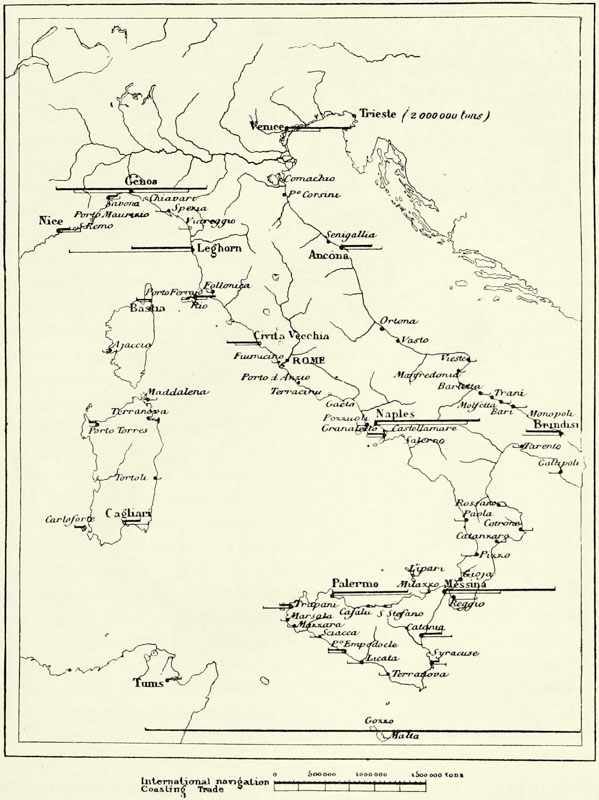
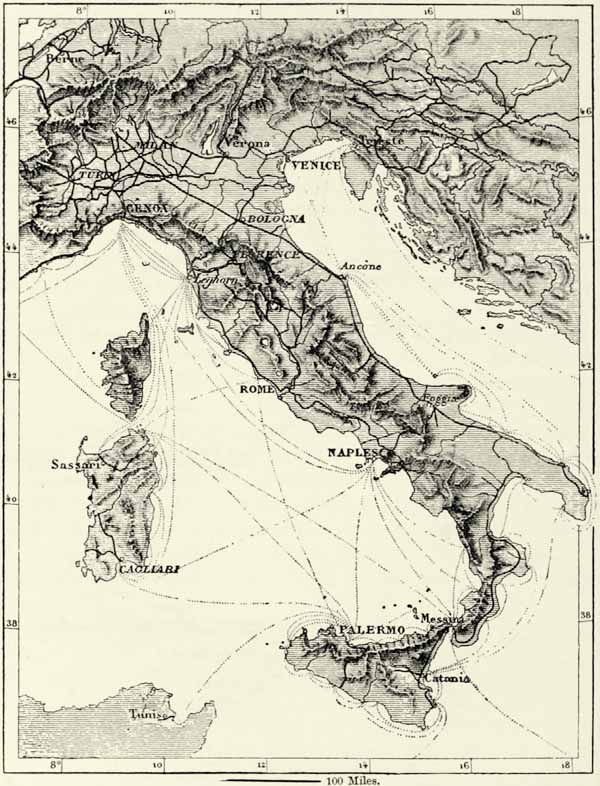
The facilities for carrying on coasting trade have, in some measure, interfered with the development of the inland trade of the country. The construction of railways, however, is gradually bringing about a change. Already five lines of {356} rails cross the Apennines, others are projected, and one of the Italian railways, namely, that which pierces the Alps in the tunnel of Mont Cenis, and finally follows the eastern coast to Rimini, has become a portion of the great European highway to India. Nor must the political importance of these railways be underrated, for they knit together the most distant provinces of Italy, and make the country really one.124
Μ
Fig. 132.—ROUTES OF COMMERCE OF ITALY.
Scale 1 : 6,000,000.
{357}
The commerce of Italy has increased rapidly of late, but it is still inferior not only to that of England, France, Germany, Austria, and Russia, but likewise to that of much smaller countries, like Belgium and the Netherlands. In 1875 the imports, including transit, were estimated at £48,614,280, the exports at £42,301,800. France participates in this commerce to the extent of 31 per cent., England is represented by 23, Austria by 20, and all the other countries of the world share in the remainder. Recently the commerce with North and South America has assumed considerable proportions, and efforts are being made to obtain a footing in Eastern Asia.
The great scourge of Italy consists in the poverty of its peasantry even in the most fertile provinces, as in Lombardy and the Basilicata. These peasants live in foul hovels, and the united earnings of a whole family are hardly sufficient to procure bread. Chestnuts, and a polenta of maize and paste made of damaged flour, are the principal articles of food, and nothing is left for luxuries, or even comfortable clothing. Rickets and other diseases brought about by an insufficiency of food are common, and, in fact, mortality is very great. Emigration is under these circumstances of immense advantage to the country, for the thousands of Italians who seek work or found new homes in South America, the United States, France, Turkey, Egypt, and elsewhere, not only earn their bread, but also render some assistance to those of their relatives who remain behind. It is said that out of 500,000 Italians living abroad, no less than 100,000 are engaged in art, either as painters, sculptors, or musicians, the latter being frequently mere street-singers or organ-grinders.
Ignorance, the usual companion of poverty, is still very great throughout the peninsula. We might err in condemning the Italians because of their ignorance of the arts of reading and writing, for, as the heirs of an ancient civilisation, they are more polished in their manners than the educated peasants of the North. Still this ignorance is most deplorable, for it precludes all progress. Nearly two-thirds of the population over ten years of age are unable to read, and fifty-nine men and seventy-eight women out of every hundred are unable to sign the marriage registers. There are several thousand parishes without elementary schools, and the number of pupils, instead of amounting to the normal proportion of one to every six or seven inhabitants, is only one to about eleven.125 Education, however, is making fair progress, but its influence upon the diminution of crimes of violence has hitherto been small. In 1874 Signor Cantelli, the Home Secretary, stated that there occurred annually 3,000 homicides, 4,000 cases of highway robbery, and 30,000 violent assaults.
The permanent confusion of the finances of Italy, attended as it is by heavy and vexatious taxes, must be looked upon as one of the principal causes which retard the development of the country. The national debt may appear a small matter if we compare it with that of France, but it has been raised in the course {358} of a single generation, and is augmenting from year to year. The revenue increases but the expenditure does so likewise, and the additional income resulting from an increase of taxation and the sales of Church property is not sufficient to cover the deficiency. The heavy cost of the army, an absence of sustained efforts in carrying on public works, waste and fraud by public servants, have hitherto prevented the establishment of a balance between income and expenditure, and the paper money issued by Government is nowhere accepted at its nominal value.
This disorganization of the finances places Italy at the mercy of foreigners, and the arrangements which have to be made from time to time with foreign capitalists are not always of a purely financial nature. The inefficiency of her military and naval organization, moreover, compels her to cultivate foreign alliances as expediency may direct, and to these alliances Italy is, in a large measure, indebted for her political unity.126
Nor is this unity even now as perfect as could be desired. The Pope has been deprived of his temporal power; he resides at the Vatican as a guest; and the money offered him by the Italian Government, but which has never been accepted, is not tribute, but a gratuity. But, in spite of this, the Pope is still a real power, and his very presence interferes substantially with the permanent establishment of the state. The Catholics of the world have not yet acquiesced in his disestablishment, and they allow no opportunity for attacking the new order of things to escape them. Political Europe is consequently much interested in the home affairs of Italy, and feels tempted frequently to intervene. The most expert diplomacy may not be able to avert this danger, and if there is a struggle it will certainly not be confined to the peninsula.
In the end Italy will no doubt escape from the anomalous position of having for her capital a city which is the seat of a theocratic government claiming the allegiance of the Roman Catholics of the entire world. The geographical conditions of no other country are equally favourable to the development of national sentiments and the maintenance of a national individuality. At the same time the well-defined boundaries of the country deprive it of all force of expansion. Italy will never play a great part beyond the bounds of the Mediterranean, and though Italian may obtain a certain preponderance in Tunis, Egypt, and the Levant, the noble language of Dante has no chance, as regards universality, when opposed to English, French, Spanish, German, or Russian.
X.—GOVERNMENT AND ADMINISTRATION.
The charter promulgated in March, 1848, declares the old kingdom of Sardinia to be an hereditary constitutional monarchy. It has gradually been {359} extended to the other portions of the peninsula. Like most similar documents, it guarantees equality before the law, personal liberty, and inviolability of the domicile. The press is free, “subject to a law repressing its abuses;” the right of meeting is recognised, “but not in the case of places open to the general public;” and all citizens are promised the enjoyment of equal civil and political rights, “except in those cases which shall be determined by law.”
The executive is intrusted to the King, but no law or act of government is valid unless countersigned by a minister. The King, as such, is commander of the naval and military forces, he concludes all treaties, and the assent of the Chambers is only required if they concern cessions of territory, or entail an expenditure of public money. All Government officials are appointed by the King, he may dissolve the Chamber of Deputies, justice is administered in his name, and he possesses the right of pardon. He enjoys the fruits of the Crown lands, and may dispose of his private property without reference to the general laws of the country. The civil list of the King and the members of his family annually exceeds £800,000 !
Senators are appointed by the King from amongst ecclesiastical, military, and civil functionaries, persons of wealth, and men who have deserved well of the country. Their number is not limited, and they must be forty years of age. Deputies are elected for five years. They must be thirty years of age. Neither senators nor deputies are in receipt of emoluments, and this may explain the little zeal they exhibit in the performance of their public duties. A quorum, consisting of one-half the members of each house plus one, is frequently unattainable for weeks.
The franchise is enjoyed by professors of universities and colleges, civil servants, knights of orders of chivalry, members of the liberal professions, merchants, persons who have an income of £24 from money invested in Government securities, and all others twenty-five years of age, able to read and write, and paying 32s. in taxes. The number of electors is about 400,000, but hardly one-half of them ever go to the poll.
Each province occupies the position of a “corporation,” which may hold property, and enjoys a certain amount of self-government. The “Provincial Councils” consist of from twenty to sixty members, who are chosen by the municipal electors for five years. These Councils usually occupy themselves with the material interests of the province, and, when not sitting, are represented by a “Deputation” charged with controlling the acts of the prefect.
The municipal organization is very similar to that of the provinces. The Councils are elected for five years: all males of twenty-one years of age paying from 4s. to 20s. in taxes (according to the importance of the municipality), professors, civil servants, members of liberal professions, and soldiers who have been decorated are in the enjoyment of the franchise. The Council meets twice a year, and its sittings are held in public if a majority demands it. It appoints a municipal giunta of from two to twelve members, charged with the conduct of current affairs. The mayors, like the provincial prefects, are {360} appointed by Government, but must be chosen from the members of the Municipal Council.
The great territorial divisions of the kingdom (see p. 362) consist of 69 provinces and 284 circles (circondarii), or districts. These latter again are subdivided into 1,779 judicial districts (mandamenti) and 8,360 communes. The central Government is represented in the provinces by a prefect, in the districts by a sub-prefect, and in the communes by a mayor, or sindaco. This system of administration is very much like that existing in modern France.
The administration of justice was organized in 1865. In each commune there is a “Conciliator,” appointed for three years by Government, on the presentation of the Municipal Council. A “Pretor” administers justice at the capital of each of the judicial districts: he is assisted by one or more Vice-pretors. Next follow 161 civil and correctional courts, 92 assize courts, 24 courts of appeal, 25 commercial tribunals, and 4 courts of cassation; the latter at Florence, Naples, Palermo, and Turin. The Code of Laws is an adaptation of the Code Napoléon, and breathes the same spirit.
In military matters Prussia has served as a model. Every Italian, on attaining his twenty-first year, becomes liable to serve in the army or navy. Men embodied in the first category of the standing army (esercito permanente) remain from three to five years under the colours, according to the arm to which they belong, and six to seven years on furlough. The men of the second category, or reserve of the standing army, drill fifty days, and are then dismissed to their homes. The “mobilised militia” includes all men up to forty not belonging to the standing army. A “levy en masse,” or Milizia stanziole, is provided for by law, but nothing has been done hitherto to render it a reality. The standing army includes 90 regiments of infantry, 20 regiments of cavalry, 14 of artillery, and 1 of engineers, and numbers 410,000 men; the reserve amounts to 180,000 men; the mobilised militia (247 battalions, 24 Alpine companies, 60 batteries, and 10 companies of engineers), 277,000, and 234,000 officers and men are stated to be under the colours. The four great fortresses of the north are Verona, Mantua, Peschiera, and Legnago. These form the famous “Quadrilateral.” Venice is likewise a place of great strength, and made an heroic defence in 1849. Palmanova defends the frontier between the Julian Alps and the Gulf of Trieste. Rocca d’Anfo, on an isolated rock to the north of Lake Garda, commands the defiles of the Adige and Chiese. Pizzighettone, on the Adda, is no longer of much importance, now that Italy has acquired possession of the Quadrilateral; but Alessandria, at the confluence of the Tanaro and Bormida, will always retain its rank as the great strategical centre of Piemont, and one of the strongest places of Europe. Casale may be looked upon as one of its outworks, and together with Genoa defends the passages of the Apennines. Piacenza and Ferrara command important passages of the Po. The other fortresses of Italy are Ancona in the centre; Porto Ferrajo in Elba; Gaeta, Capua, and Taranto in the south; and Messina in Sicily.
The navy consists of 21 ironclads (179 guns, engines of 11,310 horse-power, 76,842 tons) and 51 wooden steamers, manned by 20,000 seamen. The great {361} naval arsenals and stations are at Spezia, Genoa, Naples, Castellamare di Stabbia, Venice, Ancona, and Taranto.
The Roman Catholic Church alone is acknowledged by the State, but all other religions are tolerated. The conflict between Church and State is favourable to the spread of Protestantism; but, apart from the Waldenses and a few foreigners in the larger towns, there are no Protestants in Italy. Many of those, however, who are nominally Catholics have ranged themselves amongst the enemies of their Church, or are perfectly indifferent.
Italy occupies quite a special position in the world, owing to its being the seat of the Papacy. Rome is the seat of two governments, viz. that of the King and of the Sovereign Pontiff. The latter, though shorn of his temporal power, is in principle one of the most absolute monarchs. Once elected Vicar of Jesus Christ by the cardinals met in conclave, he is responsible to no one for his actions, though it is customary for him to listen to the advice of the Sacred College of Cardinals before deciding questions of importance. The Pope alone, of all men, is infallible; he can efface the crimes of others, “bind and unbind,” and holds the keys of heaven and hell, his power extending thus beyond the span of man’s natural life.
The cardinals are the great dignitaries of this spiritual government. They are created by the Pope. Their number is limited to 70, viz. 6 Cardinal Bishops (who reside at Rome), 50 Cardinal Priests, and 14 Cardinal Deacons. The Cardinal Camerlengo represents the temporal authority of the Holy See, and on the death of a pope he takes charge of the Vatican and of the Fisherman’s Key, which is the symbol of the power bestowed upon St. Peter and his successors. In special cases the cardinals of the three orders may be convoked to an Œcumenical Council. On the death of a pope the cardinals elect his successor, who must be fifty-five years of age, and obtain two-thirds of the votes. His investment with the pallium and tiara, however, only takes place after the assent of the Governments of France, Spain, Austria, and Naples (now represented by Italy) has been secured.
In virtue of the formula of “A free Church in a free State,” so frequently repeated since Cavour, the Pope is permitted to enjoy sovereign rights. He convokes councils and chapters, appoints all ecclesiastical officers, has his own post-office and telegraph, his guard of nobles and of Swiss, pays no taxes, and enjoys in perpetuity the palaces of the Vatican and Lateran, as well as the villa of Castel-Gandolfo, on the Lake of Albano. In addition to this, he has been voted by the Italian Parliament an annual “dotation” of £129,000. This grant, however, he has not touched hitherto, but the “Peter’s pence,” collected by the faithful in all parts of the world, amount to more than double that sum.
Italy is divided into 47 archiepiscopal and 206 episcopal sees. There are more than 100,000 secular priests, and in 1866, when the monasteries and convents were suppressed, their inmates receiving pensions from Government, there were 32,000 monks and 44,000 nuns. The ecclesiastical army consequently numbers 176,000 souls, and is nearly as numerous as the military force on a peace footing. {362}
The following table exhibits the area and population (estimated for 1875) of the great territorial divisions of Italy:―
Area. Square miles. Population.
Piemont 11,301 2,995,213
Liguria 2,056 865,254
Lombardy 9,084 3,553,913
Venetia (Venezia) 9,060 2,733,406
Emilia 7,921 2,153,381
Umbria 3,720 563,582
Marches 3,748 930,712
Tuscany 9,287 2,172,832
Rome (Latium) 4,601 839,074
Abruzzos—Molise 6,676 1,302,966
Campania 6,941 2,807,450
Apulia (Puglie) 8,539 1,464,604
Basilicata 4,122 517,069
Calabria 6,663 1,229,614
Sicily 11,290 2,698,672
Sardinia 9,398 654,432
Total 114,407 27,482,174