GREECE. (continued 2)
Reading edition
These historical vicissitudes have caused the centre of gravity of the Cyclades to be shifted from island to island. In the time of the ancient Greeks, Delos, the island of Apollo, was looked upon as the “holy land,” where merchants congregated from all quarters, carried on business in the shadow of sanctuaries, and held slave markets at the side of the temples. The sale of human flesh became in the end the main feature of the commerce of Delos, and in the time of the Roman emperors as many as ten thousand slaves were bartered away there in a single day. But the markets, the temples, and monuments of Delos have vanished, and its stony soil supports now only a few sheep. During the Middle Ages Naxos enjoyed the predominance; and at present, Tinos, with its venerated church of the Panagia and its thousands of pilgrims, is the “holy land” of the Archipelago; whilst Hermopolis, on Syra, though without trees or water, holds the position of commercial metropolis of the Cyclades. The latter was a town of no importance before the war of independence; but it remained neutral during that struggle, and thus attracted numerous refugees from other islands, and, thanks to its central position, it has since become the principal mart, dockyard, and naval station of the Ægean Sea. Whether travellers proceed to Saloniki, Smyrna, Constantinople, or the Black Sea, they must stop at Hermopolis. The town formerly occupied the heights only, for fear of pirates, but it has descended now to the foot of the hill, and its quays and warehouses extend along the seashore.
Commerce has peopled the naked rocks of Syra, but it has not yet succeeded in developing the resources of the Archipelago as in ancient times. Eubœa is no longer “rich in cattle,” as its name implies, and only exports corn, wine, fruit, and the lignite extracted from the mines near Kumi. The gardens of Naxos yield oranges, lemons, and citrons; Scopelos, Andros, and Tinos, the latter one of the best cultivated amongst the islands, export wines, which are excelled, however, by those of Santorin, the Calliste of the earliest Greeks. The volcanic and other islands of the Cyclades export millstones, china clay, lavas, and cimolite, this being used in bleaching. Naxos exports emery, and that is all. The marbles of Paros even remain untouched, and the excellent harbour of that island only rarely sees a vessel. The inhabitants of the Cyclades confine themselves to the cultivation of the soil, and to the breeding of a few silkworms, the surplus population of Tinos, Siphnos, and others emigrating annually to Constantinople, Smyrna, or Greece, to work as labourers, cooks, potters, masons, or sculptors. But whilst some of the islands can boast of a surplus population, there are others which are the abode of a few herdsmen only. Most of the islands between Naxos and Amorgos are hardly more than barren rocks. Antimilos, like Delos, is merely a pasture-ground sown over with rocks. Seriphos and Giura are still dreary solitudes, as in the time of the Roman emperors, when they were set aside as places of exile. Seriphos, however, possesses iron of excellent quality, and may, in consequence, again become of some importance. On Antiparos there are lead mines. {75}
V.—THE IONIAN ISLES.
The island of Corfu, on the coast of Epirus, and the whole of the Archipelago to the west of continental and peninsular Greece, down to the island of Cythera, which divides the waters of the Ionian Sea from those of the Ægean, have passed through the most singular political vicissitudes in the course of the last century. Corfu, thanks to the protection extended to it by the Venetian Republic, is the only dependency of the Balkan peninsula which successfully resisted the assaults of the Turk. When Venice was handed over to the Austrians by Bonaparte in 1797, Corfu and the Ionian Islands were occupied by the French. A few years afterwards the Russians became the virtual masters in these islands, which they formed into a sort of aristocratic republic under the suzerainty of the Porte. In 1807 the French once more took possession of them; but the English captured one after the other until there remained to them only Corfu, and this, too, had to be given up in 1814. The Ionian Islands were then converted into a “Septinsular Republic,” governed by the landed aristocracy, supported by British bayonets. Twice did England alter the constitution of this republic in a democratic sense, but the patriotism of the islanders refused to submit to British suzerainty; and, when Great Britain parted with her conquest, the Ionian Islands annexed themselves to Greece, and they now form the best educated, the wealthiest, and the most industrious portion of that kingdom. England, no doubt, consulted her own interests when she set free her Ionian subjects; but her action is nevertheless deserving of approbation. England exhibited her faith in the axiom that moral influence is superior to brute force, and yielded with perfect good grace, not only the commercial ports of the islands, but likewise the citadel of Corfu, which gave her the command of the Adriatic. This magnanimous policy has not hitherto met with imitators in other countries, but England herself has still many opportunities of applying it in other parts of the world.
Corfu, the ancient Corcyra, has always held the foremost place amongst the Ionian Islands. It owes this position to the vicinity of Italy, and to the commercial advantages derived from an excellent port and a vast roadstead almost resembling an inland lake. The inhabitants are fond of appealing to Thucydides in order to prove that Corfu is the island of the Phæaces of Ulysses. They even pretend to have discovered the rivulet in which beauteous Nausicaa washed the linen of her father, and the shaded walks near the city are known by them as the gardens of Alcinous. Corfu is the only one of the islands which can boast of a small perennial stream, the Messongi, which is navigable for a short distance in barges. The hills, which are placed like a screen in front of the plains of the Epirus, are exposed to the full force of the south-westerly winds, which bring much rain; the vegetation, consequently, is rich: orange and lemon trees form fragrant groves around the city, vines and olive-trees hide the barren ground of the hills, and waving fields of corn cover the plains. Corfu, unfortunately, is exposed to the hot sirocco, blowing from the south-east, and this very much curtails its advantages as a winter station for invalids. {76}
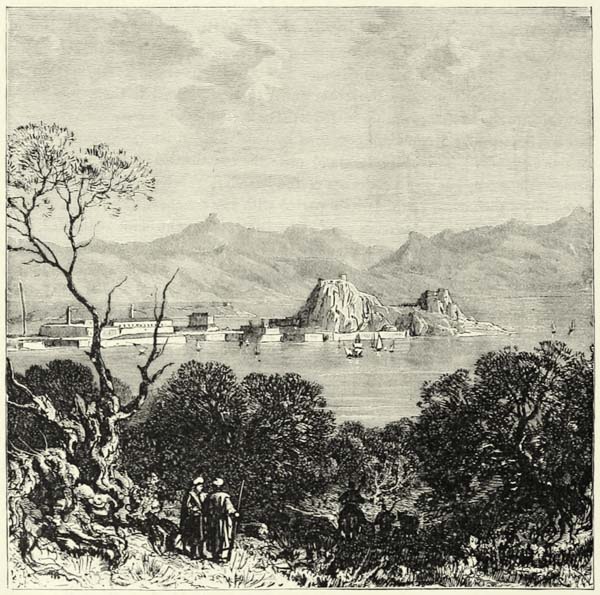
The city occupies a triangular peninsula opposite the coast of the Epirus, and is the largest, and commercially the most important, of the former republic. It is strongly fortified, and its successive possessors—Venetians, French, Russians, and English—have sought to render it impregnable. A beautiful prospect may be enjoyed from its bastions; but far superior is that from Mount Pantokratoros, the “commandant,” for it extends across the Strait of Otranto to Italy. The commercial relations with the latter, as well as the traditions of Venetian dominion, have converted Corfu into a city almost half Italian, and numerous families residing in it belong to both nations, the Greek and the Italian, by descent as well as language. Italian remained the official language of the island until 1830. Maltese porters and gardeners constitute a prominent element amongst the cosmopolitan population of the city.
Fig. 25.—CORFU.
Corfu formerly owned the town of Butrinto and a few villages on the mainland; but an English governor thought fit to surrender them to the terrible Ali Pasha, {77} and the only dependencies of Corfu at present are the small islets near it, viz. Othonus (Fano), Salmastraci, and Ericusa, in the north; Paxos, with its caverns, and Antipaxos, the rocks of which exude asphalt, on the south. Paxos is said to produce the best oil in Western Greece.
Leucadia, Cephalonia, Ithaca, Zante, and a few smaller islands, form a crescent-shaped archipelago off the entrance to the Gulf of Patras. They are the summits of a half-submerged chain of calcareous mountains, alternately flooded by the rains or scorched by the sun. Their valleys, like those of Corfu, produce oranges, lemons, currants (“Corinthians”), wine, and oil, which form the objects of a brisk commerce. The inhabitants very much resemble those of Corfu, the Italian element being strongly represented, except on Ithaca.
Μ
Fig. 26.—THE CHANNEL OF SANTA MAURA.
From the French Staff Map. Scale 1 : 200,000.
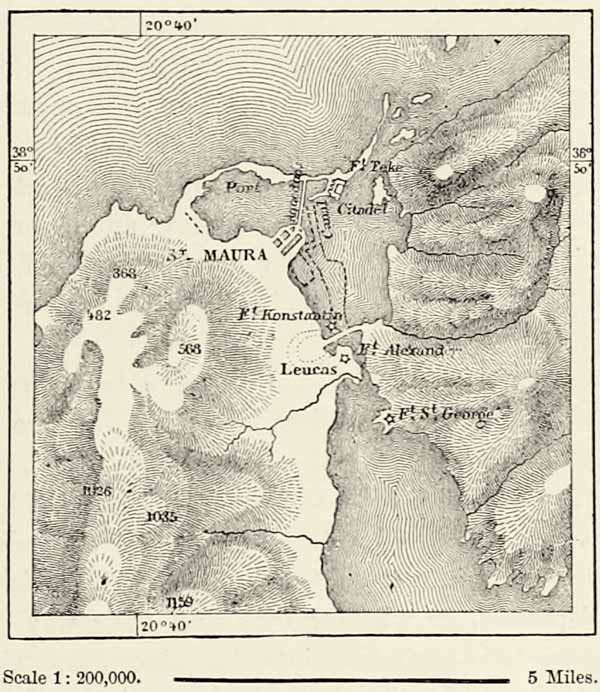
Leucadia, or the “white island,” thus called because of its glittering chalk cliffs, is evidently a dependency of the continent. The ancients looked upon it as a peninsula converted into an island by Corinthian colonists, who cut a canal through the isthmus which joined it to the mainland; but this legend is not borne out by an examination of the locality. These Corinthians probably merely dug a navigable channel through the shallow lagoon which separates the island from the coast, and does not exceed eighteen inches in depth. In fact, if there were any tides in the Ionian Sea, the island of Leucadia would be converted twice daily into a peninsula. A bridge, of which there still exist considerable remains, formerly joined the island to the mainland near the southern extremity of the lagoon, whilst an island occupied by the citadel of Santa Maura—a name sometimes applied to the whole of the island—defended its entrance to the north. {78} Until recently this was the only spot in Western Greece where a grove of date-trees might be seen. A magnificent aqueduct of two hundred and sixty arches, which was also used as a viaduct, joined the citadel to Amaxiki, the chief town and harbour of Leucadia. This monument of Turkish enterprise—it was constructed in the reign of Bajazet—has sustained much injury from earthquakes. Amaxiki might be supposed to be haunted by fever, owing to the salt swamps and lagoons which surround it; but such is not the case: on the contrary, it is a comparatively healthy town, and its women are noted for freshness of complexion and beauty. To the south of it rise the wooded mountains which terminate in the promontory of Leucate (Dukato), opposite to Cephalonia. On the summit of this promontory stood a temple of Apollo, whence, at the annual festival of the god, a condemned criminal was hurled as an expiatory victim. It was celebrated, also, as the lover’s leap, whence lovers leaped into the sea to drown their passion.
Cephalonia, or rather Cephallenia, is the largest of the Ionian Islands, and its highest summit—Mount Ænus, or Elato—is the culminating point of the entire Archipelago. Mariners from the centre of the Ionian Sea can see at one and the same time Mount Ætna in Sicily and this mountain of Cephalonia. The forests of conifers, to which the latter is indebted for its Italian name of Montenero, have for the greater part been destroyed by fire, but there still remain a few clumps of magnificent firs. On its summit may be seen the remains of a temple of Jupiter. The island is fertile and populous, but suffers much from want of water. All its rivers dry up in summer, the calcareous soil sucking up the rain, and most of the springs rise from the bottom of the sea, far away from the fields thirsting after water. On the other hand, two considerable streams of sea-water find their way into the bowels of the island.
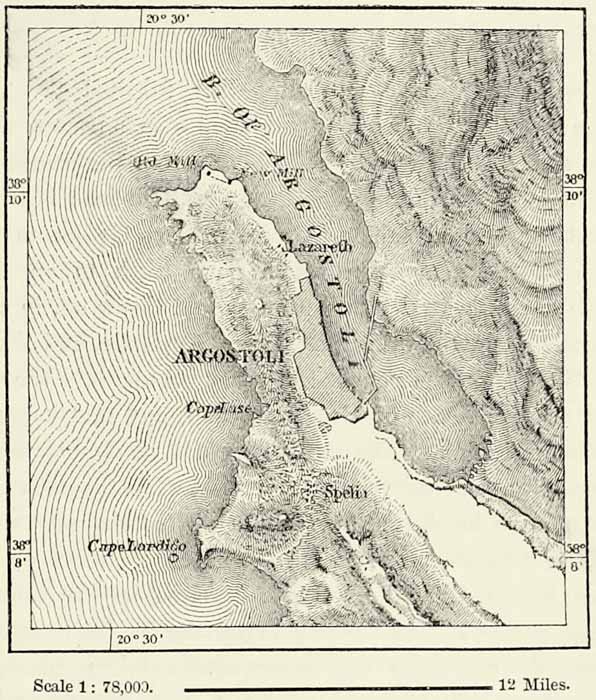
This curious phenomenon occurs a short distance to the north of Argostoli, a bustling town, having a safe but shallow harbour. The two oceanic rivers are sufficiently powerful to set in motion the huge wheels of two mills, one of which has been regularly at work since 1835, and the other since 1859. Their combined discharge amounts to 35,000,000 gallons daily, and naturalists have not yet decided whether they form a vast subterranean lake, in which beds of salt are constantly being deposited, or whether they find their way through numerous threads, and, by hydrostatic aspiration, into the subterranean rivers of the island, rendering their water brackish. The latter is the opinion of Wiebel, the geologist, and thus much we may assume for certain—that these subterranean waters and caverns are one of the principal causes of the severe earthquakes which visit Cephalonia so frequently. The island of Asteris, between Cephalonia and Ithaca, upon which stood the city of Alalkomenæ, exists no longer, and was probably destroyed by one of those earthquakes.
Ithaca of “divine Ulysses,” the modern Theaki, is separated from Cephalonia by the narrow channel of Viscardo, thus named after Robert Guiscard. The island is small, and all the sites referred to in the Odyssey are still pointed out there, from the spring of Arethusa to the acropolis of Ulysses; but the black forests which clothed the slopes of Mount Neritus have disappeared. The inhabitants are {79} excessively proud of their little island, rendered so famous by the poetry of Homer, and in every family we meet with a Penelope, a Ulysses, and a Telemachus. But the present inhabitants have no claim whatever to be the descendants of the crafty son of Laertes, for during the Middle Ages their ancestors were exterminated by invaders, and in 1504 the deserted fields were given, by the Senate of Venice, to colonists drawn from the mainland. Most of those immigrants came from the Epirus, and the dialect spoken by the islanders is much mixed with Albanian words. At the present time the island is well cultivated, and Vathy, its chief port, carries on a brisk commerce in raisins, currants, oil, and wine. Ithaca, as in the days of Homer, is the “nurse of valiant men.” The inhabitants are tall and strong, and Dr. Schliemann is enthusiastic about the high standard of virtue and morality prevailing amongst them. There are neither rich nor poor, but they are great travellers, and natives of Ithaca are met with in every populous city of the East.
Μ
Fig. 27.—ARGOSTOLI.
According to Wiebel. Scale 1 : 78,000.
“Zante, fior del Levante,” say the Italians. And, indeed, this ancient island, Zacynthus, is richer in orchards, fields, and villas than any other of this Archipelago. An extensive plain, bounded by ranges of hills, occupies the centre of this “golden isle”—a vast garden, abounding in vines, yielding currants of superior quality. The inhabitants are industrious, and not content with cultivating their own fields, they assist also in the cultivation of those of Acarnania, receiving wages or a share of the produce in return. The city of Zante, on the eastern coast of the island, facing Elis, is the wealthiest and cleanest town in the Archipelago. {80} Unfortunately it suffers frequently from earthquakes, to which a volcanic origin is ascribed. Nor is this improbable, for bituminous springs rise near the south-eastern cape of the island, and though worked since the days of Herodotus, they still yield about a hundred barrels of pitch annually. Oil springs discharge themselves close to the shore, and even at the bottom of the sea; and near Cape Skinari, in the north, a kind of rank grease floats on the surface of the waters.
The only islets dependent upon Zante are the Strivali, or the Strophades, to which flew the hideous harpies of ancient mythology.19
VI.—THE PRESENT AND THE FUTURE OF GREECE.
The Greeks, although they have not altogether fulfilled the expectations of Philhellenes, have nevertheless made great strides in advance since they have thrown off the yoke of the Turks. The deeds of valour performed during the war of independence recalled the days of Marathon and Platæa; but it was wrong to expect that a short time would suffice to raise modern Greece to the intellectual and artistic level of the generation which gave birth to an Aristotle and a Phidias. Nor can we expect that a nation should throw off, in a single generation, the evil habits engendered during an age of servitude, and digest at once the scientific conquests made in the course of twenty centuries. We should likewise bear in mind that the population of Greece is small, and that it is thinly scattered over a barren mountain region. The numerous ports, no doubt, offer great facilities for commerce, nor have their inhabitants failed to avail themselves of them; but there is hardly a country in Europe which offers equal obstacles to a development of its agricultural and industrial resources. The construction of roads, owing to the mountains, meets with difficulties everywhere, whilst the blue sea invites its beholders to distant climes and commercial expeditions. No immigration from the neighbouring Turkish provinces has consequently taken place, whilst many Hellenes, and more especially natives of the Ionian Islands and the Cyclades, annually seek their fortune in Constantinople, Cairo, and even distant India. Men of enterprise leave the country, and there remains behind only a horde of intriguers, who look upon politics as a lucrative business, and an army of government officials, who depend upon the favour of a minister for future promotion. This state of affairs explains the singular fact that the most prosperous Greek communities exist beyond the borders of the kingdom of Greece. These foreign communities are better and more liberally governed than those at home. In spite of the Pasha, who enjoys the right of supervision, the administration of the smallest Greek {81} community in Thracia or Macedonia might serve as a pattern to the independent and sovereign kingdom of Greece. Every one there takes an interest in the prosperity of the commonwealth; but in Greece a rapacious bureaucracy takes care only of its own advancement, the electors are bribed, and the expenses thus illegally incurred are recovered by illegal exactions and robbery, such as have prevailed for many years.
The actual population of Greece may amount to 1,500,000 souls; that is to say, it includes about two-fifths of all the Greeks residing in Europe and Asia. The population is less dense than in any other country of Europe, including Turkey. Greece, at the epoch of its greatest prosperity, is said to have supported 6,000,000 or 7,000,000 inhabitants. Attica was ten times more populous at that time, and many islands which now support only a few herdsmen could then boast of populous towns. Sites of ancient cities abound on the barren plateaux, on the banks of the smallest rivulet, and crown every promontory throughout the ancient countries of the Hellenes, from Cyprus to Corfu, and from Thasos to Crete.
The country, however, is being gradually repeopled. Before the war of independence, the population, including the Ionian Islands, amounted, perhaps, to 1,000,000; but battles and massacres diminished it considerably, and in 1832 the number of inhabitants was 950,000 at most. Since that epoch there has been an annual increase varying between 9,000 and 14,000 souls. This increase, however, is spread very unequally over the country. The towns increase rapidly, but several islands, and more especially Andros, Santorin, Hydra, Zante, and Leucadia, lose more inhabitants by emigration than they gain by an excess of births over deaths. The swamp fevers prevailing in continental Greece much retard the increase of population. Naturally the climate is exceedingly salubrious, but the water, in many localities, has been permitted to collect into pestilential swamps, and the draining of these and their cultivation would not only add to the wealth of the country, but would likewise free it from a dire plague.20
Unfortunately agriculture progresses but slowly in Greece, and its produce is not even sufficient to support the population, still less to supply articles for export. And yet the cultivable soil of Greece is admirably suited to the growth of vines, fruits, cotton, tobacco, and madder. Figs and oranges are delicious; the wines of Santorin and the Cyclades are amongst the finest produced in the Mediterranean; the oil of Attica is as superior now as when Athene planted the sacred olive-tree; {82} but, excepting a little cotton grown in Phthiotis, and the raisins known as currants or Corinthians, which are exported from the Ionian Islands and Patras to the annual value of about £1,500,000, agriculture contributes but little towards the exports. One of the principal articles is the valonia, a species of acorn picked up in the forests, and used by tanners.
In a country so far behindhand in agriculture manufactures cannot be expected to flourish. All manufactured articles have consequently to be imported from abroad, and especially from England. Greece does not even possess tools to work its famous marble quarries, though they are richer than those of Carrara. There is only one metallurgical establishment in the whole of the kingdom—that of Laurion. The ancients had been working argentiferous lead mines in that part of the country for centuries, and vast masses of unexhausted slag had accumulated near them. This waste is now being scientifically treated in the smelting-works of Ergastiria, and nearly ten thousand tons of lead, and a considerable quantity of silver, are produced there annually. Quite a brisk little town has arisen near the works, and its harbour is one of the busiest in all Greece. But the founders of this flourishing concern had to struggle against jealousies, and the “Laurion question” nearly embroiled the Governments of France and Italy with Greece.21
The Greeks do not support themselves by agriculture, nor can they boast of manufactories, and they would be doomed to starvation if they did not maintain six thousand vessels acting in the lucrative business of ocean carriers throughout the Mediterranean. This Greek mercantile marine is superior to that of Russia, almost equal to that of Austria, and six times larger than that of Belgium, and we should bear in mind that many vessels sailing under Turkish colours are actually owned by Greeks. The ancient instinct of the race comes out strongly in this coast navigation. The large fleets of swift ocean steamers belong to the powerful companies of the West, and the Greeks are content to sail in small vessels suited to the requirements of the coasting trade, which hardly ever extend their voyages beyond the limits of the ancient Greek world. None can compete with them as regards low freight, for every sailor has an interest in the cargo, and all of them are anxious to increase the profits. One may have furnished the wood, another the rigging, a third a portion of the cargo, whilst their fellow-citizens have advanced money for the purchase of merchandise, without requiring any bond except their word of honour. On many of these vessels all are partners, all work alike, and share in the proceeds of the venture.
But, whatever the sobriety and intelligence of these Greek mariners, they cannot escape the fate which has overtaken the small trader and the handicraftsman throughout the world. The cheap vessels of the Greeks may be able to contend for a long time against the steamers of powerful companies, but in the end they must succumb. The country will lose its place amongst the commercial nations of the world unless its agricultural and industrial resources are quickly developed, {83} and railways are constructed to convey the products of the interior to the sea-coast. Greece, even now, has only a few carriage roads, not so much because the mountains offer insurmountable obstacles, but because its heedless inhabitants are content with the facilities for transport offered by the sea. It would be impossible in our day to travel from the Pylos to Lacedæmon in a chariot, as was done by Telemachus; for the road connecting these places leads along precipices and over dangerous goat paths. Greece and Servia are the European states which remained longest without a railway, and even now the former is content with a short line connecting Athens with its harbour. It has certainly been proposed to construct several lines of the utmost importance, but, owing to the bankrupt condition of the Greek exchequer, these works have not yet been begun. The public income is not sufficient to meet the expenditure, the debt exceeds £15,000,000, and the interest on the loans remains unpaid.22
The poverty of the majority of the inhabitants of Greece is equal to that of the State. The peasants are impoverished by the payment of tithes, and of a Government impost double or even treble their amount. Though naturally very temperate, they are hardly able to sustain life; they dwell in unwholesome dens, and are frequently unable to put by sufficient means for the purchase of clothing and other necessaries. The young men of the poorest districts of Greece thus find themselves forced to emigrate in large numbers, either for a season or for an indefinite period. Arcadia may be likened in this respect to Auvergne, to Savoy, and to other mountain countries of Central Europe. The Ætolians, however, exchange their fine savage valleys for foreign cities only very reluctantly, though they, too, suffer intensely from the weight of taxation. In ancient times, before their spirit was broken by servitude, they would have resisted the tax-gatherer with arms in their hands. They now content themselves with sallying forth from their villages, in order to pile up a heap of stones by the side of the high-road, as a testimony of the injustice with which they have been treated. This heap of stones is anathema. Every peasant passing it religiously adds a stone to this mute monument of execration, and the earth, the common mother of all, is thus charged with the task of vengeance.
Ignorance, the usual attendant of poverty, is great in the rural districts of Greece, and especially in those difficult of access. In Greece, as in Albania and Montenegro, they believe in perfidious nymphs, who secure the affections of young men, and then drag them down below the water; they believe in vampyres, in the evil eye and witchcraft. But the Greeks are an inquiring race, anxious to learn, in spite of their poverty. The peasant of Ithaca will stop a traveller of education on the road, in order that he may read to him the poetry of Homer. Elementary schools have been established in nearly every village, in spite of the poverty of the Government. If no school buildings can be secured, the classes meet in the open air. The scholars, far from playing truant, hardly raise their eyes from the books to notice a passing stranger or the flight of a bird. The scholars in the superior schools and at the University of Athens are equally {84} conscientious and assiduous. It may be that some of them merely aspire to become orators, but they certainly do not resort to a city on the pretence of study, whilst in reality they yield themselves up to debauchery. Amongst the students of the University of Athens there are many who work half the night at some handicraft, others who hire themselves out as servants or coachmen, to enable them to pursue their studies as lawyers or physicians.
This love of study cannot fail to secure to the Greek nation an intellectual influence far greater than could be looked for from the smallness of its numbers. The Greeks of the East, moreover, look upon Athens as their intellectual centre, whither they send their sons in pursuit of knowledge. They found scholarships in connection with the schools of Athens, and largely contribute towards their support. And it is not only the rich Greek merchants of Trieste, Saloniki, Smyrna, Marseilles, and London who are thus mindful of the true interests of their native country, but peasants of Thracia and Macedonia, too, devote their savings to the promotion of public education. The people themselves support their schools and museums, and pay their professors. The Academy of Athens, the Polytechnic School, the University, and the Arsakeion, an excellent ladies’ college—these all owe their existence to the zeal of Greek citizens, and not to the Government. It may readily be understood from this how carefully these institutions are being watched by the entire nation, and how salutary must be the influence of young men and women returning to their native provinces after they have been educated at them.
It is thus a common language, common traditions, and a common hope for the future that have made a nation of the Greeks in spite of treaties. Greek patriotism is not confined to the narrow limits laid down by diplomacy. Whether they reside in Greece proper, in European or Asiatic Turkey, the Greeks feel as one people, and they lead a common national life independently of the Governments of Constantinople and Athens. Nay, amongst the Greeks dwelling in foreign lands this feeling of nationality is, perhaps, most intense, for they are not exposed to the corrupting influence of a bureaucracy. They have more carefully guarded the traditions and practices of municipal government, and are practically in the enjoyment of greater individual liberty. The Greek nation, in its entirety, numbers close upon 4,000,000 souls. Its power, already considerable, is growing from day to day, and is sure to exercise a potent influence upon the destinies of Mediterranean Europe.
We are told sometimes that community of religion might induce the Greeks to favour Russian ambition, and to open to that power the road to Constantinople. Nothing can be further from the truth. The Hellenes will never sacrifice their own interests to those of the foreigner. Nor do there exist between Greece and Russia those natural ties which alone give birth to true alliances. Climate, geographical position, history, commerce, and, above all, a common civilisation, attach Greece to that group of European nations known as Greco-Latin. In tripartite Europe the Greeks will never range themselves by the side of the Slav, but will be found amongst the Latin nations of Italy, France, and Spain.
Μ
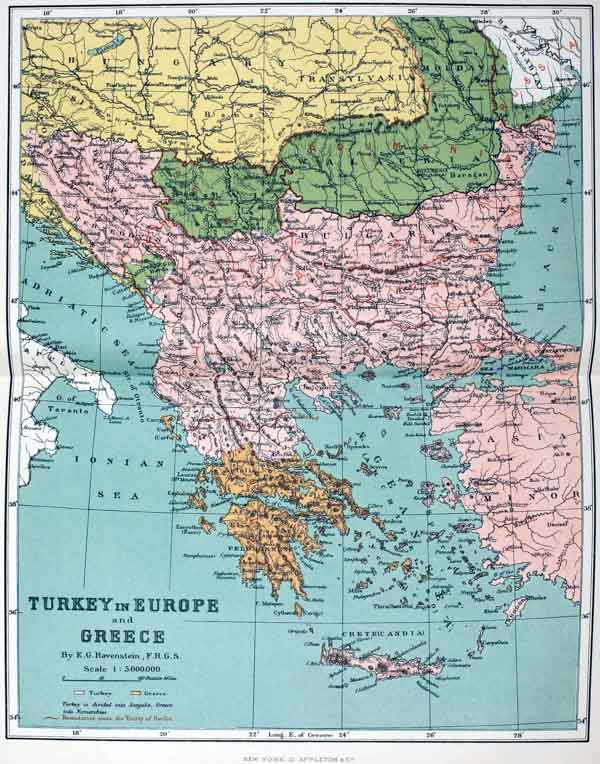
TURKEY IN EUROPE and GREECE
By E. G. Ravenstein, F.R.G.S. Scale 1 : 5,000,000.
{85}
VII.—GOVERNMENT AND POLITICAL DIVISIONS.
The protecting powers have bestowed upon Greece a parliamentary and constitutional Government, modelled upon West European patterns. Theoretically the King of the Greeks reigns, but does not govern, and his ministers are responsible to the Chambers, whose majority changes with the fluctuations of public opinion. In reality, however, the power of the King is limited only by diplomacy. Nor do those Western institutions respond to the traditions and the genius of the Greeks, and although the charter has been modified three times since the declaration of independence, it has never been strictly adhered to.
In accordance with the constitution of 1864, every Greek citizen possessing any property whatever, or exercising a profession, has a right to vote on attaining his twenty-fifth year, and becomes eligible as a deputy at thirty. The deputies, one hundred and eighty-seven in number, are elected for four years, and are paid for their services. The civil list of the King, inclusive of a subvention granted by the protecting powers, amounts to £46,000 a year.
The orthodox Greek Church of Hellas is independent of the Patriarch of Constantinople. It is governed by a Holy Synod, sitting in the capital, and presided over by an archbishop as metropolitan. A royal commissioner is present at the meetings of the Synod, and countersigns every proposition that is carried. Decisions not bearing this official signature are void. The King, on the other hand, is permitted to dethrone or remove a bishop only by consent of the Synod, and in accordance with the canon law. The constitution guarantees religious liberty, but this official Church nevertheless exercises considerable powers, and frequently calls upon the civil authorities to give force to its decrees. The Synod carefully watches over the observance of religious dogmas; it points out to the authorities heretical or heterodox preachers and writers, and demands their suppression; exercises a censorship over books and religious pictures; and calls upon the civil tribunals to punish offenders.
There are no longer any Mohammedans in Greece, except sailors or travellers, and the last Turk has quitted Eubœa. The only Church besides the established one which can boast a considerable number of adherents is the Roman Catholic. It prevails amongst the middle classes on Naxos, and on several others of the Cyclades, and is governed by two archbishops and four bishops.
Greece is divided into thirteen nomes, or nomarchies, and these, again, into fifty-nine eparchies. Each eparchy is subdivided into districts, or dimes (dimarchies), and the latter into parishes, governed by paredres, or assistant dimarchs. These officials are appointed by the King, and are in receipt of small emoluments. The number of officials is proportionately greater in Greece than in any other part of Europe. They form the sixtieth part, or, including their families, the twelfth part of the population, and although their pay is small, they swallow up between them more than half the public income. {86}
The thirteen nomes and fifty-nine eparchies of Greece, with their population in 1870:―
Eparchies. Population.
Mantinea 46,174
Kynuria 26,733
Gartynia 41,408
Megalopolis 17,425
Arkadia 131,740
Lakedæmon 46,423
Gythion 13,957
Itylos (Œtylos) 26,540
Epidauros Limera 18,931
Lakonia 105,851
Kalamæ 25,029
Messini 29,529
Pylia 20,946
Triphylia 29,041
Olympia 25,872
Messenia 130,417
Nauplia 15,022
Argos 22,138
Korinthia 42,803
Spetsæ and Hermionis 19,919
Hydra and Trizinia 17,301
Kythyra 10,637
Argolis and Korinthia 127,820
Syros 30,643
Koa 8,687
Andros 19,674
Tinos 11,022
Naxos 20,582
Thira (Thera, Santorin) 21,901
Milos 10,784
Kyklades 123,293
Attiki 76,919
Ægina 6,103
Megaris 14,949
Thiva (Thebæ) 20,711
Livadia 18,122
Attiki and Viotia (Bœotia) 136,804
Khalkis 29,013
Xerochorion 11,215
Karystia 33,936
Skopelos 8,377
Euvia (Eubœa) 82,541
Phthiotis 26,747
Parnasis 20,368
Lokris 20,187
Doris 49,119
Phthiotis and Phokis 106,421
Mesolongion (Missolonghi) 18,997
Valtos 14,027
Trichonia 14,453
Evrytania 33,018
Navpaktia 22,219
Vonitza and Xeromeros 18,979
Akarnania and Ætolia 121,693
Patras 46,527
Ægialia 12,764
Kalavryta 39,204
Ilia (Elis) 51,066
Achaia and Ilis (Elis) 149,561
Kerkyra (Corfu) 25,729
Mesi 21,754
Oros 24,983
Paxi (Paxos) 3,582
Leucas (Santa Maura) 20,892
Kerkyra (Corfu) 96,940
Kranæa 33,358
Pali 17,377
Sami 16,774
Itaki 9,873
Kephallinia 77,382
Zakynthos (Zante) 44,557
The modern nomenclature has been adopted in the above table.