ITALY.* (continued 3)
Reading edition
An uncultivated and insalubrious region extends, likewise, along the sea to the south of the Tiber. Poisonous vapours arise from the stagnant waters separated by dunes from the sea, and in order to escape them it is necessary to seek a refuge in the hills of the interior, or even on jetties built out into the sea, as at Porto d’Anzio. The palaces which formerly lined the shore from Ostia to Nettuno, and from the ruins of which have been recovered some of our most highly valued art treasures, such as the Gladiator and Apollo Belvedere, have been buried long ago beneath the dunes or in the swamps. The most dreaded of these malarial districts lies at the foot of the Monti Lepini, and extends from Porto d’Anzio to Terracina. It is known as the Pontine Marshes, from Pometia, a city said to have perished before historical times. No less than twenty-three cities formerly flourished in what is now a deserted and deadly country, but which was the most prosperous of the districts held by the confederation of the Volsci. The Roman conquerors created “peace and solitude” at the same time. Four hundred and forty years after the building of Rome, when Appius constructed his famous road to Terracina, the country was only a swamp. Various attempts have been made since to reclaim this region, but it still remains the haunt of boars, deer, and semi-savage buffaloes, whose ancestors were imported from Africa in the seventh century. The canals dug during the reign of Augustus appear to have been of little use; the works undertaken by Theodoric the Goth were more efficacious; but stagnant waters and malaria in the end regained the mastery. The engineers employed by Pius VI. towards the close of the eighteenth century failed likewise, and this district of 290 square miles remains a wilderness to the present day. If a brigand seeks refuge in it, pursuit is stopped, and he is allowed to die in peace.
Μ
Fig. 95.—THE PONTINE MARSHES.
Scale 1 : 280,000.
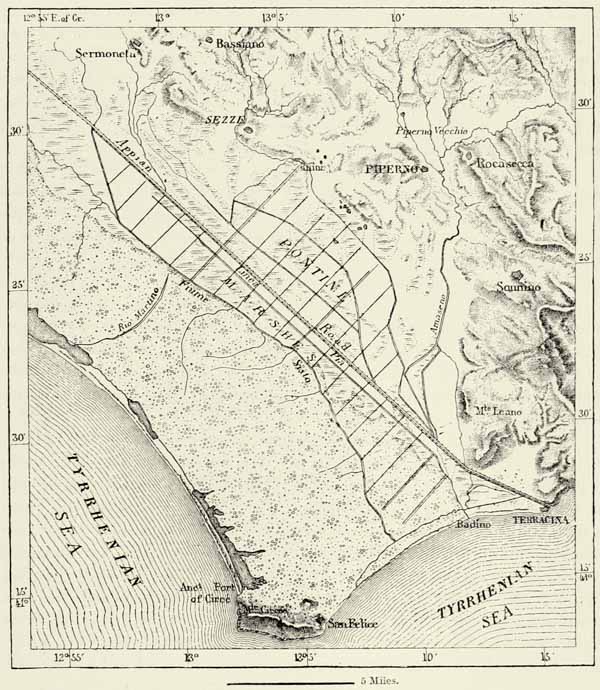
In order to drain these marshes an accumulation of difficulties will have to be surmounted. A range of wooded dunes bounds the marshes on the west. Having crossed these, we enter a second zone of marshes, which are separated from the sea by a second range of dunes, extending northward from the Monte Circello, and likewise densely wooded. These two formidable barriers would have to be surmounted in order to drain the marshes towards the west. Nor are the prospects more promising in the direction of Terracina, for there, too, every outlet is stopped by dunes. The streams and canals crossing the marshes are, moreover, choked up with a dense {267} growth of aquatic plants, which impedes the circulation of the water, feeble though it be. Herds of buffaloes are sometimes driven into these streams to trample down the vegetation, but neither this barbarous procedure nor the more regular process of mowing has availed against its rapid and luxuriant growth, and the water remains stagnant. Rains are not only heavy in this portion of Italy, but the superabundant waters of neighbouring river basins actually find their way through subterranean channels into the depression occupied by the Pontine Marshes. This happens after heavy rains in the case of the Sacco, a tributary of the Garigliano, and of the Teverone, a tributary of the Tiber, and to this circumstance {268} must be ascribed the curious fact first ascertained by M. de Prony, viz. that the volume of water annually discharged by the Badino, which drains the marshes, exceeds by one-half the whole of the rain which annually descends upon them. When this happens the whole of the country is under water. Another danger arises during dry weather. It happens then occasionally that the parched vegetation is ignited through the carelessness of herdsmen; the fire communicates itself to the turfy soil, and the latter smoulders until the subsoil water is reached. In this manner tracts of land which were looked upon as secure against every inundation are converted into marsh. During the greater portion of the year the Pontine Marshes present the appearance of a plain covered with herbage and flowers, and it is matter for surprise that a country so fertile should be without inhabitants. The town of Ninfa, which was built in the eleventh century, near the northern extremity of the plain, has since been abandoned, its walls, houses, and palaces still remaining, covered with ivy and other creeping plants.
There can be no doubt that our engineers would be able to reclaim this desolate region. The system adopted in the case of the valley of the Chiana may not be practicable, but other, if more costly, means may be devised. Whatever the outlay, it is sure to be productive, for even now the marshes yield rich harvests of wheat and maize.
The Tiber, or Tevere, the great river of the Romans, has defied all attempts at correction down to our own days, and its sudden floods are said to be even more formidable now than they were in the days of the Republic. Ever since the time of Ancus Martius there has been going on a struggle against the alluvium brought down by the river, and it will need all the skill of the Italian engineers to master this difficult problem.
The Tiber is by far the most important river of the peninsular portion of Italy, and its basin is the most extensive.90 It is, too, the only river that is navigable in its lower course, from Ostia to Fidenæ. The Tiber rises on the western slope of the Alpe della Luna, in the latitude of Florence. The valley through which it flows, whilst in the heart of the Apennines, is of surpassing beauty; at one time it expands into broad and fertile basins, at others it is hemmed in by precipitous rocks. Below the charming basin of Perugia the Tiber receives the Topino, formed by the confluence of several streams in the old lacustrine basin of Foligno, one of the most delightful districts of all Italy, situated at the foot of the Great Apennines and of the Col Fiorito, which leads across them. The Clituno (Clitumnus) debouches upon this plain, famous on account of its pellucid waters:―
“The most living crystal that was e’er
The haunt of the river nymph, to gaze and lave
Her limbs.”
The ruins of a beautiful temple still remain near the source of this river, but the miraculous power of the latter of changing into a brilliant white the wool of the sheep grazing upon its sacred banks has gone for ever. {269}
Μ
Fig. 96.—ANCIENT LACUSTRINE BASINS OF THE TIBER AND TOPINO.
Scale 1 : 294,000.
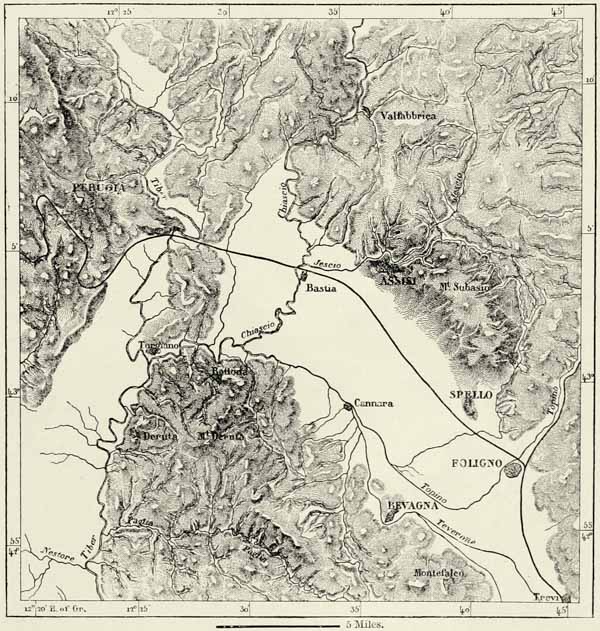
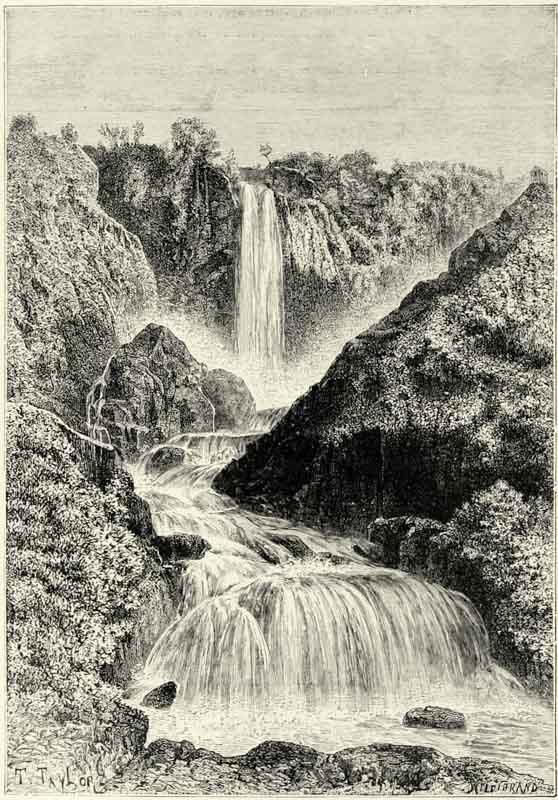
Fig. 97.—THE CASCADES OF TERNI.
Μ
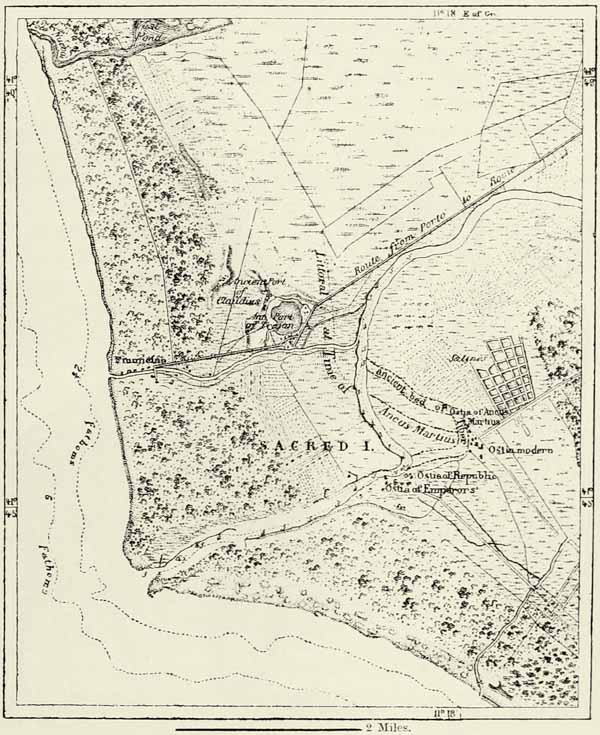
Fig. 98.—THE DELTA OF THE TIBER.
According to Darondeau (1861) and Desjardins.
The Nera is the most important tributary of the Tiber; “it gives it to drink,” as the Italian proverb says, and rivals it in volume. It is formed by the junction of several streams descending from the Sibylline Mountains, Monte Velino, and the Sabine Hills. About two thousand years ago, it is said, most of these rivulets did not reach the Tiber; they were intercepted in the plain of Rieti, where they formed the Lacus Velinus, represented at the present day by a few ponds and marshes scattered over the fertile fields of the “Garden of Roses.” A breach effected in the calcareous rocks, and several times enlarged since, allowed the pent-up waters of the Velino to escape to the Nera, and in doing so they formed those beautiful cascades of Marmora, above Terni, whose charms have been celebrated by poets and painters. The river falls down a perpendicular height of {270} 542 feet in a single sheet, and then rushes down, over heaped-up blocks of rock, until it joins the more placid waters of the Nera. Far less grand, but perhaps {271} more charming, are the numerous cascatellas of the Anio, or Teverone, the last affluent of any importance which the Tiber receives above Rome. Standing on the verdant hill upon which is built the picturesque town of Tivoli, silvery cascades may be seen to escape in every direction. Some of them glide down the polished rocks; others shoot forth from gloomy arches, remain suspended an instant in the air, and then disappear again beneath the foliage; but every one of them, whether a powerful jet or a mere thread of water, possesses some charm of its own, and, as a whole, they form one of the most delightful spectacles to be witnessed in Italy. It is these cascades which have rendered Tivoli famous throughout the world; and in spite of the popular rhyme—
“Tivoli di mal conforto,
O piove, o tira vento, o suona a morto !”—
{272}
modern residences have taken the place of the villas of the ancient Romans, amongst which that of Hadrian was the most sumptuous. Its ruins, to the west of Tivoli, cover an area of three square miles. Recently it has been proposed to {273} utilise the great water power of the Anio far more extensively than has been done hitherto. The ancients contented themselves with quarrying the concretionary limestone, or travertin, deposited by the calcareous waters of the river, sometimes to the depth of a hundred feet. They made use of this stone for the construction of their public buildings. Travertin, when first quarried, is white; after a certain time it turns yellow, and subsequently assumes a beautiful roseate hue, which imparts a character of majesty to the edifices constructed of it.
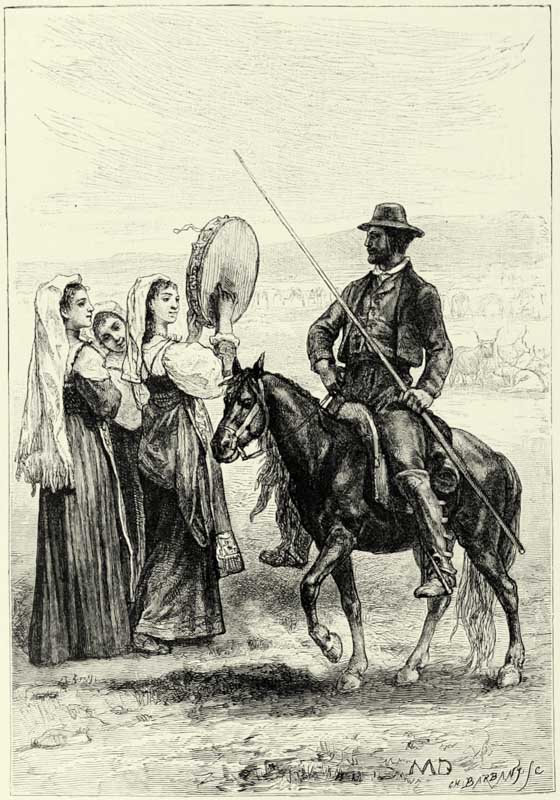
Fig. 99.—PEASANTS OF THE ROMAN CAMPAGNA.
Below their confluence with the Anio, the yellow waters of the Tiber, discoloured by the clay brought down from the plains of Umbria, rush beneath the bridges of Rome. Soon afterwards the river winds round the last hills, which formerly bounded an ancient gulf of the sea, now silted up. The influence of the tides makes itself felt. At the head of the Sacred Island, formerly dedicated to Venus, and famous for its roses, but now a dreary swamp, covered with reeds and asphodels, it bifurcates. The principal branch, the old Tiber, passes to the south of this island. Ostia, which was the port of the river during the early days of Rome, is buried now beneath fields of cereals and thistles, at a distance of five miles from the sea. Excavations made there since 1855 have laid bare several temples, tombs, and warehouses. The merchants of Rome were compelled to abandon that city two thousand years ago, on account of a bar formed at the mouth of the river.
The Roman emperors, anxious to have an outlet into the sea, ordered a ship canal to be excavated to the north of Ostia. This is the Fiumicino, which the erosive action of the Tiber has converted into a small river. Claudius had huge docks excavated to the north of this canal, and a new Ostia arose near them. Trajan opened another port to the south-east of it, which remained for several centuries the port of Rome. But it, too, has been silted up for about a thousand years, and the alluvium brought down by the Tiber is continually encroaching upon the sea, the rate of progress being about three feet annually at the mouth of the Fiumicino, and ten feet at that of the old Tiber. Extensive ruins of palaces, baths, and storehouses exist near the ancient port of Trajan, and several works of art have recently been excavated there.
The mouth of the Tiber is thus closed by a bar, like that of all other rivers which flow into the Mediterranean; and the Romans, instead of being able to make use of their river for communicating with the sea, are obliged to have recourse to more distant harbours. In former times they kept up this communication with Sicily, Greece, and the Orient through Antium, Anxur (Terracina), and even Puteoli; but since the countries of the North have risen into political and commercial importance, Cività Vecchia has become the great maritime entrepôt of the valley of the Tiber. It is well known that Garibaldi has conceived the stupendous project of converting Rome into a great maritime city. The stagnant waters of the Campagna are to be carried off by means of a huge sanitary canal, the bed of the Tiber is to be deepened, and an artificial harbour capable of receiving the largest vessels is to be constructed far out in the Mediterranean. {274}
The execution of this vast scheme is no doubt attended with immense difficulties, not the least amongst which are the annual floods of the Tiber. Ancient writers tell us that these inundations were dreaded not only because of the damage done directly, but also because of the great quantities of animal and vegetable deposits which remained in the fields after the subsidence of the waters. The nature of these floods has continued the same down to the present time. At Rome, though its distance from the sea is only twenty-two miles, the river frequently rises forty or fifty feet, and in December, 1598, it rose sixty-five feet ! How is this huge volume of water to be disposed of after it has passed beneath the bridges of Rome? If the destruction of the forests in the Apennines is one of the principal causes of these floods, will it be sufficient to replant them? Or would it be preferable to restore some of those ancient lakes into which numerous rivers discharged themselves, which now take their course to the sea? The difficulties are great indeed, for the western slope of the Apennines is exposed to the rain-bearing westerly and south-westerly winds, and the floods of every one of the numerous tributaries of the Tiber take place simultaneously, and combine to form one vast inundation.
It is by no means difficult to account for the great floods of the Tiber which take place in winter, but the condition of the river during summer has for a long time baffled inquiry. The level of the river during the dry season is far higher than could possibly be accounted for by the small quantity of rain which falls within its basin. Its volume in summer is never less than half its average volume, a phenomenon not hitherto observed in the case of any other river. The Seine has a basin five times larger than that of the Tiber, and its average volume is almost double; yet, after a continuance of dry weather, its volume is only a third or fourth of the Italian river. This perennity of the Tiber can only be accounted for by assuming that it is fed, during the dry season, from subterranean reservoirs, in which the water is stored up during winter. These reservoirs must be very numerous, if we are to judge by the numerous “sinks,” or “swallows,” met with on the calcareous plateaux of the Apennines. One of these sinks, known as the “Fountain of Italy,” near Alatri, close to the Neapolitan frontier, has the appearance of a huge pit, 160 feet in depth and 300 feet across. Its bottom is occupied by a forest, and numerous springs give rise to luxuriant herbage, upon which sheep lowered by means of ropes feed with avidity. It is from sinks like this that the rivers of the country, the Tiber and the Sacco, are fed. It has been computed by Venturoli and Lombardini, the engineers, that about three-fourths of the liquid mass of the Tiber during winter are derived from subterranean lakes hidden in the depths of the Apennines. The volume of water annually supplied from this source to the Tiber would fill a basin having an area of 100 square miles to a depth of 80 feet ! 91
Primitive Rome is to a large extent indebted for her power to the Tiber, not {275} because that river is navigable, but because it traverses the centre of a vast basin, of which Rome is the natural capital. Rome, moreover, occupied a central position with regard to the whole of Italy and the world of the ancients; but, as has already been pointed out, Rome no longer lies upon any of the great high-roads of nations. That city certainly occupies not only the centre of Italy, but of all the countries surrounding the Tyrrhenian Sea; and its climate would leave little to be desired, if it were not for the insalubrity of the Campagna. Still Rome, though the residence of two sovereigns, the King of Italy and the Pope, is not even the principal city of the peninsula, and still less the capital of the Latin race. It is said that during the Middle Ages, when the popes resided at Avignon, the population of Rome was reduced to 17,000 souls. Gregorovius, than whom no one is better acquainted with that epoch in the history of Rome, doubts this; but there can be no doubt that after the sack ordered by the Constable of Bourbon its population was reduced to 30,000 souls. More recently Rome has increased rapidly, but it is still very inferior to Naples, and even to Milan.
From the very first the Romans were a mixed race. The myth of Romulus and Remus, the rape of the Sabine women, and incessant internal conflicts bear evidence to this fact. The remains of ancient cities, cyclopean walls, burial-grounds, urns, vases, and ornaments prove that on the right bank of the Tiber the Etrurians were at least as strong as the Italians. Elsewhere the Gauls predominated, and from an intermixture of all these various peoples sprang the primitive Roman.
When Rome had reached the zenith of her power things wore a different aspect, and thousands of foreigners became amalgamated with the Latins, Gauls, Iberians, Mauritanians, Greeks, Syrians, and Orientals of every race and climate; slaves, freemen, and citizens flocked towards the capital of the world, and modified the character of its inhabitants. Towards the close of the Empire there were more strangers within the walls of Rome than Romans, and when the empire of the West broke to pieces, and the empress-city was pillaged repeatedly by barbarian hordes, the Italians had already become mixed with the most diverse elements. This endless mixture between different races, victors and vanquished, masters and slaves, accounts, perhaps, more satisfactorily for the great changes which have taken place in the course of two thousand years in the character and spirit of the Romans. Still the Romans on the right bank of the Tiber, the so called Trasteverini, have preserved the old Roman type, as transmitted to us in statues and on medals.
Fig. 100.—ROME.
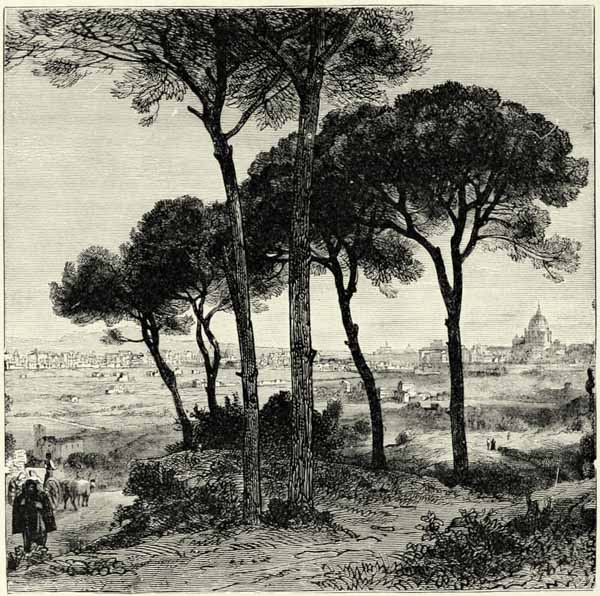
Rome is great because of its past, and its ruins are more attractive than its modern buildings; it is a tomb rather than a living city. These monuments, raised by the former masters of the world, strongly impress the imagination. The sight of the Coliseum arouses an admiration akin to terror, unless we look upon this formidable edifice as a mere heap of stones. The thought that this vast arena was crowded with men who sought to kill each other, that the steps surrounding it were occupied by 80,000 human beings who delighted in this butchery and {276} encouraged it by their shouts, calls up an amount of baseness, ferocity, and frenzy, whose existence could not fail to sap the foundations of Roman civilisation, and make it an easy prey to the barbarian. The Forum awakens memories of quite a different nature. Abominations were practised there, too, but its history as a whole exhibits it as the true centre of the Roman world. It was from this spot that the first impetus was given to the nations of the West; it was here that the ideas imported from every quarter of the world bore fruit. The walls, columns, temples, and churches which surround the Forum relate in mute language the principal events in the history of Rome; and if we search beneath existing edifices we meet with structures more ancient, which take us back to a period still more remote, for edifice has succeeded edifice on this spot, where pulsated the life of the Roman people. And thus it is throughout Rome. Every ancient monument, arcade, or broken column, every stone, bears witness to some {277} historical event, and though it may be difficult sometimes to interpret these witnesses of the past, the truth is elicited by degrees.
In spite of pillage and wholesale destruction, there still exist numerous ancient monuments, of which the Pantheon of Agrippa is one of the most marvellous. The Vandals, who are usually charged with the work of destruction, pillaged the city, it is true, but they demolished nothing. The systematical destruction had begun long before their time, when the materials for building the first church of St. Peter were taken from the Circus of Caligula, and from other monuments near it. The same plan was pursued in the construction of innumerable other churches and buildings of every kind. Statues were broken to pieces and used for making lime, and in the beginning of the fifteenth century there only remained six of them in all Rome, five of marble and one of bronze. The invasion of the Normans in 1084, and the numerous wars of the Middle Ages, which were frequently attended by pillage and conflagrations, wrought further havoc, but so large had been the number of public buildings and monuments, that on the revival of art in the sixteenth century many still remained for study and imitation. Since that time the architectural collection enclosed by the walls of Rome has been guarded with the utmost care, and still further enriched by the masterpieces of Michael Angelo, Bramante, and others.
On the Palatine Hill the most curious remains of ancient Rome, including the foundations of the palaces of the Cæsars and of the walls of Roma Quadrata, have recently been laid open. It was on this hill, so rich in precious relics, that the first Romans built their city, in order to afford it the protection of steep escarpments, and of the marshes on the Tiber and Velabro. When Rome grew more populous it became necessary to descend from this hill. The town spread over the valley of the Velabro, which had been drained by Tarquin the Etruscan, and then climbed up the surrounding hills. A small island in the Tiber occupied its centre. This the Romans looked upon as a sacred spot. They enclosed it by a masonry embankment, shaped like a ship, erected an obelisk in its centre to represent a mast, and a temple of Æsculapius upon the poop. This island was likened to a vessel bearing the fortunes of Rome.
There is still another Rome, the subterranean one, which is well worth study, for we learn more from it about early Christianity than from all the books that have been written. The crypts of the Christian burying-places occupy a zone around the city a couple of miles in width, and embrace about fifty distinct catacombs. Signor Rossi estimates the length of the subterranean passages at 360 miles. They are excavated in the tufa, and are, on an average, a yard in width, but they include chambers which served as oratories, and numerous tiers of niches for the bodies. The inscriptions, bas-reliefs, and paintings of these cities of the dead were at all times respected by the pagans, and fortunately the entrances to them were closed up at the time the Barbarians invaded Rome. This saved their contents from destruction, and everything was found intact when they were first reopened towards the close of the sixteenth century. These tombs prove that the popular belief of the Christians of that time was very different from what it is {278} represented to have been by contemporaneous writers, who belonged to a different class of society from that of the majority of the faithful. A serene gaiety reigns throughout, and lugubrious emblems find no place there. We neither meet with representations of martyrdoms nor with skeletons or images of Death; even the cross, which at a later epoch became the great symbol of Christianity, is not seen there. The most common symbols met with are those of the Good Shepherd carrying a lamb upon his shoulders, and the vine decked with leaves. In the oldest catacombs, which date back to the second and third centuries, the figures are Greek in character, and abound in heathen subjects. One represents the Good Shepherd surrounded by the Three Graces. There are two Jewish catacombs, likewise excavated in the tufa, and they enable us to compare the religious notions which prevailed at that time amongst the followers of the two religions.
Μ
Fig. 101.—THE HILLS OF ROME.
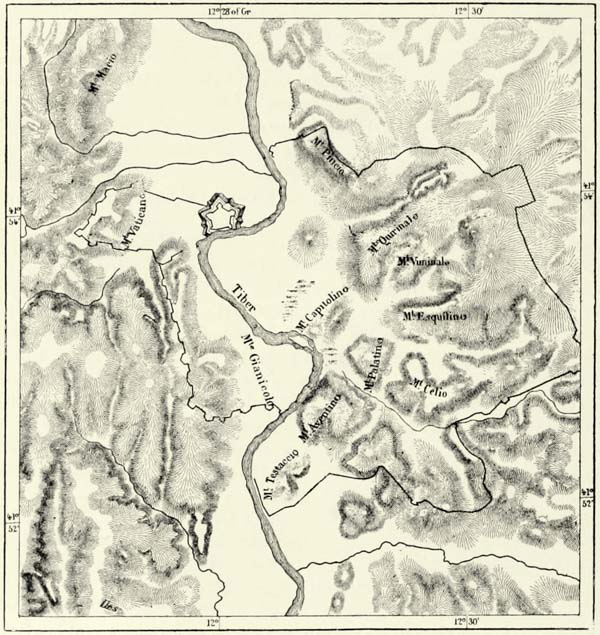
By an absurd predilection for mystical numbers, Rome is even now spoken of as the “City of the Seven Hills,” although it lost all claim to such a designation {279} after it had outgrown the walls built by Servius Tullius. Independently of Monte Testaccio, which is merely a heap of potsherds, there are at least nine hills within the walls of actual Rome, viz. the Aventino, to which the plebeians retired during their feeble struggles for independence; the Palatino, the ancient seat of the Cæsars; the Capitolino, surmounted by the temple of Jupiter; Monte Celio (Cælius); the Esquilino; Viminale; Quirinale; Citorio; and the Pincio, with its public gardens. Besides these, there are two hills on the opposite bank of the Tiber, viz. Monte Gianicolo (Janiculum), the highest of all, and the Vatican, which derives its name from the Latin word vates, a soothsayer, it having once been the seat of Etruscan divination.
Faithful to its traditions, the last hill has ever since remained the place of vaticinations. When the Christian priests left the obscurity of the catacombs they established themselves upon it, and thence they governed Rome and the Western world. The Papal palace, abounding in treasures of art, was built upon it, and close to it stands the resplendent basilica of St. Peter, the centre of Catholic Christendom. A long arcade connects the palace with the Castle of Sant’ Angelo, the ancient mausoleum of Hadrian. The guns of this fortress no longer defend the Vatican, for the temporal power of the pontiffs is a thing of the past; but their sumptuous church of St. Peter, with its dome rising high into the air, and visible even from the sea, its statues, marbles, and mosaics, bears witness to the fact that the riches of all Christendom formerly found their way to Rome. St. Peter’s alone cost nearly £20,000,000 sterling, and is only one out of the 365 churches of the city of the popes. At the same time, the admiration which their sumptuous edifice arouses is not without its alloy. A multiplicity of ornaments dwarfs the proportions of this colossal building, and, more serious still, instead of its being the embodiment of an entire epoch of its faith and ideas, it is representative only of a transitory phase in the local history of Catholicism, of an age of contradictions, when the paganism of the Renaissance and the Christianity of the Middle Ages allied themselves in order to give birth to a pompous and sensuous neo-Catholicism suited to the tastes and caprices of the century. How different is the impression we derive from this building from that which the sombre nave of a Gothic cathedral makes upon us ! It is a remarkable fact that the quarter of Rome in which the church of St. Peter is built is the only portion of the city which was laid waste by the Mussulmans in 846, who are thus able to boast of having sacked Papal Rome and taken possession of Jerusalem, whilst the tomb of Mohammed has ever remained in the hands of the faithful. As to the Jews, they did not come to Rome as conquerors. Shut up in their filthy Ghetto near the swampy banks of the Tiber, and not far from that arch of Titus which reminded them of the destruction of their temple, they have been the objects of hatred and persecution during nineteen centuries. They have survived, thanks to the power of their gold, and since their liberation from bondage they contribute even more to the embellishment of the Italian capital than do their Christian fellow-citizens.
Our nineteenth century is not favourable to the creation of edifices fit to rival {280} the Coliseum or St. Peter’s, but there are works of another nature, not less deserving of attention, which may distinguish this third era in the history of Rome. Above all, it will be necessary to protect the city against the floods of the Tiber, and to improve its sanitary condition. The bed of the river will have to be deepened, embankments constructed, and a system of drainage established.
It is well known that the quantity of water supplied to the Rome of the ancients was prodigious. In the time of Trajan nine grand aqueducts, having a total length of 262 miles, supplied about 4,400 gallons of water per second, and this quantity was augmented to the extent of one-fourth by canals subsequently constructed. Even now, although most of these ancient aqueducts are in ruins, the water supply of the capital of Italy is superior to that of most other cities.92 But if the time should ever come when Rome will occupy the whole of the space enclosed within its walls, if ever the Forum should again become the centre of the city, then the want of water will be felt there as much as in most of the other great towns of Europe.
Irrespective of the insalubrity of the environs, there is another reason why modern Rome cannot compare with the ancient city. Its streets no longer radiate from a centre towards all the points of the compass, as they did of yore. The Appian Road, which on first leaving the city passes through a curious avenue of tombs, is typical of the old roads, constructed in straight lines, and shortening distances. It is true that these ancient highways have been superseded by railways, but they are still few in number, and Rome is not situated on a trunk line. Elsewhere railways were built from the capital of the country towards its periphery; in Italy, on the contrary, it was Florence, Bologna, and Naples which constructed lines converging upon Rome.
Rome is one of those large cities which are least able to exist upon their own resources, and having no port, and its immediate vicinity being rendered uninhabitable by miasmata, it has attached to it outlying places, and occupies a position similar to that of a spider in the centre of its web. Its gardens, rural retreats, and industrial establishments are all in the hill towns of Tivoli, Frascati (near which on a ridge are the ruins of Tusculum), Marino (near which the confederated nations of Latium held their meetings), Albano (joined by a magnificent viaduct to Ariccia), Velletri (the old city of the Volsci), and Palestrina (more ancient than either Alba Longa or Rome, and occupying the site of a famous temple of Fortune, the pride of ancient Præneste). Its watering-places are Palo, Fiumicino, and Porto d’Anzio, which adjoins the little town of Nettuno, so famous because of the {281} haughty beauty of its women. Its only seaport is Cività Vecchia, a dreary town on the Tyrrhenian Sea, with a magnificent harbour.93 The ancient harbours to the south of the Tiber are very little resorted to in our day. Terracina, hidden amidst verdure at the foot of white cliffs, is only used by Rome-bound travellers coming by the coast road from the south.94 Nearly every other town of Latium is built on one or other of the two great roads, of which one leads northward to Florence, whilst the other penetrates the valley of the Sacco towards the south-east, and finally issues upon the campagna of Naples. Viterbo, the “city of nice fountains and pretty girls,” is the principal town in the north. Alatri, on the slope of the Garigliano, and commanded by a superb necropolis enclosed by cyclopean walls, occupies a similar position in the south. In the east, in one of the most charming valleys of Sabina, traversed by the ever-cool waters of the Anio, lies Subiaco, the ancient Sublaqueum, thus named after the three reservoirs constructed by Nero, who used to fish trout in them with a golden net. It was in a holy cave (sacro specu) near Subiaco that St. Benedict established his famous monastery, which preceded the still more famous monastery of Monte Casino, and conjointly with that of Lérins, in Provence, became the cradle of monachism in the West.95
Μ
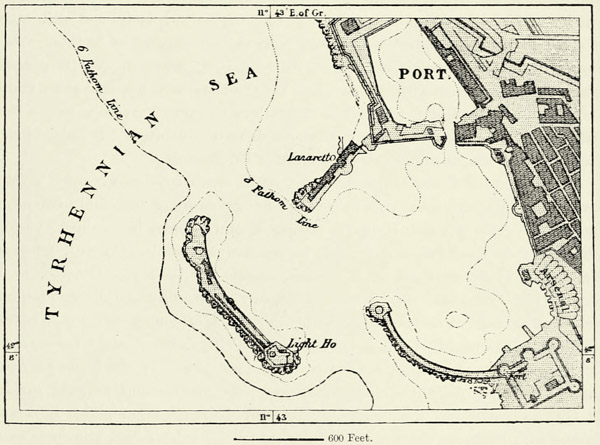
Fig. 102.—CIVITÀ VECCHIA.
Scale 1 : 8,888.
{282}
Perugia, the capital of Umbria, on the road from Rome to Ancona, is one of the ancient cities of the Etruscans, and excavations carried on in its vicinity have revealed tombs of the highest interest. After every war and disaster this city has arisen from its ruins, for its position in the midst of a fertile plain, and at the point of junction of several natural high-roads, is most favourable. It is both a Roman and a Tuscan city, and at the period of the Renaissance it gave birth to one of the great schools of painting. There still remain numerous monuments at Perugia which date back to that famous epoch, and although no longer one of the artistic head-quarters of Italy, it is still the seat of a university; its trade, especially in raw silk, is active; and its clean houses and streets, its pure atmosphere, and charming inhabitants annually attract to it a large number of the foreigners who spend the winter at Rome. Perugia has by far outstripped its rival, Foligno, which was formerly the great commercial mart of Central Italy, and still carries on a few branches of industry; amongst others, the tanning of leather. As to Assisi, it is justly famous because of its temple of Minerva, and its gorgeous monasteries decorated with the frescoes of Cimabue and his successor, Giotto, the last of the Greek and the first of the Italian painters. Assisi is only a small place now, but its environs are fertile and densely inhabited. It gave birth to Francesco d’Assisi, the founder of the order of St. Francis.
Other towns of Umbria, though not now of much importance, may boast of having once played a great part in history, or of possessing beautiful monuments. Spoleto, the gates of which Hannibal sought in vain to force, has a superb basilica, a Roman viaduct carried across a deep ravine, and mountains clad with pines and chestnuts. Terni is proud of its famous cascade (see p. 270). Orvieto, to the north of the Tiber, near the frontier of Tuscany, is haughty and dirty, but justly famous on account of its marvellous cathedral, one of the most costly and tasteful buildings in the world. Città di Castello, on the Upper Tiber, and Gubbio, in the very heart of the mountains, are the two principal towns in the Umbrian Apennines. Both are delightfully situated, and possess efficacious mineral springs. At Gubbio are shown the famous “Eugubian Tables,” seven plates of bronze covered with Umbrian characters, and the only relics of that kind known to exist. The little town of Fratta, now known as Umbertide, half-way between Perugia and Città di Castello, is only of local importance.96
Ancona is the Adriatic port of the Roman countries. It is an ancient city of the Dorians, which still retains the name given it by its founders, on account of its being situated at the “angle” formed by the coast between the Gulf of Venice and the Southern Adriatic. A fine triumphal arch near the mole attests the importance which Trajan attached to the possession of this port. Thanks to its favourable position and the labour bestowed upon the improvement of its harbour, Ancona is one of the three great places of commerce on the Adriatic; it ranks next to Venice, and is almost the equal of Brindisi, though not one of the stages on the road to India. Its commerce is fed by Rome, the Marches, and Lombardy; and {283} amongst its exports are fruits, oil, asphalt from the Abruzzos, sulphur from the Apennines, and silk, “the very best in the world,” if the native estimate of its quality can be accepted.97 The other ports along this coast offer but little shelter, and their commerce is small. Pesaro, the native town of Rossini, is only visited by vessels of twenty or thirty tons. Fano merely admits barges. The small river port of Sinigaglia (Senigallia) was formerly much frequented during the fair, at which commodities valued at £1,000,000 sterling used to change hands, but since its abolition in 1870 it has been deserted.
Μ
Fig. 103.—VALLEYS OF EROSION ON THE WESTERN SLOPE OF THE APENNINES.
Scale 1 : 403,000.
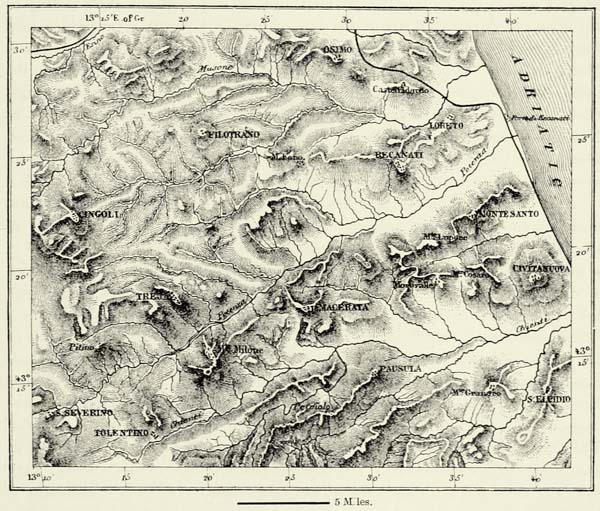
With the exception of Fabbriano, which occupies a smiling valley of the Apennines, and of Ascoli-Piceno, on the river Tronto, the inland towns of the Marches are built upon the summit of hills, but extend through their suburbs to the cultivable plains. The principal amongst them are Urbino, whose greatest glory consists in having been the birthplace of Raphael, and which, like its neighbour Pesaro, formerly produced a kind of faience much valued by connoisseurs; Jesi; Osimo; Maxerata; Recanati, the native place of Leopardi; and Fermo. One of the most famous of these hill towns is Loreto, formerly the most-frequented place of pilgrimage in the Christian world. Before the Reformation, and at a time when {284} travelling was far more difficult than now, as many as 200,000 devotees visited the shrines of Loreto every year. They were shown there the veritable house in which the Virgin Mary was born, and which was carried by angels to the spot it now occupies, where it is sheltered by a magnificently decorated dome. At Castelfidardo, close by, was fought the battle which cost the Pope the greater part of the “patrimony of St. Peter.”
There are only a few towns in the uplands of the Abruzzos. The principal of these is Aquila, founded in the thirteenth century by the Emperor Frederick II. The other towns are difficult of access, and, far from attracting inhabitants from beyond, they send their vigorous sons to the lowlands, where they are known as Aquilani, and highly appreciated as terrace gardeners. The most populous places are met with in the lower valley of the Aterno, or command the road leading to the coast and the fertile fields of the Adriatic slope. Solmona is embedded in a huge garden, anciently a lake, and overlooked in the south by the steep scarps of Monte Majella. Popoli, at the mouth of a defile, where the Aterno assumes the name of Pescara, is one of the busiest places between the sea and the uplands. Chieti, lower down on the same river, is said to have been the first town in the old Neapolitan province to introduce steam into its spinning-mills and other factories. Teramo and Lanciano are likewise places of some importance, but the only ports along the coast, Ortona and Vasto, are merely frequented by small coasting vessels.98
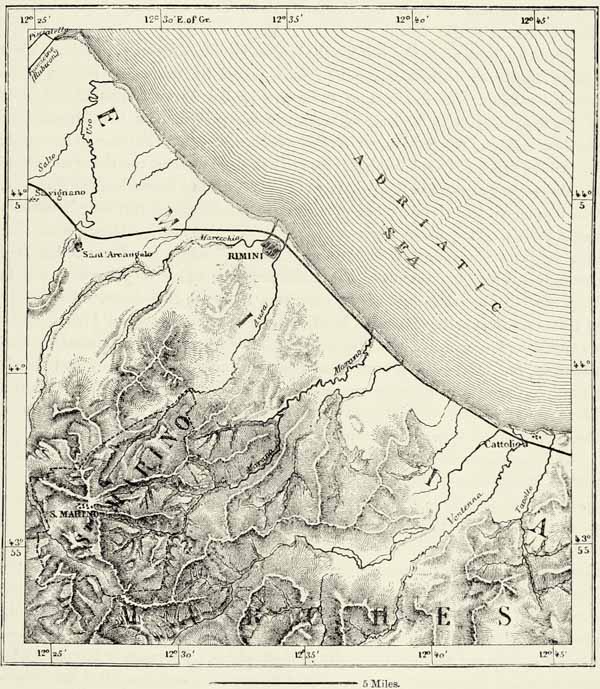
A small district in the Marches, joined to the coast by a single road, has maintained its independence through ages. Monte Titano, which rises in one of the most beautiful parts of the Apennines, and the base of which has been used as a quarry since time immemorial, bears upon its summit the old and famous city of San Marino. From its turreted walls the citizens can see the sun rise above the Illyrian Alps. San Marino, with some neighbouring hamlets, constitutes a “most illustrious” republic, and is now the only independent municipality of Italy. Named after a Dalmatian mason who lived as a hermit on Monte Titano, San Marino has existed as a sovereign state from the fourth century, its citizens having at all times known how to turn to advantage the jealousies of their neighbours. The constitution of this republic, however, is anything but democratic. The citizens, even though they be landed proprietors, have no votes, and are at most permitted to remonstrate. The supreme power is vested in a Council of sixty members, composed of nobles, citizens, and landowners. The title of councillor is hereditary in the family, and when a family becomes extinct the remaining fifty-nine choose another. The Council appoints the various officials, including a captain for the town and one for the country. San Marino has its little army, its budget, and its monopolies. A portion of its income is derived from the sale of titles and of decorations, and on the payment of £1,400 it has even created dukes, who take rank with the highest nobility of the kingdom. Taxation is voluntary. When the public chest is empty a drummer is sent round the town to invite {285} contributions. Though perfectly independent, this republic accepts a subsidy from Italy, and claims the special protection of the King. Its criminals are shut up in an Italian prison, its public documents are printed in Italy, and an Italian judge occupies the bench of the republican prætorium. There is no printing-office in the little state, for the Council is afraid that books objectionable to the surrounding kingdom might be issued from it.99
Μ
Fig. 104.—RIMINI AND SAN MARINO.
Scale 1 : 250,000.
{286}
VI.—SOUTHERN ITALY, NAPLES.
Amongst the various states which have been welded into the modern kingdom of Italy, Naples, though second to others in population and industry, occupies the largest area.100 It embraces the whole southern half of the peninsula, and its coast has a development of 995 miles. Formerly the country was better known than any other portion of Italy as Magna Græcia, but now many parts of it are scarcely known at all.
The Apennines of Naples can hardly be described as a mountain chain. They consist rather of distinct mountain groups joined by transverse ranges, or by elevated saddles. In the first of these groups the serrated crest of the Meta (7,364 feet) rises above the zone of trees, and is separated from the Abruzzos by the deep valley of the Sangro, which flows to the Adriatic. Farther to the south, beyond the valley of Isernia, which gives birth to the Volturno, rise the mountains of the Matese, culminating in the Miletto (6,717 feet), the last bulwark of the Samnites. Other summits, less elevated, but equally steep and imposing, rise near Benevento and Avellino. They abound in savage defiles, in which many a bloody battle has been fought. The valley of the “Furcæ Caudinæ,” where the Romans humbled themselves before the Samnites, and made promises which they never meant to keep, may still be recognised on the road from Naples to Benevento. The memory of this event lives in the Caudarola Road, and the village of Forchia d’Arpaia. This mountain region, which might fitly be called after its ancient inhabitants, is connected in the south with a transversal chain, running east and west, and terminating in Cape Campanello, to the south of the Bay of Naples. The beautiful island of Capri, with its white cliffs and caverns flooded by the azure waters of the Mediterranean, lies off this cape.
The eastern slope of the cretaceous mountains of Naples is gentle, and gradually merges in argillaceous tavolieri, or table-lands, deposited during the Pliocene epoch. The tavoliere de la Puglia is, perhaps, the most sterile and dreary portion of Italy. It is cut up into terraces by deep ravines, through which insignificant streams find their way to the Adriatic, and the centres of population must be looked for at the mouths of valleys or along the high-roads. The country itself is a vast solitude, deserted by all except nomad herdsmen. There are no shrubs, and a kind of fennel, which forms the hedges separating the pasturing grounds, is the largest plant to be seen. Hovels, resembling tombs or heaps of stone, rise here and there in the midst of these plains. Fortunately the old feudal customs which prevented the cultivation of these plains, and compelled the mountaineers to keep open wide paths, or tratturi, through their fields for the passage of sheep, have been abolished, and the aspect of the tavoliere improves from year to year.
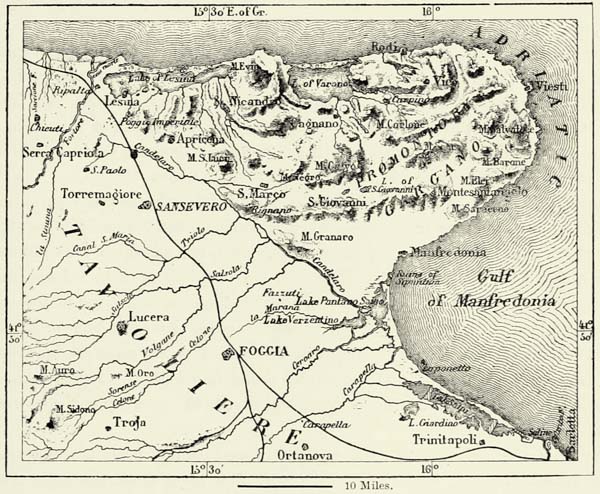
These tavolieri completely separate the mountains of the peninsula of Gargano—the “spur” of the Italian “boot”—from the system of the Apennines. The northern slopes of these rugged mountains are still clad with forests of beeches {287} and pines, which supply the best pitch of Italy, and by thickets of carob-trees and other plants, whose flowers are transformed by the bees into delicious honey; but the very name of the most elevated summit—Monte Calvo (5,150 feet), or “bald mountain”—proves that the deplorable destruction of forests has been going on here as in the rest of the peninsula. In former times the recesses of Monte Gargano were held by Saracen pirates, and they defied the Christians there for a long time, in spite of the many sanctuaries which had been substituted for the ancient heathen temples. The most famous of these was the church on Monte Sant’ Angelo, at the back of Manfredonia, which was frequently resorted to by the navigator about to leave the shelter of the bay for the dangerous coasts of Dalmatia or the open sea.
Μ
Fig. 105.—MONTE GARGANO.
Scale 1 : 950,000.
The Neapolitan Apennines terminate in the south with the ancient volcano of Monte Vultur (4,356 feet). Farther south the country gradually sinks down into a table-land intersected by deep ravines, which discharge their waters in three directions—towards the Bay of Salerno, the Bay of Taranto, and the Adriatic. The Apennines, far from bifurcating, as shown on old maps, are cut in two by the low saddle of Potenza, and on the peninsula forming the “heel” of Italy only low ridges and terraces are met with.
The peninsula of Calabria, however, is rugged and mountainous. The Apennines, near Lagonegro, again rise above the zone of forests. Monte Polino (7,656 feet) is the highest summit in Naples. The group of which it forms the {288} centre occupies the entire width of the peninsula, and along its western coast it forms a wall of cliffs even less accessible than those of Liguria. Towards the south it opens out into wooded valleys, where the inhabitants collect manna, an esteemed medicinal drug. The deep valley of the Crati separates these mountains from the Sila (5,863 feet), which is composed of granites and schists, and still retains its ancient forests, haunted by brigands. The shepherds who pasture their flocks in the clearings of these woods are said to be the descendants of the Saracens, who formerly occupied this “Country of Rosin,” by which name it was known to the Greeks.
To the south of the isolated Sila the peninsula narrows to a neck of small elevation, where raised beaches attest the successive retreats of the sea. A third mountain mass, of crystalline formation, rises to the south of this depression, its furrowed slopes clad in forests. This is the Aspromonte (6,263 feet), or “rugged mountain.” One of its spurs forms the palm-clad promontory of Spartivento, or “parting of the winds.”
Naples, like Latium, has its volcanic mountains, which form two irregular ranges, one on the continent, the other in the Tyrrhenian Sea, and are, perhaps, connected beneath the sea with the volcanic mountains of the Liparic Islands and Mount Etna. One of these is Mount Vesuvius, the most famous volcano of the world, not because of its height or the terror of its eruptions, but because its history is that of an entire population who have made its lavas their home.
Scarcely have we left the defile of Gaeta and entered upon the paradisiacal Terra di Lavoro than we come upon the first volcano, the Rocca Monfina (3,300 feet), which rises between two calcareous mountains, one of which is the Massico, whose wines have been sung by Horace. No eruption of this volcano is on record, and a village now occupies its shattered crater. To judge from the streams of lava which surround its trachytic cone, its eruptions must have been formidable. The entire Campania is covered to an unascertained depth with ashes ejected from it, and the marine shells found in them prove that the whole of this region must have been upheaved at a comparatively recent epoch.
Μ
THE BAY OF NAPLES
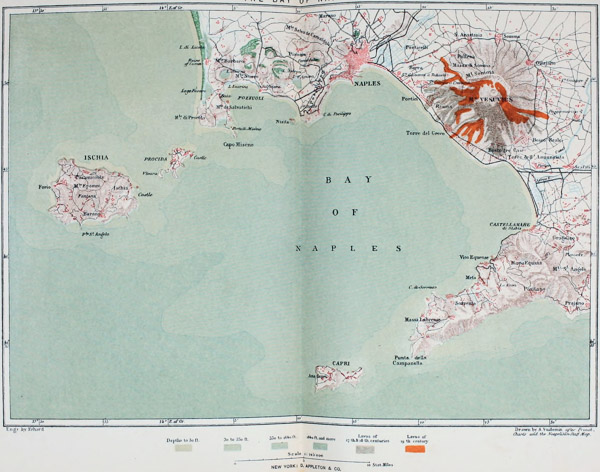
The hills which rise to the south of the Campania cannot boast of the grandeur of the Rocca Monfina, but they have been looked upon from the most remote times as one of the great curiosities of our earth. Standing upon the commanding height of the Camaldoli (518 feet), the Phlegræan Fields lie at our feet. Acquainted as we now are with the far more formidable volcanoes of Java and the Andes, this verdant sea-bound country may not strike us as a region of horrors. But our Græco-Roman predecessors looked upon it with very different eyes, and being unable to account for the phenomena they witnessed, they ascribed them to the gods. The quaking soil, the flames bursting forth from hidden furnaces, the gaping funnels communicating with unexplored caverns, lakes which disappeared at irregular intervals, and others exhaling deadly gases—all these things left their impress upon ancient mythology and poetry. At the time of Strabo the shores of the Bay of Baiæ had become the favourite resort of {289} voluptuaries, and sumptuous villas rose upon every promontory; but the terrors inspired by hidden flames and mysterious caverns had not yet departed. A dreaded oracle was said to have its seat there, guarded by Cimmerians, to whom strangers desirous of consulting the gods had to apply. These troglodytæ were doomed never to behold the sun, and only quitted their caverns during the night. The Phlegræan Fields were likewise supposed to have been the battle-ground of giants struggling for the possession of the fertile plains of the Campania. During the Middle Ages Pozzuoli was looked upon as the spot from which Christ descended into hell.
Μ
Fig. 106.—THE ASHES OF THE CAMPANIA.
According to Carl Vogt. Scale 1 : 835,400.
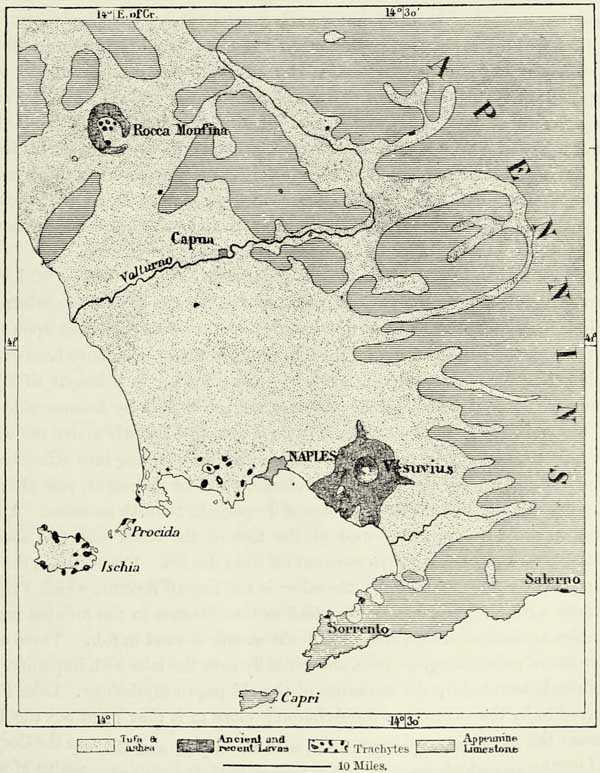
The number of craters still distinguishable is twenty. If we were to suppose {290} the country to be deprived of its vegetation, its aspect would resemble that of the surface of the moon. Even the city of Naples occupies an ancient crater, the contours of which have become almost obliterated. To the west of it several old craters can still be traced, one of them occupying a promontory of tufa, surmounted by what is called the tomb of Virgil. Passing through the famous grotto of Posilippo, we find ourselves in the Phlegræan Fields. On our left rises the small conical island of Nisita, its ancient crater invaded by the sea. Farther on we reach the crater known as the Solfatara, the Forum Vulcani of the ancients. Its last eruption took place in 1198, but it still exhales sulphuretted hydrogen. The Park of Astroni lies to the north. The interior slope of its enclosing wall is exceedingly steep, so as to render impossible the escape of the deer and boars which are kept within. The only access is through an artificial breach. Another crater, less regular in shape, is now filled with the bubbling waters of the Lake of Agnano. Near it is the famous Grotto of Dogs, with its spring of carbonic acid. Other springs of gas and sulphurous water rise in the neighbourhood, and to them Pozzuoli is indebted for its name, which is said to mean the “town of stinks.” The town, in turn, has given its name to the earth known as pozzuolana, which supplies an excellent material for the manufacture of cement.
The coast of the bay of Pozzuoli has undergone repeated changes of level, in proof of which the three columns of the temple of Serapis are usually referred to. At a time anterior to the Romans this temple, together with the beach upon which it stands, sank beneath the waters of the sea, and its columns must have been exposed to their action for many years, perhaps centuries, for up to a height of twenty feet they are covered with tubes of serpulæ, and perforated by innumerable holes bored by pholadidæ. In the course of time it rose again slowly above the waters. This happened, perhaps, in 1538, when the Monte Nuovo sprang into existence. In the short period of four days this new volcano, 490 feet in height, rose above the surrounding plain, and buried the village of Tripergola beneath its ashes. A beach now known as La Starza was formed at the foot of the cliffs, and two sheets of water to the west of Monte Nuovo were cut off from the sea. One of these, the Lago Lucrino, is famous for its oysters; the other is the Lago d’Averno, which Virgil, in conformity with antique legends, described as the entrance to the infernal regions. It occupies an ancient crater, and its pellucid waters abound in fish. There are no exhalations of poisonous gases now, and birds fly over the lake with impunity. Still its vicinity is haunted by the memories of the old pagan mythology. Lake Fusaro is referred to by the ciceroni as the Acheron; close to it they point out the den of Cerberus; the sluggish stream of Acqua Morta has been identified with the Cocytus; Lake Lucrino, or rather a spring near it, with the Styx; and the remains of a subterranean passage which connected the Averno with the sea are pointed out as the whilom grotto of the Sibyl. The inhabitants of Cumæ, which was founded by a colony from Chalcis, and the ruins of which still exist on the Mediterranean coast, to the east of Pozzuoli, brought with them the myths of Hellas, and Grecian poetry, which took possession of them, has kept their memory alive.
It is quite proper that this region of Tartarus should have its contrast in Elysian {291} Fields, and this name has actually been bestowed upon a portion of the peninsula of Baiæ, which formed the chief attraction of the voluptuous Romans, and where Marius, Pompey, Cæsar, Augustus, Tiberius, Claudius, Agrippina, Nero, and others had their palaces. Many a fearful tragedy has been enacted in these sumptuous buildings. But hardly a trace of them exists now; nature has resumed possession of the country, and the hills of tufa and volcanoes are the only curiosities of the peninsula. Cape Miseno is one of these old volcanoes, and from its summit may be enjoyed one of the most delightful prospects in the world. The whole of the Bay of Naples—“a bit of heaven fallen upon our earth”—lies spread out beneath us, and Ischia the joyous, formidable Capri, the promontory of Sorrento, Mount Vesuvius, and the houses and villas of Naples fill up the space bounded by the sea and the distant Apennines.
The island of Procida joins the Phlegræan Fields to the chain of island volcanoes lying off the Bay of Gaeta. Ischia is the most important of these, and its volcano, the Epomeo (2,520 feet), almost rivals Mount Vesuvius in height. One of its most formidable eruptions occurred in 1302, at a time when Mount Vesuvius was quiescent, but after the latter resumed its activity Ischia remained in repose. Similarly, when the Monte Nuovo was ejected from the earth, the huge volcano went to sleep for no less a period than one hundred and thirty years. Ischia has known no eruption for five centuries and a half, and the gases escaping from its thirty or forty hot springs are now the only signs of volcanic activity.
Ischia has certainly been upheaved during a comparatively recent epoch, for its trachytic lavas rest in many places upon clays and marls containing marine shells of living Mediterranean species. Some of these have been found at a height of nearly 2,000 feet. At the present time the tufa rocks of Ischia, and of the other volcanic islands to the west of it, are being washed away by the sea. Ventotene, the ancient Pandataria, to which the Roman princesses were exiled, is hardly more now than a heap of scoriæ. Ponza, likewise a place of exile of the Romans, has been separated by the erosive action of the sea into a number of smaller islands. Its lavas overlie Jurassic rocks, similar in all respects to those of Monte Circello on the coast nearest to it.
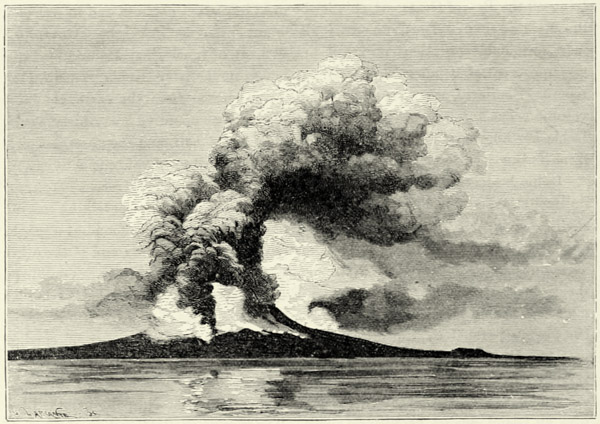
Mount Vesuvius (4,100 feet), the pride and dread of the Neapolitans, was likewise an island during prehistoric times. The marine shells found in the tufa of Monte Somma prove this, and on the east the volcano is still surrounded by plains but little elevated above the sea. Formerly the mountain was covered with verdure to its very summit, but the explosion of A.D. 79 shattered its cone, and the ashes thrown up into the air shrouded the whole of the country in darkness. Even at Rome the sun was hidden, and an age of darkness was believed to have set in. When at length the light reappeared, the face of the country was found to have undergone a marvellous change. The mountain had lost its shape, the fertile fields were hidden by masses of débris, and entire towns had been buried beneath ashes.
Since that terrible event Mount Vesuvius has vomited lavas and ashes on many occasions. No periodicity has been traced in these outbursts, and the intervals {292} of repose were generally of sufficient duration to enable vegetation to resume its sway. But these eruptions have become more frequent since the seventeenth century, and hardly a decade passes by without one or more of them. Each of them modifies the contours of the mountain, whose great central vent has undergone many changes. The crescent-shaped mass of débris which surrounds the old crater, known as the Atrio del Cavallo, was undoubtedly of loftier height previously to the great outburst of 79 than it is now. The vicinity of Naples has facilitated a study of the phenomena attending volcanic eruptions, and an observatory, permanently occupied, has been built close to the cone of eruption.
Fig. 107.—ERUPTION OF MOUNT VESUVIUS, APRIL 26TH, 1872.
The neighbourhood of Mount Vesuvius, like that of all other volcanoes, abounds in hot and gas springs, but there are no subsidiary craters. The nearest volcano is Monte Vultur (4,356 feet), a regular cone on the eastern slope of the peninsula. Its dimensions are larger than those of Vesuvius, but no eruptions are on record, though a slight escape of carbonic acid is still going on from the two lakes which occupy the bottom of its vast crater. On a line connecting Ischia, Vesuvius, and Monte Vultur, and about half-way between the two latter, we meet with the most abundant carbonic acid spring of Italy. The gas escapes with a hissing noise from the pond of Ansanto, and the ground around the spring is covered with the remains of insects, killed in myriads on coming within the influence of the poisonous air. Near it the Romans erected a temple in honour of Juno the Mephitic.
The disasters resulting from volcanic eruptions are great, no doubt, but they {293} are exceeded by those caused by earthquakes. Some of these are unquestionably caused by a subterranean displacement of lava, and thus, when Vesuvius begins to stir, Torre del Greco and other towns at its foot incur the risk of being buried beneath ashes or destroyed by earthquakes. But the Basilicata and Calabria—that is to say, the two provinces lying between the volcanic foci of Vesuvius and Etna—have many times been shaken by earthquakes whose origin cannot be traced to volcanic agencies. Out of a thousand earthquakes recorded in Southern Italy during the last three centuries, nearly all occurred in the provinces named, and they were occasionally attended by the most disastrous results. The earthquake of 1857 cost the lives of 10,000 persons at Potenza and its vicinity, but the most disastrous of these events happened in 1785 in Southern Calabria. The first shock, which proceeded from a focus beneath the town of Oppido, in the Aspromonte Mountains, only lasted a hundred seconds, but within that short space of time 109 towns and villages were overthrown, and 32,000 of their inhabitants buried beneath their ruins. Crevasses opened in the ground; rivers were swallowed up, to reappear again lower down as lakes; liquid clay flowed down the hill-slopes like lava, converting fertile fields into unproductive wastes. The commotion of the sea added to these horrors. Many of the inhabitants of Scilla, afraid to remain on the quaking land, fled to their boats, when an enormous mass of rock detached itself from a neighbouring mountain, and, tumbling into the sea, produced a wave which upset the boats and cast their fragments upon the shore. Want of food brought on famine, and typhus, as usual, came in its train.
We are not yet able to predict earthquakes, and can only provide against them by a suitable construction of our dwellings. There exists, however, another cause of misery and depopulation which the Neapolitans might successfully combat, as was done by their ancestors. In the time of the Greeks the swamps along the coast were certainly less extensive than they are now. War, and a return towards barbarism, have caused the rivers to be neglected, and to produce a deterioration in the climate. Baia, a place once famous on account of its healthiness, has become the home of malaria. Sybaris, the town of luxury and pleasure, has been supplanted by a fever-plain “which eats more men than it is able to nourish.” These paludial miasmata, poverty, and ignorance decimate the population of La Puglia, Basilicata, and Calabria. Even certain Asiatic diseases, such as elephantiasis and leprosy, ravage the country, which, from its rare fertility and fine climate, ought to be in the enjoyment of the greatest prosperity.
Continental Sicily is indeed a favoured region, and its eastern slopes more especially might be converted into one huge garden, for the rainfall there is abundant. Naples enjoys a semi-tropical climate, and its winter temperature is hardly inferior to the annual mean of London. Snow very rarely falls, and only remains on the tops of the hills for a few weeks.101 The vegetation along the coast is of tropical luxuriance. Oranges and lemons bear excellent fruit; date-palms uplift their fan-shaped leaves, and sometimes bear fruit; the American agave {294} stretches forth its candelabra-like branches; sugar-cane, cotton, and other industrial plants, which elsewhere in Europe are scarcely ever met with outside hothouses, grow in the fields. In the forests of Calabria the olive-tree affords as much shade as does the beech with us. Even the bare rocks on the coast yield excellent grapes and garden fruits. Naples, Sicily, Andalusia, and certain districts of Greece and Asia Minor realise our beau idéal of the sub-tropical zone, and only the heaths on the Adriatic slope and the upper valleys of the Apennines remind us that we are still in Central Europe.
This delightful country is inhabited by a people having the most diverse origin. It is now 2,300 years since the Samnites occupied the whole of it from sea to sea. They were more numerous than the Romans, and might have conquered the whole of Italy had there been more cohesion amongst them, and some of that talent for organization which constituted the strength of their adversaries. But they were split into five tribes, each speaking a different dialect; and whilst the Samnites of the hills quarrelled with their kinsmen in the plains, the latter were at enmity with the Hellenized Samnites who lived near the Greek towns on the coast.
The whole of the coast of Southern Italy, from Cumæ—founded more than a thousand years before our era—to Sipuntum, of which some ruins remain near the modern Manfredonia, was dotted with Greek colonies. In these districts of Southern Italy the bulk of the population is of very different origin from that of other parts of the peninsula. To the north of Monte Gargano, Celtic, Etruscan, and Latin elements preponderate, whilst Hellenes, Pelasgians, and kindred races dominate in the south. Not only did civilised Greeks found their colonies there, but the aboriginal population, the Iapygians, spoke a dialect akin to the Hellenic, and Mommsen may be right when he conjectures that these Iapygians were of the same origin as the modern Albanians.
At a subsequent date these southern Italians had to bow down before the Romans, who founded military colonies amongst them, but never succeeded in completely Latinising them. When the Roman Empire fell to pieces the Cæsars of Byzantium still maintained themselves for a long time in Southern Italy, and the Greek language again preponderated, but gradually Romance dialects gained the upper hand. The inhabitants returned to a state of barbarism, but they retained to a great extent their language and customs, and even now there are districts in the south which are Italian in appearance rather than in reality, and in eight villages of the Terra d’Otranto the Hellenic dialect of the Peloponnesus is still spoken. Towns like Naples, Nicastro, Taranto, Gallipoli, Monopoli, and others, whilst preserving their sonorous Greek names, have also retained many features which recall the times of Magna Græcia.
Reggio—that is, the “city of the strait”—appears to have retained the use of Greek much longer than any other town, and its patricians, who boasted of being pure Ionians, still spoke the language of their ancestors towards the close of the thirteenth century. In several remote towns of the interior Greek was formerly in common use. The old popular songs of Bova, a small town near the southern {295} extremity of Italy, are in an Ionian dialect more like the language of Xenophon than is modern Greek. Down to a very recent date the peasants near Roccaforte del Greco, Condofuri, and Cardeto spoke Greek, and when they appeared before a magistrate they required an interpreter. At the present day all young people speak Italian; the old language has been forgotten, but the Greek type remains. The men and women of Cardeto are famous for their beauty, more especially the latter. “They are Minervas,” we are told by a local historian. Their principal livelihood consists in acting as wet nurses to the children of the citizens of Reggio. The women of Bagnara, between Scilla and Palmi, are likewise of wondrous beauty, but their features are stern, betraying Arab blood, and they are destitute of the noble placidity of the Greek.
It is said that the women of the Hellenic villages of Calabria are still in the habit of executing a sacred dance, which lasts for hours, and resembles the representations we meet with on ancient vases, only they dance before the church instead of the temple, and their ceremonies are blessed by Christian priests. Funerals are accompanied by weeping women, who collect their tears in lachrymatories. Elsewhere, as in the environs of Tarento, the children consecrate the hair of their head to the manes of their ancestors. Old morals, no less than old customs, have been preserved. Woman is still looked upon as an inferior being, and even at Reggio the wives of citizens or noblemen who respect ancient tradition confine themselves to the gynæceum. They do not visit the theatre, go out but rarely, and when they walk abroad are attended by barefooted servants, and not by their husbands.
In addition to Samnites, Iapygians, and Greeks, who form the bulk of the population of Southern Italy, we meet with Etruscans in the Campania; Saracens in the peninsula of Gargano, in the Campania, the marina of Reggio, Bagnara, and other coast towns; Lombards in Benevento, who retained their language down to the eleventh century; Normans, from whom the shepherds on the hills are supposed to be descended; and Spaniards in several coast towns, especially at Barletta, in Apulia. The Albanians have probably furnished the largest contingent of all the strangers now domiciled in Southern Italy. They are numerous on the whole of the eastern slope of the peninsula, from the promontory of Gargano to the southernmost point of Calabria. One of their clans came to Italy in 1440, but the bulk of them only arrived during the second half of the fifteenth century, after the heroic resistance made by Scanderbeg had been overcome by the Turks. The conquered Skipetars were then compelled to expatriate themselves in order to escape the yoke of the Turks, and they were received with open arms by the Kings of Naples, who granted them several deserted villages, which are now amongst the most flourishing of Southern Italy. The descendants of these Skipetars, who are principally domiciled in the Basilicata and Calabria, rank among the most useful citizens of the country. They take the lead in the intellectual regeneration of the old kingdom of Naples, and were the first to join the liberating army of Garibaldi. Many have become Italianised, but there are still over 80,000 who have neither forgotten their origin nor their language. {296}
The Neapolitans are undoubtedly one of the finest races of Europe. The Calabrians, the mountaineers of Molise, and the peasants of the Basilicata are so well proportioned, erect, supple of limb, and agile, that their low stature, as compared with the races of the North, can hardly be a subject of reproach; and the nobility and expression of the faces of Neapolitan women fully compensate for the irregularity we frequently meet with. The faces of the children, with their large black eyes and well-formed lips, beam with intelligence, but the wretched existence to which too many of them are condemned soon degrades their physiognomy. Supremely ignorant, the Neapolitan is, nevertheless, most admirably gifted by nature. The country which has produced so many great men since the days of Pythagoras is in nowise inferior to any other; its philosophers, historians, and lawyers have exercised a powerful influence upon the march of human thought; and the number of great musicians which it has produced is proportionately large.
Still, in many respects, the inhabitants of Southern Italy hold the lowest rank amongst the nations of Europe. Ever since the annihilation of the Greek republican cities the country has been subjected to foreign masters, who have either devastated it or systematically oppressed its inhabitants. With the exception of Amalfi, no other town was granted the privilege of governing itself for any length of time. The very position of the country exposed it to dangers. Placed in the centre of the Mediterranean, it was on the high-road of every pirate or invader, whether Saracen or Norman, Spaniard or Frenchman, and the absence of any natural cohesion between its various districts prevented its population from organizing a united resistance against the attacks of foreign invaders. Southern Italy has not the river basins of Lombardy, Tuscany, Umbria, or Rome; there exists no centre of gravity, so to say, and the country is split up into separate sections having nothing in common.
The government under which the Neapolitans lived until quite recently was most humiliating. “I do not require my people to think,” said King Ferdinand II. of Naples. Ideas which did not commend themselves to the authorities were punished as crimes, and only mendicity and moral depravity were allowed to flourish. Science was compelled to live in retirement; history to seek a refuge in the catacombs of archæology; and literature was corrupt or frivolous. Of the Neapolitans who did not expatriate themselves only a very small number became eminent. Schools were hardly known outside the large towns, and where they did exist they were placed under the supervision of the police. Men able to read and write were looked at askance, and, to escape being accused of belonging to some secret society, they were compelled to turn hypocrites. Old superstitions exist in full force, and the heathen hallucinations of Greeks and Iapygians still survive. The idolatrous Neapolitan casts himself down before the statue of St. Januarius, but heaps imprecations upon the head of his saint if his miraculous blood does not quickly liquefy. Similar superstitions exist in nearly every town of Naples. Every one of them has its patron saint or deity, who, if he should fail to protect his people, is treated as a common enemy. As recently as 1858 the villagers of Calabria, irritated by a drought, put their venerated saints into prison; and Barletta, {297} about the same period, had the melancholy honour of being the last town in Europe in which Protestants were burned alive. Such is the fanaticism still met with in the second half of the nineteenth century ! 102
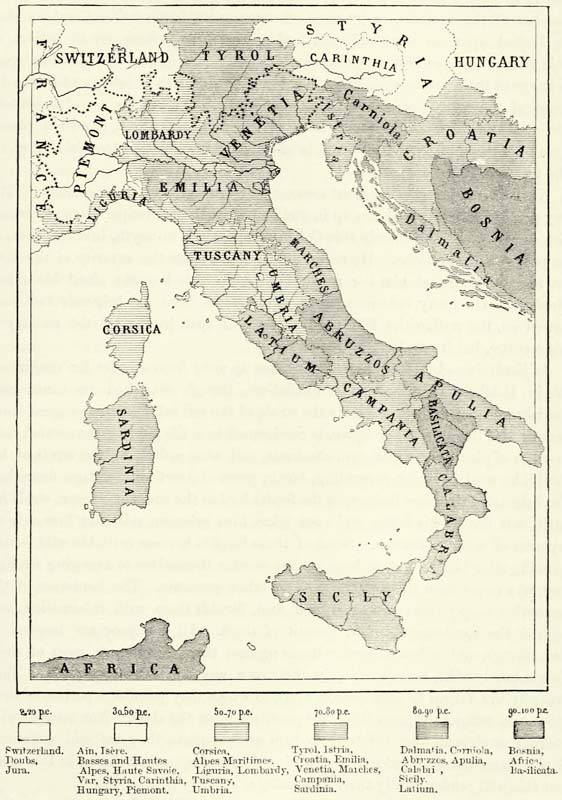
Μ
Fig. 108.—EDUCATIONAL MAP OF ITALY.
{298}
One of the great superstitions of the Neapolitans refers to the “evil eye.” The unfortunate being who happens to have a nose like a battle-axe and large round eyes is looked upon as jettatore, and is avoided as a fatal being. If by any evil chance his glance happens to fall upon any unfortunate person, it is considered necessary to counteract it by the influence of an amulet resembling the fascinum of the ancients, or by some other means no less potent. Coral amulets are looked upon as most efficient, and many who pretend not to believe in their virtues are the first to make use of them. The peasants of Calabria wear an image of their patron saint upon the chest, and shield their cattle and houses by means of the images of saints or household gods. At Reggio a cactus may be seen near the door or on the balcony of every house, which has been placed there to keep off evil influences, and is universally known as l’albero del mal’ occhio (the tree of the evil eye).
Next to superstition, the great scourge of Southern Italy is brigandage. The very name of Calabria conjures up in our imagination picturesque brigands armed with carbines. Unfortunately this Calabrian brigand is no myth, invented to serve the purposes of the stage. He really exists, and neither the severity of the laws put in motion against him nor political changes have brought about his extermination. On many occasions, after a successful hunt for brigands had been carried on, the authorities felicitated themselves upon having rid the country of this scourge, but it regularly revived.
In Sardinia and Corsica the peasant takes up arms from a desire for vengeance, but in Calabria from poverty. Feudalism, though abolished in name, still flourishes in that country. Nearly the whole of the soil belongs to a few great landowners, and the peasant, or cafore, is condemned to a life of ill-remunerated toil. In years of plenty, when the rye, chestnuts, and wine suffice for the wants of his family, he works without grumbling, but in years of dearth brigandage flourishes. The brigand, or gualano, looks upon the feudal lord as the common enemy, steals his cattle, sets fire to his house, and even takes him prisoner, releasing him only on payment of a heavy ransom. Some of these bandits become veritable wild beasts, thirsting after blood; but, as long as they confine themselves to avenging wrongs, they may count upon the complicity of all other peasants. The herdsmen of the mountains supply them with milk and food, furnish them with information, and mislead the carabiniers sent in pursuit of them. All the poor are leagued in their favour, and refuse to bear witness against them. Moreover, most of these Neapolitan bandits, conscientious in their own way, are extremely pious. They swear by the Virgin or some patron saint, to whom they promise a portion of their booty, and religiously place the share promised upon the altar. Not content with wearing amulets all over the body to turn aside bullets, they are said sometimes to place a consecrated wafer in an incision they make in their hand, in the belief that this will render deadly their own bullets.
The fearful poverty of the South Italian peasantry has led to another practice, even worse than brigandage. Foreign speculators, Christians as well as Jews, travel the country, and particularly the Basilicata, in order to purchase children, whom {299} their poverty-stricken parents are ready to part with for a trifle. The more intelligent and prettier the child, the greater the likelihood of its passing into the hands of these dealers in human flesh. The latter are threatened with the penalties of the law, but custom and ignoble accomplices enable them to evade them, and to carry their living merchandise to France, England, Germany, and even America, where the children are converted into acrobats, street musicians, or simple mendicants. The chances of this shameful commerce have been carefully calculated, and the losses arising from deaths and the cost of travelling are more than covered by the earnings of the children. Viggiano, a small town of the Basilicata, is more especially haunted by these traffickers, for its inhabitants possess a natural gift for music.
Voluntary emigration is on the increase, and if it were not for the obstructions placed in the way of young men liable to the conscription, certain districts would become rapidly depopulated in favour of South America. Only the poorest peasants remain behind. This emigration influences in a large measure the customs of the country, and, conjointly with railways and factories, will no doubt bring about an assimilation of Southern Italy to the rest of the peninsula. Brigandage and the traffic in children will doubtless disappear, but the proletarianism of manufacturing towns is likely to be substituted for them.
For the present Naples is almost exclusively an agricultural country. The tavolieri of Puglia, and the hills which command them, remain for the most part a pastoral country, but the greater portion of the productive area of Naples is under cultivation. As in the time of the Romans, cereals, with oil and wine, form the principal produce; but, in addition to these, tobacco, cotton, madder, and several other plants used in manufactures, are grown. With some care these products might attain a rare degree of excellence. Even now the oil of the Puglia competes successfully with that of Nice, and the wines grown on the scoriæ of Mount Vesuvius enjoy their ancient celebrity, the Falernian of Horace, grown in the Phlegræan Fields, disputing the pre-eminence with the Lachrymæ Christi of Vesuvius and the white wine of Capri.
The agricultural products of Naples are almost exclusively derived from the coast region, and commerce is principally carried on in coasting vessels. The interior is sterile to a great extent, and there are no metalliferous veins to attract population.
Southern Italy has no natural centre, and, as its life has at all times been eccentric and maritime, it is but natural that all the large towns should have sprung up on the coast. Two thousand years ago, when Greece was a civilised country and Western Europe sunk in barbarism, the most important towns lay on the Ionian Sea facing the east. But, when Rome became the mistress of the world, Magna Græcia was forced to face about, and Naples became the successor of Sybaris and Tarentum. This position of vantage it has retained even to the present day, when Western Europe has become the focus of civilisation. The wave of history has passed over Tarentum and Sybaris, and whilst the fine port of the former is now deserted, the latter, at one time the largest city of all Italy, has entirely disappeared. {300}
Naples, the “new town” of the Cumæans, has for centuries been the most populous town of Italy, and even now the number of its inhabitants is double that of Rome. In the days of Strabo Naples was a large town. Greeks who had made money by teaching or otherwise, and who desired to end their days in peaceful repose, used to retire to that beautiful town, where Greek manners predominated, and the climate resembled that of their native country. Many Romans followed their example, and Naples, together with the numerous smaller towns dotting the shores of its magnificent bay, thus became a place of repose and pleasure. At the present day it attracts men of leisure from every part of the world, who revel in its beauties and enjoy the noisy gaiety of its inhabitants—“masters in the art of shouting,” as Alfieri called them. The prospect from the heights of Capodimonte and the other hills surrounding the immense city is full of beauty: promontories jut out into the blue waters, islands of the most varied colours are scattered over the bay, shining towns stretch along the foot of verdant hills, and vessels ride upon the waves. Looking inland, we behold the grey summit of Vesuvius, which, lurid at night, and always threatening, imparts a modicum of danger to the voluptuous picture.
The Neapolitans are indeed a happy people, if such a term may be applied to any fraction of mankind. They know how to enjoy the gifts of nature, and are content, if need be, with very little. Naturally intelligent, they are equal to any enterprise; but, as they hate work, they soon give up what they have begun, and make short of their want of success. Travellers were formerly fond of describing that curious type, the lazzarone, the idle man of pleasure, who, enveloped in a rag, slept on the beach or in the porch of a church, and disdained to work after he had earned the pittance sufficing for his simple wants. There still remain a few representatives of this type, but the material exigencies of our time have absorbed the majority of these idle tatterdemalions, and converted them into labourers. Others have succumbed to disease, for they knew nothing of sanitary laws, and dwelt in damp cellars, or bassi, beneath the palaces of the wealthy. Naples contributes her fair share towards the industrial products of the peninsula. The principal articles manufactured are macaroni and other farinaceous pastes, cloth, silks known as gros de Naples, glass, china, musical instruments, artificial flowers, ornaments, and everything entering into the daily consumption of a large city. Its workers in coral are famous for their skill; and Sorrento, near Naples, supplies the much-prized workboxes, jewel cases, and other articles carved in palm-wood. The ship-yards of Castellamare di Stabia are more busy than any others in Italy, those of Genoa and Spezia alone excepted. The sailors of the bay are equal to the Ligurians in seamanship, and surpass them as fishermen. The inhabitants of Torre del Greco, who engage in coral-fishing, are well acquainted with the submarine topography of the coasts of Sardinia, Sicily, and Barbary, and the least movement of the air or water reveals phenomena to them which remain hidden to all other eyes. They own about 400 fishing-boats, which depart in a body, and their return after a successful season presents a spectacle which even Italy but rarely affords.103
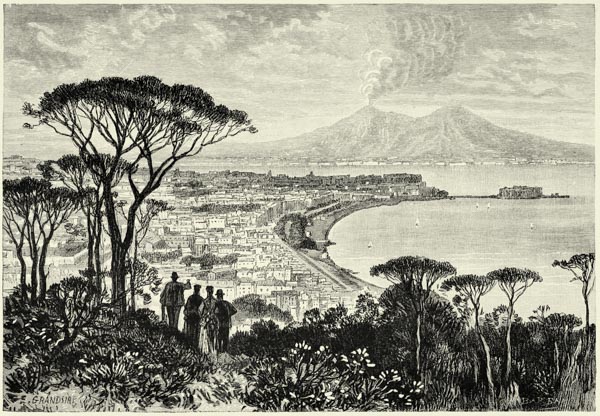
NAPLES.
{301}
Naples, with its magnificent bay, and the fertile tracts of the Campania and the Terra di Lavoro near it, could hardly fail to become a great commercial city, and if it holds an inferior rank in that respect to Genoa, this is owing to its not being placed upon a great high-road of international commerce. The country depending upon it is of comparatively small extent; only a single line of rails crosses the Apennines; and travellers who follow the mountain road to Taranto are not, even now, quite safe from brigands. The foreign commerce of the city is carried on principally with England and France, and the coasting trade is comparatively of great importance.104
Μ
Fig. 109.—POMPEII.
From the Neapolitan Staff Map. Scale 1 : 35,000.
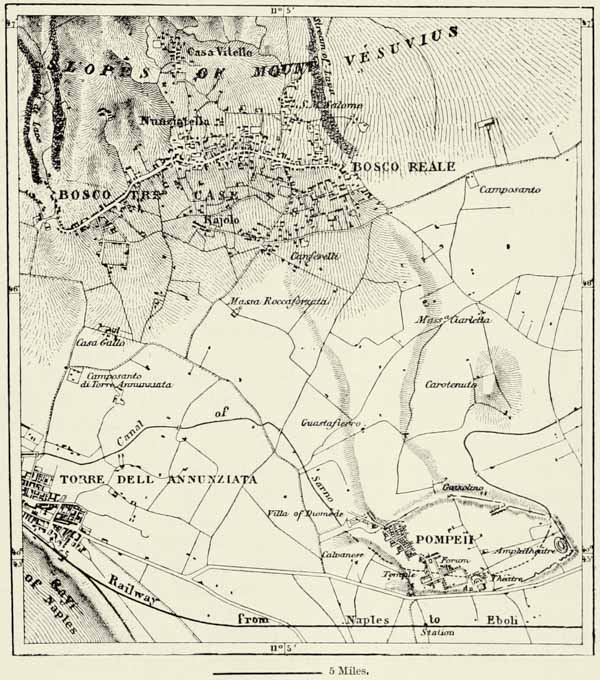
The university is one of the glories of Naples. Founded in the first half of {302} the thirteenth century, it is one of the oldest of Italy, but has had its periods of disgraceful decay. Up to a recent period, when archæology and numismatics were the only sciences not suspected of revolutionary tendencies, it was a place of intellectual corruption, but its regeneration has been brought about with marvellous rapidity. The young Neapolitans now study science with a zest sharpened by abstinence; and, if the rather gushing eloquence of the South could be trusted, Naples has become the greatest seat of learning in the world. Thus much is certain, that the 2,000 students of the university will give a great impulse to the “march of ideas.”
Naples possesses an admirable museum of antiquities, open to all the world, and, more precious still, the ruins of Pozzuoli, Baiæ, and Cumæ, and catacombs no less interesting than are those of Rome; and, above everything else, the Roman city of Pompeii, which has been excavated from the ashes of Mount Vesuvius, beneath which it lay buried for seventeen centuries. It is not merely a City of the Dead, with its streets and tombs, temples, markets, and amphitheatres, which these excavations have restored to us, but they have likewise given us an insight into the life of a provincial Roman city. When we gaze upon inscriptions on walls and waxed tablets, at work interrupted, at mummified corpses in the attitude of flight, we almost feel as if we had been present at the catastrophe which overwhelmed the town. No other buried city ever presented us with so striking a contrast between the tumult of life and the stillness of death. In spite of a hundred years of excavation, only one-half of the city has yet been revealed to us. Herculaneum is buried beneath a layer of lava sixty feet in thickness, upon which the houses of Resina, Portici, and other suburbs of Naples have been built, and but very few of its mysteries have been revealed to us. Of Stabiæ, which lies hidden beneath the town of Castellamare, close to the beach, we know hardly anything.
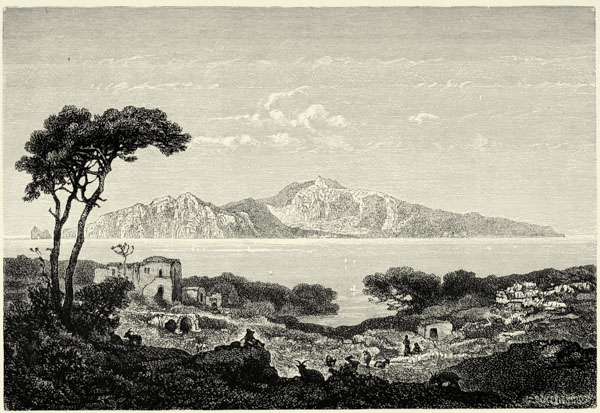
CAPRI, SEEN FROM MASSA LUBRENSE.
Numerous populous towns cluster around Naples, rivalling it in beauty. To the south, on the shores of the bay, are Portici, Resina, Torre del Greco, Torre dell’ Annunziata, Castellamare, and sweet Sorrento, with its delicious climate, its delightful villas and olive groves. Off Cape Campanella, facing the volcanic islands of Ischia and Procida, at the other extremity of the bay, rise the bold cliffs of Capri, full of the memories of hideous Tiberius, the Timberio of the natives. Another bay opens to the south of that barren mass of limestone, its entrance guarded by the islets of the Sirens, who sought in vain to cast their spell over sage Ulysses. This bay is hardly inferior in beauty to that of Naples; its shores are equally fertile, but neither of the three cities, Pæstum, Amalfi, and Salerno, which successively gave a name to it, has retained its importance for any length of time. Amalfi, the powerful commercial republic of the Middle Ages, whose code was accepted by all maritime nations, is almost deserted now, and only shelters a few fishing-smacks within its rocky creek. In a delightful valley near it stands the old Moorish city of Ravello, almost as rich as Palermo in architectural monuments. Salerno is much more favourably situated than Amalfi, for the road of the Campania debouches upon it. The town is said to have been founded by a son of Noah, and when the Normans occupied the country in the eleventh century {303} they made it their capital. But its ancient splendours have gone. Its university, at one time the representative of Arab science, and the most famous in Europe for its medical faculty, has made no sign for ages, and Salerno has now no claim whatever to the title of “Hippocratic town.” It aspires, however, to rise into importance through commerce and industry, and a breakwater and piers might convert it into a formidable rival of Naples. The inhabitants are fond of repeating a local proverb―
“When Salerno a port doth obtain
That of Naples will be inane.”
Pæstum, or Posidonia, the ancient mistress of the bay, stood to the south-east of Salerno. It was founded by the Sybarites on the ruins of a more ancient town of the Tyrrhenians. The Roman poets sang this “city of roses” on account of its cool springs, shady walks, and mild climate. It was destroyed by the Saracens in 915, and its ruins, though amongst the most interesting of all Italy, dating as they do from a period anterior to that of Rome, were known only to shepherds and brigands up to the middle of last century. Its three temples, the most important of which was dedicated to Neptune, or Poseidon, are amongst the most imposing of continental Italy, their effect being heightened by the solitude which surrounds them and the waves which wash their foundations. The traveller, however, cannot afford to remain for any length of time within their vicinity, for the site of the ruins is surrounded by marshes, the exhalations from which sadly interfere with the excavations going on.
Numerous towns and villages are dotted over the champaign country separating Mount Vesuvius from the foot-hills of the Apennines. Starting from Vietri, a suburb of Salerno on the banks of a narrow ravine, we ascend to Cara, a favourite summer retreat, abounding in shade-trees. Near it is a monastery famous amongst antiquaries on account of its ancient parchments and diplomas. On descending to the plain of the Sarno we pass Nocera, a country residence of the ancient Romans; Pagani, still situated within the region of woods; Angri, which manufactures yarns from cotton grown in its environs; and Scafati, more industrious still. Near it may be seen the ruins of Pompeii, the town of Torre dell’ Annunziata, and, on the southern slope of Vesuvius, the houses of Bosco Tre Case and Bosco Reale. There are savants who believe they can trace in the veins of the inhabitants of Nocera and the neighbourhood the Arab and Berber blood of the 20,000 Saracens who were settled here by the Emperor Frederick II.
The valley of the Sarno, above Nocera, is densely peopled as far as the foot of the Apennines, and another chain of villages extends northwards to the town of Avellino, the fields of which are enclosed by hedges of filbert-trees (avellana in Italian), and which is important on account of its intermediary position between the mountains and the plain. The population, however, is densest in that portion of the Campania known as the “Happy” (Felice), which extends between Vesuvius and Monte Vergine. Sarno, named after the river, though far away from it, abounds in cereals, vines, fruit, and vegetables, and manufactures cotton stuffs and raw silk. Palma stands in the midst of fertile fields; Ottajano, the {304} town of Octavius, on the lower slope of the Somma of Vesuvius, is famous for its wines; Nola, where Augustus died, and which gave birth to Giordano Bruno, has fertile fields, but is better known through the fine Greek vases found in its ruins, and on account of the remains of an amphitheatre built of marble, and of greater size than that of Capua.
Famous Capua, the ancient metropolis of the Campania, at one time the rival of Rome, with half a million inhabitants dwelling within its walls, has been completely stripped of its former splendours. Its name is applied now to a sullen fortress on the Volturno, the Casilinum of the Romans; and Santa Maria, which is the representative of the veritable Capua, offers no “delights” other than those of a large village. In its environs, however, may still be seen the ruins of a fine amphitheatre, a triumphal arch, and other remains of a vast city. Caserta, the “town of pleasure” of the modern Campania, lies farther to the south. It boasts of a large palace, shady parks, and vast gardens ornamented with statues and fountains, and was the Versailles of the Neapolitan Bourbons. An aqueduct supplies it with water from a distance of twenty-five miles, and crosses the valley near Maddaloni by means of a magnificent bridge, built about the middle of last century by Vanvitelli, and one of the masterpieces of modern architecture.
The great Roman highway bifurcates to the north of Capua and the Volturno. One branch turns towards the coast; the other, along which a railway has been built, skirts the volcano of Rocca Monfina, follows the valley of the Garigliano and of its tributary the Sacco as far as the eastern foot of the volcano of Latium, and then descends into the Campagna of Rome. Historically the coast road is the more famous of the two. It first passes close to Sessa, the ancient city of the Aurunci, whose acropolis stood in the crater of the Rocca Monfina. It then turns towards the coast, and having crossed the Garigliano near its mouth, where it is bounded by insalubrious marshes, it penetrates the defile of Mola di Gaeta, officially called Formia, in memory of ancient Formiæ, where Cicero lived and died. Travellers coming from Rome first look down from this spot upon the beauties of the Campania, and see stretched out before them the Bay of Gaeta, with the volcanic islands of Ponza, Ventotene, and Ischia in the distance. Gaeta, a fortress which guards this gateway to the Neapolitan paradise, is built on the summit of Monte Orlando, occupying a small peninsula attached to the mainland by an isthmus only 300 yards in width. The port of Gaeta is well sheltered against westerly and northerly winds, and is much frequented by coasting vessels and fishing-smacks; but Gaeta itself is better known as a fortress. It was here the kingdom of the Two Sicilies was put an end to by the surrender of Francis II. in 1861.
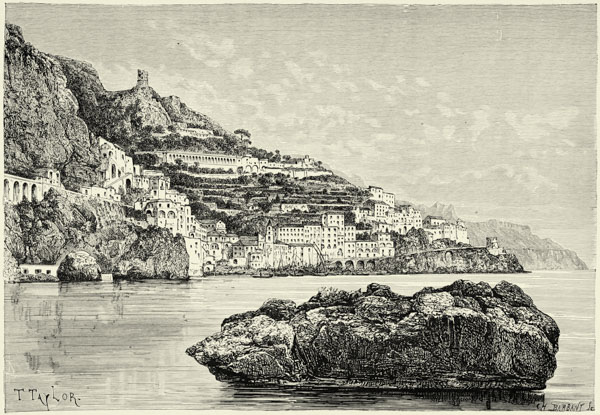
AMALFI.
Towns of some importance are likewise met with on following the eastern road from Naples to Rome. The most considerable amongst them is San Germano, the name of which has recently been changed into Casino, in honour of the famous monastery of that name occupying a terrace to the west of the town, and affording a glorious prospect of hills and valleys. This monastery was founded in the sixth century by St. Benedict, or Bennet, and its rules have been accepted throughout {305} the Eastern Church. No body of men has ever exercised a greater influence upon the history of Catholicism than these Benedictine monks of Monte Casino. At the height of its power the order held vast estates throughout Italy, and many popes and thousands of Church dignitaries have been furnished from its ranks. The library of Monte Casino is one of the most valuable in Europe, and the services formerly rendered to science by the Benedictines have saved this monastery from disestablishment, a favour likewise extended to the monastery of La Cava and the Certosa of Pavia.
Μ
Fig. 110.—THE MARSHES OF SALPI.
Scale 1 : 225,000.
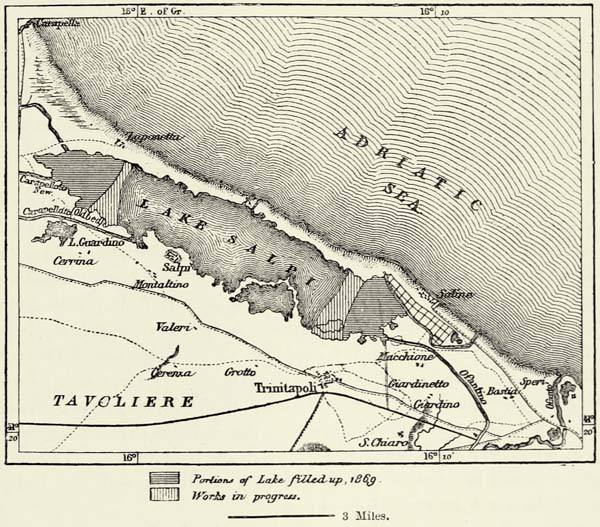
There are but few towns of importance in the mountain region of Naples. Arpino, the ancient Arpinum, the birthplace of Cicero and Marius, with cyclopean walls built by Saturn, is the most populous place in the upper valley of the Liri, to the south of the mountains of Mantese. Benevento occupies a central position on the Calore, the principal tributary of the Volturno, and several roads diverge from it. The ancient name of this place was Maleventum, but in spite of its change of name the town has frequently suffered from sieges and earthquakes, and of all the great edifices of its past there now remains only a fine triumphal arch erected in honour of Trajan. The city walls, nearly four miles in circumference, have for the most part been constructed from the fragments of ancient monuments.
Ariano, to the east of Benevento, and also in the basin of the Volturno, is built upon three hills commanding a magnificent prospect, extending from the {306} often snow-clad Matese Mountains to the cone of the Vultur. It lies on the railroad connecting Naples with Foggia and the Adriatic, and carries on a considerable trade. Campobasso, the capital of Molise, is likewise an important commercial intermediary, though still without a railway.