EUROPE.
Reading edition

I.—GEOGRAPHICAL IMPORTANCE.
N the geography of the world the first place is claimed for Europe, not because of a prejudice like that of the Chinese, but as a matter of right. Europe as yet is the only continent the whole of whose surface has been scientifically explored. It possesses a map approximately correct, and its material resources are almost fully known to us. Its population is not as dense as that of India or of China, but it nevertheless contains about one-fourth of the total population of the globe; and its inhabitants, whatever their failings and vices, or their state of barbarism in some respects, still impel the rest of mankind as regards material and mental progress. Europe, for twenty-five centuries, has been the focus whence radiated Arts, Sciences, and Thought. Nor have those hardy colonists who carried their European languages and customs beyond the sea succeeded hitherto in giving to the New World an importance equal to that of “little” Europe, in spite of the virgin soil and vast area which gave them scope for unlimited expansion.

“Old Europe,” where every clod of earth has its history, where every man is the heir of a hundred successive generations, therefore still maintains the first place, and a comparative study of nations justifies us in the belief that its moral ascendancy and industrial preponderance will remain with it for many years to come. At the same time, we must not shut our eyes to the fact that equality will obtain in the end, not only between America and Europe, but also between these two and the other quarters of the world. The intermingling of nations, migrations which have assumed prodigious proportions, and the increasing facilities of intercourse, must in the end lead to an equilibrium of population throughout the world. Then will each country add its proper share to the wealth of mankind, and what we call civilisation will have “its centre everywhere, its periphery nowhere.”
The central geographical position of Europe has undoubtedly exercised a most favourable influence upon the progress of the nations inhabiting it. The superiority of the Europeans is certainly not due to the inherent virtues of the races from which they sprang, as is vainly imagined by some, for in other parts of {6} the ancient world these same races have exhibited far less creative genius. To the happy conditions of soil, climate, configuration, and geographical position, the inhabitants of Europe owe the honour of having been the first to obtain a knowledge of the earth in its entirety, and to have remained for so long a period at the head of mankind. Historical geographers are, therefore, right when they insist upon the influence which the configuration of a country exercises upon the nations who inhabit it. The extent of table-lands, the heights of mountain ranges, the direction and volume of rivers, the vicinity of the ocean, the indentation of the coast-line, the temperature of the air, the abundance or rarity of rain, and the correlations between soil, air, and water—all these are pregnant with effects, and explain much of the character and mode of life of primitive nations. They account for most of the contrasts existing between nations subject to different conditions, and point out the natural highways of the globe which nations are constrained to follow in their migrations or warlike expeditions.
II.—EXTENT AND BOUNDARIES.
The dwellers on the eastern shores of the Mediterranean Sea must have learnt, in the course of their first warlike and commercial expeditions, to distinguish between the great continents; for within the nucleus of the ancient world Africa is attached to Asia by a narrow band of arid sand, and Europe separated from Asia Minor by seas and channels difficult to navigate on account of dangerous currents. The division of the known world into three distinct parts could not fail to impress itself upon the minds of those infant nations; and when the Greeks had attained a state of maturity, and historical records took the place of myths and oral traditions, the name of Europe had probably been transmitted through a long series of generations. Herodotus naïvely admits that no mortal could ever hope to find out the true meaning of this name, bequeathed to us by our forefathers; but this has not deterred our modern men of learning from attempting to explain it. Some amongst them consider that it was applied at first to Thrace with its “large plains,” and subsequently extended to the whole of Europe; others derive it from one of the surnames of Zeus with the “large eyes,” the ancient god of the Sun, specially charged with the protection of the continent. Some etymologists believe that Europe was designated thus by the Phœnicians, as being the country of “white men.” We consider it, however, to be far more probable that its name originally meant simply “the West,” as contrasted with Asia, “the East,” or “country of the rising sun.” It is thus that Italy first, and then Spain, bore the name of Hesperia; that Western Africa received the name of El Maghreb from the Mohammedans, and the plains beyond the Mississippi became known in our own times as the “Far West.”
But, whatever may be the original meaning of its name, Europe, in all the myths of the ancients, is described as a Daughter of Asia. The Phœnicians were the first to explore the shores of Europe, and to bring its inhabitants into contact with those of the East. When the Daughter had become the superior of her {7} Mother in civilisation, and Greek voyagers were following up the explorations begun by the mariners of Tyre, all the known countries to the north of the Mediterranean were looked upon as dependencies of Europe, and that name, which was originally confined to the Thraco-Hellenic peninsula, was made to include, in course of time, Italy, Spain, the countries of the Gauls, and the hyperborean regions beyond the Alps and the Danube. Strabo, to whom were known already the most varied and fruitful portions of Europe, extends it eastward as far as the Palus Mæotis and the Tanais.2
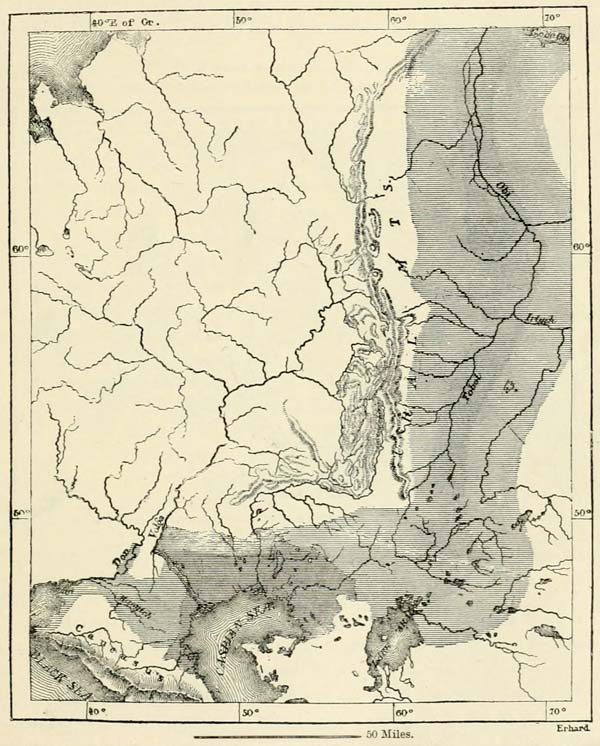
Fig. 1.—THE NATURAL BOUNDARY OF EUROPE.
Scale 1 : 21,800,000.
Μ
The zone of depression extending from the Black Sea to the Gulf of Obi is shaded. The darker shading to the north of the Caspian shows the area depressed below the level of the Mediterranean.
{8}
Since that epoch the limits between Europe and Asia have been shifted by geographers still further to the east. They are, however, more or less conventional, for Europe, though bounded on three sides by the ocean, is in reality but a peninsula of Asia. At the same time, the contrasts between these two parts of the world fully justify scientific men in dividing them into two continental masses. But where is the true line of separation between them? Map-makers generally adopt the political boundaries which it has pleased the Russian Government to draw between its vast European and Asiatic territories, and others adopt the summits of the Ural Mountains and of the Caucasus as the boundary between the two continents; and although, at the first glance, this delineation appears more reasonable than the former, it is in reality no less absurd. The two slopes of a mountain chain can never be assigned to different formations, and they are generally inhabited by men of the same race. The true line of separation between Europe and Asia does not consist of mountains at all, but, on the contrary, of a series of depressions, in former times covered by a channel of the sea which united the Mediterranean with the Arctic Ocean. The steppes of the Manych, between the Black Sea and the Caspian, and to the north of the Caucasus, are still covered in part with salt swamps. The Caspian itself, as well as Lake Aral and the other lakes which we meet with in the direction of the Gulf of Obi, are the remains of this ancient arm of the sea, and the intermediate regions still bear the traces of having been an ancient sea-bed.
Μ
Fig. 2.—THE RELIEF OF EUROPE.
According to Houzeau, Berghaus, Kiepert, Olsen, and others. Scale 1 : 60,000,000.
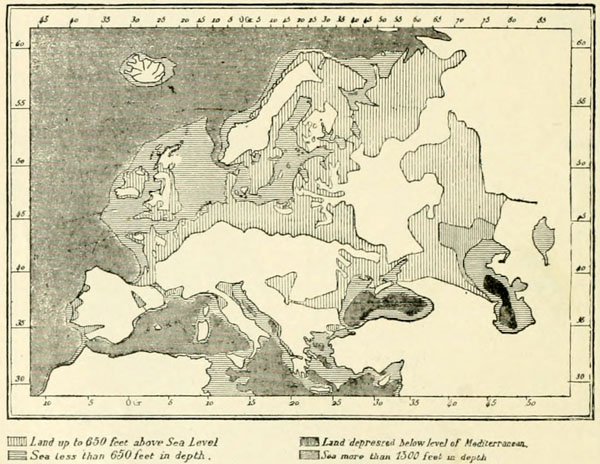
There can be no doubt that vast changes have taken place in the configuration {9} of Europe, not only during more ancient geological periods, but also within comparatively recent times. We have already seen that a vast arm of the sea formerly separated Europe from Asia; it is equally certain that there was a time when it was joined to Anatolia by an isthmus, which has since been converted into the Bosphorus of Constantinople; Spain was joined to Africa until the waters of the Atlantic invaded the Mediterranean; Sicily was probably connected with Mauritania; and the British Islands once formed a portion of the mainland. The erosion of the sea, as well as upheavals and subsidences of land, has effected, and still effect, changes in the contours of our coasts. Numerous soundings in the seas washing Western Europe have revealed the existence of a submarine plateau, which, from a geological point of view, must be looked upon as forming an integral portion of our continent. Bounded by abyssal depths of thousands of fathoms, and submerged one hundred fathoms at most below the waters of the ocean, this pedestal of France and the British Islands must be looked upon as the foundation of an ancient continent, destroyed by the incessant action of the waves. If the shallow portions of the ocean, as well as those of the Mediterranean Sea, were to be added to Europe, its area would be increased to the extent of one-fourth, but it would lose, at the same time, that wealth in peninsulas which has secured to Europe its historical superiority over the other continents.
If we supposed Europe to subside to the extent of one hundred fathoms, its area would be reduced to the compass of one-half. The ocean would again cover her low plains, most of which are ancient sea-beds, and there would remain above the waters merely a skeleton of plateaux and mountain ranges, far more extensively indented by bays and fringed by peninsulas than are the coasts existing at the present time. The whole of Western and Southern Europe would be converted into a huge island, separated by a wide arm of the sea from the plains of interior Russia. From an historical as well as a geological point of view, this huge island is the true Europe. Russia is not only half Asiatic on account of its extremes of temperature, and the aspect of its monotonous plains and interminable steppes, but is likewise intimately linked with Asia as regards its inhabitants and its historical development. Russia can hardly be said to have belonged to Europe for more than a hundred years. It was in maritime and mountainous Europe, with its islands, peninsulas, and valleys, its varied features and unexpected contrasts, that modern civilisation arose, the result of innumerable local civilisations, happily united into a single current. And, as the rivers descending from the mountains cover the plains at their foot with fertile soil, so has the progress accomplished in this centre of enlightenment gradually spread over the other continents to the very extremities of the earth.
III.—NATURAL DIVISIONS AND MOUNTAINS.
The Europe alluded to includes France, Germany, England, and the three Mediterranean peninsulas, and constitutes several natural divisions. The British Islands form one of these. The Iberian peninsula is separated scarcely less {10} distinctly from the remainder of Europe, for between it and France rises a most formidable range of mountains, the most difficult to cross in all Europe; and immediately to the north of it a depression, nowhere exceeding a height of 650 feet, extends from the Mediterranean to the Atlantic Ocean. The geographical unity of Europe is represented to the full extent only in the system of the Alps, and in the mountains of France, Germany, Italy, and the Balkan peninsula which are connected with it. It is there we must seek the framework of continental Europe.
The Alps, whose ancient Celtic name probably refers to the whiteness of their snowy summits, stretch in an immense curve, more than 600 miles in length, from the shores of the Mediterranean to the plains of the Danube. They consist in reality of more than thirty mountain masses, representing as many geological groups, and joined to each other by elevated passes; but their rocks, whether they be granite, slate, sandstone, or limestone, form one continuous rampart rising above the plains. In former ages the Alps were higher than they are now. This is proved by an examination of their detritus and of the strata disintegrated by natural agencies. But, whatever the extent of detrition, they still rise in hundreds of summits beyond the line of perennial snow, and vast rivers of ice descend from them into every upland valley. Looked at from the plains of Piedmont and Lombardy, these glaciers and snow-fields present the appearance of sparkling diadems encircling the mountain summits.
In the eastern portion of the Alpine system—that is to say, between the Mediterranean and Mont Blanc, the culminating point of Europe—the average height of the mountain groups gradually increases from 6,500 to more than 13,000 feet. To the east of Mont Blanc the Alps change in direction, and, beyond the vast citadels represented by Monte Rosa and the Bernese Oberland, they gradually decrease in height. To the east of Switzerland no summit exceeds a height of 13,000 feet, but this loss in elevation is fully made up by increase of breadth. And whilst the general direction of the principal axis of the Alps remains north-easterly, very considerable mountain chains, far exceeding the central mass in breadth, are thrown off towards the north, the east, and the south-east. A line drawn across the true Alps from Vienna has a length of no less than 250 miles.
In thus spreading out, the Alps lose their character and aspect. We no longer meet with grand mountain masses, glaciers, and snow-fields. Towards the north they gradually sink down into the valley of the Danube; towards the south they branch out into secondary chains, resting upon the arched plateau of Turkey. But, in spite of the vast contrasts offered by the true Alps and the mountains of Montenegro, the Hæmus, the Rhodope, and the Pindus, all these mountain chains nevertheless belong to the same orographical system. The whole of the Balkan peninsula must be looked upon as a natural dependency of the Alps; and the same applies to Italy, for the chain of the Apennines is nothing but a continuation of the Maritime Alps, and we hardly know where to draw the line of separation between them. The Carpathians, too, must be included among the {11} mountain chains forming part of the system of the Alps. They have been gradually separated from them through the continuous action of water, but there can be no doubt that, in former times, the semicircle of mountains known as the Little Carpathians, the Beskids, the Tatra, the Great Carpathians, and the Transylvanian Alps was joined, on the one hand, to the Austrian Alps, and on the other to spurs descending from the Balkan. The Danube has forced its way through these mountain ramparts, but the passages, or “gates,” are narrow; they are strewn with rocks, and commanded by what remains of the ancient partition ranges.
The configuration of the Alps, and of the labyrinthine mountain ranges branching off from them towards the east, could not fail to exercise a most powerful influence upon the history of Europe and of the entire world. The only high-roads known to barbarians are those traced out by nature herself, and they were consequently able to penetrate into Europe only by sea, or through the vast plains of the north. Having penetrated to the westward of the Black Sea, their progress was first stopped by the lakes and difficult swamps of the Danubian valley; and, when they had surmounted these obstacles, they found themselves face to face with a barrier of high mountains, whose intricate wooded valleys and declivities led up to the inaccessible regions of eternal snow. The Alps, the Balkan, and all the other advanced chains of the Alpine system constituted an advanced defensive barrier for Western Europe, and the conquering nomad tribes who threw themselves against it did so at the risk of destruction. Accustomed to the boundless horizon of the steppes, they did not venture to climb these steep hills—they turned to the northward, where the vast plains of Germania enabled successive swarms of immigrants to spread over the country with greater ease. And as to the invaders, whom blind rage of conquest impelled to engage in the defiles of these mountains, they found themselves caught as in a trap; and this accounts for the variety of nations, and of fragments of nations, whose presence has converted the countries of the Danube into a sort of ethnological chaos. And as the débris carried along by the current is deposited in the eddy of a river, so were these fragments of nearly every nation of the East accumulated in motley disorder in this corner of the Continent.
To the south of this great mountain barrier the migrations between Europe and Asia could take place only by sea—a high-road open to those nations alone who were sufficiently advanced in civilisation to have acquired the art of building ships. Whether pirates, merchants, or warriors, they had raised themselves long ago above a state of primitive barbarism, and even their voyages of conquest added something to the stock of human knowledge. Moreover, owing to the difficulties of navigation, they migrated only in small bodies. At whatever point they settled they came into contact with populations of a different race from their own, and this intercourse gave birth to a number of local civilisations, each bearing its own stamp, and nowhere did their influence preponderate. Every island of the Archipelago, and every valley of ancient Hellas, differed from its neighbours as regards social condition, dialect, and customs, but they all remained Greek, in spite of the Phœnician and other influences to which they had been subjected. It is thus owing to the {12} configuration of the mountain chains and coast-lines that the civilisation which developed itself gradually in the Mediterranean countries to the south of the Alps was, upon the whole, more spontaneous in its nature, and offered more variety and greater contrasts, than the civilisation of the far less advanced nations of the north, who were moving from place to place on vast plains.
The wide range of the Alps and of their advanced chains thus separated two distinct worlds, in which historical development went on at a different rate. At the same time, the separation between the two slopes of the Alpine system was by no means complete. Nowhere in the Alps do we meet with cold and uninhabited plateaux, as in the Andes and in Tibet, whose enormous extent forms almost insurmountable barriers. The Alpine masses are cut up everywhere into mountains and valleys, and the climate of the latter is sufficiently mild to enable man to exist in them. The mountaineers, who easily maintained their independence, owing to the protection extended to them by nature, first served as intermediaries between the peoples inhabiting the opposite lowlands. It was they who effected the rare exchanges of produce which took place between the North and South, and who opened the first commercial high-roads between the summits of the mountains. The direction of the valleys and the deeply cut mountain passes even then indicated the grand routes by which the Alps would be crossed, at a future period, for the purposes of commerce or of war. That portion of the Alps which lies between the mountain masses of Savoy and of the Mediterranean would naturally cease first to form an obstacle to military expeditions. The Alps there are of great height, it is true, but they are narrower than anywhere else; besides which, the climate on the two opposite slopes is similar, and assimilates the mode of life and the customs of the people dwelling there. Far more formidable, as a natural barrier, are the Alps to the north-east of Mont Blanc, for they constitute a climatic boundary.
The other mountain ranges play but a secondary or local part in the history of Europe, when we compare them with the Alps. Still, the influence which they have exercised upon the destiny of nations is no less evident. The table-lands and snow-fields of the Scandinavian Alps form a wall of separation between Norwegians and Swedes. The quadrangular mountain fort of Bohemia, in the centre of Europe, which shelters the Chechians, is almost entirely enclosed by Germans, and resembles an island fretted by the waves of the ocean. The hills of Wales and of Scotland have afforded a shelter to the Celtic race against the encroachments of Anglo-Saxons, Danes, and Normans. The Bretons, in France, are indebted to their rocks and landes for the fact of their not having yet become wholly French; whilst the table-land of Limousin, the hills of Auvergne and the Cevennes constitute the principal cause of the striking contrast which still exists between the inhabitants of Northern and of Southern France. The Pyrenees, next to the Alps, constitute the most formidable obstacle to the march of nations in Europe; they would have remained an insurmountable rampart down to our own time, were it not easy to pass round them by their extremities abutting upon the sea. {13}
IV.—THE MARITIME REGIONS.
The valleys which radiate in all directions from the great central masses of the Alps are admirably adapted for imparting to almost the whole of Europe a remarkable unity, whilst they offer, at the same time, an extreme variety of aspects and of physical conditions. The Po, the Rhone, the Rhine, and the Danube traverse countries having the most diverse climates, and yet they have their sources in the same mountain region, and the fertilising alluvium which they deposit in their valleys results from the disintegration of the same rocks. Minor valleys cut up the slopes of the Alps and of their dependent chains, and carry towards the sea the waters of the mountains and the triturated fragments of their rocks. Running waters are visible, wherever we cast our eyes. There are neither deserts, nor sterile plateaux, nor inland lakes and river basins such as we meet with in Africa and Asia. The rivers of Europe are not flooded as are those of certain portions of South America, which deluge half the country with water. On the contrary, in the scheme of her rivers Europe exhibits a certain degree of moderation which has favoured the work of the settler, and facilitated the rise of a local civilisation in each river basin. Moreover, although most rivers are sufficiently large to have retarded migration, they are not sufficiently so to have arrested it for any length of time. Even when roads and bridges did not exist, barbarian immigrants easily made their way from the shores of the Black Sea to those of the Atlantic.
But Europe, in addition to the advantages due to its framework of mountains and the disposition of its river basins, enjoys the still greater advantage of possessing an indented coast-line. It is mainly the contours of its coasts which impart to Europe its double character of unity and diversity, which distinguish it amongst continents. It is “one” because of its great central mass, and “diversified” because of its numerous peninsulas and dependent islands. It is an organism, if we may say so, resembling a huge body furnished with limbs. Strabo compared Europe to a dragon. The geographers of the period of the revival of letters compared it to a crowned virgin, Spain being the head, France the heart, and England and Italy the hands, holding the sceptre and the orb. Russia, at that time hardly known, is made to do duty for the ample folds of the robe.
The area of Europe is only half that of South America, and one-third of that of Africa, and yet the development of its coast-lines is superior to that of the two continents taken together. In proportion to its area the coasts of Europe have twice the extent of those of South America, Australia, and Africa; and although they are to a small extent inferior to those of North America, it must be borne in mind that the arctic coasts of the latter are ice-bound during the greater portion of the year. A glance at the subjoined diagrams will show that Europe, as compared with the two other continents washed by the Arctic Ocean, enjoys the immense advantage of possessing a coast-line almost wholly available for purposes of navigation, whilst a large portion of the coasts of Asia and America is altogether useless to man. And not only does the sea penetrate into the very heart of {14} temperate Europe, cutting it up into elongated peninsulas, but these peninsulas, too, are fringed with gulfs and miniature inland seas. The coasts of Greece, of Thessaly, and of Thrace are thus indented by bays and gulfs, penetrating far into the land; Italy and Spain likewise possess numerous bays and gulfs; and the peninsulas of Northern Europe, Jutland and Scandinavia, are cut up by the waters of the ocean into numerous secondary peninsulas.
Fig. 3.—DEVELOPMENT OF COAST-LINES RELATIVELY TO AREA.
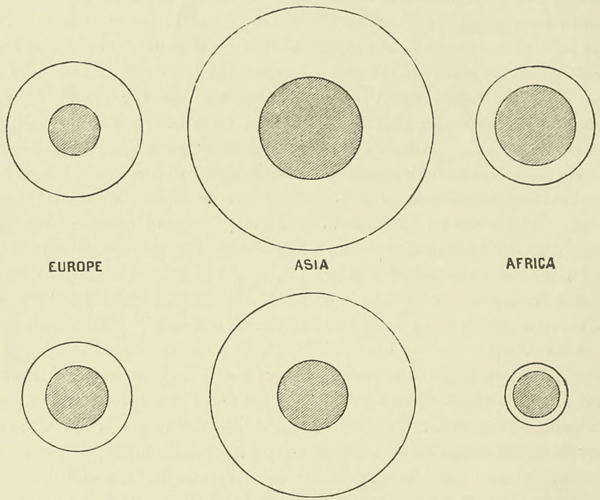
Europe. Asia. Africa. N. America. S. America. Australia.
Total area, square miles 4,005,100 17,308,400 11,542,400 9,376,850 6,803,570 3,450,130
Mainland area, square miles 3,758,300 15,966,000 11,293,930 7,973,700 6,731,470 2,934,500
Development of coast-line, miles 18,600 34,110 16,480 30,890 16,390 10,570
Accessible coasts 17,610 28,200 16,480 26,510 16,390 14,400
Ratio of the geometrical to the actual contour 1 : 2·5 1 : 2·5 1 : 1·4 1 : 3·1 1 : 1·8 1 : 1·7
The shaded circles represent the various continents; the outer circle represents the actual extent of coast-line. The blank space between the two concentric circles represents graphically the difference between the smallest possible or geometrical contour of a country having the area of the respective continents, and the actual contour as exhibited in the existing coast-lines. Europe, being in reality only a peninsula of Asia, hardly admits of this comparison.
The islands of Europe must be looked upon as dependencies of that continent, for most of them are separated from it only by shallow seas. Candia and the islands scattered broadcast over the Ægean Sea, the Archipelagos of the Ionian Sea, and of Dalmatia, Sicily, Corsica and Sardinia, Elba, and the Baleares, are in reality but prolongations, or maritime out-stations, of neighbouring peninsulas. To the islands of Sealand and Fyen, at the entrance to the Baltic, Denmark owes {15} most of her commercial and political importance. Great Britain and Ireland, which actually formed a portion of the European continent in a past age, cannot be looked upon otherwise than as dependencies of it, although the isthmus which once joined them has been destroyed by the waters of the ocean. England has actually become the grand commercial emporium of Europe, and plays now the same part in the world’s commerce that Greece once played in that of the more restricted world of the Mediterranean.
It is a remarkable fact that each of the European peninsulas should have enjoyed in turn a period of commercial preponderance. Greece, the “most noble individuality of the world of the ancients,” came first, and when at the height of her power governed the Mediterranean, which at that time meant nearly the whole universe. During the Middle Ages Amalfi, Genoa, and Venice became the commercial agents between Europe and the Indies. The discovery of a passage round the Cape and of America diverted the world’s commerce to Cadiz, Seville, and Lisbon, on the Iberian peninsula. Subsequently the merchants of the small Dutch Republic seized a portion of the heritage of Spain and Portugal, and the wealth of the entire world was floated into the harbours of their sea-bound islands and peninsulas. In our own days Great Britain, thanks to its favourable geographical position, in the very centre of great continental masses, and the energy of its people, has become the great mart of the world. London, the most populous city of the world, is also the great centre of attraction for the treasures of mankind; but there can be no doubt that sooner or later it will be supplanted, in consequence of the opening of new commercial high-roads, and changes in the political preponderance of nations. Perhaps some city of the United States will take the place of London in a future age, and thus the American belief in the westward march of civilisation will be verified; or we may possibly return to the East, and convert Constantinople or Cairo into the world’s emporium and centre of intercourse.
But, whatever may happen in the future, the great changes which have taken place in the relative importance of the peninsulas and islands of Europe in the short span of twenty centuries, sufficiently prove that geographical features exercise a varying influence at different epochs. That which at one time was looked upon as a great natural advantage may become, in course of time, a serious disadvantage. Thus the numerous inlets and gulfs enclosed by mountain chains, which favoured the rise of the cities of Greece, and gave to Athens the dominion of the Mediterranean, now constitute as many obstacles to their connection with the existing system of European communications. That which in former times constituted the strength of the country has become its weakness. In primitive times, before man ventured upon the seas, these bays and gulfs formed insurmountable obstacles to the migration of nations; at a later date, when the art of navigation had been acquired, they became commercial high-roads, and were favourable to the development of civilisation; and at the present time they are again obstacles in the way of our road-builders and railway engineers. {16}
V.—CLIMATE.
The influence exercised by the relief of the land and the configuration of the coasts varies in different ages, but that of climate is permanent. In this respect Europe is the most favoured region of the earth, for during a cycle of unknown length it has enjoyed a climate at once the most temperate, the most equable, and the most healthy of all continents.
Owing to the inland seas which penetrate far into the land, the whole of Europe is exposed to the modifying influence of the ocean. With the exception of Central Russia, no part of Europe is more than 400 miles from the sea, and, as most of the mountains slope from the centre of the continent towards its circumference, the influence of the sea breezes is felt throughout. And thus continental Europe, in spite of its great extent, enjoys the advantages of an insular climate throughout, the winds passing over the ocean moderating the heat of summer and tempering the cold of winter.
The continuous north-easterly movement of the waters of the Atlantic likewise has a favourable effect upon the climate of Europe. After having been heated by a tropical sun in the Gulf of Mexico, the gulf-stream issues through the Strait of Florida, and, spreading over the Atlantic, takes its course towards the coasts of Europe. This enormous mass of warm water, equal in volume to twenty million rivers as large as the Rhone, brings the warmth of southern latitudes to the western and northern shores of Europe. Its influence is felt not only in the maritime countries of Western Europe, but to some extent as far as the Caspian and the Ural Mountains.
The currents of the air exercise as favourable an influence upon the climate of Europe as do those of the ocean. The south-westerly winds predominating on the coasts pass over the warm gulf-stream, and, on reaching Europe, they part with the heat stored up by them between the tropics. The north-westerly, northerly, and even north-easterly winds, which blow during a portion of the year, are less cold than might be expected, for they, too, have to cross the warm waters of the gulf-stream. And lastly, there is the Sahara, which elevates the temperature of a portion of Europe.
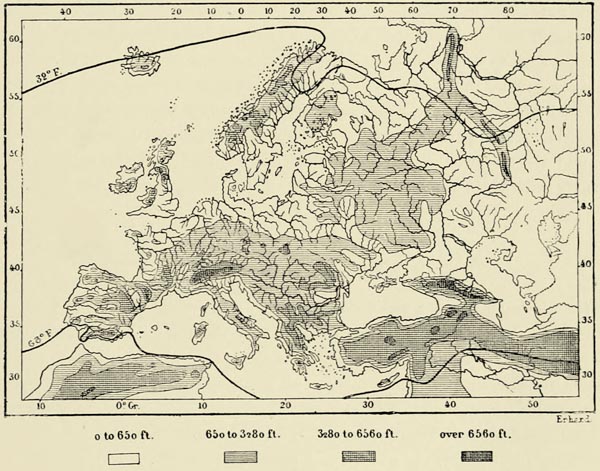
The increase in temperature due to the combined influence of winds and ocean currents amounts to 40° 50°, and even 60°, if we compare Europe with other parts of the world lying under the same latitudes. Nowhere else, not even on the western coast of North America, do the isothermals, or lines of equal annual temperature, ascend so high towards the arctic regions. The inhabitants of Europe, though they may live 900 to 1,200 miles farther away from the equator, enjoy as mild a climate as do those of America, and the decrease of temperature on going northward is far less rapid than in any other part of the globe. This uniformity of temperature constitutes one of the most characteristic features of Europe. The whole of it lies within the temperate region bounded by the isothermal lines of 32° F. and 68° F., whilst in America and Asia that privileged zone has only half this extent. {17}
Μ
Fig. 4.—THE ISOTHERMAL ZONE OF EUROPE.
Scale 1 : 60,000,000.
This remarkable uniformity in the climate of Europe is exhibited not only in its temperature, but likewise in the distribution of its rains. The seas washing the shores of Europe supply all parts of it with the necessary amount of moisture. There is no rainless district, nor, with the exception of a portion of the maritime region of the Caspian and a small corner of Spain, any district where droughts occasionally entail the entire loss of the harvest. Rains fall not only regularly every year, but in most countries they occur in every season, the only exception being the countries of the Mediterranean, where autumn and winter are the real rainy seasons. Moreover, in spite of the great diversity in the physical features of Europe, the amount of rain is scarcely anywhere excessive, whether it descends as a fine drizzle, as in Ireland, or in heavy showers, as in Provence and on the southern slope of the Alps. The annual rainfall scarcely ever exceeds thirty-nine inches, except on the flanks of certain mountain ranges which arrest the passage of currents charged with moisture. This uniformity and moderation in the rainfall exercise a regulating influence upon the course of the rivers, for even the smallest amongst them, at all events those to the north of the Pyrenees, the Alps, and the Balkan, flow throughout the year. They rise and fall generally within narrow limits, and inundations on a vast scale are as rare as is want of water for purposes of irrigation. In consequence of this regularity, Europe is able to derive a greater advantage from its waters than other continents where the amount of precipitation is more considerable. The Alps contribute much towards {18} maintaining a regular flow of the rivers; the excess of humidity which falls to their share is stored up in the shape of snow and ice, which descend slowly into the valleys, and melt during the heat of summer. This happens just at a time when the rivers gain least from rain, and lose most by evaporation, and some amongst them would dry up if the ice of the mountains did not come to the aid of the waters descending from the sky. It is thus that a sort of balance is established in the economy of European rivers.
The climate of Europe is thus characterized by uniformity as a whole, and by a compensatory action in its contrasts. Regularity and freedom from excess, such as are not known in other continents, mark its ocean currents, its winds, its temperature and rains, and the course of its rivers. These great advantages have benefited its inhabitants in the past, and will not cease to do so in the future. Though small in extent, Europe possesses by far the largest area of acclimation. Man may migrate from Russia to Spain, or from Ireland to Greece, without exposing himself to any great risk of life. The inhabitants of the Caucasus and the Ural Mountains were thus able to cross the plains and mountains of Europe, and to establish themselves on the shores of the Atlantic. Soil and climate are equally propitious to man, and enable him to preserve his physical and intellectual powers wherever he goes. A migratory people might found new homesteads in any part of Europe. Their companions of travel—the dog, the horse, and the ox—would not desert them on the road, and the seed-corn which they carry with them would yield a harvest wherever confided to the earth.
VI.—INHABITANTS.
A study of the soil and a patient observation of climatic phenomena enable us to appreciate the general influence exercised by the nature of the country upon the development of its inhabitants; but it is more difficult to assign to each race or nation its due share in the progress of European civilisation. No doubt, in their struggles for existence, different groups of naked and ignorant savages must have been acted upon differently, according to their numbers and physical strength, their inborn intelligence, their tastes and mental tendencies. But who were those primitive men who first turned to account the natural resources of the country in which they dwelt? We know not; for, if we go back for a few thousand years, every fact is shrouded in darkness. We know nothing even as regards the origin of the leading nations of Europe. Are we the “sons of the soil,” and the “shoots of oak-trees,” as told in the poetical language of ancient tradition, or are we to look upon the inhabitants of Asia as the ancestors to whom we are indebted for our languages, and for the rudiments of our arts and sciences? Or did those immigrants from a neighbouring continent settle down amongst an indigenous population? Not many years ago the Asiatic origin of European nations was accepted as an established fact, and the original seats of our forefathers were pointed out upon the map of Asia. But now most men of science are agreed to {19} seek our ancestors upon the very soil which we, their descendants, still occupy. Caverns, the shores of oceans and lakes, and the alluvial beds of our rivers have yielded the remains of human industry, and even human skeletons, which clearly prove that long before these supposed immigrations from Asia there existed in Europe tribes who had already made some progress in human industry. Even in the childhood of history there existed tribes who were looked upon as aborigines, and some of their descendants—as, for instance, the Basks—have nothing in common with the invaders from the neighbouring continent. Nor is it universally admitted that the Aryans—that is, the ancestors of the Pelasgians, the Greeks, the Latins, Celts, Germans, and Slavs—are of Asiatic origin. Similarity of language may justify our belief in the common origin of the Aryans of Europe, the Persians, and the Hindoos, but it does not prove that their ancestral home should be looked for somewhere near the sources of the Oxus. Many men of learning3 look upon the Aryans as aborigines of Europe, but certainty on this point does not exist. No doubt, in prehistoric times, intermigrations between the two continents were frequent; but we hardly know what directions they took, and can speak with certainty only of those migrations of peoples which are related by history. We thus know that Europe sent forth to other continents Galatians, Macedonians, and Greeks, and more recently innumerable emigrants of all nationalities, and received in turn Huns, Avares, Turks, Mongols, Circassians, Jews, Armenians, Moors, Berbers, and members of many other nations.
Μ
ETHNOGRAPHICAL MAP OF EUROPE
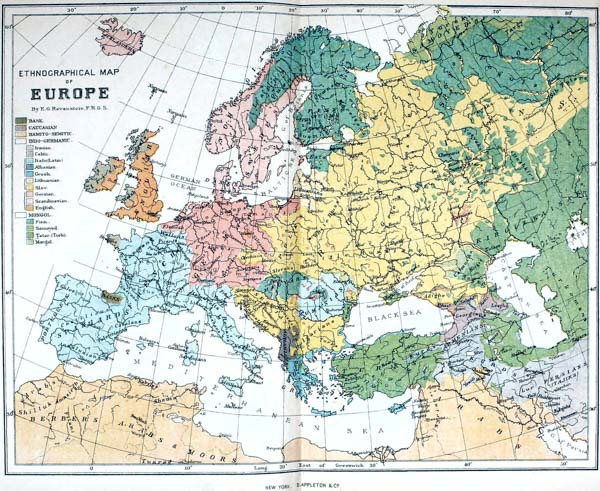
Leaving out of consideration the smaller families of nations, as well as the members of races who have not attained a national existence, Europe may be described as consisting of three great ethnological divisions, the principal boundary between which is formed by the Alps, the Carpathians, and the Balkan.
The first of these great families of European nations, the members of which speak Greco-Latin languages, occupies the southern slopes of the Balkan and of the Alps, the Iberian peninsula, France, and a portion of Belgium, as well as a few detached territories within the limits of the ancient Roman empire, altogether surrounded by alien nations. Such are the plains of the Lower Danube and a portion of Transylvania, which are inhabited by the Rumanians, and a few secluded Alpine valleys inhabited by “Romans.” On the other hand, fragments of two ancient nations have maintained their ground in the midst of Latinised populations, viz. the Celtic inhabitants of Brittany, and the Basks of the Pyrenees. Generally speaking, however, all the inhabitants of South-western Europe, whether of Celtic, Iberian, or Ligurian race, speak languages derived from the Latin, and whatever differences existed originally between these various populations, this community of language has more or less obliterated them.
The Teutonic nations form the second great group. They occupy nearly the whole of Central Europe to the north of the Alps, and extend through Holland and Flanders to within a short distance of the Straits of Dover. Denmark and the great Scandinavian peninsula, as well as Iceland, belong to the same group, and {20} the bulk of the inhabitants of the British Islands are likewise generally included in it. The latter, however, should rather be described as a mixed race, for the aboriginal Celtic population of these islands, which now exists pure only in a few remote districts, has amalgamated with Anglo-Saxon and Danish invaders, and the language of the latter has become mixed with mediæval French, the resulting idiom being almost as much Latin as Saxon. The development of national characteristics has been favoured by the isolation in which the inhabitants of the British Islands found themselves, and they differ essentially from continental neighbours—the Scandinavians, Germans, and Celto-Latins—in language and customs.
The Slavs, or Slavonians, form the third group of European nations. They are less numerous than the Greco-Latins, but the territories they occupy are far more extensive, for they spread over nearly the whole of Russia, over Poland, a large portion of the Balkan peninsula, and about one-half of the Austro-Hungarian monarchy. All the great plains to the east of the Carpathians are inhabited by Slavs, either pure or mixed with Tartars and Mongols. To the west and south of the mountains the race is split up into numerous small nations, and in the valley of the Danube these come into contact with Rumanians, as well as with Turks and Magyars, the two latter being of Asiatic origin, and these separate the Slavonians of the north from the Slavonians of the south. In the north, Finns, Livonians, and Lithuanians interpose between the Slavonians and the Germanic nations.4
Race and language, however, are not always identical. Members of one race frequently speak the language of another, and race and linguistic boundaries, therefore, differ frequently. As for the political boundaries, they scarcely ever follow those natural features which would have been selected had their settlement been intrusted to the spontaneous action of the different nations. They hardly ever coincide with the boundaries of races or of languages, except in the case of a few high mountain ranges or of arms of the sea. On many occasions the countries of Europe were arbitrarily split up in consequence of wars or diplomatic arrangements. A few peoples only, protected by the nature of their country as well as {21} by their valour, have maintained their independence since the age of great migrations, but many more have been swept away by successive invasions. Many others, again, have alternately seen their frontiers expand and contract more than once even during a generation.
The so-called “balance of European powers,” founded as it is upon the rights of war and ambitious rivalries between nations, is necessarily unstable. Nations eminently fit to lead a common political existence are torn asunder on the one side, whilst the most heterogeneous elements are thrown together on the other. In these political arrangements the nations themselves are never consulted, but their wishes and inclinations must nevertheless prevail in the end, and the artificial edifice raised by warriors and statesmen will come to the ground. A true “balance of power” will only be established when every nation of the continent shall have become the arbiter of its own destinies, when every pretended right of conquest shall have been surrendered, and neighbouring nations shall be at liberty to combine for the management of the affairs they have in common. Our arbitrary political divisions, therefore, possess but a transitory value. They cannot altogether be ignored; but in the following descriptions we shall, as far as possible, adhere to the great natural divisions as defined by mountains and valleys, and by the distribution of nations having the same origin and speaking the same language. But even these natural boundaries lose their importance in countries like Switzerland, inhabited by nations speaking different languages, but held together by the strongest of all ties—the common enjoyment of freedom.
From an historical point of view a description of Europe should commence with the maritime countries of the Mediterranean. It was Greece which gave birth to our European civilisation, and which at one time occupied the centre of the known world. Her poets first sang the praises of venturesome navigators, and her historians and philosophers collected and classified the information received with respect to foreign countries. In a subsequent age, Italy, in the very centre of the Mediterranean, took the place of Greece, and for fifteen centuries maintained herself therein: Genoa, Venice, and Florence succeeded Rome as the leaders of the civilised world. During that period the surrounding nations gravitated towards the Mediterranean and Italy; and it was only when the Italians themselves enlarged the terrestrial sphere by the discovery of a new world beyond the ocean that this preponderance passed away from them, to remain for a short time with the Iberian peninsula. Greece had been the mediator between Europe and the ancient civilisations of Asia and Africa; Spain and Portugal became the representatives of Europe in America and the extreme Orient; historical development in its progress had followed the axis of the Mediterranean from east to west.
It will be found natural, under these circumstances, when we describe the three Mediterranean peninsulas in the same volume, particularly as they are peopled almost exclusively by Greco-Latin nations. France, though likewise Latinised, nevertheless occupies a distinct position. It is a Mediterranean country only as respects Provence and Languedoc, the rest of its territory sloping towards the Atlantic. Its geographical position and history have made France the great {22} European thoroughfare upon which the nations of the Mediterranean and of the Atlantic meet to exchange their products and to fight their battles. Ideas are imported into France from all parts of Europe, and she is called upon to act the part of an interpreter between the nations of the North and of the South. Next to France we shall describe the Germanic countries of Europe, the British Islands, and Scandinavia; and lastly, the immense empire of Russia.