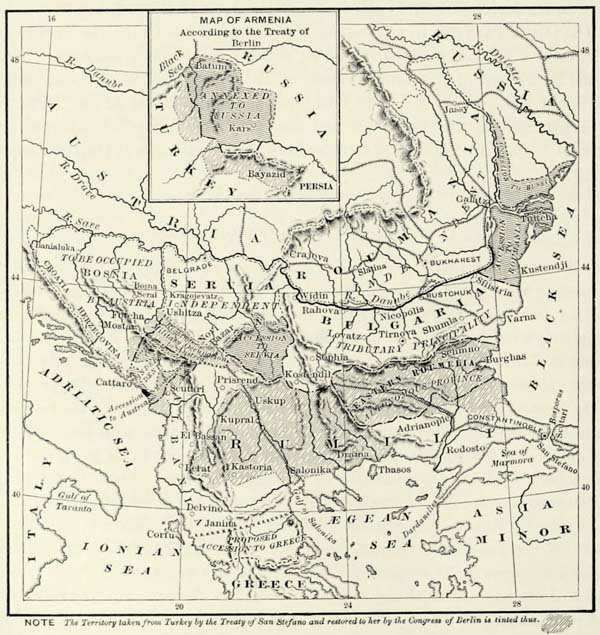
TURKEY IN EUROPE.* (continued 2)
Reading edition
Family ties are very powerful amongst the Albanians. The father retains the rights of sovereign lord up to an advanced age, and as long as he lives the earnings of his children and grandchildren are his own. Frequently this communism continues after his death, the eldest son taking his place. The loss of a member of the family, and particularly of a young man, gives rise to fearful lamentations amongst the women, who frequently swoon away, and even lose their senses. But the death of persons who have reached the natural limits of human life is hardly mourned at all. The descendants of the same ancestor never lose sight of their parentage. They form clans, called phis or pharas, which are bound firmly together for purposes of defence or attack, or in the pursuit of their common interests. Brotherhood by election is known amongst the Albanians, as well as amongst the Servians and other ancient nations, and its ties are as strong as those of blood. Young men desirous of becoming brothers bind themselves by solemn vows in the presence of their families, and, having opened a vein, they {122} drink each other’s blood. The need of these family bonds is felt so strongly in Albania, that young people brought up together frequently remain united during the remainder of their lives, forming a regular community, having its days of meetings, its festivals, and a common purse.
But in spite of these family associations and clans, in spite of the enthusiastic love which the Albanian bears his native land, there exists no political cohesion amongst the various tribes. The physical conditions of the country, no less than an unhappy passion for war, have scattered their forces, and rendered them unable, consequently, to maintain their independence. The religious animosities between Mussulman and Christian, Greek and Roman Catholic, have contributed to the like result.
It is generally supposed that the majority of the Albanians are Mohammedans. When the Turks became masters of the country the most valiant amongst them fled to Italy, and the greater part of the tribes that remained behind were compelled to embrace Islamism. Many of the chiefs, moreover, turned Mussulmans, in order that they might continue their life of brigandage, on pretence of carrying on a holy war. This accounts for the fact of the aristocracy of the country being for the most part Mohammedan, and in possession of the land. The Christian peasant who tills it is nominally a free man, but in reality he is at the mercy of his lord, who keeps him at the point of starvation. These Albanian Mussulmans, however, are fanatic warriors rather than religious zealots, and many of their ceremonies, particularly those connected with their native land, differ in nothing from those of their Christian compatriots. They have been converted, but not convinced, and cynically they say of themselves that their “sword is wherever their faith is.”
In many districts the conversion has been nominal only, and zealous Christians have continued to conduct their worship in secret. Many Mohammedans of this class returned to the faith of their fathers as soon as the tolerance of Government permitted them to do so. As to the warlike mountain clans, the Mirdits, Suliotes, and Acroceraunians, they had no need to bend to the will of the Turks, and remained Greek or Roman Christians. The boundary between Gheges and Tosks coincides approximately with the boundary between these two denominations, the Roman Catholics living to the north of the Shkumbi, the orthodox Greeks to the south of the river. The Hellenes and Zinzares in Southern Albania are orthodox Greeks. The hatred between these two denominations of Christians is intense, and this is the principal reason why the Albanians have not succeeded in regaining their independence, as have the Servians.
Southern Albania and Epirus had feudal institutions up to the close of last century. The chiefs of the clans and the semi-independent Turkish pashas lived in strong castles perched upon the rocks, from which they descended from time to time, followed by bands of servitors. War existed in permanence, and property changed hands continuously, according to the fortunes of the sword. Ali the Terrible, of Yanina, put a stop to this state of affairs. He reduced high and low to the same level of servitude, and the central Government now wields the power formerly exercised by lords and heads of families. {123}
If we would become acquainted with a social condition recalling the Middle Ages, we must go amongst the independent tribes of Northern Albania. On crossing the Matis we at once perceive a change. Every one goes armed; shepherds and labourers carry a carbine on the shoulder; and even women and children place a pistol in their belts. Families, clans, and tribes have a military organization, and at a moment’s notice are ready to take the field. A sheep missing in a flock, an insult offered in the heat of passion, may lead to war. Not long since the Montenegrin was the most frequent disturber of the peace, for, shut up in his sterile mountains, he was often obliged to turn brigand in order to sustain life, and laid under contribution the fields of his neighbours. The Turks have at all times nourished this hatred between Albanians and Montenegrins. They recompense the warlike services of the tribes of the border clans by exempting them from taxation, and allowing them to govern themselves according to their own laws. Let these immunities be touched, and they will make common cause with their hereditary foes of the Black Mountains.
The Mirdits are typical of the independent tribes of Northern Albania. They inhabit the high valleys to the south of the gorge of the Drin, and, though hardly numbering 12,000 souls, they exercise, in consequence of their warlike valour, a most important influence in all Western Turkey. Their country is accessible only through three difficult defiles, and they hold command of the roads which the Turkish troops must follow when operating against the Montenegrins. The Sublime Porte, well aware how difficult it would be to subdue these redoubtable mountaineers, has endeavoured to attach them, showering honours upon them, and granting them the most complete self-government. The Mirdits, on their side, though Christians, have at all times fought most valiantly in the ranks of the Turkish army, in Greece and the Morea, as well as against their fellow-Christians of Montenegro. They are formed into three “banners” of the mountains and two of the plains, and in time of war are joined by the five banners of Lesh, or Alessio. The banner of the renowned clan of Orosh takes precedence of all others.
The country of the Mirdits is governed by an oligarchy, of which the Prince or Pasha of Orosh is the hereditary head. His power, however, is merely nominal, for in reality the country is governed by a council consisting of the elders (vecchiardi) of the villages, the delegates of the banners, and the heads of clans. The proceedings of this council are regulated by ancient traditions. Wives are taken by force from the enemy, for the members of the five banners look upon each other as relatives, and the Mohammedan girls in the lowland villages look forward with little fear to their being carried off by Mirdit warriors. The vendetta is exercised in an inexorable manner, and blood cries for blood. A violation of hospitality is punished with death. The adulteress is buried beneath a heap of stones, and her nearest relative is bound to deliver the head of her accomplice to the injured husband. It need hardly be said that education is at a very low ebb amongst these savages. There are no schools, and in 1860 hardly fifty Christians of the Mirdit country and of the district of Lesh were able to {124} read. Agriculture, nevertheless, is in a relatively advanced state. The valleys of the sterile mountains are cultivated with a certain amount of care, and they produce finer crops than do the fertile plains, inhabited by an indolent population.
By a strange contrast, these direct descendants of the ancient Pelasgians, to whom we are indebted for the beginning of civilisation in Europe, still number amongst the most savage populations of our continent. But they, too, must yield in time to the influence of their surroundings. Until recently the Epirotes and southern Shkipetars left their country only in order to lead the easy but degrading life of mercenaries. In the last century the young men of Acroceraunia sold themselves to the King of Naples, to be embodied in his regiment of “Royal Macedonians;” and even in our own days not only Mohammedans, but also Christian Tosks, enter the service of pashas and beys. These men, known as Arnauts, may be met with in the most remote parts of the empire—in Armenia, at Bagdad, and in Arabia. On the expiration of their term of service, the majority of these veterans retire to estates granted them by Government, and this accounts for the large number of Arnaut villages met with in all parts of the empire.
But wars are less frequent now, the life of a mercenary offers fewer advantages, and increasing numbers of Albanians leave their country annually in order to gain a living abroad by honest labour. Like the Swiss of the canton of Grisons, many Shkipetars descend from their mountains at the commencement of winter in order to work for wages in the plains. Most of these return to their mountain homes in spring, enriched by their earnings; but there are others who remain abroad for years, or who never return. The advantages of a division of labour appear to be well understood by these mountaineers of Epirus and Southern Albania, and each mountain valley is noted for the exercise of some special craft. One valley sends forth butchers, another bakers, a third gardeners. A village near Argyrokastro supplies Constantinople with most of its well-sinkers. The district of Zagori, perhaps the home of the ancient Asclepiads, sends its doctors, or rather “bone-setters,” into every town of Turkey. Many of these emigrants, when they become wealthy, return to their native land, where they build themselves fine houses in the midst of sterile mountains, and these take the places of the old seigneurial towers, which were erected only for purposes of defence.
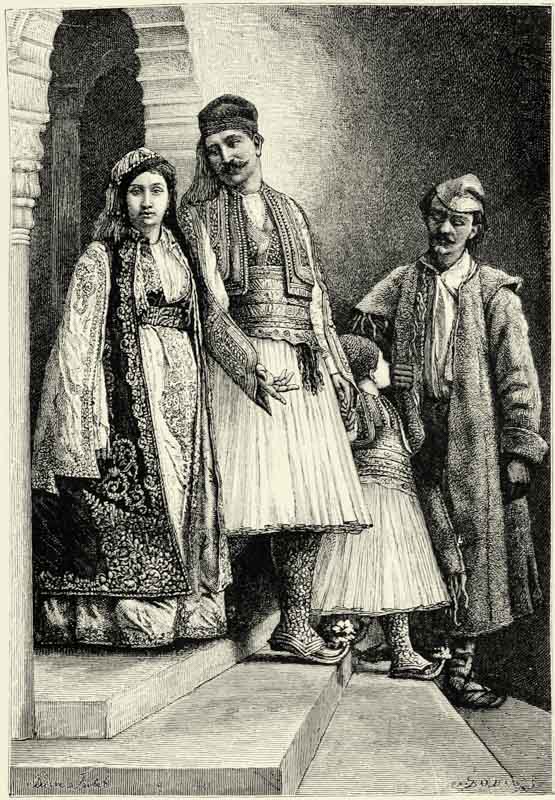
WEALTHY ARNAUTS.
The Albanians are thus being carried along by a general movement of progress, and if once they enter into the common life of Europe, we may expect them to play a prominent part, for they possess a penetrating mind and much strength of character. The Albanians enjoy the advantage of having ready access to the sea, but hitherto they have derived only small benefit from it, not only owing to the disturbed state of the country and the absence of roads, but also because of the alluvial deposits formed by the rivers and the malaria of the marshes. Still, making every allowance for these disadvantages, they hardly account for the almost entire absence of maritime enterprise. One would scarcely fancy these Epirotes and Gheges to be of the same race as those Hydriote corsairs who launched whole fleets upon the waters of the Archipelago at the time of the war for Hellenic independence, and who still maintain the foremost place amongst the mariners of {125} Greece. The ports of Albania—Antivari, Porto Medua (one of the safest on the Adriatic), Durazzo, Avlona, Parga (lost in a forest of citron-trees), and even strong Prevesa, surrounded by more than a hundred thousand olive-trees—can boast but of a trifling commerce, and two-thirds of that are carried on in Austrian vessels from Trieste. With the exception of the Acroceraunians and the inhabitants of Dulcigno, which is the port of Scutari, no Mohammedan Albanian ventures upon the sea, not even as a fisherman. In spite of the fertility of the soil, there are hardly any articles to export. The mines of the country are unexplored, agriculture is in a most backward state, and in Epirus hardly any industry is known except the rearing of sheep and goats.
At the time of the Romans these countries were equally forsaken. There was one magnificent city, Nicopolis, built by Augustus on a promontory to the north of the modern Prevesa to commemorate his victory at Actium. The only other town of importance was Dyrrhachium, called Durazzo by the Italians. It formed the terminus of the Via Egnatia, which traversed the whole of the Balkan peninsula from west to east, and constituted the great highway between Italy and the Orient. Avlona may aspire one day to take the place of ancient Dyrrhachium. Its geographical position is superior to that of Durazzo, for it is nearer to Italy, and its deep and secure harbour enjoys the shelter of the island of Suseno and of the Linguetta of Acroceraunia.
In the meantime all the commerce of the country is concentrated in Scutari and Yanina, and in some other towns of the interior. The most considerable amongst the latter are Prisrend, at the foot of the Skhar, whose nobles boast of their magnificent dresses and fine weapons; Ipek (Pech), Prishtina, Jakovitza (Yakova), in the north-eastern portion of the country, and on roads which lead from Macedonia into Bosnia. Nearer the coast are Tirana, Berat, and Elbasan, the ancient Albanon, whose name recalls that of the entire country. Gyorcha (Koritza), to the south of the Lake of Okhrida, is likewise a place of much trade, thanks to its position on a road joining the Adriatic to the Ægean Sea. Scutari and Yanina occupy sites at the foot of the mountains, whose natural advantages could not fail to attract a numerous population. Yanina, the capital of Epirus, is the more picturesque of these two cities. It is situated on the shore of a fine lake, opposite the somewhat heavy masses of the Pindus, but in sight of the mountains of Greece, which are of a “luminous grey, glittering like a tissue of silk.” At the time of Ali Pasha, Yanina became the capital of an empire, and its population then exceeded that of Scutari. But the latter has now regained its pre-eminence. It is admirably situated, and the roads from the Danube and the Ægean, from the Lower Drin and the Adriatic, converge upon it. Scutari, or Shkodra, is the first oriental city which a traveller coming from Italy meets with, and the first impression made by its numerous gardens enclosed by high walls, its deserted streets and irregular buildings, is sufficiently curious. Long after he has entered the town, the traveller will remain uncertain as to its whereabouts. But let him climb to the summit of the limestone rock surmounted by the old Venetian castle of Rosapha, and the most magnificent panorama will {126} unfold itself before his eyes. The domes of Scutari, its twenty minarets, the emerald verdure of the plain, the surrounding amphitheatre of fantastically shaped mountains, the winding waters of the Boyana and Drin, and the placid surface of the lake glittering in the sun—these all combine to produce a spectacle of rare magnificence. The sea alone is wanting to render this picture perfect, but, though near, it is not within sight.34
V.—THE ILLYRIAN ALPS, BOSNIA, AND HERZEGOVINA.
Bosnia, in the north-western corner of Turkey, is the Switzerland of the European Orient, but it is a Switzerland whose mountains do not reach the zone of perennial snow and ice. In many respects the mountain ranges of Bosnia, and of its southern province, the Herzegovina, resemble those of the Jura. They, too, are composed principally of limestone, and rise in parallel ridges, surmounted here and there by sharp crests. Like the successive ridges of the Jura, they are of unequal height, and, taken as a whole, assume the appearance of a plateau traversed by parallel furrows, and gently sloping in one direction. The most elevated chain of Northern Bosnia is that which separates it from the coast of Dalmatia, and the less elevated ridges running parallel with it gradually decrease in height towards the north-east, in the direction of the plains of the Save.
Rocks not belonging to the Jurassic system, such as crystalline slates, dolomites, tertiary deposits, and serpentine, are met with in various localities, and impart some variety to the orographical features of Bosnia. Several crater-shaped depressions in the east and south-east separate the mountains of Bosnia from the mountain masses of Servia. The most remarkable amongst these plains is that of Novibazar, into which numerous torrents discharge themselves, and which commands roads diverging in various directions. This is the strategical key of the country, and is destined on this account to become an important railway junction.
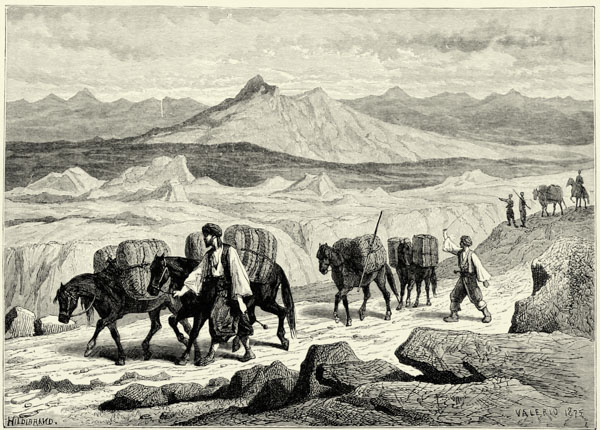
TURKISH MULETEERS IN THE HERZEGOVINA.
Nearly all the mountain ranges which pass from Carniola and Austrian Croatia into Bosnia increase in height as we advance towards the centre of the peninsula. The bleached pyramid of the Durmitor, close to the northern frontier of Montenegro, attains an elevation of nearly 8,000 feet, and the plateau surrounding it is cut up by deep cavities, some of which, like the troughs of the Herzegovina, open out in one direction, whilst others are completely shut in by declivities. The Prokletya, or “cursed” mountain, still farther to the south-east, rises to a height even more considerable, and constitutes one of the most formidable mountain masses of all Turkey. A huge depression occupies its centre, the bottom of which is covered by the Lake of Plava. Even in summer patches of snow may be seen on some of the mountains which surround this abyss. But Mount Kom, the {127} highest of all, never retains its cap of snow during the whole of the year, for it melts away before the hot African winds to which it is exposed. Mount Kom may possibly turn out to be the culminating point of the Balkan peninsula. It is certainly one of the highest summits, and its double peak, rising above the plateau of Montenegro, is descried from afar by the mariner navigating the Adriatic. It has been ascended by several travellers, for its slopes are gentle.35
The rivers of Bosnia, like those of the Jura, flow between parallel mountain ranges towards the north-east, along the furrows traced out for them by nature. But these calcareous mountain ramparts of Bosnia, like those of the Jura, are broken up by narrow gorges, or cluses, through which the pent up waters find a way from furrow to furrow. Instead of taking a serpentine course, as do most rivers flowing through a plain, these rivers of Bosnia change from valley to valley by abrupt bends. Gentle and furious in turns, they gradually reach the lower regions, and are finally swallowed up by the Save. Only one river, the Narenta, finds its way into the Adriatic; all others, in accordance with the general slope of the country, flow in the direction of the Danube. These river valleys, with their sudden turnings, would be available as natural roads for reaching the plateau, if most of the gorges were not exceedingly difficult of access; and until regular roads have been constructed, as in the cluses of the Jura, travellers are obliged to scale steep heights in order to pass from valley to valley. It is this want of practicable roads which renders military operations in Bosnia so difficult and perilous.
Great armies have at all times remained to the east of the mountain masses referred to, passing from the valley of the Vardar into that of the Morava, whose springs almost intermingle their waters. In that locality we meet with the bed of an ancient lake, through which flows the Sitnitza, one of the upper tributaries of the Servian Morava: this is the plain of Kosovo, the “field of black birds,” which reminds all southern Slavs of painful events. It was there the power of the Servians succumbed in 1389, and, if we may credit ancient heroic songs, more than 100,000 men perished in a single day. Five hundred years have passed away since this great disaster, but the Slavs have never ceased to hope for a day of vengeance, and they look forward to the time when on this very field they may reconquer the independence they have lost.
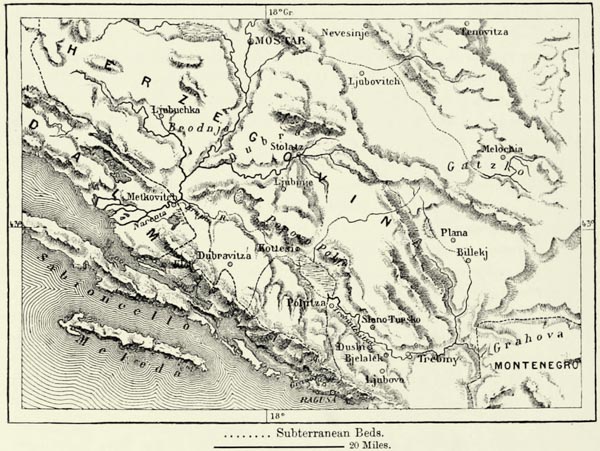
The similarity between the mountains of Bosnia and of the Jura is rendered complete by the existence of grottoes, sink-holes, and subterranean rivers. Sink-holes from 60 to 100 feet in diameter, and shaped like funnels, are met with in many localities. Several rivers appear suddenly at the foot of a hill, and, after flowing on for a few miles, disappear again beneath some portal in the rocks. The table-land of the Herzegovina especially abounds in phenomena of this kind. The ground there is pierced by “sinks,” or ponors, which swallow up the water derived from precipitation. “Blind valleys” and “troughs” present everywhere the traces of currents of water and of temporary lakes, and after heavy rains the subterranean basins sometimes rise to the surface, and a river then flows for a time along the valley. As a rule, however, the inhabitants are compelled to {128} collect the water they require in cisterns, or to fetch it from long distances. Elsewhere the hydrography of the country is subject to annual changes. Lakes which still figure upon our maps are drained through subterranean passages only recently opened; other lakes are formed in consequence of some passage, which formerly carried off the surface water, having become choked with alluvium. No more curious river probably exists in the world than the Trebinishtitza, in the Western Herzegovina. It appears and disappears many times. One of its branches, flowing at one time on the surface, at others underground, crosses the plains of Kotesi, in turns a parched champaign country or a lake abounding in fish, and enters the Narenta. Other branches pass beneath the mountains, and gush out near the shores of the Adriatic. One of the most famous of these springs is that of Ombra, which pours its waters into the Bay of Gravosa, to the north of Ragusa.
Μ
Fig. 37.—SUBTERRANEAN BEDS OF THE AFFLUENTS OF THE NARENTA.
Scale 1 : 1,925,000.
“Where the rocks finish and the trees appear, there begins Bosnia.” So said the Dalmatians formerly. But many parts of Bosnia have now lost their clothing of verdure. The table-lands of the Herzegovina and Montenegro, no less than Dalmatia, have been despoiled of their forests, but Bosnia proper still remains a country of woods. Nearly one-half its area is covered with forests. In the valleys trees have almost disappeared, for the peasant is allowed to wield his axe {129} without hindrance, but in the virgin forests of the mountains trees still abound. The principal trees of Europe are met with in these magnificent woods: walnut-trees, chestnut-trees, limes, maples, oaks, beeches, ash-trees, birches, pines, firs, and larches. Austrian speculators, unfortunately, avail themselves of the roads which begin to open up the interior of the country to devastate these forests, which ought to be preserved with the greatest care. The song of birds is but rarely heard in these sombre woods, but wild animals abound in them. They shelter bears, wild boars, and deer, and the number of wolves is so large that their skins form one of the most important articles of Bosnian commerce. Taken as a whole, Bosnia ranks among the most fertile countries of Europe, and few regions surpass it in the beauty of its rural scenery. In some parts of the country, and particularly near the Save, large herds of hogs, almost wild, roam through the oak forests. Hence the epithet of “country of hogs” which the Turks have derisively given to Bosnia.
With the exception of the Jews, the gipsies, and the few Osmanli officials, soldiers, and merchants in the principal towns, the entire population of the country is of Slav race. The inhabitants of Kraina, near the Austrian frontier, call themselves Croats, but they scarcely differ from the Bosnian Servians and Raitzes of ancient Rascia, now known as the sandjak of Novibazar. On the classical soil of Rascia originated most of those cherished piesmas, or popular songs, in which the Southern Slavs have deposited their national traditions. The Herzegovinians, in some respects, differ from their Bosnian kinsmen. They are the descendants of immigrants who came from the banks of the Vistula in the seventh century. Like their neighbours the Montenegrins, they are more voluble in their speech than the Servians proper, and make use of numerous peculiar turns of expression and a few words of Italian which have glided into their language.
Although most of the Bosnians are of the same race, they are divided by religious animosities, and these account for their state of political servitude. At the first glance it may cause surprise that the Slavs of Bosnia should not have succeeded in throwing off the Turkish yoke, like their kinsmen of Servia. Their country is more remote from the capital, and far less accessible than Servia. A conquering army coming from the south has not only to force numerous defiles, but has to contend, too, with the climate, which is far more severe than that of the remainder of the Balkan peninsula. But, in spite of these great natural advantages from a defensive point of view, every revolt has hitherto failed lamentably. We need not seek far for the cause of this: Christian and Mohammedan Bosnians are at enmity, and the Christians themselves are split up into Greeks, who are led by their popes, and Romans, who follow blindly their Franciscan priests. In their divided state they fall an easy prey to their oppressors, and servitude has degraded their character.
The Mussulmans of Bosnia call themselves Turks, but they are Slavs nevertheless, like their Christian compatriots, and, like them, speak Servian with a large admixture of Turkish words. They are the descendants of the nobles who, in {130} the fifteenth and sixteenth centuries, embraced Islamism in order to save their feudal privileges. They also number amongst their ranks the descendants of brigands, who changed their religion in order to be able to continue their trade without fear of punishment. This apostacy gave to the lords even greater power over their wretched dependants than they had formerly possessed. The hatred of caste was augmented by religious animosity, and they soon surpassed in fanaticism the Mohammedan Turks, and reduced the Christian peasantry to a condition of veritable slavery. A wild pear-tree is still pointed out near one of the gates of Sarayevo, upon which the notables occasionally suspended some unfortunate raya for their amusement. Whether beys or spahis, these Mohammedan Bosnians are the most retrograde element of old Turkey, and on several occasions, as in 1851, they even rose up in rebellion in order to maintain intact their ancient feudal privileges. Sarayevo, as a Mussulman city, stood under the special protection of the Sultan’s mother, and possessed most extravagant privileges, which converted it into a state in the state more hostile to Christianity than the Sublime Porte itself.
Even in our own days the Bosnian Mussulmans possess far more than their proper share of the land. The country is divided into spahiliks, or Mussulman fiefs, which are transmitted, in accordance with the custom of the Slavs, indivisibly to all the members of the family. The latter choose the most aged or most valorous of their members as their head. The Christian peasants are compelled to work for these Mussulman communities; and, although no longer serfs, they are called upon to bear the chief burden of taxation and of other expenses. It is natural, under these circumstances, that the Christians of Bosnia should shun agriculture in order to devote themselves to trade, and nearly the whole of the commerce is in the hands of the Christians of the Herzegovina and of their co-religionists from Slavonian Austria. The Spanish Jews form communities in the principal towns, where they carry on their usual commercial pursuits and money-lending on tangible securities. They still talk Spanish amongst themselves, and never mention without emotion the name of the country which sent them into exile.
The number of Mussulmans hardly exceeds one-third of the total population of Bosnia, and they are said to remain stationary, or even to diminish, whilst the more fecund Christians increase in numbers.36
For the rest, the Bosnians, in spite of the differences in their religious belief, possess the same natural gifts as their Servian kinsmen, and, whatever destinies may be in store for them, they will in the end rise to the same level of intelligence. They are frank and hospitable, brave in battle, industrious, thrifty, of a poetical turn, fast as friends, and true as lovers. The marital ties are respected, {131} and even the Mussulmans reject the polygamy permitted by the Koran. In the Herzegovina the women enjoy much liberty, and in many villages there are even back doors to the houses, in order that they may be able to gossip with their neighbours without going into the street. In Northern Bosnia, however, the Mussulman women are wrapped up closely in white linen sheets, and are hardly able to see a few steps before them. But, in spite of these good qualities, there exists an amount of barbarity, ignorance, superstition, and fanaticism, amongst Christians and Mohammedans alike, which is truly astounding. Incessant wars, tyranny on the one side, and servitude on the other, have brutalised their manners. The want of roads, the extensive forests, and the precipitous mountains have placed them beyond the reach of civilising influences. There are hardly any schools, and the few monasteries which supply their places are of little use, for the monks themselves are steeped in ignorance, and their pupils at most learn to chant a few hymns. Besides this, the immense consumption of slibovitza undermines the health of the people and demoralises them, and it has been estimated that every Bosnian—man, woman, or child—drinks annually no less than thirty-four pints of this detestable plum-brandy.
It may be matter for surprise that bustling towns should exist in so rude a country, but the natural resources of Bosnia are so great that a certain amount of local trade was sure to spring up. Isolated as they are, the Bosnians are thrown upon their own resources. They grind their own flour, manufacture their arms, stuffs, and iron implements, and the exchange of these commodities has given rise to commerce in the cities most favourably situated as entrepôts, the principal amongst which are Sarayevo, or Bosna Serai, and Travnik, the ancient capital of the country, picturesquely situated at the foot of an ancient castle. Banyaluka, which is connected with Austria by a railway, has some trade with Croatia; Tuzla extracts salt from its abundant brine springs; Zvornik, which guards the frontier of Servia, also carries on some trade with that country; Novibazar has commercial relations with Albania; Mostar and Trebinye import a few articles from Dalmatia. The populations of these towns have not, however, been solely attracted by trade and industry, for the insecurity of the country has also contributed to that result. There is no part of Europe, the neighbouring Albania and the polar regions of Scandinavia and Russia excepted, which is so rarely visited by strangers, and this isolation will only cease when the proposed international railway shall have joined it to Saloniki and Constantinople.37
VI.—BULGARIA.
The centre plateau of Turkey is still amongst the least-known countries of the Balkan peninsula, although it is intersected by the great highways which connect Thracia with Bosnia, and Macedonia with the Danube. This plateau, {132} known to the ancients as Upper Mœsia, consists of a vast granitic table-land, rising to an average height of 2,000 feet. Its surface is diversified by several planinas, or mountain chains, of small relative height, and by domes of trachyte, the remains of ancient volcanoes. Its numerous depressions were formerly filled with water, and the contours of the ancient lakes can still be traced. They have been gradually filled up by alluvium, or drained by rivers. The most remarkable amongst these ancient lacustrine basins are now represented by the fertile plains of Nish, Sofia, and Ikhtiman.
Μ
Fig. 38.—MOUNT VITOSH AND ITS ENVIRONS.
According to F. von Hochstetter. Scale 1 : 1,058,000
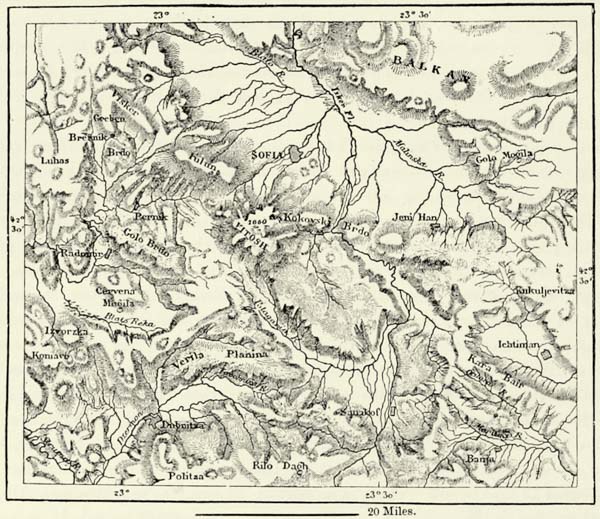
The superb syenitic and porphyritic mountain group of Vitosh forms the eastern bastion of the Mœsian plateau. Immediately to the east of it the deep valley of the Isker pierces the whole of the Balkan Mountains, and, crossing the plain of Sofia, takes its course in the direction of the Danube. The upper valley of this river and the plain mentioned form the true geographical centre of European Turkey. From Sofia diverge some of the most important roads of the peninsula, one leading through the valley of the Isker to the Lower Danube, another along the Morava valley into Servia, a third by way of the Maritza into Thracia, and a fourth down the Struma into Macedonia. It is said that Constantine the Great, struck by these important natural advantages of Sofia, then called Sardica, thought of making it the capital of his empire. {133}
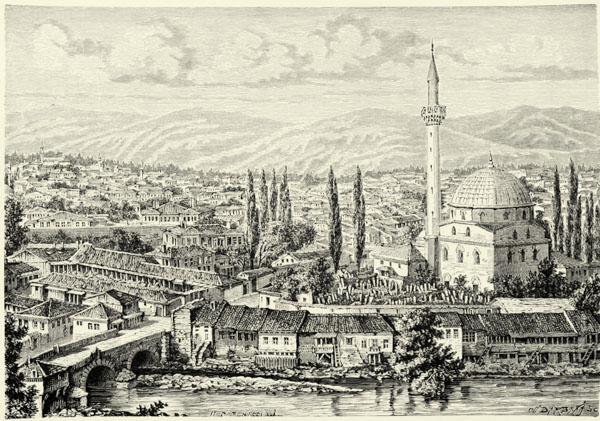
TIRNOVA.
The Turks apply the name of Balkans to all the mountain ranges of the peninsula, but geographers restrict that term to the Hæmus of the ancients. This mountain rampart begins to the east of the basin of Sofia. It does not form a regular chain, but rather an elevated terrace sloping down gently in the direction of the Danube, whilst towards the south it presents an abrupt slope, it appearing almost as if the plateau on that side had suddenly sunk to a lower level. The Balkan consequently presents the appearance of a chain only when looked at from the south. But its contours even there are only slightly undulating; there are neither abrupt projections nor rocky pyramids, and the prevailing character is that of long-stretched mountain ridges. The porphyritic mountain group of Chatal, which rises to the south of the principal chain, constitutes the only exception to this gentleness of contour. Though inferior in height to the summits of the Balkan, its steep precipices, slashed crests, and chaotic rock masses strike the beholder, and the contrast between this mass of erupted rock and the gentle slopes of the calcareous hills which surround it is very great.
The uniformity of the northern slopes of the Balkan is such that, in many places, a traveller is able to reach the crest without having come in sight of mountains. When the woods have disappeared from the Balkan, these undulating slopes will be deprived of their greatest charm; but, as long as the forests ornament them as now, the country will remain one of the most delightful in Turkey. Running streams flow through each valley, bordered by pastures as brilliantly green as are those of the Alps; the villages are built in the shade of beech-trees and oaks; and nature everywhere wears a smiling aspect. But the plains which extend to the Danube are barren, and sometimes not a single tree is visible. The inhabitants, deprived of wood, are dependent upon cow-dung dried in the sun for their fuel, and they dig for themselves holes in the ground, where they seek protection from the cold of winter.
The core of the Balkan, between the basin of Sofia and that of Slivno, consists of granite, but the terraces which descend towards the Danube present every geological formation, from the metamorphic to the most recent rocks. The cretaceous formation occupies the largest area in Bulgaria, and the rivers rising in the mountains, in traversing it, form picturesque valleys and defiles. Ancient fortresses defend each of these valleys, and the towns have been built where they debouch upon the plain. Tirnova, the ancient capital of the tsars of Bulgaria, is the most remarkable of these old bulwarks of defence. The Yantra, on debouching there from the mountains, winds about curiously; steep cliffs form an amphitheatre, in the centre of which rise two precipitous isolated rocks, crowned formerly by walls and towers. The houses of the town are built on the slopes, and its suburbs extend along the foot of the cliffs.
A singular parallelism has been noticed on the northern slopes of Balkan. The elevated mountain saddles, crests of secondary chains, geological formations, the faults which give rise to the meandering of the rivers, and even the Danube itself, all follow the same direction, from west to east. As a consequence, each of the parallel valleys descending from the Balkans offers similar features; the {134} population is distributed in the same manner; and the towns occupy analogous positions. The valley of the Lom offers the only exception to the rule, for its direction is towards the north-west. It debouches upon the Danube at Rustchuk, and its green orchards and gardens are hemmed in by dazzling white cliffs of chalk rising to a height of about 100 feet.
The symmetry would be almost complete in Northern Turkey if it were not for the detached arid hills of the Dobruja, which force the Danube to make a wide détour to the north. Rising in the low and swampy delta of the Danube, these hills appear to be much higher than they are. In reality they do not exceed 1,650 feet in height. It is possible that during some very remote geological epoch the Danube took its course to the south of these hills, through the depression which has been utilised for the construction of the first Turkish railway. Trajan, who feared that the Goths might obtain a footing in this remote corner of the Roman empire, constructed one of those lines of fortifications here which are known throughout the countries of the Lower Danube as Trajan’s Walls. Remains of walls, ditches, and forts may still be traced along the banks of the marshes, and on the heights commanding them. This country of the Dobruja is the “savage hyperborean region” where Ovid, exiled from Rome, wept for the splendours of the capital. The port of Tomi, the place of his banishment, is the modern Kustenje.
To the north of the Gulf of Burgas, which is the westernmost extremity of the Black Sea, rise the fine porphyry mountains which terminate in the superb Cape of Emineh. They are sometimes described as an eastern prolongation of the Balkan, but erroneously, for the ancient lacustrine basin of Karnabat, now traversed by a railway, separates them from the system of the Hæmus. The granitic plateaux and mountains of Tunja and Stranja, which command the wide plain of Thracia on the north, are likewise separate mountain ranges. The Southern Balkan is, in reality, without ramifications or spurs, except in the west, where the mountains of Ikhtiman and of Samakov, so rich in iron ore and thermal springs, and other transverse chains, connect it with the mountain mass of the Rhodope. The upper basin of the Maritza River, enclosed between the Balkan and the Rhodope, has the shape of an elongated triangle, whose apex, directed towards the plain of Sofia, indicates the point of junction between the two systems. The whole of this triangular depression, with its lateral ramifications, was formerly occupied by lakes, now converted into bottom-lands of marvellous fertility. The passes near the apex of this triangle are naturally points of the highest strategical and commercial importance. Through one of them, still marked by ancient fortifications, and known as Trajan’s Gate, passed the old Roman highway, and there, too, the railway now in course of construction will cross the summit between the two slopes of the peninsula. This is the true “gateway of Constantinople,” and from the most remote times nations have fought for its possession. The numerous tumuli scattered over the neighbouring plains bear witness to many a bloody struggle.
The spurs of the Rhodope intermingle with those of the Balkan, and the lowest {135} pass which separates the two still exceeds 3,000 feet in elevation. The Rilo Dagh, the most elevated mountain mass of the Rhodope, boldly rises at its northern extremity, and, to use the expression of Barth, forms the shoulder-blade of junction. Its height is 9,580 feet. It rises far beyond the region of forests, and its jagged summits, pyramids, and platforms contrast strikingly with the rounded outlines of the Balkan. But the lower heights, surrounded by this imposing amphitheatre of grand summits, are covered with vegetation. Forests of pines, larches, and beech-trees, the haunts of bears and chamois, alternate with clumps of trees and cultivated fields, and the villages in the valleys are surrounded by meadows, vineyards, and oaks. Picturesque cupolas of numerous monasteries peep out amongst the verdure: to their existence the mountain owes its Turkish name of Despoto Dagh, i.e. “mountain of the parsons.” The Rilo Dagh, likewise famous on account of its monasteries, has altogether the aspect of the Swiss Alps. The moist winds of the Mediterranean convey to it much snow in winter and spring, but in summer the clouds discharge only torrents of rain, and the snow rapidly disappears from the flanks of the mountains. These sudden rain-storms are amongst the most remarkable spectacles to be witnessed. In the forenoon the mist which hides the tops of the mountains grows dense by degrees, and heavy copper-coloured clouds collect on the slopes. About three in the afternoon the rain begins to pour down, the clouds grow visibly smaller, first one, then another summit is seen through a rent in the watery vapours, until at last the air has become purified, and the mountains are lit up in the sunset.
To the south of the Rilo Dagh rises the mountain mass of Perim, hardly inferior to it in height. This is the Orbelos of the ancient Greeks, and the rings to which Noah made fast his ark when the waters subsided after the deluge are still shown there, and even Mussulman pilgrims pay their devotions at this venerated spot. It is the last high summit of the Rhodope. The mountains to the south rapidly decrease in elevation, though the granitic formation to which they belong is spread over a vast extent of country from the plains of Thracia to Albania. The extent of the hilly region connected with the Rhodope is still further increased by numerous groups of extinct volcanoes, which have poured forth vast sheets of trachytic lava. The rivers which flow from the central plateau of Turkey into the Ægean Sea have cut for themselves deep passages through these granites and lavas, the most famous amongst which is the “Iron Gate” of the Vardar, or Demir Kapu, which formerly figured on our maps of Turkey as a large town.
The aspect of the crystalline mountain masses to the west of the Vardar is altogether of an Alpine character, for the peaks not only attain a high elevation, but snow remains upon them during the greater portion of the year. The Gornichova, or Nije, to the north of Thessaly, rises to a height of 6,560 feet; and the Peristeri, whose triple summit and snow-clad shoulders have been likened to the spread-out wings of a bird, and which rises close to the city of Bitolia, or Monastir, is more elevated still. The mountains of ancient Dardania enclose extensive circular or elliptical plains, and the most remarkable amongst these, {136} namely, that of Monastir, has been compared by Grisebach, the geologist, to one of those huge crater lakes which the telescope has revealed to us on the surface of the moon. In most of these plains we meet with swamps or small lakes, the only remains of the sheets of water which at one time covered them. The most extensive of these lakes is that of Ostrovo. The Lake of Kastoria resembles the filled-up crater of a volcano. In its centre rises a limestone hill joined to the shore by an isthmus, upon which is built a picturesque Greek town.
According to Viquesnel and Hochstetter, traces of glaciers do not exist in any of these ancient lacustrine basins, or on the flanks of the mountains. It is certainly remarkable that whilst other European mountains—as, for instance, the Vosges and the mountains of Auvergne—have passed through a glacial epoch, the far more elevated Peristeri, Rilo Dagh, and Balkan, under about the same latitude as the Pyrenees, should never have had their valleys filled by moving rivers of ice.38
All the large rivers of European Turkey belong to the Bulgarian regions of the Balkan or Hæmus. In Bosnia there are merely small parallel rivers flowing to the Save; Albania has only turbulent torrents forcing their way through wild gorges, like the Drin; but the Maritza, the Strymon or Karasu, the Vardar, and the Inje Karasu, which descend from the southern flanks of the Balkans, or originate in the crystalline mountain masses of the Rhodope, are large rivers, which bear comparison with the tranquil streams of Western Europe. As yet we know but little about their mode of action. The volume of water discharged by them has never been measured, and they are hardly made use of for purposes of navigation or irrigation. They all traverse ancient lake basins, which they have filled up gradually with alluvium, and converted into fertile plains. This work of filling up still goes on in the lower portions of these fluvial valleys, where extensive marshes, and even gradually shrinking lakes, abound. One of these lakes, the Takhino, through which the Strymon flows before it enters the Ægean Sea, is said to be the Prasias of Herodotus, and its aquatic villages were no doubt similar to the pile dwellings discovered in nearly all the lakes of Central Europe.
The Danube, to the north of the Dobruja, performs an amount of geological work, in comparison with which that of the Maritza, the Strymon, and Vardar sinks into insignificance. That mighty river annually conveys to the Black Sea a volume of water far in excess of that which is carried down the rivers of all France, and the solids which it holds in suspension are sufficient to cover an area of ten square miles to a depth of nine feet. This enormous mass of sand and clay is annually deposited in the swamps and on the banks of the delta, and the slow but steady growth of the latter is thus sufficiently explained. Even the ancients {137} anticipated a time when the Black Sea would be converted into a shallow pond abounding in sand-banks, and it must, therefore, afford some consolation to our mariners to be told that six million years must pass before the alluvium carried down the river will fill the whole of the Black Sea.
Μ
Fig. 39.—THE DELTA OF THE DANUBE.
Scale 1 : 1,500,000.
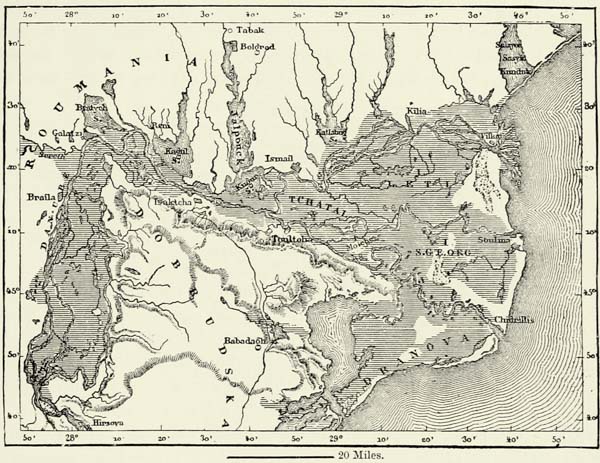
The large triangular plain which the Danube has conquered from the sea has not yet fully emerged from the waters. Lakes, and the remains of ancient bays, half-obliterated branches of the Danube, and the ever-changing beds of rivulets, have converted this delta into a domain, half land, half sea. More elevated tracts, consolidated by the attack of the waves, rise here and there above the melancholy mire and reeds, and bear a dense vegetation of oaks, olives, and beeches. Willows fringe most of the branches of the river which take their winding course through the delta. Twenty years ago the Danube had six mouths; it has now only three.
After the Crimean war the Western powers determined that the Kilia branch, which conveys to the Black Sea more than half the volume of the Danube, should thenceforth form the boundary between Rumania and Turkey. The Sultan thus possesses not only the whole of the delta, which has an area of about 4,000 square miles, but also the only mouth of the river which makes the possession of that territory of any value to him. The mouth of the Kilia is closed by a bar of sand, which does not even permit small vessels to enter it. {138}
The southern mouth, that of Khidrillis, or St. George, is likewise inaccessible. The centre branch, that of the Sulina, which has served the purposes of commerce from time immemorial, can alone be entered by vessels. But even this channel would not be practicable, in the case of large vessels, if our engineers had not improved its facilities of access. Formerly the depth of water on the bar hardly exceeded a fathom during April, June, and July; and even at times of flood was at most two or three fathoms. But by building convergent jetties, which guide the waters of the river into the deep sea, the depth of water has been increased to the extent of ten feet, and vessels drawing twenty feet can enter. Sulina is now one of the most important commercial ports of Europe, and a highly prized harbour of refuge on the Black Sea, which is so much dreaded by mariners on account of its squalls. We are indebted for this great public work to an international commission, which enjoys almost sovereign rights over the Danube as high up as Isakcha.39
Fig. 40.—COMPARATIVE DISCHARGE OF THE MOUTHS OF THE DANUBE.

The Bulgarians inhabit the country to the south of the Danube as far as the slopes of Mount Pindus, excepting only certain detached territories in the occupation of Turks, Wallachians, Zinzares, or Greeks. In the Middle Ages their kingdom was even more extensive, for it included the whole of Albania, and had Okhrida for its capital.
The origin of the Bulgarians has been a theme of frequent discussion. The Bulgarians of the Byzantines, who laid waste the plains of Thracia about the close of the fifth century, and whose name became a term of opprobrium, probably were a Ugrian race, like the Huns, and spoke a language akin to that of the Samoyeds. The name of these savage conquerors is sometimes derived from the Volga, on the banks of which they formerly dwelt; but their manners and appearance have undergone a singular change, and nothing now indicates their origin. Originally Turanians, they have been converted into Slavs, like their neighbours the Servians and Russians.
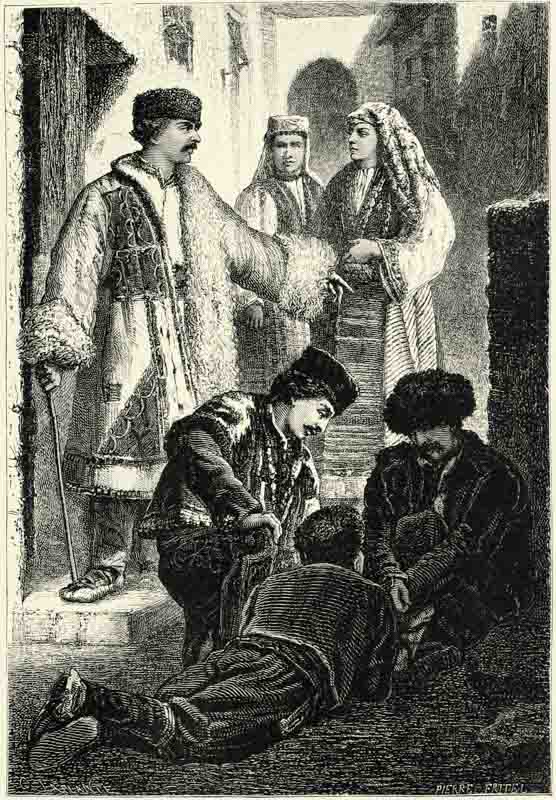
BULGARIANS.
Christian from Viddin. Christian Ladies from Skodra. Mohammedans from Viddin. A native of Koyutepe.
This rapid conversion of the Bulgarians into Slavs is one of the most remarkable ethnological phenomena of the Middle Ages. Even in the ninth century the Bulgarians had adopted the Servian language, and soon afterwards they ceased to speak their own. Their idiom is less polished than that of the Servians, and, possessing no literature, has not become fixed. The purest Bulgarian, it is said, may be heard in the district of Kalofer, to the south of the Balkan. The gradual transformation of the Bulgarians into Slavs is ascribed by some authors to the {139} prodigious facility for imitation possessed by that people; but it is simpler to assume that, in course of time, the conquering Bulgarians and the conquered Servians became amalgamated, and that, whilst the former gave a name to the new nation, the latter contributed their language, their manners, and physical features. Thus much is certain, that the inhabitants of Bulgaria must now be looked upon as members of the Slavonian family of nations. Together with the Servians, Croats, and Herzegovinians, they are the most numerous people of European Turkey; and, if the succession to the dominion of the Turks is to be decided by numbers alone, it belongs to the Servo-Bulgarians, and not to the Greeks.
The Bulgarians, as a rule, are not so tall as their neighbours the Servians; they are squat, strongly built, with a large head on broad shoulders. Lejean, himself a Breton, and others, consider that they bear a striking resemblance to the peasants of Brittany. In several districts, and notably in the environs of Philippopoli, they shave the head, a tuft of hair alone excepted, which they cultivate and dress into a tail as carefully as the Chinese. Greeks and Wallachians ridicule them, and many proverbial expressions refer to their want of intelligence and polish. This ridicule, however, they hardly deserve. Less vivacious than the Wallachian, or less supple than the Greek, the Bulgarian is certainly not deficient in intelligence. But bondage has borne heavily upon him; and in the south, where he is oppressed by the Turk and fleeced by the Greek, he looks unhappy and sad; but in the plains of the north and the secluded mountain villages, where he has been exposed to less suffering, he is jovial, fond of pleasure, fluent of speech, and quick at repartee. The inhabitants of the northern slopes of the Balkan, perhaps owing to a greater infusion of Servian blood, are better-looking, too, than other Bulgarians, and dress in better taste. A still finer race of men are the Pomakis, in the high valleys of the Rhodope, to the south of Philippopoli. Their speech is Bulgarian, but in no other respect do they resemble their compatriots. They are a fine race of men, with auburn hair, full of energy, and of a poetical temperament. We almost feel tempted to look upon them as the lineal descendants of the ancient Thracians, especially if it should turn out to be true that in their songs they celebrate Orpheus, the divine musician.
The Bulgarians, and especially those of the plains, are a peaceable people, recalling in no respect the fierce hordes who devastated the Byzantine empire. They are not warlike, like their neighbours the Servians, and do not keep alive in their national poetry the memory of former struggles. Their songs relate to the events of every-day life, or to the sufferings of the oppressed; and the “gentle zaptieh,” as the representative of authority, is one of the characters most frequently represented in them. The average Bulgarian is a quiet, hard-working peasant, a good husband and father; he is fond of home comforts, and practises every domestic virtue. Nearly all the agricultural produce exported from Turkey results from the labour of Bulgarian husbandmen. It is they who have converted certain portions of the plain to the south of the Danube into huge fields of {140} maize and corn, rivalling those of Rumania. It is they, likewise, who, at Eski-Za’ara, at the south of the Balkan, produce the best silk and the best wheat in all Turkey, from which latter alone the bread and cakes placed upon the Sultan’s table are prepared. Other Bulgarians have converted the noble plain of Kezanlik, at the foot of the Balkan, into the finest agricultural district of Turkey, the town itself being surrounded by magnificent walnut-trees and by rosaries, which furnish the famous attar of roses, constituting so important an article of commerce throughout the East. Amongst the Bulgarians between Pirot and Turnov (Tirnova), on the northern slope of the Balkan, there exist flourishing manufactures. Each village there is noted for a particular branch of industry. Knives are made at one, metal ornaments at another, earthenware at a third, stuffs or carpets elsewhere; and even common workmen exhibit much manual dexterity and purity of taste. An equally remarkable spirit of enterprise is manifested amongst the Bulgarians and Zinzares of the district of Bitolia, or Monastir. The town itself, as well as Kurshova, Florina, and others in its vicinity, are manufacturing centres.
The Bulgarians, peaceable, patient, and industrious as they are, are beginning to grow tired of the subjection in which they are held. They certainly do not as yet dream of a national rising, for the isolated revolts which have taken place amongst them were confined to a few mountaineers, or brought about by young men whom a residence in Servia or Rumania had imbued with an enthusiasm for liberty. But though docile subjects still, the Bulgarians begin to raise their heads. They have learnt to look upon each other as members of the same nation, and are organizing themselves for the defence of their nationality. The first step in this direction was taken on a question of religion. When the Turks conquered the country a certain number amongst them turned Mohammedan to escape oppression; but though they visit the mosques, they nevertheless still cling to the faith of their forefathers, venerate the same springs, and put their trust in the same talismans. A few joined the Roman Church, but a great majority remained Greek Catholics. Greek monks and priests, not long since, enjoyed the greatest influence, for during centuries of oppression they had upheld the ancient faith. Their presence vaguely recalled the times of independence, and their churches were the only sanctuaries open to the persecuted peasant. But the Bulgarians, in the end, grew discontented with a priesthood who did not even take the trouble to acquire the language of its congregations, and openly sought to subject them to an alien nation like the Greeks. Nothing was further from their thoughts than a religious schism. They merely desired to withdraw from the authority of the Patriarch of Constantinople, and to found a National Church of their own, as had been done by the Servians, and even by the Greeks of the new Hellenic kingdom. The Vatican of Constantinople protested, the Turkish Government proved anything but favourable to this movement of emancipation, but in the end the Greek priests were forced to retire—precipitately in some instances—and the new National Church was established. {141}
This pacific revolution, though directed against the Greeks, cannot fail to influence the relations between Bulgarians and Turks. The former have combined, for the first time since many centuries, for the accomplishment of a common national object, and this reawakening of a feeling of nationality cannot but prove detrimental to the rule of the Osmanli. The latter are not very numerous in the country districts of Western Bulgaria, where they are met with chiefly in the towns, and particularly in those which are of strategical importance. Eastern Bulgaria, however, is for the most part peopled by Turks, or at all events by Bulgarians who have adopted the language, dress, manners, and modes of thought of their conquerors. No Christian monastery exists in this stronghold of Turkish power, though there are several Mohammedan places of pilgrimage held in high repute for their sanctity.
The Greeks, next to the Turks, are the most important element of the population of Bulgaria. They are not very numerous to the north of the Balkan, where their influence hardly exceeds that of the Germans and Armenians established in the towns. To the south of the Balkan, though not numerous relatively, they are much more widely distributed. One or two Greeks are met with in every village, carrying on trade or exercising some handicraft. They make themselves indispensable to the locality, their advice is sought for by all, and they impart their own spirit to the whole of the population. Where two or three of these Greeks meet they at once constitute themselves into a sort of community, and throughout the country they form a kind of masonic brotherhood. Their influence is thus far greater than could be expected from their numbers. There are a few important Greek colonies amongst the Bulgarians, as at Philippopoli and Bazarjik, and in a valley of the Rhodope they occupy the populous town of Stanimako, to the exclusion of Turks and Bulgarians. The ruins of ancient buildings, as well as the dialect of the inhabitants, which contains over two hundred Greek words not known to modern Greek, prove that Stanimako has existed as a Greek town for upwards of twenty centuries, and M. Dumont thinks that it is one of the old colonies of Eubœa.
The initiatory part played by the Greeks in Southern Bulgaria is played in the north by the Rumanians. The right bank of the Danube, from Chernavoda to the Black Sea, is for the most part inhabited by Wallachians, who are gradually gaining upon the Turks. Other colonists are attracted by the fertility of the plains at the northern foot of the Balkan. The Bulgarians are careful cultivators of the soil themselves, but the Rumanians nevertheless gain a footing amongst them, as they do with the Servians, the Magyars, and the Germans. They are more active and intelligent than the Bulgarians, their families are more numerous, and in the course of a generation they generally succeed in “Rumanising” a village in which they have settled.
Bulgarians and Turks, Greeks and Wallachians, isolated colonies of Servians and Albanians, communities of Armenians and of Spanish Jews, colonies of Zinzares and wandering tribes of Mohammedan Tsigani, have converted the {142} countries of the Balkan into a veritable ethnological chaos; but the confusion is greater still in the small district of Dobruja, between the Lower Danube and the Black Sea. In addition to the races enumerated, we there meet with Nogai Tartars, who are of purer blood than their kinsmen the Osmanli, and exhibit the Asiatic type in greater purity. Although they cultivate the soil, they have not altogether abandoned their nomad habits, for they wander with their herds over hill and dale. They are governed by an hereditary khan, as at the time when they dwelt in tents.
After the Crimean war several thousand Nogai Tartars, compromised by the aid which they had rendered the Allies, joined their compatriots in the Dobruja. On the other hand, about 10,000 Bulgarians, terrified at the approach of these much-maligned immigrants, fled the Dobruja, and sought an asylum in Russia, where they were assigned the lands abandoned by the Crimean Tartars. This exchange proved disastrous to both nations, for sickness and grief carried off many victims. More deplorable still was the lot of the Circassians and other Caucasian tribes, who, to the number of 400,000, sought a refuge in Turkey in 1864. It was by no means easy to provide accommodation for so large a host. The pasha intrusted with the installation of these immigrants sent many of them to Western Bulgaria, in the vain hope that they would cut off all contact between Servians and Bulgarians. The rayas were compelled to surrender to them their best lands, to build houses for them, and to supply them with cattle and seed-corn. This hospitable reception, compulsory though it was, would have enabled these immigrants to start in their adopted country with a fair chance of success, had they but deigned to work. This, however, they declined. Hunger, sickness, and a climate very different from that of their mountains, caused them to perish in thousands, and in less than a year about one-third of these refugees had perished. Young girls and children were sold to procure bread, and this infamous traffic became a source of wealth to certain pashas. The harems became filled with young Circassians, who were a drug in the market at that time, and the human merchandise not saleable at Constantinople was exported to Syria and Egypt. These Circassians, after thus suffering from sickness and their own improvident laziness, have now accommodated themselves to the conditions of their new homes. Though of the same religion as the Osmanli, they readily assimilate with the Bulgarians amongst whom they dwell, and adopt their language.
Other refugees, more kindly treated by fate, have found an asylum in the Dobruja. They are Russian Cossacks, Ruthenians, and Muscovites of the “Old Faith,” who left their steppes towards the close of last century in order to escape persecution. The Padisha, more tolerant than the Christian Empress of Russia, generously received them, and granted them land in various parts of his dominions. The Russian colonies in the Dobruja and in the delta of the Danube have prospered, and one of their settlements on the St. George’s branch of the river is known as the “Cossacks’ Paradise.” Most of these Russians are engaged in the sturgeon fishery and the preparation of caviare. They have {143} proved grateful for the hospitality extended to them, and have always fought valiantly in defence of their adopted country. They retain their national dress, their language, and their religion, and do not mix with the surrounding populations.
In addition to the above, we meet in the Dobruja with colonies of Germans, Arabs, and Poles, and, in the new port of the Sulina, with representatives of many nations of Europe and Asia.
There are few countries where the great international high-roads are as plainly traced by nature as in Bulgaria. The first of these roads is formed by the Danube. The Turkish towns along its banks—Viddin, Shishtova, Rustchuk, and Silistria—are taking an increasing share in European commerce. This highway is continued along the shores of the Black Sea, where there are several commercial harbours, the most important being Burgas, a great grain port. This natural highway, however, has become too circuitous for purposes of commerce. A railway has therefore been built across the isthmus of the Dobruja, from Chernavoda to Kustenje, and a second line connects Rustchuk, on the Danube, with Varna, on the Black Sea, the latter line crossing the whole of Eastern Bulgaria, and touching the towns of Razgrad and Shumna. A third line, now in course of construction, will cross the Balkans by a depression to the south of Shumna, and traversing the plain in which the towns of Yamboly and Adrianople are built, will connect the Lower Danube with the Ægean Sea. A third route, still farther to the west, passes Turnov, or Tirnova—the ancient capital of the tsars of Bulgaria—Kezanlik, and Eski-Za’ara.
These railways, already opened for traffic or approaching completion, certainly shorten the journey between Western Europe and Constantinople; but it is proposed now to avoid the circuitous navigation of the Lower Danube altogether, by joining the railway system of Europe to that of Turkey. One of these proposed railways will pass through Bosnia, and down the valley of the Vardar to Saloniki; another will follow the ancient Roman road, which connected Pannonia with Byzantium, and which was paved in the sixteenth century as far as Belgrad. The principal cities along this great highway are Nish, on a tributary of the Morava, close to the frontier of Servia; Sofia, the ancient Sardica, on the Isker, a tributary of the Danube; Bazarjik, or “the market;” and the fine town of Philippopoli, with its triple mountain commanding the passage of the Maritza. These towns, on the completion of the railway, cannot fail to become of great commercial importance. A hideous monument near Nish will, perhaps, be pointed out to tourists attracted thither on the opening of the railway. It was erected to remind future generations of a deed of “glory.” This trophy of Kele-kalesi consists of a tower built of the skulls of Servians, who, rather than fall alive into the hands of their enemies, blew themselves up together with the redoubt which they defended. A governor of Nish, more humane than his predecessors, desired to remove this abominable piece of masonry, which no raya passes without a shudder, but Mussulman fanaticism forbade it. {144}
The influence of commerce cannot fail to modify largely the manners and customs of a nation as supple and pliable as are the Bulgarians. War has brutalised the Albanians, and slavery degraded the Bulgarians. In the towns, more particularly, they have sunk very low. The insults heaped upon them by Mussulmans, and the contemptuous manner in which they were treated, rendered them abject and despicable in their own eyes. Demoralised by servitude and misery, given up to the mercy of their rich compatriots, the chorbajis, or “givers of soup,” they became shameless and low-minded helots. The Bulgarian women, in the towns more particularly, presented a spectacle of the most shameful corruption, and their want of modesty, their coarseness, and ignorance fully justified the contempt in which they were held by their Mohammedan sisters. Even as regards education the Turks were in advance of them: not long ago their schools relatively were more numerous, and the instruction given in them was of a superior order. Christian villages, moreover, were never so clean or pleasant as those of the Turks.
But, whatever may have been the case in the past, things have already begun to mend. The Turks, as a body, may still be the superiors of the Bulgarians, as regards probity and a respect for truth, but they work less, and become impoverished by degrees. In the country the land gradually passes into the hands of the rayas, in the towns the latter monopolize nearly all the trade. The Bulgarians, moreover, have learnt to appreciate the importance of education; they have founded schools and colleges, have set up printing presses, and send their young men to be educated at the universities of Europe. The young Bulgarians in the mixed colleges of Constantinople invariably make the most satisfactory progress in their studies. This revival of learning is a most hopeful sign of vitality. If persevered in, the Bulgarian race, which has been dead, as it were, for so many centuries, may again play its part in the world’s history. The atrocities of which Bulgaria has recently been the scene may retard this regeneration, but they certainly cannot stop it.40 {145}
VII.—PRESENT POSITION AND PROSPECTS OF TURKEY.
The prophecies respecting the “sick man” have not yet been fulfilled, and his heritage divided amongst the surrounding powers. To a great extent he is indebted for this continued existence to the jealousies of the European powers, and to the fact of Russia having her hands full in Central Asia. Still, Turkey has recently exhibited a wonderful amount of vitality. Fresh provinces have been incorporated with the empire in Arabia, at a distance of 1,800 miles from the capital; and a rebellion in the north-western portion of European Turkey, originating in the misgovernment of the country, but aided and abetted by Russia, has been suppressed with a strong hand. The Turkish empire remains not only intact, but will actually be found to have considerably increased in extent, if we include within it the territories of the Khedive of Egypt, whose arms have been carried to the Upper Nile and into Dar Fur.
We must guard ourselves, at the same time, against the assumption that Turkey has entered upon a path of normal progress. On the contrary, Turkey is a mediæval country still, and will have to pass through many intestine revolutions before it can rank with the civilised states of Europe or America. The country is in the occupation of hostile races, who would fall upon each other were they not restrained by force. The Servian would take up arms against the Albanian, the Bulgarian against the Greek, and all the subject races would combine against the Turk. National jealousies are augmented by religious animosities. The Catholic Bosnians hate other Slavs, and the Tosks detest the Gheges, although they speak the same language. The Osmanli oppress these various populations without compunction, their art of government consisting in playing them off against each other.
Nor can better things be expected in an empire in which caprice reigns supreme. The Padishah is lord of the souls and bodies of his subjects; he is commander-in-chief of the army, supreme judge, and sovereign pontiff. In former times his power was practically limited by semi-independent feudatories, but since the fall of Ali Pasha and the massacre of the janissaries he is restrained only by customs, traditions, and the demands of the Governments of Europe. He is the most despotic sovereign of Europe, and his civil list the heaviest in proportion to the revenues of the country. The household of the late Sultan and of the members of his family was exceedingly numerous. There lived in the Seraglio an army of 6,000 servants and slaves of both sexes, of whom 600 were cooks. These servants, in turn, were surrounded by an army of hangers-on, who were fed from the imperial kitchens, to which no less than 1,200 sheep were supplied daily by the contractors.
Current expenses were sufficiently heavy, but more considerable still was the extraordinary expenditure incurred in the construction of palaces and kiosks, the purchase of articles de luxe and of curiosities, and for all kinds of prodigalities. The present Sultan, driven thereto by the precarious position of his empire, has limited his expenditure. But will this last? {146}
Ministers, valis, and other high officials of the empire faithfully follow in the footsteps of their sovereign, and their expenditure always exceeds their salary, though the latter is fixed on a most liberal scale. As to the lower officials, their salaries are small and irregularly paid; but it is understood that they may recoup themselves at the expense of the ratepayers. Everything can be purchased in Turkey, and, above all, justice. The state of the finances is most lamentable; loans are raised at usurious interest; and so badly is the country governed that it has been seriously proposed to intrust the management of its finances to a syndicate of the European powers ! 41
Agriculture and industry progress but slowly under such misgovernment. Vast tracts of the most fertile land are allowed to lie fallow; they appear to be no one’s property, and any one may settle upon and cultivate them. But woe to him if he conducts his operations with profit to himself; for no sooner is he observed to become wealthy than his land is laid claim to on behalf of the clergy or of some pasha, and he may consider himself lucky if he escapes a bastinado. The peasants, in many districts, are careful not to produce more than they absolutely require to live upon, for an abundant harvest would impoverish them—would merely lead to a permanent increase of taxation. The tradesmen in the smaller towns are equally careful to conceal their wealth, if they possess any.
Many Mussulman families have ceded to the mosques their proprietary rights. They thus enjoy merely the usufruct of their lands, but are freed, on the other hand, from the payment of taxes, and the land remains in the possession of their families until they become extinct. These lands are known as vakufs, and they form about one-third of the area of the whole empire. They contribute actually nothing towards the revenues of the State. In the end they aggrandise the vast estates of the Mohammedan clergy. Taxation weighs almost exclusively upon the lands cultivated by the unfortunate Christians; and in proportion as the vakufs increase, so does the produce of taxation diminish. This must in the end necessarily lead to a secularisation of the estates of the clergy; and even now, to the great horror of the old Turks, the Ottoman Government is timidly extending its hands towards the estates belonging to the mosques of Constantinople.
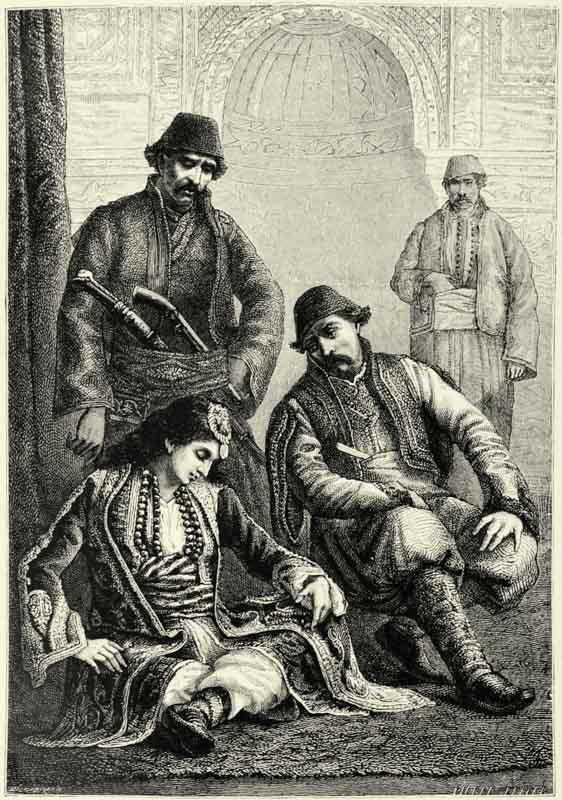
MUSSULMAN OF ADRIANOPLE, AND MUSSULMAN LADY OF PRISREND.
The Servian, Albanian, and Bulgarian peasants actually cultivate their land in spite of their masters. A single fact will show this. Certain collectors of tithes, in order to prevent fraud, insist upon the peasants leaving the whole of the harvest upon the fields until they have withdrawn their tenth part. Maize, rice, and corn are exposed there to the inclemencies of the weather and other destructive agencies; and it frequently happens that the harvest has deteriorated to the extent of one-half in value before the Government impost is levied. Sometimes the peasants allow their grapes or fruit to rot rather than pay the tithes. But it is not the tax-gatherer alone of whose conduct the peasant may complain; for he is exposed likewise to exactions by the middlemen with whom he comes into contact when selling his produce. “The Bulgarian works, but the Greek holds the plough.” So says an ancient proverb; and this is still true at least of the {147} countries to the south of the Balkan, where the Bulgarian peasant is not always the proprietor of the land he tills. But where he does not directly work for a Greek or Mussulman proprietor, his harvest, even before it is cut, is frequently the property of a usurer; but he works on from day to day, a wretched slave, in the vain hope of becoming one day a free man.
The fertility of the soil on both slopes of the Balkans, in Macedonia, and in Thessaly is, however, such that in spite of mosques and tax-collectors, in spite of usurers and thieves, agriculture supplies commerce with a large quantity of produce. Maize, or “Turkish corn,” and all cereals are grown in abundance. The valleys of the Karasu and Vardar produce cotton, tobacco, and dye stuffs; the coast districts and islands yield wine and oil, whose quality would leave nought to be desired, were a little more care bestowed upon their cultivation; and forests of mulberry-trees are met with in certain parts of Thracia and Rumelia, and the export of cocoons to Italy and France is increasing from year to year. Turkey, with its fertile soil, is sure to take a prominent part amongst the European states for the variety and superiority of its products. As to its manufactures, they will no doubt be gradually displaced on the opening of new roads of commerce. The manufacturers of arms, stuffs, carpets, and jewellery in the cities of the interior will suffer considerably from foreign competition, and many amongst them will succumb to it, unless they pass into the hands of foreigners. The great fairs, too, which are now held annually at Slivno and other places, and at which merchants from the whole of the empire meet to transact business—as many as a hundred thousand strangers being attracted occasionally to a single spot—will gradually give place to a regular commercial intercourse.
It is certain that the commerce of Turkey has increased of late years, thanks to the efforts of Greeks, Armenians, and Franks of all nations. The annual value of the exports and imports of the whole of the Ottoman empire in Europe and Asia is estimated at £40,000,000—a very small sum, if we bear in mind the resources of these countries, their many excellent harbours, and their favourable geographical position.
The Turks themselves perform but a very small share of the work that is done in their empire. Various causes combine to render them less active than the other races. They are the governing class, and their ambition naturally aspires to the honours and the luxury of kief; that is to say, of sweet idleness. Despising everything not Mohammedan, and being, besides, heedless and of a sluggish mind, they but rarely learn foreign languages, and are thus in a certain measure at the mercy of the other races, most of whom speak two or more idioms. Moreover, the fatalism taught in the Koran has deprived the Turk of all enterprise, and once thrown out of his ordinary routine, he is helpless. Polygamy and slavery are likewise two causes of demoralisation. It is true that the rich alone can permit themselves the luxury of a harem, but the poor learn from their superiors to despise women, they become debased, and take a share in that traffic in human flesh which is a necessary sequence of polygamy. Yet, in spite of the innumerable slaves imported in the course of four centuries from all the regions bordering upon {148} the Turkish empire; in spite of the millions of Circassian, Greek, and other girls transplanted into the harems, the Osmanli are numerically inferior to the other races of the peninsula. This dominant race—if the term race be applicable to the product of so many crossings—hardly numbers ten per cent. of the population of European Turkey. And this numerical inferiority is on the increase, for, owing to polygamy, the number of children surviving in Mohammedan families is less than in Christian families. We are not in possession of precise figures, but there can be no doubt that the Turks are on the decrease. The conscription, to which they alone are subject, has contributed towards this result, and becomes more difficult from year to year.
It has often been repeated since Chateaubriand that the Turks have but camped in Europe, and expect to return to the steppes whence they came. It would thus be a feeling of presentiment which induces the Turks of Stambul to seek burial in the cemetery of Scutari, hoping thus to save their bones from the profanation of the Giaour’s tread on his return, as master, to Constantinople. In many places the living follow the examples of the dead, and a feeble current of emigration sets from the Archipelago and the coast districts of Thracia in the direction of Asia, carrying along many an old Turk discontented with the stir of European life. This migration, however, is but of very small importance, and does not affect the Osmanli of the interior. Nothing is further from the minds of the Turks of Bulgaria, the Yuruks of Macedonia, or the Koniarides, who have inhabited the mountains of Rumelia since the eleventh century, than to quit the land which has become their second home. The Turkish element in the Balkan peninsula can be got rid of only by exterminating it; that is, by treating the Turks more ferociously than they treated the native populations at the time of the conquest. We ought not to forget, at the same time, that the Turks, though far inferior in numbers to the other races, are nevertheless able to reckon upon the support of millions of Mohammedan Albanians, Bosnians, Bulgarians, Circassians, and Nogai Tartars. The Mussulmans constitute more than a third of the population of European Turkey, and, in spite of differences of race, they hold firmly together. Nor must it be forgotten that they are backed up by a hundred and fifty millions of co-religionists in other parts of the world.42
Μ
ETHNOGRAPHICAL MAP OF TURKEY in EUROPE
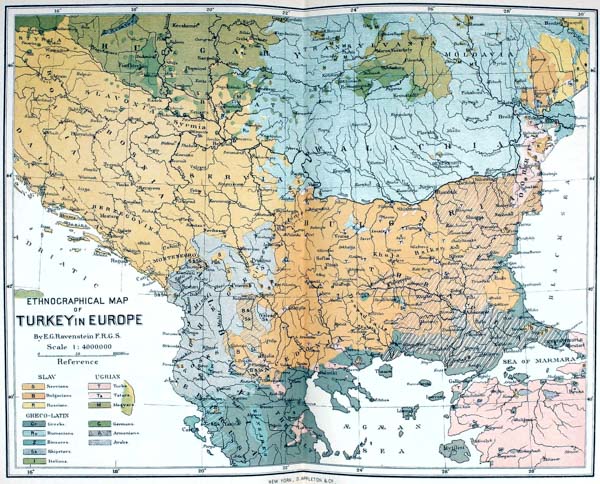
{149}
Let us hope that the future may not give birth to a struggle of extermination between the races of the peninsula, but rather to institutions enabling these diverse and partially hostile elements to develop themselves in peace and liberty. The Turks themselves begin to see the necessity of such institutions, and, in theory at least, have abandoned their policy of violence and oppression. All the nationalities of the empire, without reference to race or religion, are supposed to be equal before the law, and Christians are admitted to Government offices on the same terms as Mussulmans. No doubt these fine laws have for the most part hitherto remained a dead letter, but it would nevertheless be unjust if we denied that much progress towards an equalisation of the various races has been made.
Fortunately the despotism of the Turks is not the despotism of learning, based upon a knowledge of human nature, and directed to its debasement. The Osmanli ignore the art of “oppressing wisely,” which the Dutch governors of the Sunda Islands were required to practise in former times, and which is not quite unknown in other countries. The pashas allow things to take their course as long as they are able to enrich themselves and their favourites, to sell justice and their favours at a fair price, and to bastinade now and then some unlucky wight. They do not inquire into the private concerns of their subjects, and do not call for confidential reports on families and individuals. Their Government, no doubt, is frequently violent and oppressive; but all this only touches externals. Such a government may not be favourable to the development of public spirit, but it does not interfere with individuals, and powerful national institutions, such as the Greek commune, the Mirdit tribe, and the Slav community, have been able to survive under it. Self-government is, in fact, more widely practised in Turkey than in the most advanced countries of Western Europe. It would have been difficult to force these various national elements under a uniform discipline, and the lazy Turkish functionaries generally leave things alone. The Frankish officials in the pay of the Turkish Government, in fact, more frequently interfere with the prejudices and privileges of the governed than do the Mussulman pashas of the old school.
It cannot be doubted for a moment that, in a time not very far distant, the non-Mohammedan races of Turkey will take the lead in politics, as they do already in commerce, industry, and education. The Osmanli of the olden school, who still wear the green turban of their ancestors, look forward towards this inevitable result with despair. They struggle against every measure calculated to accelerate the emancipation of the despised raya, and European inventions, in their eyes, are working a great social transformation to their injury; and, indeed, it is the raya who profits most from roads, railways, harbours, agricultural and other machines. Bosnians, Bulgarians, and Servians have learnt to look upon each other as brothers; Albanians and Rumanians are drawn towards the Greeks; all alike feel themselves as Europeans; and thus the way is being paved for the Danubian Confederation of the future.
The approaching completion of the railway from Vienna to Constantinople cannot fail to work a commercial revolution as far as the trade of a considerable portion of Eastern Europe is concerned. It will form a link in the direct line {150} between England and India, and to travellers and merchandise will afford the shortest route from the centre of Europe to the Bosporus. On its opening, Constantinople will be enabled to avail itself to the fullest extent of the highways of commerce which converge upon it. Still greater must be the political consequences of opening this line, for it will bring the populations of the Balkan peninsula into more direct and active contact with those of Austro-Hungary and the rest of Europe.
Μ
Fig. 41.—COMMERCIAL HIGHWAYS CONVERGING UPON CONSTANTINOPLE.
Scale 1 : 17,100,000.
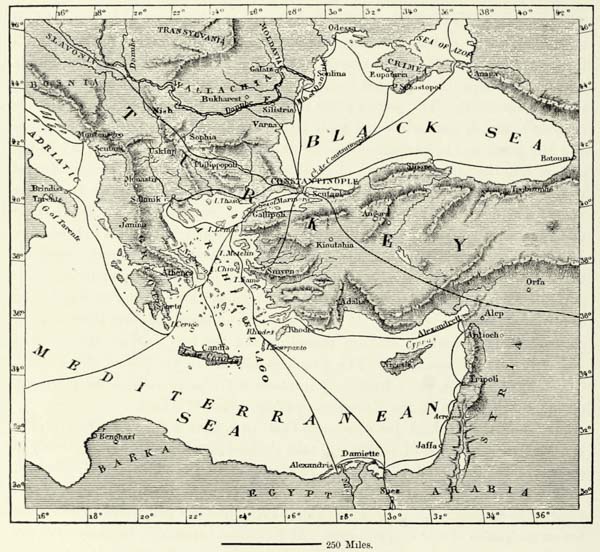
VIII.—GOVERNMENT AND ADMINISTRATION.
The Turkish empire occupies a vast area, the greater portion of which is governed by vassals, almost independent of the Sultan at Stambul. The vast territories of Egypt and Tunis are in that position. The interior of Arabia is in possession of the Wahabites; the coast of Hadramaut is inhabited partly by tribes acknowledging the suzerainty of England; and even between Syria and the Euphrates there {151} are numerous districts only nominally under the government of Turkish pashas, but in reality in the possession of predatory Bedwins. The Ottoman empire, properly so called, includes the European provinces, Asia Minor, Syria, Palestine, the basins of Tigris and Euphrates, Hejaz and Yemen in Arabia, and Tripoli, with Fezzan, in Africa. These territories, with their dependent islands, cover an area of no less than 210,156 square miles; but their population, being far less dense than that of Western Europe, hardly numbers 47,000,000 souls.
Μ
Fig. 42.—THE TURKISH EMPIRE.
Scale 1 : 55,000,000.
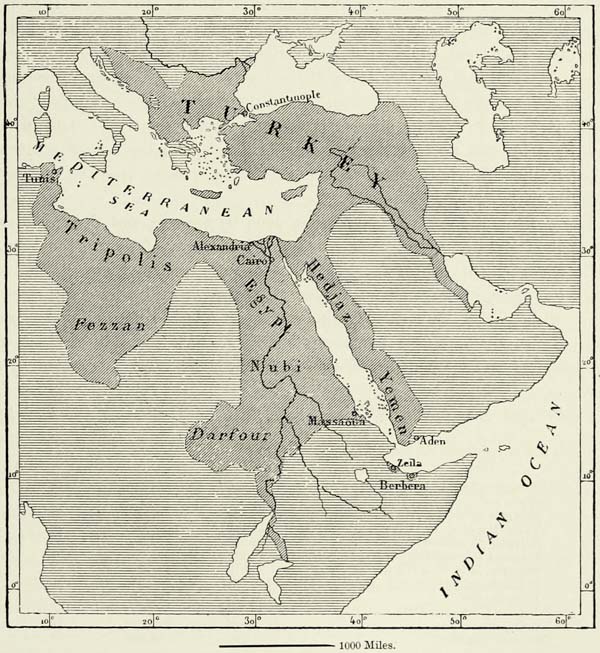
The area of Turkey in Europe, exclusive of Rumania, Servia, and Montenegro, is about equal to that of the British Islands. Constantinople, with the surrounding country, forms a district under the immediate supervision of the Ministry of Police. The remainder of the country is divided into eight vilayets, or provinces; the vilayets are subdivided into mutesarifliks, or sanjaks; these latter into kazas, or cantons; and the kazas into rahiés, or parishes. Lemnos, Imbros, Samothrace, and Astypalæa, with Rhodes and the islands along the coast of Anatolia, form a {152} separate vilayet. These political divisions, however, are subject to frequent changes.43
The Sultan, or Padishah, concentrates all powers within his person. He is Emir el mumenin, or head of the faithful, and his conduct is guided solely by the prescriptions of the Koran and the traditions of his ancestors. The two most influential persons in the empire, next to him, are the Sheik-el-Islam, or Great Mufti, who superintends public worship and the administration of justice, and the Sadrazam, or Grand Vizier, who is at the head of the general administration, and is assisted by a council of ten ministers, or mushirs. The Kislar Agasi, or chief of the black eunuchs, to whom is confided the management of the imperial harem, is likewise one of the great dignitaries of the empire, and frequently enjoys the very highest influence. The legal advisers of the various ministries are known as mufti. Efendi, bey, and aga are honorary titles bestowed upon certain Government officials and persons of consideration. The title of pasha, which signifies “grand chief,” is given to certain high civil or military functionaries. This title is symbolized by one, two, or three horse-tails attached to the top of a lance, a usage recalling the time when the nomad Turks roamed over the steppes of Central Asia.
The work of the various ministries is done by councils, and there thus exist a council of state, or shuraï devlet, councils of accounts, of war, of the navy, of public education, of police, &c. These various councils, in their totality, constitute the divan, or government chancery. There is also a supreme court of justice, with sections for civil and criminal cases. The members of these various official bodies are appointed by Government. Each of the subject “nations” is represented on the Council of State by two members, carefully selected by the Sadrazam.
The vilayet is governed by a vali, the sanjak by a mutesarif, the kaza by a {153} kaimakan, the parish by a mudir. Each of these is supposed to act by advice of a council composed of the leading religious and civilian functionaries, Mohammedan and non-Mohammedan. In reality, however, the vali appoints all these councils, and they are popularly known as the “Councils of the Ayes.”
The rules laid down by the supreme Government for its own guidance are embodied in the hatti-sherif of Gulhane, promulgated in 1839, and in the hatti-humayum of 1856. These hatts promise equal rights to all the inhabitants of the empire, but have been carried out hitherto only very partially. A “constitution” was promulgated in December, 1876, on the assembling of the European Conference at Constantinople. It provides representative institutions, local self-government, and various improvements, but is likely to remain a dead letter.
The religious and judicial organization of the country is jealously watched over by the Sheik-el-Islam and the priests, and cannot possibly be changed. The imans are specially charged with the conduct of public worship. They include sheiks, or preachers; khatibs, who recite the official prayers; and the imans properly so called, who celebrate marriages and conduct interments. Judges and imans form a body known as ulemas, at whose head is placed a kazi-asker, or chief judge, and who are divided hierarchically into mollahs, kazis (kadis), and naibs.
The Greek Patriarch of Constantinople, as head of the Church in Turkey and civil director of the Greek communities, wields a considerable influence. He is elected by a synod of eighteen members, which administers the religious budget, and whose decisions in matters of faith are final. The heads of the Latin rite are a patriarch at Constantinople and the two Archbishops of Antivari and Durazzo. The two Armenian Churches have each a patriarch at Constantinople.
TREATIES OF SAN STEFANO AND BERLIN.
It will be noticed that the preceding description of Turkey in Europe, and the succeeding accounts of Rumania, Servia, and Montenegro, present the conditions existing immediately prior to the late war with Russia, in which the Turks were completely overpowered in a few months. The Congress of European powers sitting at Berlin in the summer of 1878, to consider the preliminary treaty of San Stefano (March 2) between Russia and Turkey, materially modified its provisions in the joint treaty signed July 13, disposing of European Turkey in the following manner: 1. The tributary principality of Bulgaria is created (with less than half the dimensions assigned to it by the treaty of San Stefano), to be governed by a prince (who shall not be a member of any ruling dynasty) chosen by the people within nine months, and confirmed by the Porte and the other powers, and in the mean time by Russian commissioners assisted by delegated European consuls. 2. South of the Balkans is formed the autonomous province of Eastern Roumelia, under a Christian governor-general, appointed for five years by the Porte with the assent of the powers, which are to determine within three months the administrative requirements of the province. 3. Bosnia and Herzegovina to be occupied and {154} administered by Austria-Hungary, excepting Novi-Bazar and a small surrounding district. This provision, unlimited as to time, practically annexes those provinces to the Austro-Hungarian Empire, and has already (October, 1878) been executed, after serious armed resistance by their Moslem inhabitants. 4. Rumania, Servia, and Montenegro are made independent, with the enlarged boundaries shown by the annexed map. Rumania receives the Dobruja from Russia, to which it was ceded by the treaty of San Stefano, with the understanding that it was to be exchanged for the strip of Bessarabia transferred from Russia to Rumania by the treaty of Paris of 1856, which has accordingly been restored. The additions to Montenegro include the port of Antivari, which is closed to war-ships of all nations; and Montenegro is to have no national flag nor ships of war, its merchant flag to be protected by Austrian consuls. 5. Austrian Dalmatia receives from Albania the small port of Spitza. 6. The services of the powers are offered for the rectification of the northern frontier of Greece. 7. Entire religious liberty and political equality are provided for in all the territories affected by the treaty.
Μ
MAP SHOWING CHANGES IN EUROPEAN TURKEY AND ARMENIA, AS PROPOSED BY THE TREATY OF SAN STEFANO, AND AS DETERMINED BY THE TREATY OF BERLIN.