Chapter XVIII · (continued 2)
Reading edition
Fam. 7. Brissidae.—Allied to the Spatangidae, but distinguished by sunken petals and a peripetalous fasciole.
Two genera are recorded from the British area, Schizaster and Brissopsis, but the first has only been found once in deep water; the second is common. Schizaster has the front petals three times as long as the hind ones, and no sub-anal fasciole. Brissopsis has the front and hind petals of about the same length, and a sub-anal fasciole. The only British species is called B. lyrifera, on account of the fiddle-shaped outline of the peripetalous fasciole.
Hemiaster (Fig. 250) in general resembles Schizaster, but the petals are equal in length, and the two posterior serve as brood-pouches for the young. This genus is mainly Antarctic.
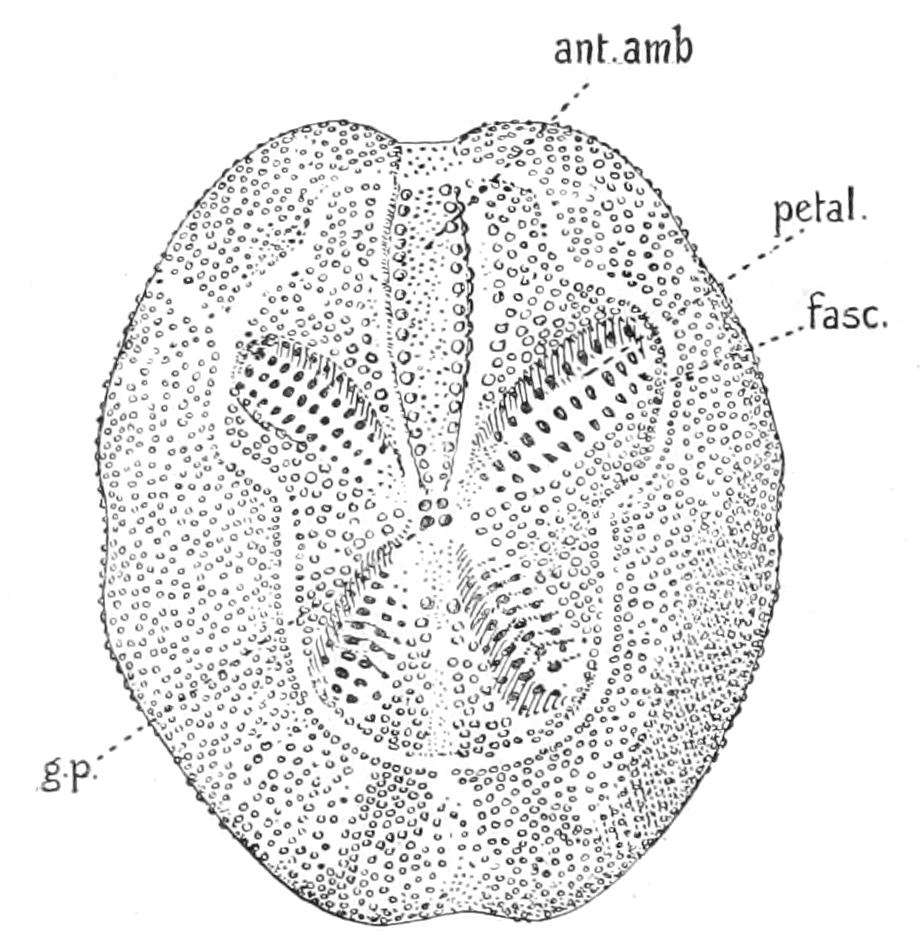
Fig. 251.—Dried shell of Schizaster, showing peripetalous fasciole. ant.amb, Anterior ambulacrum; fasc, peripetalous fasciole; g.p, genital pores, × 1. (After Agassiz.)
Fossil Echinoidea.—Echinoidea are well represented in the geological record, and form a characteristic element in many fossil faunas. They appear in the Ordovician formation, but the first representatives of an existing family (Cidaridae) only appear in the Permian.
Space will only permit us to treat of the extinct members of the group very briefly. Leaving out of sight the representatives of families still living, the fossil Echinoidea may be divided into two great groups, viz.:—
(a) Palaeozoic forms, which in some points serve to connect the Endocyclica with the primitive Asteroidea.
(b) Mesozoic forms, which serve to connect the Clypeastroidea and Spatangoidea with the Endocyclica.
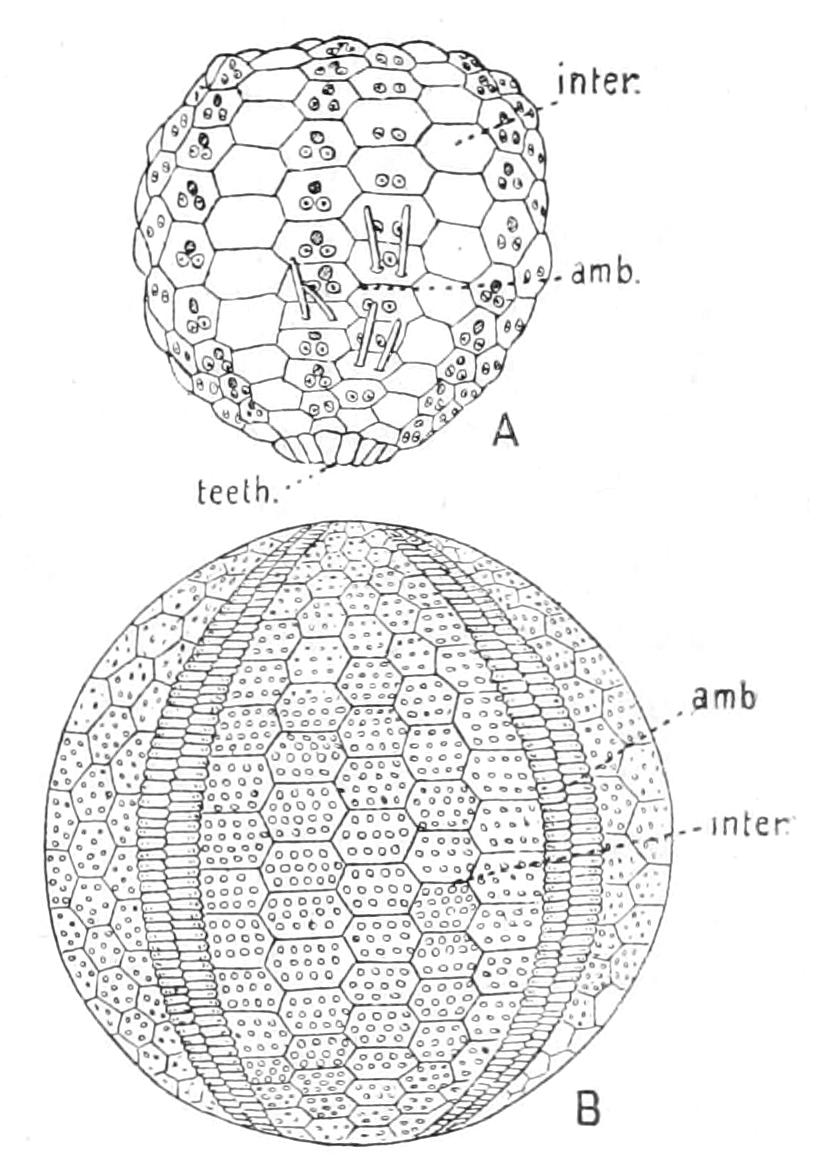
Fig. 252.—A, Bothriocidaris. × 1. B, Palaeoechinus. × 1. amb, Ambulacral plates; inter, interambulacral plates. (After Zittel.)
The Palaeozoic forms are often called Palaeoechinoidea, and they are above all distinguished by the fact that the number of vertical bands of plates composing the corona is variable, in a word, that the corona has not yet acquired a fixed definite constitution. One genus (Echinocystites) has the anus outside the apical system. It has four rows of pore-plates in each radius, and numerous rows of plates each with a single spine in the interradii. Another (Palaeodiscus) has been shown by Sollas[504] to be in many respects the missing link between Asteroidea and Echinoidea. Inside the plates of the corona there is a series of ambulacral plates like those of Asteroidea. The tube-feet in the oral portion of the radii seem to have issued between the (outer) ambulacral plates. No anus has been detected. All the rest are Endocyclic. The oldest known form, Bothriocidaris (Fig. 252, A), from the Ordovician, has only one row of interambulacral plates and two of ambulacral; no peristome is distinguishable from the corona. The Archaeocidaridae appear in the Devonian. They have narrow ambulacra of two rows of pore-plates as in the Cidaridae, but the interambulacra consist of many rows, the members of which overlap, and therefore were probably slightly movable, as in the Echinothuriidae; the primary tubercles are large, and there is only one on each plate. The Melonitidae (Fig. 252, B) appear in the Carboniferous. Each interambulacral plate, of which there may be five rows in each interradius, bears numerous small tubercles, and there may be four or more vertical rows of pore-plates, though in the genus figured, Palaeoechinus, there are only two. The Tiarechinidae are represented by one genus, Tiarechinus, with an enormous apical system, from the Triassic of the Tyrol. The interambulacra consist of one plate bordering the mouth, three, side by side, forming the interradial area of the corona, and one large genital plate; the ambulacra, of two rows of pore-plates. This family consists of dwarfed forms which probably inhabited the land-locked seas and salt lagoons of the Triassic epoch.
When we recollect that some of the oldest Asteroidea known to us had very narrow arms and interradial areas edged by large square marginals, it does not require a very great effort to imagine how these marginals could be converted into the vertical rows of the interambulacra, and the pointed narrow arms becoming recurved, could have formed the ambulacra. The physiological advantage of this will be discussed in the chapter on development.
True Cidaridae occur in the Permian, and are abundant in all the younger formations. One Cretaceous genus, Tetracidaris, has four rows of interambulacral plates near the mouth, diminishing to two at the apex. This circumstance renders it probable that the Cidaridae are the direct descendants of the Archaeocidaridae. The Saleniidae, Echinothuriidae, and Diadematidae appear in the Jurassic, the Echinidae in the Cretaceous, and the Arbaciidae only in the Tertiary epoch.
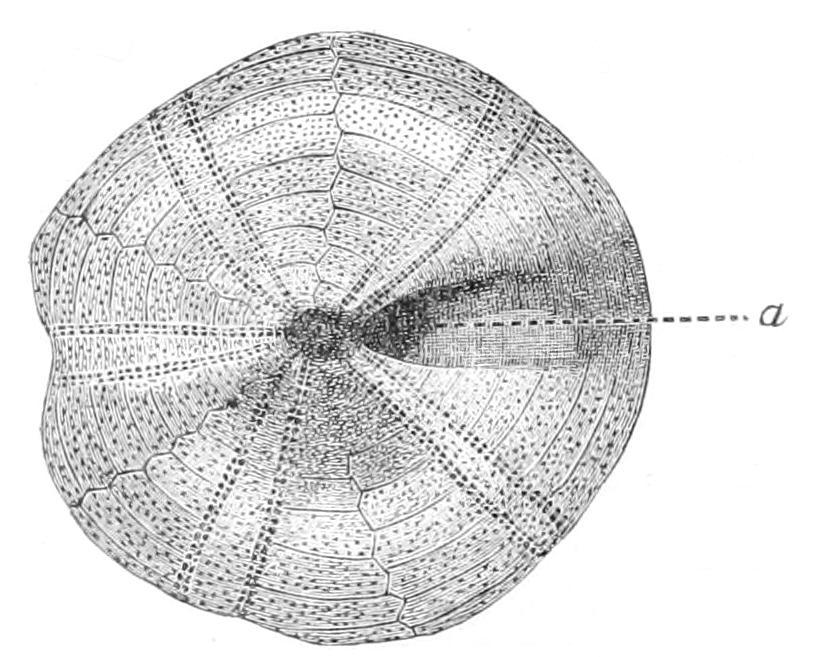
Fig. 253.—Hyboclypus gibberulus. × 1. a, Anus. (After Zittel.)
Turning now to the Mesozoic forms with an excentric anus, there were a number of forms which have been grouped together as Holectypoidea which had auricles and teeth and gills, although these were only feebly developed, and in which the pore-plates remained separate. The periproct was a comparatively large area, and in Pygaster, as in the surviving form Pygastrides, it was in contact with the apical system, although outside it. Many of the genera were of considerable height in proportion to their length. In Conoclypeus and Discoidea the jaws and auricles were very weak. The Echinoconidae have only vestigial auricles, and on this account are often definitely grouped with the Spatangoidea, but they are closely allied to the Holectypoidea. They are Cretaceous forms of high conical shape (Galerites). In Hyboclypus (Fig. 253) all trace of the teeth has disappeared, but the periproct is large and in contact with the apical system; these forms appeared in the Jurassic. The Collyritidae, also Jurassic, had a marginal anus. The apical system was so much elongated that two of the ocular plates are widely separated from the other three, two opposite interambulacra meeting between them. Unmistakable Spatangoidea (Spatangidae and Ananchytidae) appear in the Cretaceous, true Clypeastroidea (Fibularites) in the Cretaceous, the other families in the Tertiary.
Reviewing these facts, we see that from the Holectypoidea we can pass by insensible steps on the one hand into true Clypeastroidea, and on the other hand into true Spatangoidea. The Holectypoidea differed from Endocyclica only in the position of the anus, and the initial step in the backward shift of this organ is seen in Pygaster. One result follows from this conclusion, that the modification of the dorsal tube-feet into breathing organs, and the consequent appearance of petals which accompany the taking on of burrowing habits, were independently developed in the Clypeastroidea and Spatangoidea, since these features were absent in the more primitive members of both groups.