Chapter XIV
Reading edition
ANTHOZOA (CONTINUED): ZOANTHARIA
Sub-Class II. Zoantharia.
The Zoantharia exhibit a great deal more diversity of form and structure than the Alcyonaria. The sub-class is consequently difficult to define in a few words, and it may be taken to include all the Anthozoa which do not possess the typical Alcyonarian characters.
All the orders, with the exception of the Antipathidea and Zoanthidea, contain genera of solitary zooids, and the orders Edwardsiidea and Cerianthidea contain no genera that form colonies. In the Madreporaria, Zoanthidea, and Antipathidea, on the other hand, colonies are formed composed of a very large number of individuals which frequently attain to a very great size. The term "Sea-anemone" is commonly used in writing about the solitary Zoantharia which do not form any skeletal structures, and the term "Coral" is applied to all those Zoantharia which do form a skeleton.
In a scientific treatise, however, these popular terms can no longer be satisfactorily employed. The "Sea-anemones" exhibit so many important differences in anatomical structure that they must be placed in at least three distinct orders that are not closely related, and the organisms to which the term Coral has been applied belong to so many organisms—such as Alcyonaria, Hydrozoa, Polyzoa, and even Algae—that its use has become indeterminate.
Whilst these terms must disappear from the systematic part of Zoology, they may still be employed, however, in the description of a local fauna or coral reef to signify the soft solitary zooids on the one hand, and the organisms, animals or plants, which form large, massive skeletons of carbonate of lime, on the other.
The form of the solitary zooids and of the colony of zooids in the Zoantharia, then, may be very divergent. In the Actiniaria we find single soft gelatinous zooids of considerable size adherent to rocks or half-buried in the sand. Among the Madreporaria we find great branching colonies of thousands of zooids supported by the copious skeleton of carbonate of lime that they have secreted. Among the Antipathidea, again, we find a dendritic skeleton of a dark horny substance, formed by a colony of small zooids that cover it like a thin bark. The majority of the Zoantharia are, like other zoophytes, permanently fixed to the floor of the ocean. Where the embryo settles, there must the adult or colony of adults remain until death. Some of the common Sea-anemones can, however, glide slowly over the surface on which they rest, and thus change their position according to the conditions of their surroundings. Others (the Minyadidae) float upside down in the sea, and are carried hither and thither by the currents. Others, again (Cerianthus, Edwardsia, Peachia), burrow in the sand or mud at the sea-bottom.
The structure of the zooid varies considerably, but in the following characters differs from the zooid of the Alcyonaria. The tentacles are usually simple finger-like processes, and when they bear secondary pinnae these can readily be distinguished from the rows of secondary pinnules of the Alcyonarian tentacle. The number of tentacles is very rarely eight (young Halcampa), and in these cases they are not pinnate. The number of tentacles may be six (many Antipathidea and some zooids of Madrepora), twelve (Madrepora), some multiple of six, or an indefinite number. In the Thalassianthidae and some other families of Actiniaria the tentacles are plumose, but do not exhibit the regular pinnate form of the tentacles of Alcyonaria.
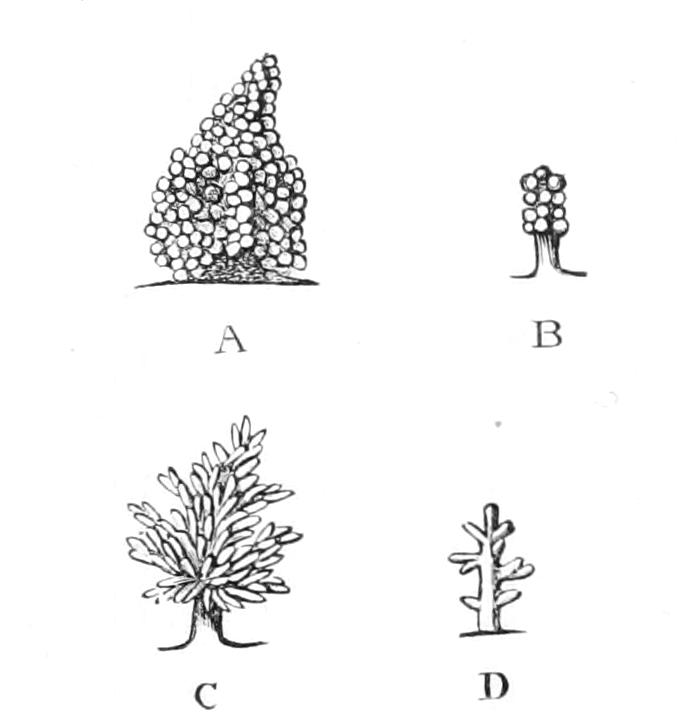
Fig. 162.—Large (A) and small (B) plumose tentacles of Actinodendron plumosum. Large (C) and small (D) plumose tentacles of A. glomeratum. (After Haddon.)
As regards the number of mesenteries, the Zoantharia exhibit very great variety. It has been shown that there is frequently a stage in their development during which there are only eight mesenteries. This stage is usually called the Edwardsia stage. These eight mesenteries are arranged in bilateral pairs as follows:—One pair is attached to the body-wall and reaches to the dorsal side of the stomodaeum, and is called the pair of dorsal directives; a corresponding pair attached to the ventral side of the stomodaeum is called the pair of ventral directives. The other two pairs are the lateral mesenteries. To these four pairs are added, at the close of the Edwardsia stage, two additional pairs, making in all twelve mesenteries (cf. Fig. 163).
These six primary pairs of mesenteries, conveniently called the "protocnemes" by Duerden, may be traced in the development and recognised in the adult of the majority of Zoantharia. But the number of the mesenteries is usually increased in the later stages by the addition of other mesenteries called the "metacnemes." The metacnemes differ from the protocnemes in that they usually appear in unilateral pairs, that is to say, in pairs of which both members arise on the same side of the stomodaeum, and the number is very variable throughout the group. The space enclosed by a pair of mesenteries is called an "entocoele," and the space between two pairs of mesenteries is called an "ectocoele."
The twelve protocnemes are usually complete mesenteries, that is to say, they extend the whole distance from the body-wall to the stomodaeum, while the metacnemes may be complete or incomplete; in the latter case extending only a part of the distance from the body-wall towards the stomodaeum.
We find, therefore, in making a general survey of the anatomy of the Zoantharia that there is no general statement to be made, concerning the number or arrangement of the mesenteries, which holds good for the whole or even for a considerable portion of the genera.
The bands of retractor muscles are, as in the Alcyonaria, situated on one face only of the mesenteries (except in the Antipathidea and Cerianthidea), but an important character of the Zoantharia is that the muscle bands on the ventral pair of directives are situated on the dorsal faces of these mesenteries, and not on the ventral faces as they are in Alcyonaria.
In the Edwardsiidea there are only eight complete mesenteries, but a variable number of other rudimentary and incomplete mesenteries have recently been discovered by Faurot.[392] In the Zoanthidea the mesenteries are numerous, but the order is remarkable for the fact that the dorsal directives are incomplete, and that, of the pairs of metacnemes that are added, one mesentery becomes complete and the other remains incomplete. In most of the genera of the Antipathidea there are only ten mesenteries, but in Leiopathes there are twelve, and as they bear no bands of retractor muscles it is difficult to determine accurately their true relation to the mesenteries of other Zoantharia.
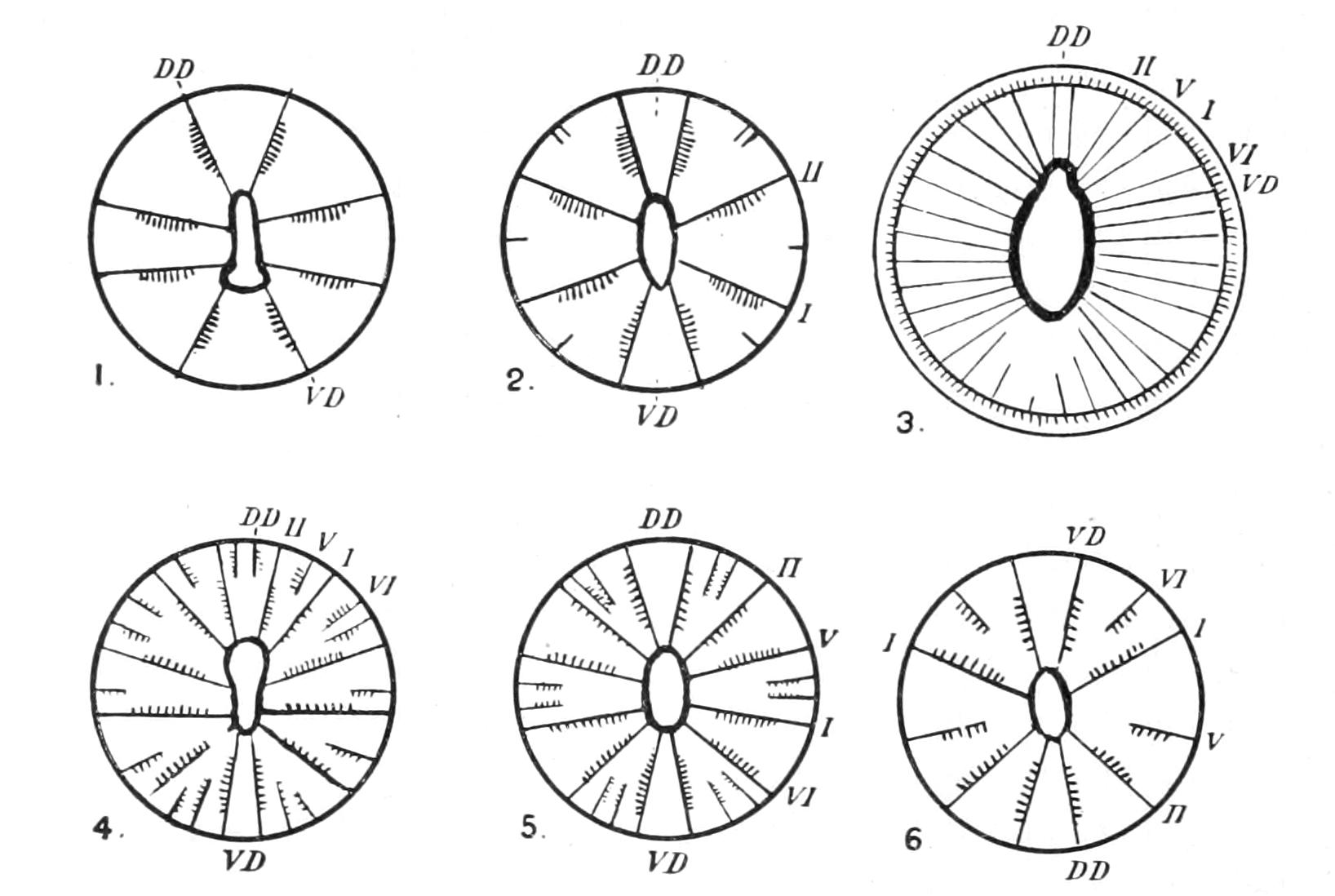
Fig. 163.—Diagrams of transverse sections of 1, Alcyonarian; 2, Edwardsia; 3, Cerianthus; 4, Zoanthus; 5, Favia; 6, Madrepora. DD, the dorsal directive mesenteries; VD, the ventral directives; I-VI, the protocnemes in order of sequence.
In the Cerianthidea the mesenteries are very numerous, and increase in numbers by the addition of single mesenteries alternately right and left in the ventral inter-mesenteric chamber throughout the life of the individual. These mesenteries do not bear retractor muscles.
In the Actiniaria and Madreporaria, with the exception of the genera Madrepora, Porites, and a few others, there are also very many mesenteries. The two pairs of directives are usually present, but they may not occur in those zooids that are produced asexually by fission (see p. 388). The metacnemes are frequently formed in regular cycles, and in many genera appear to be constantly some multiple of six (Fig. 163, 5).
In Madrepora and Porites[393] the two pairs of directives and two pairs of lateral protocnemes are complete; the other two pairs of protocnemes are, however, incomplete; and metacnemes are not developed (Fig. 163, 6).
The stomodaeum is usually a flattened tube extending some distance into the coelenteric cavity and giving support to the inner edges of the complete mesenteries; in many of the Madreporaria, however, it is oval or circular in outline. In most of the Actiniaria there are deep grooves on the dorsal and ventral sides of the stomodaeum, but in Zoanthidea the groove occurs on the ventral side only and in the Cerianthidea on the dorsal side only. In the Madreporaria these grooves do not occur or are relatively inconspicuous.[394] In the Alcyonaria the siphonoglyph exhibits a very marked differentiation of the epithelium (see Fig. 148, p. 334), and the cilia it bears are very long and powerful. It has not been shown that the grooves in the Zoantharia show similar modifications of structure, and they are called by the writers on Zoantharia the sulci. There is no difference in structure, and rarely any difference in size, between the dorsal sulcus and the ventral sulcus in the Actiniaria, and the use of the word—sulculus—for the former is not to be commended.
The mesenteries bear upon their free edges the mesenteric filaments. These organs are usually more complicated in structure than the corresponding organs of the Alcyonaria, and the dorsal pair of filaments is not specialised for respiratory purposes as it is in that group.
In many genera the mesenteric filaments bear long, thread-like processes—the "acontia"—armed with gland cells and nematocysts which can be protruded from the mouth or pushed through special holes (the "cinclides") in the body-wall.
The gonads in the Zoantharia are borne upon the sides of the mesenteries and are usually in the form of long lobed ridges instead of being spherical in form, and situated at the edges of the mesenteries as they are in the Alcyonaria.
Nearly all the zooids and even the colonies of the Zoantharia are unisexual, but some species, such as Manicina areolata (Wilson), Meandrina labyrinthica (Duerden), Cerianthus membranaceus, and others, are hermaphrodite. Mr. J. S. Gardiner has recently given reasons for believing that the genus Flabellum is protandrous.
Skeleton.—The soft tissues of the Zoantharian zooids may be supported or protected by hard skeletal structures of various kinds. In the Zoanthidea and the Actiniaria there are many species that have no skeletal support at all, and are quite naked. These seem to be sufficiently well protected from the attacks of carnivorous animals by the numerous nematocysts of the ectoderm, and perhaps in addition by a disagreeable flavour in their tissues. Anemones do not seem to be eaten habitually by any fish, but cases have been described of Peachia hastata being found in the stomach of the Cod, and of Edwardsia in the stomach of the Flounder.[395] On the Scottish coasts Anemones are occasionally used with success as a bait for cod.[396] The body-wall of Edwardsia, however, is protected to a certain extent by the secretion of a mucous coat in which grains of sand and mud are embedded. Some Anemones, such as Urticina, Peachia, and others, lie half-buried in the sand, and others form a cuticle, like that of Edwardsia, to which foreign bodies are attached.
Cerianthus is remarkable for constructing a long tube composed of a felt-work of discharged nematocysts mixed with mud and mucus, into which it retires for protection. In the Zoanthidea the body-wall is frequently strengthened by numerous and relatively large grains of sand, which are passed through the ectoderm to lie in the thick mesogloea.
In the Madreporaria a very elaborate skeleton of carbonate of lime is formed. In the solitary forms it consists of a cup-shaped outer covering for the base and column of the zooid called the "theca," of a series of radial vertical walls or "septa" projecting into the intermesenteric chambers carrying the endodermal lining of the coelenteric cavity with them, and in some cases a pillar, the "columella," or a series of smaller pillars, the "pali" projecting upwards from the centre of the base of the theca towards the stomodaeum. In the colonial forms the theca of the individual zooids is continuous with a common colonial skeleton called the "coenosteum." This is solid in the Imperforate corals, and it supports at the surface only a thin lamina of canals and superficial ectoderm. In the Perforate corals, however, the coenosteum envelopes and surrounds the canals during its formation, and thereby remains perforated by a network of fine channels. In the colonial Madreporaria the skeletal cups which support and protect the zooids are called the "calices."
The skeleton of the Antipathidea is of a different nature. It is composed of a horny substance allied to keratin. When it is old and thick, it usually has a polished black appearance, and is commonly termed "black coral." The surface of this kind of coral is ornamented with thorny or spiny projections, but it is never perforated by calices or canal systems. It forms a solid axis for the branches of the corals, and all the soft parts of the zooids and coenosarc are superficial to it.
It was formerly considered that this type of coral, which shows no trace of the shape and form of the living organisms that produce it, is of a different character to the calcareous skeleton which exhibits calices, septa, pores, and other evidence of the living organism, and it was called a "sclerobase" to distinguish it from the "scleroderm" of the Madreporaria.
It is now known that both the sclerobasic skeleton and the sclerodermic skeleton are products of the ectoderm, and consequently these expressions are no longer in general use.
Asexual reproduction in the Zoantharia may be effected by continuous or discontinuous fission or gemmation.
In the Edwardsiidea, Actiniaria, and Cerianthidea, that is to say in the animals popularly known as Sea-anemones, asexual reproduction does not commonly occur, but nevertheless a good many instances of it are now known in individual genera. In Actinoloba (Metridium), for example, Parker has described a case of complete longitudinal fission, and Duerden states that it occurs in the West Indian Anemones Actinotryx and Ricordea. A still more remarkable form of asexual reproduction known as transverse fission has been described in the genus Gonactinia.[397] In this case, the body of the Anemone becomes constricted in the middle, a circlet of tentacles is formed below the constriction, and division takes place. The upper half floats away with the original tentacles and stomodaeum and becomes attached by the base in another place; the lower half remains behind and develops a new stomodaeum, mesenteric filaments, and sexual organs. In some of the Actiniaria another form of asexual reproduction occurs, known as "Pedal laceration." In the common British Actinoloba, for example, so often kept in aquaria, the pedal disc sometimes spreads on the glass or rock upon which the animal rests, in the form of a thin membrane or film of an irregular circular shape, nearly twice the diameter of the column. As the Anemone glides along, the film remains behind and breaks up into a number of hemispherical droplets, which in a few days develop tentacles, a mouth, mesenteries, and the other organs of a complete and independent Anemone. A similar method of reproduction has been observed in several species of Sagartia. A true process of discontinuous gemmation has also been observed in Gonactinia, in Corynactis, and in Actinoloba.
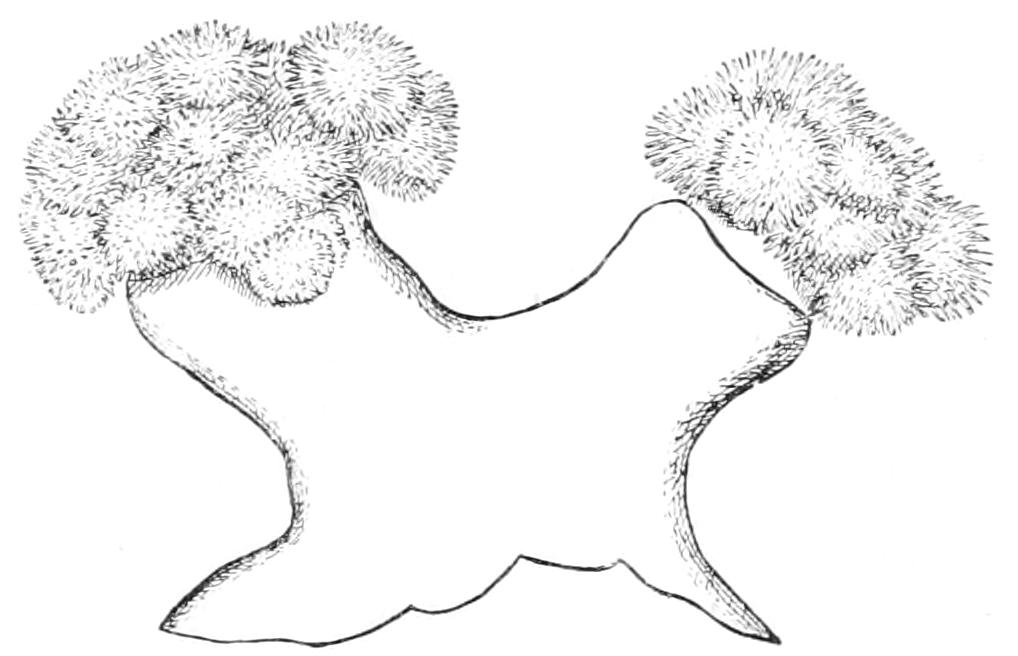
Fig. 164.—Longitudinal fission of Actinoloba. (After Agassiz and Parker.)
In the Madreporaria, Zoanthidea and Antipathidea, the usual method of reproduction to form the colonies is continuous gemmation. The new zooids that are added to the colony as it grows arise as buds, either from the superficial canals of the coenenchym, or from the base or body-wall of the older zooids. In these cases the young zooids acquire the same number of mesenteries, and the same characters of the stomodaeum as the original parent. Some further particulars of asexual reproduction in the Madreporaria are given on p. 387.
The sexual reproduction of a great many species of Zoantharia has now been observed. The eggs are, as a general rule, ripened in batches, and fertilisation is effected before their discharge from the body. In some cases the sexual condition is seasonal. In temperate climates the generative organs ripen in the spring and summer months, and remain small and relatively inconspicuous in the colder weather; but British Sea-anemones, when kept in an aquarium and regularly fed, will breed nearly all the year round. The corals of the tropics living in warmer water of a more regular temperature show considerable variety in their breeding habits. Thus Duerden found that colonies of Favia, Manicina, Siderastraea and Porites are fertile at nearly all times, whereas colonies of Madrepora, Orbicella and Cladocora were rarely so. In nearly all cases the fertilisation is effected, and segmentation of the ovum occurs within the body of the parent, the young Zoantharian beginning its independent life as an oval or pear-shaped ciliated larva.
There are a great many cases among the Actiniaria in which the embryos are retained within the coelenteron, or in special brood pouches of the parent (p. 379), until a stage is reached with twelve or more tentacles.
The oval or pear-shaped larva swims about for a few days or hours, and then settles down on its aboral end. In swimming, the aboral end is always turned forwards. In the larva of Lebrunia coralligens and Rhodactis sancti-thomae, a distinct sense organ has been observed upon the aboral extremity, and a similar but less distinct organ on the larva of Actinia equina. These organs are of considerable interest, as they are probably the only specialised sense organs known to occur in the Zoantharia.
The larvae of Zoantharia present, as a rule, very little variation from the type described, and live but a short time if they fail to find a suitable place for fixation. The colour is usually white and opaque, but in some species the endoderm may be coloured yellow by Zooxanthellae (cf. pp. 86, 125).
The larvae of the Cerianthidea, however, are remarkable and exceptional. After the larva of these animals has passed through the gastrula stage, a certain number of mesenteries and tentacles are formed, and it rises in the water to live a pelagic life of some duration. This larva is known as Arachnactis, and is not unfrequently found in the plankton.
The character of the food of the Zoantharia varies with the size of the zooids, the occurrence of Zooxanthellae in the endoderm, and local circumstances; but in general it may be said to consist mainly of small living animals.
Sea-anemones kept in an aquarium will readily seize and devour pieces of raw beef or fragments of mussel that are offered to them; but they may also be observed to kill and swallow the small Crustacea that occur in the water. When a living animal of a relatively small size comes within range of the tentacles, it appears to be suddenly paralysed by the action of the nematocysts and held fast. The tentacles in contact with it, and others in the neighbourhood but to a lesser extent, then bend inwards, carrying the prey to the mouth. The passage of the food through the stomodaeum is effected partly by ciliary, and partly by muscular action, and the food is then brought to the region of the mesenteric filaments where it is rapidly disintegrated by the digestive fluids they secrete. Any unsavoury or undigested portions of the food are ejected by the mouth.
Very little is known concerning the food of the Madreporarian Corals. Many investigators have noticed that the zooids of preserved specimens very rarely contain any fragments of animal or plant bodies that could possibly be regarded as evidence of food. It is possible that many Corals derive a part, perhaps in some cases a considerable part, of their nourishment from the symbiotic Zooxanthellae (pp. 86, 125) which flourish in the endoderm; but it is improbable that in any case this forms the only source of food supply. The absence of food material in the cavities of the zooids may perhaps be accounted for by the fact that nearly all the Corals are fully expanded, and therefore capable of catching their food only at night. Corals are usually collected during the daytime, and therefore during the period of rest of the digestive organs.
It is true that nearly all Corals do exhibit Zooxanthellae in their endoderm, but there are some species from which they are nearly or wholly absent, such as Astrangia solitaria and Phyllangia americana on the West Indian reefs,[398] and the Pocilloporidae. The absence of any signs of degeneration in the tentacles or digestive organs of those corals with Zooxanthellae as compared with those without them suggests, at any rate, that the Zooxanthellae do not supply such a large proportion of the food necessary for the support of the colonies as to warrant any relaxation of the efforts to obtain food by other means. Mr. Duerden found that when living Annelids are placed upon the tentacles of a living Siderastraea—a genus with Zooxanthellae, the tentacles at once close upon them and prevent their escape. The general conclusion seems to be, therefore, that the Madreporarian Corals feed upon small animals in much the same way as the Sea-anemones, whether they have Zooxanthellae or not, but that in general they feed only at night.
Age.—It is known that Sea-anemones kept in an aquarium and regularly fed will live for a considerable number of years without showing signs of weakness or failing health. Dalyell kept in an aquarium a specimen of Actinia mesembryanthemum, which lived for sixty-six years and then died a natural death; and specimens of Sagartia, still living, are known to be about fifty years old.[399] The unnatural conditions of life in an aquarium may have favoured the longevity of these specimens, and it would not be reasonable to conclude from these records that the average life of a full-grown Anemone on the rocks is more than thirty or thirty-five years, and perhaps it is a good deal less.
As regards the Madreporarian Corals, we know but little concerning their duration of life. An examination of any living coral reef is sufficient to convince an observer that the power of asexual reproduction of the colonial forms is not unlimited; that colonies, like individuals, have a definite span of life, and that they grow old, senile, and then die a natural death if spared in their youth from accident and disease. Mr. Gardiner has calculated that the duration of life in solitary Corals like Flabellum is about twenty-four years, in colonial forms such as Goniastraea, Prionastraea, Orbicella, and Pocillopora, from twenty-two to twenty-eight years.
Order I. Edwardsiidea.
This order contains only a few genera and species of small size living in shallow water in various parts of the world. In external features they closely resemble several genera of the Actiniaria, particularly those belonging to the family Halcampidae. The distinguishing character of the order is to be found in the system of mesenteries. In all the species only eight mesenteries are complete, namely, the first two pairs of protocnemes, and the two pairs of directives (Fig. 163, 2), and these usually support such large and powerful muscle-bands that they appear to be the only mesenteries present. A careful examination of transverse sections, however, reveals the fact that other mesenteries are present. The fifth and sixth pairs of protocnemes seem to be invariably represented, and two or three pairs of metacnemes can also be traced in some species.
The tentacles are variable in number. In Edwardsia beautempsii, for example, they may be 14-16 in number, arranged in a single row round the oral disc. In E. timida they vary from 20 to 24. The normal number appears to be eight tentacles of the first cycle, corresponding to the eight primary inter-mesenteric chambers, plus 6 or 12 tentacles, corresponding with the chambers limited by the more rudimentary mesenteries,—making a total of 14 or 20 tentacles; but by the suppression of the two primary dorso-lateral tentacles, or by the addition of tentacles of another cycle, the actual number is found to vary considerably. The Edwardsiidea are not fixed to the bottom, but are usually found deeply embedded in sand, the aboral extremity being pointed and used for burrowing purposes. The general colour of the body is yellow or yellowish brown, but it is partly hidden by a short jacket of mud or sand and mucous secretion. The oral crown frequently shows beautiful colours. De Quatrefages relates that in Edwardsia beautempsii the oral cone is golden yellow, and the tentacles, transparent for the greater part of their extent, terminate in opaque points of a beautiful yellowish red colour.
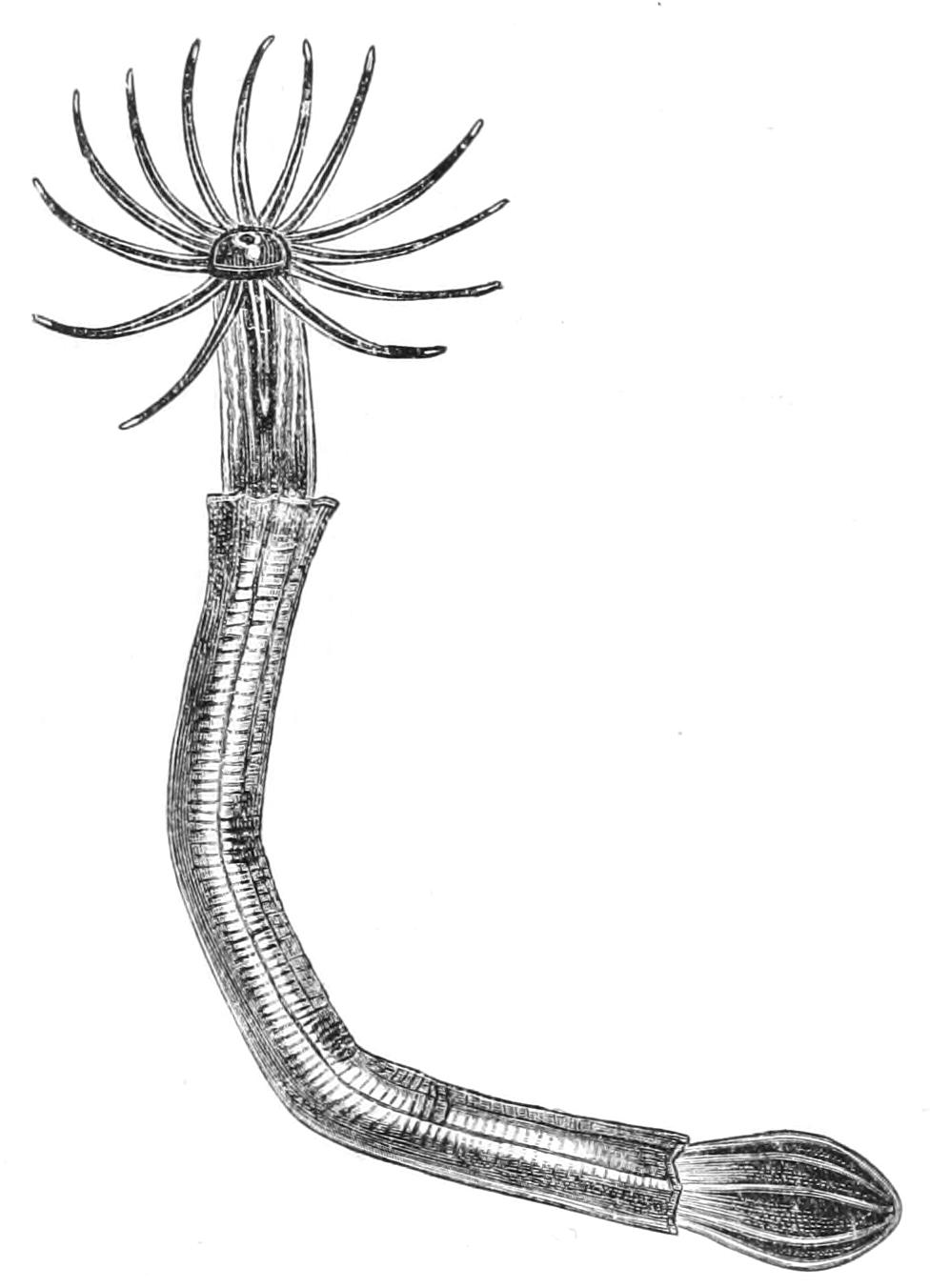
Fig. 165.—Edwardsia beautempsii. Nat. size. (After de Quatrefages.)
Fam. 1. Edwardsiidae.—Several species of this family have been found in the British area. They are very local in their distribution, but sometimes occur in great numbers.
Edwardsia beautempsii occurs in shallow water near the shores of the English Channel and has been found in Bantry Bay; and E. carnea and E. timida have also been found in the Channel. E. tecta is a recently described species from the S. Irish coast, and E. allmani and E. goodsiri are found in Scottish waters.
Fam. 2. Protantheidae.—This family, constituted for the reception of three remarkable genera, is now usually included in the order Edwardsiidea on the ground that not more than eight mesenteries are complete.
The genus Gonactinia exhibits the very exceptional character of having a thick layer of muscles in the body-wall (cf. Cerianthidea, p. 409), and it is also remarkable for the frequency with which it reproduces itself asexually by longitudinal and, more rarely, by transverse fission. It has been found in Norway, the Mediterranean, and on the reefs of New Caledonia. The other genera of the family are Oractis from California, and Protanthea from the coast of Sweden.
Order II. Actiniaria.
This order contains nearly all the animals popularly known as Sea-anemones. They are usually found in shallow water, attached by a broad basal disc to shells, stones, or sea-weeds. In the Halcampidae, however, the aboral extremity ends in a blunt point as in the Cerianthidea and Edwardsiidea, and the animals live half-buried in sand or mud. The Minyadidae of the southern oceans are pelagic in habit, floating near the surface of the sea with the mouth turned downwards. They are supported in the water by a bladder, formed by an involution of the pedal disc, and filled with gas.
Many of the Sea-anemones are found in symbiotic association with other animals. The common Adamsia of the British coasts is found on whelk shells containing hermit crabs. The crab is probably protected from the attacks of some of its enemies by the presence of the Anemone, which in its turn has the advantage of securing some fragments of the food captured and torn to pieces by the crab. The association, therefore, seems to be one of mutual advantage to the messmates. It is a noteworthy fact that in these associations the species of Sea-anemone associated with a particular hermit crab is nearly always constant. Thus in the English Channel, Adamsia palliata is almost invariably found associated with Eupagurus prideauxii, and Adamsia rondeletii with Eupagurus bernhardus. But, perhaps, the most remarkable association of this kind is to be seen in the case of the little shore crab of the Indian Ocean, Melia tesselata, which invariably holds in each of its large claws a small Sea-anemone. Möbius, who originally described this case, relates that when the crab is robbed of its Anemone it appears to be greatly agitated, and hunts about on the sand in the endeavour to find it again, and will even collect the pieces, if the Anemone is cut up, and arrange them in its claw.[400]
Another very interesting association is that of certain fish and Crustacea with the large Sea-anemones of the tropical Australian coast.[401] Thus Stoichactis kenti almost invariably contains two or more specimens of the Percoid fish Amphiprion percula. This fish is remarkable for its brilliant colour, three pearly white cross-bands interrupt a ground plan of bright orange-vermilion, and the ends of the cross-bands as well as the fins are bordered with black. In another species a prawn of similar striking colours is found. These companions of the giant Anemones swim about among the tentacles unharmed, and when disturbed seek refuge in the mouth. It has been suggested that these bright and attractive animals serve as a lure or bait for other animals, which are enticed into striking distance of the stinging threads of the Anemone, but how the commensals escape the fate of the animals they attract has yet to be explained.
In a considerable number of Sea-anemones, such as Actinoloba marginata and A. dianthus, some species of Sagartia, Actinia cari, Anemonia sulcata, and Calliactis parasitica, the fertilisation of the eggs and their subsequent development take place in the sea water.[402] In a great many others, such as Bunodes (several species), Cereactis aurantiaca, Sagartia troglodytes, Bunodactis gemmacea, etc., the embryos are discharged into the water from the body-cavity of the parent, at a stage with six or twelve tentacles. In the Arctic species of the genera Urticina and Actinostola, however, the embryos are retained within the body of the parent until several cycles of tentacles are developed, and in Urticina crassicornis the young have been found with the full number of tentacles already formed. In Epiactis prolifera from Puget Sound, the young Anemones attach themselves to the body-wall of the parent after their discharge, and in Epiactis marsupialis, Pseudophellia arctica, Epigonactis fecunda, and other species from cold waters, the young are found in numerous brood sacs opening in rows on the body-wall. It is not known for certain how these embryos enter the brood sacs, but it is possible that each sac is formed independently for a young embryo that has settled down from the outside upon the body-wall of the parent. The most specialised example of this kind of parental care in the Sea-anemones is seen in Marsupifer valdiviae from Kerguelen, in which there are only six brood sacs, but each one contains a great many (50-100) embryos.
The wonderful colours of our British Sea-anemones are familiar to most persons who have visited the sea-side. The common Actinia mesembryanthemum of rock pools, for example, is of a purple red colour. The base is usually green with an azure line. Around the margin of the disc there are some twenty-five turquoise blue tubercles. On each side of the mouth there is a small purple spot, and the numerous tentacles forming a circlet round the mouth are of a pale roseate colour. Nothing could be more beautiful than the snowy-white Actinoloba dianthus or the variegated Urticina crassicornis.
Similar wonderful variety and beauty of colour are seen in the Sea-anemones of other parts of the world. Thus Saville Kent[403] in describing a species of the gigantic Stoichactis of the Australian Barrier Reef says, "the spheroidal bead-like tentacles occur in irregularly mixed patches of grey, white, lilac, and emerald green, the disc being shaded with tints of grey, while the oral orifice is bordered with bright yellow."
The order Actiniaria contains a large number of families, presenting a great variety of external form and of detail in general anatomy. The definitions of the families and their arrangement in larger groups have presented many difficulties, and have led to considerable differences of opinion; and even now, although our anatomical knowledge has been greatly extended, the classification cannot be regarded as resting on a very firm basis. The families may be grouped into two sub-orders:—
Sub-Order 1. Actiniina.—The tentacles are simple and similar, and there is one tentacle corresponding to each intermesenteric chamber (endocoel).
Sub-Order 2. Stichodactylina.—The tentacles are simple and similar, or provided with teat-like or ramified pinnules. One or more tentacles may correspond with an endocoel, and there may be two kinds of tentacles (marginal and accessory) in the same genus.
Sub-Order 1. Actiniina.
Fam. 1. Halcampidae.—This family is clearly most closely related to the Edwardsiidea. There are, however, twelve complete mesenteries of the first cycle, and a second cycle of more or less incomplete mesenteries. The tentacles are usually twelve in number, but may be twenty or twenty-four. There is no pedal disc, but the base is swollen and rounded or pointed at the end.
The genus Halcampa includes a considerable number of small species occurring in the shallow waters of the temperate northern hemisphere, and of the Kerguelen Islands in the south. Three British species have been described, of which Halcampa chrysanthellum alone is common. The larva with eight tentacles and eight mesenteries has been found living on the Medusa Thaumantias.
Peachia is a genus containing Anemones of much larger size (10-25 cm.). It is remarkable for the very large siphonoglyph on the ventral side of the stomodaeum, prolonged into a papillate lip projecting from the mouth called the "conchula." The genera Scytophorus from 150 fathoms off Kerguelen and Gyractis from Ceylon, although showing some remarkable peculiarities of their mesenteric system, appear to be closely related to this family.
Ilyanthus mitchellii is a large Anemone with a vesicular base, forty-eight tentacles and mesenteries, occurring in the English Channel, but it is not very common. It is usually placed in a separate family, but is in many respects intermediate in character between the Halcampidae and the Actiniidae.
Fam. 2. Actiniidae.—This family contains some of the commonest British Sea-anemones. There is a large flat pedal disc by which the body is attached to stones and rocks. The body-wall is usually smooth, and not perforated by cinclides. The edge of the disc is usually provided with coloured marginal tubercles. There are no acontia.
Actinia.—This genus contains the widely distributed and very variable species Actinia mesembryanthemum, one of the commonest of the Sea-anemones found in rock pools on the British coast. The colours of this species are often very beautiful (see p. 379) but variable.
Anemonia is a genus with remarkably long tentacles which are not completely retractile. A. sulcata (sometimes called Anthea cereus) is very common in the rock pools of our southern coasts.
Bolocera tuediae is, next to Actinoloba dianthus, the largest of the British Anemones. It has very much the same colour as the common varieties of Actinia mesembryanthemum, but the body-wall is studded with minute, rounded warts. It is found between tide marks in the Clyde sea-area, but usually occurs in deeper water.
Fam. 3. Sagartiidae.—This family includes several genera with a contractile pedal disc, with the body-wall usually perforated by cinclides, and provided with acontia.
The genera may be arranged in several sub-families distinguished by well-marked characters. Among the well-known Sea-anemones included in the family may be mentioned:—
Sagartia troglodytes, a very common British species found in hollows in rocks. It is usually of an olive green or olive brown colour, and the upper third or two-thirds of the body-wall is beset with numerous pale suckers. Adamsia palliata has a white body-wall spotted with bright red patches, and is associated with the hermit crab Eupagurus prideauxii.
Actinoloba (frequently called Metridium) dianthus is considered the handsomest of all the British Sea-anemones. It has a lobed disc frilled with numerous small tentacles, and is uniformly coloured, creamy-white, yellow, pale pink, or olive brown. It lives well in captivity, and sometimes reaches a length of 6 inches with a diameter of 3 inches (Fig. 164).
Aiptasia couchii is a trumpet-shaped Anemone, found under stones at low-water mark in Cornwall and the Channel Islands, with relatively slight power of retraction.
Gephyra dohrnii is an interesting species with twelve tentacles, which was supposed at one time to form a connecting link between the Actiniaria and the Antipathidea. It is found attached to the stems and branches of various Hydrozoa and Alcyonaria, sometimes in such numbers and so closely set that it gives the impression of having formed the substance of its support. Haddon[404] has described specimens found on the stems of Tubularia from deep water off the south and south-west coasts of Ireland. It also occurs in the Mediterranean and the Bay of Biscay.
Fam. 4. Aliciidae.—The members of this family have a large flat contractile base and simple tentacles. The body-wall is provided with numerous simple or compound outgrowths or vesicles, usually arranged in vertical rows. Alicia mirabilis is a rare Anemone from Madeira with a very broad base, capable of changing its position with considerable activity, and of becoming free and floating upside down at the surface of the sea. Other genera of the family are Bunodeopsis and Cystiactis. The genus Thaumactis, described by Fowler,[405] from the Papeete reefs, has many peculiarities, but is probably capable of crawling rapidly and of floating at the surface like other members of the family. The remarkable Anemone Lebrunia from the West Indies may be included in this family.
Fam. 5. Phyllactidae.—These are distinguished by the presence of a broad collar of foliaceous or digitate processes outside the circle of tentacles. The processes have some resemblance to the foliaceous tentacles of the Stichodactylinae. They are found in the Mediterranean, Red Sea, and on the shores of the Atlantic Ocean, but have not yet been found in the British area.
Fam. 6. Bunodidae.—This family is characterised by prominent verrucae and tubercles of the body-wall. It contains several British species, of which Bunodes gemmacea found between tide marks on our southern shores is fairly common. The very common British species Urticina (Tealia) crassicornis is usually placed in this family, but exhibits some peculiarities which seem to warrant its removal to another division of the Actiniaria. It is found in tide pools attached to rocks, but is usually partially hidden by adherent sand or small stones.
Fam. 7. Minyadidae.—This family contains a number of floating Anemones. The basal disc is folded over to form a gas bladder lined by a cuticular secretion. The species are principally found in the seas of the southern hemisphere.
Sub-Order 2. Stichodactylina.
Fam. 1. Corallimorphidae.—In this family the marginal cycle of tentacles and accessory tentacles are all of the same kind. The accessory tentacles are arranged in radial rows. All the tentacles are knobbed at the extremity. The musculature is weak. Capnea sanguinea, Corynactis viridis, and Aureliania heterocera belong to the British fauna. They are all small Anemones of exquisite colours, but are not very common. The genus Corallimorphus is principally found in the southern hemisphere.
Fam. 2. Discosomatidae.—The tentacles are all of one kind and are very numerous. The mesenteries are also very numerous. The sphincter muscle is strong.
This family includes a rather heterogeneous assembly of forms, and will probably require some rearrangement as our knowledge increases. Nearly all the species are found in the shallow waters of the tropics, and among them are to be found some of the largest Anemones of the world. Stoichactis kenti, from the Barrier Reef, is from one to four feet in diameter across the disc. In the West Indies these Anemones do not attain to such a great size, but Homostichanthus anemone from Jamaica is sometimes 8 inches in diameter.
Fam. 3. Rhodactidae.—In this family the body-wall is smooth and the oral disc greatly expanded. The tentacles are of two kinds. On the margin there is a single cycle of minute tentacles, while on the disc there are numerous tuberculate or lobed tentacles. Many of the species of this family are quite small, but Actinotryx mussoides from Thursday Island has an oral disc 8 inches in diameter. The genera and species are widely distributed in the warm, shallow waters of the world.
Fam. 4. Thalassianthidae.—The tentacles are simple or ramified (Fig. 166), and in some cases very long (Actinodendron arboreum). Many of the specimens of A. plumosum and Megalactis griffithsi are of very large size, 8 to 12 inches in diameter. Of the former of these two species Saville Kent remarks: "The colours are lacking in brilliancy, being chiefly represented by varying shades of light brown and white, which are probably conducive to its advantage by assimilating it to the tint of its sandy bed. When fully extended the compound tentacles are elevated to a height of 8 or 10 inches, and bear a remarkable resemblance to certain of the delicately branching, light brown sea-weeds that abound in its vicinity." The same author calls attention to their stinging, which is "nearly as powerful as the ordinary stinging nettle."
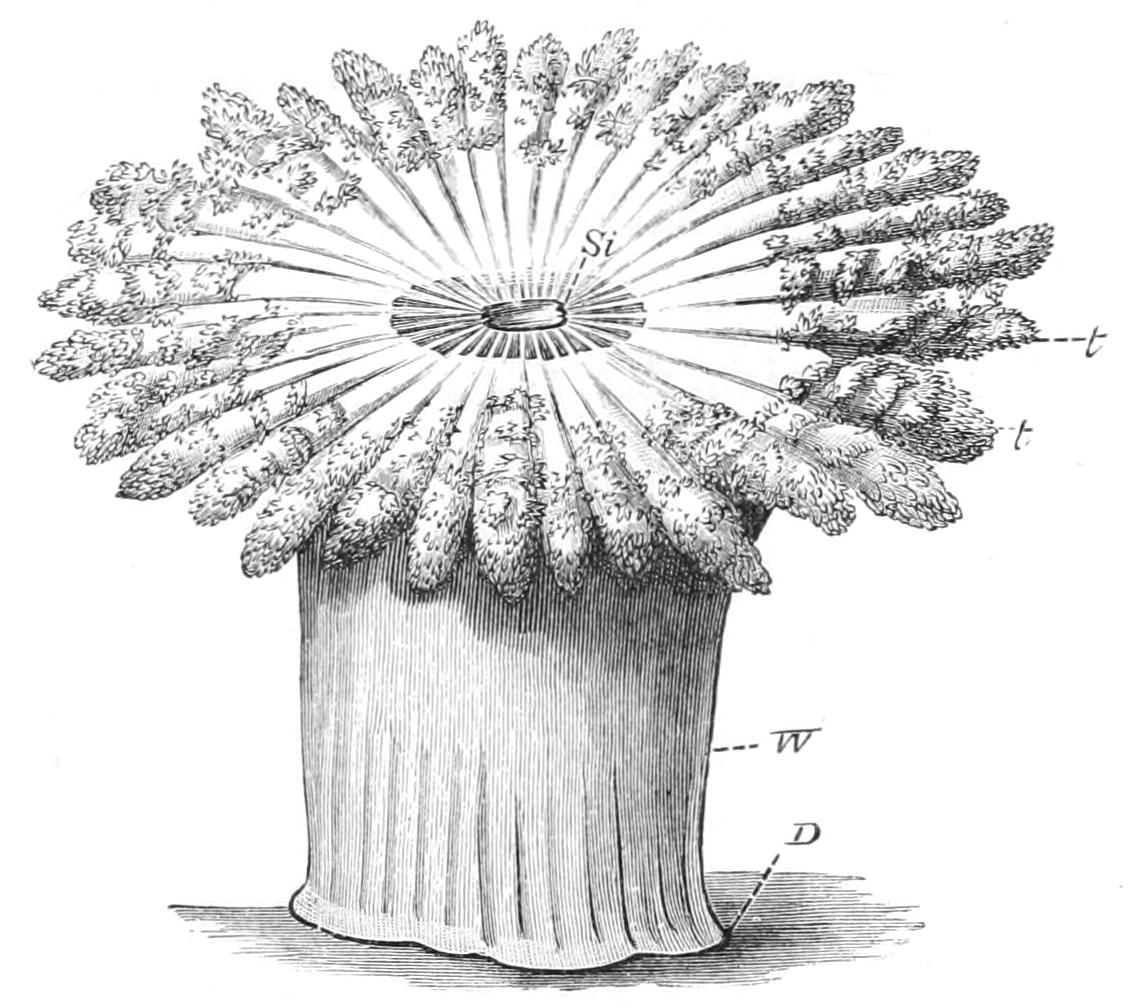
Fig. 166.—Actinodendron plumosum. D, disc of attachment; Si, siphonoglyph; t, t, lobes of the marginal disc bearing the tentacles; W, body-wall. Height of the column 200 mm. (After Haddon.)
Order III. Madreporaria.
The Madreporaria form a heterogeneous group of Zoantharia characterised by a single common feature, the formation of an extensive skeletal support of carbonate of lime. In a great many cases the skeleton exhibits cups or "calices" into which the zooids may be completely or partially retracted, and these calices usually exhibit a series of radially disposed vertical laminae, the "septa," corresponding with the inter-mesenteric spaces of the zooids. Calices and structures simulating septa also occur in Heliopora, which is an Alcyonarian, and in certain fossil corals which are probably not Zoantharians. The anatomy of the zooids of a great many Madreporaria is now known, and, although a great deal of work yet remains to be done, it may be said that the Madreporaria exhibit close affinities in structure with the Actiniaria. The chief points in the anatomy of the zooids are described under the different sub-divisions, but a few words are necessary in this section to explain the principal features exhibited by the skeleton.
There is no more difficult task than the attempt to explain upon any one simple plan the various peculiarities of the Madreporarian skeleton.[406] The authorities upon the group are not agreed upon the use of the terms employed, nor are the current theories of the evolution of the skeleton consistent. It is necessary, however, to explain the sense in which certain terms are employed in the systematic part that follows, and in doing so to indicate a possible line of evolution of the more complicated compound skeletons from the simple ones.
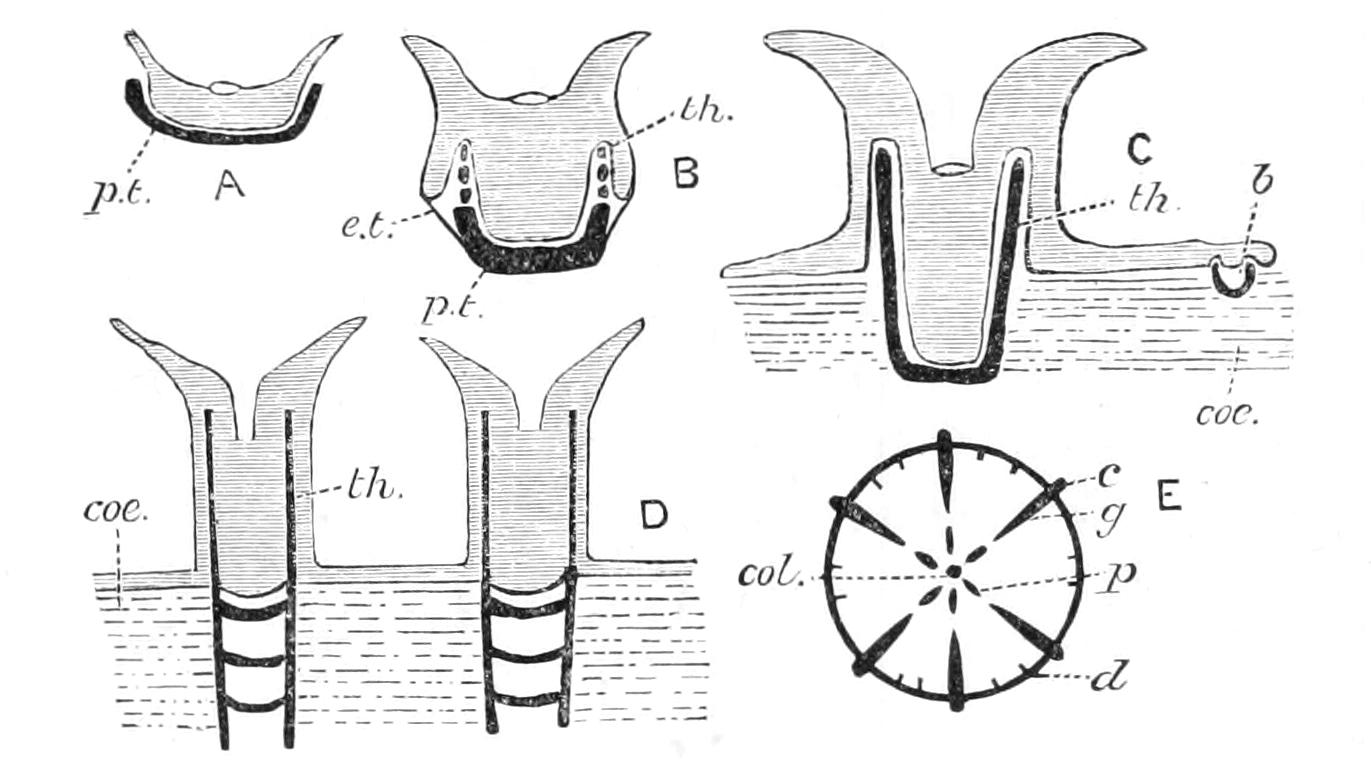
Fig. 167.—Series of diagrams to illustrate the structure of the Madreporarian skeleton. A, young stage of a solitary coral with simple protheca (p.t). B, solitary coral, with theca (th), epitheca (e.t), and prototheca (p.t). C, young stage of colonial coral, showing coenosteum (coe) and theca (th), and the formation of the theca of a bud (b). D, two zooids of a more advanced stage of a colonial coral. coe, Coenosteum; th, theca. The black horizontal partitions are the tabulae. E, transverse section of a calyx. c, Costa; col, columella; d, dissepiment; g, septum; p, pali.
There can be no doubt whatever that the whole of the skeleton of these animals is formed by the ectoderm, and is external to their bodies. If we could get rid of the influence of tradition upon our use of popular expressions we should call this skeleton a shell. There can be little doubt, moreover, that this skeleton is formed by a single layer of specialised ectoderm cells called the "calicoblasts."
The calicoblasts form, in the first instance, a skeletal plate at the aboral end of the coral embryo, which becomes turned up at the edges to form a shallow saucer or cup. This cup is called the "prototheca."[407] At this stage the body-wall of the living zooid may or may not overflow the edge of the prototheca. In the former case the growth of the rim of the prototheca is brought about by the calicoblasts of an inner and outer layer of epiblast, and the cup is then called the "theca." In the latter case, the growth of the rim of the prototheca is continued by the calicoblasts of one layer of epiblast only, and it is called the "epitheca" (Flabellum). With the continued growth of the theca the tissues that have overflowed—the "episarc"—retreat from the base, and in doing so the ectoderm of the edge and, to some extent, the outer side of the episarc secrete a layer of epitheca which becomes more or less adherent to the theca. Thus the cup may have a double wall, the theca and the epitheca (Caryophyllia).
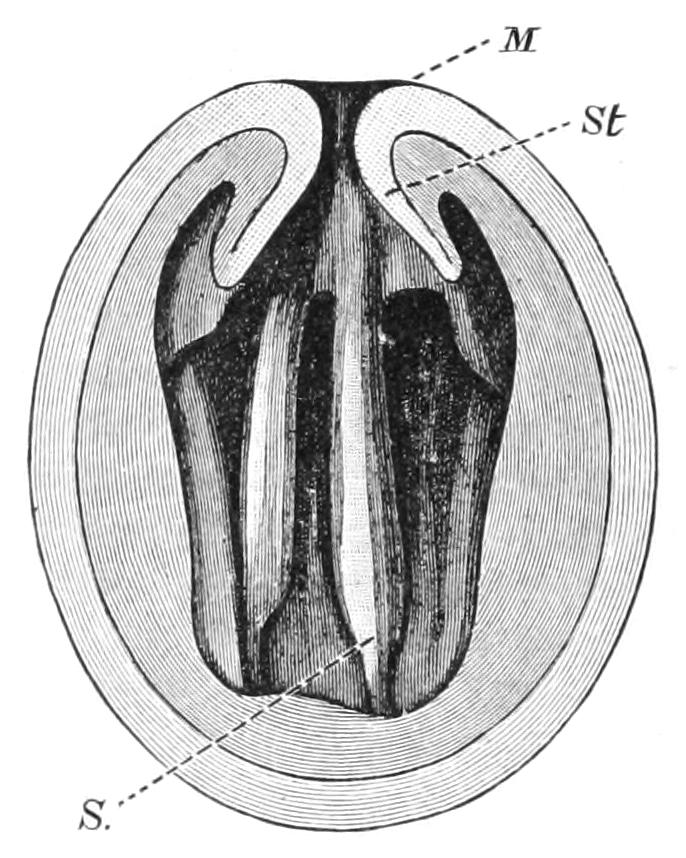
Fig. 168.—Diagram of a vertical section of a young Caryophyllia, showing the septa (S) covered with endoderm projecting into the coelenteric cavity. M, mouth; St, stomodaeum. (After G. von Koch.)
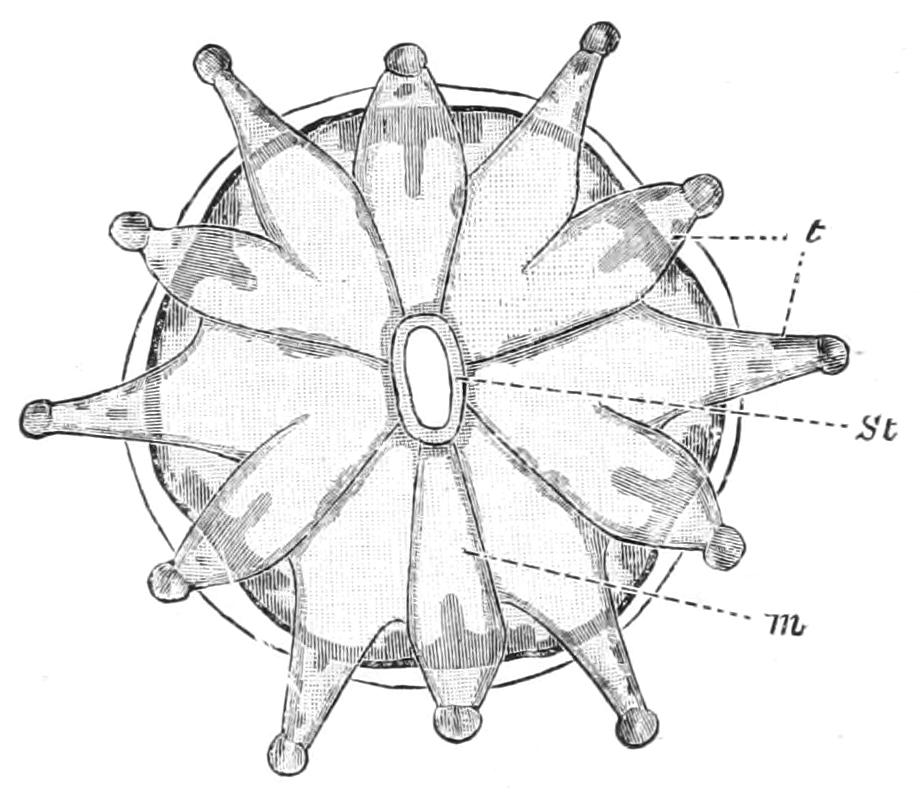
Fig. 169.—A young Caryophyllia, viewed from above, showing the tentacles (t) and the stomodaeum (St). The letter m points to a space between a pair of mesenteries, and the darker shading in this place shows a septum projecting radially from the wall of the theca. (After G. von Koch.)
With the growth of the theca and epitheca a certain number of radially disposed laminae of lime rise from the walls and grow centripetally. These are the "septa." Additional ridges on the inner wall of the cup between the septa are called the "dissepiments." Corresponding with the septa there may be a circle of columns or bands rising from the basal parts of the prototheca—the "pali"; and from the actual centre a single column called the "columella." The longitudinal ridges on the outside of the theca, corresponding in position with the septa inside, are called the "costae" (Fig. 167, E, c).
We may imagine that in the primitive forms that gave rise to colonies, the episarc of the primary zooid overflowed on to the substance to which it was attached, and gave rise to successive layers of epithecal skeleton, which may be called the "coenosteum." The ectoderm at the base of the original prototheca is in some corals periodically dragged away from the skeleton, and forms another cup or platform of lime at a little distance from it—the "tabula." New zooids are developed at some distance from the primary one by a process of gemmation in the episarc, and independent thecae, septa, etc., are formed in it; the skeleton of the new zooid thus originated being connected with that of the primary zooid by the coenosteum.
There are many modifications of this simple description of skeleton formation to be considered before a thorough knowledge of coral structure can be understood, but sufficient has been said to explain the use of the terms that it is necessary to employ in the description of the families. When it is necessary to speak of the cup in which the zooid is situated without expressing an opinion as to the homology of its wall, it is called the calyx.
There are many forms of asexual reproduction observed in the Madreporaria. Of these the most frequent is gemmation. The buds are formed either on the episarc or on the canals running between zooids at the surface of the coenenchym. When the young zooids that have been formed by gemmation reach maturity they have the same characters as their parents. Fission occurs in the production of a great many colonies of Madreporaria. It occurs occasionally in such genera as Madrepora and Porites, where reproduction by gemmation prevails, but it is said that gemmation never occurs in those forms such as the Astraeidae Fissiparantes where fission is the rule. In fission a division of the zooid takes place in a vertical plane passing through the stomodaeum and dividing the zooid into two equal parts. In some cases these two parts become separated during the further growth of the coral. In other cases, however, further divisions of the stomodaeum occur before the separation of the zooids, and then elongated, serpentine polyps are produced (as in Meandrina, etc.), which consist of a number of imperfectly separated zooids, each with a distinct mouth and stomodaeum but with continuous coelenteric cavities. Two kinds of fission must be distinguished from each other. In Madrepora and Porites the plane of fission passes dorso-ventrally through the zooids, that is, between the dorsal and ventral pairs of directive mesenteries. In these cases the zooids produced by fission are similar to the parent form. In most Madreporaria, however, the plane of fission appears to be more or less at right angles to this, and the resulting zooids are unlike the original parent form in having either no directive mesenteries at all or only one pair of them.
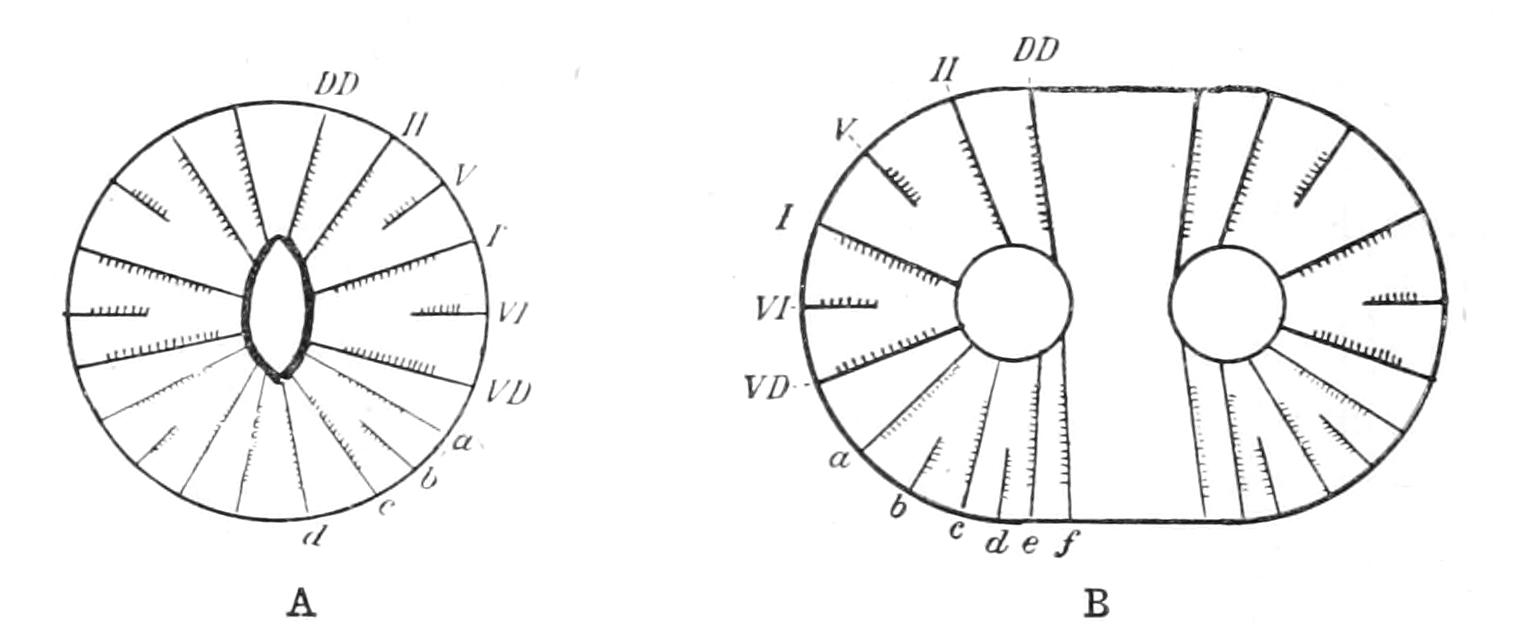
Fig. 170.—Diagrammatic transverse sections of Porites to illustrate the process of fission. A, before division; B, fission nearly completed. In A four bilateral pairs (a, b, c, d) of mesenteries have appeared in the entocoele of the ventral directives (VD). These are increased to six pairs and then fission commences as seen in B, the plane of fission passing through the entocoeles of the last pair of secondary mesenteries (f) and of the dorsal directives (DD). I, II, V, VI, the protocnemes in the order of their development. (After Duerden.)
The section Fungacea presents us with some exceptional and remarkable forms of asexual reproduction. The embryo Fungia gives rise to a conical fixed coral called a "trophozooid." The upper part of the calyx of this trophozooid expands and becomes disc-shaped. This is called the "anthocyathus," and after it has reached a certain size it breaks away from the rest of the trophozooid as an adult Fungia. Several anthocyathi may be formed in succession from one trophozooid. This may be described as a process of successive transverse fission. In Diaseris the disc divides into four quadrants, and each quadrant appears to be capable of acquiring the shape and size of the undivided parent.
Without doubt a process of sexual reproduction occurs in all Madreporaria. In some genera sexual reproduction appears to be almost continuous throughout the year; in others the sexual organs are formed only at periods separated by considerable intervals of sterility. According to the researches of Duerden the Madreporaria appear to be usually viviparous, the early stages of development are passed through within the body of the parent, and the young coral is discharged into the water as a free-swimming ciliated larva. The larvae are spheroidal, oval, or pear-shaped, but change their shape a good deal, and sometimes become elongated, straight, or spirally twisted rods. The larvae are at first dense and opaque, but subsequently they become distended by the absorption of water, and more nearly transparent. They swim about for one or two days, and then settle down by the aboral pole and become fixed. The tentacles are not formed, in any species that has yet been observed, during the free-swimming stage of existence.
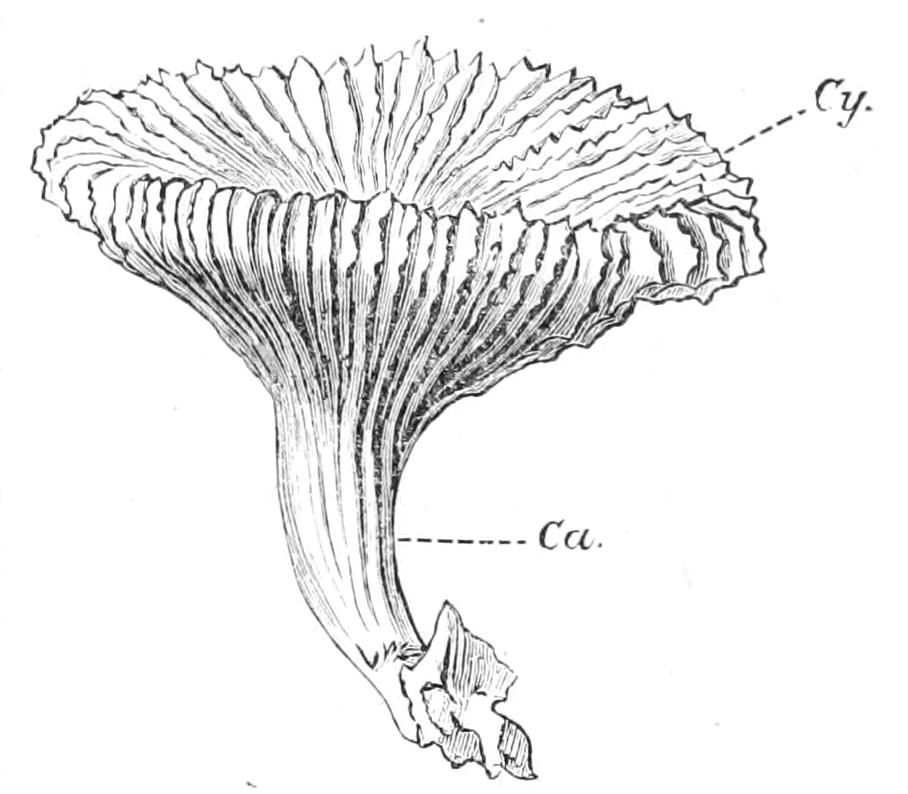
Fig. 171.—A fixed stage in the development of Fungia. The trophozooid has become differentiated into a discoid crown, the anthocyathus (Cy) and a pedicle, the anthocaulus (Ca). (After G. C. Bourne.)
Distribution of Reef Corals.—The principal reef-forming corals reach their greatest size and grow with greatest rapidity in the warm, shallow waters of the world, but they are not confined to this habitat. A species of Madrepora has been found in the very cold waters of Archangel, and Manicina areolata occurs in Simon's Bay, Cape of Good Hope, many degrees south of the region of the East African coral reefs. As regards the distribution of these corals in depth, very little is known at present. The face of the growing coral reef that is turned towards the open sea is so steep that it has been found impossible to determine to what depth the living reef corals actually extend.
The survey of the Macclesfield bank proved that a considerable number of reef corals are to be found alive at depths ranging from 30 to 50 fathoms.[408] To give one example:—In the dredging No. 50, depth 32 to 35 fathoms, living examples of the following genera of corals were obtained: Madrepora, Montipora, Psammocora, Pavonia, and Astraeopora.
Coral Reefs and Atolls.—In many regions of the tropical seas, banks and islands are found which are built up of blocks of coral, coral detritus, and altered or modified limestone. These are the famous coral reefs of which so much has been said and written during the last half-century. There can be little doubt that the superficial strata of these formations are entirely due to the action of coral-forming animals and plants living in warm, shallow sea-water.
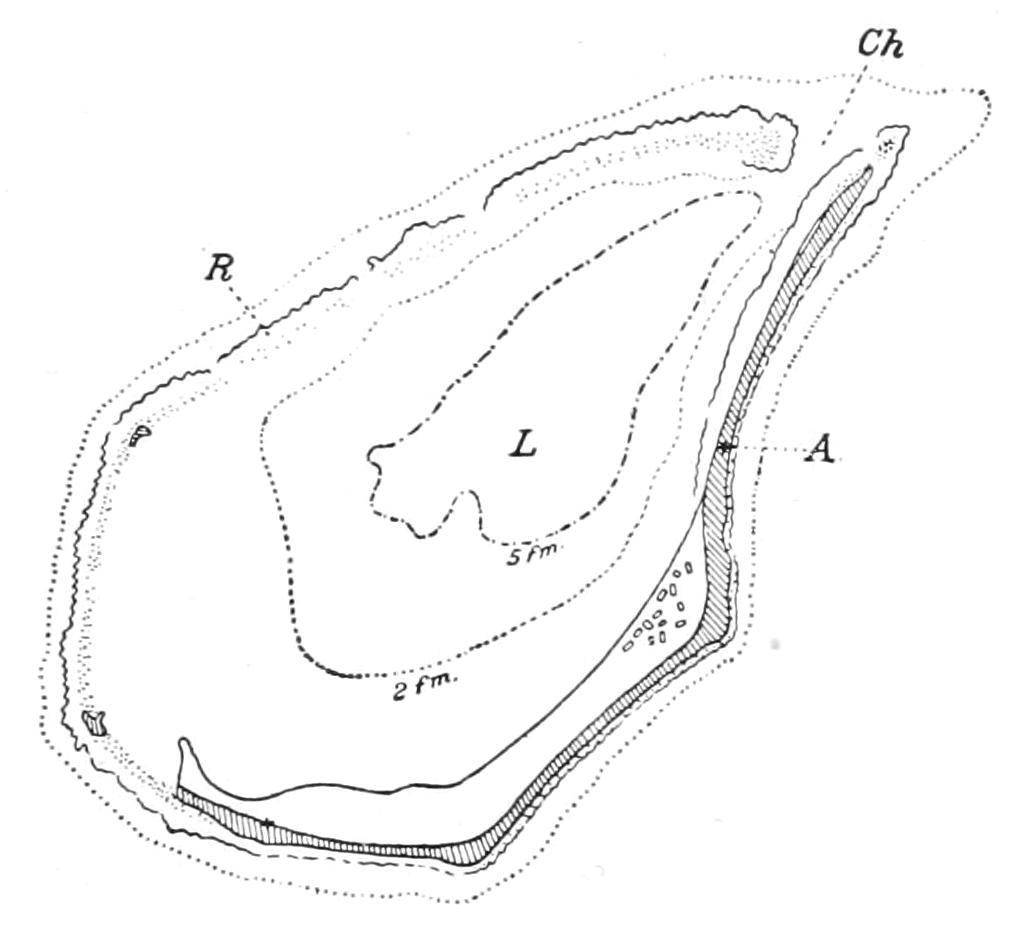
Fig. 172.—Plan of Minikoi Atoll in Laccadive Archipelago. A, the land elevated above the level of high-water mark; Ch, the boat channel; 5 fm, the five fathom line; 2 fm, the two fathom line; L, the lagoon with a maximum depth of 7 fathoms; R, the reef continuing the circle on the east side of the atoll, awash at high tides. (After Stanley Gardiner.)
Three classes of coral reefs are usually recognised: the "fringing reefs" which follow the contour of the coast at a distance of a few hundred yards, and are separated from the beach at low tide by sand flats or a shallow lagoon; the "barrier reefs," following the contour of the coast less regularly than the fringing reefs, but at a much greater distance, and separated from the beach by a lagoon of sufficient depth to serve as a harbour for ships of great size; and, finally, the "atolls," which are ring-shaped, or broken circlets of low islands enclosing a lagoon which is, in some cases, of considerable depth.
It was observed by the early surveyors that in many cases the sea-bottom slopes downwards steeply or almost precipitously from the outer edge of the barrier reefs and atolls to very great depths—to depths, in fact, at which reef-forming corals do not live.
It seems obvious, therefore, that the atolls and barrier-reefs are resting upon some stratum which could not possibly have been formed by reef-building organisms at the same relative position it has now, and the questions arose, What is the substratum and how was it formed?
If this stratum is a coral rock, it is clear that it must have been formed at a time when it was nearer to the surface of the sea than it is now, and that it must have subsided subsequently to greater depths. If, on the other hand, it is a primitive rock, we must assume that in such regions as the Indian Ocean and the South Pacific, where the archipelagoes of atolls extend for hundreds of miles, there are chains of mountain ranges with peaks reaching to a uniform level beneath the surface of the sea. "But we cannot believe that a broad mountain summit lies buried at the depth of a few fathoms beneath every atoll, and nevertheless that throughout the immense areas above named not one point of rock projects above the level of the sea. For we may judge of mountains beneath the sea by those on land, and where can we find a single chain, much less several such chains many hundred miles in length, and of considerable breadth, with broad summits attaining the same height from within 120 to 180 feet?"[409]
To account for the observed facts of the atolls and barrier-reefs, Darwin conceived and expounded the subsidence theory. According to this theory, the regions where atolls now occur were at one time dry land, or an archipelago of volcanic islands surrounded by fringing reefs of the ordinary type. A gradual subsidence of the land took place, and the area of the land diminished; but the area enclosed by the coral reefs did not diminish in a corresponding degree, and the young corals growing on the débris of the older ones as they sank continued the growth of the reef in a direction nearly vertical to the sea-bottom. The fringing reefs thus became barrier reefs, and they were separated from the land by a lagoon of considerable depth. Finally, when the mountain peaks disappeared beneath the waves, a ring-shaped reef or atoll was all that was left to mark the position of the former land.
The fundamental assumption in the subsidence-theory is that the substratum of the coral reefs and islands is coral-formed limestone. To test the truth of this assumption an expedition was sent out to obtain, by boring, evidence of the character of the substratum of a typical atoll. The island of Funafuti in the Ellice group of the Pacific Ocean was selected, and after several attempts a successful boring was made to a depth of 1114 feet. The material from the boring was found to consist of rocks or sands entirely derived from the calcareous skeletons of marine Invertebrate animals and calcareous Algae.[410] Moreover, in the cores from various depths down to the lowermost the fossilised skeletons of the common genera of recent corals, and very few or no representatives of genera of corals now extinct were discovered.
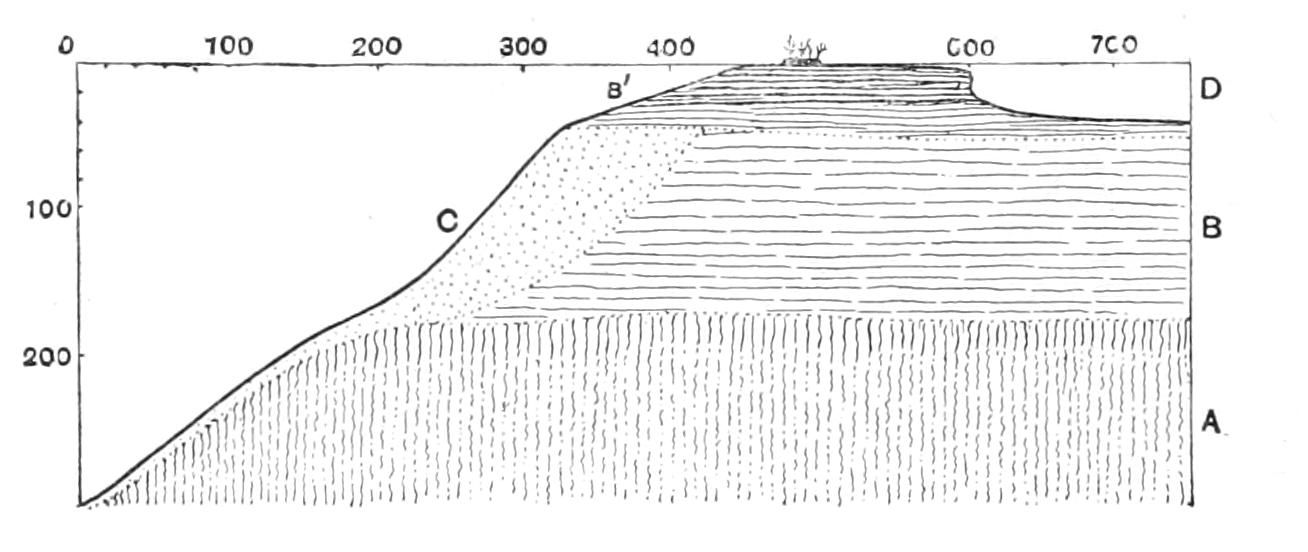
Fig. 173.—Section of the outer edge of one of the Maldive Atolls. A, foundation of primitive rock cut down by the currents; B, upgrowth of the rim by the deep-sea-, intermediate depth- and (B') reef-organisms; C, extension outwards by means of the talus slope; D, lagoon. Scale in fathoms. (After Stanley Gardiner.)
These facts, therefore, prove the justice of Darwin's assumption as to the nature of the substratum—and give support to the subsidence-theory as applied to this particular island. A strong opinion has, however, been expressed by several authors of recent years that the subsidence-theory cannot account for the formation of all the atolls and barrier reefs that have now been investigated, and alternate hypotheses have been put forward to account for particular cases. The main chain of the Maldive Archipelago in the Indian Ocean, for example, presents special difficulties to the acceptance of the subsidence-theory as one of general application.[411] The main chain of these islands is more than 300 miles long, and lies at right angles to the monsoon currents of the Indian Ocean. Here the action of the currents appears to have cut down a great tract of land to form a plateau more than 100 fathoms in depth. The outer rim of this plateau may have grown in height by the deposit of the skeletons of surface-swimming animals, and the skeletons of deep-sea corals, until it reached a level where reef-forming corals can thrive. A certain number of channels would be retained and even deepened as the rim grew up, and thus the coral would eventually reach the surface not as a single large atoll, but as a series of coral islands. When the coral reef has thus reached the surface and cannot grow farther in height, it spreads radially like a fairy ring on the talus formed by broken corals that have fallen down the slopes. The central parts, no longer protected by living organisms, are continually subject to the solvent action of the sea water penetrating the porous substratum, and sink to form the lagoon.
It is not only in the reefs of the Indian Ocean, however, but in many of the archipelagoes of the Pacific Ocean, where there is evidence of very extensive elevation of the land areas in the neighbourhood of atolls and barrier reefs, that the subsidence-theory does not satisfactorily account for all the observed facts. It appears probable, therefore, that although a gradual subsidence of the land may have been the primary cause of coral reef formation in some areas, similar reefs may have been formed in other areas by other natural methods.
Fossil Corals.—A great number of the genera of corals found in the newer Tertiary deposits, and a smaller number of those occurring in the older Tertiary and Cretaceous strata clearly belong to families now represented by recent corals. In the earlier strata, however, fossils are found which cannot be placed in our system with any degree of certainty. Attempts have been made from time to time to arrange these corals in their proper positions by the careful study and comparison of their skeletal features, but the reasons given are not convincing. The genus Syringopora, and the families Favositidae, Heliolitidae, and Coccoseridae have been noticed in the chapter on Alcyonaria (pp. 343-346). The family Zaphrentidae will be noticed when dealing with the order Zoanthidea.
Among the families of fossil corals of uncertain position which may still be included in the order Madreporaria, the more important are:—
Cyathophyllidae, a family of solitary and colonial corals with numerous radially arranged septa, extending from the Silurian to the Carboniferous limestone. It includes the genera Cyathophyllum, which was very abundant in Devonian times, and Lithostrotion, which, in the times of the formation of the Carboniferous limestone, occurred in continuous masses extending over great areas of the sea-bottom. The Cyathophyllidae may possibly be ancestral to the representatives of both Astraeidae and Fungiidae, which appeared in the Triassic strata.
The Cyathaxoniidae form a family of solitary turbinate or horn-shaped corals, with septa showing a regular, radial arrangement, and may have been the ancestors of the modern family Turbinoliidae. They have the same geological range as the Cyathophyllidae.
The Cystiphyllidae.—This family consists of solitary corals with very thin septa; the interseptal spaces are filled with an abundant vesicular substance called the "stereoplasm." The systematic position of this family is very doubtful, as the structure is evidently much destroyed, but by some authors it is supposed to be ancestral to the family Eupsammiidae.
These three families, together with the Zaphrentidae (p. 406), were formerly grouped together as the Tetracoralla or Rugosa.
Sub-Order 1. Entocnemaria.
Madreporaria forming perforate coralla, with calices that do not project above, or project only slightly above the surface of the coenosarc. The zooids of each colony are usually small and crowded. The mesenteries arise in bilateral pairs, and the increase in their number takes place in the chamber between the ventral or the dorsal pairs of directives. The corals included in this order are among the most important of the reef-builders. On many of the recent coral reefs they occur in enormous numbers and of great individual size. But although so prevalent upon recent reefs, they appear to have played a far less important part in the formation of the reefs of the early Tertiary times, and in the reefs of times antecedent to the Tertiary they were rare or absent.
Judging from the structure of the skeleton and the palaeontological history alone it might be thought that the Entocnemaria represent the most recent types of Madreporarian structure, but the anatomy of the zooids points to a contrary conclusion. The zooids are of very simple structure; the mesenteries are found only in bilateral pairs, and all the new mesenteries formed after the protocnemes originate in one of the directive chambers. These are characters indicating a very ancient history, suggesting affinities with the Edwardsiidea on the one hand, and some ancient type of Cerianthidea on the other. There can be little doubt that it was owing to the evolution of a porous skeleton of rapid growth that these corals have caught up and passed the Astraeidae and other more specialised forms in the struggle for predominance on the coral reefs.
Fam. 1. Madreporidae.—The calices of the corallum are small and contain a few perfectly distinct septa. The coenosteum is porous and contains a plexus of the coenosarcal canals, which connects the cavities of neighbouring zooids. This family is divided into a number of sub-families, but it is only necessary here to mention the peculiarities of a few of the well-known genera.
Madrepora.—This genus is represented by an immense number of forms on the coral reefs of both the old and new world. Attempts have been made at various times to divide these forms into specific groups, and a large number of species have been defined and named. The differences between these species, however, are such as may be due to varying conditions of life upon the reefs and not to characters transmitted from generation to generation by heredity. There can be no doubt that when our knowledge of the soft tissues of these corals is extended the number of species will be greatly reduced. There are, however, three principal forms of growth or facies in the genus.
1. The flabellate or palmate colonies with large flat or concave fronds, radiating from an encrusting base: Forma palmata.
2. Much branched colonies, several branches radiating obliquely from a common centre: Forma prolifera.
3. Large and more erect colonies, less branched except towards the periphery: Forma cervicornis.
On some reefs one of these forms of growth predominates, and for miles the reef seems to be built up mainly of corals of this shape. On other reefs two or sometimes all three of these forms may be found within a stone's throw of one another. Notwithstanding the difficulty of distinguishing the species, the genus itself is quite well defined. The calices project slightly from the surface of the branches and contain six septa, of which the pair that is parallel with the axis of the branch is the strongest. This strong pair of septa can usually be well seen when a slender branch of a Madrepore is examined by a lens by transmitted light. At the apex of each branch there is a terminal zooid and in the skeleton an apical calyx. The terminal zooid is (in some species at least) different from the lateral or radial zooids. The former is radially symmetrical and has six long equal digitiform tentacles, the latter have usually twelve tentacles, of which six are larger than the others. These tentacles alternate, but they are so arranged on the disc as to give a distinctly bilateral appearance to the zooids.
The colour of the West Indian Madrepores appears to be entirely due to Zooxanthellae (pp. 86, 125). They are lighter or darker shades of brown, sometimes becoming green, yellow, or orange. On the Australian barrier reef and other reefs of the eastern seas the growing points of the branches are variable and often brilliantly coloured, emerald green, violet, or red; giving some of the most wonderful colour effects for which the reef pools are famous. The cause of these brilliant apical colours has not yet been ascertained.
The genus is found in shallow water of all seas of the tropical belt except on the western side of the continent of America.
Montipora.—In this genus the calices are small and situated in depressions in the coenosteum, and there are six, sometimes twelve, septa of approximately equal size. There is no terminal calyx at the apex of the branches. This is a genus of very variable form and wide distribution in all tropical seas except on the shores of the Atlantic Ocean.
Turbinaria.—This genus is usually cup-shaped or foliaceous and twisted in form. The septa may be six to thirty in number. Some of the species of this genus attain to a very great size in favourable localities. There is a specimen in the British Museum that is 16 feet in circumference and weighed, when dried, 1500 lbs.
Fam. 2. Poritidae.—The corallum is usually encrusting, foliaceous, lobed or tufted, rarely dendritic. The whole skeleton is built up of a system of trabeculae and stout cross bars, and in section the limits of the calices are not well defined. The septa are represented by twelve trabeculae. The zooids are small and are usually provided with twelve tentacles. The most important genus is Porites, which is so abundant on many reefs that it may be said to rival Madrepora itself in the luxuriance of its growth. On the Australian barrier reef a species of Porites builds up coralla over twenty feet in length and as many in height. According to Saville Kent they are usually found on the outer side of the reef and form a basis of support for the high-level Madreporas and other corals.[412]
The colours of Porites are very variable and often beautiful. In Jamaica[413] the prevailing colours are bright blue, pale yellow, and yellowish green. In Australia the colours are less brilliant perhaps, but among the prevailing tints are light or bright lilac, a delicate pink, dark yellow, and brown. The genus Porites occurs in Eocene and Miocene deposits, and is now found on all the more important coral reefs of the world.
The genus Alveopora is usually placed with the Poritidae. According to Bernard,[414] however, its affinities with this family are remote, and it is more closely related to the Favositidae (see p. 344). The walls of the calices are contiguous and the septa are reduced to rows of spines, as in the Favositidae. It is found in shallow water in the Pacific, the Indian Ocean, and the Red Sea.
Sub-Order 2. Cyclocnemaria.
Madreporaria forming perforate or imperforate coralla. Solitary or colonial. The zooids have usually a large number of mesenteries arranged in two or more cycles. The mesenteries beyond the protocnemic pairs arise in unilateral pairs in chambers other than those between the directives.
Sect. 1. Aporosa.—Cyclocnemaria in which the theca and septa are not perforated. The zooids of the colonial forms may communicate by means of superficial canals of the coenosarc, or they may be in contact with one another only at their edges.
Several families are included in this section, of which the more important are:—
Fam. 1. Turbinoliidae.—The corals included in this family are mostly solitary forms attached to foreign objects, or living partly embedded in sand. In some cases a small colony is formed by gemmation.
The genus Flabellum is a solitary coral of a compressed top shape. It has a large number of septa arranged radially on the cup-wall. This cup-wall is not a true theca but an epitheca. In some forms root-like tubes grow out from the sides of the cup near its base and may serve to support the coral on solid objects. In some remarkably fine specimens recently obtained from the Persian Gulf these tubes served to attach the coral to a telegraph cable. Flabellum seems to be cosmopolitan in its distribution. It is usually found in deep or moderately deep water, but some specimens have been dredged in water of 2 to 9 fathoms.
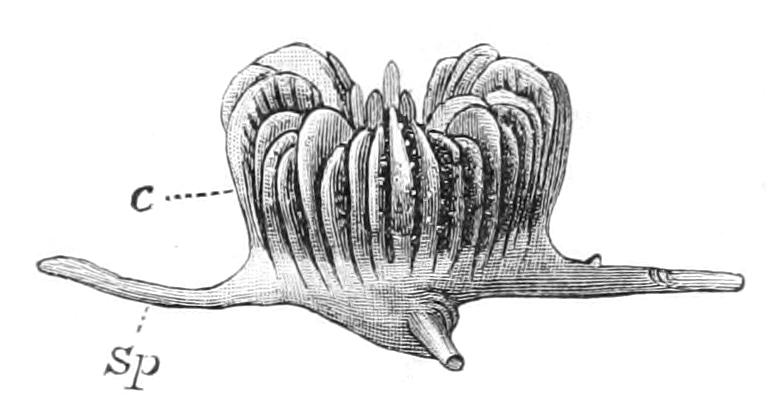
Fig. 174.—Side view of Trochocyathus hastatus, with exsert septa, well-marked costae (c), and with three spinous projections (Sp) at the base formed by outgrowths from primary costae. (After G. C. Bourne.)
Caryophyllia is a conical coral fixed by a slightly expanded base. The cup-wall is a true theca covered below by an epitheca. There is a spongy columella surrounded by a single circle of pali. There is one British species, C. smithii. It is found attached to shells at a depth of about thirty fathoms near the Eddystone Lighthouse and in other localities in the English Channel. It also occurs between tide marks in the Scilly Islands, and is found off the Shetlands, on the west coast of Scotland, and the south-west of Ireland. The genus is widely distributed and extends from shallow water to depths of 1500 fathoms. Caryophyllia sometimes occurs in clusters which have the appearance of an incipient colony. This may be due to the embryos fixing themselves upon the epitheca of existing individuals and developing there. It is doubtful whether the species ever reproduce asexually either by gemmation or by fission. When the zooid is fully expanded it projects some distance above the corallum and shows a very transparent body-wall with a crown of some fifty tentacles. Each tentacle terminates in a globose head (Fig. 169) charged with nematocysts. The general colour is pale pink, and there is a broad brown circle round the mouth. Large specimens may be three-quarters of an inch in diameter.
Turbinolia is a common Eocene fossil genus found in England and France, and is stated to occur in the Caribbean Sea. The columella stands up like a stylet and the septa are "exsert," i.e. project above the rim of the theca.
Trochocyathus is a genus with well-marked "costae" occurring in tropical shallow water (Fig. 174).
Fam. 2. Oculinidae.—Colonial forms, dendritic or encrusting, with relatively large and rather prominent calices separated by considerable stretches of compact coenosteum. The zooids bear a crown of ten to forty-eight or more capitate tentacles.
Neohelia has a fistulose stem lined internally by a horny membrane. There seems to be some reason for supposing that this membrane is formed by the zooids themselves. A similar membrane is found in the fistulose stems of Amphihelia and perhaps other Oculinidae. If this membrane is really formed by the activity of the corals it forms an exception to the general rule that the skeleton of the Madreporaria is entirely calcareous. Others maintain, however, that this membrane is formed by the Chaetopod worms which are found in the tubes, and that the fistulose stem of the coral is formed by folding round and encrusting the horny tubes of the worm. Neohelia is found in the Pacific Ocean.[415]
Lophohelia is a genus forming dendritic colonies of considerable size. The calices have thick walls and are very deep. Lophohelia prolifera has been found in deep water off the island of Skye and in other localities off the west coast of Scotland. It is also not uncommon in some of the Norwegian fjords and in other parts of the world.
Oculina is another widely distributed genus found in the shallow tropical waters of the West Indies, the Indian and Pacific Oceans. It forms dendritic colonies of considerable size. The calices are usually arranged in a spiral manner on the branches. The colour of the West Indian species is stated to be light or dark brown when alive. The tentacles are arranged in three cycles, and are usually twenty-four in number. Asexual reproduction takes place by budding at the apex of the branches.
Fam. 3. Astraeidae.—This is a very large family, and authorities are not agreed as to its limits or classification. Excluding the simple forms for the present, the family may be said to be distinguished by having the calices so closely crowded that there is little or no coenosteum between them. The corallum is compact and massive, unless bored and perforated by algae, worms, and other coral-destroying organisms.
The genera of Astraeidae that form colonies may be divided into two groups: the Gemmantes and the Fissiparantes. In the group Gemmantes asexual reproduction is effected by gemmation, and each zooid of a colony is a distinct individual with two pairs of directive mesenteries. Among the best known of recent corals included in this group may be mentioned Galaxea. In this genus there is a good deal more coenosteum between the calices than there is in most of the Astraeidae. The calices are long and project some distance above the coenosteum. The septa are exsert. In Galaxea esperi examined by Fowler[416] there are twelve septa, twelve pairs of mesenteries, and twenty-four tentacles, of which twelve are very small and twelve rather larger. The colour is green or brown. The genus is found in shallow water in the tropics of the old world.
In Astrangia solitaria the zooids are either isolated or more generally united by thin strands of perithecal tissue to form encrusting colonies. The septa are not exsert as in Galaxea. Six are prominent and belong to the first cycle, six smaller ones form a second cycle, and an incomplete third and fourth cycle may be seen. Corresponding with each septum there is a tentacle. The tentacles of the innermost cycle are the longest (3 mm. in length). All the tentacles terminate in a knobbed apex. The living zooids are colourless throughout, or display only very delicate tints within restricted areas.[417] This genus occurs principally on the coasts of the American continent, extending as far south as the Straits of Magellan. Other well-known genera of Astraeidae Gemmantes are Orbicella, Cladocora, Phyllangia.
In the group Fissiparantes asexual production takes place by fission without the production of morphologically complete zooids. The tentacles, mesenteries, and septa, when fission is established, are not arranged in regular hexameral cycles, and no new directive mesenteries arise. In some cases very large corals are formed, and, if our conception is correct, these must be regarded, not as a colony of zooids, but as a single individual zooid divided into a considerable number of incompletely separated parts. Among the well-known genera belonging to this group are Euphyllia, Mussa, Meandrina, Coeloria, Favia, and Goniastraea.
In such genera as Euphyllia the parts of the colony become separated by deep grooves, and have the superficial appearance of being distinct individuals; but in the Brain-coral Coeloria and others the surface of the coral presents a series of more or less bent or curved grooves, each with a row of slit-shaped mouths and bordered by rows of tentacles.
A number of genera of solitary corals united in the subfamily Trochosmiliacea are generally included in the family Astraeidae. The study of their skeletal characters has suggested[418] that they are more closely allied to the Turbinoliidae. The principal genera thus transferred would be Trochosmilia, Placosmilia, Parasmilia, and Asterosmilia. As these genera and their allies are nearly all extinct, and nothing is known of the structure of the living zooids, their removal from the Astraeidae may be regarded as not fully justified.
Fam. 4. Pocilloporidae.—The general anatomy of the zooids of this family of corals has some resemblance to that of the Entocnemaria, and it is possible that they will eventually find a place in our classification near to, if not actually within that group. The fact, however, that the skeleton is imperforate is sufficient for the present to justify the inclusion of the family in the section Aporosa. There are but two genera at present known, and in both of them the zooids have twelve tentacles, twelve mesenteries, and only two mesenterial filaments. The zooids are connected together by an elaborate system of canals running in the superficial coenosarc. The calices are bilaterally symmetrical, and in Seriatopora the septa which are parallel with the axis of the branch are united in the centre of the calyx, and are very much larger than the others, as in Madrepora. In all these characters the family shows affinities with the Entocnemaria. In the characters of the skeleton, which is imperforate and tabulate, the affinities are rather with the Cyclocnemaria. The two genera are widely distributed on the coral reefs of the old world, and in some localities are very abundant. Neither genus is found in the West Indies. They are both of recent origin, but Pocillopora occurs in the Miocene. It is a remarkable feature of the family that both genera may be attacked by the gall-forming crab Hapalocarcinus. From some reefs nearly all the Pocilloporidae show crab-galls on a large number of their branches, whereas other Madreporaria are free from them.
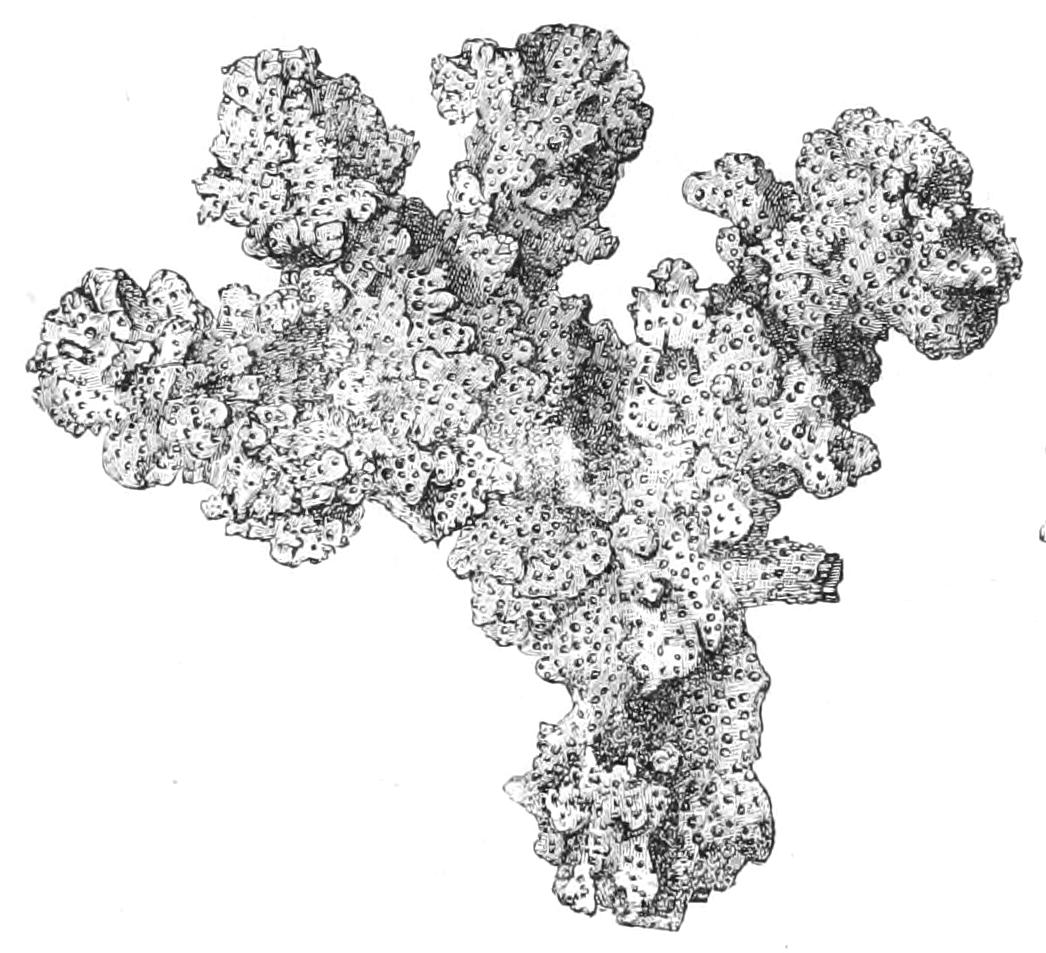
Fig. 175.—A portion of a colony of Pocillopora from the Maldive Archipelago.
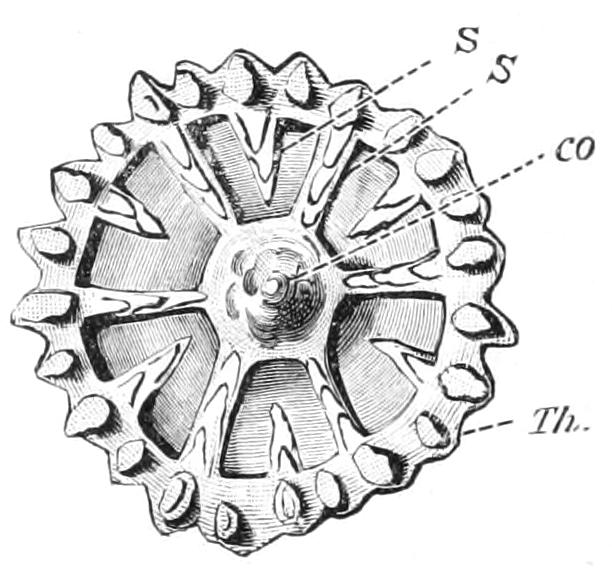
Fig. 176.—A single calyx of Pocillopora septata, showing Co, the columella; S, S, the septa; Th, the theca wall. (After Gardiner.)
Pocillopora is a coral that forms encrusting masses, rising into lobes or branches of considerable size, terminating in blunt apices. Seriatopora is much more slender and ramified, the branches terminating in sharp points.
Sect. 2. Fungacea.—This section of Cyclocnemaria contains a number of solitary and colonial corals of very varied form united in the possession of a number of cross-bars called "synapticula" connecting the septa, and thereby giving strength to the calyx apart from any increase in the thickness of the calyx-wall. The family Fungiidae shows many peculiarities which separate it very distinctly from both the Cyclocnemaria and the Aporosa. The Eupsammiidae, however, approach the Cyclocnemaria in many respects, and the Plesiofungiidae form a connecting link with the Astraeidae. It is very probable that this section had a dual origin, and therefore does not represent a single line of descent.
Fam. 5. Plesiofungiidae.—This family is related to the Aporosa in the possession of septa that are generally solid and imperforate, and to the Astraeidae in particular in the possession of dissepiments. They differ from them, however, in the presence of synapticula and in certain peculiarities of the tentacles.
The genus Siderastraea has recently been studied by Duerden.[419] The colony is usually massive and encrusting in habit. The zooids when expanded do not rise much above the level of the corallum. The tentacles are short and are arranged in irregular cycles on the disc. They terminate in knobbed extremities, and those of the inner cycles are bifurcated. The colour of S. sideraea is reddish-brown when alive. Siderastraea is found in shallow water on the coral reefs, and is widely distributed.
In Agaricia the colony is more foliaceous. The tentacles are rudimentary or small. The colour of the living zooids is very similar to that of Siderastraea. Epistrelophyllum is a solitary coral, from the Jurassic series, belonging to the family.
Fam. 6. Fungiidae.—Fungia is an unattached solitary coral of a flat disc-like shape with very numerous exsert imperforate septa. It is frequently of considerable size (six to twelve inches in diameter). On many of the coral reefs of the old world it is extremely abundant, and consequently it is one of the commonest corals of our collections. When alive the corallum is almost hidden by the disc, which is studded all over with very numerous long tentacles.[420] The colour varies in different species, but is usually brown. One species on the Australian barrier reef, F. crassitentaculata, is of a dark olive green colour, the tentacles terminating in white knobs.
The free adult Fungias are derived from a fixed stock called the trophozooid, from which the young Fungias are detached by transverse fission (see p. 388). The thecal wall of the young Fungia when detached from the trophozooid is perforated, but the pores become largely filled up during the later growth of the coral.
There are several genera of colonial Fungiidae of less frequent occurrence, such as Halomitra, Herpetolitha, and Cryptabacia.
Fam. 7. Cycloseridae.—These are solitary or colonial Fungacea with an imperforate theca. Bathyactis occurs at great depths. Diaseris, shallow water on coral reefs.
Fam. 8. Plesioporitidae.—The septa in this family are trabeculate and perforate, resembling in this respect the septa of Poritidae. Leptophyllia, Microsolena, extinct.
Fam. 9. Eupsammiidae.—This family of perforate corals is usually placed with the Madreporidae and Poritidae in the old group Perforata. The researches of Fowler and Gardiner have shown that the arrangement of the mesenteries is that of the Cyclocnemaria, and the presence of synapticula connecting the septa suggests affinities with the Fungacea. The synapticula of the Eupsammiidae, however, are peculiar in being arranged, not in a vertical series, but alternately with one another or quite irregularly in position. The members of this family are solitary or colonial in habit.
Stephanophyllia is a flattened disc-shaped coral, with perforate and dentate septa, found in the Pacific Ocean and as a fossil in various strata since Cretaceous times.
In Leptopenus, from depths of about 1500 fathoms, the perforations are much larger than in the last-named genus, and the skeleton is reduced to a system of slender trabeculae.
Rhodopsammia has a conical shape, and gives rise by gemmation to a number of young zooids, which remain attached for some time to the parent form before becoming free.
Among the colonial genera are Dendrophyllia, Coenopsammia, and the well-known Mediterranean genus Astroides.
Order IV. Zoanthidea.
This order of Zoantharia consists of a number of solitary or colonial Anemones that do not form a skeleton of horn or carbonate of lime, and are distinguished from the Actiniaria by the peculiar arrangement of their mesenteries.
Fam. 1. Zoanthidae.—Sphenopus is a solitary coral and terminates aborally in a small sucker-like base, by which it may be attached to foreign bodies. The genera Gemmaria and Isaurus include solitary forms.
In the majority of the species of Zoanthids, however, a basal encrusting stolon is formed, which may be thick and fleshy or membranous, or may consist of a plexus of bands from which several zooids rise and on which the new buds are formed.
The tentacles are numerous, simple, usually short, and arranged in one or two circles on the margin of the disc. Most Zoanthidae are encrusted with sand, shell fragments, or sponge spicules, but Zoanthus and Isaurus are naked. The foreign particles that form the incrustation are firmly attached to the ectoderm, and as a rule many of them sink down into the mesogloea to give additional support to the body-wall. It is the presence of so much incorporated sand that frequently gives these Zoantharia such a very brittle character. The stomodaeum usually exhibits a well-marked ventral siphonoglyph. The mesenteries consist of a pair of complete ventral directives, a pair of incomplete dorsal directives, while of the remaining protocnemes the lateral mesenteries which are first and second in the order of appearance are complete, the sixth is incomplete, whereas the fifth is complete in the Macrocneminae and incomplete in the Brachycneminae. Duerden[421] has found in specimens of three species that the arrangement of the mesenteries is "brachycnemic" (the sixth protocneme imperfect) on one side and "macrocnemic" (the sixth protocneme perfect) on the other. The metacnemes appear in the spaces between the sixth protocnemes and the ventral directives in unilateral pairs, of which one becomes complete and the other always remains incomplete (Fig. 163, 4, p. 368).
The Zoanthidae are usually dioecious, but hermaphroditism undoubtedly occurs in the genera Zoanthus and Isaurus. Little is known of their development, but a larval form discovered by Semper off the Cape of Good Hope, of cylindrical shape, with an opening at each end and distinguished by a longitudinal band of cilia running from one end to the other, is probably the larva of a Zoanthid. It is commonly known as Semper's larva. Other larvae provided with a ring of cilia have also been attributed to this group.
A great many Zoanthidae are epizoic in habit. Thus several species of Epizoanthus form colonies on the shells of Gasteropods inhabited by hermit crabs. Parazoanthus tunicans is found on the stem of a Plumularia; Parazoanthus separatus, from Jamaica, is associated with a sponge. The base of the bundle of long spicules of the Sponge Hyalonema (p. 204) is almost invariably sheathed by a colony of Epizoanthus stellaris.
The only genera occurring within the British area are Epizoanthus (with six species), Parazoanthus (with four species), and Zoanthus sulcatus.
Of the species of Epizoanthus, E. incrustatus is fairly common, in depths of twenty to eighty fathoms on all our coasts, and is frequently commensal with different species of hermit crabs, while E. paguriphilus is found in much deeper water off the west coast of Ireland and is always commensal with hermit crabs. Parazoanthus anguicomus is found at depths of a hundred fathoms off the Shetlands and west of Ireland, and is usually associated with various species of Sponges.
Gerardia savalia is the largest "black coral" of the Mediterranean. The colony begins by encrusting the stem of one of the Gorgoniidae, but soon surpassing its support in growth, it forms a basal horny skeleton of its own and builds up very large branching colonies. A specimen in the British Museum,[422] from twenty fathoms off the island Negropont, is two metres high and two metres wide. The genus appears to be related anatomically to Parazoanthus.
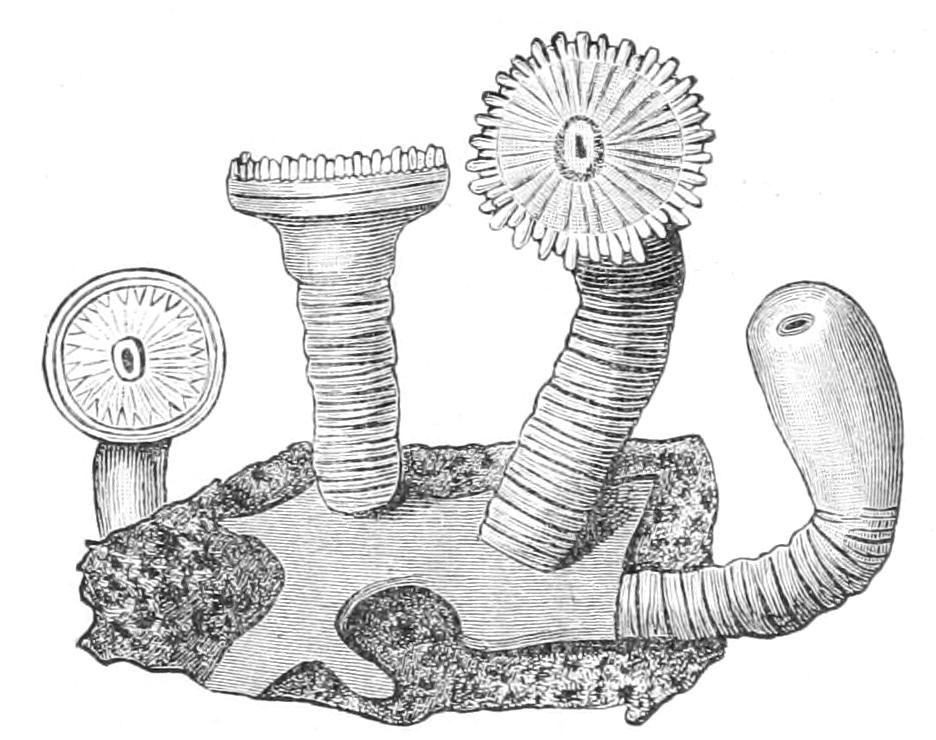
Fig. 177.—Zoanthus macgillivrayi, a small colony. The tentacles are shown somewhat contracted by the preservative. Each zooid is about 25 mm. in length. (After Haddon.)
Fam. 2. Zaphrentidae.—This family of Palaeozoic corals is usually placed with the Turbinoliidae or in the separate group Tetracoralla. Recently Duerden[423] has given reasons, based on the method of increase of the septa in Lophophyllum, for believing that their affinities lie rather with the Zoanthidae than with the Madreporaria. They are solitary turbinate corals, with numerous septa exhibiting a distinct bilateral symmetry in arrangement. Zaphrentis, Lophophyllum.
Order V. Antipathidea = Antipatharia.
The members of this order can readily be distinguished from all other Zoantharia by the presence of a horny axial skeleton (sclerobase) and the absence of any spicules of calcium carbonate. The skeleton is covered by a thin bark which consists of a number of simple, naked zooids united at their edges. The zooids bear six tentacles, or if there are more than six, six large prominent tentacles. In most genera there are but ten mesenteries, in others twelve. In Cladopathes only six mesenteries are found. The skeleton of the Antipathidea is simple in Stichopathes and Cirripathes, but in all other genera it is ramified. The ramification is usually profuse and irregular. The horny substance of which it is composed is free from any deposit or infiltration of lime. The surface of the younger branches is beset with numerous short spines, the number and arrangement of which are characters largely used in the determination of species. The basal parts of the main axis and the thicker branches are frequently bare, the zooids having died and become disintegrated. In these cases the spines wear away and the skeleton appears to be smooth. The presence of spines on some of the branches is, however, generally sufficient to enable the naturalist to distinguish a dried Antipathid from the axis of a Gorgonid, with which alone it might be confounded.
There are six complete mesenteries in each zooid, but as they bear no retractor muscles it is not certain that they represent the first six protocnemes of other Zoantharia. In a great many species the zooids are oval in shape, the longer diameter being parallel with the axis of the branch. The mouth and stomodaeum are compressed and at right angles to this diameter. It is usually assumed that the mesenteries attached to the angles of the stomodaeum are the directives, and that the remaining pair, which is axial in direction, corresponds with the first pair of protocnemes. The axial pair of mesenteries is frequently very well developed and alone bears the gonads. When other mesenteries are formed they always arise in bilateral pairs between the axial mesenteries and the directives. The tentacles correspond with the intermesenteric chambers. In some genera there is a constriction of the zooid between the pairs of the tentacles on each side of the axial mesenteries and the directive tentacles. This gives them the appearance of a division into three zooids with two tentacles apiece, one with a mouth and two without a mouth; and as the mouthless parts alone bear the gonads on the single axial mesentery, they have been called the "gastrozooids" and "gonozooids" respectively. This must not be regarded, however, as a case of true dimorphism, as the cavities of the so-called gastrozooid and gonozooids are continuous.
The Antipatharia are widely distributed in nearly all the great seas of the world. Some species are found in shallow water in the tropics, but most of them occur in depths of fifty to five hundred fathoms. The genus Bathypathes is only found at enormous depths ranging from 1070 to 2900 fathoms. Specimens of Cirripathes spiralis, Antipathella gracilis, and another species have recently been obtained in deep water off the west coast of Ireland,[424] but these are the only Antipatharia known to occur within the British area.
The very simple structure of the Antipatharia is usually attributed to degeneration. On this view the Antipathidae with only six complete mesenteries are the most modified, whereas the Leiopathidae with twelve mesenteries are more closely related to the ancestral forms, and Gephyra dohrnii (see p. 382) is a link connecting the order with the Actiniaria.
There is no reason, however, for supposing that Gephyra is specially related to this order, and, as pointed out recently by Roule,[425] the simple structure of the zooids of the Antipathidea is more easily explained if they are regarded as primitive forms.
Gerardia (p. 406), from the Mediterranean, forms a horny axial skeleton like that of the Antipathidea, but this genus is probably a Zoanthid.
Fam. 1. Antipathidae.—In this family the zooids have six tentacles and six or ten mesenteries. It includes nearly all the familiar genera, such as Stichopathes, Cirripathes, Antipathes, Antipathella, Cladopathes, and Bathypathes. Schizopathes and its allies occurring in deep water are the forms regarded by Brook as dimorphic.
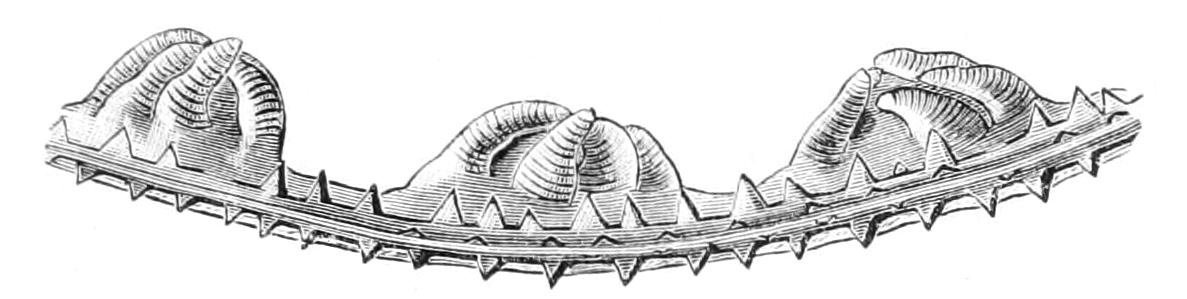
Fig. 178.—A portion of a branch of Antipathes ternatensis, showing three zooids and the horny axis beset with thorn-like projections. (After Schultze.)
Fam. 2. Leiopathidae.—This family includes the single genus Leiopathes of the Mediterranean Sea. It is distinguished from the others by the presence of twelve mesenteries.
Fam. 3. Dendrobrachiidae.—This family also consists of a single genus, Dendrobrachia, from 400 fathoms in the South Atlantic. It is distinguished by having pinnate retractile tentacles.
Order VI. Cerianthidea.
This order contains the remarkable Sea-anemone called Cerianthus. Two of the species have been placed in separate genera, but they do not appear to be of more than sub-generic rank. Cerianthus has a long cylindrical body with a double crown of numerous long tentacles at the oral extremity and tapering to a blunt point or rounded at the aboral extremity.
There are numerous mesenteries, which increase in number by the addition of bilateral pairs, arising only in the ventral inter-mesenteric space throughout the greater part, if not the whole, of the life of the zooid. The right mesentery of each young pair is always more advanced than the left, so that the mesenteries have the appearance of arising alternately right and left. None of the mesenteries bear conspicuous bands of retractor muscles. The movements of the body are effected by a thick band of longitudinal fibres lying between the ectoderm and the mesogloea in the body-wall.
The absence or very slight development of muscles on the mesenteries renders it difficult to recognise the homologues of the protocnemes of other Zoantharia in the adult. From the evidence of embryology, however, it seems certain that the six dorsal pairs of mesenteries represent the protocnemes (Fig. 163, 3, p. 368) and the others are metacnemes.
The stomodaeum exhibits a single long deep siphonoglyph, which is probably dorsal in position.
There are two tentacles to each inter-mesenteric space, one being marginal and the other circumoral. The gonads are borne upon alternate mesenteries, and both ova and spermatozoa are produced by the same individual.
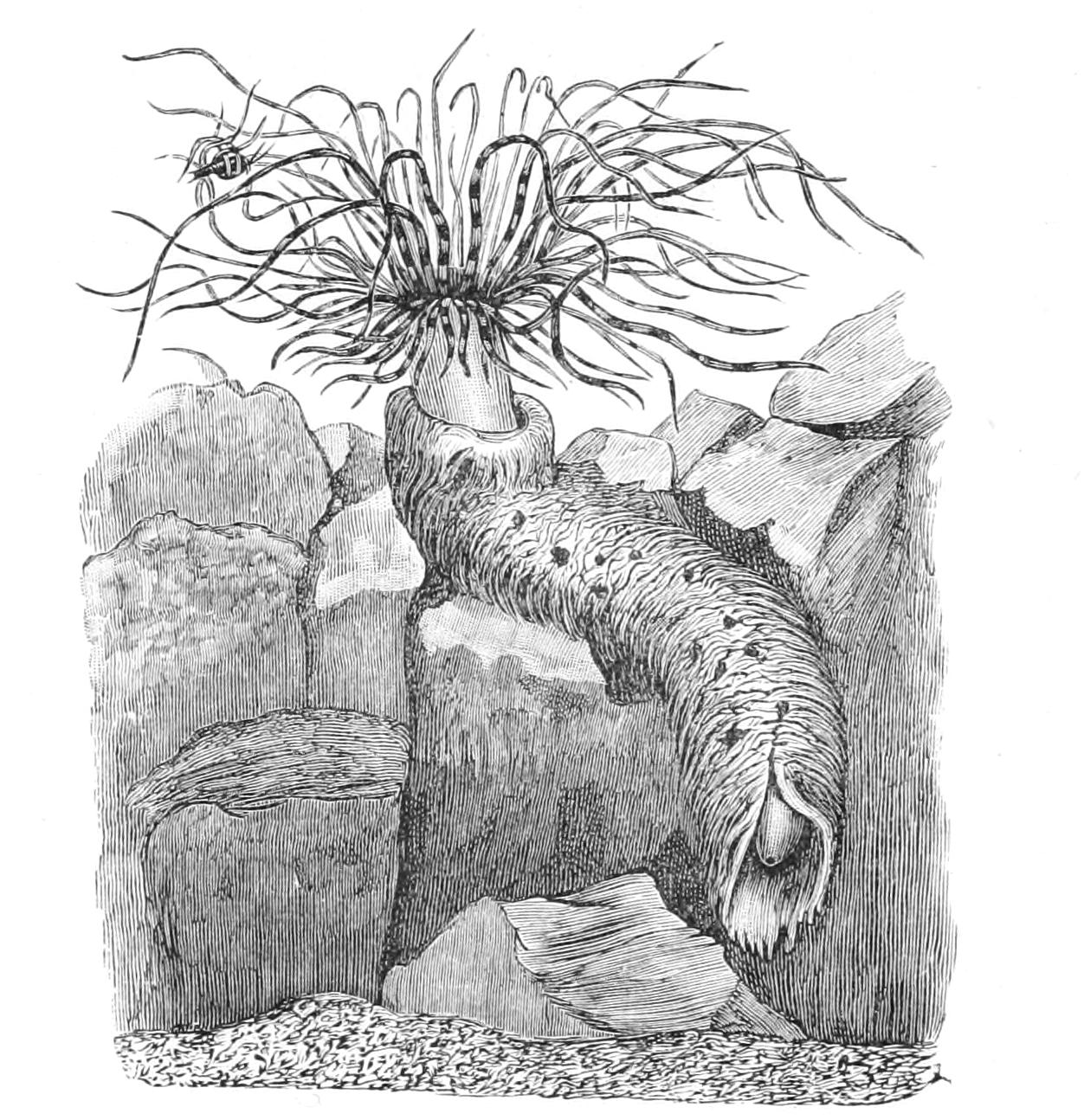
Fig. 179.—Cerianthus membranaceus. Colour pink, with tentacles annulated pink and brown. About 35 cm. in length. (After Andres.)
The ectoderm of Cerianthus is remarkable for the immense number of nematocysts and gland cells. The latter secrete a quantity of mucus which binds the threads of the discharged nematocysts into a sticky feltwork and this secures particles of sand and mud, the whole forming a long tube in which the animal freely moves. This tube is often of considerable thickness. It is tough and resistant, smooth inside but ragged and muddy outside. It is often many times the length of the animal's body.
The embryo of Cerianthus is set free before the completion of segmentation, and it gives rise to a floating pelagic larva known as Arachnactis. It has a variable number of tentacles and mesenteries according to its age, but when it reaches a size of about 15 mm. in length it has developed characters which are sufficient to determine its position as a Cerianthid.
The genus Cerianthus appears to be widely distributed. C. membranaceus is the common species in the Mediterranean Sea, but a smaller species has been described from Naples under the name C. oligopodus by Cerfontaine. C. americanus occurs on the eastern coasts of North America. The British and North European species is C. lloydii, but another species, C. vogti, has been found at a depth of 498 fathoms in the North Sea. C. nobilis is a gigantic species supposed to be about 1 foot in length when complete, from Torres Straits.
C. bathymetricus of Moseley, placed by Andres in the genus Bathyanthus, is a species of small size (25 mm.), obtained by the "Challenger" from a depth of 2750 fathoms in the North Atlantic. It exhibits a remarkable prolongation of the stomodaeum into the coelenteron in the form of a sack which contained food. Moseley described a species of Cerianthus, 6 inches long, living on the coral reef at Zebu in the Philippines fully expanded in the tropical sunshine.
Several species of Arachnactis larvae have been described. Of these Arachnactis lloydii appears to be undoubtedly the larva of C. lloydii. The adult forms of Arachnactis albida from various stations in the Atlantic Ocean and of Arachnactis americana are not known. The larva of Cerianthus membranaceus has been called Dianthea nobilis, and is characterised by the great length of the column, by the general opacity of all parts of the body, and by the precocious appearance of the median marginal tentacle. A considerable number of remarkable pelagic larvae have been described by van Beneden[426] from the Atlantic Ocean, and provisionally assigned by him to five different genera. The adult forms of these larvae are not known, but they are probably members of this order.