Chapter XIII
Reading edition
COELENTERATA (CONTINUED): ANTHOZOA = ACTINOZOA—GENERAL CHARACTERS—ALCYONARIA
CLASS III. ANTHOZOA = ACTINOZOA
Among the familiar objects included in this class are the Sea-anemones, the Stony Corals (Madrepores), the Flexible Corals, the Precious Coral, and the Sea-pens. With the exception of a few species of Sea-anemone, Anthozoa are not commonly found on British sea-shores; but in those parts of the tropical world where coral reefs occur, the shore at low tide is carpeted with various forms of this class, and the sands and beaches are almost entirely composed of their broken-down skeletons.
The majority of the Anthozoa are colonial in habit, a large number of individuals, or zooids as they are called, being organically connected together by a network of nutritive canals, and forming a communal gelatinous or stony matrix for their protection and support. Whilst the individuals are usually small or minute, the colonial masses they form are frequently large. Single colonies of the stony corals form blocks of stone which are sometimes five feet in diameter, and reach a height of two or three feet from the ground. From the tree or shrub-like form assumed by many of the colonies they were formerly included in a class Zoophyta or animal-plants.
But whether the individual polyps are large or small, whether they form colonies in the adult condition or remain independent, they exhibit certain characters in common which distinguish them not only from the other Coelenterata, but from all other animals. When an individual zooid is examined in the living and fully expanded condition, it is seen to possess a cylindrical body, attached at one end (the aboral end) to the common colonial matrix or to some foreign object. At the opposite or free extremity it is provided with a mouth surrounded by a crown of tentacles. In these respects, however, they resemble in a general way some of the Hydrozoa. It is only when the internal anatomy is examined that we find the characters which are absolutely diagnostic of the group.
In the Hydrozoa the mouth leads directly into the coelenteric cavity; in the Anthozoa, however, the mouth leads into a short tube or throat, called the "stomodaeum," which opens into the coelenteric cavity. Moreover, this tube is connected with the body-wall, and is supported by a series of fleshy vertical bands called the mesenteries (Fig. 146). The mesenteries not only support the stomodaeum, but extend some distance below it. Where the mesenteries are free from the stomodaeum their edges are thickened to form the important digestive organs known as the mesenteric filaments (mf). It is in the possession of a stomodaeum, mesenteries, and mesenteric filaments that the Anthozoa differ from all the other Coelenterata. There is one character that the Anthozoa share with the Scyphozoa, and that is, that the gonads or sexual cells (G) are derived from the endoderm. They are discharged first into the coelenteric cavity, and then by way of the mouth to the exterior. In the Anthozoa the gonads are situated on the mesenteries.
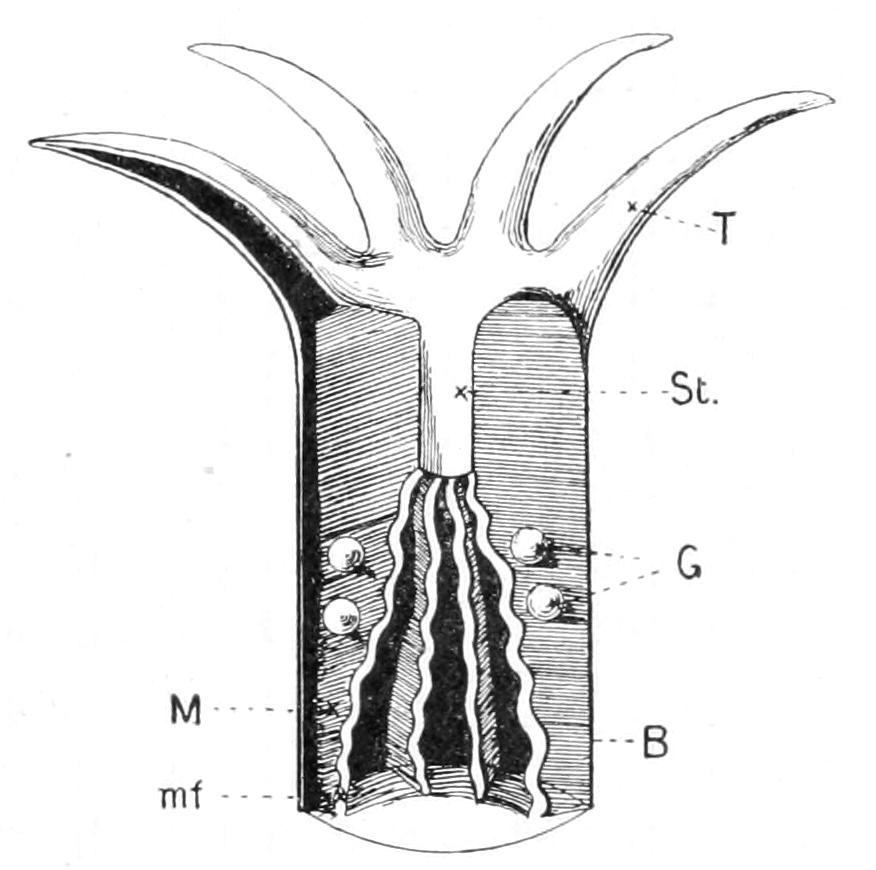
Fig. 146.—Diagram of a vertical section through an Anthozoan zooid. B, Body-wall; G, gonads; M, mesentery; mf, mesenteric filament; St, stomodaeum; T, tentacle.
Nearly all the Anthozoa are sedentary in habit. They begin life as ciliated free-swimming larvae, and then, in a few hours or days, they become attached to some rock or shell at the bottom and immediately (if colonial) start the process of budding, which gives rise to the colonies of the adult stage. Many of the Sea-anemones, however, move considerable distances by gliding over the rocks or seaweeds, others habitually burrow in the sand (Edwardsia, Cerianthus), and one family (the Minyadidae) are supported by a gas bladder, and float at the surface of the sea. The Sea-pens, too, although usually partly buried in the sand or mud, are capable of shifting their position by alternate distension and contraction of the stalk.[362] The Anthozoa are exclusively marine. With the exception of a few Sea-anemones that are found in brackish or almost fresh water in river estuaries, they only occur in salt sea water. The presence of a considerable admixture of fresh water, such as we find at the mouths of rivers, seems to interfere very materially with the development and growth of all the reef-forming Corals, as will be noticed again in the chapter on coral reefs. A few genera descend into the greatest depths of the ocean, but the home of the Anthozoa is pre-eminently the shallow seas, and they are usually found in great abundance in depths of 0-40 fathoms from the shores of the Arctic and Antarctic lands to the equatorial belt.
The only Anthozoa of any commercial importance are the Precious Corals belonging to the Alcyonarian family Coralliidae. The hard pink axis of these corals has been used extensively from remote times in the manufacture of jewellery and ornaments. Until quite recently the only considerable and systematic fishery for the Precious Corals was carried on in the Mediterranean Sea, and this practically supplied the markets of the world. In more recent times, however, an important industry in corals has been developed in Japan. In 1901 the value of the coral obtained on the coasts of Japan was over £50,000, the greater part of which was exported to Italy, a smaller part to China, and a fraction only retained for home consumption. The history of the coral fishery in Japan is of considerable interest. Coral was occasionally taken off the coast of Tsukinada in early times. But in the time of the Daimyos the collection and sale of coral was prohibited, for fear, it is said, that the Daimyo of Tosa might be compelled to present such precious treasure to the Shogun. After the Meiji reform, however (1868), the industry revived, new grounds were discovered, improved methods employed, and a large export trade developed.
There is evidence, however, in the art of Japan, of another coral fishery in ancient times, of which the history is lost. Coral was imported into Japan at least two hundred years ago, and used largely in the manufacture of those exquisite pieces of handicraft for which that country is so justly famous. On many of the carved "Netsukes" and other ornaments, however, the coral branches are represented as the booty of dark-skinned, curly-headed fishermen, "kurombo," and never of Japanese fishermen. The coral used in this art-work can hardly be distinguished from Mediterranean coral, and there are some grounds for believing that Japan imported coral from the far West in very early times. But this does not account for the "kurombo." The only coast-dwelling people of the type that is so clearly carved on these ornaments within the area of the Pacific Ocean at the present time are the Melanesians and Papuans, and the suggestion occurs that a coral fishery existed at one time in the Southern Pacific, which has since been lost.[363]
The class Anthozoa is divided into two sub-classes:—I. Alcyonaria; II. Zoantharia.
In the Alcyonaria the fully developed zooids have always eight tentacles and eight mesenteries. In the Zoantharia the number of tentacles and the number of mesenteries in the fully developed zooids may be six, twelve, twenty-four, or an indefinite number, but individuals with eight mesenteries and only eight tentacles are not known to occur.
Sub-Class I. Alcyonaria.
This sub-class includes a large number of genera living in shallow sea-water and a few genera that extend down into deep water. With a few doubtful exceptions (Protoalcyonacea) they all form colonies composed of a large number of zooids. These zooids may be connected together by basal plates or a network of basal strands (stolons), or by stolons with additional connecting bars (Clavularia viridis, Syringopora) or by plates (Tubipora). In the majority of the genera the individual zooids are for the greater part of their length, from the base upwards, united together to form a continuous spongy, colonial mass, which determines the shape of the colony as a whole.
In this last-named group of genera there may be distinguished the free distal portions of the zooids bearing the mouths and tentacles (the "anthocodiae") from the common colonial mass perforated by the coelenteric cavities of the individual zooids. The coelenteric cavities are separated by a considerable amount of a substance called the "mesogloea," usually gelatinous in consistency but chemically more closely related to mucin than to gelatin, which is traversed by endodermal canals, rods of endoderm cells and a number of free amoeboid cells. In this substance, moreover, there are found in nearly all cases numerous spicules of carbonate of lime formed by the "scleroblasts" (spicule-forming cells) which have wandered from the superficial ectoderm of the common colonial mass. This common colonial mesogloea with its spicules, endoderm cells, and superficial covering of ectoderm is called the "coenenchym." The form assumed by the colonies is very varied. In some species of Clavularia they form encrusting plates following the irregularity of the rock or stones on which they grow, in Alcyonium they construct lobed masses of irregular form, in Sarcophytum they are usually shaped like a mushroom, in Juncella they are long whip-like rods, in most of the Gorgonacea they are branched in all directions like shrubs or in one plane to form fan-shaped growths, and in many of the Pennatulacea they assume that graceful feather form which gives the order its name.
The consistency and texture of the colonies also varies considerably. In some cases where the spicules are few or very small, the substance of the colony is soft to the touch, and frequently slimy at the surface, in other cases the great number of the spicules makes the colony hard but brittle, whilst in a few genera (Sclerophytum, Heliopora) the colony is so hard that it can only be broken by the hand with difficulty. In some genera (Spongodes and the Muriceidae) projecting spicules cause the surface to be rough or thorny, and in the Primnoidae the zooids and the surface of the general coenenchym are protected by a series of overlapping scales or plates.
In all the Alcyonaria the nematocysts are very minute, and although they can undoubtedly paralyse minute organisms they are unable to penetrate the human skin. None of the Alcyonaria have been described as stinging-corals except the Pennatulid Virgularia rumphii.
Zooids.—The fully formed zooids of the Alcyonaria exhibit a remarkable uniformity of structure. They have eight intermesenteric tentacles containing a cavity continuous with the coelenteron. Each of these tentacles bears at least two rows of simple pinnules, and they are therefore said to be "pinnate" tentacles. In some species of Xenia the tentacles may have three or four rows of pinnules, which give them a much more feathery appearance than is usually the case. In the great majority of species a single row of from eight to fourteen pinnules is found disposed laterally on each side of the tentacle. The mouth is usually small and slit-like with a slight rounded gape at the ventral extremity. The stomodaeum is usually very short, but in Xenia and in the autozooids of some Pennatulids it is relatively much longer. It is not known how far the stomodaeum is of importance in the digestion of the food. In Xenia[364] it has probably some importance, as shown by its unusual length and the numerous large goblet cells (mucus cells) which it exhibits, associated with the fact that the mesenteric filaments are relatively very small. In Alcyonium and other Alcyonaria gland cells also occur in the stomodaeum, and it is probable that they secrete a fluid capable of digesting to some extent the food as it passes through. The most important part of the digestion, however, is performed by the six "ventral" mesenteric filaments.
Attention has already been drawn to the fact (p. 330) that two regions of the zooids of the colonial Alcyonaria can be recognised. At the oral end there is a region, which in the fully expanded condition consists of a crown of eight tentacles surrounding the mouth, and a body-wall free from its immediate neighbours. This region is called the "anthocodia." The anthocodia is continuous with a region which forms a part of the common colonial mass. Some genera seem to have very little power of contracting the tentacles or of withdrawing the anthocodiae. The zooids of Stereosoma, of Xenia, of Umbellula, and of a few other genera may be described as non-retractile. In many cases, however, the tentacles can be considerably contracted, bent over the mouth, and withdrawn into the shelter of the subjacent body-wall. In such a condition the surface of the colony exhibits a number of tubular, conical, or convex protuberances, called "verrucae," and the colony is said to be partially retractile. In many genera, however, the whole of the anthocodiae can be withdrawn below the general surface of the coenenchym, so that the position of the zooids in the colony is indicated only by star-like holes, or simple key-hole slits in the superficial coenenchym. Such colonies are said to be completely retractile (Fig. 147).
It is often very difficult to determine whether a particular species is or is not completely retractile, unless observations can be made upon the living colony; and there are many instances of confusion in the work of systematists due to a species being described as partially retractile in one instance, and completely retractile in another. The complete retraction of the anthocodiae may be effected very slowly, and after continuous irritation only. If the colony is killed too quickly, the anthocodiae remain in a state of partial retraction. An example of this may be found in the common British Alcyonium digitatum. Specimens of this species which are put into a bucket of sea water and allowed to roll about with the movements of a small boat in a rough sea, undergo complete retraction; but if the same specimens be allowed to expand in the aquarium, and then plunged into spirit, or allowed to dry in the sun, they will die in a condition of partial retraction.
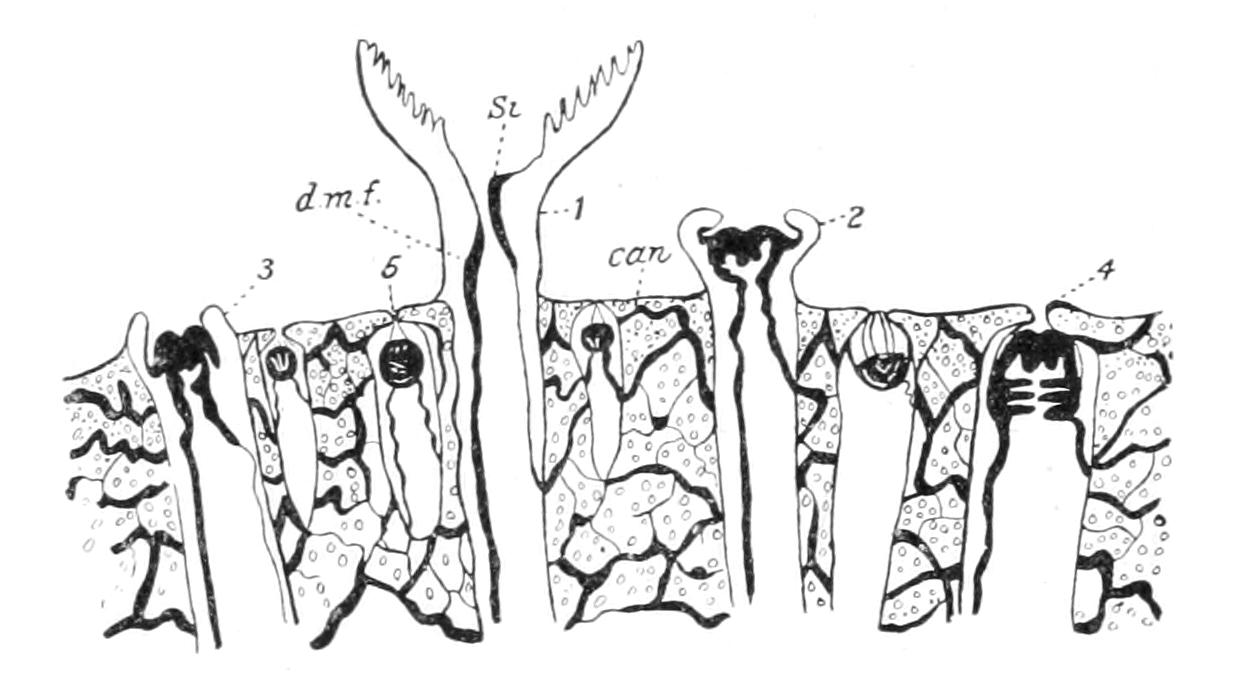
Fig. 147.—Diagram of a vertical section of a portion of a lobe of Alcyonium to show the mode of retraction of the anthocodiae. 1, Anthocodia of a zooid fully expanded; 2, in the first stage of retraction; 3, in the second stage; 4, in the third stage, leaving a shallow prominence or "verruca" on the surface; 5, final stage, the verruca flattened down and the coenenchym closed. can, Canal system; d.m.f, dorsal mesenteric filament of a zooid; si, siphonoglyph.
The phenomenon of dimorphism occurs in some Alcyonaria. A certain number of the zooids of a colony are arrested in their development, and are known as the "siphonozooids." They may be distinguished from the fully formed zooids, which, in these cases, are called the "autozooids," by the absence of tentacles, by the absence of the six ventral and lateral mesenteric filaments, and by the incomplete development of the muscles on the mesenteries, and of the mesenteries themselves. They are, moreover, frequently distinguished by the greater development and extent of the ciliated groove or siphonoglyph on the ventral side of the stomodaeum.
It is often difficult to distinguish between true siphonozooids and young autozooids, and consequently dimorphism has been attributed to some genera in which it almost certainly does not occur. Simple dimorphism undoubtedly occurs in the genera Heteroxenia, Sarcophytum, Anthomastus, Lobophytum, Acrophytum, and Paragorgia. It has also been said to occur in Corallium (Moseley and Kishinouye), Melitodes (Ridley), and some species of Dasygorgiidae.
The Pennatulacea are trimorphic. The main shaft of these colonies is the much modified first formed or axial zooid, adapted for the support of all the other zooids. It usually exhibits no mouth, no tentacles, and only four of the original eight mesenteries. It has no mesenteric filaments and no stomodaeum, and bears no sexual cells. The other zooids of the colony are similar in structure to the autozooids and siphonozooids of the dimorphic Alcyonaria.
There are eight mesenteric filaments in all Alcyonarian zooids. They have the appearance of thickenings of the free edges of the mesenteries. Two of them, called the "dorsal" mesenteric filaments, are straight when the anthocodia is expanded, and extend from the edge of the stomodaeum for a long distance down into the coelenteron of the zooid; the other six, called the "ventral" mesenteric filaments (i.e. the ventral and ventro-lateral and dorso-lateral), are usually short and are almost invariably slightly convoluted. The dorsal filaments are built up of columnar cells provided with long cilia, and have usually no gland cells, the others may show a few cilia but are principally composed of non-ciliated gland cells. When the bolus of food has passed through the stomodaeum it is seized by these ventral filaments and rapidly disintegrated by the secretion of its cells. The function of the dorsal mesenteric filaments is mainly respiratory. During life their cilia produce a current which flows towards the stomodaeum. On the ventral side of the stomodaeum itself there is a groove called the "siphonoglyph" composed of a specialised epithelium bearing long powerful cilia. But the current produced by the siphonoglyph flows from the mouth downwards into the coelenteric cavity and is thus in the opposite direction to that produced by the dorsal mesenteric filaments. It is very probable that these two currents on the opposite sides of the zooids maintain the circulation of water in the deep-seated parts of the colony which is necessary for the respiration of the tissues.
On each of the eight mesenteries there is a longitudinal ridge due to the presence of a band of retractor muscles. The position of these muscles on the ventral surfaces of the mesenteries only is one of the characteristic features of the sub-class (Fig. 148, and p. 329). They vary considerably in thickness and extent according to the power of retractility possessed by the zooids, but they never vary in their position on the mesenteries.
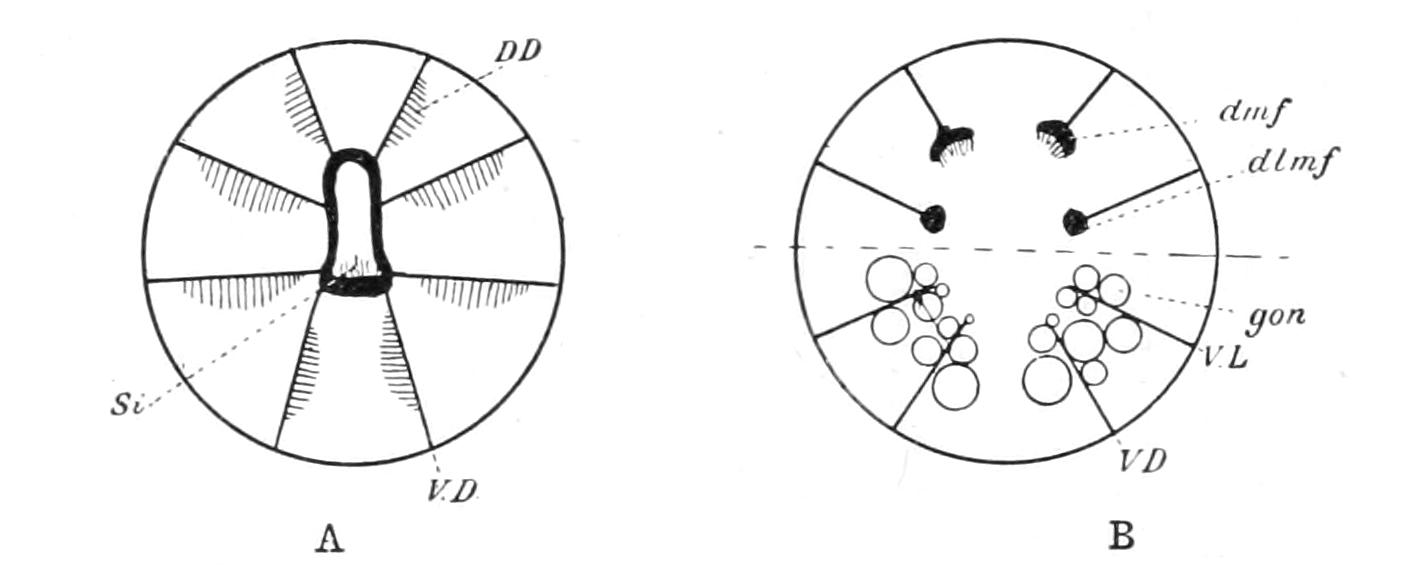
Fig. 148.—Diagrammatic transverse sections of an Alcyonarian. A, through the stomodaeum; B, below the level of the stomodaeum. DD, Dorsal directive; dlmf, dorso-lateral mesenteric filament; dmf, dorsal mesenteric filament; gon, gonad; Si, siphonoglyph; V.D, ventral mesentery; V.L, ventro-lateral mesentery. The upper half of the section in B is taken at a higher level than the lower half.
The skeleton of Alcyonaria may consist of spicules of calcium carbonate, of a horny substance frequently impregnated with calcium carbonate and associated with spicules of the same substance, or in Heliopora alone, among recent forms, of a continuous crystalline corallum of calcium carbonate.
The spicules constitute one of the most characteristic features of the Alcyonaria. They are not found in Cornularia, Stereosoma, in a recently discovered genus of Gorgoniidae (Malacogorgia), in certain Pennatulacea and in Heliopora; and it is probable that they may be absent in some local varieties of certain species of Clavularia.
The spicules of Alcyonaria consist of an organic matrix supporting a quantity of crystalline calcium carbonate. In some cases (Xenia) the amount of inorganic salt is so small that the spicule retains its shape after prolonged immersion in an acid; but generally speaking the relative amount of calcium carbonate is so great that it is only by the careful decalcification of the spicules in weak acetic acid that the delicate fibrous organic matrix can be demonstrated.
The spicules vary in size from minute granules to long spindles 9 mm. in length (Spongodes, sp.). They exhibit so many varieties of shape that an attempt must be made to place them in groups. The most prevalent type perhaps is that called the spindle. This is a rod-shaped spicule with more or less pointed extremities. They are usually ornamented with short simple or compound wart-like tubercles (Fig. 149, 5). Spicules belonging to this type are found in all the principal subdivisions of the group except the Pennatulacea.
In the Pennatulacea a very characteristic form of spicule is a long rod or needle marked with two or three slightly twisted ridges, frequently a little knobbed or swollen at the extremities. In the same group, in Xenia and Heteroxenia among the Alcyonacea, and in the family Chrysogorgiidae the spicules are in the form of minute discs or spheres, and in some genera the discs may be united in couples (twins) or in threes (triplets) by short connecting bars (Fig. 149, 10). More irregular calcareous corpuscles of minute size are found in some genera of Pennatulacea.
Other characteristic spicules are the warted clubs of Juncella, the torch-like spicules of Eunicella (Fig. 149, 3), the clubs with irregular leaf-like expansions at one extremity ("Blattkeulen") of Eunicea, and the flat but very irregular scales of the Primnoidae. There are also many genera exhibiting spicules of quite irregular form (Fig. 149, 8).
In the greater number of cases the spicules lie loosely in the mesogloea and readily separate when the soft tissues of the colony decay or are dissolved in a solution of potash. In a few noteworthy examples the spicules become in their growth tightly wedged together to form a compact skeleton, which cannot subsequently be disintegrated into its constituent elements. In the Precious corals (Coralliidae) the spicules of the axial region fuse together to form a solid mass of lime almost as hard and compact as the substance of a pearl.
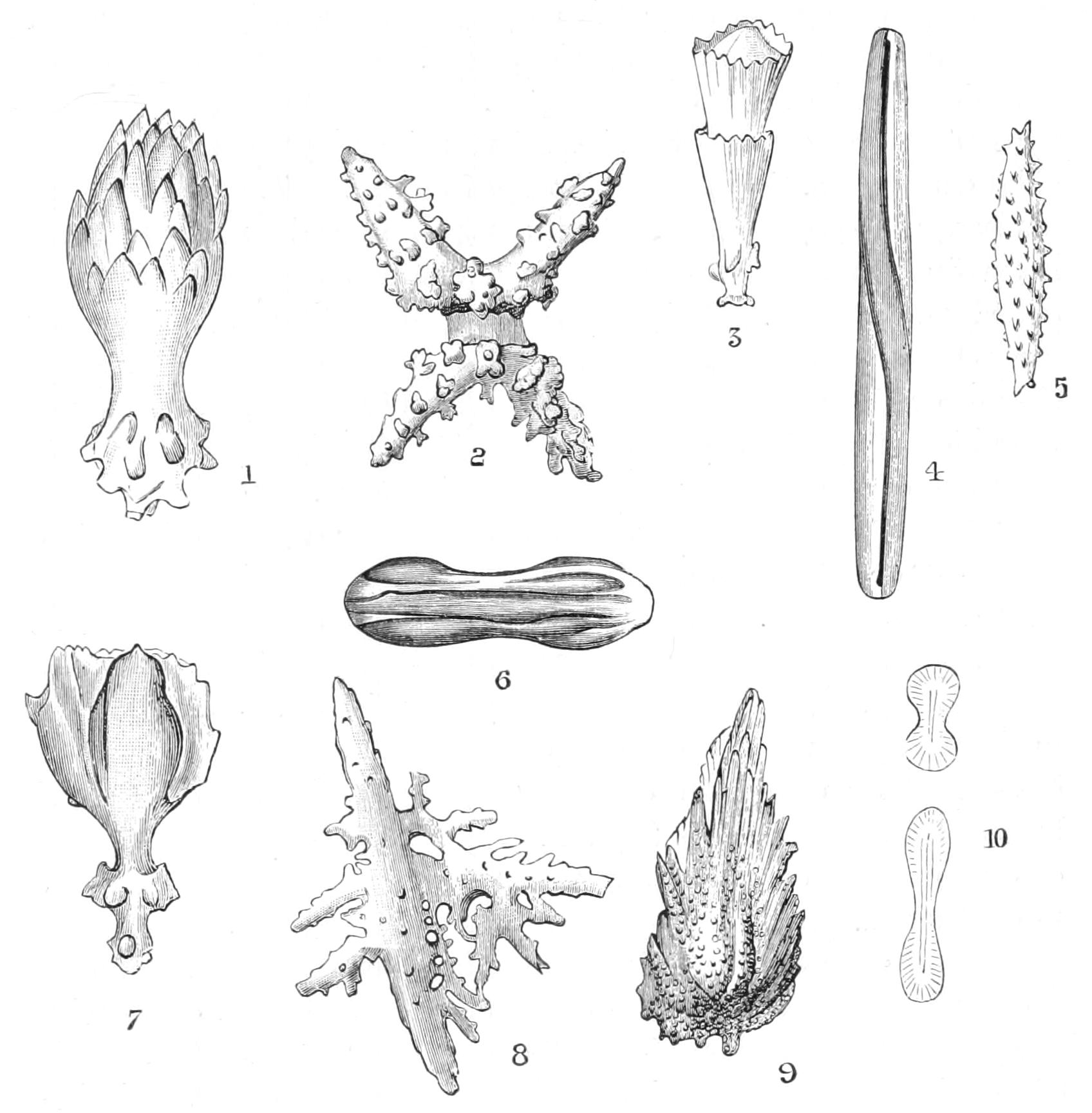
Fig. 149.—Spicules of Alcyonaria. 1, Club of Juncella; 2, warted cross of Plexaurella; 3, torch of Eunicella; 4, needle of Renilla; 5, warted spindle of Gorgonella; 6, spicule of Pennatula; 7, foliate club of Eunicea; 8, irregular spicule of Paramuricea; 9, scale of Primnoa; 10, spicules of Trichogorgia. (5 and 10 original, the remainder after Kölliker.)
In Paragorgia and some other closely related genera the spicules of the axis of the colony also become tightly wedged together, but the core thus formed is far more porous and brittle than it is in the Coralliidae. In Tubipora (the organ-pipe coral) and in Telesto rubra the spicules of the body-walls of the zooids fuse to form perforated calcareous tubes. In some species of Sclerophytum the large spicules of the coenenchym become so closely packed that they form dense stony masses, almost as hard as a Perforate Madreporarian coral. The horny substance, allied chemically to keratin, plays an important part in the building up of skeletal structures in many Alcyonaria. In Clavularia viridis and in Stereosoma a change in the chemical character of the mesogloea of the body-walls of the polyps leads to the formation of a horny tube, which in the former case is built up of interlacing fibres, and in the latter is formed as a homogeneous sheath. In many of the Alcyonacea which have a compact axial skeleton the spicules are cemented together by a horny matrix.
In the Gorgonellidae and some others the hard axis is formed of a horny substance impregnated with a crystalline form of calcium carbonate; but in the Gorgoniidae, many of the Pennatulacea and some other genera very little or no carbonate of lime is found in the horny axis.
The skeleton of the genus Heliopora differs from that of all the other Alcyonaria in its development, structure, and form. In the words of Dr. G. C. Bourne,[365] "the calcareous skeleton of Heliopora is not formed from spicules developed within cells but is a crystalline structure formed by crystallisation of carbonate of lime, probably in the form of aragonite, in an organic matrix produced by the disintegration of cells which I have described as calicoblasts." It is further characterised by its blue colour. A peculiar form of the axial skeleton (Fig. 155), consisting of alternate nodes mainly composed of keratin, and internodes mainly composed of calcium carbonate, is seen in the families Isidae and Melitodidae. In the Melitodidae the nodes contain a considerable number of loose spicules, and the internodes are mainly composed of spicules in close contact but firmly cemented together by a sparse horny matrix. In the Isidae the scanty calcareous substance of the nodes, and the bulk of the substance of the internodes, is formed of amorphous crystalline limestone.
The Alcyonaria exhibit a great variety of colour. Very little is known at present of the chemistry of the various pigments found in the group, but they may conveniently be arranged in two sections, the soluble pigments and the insoluble pigments. To the former section belong various green and brown pigments found in the anthocodiae and superficial coenenchym of many genera. These are related to chlorophyll, and may be very largely the product, not of the Alcyonarians themselves, but of the symbiotic "Algae" (cf. p. 261) they carry. A diffuse salmon-pink colour soluble in spirit occurs in the living Primnoa lepadifera of the Norwegian fjords, and a similar but paler pink colour occurs in some varieties of the common Alcyonium digitatum. Gilchrist[366] states that when he was preserving specimens of Alcyonium purpureum from Cape waters a considerable quantity of a soluble purple pigment escaped.
But the predominant colour of Alcyonarians is usually due to the insoluble pigments of the calcareous spicules. These may be of varying shades of purple, red, orange, and yellow. The colours may be constant for a species or genus, or they may vary in different specimens of one species, or even in different parts of a single colony. Thus the skeletons of Tubipora musica from all parts of the world have a red colour, the species of the genus Anthomastus have always red spicules. On the other hand, we find in Melitodes dichotoma red and yellow varieties in the same locality, and in M. chamaeleon some of the branches of a colony are red and others yellow. In Chironephthya variabilis the colour of the spicules in any one specimen varies considerably, but in a collection of several specimens from a single locality a kaleidoscopic play of colours may be seen, no two specimens being exactly the same in the arrangement of their colour pattern. The influences that determine the colour of the spicules is at present quite unknown, and in view of the great variability that occurs in this respect, colour must be regarded as a most uncertain guide for the determination of species. The blue colour of the genus Heliopora is due to a peculiar pigment which shows characteristic bands in the spectrum.[367]
Phosphorescence.—A great many Alcyonaria are known to be phosphorescent. Moseley says that "All the Alcyonarians dredged by the 'Challenger' in deep water were found to be brilliantly phosphorescent when brought to the surface." The phosphorescence of the common British Pennatula phosphorea has attracted more attention than that of any other species, and has been well described by Panceri, Forbes, and others. Forbes[368] says, "The pen is phosphorescent only when irritated by touch; the phosphorescence appears at the place touched, and proceeds thence in an undulating wave to the extremity of the rachis, but never in the opposite direction; it is only the parts at and above the point of stimulation that show phosphorescence, the light is emitted for a longer time from the point of stimulation than from the other luminous parts; detached portions may show phosphorescence. When plunged in fresh water, the Pennatula scatters sparks about in all directions—a most beautiful sight."
Panceri was of opinion that the mesenteric filaments were the organs of phosphorescence, but the whole question of the cause and localisation of the light in these colonies requires further investigation.
Food.—Very little is known about the food of Alcyonaria, but it is very probable that it consists entirely of minute larvae and other living organisms. When the coelenteric cavities of preserved Alcyonaria are examined, food is very rarely found in them, although fragments of Crustacean appendages have occasionally been seen in the neighbourhood of the mesenteric filaments. Experimenting upon Alcyonium digitatum, Miss Pratt[369] has found that the zooids seize and swallow various small organisms of a surface-net gathering, and that they will also swallow finely minced fragments of the muscle of fish, but that they reject many kinds of fish ova. In many tropical and some extra-tropical species the superficial canal systems and the inter-mesenterial spaces of the zooids contain a large number of Zooxanthellae, and their presence seems to be associated in some cases with a decided degeneration of the digestive organs. It has been suggested that these symbiotic "Algae" prepare food materials after the manner of plants, and that these are absorbed by the hosts, but it appears improbable that in any case this source of food supply is sufficient. It must probably be supplemented in some degree by food obtained by the mouth, and digested in the coelenteric cavity.
The question whether the Alcyonaria can form an important part of the dietary of fish or other carnivorous animals may be economically important. Fragments of the Pennatulid Virgularia have been found in the stomachs of cod and other fish, but with this exception there is no evidence that any genus is systematically or even occasionally preyed upon by any animal. With a very few exceptions Alcyonaria show no signs of having been torn, bitten, or wounded by carnivorous animals. It is improbable that the presence of nematocysts in the tentacles can account for this immunity, as it is known that some predaceous animals do feed upon Coelenterates provided with much larger nematocysts than any Alcyonarian possesses. All Alcyonaria, however, have a characteristic disagreeable odour, and it is possible, as in many other cases, that this is accompanied by an unpleasant taste. But if the Alcyonaria themselves are immune, it is possible that their large yolk-laden eggs may form a not unimportant source of food supply. In places where large colonies flourish, an immense number of eggs or embryos must be discharged into the water during the spawning season, and of these only a minute fraction can survive long enough to found a new colony.
Reproduction.—The formation of colonies by gemmation has frequently been mentioned above. The young buds of a colony arise from the endoderm canals in the body-wall of the zooids, in the general coenenchym, or in the stolon. They never arise from evagination of the coelenteric cavities of the zooids. There is no evidence that fission of a colony to form secondary colonies ever occurs. Gemmation leads to the increase in the number of zooids forming a colony, but not to an increase in the number of colonies.
Fission of the zooids is of extremely rare occurrence; a single case, however, has been recorded by Studer in the genus Gersemia. Sexual reproduction usually occurs once in a year; it is doubtful whether it ever occurs continuously. The colonies appear to be nearly always dioecious, only one case of hermaphroditism having yet been recorded.[370] The ova and sperm sacs are usually formed and matured on the six ventral mesenteries, rarely on the dorsal pair of mesenteries (Fig. 148, B) as well. The spawning season varies with the locality. Alcyonium digitatum spawns at Plymouth at the end of December, and somewhat later at Port Erin. The Pennatulid Renilla and the Gorgonid Leptogorgia spawn in the summer months on the coast of North America. In the Mediterranean Alcyonium palmatum spawns in September and October (Lo Bianco), Gorgonia cavolinii in May and June.
It is not known for certain when the fertilisation of the ova is effected, but in Alcyonium digitatum, and in the majority of the Alcyonarians, it probably takes place after the discharge of the ova from the zooids. A few forms are, however, certainly viviparous, the larvae of Gorgonia capensis being retained within the coelenteric cavity of the parent zooid until they have grown to a considerable size. The other viviparous Alcyonarians are Corallium nobile (de Lacaze Duthiers), the "Clavulaires petricoles," and Sympodium coralloides (Marion and Kowalevsky), and three species of Nephthya found at depths of 269 to 761 fathoms (Koren and Danielssen). The general features of the development are very similar in all Alcyonarians that have been investigated. The egg contains a considerable amount of yolk, and undergoes a modified form of segmentation. The free-swimming larva is called a "sterrula." It consists of an outer layer of clear ciliated ectoderm cells, surrounding a solid endodermic plasmodium containing the yolk. As the yolk is consumed a cavity appears in the endoderm, and the larva is then called a "planula" (Fig. 150). The mouth is subsequently formed by an invagination of the ectoderm at the anterior pole. The development of the mesenteries has not yet been fully described.
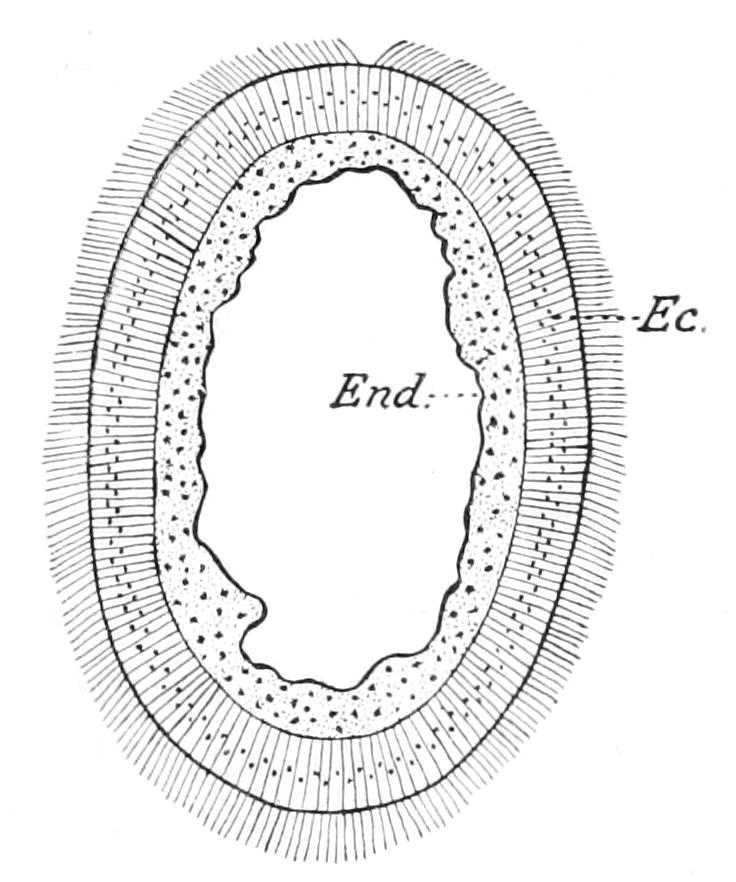
Fig. 150.—Ciliated "planula" larva of Alcyonium digitatum. Ec, Ectoderm; End, endoderm.
Classification.—The sub-class Alcyonaria may conveniently be classified as follows:—
Grade A. Protalcyonacea. Grade B. Synalcyonacea. Order 1. Stolonifera. Order 2. Coenothecalia. Order 3. Alcyonacea. Order 4. Gorgonacea. Order 5. Pennatulacea.
Grade A. Protoalcyonacea.
This Grade includes those genera which, like many sea-anemones, do not reproduce by continuous gemmation to form colonies.
Several genera have been described, and they have been placed together in one family called the Haimeidae.
Haimea funebris, M. Edwards, was found off the coast of Algeria; H. hyalina, Koren and Danielssen, in Norway; Hartea elegans, Wright, from the Irish coast; Monoxenia darwinii, Haeckel, from the Red Sea, and a large new species found by the "Siboga" Expedition in deep water off Ceram. All these species, however, are very rare, and there is no satisfactory evidence at present that they remain solitary throughout life.
Grade B. Synalcyonacea.
The sub-division of the Synalcyonacea into orders presents many difficulties, and several different classifications have been proposed. Only two orders of the five that are here recognised are clearly defined, namely, the Coenothecalia, containing the single living genus Heliopora, and the Pennatulacea or Sea-pens; the others are connected by so many genera of intermediate characters that the determination of their limits is a matter of no little difficulty.
Order I. Stolonifera.
These are colonial Alcyonaria springing from a membranous or ribbon-like stolon fixed to a stone or some other foreign object. The body-walls of the individual zooids may be free or connected by a series of horizontal bars or platforms (autothecalous); never continuously fused as they are in other orders (coenothecalous).
In the simplest form of this order, Sarcodictyon catenatum Forbes, the ribbon-like strands of the stolon meander over the surface of stones, forming a red or yellow network, from the upper surface of which the clear transparent anthocodiae of the zooids protrude. When retracted the anthocodiae are drawn down below the surface of the general coenenchym, and their position is indicated by small cushion-like pads on the stolon. Sarcodictyon is found in depths of 10 to 22 fathoms in the Irish Sea, off the west coast of Scotland, the Shetlands, and off the Eddystone Lighthouse, South Devon.
Another very important genus is Tubipora, in which the tubular body-wall of each zooid is very much longer in proportion to its diameter than it is in Sarcodictyon, and the anthocodia is retracted not into the stolon, but into the basal part of the body-wall. The zooids are connected together by horizontal platforms on which new zooids are formed by gemmation. Both horizontal platforms and the body-walls of the zooids are provided with a skeleton of fused spicules of a red colour.
This genus is the well-known Organ-pipe coral, and is found sometimes in immense quantities on the coral reefs of both the old and new world.
It may be seen in pools on the edge of the reefs at low tides in colonies frequently a foot or more in diameter. The tentacles are often of a bright emerald green colour, and as the anthocodiae stand expanded in the clear water they contribute a brilliant patch of colour to the many beauties of their surroundings. When the coral is disturbed, or the water shallows and the anthocodiae are retracted, the dull red colour of the skeleton gradually takes the place of the bright green of the tentacles.
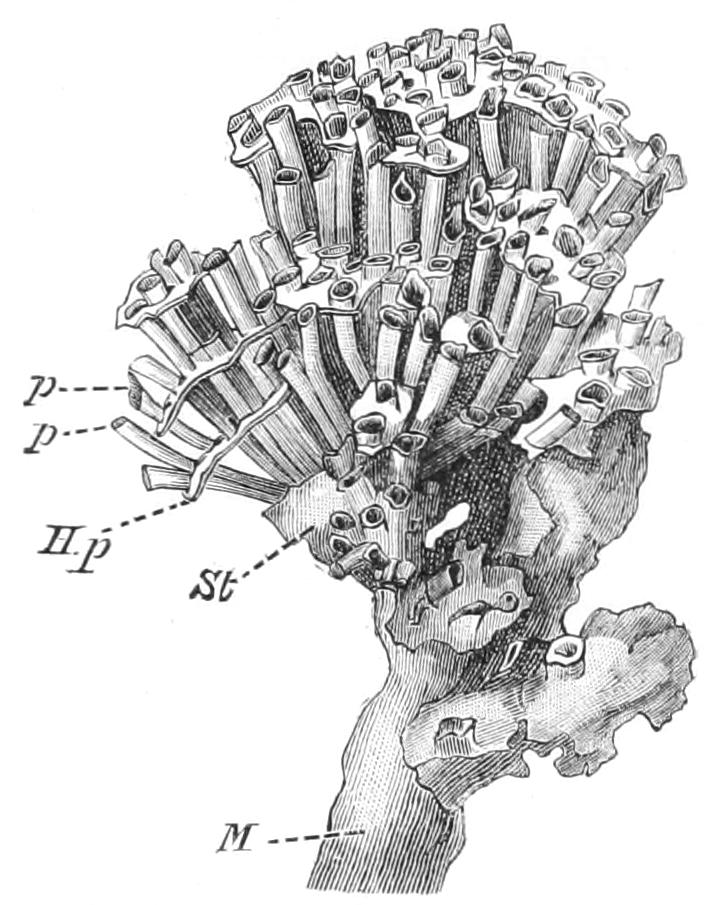
Fig. 151.—Tubipora musica, a young colony growing on a dead Madrepore branch (M). Hp, The connecting horizontal platforms; p, p, the skeletal tubes of the zooids; St, the basal stolon.
It is probable that this order of Alcyonaria was better represented on the reefs of some of the earlier periods of the world's history than it is at present. The fossil Syringopora, which is found abundantly in the carboniferous limestone and other strata, was probably an Alcyonarian belonging to this order. It resembles Tubipora in its mode of growth, but in place of the horizontal platforms connecting the zooids there are rods or bars from which new zooids spring (Fig. 152). Similar connecting bars are found in the recent Clavularia (Hicksonia, Delage) viridis of the East Indian reefs (Fig. 153). Other fossil forms belonging to the order are Favosites, a very abundant coral of the Upper Silurian rocks, and possibly Columnaria.
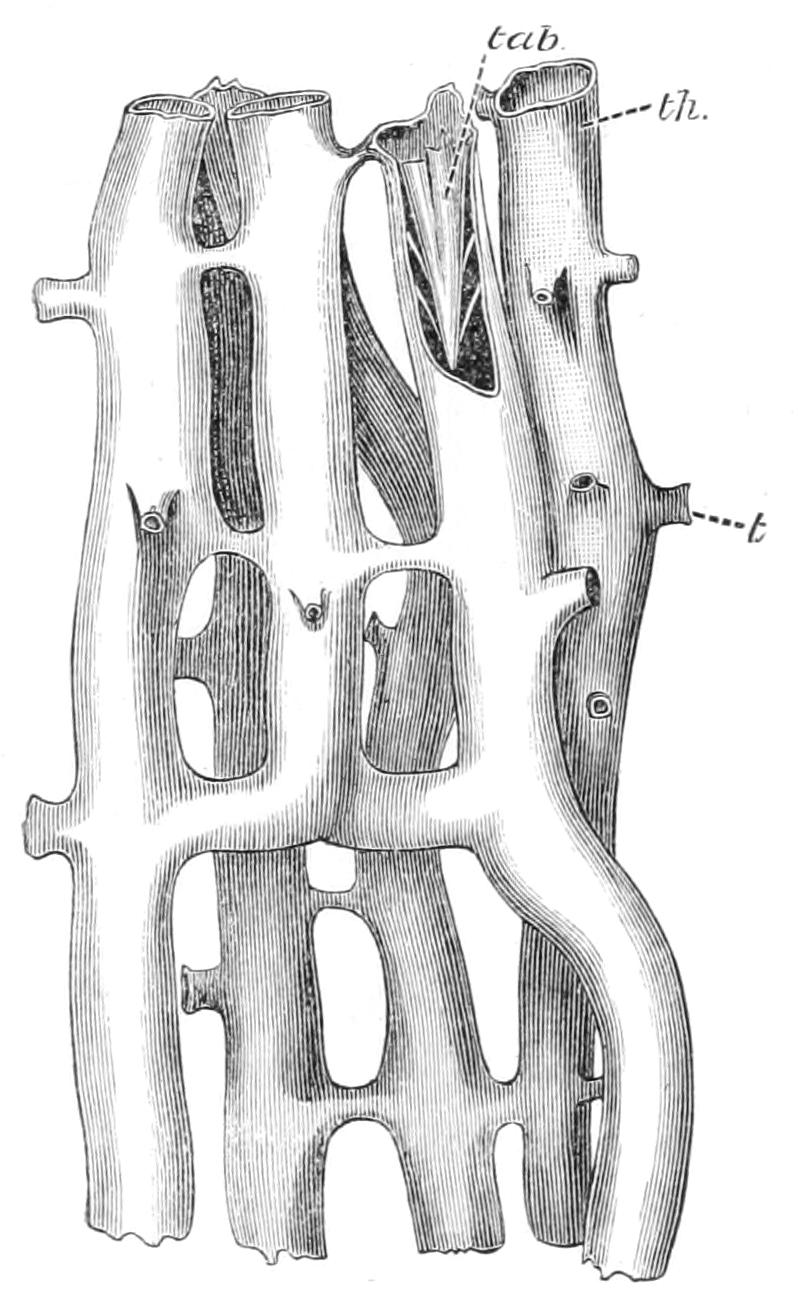
Fig. 152.—Syringopora, a fossil, showing autothecalous tubes (th), funnel-shaped tabulae (tab), and tubular cross-bars (t).
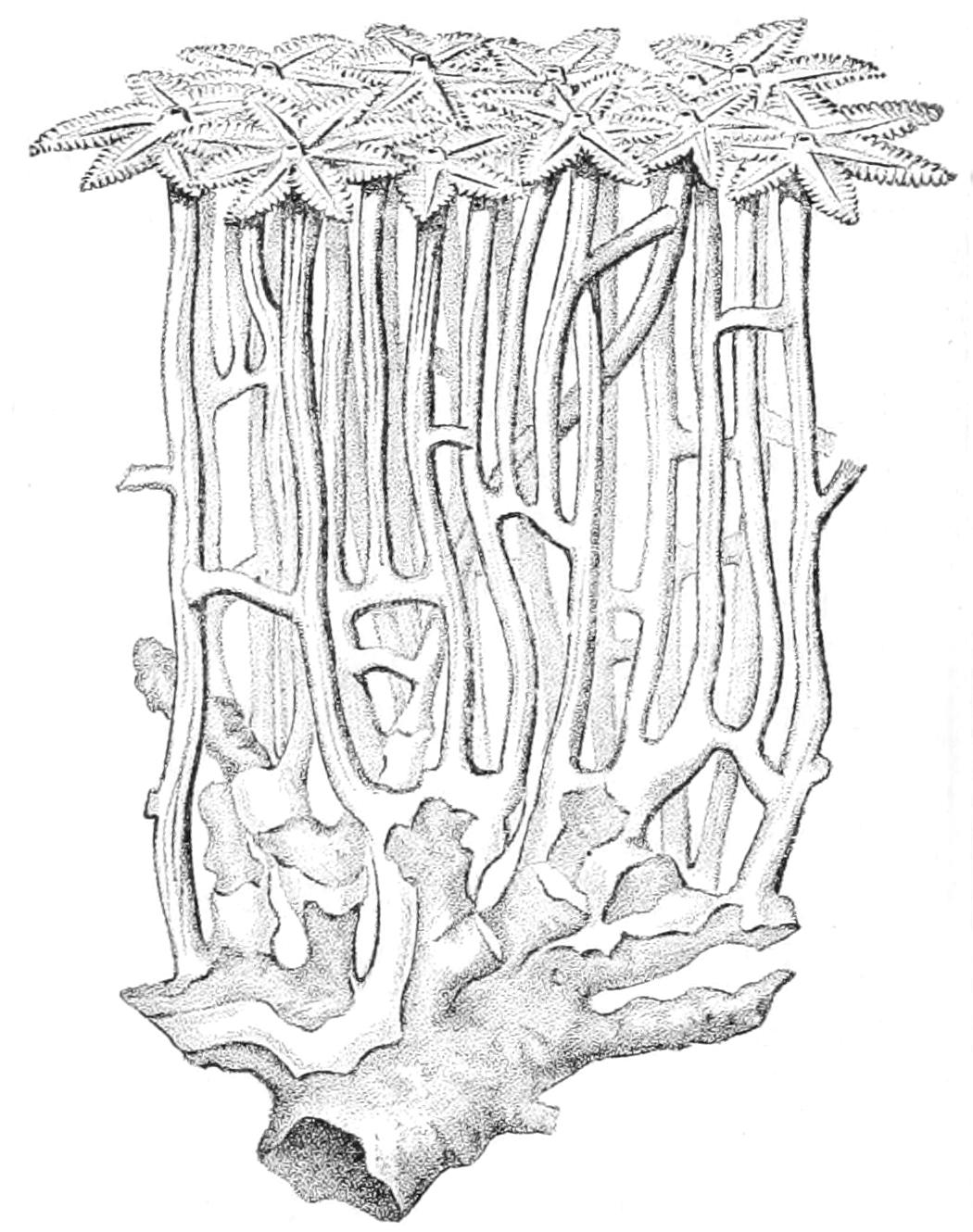
Fig. 153.—Clavularia (Hicksonia) viridis, with creeping stolon and transverse connecting tubes.
The principal families of the Stolonifera are:—
Fam. 1. Cornulariidae.—Without spicules; Cornularia, Lamarck, Mediterranean; Stereosoma, Hickson, Celebes.
Fam. 2. Clavulariidae.—Clavularia, Quoy and Gaimard; Sarcodictyon, Forbes, British; Sympodium, Ehrb.; Syringopora, Goldfuss, fossil.
Fam. 3. Tubiporidae.—Tubipora, Linnaeus, tropical shallow water.
Fam. 4. Favositidae.—Favosites, Lamarck; Syringolites, Hinde; Stenopora, King.
Order II. Coenothecalia.
This order contains the single genus and species Heliopora coerulea among recent corals, but was probably represented by a large number of genera and species in earlier periods.
It is found at the present day in many localities in the warm shallow waters of the tropical Pacific and Indian Oceans. It usually flourishes on the inside of the reef, and may form masses of stone five or six feet in diameter. The coral may easily be recognised, as it is the only one that exhibits a blue colour. This colour usually penetrates the whole skeleton, but in some forms is absent from the superficial layers.
The skeleton consists of a number of parallel tubes with imperforate walls, which are fused together in honey-comb fashion. On making a vertical section through a branch of the coral it is found that the tubes are divided into a series of chambers by transverse partitions or "tabulae." The soft living tissues of the coral, the zooids and coenosarc, are confined to the terminal chambers, all the lower parts being simply dead calcareous skeleton supporting the living superficial layer. Among the parallel tubes there may be found a number of larger chambers that seem to have been formed by the destruction of the adjacent walls of groups of about nineteen tubes. These chambers are provided with a variable number of pseudo-septa, and have a remarkable resemblance to the thecae of some Zoantharian corals. That Heliopora is not a Zoantharian coral was first definitely proved by Moseley, who showed that each of these larger chambers contains an Alcyonarian zooid with eight pinnate tentacles and eight mesenteries. The zooids arise from a sheet of coenosarc that covers the whole of the living branches of the coral mass, and this sheet of coenosarc bears a plexus of canals communicating on the one hand with the zooids, and on the other with a series of blind sacs, each of which occupies the cavity of one of the skeletal tubes as far down as the first tabula. The zooids of Heliopora are very rarely expanded during the day-time, and it has been found very difficult to get them to expand in an aquarium. The coral, however, is frequently infested with a tubicolous worm allied to the genus Leucodora, which freely expands and projects from the surface. So constant and so numerous are these worms in some localities that it has actually been suggested that Heliopora should be regarded as a Polychaete worm and not as an Alcyonarian. According to Mr. Stanley Gardiner, however, these worms do not occur in association with the Heliopora found on the reefs of the Maldive Archipelago.
There is very strong reason to believe that certain fossil corals were closely related to Heliopora; that Heliopora is in fact the solitary survivor of a group of Alcyonarian corals that in past times was well represented on the reefs, both in numbers and in species. The evidence is not so convincing that other fossil corals are closely related to Heliopora, and their true zoological position may remain a matter for surmise. The order may be classified as follows:—
Fam. 1. Heliolitidae.[371]—Coenothecalia with regular, well-developed septa, generally twelve in number, in each calicle.
Heliolites, Dana, Silurian and Devonian. Cosmiolithus, Lindström, Upper Silurian. Proheliolites, Klaer, Lower Silurian. Plasmopora, Edwards and Haime, Upper Silurian. Propora, E. and H., Upper Silurian. Camptolithus, Lindström, Upper Silurian. Diploëpora, Quenst, Upper Silurian. Pycnolithus, Lindström, Upper Silurian.
Fam. 2. Helioporidae.[372]—Coenothecalia with small irregularly arranged coenosarcal caeca, and a variable number of septa or septal ridges. Heliopora, de Blainville, recent, Eocene and Upper Cretaceous. Polytremacis, d'Orbigny, Eocene and Upper Cretaceous. Octotremacis, Gregory, Miocene.
The family Coccoseridae is regarded by Lindström as a sub-family of the Heliolitidae, and the families Thecidae and Chaetetidae are probably closely related to the Helioporidae.
Order III. Alcyonacea.
This order contains a large number of genera of great variety of form. The only characters which unite the different genera are that the body-walls of some groups of zooids, or of all the zooids, are fused together to form a common coenenchym penetrated by the coenosarcal canals, and that the spicules do not fuse to form a solid calcareous, or horny and calcareous, axial skeletal support.
The affinities with the order Stolonifera are clearly seen in the genera Xenia and Telesto. Some species of Xenia form flattened or domed colonies attached to stones or corals, with non-retractile anthocodiae and body-walls united for only a short distance at the base. Young Xenia colonies are in fact Stolonifera in all essential characters. In Telesto prolifera we find a network of stolons encrusting coral branches and other objects after the manner of the stolons of many species of Clavularia, although the zooids do not arise from these stolons singly, but in groups, with their body-walls fused together for a certain distance. In Telesto rubra the spicules of the body-walls are fused together to form a series of perforated tubes very similar in some respects to the tubes of Tubipora.
A remarkable genus is Coelogorgia. Here we find a branching colony arising from a basal stolon, and the axis of the main stem and of each branch consists of a single very much elongated zooid bearing on its thickened walls the branches of the next series and other zooids. It is true that in this genus there is very little fusion of neighbouring zooids, and the amount of true coenenchym is so small that it can hardly be said to exist at all. Bourne[373] has united this genus with Telesto into a family Asiphonacea, which he joins with the Pennatulida in the order Stelechotokea; but their affinities seem to be closer with the Alcyonacea than with the Pennatulacea, from which they differ in many important characters.
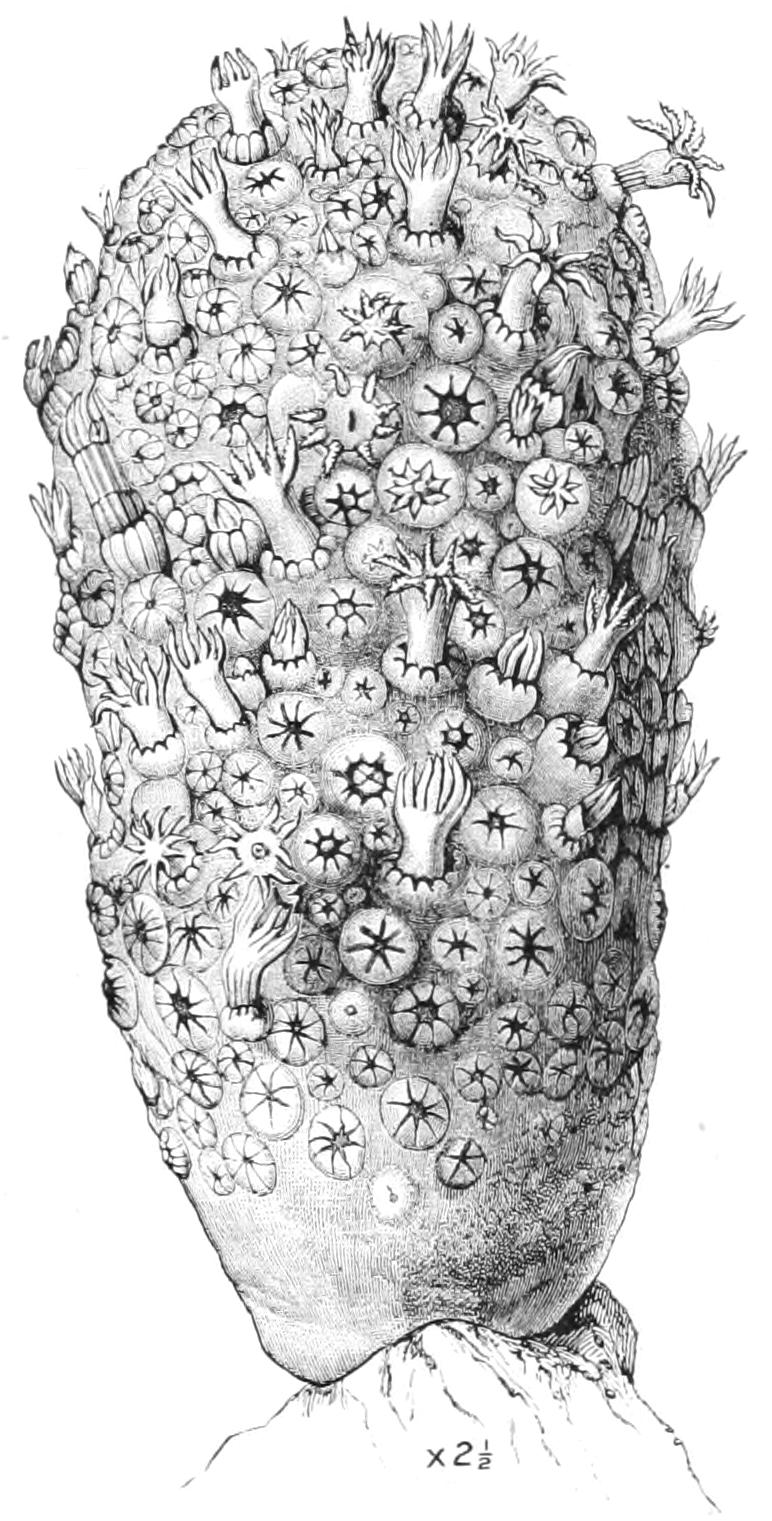
Fig. 154.—Alcyonium digitatum, a single-lobed specimen, with some of the zooids expanded.
The genus Alcyonium not only contains the commonest British Alcyonarian (A. digitatum), but it is one of the most widely distributed genera of all Alcyonaria that occur in shallow water.
The genera Sarcophytum and Lobophytum occur in shallow water in the tropics of the old world. The former frequently consists of huge toad-stool shaped masses, soft and spongy in consistency, of a green, brown, or yellow colour. On some reefs the colonies of Sarcophytum form a very conspicuous feature, and from their very slimy, slippery surface, add to the minor dangers of wading in these regions. Both genera are dimorphic. Some species of the genus Sclerophytum,[374] which occur in the Indian Ocean, are so hard and brittle that they might readily be mistaken for a Zoantharian coral. This character is due to the enormous number of tightly packed spicules borne by the coenenchym. Some of these spicules in S. querciforme are 7 mm. × 1.7 mm.; the largest, though not the longest (vide p. 335) of any spicules occurring in the order.
Another very important genus occurring on coral reefs, and of very wide distribution, is Spongodes. This genus forms bushy and rather brittle colonies of an endless variety of beautiful shapes and colours. Arising from the neck of each anthocodia there are one or two long, sharp, projecting spicules, which give the surface a very spiny or prickly character.
The genera Siphonogorgia and Chironephthya form large brittle, branching colonies which might readily be mistaken for Gorgonians. The strength of the branches, however, is mainly due to the large, densely packed, spindle-shaped spicules at the surface of the coenenchym, the long coelenteric cavities of the zooids penetrating the axis of both stem and branches. Siphonogorgia is usually uniformly red or yellow in colour. Chironephthya, on the other hand, exhibits a great variety of colour in specimens from the same reef, and indeed in different branches of the same colony.
Fam. 1. Xeniidae.—Alcyonacea with non-retractile zooids. Spicules very small discs, usually containing a relatively small proportion of lime.
Xenia, Savigny; Indian Ocean and Torres Straits. Heteroxenia, Kölliker; Red Sea, Cape of Good Hope, and Torres Straits.
Fam. 2. Telestidae.—Colonies arising from an encrusting membranous or branching stolon. The erect stem and branches are formed by the body-walls of two or three zooids only, from which secondary zooids and branches of the next order arise.
Telesto, Lamouroux, widely distributed in warm waters of the Atlantic, Pacific, and Indian Oceans. The genus Fascicularia, Viguier, from the coast of Algiers, seems to be related to Telesto, but the groups of zooids are short, and do not give rise to branches.
Fam. 3. Coelogorgiidae.—The colony arborescent, attached by stolon-like processes. The stem formed by an axial zooid with thickened body-walls. Branches formed by axial zooids of the second order, and branchlets by axial zooids of the third order, borne either on two sides or in spirals by the main stem. Genus Coelogorgia, Zanzibar.
Fam. 4. Alcyoniidae.—The colonies of this family are usually soft and fleshy, and the spicules, evenly distributed throughout the coenenchym, do not usually fuse or interlock to form a continuous solid skeleton. They may be unbranched or lobed, never dendritic in form. The principal genera are:—Alcyonium, Linnaeus, cosmopolitan, but principally distributed in temperate and cold waters. Alcyonium digitatum is the commonest British Alcyonarian. It is found in shallow water, from the pools left at low spring tides to depths of 40 or 50 fathoms, at most places on the British shores. It is stated by Koehler to descend into depths of over 300 fathoms in the Bay of Biscay. There are two principal varieties; one is white or pale pink in the living condition, and the other yellow. In some localities the two varieties may be found in the same pools. Another species, Alcyonium glomeratum, placed in a distinct genus (Rhodophyton) by Gray, and distinguished from the common species by its red colour and long digitate lobes, is found only off the coast of Cornwall. Paralcyonium, Milne Edwards; Mediterranean. Sclerophytum, Pratt; sometimes dimorphic, Indian Ocean. Sarcophytum, Lesson; dimorphic, principally tropical. Lolophytum, Marenzeller; dimorphic, tropical. Anthomastus, Verrill; dimorphic, Atlantic Ocean, deep water. Acrophytum, Hickson; dimorphic, Cape of Good Hope.
Fam. 5. Nephthyidae.—Colonies dendritic. Usually soft and flexible in consistency. Nephthya, Savigny; Indian and Pacific Oceans. Spongodes, Lesson; widely distributed in the Indian and Pacific Oceans.
Fam. 6. Siphonogorgiidae.—Colonies often of considerable size. Dendritic. Spicules usually large and abundant, giving a stiff, brittle consistency to the stem and branches. Siphonogorgia, Kölliker; Red Sea, Indian, and Pacific tropics. Chironephthya, Wright and Studer; Indian and Pacific Oceans. Lemnalia, Gray; Zanzibar. Agaricoides, Simpson;[375] Indian Ocean, 400 fathoms.
Order IV. Gorgonacea.
This order contains a very large number of dendritic and usually flexible corals occurring in nearly all seas and extending from shallow waters to the very great depths of the ocean. A large proportion of them are brightly coloured, and as the principal pigments are fixed in the spicules, and are therefore preserved when the corals are dead and dried, they afford some of the most attractive and graceful objects of a natural history museum.
The only character that separates them from the Alcyonacea is that they possess a skeletal axis that is not perforated by the coelenteric cavities of the zooids. The coelenteric cavities are usually short. The order may conveniently be divided into two sub-orders.
Sub-Order 1. Pseudaxonia.
The axis in this sub-order consists of numerous spicules tightly packed together, or cemented together by a substance which is probably allied to horn in its chemical composition. This substance may be considerable in amount, in which case it remains after decalcification as a spongy, porous residue; or it may be so small in amount, as in Corallium, that the axis appears to be composed of solid carbonate of lime. The statement is usually made that the axis is penetrated by nutritive canals in certain genera, but the evidence upon which this is based is unsatisfactory and in some cases unfounded. There can be no doubt, however, that in some genera the axis is porous and in others it is not, and this forms a useful character for the separation of genera.
Fam. 1. Briareidae.—The medullary substance consists of closely packed but separate spicules embedded in a soft horny matrix, which is uniform in character throughout its course. Nearly all the genera form dendritic colonies of considerable size.
The principal genera are:—Solenocaulon, Gray; Indian Ocean and North Australia. Many of the specimens of this genus have fistulose stems and branches. The tubular character of the stem and branches is probably caused by the activity of a Crustacean, Alpheus, and may be regarded as of the nature of a gall-formation.[376] Paragorgia, M. Edwards; Norwegian fjords, in deep water. This genus forms very large tree-like colonies of a ruby-red or white colour. It is perhaps the largest of the dendritic Alcyonarians. It is dimorphic. Spongioderma, Kölliker; Cape of Good Hope. The surface of this form is always covered by an encrusting sponge. Iciligorgia, Ridley; Torres Straits. The stem and branches are compressed and irregular in section.
Fam. 2. Sclerogorgiidae.—The medullary mass forms a distinct axis consisting of closely packed elongate spicules with dense horny sheaths.
Suberogorgia, Gray, has a wide distribution in the Pacific Ocean, Indian Ocean, and the West Indies. Keroeides, W. and S., comes from Japan.
Fam. 3. Melitodidae.—The axis in this family exhibits a series of nodes and internodes (Fig. 155), the former consisting of pads formed of a horny substance with embedded spicules, the latter of a calcareous substance with only traces of a horny matrix. The internodes are quite rigid, the nodes however give a certain degree of flexibility to the colony as a whole. Neither the nodes nor the internodes are penetrated by nutritive canals, but when dried the nodes are porous.
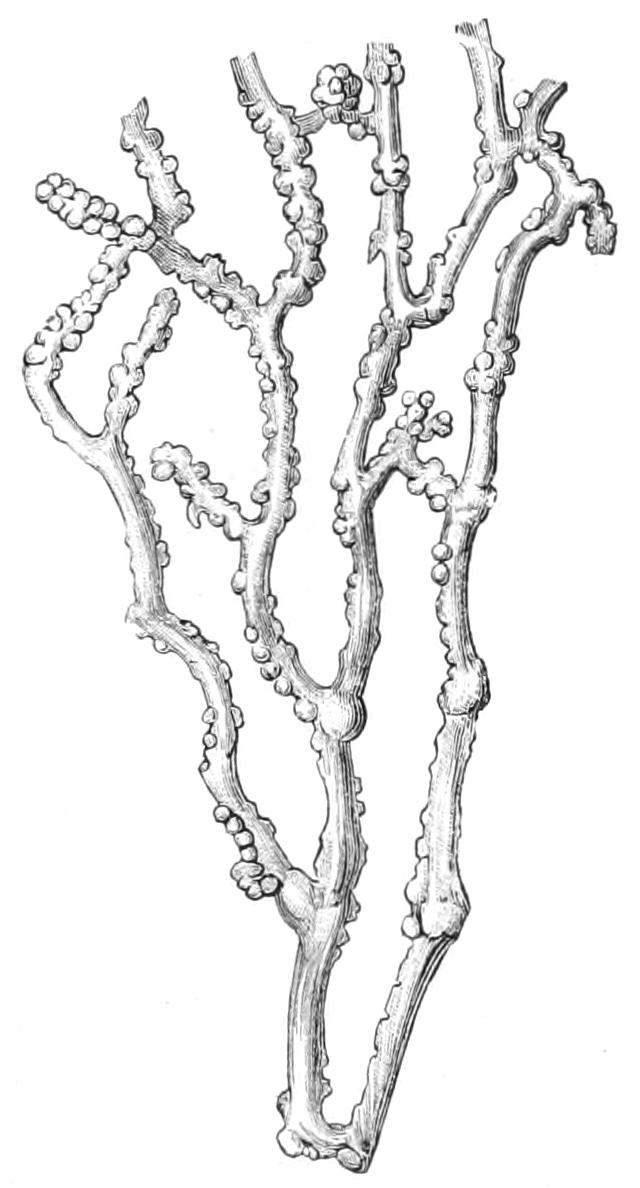
Fig. 155.—Melitodes dichotoma, showing the swollen nodes and the internodes.
The principal genera are:—Melitodes, Verrill; widely distributed in the Indian and Pacific Oceans, Cape of Good Hope, etc. This genus is in some localities extremely abundant and exhibits great brilliancy and variety of colour. The branching is usually dichotomous at the nodes. Wrightella, Gray. This is a delicate dwarf form from Mauritius and the coast of South Africa. Parisis, Verrill; Pacific Ocean from Formosa to Australia but not very common. One species from Mauritius. The branches arise from the internodes.
Fam. 4. Coralliidae.—The axis is formed by the fusion of spicules into a dense, solid, inflexible, calcareous core.
Corallium, Lamarck. Corallium nobile, Pallas, the "precious coral," occurs in the Mediterranean, chiefly off the coast of North Africa, but also on the coasts of Italy, Corsica, Sardinia, and it extends to the Cape Verde Islands in the Atlantic Ocean. C. japonicum, Kishinouye, called Akasango by the fishermen, occurs off the coast of Japan, and C. reginae, Hickson, has recently been described from deep water off the coast of Timor.[377] The genus Pleurocorallium, Gray, is regarded by some authors as distinct, but the characters that are supposed to distinguish it, namely, the presence of peculiar "opera-glass-shaped spicules," and the occurrence of the verrucae on one side of the branches only, are not very satisfactory. The following species are therefore placed by Kishinouye[378] in the genus Corallium:—C. elatius, Ridley (Momoirosango); C. konojoi, Kishinouye (Shirosango); C. boshuensis, K.; C. sulcatum, K.; C. inutile, K.; and C. pusillum, K.,—all from the coast of Japan. Of the coral obtained from these species, the best kinds of Momoirosango vary in price from £30 per pound downwards according to the quality. The Shirosango is the least valuable of the kinds that are brought into the market, and is rarely exported.[379] Three species of Corallium (Pleurocorallium) have been described from Madeira,[380] and one of these, C. johnsoni, has recently been found in 388 fathoms off the coast of Ireland.[381] Other species are C. stylasteroides, from Mauritius; C. confusum, Moroff,[382] from Sagami Bay in Japan; and an undescribed species obtained by the "Siboga," off Djilolo. These corals range from shallow water to depths of 300-500 fathoms. Pleurocoralloides, Moroff, differs from the others in having very prominent verrucae and in the character of the large spindle-shaped and scale-like spicules. It was found in Sagami Bay, Japan. Specimens attributed to the genus Pleurocorallium have been found fossil in the white chalk of France, but Corallium has been found only in the tertiaries.[383]
Sub-Order 2. Axifera.
The axis in this sub-order may be horny, or horny with a core of calcium carbonate, or composed of horn impregnated with calcium carbonate, or of nodes of horn alternating with internodes of calcium carbonate. It may be distinguished from the axis of the Pseudaxonia by the fact that in no case have definite spicules been observed to take part in its formation. It has been suggested that as the Axifera represent a line of descent distinct from that of the Pseudaxonia they should be placed in a separate order. Apart from the character of the axis, however, the two sub-orders show so many affinities in their general anatomy that it is better to regard the two lines of descent as united within the Gorgonacean limit. It is very improbable that the two groups sprang independently from a stoloniferous ancestor.
Fam. 1. Isidae.—This family includes all those Axifera in which the axis is composed of alternate nodes of horn and internodes of calcareous substance.
There can be little doubt of the close affinities of many of the genera of this family with the Melitodidae among the Pseudaxonia. In both the coenenchym is thin and the coelenteric cavities short. No important differences have been observed between the structure of the zooids of the two families, and now that we know that the "nutritive canals" of Melitodes do not perforate the nodes there is no important difference left between the coenosarcal canal systems. The structure and method of calcification of the internodes of the two families are very similar. The main difference between them is that the nodes of the Isidae are purely horny, whereas in the Melitodidae the horny substance of the nodes contains calcareous spicules.
The principal genera are:—Isis, Linnaeus; Pacific Ocean. This genus forms substantial fan-shaped colonies with, relatively, a thick coenenchym, short stout internodes and black horny nodes. Mopsea, Lamouroux; Coast of Australia. The verrucae are club-shaped and are arranged in spiral rows round the stem. Acanella, Gray; principally found in deep water in the Atlantic Ocean but also in the Pacific. The internodes are long and the branches arise from the nodes. Most of the species occur in deep water, some in very deep water (A. simplex, 1600 to 1700 fathoms). In this and the following genera the coenenchym is thin and the zooids imperfectly or not retractile. Ceratoisis, Wright; Atlantic Ocean, extending from shallow to deep water. The branches arise from the nodes. Chelidonisis, Studer; deep water off the Azores. Isidella, Gray; Mediterranean Sea. Bathygorgia, Wright; off Yokohama, 2300 fathoms. This genus is unbranched, with very long internodes and short nodes. The zooids are arranged on one side only of the stem.
Fam. 2. Primnoidae.—This is a well-marked family. The axis of the colonies is horny and calcareous. The coenenchym and the non-retractile zooids are protected by scale-like spicules, which usually overlap and form a complete armour for the protection of the soft parts. On the aboral side of the base of each tentacle there is a specialised scale, and these fit together, when the tentacles are folded over the peristome, to form an operculum.
The principal genera are:—Primnoa, Lamouroux; Atlantic Ocean, occurring also in the Norwegian fjords. This genus is usually found in moderately deep water, 100 to 500 fathoms. Primnoella, Gray. This genus seems to be confined to the temperate seas of the southern hemisphere. It is unbranched. The zooids are arranged in whorls round the long whip-like stem. Plumarella, Gray; southern hemisphere, in moderately deep water. This is branched pinnately in one plane. The zooids are small and arise at considerable intervals alternately on the sides of the branches. Stenella, Gray; widely distributed in deep water. The zooids are large and are arranged in whorls of three situated at considerable distances apart. Stachyodes, W. and S.; Fiji, Kermadecs, Azores, in deep water. Colony feebly branched. Zooids in regular whorls of five. Other genera belonging to this group of Primnoidae are Thouarella, Gray, and Amphilaphis, Antarctic seas.
The following genera are placed in separate sub-families:—Callozostron, Wright; Antarctic Sea, 1670 fathoms. The axis is procumbent and the zooids are thickly set in rows on its upper surface. The zooids are protected by large imbricate scales, of which those of the last row are continued into long spine-like processes. Calyptrophora, Gray; Pacific Ocean, in deep water. The base of the zooids is protected by two remarkably large scales. Primnoides, W. and S.; Southern Ocean. The opercular scales are not distinctly differentiated and the calyx is therefore imperfectly protected.
Fam. 3. Chrysogorgiidae.[384]—The axis in this family is composed of a horny fibrous substance with interstratified calcareous particles, and it springs from a calcareous plate, which sometimes gives off root-like processes. It may be unbranched or branched in such a way that the branches of the second, third, and subsequent orders assume in turn the direction of the base of the main axis. The axis is frequently of a metallic iridescent appearance. The zooids usually arise in a single straight or spiral row on the branches, and are not retractile. The coenenchym is thin. The spicules vary considerably, but in a very large proportion of the species they are thin, oval, or hour-glass plates (Fig. 149, 10, p. 336).
By some authors this family is considered to be the simplest and most primitive of the Axifera; but the delicate character of the axis of the main stem and branches, the thinness of the coenenchym, the position of the zooids on one side of the branches only, and the tenuity of the calcareous spicules may be all accounted not as primitive characters, but as special adaptations to the life in the slow uniform currents of deep water.
The principal genera are:—Lepidogorgia, Verrill; Atlantic and Pacific Oceans, 300 to 1600 fathoms. Axis unbranched. Zooids large and arranged in a single row. Trichogorgia, Hickson; Cape of Good Hope, 56 fathoms. Colony branching in one plane. Zooids numerous and on all sides of the branches. Chrysogorgia, D. and M.; deep water. Axis branched. Spicules on the zooids always large. Metallogorgia, Versluys; Atlantic Ocean, 400 to 900 fathoms. Basal part of the stem unbranched (monopodial). Iridogorgia, Verrill. Spiral stem and branches. Pleurogorgia, Versluys. Axis branched in one plane. Coenenchym thick. Riisea, D. and M. Monopodial stem and thick coenenchym.
Fam. 4. Muriceidae.—This is a large family, exhibiting very great variety of habit. The spicules are often very spiny, and project beyond the surface of the ectoderm, giving the colony a rough appearance. A great number of genera have been described, but none of them are very well known. The family requires careful revision.
The more important genera are:—Acanthogorgia, Gray; principally in deep water in the Atlantic Ocean. The calices are large, cylindrical, and spiny. Villogorgia, D. and M.; widely distributed. Delicate, graceful forms, with thin coenenchym. Echinomuricea, Verrill; Muricea, Lamouroux; Paramuricea, Köll; Acamptogorgia, W. and S.; Bebryce, Philippi.
Fam. 5. Plexauridae.—In this family we find some of the largest and most substantial Gorgonids. The axis is usually black, but its horny substance may be impregnated with lime, particularly at the base. The coenenchym is thick, and the zooids are usually completely retractile, and the surface smooth. The species of the family are principally found in shallow water in warm or tropical regions.
The principal genera are:—Eunicea, Lamouroux. The calices are prominent, and not retractile. Plexaura, Lamouroux; Euplexaura, Verrill. Eunicella, Verrill. With an outer layer of peculiar torch-shaped spicules. The only British species of this order is Eunicella cavolini (formerly called Gorgonia verrucosa). It is found in depths of 10 to 20 fathoms off the coast of the English Channel and west of Scotland. Occasionally specimens are found in which a gall-like malformation with a circular aperture is seen, containing a Barnacle. Such gall formations, common enough in some species of Madreporaria, are rarely found in Alcyonaria.
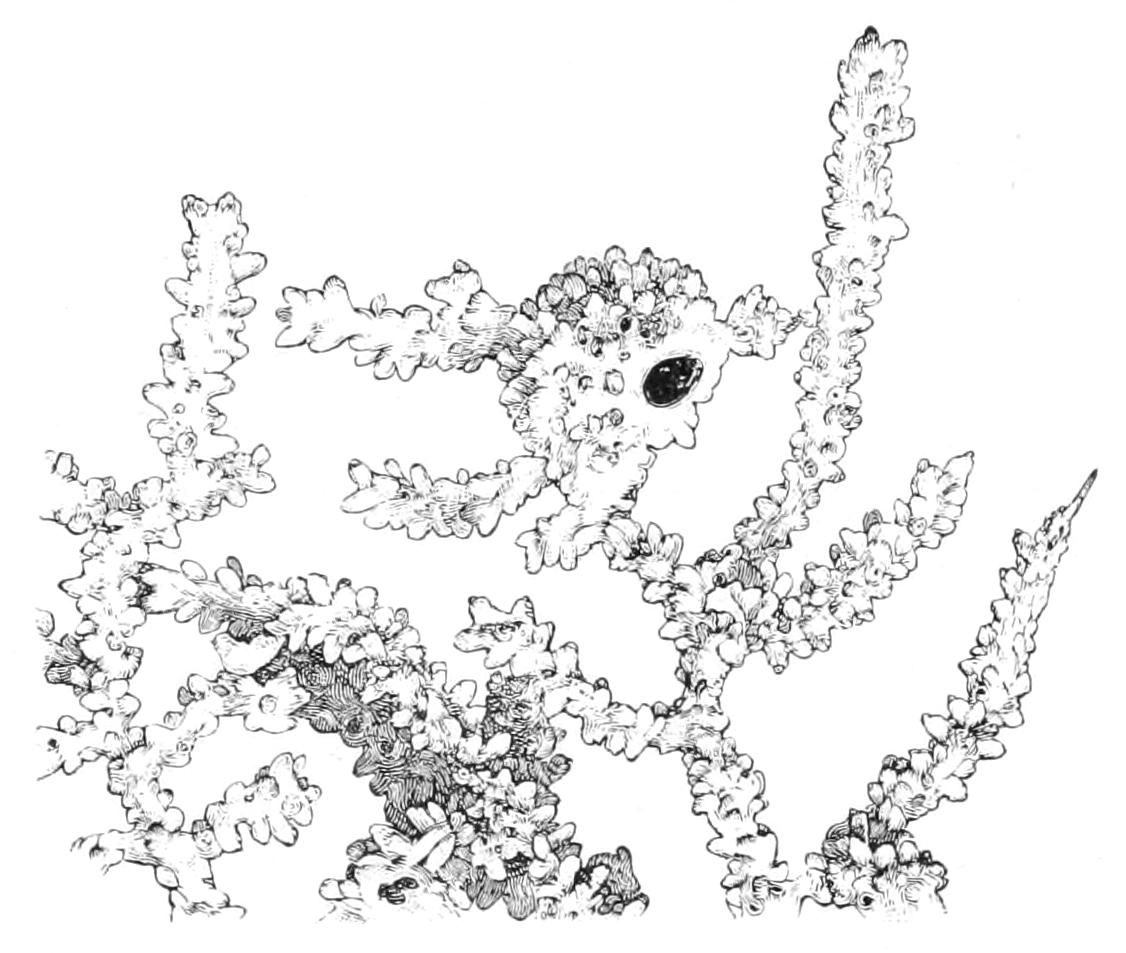
Fig. 156.—Eunicella cavolini. Some branches of a large dried specimen, showing a gall formed by a Cirripede.
Fam. 6. Gorgoniidae.—This family contains some of the commonest and best-known genera of the order. They usually form large flexible branched colonies with delicate horny axes and thin coenenchym. The zooids are usually completely retractile.
The principal genera are:—Gorgonia, Linn. This genus includes Gorgonia (Rhipidogorgia) flabellum, the well-known fan Gorgonia with intimately anastomosing branches, from the warm waters of the Atlantic Ocean. The genera Eugorgia, Verrill, and Leptogorgia, Milne Edwards, differ from Gorgonia in the character of the spicules. In Xiphigorgia, Milne Edwards, from the West Indies, the branches are much compressed, forming at the edges wing-like ridges, which bear the zoopores in rows. Malacogorgia, Hickson, has no spicules. Cape of Good Hope.
Fam. 7. Gorgonellidae.—In this family the horny axis is impregnated with lime. The surface of the coenenchym is usually smooth, and the spicules small. The colonies are sometimes unbranched (Juncella). In the branching forms the axis of the terminal branches is often very fine and thread-like in dimensions.
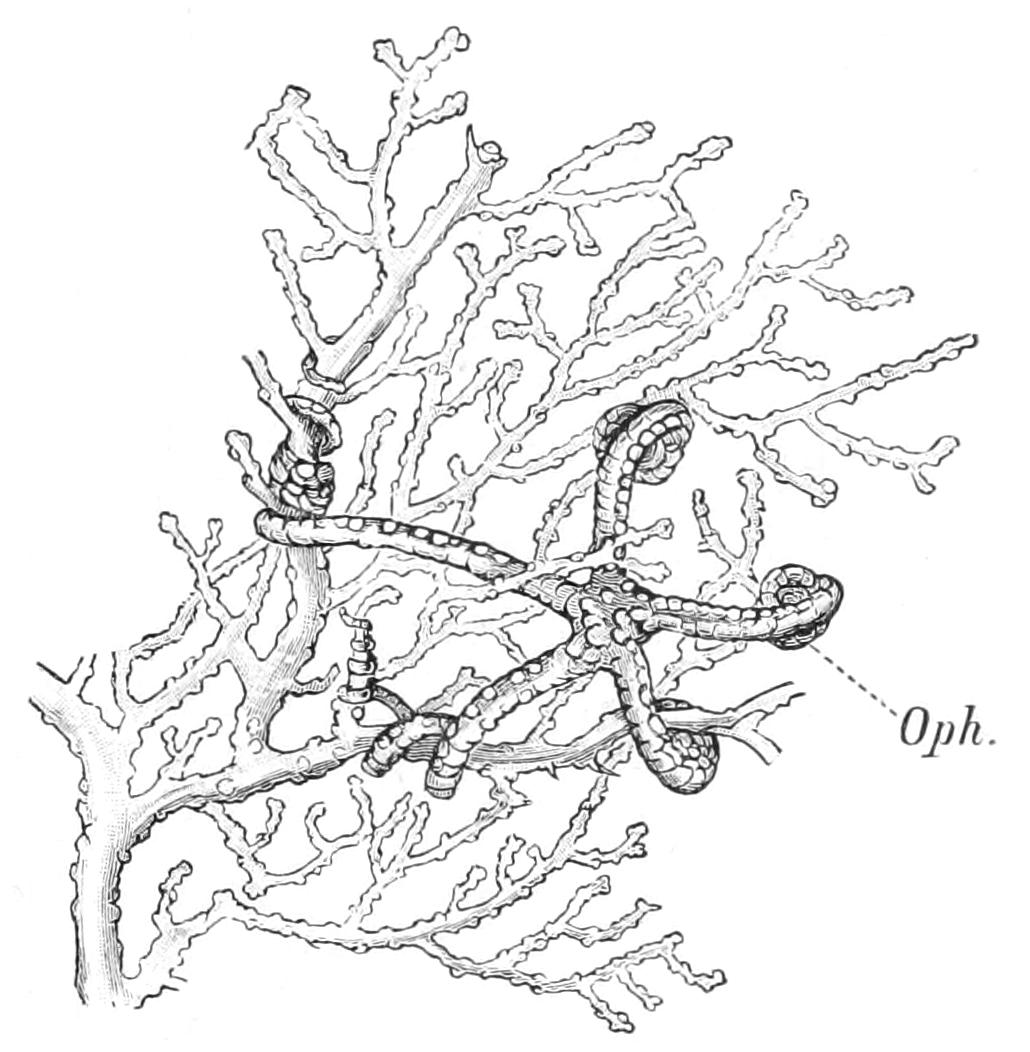
Fig. 157.—Verrucella guadaloupensis, with an epizoic Brittle star (Oph.) of similar colour.
The principal genera are:—Gorgonella, with a ramified flabelliform axis; Ctenocella, with a peculiar double-comb manner of branching; and Juncella, which forms very long unbranched or slightly branched colonies, with club-shaped spicules. All these genera are found in shallow water in the tropical or semi-tropical regions of the world. Verrucella is a genus with delicate anastomosing branches found principally in the shallow tropical waters of the Atlantic shores. Like many of the Gorgonacea, with branches disposed in one plane (flabelliform) Verrucella frequently carries a considerable number of epizoic Brittle stars, which wind their flexible arms round the branches, and thus obtain a firm attachment to their host. There is no reason to suppose that these Brittle stars are in any sense parasitic, as a specimen that bears many such forms shows no sign of injury or degeneration, and it is possible they may even be of service to the Verrucella by preying upon other organisms that might be injurious. An interesting feature of the association is that the Brittle stars are of the same colour as the host, and the knob-like plates on their aboral surface have a close resemblance to the verrucae (Fig. 157).
Order V. Pennatulacea.
The Sea-pens form a very distinct order of the Alcyonaria. They are the only Alcyonarians that are not strictly sedentary in habit, that are capable of independent movement as a whole, and exhibit a bilateral symmetry of the colony. No genera have yet been discovered that can be regarded as connecting links between the Pennatulacea and the other orders of the Alcyonaria. Their position, therefore, is an isolated one, and their relationships obscure.
The peculiarities of the order are due to the great growth and modification in structure of the first formed zooid of the colony. This zooid (Oozooid, Hauptpolyp, or Axial zooid) increases greatly in length, develops very thick fleshy walls, usually loses its tentacles, digestive organs, and frequently its mouth, exhibits profound modification of its system of mesenteries, and in other ways becomes adapted to its function of supporting the whole colony.
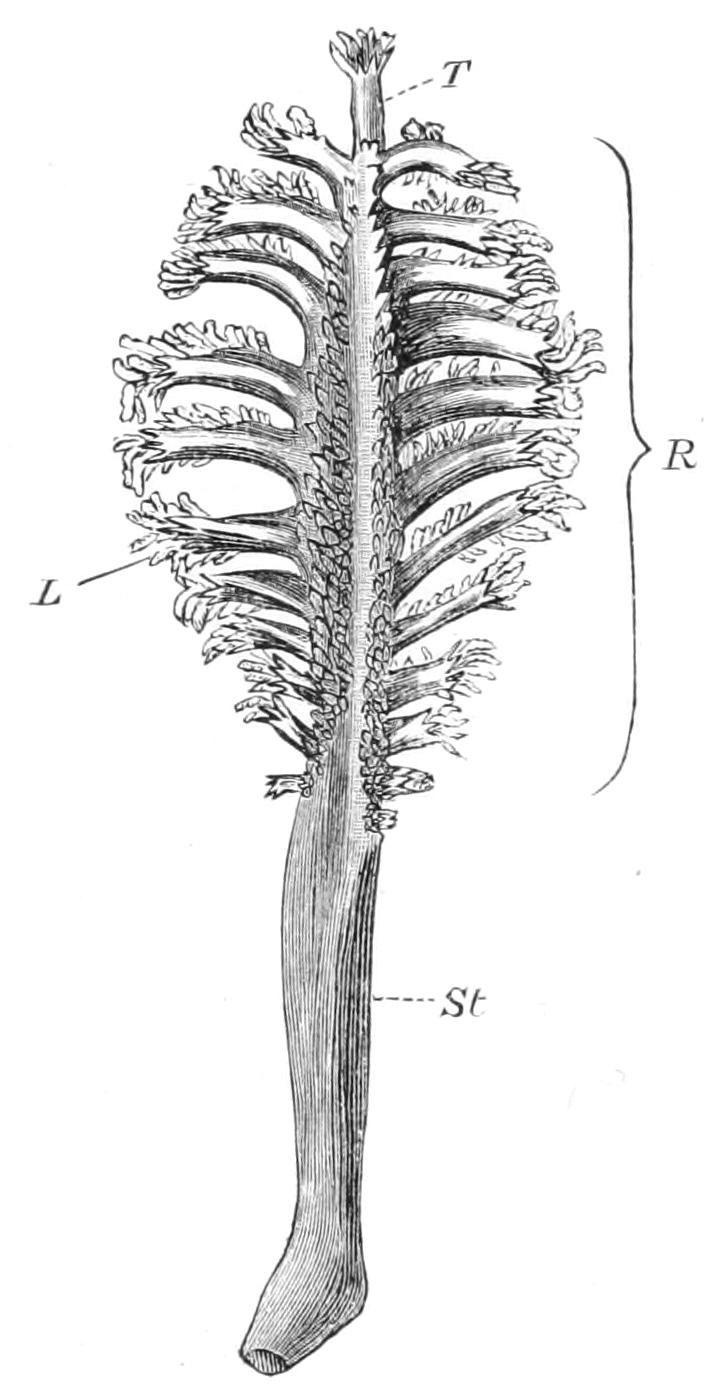
Fig. 158.—Diagram of a Sea-pen. L, leaves composed of a row of autozooids; R, rachis; St, stalk; T, anthocodia of the axial zooid, usually suppressed. (After Jungersen.)
The axial zooid shows from an early stage of development a division into two regions: a distal region which produces by gemmation on the body-wall numerous secondary zooids, and becomes the rachis of the colony; and a proximal region which becomes the stalk or peduncle, and does not produce buds (Fig. 158). The secondary zooids are of two kinds: the autozooids and the siphonozooids. The former have the ordinary characters of an Alcyonarian zooid, and produce sexual cells; the latter have no tentacles, a reduced mesenteric system, and a stomodaeum provided with a very wide siphonoglyph.
The arrangement of the autozooids and siphonozooids upon the axial zooid is subject to great modifications, and affords the principal character for the classification of the order. In the Pennatuleae the autozooids are arranged in two bilaterally disposed rows on the rachis, forming the leaves or pinnae of the colony (Fig. 158). The number in each leaf increases during the growth of the colony by the addition of new zooids in regular succession from the dorsal to the ventral side of the rachis[385] (Fig. 159). In other Pennatulacea the autozooids are arranged in rows which do not unite to form leaves (Funiculina), in a tuft at the extremity of a long peduncle (Umbellula), scattered on the dorsal side of the rachis (Renilla, Fig. 160), or scattered on all sides of the rachis (Cavernularia, Fig. 161). In those forms in which the autozooids are scattered the bilateral symmetry of the colony as a whole becomes obscured. The siphonozooids may be found on the leaves (Pteroeides), but more frequently between the leaves or rows of autozooids, or scattered irregularly among the autozooids. Usually the siphonozooids are of one kind only, but in Pennatula murrayi there is one specially modified siphonozooid at the base of each leaf,[386] which appears to have some special but unknown function.
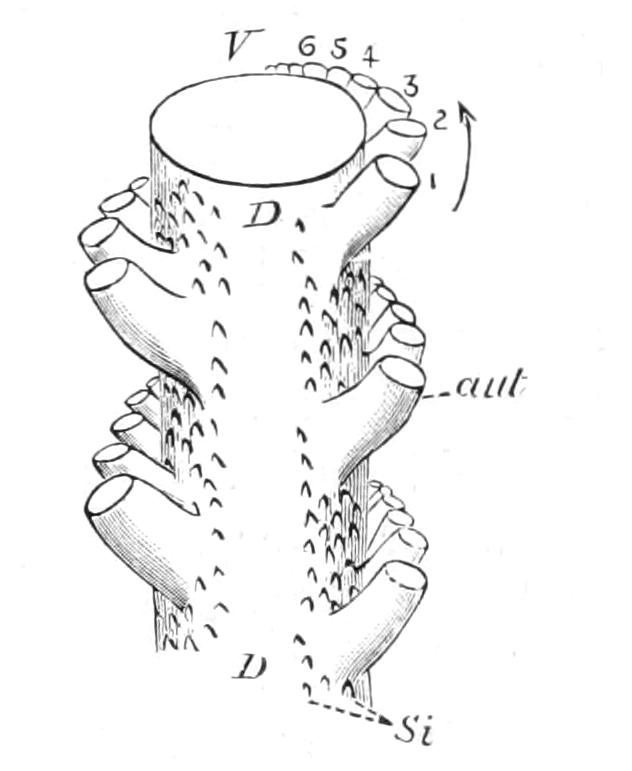
Fig. 159.—Diagram of a portion of a rachis of a Sea-pen, aut, The rows of autozooids; 1-6, the order of age of the autozooids composing a leaf; D, the dorsal side of the rachis; Si, the siphonozooids; V, the ventral side of the rachis. (After Jungersen.)
In Umbellula gracilis each siphonozooid bears a single pinnate tentacle, and in some other species of the same genus there is a tentacle which is not pinnate.[387]
The zooids and coenenchym are usually protected by a crust of coloured or colourless, long, smooth, needle-like, calcareous spicules, situated principally in the superficial layer, so as to leave the subjacent tissues soft and spongy in texture. In some cases the spicules are smooth double clubs, rods, discs, or irregular granules, and in Sarcophyllum, Chunella, some species of Umbellula and others, there is no calcareous skeleton. The tuberculated spindles, so common in other Alcyonaria, are not found in any species. In most genera a horny, or calcified horny rod is embedded in the central part of the axial polyp, serving as a backbone or support for its muscles. It is absent, however, in Renilla, and reduced or absent in Cavernularia.
The sexual organs are borne by the mesenteries of the autozooids only, and each colony is either male or female. There is no record of hermaphroditism in the order. The eggs contain a considerable amount of yolk, and fertilisation is effected in the sea-water after their discharge. The segmentation is irregular, and the free-swimming ciliated larva (of Renilla) shows the rudiments of the first buds from the axial polyp before it settles down in the mud.
The Sea-pens are usually found on muddy or sandy sea-bottoms, from a depth of a few fathoms to the greatest depths of the ocean. It is generally assumed that their normal position is one with the peduncle embedded in the mud and the rachis erect. Positive evidence of this was given by Rumphius, writing in 1741, in the case of Virgularia rumphii and V. juncea at Amboina,[388] and by Darwin in the case of Stylatula darwinii at Bahia Blanca.[389]
"At low water," writes Darwin, "hundreds of these zoophytes might be seen projecting like stubble, with the truncate end upwards, a few inches above the surface of the muddy sand. When touched or pulled they suddenly drew themselves in with force so as nearly or quite to disappear."
It is not known whether the Pennatulids have the power of moving from place to place when the local conditions become unfavourable. It is quite probable that they have this power, but the accounts given of the Sea-pens lying flat on the sand do not appear to be founded on direct observation. The fable of Pennatula swimming freely "with all its delicate transparent polypi expanded, and emitting their usual brilliant phosphorescent light, sailing through the still and dark abyss by the regular and synchronous pulsations of the minute fringed arms of the whole polypi," appears to be based on a statement made by Bohadsch in 1761, and picturesque though it be, is undoubtedly erroneous.
The brilliant phosphorescence of many species of Pennatulacea has been observed by many naturalists, and it is very probable that they all exhibit this property to some degree. The phosphorescence appears to be emitted by the mesenteric filaments of the autozooids, but it is not yet determined whether the phenomenon is confined to these organs or is more generally distributed.
The Pennatulacea are usually devoid of epizoites, but occasionally the parasitic or semi-parasitic Entomostracan Lamippe is found in the zooids. A small crab is also frequently found between the large leaves of species of Pteroeides. The most remarkable case of symbiosis, however, has recently been observed in the form of an encrusting Gymnoblastic Hydroid[390] living on the free edge of the leaves of a species of Ptilosarcus.
The order Pennatulacea is divided into four sections.
Sect. 1. Pennatuleae.—In this section the colony is distinctly bilaterally symmetrical, and the autozooids are arranged in rows with their body-walls fused to form leaves.
The genus Pteroeides, the representative genus of the family Pteroeididae, is a fleshy Sea-pen found in shallow sea water in the warm waters of the Pacific Ocean and in the Mediterranean. It has large leaves with long spiny, projecting spicules, and the siphonozooids are borne by the leaves. Pennatula, the representative genus of the family Pennatulidae, has a wider distribution in area and in depth. Pennatula phosphorea is a common British species, found in depths of 10 to 20 fathoms in many localities off our coasts. It is about 5 inches in length. There are several varieties of this species distributed in Atlantic waters. Pennatula grandis is a magnificent species found in Norwegian fjords, in the Faeroe Channel, and off the northern coasts of N. America, in depths of from 50 to 1255 fathoms. Specimens have been obtained no less than 2½ feet in length. P. murrayi and P. naresi are species of the genus found at depths of a few hundred fathoms in tropical seas.
The genus Virgularia, belonging to the family Virgulariidae, is represented in the British seas by V. mirabilis, a long slender Sea-pen found in many localities off the Scottish coasts.
Sect. 2. Spicatae.—This section includes those Sea-pens in which the autozooids are arranged bilaterally on the axial zooid in rows or more irregularly, but do not unite to form leaves. It is a large section and contains many widely divergent genera.
The family Funiculinidae is represented on our coasts by Funiculina quadrangularis, a long and slender Sea-pen 2 to 3 feet in length. The autozooids are arranged in oblique rows, and the siphonozooids are on the ventral side of the rachis. There is one point of special interest in this genus. The siphonozooids appear to change as the colony grows and to become autozooids. If this is the case it may be more correct to describe the genus as devoid of true siphonozooids.
The family Anthoptilidae contains the species Anthoptilum grandiflorum, which has a wide distribution in depths of 130 to 500 fathoms in the N. and S. Atlantic Ocean. It is perhaps the largest of all the Pennatulacea, specimens having been obtained from the Cape of Good Hope over 4 feet long with expanded autozooids, each more than half an inch in length.
The family Kophobelemnonidae contains a number of forms with remarkably large autozooids arranged in irregular rows on the two sides of the rachis. The siphonozooids are numerous and scattered, and their position is indicated by small papilliform calices on the coenenchym. The surface of these pens is usually rough, owing to the presence of numerous coarse projecting spicules. Kophobelemnon occurs in the Mediterranean in deep water, off the coasts of Ireland and Scotland, and in other regions.
The family Umbellulidae contains some of the most remarkable and interesting examples of the deep-sea fauna. The peduncle is very long and the rachis stunted and expanded. The autozooids are of great size, non-retractile, and arranged in a cluster or rosette on the terminal rachis. There is a wide structural range between the species. Some species have numerous large spicules, others have none. In some species the siphonozooids have a single pinnate or digitate tentacle, in others the siphonozooids are of the usual type. Umbellula appears to be a somewhat rare but cosmopolitan genus in deep water, extending from the Arctic to the Antarctic region in water ranging from 200 to 2500 fathoms.
The interesting genus Chunella was discovered by the German "Valdivia" Expedition at a depth of about 420 fathoms off the coast of E. Africa, and subsequently by the Dutch "Siboga" Expedition at a depth of about 500 fathoms in the Malay Archipelago. According to Kükenthal,[391] this genus with another closely allied genus Amphianthus should form a new section of Pennatulacea, the Verticilladeae. Chunella has a long and very delicate rachis and peduncle, and the former terminates in a single autozooid and has five or six whorls of three autozooids, situated at considerable distances from one another. Spicules are absent. The full description of this genus has not yet been published, but it is clear that it occupies a very isolated position in the order.
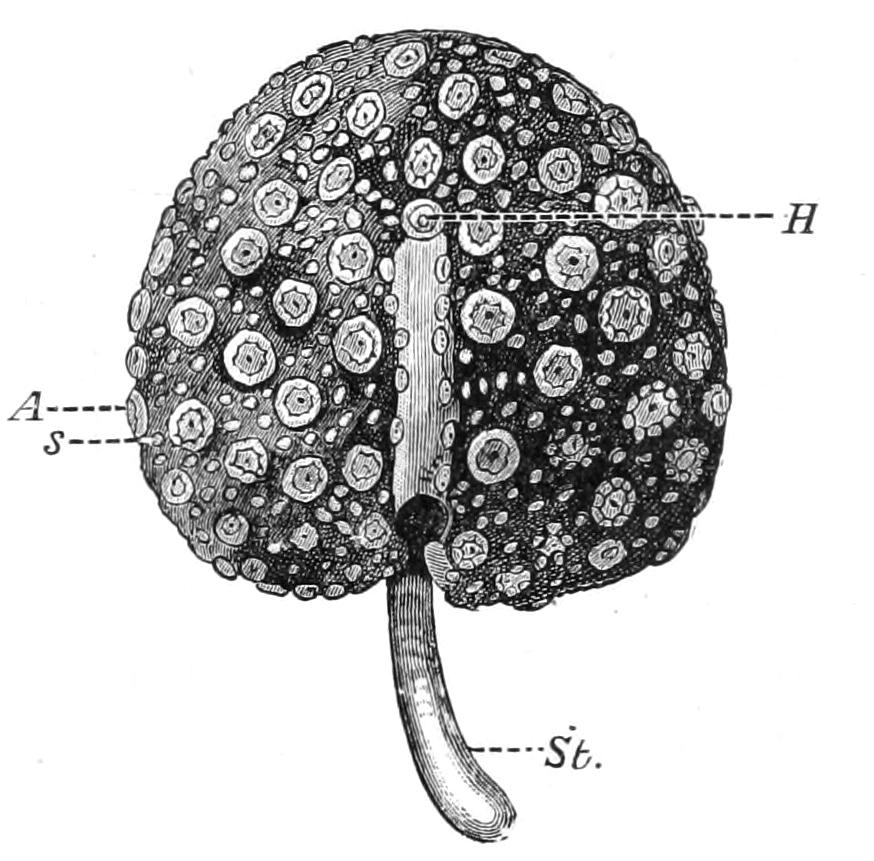
Fig. 160.—Renilla reniformis, a small specimen (34 mm.), showing the dorsal side of the expanded rachis. A, autozooid; H, the mouth of the axial zooid; s, siphonozooid; St, the short stalk. (After Kölliker.)
Sect. 3. Renilleae.—This section contains a single family Renillidae and a single genus Renilla (Fig. 160). The rachis is expanded into a flattened cordate form set at an angle to the peduncle, and the zooids are confined to the dorsal surface, which is uppermost in the natural position of the colony. The peduncle is short and does not contain an axial skeleton. The colour of this Sea-pen is usually violet when dried or preserved. Specimens of Renilla are very abundant in shallow water in some localities on the Atlantic and Pacific coasts of N. America, but the genus has also been obtained from the Red Sea and the coast of Australia. A popular name for this genus is "Sea pansy."
Sect. 4. Veretilleae.—This section contains a number of genera in which the bilateral arrangement of the zooids is obscured by their gradual encroachment on the dorsal side of the axial polyp. The rachis and peduncle are thick and fleshy, and the autozooids and siphonozooids are irregularly distributed all round the rachis. The genus Cavernularia is not uncommonly found in moderate depths of water in the Indian and Pacific Ocean, and is distinguished from the other genera by the reduction of the skeletal axis. Other genera are Veretillum, Mediterranean and Atlantic Ocean, and Lituaria, Indian Ocean.
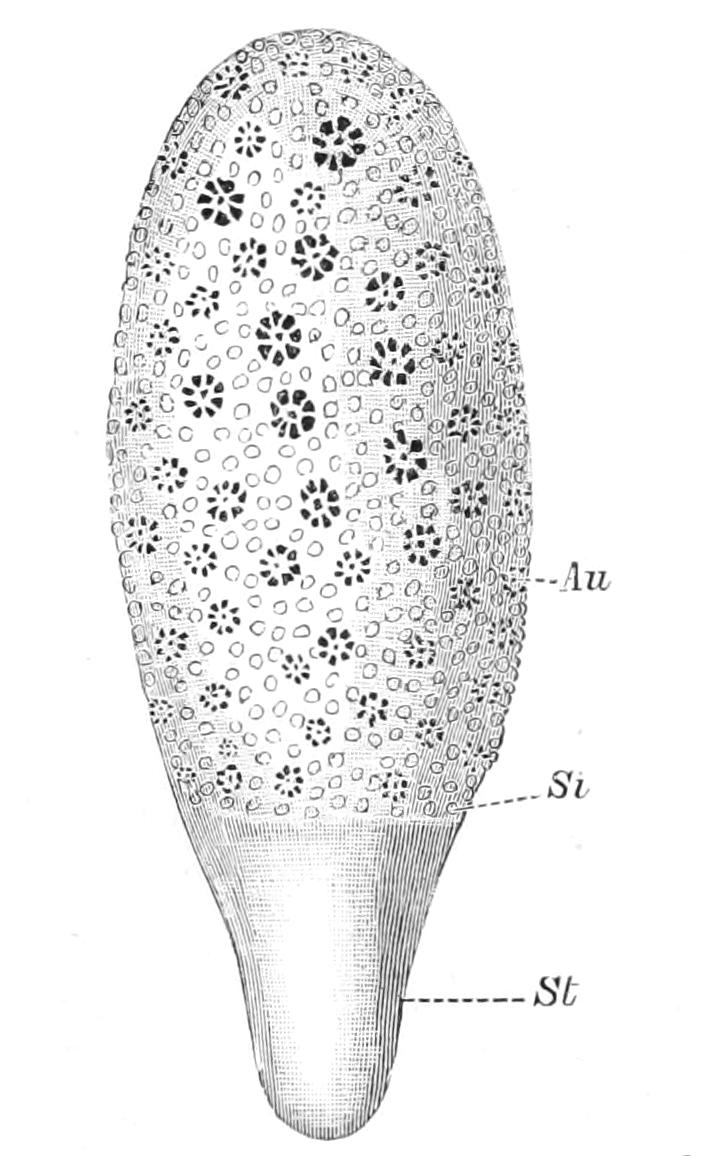
Fig. 161.—Cavernularia obesa. Au, autozooid; Si, siphonozooid; St, stalk. (After Kölliker.)