Part 1 — V—THE MONEY COST OF THE WAR Over $210,000,000,000 Spent by the Belligerents—How This Stupendous Sum Was Raised—What the War Cost Uncle Sam
Reading edition
By EDWIN R. A. SELIGMAN
Professor of Political Economy and Finance in Columbia University
The cost of a war may mean several different things. It may mean, in the first place, the actual money cost, or expenditure in dollars and cents, directly involved in prosecuting the war. Or, secondly, it may mean the war cost, both direct and indirect, from the economic point of view. The real cost of a war from this latter point of view may mean either actual loss of lives and property or the diminution of the annual social production. The wealth of a country measured in its social income may be reduced either by the actual loss of territory, as in Germany; by the impairment of its natural resources like the coal mines and forests, as in France; by the reduction of labor power, due to the wounded workmen or the results of starvation or privation, as in many countries of Europe; or by the loss of economic efficiency due to a reduction of the standard of life or to a changed attitude toward habits of work. The real costs of war, although often incalculable, are none the less of profound significance.
The actual money costs or expenditures of government for war include not only the actual outlays for military and naval purposes, but also the whole range of expenditures incurred in industrial life to prepare the wherewithal for the Army and Navy; and they also comprise the sums devoted to the maintenance of the families of the soldiers. All these items are far greater in modern times than they used to be. It is a far cry from the meeting of two savage tribes armed only with bows and arrows or javelins, to the modern 16-inch guns, the dreadnoughts, the airplanes, the submarines, the poison gas and the innumerable technical adjuncts of modern warfare. The consequence is that the money costs of the World War have far transcended those of all previous conflicts.
The attempt to present in figures the costs of the war meets with several difficulties. In the first place the question arises as to the period at which we ought to stop. In one sense the war ceased when the armistice was declared. In another sense the war did not actually stop until the peace was declared—in this case a matter of many months additional. But even when peace was declared the war expenses were by no means over. The process of demobilization is a slow one: moreover it is necessary to continue for some time the policing of the conquered countries; and finally comes the question of the pensions to the wounded soldiers or to the families of the dead. It will be seen, therefore, how impossible it is to state with any accuracy at the present time the costs of the war, when those are still being incurred. Furthermore, the figures ordinarily given contain additional inaccuracies. The richer countries make loans to the poorer countries and these expenditures are consequently counted twice in the total,—a procedure legitimate only on the assumption that the loans will not be repaid. Again, in a country like the United States, which has substituted an insurance system for the pension system, the nominal expenditures appear smaller than is really the case, because of the receipt of vast insurance premiums which will ultimately all be expended again. Finally the figures make no allowances for the change in the price level or the alteration in the value of money. In a great war like the present, prices have risen: in some countries they have doubled, in some countries they have more than tripled, for reasons which it is needless to discuss here. What appears, therefore, to be a great and increasing outlay from year to year may be in reality due in part, at least, to this cause.
After making all allowances for these difficulties we may proceed to state some of the facts as to the actual outlays of various countries.
THE COST OF THE WAR DAY BY DAY
In all the belligerent countries it naturally took some time for them to get into their stride. This is especially true of Great Britain. The figures of the average daily expenditures, as given by the Chancellor of the Exchequer, amounted to almost $10,000,000 in the opening months of the war and reached a maximum of almost $36,000,000 by 1918. These figures, however, are not exact because they include all of the expenditures. The real war expenditures may be arrived at by deducting in each case the amount of the expenditures in the last year of peace, ending March 31, 1914. Making these corrections, it appears that the average daily war expenditures in England rose from about $9,500,000 during the first eight months of the war to about $33,500,000 in 1918, then slowly receding in 1919. In France the average daily expenditures were naturally somewhat less, rising from about $8,500,000 during the first three months of the war to over $21,000,000 during 1917, the last full year of the war. In Germany the daily expenses were approximately the same as in Great Britain, rising from about $13,000,000 in the first nine months of the war to $34,500,000 during the last six months of 1918. In the case of both Germany and France, it is not known whether the figures comprise the total expenditures or only the pure war expenditures. In the former event the daily expenditures of Germany would be a little less than those of Great Britain; in the latter, they would be a little more. In Italy and Austria-Hungary the daily expenditures were naturally smaller, amounting at the maximum to about $10,500,000 and $20,000,000 respectively. In Russia the daily expenditures rose in 1916 to about $20,000,000 and in 1917, just prior to the October revolution, nominally to $47,000,000. But, owing to the great depreciation of the ruble, the actual expenditures were much less.
OUR WAR EXPENSES MONTH BY MONTH
When the United States entered the war the scale of its operations became so stupendous that its daily war expenditures soon far exceeded those of any other belligerent. In the second month of the war the average daily expenditures for pure war purposes were $15,000,000 and little over a year later they had risen to almost $50,000,000. By the end of 1918, the daily average war expenditures reached the staggering figure of $64,500,000.
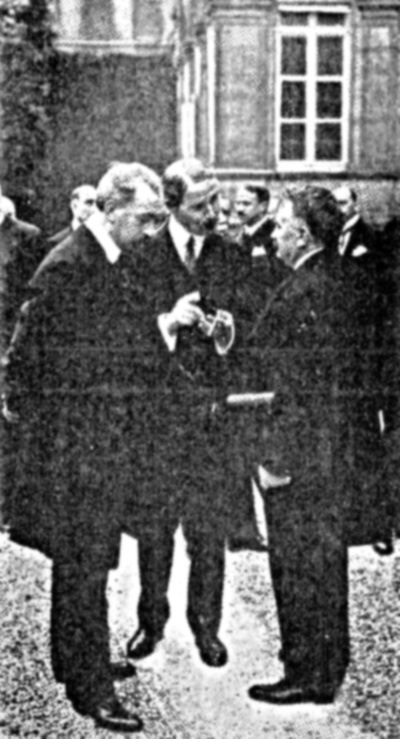
The Economic Conference in Paris
Mr. Bonar Law talking with M. Clementel (Minister of Commerce) and M. Doumergue (Colonies) in the garden of the foreign ministry.
If, now, we attempt to present the statistics of the total cost of the war we must be mindful of the difficulties mentioned above. The figures are not entirely accurate, and cannot be made entirely accurate for the following reasons: In the first place, the last date in the official return differs from country to country. They are, however, all subsequent to the armistice, with the exception of Russia, where we have no trustworthy figures after the advent of Bolshevism. In the second place, we do not know, except in the case of the United States and Great Britain, whether the figures comprise the total expenditures or only the purely war expenditures. Even making allowance for these differences it will be seen that the total war expenditures amount to over $232,000,000,000. In Japan and some of the minor belligerents, there were virtually no war expenses. Inasmuch, however, as most of the countries will continue to have expenses attributable to the war for some little time in the future, it is probable that the total war expenditures will amount, by the end of 1920, to almost $236,000,000,000. From this must, however, be deducted the sums counted twice, because advanced to their allies by the United States, Great Britain, France and Germany. Making allowance for this, it is safe to say that the total net war expenditures will be about $210,000,000,000.
WAR EXPENDITURES OF ALL BELLIGERENTS
In Millions
From entrance into warTo
Great BritainAugust 4, 1914March 31, 1919£ 8,601$41,887
AustraliaAugust 4, 1914March 31, 1919£ 2911,461
Canada (inc. Newfoundland)August 4, 1914August 31, 19191,545
New ZealandAugust 4, 1914March 31, 1919£ 76365
South AfricaAugust 4, 1914March 31, 1919£ 33243
IndiaAugust 4, 1914March 31, 1919£ 119584
———
British Empire$46,083
FranceAugust 3, 1914March 31, 1919fr 169,000$32,617
RussiaAugust 1, 1914October 31, 1917ru 51,50026,522
ItalyMay 23, 1915October 31, 1918li 81,01615,636
BelgiumAugust 2, 1914October 31, 1918fr 5,9001,387
RumaniaAugust 27, 1916October 31, 1918907
SerbiaJuly 28, 1914October 31, 1918635
United StatesApril 15, 1917June 30, 191932,261
————
Entente Powers$156,050
GermanyAugust 1, 1914October 31, 1919mk 204,26848,616
Austria-HungaryJuly 28, 1914October 31, 1919kr 119,50424,858
TurkeyNovember 3, 1914October .., 19191,802
BulgariaOctober 4, 1915October .., 1919732
———
Central Powers$76,008
Total(In Millions)$232,058
HOW MONEY FOR WAR WAS RAISED
The question now arises as to the steps taken by the various countries to meet these stupendous outlays. Of the older expedients, such as war treasures, or the sale of public property there was naturally no question. In only one country, viz., Germany, was there a war treasure; but this was so small as to be well-nigh negligible. The only two available resources were accordingly taxation and borrowing.
When we compare these two expedients, we are struck not only by the great difference in the theories of war finance followed by the various countries, but also by the diversity in the economic conditions which largely influenced the choice. In a general way, it may be said that all countries were compelled to rely to an overwhelming extent on public loans, but that Great Britain and the United States raised a far greater share by taxation than did other countries. Italy was able to raise by new taxation only just about enough to pay the interest on the new loans; Germany accomplished this only in part; while France was not in a position to defray any of her war expenditures from additional taxation. The same is true of the other belligerents, with the exception of the British colonies.
Proceeding now to take up this matter in detail, we shall first attempt to set forth the facts as to war taxation.
UNITED STATES
Monthly Expenditures exclusive of the principal of the public debt and of postal expenditures Monthly War Expenditures [19] Average Daily War Expenditures
Million $Million $Million $
April 6—30, 1917279219 8.0
May, 1917527467 15.0
June, 1917410350 11.7
———— ——
Total April 6—June 30, 19171,216 1,156
July 1917662602 19.4
August 1917757697 22.5
September 1917746686 22.9
October 1917944884 29.5
November 1917986926 30.9
December 19171,1051,045 33.7
January 19181,0901,030 33.2
February 19181,012952 34.
March 19181,1561,096 35.9
April 19181,2151,155 38.5
May 19181,5081,448 46.7
June 19181,5121,452 48.4
———— ——
Total for fiscal year, 191812,697 11,977
July 19181,6081,548 49.9
August 19181,8051,745 56.8
September 19181,5571,497 49.9
October 19181,6651,605 51.8
November 19181,9351,875 62.5
December 19182,0612,001 64.5
January 19191,9621,902 61.4
February 19191,1891,129 40.
March 19191,3791,319 42.5
April 19191,4291,369 45.6
May 19191,1121,052 33.9
June 1919809749 24.9
———— ——
Total for fiscal year, 191918,505 17,785
Total April 6, 1914 to June 30, 191932,428 30,918
WAR TAXATION IN OTHER COUNTRIES
Great Britain, as the wealthiest country at the outbreak of the war, endeavored to raise as much as possible from taxation. From year to year, as the expenses mounted up, more and more demands were made upon the taxpayer. But the expenditures for the war were so enormous that it soon turned out to be impracticable, even with the best of will, to secure more than a comparatively small proportion of the total cost from taxation. The figures usually advanced by the various Chancellors of the Exchequer and repeated parrot-like by most commentators take the proportion that total taxes bear to total expenditures. This method of calculation, as will be seen from the table, shows that almost a quarter of the total expenditures, or to be more exact, 24.9 per cent., was derived from taxes. These figures, however, err doubly. In the first place the significant problem is to ascertain the war expenditures, not simply the total expenditures. These can naturally be obtained only by deducting from the annual total expenditures the sums equal to the peace expenditures, i. e., the expenditures for the last full year of peace. In the second place, what is significant is not the total taxes, but the war taxes; that is, the proceeds of the additional taxes raised during the war. These again can be obtained only by deducting from the total tax revenue the proceeds of the taxes during the last full year of peace. If then we endeavor to ascertain how much of the war expenditures were met by war taxes—and this is really the important problem—we find that, immense as were the burdens resting upon the British taxpayer, the percentage of war expenditures raised by war taxes is much smaller than is usually stated. As a matter of fact, in the first year of war only a little over 7 per cent. of the total war expenditures were raised from taxes. With every succeeding year the percentage increased until the last year of war, 1918—19, a little over one-quarter of the war expenditures were met from war taxes. For the entire five years the proportion of war taxes to war expenditures was slightly over 17 per cent.
In the other belligerent countries the showing was by no means so good. France struggled under a double difficulty. In the first place France was invaded at the very outset of the war, and the territory occupied, although relatively small in extent, represented the richest and the most industrially developed part of the country. This operated largely to reduce the ordinary revenues. In the second place the resultant economic confusion, as well as the general political situation, made it very difficult to impose any new taxes at all. The consequence was that for the first three years of the war, the tax revenues of France did not even suffice to defray the ordinary peace expenditures.
After a little while, indeed, France found it possible to levy some war taxes; but these were exceedingly slight compared with what had been accomplished in Great Britain. The result is that the new war taxes of France were only just about sufficient to make up the deficit on the ordinary peace budget—a deficit caused chiefly by the devastation of the occupied territory. In France, therefore, we may say that as a result no part of the expenditures was met by war taxes.
In Italy the situation was a little better. Italy had not been invaded and its financial situation was not so desperate as that of France. Moreover, Italy entered the war somewhat later and did not have to endure a strain for so long a time. Italy consequently proceeded as soon as possible to levy new war taxes; but as Italy had always been relatively overtaxed, as compared with Great Britain, it was not feasible to do as much. As a result, the war taxes levied by Italy were just about sufficient to pay the interest on the war loans. While Italy, therefore, did better than France, she also was not able to defray any of the war expenditures proper out of war taxation.
The condition of Russia soon became worse than that of France and Italy, and even before the October revolution, Russia was able to put very little reliance upon revenues from war taxation.
Among the Central Powers the situation was much the same, but for a different reason. Germany at the outset of the war had so confidently counted upon victory and upon huge indemnities that it resolved to defray its war expenses entirely from loans. It must, however, be observed that in Germany a not insignificant part of the war expenses were met by the separate states; and in these various states a considerable increase of taxation was provided for at once. As the war proceeded and the hopes of a speedy and complete victory gradually faded away, Germany began to change her policy and decided, especially from 1916 on, to impose more and more taxes. The result was that by the end of the war Germany had done a little better than France.
OUR WAR TAXES COMPARED WITH WAR EXPENDITURES
We come finally to the experience of the United States. When the United States entered the war it was confronted by two rival theories of public finances. One was to the effect that the war expenses should be defrayed entirely by war loans, as had been the case in the early years of the Civil War and as was true of many of the belligerents during this war. The other theory was that the war expenditures ought to be defrayed entirely out of war taxes. This was equally extreme and perilous as the former theory, and labored under the additional disadvantage of being impossible of achievement. The President went so far as to adopt the fifty-fifty theory, namely, that half of the war expenditures ought to be defrayed from taxation.
The prodigious profits made during the beginning years of the European war and the resulting prosperity throughout the country enabled Congress to levy taxes far higher than had before been attempted in our history. Even with an immense addition to taxation, however, the proportion of war expenses derived from war taxes was relatively small. Here, again, we must observe the same caution as in the case of the British figures. We must not compare total expenditures with total taxes, but war expenditures with war taxes. War expenditures are easily ascertained by deducting for each year the amount of the expenditures for the last year of peace, the year ending June 30, 1916. In the case of war taxes, however, it is more exact to deduct from the total revenues the tax revenues for the year ending June 30, 1915. For during the year 1915—16 a number of taxes were already levied in preparation for our possible entrance into the war.
As a matter of fact, during the first quarter of war ending June 30, 1917, the proportion of war expenditures derived from war taxes was less than one-third or 30 per cent. If we exclude loans to Allies on the assumption that they will all be repaid some day, the showing is somewhat better—as two-thirds of the expenditures of that period consisted of such loans.
As soon, however, as we struck our full gait the situation was less satisfactory. The proportion of war expenditures derived from war taxes during the year 1917—18 was less than one-quarter or more exactly only 24.8 per cent. and if we again exclude loans to Allies, only 30 per cent. In the last year of the war the showing was still less favorable. If we take the expenditures for the entire period of our participation in the war the figures are respectively 21.7 per cent. and 27 per cent. For the entire period of our participation in the war, less than one-fourth (or exactly 23.3 per cent.) of the war expenditures were paid out of war taxes. And if the loans to Allies are again excluded the proportion is still under one third, or more exactly 32.5 per cent.
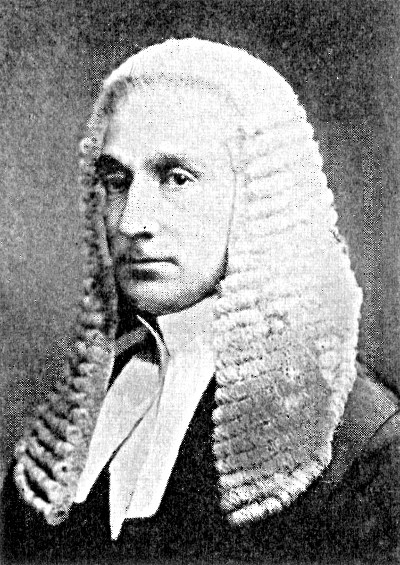
Copyright Underwood & Underwood
Lord Reading
President of the Anglo-French loan mission to the United States in 1915, and special envoy of the British Government to the United States in 1917.
This compares favorably even with the British figures. But it conclusively shows how impossible it is even with the best of will, to raise more than a relatively small part of war expenses from war taxes; especially during the early period of a war.
CHARACTER OF WAR TAXATION
The next point of interest is that of the character of the war taxes imposed by the various countries. Here again we notice a very great difference. In all of the European belligerents on the continent, at least as much additional revenue was raised from direct, as from indirect, taxation. In France about as much new revenue came from indirect taxation or taxes on consumption as from direct taxation or taxes on wealth.
The situation is still less satisfactory in the other continental countries.
In England, on the other hand, a different path was pursued from the beginning. While it is true that a considerable increase of revenue was derived from indirect taxes like customs and excise, the chief reliance was placed on the increase of the income tax, on a new war profits tax and finally, although to a minor degree, on an increase in the inheritance tax.
When we come, however, to the situation in the United States we find the democratic movement so strong that the overwhelming proportion of the new tax revenue was derived from direct taxation on wealth rather than from indirect taxation on consumption. In the great Revenue Act of 1917 over 79 per cent. of the new tax revenue came from direct taxation, principally the income tax and the excess profits tax. In the second great Revenue Act of 1918, the proportions were still more favorable, the amount ascribable to direct taxation in 1919 being almost 81 per cent.
UNITED STATES
Internal Revenue Receipts
In millions of dollars
Year ending June 301918Per Cent.1919Per Cent.
Income and profits taxes2,8392,596[20]
Munition manufacturers tax13
Estate tax4782
Corporate capital stock tax2529
————
Total taxes on wealth2,92479.12,70770.5
Distilled spirits318365
Fermented liquors126118
Tobacco158206
Stamp taxes1937
Transportation71234
Insurance615
Excise taxes3778
Soft drinks27
Admissions2651
Miscellaneous822
————
Total taxes on consumption, transactions and commodities77120.91,13329.5
Total3,695....3,840....
With the impossibility of securing more than a comparatively small proportion of the war expenditures from taxation, it accordingly became necessary to resort to borrowing. This was consequently done by every country on a gigantic scale; although here again the fiscal and economic conditions in the various countries were so different that they employed quite diverse expedients.
Great Britain provided at the outset of the war for immediate needs by the selling of short time securities, principally Treasury Bills. Before long these had amounted to such a sum that it became necessary to issue long time bonds. Accordingly, subscriptions were invited to the first war loan, which was issued on March 1, 1915, followed by the second war loan on June 1, 1915. These bore interest at the rate of 3½ and 4½ per cent. and the amount issued was $1,703,000,000 and $2,883,000,000 respectively. On February, 1916, a continuous issue of War Savings Certificates was inaugurated. On April 15, 1917, the third war loan was issued at 4 per cent., followed on June 1, by the issue of 5 per cent. bonds. Of these $4,811,000,000 were issued.
Beginning on October 2, 1917, a continuous issue of 4 and 5 per cent. National War Bonds was made, the difference in the rate of interest being due to the tax exemption. The temporary and short time paper was gradually funded into these bonds. In the meantime the Anglo-French loan of $500,000,000, of which England had one-half, had been contracted in the United States; and with the entrance of the United States into the war on April 6, 1917, continually larger sums were borrowed from the American Government. During the period of the war the British debt rose from £650,000,000 to £7,643,000,000 or from $3,115,000,000 to $37,221,000,000. It is expected that $250,000,000 will be borrowed during the year 1919—20, so that in all probability the debt of Great Britain at the end of 1920 will amount to almost £8,000,000,000, or $38,500,000,000, meaning that the war debt probably will amount to about £7,500,000,000, or $35,000,000,000.
France was in a far less favorable situation than England at the outset of the war. The total debt of France at the close of 1913 amounted to fr. 32,594,000,000, or $6,291,000,000, and the ordinary budget had closed with a large deficit. So that it had been necessary to issue a loan during the spring and summer of 1914. When the war suddenly broke out, precipitating an economical and financial crash, it became practically impossible to issue another loan. The government was therefore compelled to rely upon advances from the Banque de France, which was permitted correspondingly to increase its notes issue. It was not until November, 1915, that France saw her way to issue her first war loan of 5 per cent. bonds. This was followed on August 6, 1916, by the second war loan, also of 5 per cent. bonds, on December 15, 1917, by the third war loan of 4 per cent. bonds, and on Dec. 15, 1918, by the fourth war loan, also at 4 per cent. The first war loan issued at 88 yielded $1,894,000,000; the second, at 83.75, yielded $1,981,000,000; the third at 68.60 yielded $2,914,000,000 and the fourth at 70.8 yielded $5,382,000,000. Meanwhile National Defense Bonds were issued continuously from February 25, 1915, and foreign loans had been contracted in England, in the United States and in Japan. The result was that at the close of the year 1918 the French debt amounted to fr. 167,469,000,000 or $32,322,000,000. This meant that the debt due to the war amounted to fr. 134,875,000,000 or $26,031,000,000. It is expected, however, that a considerable sum will still have to be borrowed during the year 1919, thus bringing the total French debt to 27 or 28 billions of dollars.
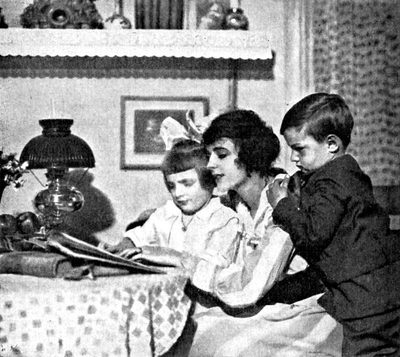
Courtesy McClure's Magazine
While the Men Fought, Those Left Behind Bought Bonds
Not all brave hearts beat under khaki during the war. More than $20,000,000,000 was raised by the four Liberty Loans and the Fifth Victory Loan. Among those who bought bonds were hundreds of thousands of wives and children of the men at the front.
Click for a larger image.
Russia was the first of the Entente Powers to issue public loans. On September 14, 1914, it issued a 5 per cent. loan at 94, yielding $259,000,000. This was followed at regular intervals by six more loans prior to the revolution of 1917. After the revolution there was considerable confusion which, of course, was much accentuated by the advent of Bolshevism. The consequence was that the public debt of Russia, which amounted for July, 1914, to $4,623,000,000, increased by the time of the October revolution in 1917 to 49,288 millions of rubles or 25,383 millions of dollars. This would mean a war debt of almost twenty-one billions of dollars. As a matter of fact of course it is very uncertain whether the debt will ever be redeemed at these figures.
The debt of Italy before it entered the war amounted to lire 13,636,000,000 or $2,621,000,000. Italy started at once with a so-called mobilization loan followed by its first war loan in July, 1915, and successive war loans on the first of January of each of the following years. The result was that on October 31, 1918, the total debt amounted to lire 63,093,000,000 or $12,177,000,000. By the end of May, 1919, the debt had grown to 77,763,000,000 lire or $15,009,000,000 leaving as the war debt lire 64,127,000,000 or $12,388,000,000.
Of the Central Powers, Germany started at once on October 1, 1914, to issue a war loan at 5 per cent., having from the outset decided to rely upon comparatively long time bonds rather than upon temporary or short time securities as was the case in England and in France. There followed in regular succession eight war loans bearing 4½ and 5½ per cent. interest. As a result, the debt of Germany, which before the war amounted to Mk. 4,732,000,000 increased on October 31, 1919, to Mk. 204,000,000,000 or $48,552,000,000; the war debt proper in Germany would therefore amount to $47,426,000,000.
TOTAL WAR DEBT, UNITED STATES
When the United States entered the war it depended, for the time being, on temporary war certificates. But at the beginning of June, 1917, Liberty Loans were issued in continually greater dimensions. In the table below the details of the four Liberty Loans and the Fifth Victory Loan are given, showing that over $20,000,000,000 were raised from bonds alone. To these is to be added the unfunded loans. It appears that the total net debt of the United States, which in April, 1917, was $1,190,000,000, increased by June 30, 1919, to $24,232,000,000, making a war debt of $23,042,000,000. Inasmuch, however, as somewhat over a billion dollars from the Victory Loan will be paid in the course of the year 1919—20, and as still more will have to be borrowed temporarily, the total war debt of the United States by the end of 1920 will amount to over $25,000,000,000, including the nine billions advanced to the Allies.
UNITED STATES
In Millions
Debt Less Cash in TreasuryAnnual Interest Charge
April 5, 1917$1,189$23
June 30, 19171,90984
June 30, 191810,924466
June 30, 191924,233619
DEBT ON JUNE 30, 1919
Bonds
Pre-war bonds833
War loans
First Liberty Loan$1,985
Second Liberty Loan3,566
Third Liberty Loan3,959
Fourth Liberty Loan6,795
Victory Loan (notes)3,46820,455
Treasury Certificates3,634
Old debt on which interest increased2
Non-interest bearing debt236
———
Total gross debt25,485
Cash on hand1,252
———
Net debt(In Millions) $24,233
The other belligerents need not be treated separately. The total pre-war debt, including Japan, whose debt was increased only by the money raised to loan to Great Britain and France, amounted to almost $28,000,000,000. The debt at the close of the war amounted to over $224,000,000,000, making the net war debt somewhat over $196,000,000,000. When we compare this with the total cost of the war, which, as we have seen, will amount to about $210,000,000,000, it appears that almost the entire cost of the war will have been defrayed from loans, the difference of well-nigh $15,000,000,000 derived from taxation being due almost entirely to the efforts of Great Britain and the United States respectively.
PUBLIC DEBT OF THE BELLIGERENTS
000,000 omitted
Before the warAfter the warWar debt
Great BritainAug. 4, 1914£650 = $3,165Mar. 31, 1919£7,643[21]= $37,221$34,056
AustraliaAug. 4, 191497 = 472Jan. 31, 1919[22]336 = 1,6341,162
Canada.Aug. 4, 1914332Mar. 31, 19191,5841,250
New ZealandAug. 4, 1914100 = 487Mar. 31, 1919170 = 828341
South AfricaAug. 4, 1914126 = 614Mar. 31, 1919175 = 846332
British Empire$5,070$42,213$37,143
FranceJuly Empirefr. 32,594 = $6,291Dec. 31, 1918fr. 167,459 = 32,32226,031
RussiaJuly 1914ru. 8,800 = 4,623Jan. 1, 1918ru. 49,288 = 25,38320,760
ItalyMay 1915li. 13,636 = 2,621Oct. 31, 1918li. 77,763 = 15,00912,388
BelgiumAug. 2, 1914fr. 3,743 = 722Apr. 30, 1919fr. 9,787 = 1,8881,166
RumaniaAug. 1916292Oct. 31, 19181,020728
SerbiaJuly 1914271Oct. 31, 1918730459
JapanJuly 1914yen 2,494 = 1,190July 31, 1918yen 2,530 = 1,26518
United StatesApr. 5, 19171,190June 30, 191924,23223,042
Entente Powers$22,327144,062121,735
GermanyAug. 1, 1914mk. 4,732 = $1,126Dec. 31, 1918mk. 204,000 = $48,35247,426
Austria-HungaryAug. 1, 19143,726Oct. 31, 1918kr. 137,858 = 25,58424,858[23]
TurkeyNov. 1914LT 112 = 485Oct. 31, 1918LT 455 = 2,0021,517
BulgariaOct. 4, 1915219Oct. 31, 1918974755
Central Powers$5,556$80,112743,556 74,556
TotalIn Millions $27,883In Millions $224,174196,291
French School Children Waiting to Welcome General Pétain
Click for a larger image.