The Great Results of the War PART I I—ECONOMIC RESULTS OF THE WAR (continued 2)
Reading edition
All of the great wars in European history have been followed by periods of increased production and economic expansion. Experts are convinced that the World War will prove no exception to the world's previous experience. Wars have been the principal influence that have determined the course of commodities and prices. In the Napoleonic Wars the index number rose seventy-two points in twenty years, but during the four years between 1914 and 1918 there was a rise of one hundred and eight points in four and a half years, a movement which Edgar Crammond, widely known British expert in economic and financial affairs, declared to be a movement to which there was no precedent in point of rapidity or magnitude. In an address outlined in the New York Journal of Commerce this authority estimated the direct cost of the war to the Allies as being roughly $145,000,000,000. The Central Powers had spent about $60,000,000,000. The total cost in dollars he estimated at $260,000,000,000. The upheaval caused by the war was manifested, according to the same authority, in the rise of the cost of living and in the universal increase of wages. Other economic consequences will be more gradually unfolded. Prospects of fall in the price of commodities and wages as the result of peace, he thinks, will be arrested for two reasons: First, the vast increase in the amount of paper money; second, the huge amount of public debts to the belligerents. He saw an additional psychological cause in the attitude of the laboring classes to maintain wages at a higher level than before the war and to improve the standard of living.
Reduced production is sufficient to account for all the economic disturbances that were produced during the war, according to the London Statist, which says:
"It is enough to say that production is reduced almost to a minimum, while consumption is going on at a most extravagant rate. Those who wish to pose as economists without competent knowledge are telling the public that all the evil is due to this, that, and the other thing—such, for example, as inflation, the rise in prices, the enormous loans raised, and several other fads. It is pure moonshine. The world is impoverished, firstly, because so much of the world's manhood is withdrawn from production to consumption; and, secondly, because reduction in production is so serious that very little has been saved either by the belligerents or the neutral countries of Europe, at all events. International trade is really carried on by barter. It is true that money is frequently paid. At the present time money has in some markets to be paid because credit has been injured, and those who possess wealth are not as willing as they used to be to trust to mere credit."
QUESTIONS OF INFLATION
The enormous advance of prices in England was synchronous with the issue of currency notes to an excess of £700,000,000 beyond the gold reserve. High officials in British administration ascribed this rise to the increased consuming capacity. According to the British Board of Trade a sovereign could purchase no more during the war time than eleven shillings would just before the war started. A writer in the Fortnightly Review, Mr. W. F. Ford, quotes Jevons' remark in his classical book on money in explanation of the phenomenon. "A number of bankers all trying to issue additional notes resemble a number of merchants offering to sell corn for future delivery, and the value of gold will be affected as the price of corn certainly is. We are too much inclined to look upon the value of gold as a fixed datum line in commerce, but in reality it is a very variable thing." Substitute today the word Government for bankers and one can see the reason for the upward rise in prices. This rise would take place apart from any questions of war waste, profiteering, difficulties of transport by sea or land or shortage of labor. All the countries involved have followed the same policy of inflation. The operation is depicted in the following passage:
"The inevitable result of extensive note issues by a number of Governments was that prices were irresistibly impelled upwards in all belligerent countries—apart from any questions of war waste, profiteering, difficulties of transport by sea or land, or shortage of labor. Belligerent countries became extraordinarily good markets in which to sell goods; and a golden harvest was temptingly displayed to neutral nations, in whose favor enormous trade balances rapidly grew up. In large part these balances were met by payment in gold.... But just as gold substitutes in the shape of paper money swelled the currencies and increased prices in the belligerent countries, so also the large quantities of gold coin sent to neutral States in payment for goods supplied to the warring nations swelled the currencies and increased prices in the neutral states themselves. The withdrawal of gold set up a natural tendency for prices to fall in the countries from which it had been exported; but not only was this tendency overcome, but the upward movement of prices was continued by the action of the several Governments in placing still further issues of inconvertible paper money on their respective markets. The net results have been that currencies have been inflated and prices forced up all over the world, that inconvertible paper money is tending more and more to drive out gold from the currencies of the states that issue it, and that the gold so driven out is being absorbed into the currencies of the neutral nations. Between August, 1914, and the date of her own declaration of war, America increased the amount of her gold currency by approximately £200,000,000 sterling. No real benefit has accrued.
"The currencies of the whole world have been artificially inflated to the extent that, under the most favorable circumstances existing in any part of the world, £5 are now needed to do the work in circulation that before the war was accomplished by £3. The loss to people with fixed incomes, the disturbance of trade, the potential labor difficulties are stupendous. And as a result of purchasing war material at excessively high prices, the dead weight of debt incurred by all the countries at war is very much greater than it need have been had currencies been kept within reasonable bounds."
CURRENCY EXPANSION IN GREAT BRITAIN
In Great Britain £200,000,000 worth of new paper currency was placed in circulation and there was a considerable expansion in the use of banknotes, silver and copper coinage. Proposals were made that the famous English Bank Act should be repealed and that excess issues of banknotes should be made legal on the payment of a tax. But apart from these theories of involving the banking system there was a good deal of adverse criticism.
"Mr. Herbert Samuel made a masterly attack upon the vicious system of War Finance, by which no less a sum than £196,170,000 is added to the expenditure by bonuses and increases of wages, which, in their turn, only force prices still higher and raise the cost of living. Lives have been conscripted; incomes have been conscripted; the only thing which has not been conscripted is labor. If the Government had at an early stage of the war had the courage to fix wages, instead of prices, the cost of living would then have been regulated by supply and demand. By fixing prices of commodities, after they had risen to almost famine figures, we have the maximum of loss and inconvenience, high wages, dear food, and a war bill that increases day by day. Despite Mr. Bonar Law's assurance that the bill of the year would not be so high as he expected, we have the fact that we are spending over seven millions a day. The satire of 'the cheap loaf' consists in its cost to the nation at large of £45,000,000 a year. Bonuses to munition workers amount to £40,000,000, bonuses to miners come to £20,000,000, to railway workers £10,000,000, to potato growers £5,000,000. Is this anything else but a system of gigantic corruption? In order that artisans and agriculturists may be kept in good humor with the war, they are bribed with bonsuses bonuses and allowed to buy food at prices which are partially paid by the rest of the community. If ever there was a case of robbing Peter to pay Paul it is here."
AMERICA'S EXPERIENCE WITH INFLATION
Protests against war inflation were not confined to British specialists in finance. What is inflation? As used by the more careful writers on the subject today, it is taken to signify the increase of bank credits not represented by any immediate addition to current wealth. For example, if the Government borrows by an issue of bonds, such bonds taken by the banks, and payment for them made in the form of bank credit which is at once transferred to individuals who have furnished labor or supplies, it is evident that there has been a net addition to the purchasing power of the community not represented by any corresponding addition to wealth whether of a saleable or available form. Mr. Delano, a member of the Federal Reserve Board, said that the war had produced a world inflation the like of which had never occurred before—"The usual symptoms of such methods of inflation are the disappearance of metallic money and the general advance in the prices of commodities." He gives the following illustration of what has taken place in this process of inflation:
"Prior to our entry into the war, when the European nations were buying heavily in the United States, they paid largely in gold for what they bought, and as a result about a billion dollars in gold coin came to this country in the period of two and one-half years. The reason the European nations were able to send us their gold was that they printed paper money for their own use, releasing gold for us. But that gold inflation in this country is one explanation of the general advance in prices of all commodities, although undoubtedly it is not the only explanation; for it must be freely admitted that prices have been affected, first, by scarcity, occasioned by increased demand from Europe for many articles produced by us; second, by reason of the fact that increases in taxes and wages of labor have entered into the cost of production and sale of all articles and account for a share of the increased prices of commodities."
CIVIL WAR INFLATION.
The United States had large experience with inflation during the Civil War. Some $500,000,000 were in this way added to the cost of the war which might have been avoided. A plain statement of the real incidents of inflation is given by Mr. A. C. Miller of the Federal Reserve Board in his Financial Mobilization for War, in the following passage:
"For let it not for a moment be overlooked that inflation, in its effects, amounts to conscriptive taxation of the masses. It is, indeed, one of the worst and the most unequal forms of taxation, because it taxes men, not upon what they have or earn, but upon what they need or consume. The only difference for the masses between this kind of disguised and concealed taxation and taxes which are levied and collected openly is that in the case of the latter the government gets the revenue, while in the former case it borrows it, and those to whom it is eventually repaid are not those, for the most part, who have been mulcted for it. Inflation therefore produces a situation akin to double taxation in that the great mass of the consuming public is hard hit by the rise of prices induced by the degenerated borrowing policy and later has to be taxed in order to produce the revenue requisite to sustain the interest charge on the debt contracted and to repay the principal. The active business and speculative classes can usually take care of themselves in the midst of the confusion produced by inflation and recoup themselves for their increasing outlays. Indeed inflation frequently makes for an artificial condition of business prosperity. That is why war times are frequently spoken of in terms of enthusiasm by the class of business adventurers. But it is a prosperity that is dear-bought and at the expense of the great body of plain living people. It would be a monstrous wrong if in financing our present war we should pursue methods that would land us in a sea of inflation in which the great body of the American people, who are called upon to contribute the blood of their sons to the war, were made the victims of a careless or iniquitous financial policy."
INFLATION ILLUSTRATED.
One of the ways in which inflation was caused in the United States during the war period was the plan adopted by the banks of financing the loan directly by means of bank credits to the buyers. According to Mr. Carl Snyder the banking officials roughly agree that on the first Liberty Loan for $2,000,000,000 the banks may have loaned somewhere near half the total and on the second loan even more. Of course, this means a heavy expansion of bank credit. Economists are generally agreed that the flooding of the country with paper money brings about an enormous rise in prices. They differ chiefly in regard to the degree of inflation. The most accepted statement of inflation is that prices vary directly as the volume of the actual currency employed and its rate of turn over or velocity, and inversely with the volume of trade. The effect of bank credits is exactly that of an excessive issue of notes; that is, if they are expanded more rapidly than the actual volume of business there is a rise in prices, that is to say there is inflation.
The situation of the country during the war in regard to business was put plainly by Mr. Snyder in the following words: "Railroads cannot haul any more goods. The government is already stepping in to shut down on shipments on certain lines of industry. We can not get any more coal unless labor is drafted from other industries, and as a whole we cannot get any more labor as is evident from the fantastic wages that are now being paid. In a word, production and therefore the actual volume of exchange is practically at the limit and has been for a year or more. No expansion of bank credits can put this production any higher. It follows, therefore, as a practical fact that any expansion of bank loans now means inflation—to all practical intents dollar for dollar." Because of the introduction of a billion dollars worth of gold into the country, prices have risen nearly one hundred percent. The expansion of bank credits increases the cost of living and the cost of the war will be doubled.
Some bankers estimated that if the war lasted the expansion of bank loans might reach $50,000,000,000. The progress of these loans was encouraged by the cutting of the required metallic reserve under the new Federal Reserve system and the system of book credits with the Federal Reserve banks allowed to the banks that are members of the system. The following is Mr. Snyder's description of the way the inflation was encouraged.
"Every dollar of gold may become three dollars of Federal Bank credits and each dollar of this may in turn become the basis of eight dollars of credits for the Central Reserve cities, ten dollars for the smaller cities and fifteen dollars for the country banks, which works out to a practical average of ten dollars for all the banks in the Federal Reserve system."
He then went on to speak of the possibilities of this inflation and uttered a warning of the danger, because the only obstacle in the way was the good sense and conservatism of the American banks. Some authorities hold that a war cannot be fought without inflation. Mr. Snyder thought that the United States with large ante-war income could and should have tried the experiment. People want easy money and flush times. If credit were contracted there would be tight money and a high interest rate. Mr. McAdoo and the Administration at Washington feel highly elated when they roll up five billion of statistics, half of which are merely bank rolls. It seems not to matter that all this may add two or three billion to the already swollen credit currency and that the millions of poor people, small investors and life insurance holders who cannot expand their income in any adequate way must pay the piper. These are the millions who rarely have any voice in national affairs, and all the more so because they are for the most part ignorant. It seems an idle consequence that we may spend perhaps ten long weary years of hard times, of falling prices, declining business and sharp distress, paying for the orgy of inflated prices, waste and extravagance in which we are now indulging.
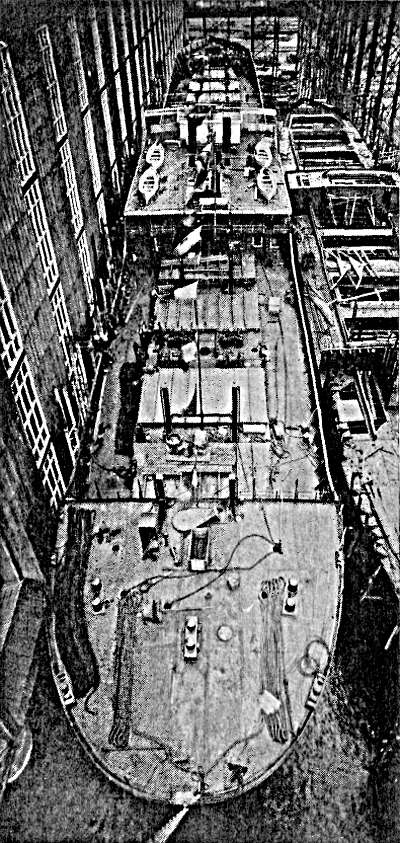
Photo by Paul Thompson
Ship-building at Camden, N.J.
One of the financial effects of the war was the transformation of the United States from a debtor to a creditor nation. Immense private fortunes were made. In no industry was there a greater boom than in ship-building.
CREDIT EXPANSION
The wide expansion of credit can be studied by making a comparison of the gold holdings of the leading nations. For example, in 1914 just before the outbreak of the war, the amount of cash held by all the banks of the United States was estimated at about $1,639,000,000. Of this amount about $913,000,000 was in the form of gold or gold certificates. Upon this basis there rested a structure of credit amounting to $21,351,000,000. In other words the gold basis of the country's deposit credits amounted to 4.27 percent.
In 1916 the cash held was $1,911,000,000; about $1,140,000,000 was in gold; and on this basis there rested a credit structure of $28,250,000,000.
UNITED STATES A CREDITOR NATION
One of the financial effects of the war was the transformation of the United States from a debtor to a creditor nation. The reconstruction period in finance is certain to bring about a situation described by a writer in the Wall Street Journal as one of the most interesting developments known in financial history. Financial waste in emergency measures was a superficial side of America's part in the World War. But this writer considers that what happened during the war was not altogether financial waste:
"A great upheaval took place in the world of finance. Credit resources were brought to the fore and nations established on a financial basis of far-reaching importance, but of a kind that had only a secondary place before.
"The war has turned the United States from a debtor to a creditor nation. Formerly we owed abroad something like $4,000,000,000, about three-quarters of which sum we have bought back. Moreover, Europe now owes us about $9,000,000,000—on private account; about $2,000,000,000 in securities; in United States Government obligations over $7,000,000,000. The world is under obligations to us in interest alone of between $400,000,000 and $500,000,000 a year."
After the United States took an active part in the war large credits and loans were made in behalf of other countries as the following excerpt shows:
"A total appropriation of $7,000,000,000 has been made, $3,000,000,000 by the Act of April 24, 1917, and $4,000,000,000 by the Act of September 24, 1917. Under these authorizations credits have been established in favor of the governments of Great Britain, France, Italy, Russia, Belgium, and Serbia. These loans, up to January 17, 1918, are given in the following table:
CountryLoans and CreditsLoansBalances Under
Agreed UponMadeEstablished Credits
Great Britain$2,045,000,000$1,985,000,000$311,070,250 60,000,000
France1,285,000,0001,225,000,00050,000,000 60,000,000
Italy500,000,000450,000,00050,000,000
Russia325,000,000187,729,750137,270,250
Belgium77,400,00075,400,0002,000,000
Serbia6,000,0004,200,0001,800,000
Totals$4,238,400,000$3,927,329,750$311,070,250
"On the basis of the requests being made on the Treasury, it is estimated that credits aggregating approximately $500,000,000 per month will be required to meet the urgent war needs of the foreign governments receiving advances from the United States. At this rate approximately the entire appropriation authorized by Congress will be accredited to our Allies by the close of the present fiscal year (June 30, 1918).
"A significant feature of the loans floated in this country in the last three and a half years has been the fact that many states and municipalities which formerly went to London to sell their securities have recently been financed through the United States. About $150,000,000 of the Canadain Canadian loans went to provinces and municipalities, and many of the South American obligations were contracted for municipal improvements. The neutral nations of Europe have also sought accommodation in the American money market. Loans have been made to the city of Dublin, Ireland, the London Water Board, and the French cities of Paris, Bordeaux, Lyons, and Marseilles."
DISAPPEARANCE OF GOLD CURRENCY
During the war gold almost ceased to be currency in all the Allied countries. The Central Powers at the end of the struggle had comparatively little. Of the total gold production the United States produced about twenty-five percent., while the British Empire produced nearly sixty-four. A writer in the Edinburgh Review proposed to take the opportunity of creating a standard price for gold. For example, if the standard price of gold were reduced to half, the prices of all commodities would come down in sympathy. We must take advantage of the fact that we are working with a paper currency, and all authorities agree that financial stability is only secured by the backing of as much gold as possible against paper securities and emergencies.
The plan involved an increase of the standard price. The success of the scheme depends upon the concordant will of the United States and Great Britain to adopt it as the following article suggests:
"Obviously if Great Britain or any other country alone attempted to alter the standard price of gold, and therefore the value of the present sovereign (or its equivalent), the currency would be debased, instead of being enhanced. It would also in effect amount to a partial repudiation of national debt. A standard ceases to be a standard if one nation can arbitrarily alter it, but surely there can be no argument against the creation of a new standard sanctioned by the whole civilized world for their mutual advantage. If Great Britain and the United States were to proclaim their desire to adopt my scheme it is hardly likely that any country other than the Central Powers would fail to welcome it. Spain, for instance, has increased her gold reserve to about £80,000,000 and greatly enhanced the value of her currency thereby. Would she fail to grasp the happy chance of making this £120,000,000, and would any country continue to part with its gold at £4 per ounce when it could get £6 or £8?"
WAR'S EFFECT ON SILVER
Along with all other commodities, that cinderella of finance—silver—had a share in the general rise in prices. One of the reasons is the enormous falling off of silver production in Mexico, where one-third of the total world supply is produced; another is the great demand for silver. Prior to the war, the use of silver plate by the wealthy classes had largely fallen off; but the war, because of the rise in wages, brought about a largely increased demand for silver to be used in ornaments:
"The war has brought into the market a vast number of new buyers for ornaments, whose demand in the aggregate is estimated to more than compensate for the falling off in the purchases by the wealthy classes of silver plate. Wages everywhere, not merely in England, but practically all over the world, have advanced, and particularly in Western Europe; moreover, immense numbers of women, and even children, are being employed who were not employed before, and those who were employed before have a larger income, particularly amongst the wage earning classes, than has been the case in this country for many years past."
The use of silver in coinage, too, was notably increased. Gold disappeared in countries where gold coins were used; paper money and silver token money took its place. Another reason for the advance in silver is connected with the demand for the metal in eastern countries. According to the London Statist:
" ... About half the annual production of silver throughout the world is absorbed by the East, meaning principally India and China. It has to be borne in mind that prices in the East have advanced as well as in Europe and the two Americas, and, consequently, more token money is required there as well as here. Silver is the standard of value, and not token money at all, in China; and in India, while gold is nominally the standard of value, the rupee is the actual coin in which the Indian natives, as distinct from mere government officials, reckon their wealth. Now, as one result of the war, nearly all the governments forbid the export of gold; consequently, India requires a steadily increasing supply of silver, not merely to do the work that silver did before the war, but, in addition, to supply the void created by the prohibition of the export of gold."
STOCK EXCHANGE WAR
The accompanying diagram showing how military operations in Europe affected the average prices of fifty stocks, half industrial and half railway, was published in the New York Times Annalist:
The wider black area shows the high and low average prices of the twenty-five industrials included in the fifty, and the white area the corresponding figures for the twenty-five rails. The lines begin at a time when Germany was suffering severely from her failure at Verdun and from losses in men and territory from the great Allied Somme offensive. The subsequent rapid decline (November to February) embraces the period of Bethmann-Hollweg's sensational peace offensive, followed a few weeks later by Germany's intensified submarine warfare. The lowest point of all (December, 1917) was reached after Germany's successful counter-thrust for Cambrai, her "peace offensive" with the Bolsheviki at Brest-Litovsk, and the taking over of our railroads by the government.—Literary Digest, October 19, 1918.
A further indication of how military operations reacted on Stock Exchange quotations was shown in the decided improvement that took place since the end of July, 1918, after the Germans were pushed back in their drive towards Paris. The most direct way of measuring this influence is to take the quotations for the bonds and notes of the Allied Governments dealt in at the New York Stock Exchange since 1915:
"The lowest quotations for these bond and note issues were reached in 1917, when the cause of the Allies assumed a gloomy appearance. The depression was aggravated by the general decline of the entire securities market in the later part of that year. Some recovery occurred by the end of last year, but the beginning of 1918 saw them still depressed. Last March, April, May and June, when the great German drives were in progress, they showed little disposition to break, but after the active participation of the American Army in the fighting began and news came that the counter-offensive had assumed a decided and successful phase, an assertion of strength took place in foreign government bonds, carrying quotations 'not only to the highest of the year, but in some instances to the best figures attained since they first made their appearance in the American market.' The following tabulation is presented by Bradstreet's as giving the range of prices for the most prominent bonds and short-term notes of foreign countries during 1917 and 1918, with the quotations for them on August 22nd:
/——1917——\/——1918——\Aug.
HighLowHighLow22
Am. For. Sec. 5s.1919977/8909894½97½
Anglo-French 5s.192095817/89588¼94¾
Canada 5s.19261008995907/892
Canada 5s.1931100¼87½94887/8923/8
Fr. Republic 5½s.191910191½9994987/8
U. Kingdom 5s.1918985/895½10097997/8
U. Kingdom 5½s.1919987/893¼99¼95¼98¾
U. King. 5½s, new19191019/1695¼1009¾995/8
U. Kingdom 5½s.192198½84½95¾915/8953/8
French Cities
Paris 6s.1921967/873½921/8815/8917/8
Bordeaux 6s.1919967/87495½84947/8
Lyons 6s.1919967/87495½8494¾
Marseilles 6s.1919967/87495½8494¾
Russian Govern.[6]
External 6½%98¾4564½3361
External 5½%1921985/83660½34½57
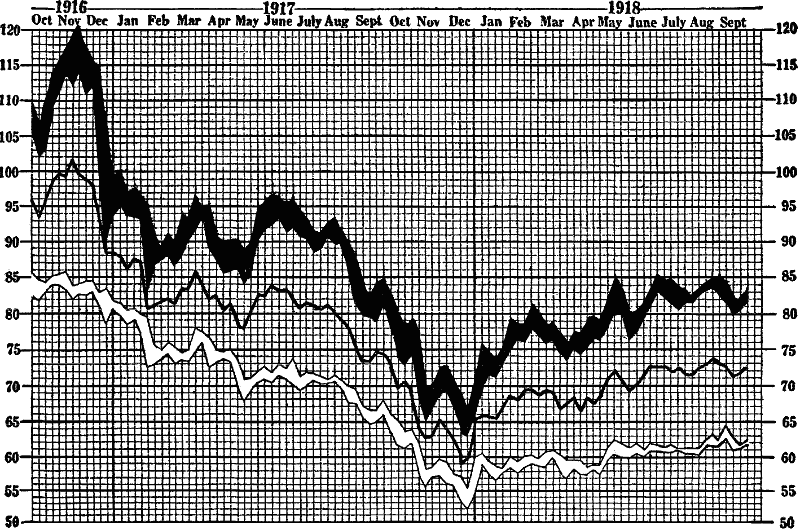
Diagram Showing the Effect of the War on the Prices of Stocks
(See explanation on page 32)
"British issues, as shown above, declined least of all, 'and consequently had less ground to regain in the rise,' Bradstreet's adds:
"The feeling of confidence in England's credit has all along been a factor in connection with its American obligations. This will doubtless be strengthened by the announcement made this week that the United Kingdom secured 5 per cent. notes, due September 1, 1918, will be paid at their maturity on that date. There were originally $250,000,000 of these notes, which were sold in our market in 1916; but the outstanding issue has been reduced to about $180,000,000 by purchases in the market for redemption. French obligations have been one of the chief features of the advance. As will be seen from the above table, the French Republic 5½ per cents., due 1919, have risen 6 points from the low figures of the year. The 6 per cent. notes of the French cities, Paris, Lyons, Bordeaux, and Marseilles, with rises of about 10 points each, are conspicuous examples of the good effects following the checking of the German advance and the counter-offensive launched by the Allies and the American Army. No division of this part of the bond market has, however, shown such a marked improvement as the Russian external or dollar bonds, which though not listed at the Stock Exchange, are dealt in extensively on the New York Curb market'."
GERMAN PROPERTY IN AMERICA
Until the United States entered the war with Germany it had never been realized that an enormous share of the economic wealth of the country was under German control. Attorney-General Palmer, in an address at Detroit, estimated this share to be about two billion dollars in money value, with an economic and political value far greater:
"Furthermore, this structure was 'designed so to hold American industry as to frustrate the organization of our resources in case of war.' With two hundred American corporations controlled by the financial and military power in Germany, we had a situation that 'might easily have been fatal in America had it not been discovered in time.' When the war began in 1914 the structure 'had become so large and powerful and was so firmly entrenched in the industrial life of our country that its real commanders in Germany cherished the hope that it would prove the make-weight which would keep America out of the war, or, failing in that, constitute a powerful ally of the German cause in our very midst.'" Mr. Palmer added:
"'During the last twenty-five or thirty years Germany had built up upon American soil a structure reaching into every part of the country and stretching its arms across the seas to fasten upon Porto Rico, the Virgin Islands, Hawaii, and the Philippines. Congress has declared that all these enemy properties shall be managed and administered by the Alien Property Custodian with all the powers of a common law trustee, the proceeds to be distributed after the war in such manner as the Congress may determine. This means that the final disposition of the properties or the funds realized from their sale will be a topic for discussion and a subject for settlement at the council table of the nations at which permanent peace shall be restored to the world.
"'This being so, it seems to me to be an important part of our work to capture the army which Germany skilfully and craftily planted midst the busy wheels of American industry, and to break, never to be again repaired, the industrial and commercial chain which Germany has stretched across the American continent and our insular possessions. I would let Germany understand now that her plan has dismally failed. I would let her understand now that no matter how long she fights, or what sacrifice she makes, or what price she pays, however much territory she may occupy, or whatever worlds she may conquer, there is one place which she will never soil again with the tramp of the marching legions of her industrial army. That is the United States of America. I would divorce utterly and forever all German capital from American industry'."