Part 1 — VIII—FOOD AND THE WAR How Scientific Control and Voluntary Food-Saving Kept Belgium from Starving and Enabled the Allies to Avert Famine
Reading edition
By VERNON KELLOGG
Member of the Commission for the Relief of Belgium
America was made familiar with a slogan during 1917 and 1918 which declared that "Food Will Win the War." The European Allies became familiar from the very beginning of the war with the fact that without much more food than they could count on from their own resources they could not hope to win the war. And it became equally obvious to Germany and her associates that if their normal food resources were materially impaired they also could not hope to win the war.
So there arose almost from the beginning of the great military struggle an equally great struggle to get food and to keep food from being got. The Allies, devoting their manpower to fighting and munitions-making, saw their farms doomed to neglect and their food reduction doomed to lessen. And they began their call on America for food in such quantities as America had never dreamed of exporting before. In the last years before the war we had been sending about five million tons of foodstuffs a year to Europe. In 1918 we sent over fourteen million tons. Also the Allies began trying, by their blockade, to prevent the Central Empires from adding to their own inevitably lessened native production by importations from without.
On the other hand, Germany and her associates began to husband carefully their internal food supplies by instituting a rigid, or would-be rigid, control of internal marketing and consumption, and to collect from any outside sources still accessible to them, such as the contiguous neutral lands, whatever food was possible. Also they had strong hopes of preventing, by their submarine warfare, the provisioning of the Allies from America and other overseas sources.
Thus, from the beginning of the war, and all through its long course, food supply and food control were of the most vital importance. If our epigrammatic slogan, "Food Will Win the War," was, like most epigrams, not literally true, it was, nevertheless, literally true that there was always possible to either side the loss of the war through lack of food, and it is literally true that the food victory of the Allies was a great element in the final war victory. Germany's military defeat was partly due to food defeat, and if a military decision had not been reached in the fall of 1918, Germany would have lost the war in the spring of 1919 anyway from lack of food and raw materials.
ECONOMIC SELF-SUFFICIENCY
The great struggle for food supply and food control involved so many and such complex undertakings that it is hopeless to attempt a detailed account of it in any space short of a huge volume. Yet the very limitations of the present discussion may have its advantages in compelling us to concentrate our attention on the most important aspects of the struggle and to try to sum up the most important results of it. Some of these at least should not be forgotten, for they have a bearing on the peace-time food problem as well as the war-time one. Fortunately the war-time food situation has developed in us a national and an individual food consciousness that will certainly not disappear in this generation at least.
The first important lesson that has been learned is that it is of great value to a nation to be able to provide in its own land its own necessary food supply. For although in times of peace and usual harvests international food exchanges enable a country, such as England or Belgium, highly industrialized and of large population in proportion to area, to make up without much difficulty its deficit as between production and consumption, the moment the great emergency arrives there is the utmost danger for its people. The history of the "relief of Belgium" during the war will illustrate this.
$600,000,000 WORTH OF FOOD SUPPLIED
This little country, famous through all past history as a battleground and now famous for all future time for its heroic and pathetic rôle in the World War, found itself at the very beginning of the war faced with a food problem that seemed at first insoluble, and which, if not solved, meant starvation for its people. It is a country highly industrialized, and with an agriculture which, though more highly developed as to method than that of almost any other country, was yet capable of providing but little more than a third of the food necessary to its people. It depended for its very life on a steady inflow of food from outside sources. But with its invasion and occupation by the Germans this inflow was immediately and completely shut off. Belgium was enclosed in a ring of steel. What food it possessed inside this ring disappeared rapidly.
The terrible situation was met in a way of which Americans may be proud. For the Commission for the Relief of Belgium, which was the agency that solved Belgium's great problem, was an American organization with a staff composed chiefly of young Americans, most of them from American colleges and universities, headed by an American, Herbert Hoover, of great organizing and diplomatic genius, and with the large heart of a world philanthropist. In the four and a half years from November 1, 1914, to May 1, 1919, which was the period of activity of the Commission, Belgium depended upon it for the supplying of three-fourths of the food of its people, over seven million in number. This amounted to about one million tons a year. In addition, the Commission supplied the food through practically all this period for the maintenance of the nearly two million unfortunate people in the German-occupied area of France. This amounted to a total of about one million tons. The total value of the food supplied to Belgium and occupied France was about six hundred million dollars, which was provided by the Governments of Belgium, France, England, and America, and the private charity of the world.
THE FOOD PRODUCTION OF GERMANY
For another impressive war-time food problem—which did not have the same solution as Belgium's—let us take that of Germany. In peace times the Germans produce about 80 percent. of the total food annually consumed by them. But their tremendous military effort necessarily entailed some reduction in their capacity for food production, although they also made a tremendous effort to stimulate and direct into most effective channels the native production of food.
Although it is true, as already stated, that Germany normally produces about 80 percent. of her food needs, making it seem possible for the nation to meet the blockade emergency by repressing consumption by 10 per cent. and increasing production by 10 per cent. this does not mean that they normally produce 80 per cent. of each kind of food consumed by them. As a matter of fact, they produce more than their total needs of certain kinds of food, as sugar, for example, and less than 80 per cent. of certain other kinds. And while there is a possibility of substituting, within certain limits, one kind of food for another, so that a shortage of wheat might be made up by an abundance of rye, or a shortage of bread-grains in general be made up, in some degree, by increasing the ration of potatoes, if they are available, this substitution cannot go to the extent of substituting pure carbo-hydrate or starchy foods like potatoes, which simply produce heat or energy for the body, for the protein foods like meat, fish, eggs and dairy products which produce not only energy but new tissues. A child must have protein food in order to grow; an adult must have it in order to replace the tissues worn out by daily work. Also, there are certain peculiar and so far little understood elements, called vitamines, found only in certain kinds of food, notably fats, milk and the green vegetables, which are essential to the proper metabolism of the body.
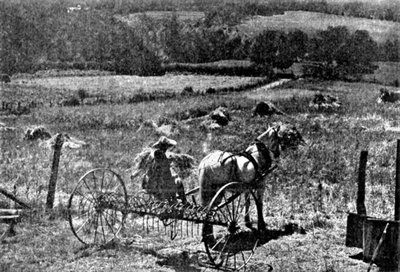
Photo by P. Thompson
The Battle Scene at Home
During the war the Allies called on the United States for food in far greater quantities than we had ever dreamed of exporting. For example, in the last years before the war we had been sending yearly to Europe about five million tons of food. In 1918 alone we shipped more than fourteen million tons of foodstuffs overseas.
Click for a larger image.
GERMANY'S FOOD PROBLEM
Now in the light of these needs for proper feeding, and in the light of the special conditions produced by the war, what was Germany's food problem through the war? It was that of attempting to increase production when the men and work animals had been sent to the fighting lines, of repressing consumption when both men in the army and the men in the war factories had to be well fed in order to fight well and work well, of attempting to get in food from outside the country when a blockade was steadily closing the borders ever and ever more tightly, and finally, of trying to get the people to modify their food habits in the way of accepting substitutes and using strange new semi-artificial foods in place of the familiar staples.
In 1916 the potato crop of Germany was a failure—but the turnip crop was enormous. So turnips were substituted largely for potatoes, and for many other kinds of food as well. Even marmalade and coffee substitutes were made from them, and turnip meal was mixed in the already too coarse and too much mixed flour. The Germans will never forget that terrible kohl-rüben zeit, or turnip time, of late 1916 and early 1917. And it was just after this time that the effects of Germany's great food difficulties began to show in a really serious way; they began to undermine the strength and health of the people. Those diseases like tuberculosis, which can rest in incipient or suppressed form for years without becoming serious as long as the body is well nourished, began to develop rapidly and dangerously. The birth rate decreased and the death rate increased. The physical and mental and moral tone of the whole nation dropped.
THE SUGAR SHORTAGE
Belgium and Germany illustrate a special food situation created by the war, namely, one in which a country, which relied on outside sources for a greater or lesser part of its food needs, had access to these sources suddenly and almost completely shut off. But grave food problems also confronted the countries which were not blockaded in so specific a way. England and France, with full access to all the great food-producing lands overseas (except to the extent that the submarines reduced this freedom of access), nevertheless had food problems hardly less serious than those of the more strictly blockaded countries. Their difficulties arose primarily from the fact that there was only so much shipping in the world and that the war conditions created suddenly a need for much more shipping than existed. The transference of large numbers of troops with their necessary equipment and munitions from the distant colonies to the European seat of fighting, and of other numbers from the mother countries to extra-European battlegrounds, made great demands on the shipping available to these nations. At the same time, the reduction of their native production increased largely their needs of food importations.
Take, for example, the case of the sugar supply for England and France. England is accustomed to use about 2,000,000 tons of sugar a year but she does not produce, at home, a single ton. She had relied before the war chiefly on importations from Germany and Austria with some little from Belgium and France. But with the outbreak of the war, she could get none from the Central Empires, and none from Belgium, while France, instead of being able to export sugar, suddenly found herself with her principal sugar-producing region invaded by the Germans and able to produce hardly a third of her former output. In fact, France herself was suddenly placed in the position of needing to import nearly two-thirds of the supply needed for her own consumption. So England and France had to turn to Cuba, the nearest great sugar-producing country, and ask for large quantities of her output. But the United States has always depended on Cuba for a large part of its own needs. Consequently there was a sugar problem for our own country as well as for England and France long before we entered the war.
The situation was serious; the demands on Cuba were much larger than she could meet, although she was able under this stimulation of demand to increase materially her sugar crop in the years following the first of the war. One way of meeting this problem, which was promptly resorted to, was to cut down the consumption of sugar in the countries involved. In England and France sugar was strictly rationed; and in America the people were called on to limit their use of sugar by voluntary agreement. England cut her sugar allowance per capita from about seven and a half pounds a month to two, and France from nearly four to one. In America we reduced our per capita consumption by legally restricting the making of soft drinks and candy and by the voluntary restriction of the home use of sugar by about one-half. All this lessened the demand on Cuba, and also the demand on shipping.
NATIONAL TASTES IN FOOD
In this discussion of the war-time sugar problem one may be struck by the fact, as noted, that the people of France were normally accustomed to eat much less sugar than the people of England, indeed only about one-half as much. This introduces a subject of importance in any general discussion of the world food problem. It is that of the varying food habits of different peoples, even peoples living under very similar climatic and general physical conditions. For example, the people of Germany are accustomed to eat twice as many potatoes as the people of England, who in turn use more than three times as many as the people of Italy. On the other hand, England uses twice as much sugar as Germany, although she produces no sugar and Germany produces much sugar. The Italians eat only a third as much meat as the English and the French only half as much. But the English eat only two-thirds as much bread as the French.
These differences in food use, established by long custom, have to be taken into account in all considerations of the world's food supply. They are differences which cannot be easily or quickly changed, even under circumstances which such great emergencies as war may produce. For example, we in America are accustomed to eat corn as food in the form of green corn, corn meal, corn flakes, etc. And in Italy one of the great national dishes is polenta (corn meal cooked in a certain way). But when the Commission for the Relief of Belgium tried to introduce corn as human food in Belgium, because of the large amount that could be obtained from America when wheat and rye were scarce, it met with great opposition and but little success. To the Belgians, corn is food for animals.
SCIENTIFIC CONTROL OF FOOD
An important point brought out by the war-time food problem is that of the "scientific" make-up of the personal ration. Not only are the national food habits of a people often difficult to understand from a point of view of taste, but they are often of such a character as to lead to a most uneconomical use of food. The exigencies of a world food shortage and a shortage of shipping for food transport have made it necessary for food ministries and relief organizations to give careful consideration to the most economical selection of foods for import and distribution, both from the point of view of economy of space and weight and lack of deterioration during shipping and storage, and from that of concentrated nutritional values and proper balancing of the ration.
Food provides energy for bodily work and maintenance. It is the fuel for the human machine. Scientific students of nutrition measure the amount of energy thus provided, or the amount needed by the body, in units termed calories. Physiologists have determined by experiment the different amounts of calories produced by different kinds of foods and the varying amounts needed by men at rest, at light work, at hard work, by women and by children. By analyzing the make-up of a given population as to proportions of men, women and children, and of work done by them, it is possible to express the total food needs of the population in calories and to arrange for the most economical provision of the total calories necessary.
But the simple provision of the total sum of calories may by no means satisfy the real food needs of the population. For example, all the calories might be provided by potatoes alone, or grains alone, or meat or fats alone. But the population would starve under such circumstances. Food provides not merely the energy for the body, but the substances from which the body adds new tissue to itself during growth and reproduces its constantly breaking down tissues during all of life. Now while all kinds of food produce energy in greater or less quantity, only certain kinds are the source of new tissues. Hence there must be in the personal or national ration a sufficient proportion of the tissue-producing foods, the protein carriers, as well as a sufficient amount of the more strictly energy-producing foods, such as the fats and carbohydrates. And there is necessary, too, in any ration capable of maintaining the body in properly healthy condition, the presence in it, in very small quantities, of certain food substances called vitamines which have an important regulatory effect on the functioning of the body. These substances occur only in certain kinds of food.
All these things had to be taken into account in the war-time handling of food. So important was a proper knowledge of scientific food use and application of this knowledge, in connection with the efforts of the various countries to feed themselves most economically and to best effect in the light of their possibilities in the way of food supply, that every country concerned called on its scientific men to advise and help control the obtaining and distribution of its national food supply. For example, America and the Allies (England, France, Belgium and Italy) established an Inter-Allied Scientific Food Commission composed of experts who met at various times at London, Paris, and Rome, and on whose advice the determination, both as to kind and quantity, of the necessary importations of food from overseas to England, France, Belgium and Italy was largely made. Thus the war has done more to popularize the scientific knowledge of food, and to put into practice a scientific control of food-use than all the efforts of colleges and scientific societies and food reform apostles for years and years before. Calories, proteins, carbohydrates, fats and vitamines have been taken out of the dictionary and put into the kitchen.
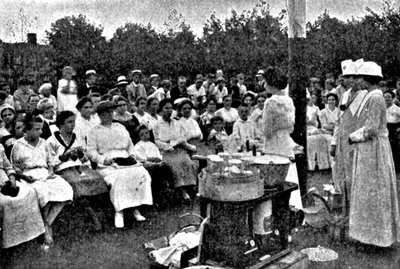
Photo by P. Thompson
A Community Conference on Food-Saving
The importance of work of this kind increased after the signing of the armistice, because the Poles, the Belgians, and other peoples whom we could not reach during the war needed every pound of food we could spare.
Click for a larger image.
GOVERNMENT REGULATIONS
America's special relation to the world's war food problem was primarily that of a provider of the Allies, but in order to insure that this provision should be sufficient to keep the Allied soldiers and war workers up to full fighting and working strength and their families in full health, it was necessary for America to stimulate its own production, repress considerably its consumption and cut out all possible waste in food handling. To do this there was needed some form of governmental food control and a nation-wide voluntary effort of the people. Each of the Allied countries had established governmental food control early in the war under the direction of a "food controller" either attached to an already existing government department of agriculture or commerce, or acting as an independent food minister.
On the actual entrance of America into the war in 1917, governmental food control was vested in a "United States Food Administration" with powers given it by Congress to control all exports of food and all food-handling by millers, manufacturers, jobbers, wholesalers, and large retail dealers. But no retail dealer doing a business of less than $100,000 a year, nor any farmer or farmers' coöperative association came under the Food Administration's control. Thus the American food administration differed from that of most European countries in that it had no authority to fix the prices at which the actual producers should sell their products or the small retailers should charge the consumers.
But, indirectly, it was able to do, and did, a good deal in this direction. By its direct control of exports, and of the millers, manufacturers and large dealers, it was able to cut out a great part of the middleman profits, and reduce wholesale prices for most staple foodstuffs, especially that most important one, flour. By publicity of prices and by indirect pressure through the wholesaler it was also able to restrain the further sky-rocketing of retail prices.
NATION-WIDE FOOD SAVING
But if the Food Administration was limited in what it could effect by legal authority, there was no limit to what it could do by calling on the voluntary action of the people of the country, except by the possible refusal of the people to help. So there was set in movement a nation-wide propaganda for food-production and food-saving which resulted in the voluntary acceptance of wheatless and meatless days, voluntarily modified hotel and restaurant and dining-car meals, and the adoption of household pledges, taken by more than 12,000,000 American homes, to follow the Food Administration's suggestions for food-saving. All this, and the many other things which the Food Administration asked the people to do, and which the people did, resulted in accomplishing a very necessary thing. It enabled America not only to meet all those ever-increasing absolutely imperative calls of the Allies for food for their armies and people through 1917 and 1918, but to supply its own army and people sufficiently well to carry on the war effectively. The more food sunk by submarines, or prevented from coming to Europe from distant food sources, as Australia and Argentine and India, the more we provided by saving and increasing our production.
A few figures will illustrate the actual results of the call for food conservation. We entered the crop year of 1917 (July 1, 1917, to July 1, 1918), with a wheat supply which gave us only about 20,000,000 bushels available for export. By December 1, 1917, our surplus had gone overseas and an additional 36,000,000 bushels had been shipped to the Allies. In January we learned of the further imperative need of the Allies of 75,000,000 bushels. We responded by sending 85,000,000 bushels between the first of the year and the advent of the new crop. When the crop year ended we had sent in all about 136,000,000 bushels of wheat to Europe. We were assisted in these operations by the importation of 28,000,000 bushels of wheat from Australia and the Argentine to supplement our domestic supply, but the outstanding fact was the saving in our domestic consumption, most of which was accomplished in the six-months' period from January 1 to July 1, 1918.
AMERICAN RELIEF ADMINISTRATION
But the cessation of the war did not produce food for the war-ravaged countries of Europe. The newly liberated peoples of Central and Eastern Europe found themselves, at the time of the Armistice, facing a period of starvation until their 1918 harvest could come in. Something to save these peoples had to be done quickly and on a large scale. The situation was met by the establishment of a new American governmental organization called the American Relief Administration which, with Mr. Hoover as director-general, worked in connection with the Inter-Allied Supreme Economic Council. Representatives of the A. R. A. were sent at once into all the countries crying for help to find out the exact food situation, and to arrange with the respective governments for the immediate beginning of the importation and distribution of staple foodstuffs. Programs for a food supply sufficient to last until the 1919 harvest were determined on a basis of minimum necessity, and provision for sufficient shipping and rail transportation was arranged by international agreement.
Modern war has thrown the spotlight on food. It has partly realized that famous prophecy of the Polish economist, Jean Bloch, who wrote, twenty years ago: "That is the future of war, not fighting, but famine." In the World War of 1914—18 there was fighting on a scale never before reached, but there was also famine, as never before dreamed of.