Part 1 — VI—AMERICAN BUSINESS IN THE WAR Voluntary Coöperation of Experts and Loyal Support of Labor Put Our Industries on a War Basis
Reading edition
By GROSVENOR B. CLARKSON
Director of the U. S. Council of National Defense and of Its Advisory Commission
Modern wars are not won by mere numbers. They are not won by mere enthusiasm. They are not won by mere national spirit. They are won by the scientific conduct of war, the scientific application of irresistible force.
—Woodrow Wilson.
War today means that for every man on the fighting line there must be approximately ten men—and women—behind him in the factories, mills, and mines of the nation that enters the conflict. It is an enterprise to which military men alone have ceased to be called, for it enlists the specialists of every industry and every science from the fighting line clear back to the last line of defense.
When the American Marines were thrown into the battle line at the Marne, a French general officer rode up to headquarters.
"How deep is your front?" he asked.
"From here to San Francisco," was the reply; and in that statement lay the story of America's industrial and economic mobilization for war.
For America the actual arena of the war was 3,000 miles oversea, and into this arena the Government of the United States threw 2,000,000 of the most superb troops that the drama of warfare has known; and, what is more, got them there on time to make possible the final smashing blow. The organization, transportation, and clocklike delivery at the eleventh hour of these irresistible citizen armies of the great Republic of the western world is an epic in itself.
But here at home there were armies too. They were created without mandates; they were welded into cohesive form by suggestion rather than by order; they were galvanized from beginning to end by the mighty force of voluntary coöperation; and they went into the home stretch with a power which nothing could have stopped. These were the armies of production—production mainly, it is true, of guns and steel plates and soldiers' shoes; but production as well of energy, of thought that made the sword a flaming thing, of optimism to offset the stupid pessimism of people who criticized but had nothing tangible to contribute, of the immortal spirit of "carry on," of, above all, unification.
In all of this endeavor, in all of this uprooting of the static national life of peace time, the business man of America reached his apotheosis and surprised even himself in his ability to merge his heart and nerves and brain into the national interest in the most emergent hour of the country's history.
In effect, America went into the war unprepared. The will to war was a dormant thing throughout the nation. The country was swollen with material success almost to the point expressed in Lincoln's phrase: "A fat hound won't hunt." The evolution of the Government of the United States, enjoying profound peace for more than half a century, except for the minor military operations of the Spanish-American conflict, into a great war-making machine in mercilessly short time was a task to challenge the ability of even the most resourceful nation of the earth.
There, broadly stated, was the national picture in the spring of 1917. War came, and almost with every day grew the need for increased participation on America's part.
COUNCIL OF NATIONAL DEFENSE
The only federal agency in existence on April 7, 1917, capable of the elasticity to mobilize industry, labor, and science for the national defense was the United States Council of National Defense. This body, composed of the Secretaries of War, Navy, Interior, Agriculture, Commerce, and Labor, had providentially been created by Congress eight months before. It was charged by Congress with "the coördination of industries and resources for the national security and welfare" and "the creation of relations which will render possible in time of need the immediate concentration and utilization of the resources of the nation." With it was to act an advisory commission of seven men, each to have expert knowledge of some special industry, public utility, or the development of some natural resource.
The Council was further charged with the following particular duties:
To supervise and direct investigations and make recommendations to the President and the heads of Executive Departments as to: The location of railroads with reference to the frontier of the United States, so as to render possible expeditious concentration of troops and supplies to points of defense. The coördination of military, industrial, and commercial purposes in the location of extensive highways and branch lines of railroads. The utilization of waterways. The mobilization of military and naval resources for defense. The increase of domestic production of articles and materials essential to the support of the armies and of the people during the interruption of foreign commerce. The development of sea-going transportation. Data as to amounts, location, methods and means of production and availability of military supplies. The giving of information to producers and manufacturers as to the class of supplies needed by the military and other services of the Government, the requirements relating thereto, and the creation of relations which will render possible in time of need the immediate concentration and utilization of the resources of the nation.
To report to the President or to the heads of Executive Departments upon special inquiries or subjects appropriate thereto.
To submit an annual report to Congress, through the President, giving as full a statement of the activities of the Council and the agencies subordinate to it as is consistent with the public interest, including an itemized account of the expenditures made by the Council or authorized by it, in as full detail as the public interest will permit, providing, however, that when deemed proper the President may authorize, in amounts stipulated by him, unvouchered expenditures and report the gross so authorized not itemized.
PERSONNEL OF THE COUNCIL
Save for preliminary meetings late in the winter of 1916, the Council and Advisory Commission did not get under way to any appreciable degree until February, 1917, when both bodies began to meet separately and jointly with the primary purpose of taking the national balance, chiefly with regard to industrial resources. The permanent organization of both bodies was made on March 3, 1917.
The Council of National Defense was composed as follows:
Secretary of WarNewton D. Baker, Chairman.
Secretary of the NavyJosephus Daniels.
Secretary of the InteriorFranklin K. Lane.
Secretary of AgricultureDavid F. Houston.
Secretary of CommerceWilliam C. Redfield.
Secretary of LaborWilliam B. Wilson.
The members of the Advisory Commission were:
Transportation and Communication:
Daniel Willard, Chairman, President of the Baltimore and Ohio Railroad.
Munitions and Manufacturing, including Standardization and Industrial Relations:
Howard E. Coffin, Vice-President of the Hudson Motor Car Company.
Supplies, including Food and Clothing:
Julius Rosenwald, President of Sears, Roebuck & Company.
Raw Materials, Minerals and Metals:
Bernard M. Baruch, financier.
Engineering and Education:
Doctor Hollis Godfrey, President of the Drexel Institute.
Labor, including Conservation of Health and Welfare of Workers:
Samuel Gompers, President of the American Federation of Labor.
Medicine and Surgery, including General Sanitation:
Doctor Franklin Martin, Secretary-General of the American College of Surgeons.
The Director of the Council and the Advisory Commission during the greater part of the war was Walter S. Gifford, now Vice-President of the American Telephone and Telegraph Company, a most capable organizer, who with the writer had been closely associated with Howard Coffin in a pioneer industrial preparedness movement inaugurated in the spring of 1916 to examine into the capacity of industrial plants for military purposes. This was an entirely volunteer movement of business men and industrial engineers under the Naval Consulting Board of the United States, acting with the full approval of the President and the War and Navy Departments. Mr. Coffin's Committee on Industrial Preparedness did a remarkable job in a very short space of time, and the creation of the Council of National Defense was the logical sequence of the Committee's work, its records being turned over to the Council. The writer was the Secretary of the Council and the Advisory Commission throughout until the early summer of 1918, when he became Acting Director, succeeding Mr. Gifford shortly after the signing of the armistice.
Copyright by Harris & Ewing
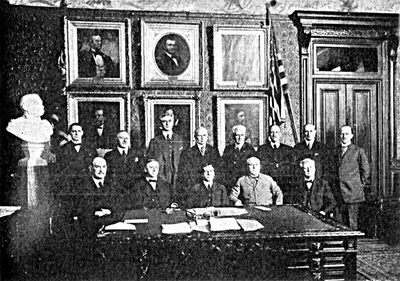
United States Council of National Defense and Its Advisory Commission
Seated, left to right: David F. Houston, Secretary of Agriculture; Josephus Daniels, Secretary of the Navy; Newton D. Baker, Secretary of War; Franklin K. Lane, Secretary of the Interior; William B. Wilson, Secretary of Labor. Standing, left to right: Grosvenor B. Clarkson, Secretary, later Director, of both Council and Advisory Commission; Julius Rosenwald, Bernard M. Baruch, Daniel Willard, Chairman of the Advisory Commission; Dr. Franklin Martin, Dr. Hollis Godfrey, Howard E. Coffin and Walter S. Gifford, Director of the Council and Advisory Commission.
Click for a larger image.
PROPOSALS OF THE ADVISORY COMMITTEE
Although the Council and Advisory Commission did not, as has been stated, make permanent organization until March 3, 1917, the Advisory Commission on December 7, 1916, determined on the following proposals of action:
To begin immediately a study to determine the most effective flexible organization and mechanism for the securing of all necessary information and for the clarifying, recording, and classifying of such information when secured.
To begin immediately a study as to what media now exist which can aid in the carrying out of the purposes of the council. This study to be made in three divisions—governmental media in the departments, governmental media outside the departments, and civil media. As this study progresses it is believed that the council can aid materially in the development of such media, and can from time to time define (i.e., delimit and delineate) spheres of activity in which existing organizations may operate intensively without duplication.
To assist in the advance of the physical well being of the people of the nation.
To begin immediately a study of the possibility of the coördination of transportation, communication and surveys.
To continue the work done on the inventory of manufactures, of medical equipment and officers, of supplies, and of resources.
To assist in the development of the "Personal Index" already begun.
To set a fixed date (a date three months after the beginning of action is suggested) on which an inspection may be made of the work accomplished to that date. This inspection to be made through the submitting to the commission of an actual problem by the Departments of War and Navy, with the intent to determine at that time what needed information is or is not available.
To form a temporary organization to put the above proposals or any part of them or additional proposals into effect at the earliest possible date, with the intention of changing from a temporary organization to a permanent organization as the progress of the work makes this possible.
To begin a study of the best methods of expression of the work of the council to the people of the nation.
To scrutinize all legislative action touching national defense.
To do any other thing or take any other action necessary to give effect to the law under which the council and commission are organized.
PRE-WAR ACTIVITIES
At this time there was consideration of plans to enroll labor in an industrial reserve, and the question of mobilization of American railroads for military purposes was seriously discussed against future need. At the same time Commissioner Baruch stated that he had been making a study of the steel and metal industries in connection with the national defense, and wished for authority to consult further with the leaders in those trades. The Director was asked to establish relations in the interest of the national defense with civic organizations, patriotic associations, and chambers of commerce.
At a meeting on February 12, 1917, plans were discussed to call a series of conferences with the leading men in each industry fundamental to the defense of the country in the event of war, and at the same meeting a plan was laid down and afterwards agreed upon to split the Advisory Commission up into seven separate committees as detailed above, the Chairman of each committee to be given power to select the members of his committee from either governmental or civil life, or both.
At a meeting on February 14, 1917, E. S. Stettinius, who, acting for J. P. Morgan and Company, was the purchasing agent of the Allies at that time, was called before the Council to confer with it on the manufacture of munitions. In the same way during this early period men of the authority and standing of Herbert Hoover, Admiral Peary, and General Kuhn, who had closely studied the German armies, were called into consultation by the Council, Mr. Hoover of course, discussing the mobilization, distribution, and conservation of food supplies, and Admiral Peary the development of the aeroplane and seaplane for modern war.
On February 15th the Advisory Commission, further to progress its work then already under way, requested detailed lists of materials, with specifications and detailed dimensioned blueprints covering all equipment needed for a force of 1,000,000 men and for the assumed force of the Navy and Marine Corps with its numbers increased to emergency strength. It also called for estimates of reasonable accuracy covering the maintenance of a force of the size mentioned in the field during each ninety days of active service. The information was desired in order that approximations might be made as to the amounts of both manufactured and raw material for which it would be necessary to draw upon the resources of the country. The Advisory Commission later furnished estimates of its own.
On March 3rd Chairman Willard of the Advisory Commission read to the Council a list of men nominated by the Commission to compose a munitions standards board. It is highly significant to detail the names of these men with their occupations, for they were typical of the cream of American industry which from that time on was enlisted in the Government's interest:
W. H. Vandervoort, builders of special machine tools, and President of the Moline Automobile Co.
E. A. Deeds, formerly General Manager for the National Cash Register Co., President of the Dayton Engineering Laboratories Co., and interested in many industrial activities.
Frank A. Scott, Warner & Swasey Co., Cleveland, manufacturers of automatic machinery and optical instruments.
Frank Pratt, General Electric Co., Schenectady.
Samuel Vauclain, Baldwin Locomotive Works, Remington and Westinghouse Cos.
John E. Otterson, Vice-President, Winchester Arms Co.
The Council duly approved these nominations.
Copyright Underwood & Underwood
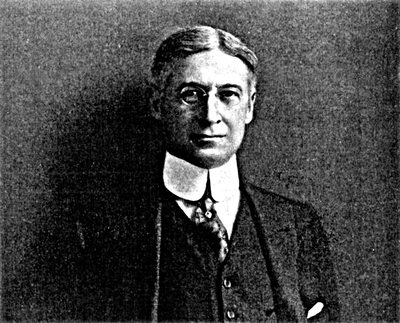
Bernard M. Baruch
Known as the "Eye of Industry," because his task was to see that the raw materials were brought to the factories and the finished products shipped overseas.
Click for a larger image.
MEN OF VISION
It is impossible here to give more than a few instances such as the foregoing of the way in which the Council and Commission, with remarkable vision and perhaps even more remarkable disregard of precedent when precedent got in the way of the national welfare, made history in these pre-war days. Fully to tell the story of this period would pack a large volume. I quote from a recent partisan criticism directed by an American Congressman, as chairman of a congressional committee to investigate war expenditures, against the Advisory Commission particularly, which he characterized as the "secret government of the United States" during this vital space of time:
It appears from the minutes of the advisory commission and the council, which were kept separately, that practically all of the measures which were afterwards considered as war measures, were initiated by this advisory commission, adopted by the council, and afterwards acted upon by Congress. In many cases, a considerable period before the actual declaration of war with Germany this advisory commission was discussing matters which were thought to be new legislation, conceived by reason of the necessities of war. For instance, on March 3rd, over a month before the War declaration, the advisory commission indorsed to the Council of National Defense a daylight-saving scheme, and recommended a Federal censorship of the press. The question of Federal censorship of the press was further discussed on March 24th, two weeks before the declaration of war.
On February 15th, about two months before the declaration of war, Commissioners Coffin and Gompers made a report as to the exclusion of labor from military service, and the draft was discussed; the draft was also discussed on other occasions before anyone in this country, except this advisory commission and those who were closely affiliated with the administration, knew that a declaration of war was to be made later. At a meeting, on February 15th, this same commission of seven men (none of whom had any official authority except as advisors), recommended that Herbert Hoover be employed by the Government in connection with food control. It was generally understood, as appears from the minutes, that Mr. Hoover was to be in control of this matter, although war was two months in the future.
The advisory commission first met on December 6, 1916. Almost the first thing the commission did was to take up the matter of arranging an easy method of communication between the manufacturers and the Government. On February 12th, for example, Secretary Lane offered a resolution to the advisory commission suggesting to them to call a series of conferences of the leading men in various industries, so the industries might organize and be able to do business with the council through one man. In several meetings, long before the war was declared, this advisory commission of seven men met with the representatives of the manufacturing industries and formed an organization of them for selling supplies to the Government, which organization was well perfected before the war was declared. This method consisted of having the representatives of the various businesses, producing goods which the Government would have to buy, form themselves into committees so that they might be able to sell to the Government the goods direct, which their industries produced. In almost every meeting that this advisory commission had before the declaration of war, they discussed and recommended to the council (which consisted of six Cabinet members) these plans for fixing prices and selling to the Government. When war was declared on April 6th, this machinery began to move, headed by the advisory commission of these minutes, the active Government of the seven men, who were, in effect, as shown by United States, so far as the purchase of supplies was concerned. So far as I can observe, there was not an act of the so-called war legislation afterward enacted that had not before the actual declaration of war been discussed and settled upon by this advisory commission.
It should be said, of course, that no member of this Council organization ever sold commodities to himself. But that is another story.
MEN OF EXPERIENCE
I could not complete even a skeleton outline of the period in question without certain other references.
Further to emphasize the quality of the business men being called to Washington by the Council and Advisory Commission, I quote part of a letter to Chairman Willard of the Commission from Commissioner Baruch of March 23, 1917:
Mr. Daniel Willard, Chairman, Advisory Commission, Council of National Defense, Washington, D. C. Dear Sir:
In pursuance of the authority given me and in order to be prepared to meet the requests made of the advisory commission, I have appointed the following committees. As the necessity arises and the advisability becomes apparent, I shall add from time to time other members to these committees, always bearing in mind keeping them down to such a size that they will be workable. It has been my endeavor to appoint on these committees men of proved ability and undoubted integrity.
Leather.—Walter C. Garritt, U. S. Leather Co., Boston, Mass.; George F. Johnson, Endicott, N. Y.; Theodore P. Haight, American Hide & Leather Co., New York City.
Rubber.—A. Marks, Diamond Rubber Co., Akron, Ohio; Fred Hood, Hood Rubber Co., Watertown, Mass.; Stuart Hotchkiss, General Rubber Co., New York City.
Steel.—E. H. Gary, President, American Iron & Steel Institute, New York.
Wool.—J. F. Brown, Boston, Mass.; Sigmund Silberson, Chicago, Ill.; Joseph R. Grundy, Bristol, Pa.; F. J. Hagenbarth, President, National Association of Wool Growers, Salt Lake City, Utah.
Nickel.—Ambrose Monell, President, International Nickel Co., New York.
Oil.—I have asked Mr. A. C. Bedford, president of the Standard Oil Co., to serve on the committee, but I shall probably add another from the Middle West, whose name I have not yet determined upon, and Mr. Ed. L. Doheny, of Los Angeles, Calif.
Zinc.—I have in the process of formation a committee representing the zinc trade. There are certain difficulties in the way of trade jealousies which we have to smooth away. The same thing is occurring in other lines, but it will be adjusted, and I shall report on them from time to time.
Coal.—I have been in consultation with the producers of coal, both bituminous and anthracite, and am now studying that situation as to the best method of covering coal.
Spruce Wood.—I have also under consideration, but have come to no conclusion, the employment through a committee of those best fitted for obtaining the manufacture of aeroplanes for the Government the proper amount of spruce wood which seems to be needed.
LABOR PLEDGES SUPPORT
It will be long before the writer forgets the dramatic meeting of the Advisory Commission as early as March 3, 1917, when Commissioner Gompers reported that he had called an executive council meeting of the American Federation of Labor for March 9, 1917, for the purpose of considering the attitude of labor toward the preparedness plans of the government. The labor leader spoke with great emotion. He referred to England's difficulty in the first year of the war in enlisting the services of the working people. He went on to say that in England unity was then lacking between government and labor and that the same situation, if not properly handled before hand, could arise in this country in even more acute form, largely because of the racial diversity of our working classes. He concluded by stating that he was now bending his efforts to mobilizing good will in this direction, saying: [24] "I want the workingmen to do their part if war comes to America." He forecasted the meeting in Washington on March 12, 1917, of the officers of the National and International Trade Unions of America, and said: "I am expecting a definite response of support from every trade union in America." There is no doubt in the writer's mind that Samuel Gompers kept the faith throughout.
On April 6, 1917, the Council and Advisory Commission approved a declaration of the attitude of American labor toward the war presented by Mr. Gompers' Committee on Labor of the Advisory Commission. This action was directed toward the maintenance of existing standards of employment, and provided, among other things, that the Council should issue a statement to employers and employees in industrial plants and transportation systems advising that neither employers nor employees should endeavor to take advantage of the country's necessities to change existing standards; and providing further that when economic or other emergencies might arise requiring changes of standards, the same should be made only after such proposed changes were investigated and approved by the Council. It likewise provided that the Council urge upon the legislatures of the States, as well as upon all administrative agencies charged with the enforcement of labor and health laws, the great duty of rigorously maintaining the existing safeguards as to the health and welfare of workers, and that no departure from such standards in State laws and State rulings affecting labor should be taken without a declaration of the Council that such departure was essential for the effective pursuit of the national defense.
MERGING THE RAILROADS
On April 7, 1917, the Council directed Chairman Willard of the Advisory Commission to call upon the railroads so to organize their business as to lead to the greatest expedition in the movement of freight and troops. The response of the railroads was literally splendid. Their executives came to Washington, conferred with Mr. Willard, and passed the following resolution:
Resolved, That the railroads of the United States, acting through their chief executive officers here and now assembled and stirred by a high sense of their opportunity to be of the greatest service to their country in the present national crisis, do hereby pledge themselves, with the Government of the United States, with the governments of the several States, and one with another, that during the present war they will coördinate their operations in a continental railway system, merging during such period all their merely individual and competitive activities in the effort to produce a maximum of national transportation efficiency. To this end they hereby agree to create an organization which shall have general authority to formulate in detail and from time to time a policy of operation of all or any of the railways, which policy, when and as announced by such temporary organization, shall be accepted and earnestly made effective by the several managements of the individual railroad companies here represented.
COÖPERATING COMMITTEES
The first of July, 1917, found the Council and Advisory Commission directing the operation of the following boards and committees:
Aircraft Production Board.
Committee on Coal Production.
Commercial Economy Board.
Woman's Committee.
General Munitions Board with its sub-committees on Army Vehicles, Armored Cars, Emergency Construction and Contracts, Optical Glass, Storage Facilities, Machine Guns, Priority, and Accounting.
Munitions Standards Board with its sub-committees on Gauges and Dies, Army and Navy Artillery, Fuses and Detonators, Small Arms and Munitions, Optical Instruments, and Army and Navy Projectiles.
Section on Coöperation with States.
Committee on Inland Waterways.
Committee on Telegraphs and Telephones.
Committee on Railroad Transportation, with which acted an executive committee made up of leading railroad presidents and six departmental committees composed likewise of railroad executives and paralleling the military departments over the country, and sub-committees on Express, Car Service, Military Equipment Standards, Military Transportation Accounting, Military Passenger Tariffs, Military Freight Tariffs, and Materials and Supplies.
Committees on Cars and Locomotives, with their personnel made up of the high executives of such concerns as the Baldwin Locomotive Works, the Pullman Company, and the American Locomotive Company.
Committee on Electric Railroad Transportation, composed of electric railway presidents.
Committee on Gas and Electric Service.
Committee on Automotive Transport.
Committee on Supplies, with its sub-committees on Cotton Goods, Woolen Manufacturers, Shoe and Leather Industries, Knit Goods, Leather Equipment, Mattresses and Pillows, and Canned Goods.
Committee on Raw Materials, with its sub-committees, popularly known at the time as the "A to Z" committees, on Alcohol, Aluminum, Asbestos, Magnesia and Roofing, Brass, Cement, Chemicals, Acids, Alkalis, Electrochemicals, Fertilizers, Miscellaneous Chemicals, Coal-Tar Products, Pyrites, Sulphur.
Sub-Committees on Copper, Lead, Lumber, Mica, Nickel, Steel Products, with sub-committees on Alloys, Sheet Steel, Pig Tin, Steel Distribution, Scrap Iron, Pig Iron, Iron Ore, and Lake Transportation, Tubular Products, Tin Plate, Wire Rope, Wire Products, and Cold Rolled and Cold Drawn Steel.
Sub-Committee on Oil, Rubber, Wool, and Zinc.
Committee on Engineering and Education, with its sub-committees on General Engineering, Production Engineering, Universities and Colleges, Secondary and Normal Schools, and Construction Engineering.
Committee on Labor, with its sub-committees on Mediation and Conciliation, Wages and Hours, Women in Industry, Welfare Work, Sanitation with twelve subdivisions, Vocational Education with nine subdivisions, Information and Statistics, Cost of Living and Domestic Economy.
General Medical Board, with a long and active list of sub-committees.
Copyright by Underwood & Underwood
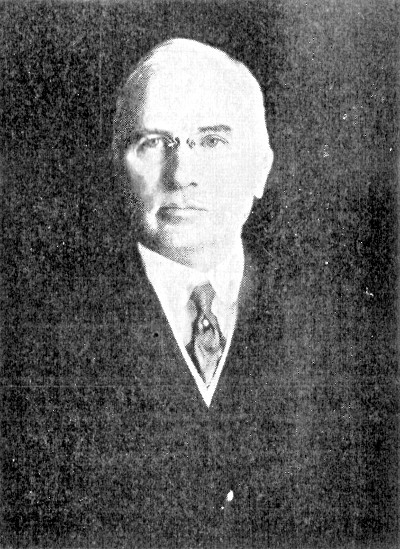
Daniel Willard
President of the Baltimore and Ohio Railroad. He was chairman of transportation and communication in the Council of National Defense.
SERVICE OF EXPERTS
On these boards and committees sat, almost without exception, the American leaders of industry, science, and labor. Scattered through the list one finds such names as:
Rear Admiral David W. Taylor, one of the world's leading naval constructors.
F. S. Peabody, the great coal operator.
James J. Storrow, of Lee, Higginson & Co., of Boston.
A. W. Shaw, publisher of the System magazine, who, as Chairman of the Commercial Economy Board, preached with remarkable success the gospel of conservation in business.
Dr. Anna Howard Shaw, who for her labors as Chairman of the Woman's Committee received the Distinguished Service Medal.
Frank A. Scott, on whom was bestowed the same distinction for his leadership of the General Munitions Board.
W. A. Starrett, constructing architect of New York, to whom in great measure is due the credit for the building of the cantonments in an incredibly short space of time.
Samuel Vauclain, President of the Baldwin Locomotive Works, whose contribution in the matter of Army and Navy artillery was monumental.
Theodore Vail, President of the American Telephone & Telegraph Company, who brought the wire communication men of the country to a common center in the national interest.
Charles Clifton, President of the National Automobile Chamber of Commerce.
Gen. George H. Harries, the famous electric railway operator.
Samuel Insull, President of the Commonwealth Edison Co., of Chicago.
Charles Eisenman, who, as active head of the Council's Committee on Supplies, procured for the Government $800,000,000 of supplies in 200 days at an overhead cost of but $20,000, involving the handling of 45,000 contracts, and who justly received the Distinguished Service Medal.
A. F. Bemis, President of the National Association of Cotton Manufacturers.
John P. Woods, the eminent woolen manufacturer.
J. F. McElwain, of the McElwain Shoe Company.
Lincoln Cromwell, of Wm. Iselin & Co., New York.
Arthur V. Davis, President of the Aluminum Co. of America.
Thomas F. Manville, President of H. W. Johns-Manville Co.
Charles F. Brooker, President of the American Brass Company.
John E. Morron, President of the Atlas Portland Cement Company.
John D. Ryan, President of the Anaconda Copper Company.
R. L. Agassiz, President of the Calumet & Hecla Mining Company.
W. A. Clark, President of the United Verde Copper Company.
Murry M. Guggenheim.
R. H. Downman, President of the National Lumber Manufacturers' Association.
Ambrose Monell, President of the International Nickel Company.
The great steel executives. Gary, Farrell, Burden, Dinkey, King, Grace, Schwab, Topping, Dalton, and Clarke
Bedford, Davison, Doheney, Lufkin, Markham, Sinclair, Van Dyke, Muir, James, and Guffy, in whose hands lay almost the entire oil output of America.
Stuart Hotchkiss, President of the General Rubber Company.
F. J. Hagenbarth, President of the National Association of Wool Growers.
The Presidents of the leading zinc companies.
Then when we come to Engineering and Education:
Dr. Henry E. Crampton, of Columbia University.
Charles A. Stone, of Stone and Webster.
The heads of the great engineering societies.
The presidents of Harvard, Johns Hopkins, and other famous universities and colleges.
Among labor leaders such persons as:
Warren S. Stone, Grand Chief of the Brotherhood of Locomotive Engineers.
James W. Sullivan, Matthew Woll, and Frank Morrison; all high in the American Federation of Labor.
Such well-known men as:
V. Everit Macy, Benjamin Ide Wheeler, John H. Finley, August Belmont, E. T. Stotesbury and Charles G. Dawes, afterwards a brilliant figure as a General in France.
Such nationally and internationally known physicians as:
General Gorgas, Dr. William H. Welch, of Johns Hopkins, the Mayos, Dr., afterwards Brigadier-General Finney, Dr. George E. Brewer, Dr. George W. Crile, Dr. Simon Flexner, and Dr. Theodore Janeway.
Dr. George E. Hale, Chairman of the National Research Council, which was and is the Council's Department of Science and Research.
Thomas A. Edison, President of the Naval Consulting Board, which was and is the Council's Board of Inventions.
The activities of these men and their hundreds of colleagues, nearly all dollar-a-year workers and men whose time could not be bought, as a rule, in days of peace, reached out and touched almost every town and village in almost every part of the United States. They were moved and stimulated by the philosophy of voluntary coöperation, which was first and in a very daring way thrust into the consciousness of the nation by the Council of National Defense. It was the policy that won the war. One distinct benefit which the Government received from calling the industrial intelligence of the country to its aid was the breadth of view which industrial leaders possess. Their habit of mind to survey the field as a whole, to take a bird's-eye view of the problem to be solved, enabled the Government agencies to obtain a proper comprehension of the task of building the war machine. The country will probably never know the debt that it owes to these men and their like who came to Washington and bent their backs throughout the hot Southern summer during a series of endeavors in which absolutely no paths were charted.
NON-PARTISAN REPRESENTATION
It has been asked why a coalition government was not formed to wage the war. That very thing was in effect done by the Council, though we were all too busy to point it out at the time. A majority of the Advisory Commission was made up of Republicans. Certainly Republicans were in the huge preponderance in the Committee and Boards of the Council and Advisory Commission. Speaking as one who was not affiliated with the politics of the Administration of Woodrow Wilson, the writer never perceived a trace of political flavor in the organization and operation of the Council from first to last. Never did the six Democratic cabinet officers forming the Council itself so much as inquire into the politics of the hundreds of business men and experts nominated to them for appointment. It was an amazing demonstration of non-partisanship in a national crisis. The Council was an organization of specialists from beginning to end, and the work was everywhere carried forward on the most impersonal basis. The writer attributes this state of affairs to the breadth of view, and the very genuine passion for national service, of Secretary of War Baker, Chairman of the Council.
It should be plainly stated that, utilizing in the main dollar-a-year experts, the Council made the preliminary mobilization of industry to July 1, 1917, at the grotesquely small sum of $127,000. To May 1, 1919, its total expenditures, including the operation of the war industries for nearly a year, amounted to but $1,500,000, and this comprehended the expenditure of $225,000 for the erection of a building. I doubt if there is anything in governmental or commercial history to match those figures, squared with results. The savings of the Council and Advisory Commission to the Government and the people mounted literally into the billions, as careful analysis of pre-war and war-time prices on certain commodities will demonstrate. It was made possible by the Council's course in commandeering to its side the business men of the United States.
SOME RESULTS OF COÖPERATION
One of the practical results of voluntary coöperation was the agreement made by Mr. Baruch and Mr. Ryan with the largest copper producers of the country to furnish the Navy 20,000,000 pounds of copper and the Army 25,510,000 pounds at 162/3¢. a pound when the market price was 35¢. a pound. This meant saving to the Government close to $10,000,000. The copper men made this offer notwithstanding their increased cost for labor, materials, etc., because, as they said: "We believe it to be our duty to furnish the requirements of the Government in preparing the nation for war with no more profit than we receive from our regular production in normal times."
In the same way the steel makers of the country, represented in the Steel Institute, agreed to furnish steel to the Government at the basic price of 2.9¢. per pound as compared with the then market price of from 5¢. to 7¢. a pound. This represented an approximate saving to the Government of $18,000,000.
THE FIELD DIVISION
The tremendous effort of the Council to mobilize and coalesce into a fluid and powerful whole the industrial, economic and scientific forces, was supplemented and to a great extent made possible by the Council's Section on Coöperation with States, later known as the Field Division. Through this subordinate body was created, guided and coördinated the 185,000 units of the state, county, community and municipal councils of defense, which literally unified the citizenship of America for war. If production was to win the war, it was elementary that the civilian morale must be brought to the highest pitch of coöperation and efficiency—and it was accomplished. In this vital task a noble part was played by the Woman's Committee of the Council, which in the most thorough-going and swift manner brought the services of the women of the country to the Government. The director of this committee, Miss Hannah J. Patterson, received the Distinguished Service Medal.
WAR INDUSTRIES BOARD
On August 1, 1917, the Council, with its fortunate power to create subordinate bodies, brought into being the War Industries Board, of which the first Chairman was Frank A. Scott, and of which some of the other members up to the end of the war were:
Robert S. Brookings.
Brigadier-General Hugh S. Johnson.
Rear Admiral F. F. Fletcher.
Hugh Frayne, of the American Federation of Labor.
George N. Peek, a prominent Middle Western manufacturer.
J. L. Replogle, who became the very efficient Director of Steel Supply.
L. L. Summers, an expert on explosives.
Alexander Legge, General Manager of the International Harvester Company.
And Judge Edwin B. Parker.
Mr. Brookings was later placed in charge of price fixing and Judge Parker in charge of priorities. The War Industries Board undoubtedly accomplished a much better centralization of effort than was possible in the hurried organization of the early days, when the imperative need was to increase the sources of supply and get production going until the executive departments of the Government could get into their full stride. Mr. Scott was succeeded as Chairman of the War Industries by Daniel Willard, who in turn was succeeded by B. M. Baruch, who, in his leadership of this vital and powerful agency, duplicated the success that Mr. Willard had made as Chairman of the pioneer Advisory Commission.
CANTONMENT CONSTRUCTION
In indicating even an outline statement of the American industrial and economic effort in the war, the writer feels helpless to paint the picture within the space of a few thousand words. It simply cannot be done. But to visualize what the measure of the task was, let one thing be cited:
Copyright Underwood & Underwood
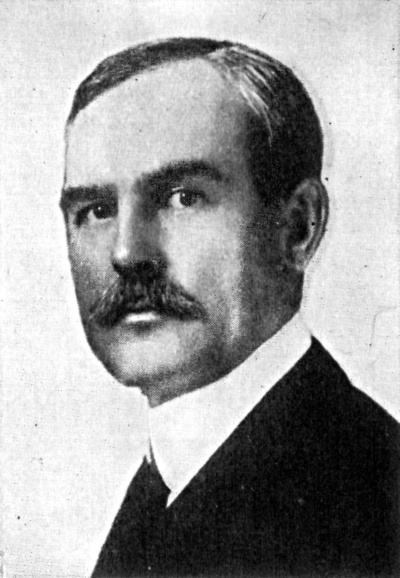
John D. Ryan
President of the Anaconda Copper Company. He was made chairman of the Aircraft Production Board after we entered the war.
At our entrance into the war there were one colonel and four men to build the cantonments. The job involved the expenditure of $150,000,000 in about three months. The largest year's work on the Panama Canal amounted to but some $50,000,000. The situation was heart-breaking. On hearing of it Frank Scott, then Chairman of the General Munitions Board, called up the Secretary of War and said that something had to be done, with which the Secretary instantly agreed. The result was that the Colonel, afterwards Brigadier-General Littell, had a civilian organization built around him by the Council of National Defense, notably by W. A. Starrett, later himself a colonel in the Army, which functioned until the Army was in shape to carry on the job alone. The building of the cantonments was the greatest job of the ages. Incidentally it should be stated that the average profit to the contractors was less than three per cent.
MEN LITTLE KNOWN
The writer likewise feels great reluctance in mentioning, as he has mentioned, only a few of the men who waged the industrial side of the war. Many business men little known to the country gave up their businesses and came to Washington and did superhuman things—did them in an impersonal, selfless way that was nothing less than stirring. Many of them remain unknown to this day, and their chief reward must lie in the satisfaction that they drew to their own souls by what they did, which is, of course, the greatest satisfaction of all in such situations as war-time Washington exemplified.
It has not even been possible to touch on the work of business men in such great war agencies as the Food and Fuel Administration, the War Trade Board, the Shipping Board, the Aircraft Production Board, the Office of the Alien Property Custodian, the War Finance Corporation, and those divisions of the War Department which called highly qualified civilians to their aid. It would seem better to emphasize the initial effort, when the Council, through force of circumstances, became the great administrative laboratory for the examination, organization, and, at the proper time, allocation of totally new and untried phases of Federal action related to the prosecution of the war. It was in effect a fecund mother, which, it is not the slightest exaggeration to say, gave birth to and propelled the war machine which in the closing days of the conflict oversea overseas was reaching to the peak of its load, and which in fact dealt the death blow to the Imperial German Government. It made, in truth, its fair share of mistakes, but some day its part in sending out the trumpet call to the business and labor and scientific leaders of America to join in the national defense will be fully told. Then there will be perceived in clear and true light the extent to which peace-loving American civilians offered all they had and all they were to the Government of the United States so that decency might again be paramount upon the face of the earth.