Part 1 — III—INDUSTRY AND LABOR IN WARTIME Unprecedented Conditions and Developments Due to the World War and How They Were Met
Reading edition
The issue of the great world conflict between autocracy and democracy rested largely in the hands of the laboring classes behind the lines. Mr. William B. Wilson, Secretary of Labor, placed vividly before the public in one of his official statements the views of American labor at the outbreak of the war:
"During the past decade the sentiment of American labor has crystallized against resort to arms as a means of settlement of disputes between nations. War had come to be considered wasteful economically, socially, and morally. Labor felt that no national advantage gained through force of arms could offset the human life sacrificed, the burden of taxation levied upon successive generations to pay the cost of war, the standards of life set back or destroyed, which had to be rebuilt slowly and with infinite sacrifice. In short, war had come to be looked upon as morally wrong, entirely unnecessary, a calamity that could be avoided and must be avoided if the race was to progress. This feeling was shared to a greater or lesser extent by the workers of all civilized nations, and there was a universal feeling in world labor ranks prior to the outbreak of the European war that this sentiment, shared by many thoughtful people outside the ranks of the wage workers in all civilized nations, was strong enough to prevent any armed conflict which would involve any number of peoples. This sentiment was undoubtedly responsible for the lack of military preparedness, in the sense that Germany prepared, among the other major powers now engaged in the world conflict.
"When the war clouds broke in Europe, American labor was stunned. All its preconceived notions as to the inability of any great nation to wage war upon another nation because the working people would refuse either to fight or produce munitions and supplies of war were shattered when nation after nation quickly mobilized its armies and the organized labor movements of each country, without exception, quickly pledged their men and their resources to the support of their respective governments. But the fact that America itself might be drawn into the world conflict was still foreign to the mind of the American workman. While American labor grieved over the fate which had befallen its kind in Europe no sense of danger to this country was apparent. From the beginning of this Republic it had been our national policy to hold aloof from the quarrels of the Old World. The splendid isolation of thousands of miles of ocean protected us. We had no quarrel with Europe and we asked but to be let alone. We stood upon our rights to protect the people of continental America from invasion or aggression as enunciated by the Monroe Doctrine, and further than that we could not see that the European conflict embroiled us as a nation. Let Europe settle her own family quarrel. We were to remain the one great neutral nation of the earth. When the time came America, untrammeled by participation in the conflict, with no desire for American aggrandizement or territorial expansion, would be the natural messenger of peace to war-worried Europe."
SAFEGUARDS FOR WORKINGMEN
From the moment of the declaration of war the general loyalty of the laboring classes throughout the United States was apparent. This attitude of loyalty found a ready response in the immediately declared intention of the Government to safeguard the interests of the workingmen. Congress announced its attitude toward standards of legal protection for workers. It was printed verbatim in Labor Laws in War Time, 201, p. 1, as follows:
"Whereas, The entrance of the United States into the World War appears imminent; and
"Whereas, Other countries upon engaging in the conflict permitted a serious breakdown of protective labor regulations with the result, as shown by recent official investigations, of early and unmistakable loss of health, output, and national effectiveness; and
"Whereas, Our own experience has already demonstrated that accidents increase with speeding up and the employment of new workers unaccustomed to their tasks, that over fatigue defeats the object aimed at in lengthening working hours, and that new occupational poisoning has accompanied the recent development of munition manufacture; and
"Whereas, The full strength of our nation is needed as never before and we cannot afford to suffer loss of labor power through accidents, disease, industrial poisoning, and overfatigue; now, therefore, be it.
"Resolved, That the American Association for Labor Legislation, at this critical time, in order to promote the success of our country in war as well as in peace, would sound a warning against the shortsightedness and laxness at first exemplified abroad in these matters, and would urge all public-spirited citizens to coöperate in maintaining, for the protection of those who serve in this time of stress the industries of the nation (who as experience abroad has shown are quite as important to military success as the fighting forces), the following essential minimum requirements:
I. SAFETY
"1. Maintenance of all existing standards of safeguarding machinery and industrial processes for the prevention of accidents.
II. SANITATION
"1. Maintenance of all existing measures for the prevention of occupational diseases.
"2. Immediate agreement upon practicable methods for the prevention of special occupational poisonings incident to making and handling explosives.
III. HOURS
"1. Three-shift system in continuous industries.
"2. In non-continuous industries, maintenance of existing standard working day as basic.
"3. One day's rest in seven for all workers.
IV. WAGES
"1. Equal pay for equal work, without discrimination as to sex.
"2. Maintenance of existing wage rates for basic working day.
"3. Time and one-half for all hours beyond basic working day.
"4. Wage rates to be periodically revised to correspond with variations in the cost of living.
V. CHILD LABOR
"1. Maintenance of all existing special regulations regarding child labor, including minimum wages, maximum hours, prohibition of night work, prohibited employment, and employment certificates.
"2. Determination of specially hazardous employments to be forbidden to children under sixteen.
VI. WOMAN'S WORK
"1. Maintenance of existing special regulations regarding woman's work, including maximum hours, prohibition of night work, prohibited hazardous employments, and prohibited employment immediately before and after childbirth.
VII. SOCIAL INSURANCE
"1. Maintenance of existing standards of workmen's compensation for industrial accidents and diseases.
"2. Extension of workmen's compensation laws to embrace occupational diseases, especially those particularly incident to the manufacture and handling of explosives.
"3. Immediate investigation of the sickness problem among the workers to ascertain the advisability of establishing universal workmen's health insurance.
VIII. LABOR MARKET
"1. Extension of existing systems of public employment bureaus to aid in the intelligent distribution of labor throughout the country.
IX. ADMINISTRATION OF LABOR LAWS
"1. Increased appropriations for enlarged staffs of inspectors to enforce labor legislation.
"2. Representation of employees, employers, and the public on joint councils for coöperating elsewhere with the labor departments in drafting and enforcing necessary regulations to put the foregoing principles into full effect."
ORGANIZING LABOR FOR WAR WORK
Supplying the man power for industrial action during the war was a really more complicated task than drafting men for military service. In the earlier period of American participation labor was distributed more or less according to the law of supply and demand. The unequal distribution of workers became a grave problem. To meet this the United States Employment Service of the Department of Labor took over the supply of war industries with common labor, and all independent recruiting of labor by manufacturers having a pay roll of more than a hundred men was discontinued.
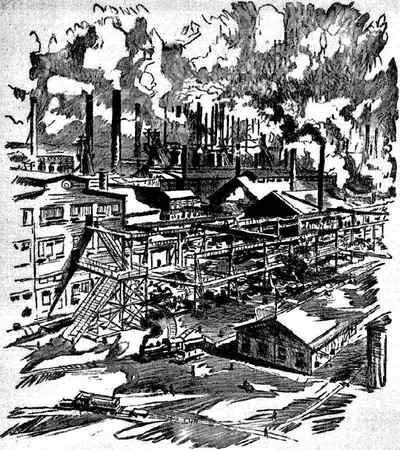
In the Heart of the Bethlehem Steel Plant
H. E. Coffin, Chairman on Industrial Preparedness of the Council of National Defence, described the conflict as a war of munitions, of factories, of producing powers, of sweating men and women workers. In the plant sketched above, 26,000 men toiled and sweated during the war to make munitions for our troops overseas.
Click for a larger image.
"On this Board were representatives of the War, Navy, and Agriculture Departments, the Shipping Board and the Emergency Fleet Corporation, the War Industries Board, and the Food, Fuel, and Railroad Administrations. Assistant Director Nathan A. Smyth, of the United States Employment Service, was quoted in the New York Globe as saying in part:
"'Today the war industries of the country are short about 500,000 unskilled workers, and the coming requirements of war production necessitate finding between 2,000,000 and 3,000,000 more.
"'Similarly the demand for skilled workers in war industries is greater than the immediately available supply. Before long we will have to take every tool maker and die-sinker in non-war work and put him in war production.'
"The country was divided into thirteen Federal districts, by the regulation of labor for war industries, and each was in charge of a superintendent of the United States Employment Service, while the States within the several districts were in charge of a State director. The labor problem this measure was designed to remedy and control was pictured by Secretary of Labor Wilson, who was quoted in the New York Sun as saying in part:
"'The Government found itself in need of men, and on going out to get them found itself in competition with private industry, which was equally hard pressed. Men who had never drawn more than a common laborer's wages found themselves at a premium in the market, and began to ask and receive extortionate prices, and to rove from place to place seeking still higher prices.
"'Everywhere industry was hampered by what is known as the turnover, or the constant shifting of itinerant labor, in some cases the loss in efficiency running as high as 100 per cent. This is what is perhaps best described as the evil of the individualistic strike—the strike by the man, thousands of him, in different yards and factories all over the country, who is forever throwing down his tools and wandering away on the slightest rumor of higher wages elsewhere, who by his habit of roving never masters the details of any trade, and who in the mass accounts for a greater loss than all the organized strikes and walkouts in the land.'"
INFLUENCE OF WAR CONDITIONS
In the United States under war conditions labor unrest did not reach the intense form manifested in England. Nevertheless a great many strikes were reported. Surprise was expressed that the labor adjustment machinery of the War Department and of the Navy Department was not appealed to. Besides there was the National War Labor Board to take up mediation. Investigations in Bridgeport, Connecticut, showed an increase of earnings of 81 per cent. against an increase of living prices of 61 per cent. Yet at one time the Press reported strikes in over 350 machine shops in New Jersey—nearly all engaged in necessary war work—as well as trouble in many shipyards. Of course there was the explanation of foreign propaganda or a tendency toward industrial Bolshevism. Such explanations failed to account for the fact that American workmen as a whole were patriotic.
Attention was called, on the other hand, to the warm tribute given by the Federal Fuel Administrator to the bituminous coal miners who had brought production past the 13 million ton mark in the second week in July, 1917, and the exceptional efforts of diligent and patriotic workers in the shipyard. A portion of the press emphasized the unreasonableness of striking while the laboring people enjoyed, during war time, immunity from service and immunity from the pressure of competition for wages. The Springfield Republican protested against applying to the workingmen exaggerated standards of economic rectitude.
"It is easy to be harsh in one's judgment even in the case of the strikes that occur. Why do they strike at all while the war continues? Have they no capacity for self-sacrifice for the country? These questions will be asked by many people whenever war work anywhere is checked in the least degree by workmen dropping their tools.
"On the other hand, let us not be unjust to labor, for in the American Army in France labor is represented by multitudes of youth upon whose gallantry and steadiness all our hopes of victory depend. No class here at home gives 100 per cent. efficiency or commits itself to 100 per cent. of sacrifice in the winning of the war. Why demand it of the wage earners or the labor unions?
"Simply because of its organization and its machinery of leadership, however, labor enjoys an exceptional opportunity to contribute to the winning of the war. This is the first great war in history in which labor has been organized into an economic unit, and that is the reason for some special war problems today which were never encountered by governments in previous wars. But there can be gains even more than losses to the national strength by reason of this organization, if the opportunity be accepted to promote labor's contribution. This is a task especially for the leadership of organized labor. It is certainly no exaggeration to say that in no way can labor be advantaged after the war so much as by the wholehearted acceptance of its opportunity for loyal service to the nation during the war. Let labor splendidly do its part in bringing victory and its future influence will expand beyond the dreams of its prophets....
"Labor and victory are inseparable; nay more, the one may command the other, and thus it may control the fate of the world."
INDUSTRIAL MEANING OF WAR
Mr. H. E. Coffin, Chairman of the Committee on Industrial Preparedness, described the European War in its last analysis as a war of munitions, a war of factories, of producing powers, of sweating men and women workers. When the United States entered the war there were four main things required of its government and its people, viz., ships, munitions and materials of war, food and soldiers. It can be seen that three out of these four factors are matters that belong to the economic history of the war. Fortunately for our Government, it had the experience of foreign countries to learn from, and learning was an essential part of war preparation in spite of the resources in hand in the United States; as Mr. Coffin said:
"A close observation of the experience in foreign countries has shown us the vital necessity for a peace time prearrangement for conversion in all industries. Wars, as now waged, involve every human and material resource of a belligerent nation. Every factory and every man, woman, and child are affected. Every sinew of industry, of transportation, and of finance must be harnessed in the country's service. In England two years and a half ago there were three government arsenals. Today thousands of England's industrial plants are being operated as government factories for the production of war materials, and many other thousands of plants, still under private control, are centering their energies in this same direction.
"We have here in the United States vast resources in manufacturing and producing equipment, but they are unorganized and uneducated for the national service. Our observations of the European War have taught us that it is upon organized industry that we must base every plan of military defense. In the event of trouble with any one of the several first-class powers, between 80 and 90 per cent. of our industrial activity would of necessity be centered upon the making of supplies for the government. We have learned also that from one to two years of time and of conscientious effort are needed to permit any large manufacturing establishment to change over from its usual peace-time commercial line to the quantity production of war materials for which it has had no previous training."
In certain respects the position of the United States was unique, not only because of its resources but because it was to a certain extent self-dependent as a belligerent. England was able for some time to import large quantities of munitions and supplies from other countries. In the case of the United States when it entered the war, munition and food supplies had to come from its own resources. Practically all of the war materials had to be ultimately produced in the United States. Many observers were optimistic because they had a sanguine opinion of the efficiency presented by American industrial democracy. But efficiency alone could not win the war. There were certain limitations to the sphere of efficiency. This was pointed out by Mr. H. G. Moulton in an address on "Industrial Conscription," delivered before the Western Economic Society, at Chicago, in 1917:
"At this point it should be emphasized that the position of the United States is unique, so far as the allied nations are concerned. England, for instance, at the outbreak of the conflict could import vast quantities of munitions and supplies from other countries. England, therefore, had a fourth alternative, one denied to us because the struggle is now world-wide. All of the materials of war that we furnish must come from the current energy of our own people. We must ourselves produce these ships, munitions, food supplies, and stocks in the coming months. There is no one else to do it for us. In this connection I should like to emphasize with all the power at my command the argument that we cannot by bond issues shift the burdens of this war to future generations. The mere fact that all of us—as represented by the government—borrow from some of us—as represented by bond purchasers—does not change the other essential fact that we, the people within this country, must actually produce practically practically all the war materials we are to have for use in the war.
"There is also much current discussion of the wonderful gains that may be made through increasing efficiency. It is argued that we should make our patriotic impulses the occasion for the universal introduction of scientific management. It of course goes without saying that we should do all that we possibly can to further the improvement of industrial methods; and doubtless something may be accomplished."
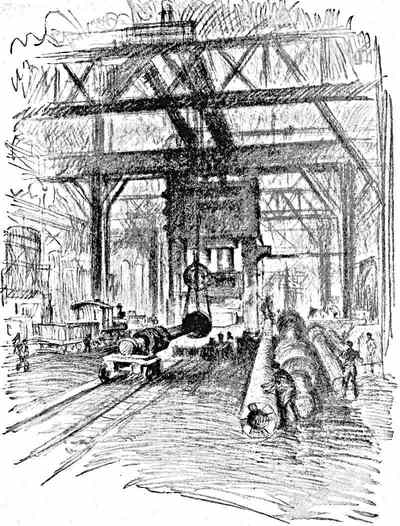
Forging Armor Plate
"Every man, in the draft age at least, must work or fight," said General Crowder. And the workers were just as important a factor in winning the war as the fighters. In the gigantic machine sketched above, ingots of sixty and seventy tons were pressed into plates of any size and thickness for use on our super dreadnoughts.
Click for a larger image.
LABOR DISLOCATION
It is estimated that about 35,000,000 men, women and children in the United States do the country's work: dig its coal, raise its crops, run its trains, build its roads, make its powder, turn out its munitions. There was an increase each year of a million man-power through immigration. The result of the war was that this source of supply was cut off. What was the economic significance of this cutting off of immigration? The immigrant was almost the only source of what we call day labor—the men who do the building and repairing of railroads, the mending of streets and roads, mining, and the rough work of steel mills and other factories. Along with the cessation of immigration came the withdrawal from labor power of two million men who were drawn into the Army. These men, incidentally, became large consumers of goods rather than normal producers of wealth. Some estimates were made that the United States Government was using for war purposes about one-half of the entire productive capacity of the country. These figures enable one to gauge the industrial dislocation caused by the war. In matters affecting the members of what might be called the labor army, which still kept up the work of production, the Government laid great emphasis on the need of securing industrial peace.
A Mediation Commission was appointed by the President to deal with conditions of labor unrest. This Commission made a report early in 1918, in which it spoke of the lack of knowledge on the part of Capital as to Labor's feelings and needs and on the part of Labor as to problems of management. The program outlined by the Commission was as follows:
"Modern large scale industry has effectually destroyed the personal relation between employer and employee—the knowledge and coöperation that come from personal contact. It is therefore no longer possible to conduct industry by dealing with employees as individuals. Some form of collective relationship between management and men is indispensable. The recognition of this principle by the government should form an accepted part of the labor policy of the nation.
"Law, in business as elsewhere, depends for its vitality upon steady employment. Instead of waiting for adjustment after grievances come to the surface there is needed the establishment of continuous administrative machinery for the orderly disposition of industrial issues and the avoidance of an atmosphere of contention and the waste of disturbances.
"The eight-hour day is an established policy of the country; experience has proved justification of the principle also in war times. Provision must of course be made for longer hours in case of emergencies. Labor will readily meet this requirement if its misuse is guarded against by appropriate overtime payments.
"Unified direction of the labor administration of the United States for the period of the war should be established. At present there is an unrelated number of separate committees, boards, agencies, and departments having fragmentary and conflicting jurisdiction over the labor problems raised by the war. A single-headed administration is needed, with full power to determine and establish the necessary administrative structure.
"When assured of sound labor conditions and effective means for the just redress of grievances that may arise, Labor in its turn should surrender all practices which tend to restrict maximum efficiency.
"Uncorrected evils are the great provocative to extremist propaganda, and their correction would be in itself the best counter-propaganda. But there is need for more affirmative education. There has been too little publicity of an educative sort in regard to Labor's relation to the war. The purposes of the government and the methods by which it is pursuing them should be brought home to the fuller understanding of Labor. Labor has most at stake in this war, and it will eagerly devote its all if only it be treated with confidence and understanding, subject neither to indulgence nor neglect, but dealt with as a part of the citizenship of the state."
ADVISORY LABOR COUNCIL
In order to prevent lack of coördination in the government's handling of the labor situation an advisory council was created to help the Secretary of Labor to organize the new war work. The field of this advisory council is indicated in a series of memoranda presented to him in January, 1917.
"An Adjustment Service which will have to do with the adjustment of industrial disputes according to policies and principles arrived at through the deliberations of the War Labor Conference Board.
"A Condition of Labor Service which will have charge of the administration of conditions of labor within business plants.
"An Information and Education Service which will devote itself to the establishment of sound sentiment among both employers and employees and to the establishment in individual plants of the local machinery (e.g., employment management) and policies necessary for the successful operation of a National Labor Program.
"A Woman in Industry Service which will meet the problems connected with the more rapid introduction of women into industry as a result of war conditions.
"A Training and Dilution Service which will administer such training and dilution policies as may be agreed upon.
"A Housing and Transportation of Workers Service whose duty it will be to provide the housing facilities to meet the nation's needs.
"A Personnel Service whose duties it shall be to assemble and classify information concerning appropriate candidates for positions in the war-labor administration and make recommendations for appointment.
"A Division for the Investigation of Special Problems which would be a part of the Secretary's office force and would conduct investigations in the placing of contracts, in priority of labor demand, in powers of the Department, in problems of reconstruction, and would assist in formulating the national labor policy.
"An Investigation and Inspection Service to provide the field force of examiners and inspectors required by the other services."
After various stages of experience the War Industries Board secured something more than an advisory position. This was done only after a year of warfare. The final situation was explained by Mr. C. M. Hitchcock in the Journal of Political Economy, June, 1918:
"When on March 4th of the present year the President appointed Bernard M. Baruch Chairman of the War Industries Board and defined his duties he did not, as certain press reports have implied, create an industrial dictator. His action did clear the way for Mr. Baruch's assumption of the duties of a director of industrial war strategy, of an industrial Chief of Staff—for the present position of the War Industries Board in the American Government is comparable in its relation to national industrial policy to nothing so much as the functions of the General Staff of the Army in its jurisdiction over military strategy. After a year of war the direction of industrial policy is placed in single hands, and a central planning board is established for dealing not only with the problems of production and purchase but with the whole attitude of the government toward the mobilization of business resources for the prosecution of the war. Leadership has been focused and an administrative channel opened for the inauguration of a studied and inferentially constructive industrial policy.
"From the present trend of events the War Industries Board promises to become the sole directing agency between the government and industry. Backed by the power of the President to commandeer, to withhold fuel, and in other ways to force the halting into line, it can mold the country's industrial system almost as it will—whether in organizing the nation for war or in directing the lines along which it shall return to normal conditions when peace comes. In a system of government such as ours, where the responsibility for directing the war rests almost exclusively in the hands of the President, and where his power ultimately becomes almost absolute, the Board has been shaped into a very potent instrument.
"Yet powerful as it may become, subject only to the jurisdiction of the President, it is well to remember that in a comprehensive national war plan it cannot stand alone. Its policies must be subject to the administration's general strategy in the war—for instance, to the amount of munitions in comparison with the number of men or the amount of food that it wishes to send abroad at any given time. The munitions program and the conversion of industry to war purposes must be governed by the ultimate end in view. In addition, one of the great factors in production—the labor factor—is being administered by another government agency, and it is obvious that priority in the labor supply must go hand in hand with priority in materials."
WORK OR FIGHT
Military men were as keen as business men in realizing the industrial factor as a powerful contributory cause in winning the war. General Crowder's famous "work or fight" alternative was a sufficient witness of this fact. He said:
"Every man, in the draft age at least, must work or fight.
"This is not alone a war of military maneuvers. It is a deadly contest of industries and mechanics. Germany must not be thought of as merely possessing an army; we must think of her as being an army—an army in which every factory and loom in the Empire is a recognized part in a complete machine running night and day at terrific speed. We must make ourselves the same sort of effective machine.
"We must make vast withdrawals for the Army and immediately close up the ranks of industry behind the gap with an accelerating production of every useful thing in necessary measure. How is this to be done? The answer is plain. The first step toward the solution of the difficulty is to prohibit engagement by able-bodied men in the field of hurtful employment, idleness, or ineffectual employment, and thus induce and persuade the vast wasted excess into useful fields.
"One of the unanswerable criticisms of the draft has been that it takes men from the farms and from all useful employments and marches them past crowds of idlers and loafers away to the Army. The remedy is simple—to couple the industrial basis with other grounds for exemption and to require that any man pleading exemption on any ground shall show that he is contributing effectively to the industrial welfare of the nation."
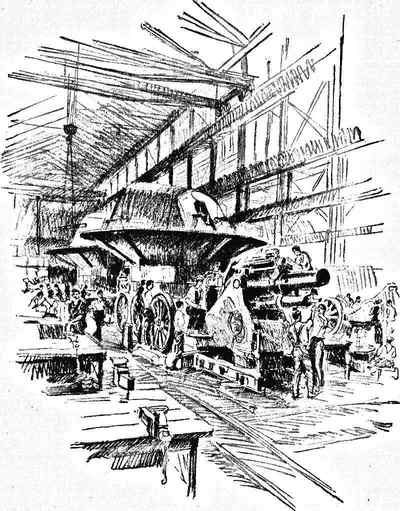
Building Howitzers
A nine-mile howitzer nearly ready for transportation. Beyond are seen heavy armorplate turrets in the making. The small and large manufacturers were given equal opportunity to obtain war business.
Click for a larger image.
Industrial preparation for war was guided by the principle of priority. This is an old principle, but it began to be applied in unheard-of ways. When an army is to be moved all means of transport in sight are commandeered. When an army is to be fed, civilians protest in vain against the seizure of stores. These practices were always features in the history of warfare.
A novel factor in priority as applied during the present war was the breadth of its scope.
"When the whole industry of a nation is mobilized behind the fighting line, it is not merely finished munitions that must be given priority in transportation, but also the materials and fuel for further munitions production. The food supply of the industrial population, as well as that of the army, has a claim to priority. So also have clothing supplies, lumber for housing, and whatever else is essential to working efficiency. In production it would be impossible to fix definite limits upon the application of the priority principle. We can not much longer permit the free flotation of the securities of foreign enterprises, nor even of the less essential domestic enterprises, so long as national loans or issues designed to finance railways or industrial enterprises of prime necessity are to be floated. Modern warfare, in involving the whole national life, has made inevitable a control of business practically coextensive with the economic system.
"The application of the priority principle to transportation and production is quite in accord with plain common sense. It is none the less revolutionary in its social economic implications. What it means is that necessities shall have right of way. If we have excess productive capacity, the unessentials and luxuries may be provided, but not otherwise. And necessities are definable in terms that take account only of physical requirements. There is no room in the definition for class distinction. A new country house may seem a matter of necessity to the man of fortune, but he will persuade no priority board to permit shipment of building materials while cars are needed for coal or wheat. Nor will he persuade them to let him have lumber that could be used for ships or workingmen's camps, or labor that could be employed to advantage in production for more clearly national and democratic needs."
WAR SUPPLIES
The United States, following the experience of other belligerents, adopted the policy of decentralization in the production of war supplies. A plan was worked out under which the small and large manufacturer were given equal opportunity to obtain war business:
"Under the plan that has been worked out for bringing the manufacturing resources of the country into more effective coöperation with the government, the country is to be divided into twenty industrial regions, with the following cities as centers: Boston, Bridgeport, New York, Philadelphia, Pittsburgh, Rochester, Cleveland, Detroit, Chicago, Cincinnati, Baltimore, Atlanta, Birmingham, Kansas City, St. Louis, Dallas, Milwaukee, St. Paul, Seattle, San Francisco. The following plan for effecting the organization is suggested by the officials in charge:
"Organize through Chambers of Commerce and other business associations Industrial Committees with the principal industrial center as headquarters and such subdivisions as are recommended by the business association of each district.
"Develop such organization in various classes of industry as well as in area for greatest convenience, to get information of all classes of products in and between regions.
"Having established such region and sub-region, through the coöperation of the best business men in each district have a survey of the industries recorded in the hands of the section in Washington of the War Industries Board for information to the various procurement sections of the government.
"Each region may have in Washington a representative who through the Resources and Conversion Section of the War Industries Board may keep in direct contact with his region and be available to the governmental procurement divisions or the War Industries Board for prompt action in giving data from his region.
"The detailed form of organization suggested for each region (subject, of course, to modifications as desired to meet the needs of any region) is known as the Cleveland Plan, which has been for some time in operation. Under this plan each region is divided into eight sub-regions, an important industrial city in each sub-region being designated as a center. Each sub-region has a local War Industries Commission which coördinates all industry within its territory. Within each sub-region manufacturing is divided into the following classes: castings, forgings and stampings; machinery and machine products; rubber products; clay products, chemicals, oils, and paints; textiles and clothing, wood and leather; engineering; automotive. Other classifications may of course be added in important lines of industry."
Such regional divisions were but one factor in industrial administration. Government needs and labor shortage made imperative the regulation of manufactures by the priority system.
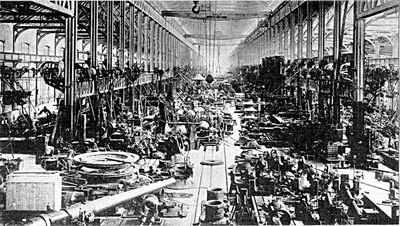
Guns and Armaments for United States and Her Allies
Interior of one of the Bethlehem Steel Company's mills—among the largest plants in the world for the production of munitions during the War.
Click for a larger image.
THE PRIORITY SYSTEM
The actual working of the priority system is shown in the following general classification of industry for the purpose of priority treatment:
Ships—Including destroyers and submarine chasers.
Aircraft.
Munitions, Military and Naval Supplies and Operations—Including building construction for government needs and equipment for same.
Fuel—For domestic consumption, and for manufacturing necessities named herein.
Food and Collateral Industries— Foodstuffs for human consumption, and plants handling same. Feeding stuffs for domestic fowls and animals, and plants handling same. All tools, utensils, implements, machinery, and equipment required for production, harvesting and distribution, milling, preparing, canning and refining foods and feeds such as seeds of foods, and feeds, binder twine, etc. Products of collateral industries, such as fertilizer, fertilizer ingredients, insecticides and fungicides, containers for foods and feeds, collateral products. Materials and equipment for preservation of foods, and feeds, such as ammonia and other refrigeration supplies, including ice.
Clothing—For civilian population.
Railroad—Or other necessary transportation equipment, including water transportation.
Public Utilities—Serving war industries, Army, Navy, and civilian population."
But the perplexity of applying this system to such a question as fuel administration is shown in the following list taken from one of the trade publications of the Administration for April, 1918:
"The Fuel Administration has therefore arranged the following list of preferred industries:
Aircraft—Plants engaged exclusivevly exclusively in manufacturing aircraft or supplies and equipment therefor.
Ammunition—Plants engaged in the manufacture of ammunition for the United States Government and the Allies.
Arms (small)—Plants engaged in manufacturing small arms for the United States Government and the Allies.
Army and Navy cantonments and camps.
Chemicals—Plants engaged exclusively in manufacturing chemicals.
Coke plants.
Domestic consumers.
Electrical equipment—Plants manufacturing same.
Electrodes—Plants producing electrodes.
Explosives—Plants manufacturing explosives.
Farm implements—Manufacturers exclusively of agricultural implements and farm-operating Equipment.
Feed—Plants producing feed.
Ferro-alloys—Plants producing same.
Fertilizers—Manufacturers of fertilizers.
Fire brick—Plants producing same exclusively.
Food—Plants manufacturing, milling, preparing, refining, preserving, and wholesaling food for human consumption.
Food containers—Manufacturers of tin and glass containers and manufacturers exclusively of other food containers.
Gas—Gas-producing plants.
Guns (large)—Plants manufacturing same.
Hemp, jute, and cotton bags—Plants manufacturing exclusively hemp, jute, and cotton bags.
Insecticides—Manufacturers exclusively of insecticides and fungicides.
Iron and steel—Blast furnaces and foundries.
Laundries.
Machine tools—Plants manufacturing machine tools.
Mines.
Mines—Plants engaged exclusively in manufacturing mining tools and equipment.
Newspapers and periodicals—Plants printing and publishing exclusively newspapers and periodicals.
Oil—Refineries of both mineral and vegetable oils.
Oil production—Plants manufacturing exclusively oil-well equipment.
Public institutions and buildings.
Public utilities.
Railways—Plants manufacturing locomotives, freight cars and rails, and other plants engaged exclusively in manufacture of railway supplies.
Refrigeration—Refrigeration for food and exclusive ice-producing plants.
Seeds—Producers or wholesalers of seeds (except flower seeds).
Ships (bunker coal)—Not including pleasure craft.
Ships—Plants engaged exclusively in building ships (not including pleasure craft) or in manufacturing exclusively supplies and equipment therefor.
Soap—Manufacturers of soap.
Steel—Steel plants and rolling mills.
Tanners—Tanning plants, save for patent leather.
Tanning extracts—Plants manufacturing tanning extracts.
Tin plate—Manufacturers of tin plate.
Twine (binder) and rope—Plants producing exclusively binder twine and rope.
CIVIL WAR CONDITIONS
During the war period labor was much better off than during the Civil War epoch. The New York World presented the following table from the Merchants' Magazine of December, 1864, showing the rise of prices during the Civil War era:
18621864
Copper, 100 lbs$22.00 @ $25.00$41.00 @ $42.00
Coal, ton4.50 @ 5.009.00 @ 10.00
Iron, pig21.00 @ 25.0048.00 @ 49.00
Lead, 100 lbs6.50 @ 6.7511.75 @ 12.00
Nails, 100 lbs3.25 @ 3.756.00 @ 6.25
Ashes, pot bbl5.50 @ 5.758.75 @ 8.87
Dry cod, cwt3.37 @ 4.256.50 @ 7.00
Flour, bbl4.50 @ 5.607.30 @ 7.35
Corn, 100 bush58.50 @ 60.00131.00 @ 134.00
Hay, 100 lbs.80 @ .851.35 @ 1.40
Wheat, bush1.30 @ 1.451.63 @ 1.65
Hemp, cwt10.00 @ 11.2514.00 @ 16.12
Barley, bush.85 @ 1.001.35 @ 1.50
Oats, bush.37 @ .39.90 @ .91
Hops, 100 lbs14.00 @ 20.0026.00 @ 33.00
Clover seed, 100 lbs7.50 @ 7.7512.50 @ 13.50
Lime, bbl.60 @ .651.25 @ 1.35
Oil, whale, gal.25 @ .35.58 @ .60
Oil, coal, gal.48 @ .571.10 @ 1.12
Pork, bbl13.25 @ 13.7521.75 @ 23.50
Beef, bbl5.50 @ 8.0010.00 @ 15.00
Lard, 100 lbs7.50 @ 8.2513.59 @ 14.00
Whisky, 100 gals25.00 @ 25.5089.00 @ 91.00
Tallow, 100 lbs8.75 @ 9.0012.62 @ 12.75
Whalebone, 100 lbs68.00 @ 70.00150.00 @ 155.00
Wool, fleece, 100 lbs52.00 @ 53.0078.00 @ 82.00
Wool, pl'd, 100 lbs44.00 @ 45.0070.00 @ 75.00
Butter, 100 lbs16.00 @ 21.0036.00 @ 37.00
Cheese, 100 lbs5.00 @ 7.0015.00 @ 18.00
"Wheat flour, one of the prime necessities, 'was at no time during the Civil War above $7.35 per barrel, which is somewhat less than four cents per pound,' while at the present time it is seven cents per pound, 'or close to 100 per cent. higher than the top notch of the '60s.' Lard has already advanced about 100 per cent., while its greatest advance during the Civil War was 75 per cent.
"'The present-day advance in the price of clothing in general has not been proportionate with the advance of foodstuffs, though it has been considerable, especially as to the cheaper grades. Cotton shirts that sold for 48 cents in 1913 are now bringing 90 cents to $1. Cheap hosiery has also about doubled in value. Suits that formerly sold for $15 are now bringing $17, which is about 10 per cent. advance. Cotton goods during the Civil War were exceptionally high, owing to the difficulty of procuring the staple. After the stocks on hand at the beginning of the war were exhausted, New England mills shut down because of inability to get supplies. In 1864 raw cotton ruled at 72 cents per pound, while at one time it touched $1.90. Cotton goods of all kinds were therefore extraordinarily high.'
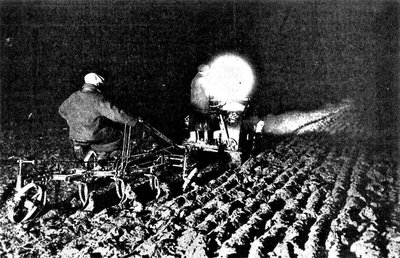
Copyright Underwood & Underwood
Plowing by Night
The number of men drawn from Great Britain into the army and navy during the war was about 5,000,000. This meant extraordinary efforts of production were necessary on the part of those who were left behind. By means of a motor tractor and an acetylene gas generator, the owner of the farm shown above was able to run day and night shifts.
Click for a larger image.
"The public spirit manifested at present is much more admirable than that displayed in the '60s, as shown by the following first-hand description of life in those days, as compared with what we see on every hand today. Said the New York Independent of June 25, 1864:
"'Who at the North would ever think of war if he had not a friend in the army or did not read the newspapers? Go into Broadway and we will show you what is meant by the word "extravagance." Ask Stewart about the demand for camel's-hair shawls and he will say "monstrous." Ask Tiffany what kind of diamonds and pearls are called for. He will answer "the prodigious, as near hen's-egg size as possible, price no object." What kind of carpetings are now wanted? None but "extra." Brussels and velvets are now used from basement to garret. Ingrains and three-plys won't do at all.
"'Call a moment at a carriage repository. In reply to your first question you will be told, "Never such a demand before, sir." And as for horses, the medium-priced $500 kind are all out of the market. A good pair of fast ones, "all right," will go for $1,000 sooner than a basket of strawberries will sell for four cents. Those a "little extra" will bring $1,500 to $2,000, while the "superb" 2.40 sort will bring any price among the high numbers.'"
GREAT BRITAIN'S PRODUCTIVE POWER
To appreciate what industrial mobilization meant in England the best method is to start with the figures on national production taken from the British census of 1907, the last accesible accessible for the peace period:
In 1907 the British people are estimated to have produced goods to the total amount of, roughly$10,000,000,000
The nation consumed during that year in personal consumption7,050,000,000
It spent on capital purposes at home:
(a) On betterment of its national plant950,000,000
(b) On maintenance of its national plant900,000,000
It used up goods to the value of (in keeping up and probably increasing its stocks of material on hand)325,000,000
It exported goods in the form of loans to foreign countries of about500,000,000
By 1914 the British Empire had probably advanced its income to at least $12,500,000,000; and the surplus of goods which it had to export as loans to foreign countries seems to have increased from about $500,000,000 to $1,000,000,000. What happened in war-time? First of all there was an unprecedented manufacture of munitions and war supplies. This production was needed not only for Great Britain, but also for her Allies. Seven-tenths of what was produced in Great Britain in the year 1907 was immediately used up in the form of personal consumption by its population; accordingly war industrial activities meant either that British production must be increased or British comsumpton consumption reduced, or that more goods must be bought from foreign countries through the sale of British liquid capital assets.
First of all, consumption was cut down; in detail, this was accomplished in the following ways: 1. By cutting down all normal additions to England's national plant, i. e., by building no more houses, factories, railways, roads, etc., except for purely war purposes. This expenditure in 1907 amounted to about $950,000,000. 2. By cutting down and ceasing as far as possible to spend money on the maintenance of this national plant, except the minimum required to keep it running. This expenditure in 1907 amounted to $900,000,000. 3. Most important of all, by cutting down civil personal expenditure. This was so far the largest item of consumption that it was here that the most important savings were made.
A WHOLE POPULATION AT WORK
In England the total number of "occupied males" between the ages of 18 and 44, i. e., roughly, the conscription age was, in 1911, 7,200,000. The number of men from the United Kingdom in the Army and Navy amounted to over 5,000,000; therefore, out of every seven of these men, on the average five were soldiers or sailors. These men were lost from the productive capacity of the nation. It is obvious that if English production remained the same, or increased, it must have been the result of extraordinary efforts on the part of the small percentage of occupied males of fighting age left, on the part of all the other males occupied or formerly occupied, and on the part of all females.
Mr. R. H. Brand, in discussing the situation in 1918, said:
"Notwithstanding the great difficulties, I think it is probable that our production is quite as great as before. Measured in money, and owing to the rise of prices, it would probably be much greater. This is due to the fact that the whole population, practically speaking, has been working, and working intensely. Millions of women who have not worked before are working now. No one is idle. Every acre of land or garden that can be used is being used. Methods of production have been speeded up, labor-saving machinery in industry and agriculture multiplied. In every direction the wheels have been turning faster.
"But, perhaps more important still, the character of our production has entirely changed—almost our entire industry is producing for war purposes. Ordinary civil needs are no longer considered. We have of course to produce what is essential for life, but beyond that all our energies are directed to war production. The government has of necessity compelled the whole of British industry to produce for war and to produce what it is told to produce, because in no other way could our own armies and our Allies have been supplied. No man is free to do what he likes with his labor and capital, with his ships, or with his steel. He has to do what he is told to do. By this means production for war purposes has enormously increased, and civil consumption has enormously decreased, because the goods for the civil population were no longer produced and one cannot buy what isn't there. Instead of gramophones, the gramophone company makes fuses; instead of cloth for ordinary clothes, the woolen factory makes khaki; instead of motor cars, the motor-car maker makes shells.
BRITISH INDUSTRY ON WAR BASIS.
"Apart from selling our liquid capital assets in return for foreign goods, and apart from borrowing from foreign countries for the same purpose, our power to provide our own army and navy with all they want and have any surplus over for our Allies has indeed depended entirely on our extraordinary efforts in production—not in normal production, but in war production—and also on the extent to which we have been able to reduce our civil consumption of all kinds. I put production first because, while economy in consumption is exceedingly important, increased productive capacity devoted to war material, in my opinion, is still more important. Our increased productivity has, as I say, been devoted entirely to war requirements. We have had to turn over our whole industry from a peace to a war basis. We have both voluntarily and compulsorily cut off the production of goods which are unnecessary for war purposes. Many trades have been actually shut down and the labor taken from them and handed over to war industries. Labor itself has been subjected to restrictions which would have been wholly impossible before the war. Labor may not leave its employment without government leave; salaries and wages may not be increased without government approval. Measures for the control of industry which were unheard of and, in fact, absolutely impossible before the war have been imposed upon all industry.
"Fixed prices had been placed on the most important materials; the government now has the absolute control of the use of steel, copper, lead, wool, leather, and other materials for which the war demand is insatiable, and also of all materials manufactured therefrom. No use may be made of most of these materials for any purpose whatever without a certificate being first obtained, no buildings of any kind may be erected without leave of the Ministry of Munitions. The whole of industry may now be said to be directed according to the requirements of the government, its regulation is an enormous task. In the head office of the Ministry of Munitions alone there are more than 10,000 people.
Mr. R. H. Brand, who is responsible for these statements and used them in an address to the American Bankers' Association, showed how these regulations had resulted in a decline of British imports from peace conditions of 55,000,000 tons annually to war conditions of 20,000,000 tons. The imports were nearly all foodstuffs. England exported large amounts of munitions and supplies to her Allies. In the year 1916 alone we supplied them with 9,000,000 pairs of boots, 100,000,000 sand bags, 40,000,000 yards of jute, millions of socks and blankets, and in addition several thousand tons of leather; also cloth, foodstuffs of every kind, portable houses, tools, hospital equipment and so on.
LABOR POWER IN ENGLAND
Mr. Lloyd George became the man naturally selected to be Prime Minister because of his success in directing one of the chief war industries—the work of munitions. In May, 1915, when he was made head of the newly created Department of Munitions, the problem before him was no easy one. The Central Empires were able to turn out 250,000 shells a day, while the British rate of production was 2,500 high-explosive shells a day, and 13,000 shrapnel shells. Lloyd George selected a large technical staff; the work was decentralized as much as possible, and special committees were formed for the purpose of organizing the work in each district. The question of raw materials had to be handled and this was not always easy because there were unscrupulous suppliers trying to make a corner in their goods. New machinery had to be made for the manufacture of large shells; all the big machine works were taken under direct control by the Government. Old factories had to be equipped and altered and twenty-six large plants had to be created. To provide the labor power, workmen were recruited by voluntary methods. A hundred thousand were in this way got together by July, 1915, most of whom were experts in machinery and ship-building. The result is pictured in the following extract by a French expert, Jules Destrée:
"On the 20th of December, 1915, Mr. Lloyd George, in a speech delivered in the House of Commons, summarized the results of the first six months of his tenure of office. We will take a few points.
"Orders placed before the formation of the department were delivered with an increase of 16 per cent. on previous deliveries. The number of new orders placed increased by 80 per cent.
"The state regulation of the metal market resulted in a saving of from 15 to 20 million pounds sterling.
"The present output of shells for a single week is three times as great as the entire output for May, 1915, which means that the rate of production is twelve times as great.
"The enormous quantity of shells consumed during the offensive of September, 1915, was made good in a month. The time will soon come when a week will suffice.
"The output of machine guns is five times as great; that of hand grenades is increased forty fold.
"The production of heavy artillery has been accelerated, and the heaviest guns of the early days of the war are now among the lightest.
"An explosive factory in the south of England, which on October 15, 1915, started to fill bombs at the rate of 500 a week with a staff of 60, was in March, 1916, turning out 15,000 a week with a staff of 250.
"An entirely new factory which started work at the end of October, 1915, with one filling shed and six girl fillers and an output of 270 a week, was in March, 1916, employing 175 girls and handling 15,000 bombs a week.
"The Ministry of Munitions has built, or is building, housing accommodation for 60,000 workers, and canteens and mess rooms in munition works now give accommodation for 500,000 workers a day.
"All the workmen were assigned either to the works already in existence—which in many cases were short of hands and unable for this reason to fulfill their contracts—or else they were allotted to the new factories.
"But in view of influence wielded by the labor unions, various provisions were inserted in the Munitions Act. They related to the settlement of labor disputes and to the prohibition of strikes and lockouts the grounds for which had not been submitted to the Board of Trade.
"To obviate such disputes, which were generally called forth by the excessive profits accruing to the employers and the demands of the wage-earners, the system of 'controlled establishments' was instituted. Every establishment engaged on munition work was placed, so far as the regulation of profits and salaries was concerned, under direct government control. Any modification in the rate of wages had to be submitted to the Ministry of Munitions, which had power to refer the question to an arbitration board specially set up by the act.
"To complete this rapid survey it must be added that a department was created by the Ministry of Munitions, under the control of an undersecretary, whose special business it was to examine war inventions."
INDUSTRIAL DISLOCATION IN FRANCE
When war was declared in 1914, the result in France was a complete disorganization. It must be remembered that workingmen from the age of 19 to 45 were called to the colors. This meant that the labor supply was reduced by about three-fourths. The revival of trade was very slow until the beginning of 1915. When it began to be realized that the war would be a long one, and when the consumption of ammunition and war materials was beyond all previous records, the Government was forced to prepare a program for industrial warfare. It was a hard task because much of industrial France was under enemy occupation. Munition work had to be undertaken in neighborhoods largely agricultural. Everything was lacking: labor, coal, raw material and transportation. As it became evident that the stoppage of industrial work was a serious mistake, an attempt was made to revive industries not connected with munitions, such as paper manufacture, glove and silk making. The operations undertaken by the Government are described in the following passage from M. R. Blanchard's article in the North American Review (1917):
"The first was to take men out of the army and send them to industrial work. This was done with great caution during the winter of 1914—15. The proportion of the men thus taken increased more and more during the year 1915 and reached its fullest extent in 1916. The specialists in steel work were the first to be taken out of the trenches; these were far from being sufficient, and common workmen were added to them. Then chemists and workmen trained in the manufacture of explosives were recalled; electric engineers were sent back to the hydro-electric plants; miners above thirty-five years of age who belonged to the territorial regiments were sent to the mines; paper-makers and cardboard-makers who could be employed in the preparation of explosives were put to work; cabinet-makers were put to manufacturing rifle stocks; wood-cutters were brought back from the front in order to see that there was no waste in providing the enormous amount of wood needed in the army. All this recalling of mobilized men was effected at first according to the need, and without method. By degrees it became clear that the output would be greater if these soldier-workmen were assigned to the plants or factories where they were working before the war. As it would have been unwise to take too large a number of men out of the fighting units, hundreds of thousands were taken from the auxiliary troops of the interior, men who through lack of physical ability to fight were employed in sedentary tasks. Thus in 1915 and 1916 auxiliaries were swept away to become workmen, foremen, secretaries, bookkeepers, accountants, etc. Finally the administration decided to draw from the oldest classes of men still under the military law. These were called in 1915 and sent to the factories—men born in 1868, either bachelors or married men without children.
"Another draft was made on the civil population. To make up for the absence of male help, women were called upon for a great number of occupations. Along with the women the refugees were to do their part. After a rather long period of unsettled life these refugees took again to regular occupations, some working in the fields as agricultural hands, others in factories. Today it is difficult to find unemployed people among them.
"The alien population for France is also large, considerable numbers of Italians, Spaniards, and Portuguese being employed in the southeastern region. A newer element was provided by natives from French colonies, namely, Morocco and Algeria. Since the war started large numbers of Greeks and Armenians had been imported into France; and during the last two years somethink something like 200,000 Chinamen had been brought to France for unskilled work. The last resource was the enemy itself. There were in France more than 250,000 German prisoners engaged in various work and receiving a salary for it."
Germany's industrial mobilization was picturesquely described by the head of the General Electric Co., Dr. Walter Rathenau, who was appointed at the beginning of the war to superintend the supplying of the German War Office with raw materials. He told the officials at the War Office that Germany was provided with more war materials only for a limited number of months. Accurate statistics were prepared in a short time on the power of production in various German industries. Then all the raw material was put where it could be commandeered. The flow of products was restricted, so that the raw material and also half manufactured products could be automatically diverted to articles needed by the Army. New methods were discovered and developed. Where former technical means were insufficient substitutes had to be found. Where it was prescribed that this or that article was to be made out of copper or aluminum, it was permitted to make it out of something else. All the laboring power of the country, including men from 16 to 60, were enrolled and controlled from the central organization called the War Office, described by General Gröner as follows:
"The new War Office represents Germany as a colossal firm which includes all production of every kind and is indifferent to the kind of coat, civil or military, which its employes wear. The new measures are intended to mobilize all effective labor, whereas up to the present we have only mobilized the army and industry. The whole war is becoming more and more a question of labor, and in order to give the army a firm basis for its operations the domestic army must also be mobilized. All the labor, women's as well as men's, must be extracted from the population, so far as possible voluntarily. But if voluntary enlistment does not suffice we shall not be able to avoid the introduction of compulsion."
THE GERMAN NATION IN ARMS
Sixteen months after this war organization was effected, General Ludendorff said that when the great spring offensive of 1918 opened the Germans were superior to the Allies in every form of war supplies. There was a speeding up all round; the output of shells and cannon was double. This meant the doubling of the coal and iron production, and could be done only by increasing the workers necessary to double the output of basic war materials. Adequate food had to be supplied to the workers; there was what is known as the Hindenburg "Fat Fund" to which contributions were sent in from German peasantry and agriculturists. General Gröner, the head of the German War Office, outlined optimistically the future of German war industrial production as quoted in the New York Times of December 14, 1916:
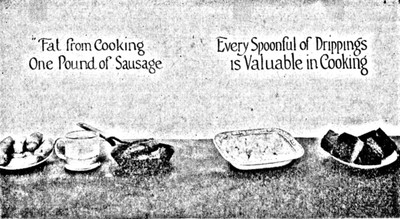
Photo by P. Thompson
A War Time Warning
Dairy production among the Allies decreased 30 per cent. during the war. The lard supply was also decreased. Kitchen economy in fats was never more important. Fats were so scarce in Germany during the latter part of 1917 that a "Hindenburg Fat Fund" was organized to which contributions were sent in from German peasantry and agriculturists.
Click for a larger image.
"German locomotives are running to the Taurus in Asia Minor; we are operating practically all the Serbian railways with German rolling stock; we have thousands of cars in Transylvania and Rumania, to say nothing of other occupied territories. After the transportation problem, we are taking measures to double the production of the auxiliary raw materials and semi-finished products. As one example, we are doubling our efforts for the manufacture of nitres from the nitrogen of the air. Not only of the basic raw materials, coal and iron, but of auxiliary raw materials we have no lack.
"The brains of our chemists and technicians are supplying the missing imports, and will continue to do so. Only when we have accomplished all this will we proceed to the last step of doubling the production of shells and cannon. Such a war is not to be won by looking ahead from month to month, but only by thinking of the distant future. After we have doubled the pyramid, we shall proceed to treble it.
"By spring we shall be going full steam ahead. After that our production will increase from month to month; and we have the labor and raw materials for keeping up the pace indefinitely.
"The male working forces available between the ages of seventeen and sixty, as provided by the Auxiliary Service Law, will cover our requirements into the distant future, but ultimately, aside from the children, aged and sick, every man and woman will be enlisted for home defense, if necessary. The home army will be the whole nation.
"What we are engaging on is not alone the progressive mobilization of all the nation's physical strength and material rsesources resources, but the mobilization of the nation's brains. An army corps of professors, scientists, chemists, engineers, technicians, and other specialists is already working with the Kriegstaat. Our idea is to be eminently scientific and practical—no theorizing. We are working to show results.
"We are coöperating closely with the war industries of Turkey, Bulgaria, and Austria. It means doubling and trebling their ammunition supply, too.
"The military successes achieved in Rumania, which synchronize with the birth of patriotic auxiliary service, are an advantage that cannot be overestimated. The Danube means everything to us. Last year we had to beg Rumania for her oil and grain and pay our good money for it too. Now we don't need to beg costly favors of Rumania.
"Lloyd George does not scare us. We have, however, not time for busying ourselves with politics; we have more important things to do—supplying Hindenburg with the means of victory."
RUSSIA'S INDUSTRIAL MOBILIZATION
In Russia industrial mobilization was badly managed. Cattle were taken to the front in herds. Often driven on foot, they were slaughtered on the spot where the meat was needed for the soldiers. The hides were thrown aside to rot. As a result of this wasting of hides, the supply of leather for military uses and for shoes for both the Army and the civilian population was soon utterly inadequate. Horses were requisitioned in the most unintelligent way, the result being that agricultural production decreased and with the lack of transportation facilities the Army horses could not be supplied with food. They died by the tens of thousands.
Gross mismanagement marked the war handling of the Russian railway system. The rolling stock was allowed to deteriorate. Locomotives and cars were put aside permanently when they needed slight repairs. They could not be repaired because the railway machine shops had been converted into munition factories. There was an appalling shortage of manufactured goods for the civilian population, because the entire output of many manufacturing concerns was taken over for the Army. It was almost impossible to get clothing, boots and articles of wearing apparel. So great was the dearth of cloth at the end of the third year of the war that one was struck by the contrast beween between the lines in front of the bakeries formed in the early morning hours and the groups of women gathered at eight in the evening before the shops which sold cloth to stand all through the night in line for the opening of the shop in the morning.
A bright spot in Russian war administration was the work of the Municipal and Provincial Councils. The members of these bodies did valiant service in preventing the growing disorganization of the economic life of their country. Their activities are described by Prof. Harper of Chicago University, an actual eye witness of Russian conditions during the war, in the following passage:
"So these organizations entered upon a campaign of 'saving' and 'production.' They saved the hides that were being thrown away, collected the discarded boots at the front and repaired them, and took over the task of supplying the underwear for the whole army—mobilizing the village coöperative societies to fill the large orders. And they did much to organize the refugees from the invaded districts for productive work. In a word, these men saw that the war was going to extend into years, and they realized that only foresight and organization of productive resources would make it possible for Russia to withstand economically the burdens of a protracted struggle.
"The attitude of the governmental authorities (the bureaucratic departments) toward the work of these non-bureaucratic, but public, institutions (the Unions of the Municipal and Provincial Councils) was one of suspicion and antagonism, and difficulties were put in their way with the deliberate intent to block their activities. The institutions were suspected of pursuing political aims. Only when it became clear that the ruling group in the bureaucracy was consciously allowing the country to drift into a state of anarchy in order to bring Russia out of the war did these leaders venture to risk revolutionary methods of action.
"The president of the All-Russian Union of Provincial Councils, the Zemstvo, was Prince Lvoff, the first Prime Minister of the new Russia after the revolution of March, 1917. In the monthly reports of the work of the All-Russian Union of Zemstva, Prince Lvoff, repeatedly issued warnings of the impending economic collapse of the country. But neither he nor Kerensky was able to liquidate the heritage received from the old régime in time to stave off the series of economic and financial crises of which the Bolsheviki availed themselves."
FOREBODINGS OF RUSSIA'S COLLAPSE
But it was not only foreign observers who were able to detect the prevailing rottenness in Russia's economic status. The following passage from an address made by A. I. Konovalov, a member of the Moscow Stock Exchange, shows that Russian business men were keenly alive to the dangers of the situation as early as April, 1917:
"The old régime has seemingly done everything deliberately to destroy and demoralize the trade-industrial apparatus it took years to build up. As a result the usual course of the country's economic life was stopped, and at the same time, through the peculiarly enforced system of regulations, a wide field for all sorts of abuses and speculations was opened. We must frankly acknowledge that from these abuses and speculations a system of oppression grew up which has called forth fully merited reproach, distrust, and hostile feelings towards the representatives of the trade-industrial class.
"At the same time there can be no doubt but that under present circumstances, lacking most of the necessaries of existence, with the factories and mills forced to cut down their production due to lack of raw material and fuel, with the demoralization of the transportation system, and being compelled, despite all these obstacles, to meet the numerous requirements at the front—there is no other way out but government control of private industrial and mercantile enterprises, and the coöperation of the democratic masses of the population in the matter of regulating the trade-industrial life of the country. In addition to fair distribution it should be the task of all the committees, which are to become parts of the Ministry, also to regulate the prices.
"Closely connected with this question there is another one which I personally consider of tremendous importance. I have in mind the question of limiting the profits of all mercantile and industrial establishments. Undoubtedly a properly worked-out solution of this question would have the tendency to check the unwarranted growth of prices that would appease the masses. The normal effect of a decree limiting profits is of tremendous importance, not only in that it would soften the feeling of ill-will towards the trade-industrial class, but also because it would afford the government a new, convincing proof that the commercial and industrial class is ready to make all possible sacrifices for the common good, a proof which would paralyze the voicing of any new demands on the part of the masses.
"Now, these are the main ideas, the fundamental points of view which the trade-industrial class should consider as a starting point in its efforts to win the confidence of the population and to safeguard that important position which it ought to occupy in the life of the country.
"The situation is becoming all the more difficult because of the ever-increasing famine due to the shortage of means of production as well as of all the necessaries of life; this famine will be felt very acutely, not only on account of the lack of these goods, but also because of the overabundance of paper money."
LABOR TRADITIONS UPSET
All kinds of economic theories and all varieties of economic experiences have been overturned by the abnormal industrialism of the war. The world really passed into a terra incognita. Even the firmest foundations of trade unionism have been shaken. There was no more firmly established fact before the war than the inability of women to secure a level of wages equal to that of the male wage earner. Such theories have passed to the limbo of forgotten things. Prejudice and tradition have given away before the actual test of facts. Women have taken the place of men called away to war service in practically all the fields of industrial activity. Apart from theory, biological and otherwise, it is now seen that the old exclusion of women from skilled industry was largely the result of trade union regulation. But the woman war-worker was found in fields untouched by trade unionism. There was the woman bank clerk as well as the woman engineer.
There was much discussion, mostly pessimistic, as to what would happen if the woman labor supply should permanently take the place of man labor after the war was over. The best solution was thought to be the placing of the woman worker under a régime of trade unionism. How far such prognostications went is illustrated in the following quotation from Miss Mary Stocks in the London Athenaeum.
"It has been presupposed that the war will end decisively before the armies engaged are reduced to inappreciable numbers of able-bodied men. It has been presupposed that the return of peace will find British industry based upon the old system of private ownership of capital and haphazard production in response to the effective demand of individuals. It presupposes no change of heart on the part of employers, government or trade unions. But, in view of possible, if not probable dangers, the most urgent stress should be laid upon what is an undoubted palliative, if not a fundamental cure for such prospective economic ills; that is, the strenuous promotion and public encouragement of trade unionism among women. What women, by reason of underlying social and economic causes, are not able to do for themselves, the moral and financial support of the public must do for them, and such support should be regarded not merely as an interference in the old struggle between capital and labor, but as an attempt to ward off a national danger.
"The root of the evil is the old incompatibility between male and female labor in the skilled and semi-skilled grades of industry. That incompatibility has arisen partly from fallacious theorizing of the 'wages-fund' type, but largely from the fact that the industrial woman, in spite of the uphill and often successful trade union work which has been accomplished, mainly from above, during the past forty years, is regarded by her male colleague as nature's blackleg. And in spite of the short-sighted policy of hostility to women members displayed by a few trade unions, it is fairly clear that it is not the woman trade unionist that the man is afraid of, but the woman blackleg; not the well-paid woman, but the sweated woman. Now there are three ways of dealing with a blackleg: he may be elbowed out of the industrial world altogether; he may be penned up, as women have been penned up, in the lowest and most undesirable grades; or he may be turned into a trade unionist. As far as women are concerned, the first two are closed by national expediency, humanity and justice. The third lies open; and in view of the peculiar economic rocks which loom vaguely ahead of us, it may be said without exaggeration that one woman trade-union leader is worth a hundred welfare workers."
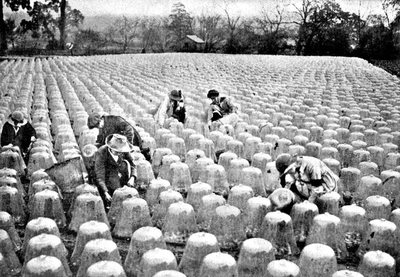
Copyright Underwood & Underwood
Women Workers in America
A field of winter lettuce, with the cloches, or glass bells, which made it possible during the war to raise plants in cold weather.
Click for a larger image.
WOMEN WORKERS IN AMERICA
As a result of the labor dislocation due to the operation of the American Draft Law, a large number of women were employed in railway work. The experience of the United States Railroad Administration in the matter of women employes was summarized in a paper read by Miss Pauline Goldmark, manager of the women's service section of the Railroad Administration, at a conference at the Academy of Political Science, in 1918:
"The number of women employed on the railroads of the United States had been 60,000 at the beginning of the year, and reached approximately 100,000 by October 1st. The greatest number are in the clerical and semi-clerical occupations. Of the 81,000 employed July 1st, 61,000 were working as clerks of all kinds, stenographers, accountants, comptometer operators, etc. In this class appear women ticket sellers and bureau of information clerks, who served the public for the first time; they were found well fitted for this type of work, and special instruction agencies were opened by the government in various states to train them in the intricacies of tariffs and routes.
"The next largest group of 4,000, it is not surprising to learn, appears in women's time-honored occupation of cleaning. Women have long been cleaning stations, offices, etc., but now they are employed in the yards to clean coaches and Pullmans, both inside and outside; and in the roundhouses, doing the heavier work of wiping locomotives; 800 were so employed. In personal service, including work in dining rooms and kitchens, as matrons and janitresses, 2,000 were found. In the railroad shops, women entered the greatest variety of new occupations. Three thousand were employed, ranging at one end of the scale from common laborers, at the other end of the scale of skilled mechanics earning the machinists' or carmen's rate of pay.
"Many women were employed a year and a half ago, before the railroads were put under Federal control, because they could be obtained for less pay than men. They were, for instance, engaged as common laborers at 20¢. to 22¢. an hour, at a time when men were receiving 28¢. to 30¢. for the same class of labor. With rare exceptions where adjustments are still necessary, the wage orders have absolutely stopped this undercutting of men's wages by women.
WORK UNSUITABLE FOR WOMEN
"Soon after women began to be largely employed it became apparent that some of their work was neither profitable nor appropriate. The use of women as section laborers, for instance, in a gang of men working along the tracks at a distance from any house or station was judged to be unsuitable. This was also found to be the case where women were employed as truckers in depots and warehouses on account of the extraordinary physical exertion required of them. In view of the wages now paid it was believed possible to secure men and to transfer the women to some class of work suitable to their strength and with proper regard to their health. The railroads were accordingly asked to discontinue their employment in both these positions.
"Comparisons with other industries can probably best be made in respect to the women employed in the shops. They are operating a number of machines such as bolt-threaders, nut-tappers, drill presses, for which no great skill or experience is needed, and which is classed as 'helpers' work,' and rated at the specified pay of 45¢. an hour. They are also employed for highly skilled work. A number have succeeded as electric welders and oxy-acetylene-burners. They have been found well adapted for work on the air-brake equipment and are cleaning, testing, and making minor repairs on triple valves. In some places they are now working in a separate group on the lighter-weight valves, weighing not more than forty pounds. After a period of training they are giving satisfaction without the help of any man operator.
"A remarkably fine type of woman is now to be seen in many of the shops, who enjoys the greater freedom of her work as compared with factory routine, although in many cases the discomfort, the dirt, and exposure are far greater. It remains to be seen whether the women will remain in these jobs to any great extent. The railroads will, of course, recognize the seniority rights of all their employees returning from military service, but as far as the new employees are concerned, women will have the same privileges as other new employees in retaining their positions or being assigned to other jobs. There can be no doubt that in the clerical and semi-clerical positions they have proved their worth, and will to a great extent be retained."
ALIEN LABOR FOR WAR PURPOSES
The man in the fighting line was only one factor in the prosecution of warlike operations. The success of strategy and tactics was dependent upon the organization of the man in the labor line not only at home but also in the territory behind the miles of trenches in France. For this purpose Chinese labor was drafted by both the British and the French Government. Large numbers of British ships sailed with crews practically consisting of Chinese sailors. The sentiment in favor of Chinese exclusion had to give way before imperative needs for labor power. There were tens of thousands of Chinamen in the service of the Allies. In the Sunset Magazine, Mr. G. C. Hodges calls attention to the fact that the break between the Chinese Republic and Germany was precipitated largely by the Allied drafting of China's manpower. Even in its beginnings he says, the French and British mobilization of Chinese labor caused a diplomatic battle royal. The significance of Chinese labor behind the battle front is described in the following words:
"They are a war factor. His Britannic Majesty's Chinese Labor Corps now behind the battle line in France is almost as large as the total Chinese population in the United States. The French Republic has recruited a force of similar dimensions, bringing Chinese manpower overseas for non-combatant and industrial work. Even teeming Russia, before its tragic collapse, had drawn upon thousands of Chinese for work as far west as the Ural mines. In 1914 there were but 7,000 in this rich country, but a fourfold increase brought the total to 30,000. All told, 200,000 Chinese are 'carrying on' in the war zone, laboring behind the lines, in munition works and factories, manning ships.
"Though the pages of no White Book say it, the break between the Chinese Republic and Germany was precipitated largely by the Allied drafting of China's manpower. Even in its beginnings, the French and British mobilization of Chinese labor caused a diplomatic battle royal."
ECONOMIC VALUE OF AMERICAN ARMY TO FRENCH INDUSTRY
Permanent economic improvements were one result of the presence in France of the American Expeditionary Force. An industrial movement was created that will probably continue long after the war is over. In various French seaports, docks had to be constructed to handle the enormous tonnage of supplies needed for the American troops. A letter in the New York Journal of Commerce gives a picture of the transformation in the transport system in France made in order to handle with speed and certainty the various supplies on which the American Army depended:
"Our project comprises nearly 1,000 miles of railroad construction, but not continuous. France already controls on her lines such facilities that she has been able to support her great military burden and not break. Their local development in the way of sidings and so forth is chiefly in the big towns, and small engines and cars are used. To meet our larger needs, it is necessary to establish terminals outside the towns for the change of engines and for our great storage warehouses. Our great railway construction in France, apart from a few cut-off lines, is in the way of storage yards. We have practically the use of two trunk-line tracks. The French run over them, too, for there is a tremendous civil population to be supported. The French are necessarily supreme, and we simply have the right to run over their railroads subject to their rules.
"The French have an arrangement with their railroads by which a piece of track that is put in for military purposes is paid for by the French Government. If the civil requirements of the railroad grow up to the use of that particular piece of track, then the government is reimbursed by the railroad. We are in the same position toward these railroads as the French Government. At the end of the war the improvements which we make will be surveyed. If they are useful to the railroads our expenditures will be reimbursed. If not, we are at liberty to take up the stuff and clear the ground. Two days ago a semi-official statement was made to the Paris press, reading:
"'Americans, in full agreement with the French authorities, are making every effort to carry out, by their own means, the debarkation of their troops in ports, their provisioning as well as their transportation over our railroads. Sidings, large stations, and establishments of every kind are being constructed by the most modern and expeditious processes. One of the warehouses has an area of about 4,000 acres, and it has a cold-storage plant capable of holding several thousand tons of meat. Aviation training camps and repair shops, considerable in size and with the most improved machinery, are being erected on every side.'"
FRENCH INDUSTRIAL EXHAUSTION
A realistic picture of the industrial exhaustion of France at the close of the war was given by M. Tardieu, General Commissioner for Franco-American war affairs. The war expenses of 120,000,000,000 francs was only a fractional part of the whole loss. Another 50,000,000,000 would have to be raised to secure raw material destroyed during the war. M. Tardieu presented in detail the various items indicating to what extent France had suffered economic disability and paralysis:
"The territories which have been under German occupation for four years were the wealthiest part of France. Their area did not exceed six per cent. of the whole country. They paid, however, 25 per cent. of the sum total of our taxes. These territories are now in a state of ruin even worse than we had anticipated. Of cities and villages nothing remains but ruins; 350,000 homes have been destroyed. To build them up again—I am referring to the building proper, without the furnishings—600 million days of work will be necessary, involving, together with building material, an outlay of 10,000,000,000 francs. As regards personal property of every description either destroyed by battle or stolen by the Germans, there stands an additional loss of at least 4,000,000,000 francs. This valuation of lost personal property does not include—as definite figures are lacking as yet—the countless war contributions and fines by the enemy, amounting also to billions. I need hardly say that, in those wealthy lands, no agricultural resources are left. The losses in horses and in cattle, bovine and ovine species, hogs, goats, amount to 1,510,000 head—in agricultural equipment to 454,000 machines or carts—the two items worth together 6,000,000,000 francs.
"As regards industries, the disaster is even more complete. Those districts occupied by the Germans, and whose machinery has been methodically destroyed or taken away by the enemy, were, industrially speaking, the very heart of France, the very backbone of our production, as shown in the following startling figures: In 1913 the wool output of our invaded regions amounted to 94 per cent. of the total. French production and corresponding figures were: For flax from the spinning mills, 90 per cent.; iron ore, 90 per cent.; pig iron, 83 per cent.; steel, 70 per cent.; sugar, 70 per cent.; cotton, 60 per cent.; coal, 55 per cent.; electric power, 45 per cent. Of all that—plants, machinery, mines—nothing is left. Everything has been carried away or destroyed by the enemy. So complete is the destruction that, in the case of our great coal mines in the north, two years of work will be needed before a single ton of coal can be extracted and ten years before the output is brought back to the figures of 1913.
Copyright Underwood & Underwood
Samuel P. Gompers
President of the American Federation of Labor.
THE WORK OF REBUILDING
"All that must be rebuilt, and to carry out that kind of reconstruction only, there will be a need of over 2,000,000 tons of pig iron, nearly 4,000,000 tons of steel—not to mention the replenishing of stocks and of raw materials which must of necessity be supplied to the plants during the first year of resumed activity. If we take into account these different items, we reach as regards industrial needs a total of 25,000,000,000 francs. To resurrect these regions, to reconstruct these factories, raw materials are not now sufficient; we need means of transportation. The enemy has destroyed our railroad tracks, our railroad equipment, and our rolling stock, which, in the first month of the war, in 1914, reduced by 50,000 cars, has undergone the wear and tear of fifty months of war.
"Our merchant fleet, on the other hand, has lost more than a million tons through submarine warfare. Our shipyards during the last four years have not built any ships. For they have produced for us and for our Allies cannon, ammunition, and tanks. Here, again, for this item alone of means of transportation we must figure on an expense of 2,500,000,000 francs. This makes, if I sum up these different items, a need of raw material which represents in cost, at the present rate of prices in France, not less than 50,000,000,000 francs."