Part 15 — OUR PART IN WINNING THE WAR Official Figures That Reveal the Enormous Contribution of This Country in Men, Money and Supplies
Reading edition
FIGURES OF AMERICAN PARTICIPATION IN THE WAR [36]
Revised to August 1, 1919
Total armed forces, including Army, Navy, Marine Corps, etc. 4,800,000
Total men in the Army4,000,000
Men who went overseas2,086,000
Men who fought in France1,390,000
Greatest number sent in one month306,000
Greatest number returning in one month333,000
Tons of supplies shipped from America to France7,500,000
Total registered in draft24,234,021
Total draft inductions2,810,296
Greatest number inducted in one month400,000
Graduates of Line Officers' Training Schools80,568
Cost of war to April 30, 1919$21,850,000,000
Cost of Army to April 30, 1919$13,930,000,000
Battles fought by American troops13
Months of American participation in the war19
Days of battle200
Days of duration of Meuse-Argonne battle47
Americans in Meuse-Argonne battle1,200,000
American casualties in Meuse-Argonne battle120,000
American battle deaths in war50,300
American wounded in war205,690
American deaths from disease57,500
Total deaths in the Army115,500
The part played by the United States in the war is statistically and graphically summarized in a compact little book prepared by Colonel Leonard P. Ayres of the Statistical Staff of the War Department. Attentively as the public may have followed the published reports of the many progressive steps and stages of our preparation for and participation in the war, much of the matter in The War With Germany—A Statistical Summary will have surprising interest. It is the first time a comprehensive view of the character and magnitude of our war activities has been made possible through anything so concrete and authoritative. The data were obtained from official reports, during the war, to the President, Secretary of War and Chief-of-Staff from the American Peace Commission in Paris, from the files of the Supreme War Council in Versailles, and other sources; and though, as Colonel Ayres states, it was still impossible to get final figures on some points or wholly reliable ones on others, care was taken to insure the degree of reliability reasonably practicable. The diagrams, figures and other information presented here and elsewhere in this volume are reproduced from Colonel Ayres' Summary, second edition, revised to August 1, 1919.
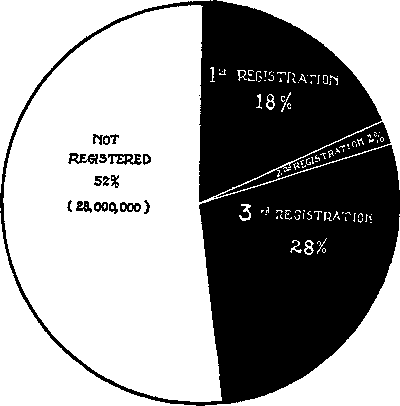
Official Government Statistics.
Male Population Registered and Not Registered
THE SELECTIVE SERVICE
"The willingness," Colonel Ayres says, "with which the American people accepted the universal draft was the most remarkable feature in the history of our preparation for war. It is a noteworthy evidence of the enthusiastic support given the war program that, despite the previous hostility to the principle of universal liability for military service, a few months after the selective service law was passed, the standing of the drafted soldier was fully as honorable in the estimation of his companions and of the country in general as was that of the man who enlisted voluntarily. Moreover, the record of desertions from the Army shows that the total was smaller than in previous wars and a smaller percentage occurred among drafted men than among those who volunteered. The Selective Service Law was passed on May 19, 1917, and as subsequently amended, it mobilized all the man power of the nation from the ages of 18 to 45 inclusive. Under this act, 24,234,021 men were registered and slightly more than 2,800,000 were inducted into the military service on the first draft. But during the war, from April 6, 1917, to November 11, 1918, about 4,000,000 served in the Army of the United States." The total number serving the armed forces of the country, including Army, Navy, Marine Corps and other services, amounted to 4,800,000. Approximately five men out of every 100 citizens were in arms. Of these, 2,086,000, constituting the American Expeditionary Force, were in service on the Western front. Those who saw actual fighting were 1,390,000.
It is interesting in this connection to record the fact that in our greatest previous war, the Civil War, 2,400,000 men served in the Northern Armies and in the Navy. In that struggle 10 men in each 100 inhabitants of the Northern States served as soldiers or sailors.
The fact is pointed out by Colonel Ayres that though the British sent to France more men in their first year than we did in our first year, it took England three years to reach a strength of 2,000,000 men in France whereas the United States reached that strength in France in a year and a half. But as an offset, it must be borne in mind that the British had to use men from the beginning to fill terrible casualty gaps, which was not the case with the American steadily building forces, and that the British also were sending men to several other battle fronts than those of France.
HOW THE DRAFT WAS MADE UP
Under the draft, registrants were subjected to a preliminary examination by the local boards to determine who were not of sufficient soundness and vigor for military life. Those accepted as qualified for service were sent to training camps where they underwent a second examination and rejections were made of those in any serious way defective. The not surprising result of the examinations was the demonstration that men representing the highest order of physical condition came from agricultural districts, the country bred boys far excelling those reared in the city. Taken by States it is noteworthy that men from the Middle West and those from Kentucky and Arkansas of the Southern States had the highest record, their physical condition enabling 70 to 80 percent. to pass the two examinations. The lowest percentage was in the New England States, in New York, in Michigan and in Western States that have for years been health resorts, where subnormal persons from all over the country resort. The percentage of men from those states who passed the two examinations was but 50 to 59. The intermediate ranges were 60 to 69. Under the two examinations not only did country boys make a better showing than city boys (100,000 country boys would furnish for military service 4,700 more soldiers than would an equal number of city boys), but the white registrants were better than the colored, the native-born better than the alien-born. Under the analysis 100,000 whites would furnish 1,240 more soldiers than would an equal number of colored; and 100,000 native-born would yield 3,500 more soldiers than would the like number of foreign-born. As 3,500 men are equivalent to an infantry regiment at full war strength, the value of these differences can be appreciated.
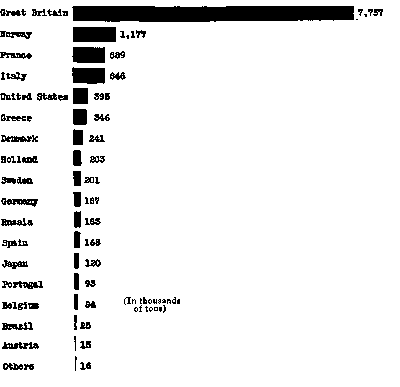
Official Government Statistics.
Comparative Losses of Merchant Shipping During the War
About 200,000 commissioned officers were required for the Army. Less than 9,000 were in the Federal Service at the beginning of the war,—5,791 were Regulars and 3,199 were officers of the National Guard in Federal Service. Thus out of every six officers one had had previous training in the army, Guard or ranks; three trained for their commissions in officers' training camps; two went from civil life into the army with little or no military training—the latter being in the majority physicians, ministers or technical men.
CAMPS AND TRAINING
Shelter was constructed in a few months for the accommodation of 1,800,000 men under training. For the National Guard and National Army divisions there were 16 camps and 16 cantonments, chiefly in the North. For National Guard Units organized during the summer of 1917 there were canvas camps in the South. One division, the Rainbow, required no training field, as it was assembled directly at Camp Mills for early transportation to France. The average American soldier who went to France received six months' training before he sailed and two months more in a quiet sector after reaching France, before entering the battle line.
The infantry soldier was trained in the division, the American typical unit, composed of about 1,000 officers and 27,000 men. Before the signing of the armistice there had been trained and sent overseas 42 divisions, the training of 12 more was well advanced and 4 others were being organized. Had the war continued this country would have had 80 divisions overseas before July, 1919, and 100 by the end of that year.
This country had the benefit in its training camps of 547 of the ablest French and English officers who had seen service on the Western front and were sent over to bring to the training of our men the approved methods developed in the experiences of the war. There were besides 226 non-commissioned British officers detailed as instructors. Colonel Ayres says they rendered services out of all proportion to their number, being a significant contribution to our training program.
GETTING THE TROOPS OVER
Especially impressive are the figures dealing with troop movements:
"During our nineteen months of war more than 2,000,000 American soldiers were carried to France. Half a million of these went over in the first thirteen months, the others in the last six months.
"The highest troop-carrying records are those of July, 1918, when 306,000 soldiers were carried to Europe, and June, 1919, when 364,000 were brought home to America.
"Most of the troops who sailed for France left from New York. Half of them landed in England and the other half landed in France.
"Among every 100 Americans who went over forty-nine went in British ships, forty-five in American ships, three in Italian, two in French, and one in Russian shipping under English control.
"Our cargo ships averaged one complete trip every seventy days and our troopships one complete trip every thirty-five days.
"The cargo fleet was almost exclusively American. It reached the size of 2,700,000 dead-weight tons and carried to Europe about 7,500,000 tons of cargo.
"The greatest troopship among all the ships has been the Leviathan, which landed 12,000 men (the equivalent of a German division) in France every month.
"The fastest transports have been the Great Northern and the Northern Pacific, which have made complete turn-arounds, taken on new troops and started back again in nineteen days."
TRANSPORTATION EXTRAORDINARY
Apropos of the rapid transportation Colonel Ayres says:
"In June (1918) with the German drives in full swing, the Allies called on us to continue the extraordinary transportation of troops begun in April. The early movement had been met by filling up the divisions that sailed with the best trained men wherever they could be found. Divisions embarked after July 1 had to meet shortages with men called to the colors in the spring. By November the average period of training in the United States had been shortened to close to four months, and the average for the period July 1 to Nov. 11 was probably five months.
"In the last months of the war, the induction of men was carried forward at top speed and every device was used for hastening training. The result fully justified the effort. Into the great Meuse-Argonne offensive we were able to throw a force of 1,200,000 men, while we had many thousands of troops engaged in other parts of the line. Our training camp officers stood up to the test; our men with their intensive drilling in open-order fighting, which has characterized American training, routed the best of the German divisions from the Argonne Forest and the Valley of the Meuse."
FEEDING AND CLOTHING PROBLEMS
When an army is 3,000 or 4,000 miles from its sources of supply the amounts of supplies in reserve and in transit are enormous as compared with the quantities actually consumed each month. As an example the army purchases of blankets in 1918 were two and one-quarter times as great as the entire American production in 1914. Put differently, the blankets bought in one year for the use of 4,000,000 or 5,000,000 soldiers would have been sufficient to make good the normal consumption of blankets by 100,000,000 American civilians for two and a quarter years. So proportionately with other things, the rule for clothing was that for every man at the front there must be a three months' reserve in France, another two or three months' reserve in the United States and a third three months' supply continuously in transit.
The same thing was true of other supplies and munitions. The need for reserves and the time required for transportation called for the supply of enormous quantities and called for it at once.
An indication of the quartermaster problem may be obtained from the fact that between April 6, 1917, and May 31, 1918, there was delivered to the army 131,800,000 pairs of wool stockings, 85,000,000 undershirts, 83,600,000 drawers, 30,700,000 pairs of shoes, 26,500,000 flannel shirts, 21,700,000 blankets, 21,700,000 wool breeches, 13,900,000 wool coats, and 8,300,000 overcoats. When the troop movement was speeded up in 1918 Colonel Ayres states that the margin of woolen clothing was dangerously narrow, and to secure these and other articles in sufficient quantity it was found necessary to take control of all states of the manufacturing process, from assembling the raw material to inspecting the finished product.
At no time was there a shortage of food in the expeditionary forces. Soldiers sometimes went hungry in this as in all other wars, but the condition was local and temporary. It occurred because of transportation difficulties during periods of active fighting or rapid movement when the units outran their rolling kitchens.
In France American engineers built seventeen new ship berths and 1,000 miles of standard and 125 miles of narrow gauge railroads. The Signal Corps strung 100,000 miles of telephone wires, and 40,000 American made motor trucks were shipped overseas. In this country army construction projects cost twice as much as the Panama Canal and were on nearly as large a scale overseas.
The storage space constructed in France was more than nine-tenths as large as that built at home. The amount of food on hand from the time the American troops entered active fighting never fell below a 45 days' supply, and at the time of the submarine scare, was kept at 59 to 72 days' supply.
Likewise the supply of clothing arose to the emergency of combat.
"The records of the quartermaster show that during the six months of hard fighting, from June to November, the enlisted man in the A. E. F. received on the average:
"Slicker and overcoat, every 5 months; blanket, flannel shirt, and breeches, every 2 months; coat, every 79 days; shoes and puttees, every 51 days; drawers and undershirt, every 34 days; woolen socks, every 23 days."
GUNS AND MUNITIONS
When war was declared we had on hand nearly 600,000 Springfield rifles. The American Enfield rifle was designed and manufactured. The total production of the two up to the signing of the armistice was over 2,500,000. The production of rifle ammunition amounted to 3,500,000,000, of which half was shipped overseas, in addition to the 200,000,000 rounds secured from the French and British.
During the war the Browning automatic rifle and the Browning machine gun were developed, put into quantity production and used in large numbers in the final battles in France. Before the war the allowance of machine guns in the American Army was four guns to a regiment; the allowance now is 336 to a regiment, testimony to the demonstrated importance in war of that effective weapon. The Browning machine guns are believed to be more effective than the corresponding weapons used in any other army.
The total number of machine guns produced in America up to the end of 1918 was 226,557, of these 69,960 being of the light Browning and 56,612 of the heavy Browning type. The Vickers field machine guns produced totaled 12,125, the other field guns 6,366, the Lewis aircraft guns, 39,200, the Browning aircraft 580, the Marlin aircraft 38,000, and the Vickers aircraft 3,714. Before Nov. 1, 1918, 29,000 light Brownings, 27,000 heavy Brownings, and 1,500,000,000 rounds of rifle and machine-gun ammunition were shipped.
When war was declared the United States had sufficient light artillery to equip an army of 500,000 men, and shortly found itself confronted with the problem of preparing to equip 5,000,000 men. To meet the situation, it was decided in June, 1917, to allot our guns to training purposes and to equip our forces in France with artillery conforming to the French and British standard calibers. It was arranged that we should purchase from the French and British the artillery needed for our first divisions and ship them in return equivalent amounts of steel, copper and other raw materials so that they could either manufacture guns for us in their own factories or give us guns out of their stocks and replace them by new ones made from our materials.
Up to the end of April, 1919, the number of complete artillery units produced in American plants was more than 3,000, or equal to all those purchased from the French and British during the war. The number of rounds of complete artillery ammunition produced in American plants was in excess of 20,000,000, as compared with 10,000,000 rounds secured from the French and British. In the first twenty months after the declaration of war by each country, the British did better than we did in the production of light artillery, and we excelled them in producing heavy artillery and both light and heavy shells.
THE ARTILLERY SUPPLY
Colonel Ayres says:
"The most important single fact about our artillery in France is that we always had a sufficient supply of light artillery for the combat divisions that were ready for front-line service. This does not mean that when the divisions went into the battle line they always had their artillery with them, for in a number of cases they did not.
"The result of the compilation is to show that in every 100 days that our combat divisions were in line they were supported by their own artillery for seventy-five days, by British artillery for five days, by French for one and one-half days, and were without artillery for eighteen and one-half days out of the 100. Of these eighteen and one-half days, however, eighteen days were in quiet sectors and only one-half of one day in each hundred was in active sectors. There are only three records of American divisions being in an active sector without artillery support. The total of these three cases amounts to one-half of 1 per cent., or about fourteen hours out of the typical 100 days just analyzed.
"The facts can be summarized in round numbers with approximate accuracy by saying that we had in France 3,500 pieces of artillery of which nearly 500 were made in America, and we used on the firing line 2,250, of which over 100 were made in America."
THE CAMPAIGN OF 1919
At the conclusion of his chapter on rifles and machine guns Colonel Ayres has an interesting bit of semi-critical comment on the question of foresight, of which some desk-experts have been inclined to doubt the United States authorities were possessed. He says:
"At this point it is appropriate to comment on the fact that there are many articles of munitions in which American production reached great amounts by the fall of 1918 but which were not used in large quantities at the front because the armistice was signed before big supplies of them reached France. In the main, these munitions are articles of ordnance and aviation equipment, involving such technical difficulties of manufacture that their production could not be improvised or even greatly abbreviated in time.
"As the production figures are scrutinized in retrospect, and it is realized that many millions of dollars were spent on army equipment that was never used at the front, it seems fair to question whether prudent foresight could not have avoided some of this expense.
"Perhaps the best answer to the question is to be found in the record of a conference that took place in the little French town of Trois Fontaines on October 4, 1918, between Marshal Foch and the American Secretary of War.
"In that conference the Allied Commander-in-Chief made final arrangements with the American Secretary as to the shipment of American troops and munitions in great numbers during the fall and winter preparatory for the campaign of 1919.
"This was one day before the first German peace note and 38 days before the end of the war, but Marshal Foch was then calling upon America to make her great shipments of munitions and her supreme contribution of man-power for the campaign of the following year."
GAS AND EXPLOSIVES
One of the striking contributions to the cause of the Allies was the enormous quantity of smokeless powder and high explosives produced. From April 1, 1917, to November 11, 1918, the production of smokeless powder in the United States was 632,000,000 pounds, which was almost equal to the combined production of France and Great Britain. But by the time the war ended the production of smokeless powder in this country was 45 per cent. greater than that of France and Great Britain combined.
The output of high explosives, T.N.T. and others, increased rapidly from its pre-war status to a quantity 40 percent. greater than that of Great Britain, and nearly double the French production at the close of the war.
"The result of the high rate of production of both smokeless powder and high explosives was that the artillery ammunition program was never held up for lack of either the powder which hurls the bullet or the shell from the gun, or the high explosive which makes the shell effective when it reaches its destination."
Colonel Ayres says of toxic gases:
"When the clouds of chlorine suddenly enveloped the British and French lines in the Ypres salient, early in 1915, a new weapon was introduced into the war. That it was a powerful weapon is evidenced by the fact that during the year 1918 from 20 to 30 percent. of all our battle casualties were due to gas.
"At the time we entered the war we had practically no experience in manufacturing toxic gases, and no existing facilities which could be readily converted to such use. At the signing of the armistice we were equipped to produce gas at a more rapid rate than France, England, or Germany."
THE AIR SERVICE
"On the declaration of war the United States had fifty-five training airplanes, of which fifty-one were classified as obsolete and the other four as obsolescent. When we entered the war the Allies made the designs of their planes available to us and before the end of hostilities furnished us from their own manufacture 3,800 service planes.
"Aviation training schools in the United States graduated 8,602 men from elementary courses and 4,028 from advanced courses. More than 5,000 pilots and observers were sent overseas. The total personnel of the Air Service, officers, students, and enlisted men, increased from 1,200 at the outbreak of the war to nearly 200,000 at its close.
"There were produced in the United States to Nov. 30, 1918, more than 8,000 training planes and more than 16,000 training engines.
"The De Haviland-4 observation and day bombing plane was the only plane the United States put into quantity production. Before the signing of the armistice 3,227 had been completed and 1,885 shipped overseas. The plane was successfully used at the front for three months.
"The production of the 12-cylinder Liberty engine was America's chief contribution to aviation. Before the armistice 13,574 had been completed, 4,435 shipped to the expeditionary forces, and 1,025 delivered to the Allies.
"The first fliers in action wearing the American uniforms were members of the Lafayette Escadrille, who were transferred to the American service in December, 1917.
"The American air force at the front grew from 3 squadrons in April to 45 in November, 1918. On Nov. 11 the 45 squadrons had an equipment of 740 planes.
"Of 2,698 planes sent to the zone of the advance for American aviators 667, or nearly one-fourth, were of American manufacture.
"American air squadrons played important rôles in the battles of Château-Thierry, St. Mihiel, and the Meuse-Argonne. They brought down in combat 755 enemy planes, while their own losses of planes numbered only 357."
"The squadrons were of four types: Observation squadrons, whose business it is to make observations, take photographs, and direct artillery fire; pursuit squadrons, using light fighting planes to protect the observation planes at their work, to drive the enemy from the air, or to strafe marching columns by machine-gun fire; the day bombers, whose work was the dropping of bombs on railways or roads; and the night bombers, carrying heavier bomb loads for the destruction of strategic enemy works."
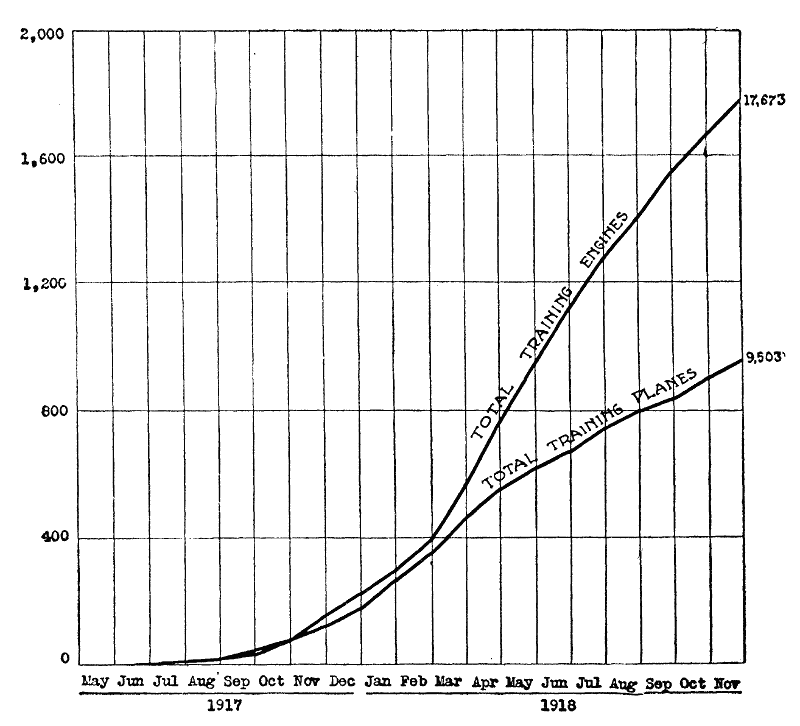
Official Government Statistics
Production of Training Planes and Engines to the End of Each Month
At the armistice there were on the front 20 pursuit squadrons, 18 observation squadrons and 7 bomber squadrons with 1,238 flying officers and 740 service planes, in addition to which there were 23 balloon companies.
CARGO SHIPMENTS
Altogether, from our entrance into the war through April, 1919, the Army shipped from this side of the Atlantic nearly seven and a half million tons (7,500,000) of cargo.
Included in the cargo shipment were 1,791 consolidation locomotives of the 100-ton type. Of these, 650 were shipped, set up on their own wheels so that they could be unloaded in France and run off in a few hours under their own steam.
The Army also shipped 26,994 standard-gauge freight cars; motor car trucks to the number of 47,018, and rails and fittings for the reinforcing of French railways and for the construction of our own lines of communications to the aggregate of 423,000 tons. The Army also shipped 68,694 horses and mules.
SIGNAL CORPS STATISTICS
In order to operate the transportation of supplies in France the Signal Corps strung its wires over nearly every part of that country. At the end of the war the Signal Corps was operating 282 telephone exchanges and 133 complete telegraph stations. The telephone lines numbered 14,956, reaching 8,959 stations. More than 100,000 miles of wire had been strung. The peak load of operation reached was 47,555 telegrams a day, averaging 60 words each.
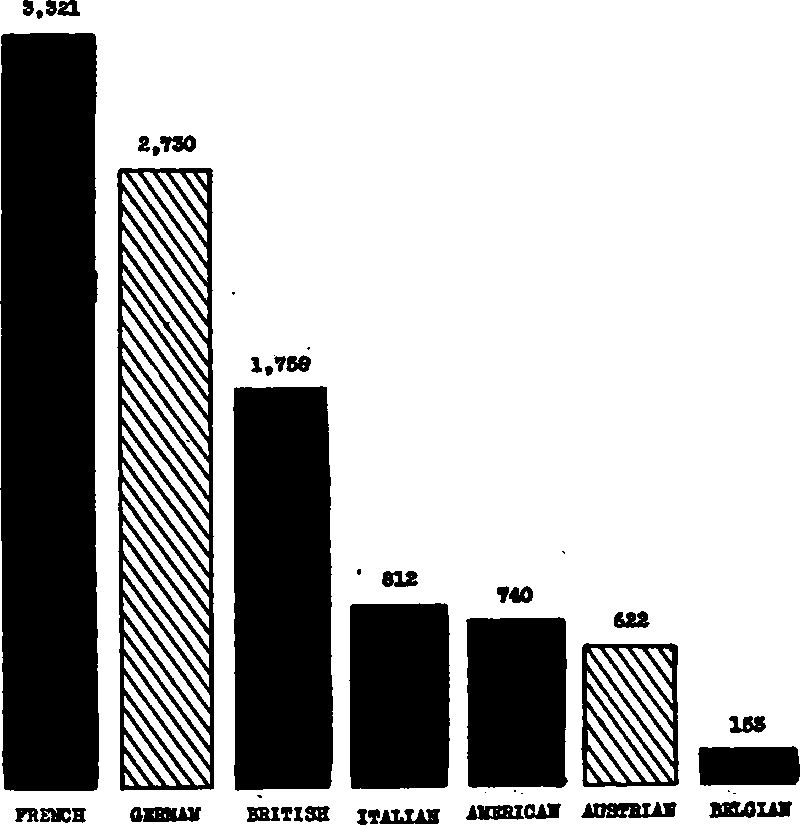
Official Government Statistics
Number of Battle Aeroplanes in Each Army at the Date of the Armistice
CONSTRUCTION STATISTICS
In building factories and storage warehouses for supplies as well as housing for troops, 200,000 workmen in the United States were kept continuously occupied for the period of the war.
The operations of the Construction Division constituted what was probably the largest contracting business ever handled in one office. The total expenditures in this enterprise to November 11, 1918, were about $800,000,000.
Construction projects were conducted in France by the Corps of Engineers under the services of supplies. Up to the signing of the armistice these projects had been undertaken to the number of 831, distributed all over France. To economize tonnage, materials were obtained in Europe as far as possible. The Engineer Corps ran its own quarries, and its own logging camps and saw-mills. The labor force consisted largely of American soldiers and German prisoners, though French and English civilians and Chinese coolies were used wherever available.
TWO HUNDRED DAYS OF BATTLE
Of our combat forces Colonel Ayres says:
"Two out of every three American soldiers who reached France took part in battle. The number who reached France was 2,086,000, and of these 1,390,000 saw active service in the front line.
"American combat forces were organized into divisions, which consisted of some 28,000 officers and men. These divisions were the largest on the Western front, since the British division numbered about 15,000 and those of the French and Germans about 12,000 each. There were sent overseas 42 American divisions and several hundred thousand supplementary artillery and service of supply troops.
"Of the 42 divisions that reached France 29 took part in active combat service, while the others were used for replacements or were just arriving during the last month of hostilities. The battle record of the United States Army in this war is largely the history of these 29 combat divisions. Seven of them were Regular Army divisions, 11 were organized from the National Guard, and 11 were made up of National Army troops.
"American combat divisions were in battle for 200 days, from the 25th of April, 1918, when the first Regular division after long training in quiet sectors, entered an active sector on the Picardy front, until the signing of the armistice. During these 200 days they were engaged in 13 major operations, of which 11 were joint enterprises with the French, British, and Italians, and 2 were distinctively American.
"At the time of their greatest activity in the second week of October all 29 American divisions were in action. They then held 101 miles of front, or 23 percent. of the entire allied battle line. From the middle of August until the end of the war they held, during the greater part of the time a front longer than that held by the British. Their strength tipped the balance of man-power in favor of the Allies, so that from the middle of June, 1918, to the end of the war the Allied forces were superior in numbers to those of the enemy."
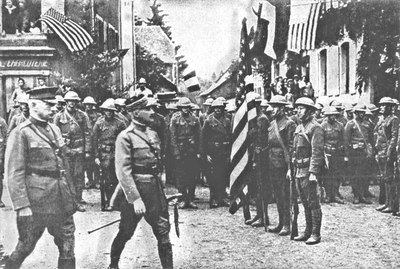
Our Flag in Alsace
A scene in Alsace after the armistice when American doughboys occupied a small town. They were welcomed there by the inhabitants.
Click for a larger image.
The total battle advances of the American divisions amounted to 782 kilometers, or 485 miles, an average advance for each division of 17 miles, nearly all of it against desperate enemy resistance. They captured 63,000 prisoners, 1,378 pieces of artillery, 708 trench mortars, and 9,650 machine guns. In June and July they helped to shatter the enemy advance toward Paris, and to turn retreat into a triumphant offensive.
It is stated in reference to the part played by the American divisions in the Argonne-Meuse that it was the 77th Division of New York selective draft men that achieved the greatest advance against the enemy—71½ kilometers, or nearly 45 miles.
In that battle the American Army captured 16,059 prisoners, liberated 150 French towns and villages, and as an army penetrated 34 miles into territory previously held by the Germans.
THE DEADLIEST WAR
In his chapter on "Health and Casualties," Colonel Ayres reminds us that "the war was undoubtedly the bloodiest that has ever been fought." The total battle deaths is given as 7,450,200. Russia led the death list with 1,700,000; Germany came next with 1,600,000; France next with 1,385,300; Great Britain next with 900,000; Austria, 800,000; Italy, 364,000; Turkey, 250,000; Serbia and Montenegro, 125,000; Belgium, 102,000; Rumania and Bulgaria 100,000 each; the United States, 50,300; Greece, 7,000; Portugal, 2,000.
Of every 100 American soldiers and sailors who took part, 2 were killed or died of disease during the period of hostilities. Among the other nations between 20 and 25 in every 100 were killed or died.
The total deaths were greater than all the deaths in all wars for more than one hundred years previous. In the above figures only deaths resulting directly from action are included. The total deaths from all causes is very much larger. Some of the armies lost more heavily through disease and privation than from battle. With regard to civilians' deaths due to the war, see Volume XII.
National Service Magazine
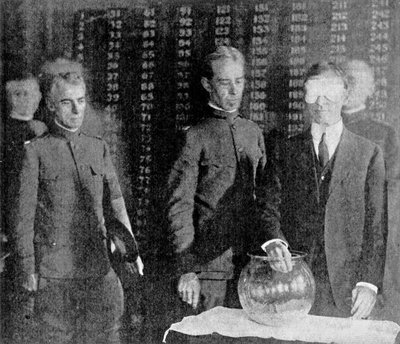
Secretary of War Baker Drawing Registration Numbers
The head of the War Department is drawing for the first capsule after the registration of young men who have become of age in the past year. All told 24,000,000 names were registered in the draft.
Click for a larger image.