Part 2 — IV—THE PEACE TREATY—ITS MEANING TO AMERICA America's "Place in the Sun" Due to Her Efforts to Secure a Just Peace
Reading edition
By GEORGE W. WICKERSHAM
Formerly Attorney-General of the United States.
"The cause of our entrance into the great war," declares Dr. David Jayne Hill in a recent essay, "being the violation by the German Imperial Government of our legal rights as a nation, our object in the war was to make our rights respected. The one clear duty of the treaty-making power in concluding peace with Germany, therefore, is to secure this result." [25]
In these words, one of the most distinguished and accomplished of the opponents of the treaty of Paris reveals the profound abyss which separates those who oppose from those who are urging the approval of the Treaty of Versailles. Dr. Hill, perhaps unconsciously, gives expression to a sordid, narrow, selfish view of the issues of the war, which would transmute into the most elemental act of self-defense one of the greatest crusades of high idealism ever conducted by any people in the history of nations. If, in fact, the cause of our participation in the war was merely to repel attacks upon our legal rights as a nation, then indeed, that end being attained, and the aggressor reduced to impotence for the future, we may return within our own borders, withdraw unto ourselves, disclaim all responsibility for the condition of the world elsewhere and plunge into the selfish exploitation of our national resources, "the world forgetting, by the world forgot." It is a strange perversion of the facts of recent history that leads to such a conception of America's responsibility for the future of civilization.
There were undoubtedly, as Mr. Wilson said, "violations of right which touched us to the quick." Was it merely violations of our own national rights that roused this peace-loving nation to array itself for battle; that sent two million of our young men across three thousand miles of ocean to take their places beside the heroes of Verdun and the Marne, the veterans of Cambrai and Arras, Ypres and the Somme; infused the weary defenders of civilization with new courage; converted their defense into an irresistible offensive which shattered the greatest military machine of history, overthrew the Kaiser and his government, and brought the German nation to its knees? No! It was not the German attacks upon our rights as a nation; it was the German challenge of the whole basis of modern Christian civilization. It was her cynical disclaimer of the binding character of treaties; her inhuman method of warfare; her brutal cruelties of non-combatant men, women and children; her ruthless destruction of monuments of art—the possessions of not merely one nation, but of the entire world of men and women in every land who love beauty and revere art. It was the growing conviction that a government which ordered the sinking of the Lusitania and the Sussex; that destroyed the priceless literary treasures of Louvain; that separated families in Belgium and France, and deported great companies of men to work in German munition factories; that ruthlessly cut up by the roots the fruit trees and shrubs of the occupied regions of France; that sought to destroy not merely the men, but the souls of nations, so that its own horrid philosophy of Force might reign over them—that such a government must no longer exist; that its pestilential influence was more noxious than tuberculosis or the bubonic plague.
THE BASIS OF PEACE
Therefore, the Youth of America joyously leaped to arms and crowded overseas in the greatest of all crusades, insuring victory and promising the opening of a new and better epoch of human history. It was the recognition of human kinship; the perception of human brotherhood, that inspired them to the great endeavor. Our proud sense of American nationality took on a deeper and holier significance as we joined forces with the older peoples in defense of the great principles of human right which had been formulated by our fathers and upon which was reared the American State. We were no less Americans that we had accepted a common responsibility with Great Britain, France and Italy for the preservation of the ideals of human freedom for which Washington fought and Lincoln died. Nay! better Americans, as we realized that the war was being fought in defense of those principles upon which our own institutions were founded and by which we had become the great, strong, free nation we are.
And as the hideous carnage went on, and we saw a whole generation of the youth of the free nations of Europe butchered because the German people had become so obsessed with their own sense of superiority that they were determined to rule the world and impose upon all other peoples subservience to their Moloch-like gospel of efficiency, another feeling began to struggle for expression in Europe and America alike—a determination that all wars of aggression must cease; that disputes between nations must be settled like those between individuals, by peaceful arbitration or conciliation; that the causes of war must be examined and, so far as possible, removed, and that no such war as this ever again should desolate the earth. This was the meaning of the phrase one came to hear on many lips, that it was "a war against war." How could such a result be attained? Obviously, only by the continued association in peace of those powers whose close coöperation in war was compelling the overthrow of German militarism, and the widening of that association to include all the other nations who should accept its program and give an earnest of adherence to its ideals. There was also the hope that some time—when they should have offered up that ancient sacrifice, "an humble and a contrite heart"—even the German people, enfranchised and regenerated, might be admitted into the society of Free Peoples and with new significance become entitled to be called a civilized nation.
These were the principles that underlay Mr. Wilson's program of peace—the fourteen points of January 8, 1918, and subsequent addresses; the only definite formulation of the basis of peace which was laid before the world, a program concerning which the American Congress expressed no definite criticism and for which it offered no substitute; a program which was accepted by Allies and opponents alike, and which constituted the Chart by which the Conference of Paris was required to endeavor to formulate the terms of the Treaty of Peace.
The work of that Conference now has been submitted to the judgment of mankind. It was accepted by the new government of Germany with a wry face, as the judgment of the victors naturally would be taken by the vanquished. It has been ratified by the Parliament of Great Britain, by Italy, by France and by Japan. It has been for weeks under debate in the Senate of the United States. Daily efforts have been made to create a partisan political issue over it, and to visit upon it party resentment against the past actions of the President. [26]
Dr. Hill again sums up the case against the treaty—the final basis which the confused gropings after some means of making it unpopular with the people finally have evolved—in these words:
"The League of Nations, as proposed, includes not only obligations not related to the reasons for engaging in the war, but also obligations opposed to the traditions, the time-honored policies, and even the constitutional provisions of the United States. It commits the whole future policy of this country to the decisions of an international body in which it would have only a single voice; it permits that body to intrude its judgments, and thereby its policies into a sphere hitherto regarded as exclusively American, and, in addition, it demands that the territories held by each of the members of the League under this treaty shall receive the permanent protection of the United States as integral parts of the Nations that now claim them."
Is it true? What is the real meaning of the Peace Treaty and its effect upon the people of the United States? The answer to these questions, and indeed to most of the criticism of the Covenant, is conclusively met by a reading of the treaty. But first let us turn for a moment to the fourteen points of Mr. Wilson's address of January 8, 1918. The basis of the territorial readjustment of Europe which he then proposed, was the giving of national expression to racial aspiration. Alien imperial rule such as that of Austria over Hungary and Bohemia, and that of Germany, Austria or Russia over Poland, was to end, and the Poles, the Croats, Serbs, Hungarians, Bohemians, and the Czechoslavs and Jugoslavs each were to be allowed national existence, with the right of self-determination. Whatever may now be thought of the wisdom of this theory, it was accepted by all of the Allies, who thereby were committed to a responsibility for the protection, certainly in the early years of their existence, of the new nations they united to call into being. Recognizing this fact, the fourteenth of the Wilson points provided for the creation of an Association of the Allied Nations to protect the work of their arms. Aside from that practical purpose, the League of Nations was recognized by many in every land as furnishing the only practicable machinery for the removal of causes of war and the prevention of new assaults upon civilization, such as that which Germany had launched in August, 1914.
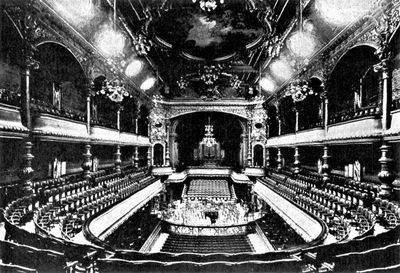
Copyright Underwood & Underwood
Victoria Hall at Geneva
Selected by the Council of the Powers as the meeting place of the League of Nations.
Click for a larger image.
The first Chapter of the Peace Treaty, therefore, is a Covenant or Compact forming a League of Nations, whose purpose, as expressed in the Preamble, is "to promote international coöperation and to achieve international peace and security." Worthy objects, these: how are they to be attained? The Preamble answers,
"by the acceptance of obligations not to resort to war, by the prescription of open, just and honorable relations between nations, by the firm establishment of the understandings of international law as to actual rule of conduct among governments, and by the maintenance of justice and a scrupulous respect for all treaty obligations in the dealings of organized peoples with one another."
Are not these methods such as America has made her own? Have we not in many treaties accepted obligations not to make war until all peaceful methods of settling disputes shall have been exhausted; have we not striven to make the principles of international law rules for the government of nations; and was not one of the main points in the indictment of Germany on which we prosecuted the war against her that she had flouted the sanctity of treaties and made them mere scraps of paper?
The objects of the League therefore, as set forth in the Covenant, are expressive only of policies and principles to which the United States has given a consistent and unbroken adherence from the days of the Jay Treaty to the present hour. How are these objects proposed to be attained in the text of the Covenant? What is there in its provisions to justify the frantic abuse that has been heaped upon it by its opponents and to sustain the final accusation that it is "un-American?"
MACHINERY OF THE LEAGUE
First, as to the Machinery of the League. There is an Assembly of its members to which each Sovereign State may send delegates. There is an Assembly of its members to which each nation necessarily has one vote. In the United States Senate, Rhode Island and New York have equal representation, despite disparity in wealth and population. The principle of sovereignty requires this recognition of equality. But the powers of the Assembly are restricted to voting upon the admission of new members to the League, the addition of members to the Council, the disposition of international disputes which may be referred to it by the Council under Article XV, and the general consideration at its meetings of "any matter within the sphere of action of the League or affecting the peace of the world." This general authority only can embrace the right of discussion, save in very exceptional cases, as by Article V, "decisions at any meeting of the Assembly or of the Council shall require the agreement of all the members of the League represented at the meeting."
The actual governing body of the League is the Council, which is to consist of representatives of the five greater powers,—the United States, Great Britain, France, Italy and Japan, together with representatives of four other members of the League selected by the Assembly from time to time. These numbers may be increased, but only by the unanimous vote of the Council, approved by a majority of the Assembly.
As noted above, save in the very few expressly expected cases, the Council can reach decisions only by unanimous vote. What are to be its functions? They need not be enumerated in detail here. Briefly, they deal with the reduction of armaments, the control by governments of the private manufacture of munitions and implements of war, the consideration of any war or threat of war—"of any circumstance whatever affecting international relations which threatens to disturb either the peace or the good understanding between nations upon which peace depends." They require the formulation and submission to the members of the League for adoption of plans for the establishment of a permanent Court of International Justice. They empower the Council to endeavor to effect a settlement of any international dispute which shall not be submitted to arbitration by the parties; to investigate, consider and report upon any such dispute, and to publish its conclusions.
The parties to the League solemnly covenant and agree that if any dispute shall arise between them likely to lead to a rupture they will submit it either to arbitration or inquiry by the Council, and that in no case will they resort to war until three months after the award by the arbitrators or the report by the Council. They agree also to carry out in good faith any award that may be rendered, and not to make war against any member of the League that complies therewith. If a report by the Council is unanimously agreed to by its members, other than the representatives of the disputants, the members agree not to go to war with any party to the dispute which complies with the recommendations of the report.
OBJECTIONS TO THE PLAN
It is objected by some that the decision of questions between nations by these provisions is left to a body of delegates composing the Council who are not bound to decide according to rules of international law, but may reach conclusions merely as political expediency. This seems a strained interpretation. The members of the League agree to submit either (1) to arbitration or (2) to investigation by the Council, every dispute which may arise between them likely to lead to a rupture and in no case to resort to war until three months after the award by arbitrators or the report by the Council. They declare (by Article XIII)
"Disputes as to the interpretation of a treaty, as to any question of international law, as to the existence of any fact which, if established, would constitute a breach of any international obligation, or as to the extent and nature of the reparation to be made for any such breach," to be among those which are generally suitable for submission to arbitration. Disputes of the character thus enumerated are what are known as justiciable, i. e., subject to be decided by a Court by the application of the recognized principles of international law.
Mr. Root recommended that such disputes should be required to be arbitrated. The Conference at Paris, like those at the two Hague Conferences, would not agree to that. But in view of the declaration just quoted, any power which should bring before the Council a dispute of the character mentioned, but which it was unwilling to submit to arbitration, would have the burden of showing convincing reason for such attitude.
When the first draft of the Covenant was before the country, American critics objected that it would compel the United States to submit to arbitration on inquiry by the Council purely domestic questions such as tariff, immigration and coastwise traffic. To meet this objection, there was inserted in Art. XV the following paragraph:
"If the dispute between the parties is claimed by one of them, and is found by the Council to arise out of a matter which by international law is solely within the domestic jurisdiction of that party, the Council shall so report, and shall make no recommendation as to its settlement."
To this it is objected that the determination of the question whether or not a matter of dispute is by the rules of international law solely with the domestic jurisdiction of a member is left to the Council and not to the member. Surely, it requires no explanation to demonstrate, that if a member State may oust the Council of jurisdiction to inquire into a given dispute which threatens the peace of the world merely by itself asserting that it arises out of a matter within its exclusive domestic jurisdiction, a very imperfect means of averting war will have been provided, and the League Covenant will hardly have more efficacy than the second Hague Convention. Remember too, that the reports of the Council must be unanimous, and the unreasonableness of the objection to the provisions cited will appear.
MEANS TO PREVENT WAR
Articles XI to XVI constitute the heart of the Covenant, the most effective means ever formulated to prevent war. The agreements of the nations not to resort to war until the processes of arbitration or inquiry are exhausted, are buttressed by the provision that should any member violate these agreements it shall ipso facto be deemed to have committed an act of war against all the other members of the League, entailing as a consequence commercial boycott, expulsion and the application of armed force, if the members shall so determine. The employment of force in this case, as in every other contemplated by the Covenant, is not left to the decision of Council or Assembly. They can only recommend. The member States agree not to go to war. There is nowhere in the document any provision compelling them to go to war. Even where one State in violation of its Covenant threatens the peace of the world, the utmost the Council can do is
"To recommend to the several governments concerned what effective military or naval forces the members of the League shall severally contribute to the armaments of forces to be used to protect the covenants of the League."
Much heated objection has been directed against Article X, which reads as follows:
"The members of the League undertake to respect and preserve as against external aggression the territorial integrity and existing political independence of all members of the League. In case of any such aggression or in case of any threat or danger of such aggression, the Council shall advise upon the means by which this obligation shall be fulfilled.'
Again, it is left to the determination of each State what force it shall employ to enforce this provision. As a matter of fact, this article adds little, if anything, to the provisions of Article XI, which declares that "Any war or threat of war ... is hereby declared a matter of concern to the whole League, and the League shall take any action that may be deemed wise and effectual to safeguard the peace of nations." Any external aggression against the territorial integrity or political independence of a member of the League would amount to a war or threat of war, and would invoke action under Article XI, if not under Article X. But the guaranty of Article X is very necessary as affording a moral protection to the new nations brought into being through the peace Conference. The United States of America, whose President formulated the principles of peace to which these Nations owe their existence, can not afford to shirk responsibility for their protection. The Covenant abolishes the evil of secret treaties between the nations composing the League, while preserving the effectiveness of existing treaties of arbitration.
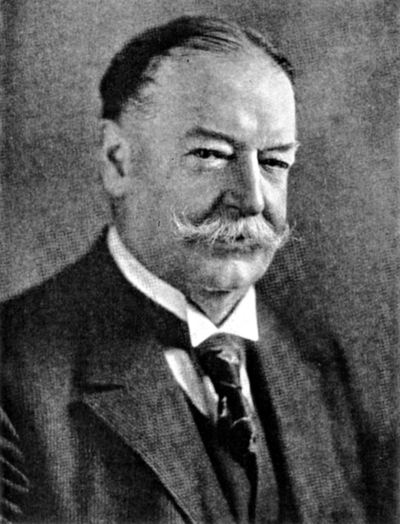
Copyright Harris & Ewing
William Howard Taft
An earnest supporter of the President and his administration throughout the war, though of the opposite party.
Click for a larger image.
THE MONROE DOCTRINE
To meet the objection that the Covenant would deprive us of the Monroe Doctrine—a national policy adopted by the United States as its own and maintained for its own protection—Article XXI of the amended Covenant provides that—
"Nothing in this Covenant shall be deemed to affect the validity of international engagements such as treaties of arbitration or regional understandings like the Monroe Doctrine for securing the maintenance of peace."
The phrase "regional understanding," as applied to the Monroe Doctrine, is not a happy one. But the article certainly excludes the Monroe Doctrine from modification or effect by the treaty. It secures from every one of the thirty-two original members and the thirteen other states which shall be invited to join the League, a recognition of the existence of the Monroe Doctrine and an agreement that it is not to be affected by anything contained in the Covenant. Certainly that is not an un-American result to accomplish, and when one reads Dr. Hill's statement that the Covenant "does not embody our traditional American ideals," one wonders in what museum of forgotten lore the learned doctor has found those "traditional ideals" preserved. Dr. Hill's so-called ideals conflict with the expression in this great treaty of the peculiarly American ideal of averting war by providing peaceful methods of settling disputes among nations, with the express recognition by all the other nations of the doctrine that "was proclaimed in 1823 to prevent America from becoming a theater for the intrigues of European absolutism," and with the official commentary of the Delegates of Great Britain which says that—
"At first a principle of American foreign policy, it (Monroe Doctrine) has become an international understanding, and it is not illegitimate for the people of the United States to ask that the Covenant should recognize this fact."
GERMAN COLONIES
One of the most difficult problems presented to the Peace Conference was the disposition of the former colonies of Germany in Asia, Africa and Australasia, and of the communities formerly belonging to the Turkish Empire. It was recognized that the victors in the war shared a common responsibility for the just and wise treatment of these peoples, who were utterly unable to stand alone. The method adopted declared all of them to be wards of the League of Nations and provided that they should be governed by Mandatory Powers willing to undertake the task and appointed by the League under charters framed by the Council. These Powers would be answerable to the League for the right exercise of their powers, and subject to inspection and report. A great deal of impassioned rhetoric has been expended over these provisions, upon the false assumption that thereby the United States was committed to a responsibility for the government of remote regions of the earth. The Covenant commits us to nothing. Our participation in the war has entailed upon us a common responsibility with our Allies for the protection and wise government of these communities. We no more can escape that responsibility with honor than we could after the Spanish War escape responsibility for the Philippine Islands.
But it is for the American Congress to determine the extent of recognition of our duty and the means by which we shall discharge it.
In the case of the Philippine Islands, the United States set for the world a great moral example in the government of colonies, not in its own interest, but for the benefit and exclusively in the interest of the inhabitants of possessions which fell into our hands as a consequence of the war with Spain. The principle thus proclaimed and practiced has been followed in the case of the colonies and territories which the World War has left at the disposition of the Allied and Associated Nations. This principle, in the words of the Covenant, is "that the well-being and development of such peoples form a sacred trust of civilization." The best method yet devised for giving practicable effect to this principle undoubtedly is,
"That the tutelage of such peoples be intrusted to advanced nations who, by reason of their resources, their experience or their geographical position, can best undertake this responsibility, and who are willing to accept it, and that this tutelage should be exercised by them as mandatories on behalf of the League."
This is the American attitude toward undeveloped peoples. To remove these provisions from the Peace Treaty would be to de-Americanize the Treaty.
MISCELLANEOUS PROVISIONS
The Covenant brings within the cognizance of the League the regulation of international relations affecting (1) efforts to secure and maintain fair and humane conditions of labor for men, women and children—a subject elaborated and provided for in great detail in Part XIII of the Peace Treaty; (2) the execution of international agreements with regard to traffic in women and children, and in opium and other dangerous drugs; (3) the trade in arms and ammunition with the countries in which the control of this traffic is necessary in the common interest; (4) the prevention and control of disease.
The members of the League further agree (1)
"To make provision to secure and maintain freedom of communication and of transit and equitable treatment for the commerce of all members of the League,"
and (2)
"to encourage and promote the establishment and coöperation of duly authorized voluntary national Red Cross organizations having as purposes improvement of health, the prevention of disease and the mitigation of suffering throughout the world."
All these are subjects customarily dealt with in international agreements. These provisions are designed to bring into coördination with the League and make more effective all provisions concerning such matters.
The framers of this great program recognized that it was, necessarily, an experiment, and that experience doubtless would develop defects and suggest needed changes. Provision is therefor made for amendments which should take effect when ratified by the members of the League whose representatives compose the Council, and by a majority of the members whose representatives compose the Assembly. But, preserving the theory that the League is to be an alliance of Sovereign Powers, it also is provided that no member shall be bound against his will by any such amendment. It may dissent, and thereby cease to be a member of the League.
Finally, any member may, at will, after two years' notice, withdraw from the League,
"provided that all its international obligations and all its obligations under this Covenant shall have been fulfilled at the time of its withdrawal."
No jurisdiction is vested in any organ of the League to determine whether or not in any instance this condition has been complied with. It is conceivable that pending some arbitration or inquiry by the Council, the application of a commercial boycott or other disciplinary process for violation of a provision of the Covenant, the offending power should seek to escape the jurisdiction of the League, by exercising the right of withdrawal. The period of notice probably is too long to allow of this, and yet the slow process of international procedure might require more than two years to reach a conclusion. Does it not seem fair that before a nation should withdraw from this great association it should be required to fulfil its obligations under the treaty?
PROBABILITY OF WAR MINIMIZED
The treaty of peace with Germany deals with many questions of vital import to European nations, but with which America has but little direct concern. Part I, the Covenant, is the section which touches us most nearly. It is the part which embodies the idealism of our people, and through which we are enabled to discharge the responsibilities we assumed by formulating for friend and foe the conditions of peace. Human nature changes but little from century to century, but the highest and purest aspirations of the human heart find expression from age to age with greater force and with wider acceptance. Doubtless, in the future, the passions of man will again flare up in bloody wars, but the creation of an adequate machinery for discussion and cooling reflection, must tend to minimize the probabilities of war. The spirits of millions of slaughtered youth who sleep in the fields of France and Flanders call out to us, for whom they died, to consecrate their sacrifice by a new and greater endeavor to safeguard the future peace of the world.
The conferees of Paris have formulated a measure for this purpose. It is not perfect. Experience may develop even greater imperfections than study has revealed. But it contains much of hope and promise. It is practical; it is subject to amendment. It commits no one irrevocably to its provisions. It is instinct with American idealism. It is in accord with the best American traditions. Washington, Lincoln, McKinley, and Roosevelt—each has contributed to the establishment of some of its main provisions. No partisan, no provincial prejudice should be permitted to influence or control the judgment of our people concerning it.
When Peace Came to Verdun
It was 10:45 on the morning of November 11th in Verdun. The Germans had thrown a barrage over the little French city, now immortal; and shells were falling, plowing up the earth that had been turned over and over, ground to powder by four years of artillery fire. Would the Germans stop at 11 o'clock? Reason said "yes." Everyone in Verdun knew that at that hour the armistice would go into effect.
It was 10:50. The guns continued bellowing. A feeling deeper than reason came over those in the city that the Germans would not stop. Verdun had lived through four years of fire, smoke, thunder, blood, and ruin. Sometimes for days there would be a lull, but the guns were never quiet long. The Germans never forgave the "they-shall-not-pass" spirit that had hurled them back just as the prize—this military key to the West front—seemed within their grasp.
It was 10:55. Men were crouching between buildings. They kept coming—doughboys, Morrocans, English soldiers, more doughboys. Even the general and his aids began to look anxious.
"Then," says B. C. Edworthy in Association Men, "as suddenly as though God himself had dropped a wet blanket over the crackling flames of hell and at one blow had extinguished them all, the firing ceased. There was an instant's pause, in which it seemed as though the world had come to an end. Then from the forty bells, high in the still untouched towers of that old cathedral at Verdun, which had witnessed the most heroic sacrifice of life and love save that on Calvary alone, pealed forth as did the voices over the Bethlehem hills those silver tones that once again were saying, 'Peace on Earth.' The men were joyously and deliriously leaping about, yelling and shouting and singing and kissing one another. Slowly those heavy cathedral doors opened and in rushed about six hundred of the Allied soldiers."
There were Mohammedans, Catholics, Jews, and Protestants. They pressed forward into the choir space, the roofs above them open to heaven. A simple impromptu service of thanksgiving followed. An English soldier led the Doxology, and all who knew the hymn joined in. Six hundred worshipers knelt, each soldier praying according to his faith. Mohammedans bowed to the stones, Catholics crossed themselves, Jews and Protestants with moving lips bent their heads or lifted their faces to heaven. Dr. Oscar E. Maurer, of New Haven, Conn., led the Lord's Prayer. As the strange congregation rose, the Americans began "My Country 'tis of Thee," the English joining in with "God Save the King."
There could be only one closing hymn in that battered shell of Verdun Cathedral. Now, as though it had been arranged, the French pushed forward and began the "Marseillaise." It was the singing of the soul of a nation, a soul redeemed:
Allons, enfants de la patrie Le jour de gloire est arrivé
Peace had come to Verdun, deliverance to France, safety to the world. With the last words of the national hymn of France, the service was finished, and the worshipers turned and reverently left the building.