Part 1 — II—WARTIME FOOD AND PRICE PROBLEMS Intricacies of a Perplexing and Critical Situation Which Taxed the Ingenuity of Statesmen of All the Belligerents
Reading edition
Europe was financially plunged into anarchy in August, 1914. All the exchanges were demoralized, checks were not cashed, the five-pound note became a worthless scrap of paper. The only thing that counted was gold and goods. Prices advanced to prohibited levels. England, in danger of a food famine, set up a Food Control Committee. Then the discovery was made that the country was short of sugar. This shortage was due to the fact that the war broke out when supplies from Cuba and elsewhere were stopping and when the German imports had not begun. Sugar was bought to the value of $86,000,000 from every country which had it to sell. When the sugar merchants began to put the price up, purchasing was stopped for the time. Later the Government managed to secure the quantity required, because it became the only sugar importer. It also supplied the French Government with sugar at cost price. Any further difficulties with the sugar supply were due to freight shortage. By this system sugar was cheaper in England than in any other belligerent country and the Exchequer took in $34,000,000 in the way of taxes, after raising the rate from 45¢ per hundred weight to $3.36 per hundred weight.
In its control of the meat situation, the Government put itself in a dominating position by seizing all steamers that had refrigerating space. Enormous quantities of canned meats were imported from the United States from the American packing firms, but the Government practically created a state monopoly in frozen meat. This product was distributed by it to all the other belligerents, except Russia. The purchase of wheat was entrusted to a large importing house, which acted as an agent of the Government. For supplying the fish market, a service of fishing boats was maintained and a deal with Norway was made by which the whole Norwegian fish supply was secured:
"The British Government went into the beef business in order to supply the troops at home and overseas with chilled meat. It did so at an average cost of 12 cents per pound. It also supplied all meat of this kind required by the French Army, the Italian Army, the Belgians, and the Serbians. The amount of meat required for the British and French armies was over 50,000 tons per month; for the Italian Army about 10,000 tons per month. These quantities increased proportionately with the additions to the forces. Having created a state monopoly in the importation and control of chilled meat, the Government had to make provisions for domestic supplies outside the Army. The Board of Trade arranged to sell to British firms the surplus meat at market prices. They obtained a small commission, lower than it hitherto received from traders. Sales to speculators were prohibited.
"Wheat was quite as important as sugar and beef, although there was less risk of a world-corner. Wheat was purchased for Government account on somewhat similar lines as beef. One of the largest importing houses was commissioned to do all the purchasing, while the other houses held off, and it was four months before the corn trade, on the selling side, discovered that purchases were made for the state. Naturally the commission which the state paid on such transactions was nominal. The British Government organization bought and shipped wheat, oats, fodder, etc., for Italy. The French Government bought their civil ravitaillement wheat through the Hudson Bay Company. Large purchases were made in Canada on behalf of the Italian Government."
UNITED STATES AS FOOD PRODUCER
"It is hard to realize that the United States was in 1917 much less favorably situated for producing a huge food surplus than it was thirty years before. In the interim industrialism had made huge strides in the land, and a great urban population has risen to eat up a large part of the surplus of food produced by the farms. This change is indicated by a growth of the urban population in the twenty years from 1890 to 1910 from 22,720,223 to 42,625,383, or more than 80 per cent., while rural population during the same period increased from 40,227,491 to 49,348,883, or less than 25 per cent. If the same ratios have been maintained since 1910 urban population has now become one-half of the whole. In terms of food production decidedly more than one-half of our population now produces a very insignificant part of the food which it consumes, for the rural population includes all who live in towns of less than 2,500. The significance of the change is indicated by the following figures of the production, export, and consumption of typical food products. The comparison is between the average of the five-year period ending in 1895 and that ending in 1914. The average production of wheat per year for the former period was 476,678,000 bushels; for the latter 697,459,000 bushels, an increase of 46 per cent. Between these periods domestic consumption increased from 310,107,000 to 588,592,000 bushels, or about 90 per cent., while exports decreased from 166,571,000 to 104,945,000 bushels, or 37 per cent. The average production of corn for the former period was 1,602,171,000 bushels; for the latter 2,752,372,000 bushels, or an increase of 72 per cent. Consumption increased from 1,552,003,000 to 2,790,962,000 bushels, or 79 per cent., while exports decreased from 50,168,000 to 41,509,000 bushels, or 17 per cent. The figures upon sugar, beef, pork, and other staples lead to similar conclusions. The growth of industrial centers has given us an increasingly urban population which has been consuming a larger and larger part of the food surplus."
THE FOOD CONTROLLER
No policy of laissez-faire for handling the food situation was possible. The need of direction was paramount and required administrative talent of a high order. Fortunately the United States met this demand.
The work of Herbert M. Hoover was one of the main factors in securing the Allied victory. This was recognized by as conservative an organ of public opinion as the London Economist, which speaks of him as an unimpeachable authority and as the organizer of the Allied victory. His experience is a tribute to the wonderful readiness and self-sacrifice shown by the Americans in the matter of food consumption and to the untiring and increasing success of our fleet in combating the submarine.
How much success in the war depended upon food supplies may be gauged from the panicky feeling prevailing in Government quarters in England when it was reported in the winter of 1917—18, that the American wheat surplus had been used up. Lord Rhonda, the British Food Controller, cabled to Mr. Hoover—"We are beaten, the war is over." Then began the era in the United States of wheatless days and war bread. The result of this period of national abstinence enabled the exportation to Europe of about 150,000,000 bushels of wheat. A British member of the Allied Food Commission said it was very remarkable to see a whole nation denying itself of all wheat products, "not because it was short but because it wanted to assist." This rationing was accomplished with very little exercise of authority, and the peril of the defeat of the Allies by famine was averted.
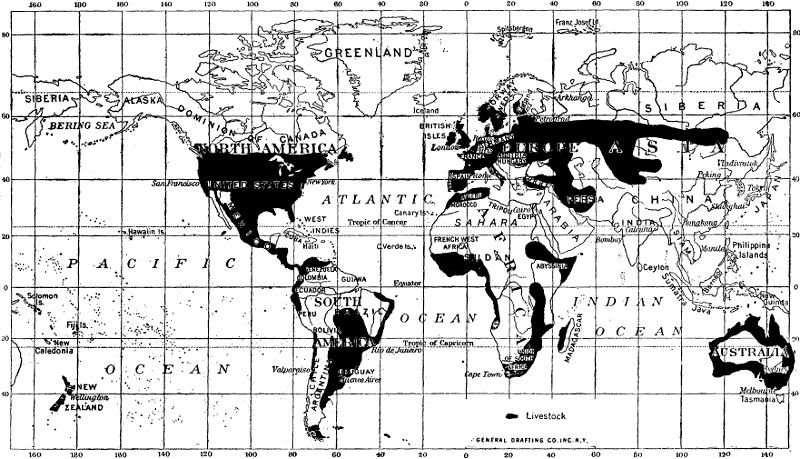
Centres of Live Stock Production Throughout the World
AMERICA'S CONTRIBUTION IN FOOD TO THE ALLIES
Mr. Hoover in a letter to President Wilson stated that the total value of American food shipments to Allied countries for their armies, for the civilian population, Belgium relief and Red Cross, amounted to about $1,400,000,000 for the fiscal year, 1918:
"Shipments of meats, fats, and dairy products were as follows,
Pounds.
Fiscal year, 1916—172,166,500,000
Fiscal year, 1917—183,011,100,000
Increase844,600,000
"'Our slaughterable animals at the beginning of the last fiscal year were not appreciably larger in number than the year before, and particularly in hogs; they were probably less'; so, as Mr. Hoover points out, 'the increase in shipments is due to conservation and the extra weight of animals added by our farmers.' Our shipments of cereal and cereal products have been,
Bushels.
Fiscal year, 1916—17259,900,000
Fiscal year, 1917—18340,800,000
Increase80,900,000
"The total shipment of wheat from our last harvest was about 141,000,000 bushels, with 13,900,000 of rye, a total of 154,900,000 bushels, of prime breadstuffs. Mr. Hoover notes a remarkable achievement in connection with the wheat shipments:
"'Since the urgent request of the Allied Food Controllers early in the year for a further shipment of 75,000,000 bushels from our 1917 wheat than originally planned, we shall have shipped to Europe, or have en route, nearly 85,000,000 bushels. At the time of this request our surplus was already more than exhausted.
"'This accomplishment of our people in this matter stands out even more clearly if we bear in mind that we had available in the fiscal year 1916—17 from net carry over and a surplus over our normal consumption about 200,000,000 bushels of wheat, which we were able to export that year without trenching on our home loaf. This last year, however, owing to the large failure of the 1917 wheat crop we had available from net carry over and production and imports only just about our normal consumption. Therefore, our wheat shipments to Allied destinations represent approximately savings from our own wheat bread.'
"The effort and sacrifice made by our people to do this are more fully appreciated when we consider that last year's wheat crop was a small one and that the corn failed to mature properly. Mr. Hoover concludes his letter with these words of warm appreciation of the people who have made up the army of which he has been the commanding general:
"'I am sure that all the millions of our people, agricultural as well as urban, who have contributed to these results should feel a very definite satisfaction that, in a year of universal food shortages in the northern hemisphere, all of these people, joined together against Germany, have come through into sight of the coming harvest, not only with health and strength fully maintained, but with only temporary periods of hardship. The European Allies have been compelled to sacrifice more than our own people, but we have not failed to load every steamer since the delays of the storm months of last winter.
"'Our contributions to this end could not have been accomplished without effort and sacrifice, and it is a matter for further satisfaction that it has been accomplished voluntarily and individually. It is difficult to distinguish between various sections of our people—the homes, public eating places, food trades, urban or agricultural populations—in assessing credit for these results, but no one will deny the dominant part of the American women'."
AGRICULTURE AND THE WAR
The significance of the strides made in agricultural productivity by which Mr. Hoover's food campaign was made possible and successful is brought out in the report of the Secretary of Agriculture for 1918:
"The efforts put forth by the farmers and the agricultural organizations to secure increased production can perhaps best be concretely indicated in terms of planting operations. The size of the harvest may not be the measure of the labors of the farmers. Adverse weather conditions and unusual ravages of insects or plant diseases may partly overcome and neutralize the most exceptional exertions."
ACREAGE UNDER CULTIVATION
"The first year of our participation in the war, 1917, witnessed the Nation's record for acreage planted—283,000,000 of the leading cereals, potatoes, tobacco, and cotton, as against 261,000,000 for the preceding year, 251,000,000 for the year prior to the outbreak of the European war, and 248,000,000 for the five-year average, 1910—14. This is a gain of 22,000,000 over the year preceding our entry into the war and of 35,000,000 over the five-year average indicated. Even this record was exceeded the second year of the war. There was planted in 1918 for the same crops 289,000,000 acres, an increase over the preceding record year of 5,600,000. It is especially noteworthy that, while the acreage planted in wheat in 1917 was slightly less than that for the record year of 1915, it exceeded the five-year average (1910—14) by 7,000,000; that the acreage planted in 1918 exceeded the previous record by 3,500,000; and that the indications are that the acreage planted during the current fall season will considerably exceed that of any preceding fall planting."
YIELDS OF PRINCIPLE CEREALS
"In each of the last two years climatic conditions over considerable sections of the Union were adverse—in 1917 especially for wheat and in 1918 for corn. Notwithstanding this fact, the aggregate yield of the leading cereals in each of these years exceeded that of any preceding year in the Nation's history except 1915. The estimated total for 1917 was 5,796,000,000 bushels and for 1918, 5,638,000,000 bushels, a decrease of approximately 160,000,000 bushels. But the conclusion would be unwarranted that the available supplies for human food or the aggregate nutritive value will be less in 1918 than in 1917. Fortunately, the wheat production for the current year—918,920,000 bushels—is greatly in excess of that for each of the preceding two years, 650,828,000 in 1917 and 636,318,000 in 1916, and is next to the record wheat crop of the Nation. The estimated corn crop, 2,749,000,000 bushels, exceeds the five-year pre-war average by 17,000,000 bushels, is 3.4 per cent. above the average in quality, and greatly superior to that of 1917. It has been estimated that of the large crop of last year, approximately 900,000,000 bushels were soft. This, of course, was valuable as feed for animals, but less so than corn of normal quality. It should be remembered, in thinking in terms of food nutritional value, that, on the average, only about 12 per cent. of the corn crop is annually consumed by human beings and that not more than 26 per cent. ever leaves the farm. It should be borne in mind also that the stocks of corn on the farms November 1, 1918, were 118,400,000 bushels, as against less than 35,000,000 bushels last year, and 93,340,000 bushels, the average for the preceding five years. It is noteworthy that the quality of each of the four great cereals—barley, wheat, corn, and oats—ranges from 3 to 5.4 per cent., above the average.
"The tables printed below may facilitate the examination of these essential facts:
ACREAGE OF CROPS IN THE UNITED STATES.
[Figures refer to planted acreage.]
Crop1918, subject to revision 1917, subject to revision19161914 Annual average 1910—1914.
CEREALS
Corn113,835,000119,755,000 105,296,000103,435,000 105,240,000
Wheat64,659,00059,045,000 56,810,00054,661,000 52,452,000
Oats44,475,00043,572,000 41,527,00038,442,000 38,014,000
Barley9,108,0008,835,000 7,757,0007,565,000 7,593,000
Rye6,119,0004,480,000 3,474,0002,733,000 2,562,000
Buckwheat1,045,0001,006,000 828,000792,000 826,000
Rice1,120,400964,000 869,000694,000 733,000
Kafirs5,114,0005,153,000 3,944,000
VEGETABLES
Potatoes4,113,0004,390,000 3,565,0003,711,000 3,686,000
Sweet Potatoes959,000953,000 774,000603,000 611,000
Total5,072,000 5,343,0004,339,000 4,314,0004,297,000
Tobacco1,452,9001,447,000 1,413,0001,224,000 1,209,000
Cotton37,073,00033,841,000 34,985,00036,832,000 35,330,000
NEED OF FOOD CONSERVATION
Statistics have not yet been published as to the comparative food production before the war and during the war years. Statistics of this kind would go a long way towards settling the question whether high prices were due to currency inflation or due to a scarcity of food. It must be remembered that the arguments on both sides are expressed very dogmatically. Take, for example, the following passage from an address by Mr. Moulton: "The food problem," he says, "goes much deeper than conserving the use of an existing stock of foodstuffs. The real food problem is how to secure a supply of food large enough to meet the continuous requirements of this nation and our Allies. This is more a question of production than of consumption. That is to say, conservation in consumption is less important than large production. There is no possible escape from a substantial shortage of the necessities of life."
PRODUCTION IN THE UNITED STATES
[Figures are in round thousands; i. e., 000 omitted.]
Crops 1918 (unrevised estimate November 1918). 1917, Subject to revision.1916 1914Annual average 1910—1914
CEREALS
Cornbush2,749,198 3,159,4942,566,927 2,672,8042,732,457
Wheatdo918,920 650,828636,318 891,017728,225
Oatsdo1,535,297 1,587,2861,251,837 1,141,0601,157,961
Barleydo236,505208,975 182,309194,953 186,208
Ryedo76,68760,145 8,86242,77937,568
Buckwheatdo18,37017,460 11,66216,88117,022
Ricedo41,91836,278 40,86123,64924,378
Kafirsdo61,18275,866 53,858
Totaldo5,638,077 5,796,3324,792,634 4,983,1434,883,819
VEGETABLES
Potatoesbush390,101 442,536286,953 409,921360,772
Sweet potatoesdo88,114 87,14170,955 56,57457,117
Beans(commercial)do17,802 14,96710,715 11,585
Onions, fall commercial cropdo13,438 12,3097,833 [8]
Cabbage (commercial)tons565 475252 [8]
FRUITS
Peachesbush40,18545,066 37,50554,10943,752
Pearsdo10,34213,281 11,87412,08611,184
Applesdo197,360174,608 204,582253,200 197,898
Cranberries, 3 Statesbbls374 255471644
MISCELLANEOUS
Flaxseedbush14,6468,473 14,29613,74918,353
Sugar beetstons6,5495,980 6,2285,5855,391
Tobaccolbs1,266,686 1,196,4511,153,278 1,034,679991,958
All haytons86,25494,930 110,99288,68681,640
Cottonbales11,81811,302 11,45016,13514,259
Sorghum sirupgalls.29,757 34,17513,668
Peanutsbush52,61756,104 35,324
Broom corn, 5 Statestons52 5239
Clover seedbush1,2481,439 1,706
The same point of view is expressed in the following extract:
"It is not usually understood that the chief cause of the enormously high prices of the necessities of life at the present time is their relative scarcity. The supply of necessities in this country has not materially increased, but the demand for them, owing to the requirements of our Allies, has enormously increased. We can prevent a still further soaring of prices only by increased production of necessities—increased production to be accomplished, let it be repeated through a diversion of productive power from the non-essential lines.
"The wealthy have often been urged since the war started to spend lavishly on luxuries and to economize on necessities in order that the necessities will remain for consumption by the poor. This is sheer shortsightedness; for the energy devoted to the production of luxuries for consumption by the wealthy would, if diverted to the production of essentials, give us a sufficient supply of the necessities of life that all might have them in relative abundance. The result of a policy of spending lavishly on luxuries is an inadequate production of necessities and hence prices so high as to cause real privation among the masses. Those engaged in producing luxuries obviously cannot at the same time be engaged in producing necessities."
In a war of attrition, physical deterioration of the masses of society in consequence of inadequate nourishment was certain to result in a serious decline in national morale, and this was a decided factor in the final outcome of the struggle. Food and other physical necessities would win the war. Mr. F. A. Vanderlip used the same argument for economies:
"Thus the diversion of productive resources to public ends requires of each of us a voluntary or compulsory rearrangement of individual and household budgets and radical changes in the habits of our lives. We must encourage direct diversion by reducing to a minimum our consumption of articles which can be used by our soldiers. But it is even more important that we give up the consumption of non-essential things in order that the productive energy which they embody be devoted to the accomplishment of the purpose in hand. The amount which we are forced to give up or voluntarily surrender constitutes a surplus over private consumption that measures the extent of our ability to wage war. We are fighting a nation which continues to be willing to reduce private consumption to the barest subsistence minimum. Unless a large surplus is produced we can gain no active participation in war and cannot hope for a victorious peace. The larger the surplus the shorter the war will be, and the nearer we are to victory."
GREAT BRITAIN'S FOOD DANGER
Under the long régime of free trade Great Britain depended upon other countries for its food supply. To offset the submarine campaign earnest appeals were made to make England self-supporting in this respect. The appeals were answered and were given enthusiastic popular support. What strides were made in England's agriculture since the war began can be seen from a paragraph in the London New Statesman:
"In 1918, as against 1916, the acreage (England and Wales) under oats is up by 35 per cent.; that under wheat by 38 per cent.; that under barley by 11 per cent.; that under other grain by 69 per cent.; that under potatoes by 50 per cent. The number of allotments (1,300,000) has increased by 140 per cent. The Report of the Food-Production Department ... is as satisfactory as we could wish; the number of acres under cultivation in the United Kingdom has gone up by over four millions in two years, all records being broken.
"This figure ignores the great increase in gardens and allotments, and it is estimated that, on the present scale of consumption, this year's home harvest will be sufficient to feed the population for forty weeks. The supply before the war was only enough to meet a ten weeks' consumption. Breadstuffs are not everything; and even of them one-fifth still has to be provided. But granted that we can keep this rate of production up, and—in spite of the drains of the Army upon our labor—can, with the help of women and prisoners, save what we produce, the wolf has now been driven a considerable distance from the door. With sinkings diminishing and ship-building on the increase, we can, we think, congratulate ourselves on the final failure of the German attempt to starve us out."
ACREAGE INCREASE DUE TO WOMEN'S LABOR
"Much of the increased cultivation has been done by women, we are told, and Mr. Prothero, the British Minister of Agriculture, had a cheerful picture to paint when appealing for recruits for 'the Women's Land Army.' As reported by the London Morning Post his speech ran:
"'Today (1918) the acreage under wheat, barley, and oats is the highest ever recorded in the history of our agriculture. That is one of the finest achievements of the war. In the same period the number of allotments has been increased by 800,000, which means something like 800,000 tons of produce raised additionally, a big saving in transport, and an improvement socially and morally. This advance has been effected in spite of the fact that there are 500,000 fewer laborers on the land. It is because of that decrease of labor that the appeal is being made for more women. I do not believe that any assembly of British farmers will hold back men who can possibly be spared when the alternative is our troops being driven back by overwhelming numbers and butchered on the beach by German guns. The promise of the harvest is not yet fulfilled, and there is much to be done. Women's work on the land is a vital necessity. I know the work they are asked to do is hard, bringing with it discomforts, and, comparatively speaking, is poorly paid. Life on the land is not luxurious, but it brings health with it, and the women have the conviction that they are doing something in one of the most important fields to make victory sure.'"
EVIDENCES OF FOOD SHORTAGE
One of the by-products of the food situation in England was the suffering occasioned by the scanty food supply on the canine population of the island. The London Times of June, 1918, contained the following pathetic paragraph:
"Considerable alarm has been caused among dog owners by the intimation that stocks of biscuits are practically exhausted. Not only is this the case, but the prospects of more flour being released for their manufacture are also remote unless some action is taken by the government to insure further importations of low-grade flours suitable for the purpose.
"The state of things is undoubtedly acute. Until the food economy campaign set in early last year most households provided enough waste to feed a dog, and where more than one was kept butchers' offals could be had for a few pence. These sources of supply having now vanished, much ingenuity will have to be exercised in order to preserve the family friend and guard from extinction. Blood, steamed until it is of a solid consistency, fish heads, and the heads of poultry offer some alternatives. Rice, oatmeal, and other cereal products may not be used.
"The whole question of dogs is engaging the closest attention of the authorities. Admittedly the problem of reducing the numbers is beset with difficulties, and, whatever is done, it is extremely unlikely the one-dog owner will be disturbed, the government recognizing the sentimental forces involved, to say nothing of the utility value of many breeds."
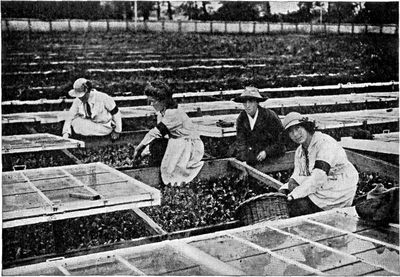
Copyright by Underwood & Underwood
Members of "The Women's Land Army" in England
Girls weeding frames in which cauliflower plants were set out to be ready for market in the early spring.
Click for a larger image.
But while English dogs were threatened with starvation, dogs of Germany were having a still worse time. Numerous cable paragraphs were published giving the price of dog flesh in various German cities.
Indeed, from all over Germany, at the closing period of the war, the hope of drawing upon Russian food supplies was seen to be illusory. There was much talk of getting food from the Ukraine, but this was probably used to keep up popular morale. The situation in the Ukraine did not encourage German hopes. This was frankly admitted by the Frankfort Zeitung:
"The stores and warehouses in the Ukraine are almost emptied. The peasants' stocks are depleted, while the best seed corn has been used to feed cattle or to supply a secret still, which nearly every household possesses.
"The outlook for next harvest is most unpromising. The peasants have plundered the estates, destroyed farm buildings and machinery, and have stolen or slaughtered most of the cattle. No labor is available for cultivation, and there are no facilities for harvesting the next crop, while the sugar industry is confronted with ruin, owing to the decrease of beet cultivation."
FOOD CONTROL FOR NEUTRALS
It is interesting to study the effect of the war on the food situation of the neutral powers. In Scandinavia, there was at first a panicky feeling of a world-wide catastrophe; then there came the realization of an unparalleled chance for making profit. The international shortage of tonnage made freight rates soar. Shipping shares became attractive. Then came the submarine sinkings, and the refusal of the Allies to allow goods to be imported into Scandinavia for the sole purpose of selling them to the Central Powers. Imports fell off rapidly. Everything which could be sold had been sold in the beginning of the war. The next step was the placing of an embargo on exports by the Scandinavian governments:
"The index of the Swedish official list of laws, dated October 31, 1916, forbidding exports, mentioned more than 1,100 articles, and even that was expressly called only a help to find the commodity looked for and did not pretend to be a complete index. The result was, of course, that trade, compared to former volumes, decreased very considerably, and the energy as well as the wealth actually earned was turned towards speculation on the local exchange.
"To supply all the people of Scandinavia with the necessities of life was a problem. Law upon law, one governmental decree after the other, tried to regulate the distribution of commodities as well as their prices. The majority of the people were in actual need. Prices soared, and it really did not matter to the ordinary man whether the cause of this rise in the cost of living was a too big circulation of paper currency or a limited supply of goods. What confronted him was the fact itself, not theories, and he realized all too well that he could not make 'both ends meet.' There was, generally speaking, no doubt that under normal circumstances the laws of supply and demand will work satisfactorily to the community and that artificial interference was only harmful. The supply being short, consequently the demand and the consumption must be controlled to secure a fair distribution. Sugar cards, which had been used in Sweden for months, and which were decreed in Denmark to go into force January 1, 1917, were an example of the means employed to control the distribution and to prevent waste to supplies.
"While on the one hand one saw new millionaires permit themselves to indulge in the most senseless luxuries, which incidentally added considerably to the high cost of living under circumstances like these, the less well-to-do actually were without many things formerly considered necessities. Collections of money and foodstuffs were made all over Scandinavia to help the less fortunate through the winter. The poorer population of the cities was especially considered. It was even difficult to get a roof over one's head. Proposals and counter proposals to remedy the evil were forthcoming, but no real remedy seemed to be in sight."
FEEDING EUROPE'S STARVING MILLIONS
A preliminary accounting was rendered on December 1, 1919, by Herbert C. Hoover, covering the $100,000,000 fund appropriated by Congress for the relief of starving Europeans. From Mr. Hoover's report it appears that in payment for relief supplied to eight European countries Mr. Hoover decided to accept their notes bearing 5% interest. Mr. Hoover's report stated:
"About 88 per cent. of the relief supplies furnished were sold under contract to the various Governments in the relief areas. For all such sales these Governments gave their special treasury notes in a form approved by the United States Treasury, bearing 5 per cent. interest, due June 30, 1921, to June 30, 1924. It was impossible to obtain reimbursement in cash because the currency in the countries to which these supplies were sent was impossible to convert into foreign exchange, except in comparatively insignificant amounts.
POLAND THE BIGGEST DEBTOR
"I give herewith approximate list of the notes of each Government, which we expect to turn over to the United States Treasury.
Poland$57,000,000
Czechoslovakia6,750,000
Armenia10,000,000
Russia.5,000,000
Esthonia2,300,000
Latvia3,000,000
Lithuania700,000
Finland4,000,000
——————
Total$88,750,000
"The remaining 12 per cent. of the supplies was donated in assistance to private organizations set up in each country under direction of the American Relief Administration for the purpose of furnishing food on a charitable basis to undernourished children. For such supplies it was, of course, impossible to obtain reimbursement. This service has contributed greatly to stabilizing the situation in those countries, aside from the physical benefits to more than 3,000,000 undernourished children, to whom the war threatened serious and permanent injury. Certainly this service is one for which the name of America will always be held in deepest gratitude."
FOOD CONDITIONS AFTER THE ARMISTICE
It is impossible in words to show what the food conditions were in Europe after the armistice was signed. The United States Food Administration issued a statement that there were 420,000,000 people in Europe with food supplies sufficient to last only until next harvest for a small proportion of them. Some countries had to be supplied at once; others, it was believed, could help themselves temporarily, provided they could be given guarantees of food for the future. Many countries were devastated, undernourished and stripped bare of food and agricultural equipment because of enemy occupation. A graphic picture of the situation was presented by the Food Administration in the Hunger Map of Europe.
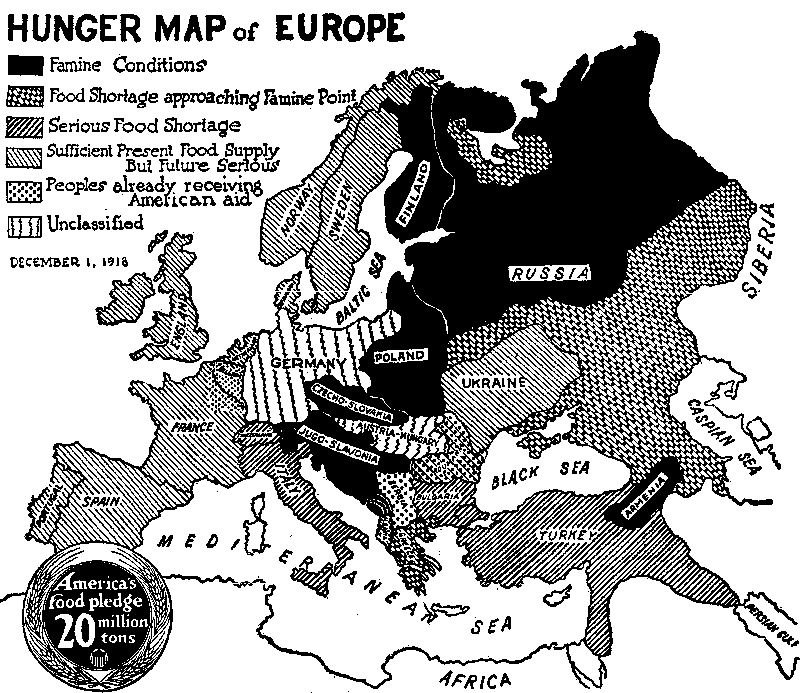
A Map Issued by the Food Administration to Show Food Conditions in Europe After the Signing of the Armistice.
NEW FACTORS AFTER NOVEMBER, 1918
An official survey of how cessation of active fighting introduced new factors in the food situation is presented in a publication of the Agricultural Department, July, 1919.
"With the signing of the armistice and the cessation of active fighting, new factors were introduced which affect the food situation. One of these was the step taken to release shipping as rapidly as possible, with the prorable probable result that the agricultural products of the more distant producing countries will again largely appear on the markets of Europe. The channels of trade are being reëstablished and food supplies will be sought wherever they can be secured most cheaply.
"A provision of the armistice required the immediate evacuation by the Germans of a large area in Belgium, France, Alsace-Lorraine, Luxemburg, and other territory. As a result many millions of people have been added to those that must be aided and fed by the Allies, and a material increase in the amount of foodstuffs to be imported has been made necessary. It may be found, too, that Turkey, Austria, and even Germany will have to draw on outside supplies to meet their needs.
"The demobilization of the European armies will permit men to return to the farms, and it may be expected that under the stimulus of an urgent demand for food an attempt will be made this year to increase food production in all the affected European countries. The devastated regions will be slow in recovering. Much time and labor will be required to construct necessary homes and farm buildings, level the ground, remove obstructions, and in other ways prepare for a resumption of regular agricultural activities. But it must be remembered that as compared with the whole of the countries concerned these areas are small and should not affect the results in any large way.
"In many sections of Europe there is a shortage of horses and other work stock, farm machinery, seeds, and fertilizers. In these localities a normal production should not be expected, but it is evident that under favorable conditions a material increase over the past year will be secured.
CEREAL REQUIREMENTS FOR 1919
"The following table presents estimates of the cereal requirements for 1919 and shows the world balance as deficit or surplus. Figures for the cereals, except rice, represent millions of bushels.
Note
.—Estimates of European crop and live-stock production, consumption, and stocks on hand, surplus or deficiency, are based on incomplete data, which are subject to change as more complete data become available.
Import RequirementsWheatRyeBarleyOatsCornRice, Hulled
EUROPEMillion pounds
Allies52525501502201,945
Neutrals12440303878302
64965801882982,247
Germany68149332438
Austria-Hungary11215183
Total Europe72865221933452,868
Other countries7,411
Grand total10,279
Surplus (estimated):
Canada1005075
Argentina18590
Australia210
India18,000
Other countries (pre-war)7,400
Total, except United States49550759025,400
Net deficit23365179118255
UNITED STATES, 1918
Production917892501,5382,5831,123
Consumption640321301,2542,730816
Surplus27757120284307
Deficit147
WORLD
Surplus4416614,428
Deficit859402
"The figures on import requirements of the Allies and neutrals are those estimated for 1917—18, while the estimated requirements of Germany and Austria are pre-war net imports.
"The rice surplus might be required in the Orient for countries whose crops may have failed.
Note
.—The figures are based on pre-war averages, 1909—1913, which may be considerably changed by post-war conditions.
MISCELLANEOUS CROP REQUIREMENTS, 1919.
Import requirements of—Cotton (50 pounds bales). Tobacco (million pounds).Flaxseed (million bushels).
EUROPE
Allies, including Japan8,058,00034021.6
Neutrals720,0001507.9
Germany and Austria-Hungary (pre-war boundaries)2,932,00035515.7
Other countries1,200,0017
Total requirements13,010,0001,02245.2
SURPLUS (ESTIMATED)
Countries, except United States, recently reported (1918)2,680,00040
Average, 1900—1913, for other surplus countries500,00650[9]5.7
Total, except United States3,180,00065040
UNITED STATES
Production, 191811,700,001,34014.7
Consumption6,600,00072026.7
Surplus5,100,000620
Deficit12
WORLD
Surplus148
Deficit4,730,00017.2
"The cotton table is based upon normal industrial conditions in all the consuming countries and upon the restoration of the spinning industry in the devastated regions. If conditions do not reach normal, and if the industry is not restored, the consumption of cotton will be substantially less. With practically complete restoration, cotton consumption may well be expected to equal the normal or pre-war times on account of the present shortage of cotton goods in various countries. The economies which the peoples of Europe must practice for some years to come must be considered."
CENTRAL EUROPE IN DIRE WANT
News from Europe showed everywhere acute suffering from lack of food; even in France the country districts were badly off. A member of the Federal Food Administration reported that bread was practically the only food that anyone could afford. President Wilson referred to this subject in the address with which he accompanied his announcement of the terms signed by Germany. He definitely took a stand in favor of provisioning the country, explaining that by use of the idle tonnage of the Central Empires it ought presently to be possible to lift the fear of utter misery,
"'from their oppressed populations and set their minds and energies free for the great and hazardous tasks of political reconstruction which now face them on every hand. Hunger does not breed reform; it breeds madness and all the ugly distempers that make an ordered life impossible.
"'For with the fall of the ancient governments which rested like an incubus on the peoples of the Central Empires has come political change not merely, but revolution.'
"Putting this danger into a nutshell, the Wall Street Journal asks whether Central Europe shall have 'bread or Bolshevism?' This strong exponent of a firm social order is of the opinion that 'we must recognize the fact that hunger breeds anarchy, and that the most effective weapon against Bolshevism is a loaf of bread.' Victory has made the Allied peoples, 'through their governments, responsible for world conditions,' in the opinion of this paper as well as of the Montreal Star quoted above, and Food Administrator Hoover declares that 'the specter of famine abroad now haunts the abundance of our tables at home.'"
TO PREVENT FAMINE IN GERMANY
Both in England and in France there was official recognition of the need of preventing famine conditions in Germany. It was believed that large imports of wheat could be brought from Australia and India. The Times (London) said:
"Mr. Hoover expects that enough wheat will be brought from those countries to permit reduction of the percentage of substitutes now required in bread, and thus release fodder grain for dairy use. The change, it is said, may take place within three months. But it will not reduce the total of foodstuffs which we must supply. He predicts that 'our load will be increased,' and that there will be a greater demand for economy.
"The available quantities of grain are sufficient. From our great crop of wheat we can spare more than 300,000,000 bushels. Canada, with a yield almost equal to last year's, has a surplus. While our crop of corn shows a decline of 441,000,000 bushels from that of a year ago, it is very near to recent averages and of very good quality. The output of home gardens, increased by one half, is not included in official reports, although its value exceeds $500,000,000. Australia has on hand the surplus of three wheat crops, India is said to have 120,000,000 bushels for shipment, and much can be taken from Argentina. As a rule, our war partners in Europe increased their crops this year. England gains 30,000,000 bushels of wheat, Italy 24,000,000, and France 35,000,000. But other crops in France are short, and the nutritive value of the entire yield is less than that of last year's harvest. It is well known that the Central Powers have very little food; and no help can come to them from the East. Before the war Russia exported a large surplus of wheat. Many of her people are now starving. So far as can be learned, she has no grain to sell. Bulgaria and Rumania have the smallest crops in fifty years. Germany and Austria can get no grain from the northern neutrals; we are sending wheat to them. There is food enough to supply the wants of our European friends and foes until the next harvest if it can be carefully distributed. But if the plans for helping those who have fought against us, as well as our partners in the war, are carried out, the American people must practice economy and submit to restrictions for some time to come."
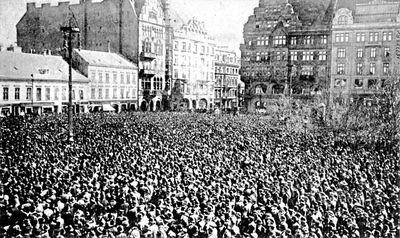
Copyright Underwood & Underwood
A Food Riot in Sweden
News from Europe immediately following the armistice showed everywhere acute suffering from lack of food. A member of the Federal Food Administration reported that bread was practically the only food that anyone could afford.
Click for a larger image.
SUGAR DISTRIBUTION
Among the multiform activities of the American Food Administration, the distribution of sugar was most difficult. America had to supply sugar to the Allies and retain enough for the use of its own people. The matter of the feeling of personal self-sacrifice was difficult enough but there was the further question of how to organize and allocate distribution. The government had to decide the amount to be distributed to sugar-using industries. These industries had to be classified. For the manufacture of soft drinks it was decided to allow only one-half of the sugar used in normal times. Bakers were given a 70 percent. allotment and hotels were permitted three pounds of sugar to every ninety meals served, including cooking.
The sugar resources of the country, both cane and beet-root, were regulated by the so-called Sugar Equalization Board. The operation of this body was explained officially in the Literary Digest:
"This board is a part of the Food Administration and approved by the President. Its purpose is to equalize the cost of various sugars and to secure better distribution. It can also coöperate with the Allies in the procurement of sugar for them and in the adjustment of overseas freight rates. Through capital supplied by the President through his special funds, it is enabled, when desirable, to buy up all available sugars at different prices and resell them at one fixed and even rate.
"In other words, it provides a sort of vast storehouse of sugar, which may be doled out where it is most needed, at a price secure from the fluctuations otherwise inevitable in war time."
KEEPING DOWN THE PRICE
What might happen without this Sugar Equalization Board is illustrated by the Civil War, when sugar, because of speculation, went as high as thirty-five cents a pound. And at that time there was no world shortage of sugar. If there were no sort of sugar control today, it may readily be believed that the consumer might have to pay sugar prices soaring far above those Civil War levels.
"It costs more to produce and market some sugars (such as domestic beet sugar and Louisiana cane) than it does others, such as Cuban cane sugar. But that is no reason why the sugar manufacturer, whose production costs are high, should suffer, even to the extent of being forced out of the market. Nor can the country afford to have this happen under present war time shortage of nearby supplies. Consequently, when it becomes necessary, the Sugar Equalization Board through its purchasing powers can insure fair profits to the manufacturers. Then the Board may resell this sugar, so that it reaches the public at a price lower than what the maximum would otherwise be."
POTATO ECONOMY
In order to remedy the generally inadequate food supply, it became necessary to treat such a standard food as the potato according to newly devised methods by which it could be stored for permanent use and widely distributed. In a lecture in Economics given to a class of the National City Bank, it was stated that, since the war began, it was found practicable so to preserve the potato by grinding and drying as to transform it from a local and perishable commodity to one which could be produced in almost unlimited quantities and distributed to any part of the world:
"The potato can be grown in almost any temperate zone area, but theretofore nine-tenths of the world's crop of 6,000,000,000 bushels is grown in a half-dozen countries, and almost exclusively in Europe and North America. Germany, Russia, Austria-Hungary, France, Great Britain, and the United States have produced in favorable years about 5,000,000,000 bushels, while the remainder of the world produced only 1,000,000,000. These six countries that produced five-tenths of the world's potato crop have only 450,000,000 peoples, while the potatoless world has a population of over 1,200,000,000, from which it appears that 'fully two-thirds of the population of the world live outside of the area.'
"Germany is by far the largest potato grower of the world, producing about 2,000,000,000 out of a world crop of 6,000,000,000 bushels, using them as a food for man and animals and the production of alcohol for use in her industries, and for the production of heat and power when necessary. Next in line is European Russia, with an annual crop of about 1,000,000,000 bushels; Austria-Hungary, 600,000,000; France, 500,000,000; United States, 450,000,000, and Great Britain, 300,000,000 bushels.
"This new system of turning the potato into a condition in which it can be readily distributed has, quite naturally, developed in the country which has the largest potato production of the world, Germany. Factories for the crushing and drying of the potato and turning the product into flour for man, flakes and cubes for animals, or alcohol for the chemical industry and also as a substitute for petrol, have grown from about a dozen a few years ago to over 400 in 1914 and 840 in 1916, with a capacity to turn into this condensed form more than 1,000,000,000 bushels of potatoes a year. The reduction in weight is about 60 per cent., while the product can be preserved almost indefinitely.
"The value of our own potato crop in the United States last year was approximately $540,000,000 at the place of production, and yet the amount entering international trade was only $4,000,000. Our potato crop averages about 90 bushels per acre, that of European Russia 100 bushels; France 135 bushels; Austria 150 bushels; United Kingdom 124 bushels, and Germany 200 bushels and upward per acre, her large flavorless potato, grown chiefly for alcohol, having reached and sometimes exceeded 500 bushels per acre."
FUEL CONTROL
The coal industry was the one basic war industry. Food and munitions were dependent upon the coal supply. It is not necessary to elaborate this argument; it is patent to every one. The following table gives a view of the coal production of the most important countries:
COAL PRODUCTION IN THE LEADING COAL-PRODUCING COUNTRIES OF THE WORLD
Country19131914191519161917
United States570,048,125513,525,477531,619,487585,372,568621,409,629
Great Britain287,698,617265,664,393253,206,081256,348,351248,473,119
Germany278,627,497245,482,135235,082,000
Austria-Hungary59,647,95730,896,38828,558,719
France40,843,61829,786,50519,908,00021,477,00028,960,000
Russia35,500,67427,820,63213,622,40013,266,760
Belgium22,847,00015,930,000
Japan21,315,96221,293,41920,490,74722,901,580
India18,163,85617,103,93217,254,309
China15,432,20018,000,000
Canada15,012,17813,637,52913,267,02314,483,39514,015,588
Spain4,731,6474,424,4394,686,7535,588,594
Holland2,064,6082,333,0002,656,000
THE COAL SHORTAGE
A rapid advance in coal prices was inevitable under war conditions of unceasing demand and diminishing supply. Says Mr. William Notz in an article in the Journal of Political Economy, June, 1918:
"The question of war-time coal prices offers many angles of interest. Everywhere prices have increased far above pre-war levels. Voluntary agreements on the part of producers and dealers to limit prices and profits have failed without exception. In all the leading coal-consuming countries of the world maximum prices had to be fixed sooner or later by government action. In every case the maximum mine prices are considerably above the average scale of prices obtaining in the years immediately prior to the war. In every country where maximum sales prices at the mines were fixed, liberal allowances were made for wage increases to mine workers. In Great Britain present maximum mine prices approximate 6s. 6d. above the average mine price which obtained during the year ending June 30, 1914. In the United States special mine prices have been fixed for each state, and in many cases also for certain coal fields within a state. The f.o.b. price for bituminous coal in Pennsylvania was in 1913 $1.11 and in 1918, $2.60. Anthracite increased to $4.00 ($4.55 for white ash broken).
"In Germany the total increase in mine prices of the Rhenish-Westphalian Coal Syndicate from the beginning of the war to January, 1917, approximated $1.25 per ton.
"While a certain degree of uniformity is noticeable in the rise in price levels for coal at the mines in the countries where maximum prices have been fixed, an entirely different picture presents itself if we compare the maximum retail coal prices obtaining under government regulations in different sections of the same country. In most countries the national coal controller has established a uniform maximum margin of profit for all retail coal dealers, while local authorities have fixed maximum retail coal prices for their communities. By reason of the fact that in establishing maximum retail consumers' prices allowances had to be made for increased handling expenses, freight rates, middlemen's profits, war taxes, etc., retail coal prices at the present time universally show a very heavy increase over pre-war prices."
FUEL CONSERVATION MEASURES
American Fuel Control had to grapple drastically with a situation of shortage so dangerous that a catastrophe might have been precipitated at any moment. Fuel Administrator Garfield issued orders for coal conservation of a most startling and unusual character. Factories east of the Mississippi were ordered shut down for five days beginning January 18, 1918. Monday, furthermore,
"was decreed a holiday for ten weeks on which offices, factories, and stores, except drug and food stores, must use only such fuel as is necessary to prevent damage. The order under which these restrictions were made, according to the Fuel Administration's statement to the press, was 'designed to distribute with absolute impartiality the burden,' and it added that the Fuel Administration 'counts upon the complete patriotic coöperation of every individual, firm, and corporation affected by the order in its enforcement.' We read further that the government aims to carry out its plan without 'undue interference with the ordinary course of business' and earnestly desires to 'prevent entirely any dislocation of industry or labor.'
SHUT-DOWN OF INDUSTRY TO SAVE COAL
"Fuel Administrator Garfield hoped to save 30,000,000 tons of coal and to give the railroads a chance to straighten out the transportation tangle in the eastern states, according to a Washington correspondent of the New York Tribune, who notes that the measures were taken by the President and the government heads 'as a desperate remedy.' The closing down of the greater part of the nation's industries, trades, and business, says the New York Sun, is the 'fruit of the insane, criminal starvation of the railroads by the government for a generation'; yet regardless of what it may cost any individual or group of individuals, the order is to be 'greeted without protest.' A surgeon was more welcome than an undertaker, in the view of this daily, and a disaster of the second degree and a temporary one is better than a disaster of the first degree and a permanent one. If the five-day term clears the railroads and the Monday holidays set the trains running with their former clocklike regularity, the Sun added, we can resume being the 'busiest nation on earth, instead of being an industrial paralytic.' While recognizing that the order struck Utica and all cities in the designated territory 'a staggering blow,' the Utica Press holds that there is really nothing a patriotic city could do about it save to accept the situation with as good grace as possible, and if the result hasten the end all will agree that it was a good investment. The Chicago Herald considered the order 'a tremendous decision' carrying with it a 'tremendous responsibility,' and while the chief industries of the principal part of a nation can not be stopped even for a day without disorganization and loss, still the country is willing to pay the price 'if it is the necessary cost of preventing the suffering of hundreds and thousands, perhaps millions, of individuals and of keeping certain indispensable war and public functions going at their accustomed speed.'"
Copyright by Underwood & Underwood
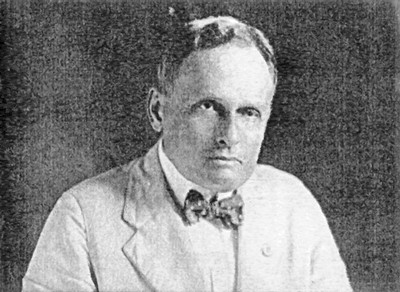
Harry A. Garfield
As Fuel Administrator during the war he issued orders for coal conservation of a most startling character. Factories east of the Mississippi were ordered shut down for five days beginning January 18, 1918. Monday was decreed a holiday for ten weeks "on which offices, factories and stores must use only such fuel as is necessary to prevent damage."
Click for a larger image.
THE GOVERNMENT'S EXPLANATION
From Fuel Administrator Garfield's explanation of the necessity of the order the following passage is taken:
"The most urgent thing to be done is to send to the American forces abroad and to the Allies the food and war supplies which they vitally need. War munitions, food, manufactured articles of every description, lie at our Atlantic ports in tens of thousands of tons, while literally hundreds of ships, waiting, loaded with war goods for our men and the Allies, can not take the seas because their bunkers are empty of coal. The coal to send them on their way is waiting behind the congested freight that has jammed all the terminals.
"It is worse than useless to bend our energies to more manufacturing when what we have already manufactured lies at tidewater, congesting terminal facilities, jamming the railroad yards and side tracks for a long distance back into the country. No power on earth can move this freight into the war zone, where it is needed, until we supply the ships with fuel.
"Once the docks are cleared of the valuable freight for which our men and associates in the war now wait in vain, then again our energies and power may be turned to manufacturing, more efficient than ever; so that a steady and uninterrupted stream of vital supplies may be this nation's answer to the Allies' cry for help....
"This is war. Whatever the cost, we must pay it, so that in the face of the enemy there can never be the reproach that we held back from doing our full share. Those ships, laden with our supplies of food for men and food for guns, must have coal and put to sea."
GARFIELD'S PLAN FOR FUEL ECONOMY, 1918—19
After the trying experiences of the winter of 1918, the Fuel Administration began to prepare in the following summer for another prospective shortage in coal supply. Fortunately the following winter was remarkably mild throughout the country. But the plans outlined by the Fuel Administration are more than useful as a matter of record. They may be used as a model under other conditions of fuel shortage. The following passage from the Fuel Administration Bulletin illustrates the plan of campaign:
"Fuel economy is being given intensive study in connection with steam plants and industrial uses. An organization is already in existence, provided with engineers and inspectors who will visit every one of the two hundred and fifty thousand steam-producing plants in the country with a view to the improvement both of equipment and firing practice. This is expected to save twenty million tons of coal.
"The economical use of power in factories will be in the hands of organized shop committees. The power loads of the public utilities throughout the country are being studied with a view to readjustments which will result in large saving.
"In many cities the isolated power plants which use an extravagant amount of coal in proportion to the power produced will be urged to obtain more economical power from large producing stations.
"The introduction of 'skip-stop' schedules on all the street railways is expected to save a million tons of coal. The consolidation of ice plants will yield a still larger tonnage. Unnecessary outdoor lighting, including advertising signs and display illumination, will be reduced. Hotels, office buildings, apartment houses, and public buildings are being asked to join in rigid economy of light and heat.
"Every American citizen will be asked to clean his furnace, keep it in repair, and study economical firing. Instructions prepared by the highest authority will be furnished by the Fuel Administration.
"If every one joins in this movement, from the owner of an industrial plant to the householder with his furnace and cook stove, if indoor and outdoor lighting is reduced to the amount absolutely needed, if houses are not overheated, the furnace dampers properly adjusted, and the ashes sifted, it will be possible to save from fifty to seventy-five million tons of coal without serious inconvenience to the American people."
DIFFICULTIES OF FUEL CONTROL
Some conception of the difficulties involved in the work of fuel control was set forth officially in a paper published by the Fuel Administration called Fuel Problems in War Time. The production of coal, it pointed out, stands on a different basis from that of any other major industry of the country. The differences are illustrated in the following paragraphs:
"As an illustration, consider the cotton crop with its millions of bales. Every bale of cotton raised in the country last year amounted to no more than the coal moved in one and one-third days. Or take the wheat crop for comparison. We hear of the immense preparations made during the fall months for moving the wheat crop; yet the weight of America's enormous wheat crop of 1917 is equaled by the coal mined and transported every eight days.
"Every year the miners go into the ground and dig out coal and the railroads ship it for hundreds of miles, dragging back the empty cars, until the amount mined equals two and one-fourth times the earth and rock removed in digging the Panama Canal. It took sixteen years to dig the Panama Canal. Our miners will dig two and one-half Panama Canals this year.
"In the mining of coal we are dealing with a task so gigantic that the wonder is not why we have not increased production to meet the demand, whatever that might be, but how, with the men and equipment overtaxed by the multiplicity of the demands of the war, we were able to increase the output fifty million tons in 1917, and will be able to add a probable fifty million tons to that high record the present year.
"The wonder is increased when we note that every other coal-producing country now in the war found it impossible to maintain the pre-war production of coal. In every case the output is less now than before the war. In England seven and one-half per cent. less coal was produced the first year of the war than in the previous year and five per cent. less than this reduced output in the following year. America alone has been able to increase its production of coal in addition to meeting the thousands of other increases demanded by war preparation.
COAL AND THE STEEL SUPPLY
"As every one knows, coal mining is very largely a matter of coal transportation. The most difficult task involved in an increase must fall upon the railroads. The wonderful work these railroads are doing is brought into bold relief when we remember that in 1914, when the great war started, the output of bituminous coal in the United States was 423,000,000 tons, and that in 1918 it promises to be nearly 200,000,000 tons greater.
"Apparently, this country today can furnish the steel required if only it can get the necessary coal. The work of the Fuel Administration during many months has been directed toward increasing coal production. These efforts have borne much fruit, miners are approaching one hundred per cent. service, while the railroads are outdoing themselves expediting the movement of coal cars from the mine to the consumer and back again.
"But war's demands mount so rapidly that even with full speed ahead production can not make the pace. A fuel deficit can be averted only by the most intensive conservation. Conservation, economy, savings, sacrifice must fill the gap between the possible increase of production and the greater increase of demand. If every user of coal will join the army of fuel conservationists, realizing that the need for steel to carry on this war is practically unlimited and that every ton saved means an additional five hundred pounds of steel, there is prospect—the figures show it—that the work of the miners will not be in vain. Our increased production, plus conservation, the Fuel Administration believes, can furnish the coal, and hence the steel needed for the war, and still leave none of our people cold."
SIDE ISSUES OF FUEL CONTROL
Economizing coal involved all kinds of unexpected side issues. As an illustration of the far extended reach of the Fuel Administration there was the example of the skip-stop plan in street railway traffic enforced by the Federal administration. A writer in the Chicago Engineering and Contracting Journal suggested, September 4, 1918, that the Government should adopt and extend the policy of compelling individuals and corporations to use economic methods and machines:
"Conceive, if you can, what could be accomplished in America in the way of increased productivity and economy if our Federal Government had the authority to make every individual and every company adopt any method or device that had been proved to be economic. No engineer acquainted with the application of the principles of the science of management can doubt that if the universal adoption of those principles could be forced upon producers in general, this nation could increase its productivity fully 25 per cent. That would alone add more than twelve million dollars annually to the national income. But that is not all. The application of the principles of the science of management is only a fraction of the total enginery at our disposal. We have literally countless labor and material-saving machines and appliances that are scarcely used, although many of them are generations old. Does this sound incredible? Certainly not to any engineer who has a wide acquaintance with the literature of engineering.
"Take so simple a thing as the heat insulator for steam pipes and boilers. It has been known to engineers for nearly a century that by encasing boilers and pipes with magnesia or other suitable insulators, practically all heat radiation and conduction losses could be stopped. Furthermore, it has been known to engineers that the saving in fuel thus effected would pay an annual interest of 20 per cent. on the cost of the heat insulator. But go into the basements of steam-heated residences if you want to get a conception of how rarely this knowledge is applied. The landlord may know that heat insulators would earn a big return on their cost, but since they would earn it for the tenant and not for himself, he does not cover the boiler and pipes adequately, if at all. The tenant, even if he knows the economics of heat insulating, will not spend the money for insulators whose use he may not enjoy for more than a year or two before he moves out. For similar reasons very few houses have double windows, although double windows will save fully 15 per cent. of the fuel required to heat the average house. On these matters the Fuel Administration has power to act, and it should act."
FUEL CONTROL IN GREAT BRITAIN
Coal mining was always one of the most significant elements in British trade. Before the war 270,000,000 tons of coal were produced in the mines of Great Britain. Parliamentary legislation of a most radical character dealing with the ownership and operation of coal mines was passed. The main provision of this legislation was described in the following passage from the London Morning Post:
"Briefly, the main provisions of the bill are the following: Under the present Finance Act the state takes 80 per cent. of the profits in excess of those made in the two best of the last three pre-war years, or above 9 per cent. of the capital employed. The new scheme deprives owners of these statutory rights. It does away altogether with the percentage standard. Output is made the chief determining factor in the regulation of the profits to be retained by the coal owner. The production of a colliery working under normal conditions during the two pre-war years, which has already been adopted under the Finance Act for the purposes of the Excess Profits Duty, is adopted as the standard output. If that output is maintained in any accounting period under the new bill, the colliery owner will be guaranteed a profit equal to the average profit made in the standard period, whether he makes it or not. If his trading profits in the accounting period are greater than those in the standard period, the treasury will take its 80 per cent. of the difference under the authority of the Finance Act, the Controller will retain 15 per cent. of it in order to create a fund for the compensation of the less fortunate collieries and the administration of his department, and the coal owner will be allowed to retain 5 per cent. of the excess. Thus a colliery company with a profits standard of £50,000 will, if it maintain its standard output, continue to receive £50,000; if such company make, say, £70,000, it will be permitted, generally speaking, to retain only 5 per cent. of the extra £20,000, that is to say, £1,000, plus the statutory £200, or £51,200 in all; but in no case shall the retainable profits exceed five-sixths of the profits standard. In that illustration the scheme is to be seen at its best, and, under the conditions, it is not unreasonable."
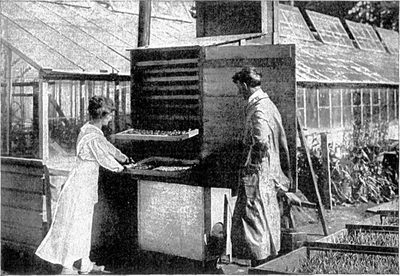
Photo by P. Thompso
Drying Fruit and Vegetables to Save Tin and Glass
Conservation became a great watchword during the World War. Mr. F. P. Lund of the U. S. Department of Agriculture showed women how tin and glass could be saved by drying fruit instead of canning it.
Click for a larger image.
OTHER FORMS OF CONSERVATION
The War Industries Board worked out a program for clothing conservation that showed a positive genius for detail. The most technical directions were issued regarding clothing. Double breasted coats, for example, were eliminated and the Board urged the wearing of sack suits only. Even the complicated subject of handling women's attire had no terrors for the experts employed by the Board. The characteristic features of its order can be judged by the following extract from the directions published on this subject:
"All shoes, both leather and fabric, shall be restricted to black, white, and two colors of tan (the two colors of tan to be dark brown or tan and a medium brown or tan).
"Patent leather shall be black only. These color regulations do not apply to baby shoes made of fabrics.
"Shoe-manufacturers shall not, for the next six months, introduce, purchase, or use any new style lasts. They may replenish to cover wastage or to meet requirements on present lasts now in use in the manufacture of shoes. This is to be effective at once. By new style lasts is meant any lasts which have not actually been used for the manufacture of shoes in the past season.
"The use of leather as a quarter lining in oxfords and low shoes is permitted only when used in skeleton form with fabric. Leather linings will be permitted in evening slippers where uppers are made of fabrics. We advocate the use of full fabric linings for low shoes wherever possible.
"The maximum height of women's shoes, both leather and fabric, shall not exceed eight inches (measured from breast of heel at side to center of top at side of finished shoes), size 4B to be the base measure.
"The maximum height of misses' shoes, size 1½, shall not exceed 6½ inches (measured as above).
"The maximum height of children's shoes, sizes 8½-11, shall not exceed six inches.
"The maximum height of boys' and youths' shoes shall not exceed 5½ inches.
"The maximum height of infants' shoes, sizes 4-8, shall not exceed 5½ inches.
"The maximum height of button shoes for women shall not exceed 6½ inches.
"The maximum height of all women's overgaiters shall not exceed eight inches, measured from breast of heel at side to center of top at side.
"The maximum height of misses' overgaiters shall not exceed 6½ inches (measured as above)."
LEATHER CONSERVATION
Germany was not the only country prepared to employ substitutes. When the National Army in the United States was organized the Wall Street Journal predicted that on account of the large consumption of leather for military purposes, the civilian population would be obliged to have thinner soles and probably to use leather substitutes:
"Price fixing on leather is still 'in the air.' It is not an easy proposition, in view of the complexity of grades and the variations in quality. The most practicable arrangement would be a series of general price standards, with allowance for deviations. Unlike other commodities, leather trading is a very flexible affair. The trade is confident of fair price maxima in relation to recently fixed hide quotations; possibly, in view of higher labor and other costs, of somewhat more liberal rates than hide prices, which have just been modified upward somewhat.
"Leather prices have been tending upward all round. Heavy sole leather, which did not recede nearly as much as lighter grades in the slump of last winter, are now nearly back to the high point of early last fall. Union sole has advanced four cents since May 1, and for some varieties of leather above No. 9 iron the market is around eighty cents, against sixty-five cents earlier this spring.
"In leather it is a case of all-round conservation, plus intensive effort for maximum output with government aid. Export license-restrictions have just been tightened, and most of what is shipped now goes to England. Neutrals must wait. In nine months to April 1st we exported but 20,342,101 pounds of sole leather, against 84,267,573 a year before. In March we shipped only 490,000 pounds to other countries than England, against 1,945,000 a year earlier. Hardly any is now moving save on British government order.
"Men't Men's shoes of higher quality and price will be affected chiefly by the requirement to carry soles as light as women's wear. This will involve either more frequent buying or more resort to tapping. Cheapest grades of shoes will be least affected, being almost wholly outside the military scope. In fact, some manufacturers of low-priced shoes have lately been enabled to use better material than usual, thanks to army 'leavings.' It is the urgent advice of the Government and tanners that shoe manufacturers promptly conform to the new program and that consumers cheerfully accept it. Meanwhile, experiments are continuing under government direction as to further extension of the use of composition or even of wooden soles to help meet the increased demand and short supply equation in leather."
FAIR PRICE LISTS
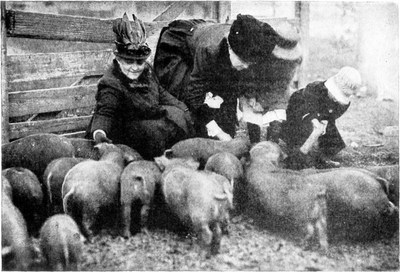
Photo by P. Thompson
"Back on the Farm"
The number of slaughterable animals decreased in the United States and in Europe during the war. The shortage of fats was helped by the production of more animals, increasing the weight of those slaughtered, and by changed methods of cooking, including the substitution of vegetable oils for butter.
Click for a larger image.
One of the plans to prevent the discontent arising from food speculation promoted by retailers and profiteers, was the preparation of fair price lists to protect the consumer. Every week new price lists were prepared so as to cover new fluctuation of cost to the retailer. These lists were given to the newspapers so that the consumer might be steadily informed and advised as to what he ought to pay the retailers in his city or town. It was shown how the patriotic retailer gained by the protection that this list offorded afforded him against the danger of unpatriotic profiteering. The United States Food Administration explained in a public statement the significance of the fair price lists. "They were nothing more," it said, "than bulletins to inform the public of the prices the retailer has to pay for certain foods, and the price he has to sell them to the consumer.
"Such a bulletin at one stroke does away with all the obscurity which too often veils the price increase which takes place at the hands of the retailer.
"To give an example, it shows at just what price a retailer is able to buy oatmeal and at just what price he is entitled to sell it. If any retailer decides to set upon the food he has for sale a higher price than that which brings him a fair profit, he is labeling himself 'Profiteer.' And thereafter it depends upon the public's own choice whether they shall trade with him or not.
"In accordance with the plans of the Food Administration such a system of fair price lists is now in operation throughout the country. Every week new price lists are prepared so as to cover new fluctuations of cost to the retailer. And these up-to-the-minute fair price lists are given to the newspapers to print so that the consumer may be steadily informed and advised as to what he ought to pay the retailers in his city or town."
HOW FAIR PRICE LISTS ARE MADE UP
"In theory the plan is the simplest imaginable. But it is complicated by the size of this country and by the variety of local food conditions which are bound to affect the price at which the retailer can buy and sell his foodstuffs. It would be utterly impossible to set forth one fair price list which would be fair for every spot in this country at any one time. A grocer in Calais, Maine, may be able to buy potatoes at a lower rate than a grocer in Snohomish, Washington. And the grocers of Red Oak, Iowa, may have to pay a different price from either. Obviously, each locality must determine its own fair price list.
"This is done by establishing in every community or county where fair price lists are to be put out a Price Interpreting Board, consisting of representatives of wholesale grocers, retailers, and consumers. The County Food Administration or his representative should act as chairman of this board. Such boards include representatives of both 'Cash and Carry' stores and 'Credit and Delivery' stores. These boards secure from wholesale representatives the prices charged to the retailer for various staple foods. With this as a basis, plus their knowledge of local conditions, and guided by a schedule of maximum margins submitted to them by the Food Administration at Washington, they determine what is a reasonable profit at which the retailer may sell to the consumer. Thus the retailer does not have a scale of selling prices arbitrarily thrust upon him; he helps determine them himself."
PROFITEERING
The natural and inevitable results of war on living conditions with food shortage and high prices were an unfamiliar factor in American experience for two generations. The artificial product of war time industry, "profiteering," was hard to be evoluted and caused resentment against those responsible for the practice. To deal with profiteers was no easy matter. How can profiteering be discriminated from legitimate profit-taking? How, too, can its existence be proved, for high fixed prices are not always an evidence of profiteering methods. The complexities of the various trade practices lumped together under the term profiteering are illustrated in the pamphlet on Profiteering, issued by W. B. Colver, Chairman of the Federal Trade Commission, in the form of a letter submitted on request to the U.S. Senate:
"Survey of the petroleum field shows that the market, when under the control of dominating factors, such as Standard Oil, can be one of huge profits without the device of the high fixed price. No price for the public has been fixed upon petroleum and its products by the government. Unlike the situation in steel, flour, and coal, there has been as yet no government interference with the law of supply and demand except in the instances of government purchases. Under that law large profits may eventuate through the bidding up of prices by anxious buyers. And, moreover, even in the absence of this element, prices may be forced up by spreading false and misleading information concerning the condition of supply and demand. Reports, for instance, have been circulated that the supply of gasoline was endangered for the purpose of maintaining the high price of that product and the heavy profits from it. At different stages of the oil industry different products of petroleum have yielded the heavy profits. Kerosene was once the chief profit producer. Gasoline followed and superseded it as the chief producer of profits. Enormous profits are now being made in fuel oil, with the advantage to the refiner that the high price of that product meets no popular challenge. Gasoline is maintained at its present high price and produces heavy profits for the low cost refiners."
PROFITEERING IN THE MEAT INDUSTRY
"Similarly, the power of dominant factors in a given industry in maintaining high prices and harvesting unprecedented profits is shown in a survey of the meat packing situation. Five meat packers, Armour, Swift, Morris, Wilson, and Cudahy, and their subsidiary and affiliated companies, have monopolistic control of the meat industry and are reaching for like domination in other products. Their manipulations of the market embrace every device that is useful to them, without regard to law. Their reward, expressed in terms of profit, reveals that four of these concerns have pocketed in 1915, 1916, and 1917, $140,000,000. Comparisons between their present profits and those of the pre-war period are given below. However delicate a definition is framed for 'profiteering,' these packers have preyed upon the people unconscionably. They are soon to come under further governmental regulation approved by Executive order."
PROFITEERING IN THE MEAT INDUSTRY
Some further details on the methods of securing huge profits in the meat packing industry are given in the following:
"An exposition of the excess profits of four of the big meat packers (Armour, Swift, Morris, Cudahy, omitting Wilson as not comparable) is given in the fact that their aggregate average pre-war profit (1912, 1913, and 1914) was $19,000,000; that in 1915 they earned $17,000,000 excess profits over the pre-war period; in 1916, $36,000,000 more profit than in the pre-war period; and in 1917, $68,000,000 more profit than in the pre-war period. In the three war years from 1915 to 1917 there their total profits have reached the astounding figure of $140,000,000, of which $121,000,000 represents excess over their pre-war profits.
"These great increases in profits are not due solely to increased volume of business. The sales of these companies in this period increased 150 per cent., much of this increase being due to higher prices rather than to increased volume by weight, but the return of profit increased 400 per cent., or two and one-half times as much as the sales.
"The profit taken by Morris & Co. for the fiscal year ended November 1, 1917, is equal to a rate of 18.6 per cent. on the net worth of the company (capital and surplus) and 263.7 per cent. on the three millions of capital stock outstanding. In the case of the other four companies the earned rate on common capital stock is much lower—from 27 per cent. to 47 per cent.—but the reason for this is that these companies have from time to time declared stock dividends and in other ways capitalized their growing surpluses. Thus Armour in 1916 raised its capital stock from twenty millions to one hundred millions without receiving a dollar more of cash. If Swift, Wilson, Cudahy, and Armour had followed the practice of Morris in not capitalizing their surpluses (accumulated from excessive profits), they too would now show an enormous rate of profit on their original capital."
JUGGLING OF ACCOUNTS—HUGE SALARIES
Mr. Colver gives information supported by trustworthy data on other devious and subtle types of profiteering practices:
"In cases where the government fixes a definite margin on profit above costs, as in the case of flour, there is a considerable incentive to a fictitious enhancement of costs through account juggling. This has added to the volume of unusual profits. Increase of cost showing on the producers' books can be accomplished in various ways. The item of depreciation can be padded. Officers' salaries can be increased. Interest on investment can be included in cost. New construction can be recorded as repairs. Fictitious valuations on raw material can be added, and inventories can be manipulated.
"The Federal Trade Commission has been vigilant and untiring in its exclusion of these practices. An instance of this practice was afforded by the Ismert-Hincke Milling Co., of Kansas City, Mo. This company padded its costs by heavily increasing all its officers' salaries and by manipulating the inventory value of flour bags on hand. As evidence of the length to which padding can be carried, it may be added that this company even included in its costs the gift of an automobile which it charged to advertising expenses. This case was heard of by the commission for the Food Administration. The commission recommended revocation of license and the recommendation was followed.
"Payment of extraordinary salaries and in some instances bonuses to executives of corporations have been found by the commission during its investigations."
WAR COST OF LIVING
A complete synopsis of the cost of living situation in the United States, during the four pears' years' period July, 1914, to June, 1918, was issued by the National Industrial Conference Board after a country-wide survey. The basis taken was that of family budgets divided under five heads: food, shelter, clothing, fuel and light, and sundries. The average increase for the period was shown to be between 50 and 55 per cent. The most marked advance was in clothing, 77 per cent. But the food advance of 62 per cent. was really more important because food represented 43 per cent. of the average expenditure, while clothing represented only 13 per cent. Wholesale prices, the report pointed out, are not to be relied upon in estimating the cost of living, because many articles enter only indirectly into the family budget. Often, too, wholesale prices are not reflected in retail prices until months later. The estimates given by the Board were based upon the expenditures of eleven thousand families:
"In reaching 52.3 per cent. as the amount of increase in the cost of living for the four years' period, the expenditures of 11,000 families were considered. Following is a table in which besides the 52.3 per cent. for all items entering into the family budget, the percentage for rent, clothing, fuel, and light, and sundries are given:
Budget ItemPer Cent. Distribution of Family ExpenditurePer Cent. Inc. in Cost Dur'g War Period to June, 1918Per Cent. Increase as Related to Total Budget
All items.100.0..52.3
Food43.16226.7
Rent17.7152.7
Clothing13.27710.2
Fuel and light5.6452.5
Sundries20.45010.2
The figures examined prove that there was a fair similarity of increase in the different sections of the country. The advance in rent in the dwelling places of the average wage earner was put down at 15 per cent.
"A general summary is given of changes in the cost of living among industrial workers as presented by the Railroad Wage Commission for the period between December, 1915, and the end of April, 1918, as follows:
Per Cent.
For families with incomes up to $60043
For families with incomes from $600 to $1,00041
For families with incomes from $1,000 to $2,00040
"By the Brotherhood of Locomotive Firemen and Enginemen the advance in living costs between 1914 and 1917 was placed at 43 per cent. Conditions among ship-building workers on the Pacific coast, as arrived at by the United States Shipping Board, indicated that between June, 1916, and February, 1918, living costs had gone up 46 per cent. A table is given which shows relative increase in the cost of food as measured by wholesale and retail prices for the past six years."
Year and MonthRelative Wholesale Price ofRelative Retail Price of Food
Farm ProductsFood, Etc.
1913
Average for year100100100
January979998
April979698
July101101100
October103102104
1914
Average for year103103102
January101102104
April1039597
July104103102
October103107105
1915
Average for year105104101
January102106103
April10710599
July108104100
October105104103
1916
Average for year122126114
January108114107
April114117109
July118121111
October136140121
1917
Average for year188177146
January147150128
April180182145
July198180146
October207183157
1918
January208188160
April217179154
CIVIL WAR COST OF LIVING
The Civil War years of the United States were always remembered as the era of high prices. Yet it is interesting to know that the increase in living cost after the United States had been in war one year was greater than the increases in the fourth year of the Civil War. During the Civil War prices rose from 100 to 117 per cent., but necessities were relatively cheaper than at present because the currency was depreciated. In January, 1864, gold was at a premium of 52 per cent.
Emerson David Fite, assistant professor of history in Yale University, describes "Social and Industrial Conditions During the Civil War" as follows:
"The situation in New York City at the end of the year 1863 is typical of the period. Eggs had then reached 25 cents per dozen, from 15 cents in 1861; cheese, 18 cents from 8 cents; potatoes, $2.25 from $1.50 per bushel, and for all the necessities of life there was an advance ranging from 60 to 75 and in some cases even 100 per cent. Wages, on the other hand, lagged behind; the blacksmith's increase was only from $1.75 to $2 per day, that of common laborers from $1 to $1.25, that of bricklayers from $1.25 to $2, and the average increase in all the trades was about 25 per cent., or less than one-half the increase of prices. The winter of 1863—64 and the ensuing months were accordingly a time of unusual industrial unrest, which increased in severity as the discrepancy between wages and prices continued. The dollar was slowly but surely diminishing in value, and labor engaged in a determined struggle to force wages up, capital to keep them down. The advantage lay with the employing classes, but labor in 1864 recovered much of the ground that had been lost in the two previous years, and the war closed with wages much nearer prices than a year earlier. It was generally agreed at the time that prices during the entire war period advanced approximately 100 per cent. and wages from 50 to 60 per cent."
WHERE THE COST OF LIVES WEIGHED THE MOST
The rapid rise in the cost of living was much more severely felt by the classes of the population dependent upon small or less rigid incomes. In many industries wages increased faster than everage average living expenses. Figures published by the New York Labor Bureau show that the sum distributed in wages to industrial workers was substantially doubled in the four years of warfare. Investigation conducted by the National Industrial Board of Boston showed that there had been an increase of 50 to 55 per cent. in the budget of the average wage earner from July, 1914, to June, 1918.
"The increases for the different items are given as follows:
Food62%
Rent15%
Clothing77%
Fuel and light45%
Sundries50%
Average increase (depending on apportionment of these respective items in the family budget)50% to 55%
In explanation of these figures the report goes on to say:
"'In combining the percentages of increase for the respective items, in order to determine the average increase for the budget as a whole, food was taken as constituting 43 per cent. of the total family expenditure, rent 18 per cent., clothing 13 per cent., fuel and light 6 per cent., and sundries 20 per cent. Applying the Board's percentages of increase for the respective items to this distribution of the budget, the average increase is 52 per cent. The distribution of budget items just given is an average based on cost of living studies made by several United States Government bureaus and other agencies, covering in all 12,000 families.
"The proportions of these major items of expenditure can be varied within narrow limits, but no reasonable arrangement would cause a wide change in the increase in the total cost of living as given above. For instance, if, instead of this average distribution of the budget, food be allocated as much as 45 per cent., rent and clothing 15 per cent. each, fuel and light 5 per cent., and sundries 20 per cent., the indicated increase in the total cost of living, using the Board's percentages of increase for the respective items, would be 54 per cent."
All articles of food, we are told, show a considerable increase in price since 1914, exceptional advances being recorded in the case of flour, lard, and cornmeal. The item of rent, says the report, "showed such wide variation that no general average applicable to all sections of the country could be reached," but the 15 per cent. estimate "is apparently ample to cover the increase in wage-earners' rents in New York, Chicago, Philadelphia, Boston, and St. Louis, which alone include several millions of the country's industrial population." Of the increase in clothing prices we read:
INCREASED COST FOR WEARING APPAREL
"Information secured from retail stores in cities well distributed throughout the country indicates increases in prices of the most common articles of wearing apparel, ranging from 50.5 per cent. for women's dollar blouses up to 161 per cent. for men's overalls. Striking increases occurred in the prices of certain yard goods, where advances in cost over 1914 prices amounted, in a number of cases, to more than 100 per cent.
"Men's hosiery, selling for 15 cents in 1914, cost in June, 1918, usually not less than 25 cents, and women's hosiery, selling for 25 cents four years ago, brought 45 cents in June of this year. Knit underwear, the report finds, had increased nearly 100 per cent. Women's shoes of a standard grade increased 88.5 per cent.; men's 69 per cent. Women's kid gloves which in 1914 cost $1 averaged more than $2 in June, 1918.
"The report places the average rise in the total clothing budget since 1914 at 77 per cent. This increase compares with an increase of 51.33 per cent. between 1914 and 1917 for families in the ship building districts of Philadelphia and an increase of 54.21 per cent. among similar families in the ship building district of New York, as reported by the United States Bureau of Labor Statistics. The difference between these increases and the Board's figure of 77 per cent. is largely explained by the difference in the period of time covered; clothing prices have continued to advance since 1917. Further increases in the fall of 1918 were, moreover, clearly indicated by the statements of retail dealers."
WAR PRICES AND LUXURY IMPORTS
In spite of the contention that war-time conditions led to an increased standard of luxurious living, statistics of imports indicated a rapid fall in articles of luxury brought into the country. In the fiscal year, 1918, there was a material decline compared with the preceding year and a marked decline when compared with the year before the war:
"A recent compilation by the National City Bank shows this in practically all imports usually classed as luxuries. That the imports should be less than before the war was quite natural by reason of the fact that many articles of this character originated in European countries, some in countries with which we are now at war, and some with our Allies who are otherwise too busily employed.
"In art works, for example, the value of the imports of 1918 was only about $11,000,000 against $23,000,000 in 1917, and $35,000,000 in the fiscal year 1914. In automobiles the value in 1918 was about $50,000 against nearly $2,000,000 in 1913, and more than $2,000,000 in 1912, while the average value per machine imported in 1918 was less than one-half what it was before the war. Decorated china imported in 1918 was about $3,500,000 in value against practically $8,000,000 in 1914. Of cotton laces imported in 1918 the value was about $10,000,000 against $16,500,000 in 1917, and nearly $34,000,000 in 1914. Of silk laces the 1918 imports were valued at little more than one-half those of 1914. Of cotton plushes and velvets the quantity in 1918 was less than 1,000,000 yards against more than 3,000,000 in 1917, and practically 5,000,000 in 1914. Of ostrich feathers, in 1918 the imports were valued at nearly $1,000,000 against nearly $4,000,000 in 1914 and over $6,000,000 in 1913. In precious stones the total for 1918 was only about $32,000,000 against $47,000,000 in 1917 and $50,000,000 in 1913; while of pearls alone the value in 1918 was less than $2,000,000 against over $8,000,000 in 1917, and more than $10,000,000 in 1916.
"In articles of food usually classed as luxuries there was also a marked fall. Cheese imported in 1918 amounted to about 9,000,000 pounds against 15,000,000 in 1917, and 64,000,000 in 1914. Of currants the imports of 1918 were over 5,000,000 pounds against 25,000,000 in 1916 and 32,000,000 in 1914, and of dates only 6,000,000 pounds in 1918 against 34,000,000 in 1914; while olives and olive oil showed totals in 1918 of about one-half those of the year before the war."
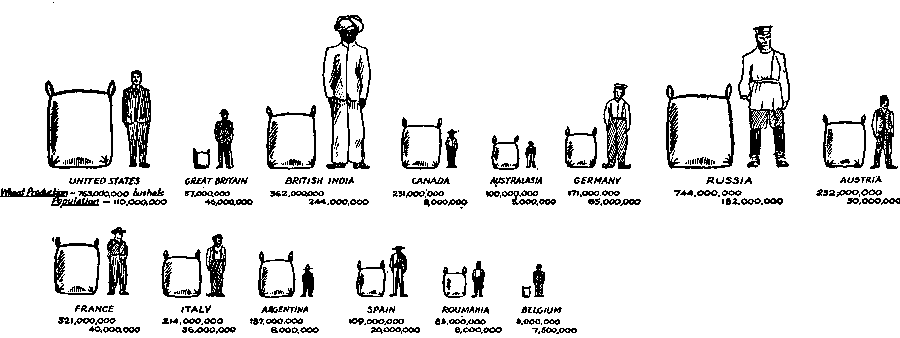
The Nations and Their Wheat Supply
Under the Lever Bill, which became the Food Control Law after the United States declared war, the President was authorized to fix a reasonable guaranteed price for wheat.
GOOD EFFECTS OF PRICE CONTROL
It became accepted on all sides that price control was the one method to correct the inequalities of war conditions. It was necessary to prevent the poorer classes in the population from having an inadequate consumption of wealth. There was the political side, too. Price control had an effect on the morale of large strata of the population. It acted as a bulwark against the rising tide of discontent and internal dissension incident to warfare on a democratic scale. Mr. Sydney Webb, a well known English student of labor problems, conceded that the British government had by its system of price control been fairly successful in staving off any general fall in the standard of life in its people. How the system worked is summarized by him in the following passage:
"What has been successful in Great Britain in economizing supplies has been a widespread appeal to the whole nation to limit its consumption of wheaten bread (4 pounds per week), meat (2½ pounds per week), and sugar (¾ of a pound per week) to a prescribed maximum per person in the household; and to make up the necessary subsistence by the use of substitutes, such as fish, other cereals than wheat, and other vegetables than potatoes, of which the crop throughout all Europe has largely failed. More efficacious still has been the absolute government monopoly of sugar, secured at the very beginning of the war, and the drastic restriction of the total quantity allowed to be issued from store, the aggregate reduction being thus infallibly secured, and the retailers being left to share what sugar they obtained among their customers. It has been found useful, too, to make the wheaten flour go farther by compelling all the millers to include both an increased proportion of bran and a certain proportion of other cereals. More drastic measures are near at hand."
STAY-AT-HOMES WHO MADE MONEY
The important effort, as seen by the Economist, was to back up the armies at the front by a policy of self-sacrifce sacrifice at home, and it spoke in drastice drastic terms of the constant evidence of profiteering among certain classes in England. The contrast in the attitudes of those at the front and those active in business life is set forth in the following words:
"One of the most curious and interesting psychological facts of the war is the manner in which one man goes to the front and becomes a hero and a preux chevalier, while another, just like him in training and blood and outlook, stays at home and works for spoils, whether in wages or profits, resenting taxation, grumbling about his food, and seeming to think that this war for justice was invented to increase his wealth and comfort."
PRICE CONTROL IN UNITED STATES
Although price control is a measure disapproved of by economists, experience has shown that for certain products, such as wheat and flour, it produced good results. In the case of bituminous coal, Professor Anderson of Harvard said that it had probably done much harm and little good, because the cut in price was too drastic. One good feature of the price control system was the ability to apply it to draft labor from non-essential industries to the production of munitions and necessities of life. It was possible to do this by refusing coal, copper, steel and freight cars to the non-essential industries. How the Food Administration came to be a general price fixing body is explained in the following article by a member of the Food Administration:
WHEAT AT $2.20 A BUSHEL
"There are many evidences that price fixing has come to lodge itself as an unwelcome factor in the program of the Food Administration. Price fixing came to be a fact even while avoided as a theory, and eventually it has become necessary to face it, if not to accept it, even as a theory. What are the evidences that price fixing is essentially involved in the program of the Food Administration? One piece of evidence lies in the fact that when once you have fixed the price of one commodity the condition is bound to be reflected in other commodities. In fixing the price of wheat Congress fixed as well, though not so explicitly, the price of corn, and hogs, and sugar beets. The determining and administering of these prices it left to the Food Administration.