Part 1 — IV—GOVERNMENT CONTROL Wartime Nationalization of Railways and Shipping—Ship-building at High Speed—Trade Licensing, Etc.
Reading edition
On April 5, 1917, the day before war was declared, Franklin K. Lane, Secretary of the Interior, introduced and had passed by the Council of National Defense the following resolution:
Resolved, That Commissioner Willard be requested to call upon the railroads to organize their business so as to lead to the greatest expedition in the movement of freight.
Acting in accordance with this resolution, the principal railroad executives of the country met in Washington on April 11, 1917, and resolved that during the war they would coördinate their operations in a continental railway system, merging during such period all their merely individual and competitive activities in the effort to produce a maximum of national transportation efficiency. The direction of the continental railway system thus organized was placed by the railroads in the hands of the executive committee of the Special Committee on National Defense of the American Railway Association. This executive committee was also known as the Railroads' War Board.
Under this resolution the railroads of the United States continued to be operated under private ownership and private management until December 28, 1917.
On that date President Wilson, exercising his war-time prerogative, took control of the railways of the country and appointed W. G. McAdoo Director General.
2. Congress in January passed a railroad-control bill.
3. On April 11, 1918, President Wilson issued a proclamation taking over for the Government the property of coastwise shipping lines.
4. On May 24th, Director General McAdoo placed in charge of each railroad property a federal manager whose duty it was to report to the regional director.
5. On June 29th, the Railroad Administration relinquished from federal control nearly 2,000 short-line railroads whose control by the Administration was regarded as not "needful or desirable."
During the first six months after the United States entered the war statistics showed that the railways not only handled far more traffic than in any earlier six months of their history but also as much as in any entire year prior to 1907. It will be remembered that the years 1906 and 1907 marked the climax of a long period of rapid increase of railroad business which resulted in the longest and most acute congestion of traffic and shortage that had ever been known prior to the war period. The grounds offered by the Government for taking over the railway systems during the war might be explained as the resultant of the findings of the Interstate Commerce Commission on December 5th, in which it was stated that the claim of the roads for higher rates could not be granted.
"From the standpoint of the Government three principal reasons are seen for the taking over of the lines:
"The avoidance of obstructions to transportation due to the routing and division of freight, intended to give a fair share to each line in a given territory.
"The abolition of preferences to given shippers and kinds of freight, and the centralization of control over priority in shipment.
"The practical termination of rate controversies and labor discussions as between private individuals and the placing of the roads on a semi-military basis.
"The railroads themselves have received the announcement of the President's action with much greater equanimity than could have been expected. They undoubtedly see in the step the following advantages:
"Assurance of a moderate if not generous income in a period of great uncertainty and difficulty, during which they have been caught between the upper and nether millstones of fixed rates and advancing costs and wages.
"Termination of the danger that threatened them from the continually maturing obligations which ordinarily they would have little trouble in refinancing, but which, under existing conditions, can scarcely be provided for on any basis.
"Provision of means for betterment and improvement at a time when such provision can be had practically only through government orders designed to place such requirements ahead of those of private concerns."
OBJECTS OF GOVERNMENT CONTROL
This experiment in government control was discussed and explained by the Director General after six months' experience in the following statement issued by him on June 15, 1918:
"The policy of the United States Railroad Administration has been informed and shaped by a desire to accomplish the following purposes, which are named in what I conceive to be the order of their importance:
"First, the winning of the war, which includes the prompt movement of the men and the material that the Government requires. To this everything else must be subordinated.
"Second, the service of the public, which is the purpose for which the railways were built and given the privileges accorded them. This implies the maintenance and improvement of the railroad properties so that adequate transportation facilities will be provided at the lowest cost, the object of the Government being to furnish service rather than to make money.
"Third, the promotion of a spirit of sympathy and a better understanding between the administration of the railways and their two million employees, as well as their one hundred million patrons, which latter class includes every individual in the nation, since transportation has become a prime and universal necessity of civilized existence.
"Fourth, the application of sound economies, including:
The elimination of superfluous expenditures.
The payment of a fair and living wage for services rendered and a just and prompt compensation for injuries received.
The purchase of material and equipment at the lowest prices consistent with a reasonable, but not an excessive, profit to the producer.
The adoption of standardized equipment and the introduction of approved devices that will save life and labor.
The routing of freight and passenger traffic with due regard to the fact that a straight line is the shortest distance between two points.
The intensive employment of all equipment and a careful record and scientific study of the results obtained, with a view to determining the comparative efficiency secured.
"The development of this policy will, of course, require time. The task to which the Railroad Administration has addressed itself is an immense one. It is as yet too early to judge of the results obtained, but I believe that great progress has been made toward the goal of our ideals."
GOVERNMENT CONTROL CRITICISED
The defects of the Government administration of the railways have been the subject of both criticism and apology. A diagnosis published by the Engineering News Record of New York states that the whole difficulty is ascribed to the employment of bankers in high places of railway management. Railroads, it was asserted, cannot be run by men of the banking type of mind. The article continues:
"Here was, and is, an agency with daily influence on the life of every member of the community, performing a service essential to the nation's life. Yet it has few friends among the people at large; more now than formerly, however, due to the number of those whose pity has been excited at the railroads' plight. The first of the railroads' plagues was the type of management—manipulation, it would better be called—which regarded the properties not as carriers but as media for stock-jobbing operations. Consolidations with the addition of water, and reconsolidations, with still more water, were the order of the day; while those operating the properties danced riotously over their territories waving insolently the flag of 'The Public Be Damned.' Rebates, car-withholding tyrannies, all manner of schemes were worked to aid the favored few, while the purchasing methods honeycombed the organization with rottenness.
"Then came the day for the people to have their say, and one national and forty-eight State commissions began to bedevil the carriers. What the stock-jobbers and the grafters had failed to do the people in their vengeance helped to complete. The public at large, which under intelligent management of the properties would have been the railroads' best friend, had been alienated. As a result we have had the drift into bankruptcy which has been railroad history during the past decade. Instances need not be cited. Each one can supply them from his own neighborhood. Probably the mention of the New Haven will furnish sufficient nausea to carry the right impression.
"And that débâcle we attribute to the banking type of mind, that type of mind that places personal profit ahead of all other considerations. The engineering type of mind, we hold, would have analyzed the purpose of the railroads—would have seen that service to the public at large, and not to any private interest, was the prime object, would have erected that as the railroads' ideal and builded a machine for its attainment."
BRITISH RAILWAY MANAGEMENT
Like American railways the railway system of Great Britain was under private control prior to the war, but the experiment of Government direction began to be applied as soon as the war was declared. Government control did not mean Government ownership. The lines remained the property of the companies. They retained the management of their own concerns subject to the instructions of an executive committee appointed by the Government and the whole machinery of administration went on as before. At the beginning the sole purpose was to facilitate the movement of troops, but as the war developed the scope of the railway executive committee became greatly extended. Working in coöperation with the acting chairman were twelve general managers of leading British lines. Under the central body were groups of committees, each made up of railway experts. The War Office and the Director General of Transport were in touch with the Central Committee. A writer in the Railway Age Gazette for December, 1917, explains the arrangements as follows:
"Under the terms on which the railways were taken over for the period of the war the Government guaranteed to the proprietors of the railways that their net revenue should be the same as in 1913, except when the net receipts for the first half of 1914 were less than the first half of 1913; in that case the sum payable was to be reduced in the same proportion. The entire Government traffic—men and freight—was to be carried without any direct charge being made for it or any accounts rendered. This plan was considered satisfactory by both sides. In the majority of cases there had been a reduction of earnings in the first half of 1914 over the previous half-year, and companies were contemplating a still further reduction. The interests of their shareholders being assured, they were able to devote themselves to the work of economical and efficient distribution, quite apart from the usual financial problems. The one weak side of this agreement was that it made no allowance to cover increased interest payments on account of new investments and new capital expenditure since the war began. This point was afterward met by an arrangement that the government should pay interest at 4 per cent. on all new capital invested by the railways since August 4, 1914, on new lines, branches, terminals, equipment, or other facilities put into use since January 1, 1913.
"The conclusion of the financial agreement between the Government and the companies automatically brought about a great economy in the system of railway accounts. The reports of the companies were cut down to a bare minimum, and in many cases even these reduced reports were not sent to the shareholders unless they specially asked for them."
RAILWAY NATIONALIZATION IN CANADA
A definite proposal to nationalize the railway systems of the Dominion of Canada was made during the war. Canada has nearly one-sixth of the railway mileage of the United States, although it has less than one-fourteenth of the population. Canada has three trans-continental systems. There is sufficient trade in the Dominion for two good systems. A royal commission appointed to inquire into the subject reported that the net returns of the railways were so low as to prove that more railways had been built than could be justified on commercial grounds. Large subsidies had been granted by the Government. In the case of the Grand Trunk Pacific this public subsidy amounted to nearly two-thirds of the total investment; in the case of the Canadian Northern to nearly three-quarters. The Canadian Pacific was reported as the strongest railway in Canada, economically built and well managed. The other companies, such as the Canadian Northern and the Grand Trunk Pacific, were facing heavy annual deficits.
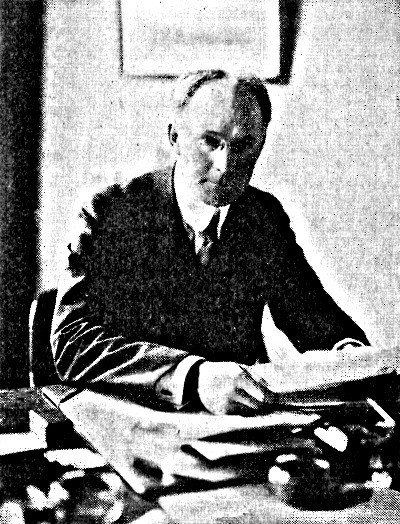
Copyright Underwood & Underwood
Walker D. Hines
He succeeded William McAdoo as Director-General of Railroads after the signing of the armistice.
The commissioners recommended heroic measures. They did not consider that operation by a Minister directly responsible to Parliament would be in the public interest. It would not secure better service nor lower rates. What the commissioners did recommend was to transfer the three companies to a new body, a board of trustees to be incorporated as the Dominion Railway Company and that the Canadian Northern, the Canadian Pacific and the Grand Trunk Pacific be transferred to this body. The Government-owned Intercolonial and Transcontinental Railways stretching from Halifax to Winnipeg were to be transferred to the Dominion Company. Under the scheme worked out by the commission, the Government would assume responsibility to the Dominion Railway Company for the interest on existing securities of the transferred companies. As to the composition of the board of trustees, the commissioner recommended that they be five; three railway members, one member selected on the ground of business and financial experience and one as especially possessing the confidence of the railway employees. The commissioners laid stress on the importance of the board being non-political, permanent and self-perpetuating, and in this connection pointed to the experience of the Australian state railways.
FRENCH RAILWAYS IN WARTIME
The great strain on a country's railway system caused by war was illustrated by the French mobilization. Four thousand seven hundred and fifty trains were required. After mobilization was over the Army still had a permanent need of railways for two purposes: for its communications in the rear, and for its movements from place to place. To bring supplies to one Army corps trainloads aggregating 200 tons a day were required.
Mr. G. Blanchon in New Warfare explained the situation as follows:
"The preparation of railways for war uses is not confined to the planning of the system itself. It extends to the provision and adaptation of stations, to the duplication of the lines, to the defence of bridges and other structures, to the provision of rolling-stock. Considerable extension may be looked for in all these directions. However important the motor-car and the aeroplane may be in military transport, it is probable that the railways will always be the most satisfactory means of conveying heavy material.
"The railway carriage itself can be adapted for military uses. We have tank cars, cold-storage cars, hospital trains; above all, we have armored trains and truck gun-carriages.
"Railways will perhaps render more effective service than ever in the matter of bringing to the required spot huge guns too heavy to be transported in any other way. These will be fired without leaving the rails. The truck gun-carriage is so arranged as to withstand the recoil; this result is obtained by placing on the ground, once the carriage is stationary, supports which take the load off the wheels. The recoil is transferred to the ground so that the rails do not suffer.
"Whether the object is to organize a supply line, to transfer reinforcements, or to carry heavy material to its destination, it may be of service to provide for the absence of normal lines by laying down rails along the road. Both the Germans and ourselves have done this very frequently. A narrow gauge of sixty centimeters is generally used. A team of skilled sappers takes about three hours to lay down about one kilometer of railway."
AMERICA'S SHIPPING PREPARATION
The two great means of transport—railways and ships—furnished in this war the greatest examples of modified state socialism which America had yet seen. As to the general way in which they were controlled these two services show a fairly close family resemblance, though the forms of organization were technically quite different. The larger railroads and the larger ships were taken possession of by the Government and were operated by the same people, in general, who operated them before, but under orders of the Railroad Administration and the Shipping Board respectively. New ships and new railroad equipment were built on plans made under federal direction, and in both cases the output was being largely standardized. The heads of the Shipping Board and the Emergency Fleet Corporation were men drawn from private business, while the regional directors of the railroad regions and the federal managers of the separate roads were railroad men, usually managing their own roads, under the government's direction. Thus in both cases private enterprise furnished the traditions and training of the personnel that made this experiment in socialism.
Besides the points of likeness there were differences between the two services. In the case of ship-building, the industry was virtually re-created, so great was the expansion and the revolution in methods. In the case of railroads the emphasis was, as has been seen, on the task of utilizing an existing and limited plant to its utmost capacity for war purposes.
WAR'S EFFECT ON SHIPPING
The following table, taken from a pamphlet distributed by the Emergency Fleet Corporation six months before the conclusion of the war, gives a perspicuous view of the shipping situation at the opening of military operations in the United States:
THE WAR AND WORLD SHIPPING
Gross Tons
World's shipping (except German and Austrian) August 1, 191442,574,537
Additional ships built, August, 1914—December 31, 19176,621,003
German and Austrian interned ships available for use of Allies875,000
————
Total50,070,540
Losses since 1914.
Due to ordinary causes.1,600,000
Due to mines, raiders and submarines:
Allies8,900,119 [17]
Norway1,031,778
Other neutrals400,000
Total11,931,897
————
Balance actual tonnage available38,138,643
Net decrease since 19144,435,894
Add 2 tons constantly required to maintain each man in France (1,500,000 men × 2)3,000,000
Shortage for merchant traffic, at least7,435,894
Another table gives a view of the rates between the building and sinking of ships among the Allied, neutral, and British nations from the beginning of the war to April, 1918:
"The world's shipping suffered a net loss of 2,632,279 tons from the beginning of the war to April 1, 1918, the greater part of this having occurred since the beginning of the unrestricted submarine warfare which brought America into the war. This loss is partly due to England's having increased her naval building at the expense of merchant tonnage. While naval construction must not be neglected, some building capacity can be turned back to merchant ship-building in case of extreme need. However, in April, 1918, Great Britain and the United States built 40,000 tons more shipping than was lost, and American construction is still rapidly increasing."
AMERICA'S SHIP-BUILDING PROGRAM
American ship-building was planned on grandiose lines, partly to make good the losses by submarine, partly to provide transportation for American troops to Europe, and partly for propaganda purposes in friendly and in enemy countries. The American program was an ambitious one. Inflated figures were offered for popular consumption and undoubtedly they were consumed and had their influence in securing a successful close to the struggle. While reports were coming from Great Britain telling of constant labor troubles on the Clyde and other ship-building localities, every item of news from Washington spoke of the marvelous achievements of American ship-building. One message read after eight months of the war had passed: "For the first time in history America has outdistanced England in her ship-building output."
Foreign critics called attention to the fact that American figures of ship-building (1918) had a different basis of valuation from those of other countries. In one case there were vessels completed and entered for service, and in another there were vessels launched. The situation is presented by the London Economist:
"British shipping, still in magnitude far beyond that of any of the Allies, is declining; it is still being sunk faster than it is being replaced. American shipping, on the other hand, is rapidly expanding, and has already turned the scale against the U-boats. The American Army in France as it is reinforced must become more and more dependent upon American ships for transport and supply. Up to the end of July the net loss in British shipping due to enemy action and marine risks since August, 1914, had been 3,851,537 gross tons. During the current year to July 31 we have lost 583,600 gross tons more than we have built. British sea power, the power to use the sea as measured in merchant shipping, is wasting. On the other hand, the net gain since August, 1914, in Allied and neutral shipping—to which the United States have largely contributed—was nearly 1,100,000 tons at the end of June this year, and was showing a very remarkable rate of expansion. Thanks chiefly to the United States, the Allied and neutral monthly gain now more than offsets the British loss. The critical corner has been turned. To those whose eyes look beyond the war, and who already anticipate a great American mercantile marine in competition with depleted British lines, we would point out that after all its losses British merchant shipping still amounts to over 14,000,000 tons gross, and that America's ocean-going tonnage built and completing—exclusive of captures—is as yet little more than 4,000,000. What the relative positions will be a year hence—or two years hence, should the war last so long—we do not venture to predict."
THE FOURTH OF JULY SPLASH
Reports of the Shipping Board's activity led to expectations of an unprecedented number of ships to be launched, fitted and ready for transport and trade purposes within a very short interval. Much enthusiasm was created by the Fourth of July splash, 1918, when, according to the New York Tribune, in twelve hours steel and wooden ships hit the water in clouds of smoke and spray, at the rate of one every seven minutes. The era of Mr. Jefferson Brick had undoubtedly returned, for the Tribune went on to expatiate in poetical exuberance that the shores of "Puget Sound, San Francisco Bay, Columbia river, the Gulf of Mexico, the Delaware, Chesapeake Bay, New York Bay, and all the coast of New England and the Great Lakes were laved by the backwash of the great ships of the Liberty Fleet rushing to their proper element." The Bureau of Navigation estimated that by the end of June, 1918, 1,622 ships of 1,430,793 gross tons would be launched—more than double the output of German yards in times of peace. One article refers to the actual event as follows:
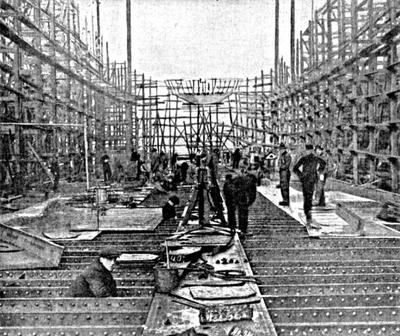
Copyright by Charles Phillip Norton
Building a Steel Ship in Seattle, Washington
American ship-building during the war was planned on a gigantic scale to make good the losses by submarines and to provide transportation for American troops to Europe. The West Lianga, shown above, an 8,800-ton cargo carrier was launched within 55 working days and delivered, ready for cargo, in 67 days.
Click for a larger image.
AMERICAN LOSSES—NEW TONNAGE BUILT
"At San Francisco on July 4th, Mr. Charles M. Schwab, Director-General of the Emergency Fleet Corporation, said to the shipworkers: 'If you stand up to your job, we'll make the Kaiser take his medicine lying down.' Mr. Schwab also ventured the statement that this Fourth of July shows the greatest record of launchings for a single day in the world's history, and added:
"'Every time we launch a cargo or troopship or tanker we add to the certainty that German submarines can not win this war. Already we have the U-boats on the run, and if we keep up the pace we will have them beaten by next year. And when we achieve this victory it will be you who will deserve the credit.
"'In 1915 all the shipyards in America turned out 215,602 dead-weight tons of shipping. The next year our output jumped to 520,847 tons. In 1917 the hot pace continued until we very nearly doubled the output of the previous year, completing a total of 901,223. I am confident now that if we pull together and every man stays on the job, we will produce more than 3,000,000 dead-weight tons in 1918—the greatest output of any nation in the world in a single year.'
"Premier Lloyd George sent a cable to President Wilson on the launching of the ships, in which he extended 'heartfelt congratulations on this magnificent performance,' and in an Independence-day speech Secretary of the Navy Josephus Daniels said in part:
"'We are launching this day far more tonnage than that of all the American vessels sunk by submarines since the war began. We are launching today more than the Germans sank of the ships of all nations in the last month for which we have the official figures. The recent enemy submarine activities off our coast resulted in the loss of 25,411 dead-weight tons of American shipping. During this same time 130,000 gross tons of shipping were built.
"'To give some idea of the tonnage situation with reference to American shipping, it may be of interest to know that the total tonnage of American vessels lost prior to the entry of the United States into the war was 67,815. The total American tonnage sunk since the entry of the United States into the war is 284,408, or a total of 352,223 tons sunk during the whole period of the European War. As against this loss, the gross tonnage of merchant ships built in the United States since the commencement of the European War is 2,722,563 tons, 1,736,664 gross tons of which have been built since the entry of the United States into the war. In addition to the tonnage thus built 650,000 tons of German shipping have been taken over. This does not include the tonnage acquired of Dutch, Japanese, and other vessels. It will be of further interest to know that today there will be launched in the great shipyards of this country over 400,000 dead-weight tons. These figures are in addition to those previously given.'"
A SHIP-BUILDING CAPACITY OF OVER 1,500,000 TONS A YEAR
The war program of the Shipping Board implied a multiplication by three of existing outputs. This increased output signified the possibility of labor difficulties, and in order to prevent these an agreement was reached between representatives of the labor unions, the Navy Department, the Shipping Board and the Emergency Fleet Corporation, to the effect that all disputes concerning wages, hours or conditions in shipyards in ship-building plants should be determined by a committee of three, one representing the corporation, one nominated by the President and the third selected by Mr. Samuel Gompers. When this agreement was entered into the United States reported a ship-building capacity of over one and one-half million gross tons a year. Two years previously the ship-building capacity was only five hundred thousand tons, but according to the London Economist, a rate of four million gross tons a year would have to be supplied if the American Army was to have sufficient means of transport.
When this forecast was made on both sides of the Atlantic, it was realized that so far as the marine situation was concerned the war had become simply a question of ship-building against the submarine. Military operations intervened to prevent a full test of our ship-building strength, but there was full confidence in the United States that American ship-building would by increased production make the German submarine program an inconsiderable factor in the question of terminating the war.
TRANSPORTING THE AMERICAN ARMY
When there came a demand for an increase of man-power to be sent to the battle front few appreciated what this effort meant in its effect on increased shipping activities. Half a million American soldiers crossed the Atlantic in the first thirteen months of the war, after our entrance into the war, and a million and a half in the last six months of the war. The shipment across the Atlantic was at first anything but rapid. There were only a few American and British troop ships chartered directly from their owners. Then the former German liners were brought into service and with this addition embarkations greatly increased.
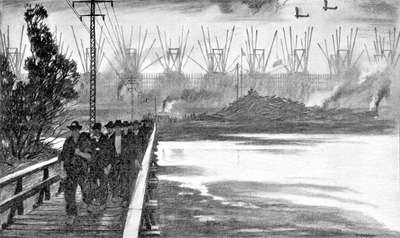
Hog Island Ship-building Yards
The expenditure of millions of dollars and the labor of thousands of workmen transformed in a short time a tract of marsh lands near Philadelphia into one of the greatest ship yards in the world.
Click for a larger image.
Early in 1918 increased shipping facilities were arranged for with the British Government. The results of this arrangement became visible in the growth of troop movements for March, 1918. Then there came the great German drive; after this every ship that could be secured was pressed into service. More British troop ships were used. Accordingly, in May, 1918, more than twice as many men were carried as in April. The June record was greater than that of May and before the first of July one million had been embarked. During the summer the number carried was more than 10,000 men per day. This record has only been excelled by the achievement in bringing back the same men to the shores of the United States. [18]
In addition to the transatlantic fleet there was an American cross-channel fleet carrying men and cargo from England to France. This fleet consisted of more than a third of a million tons by the end of 1918. One-fourth of these vessels were Swedish or Norwegian, while the rest were American. This fleet comprised large numbers of small wood and steel vessels built by the Emergency Fleet Corporation at the yards of the Great Lakes and along the coast.
ACCELERATED SHIPPING
The Emergency Fleet Corporation turned over nearly a million tons of new ships for military purposes, and besides Scandinavian and Japanese tonnage was chartered. By doing this and by taking over lake steamers the large tonnage figures were secured, but it must be remembered that the Allies were largely concerned in the American troop movement. Of every 100 men who went over, 49 went in British ships, 45 in American, three in Italian, two in French and one in Russian shipping under British control. Moreover, a way was found to increase the loading of transports by as much as 50 per cent.
The duration of the voyage round trip was considerably decreased. In the spring of 1917 the average turn around for troop ships was 52 days. Some of the fast ships averaged under 30. The Leviathan, for example, landed the equivalent of a German division in France each month. Most of the cargo ships were American and these ships carried thousands of articles of the most varied sort. Nearly one-half of all the cargoes consisted of food and clothing. Then came the engineering and ordnance supplies. A large number of locomotives were shipped, set up on their own wheels so that they could be unloaded on the tracks in France and run off in a few hours under their own steam. These locomotives were of the hundred-ton type. Shipments of this type had never been made before. When the armistice was signed the Army was prepared to ship these set-up locomotives at the rate of 200 a month. The actual record shows that 1,791 were sent to France on transports.
Nearly 27,000 standard-gauge freight cars were shipped abroad, and motor trucks to the number of 47,000; rails and fittings were sent to France aggregating in all 423,000 tons. Moreover, the Army shipped nearly 70,000 horses and mules. The increase in the shipping of cargo from the United States was consistently maintained from the start of the war, and at its cessation it was undergoing marked acceleration.
BRITISH SHIP-BUILDING
Ship-building in England was taken over by the government early in the war. This plan was described by many as an example of a blundering surrender to Socialism and a concession to bureaucratic tendencies. These critics pointed to the fact that in 1914 British shipping tonnage had reached the figure of 19 million tons, an increase of over 10 millions in 15 years; and this was done in spite of subsidized competition from abroad and lack of reasonable encouragement at home. The policy of government interference was regarded as simply a method of discouraging English initiative in this industry. A writer in the London Outlook, Mr. E. T. Good, described the project in a most unfavorable light:
"On top of foreign subsidized competition our people are to be subjected to Government competition at home, and their whole position and prospects rendered uncertain, if not impossible. This new government undertaking can have nothing but a chilling, blighting effect upon our splendid ship-building and engineering trades, and it will not give us one additional ton of shipping. The government policy—or lack of policy—is such that no one knows what to expect next. There is no certainty. There is no continuity of policy. There is no encouragement. There is no common justice for British enterprise. Whilst Germany, France, Italy and other nations are preparing large subsidization schemes for their shipping and ship-building trades, our government excessively penalizes our industries and enterprises, and gives no hint of any fair dealing in the future. Before the war German subsidized liners were permitted to come into our harbors and take on board British passengers at 'blackleg' rates, and without paying even a due share for the upkeep of our ports and lights. Now our government, whilst paying neutral shipowners—our future rivals—freights up to as much as 500 per cent. above the Bluebook rates paid to our own vessels, is taxing our shipping people up to the eyes—doing all that it can to render it difficult, if not impossible, for our companies to increase their fleets and maintain British supremacy after the war."
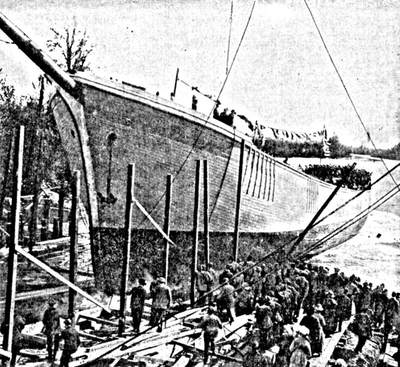
Copyright by Underwood & Underwood
Launching the City of Portland on the Columbia River, near Portland, Oregon
Most of the cargo ships that carried supplies to our troops after we entered the war were American owned, and carried thousands of articles of the most varied sort. The City of Portland, shown above, was a three hundred foot wooden motor vessel.
Click for a larger image.
It must be remembered that Great Britain's shipping problem was a matter of extreme complexity. There were first of all the submarine sinkings. There was the lack of labour for ship-building. There was, besides, the fact that the tonnage available for ordinary imports was considerably lessened by the commandeering of merchant ships for the carriage of government material. The following statement of the problem was presented by the British Premier himself in August, 1917:
"In addition to this, the Shipping Controller has taken steps for the quickening of ship-building. The tonnage built in this country during peace times is, I think, on an average something a little under 2,000,000. In 1915 the ship-building came to 688,000 tons. In 1916 it was 538,000 tons. In this year a little over a million tons, nearly 1,100,000 tons, will be built in this country and 330,000 tons will be acquired abroad, so that this year the tonnage which we shall acquire will be 1,900,000. This is purely mercantile marine. Bear in mind the condition under which the tonnage is built. It is the fourth year of the war. There is a difficulty in labor and great difficulty in material. You require steel for guns and shells for the Navy, because the ship-building program of the Navy has gone up considerably in the course of the present year. In spite of that fact the ship-building of the country in this year will not be very far from what it was in the days of peace.
"Even now we have not got enough tonnage for all essential purposes. We have got to provide tonnage for France, Italy and Russia, as well as for ourselves, and we need more ships instead of fewer ships. And I am not going to pretend that there will not be at best a rate of diminution of our shipping which will embarrass us in the struggle, and therefore it is essential, not merely that this country should build, but that the only other countries which have a great ship-building capacity should also build. If the United States of America puts forth the whole of her capacity, and I have no doubt, from what I hear, that she is preparing to do it in her own thorough and enterprising way, I have no doubt at all that we shall have sufficient tonnage not merely for this year but for the whole of 1918 and, if necessary, for 1919 as well, because America can expand very considerably her ship-building capacity if the real need ever arises for her to do so."
BRITISH BUREAUCRATIC METHODS
On the whole it must be allowed that after the results were published there was a great disappointment, particularly as the government had put forth roseate plans for ship-building on a large scale. At the beginning of the war there were 16 million tons gross of steamers of more than 600 tons each. A large part of this total was used in the service of the Navy; and the balance, available for the carriage of food, materials and exports, was lost during the submarine campaign. The government seemed to show no ability to replace it. Sometimes it is contended that the responsibility was to be charged up to the labor organizations. According to the Economist the situation was due to bureaucratic methods of control.
In a debate in Parliament the whole subject was ventilated:
"From every quarter members with first-hand knowledge of ship-building got up to tell the same story of over-centralization, fussy control, conflicting orders, leading all to the same result—discouragement of masters and men. Mr. Mackinder, speaking for a Glasgow constituency, and Sir Walter Runciman, speaking as a ship-owner—two men whose views on economics are the poles apart—were in agreement here. The fault, they declared, lay, not in the want of patriotism or the inherent vice of the British workman, or even in the lethargy of the British employer, but in the third and predominant member of the ship-building partnership, the British Government. Keeping the direction in its own hands, the Government started with a preconceived theory of the standard ship—a theory that might be of great value to a builder of revolutionary ideas laying the foundations of a prosperity to be enjoyed twenty years hence, but is of considerably less value to a nation that is losing steamers at the rate of fifteen or twenty a week, and wants new steamers now. When the standard ship was first proposed, builders pointed out that in practice each had a standard ship of his own, and they could build most quickly by confining themselves to their own familiar types. Mr. Macnamara told them that they were Solomons, wise after the event, but that is less than fair. They were wise from the beginning, and their predictions have come true."
TRADE POLICY AS A WAR WEAPON
The building of ships under Government supervision and control was only one side of Allied war shipping administration. Seaborne trade was rigidly directed as a potent arm in bringing Germany's war power to ruin. The industrial and economic effect of the marine blockade was fully conceded by a number of German and Austrian newspapers.
The Frankfurter Zeitung said:
"If the final peace does not return to us what our enemies have taken and destroyed in the outside world, if it does not restore to us freedom in our work and our spirit of enterprise in the world, then the German people is crippled for an immeasurable period. We demand restoration for all violation of the law and for all acts of destruction. We demand indemnification for all damages done, and we meet the plan of differentiation with the demand for the most-favored-nation treatment and equal rights; the plan of exclusion with the demand for the open door and free seas; and the threat of a blockade of raw materials with the demand for the delivery of raw materials."
A true picture of the situation is given in the following passage from the Vienna Arbeiter Zeitung:
"Even if Hindenburg's genius and German bravery won a complete victory on land, even if the English Army fell into our hands to the last man, and France was disarmed and had to submit to Germany's terms, even then England and America could not be compelled to the capitulation that the Pan-German word-heroes prophesy daily. Even then they would blockade our coasts and the war would continue at sea. And even if they could not or would not do that, even if peace was concluded and all the battles ended, they would still have a terrible weapon to use against us. Our domestic economy can not exist permanently without the wheat, the copper, and the cotton from America, the nickel from Canada, the cotton from Egypt and India, the phosphates from the North African coasts, the rubber from the English tropical colonies, Indian jute, and the oilplants of the South Sea Islands.
"There will be a scarcity of all these things after the war and there will be great competition for them. If England and America do not deliver to us these raw materials after the war, then we as conquerors are conquered."
GERMANY'S POTASH BOYCOTT
Before we entered the war Germany viewed with great concern the effect of the economic weight of the United States if added to the side of her antagonists. She felt that if this country remained neutral she could depend on us for raw materials. To be sure, German ingenuity had produced ten thousand substitutes, due to the skill of German chemists, ranging from bacteria fats to synthetic rubber. But even the War Office in Berlin was under no illusion on this point. "We need copper and no stripping of palace roofs, no raiding of door knockers or kitchen pans can make up for the deficiency." Even the vision of economic self-sufficiency in Central Europe had rifts in it. Raw material was so important that, in the boot and shoe industry 1,400 factories in the German Empire were amalgamated into 300. In the silk industry the spools were reduced from 45,000 to 2,500. Out of 1,700 spinning and weaving mills, only 70 were running at high pressure.
The plan, as outlined by German experts, to force the United States to supply raw material was to cut off potash exports and certain manufactured goods. "If America will sell us no cotton," was the threat of the Berlin Deutsche-Zeitung, "she shall get no potash—the indispensable fertilizer in which we have a world monopoly. If she withholds her oil and grain, then she shall get no dyes, no drugs, no glassware or optical instruments." But as a writer in the London Outlook stated, this threat could not be made an effective instrument of trade control:
"There is potash in plenty in the great Republic, especially in the alkali lakes of Nebraska and Southern California. Potash is now obtained from the Great Salt Lake in Utah, and from the vast kelp beds of the Pacific coast. American chemists are also extracting potash (by the Cottrell process) from the dust of cement-kilns and blast-furnaces. So the German monopoly will pass, and many others with it. America will produce her own dyes and optical instruments, though I may not linger on the details of this supplanting.
"American genius has long been busy with these things; another year or two will see her wholly independent of German supplies. The potash monopoly—from the mines of Stassfurt in Saxony—was undeniably a problem; there are still richer sources in Alsace, as we all known know Germany's resolve to hold that province through thick and thin. America needs 500,000 tons of potash every year, for the sandy soils of the Atlantic seaboard, and also for the citrus fruits of Florida, the tobacco of Georgia and the Carolinas, the potatoes and garden produce of Maryland."
SHUTTING OFF GERMAN TRADE
Pessimistic anticipations of German statesmen regarding the curtailing of German trade were realized when the War Trade Board in the United States began to deal with the question of American exports to neutrals. The report of the Board, published in 1918, contains the following passage:
"Neutral exports of foodstuffs to the Central Powers have declined from last year's corresponding exports in amounts estimated at from 65 to 85 per cent., depending on the neutral, and there has been a decrease in the export of many other important commodities.
"In November, 1917, we became party to Great Britain's tentative agreement with Norway, as a result of which action on our part 1,400,000 tons dead-weight of Norwegian shipping were chartered into the service of the United States and Great Britain for the period of the war. Shortly following, temporary agreements were concluded with Holland and with Sweden. That with Holland gives us the use, for periods up to 90 days, of 450,000 tons dead-weight of her shipping which had heretofore, for a long period, lain idle. The agreement with Sweden gives us the use for three months of tonnage estimated at 250,000 tons dead-weight which had not theretofore been employed in services useful to us.
"Specific accomplishments of this character are, however, far from constituting a full measure of the results achieved by the War Trade Board. The elimination of enemy advantage from our trade and, to a considerable extent, from that of the world, the securing and conserving of commodities essential to ourselves and those associated with us in the war, the bringing of shipping generally into the services most useful to us—these results can not be accurately stated or appraised at the present time, nor have they been accomplished by any single act or agreement."
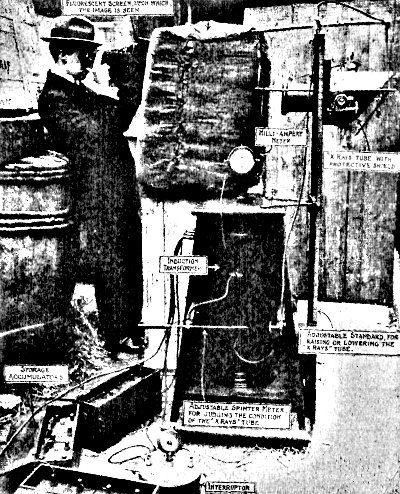
Examining Cargoes for Contraband
An inspector is using the X-ray on a bale of cotton, it having been found that smuggling of every conceivable sort was being carried by German agents.
THE TRADE LICENSE SYSTEM
The United States trade license system was extremely effective in cutting off the business of firms whose controlling motive was the advancement of German commercial interests. It was largely directed against preventing pro-German firms in neutral countries from engaging in the re-exportation process, a familiar practice in the earlier part of the war. The policy of the War Trade Board is indicated in the March (1918) issue of the War Trade Journal:
"To accomplish these results the War Trade Board, through its Bureau of Imports, has adopted certain regulations in connection with the importation of many of these raw materials, to which it is the duty of every patriotic American citizen to give complete and wholehearted support.
"Organizations have been voluntarily created in many of the trades, such as rubber, wool, jute, tin, etc., to act as consignees when required and to perform other duties in connection with importations, under and by direction of the War Trade Board.
"Every effort will be made to administer these regulations with the slightest possible detriment to legitimate business interests, but when it is considered that the transmittal of a few pounds of rubber or copper to Germany may cost the lives of scores of our men at the front, and that each day's supply of wool, or food, or money to the enemy means another day's war, with its accompanying toll of lives, the very thought of hesitancy or weakness is inconceivable. The policy will be 'safety first' for our soldiers, regardless of every other consideration. Persons and firms in this country, as well as abroad, who before our entrance into the war had little sympathy with the war-time commercial safeguards of the Allies must be taught that these are now matters of the first importance to this country, and violators of present restrictions need expect no favors, regardless of how important such individuals or firms may be in the business world. The time has come when all must realize that the war is not limited to combating the enemy on the battle fields of France, but must be carried into our every-day transactions of life, and that our business practices must be remolded, where necessary, to meet existing conditions.
"It is unnecessary to mention other desirable results which may be obtained by this import control, such as the gathering of trade information or the conservation of tonnage by elimination of non-essentials.
"No anxiety need be felt by importers that there will be any serious restrictions of the importation of necessary articles if the transaction does not involve dealing with an enemy or ally of an enemy, or otherwise giving him aid or comfort."
THE ANTI-GERMAN TOY EPISODE
An example of the intense popular indignation against encouraging trade with Germany was furnished when a Dutch boat arrived in New York in 1918, laden with 400 cases of toys made in Germany. The ship that carried them had been guaranteed against submarines by the German Government. Its arrival in America brought about a storm of indignation strong enough to remind many editors of the famous Boston Tea-Party. One of the consignees of the cargo refused to accept delivery of his share; the Manufacturers Record of Baltimore offered him its congratulations:
"It is none too soon to begin the campaign against the importation of German-made goods. Imagine for one moment any American mother giving to her baby toys made by Germany while she thinks of tens of thousands of babies murdered by Germany in this war. Every toy made in Germany and every other piece of goods of every kind will for generations bear a bloody stain which all the waters of all the oceans can never wash out."
Patriotic organizations passed resolutions on the subject. American feeling as to German merchandise was well shown through the publication of an editorial in the Hardware Age against American use of German toys. The paper received 4,000 letters on the subject and over 250,000 reprints of the editorial were sent out, all on request. On the subject of German toys, it said, among other things:
"America has fed starving Belgium. We fed and clothed and cared for her suffering people long before we became her proud ally on the battlefields. Thousands of orphaned Belgian and French children have been adopted into American homes. In the days to come are we going to force these children to play with German-made toys? God forbid! American toy manufacturers have stripped us of the last vestige of an excuse for the purchase of toys from the Huns. Our factories are making more toys than we ever imported, and they are not the flimsy jim-cracks we formerly bought from abroad. They are largely exercise toys which develop a child's body, or mechanical or structural toys which train the mind. Before the war we imported eight million dollars' worth of toys from the Central Powers. Who will make our kiddies' toys in the days to come? Once more, Mr. Buyer, it's up to you."
SMUGGLING FROM NEUTRAL COUNTRIES
Considerable aid was afforded to Germany by her trade with neutral countries. First, there was a good deal of direct re-exportation of materials imported from abroad. Then there was an exportation of domestic products, and the filling up of this deficit by importation from abroad, mainly from the United States. Mr. J. L. Moore of Harvard University, thought that smuggling deserved to be added to the source of German supply from the outside, and he mentioned the fact that a member of the Commerce Department of the Swiss Government was convicted of this offense and served a prison sentence. His exposition of how neutrals aided Germany is given in the following passage from the New York Times:
"To direct and indirect re-exportation must be added, finally, smuggling, which has always been a factor in the evasion of blockades. In Switzerland a member of the Commerce Department of the government was recently convicted of this offense and is serving a prison sentence.
"That this aid was precious to the Central Powers and enabled them to stave off starvation and consequent submission can be corroborated in various ways. First, in spite of the enormous volume of imports from the neutrals Germany was on the verge of starvation during the last winter, the economic crisis reaching its critical stage coincidentally with the political crisis in the Reichstag at the beginning of July. The most potent cause of this political upheaval was the economic destitution which cast its melancholy shadow over the whole nation and increased the desperation of people and Reichstag till it exploded in a violent outburst of wrath against the government. Secondly, the general impression of press and people in Germany and Switzerland is that the most sensational part of the speech of Erzberger, which brought the crisis into being, consisted of an exposé proving the futility of the submarine policy and impugning the judgment of the officials responsible for its inauguration, inasmuch as the entrance of the United States into the list of Germany's enemies, which resulted therefrom, was likely to result in a curtailment of the imports obtained through the neutrals, and without a continuance of these imports Germany could not hold out long."
SURPRISING INCREASE OF NEUTRAL SHIPPING
The shutting off of the German commercial fleet from trade and the employment of Allied shipping under government contract offered an exceptional opportunity to small neutral countries to advance their shipping business. This opportunity was eagerly seized. Norway reported the establishment in 1915 of no fewer than 488 shipping firms. This was followed in 1916 by an increase of 459. Some of these Norwegian firms paid dividends as high as 400 per cent. Statistics from Sweden also show a significant expansion. Swedish firms of inconsiderable capitalization before the war became important companies, able to undertake transatlantic trade on a large scale. It seems likely that these Swedish transatlantic lines will constitute a formidable competitor to the old established German companies—now that the war is over.
Corroborative evidence on the shipping situation in neutral powers is found in the following passage taken from the New York Journal of Commerce:
"Of great importance for an estimate of the future of our shipping combines is the progress which the two largest Danish lines—the Forenede, which sails to North America; and the Estasiatisk Kompagni, which, as the name suggests, runs lines to East Asia—have made during the war. The Forenede, for instance, made in 1916, with a stock capital of 30,000,000 crowns, a net profit of no less than 40,000,000 crowns, of which a good 10,500,000 crowns was allotted to the reserve and emergency funds. The collective reserves of this company amounted to more than 26,000,000 crowns at the end of 1916: and its bank credits totaled 44,000,000 crowns.
"The large Dutch shipping firms have likewise made enormous profits. The following table presents their results for 1916 (the Dutch florin, or guilder, is worth $0.402 United States currency at normal exchange):
Shipping FirmStock Capital, FlorinsNet Profits, FlorinsReserve and Emergency Funds, Florins
Holland-Amer. Line12,000,00026,500,00010,200,000
Stoomvaart Mij. Nederland19,000,00018,600,0008,800,000
Kon. Nederl. Stoomboot Mij15,050,00019,000,0007,800,000
Rotterdamsche Lloyd15,000,00015,100,00012,600,000
Kon. Holland Lloyd10,000,00010,900,0002,000,000
"The example of the Holland-America Line shows best what enormous progress took place in the inner consolidation of the Dutch firms. The reserve of this company, which in 1913 amounted to 6,600,000 florins, grew to 24,800,000 by the end of 1916—in other words, urpassed surpassed the previous stock capital (which in the meantime had been increased by 15,000,000 florins) by more than double. In addition, the company has available funds amounting in all to 21,700,000 florins. The reserves in the Nederland Company, which have increased in the same period from 6,700,000 to 23,000,000 florins, exceed the capital by 4,000,000 florins. The available funds of the Rotterdamsche Lloyd amounted at the end of 1916 to about 25,000,000 florins, with a share capital of 15,000,000 florins and a ready reserve of 16,000,000 florins.
"But the business successes of the neutral European shipping firms are far surpassed by the earnings of the Japanese overseas lines. Thus the largest Japanese shipping firm, Nippon Yusen Kaisha, that sails from East Asia to all the important shipping markets, had a net profit in the summer half-year 1916 of 19,780,000 yen (the Japanese yen is equivalent to $0.498 United States currency); in the winter half-year 1916—17 actually 22,150,000; in a single fiscal year it earned, therefore, about 42,000,000 yen. The company's capital stock amounted at the end of the fiscal year 1916—17, after a previous increase through the distribution of free shares, to 27,500,000 yen, the net profits of this single company being thus about 15,000,000 yen more than the amount of the capital.
"The company's fleet has grown considerably. The total available reserves amount to nearly 63,000,000 yen. Of ready money the company had at its disposal at the end of March, 1917, 55,300,000 yen."
GERMANS AT WORK IN SPAIN
Germany's astuteness in dealing with neutral countries was especially marked in Spain. The country was filled with German propaganda and there were skeleton German trade organizations ready to begin functioning at a moment's notice. The extent to which this propaganda was carried on was described by a correspondent of the Saturday Evening Post, Mr. I. F. Marcosson, in an address to the National Machine Tool Builders' Association at Atlantic City:
"The German propagandists have carried on a campaign on the proposition of the Kaiser. It has been the finest selling campaign that I have ever seen. They have organized it. Each man had his territory, his selling territory; each man has his line of samples, and that line of samples was the finest lot of German gold and German 'hot air' that any propaganda has ever produced.
"The Germans have sold Spain on the proposition of German trade and German good-will, because they are giving the Spaniard, as they did in business before the war, what the Spaniard had in mind.
"Germany went into Spain to fill the Spaniard with 'hot air' and to tell him he was the finest aristocrat in the world. And he got it over. And if you had gone, as I have, from one end of Spain to the other and looked into these great warehouses you would have found hundreds of them jammed and packed with copper and oil and cotton, and all the material with which to re-establish a great industry. And today, whenever there is a water-right for sale, whenever there is stock for sale, or whenever anything can be leased, or a factory can be bought, who buys it? The Germans.
"They have got the finest industrial secret service in Spain that I have seen in my life. And to what end? All to the great end that when the war is over, in Spain as in Holland and in Switzerland, the wheels of German output will be going.... Germany will put on the goods, as I have seen with my own eyes, 'Made in Spain,' 'Made in Switzerland,' and 'Made in Holland.' Your own goods, machine tools, are going out in the markets of the world now and forevermore in competition with German-made stuff, made by German hands, made by German capital, part with stuff that is marked offensive, in competition with stuff that is marked as I have said it would be marked."
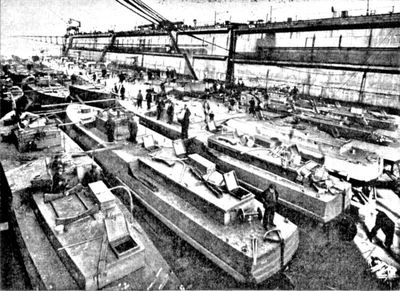
Photo by Paul Thompson
An Antidote for the Submarine Pest
Quantity production of eighty-foot motor boats in a shipyard at Bayonne, N. J., for use as scouts and submarine hunters.
Click for a larger image.
NO ECONOMIC BOYCOTT AFTER THE WAR
The official leaders of the Allied Governments soon found that the scheme to start an economic war after peace had been negotiatd negotiated had no very strong support. President Wilson took a hand in subjecting the Paris resolutions advocating this economic war to unfavorable criticism. The British Trades Union by a large majority showed their disapproval of them. The London Economist also disapproved of the program of a vindictive trade policy after the war, though it thought that an economic boycott might be used as a threat to force Germany to make peace. Lord Robert Cecil took the ground that it would not be wise to attempt an economic war. The labor point of view was that an economic war was bound to produce another outbreak of militarism. The Speaker of the British House of Commons, who always occupies a non-partisan position, in an address at Carlisle on war aims, showed no sympathy with the proposal:
"We had heard of war after the war, and it had been suggested that whatever the terms of peace might be we in England should have no dealings with Germany, that we should boycott them commercially, allow none of our raw materials to go to Germany, that we should form a combination with our Allies, and that together we should cut her off altogether and treat her as though she were a leper. He did not believe in this idea. He was out for peace, and when he said he wanted peace he meant a lasting peace. He wanted peace founded on sound conditions, which would stand wear and tear and last forever, if possible—at all events, for many, many years, it might be centuries; but a boycott of Germany would not be the way to attain a peace of that kind. That would be a way of carrying on the war, and although it would not be with the weapons we were now using, there would be the same hatred and struggle between one combination of nations and another, and it would leave the world divided and engender seeds of hatred and dissent. In many respects it would be almost as bad as the war at the present time. He did not, therefore, accept that condition of things."
In explaining England's position as to war aims the Premier, Lloyd George, made the following observations:
"Germany has occupied a great position in the world. It is not our wish or intention to question or destroy that position for the future, but rather to turn her aside from hopes and schemes of military domination and to see her devote all her strength to the great beneficent tasks of the world.... The economic conditions at the end of the war will be in the highest degree difficult. Owing to the diversion of human effort to warlike pursuits, there must follow a world shortage of raw materials, which will increase the longer the war lasts; and it is inevitable that those countries which have control of the raw materials will desire to help themselves and their friends first."
AN IMPOSSIBLE PROGRAM
In the emotional atmosphere of the war period some astonishing economic propositions were accepted as if they were axiomatic truths. Notably was this the case in the discussion of Germany's program of peaceful penetration in the economic sphere. It was undoubtedly linked up with schemes of military aggression. There was wide discussion of the methods to be used to guard against Germany's commercial policy. Sometimes these proposals indicated the desire that those who opposed Germany should take a leaf from her dog-in-the-manger policy. Strange conceptions of international trade that suggest the mercantilism of the seventeenth and eighteenth centuries were revived in order to guard against any attempt on the part of Germany to secure a privileged industrial position after the war. As early as 1916 there was the famous proposal of an anti-German economic league contemplated in the Paris resolutions of that date. In Great Britain the supporters of this policy also actively advocated a system of imperial preference by which special advantages would be given to countries within the bounds of the British Empire. The result of upholding any double-barreled policy of this type is described by the Edinburgh Review as impossible of realization.
"Even if Belgium, France, and Italy alone took that course, the whole policy of an economic boycott, or partial boycott, to prevent German expansion or to punish German crimes would fall to the ground. We cannot imprison Germany in an economic strait jacket if her territorial neighbors are willing to trade with her. As a matter of fact before the war the most important and the most expansive portion of German export trade was with the continent of Europe."
COMMERCIAL AVIATION
A great advance in aeroplane development was one of the most spectacular results of war activity. The military side of this development must be discussed in another place, but the fact that aeroplanes had to be constructed substantial enough to carry a large amount of explosives naturally brought up the whole question of the commercial side of aeroplane employment. Although the aeroplane has been developed to a remarkable extent for war purposes, it must not be taken for granted that every type of aeroplane has its use for peace. In the military machine regard has been paid rather to gun positions, bomb carrying capacity and performance than to economy in operation and large cargo space, which are the essential peace requirements. This aspect of the problem was discussed by F. Handley-Page in an article in the Fortnightly Review.
"The type of aeroplane for commercial work requires careful consideration and design. In estimating the value of a transport vehicle account must be taken of the respective proportions of the load that are and are not remunerative. A steam motor wagon that was only just able to transport the coke for its own consumption would be useless for transport work. The large quantity of fuel the aeroplane must carry makes this point an important one regarding it. It affects very largely the type of aeroplane that must be chosen for each duty.
"The total lift of a large bombing aeroplane of medium speed is about 20 lbs., while that of a small high-speed scout may not be more than about 8 to 10 lbs. per horse-power. From these lifts have to be deducted the weight per horse-power of the aeroplane structure and engines. These leave a margin of about 11 pounds per horse-power in the case of the large machine and of only about two to four pounds per horse-power in the case of the smaller and higher speed machine. From these margins have to be deducted the weight per horse-power of the pilot and of the fuel to be carried."
According to this expert's opinion there is little probability of using for commercial purposes the small high-powered aeroplane. But if large machines are used with a speed limit of 100 miles an hour and fitted with twin engines, Mr. Page thinks that such machines will have economic possibilities. Countries now far distant from one another can be brought close together. For example Australia will be within a week of London, and he thinks that passengers can be carried at the rate of about six cents a mile. If air transport is to be systematized he is in favor of strict state regulation:
"There must be no possible chance of the wildcat schemes of the early railway days recurring, nor must aircraft or their pilots be below a specified standard. The State must see that projects doomed to failure owing to lack of financial or technical backing are prevented from being placed before the public.
"Regulations must be drawn up which will insure that the machines cannot be used for the public service until they have received a certificate similar to that now issued by Lloyd's for ships. Pilots must not be allowed to fly machines conveying the public or mails, unless they have received a certificate equivalent to that issued to the master of a ship by the Board of Trade before he can take charge.
"The aeroplane will not compete with the telegraph system, cable, or wireless, but will be a useful adjunct conveying written signed statements, important documents, long reports, and descriptive letters in the time of a week-end cable and at a fraction of the cost.
"It will enable the business man to visit his overseas agencies and friends, to discuss matters with them on the spot and examine the requirements of their districts, at the cost of a few days instead of months of travel."
Copyright International Film Service
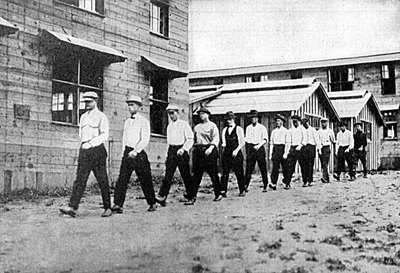
The Awkward Squad
"Left, right—one, two, three, four," was the slogan heard throughout the National Army cantonments, such as this at Camp Dodge, Des Moines, Ia., during the first days in teaching the recruits one of the first lessons of the soldier; how to keep step.
Click for a larger image.