Part 1 — VII—THE LIBERTY LOAN ARMY Mobilizing Americans at Home to Pay for the War—A National Effort Which Yielded $24,065,810,350
Reading edition
By GUY EMERSON
Vice-President of the National Bank of Commerce, formerly Director of Publicity, Government Loan Organization
Our Army was our first line in the war against Germany. Our second line of offense and defense was the Navy, and behind both stood another line without which neither the Army nor the Navy could have "carried on." This third force was the greatest unit ever marshalled in the history of this or any other country—the Liberty Loan Army. Before a man in the United States uniform entered a trench, before the first depth bomb had been dropped on a U-boat, this Army, which finally carried a roster of 22,777,680 names, had entered the war.
Think of it! One person in every five in the immense population was in the war!
True, their contribution to the eventual triumph of our arms was measured in dollars while that of the men at the front or on the seas was in lives or limbs. Yet it is a fact that dollars were as powerful relatively as men in bringing the Boche to bay.
Various causes have been given to account for the startlingly sudden collapse of the Kaiser's army. Some say that the Allies' superior military strategy brought it to its knees. Others contend that success against the U-boats broke it down. Both are partly right, for each helped to undermine the German morale. But however great the contribution of both was, it is safe to say that the front presented by the Liberty Loan Army was a vital factor. The belated German consciousness that the United States as a whole was in the war, as tangibly represented in the strength of the Liberty Loan Army, helped to shatter the Germans' will to victory. As much as the men in khaki or in blue, this gigantic unit bore in upon his mind as an unyielding opponent. He understood the futility of trying to defeat a people that enlisted against him to the number of 22,777,680 at home, 4,000,000 in the field and 300,000 on the water.
THE SPIRIT BEHIND THE DOLLAR
There is another angle to this important element of morale. In inverse ratio to the weakening of the spirit of the Germans against this resistless body there came a daily strengthening of the morale of our own men and those of the Allies through this manifestation at home. Where there are two opposing wills to victory in the field, the one that has the greater backing at home is certain to overwhelm the other.
It was not the dollar that won the war, it was the spirit behind the dollar. Before Prince Max asked for the armistice he had learned that $9,978,835,800 had been subscribed in this country toward his defeat. It is natural to assume that this fact did not impress him so much as the related fact that millions of persons had participated in the subscription.
Up to the end of the Fourth Loan, which coincided with the negotiations for the Armistice, $16,971,909,050 had been paid in and this helped to save life to an extent that we can only imagine. It was the confident expectation when the Americans halted the German onslaught at Château-Thierry that the end of the war would come in the following spring. None dared to hope that it would come before Christmas. When the crash came in November, even the Allied commanders were bewildered by its suddenness. Had the war been prolonged to the spring of 1919, it is certain that we would have paid a large toll in lives. Some have estimated that 100,000 more of our young men would have been sacrificed. That the war did not drag along for six months more may be ascribed in part to the effect that the demonstrated loyalty of the Liberty Loan Army had upon German morale. We know that the Germans fed lies to their own troops and dropped pamphlets with these same falsehoods into our own trenches. They tried to convince their own and our men that the Loans had no support.
MOBILIZING THE LIBERTY LOAN ARMY
When at 11 o'clock on November 11, 1918, peace dawned upon a war-sick world we had 2,000,000 men in Europe, and as many more on this side putting themselves in readiness to go across. On the seas we had close to 300,000 men. This tremendous force was welded into form in the nineteen months we were in the war. Yet within a few months after our entrance into the war there were more than this total in the Liberty Loan Army. The list of subscribers to the First Liberty Loan which closed two months after our entry had 4,500,000 names.
And this number remained for the duration of the war, giving every penny they could spare, mortgaging their property, committing themselves to personal privations. When the Second Loan books were totalled in November the number had increased to 9,500,000, and it leaped to 17,000,000 in the Third. In the Fourth—the last loan of war-time—it had grown to 22,777,680 and in the Fifth which closed six months after the armistice, it finished with 12,000,000 names.
As in the Army, where organization is half the battle, it was through organization of the enthusiasm and the deep fervor of the American people that success came in this big venture. We had to create a state of mind, we had to educate the American public in finance—which in itself appeared an insuperable task—we had to marshal resources on a scale such as never before had been attempted, and we had to map out a sales campaign that would comprehend millions of persons. There were no precedents to go by; the example set in Europe could not have application in the United States because of temperamental and financial differences; the flotation of the loans in the Civil War afforded no practicable working basis. It was pioneering, and this fact was made clear in the first conference held in Washington when Secretary of the Treasury William G. McAdoo called together the financial leaders of the country.
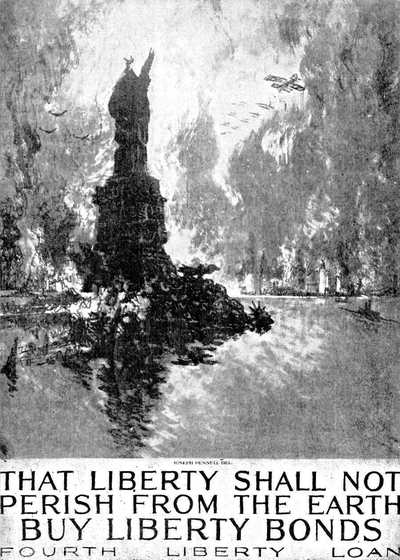
A Poster Used During the Fourth Liberty Loan Campaign
Click for a larger image.
Only three weeks were allowed to prepare for the First Loan Drive. As soon as we had decided to get into the war, this decision carried with it the determination to go in to the limit of our resources. The Secretary of the Treasury informed the bankers that the first issue would be for $2,000,000,000 and this would be merely the forerunner of a succession of loans in larger amounts. The bonds were to be put on the market at three and a half percent. and the campaigns were to be conducted according to the territories of the Federal Reserve districts, twelve in all.
"It is quite likely," said the Secretary of the Treasury, "that we could induce a group of men to take up this loan but that would compromise the country before the world. We must sell to the public in such numbers that there shall exist no doubt among our enemies that our people are back of the Government as a unit in this war."
The men whom he addressed were all recognized as organizers, all had been identified with big business. However, few of them had had the general contact with the public so essential to popularizing the loan. They knew how to sell, but not in small denominations or to millions of purchasers. In an abstract sense they realized the value of advertising and newspaper publicity, but not one of them had the remotest idea of how the ideal of Secretary McAdoo could be realized.
ORGANIZING THE FIRST DRIVE
It was at this point that their resourcefulness came into play. Their first move was the right one; they engaged specialists to undertake the tasks of which they knew little. They addressed themselves to the public through men skilled in establishing such contacts as are given through advertising, publicity, and canvassing. In the brief time allotted to them, they barely had time to surround themselves with this trained talent.
Verily, it was shooting in the dark, a process of hit and miss. Some one said that the campaign in the First Loan was planned as we went along, and that is literally true. The patriotism was there—that was an unquestionable fact; the problem was to make it manifest itself in sacrifice of savings and earnings. The work of the whole three weeks was experimental and the country was the laboratory. Let it be said that the alchemy of patriotism transmuted the hearts and minds of the public into pure gold. Once the people were informed of their duty toward the United States they rallied instantly.
Newspapers turned over their columns, advertisers offered their precious space—and it was precious in those days of paper shortage; stores and banks opened booths for sales, public speakers cancelled every other engagement that they might participate, factories strove to enlist every person in their employment as purchasers, clubs responded in whole memberships, women's committees were formed for the acceleration of interest, churches consecrated themselves to the project, trade unions abandoned all differences with employers and allied themselves unselfishly, writers pleaded for a chance to exercise their influence, foreign language groups demanded opportunity to prove their Americanism, actors, singers, and lecturers begged for a place in the campaign.
Wholeheartedly and with utter disregard of personal sacrifice this vast aggregation committed itself to the task. The initial momentum gave the drive the force of an avalanche that swept everything else aside. There came times during this first drive when the issue seemed in doubt, but this was due more to an excess of enthusiasm than to a lack of support. When the totals were in, it was realized that these misgivings were due to the physical inability of the tabulators to keep abreast of the tide of subscriptions. The subscriptions went to $3,035,226,850.
It had been said that the first campaign in its directive agencies was largely hit and miss. When it was over the strikes were recorded and the misses eliminated for the preliminary work of the Second Loan which was to follow in October. Out of the mass was evolved a system of methods that served as the groundwork of the real organization. The results afforded a working basis that would have carried a dozen loans through, granting that the people remained faithful to their patriotism.
THE APPEAL
Let it be admitted that in the first loan there was no defined appeal. We were in the war and in to win, that was sufficient. It was foreseen that the psychology of the public must have a central theme for the next loan to which it must respond. The Second campaign began on October 1, 1917, after the embarkation of the nucleus of the vast army that eventually was to overwhelm the foe. None of them yet had been called into action. The keynote of this drive was the education of the people on the meaning of a German victory. We had before us the ghastly stories of what the Germans had done in Belgium and in France; we had to throw ourselves into the conflict to keep our own homes safe.
The eyes of all Europe, our Allies and our enemies, were upon us. It was clear that by the results at home we would be judged, as we had not yet had the opportunity to show ourselves in the field. For four weeks and a day the campaign went on, this time for $3,000,000,000. The appeal which touched the heartstrings of all persons served a double purpose. Not only did it carry the message of the Loan, but it knit closer the sentiment of the whole American people to the purposes of the war. Through its constant reiteration it had the effect of a prayer and like a prayer gained added meaning with deeper thought.
Thought was compelled through its manifold repetitions. All the functions of life were linked with it, all the recreations, all the relaxations embodied it in part. It formed the backbone of conversation, it became a part of every daily activity. It assailed the eye at every turn, it smote the ear constantly, it crashed into consciousnesses in every conceivable form. Through a strange paradox it linked a fear and a hope. It embraced the whole gamut of emotions.
GROWING RESPONSE
Again there was a resounding response. In the First Loan the subscriptions were limited to the actual amount of the issue, but in the Second all subscriptions were accepted. The number of those who took bonds was increased more than 100 percent.—it reached 9,500,000, to be exact, and the $3,000,000,000 issue went to $3,808,766,150.
So it was in the Third, which was put before the public on the anniversary of our entrance into the war. At this time our men had gone into the trenches which in itself made the war our own in its most serious meaning. This was intensified throughout the land by the operation of the Selective Service Act. The draft had entered almost every home; many of those who had qualified in the first call were at that time in France. Casualty lists were beginning to appear in the newspapers.
It needed only this fact—the fact in itself was its own appeal—to bring out the finest in our people. All previous sentiment faded ito into insignificance compared with the solemnity of the actual participation. The resources that we had been led to believe had been plumbed to their depths were now revealed to us as inexhaustible. Giving seemed to be the poorest means of showing how the country was touched; the people gave as if in despair because this was all they might do.
The campaign had been for $3,000,000,000 and it brought in returns of $4,170,069,650 from 17,000,000 men, women and children in the United States; men, who regretted that this was all they might give to their country's need; women, who offered with each dollar a passionate prayer that it might help the men now matching themselves against the foe, and children, who realized with joy that they were becoming part of the world's greatest war.
FOURTH LIBERTY LOAN
Before the Fourth Loan the Rolls of Honor in the daily newspapers were carrying a lengthening list of those who had paid the supreme sacrifice. In the training camps more and more hundreds of thousands of drafted men were preparing themselves to take their places on the line; the sea lanes were crowded with troopships, each bearing the best of our country away. There had been a depressing period when Ludendorff's men seemed to carry everything before them, when the coast ports of France seemed menaced, but before the bugle called the non-combatants at home to attention again our boys had turned the tide at Château-Thierry and now were in full cry after the fugitive enemy.
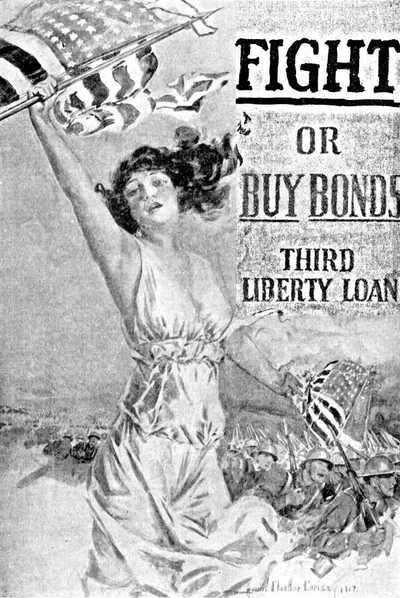
A Poster for the Third Liberty Loan Campaign
Click for a larger image.
On September 27, 1918, the call for the Fourth Loan came and it seemed at the time as if it had been postponed too long because the foe was crumbling. President Wilson sounded the tocsin in the Metropolitan Opera House in New York City. This time the appeal was to drive home the finishing blows, to demonstrate to the crumbling empire of the Hohenzollerns that here was a people undivided and unafraid.
The campaign was carried through in a veritable ecstacy ecstasy of delight. Where before there had been the spirit to give in order to wage the war to any length, here was the spirit to bring the end swiftly and splendidly, to crown the triumphs of our arms abroad with another triumph at home. In truth, the prospect of impending triumph at first almost defeated the need of a campaign. The enthusiasm during the period of the drive transcended everything ever seen in this country before. The result reflected it: In an issue of $6,000,000,000 there was an oversubscription of $933,073,250 and the total number was the 22,777,680 which will stand as the high mark of Americanism for many generations to come.
AROUSING THE HALF-HEARTED
It has been set forth here that all appeals were based on arousing the emotions of the people. This was necessary because, had the offerings gone before the public solely on their practical value as investments, the results would have been considered abroad as another demonstration of our sordidness. Had the people of the United States been sordid, it is certain that they might have obtained better investment values. That they were not touched by selfish instincts is further proved by the fact that all through the drives the bonds of the previous issues had been quoted below par, due to the machinations of a group that never could be lifted above self-interest. The public, in full realization of this apparent depreciation, fought it out and showed their utter contempt for the manipulators by subscribing in greater force and for greater amounts to each subsequent issue.
It has been said before that the feeling of the public toward the war was made clear in the First Loan. It became the problem of the Second and the succeeding drives to organize enthusiasm so that through contagion the more resistant types might be affected. This compelled an organization of psychology. Back of each demonstration there were stage managers. These managers of psychology worked upon the public through the newspapers, through advertising, through "stunts," and generated a force of example which affected the whole community in which they were expressed.
For instance, a parade always has the effect of stirring people; feelings deep-hidden cannot be well concealed when, in war-time, marching men stride past. Unconsciously there comes to the mind of people the question: "What will become of these fine boys when they reach France?" There is the wish to help them, and the means to help them has been before their eyes for days in the Liberty Loan publicity. That is what is meant by stage management.
Through all the Loans it was necessary to manipulate the emotions first, to bring to the consciousness of the people in the news reports the facts and purposes of the loans; secondly, to carry the "urge" to them through the advertising; and thirdly to work upon their feelings through spectacles, meetings, aeroplane flights, sham battles, motion pictures of actual warfare, and like accelerants. It was necessary to infect them in the mass so that as individuals they might infect others with the fever to buy bonds.
All this work had to be carried through and was carried through with brilliant success in the four war-time loans. The Army, the Navy, the stage women's committees, police organizations, Boy Scouts, foreign language groups, all played a part. When the call came for the Fifth Loan, practically everything that had been done before had to be scrapped. It was all part of the war equipment and would help little in getting over another loan when people were striving with every fiber to get away from the thought and the sacrifices of the war.
"FINISH THE JOB"
We had to deal, then, with a people who were beginning to adjust themselves to peace, who were consoling themselves with the thought that they had done their part and should not be called upon again. It looked like a hopeless prospect from the vista presented at the close of the Fourth campaign to expect the same response for a peace campaign. The one optimistic fact that stood out was that the people had proved their patriotism, and such patriotism never dies. The Fifth Loan based its appeal solely upon patriotism's one expression in peace, duty.
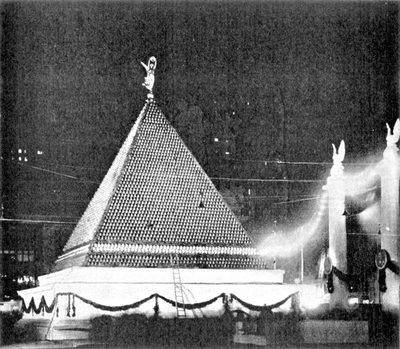
Victory Way at Night
During the Victory Loan Drive, Park Avenue, just above the Grand Central Station, was shut off and devoted to propaganda for the drive. The photograph shows a pyramid of captured German helmets.
Click for a larger image.
"Finish the Job" was the slogan of the Fifth Loan. The country was told that the war was not ended until its debts were paid, that we should feel gratitude in the lives spared by its sudden end. The Liberty Loan workers had to create a new state of mind, to begin a new education—for this time the issue was in Victory notes instead of bonds—and to arouse the people to new emotions through spectacles, parades and other features. It may be mentioned here that the greatest parade of the entire war was held in New York in this Fifth Loan, when the different branches of the army showed in procession the men and weapons they had employed to win victory.
The call was for $4,500,000,000 and the answer was subscribed in notes by 12,000,000 persons, who paid in $5,249,908,300.
WAR SAVINGS CAMPAIGN
In between the drives there was a lesser drive constantly carried on among people who were not able to participate in bond buying. This was the War Savings campaign which was a part of the Government Loan enterprise. Newsboys, bootblacks, shop-girls, clerks and others who had been unable to participate in the Loan drives or who wanted to prove again their devotion to their country answered this appeal. In these savings there was collected for the country up to the date of the armistice $932,339,000 and the number of persons hoarding in small sums was far beyond a million.
LIBERTY LOAN FIGURES
Entire Country
QuotaAm't SubscribedAllottedNo. of Subscribers
First Loan$2,000,000,000 $3,035,226,850$2,000,000,000 4,500,000
Second Loan3,000,000,000 4,617,532,3003,808,766,150 9,500,000
Third Loan3,000,000,000 4,170,069,6504,170,069,650 17,000,000
Fourth Loan6,000,000,000 6,993,073,2506,993,073,250 22,777,680
Fifth Loan4,500,000,000 5,249,908,3004,500,000,000 12,000,000
—————— —————— —————— —————
Totals18,500,000,000 $24,065,810,350$21,471,909,050 65,777,680
Federal Reserve District of New York
First Loan$600,000,000 $1,191,992,100$617,831,650 978,959
Second Loan900,000,000 1,550,453,5001,164,366,950 2,259,151
Third Loan900,000,000 1,115,243,6501,115,243,650 3,046,929
Fourth Loan1,800,000,000 2,044,901,7502,044,901,750 3,604,101
Fifth Loan1,350,000,000 1,762,684,9001,318,098,450 2,484,532
—————— —————— —————— —————
Totals$5,550,000,000 $7,665,275,900$6,260,442,450 12,373,672
BENEFITS DERIVED FROM LOAN CAMPAIGNS
The benefits derived from the Loan campaigns were many. Prominent among them was the growth of thrift among the American people. The growth of this habit will be an important factor in the future greatness of this country.
A lasting monument to the war spirit of those who had to stay at home is the fact that more than a million persons, men, women and children, were engaged actively in the promotion of the five loans. In other words, one person in every hundred in the United States was a part of the organization, and each induced twenty other persons in that hundred to buy bonds. This colossal force did not work in haphazard fashion nor scatter its energy but acted under a definite plan of campaign in which each had an assigned part and in which each worked according to a method that would avoid duplication or extra expense.
The five campaigns which united such an aggregation of workers and which produced such remarkable results were carried forward with a minimum of expense. Never before in the history of finance had such widespread exploitation been accomplished at so low a cost. Of the million workers all but a small nucleus were volunteers; the resources of the country were thrown open to the organizers with unexampled prodigality, mediums of flotation in a veritable flood being contributed without cost to the officers in the Liberty Loan Army.
A single purpose animated the whole nation. Party lines, race prejudice, creed distinctions, social barriers, all were wiped out in these loan drives. The whole country formed itself into an All-American team that rushed onward irresistibly. The closest approximation to a common brotherhood had been achieved. War, with its terrible losses, with its impairment of lusty young men, with its heartbreaks and agonies, surely had not been waged in vain when it brought about such a unity.
The United States in waging the war for democracy had won that democracy for herself at home.