Part 1 — IX THE HIGH COST OF LIVING A Study of the Extraordinary Conditions Subsequent to the Armistice
Reading edition
By THE DIRECTOR OF THE COUNCIL OF NATIONAL DEFENSE
On August 9, 1919, Grosvenor B. Clarkson, Director of the Council of National defense, submitted to the Secretary of War, a report entitled "An Analysis of the High Cost of Living Problem." This report was the result of much careful study and investigation. It is non-academic in form and by omitting details presents a "panoramic view of the problem." It laid chief stress upon conditions since the armistice.
In the report the problem of the high cost of living is viewed as a permanent one. It was, in other words, not peculiar to past war conditions. Careful investigation by the Council has resulted in the following analysis of the problem.
THE ESSENCE OF THE HIGH COST OF LIVING SITUATION
"1. The only complaints of the high cost of living which have justification are those which are based upon inability of the present income to maintain previous or reasonable standards of living at present prices—such well-founded complaints mean that increase of income has not kept pace with increased cost of living, and therefore imply enforced reduction in standards of living.
AMERICA'S PRODUCTIVE CAPACITY
"2. America's industrial and economic achievements during the war, notwithstanding depleted man power and diversion of productive effort to war purposes, demonstrate the ample ability of the Nation to sustain its population according to a standard of living equal to or above standards of living which obtained previous to or during the war.
"3. The fundamental basis for the maintenance of national standards of living is adequate production, economical distribution, and fair apportionment among the various economic groups which constitute our society. With the exception of agricultural activity, production since the armistice has shown evidence of curtailment, and has in general been abnormally low. Normal consumption can not continue unless an adequate rate of production is maintained.
FOOD SITUATION AND READJUSTMENT
"4. Food production and the facilities for food production were improved rather than injured during the war. Moreover, the program with respect to food production since the signing of the armistice has been one of vigorous expansion of the means of providing raw food products. The actual consumption of wheat, as shown by the Grain Corporation's report of May 25, 1919, had for the previous ten months averaged 37,700,000 bushels per month, as against 39,000,000 bushels for the previous twelve months. This does not necessarily imply reduced consumption of cereals.
"The number of cattle slaughtered in the period January to May, 1919, was 3,803,000, as against 4,204,000 for the corresponding period of 1918, though the national reserve of cattle on farms had increased during the war. The swine slaughtered January to May increased from 18,260,000 in 1918 to 20,500,000 in 1919.
CLOTHING SITUATION
"5. The production of civilian cloths and clothing suffered some reduction during the war, and has suffered heavy curtailment for many months since the signing of the armistice.
"Boot and shoe production for civilian use was unfavorably affected by the war and has likewise undergone extreme curtailment since the signing of the armistice.
HOUSING PROBLEM
"6. Housing facilities developed acute shortage through curtailment of building during the war and, due to curtailment, for many months following the armistice, of the production of building material and of building construction, housing is still far below normal. Rents continue to rise.
PROVISION OF NEW CAPITAL
"7. The first half of 1919 shows diminished production of raw materials and subnormal construction of new capital, and thus indicates failure to utilize an adequate proportion of our productive forces in the preliminary processes of provision to meet future requirements. In fact, due to business uncertainty and hesitation and tendencies to disagreement between productive groups, retailers, wholesalers, manufacturers, labor, etc., there ensued after the armistice a disuse of a large proportion of America's productive capacity. Unless this slump in production is atoned for by consistent future activity, and unless production is constantly maintained on an adequate scale, reduced standards of living will become inescapable, regardless of prices, whether they rise or fall.
"8. The very fact that prices of finished commodities, consumption goods, so called, have risen to an extent out of proportion to the rise in prices of raw materials and perhaps out of proportion to the rise in general wages, indicates that production and distribution carried on under these conditions is, in general, yielding profits abnormally high."
In corroboration of the preceding analysis, the report cites statistical data gathered from various sources. The relation of currency and credit to prices is admirably epitomized in the following extract:
CURRENCY AND CREDIT
"The manner in which the volume of circulating credit and currency is related to the war-time rise in prices is about as follows:
"The outbreak of the war brought to America urgent government orders for munitions and supplies. Inasmuch as the belligerent governments could not brook delay they were obliged to pay the increased prices which American producers found it possible to demand, and thus the wave of war prices was started in America. When America entered the war it required, in order to perform its part, almost boundless quantities of equipment and man power. Producers naturally took advantage of the extremely urgent character of these demands in order to increase their prices, and, as a natural sequence, wages began to advance. These increased prices and wages of course necessitated larger expenditures by the government.
"Increased prices also necessitate the employment of larger funds in the conduct of a business. A larger volume of credit is required at higher prices to take care of bills for raw materials, and more money is necessary to meet increased payrolls. As a consequence, therefore, of increased prices, business men required increased credit if they were to avoid curtailment of operations and reduced production. Due to higher prices, therefore, the banks were under the necessity of meeting the business demand for expansion of credit."
INFLATION
The inflation process is described as follows:
"In pre-war times every dollar finding its way to the market was supposedly the counterpart of some commodity or part of a commodity also appearing in the market. Funds expended for the purchase of food, clothing, and for the payment of rentals were assumed to have been earned by some productive contribution to the general supply of commodities. With the outbreak of war there began to appear in the market, funds derived from wages, profits, etc., which had been paid out in connection with nonproductive activities of war, and which therefore implied no corresponding contribution to the market supply of commodities. The producers of, and the dealers in, the decreased quantity of commodities brought to market increased the prices of these commodities to the point where they might absorb all the purchase money that became available. These increased prices and wages have required increased circulating medium. This requirement has been met primarily by increased credit and the increased use of bank checks as an instrument of payment. As to the currency situation, the total money in the United States in 1900 amounted to $2,340,000,000. According to a statement issued by Governor W. P. G. Harding, of the Federal Reserve Board, the amount of money in circulation has varied during the last five years as follows:
July 1, 1914, $3,419,108,368, or $34.53 per capita.
April 1, 1917, $4,100,976,000, or $37.88 per capita.
December 1, 1918, $5,129,985,000, or $48.13 per capita.
August 1, 1919, $4,796,890,000, or $45.16 per capita.
"This shows an increase during our war period of $7.28 per capita. The amount of money in the Treasury and in Federal Reserve Banks is not in circulation, and is, therefore not included in the figures quoted from Governor Harding's statement.
"In regard to the part played by national credit in meeting the situation growing out of the extraordinary requirements of the government and the rise in prices which the urgency of demands made possible, it is to be noted that government bonds had to be sold to pay for a large proportion of the goods which war activities were consuming. In consequence the national debt up to August 1, 1919, had been increased by $24,518,000,000, or approximately $230 per capita. Of course, government bonds are always good security for bank credit."
FOOD SUPPLY—WHEAT, CORN AND SUGAR
Despite the fact that we sent large shipments of food to our Allies, our supply at the close of the war was not seriously diminished. The 1919 crop, while not expected to be large, was amply sufficient to prevent a real shortage. This is supported by the following extract from Mr. Clarkson's report:
"The wheat crop for 1918 amounted to 917,000,000 bushels, as compared to an average for 1910—14 of 728,000,000 bushels; and the probable harvest in 1919 is 1,236,000,000 bushels. Our supply of wheat in elevators, mills, etc., on May 9, 1919, was 96,000,000 bushels, as against 34,000,000 bushels the year before. Our flour mills, whose capacity is estimated at something like double their usual output, were milling week by week during 1919 considerably more flour than the year before. They produced for the week ending May 9, 1919, for example, 2,553,000 barrels as against 1,569,000 barrels for the corresponding week of 1918. Notwithstanding large exports, our wheat supply is obviously adequate. In 1918, a record year, we exported 21,000,000 barrels of flour. In 1915 our wheat exports reached their maximum—206,000,000 bushels.
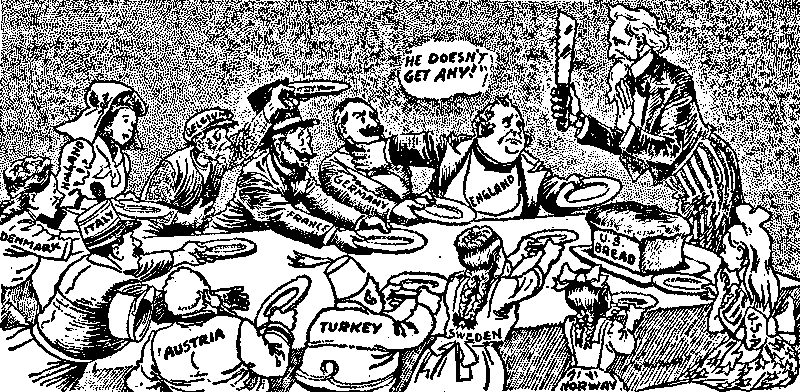
McCutcheon in the Chicago Tribune
Will There Be Enough to Go Around?
"The corn crop of 1918 was likewise sufficient. The supply of corn on hand on May 1, 1919, was 23,000,000 bushels, as compared with 16,000,000 bushels May 1, 1918, and 7,000,000 bushels on May 1 of both 1917 and 1913. Though the 1919 corn crop is not expected to be unusually large, there is no prospect of real shortage. And the situation with respect to the other cereals is generally very good.
"The sugar industry of the United States passed through the period of the war with a tendency to increased production, notwithstanding shipping difficulties. Though present stocks are somewhat low in the United States, our exports during 1919 have been unusually large. The future is normally provided for."
THE MEAT SUPPLY
The meat situation is described as follows:
"America emerged from the war producing meat at a rate far above pre-war figures, and yet possessing in reserve a larger number of animals on the farms than we had before the heavy war drafts upon our supplies began. The number of cattle slaughtered in 1918 was 11,000,000, as compared with 6,978,000 in 1913. Swine slaughtered were 41,214,000 in 1918 and 34,163,000 in 1913. The cattle slaughtered in 1919, January—May, were 3,803,000, as against 4,204,000, January—May, 1918. The swine slaughtered January—May, 1919, made an increase over the 1918 record, the figures being 20,500,000 for the present year, as against 18,260,000 for the corresponding interval last year. Although exports of hams and shoulders for 1918 approximately doubled previous records, amounting to 518,000,000 pounds, as against 172,000,000 pounds for 1913, and exports have continued large during 1919, there is no doubt that our productive capacity is vastly more than ample to meet our requirements."
HIGH PRICE OF FOOD
In view of the apparent abundance of food it is interesting to know the reason for the high price of foodstuffs. The Council of National Defense is of the opinion that the probability that the production of garden products in war gardens had fallen far below that of 1918, when, it is estimated, to have reached the value of $525,000,000, would not account for the high prices. Exportation and storage had not depleted our stock sufficiently to affect prices abnormally. In regard to the question of exports the report gives the following illuminating figures:
"Present food prices are not to be accounted for largely on the basis of heavy exports. Exports of beef, canned, fresh, and pickled, for example, have been less for 1919 than in the previous year, the quantity amounting to 23,499,000 pounds in May, 1919, as compared with 82,787,000 pounds in May, 1918. The May figures for exports of hog products show 125,937,000 pounds in 1919, as against 201,279,000 pounds in May, 1918. The monthly exports of beef and pork show a declining tendency during the first five months of 1919, contrary to the tendency in 1918, the total amounting to 1,090,000,000 pounds in 1919, as against 1,122,000,000 pounds for the corresponding period of 1918—less than the amount of all meats in cold storage on July 1, 1919, which was 1,336,000,000 pounds."
Concerning storage the same report states that:
"Even the fact that the report of goods in cold storage shows an increase of over 9 per cent. in the quantity of all meats held on July 1, 1919 (1,336,000,000 pounds), as compared with the figures for July 1, 1918, is, though very important, not a matter of significance for any considerable period of time. Storage poultry July 1, 1919, was 48,895,704 pounds, or 181 per cent. above last year; cheese, about 25 per cent.; butter, about 75 per cent.; and eggs, about 25 per cent. above July 1 last year. There was a decrease of frozen fish of about 13 per cent. from last year. Taken in connection with the evidence of relatively abundant reserves of live animals and large crops for the current year, it would seem that some relief from high prices of food should be possible."
WHY FOOD PRICES WERE HIGH
The explanation of the post-war high prices of food is given as follows:
"It is true that food is, by comparison, plentiful. But it is also true that money or other circulating medium is unprecedently plentiful. The fact that food prices are relatively high and that the prices of chemicals, metals, lumber, etc., are relatively low, though their supply is relatively small, may be due to a concentration of purchasing power upon food, and the general direction of the flow of currency toward the purchase of immediate consumables. Some relatively minor luxuries such as jewelry (and perhaps automobiles should also be included here as the semi-luxury of greater magnitude) find favor with purchasers, but the main trend of purchase seems to bear toward demand for the necessities of life now in a finished state or nearly so, with a relatively weaker tendency toward demand of capital goods. If the supply, and also the production, of raw materials has been relatively small, and if the prices at which they have exchanged have also been relatively low, it seems obvious that the proportionate amount of currency and credit engaged in their purchase must be abnormally small, thus accounting for the ability of the producers and purveyors of food to demand abnormally high prices regardless of the relative plentifulness of their goods."
CONDITIONS FAVORABLE TO PROFITEERING
"The conditions just described are highly favorable to both speculative profiteering and wasteful distribution, through the intervention of supernumerary middlemen and caterers. In fact, the statistics published by the New York Industrial Relations Commission seem to indicate an unusually large increase of persons engaging in certain kinds of salesmanship after the armistice. It should, however, be remembered that even though it may smack of profiteering to produce a very large crop and sell it at abnormally high prices, this is a kind of profiteering which deserves unstinted praise as compared with that other species of profiteering which deliberately reduces output in the expectation that the extortionate prices which the reduced product will command may more than make up to the producer or speculator for the portion of production withheld or the percentage of hoarded goods condemned to spoil and be lost to the nation."
OTHER COMMODITIES
The price of commodities other than foodstuffs was influenced in 1919 by the inadequacy of supply and the curtailment of production. This was especially true of woolens, as stated by the Council:
"The most obvious explanation of the high prices of woolens is the glaring fact of the extreme reduction in output which ensued after the signing of the armistice and the completion of Army orders, which practically ended in January, 1919.
"The war came to an end with the supply of civilian woolens unprecedentedly low. The total quantity of wool available for civilian fabrics between April and November, 1918, was probably somewhere in the neighborhood of 75,000,000 pounds, an amount perhaps a little more than sufficient to meet the demands of normal manufacture for civilian consumption for one and one-half months.
"In consequence of the general situation the total consumption of wool in manufacture during first five months of the year 1919 amounted to but little more than one-half the amount consumed during the corresponding months of the previous year. The proportion of looms, 50-inch reed space and over, idle increased from 21 per cent. in November, 1918, to 52 per cent. idle in February, 1919, and these looms were still 39 per cent. idle in May, 1919. Of worsted spindles, 27 per cent. were reported idle in December, 1918, and 52 per cent. idle in March, 1919, and 26 per cent. were still idle in May. In the meantime an extraordinary number of textile workers were condemned to idleness, their productive capacity perishing day by day and week by week, while the deficiency in the supply of clothing was developing to such a point that it became possible for the wholesale index number of the prices of cloths and clothing to rise to 250 in June."
The production of cotton and cotton goods also was far below normal. To quote again from the report:
"When the war ended the world's cotton supply was understood to be below normal. The supplies of cotton goods were also reported low. The acreage planted to cotton was in 1919 approximately 9 per cent. less than for 1918. The present prospects are that the cotton crop will be small, and published articles are appearing expressing gratification over the prospectively large commercial returns which the cotton producers may be able to command because of the high prices which may be had for the reduced cotton output. The forecast of the cotton crop for 1919 is 10,900,000 bales—about 10 per cent. below that of recent years and but little over two-thirds as large as the record crop of 1914."
"OUTPUT AND MORE OUTPUT" ABANDONED
"In regard to cotton manufacture, it may be recorded that the situation is less unsatisfactory than as regards wool manufacture. In this industry, as in most of our industries, the economic watchword of war-time, which was 'Output, and more output' (the necessary condition of full prosperity in peace, as well as of success during war), was not heard after the armistice. There soon developed, on the contrary, groundless doubts about future demand, and hints of unhealthy fears of 'overproduction.'
"Notwithstanding the release of labor, if it were needed, by demobilization, and notwithstanding adequate supplies of raw cotton to meet the season's requirements and the lack of any important difficulties in the way of reconversion to peace-time products, and with low supplies of finished goods in stock, the cotton industry kept more spindles idle during the first five months of 1919 than were idle during the corresponding period for 1918. The amount of cotton consumed in the United States during the nine months ending with April, 1919, was approximately 12 per cent. less than for the corresponding nine months of 1918. The prices of cloths and clothing, as above mentioned, show in June, 1919, an increase of 150 per cent. over 1913 prices."
The boot and show shoe industry showed a marked decline after the signing of the armistice. This, too, was borne out by the investigations of the Council.
"The production of boots and shoes for the first quarter of 1919 was reported as about 60 per cent. below the production for the last quarter of 1918. Plants were partially closed and in some cases it is reported that machinery was returned to the Shoe Machinery Co. All in all, there were 75,000,000 less pairs of shoes produced in the first quarter of 1919 than in the last quarter of 1918.
"The census report shows a reduction of more than 25 per cent. in the output of civilian men's shoes in the quarter ending with March, 1919, as compared with production in the quarter ending with December, 1918, and nearly 25 per cent. reduction as compared with the quarter ending with September, 1918. The reduction in output of women's shoes amounted to approximately 30 and 25 per cent., respectively, in comprising corresponding periods. The reduction in the output of shoes for youths, boys and misses was even more marked."
COAL AND IRON
What has been said of the production of cotton and woolen goods applied equally to the mining of coal and to the output of iron and steel. During the war we increased our coal production. In 1918 it amounted to "685,000,000 short tons, almost 50 per cent. of the world's estimated output for that year. Production for 1913 was 571,000,000 short tons." The coal situation since the armistice is stated as follows:
"Coal, the source of a vast proportion of our industrial power as well as our chief source of heat and light, is a commodity the production of which is itself an index of our economic life. Coal output since the armistice has been greatly reduced, the weekly production of anthracite for the first half of 1919 being from 1,200,000 to 1,800,000 net tons, as against 1,800,000 net tons to 3,000,000 net tons for the corresponding period of 1918. Bituminous production was 9,147,000 net tons for a typical week in 1919, as against 12,491,000 net tons for the corresponding week in 1918. Coke production for the week ending June 28, 1919, amounted to only 287,000 net tons, as compared with 627,000 net tons for the week ending June 29, 1918. The total amount of coal produced up to July 5, 1919, was 261,000,000 long tons, as compared with 364,000,000 long tons for the corresponding period of 1918."
The production of iron and steel which was greatly stimulated by the war was allowed to decline as soon as the concentrated effort of the nation to win the war was abandoned. The resulting condition is succinctly described by the Council:
"The record of our after-war steel and iron output furnishes us with another warning that we have been neglecting to keep pace with the established American rate of industrial improvement and expansion and foresighted preparation for future requirements and progress.
"The iron and steel business was considerably stimulated by war-time requirements. There was a governmental agency whose business it was to forsee the war needs and to place orders so that those productive forces which are wrapped up in the steel industry might be utilized to capacity. The steel industry's activity has, however, since the armistice greatly declined. Pig-iron production for April, 1919, was 82,607 tons per day, as against 109,607 tons in April, 1918. Birmingham properties are reported to have been working in April, 1919, at about 50 per cent. of the 1918 production. For the period January to May, 1919, pig-iron production was only 2,114,000 tons, as against 3,446,000 tons during the same period in 1918. Steel-ingot production fell in the spring of 1919 to lower figures than had been reached in more than two years. In fact, a regular decline in production was in evidence after December, 1918.
"The figures representing the unfilled orders of the United States Steel Corporation at the end of May, 1919, were smaller than they had been since 1915."
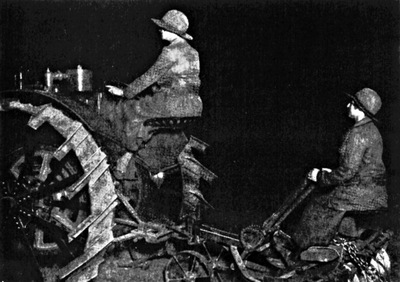
Copyright Underwood & Underwood
Women Doing Night Farming
Girls running a tractor plow and harrow at Farmingdale, Long Island.
Click for a larger image.
RECOMMENDATIONS
The Council summarized its findings and recommends remedial measures as follows:
"The findings of the Reconstruction Research Division Council of National Defense, indicate that the high cost of living is primarily due to curtailment in the production of nearly all commodities except raw food products, to hoarding of storage food products, to profiteering, conscious and unconscious, and to inflation of circulating credit. The findings indicate that the situation may be most advantageously met by:
"1. Stimulated production.
"2. Some readjustment of incomes to the basis of higher price levels.
"3. The repression of hoarding and profiteering.
"4. Improvement and standardization of methods and facilities for distributing and marketing goods.
"5. The perfecting of means of keeping the nation frequently, promptly, and adequately informed regarding probable national requirements and of current production and stocks of the more important commodities.
"The findings emphasize the fact that high standards of living can not be maintained upon a basis of reduced production, regardless of whether price levels be high or low."
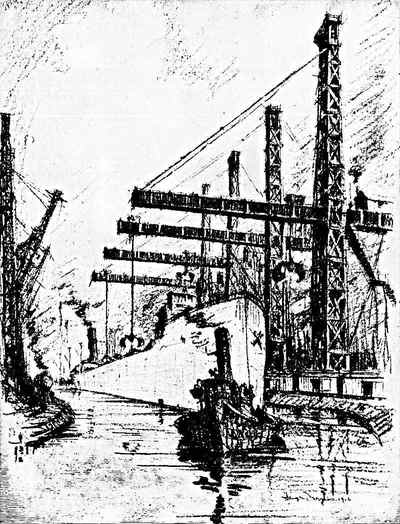
The Ore Market—Cleveland
Click for a larger image.