Volume 6 / Part 1 — PREFACE. (continued 3)
Reading edition
If posts, however, were withdrawn while erecting a house for the king, then the tenor of a former paragraph in relation to the king’s house so erected would not be exempted but applied; though if the house to be erected was a barn, then this divination would not apply to such house, or if the posts were drawn out, or taken to pieces again; it was applicable only to dwelling houses. Aka, ina he mau pou ka mea i unuhi ia ma ke kukulu ana o ka hale o ke alii, alaila, aole no e kaawale ka loina o ka pauku mua i ka hale alii ina e hana ia pela, ua pili no; a ina hoi, i hana ia ka hale, he halepapaa, alaila, aole no e pili keia kilokilo ana no ia hale. Ina ua unuhi hou ia na pou, a wawahi hou ia paha, ua pili wale no, no na hale noho.
7. FAULTILY CONSTRUCTED HOUSES. 7. NA HALE I KUKULU PONO OLE IA.
If the house was erected and completed, being thatched, and all particulars observed, and the owner residing therein, whether a chief or a commoner, and the diviner came in and saw that the plate piece in the front wall over the entrance had not been cut then the diviner would say: “That plate piece is improper for not being cut near the entrance.” Those uncut pieces of plates were called the stretcher, which betokened death. Ina ua kukulu ia ka hale, a ua hana ia a paa, a ua paa i ke ako, ua pau na hemahema a pau, a e noho ana ka mea nona ka hale i loko; ina he alii, a he makaainana paha, a komo mai ka mea kilokilo, a ike ua oki ole ia ka lohelau ma ka paia o ke alo ma ka wa e kupono ana i ka puka komo, alaila, e olelo auanei ke kilokilo: “Ua hewa kela lohelau, no ke oki ole ia ana o kahi i ka puka komo.” Ua kapa ia ua mau lohelau la i oki ole ia he manele, he make no ka hope o ia ano.
A ina ua maikai na lohelau, ua oki ia paha, alaila, aia kekahi hewa ma ke kulana o na pou. Aia kekahi hewa ma na ahokele, ina e ako ia ua mau ahokele la a paa loa. Aia kekahi hewa ma na kukuna, ina paha o ke kukuna pili pouhana ka mea i ike ia ka hewa. Ina nae ua huli pono ke kulou ana a ke kekee o ke kukuna i ka pouhana, alaila e olelo auanei ke kilokilo: “E make auanei ka mea nona ka hale, a i ole, o kona poe paha, aia no ka manalo iki, he make no kekahi mea, a he hana hou ia paha ma ke kauoha a ke kilokilo, ma ke ano oihana kahuna.” O ke ano o ia hana a ke kukuna i like peia ke ano, alaila, he mihiauau kona ano. E uwe aku ana ke kukuna i ka pouhana, ua like no ia me ka uwe ana o kekahi poe i ka make ana o ka haku mea hale.
If there were two side posts and both were crooked, and the crook of one was turned toward the other, then the diviner would say: “Some of the people within will be continually quarreling, just as one crook was opposite the other.” If the crooks of the posts were bent toward themselves, then the diviner would say: “There are two interpretations relative to the position of those side posts. All those who will live in this house will be stingy people. If two persons are eating they will bend over their own particular meals, and so will others within. They will not call others, and few will be the occasions for agreeableness, for avarice will predominate. All those who dwell in said house will be avaricious people only.” Ina e ku ana kekahi mau kukuna elua, a he mau kukuna kekee laua a elua, ua huli aku paha ke kekee o kekahi i kekahi, alaila e olelo aku ke kilokilo: “He hakaka mau ko kekahi poe o loko, e like me ke kue o kekahi kekee i kekahi kekee.” A ina ua kulou kekahi kekee o na kukuna ia laua iho, alaila, e olelo auanei ke kilokilo: “Elua ano e pili ai ka hana a kela mau kukuna. O ka poe a pau o loko o keia hale, he poe aua wale no. Ina e ai ana na mea elua, kulou no laua i ka laua mea ai iho, pela no kekahi poe e ae o loko. Aole e hiki i kekahi mau mea ke hea aku i kekahi mau mea, he kakaikahi ka manawa like, no ka aua ka nui. O ka poe a pau e noho ana i ua hale la, he poe aua wale no lakou.”
If a stranger happens to arrive at that house he would not be invited to come and partake of food, the only words to be heard then, are: “We are eating.” “Are you filled?” “How are you?” “Will you have something to eat?” because these words were only interrogations without any intention of inviting him, and it was those words which forbade the person addressed. Ina e hoea aku kekahi malihini ma ua hale la, aole e hiki ke kahea mai e ai pu, a o ka huaolelo e loaa ia wa: “Ke ai nei makou.” “Ua maona oe?” “Pehea oe?” “E paina paha?” Nokamea, o kela mau huaolelo, he ninau wale no, no ka makemake ole e kahea aku, a na kela mau huaolelo i keakea mai i ka mea i kahea ia mai.
8. DIVINATION OF A POST DENOTING DISEASE. 8. KE KILOKILO ANA O KE KUKUNA MAI.
If one side post, or more, stands with the crook of the post bulging toward the inside of the house the diviner would say: “It is a bad post; dropsy will be the disease of the owner of the house, or other person.” And if the protuberant crook of the post was turned towards the thatching of the house the diviner would say: “A broken humpback will be the malady of the owner of the house, or of some other person perhaps.” Ina e ku ana ke kukuna a mau kukuna paha, ua hoohu mai ke kekee o ka kukuna i loko o ka hale, e olelo no ke kilokilo: “He kukuna ino ia, he opuohao ka mai o ka mea nona ka hale, a o kekahi mea e ae paha.” A ina ua huli ke kanahua kekee o ke kukuna i ka pili aho o ka hale, e olelo auanei ke kilokilo: “He uhai kuapu ia ka mai o ka mea nona ka hale, a i ole o kekahi poe e ae paha.”
9. DIVINING THE POSITION OF TWO OR MORE HOUSES. 9. KE KILOKILO ANA O KE KU ANA O NA HALE ELUA A OI AE PAHA.
If two, three or more houses were standing in a row, and one house was higher than the rest of the row, and that house was owned by a commoner, then the diviner would say: “The owner of that house will become rich, perhaps a division land holder, or perhaps a district land holder.” But if two houses are in the same position, the owner of one being a division land holder and a low farmer be the owner of the other, and the house with the high roof belongs to the low farmer, the diviner would remark: “The owner of that other house will cease to be a division land holder and the owner of the high house will own the property.” Ina e kupapa like ana na hale elua, ekolu, a oi aku paha; a ina ua kiekie kekahi hale hookahi maluna o kela papa hale: Ina nae he makaainana ka mea nona ua hale kiekie la, alaila, e olelo no ke kilokilo: “E waiwai aku ana ka mea nona kela hale ma keia hope aku, he ai ahupuaa paha, he ai okana paha.” Aka, ina elua mau hale e ku like ana, he ai ahupuaa ka mea nona kekahi hale, a he lopa ka mea nona kekahi hale, a o ka hale kiekie o ke kaupaku o ke kulana o ka hale, no ka lopa, alaila, e olelo auanei ke kilokilo: “E pau ana ka aimoku ana o ka mea nona kela hale, a o ka mea nona ka hale kiekie, nona ka waiwai.”
10. DIVINATION OF ONE OR TWO HOUSES BEHIND A ROW OF DWELLINGS. 10. KE KILOKILO ANA O KA HALE MAHOPE MAI O KA PAPA HALE E KU ANA MAMUA.
If one or two houses were standing in the rear of a row of several then the diviner would say: “There will be fighting amongst these houses. The melee will be started by the house in the rear; the conduct of the houses in front will make them enemies for the rear houses, and those living in front will become opponents for him or them who live in the house in the rear.” Ina paha e ku mai ana kekahi hale hookahi a elua paha mahope mai o ka papa hale lehulehu, alaila e olelo auanei ka mea kilokilo: “He hakaka ka hope o keia poe hale. O ka hale mahope ka mea nana e hoouluulu ka hakaka, a e lilo na hana a ka poe hale mamua i enemi no ka hale mahope, a e lilo ana ka poe e noho ana mamua i mau hoa hakaka no ka mea a mau mea e noho ana ma ka hale mahope mai.”
History of the Hawaiian Priesthood in Olden Time, Called Hoomanamana. Moolelo no ko Hawaii Oihana Kahuna i ka wa Mamua, i kapa ia he Hoomanamana.
EXPLANATORY REMARKS. HE MAU OLELO HOAKAKA.
In writing the history of the priesthood I am not able to present the genealogy of those who established the order in these islands in this historical account of the priesthood, because I do not know of any one now living who could verify the account of those who founded the order among this people. However, this is what I do know of this subject. I recollect, through hearsay, of the works of the priesthood of these islands in ancient times, because when I was at the age of fourteen years I began to have a clear understanding of the character of the order of Priesthood, and from that time until A.D. 1838, I occasionally heard of the practices of the order. Mamua o kuu kakau ana i ka moolelo no ka oihana kahuna, aole e hiki ia’u, ke lawe mai i ka mookuauhau o ka poe nana i hookumu ka oihana kahuna ma keia aina, ma keia kakau moolelo ana, no ka oihana kahuna, nokamea, aole wau i ike i kekahi mea e ola ana i keia manawa nana e hoomaopopo mai ka moolelo o ka poe nana i hookahua ka oihana kahuna ma keia lahui; aka, eia wale no ka mea maopopo ia’u, ma keia moolelo ana: Ua hoomaopopo ia e a’u ma ka lohe ana i na hana oihana kahuna o keia mau aina i ka wa mamua, nokamea, i ka umikumamaha o ko’u mau makahiki, ia manawa ka hoomaka ana o’u e lohe maopopo i ke ano o ka oihana kahuna, a mai ia manawa mai a hiki i ka M. H. 1838, ko’u lohe liilii ana no ke ano o ka oihana kahuna.
In the year 1838, when Mr. E. Bailey and Mr. I. Bliss, American missionaries, arrived in Kohala and were erecting Hawaiian houses for themselves, my guardian was residing at Nunulu in Kohala. His name was Kaili, and he was in the line of chiefs of the Kalanimoku chain, and an uncle of Haalelea. I ua makahiki 1838 la, oiai ua noho ae o Mr. E. Bailey a me Mr. Berist [Bliss] ma Kohala, he mau Misionari Amerika, i ka manawa hoi i kukulu ae ai laua i mau hale Hawaii no laua, i kela manawa, aia ko’u mea nana i hanai e noho ana ma Nunulu i Kohala, ia manawa. O Kaili kona inoa, ua komo i loko o ka papa helu o na ’lii ma ka aoao o Kalanimoku, he makuakane oia no L. Haalelea.
While the missionaries were erecting their houses according to Hawaiian custom, my guardian at the same time showed his knowledge of the order of priesthood, thus: Mr. Bliss was the first to build his house. My guardian observed that the position of the house was improper and the location of the building was also faulty. There were also defects in the position of the posts. Kaili then remarked, “Had this been in the times that have passed, this house would be [considered] faulty; the owner of the house would not long reside [therein] before removing to another place. Not so, however, in this new era which is under the power of Jehovah. It will not occur.” I ka manawa i kukulu ae ai ua mau misionari la i mau hale no laua ma ke ano Hawaii, ia manawa i hoike ae ai ua mea nei o’u nana i hanai i ka ike ma ka oihana kahuna, a penei. Kukulu mua o Mr. Berist i kona hale, nana aku la ua mea nei o’u nana i hanai, a ike aku la ua hewa ke kulana o ka hale, a hewa pu me ke kahua kahi i kukulu ai, a hewa hou ma ke kulana o na pou. Ia manawa, olelo ae la ua o Kaili: “Ina o kela manawa i hala aku nei, ua hewa ka hale. Aole e liuliu ka mea nona ka hale, hele aku ma kahi e. Aole hoi, he wa hou keia, ua paa i ka mana o Iehova, aole hoi e hiki.”
A paa aku la ko Berista hale, he mau la mahope mai kukulu ae la o Mr. E. Bailey i kona hale, ma ke ano Hawaii no. Ia kukulu ana a paa, a koe hookahi kala. Ia manawa, wawahi hou ia kekahi aoao, a ako hou. Ia manawa, olelo hou ae la no ua o Kaili e like me ka olelo ana i ka hale o Mr. Berist. Aneane elua makahiki ka noho ana maloko o ua mau hale nei, alaila hoi aku la i Iole. A ma ka M. H. 1841, hoi loa aku la o Mr. Berist i Amerika, a o Mr. E. Bailey hoi, hoi aku la i Wailuku, Maui. Oia ka hooko ia ana o kana ike oihana kahuna. A mahope mai o ia manawa ko’u lohe liilii ana no ka oihana kahuna, a hiki i ka M. H. 1854, ma ka malama o Iune.
At that period my knowledge increased regarding the various divisions of the priesthood, relating to the office of true priestly healing; the office of divination; weather prophesying and architecture; also of the art of praying to death and sorcery; for, my said guardian was taught in the art of divination (kilokilo) and weather prophesying; he was also trained in the art of true healing and had some knowledge of praying to death and sorcery. He, however, lacked in architecture. The husband of my mother’s elder sister, my father’s elder brother, and my elder brothers were trained in some calling of the priesthood, while myself, my sister and our mother and aunt remained untrained. Ia manawa, ua mahuahua mai ia’u ka lohe ana, no na ano oihana kahuna a pau. E pili ana i ka oihana kahuna lapaau maoli, oihana kahuna a kilokilo, nanauli, a me ke kuhikuhi puuone, o ke kahuna anaana a me ka hoopiopio, nokamea, o ua mea la o’u nana i hanai, ua ao ia i ke kilokilo a me ka nanauli. Ua ao ia no hoi i ka lapaau maoli, a ua ike no hoi i ka anaana ana a me ka hoopiopio. A ua koe ia ia ke kuhikuhi puuone. A o ke kane a ke kaikuaana o ko’u makuahine, a me ke kaikuaana o ko’u makuakane, a me ko’u mau kaikuaana, ua ao ia lakou ma kekahi mau ano oihana kahuna, a owau a me ko’u kaikuwahine, a me ko maua mau makuawahine, na mea i ao ole ia.
Through these conditions I casually came to know about the priesthood in some things taught my relatives, and for these reasons I have written this history of the priesthood. I had not, however, expected to preserve such an account, but in June, A.D. 1862, I commenced to write this record of the priesthood, from the things which I had heard from A.D. 1837 to the time that I made a circuit in the interest of the newspaper “Hoku o ka Pakipika” (Star of the Pacific). Ma keia mau mea, ua lohe wale wau i ke ano o ka oihana kahuna ma kekahi mau mea, ma na mea i ao ia e ko’u hanauna; a mamuli o keia mau kumu i kakau iho ai wau i keia moolelo o ka oihana kahuna. Aka, aole nae wau i hoomaopopo e malama i moolelo o keia ano, a ma ka malama o Iune M. H. 1862, hoomaka iho la wau e kakau i keia moolelo o ka oihana kahuna, no loko mai nae o na mea a’u i lohe ai, mai ka M. H. 1837 a hiki i kuu kaapuni ana no ka Nupepa “Hoku o ka Pakipika.”
A ma ka M. H. 1863 ma ka malama o Aperila, hoomaka ia ke kukulu ana i Ahahui imi i na mea kahiko o Hawaii nei. Ia manawa kakau hou au maluna o keia kumumanao. Aka, aole wau i kakau i keia moolelo me kuu manao ua kina ole wau ma keia kakau moolelo ana. Malia paha o ili mai ia hewa maluna o ka mea nana i kakau keia moolelo.
Mai kinohi mai o ko’u lohe liilii ana i ke ano o ka oihana kahuna a hiki mai i ko’u hoomaka ana e kakau i keia moolelo, aole wau i manao maopopo i ka waiwai o keia mau mea. A mahope mai o ia mau la, akahi no a loaa ia’u ka hoomaopopo ana i ka waiwai o ka malama moolelo, no na hana e pili ana i keia lahui i ka wa mamua, nokamea, i iho la wau, “Ina paha aole e malama ia na moolelo o keia lahui i ka wa mamua, pehea la e ike ai na hanauna hope i ke ano o ka hana a keia mau aina i keia wa.”
A nolaila, ua malama wau i keia moolelo, me ka manao he waiwai nui ia no’u, a no ko’u hooilina, a me ko’u lahui. Aka, aole nae keia o ka maka mua o ka’u kakau moolelo ana, ua hoomaka wau e kakau i ka moolelo kaao o keia lahui, ma ka malama o Augate M. H. 1844, ma ka M. H. 1862, ma ka malama o Iulai ma ka la 4, ua loaa hou ia’u he moolelo hou. Aka, o ka oi no keia o ka moolelo mamua o na moolelo i i malama ia e a’u, nokamea, aia i loko o ia moolelo, ka hoomaka ana e ike ia keia mau aina, a me ka loaa ana o keia lahui, na hoouka kaua nui mai ka hoomaka ana o keia lahui a hiki ia Kamehameha, he kanaiwakumamahiku hanauna mai a Opuukahonua mai a hiki ia Kamehameha—a ua kapa ia ua moolelo la, “He Oihanalii.”
S. N. Haleole. S. N. Haleole.
Honolulu, June 13, 1863. Honolulu, June 13, 1863.
A HISTORY OF THE [SORCERY] PRIESTHOOD. KA MOOLELO NO KA OIHANA KAHUNA.
1. ITS DIVISIONS AND ORDINANCES. 1. NA MAHELE A ME NA KANAWAI.
O ka oihana kahuna i olelo ia ma Hawaii nei, ua pili i ke kane a wahine paha, i ike i ke ano o ka oihana kahuna. He umi no mahele nui o ka oihana kahuna. O ka Anaana, ka Hoopiopio, ka Hoounauna, ka Hookomokomo, ke Poi Uhane, ke Oneoneihonua, ke Kilokilo, ka Nanauli, a me [Lapaau me Kuhikuhipuuone]. Ina ua huipuia keia mau Oihana a pau i ke kanaka hookahi, alaila e kapa ia aku ia he Kahuna Nui, nokamea ua pau na oihana a pau i ka ike ia e ia. A ina hoi ua pakahi wale no na oihana i ke kanaka hookahi, a ua oi kona akamai ma ka oihana i loaa ia ia, aole e kapa ia he Kahuna Nui.
Within the ten divisions of the priesthood smaller branches relating to it have issued forth on account of the idol worship, and setting up of deities, wind spirits and other things of varied character. In the ten offices of the order of priesthood, he who preserved the calling vested in him had a god. Each division priest had a god. No one would revere the priesthood without he had a god. If priestly calling was being taught by some one without a god, then knowledge of the priesthood could not be imparted by such a one. I loko o na mahele he umi o ka oihana kahuna, ua puka mai he mau lala liilii e pili ana i ka oihana kahuna, mamuli o na akua hoomanamana, he mau akua hoonohonoho, he mau makani, a me na mea e ae he lehulehu ke ano. O na moolelo he umi o ka oihana kahuna, a o ka mea e malama ana i ka oihana kahuna i loaa ia ia, he akua no kona. He akua ko kela oihana, keia oihana. Aole e malama wale ana kekahi i ka oihana kahuna me kona akua ole. Ina ua ao wale ia kekahi oihana kahuna i kekahi me ke akua ole, alaila, aole no e loaa ana ka ike ma ka oihana kahuna i kekahi ke ao.
The priesthood had certain ordinances for the training of those who desired to acquire knowledge, and if an ordinance or ordinances were broken before proficiency, failure would result; no matter how great the effort, the knowledge of the callings of the priesthood could not be obtained. Only by strict adherence to the laws of the priesthood to the end would the result be satisfactory. If one had studied the priesthood under strict observance of the laws of the god of the priesthood until he reached the day of offering a sacrifice and a fault happened in the act of offering [failure resulted], for if the service was imperfect the instructor of the order of priesthood could interpret its good or evil, and if the service was indeed defective the instructor would say to the student: “You can not learn the priesthood.” If the services were faulty the instructor in priesthood would then remark whether they portended some adversity or tribulation and would dismiss the student from further instruction, because the knowledge gained by the instructor was obtained through the services. He mau kanawai no ko ka oihana kahuna, ke ao ia, a makemake paha e ike. A ina ua hai kekahi kanawai a mau kanawai paha mamua o ka ailolo ana, alaila, aole no e pono ana, e ao wale no aole e ike ana i na oihana kahuna. Aia no a malu loa i na kanawai o ka oihana kahuna a hiki i ka ailolo ana, alaila maikai. A ina ua ao kekahi i ka oihana kahuna, me ka maluhia i na kanawai o ke akua o ka oihana kahuna a hiki i ka la e ailolo ai, alaila, aia kekahi hewa i ka lolo ana, nokamea, ina e ino ka lolo ana, alaila, he hiki i ke kumu o ka oihana kahuna ke hoakaka mai i ka maikai a me ke ino. A ina ua ino ka lolo ana, alaila e olelo auanei ke kumu o ka oihanakahuna i ka haumana: “Aole e hiki ia oe ke ao i ka oihana kahuna.” Ina paha ua ku ka lolo ana i ke ino, alaila, e olelo auanei ke kumu o ka oihana kahuna, ina he lolo ku i ka pilikia, a i ka poino paha; alaila, e hoopau no ke kumu o ka oihana kahuna i ka haumana aole e ao. Nokamea, ua ku ka ike a ke kumu oihana kahuna ma ka lolo ana.
2. OF THE SACRIFICE SERVICES OF THE STUDENT. 2. NO KA AILOLO ANA O KA HAUMANA.
This is a test of the priestly [qualification]; with a pig perhaps, or a dog, or a fowl. The services must be performed in accordance with the directions of the instructor. The sacrifice services in the priesthood relates to its callings as well as to manual labors, such as fishing and cultivation, all of which belong to the service of the priesthood. No ka Ailolo. He hoailona no ia no ka Oihana kahuna, he puaa paha a he ilio paha, a he manu paha. Aia e like me ka olelo a ke kumu o ka oihana kahuna, pela no ka e hana ai. Ua pili no ka ailolo ana o ka oihana kahuna i na oihana kahuna, a me na oihana paahana, no ka lawaia a me ka mahiai, a oia mau mea a pau, he oihana kahuna no ia.
A knowledge in bone-breaking, in boxing, spear-throwing and other methods of fighting are shown to be efficient through the powers of the priesthood. Many things would show one’s competency in learning about the priesthood. Supposing that a person wished to study priesthood for praying to death. That person would not attain proficiency by an animal, or a fowl [offering]. He would only become expert in the death of a human being through praying to death. That is efficiency in learning praying to death. And if bone-breaking was the study engaged in, its knowledge was shown in the same way as that of praying to death. Efficiency, however, is not the same with all instructions in priesthood; it is alike in some things and different in others. O ke ao ana i ka lua, ke kui, ka oo ihe, a me na ano hakaka e ae, ua ailolo no ma ka hailona o ka oihana kahuna. He nui no na mea e ailolo ai no ke ao ana i ka oihana kahuna. Ina paha, ua makemake kekahi e ao i ka oihana kahuna no ka anaana, aole no e lolo ia kanaka, ma kekahi o na holoholona a me na manu. Aia no ka ailolo he make no ke kanaka ma ka anaana ana. Oia iho la ka ailolo no ke ao ana i ka anaana. A ina he lua ka mea i ao ai, alaila, ua like no kona ailolo ana me ke ao ana o ka anaana. Aka, ma na kumu oihana kahuna a pau, aole no he like o na mea e ailolo ai, ua like ma kekahi mau mea, a like ole ma kekahi.
3. DIVINATION. 3. NO NA OIHANA IKE.
From those who uphold the priesthood come various kinds of knowledge thereof, and one of these is divination (hoomanamana); and here is the method. If a person contemplated stealing the property of another, then it would be improper to go without first receiving some auguries before attempting his theft. Some augury through the priesthood must be obtained. Thus: Take some pebbles (small stones) about fifty, more or less; these pebbles are placed before those who intend to go stealing, and are covered with a piece of cloth, then the person having knowledge of the priesthood makes some remarks before praying and dividing the heap of pebbles, thus: after the heap of pebbles has been placed before them and covered with a piece of cloth, the priest says: “The heap of pebbles is before us, and you intend to go after Kanumua’s pig. Right here will be shown the wisdom or folly of your undertaking. If it is improper to procure it, it shall be so; if proper, it is well. It rests with you to choose which shall be your own side, the remaining side being for the person whose pig you intend to obtain. If the odd be on your side it is well; if your side has the even number and the odd be on the side of the person whose pig you seek to obtain, then do not go, else you will be caught.” Aia i loko o ka poe e malama ana i ka oihana kahuna i puka mai ai he mau oihana kahuna. A ua kapa ia ka oihana ike, he hoomanamana. A penei e hana ai: Ina paha e manao ana kekahi e kii aihue i ka mea a kekahi, alaila, aole e pono ke hele mua me ka hailona ole mamua o ka hele ana e aihue i kekahi mea. E pono ke lawe mai i kekahi hoailona o ka oihana kahuna. Eia. E lawe mai i mau iliili (pokahu liilii) he kanalima a oi aku a emi mai paha, a e waiho ia no ua mau iliili la i mua o ka poe e manao ana e aihue, a e uhi ia i kekahi apana kapa paha. Alaila e hoakaka mua aku ka mea ike i ka oihana kahuna mamua o ka pule ana a me ka mahele ana o ka puu iliili, penei. Aia a ku ka puu iliili i mua o lakou me ka uhi ia i ka apana kapa, alaila e olelo auanei ke kahuna: “Eia ka puu iliili i mua o kakou, ke manao nei oukou e kii i ka puaa a Kanumua. Eia no ianei ka pono a me ka hewa o ka oukou hele ana. Ina ua pono ole ke kii, oia iho la no, a ina he pono, oia no. Aia no i ka oukou aoao e koho ai, oia iho la no ko oukou aoao, a o ka aoao i koe no ka mea ia nana ka puaa a oukou e kii ai. Ina ua oi ko oukou aoao, ua maikai, a i pahu ko oukou aoao, a oi ka mea nana ka puaa a oukou e kii ai, alaila, mai hele oukou o loaa mai.”
After these remarks the priest stands in prayer, and when near the latter part of the time therein he places his hands upon the heap of pebbles, dividing it in two, at the same time uncovering it. Then counting by twos he would set aside the odd pebble; then count the other side in the same way, and if there was no remainder, the side of the intending thieves having the even, and the owner of the pig the odd number, then the priest would say: “Don’t you go, else you will be caught by the property owner.” If, however, the odd was on the side of the thieves, then the priest would say: “You all go; no one will hinder you on your way.” If both sides were odd in the division of the pebbles, the priest would say: “It is bad;” or if alike even, the priest would also say: “It is bad.” In like manner also are all the auguries of the callings of the priesthood performed. Such callings were named Sorcery. A pau ka ke kahuna hoakaka ana, alaila, ku ke kahuna i ka pule a kokoke paha i ka hapa hope o ka manawa, alaila e lalau iho na lima o ke kahuna i ka puu iliili a mahele ae a kaawale na aoao a elua, alaila wehe ae i ke kapa. Alaila, helu palua aku, a koe ka iliili hookahi, a puunaue palua hoi i kekahi aoao, a ina i pau pono aole he koena hookahi, alaila, ina o ko ka poe manao aihue kai pahu, a oi ko ka mea puaa, alaila e olelo auanei ke kahuna: “Mai hele oukou, o loaa mai oukou i ka mea waiwai.” A ina hoi o ko ka aihue ka aoao i oi, alaila, e olelo auanei ke kahuna: “O hele nui, aole mea nana e keakea i ko oukou hele ana.” A ina ua oi like na aoao elua ma ka puunaue ana i na iliili, alaila e olelo auanei ke kahuna, “Ua ino.” A ina ua pahu like, alaila, e olelo no auanei ke kahuna: “He ino.” A pela no na hailona ike o kela a me keia o na oihana ike o ka oihana kahuna e hana ai. Ua kapa ia ia mau hana ike, he “hoomanamana.”
Aole no o ka puu iliili wale no na hoailona o ka oihana ike o ka oihana kahuna. He mau hoailona e ae no kekahi. O ka awa kekahi mau hoailona ike o ka oihana.
Ina paha, ua make o Kaoao i ka anaana ia, a minamina ka mea nana ke kupapau, alaila, e hele aku ka mea nana ke kupapau i mua o kekahi kahuna kuni. Aia a halawai aku ka mea nana ke kupapau a hai i ke kumu o kona hiki ana i mua o ke kahuna kuni (kahuna anaana), ia manawa, e hoomaka mai ai ka ike o ke kahuna i ka mea nana i anaana o Kaoao. Nokamea, ua ku okoa mai la ke kahoaka o ka mea nana i anaana i mua o ke kahuna kuni. Alaila e olelo auanei ke kahuna: “Eia keia kanaka ehu loihi ke ku mai nei me ka ia i ka lima;” alaila e manao auanei ka mea nana ke kupapau, he ia ka mea i make ai o Kaoao. Aia no ia manawa a ke kahuna e ike la i ka mea nana i anaana, e ike ai i ka mea nana i lawe ka maunu. Nokamea, he mea mau i ka poe maa i ka oihana ike o ke kahuna kuni, ka ike pu i ka mea nana i lawe ka maunu i make ai kekahi. Aia a ku aku ke kahoaka o ka mea nana i anaana, e ku pu aku no auanei i mua o ke kahuna ka mea nana i lawe ka maunu. Ina nae he mea okoa ka mea nana i lawe ka maunu.
4. OF PRAYING TO DEATH. 4. NO KA ANAANA.
O ke kanaka i kapa ia he kahuna anaana, he kanaka ia i hoohiki e malama loa i na kanawai o ka oihana kahuna. No ka mea, aole no e hiki ana i kekahi ke ao i ka anaana, ke ole oia e hoohiki mua e malama i na kanawai o ka oihana kahuna. (E pono paha e hoakaka iki aku.) Ua papa ia ka huhu, ka opu inoino i ka mea e ao ana i ka anaana. O ka mea malama ole i ke kanawai no ka oihana kahuna, ua kapa ia ia he “kahuna aihamu.” A o ke kahuna i olelo ia he aihamu, aole e loihi kona ola ana, a make aku, no ka mea, o ke akua no e make ai, o ke akua no o ka oihana kahuna.
No ka Hoopiopio. Ua like no na kulana o ka hoopiopio me ko ka anaana; aka, ua kaawale na oihana, a o ka hope o ia mau mea elua, o ka make o kekahi ka mea i manao nui ia ai. Ua ao nui ia ka anaana, a me ka hoopiopio e kekahi poe, he mea e pono ai a e waiwai ai nona iho, a he paku nona iho, ma ka make e hiki mai ana ia ia iho. Aia i waena o na kanaka o ke alo alii kekahi poe, makemake lakou e ao nui i ka anaana, i malama ia ai ke ola o ke Alii. Pela mau i waena o ka poe hanai alii, a kapa ia lakou “he imi haku,” a “he malama haku.”
5. GODS OF THE PRIESTHOOD. 5. NA AKUA O KA OIHANA KAHUNA.
Many and innumerable were the gods belonging to the order of priesthood, but the supreme head of the gods of the order was Uli. Before performing the works of the priesthood prayers were offered to the gods of the order. The priests of the order held their deities in great reverence; the names of the deities were not used in profanity in olden times. If the name of the deity was blasphemed the devotees of the order felt fearful of its consequences. He nui a lehulehu wale na akua e pili ana i ka oihana kahuna, aka, o ke poo nui o ke akua o na akua o ka oihana, o Uli. Mamua o ka lawelawe ana i na hana o ka oihana kahuna, a me ka hoomaka ana e hana, ua malama ia ka pule ana i na akua o ka oihana kahuna. He poe malama nui na kahuna o ka oihana kahuna i ko lakou mau akua, aole e hoohiki ino ia ka inoa o na akua i ka wa mamua. Ina ua olelo ia me ka hoohiki ino ka inoa o ke akua, alaila he mea menemene loa ia i ka poe malama akua.
6. OF DIVINATION. 6. NO KE KILOKILO.
Ua kapa ia ke kahuna kilokilo, he kanaka ike hohonu. He hiki i ke kanaka kilokilo ke hoakaka mai no na mea e hiki mai ana mahope, ina he ino, a ina he maikai paha. He hiki no i ua kilokilo nei ke ike i ka pilikia e hiki mai ana maluna o ka lahui, ina paha he kaua, a he mau pilikia e ae paha. Ua hiki no hoi i ke kilokilo ke hai e mai i ka make ana o kekahi alii, e like penei: “E make ana kekahi alii.” He nui na oihana ike a ke kilokilo, he ike i ke ino o ke ku ana o ka hale, a mau hale paha, a me ka poe e noho ana maloko. Ua hiki i ke kilokilo ke hai mai i ka aina hemo, ina he alii aimoku, ai okana paha, a ina he alii ai ahupuaa.
7. KNOWLEDGE OF A DIVINER PRIEST RELATING TO HOUSE POSITIONS. 7. KA IKE O KE KAHUNA KILOKILO NO KE KU ANA O KA HALE A MAU HALE PAHA.
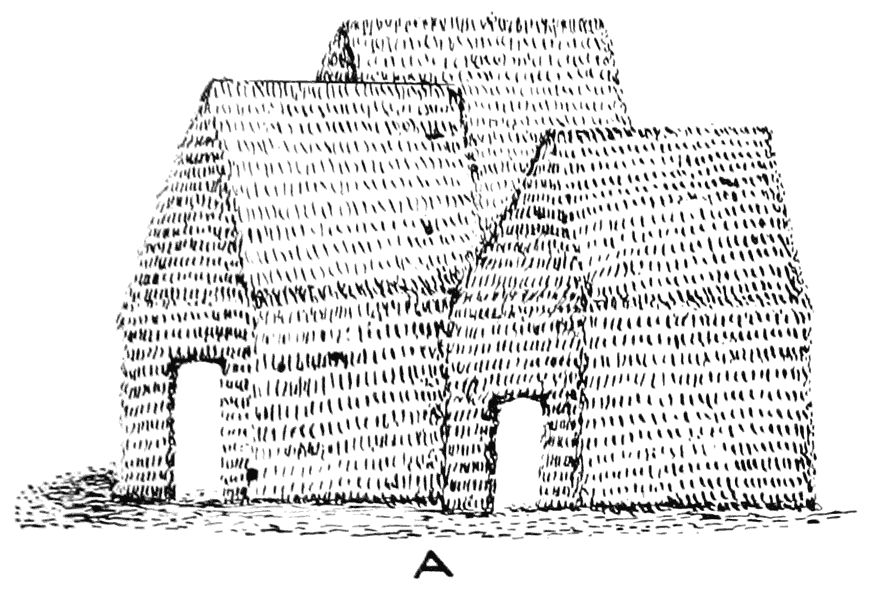
Supposing that three houses are erected on the same ground, and that one of the houses stands in the rear of the other two houses (as in Figure 1 A), then the diviner priest will come and look upon them standing thus and remark: “The positions of the houses are improper; the consequence to said houses will be constant quarreling because one house stands behind the other two; the house which stands in the rear will be the one to raise the tumult, which can only discontinue by breaking up the rear house.” Ina paha ua kukulu ia kekahi mau hale ekolu ma ke kahua hookahi, ina nae mahope mai o ke ku ana o kekahi hale o na hale elua e like me ke kii malalo iho (Helu 1, A), alaila e hele mai ke kahuna kilokilo a nana iho e ku ana me keia, e olelo auanei ke kahuna: “Ua hewa ke kulana o na hale, o ka hope o ia mau hale, he hakaka mau. Nokamea, ua ku kekahi hale mahope o na hale elua. Nokamea, o ka hale ma ke kua mai o na hale elua, ka mea nana e hoouluulu ka hakaka, aia ke oki o ka hakaka he naha no ka hale mahope mai.”
Helu 1, A. Helu 1, B. Kii 1, Na hale Hawaii kukulu hewa ia; A, no ka wahi; B, no ka nui. Figure 1,—Hawaiian houses undesirably located; A, on account of position; B, on account of size.
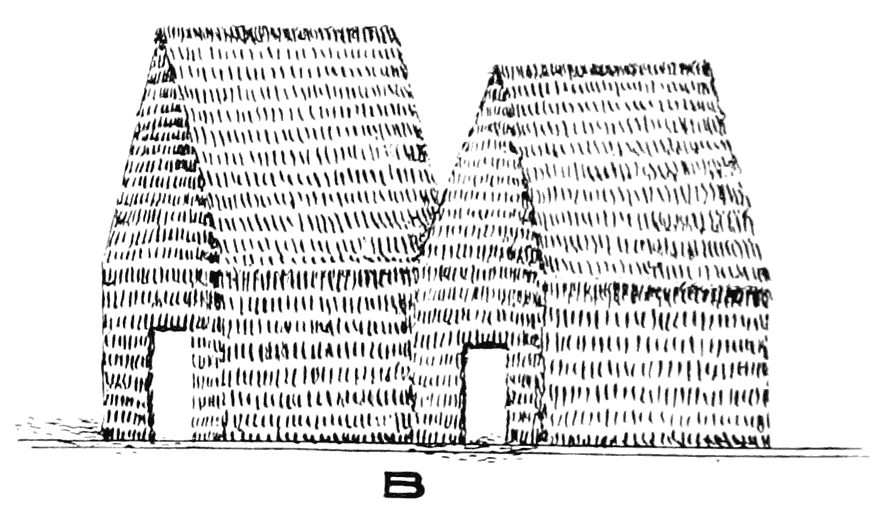
Supposing that two houses are built in line (as shown in Figure 1 B). If a chief of the island or a division chief owns the lower house, and a farmer, a low farmer, owns the taller house, when the priest comes and finds the houses standing thus, he will say: “One of these houses will be profitable; it is the taller house; the fortunes of the owner of the lower house will be possessed by the owner of the higher one.” But if the houses stand alike and of the same height, the diviner priest will pronounce the houses good, because they are not in opposition to each other. And if several houses in one or two rows were all alike, having similar positions and corresponding heights except one, which towers above the others in the rows of houses, then the priest will come, and if he finds them standing thus, he will say: “Of all those houses one will be profitable; the one with the high roof is their lord, and the one who will rule over the people (those who own the lower houses).” A ina paha ua kukulu ia kekahi mau hale, elua, ma ka lalani hookahi e like me keia kii malalo iho (Helu 1, B). Ina he Aliiaimoku ka mea nona ka hale haahaa, a he Alii Ai Ahupuaa paha, a ina he lopa a lopa kuakea paha ka mea nona ka hale kiekie. Alaila hele mai ke kahuna kilokilo, a ike e ku ana na hale penei ke ano, alaila, e olelo auanei ke kahuna: “Hookahi mea waiwai o keia mau hale e ku nei, o ka mea nona ka hale kiekie; e lilo ana ka pomaikai o ka mea nona ka hale haahaa i ka mea nona ka hale kiekie.” Aka, ina he kulike wale no na hale elua, me ka like o na kiekie, e olelo auanei ke kahuna kilokilo, ua maikai na hale, no ka mea, aole i kue kekahi i kekahi. A ina hoi ua kulike wale no na hale he lehulehu ma ka papa hookahi, a elua paha, a he like wale no ke kulana o na hale, a like wale no na kiekie, a hookahi hale oi o ia mau papa hale, e like paha me ka kii maluna ae, alaila e hele aku ke kahuna a ike, e ku ana me ia ke ano, alaila e olelo auanei ke kahuna kilokilo: “Hookahi hale waiwai o kela mau hale. O ka hale i kiekie o kaupoku; a o ko lakou haku no ia, a nana e hoounauna iho na kanaka,” (ka poe nona ka hale haahaa).
If, however, two houses are standing in one place facing each other, the entrance to one house being directly opposite to that of the other, when the diviner priest finds the houses standing thus, if one belongs to a division overseer and the other to a section overseer, the priest will say: “One of them will lose his stewardship.” This, however, refers only to the owners of the houses so standing. Ina hoi e ku like ana na hale elua ma kahi hookahi, ua huli aku a huli mai ke alo o na hale, a kupono hoi ka puka komo o kekahi hale i ka puka komo o kekahi hale; a ike ke kahuna kilokilo e ku ana ka hale peia ke ano, ina he ai ahupuaa kekahi a he ai ili kekahi, alaila, e olelo auanei ke kahuna: “E hemo ana ka ai ili o kekahi.” Aia wale no nae ma na mea nona na hale e ku ana e pili ai, aole e pili ae i ka mea e.
8. DIVINING A LOCATION UPON WHICH TO BUILD A HOUSE. 8. KE KILOKILO NO KE KAHUA KAHI E KU AI KA HALE.
There are various locations for the building of a house; it is not proper for a house to be built without a diviner priest being sent for. He nui na ano a me na loina o ke kahua, kahi e ku ai na hale; aole e pono e kukulu wale ia kekahi hale ke ole e kii ia ke kahuna kilokilo.
No ke Kahua. Ina paha e ku ana kekahi hale ma ke kae o ka pali, a ua hoohuli ia ke alo o ua hale nei i ka pali, me ke kupono o ka puka komo i ua pali nei. A hele mai ke kahuna kilokilo, a ike e ku ana ka hale i like peia ke ano, alaila e olelo auanei ke kahuna kilokilo: “He kahua ino kela, he leleopu ka inoa o kela kahua; elua mea nui i loko o kela kahua, he pau loa i ka make, a he hele aku paha ma kahi e; alaila e lilo ana kela wahi i neoneo.”
Ina hoi ua kukulu ia ka hale maluna o kekahi ahua, a puu paha, alaila, ua like no ko laua loina me ko ka hale ku i ka pali. Aka, elua nae inoa o keia kahua, he leleopu, a he holua. Aka ina ua ike ke kahuna kilokilo, ua ino ke kahua, a ua loaa kekahi kumu e ae e maikai ai, alaila, ua pono no ke ku ka hale ma ia mau kahua.
A ina hoi ua kukulu ia kekahi hale ma ke kumu o kekahi ahua, a he ano pali, ma kekahi aoao, alaila, hookahi no loina o ia kahua me ka leleopu, a me ka holua. Aka, ina ua hoohuli ia ke alo o ka hale i luna o ke ahua a puu paha, me ka hoohuli ia o ka puka komo i ka pali, alaila, e olelo auanei ke kahuna kilokilo: “Ua maikai ka hale;” ke kumu i maikai ai, o ka huli ana o ke alo i ka puu, a ahua paha.
9. DIVINATION ON THE HOUSE TIMBER. 9. KE KILOKILO ANA NO KA LAAU HALE.
Supposing that the appearance of the house is perfect and the location also perfect, defects may be found in the main posts, or in the end posts. If faultless in all these, the imperfections may be found in the plate piece or perhaps in the timbers. Ina paha ua maikai ke kulana o ka hale, a maikai pu me ke kahua, aia kekahi hewa i ke kulana o na pou a me na kukuna paha. Ina paha ua maikai ma keia mau mea a pau, aia kekahi hewa i ka lohe lau. A i ole ia aia ma ka laau.
10. DIVINATION ON THE ERECTION OF A HOUSE. 10. KE KILOKILO ANA NO KE KUKULU ANA O KA HALE.
Assuming that the posts are placed in position, the plate pieces laid on and tied fast, when it is found that the position of one of the posts is faulty and the post is drawn out, then the priest will say: “The house is defective; the owner will not remain long therein before he goes away.” Ina paha ua kukulu ia na pae pou o ka hale a paa, kau na lohe lau, kauhilo ia a paa, a ike ia ua hewa ke kulana o kekahi pou, a kii aku e unuhi hou, alaila e olelo aku ke kahuna: “Ua hewa ka hale, aole e liuliu ka mea nona ka hale i loko, alaila hele aku.”
No ka Wawahi Hou ana i ka Hale. Ina paha ua ako ia kekahi hale a ua paa a ike ka mea nona ka hale ua ino ka ako ia ana, a wawahi hou ia, a ike mai ke kahuna kilokilo e hanaia ana pela, alaila, e olelo auanei ke kahuna, “Aole e liuliu ka mea nona ka hale i loko, alaila, e hele aku oia ma kahi e, he okoa ka mea nana e noho o loko.” Aka, ina he alii aimoku ka mea nona ka hale i wawahi ia, alaila, aole e pili ia loina ma ia ano. Aia wale no o ka hale o na makaainana ka mea pili ia loina.
11. DEFECTIVE HOUSE FRAMING IN THE OPINION OF THE DIVINER. 11. KA HEWA O KA LAAU HALE MA KA IKE A KE KILOKILO.
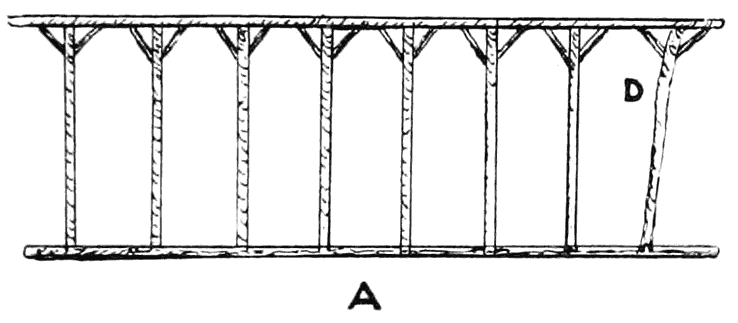
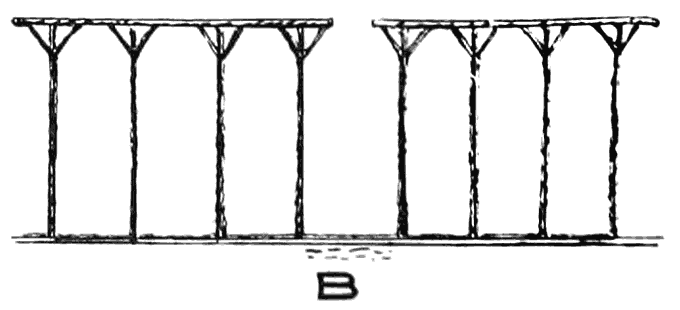
Supposing that the side posts of a house are standing in this wise (Figure 2 A), and that the diviner priest comes and finds the walls of the house built in that way. If they are posts for the front, then the priest will say: “There are two defects to the house in the position of the row of posts; one fault is in the leaning post at the end, and marked (d), and the other defect is in the plate-beam, because the door-plate is not cut.” Ina paha penei ke ku ana o ka pae pou paia o kekahi hale (Helu 2, A), a hele mai ke kahuna kilokilo, a ike penei ke kukulu ia ana o ka paia o kekahi hale, ina nae he pae pou keia no ke alo, alaila, e olelo auanei ke kahuna: “Elua hewa o keia hale ma ke kulana o na pae pou; aia kekahi hewa ma ka pou hio ma ke kihi, (i hoailona ia i ke d), a o kekahi hewa aia ma ka lohe lau, nokamea aole i oki ia ka lohe lau puka.”
Of the leaning post. The leaning post position is faulty on account of the crooked bulge being toward the next post. If the bulging is on the outside near the temporary battens that would be a little better; but the best way, in the opinion of the diviner, is to draw out the post altogether and replace it by another post similar to the rest of the posts which were put up, then it will be well. Such posts, however, shall not be drawn out at random without referring it to the gods of the priesthood, that the error of such acts may be pardoned. But if all the posts of said house are similar to the leaning post then it is well. A house that is continued in building as above described, the owners thereof will die. No ka Pou Hio. Ua hewa ke ku ana a ka pou hio, no ka huli ana o ke kanahua kekee ma ka aoao o kekahi pou. Ina ma waho ke kanahua kekee, ma ka pili kuahui, alaila maikai iki. Aka, o ka pono loa i ka manao o ke kilokilo, o ka unuhi loa, a kukulu hou iho i pou ano like me na pou e ae o ia kululu ana, alaila maikai. Aole nae e unuhi wale ia ua pou la, ke hana ole ia i mua o na akua o ka oihana kahuna, i mea e kala ia ai ka hewa o ia hana ana. Aka, ina he ano like wale no na pou a pau o ua hale nei, e like me ka pou hio, alaila ua maikai no. O ka hale i hoomau ia ke kukulu ana me ke kii malalo iho, alaila, e pau na mea nona ka hale i ka make.
Of the plate-beam. If the plate beam of a doorway is not cut, then the priest will say: “The house is not good on account of the plate for the doorway not being cut.” The name of a house made that way is called a “manele” (bier). But if the plate-beam for a doorway be cut in the front (as in Figure 2 B), then it is well. No ka Lohe Lau. Ina e oki ole ia ka lohe lau o ka wa puka o kekahi hale, alaila, e olelo auanei ke kahuna: “Aole he maikai o ka hale, o ke oki ole ia o ka lohe lau ma ka wa puka ke kumu i ino ai.” O ka inoa o ka hale i hana ia pela, he manele. Aka, ina i oki ia ka lohe lau ma ka wa puka o ka paia ma ke alo, e like me ke kii malalo iho, (Helu 2, B), alaila maikai, e like me keia.
Helu 2, A. Helu 2, B. Kii 2, Na pou o ka hale Hawaii; A, e hoike ana i ka hewa o ka kukulu ana; B, a me ka pono o na paepae. Figure 2,—Frame work of an Hawaiian house; A, showing defects in construction; B, showing proper arrangement of supports.
12. DIVINATION FOR END POSTS AND MAIN POSTS. 12. KE KILOKILO ANA NO NA KUKUNA A ME NA POUHANA.
In Numbers 10 and 11 posts and beam plates are fully explained. This number will treat of end posts and main posts. Ma ka helu 10 a me ka helu 11, ua pau ka hoakaka ana no na pou a me ka lohe lau. A ma keia helu, no na kukuna a me ka pouhana.
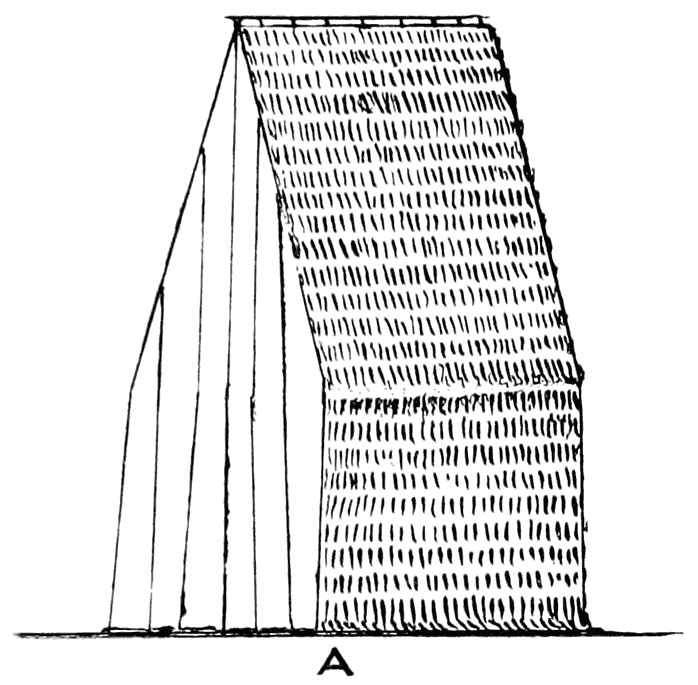
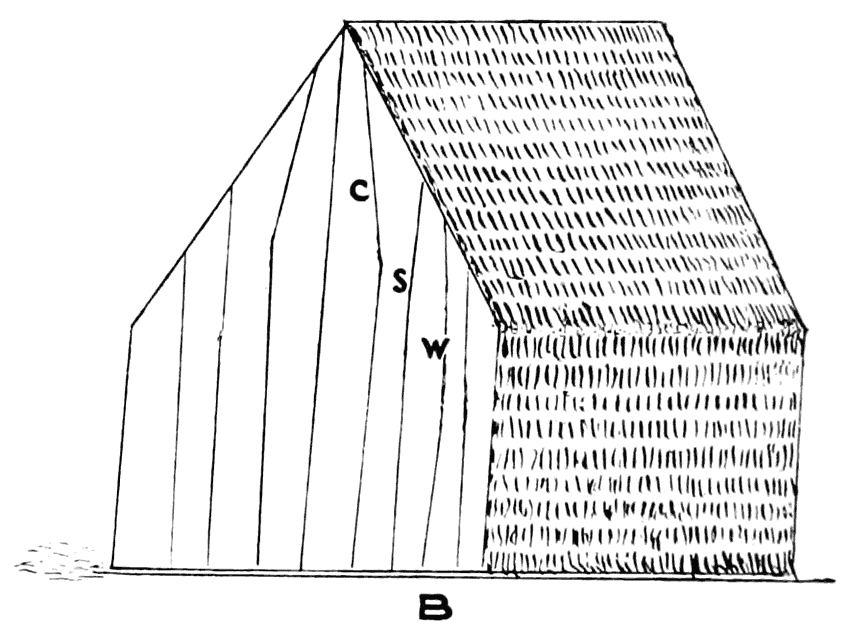
Defects in the position of a house also lie with the side posts and main posts. If the positions of the end posts of a house are as in Figure 3A, and a diviner comes and sees such position of the end posts, he will say, if a king happens to be the owner of the house: “The positions of the end posts near the main posts are defective,” because the two end posts adjacent to the main post are in opposition to the main post, and the true expression of the position made by the said end posts is that some of the king’s men will rebel against him, for, according to the character of the house timbers, the center post is the king. Supposing, however, that the end posts stand as in Figure 3B, the priest will then make an interpretation of the real meaning of them. Aia ma na kukuna a me na pouhana, kekahi hewa o ke kulana hale. Ina paha penei ke ku ana o kekahi mau kukuna o kekahi hale, e like me ke Kii (Helu 3, A). Ina paha me kela ke ku ana o na kukuna a hele mai ke kilokilo, a ike penei ke ku ana o na kukuna, alaila e olelo auanei ke kahuna, ina nae he alii ka mea nona ka hale: “Ua ino ke ku ana a na kukuna pili pouhana,” nokamea, o na kukuna pili pouhana elua, ua kue laua i ka pouhana. A o ka hoakaka ana i ke ano io maoli o ke kulana o ua mau kukuna la, e kipi auanei kekahi mau kanaka o ke alii i ke alii; nokamea ma na ouli o ka laau o ka hale, “he alii ka pouhana.” A ina hoi penei ke ku ana o na kukuna e like me ke kii malalo iho, alaila, penei ka hoakaka ana a ke kahuna, i ke ano maoli o ke kulana o na kukuna.
End posts adjacent to a main post. The end posts which are adjacent to the main post in the position shown in the diagram are not properly placed; they are in a repentant position. It represents the end posts in a mourning attitude, predicting the death of the owner of the house. No na Kukuna Pili Pouhana. O na kukuna pili pouhana i like ke kulana me keia kii (Helu 3, B), alaila, aole i maikai ia kulana o na kukuna, he mihiau. E uwe ana ke ano o ia mau kukuna, aole auanei e ole ka make o ka mea nona ka hale.
Of the end posts (c) and (s), which are adjacent to a main post. If the end posts were placed in the same manner as the end posts (c) and (s), the real interpretation is that those end posts indicate baseness, always opposing and quarreling, because their position is that of contending one against the other. And if posts were standing in the position represented by (s) and (w) in the diagram, their character is the same as that of the end posts adjacent to the main post. No ke kukuna pili pouhana (c) a me kekahi kukuna iho (s), ina ua kukuluia na kukuna e like me ke kukuna (c) a me ke kukuna (s). O ka hoakaka ana i kona ano io maoli, he mau kukuna ino kela, o ka laua hana he kue mau, a hakaka no hoi. Nokamea, ua kue aku a kue mai ke kulana o ia mau kukuna. A ina hoi e ku ana ke kukuna (s) a me kukuna (w) e like me ke kulana ma ke kii i olelo ia, alaila, ua like no ko laua loina me ko na kukuna pili pouhana elua.
Helu 1, A. Helu 1, B. Kii 3, A. B.—Pou kala o ka hale Hawaii e hoike ana ka hewa o ka kukulu ana. Figure 3, A. B.—End poles of an Hawaiian house showing defects in construction.
13. THE CONVEYANCE OF TIMBER TO THE SITE OF ERECTION. 13. NO KA LAWE ANA O NA LAAU HALE I KAHI E KUKULU AI.
Ina paha ua oki ia na laau o kekahi hale, a lawe ia mai mai uka mai o kahi i oki ia ai, a waiho ia ma ke kahua i manao ia ai e kukulu ka hale. Aka, ua hewa nae ia kahua. A o ke kahua i manao ia ai he maikai, ua hala hope paha, ma kahi i laweia mai ai ka laau. E like paha me keia. O Nuuanu kahi i oki ia ai ka laau, a ua laweia mai a waiho ma ka hale hoomaemae ko. Oia ke kahua i manao ia e kukulu, aka, no ka hewa ana o ua kahua la, ua olelo ia o Peleula ke kahua maikai. Alaila, ina i manao ia e hoihoi hou ka laau i Peleula, alaila, e olelo auanei ke kahuna kilokilo, “Ua hewa ia hoihoi hou ana o ka laau i uka.” A no ia mea, ua kapa ia aku ia kahua, “He lua no ka Ohiki.” O ka hale i hana ia pela, aole e ola ana kekahi poe ke noho i ua hale la. Pau pu ka poe nona ka hale a me ka poe e aku ke noho i ua hale la. Penei wale no ka pono e hana ai; ina ua lawe ia mai ua mau mea hana la e like me na loina maluna, a manao ia ua hewa ke kahua e waiho la na laau, a hoihoi hou ia paha i Peleula ke kahua i manao ia he maikai, alaila, e lawe aku i ka laau ma o o Leleo a ma ke Alanui Liliha pii hou i uka, aia a hala hope i kai o Peleula, alaila, e hele aoao aku a hiki ma Kaalaa, alaila iho hou i kai a hiki i Peleula, alaila maikai.
14. OF THE DIVINER PRIEST. 14. NO KE KAHUNA KILOKILO.
A diviner priest was a very sacred person and would not enter a house that he had passed judgment upon, although the restriction was not on the owner of the house but upon himself, for it is customary that houses which were restricted should be released from the ban by supplication to the gods of the priesthood. And if the priest who made the prediction entered the house that he had adjudged, he would die immediately after praying to the gods of the priesthood; he would die suddenly in one or two days after entering the house, because the house was held under the prayers of the priesthood. For that reason the diviner priest is himself restricted from entering a house that he had passed judgment upon. He kanaka kapu loa ke kahuna kilokilo, aole e komo iki i loko o ka hale ana i hooiloilo ai, aole nae no ka mea hale ka hookapu ana, aka no ua kahuna kilokilo la no; no ka mea, he mea mau i na hale i hooiloilo ia, he hana ia ma ka pule ana i na akua o ka oihana kahuna. A ina e komo ua kahuna nei nana i hooiloilo i loko o ka hale ana i hooiloilo ai, alaila e make koke no mahope iho o ka pule ana i na akua o ka oihana kahuna. Hookahi, a elua paha la mahope iho o kona komo ana, alaila, e make koke no, no ka mea ua paa ka hale i ka pule no ka oihana kahuna. A nolaila ke kahuna kilokilo i hookapu ai ia ia, aole e komo i loko o ka hale ana i hooiloilo ai.
The entry of a house by a priest. Should a diviner priest enter a house and notice that it was defective, he would remark on the defects of the house he had noticed, then the owner of the house would tell the priest to remove [such defects]. And if another diviner priest entered the house without knowledge of what had been done by the other diviner priest through prayers of the priesthood; and if he noticed the same defects referred to by the other and remarked that “the house is defective”, this priest would soon surely die. No ke Komo ana o ke Kahuna i loko o ka Hale. Ina i komo ke kahuna kilokilo i loko o kekahi hale, a ike oia ua hewa ka hale, alaila, e olelo no ke kahuna i ka hewa o ka hale, e like me kana ike ana. Alaila na ka mea nona ka hale e olelo e hana ke kahuna, alaila hana ma na akua o ka oihana kahuna. A ina ua komo mai kekahi kahuna kilokilo i loko o ka hale me ka ike ole i ka hana ia ana e kekahi kahuna kilokilo ma ka pule o ka oihana kahuna. A ina i ike i ka hewa i ike ia ai e ke kahuna mua nana i hana, a hooiloilo ae, “ua hewa ka hale,” alaila, e make koke auanei ua kahuna la.
15. THINGS TO DO ON A CONDEMNED HOUSE. 15. NA MEA E HANA AI O KA HALE I HOOILOILO IA.
A house which was seen to be defective, as mentioned in former numbers about priesthood, the priest should come and exercise in his official capacity. O ka hale i ike ia ka hewa e like me na helu mua o ka oihana kilokilo, alaila e hele mai ke kahuna kilokilo e hana ma ka oihana kahuna.
Na Mea e Hana ai. Na ke kahuna kilokilo e puhi ia loko o ka hale me ke ahi o ka oihana kahuna, a e lawe ia mai ke kuapaa, ka makaa, (he ia liilii) ka pohuli maia. Na ke kahuna kilokilo e hana i na mea a pau i lawe ia mai no ka hana ana i ka hale. E kalua ia ka puaa a me ka moa, i uku i ke akua o ka oihana kahuna. E hoailona mua nae ke kahuna kilokilo i ka puaa a me ka moa, mamua o ka hana ana, a me ke kalua ana. A o keia mau mea a pau i hana ia no ka hale, oia ke kala ia ana o ka hewa o ka hale, ma ka mana o ke akua o ka oihana kahuna.
DIVINING OMENS BY THE CLOUDS. NO KE KILOKILO ANA I NA OULI O NA AO.
This was one of the most profound accomplishments of a diviner priest because he could foresee the fortunes to be obtained in coming days, and also the death of a king and the approach of war. By the omens in the clouds could be foreseen the approaching stranger. If the omens in the clouds were observed in the evening he would prophesy the things that he saw and some day it would come to be fulfilled. O keia kekahi oihana ike hohonu a ke kahuna kilokilo. Nokamea, he hiki i ke kilokilo, ke ike aku i ka waiwai e loaa ana i kekahi la ae, a he hiki ke ike aku i ke alii make, a me ke kaua. A he hiki ke ike ia ma na ouli o na ao ka malihini puka mai. Ina he ahiahi ka ike ia ana o ke ano o na opua, alaila, e wanana mua oia no na mea ana e ike ai, a ma kekahi la e hooko ia ai.
16. ABOUT THE FORTUNE-TELLER. 16. NO KE KAHUNA NANAULI.
The fortune-teller was one of the most learned men in the order of priesthood. He was similar to the diviner priest in some respects, and in the religious ceremonies of the order their duties were alike. Fortune-telling consisted of discerning the character or disposition of a person, whether he be rich or poor, stingy or benevolent, wrathful or affectionate, mischievous or of quiet demeanor. All the characteristics of a person, and all that he does the fortune-teller could reveal, exactly as he will in fact do. O ke kahuna nanauli, o kekahi kanaka ike hohonu keia o ka oihana kahuna. Ua ano like no nae me ke kahuna kilokilo ma kekahi mau mea, aka, ma na oihana akua o ka oihana kahuna, ua like no ka mea a laua e hana ai. O ka Nanauli. O ka nana ana no ia i na uli o ke kanaka, ina he kanaka waiwai, a ina he kanaka ilihune. A ina paha he kanaka aua, a he lokomaikai paha, a ina he huhu, a ina he oluolu, a ina he kalohe, a ina he noho malie. O na ano a pau o ke kanaka, a me na mea a pau a ke kanaka e hana ai, ua hiki i ka nanauli ke hoike mai e like me ka ke kanaka e hana ai.
INTERPRETING THE CLOUD OMENS.19 Only in the evening could the omens in the clouds be interpreted, at the time that the sun was about to set; that was the time when the omens in the various dark clouds could be observed. This was more noticeable in the evenings of Ku, when the clouds were more conspicuous and these were the evenings when those who desire might learn [thereof]. NO KA NANA ANA I NA OULI O KE AO. Ma na ahiahi wale no e ike ia ai ka ouli o na ao. Aia i ka manawa e kokoke aku ana o ka la e napoo, oia ka manawa e ike ia ai ke ano o kela opua keia opua. Aia nae i na ahiahi i o Ku, oia ka wa kuku o ka opua. A oia na ahiahi e ike ai ka mea makemake e ao.
OF A FORTUNE OMEN CLOUD. NO KA OPUA WAIWAI.
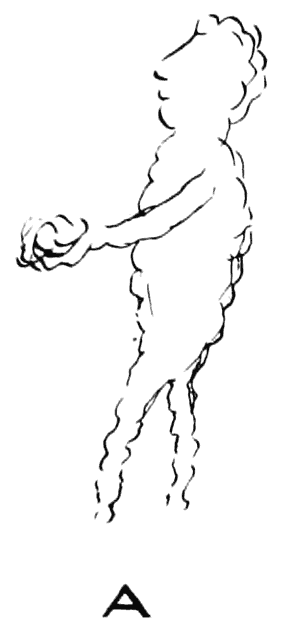
Supposing that a cloud stood in the form of a man as though holding a parcel in his hand as shown in Figure 4A. If the fortune-teller or weather prophet noticed that a cloud stood as a man in this form and if the parcel continued to be in the hand until the cloud disappeared, then the fortune-teller would say: “No fortunes will be received on the morrow (if the observation was in the evening).” Ina paha ua ku mai kekahi opua me he kanaka la a he ukana paha ko ka lima, e like paha me ke kii malalo nei (Helu 4, A). Ina e nana aku ka nanauli ua like ke ku ana a kekahi opua me he kanaka la, e like me keia ke ano, a ina i paa loa kela mea ma ka lima a hiki i ka nalowale ana o ua opua nei, alaila, e olelo auanei ka nanauli. “Aole he waiwai e loaa mai ana ma ka la apopo,” ina i ke ahiahi ka nana ana.
On the other hand, if a cloud stood as in Figure 4B, and was thus observed, then the fortune-teller would say: “Fortune will be received on the morrow; if not brought in then it will be found on the way.” If there were several clouds in the form of said Figure B then the day would be most auspicious. Aka, ina penei ke ku ana o kekahi opua e like me ke kii (Helu 4, B) malalo nei, a ike ia ia ka opua me keia, alaila, e olelo auanei ka nanauli: “E loaa ana ka waiwai i ka la apopo. Ina aole e lawe ia mai, alaila, ma kahi e hele ai, malaila no e loaa ai ka waiwai ke hele.” Ina paha ua nui loa na opua i like ke ano me ke kii maluna ae, alaila, he la waiwai nui loa ia.
Fig. 4, A. Fig. 4, B. Kii 4, A. B.—Na opua Ouli i kaha ia e ke kupa Hawaii. Figure 4, A. B.—Omen Clouds as drawn by a native Hawaiian.
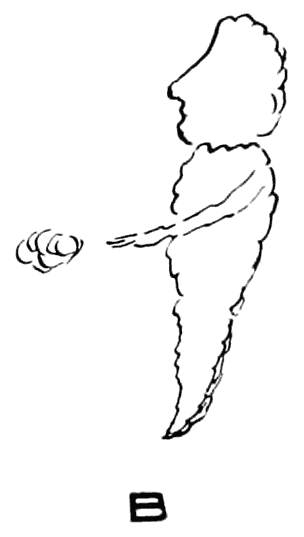
In the same manner, if a cloud resembling a canoe or canoes was seen in the evening, canoes would surely appear the next day. If a cloud was in the form of an oblong or coffin-like box, a corpse would be seen the next day. Pela hoi, ina he waa a mau waa paha ke ano o ka opua, i ike ia ai i ke ahiahi, alaila, he waa no ka mea e hiki mai ai i kekahi la ae. Ina he holowaa ke ano o ka opua, he ano holowaa kupapau paha, alaila, he kupapau no ka mea e ike ia ai i kekahi la ae.
FORETELLING BY A WEATHER PROPHET OF A TEMPEST OR A CALM. KE KILOKILO ANA A KA NANAULI NO KA INO A ME KA MALIE.
Supposing that every day was tempestuous for a long period, rainy and windy perhaps, then the weather prophet would look up to the stars; if they did not twinkle but remained steadfast, the weather prophet would say: “A calm will prevail. Tomorrow good weather will settle down, and on the following day the calm will be general.” In the same manner if indications of a calm were observed in the clouds, or in any other object in the heavens, the weather prophet’s explanation about it would be the same as that of the omens of the stars. Ina paha he ino wale no na la a pau i kekahi manawa, he ua, a he makani paha, alaila, e nana ae ka nanauli i na hoku, a ina aole e amoamo mai na hoku, he kau malie wale no, alaila, e olelo auanei ka nanauli: “E malie auanei, a po hookau ka malie, a kela la aku, haalele loa ka malie.” Pela no, ina i ike ia ka ouli malie ma na opua, a ma kekahi ano okoa ae paha o ka lani, alaila ua like me ka wehewehe ana a ka nanauli ma keia mea, me ka wehewehe ana i na ouli o na hoku.
17. ONE WAY OF FORETELLING THE WIND. 17. KEKAHI ANO O KA KILOKILO ANA NO KA MAKANI.
Supposing that the Kona was the prevailing wind for some time, about a month or more in duration; if the prophet discerned that the heads of the clouds leaned toward the east he would remark: “The Kona wind is about to subside; tomorrow the regular breeze (east wind) will return as heretofore.” In like manner if the regular breeze, or a general calm was prevailing, and the weather prophet perceived that the position of the clouds was inauspicious, that the heads of the clouds leaned toward the west, or to the south, he would observe: “The Kona wind is about to set in; the days will not be many before it comes.” As the appearance of the omens in the clouds, so would the weather prophet (Nanauli) interpret. Ina paha he Kona ka makani mau e pa ana i kekahi manawa, he malama a he mau malama paha ka pa ana. A ina e nana aku ka nanauli a ike e hina ana ke poo o na opua i ka hikina, alaila, e olelo auanei ka nanauli: “He malie koe o ka makani Kona, apopo e hoi mai ka makani mau (makani hikina) e like me mamua.” Pela hoi, ina o ka makani mau ka makani e pa ana i kekahi manawa, a i ole ia he malie wale no, a ina e nana aku ka nanauli, ua inoino ke kulana o na opua, a ua hina aku paha ke poo o na opua i ke komohana, a i ka hema paha, alaila, e olelo auanei ka nanauli: “He pa koe o ka makani Kona, aole e liuliu na la e koe hiki mai.” E like me ka ouli o na ao opua, pela no ke kilokilo lani (nanauli) e hoakaka ai.
FORETELLING A GREAT STORM; WINDY OR RAINY. KE KILOKILO ANA NO KA INO NUI; HE MAKANI A UA PAHA.
Supposing that a general calm had prevailed over the land for some time, and had so continued for nearly a year, or perhaps six months; and if the weather prophet scanned the heavens and saw that they were thickly covered with white clouds, and spotted like a white-spotted dog, such spotted clouds was called a “konane board.” When the clouds are seen in such a condition the weather prophet would observe: “A tempest will arise and its duration will be as long as the calm had prevailed.” Ina paha he malie wale no ka aina i kekahi manawa, a ua aneane makahiki, a hapa makahiki paha ka malie ana; a ina e nana aku ke kilokilo lani, a ike ia ka lani ua uhi paapu ia e na ao keokeo, ua ano kikokiko mai me he ilio kikokiko keokeo la, ua kapa ia ua ao kikokiko la, he papa konane. A ike ia pela ke ano o na ao, alaila, e olelo auanei ka nanauli kilokilo lani: “E ino auanei, e like me ka loihi o ka malie ana, pela no ka loihi o ka manawa e ino ai.”
OF THE STARS. NO NA HOKU.
The character of a coming tempest could be discerned through the stars. If the twinkling of the stars was observed during a general calm the weather prophet would say: “A tempest is near; the stars are twinkling.” The auguries in this are the same as are those of the konane board. Ma na hoku e ike ia ai ke ano o ka ino e hiki mai ana. Ina e ike ia ka imoimo ana o na hoku i loko o ka manawa malie nui, alaila, e olelo auanei ke kilokilo lani: “He ino koe, ke imoimo nei na hoku.” Ua like no ke ano o na loina o keia me ka papa konane.
18. OF A TEMPEST AT SEA. 18. KA INO MA KA MOANA.
He okoa no ka hoakaka ana a ke kilokilo lani i na ouli o ka ino ma ka aina, a he okoa no ka hoakaka ana i na ouli o ka ino ma ka moana. Ina he malie wale no ka moana i kekahi manawa, he kai make wale no, a ina e nana aku ke kilokilo lani, ua hinano keokeo mai na ao, a okupukupu inoino mai na kumu lani, a kuee na opua, a pauli eleele mai na ao i ka piko o na mauna. Alaila, e olelo auanei ke kilokilo lani: “He kaikoo koe, no ka mea, ua kuee na opua.” Ina e ike ke kilokilo lani ua ike ia na ouli o na ao e like me ka hoike ana maluna, a ina he mau waa holo moana ia manawa, alaila, e hiki no i ke kilokilo lani ke papa mua aku i ka poe mea holo moana e kaohi. A o ka poe i maa i ke ano oihana kahuna, e hoolohe no lakou i ka ke kilokilo lani.
19. OF THE HEALING PRIESTS. 19. NO NA KAHUNA LAPAAU.
There were various classes of healing priests known in Hawaii, of different denominations according to their official titles, which were divided as follows: Healing priests, massage priests, ancestral god priests and priests of wandering spirits. All these priests had different callings; some were appropriate, while the callings of others were not so, although the priests of this class were learned in their professions. He nui na ano o na kahuna lapaau i olelo ia ma Hawaii nei, he mau mahele okoa ko lakou, a me ko lakou inoa kahuna. A penei ka mahele ana o na inoa. He kahuna lapaau, he kahuna paaoao, he kahuna hoonohonoho, a me ke kahuna makani. O keia mau ano kahuna a pau, ua kaawale na oihana; ua kupono na oihana a kekahi poe, a kupono ole ka kekahi poe o keia poe ano kahuna. Aka, he mau oihana ike no ka ka poe o keia ano kahuna.
SERVICES OF A MEDICAL PRIEST. NA OIHANA IKE A KE KAHUNA LAPAAU.
Before a medical priest commenced to perform his duties, he did not operate on the sick without first seeing a sign. Again, if he did not cast lots before he was called upon by the friends of the sick, it was because he was already aware of it, and afterwards was apprised by the persons who called upon him, because there were exceptional signs through which the medical man would be apprised, whether the patient would live or die, providing the special signs were applicable to the complaint; thus: When a medical man is called upon to visit a patient, one who might then be in a precarious condition; if the caller came to the house of the medical man and said: “I have called upon you to come and administer unto Punikauamoku, who is in a very critical state; the day may not close before death occurs.” During the time that the caller was talking of the condition of the patient, if the medical man happened to be eating his meal he would say: “He will not die, [though] he is really sick. Had you arrived while I was not eating, then death would happen. But no! You came while I was eating, with the calabash open, therefore the calabash disavows the illness of Punikauamoku. Go back; I will come later.” Such would be the reply of the medical man. I ka hoomaka ana o ke kahuna lapaau i kana oihana, aole oia e hele wale e hana i ka mai, ke ole oia e … hoailona e mamua. Eia hoi. Ina aole oia e hoailona e mamua o ke kii ia ana mai e ka poe nana ka mai, alaila, ua ike e no ke kahuna lapaau, mahope o ka olelo ana mai a ka mea nana i kii ke kahuna. No ka mea, he mau hoailona ku waho okoa ae no kekahi a ke kahuna lapaau e ike ai, ina he mai ola, a ina he mai make, ke ku nae i ua hoailona kuwaho la. Penei: Aia a kii ia mai ke kahuna lapaau no kekahi mai, a he mai aneane pilikia loa paha, a ina i hiki mai ka mea kii kahuna a hiki i ka hale o ke kahuna, a olelo aku, “I kii mai nei wau ia oe, e hele ae e lapaau ia Punikauamoku, ua aneane pilikia loa, he uku paha ka po o keia la, alaila make.” I ka manawa a ka mea kii kahuna e olelo la no ka pilikia o ka mai, a ina e ai ana ke kahuna lapaau ia manawa, alaila e olelo auanei ke kahuna lapaau. “Aole e make, he mai no. Ina i hiki mai nei la oe, aole wau e ai ana, alaila la ua pilikia. Aole! hiki mai nei oe e ai ana wau, e hamama ana ka umeke. Nolaila, ke hoole mai nei ka umeke i ka mai o Punikauamoku. O hoi a mahope aku nei wau.” Pela ke kahuna lapaau e olelo ai.
When the medical man arrived at the patient’s place, through his being called upon, he would not offer medicine at the outset, but in order that his operations on the patient might be strengthened and fully understood he would draw lots in such manner as he thought was proper, and if it agreed with boldness to administer unto the sick, then he would do so. And if the drawing indicated the inappropriateness of his administering unto the patient, the medical man would tell him, saying: “I cannot cure you; seek another healer; had it been according to my drawing I would venture to operate on you.” Aia a hiki aku ke kahuna lapaau, ma kahi o ka mai mamuli o kona kii ia ana ae, alaila, aole oia e hoomaka mua e haawi i ka laau. Aka, i mea e ikaika ai ka ke kahuna lapaau hana ana i ka mai, a i mea hoi e maopopo ai, alaila, e hoailona mua ke kahuna i ka hailona ana e manao ai e hailona. A ina ua ku i ka aa o ke kahuna lapaau e hana i ka mai, alaila e hana no. A ina ua ku ka hailona i ka hiki ole ke hana i ka mai, alaila, e olelo auanei ke kahuna lapaau i ka mai, me ka i aku, “Aole oe e ola ia’u, imi hou ia ua kahuna hou, ina i ku iho nei i ka’u hailona, alaila, aa wau e hana ia oe.”
On the other hand, if a medical man had been called upon to visit a patient, and the caller arrived while the medical man or other person was cooking food: or if the medical man was present at the time the oven was being prepared, or heating; then the medical man would remark, after he had been apprised of the nature of the complaint by the caller: “Yes, sick indeed! I cannot cure him, I’m afraid. If you had not spoken until after the oven was covered there would be no danger; while you were talking of the patient I was firing the oven, therefore he will surely die.” This was the second of the special disclosures given to medical men. A ina hoi ua kii ia aku kekahi kahuna no ka mai, a ina i hiki aku ka mea kii kahuna, a e kahumu mai ana ke kahuna, a i ole o kekahi mea e ae paha, a ina e noho ana ke kahuna i ka manawa e kukulu ana ka umu, a i ole, e hoa ia ana paha, alaila, e olelo auanei ke kahuna lapaau, mahope iho o ka hai ia ana aku o ka mai ia ia e ka mea kii kahuna, “Ae! mai io!! Aole no e ola ia’u, ua hopo ae la wau. Ina i olelo ole mai nei oe a pau ka umu i ke kauwewe, alaila, aole e pilikia. Olelo mai nei oe i ka mai, e hoaa aku ana wau i ka umu, nolaila e make io ana no.” O keia ka lua o ka hoailona kuwaho a na kahuna lapaau.
Should these special signs be had at home, other signs would be met with on the way. As the danger was seen at home through special signs, so would the danger on road be conveyed through exceptional signs. A ina i loaa keia mau hoailona kuwaho i ka hale, e loaa no auanei na hoailona kuwaho e ae ma ke alanui i ka hele ana. E like me ka ike ia ana o ka pilikia ma ka hale mamuli o na hoailona kuwaho, pela no auanei e loaa ai ka pilikia i na hoailona kuwaho ma ke alanui.
20. CUSTOMARY SIGNS OF THE PRIESTHOOD RELATING TO MEDICAL MEN. 20. NA HOAILONA MAA O KA OIHANA KAHUNA E PILI ANA I NA KAHUNA LAPAAU.
In the foregoing section special omens were shown, but not all. In this section customary signs will be given in full. Many and numerous were the customary signs relating to the priesthood, and in those signs were indicated right and wrong, danger, fortune and need. Of a canoe dream. This was one of the unfavorable signs relating to the subject of healing by some people. If a medical man thought of going to treat a patient, if he had been called upon on the previous day and had resolved to go and heal the person for whom he was called, if he had a dream the night before in which he saw a canoe, the medical man would say: “It is not proper for me to go, because there was an unfavorable dream in the night.” This was a customary sign among this people from ancient times to the present day, and it is not known when these signs will pass away in the future. Ma ka mokuna maluna ae ua hoike ia kekahi mau hoailona kuwaho, aka, aole i pau; ma keia mokuna e hoike pau ai, na hoailona mau. He nui a lehulehu na hoailona mau e pili ana i ka oihana kahuna, aia i loko o ia mau hoailona ka pono a me ka hewa, ka pilikia, ka loaa a me ka nele. O ka moe waa. O keia kekahi o na hoailona o ka maikai ole, i ke kulana lapaau a kekahi poe e ae. Ina i manao kekahi kahuna lapaau e hele e lapaau no kekahi mai, ina nae ua kii ia mai paha i kekahi la e ae. A manao ua kahuna nei e hele e lapaau i ka mai i kii ia mai ai, a ina e loaa ka moe uhane i ka po iho, a he moe waa nae ka mea i loaa i ka po, alaila, e olelo auanei ke kahuna. “Aole e pono ke hele no ka mea, he moe waa ko ka po.” O keia hoailona, he hoailona maa mau keia a puni keia lahui mai kinohi mai a hiki i keia manawa. Aole i ike ia ka manawa e pau ai keia mau hoailona ma keia hope aku.
This omen did not pertain to the office of healing only, but also to other callings of the people. It pertained to the offices of a medical man, to agriculture, to fishing, and other like vocations, for, if a man had intended on a previous day to go fishing, with the hope of catching some fish, and had made all his preparations for so doing, and dreamt the night before an unfavorable dream, then the person who made such preparations for fishing could not go, because there was an unfavorable dream in the night. So would a person who had hoped to gain personal benefit through some vocation, if he had a canoe dream after meditating on his expected gain, then he would not succeed in his intentions. Aole keia hoailona i pili wale no ka oihana lapaau, aka, ua pili no kekahi mau oihana e ae e pili ana i ke kanaka. Ua pili i ka oihana kahuna lapaau, ka oihana mahiai, ka oihana lawaia, a me na oihana like e ae e pili ana i keia mau oihana. No ka mea, ina e manao mua ke kanaka i kekahi la okoa e hele i ka lawaia me ka manao e loaa mai na ia, a ua makaukau mua paha no na lako e lawaia ai, a ina e loaa ka moe waa i ka po iho, alaila, aole e hiki i ua mea nei i hoomakaukau no ka lawaia ke hele, no ka mea, he moe waa ko ka po. Pela no ke kanaka e manao ana no kekahi oihana paahana, e manao ana e loaa ia ia kekahi pomaikai nona, a ina he moe waa ka mea i loaa ia ia mahope iho o kona manao ana ia mea, alaila, aole no oia e hiki no kana mea i manao ai e loaa he pomaikai nona.
21. ANOTHER INTERPRETATION OF A CANOE DREAM. 21. KEKAHI ANO O KA MOEWAA.
Supposing that a person was occupied in pleasant reflections without any thought of being unduly arrested, but such person was suspected of being a criminal or an offender, and as such was sent for and brought before the king, or landlord perhaps, if he had a canoe dream the night before being brought before the king, then such person suspected of being a criminal or offender would say: “I will not be in danger, because a canoe dream was had in the night, for death lurks in the day, but the night contradicts it.” Ina e noho ana kekahi me ka manao maikai wale no, me kona ike ole i kona mea e hoopaa wale ia mai ai. Aka, ua manao wale ia aku ua kanaka la he pio a lawe hala paha, a ma ia ano, ua kii ia aku oia ma kona ano lawehala, a lawe ia i mua o ke alii, a haku aina paha. A ina ua loaa ia ia ka moe waa i ka po iho, mamua o kona lawe ia ana i mua o ke alii. Alaila, e olelo auanei ua mea la i manao ia he pio, a lawehala paha, “Aole au e pilikia ana, no ka mea, he moe waa ko ka po; no ke mea, he make ko ke ao, a ke hoole mai nei ka po.”
Supposing a person was sometimes meditating, with hopes only, that he had great lawful privileges, thinking that he would not be condemned for the offense that he was complained of before the king, or judge perhaps, and he had a canoe dream in the night, then the favor would not be obtained by him before the place of judgment. And if these omens were first revealed to such a person, other signs of a like nature would also be noticed. Ina paha e noho ana kekahi mea a he manaolana wale no kona i kekahi manawa he pono nui kona, me ka manao ana, aole oia e hoahewa ia no ka hewa ona i hoopii ia ai i mua o kekahi alii, a lunakanawai paha. Aka, ina he moe waa ka mea i loaa ia ia i ka po, alaila, aole no e loaa ana ka pono nona i mua o kahi nana e hoahewa mai. A ina hoi ua ike mua ia keia mau hoailona i kekahi mea, pela no e pili mai na hoailona e ae e like ana ma keia ano.
22. ANOTHER VERSION OF A CANOE DREAM. 22. KA HOAKAKA ANA I KEKAHI ANO O KA MOE WAA.
Canoe dream means a canoe as seen in a dream. If a canoe was seen in a dream and one actually boarded it; or if one saw a canoe coming toward or going from him; or a canoe on dry land, all are related to the canoe dream. Canoe dreams are of two divisions, favorable and unfavorable. (The unfavorable division of the canoe dream has already been explained.) The persons, however, who were accustomed to this omen of the office of healing did not altogether agree upon its interpretation. To some a canoe dream was auspicious and beneficial, providing it related to property. O ke ano o ka moe waa, he waa no ia i ike ia ma ka moe uhane. Ina he waa ua ike ia ma ka moe uhane ana, ina ua ee maoli i luna o ka waa, ina ua ike aku he waa e holo mai ana, a e holo aku ana, a he waa e kau ana i ka maloo, ua pili no ia i ka moe waa. Elua no mahele ana o ka moe waa, he moe waa waiwai, a he moe waa waiwai ole. (Ua hoakaka mua ia nae ke ano o ka waiwai ole o ka moe waa.) Aole nae he like loa ka manao o na kanaka maa ma keia hoailona o ka oihana kahuna. I ke kulana o kekahi poe, he maikai no ka moe waa, a he waiwai no, ke ku nae ia moe waa i ka waiwai.
23. A FAVORABLE CANOE DREAM. 23. KEKAHI MOE WAA WAIWAI.
If in a sleep a canoe dream occurred and the actual hand lifting and launching of a canoe or canoes from land into the sea and loading it with freight until it was filled took place, then the person having such a dream would obtain some gain. This benefit from the canoe dream did not, however, occur except to him who was accustomed to it. It is the same with all other signs spoken of in this history on the omens of the priesthood. In the observance of the canoe dream the people did not all agree on its interpretation, some believing in one thing and some in another. But to those who were familiar with it, the occurrence of a canoe dream resulted in the non-fulfillment of the things greatly desired. Ina i loaa kekahi moe waa i loko o ka moeuhane ana, ina, ua hapai maoli na lima i ka waa, a mau waa paha mai ka aina aku a lana i loko o ke kai, a hooili i ka ukana a komo ka waa, alaila o ka mea nana ka moeuhane, e loaa ana no ia ia ka pomaikai. Aole no e pili wale ana ka pomaikai ma keia moe waa ke ole e maa kekahi no keia moe uhane. Pela no i na ano hoailona a pau i olelo ia i loko o keia moolelo no na hoailona o ka oihana kahuna. I loko o ka malama ana o kekahi poe i ka moe waa, aole no i like ko lakou mau loina, ua kaawale ka kekahi a kaawale ka kekahi poe. Aka o ka mea mau i kekahi poe, o ka loaa ana o ka moe waa ma ka moe uhane ana i ka po, he nele ka hope o na mea i manao nui ia.
24. AN ADVERSE SIGN IN THE PRIESTHOOD. 24. KEKAHI HOAILONA NELE O KA OIHANA KAHUNA.
Crossing the hands in the back was one of the signs of adversity in the things that a person greatly desired for his benefit and prosperity. If a person intended to go to a place with the hope of obtaining that which he had greatly longed for, if he met this sign on the road then he had reason to doubt the propriety of journeying on, and that he had better return. If, however, he should meet this sign twice on his way, then his thought about adversity vanished, the fulfillment of the wish only remained, with no reason for doubt and returning back to the house. Crossing the hands in the back was a recognized omen by the priesthood, from the earliest days to the present time. No ka Opeakua. O keia kekahi o na hoailona no ka nele ma ka mea a ke kanaka e noonoo nui ai no kona pono, a me ka pomaikai. Ina e manao ana ke kanaka e hele i kana wahi i manaolana ai e hele, me ka manao e loaa kana mea i manao nui ai, aka, ina e loaa keia hoailona ia ia ma ke alanui, alaila, ua loaa kona kumu kanalua no ka hele ana, o ka hoi wale no kona pono. A ina hoi ua palua mai ka opeakua mua ana ma kona hele ana, ma ke alanui, alaila ua pau kona manao no ka nele; o ka loaa wale no ka manao i koe, aole kumu kanalua e hoi hou ai i ka hale. O ka opeakua. (Oia no ka opea ana o ke kanaka i kona mau lima ma ke kua, he opeakua ia.) He hoailona mau keia o ka oihana kahuna mai kinohi mai o keia lahui a hiki mai i keia manawa.
25. OF CROSSING THE HANDS IN THE BACK. 25. NO KA OPEAKUA.
If a medical man met one with hands crossed in the back while he was on the way in the interest of his profession, he would say: “I can not cure the patient.” Doubt would then come in, resulting in his returning home. If he continued on to the patient’s house, then he would not treat him; the only thing for him to do was to tell the patient “I cannot treat you.” Ina e loaa ka opeakua i kekahi kahuna lapaau ma ka hele ana i kana oihana, alaila, e olelo auanei ke kahuna, “Aole e ola ia’u ka mai;” alaila o ke kanalua iho la no ia, o ka hoi wale no ka pono. A ina i manao e hele i kahi o ka mai, alaila, aole a ke kahuna lapaau aku. Eia wale no kana, o ka olelo aku i ka mai, “Aole e hana.”
Supposing that a medical man knew of a complaint, one that he knew could be cured, being within the range of his possible cures, and if some one was sent to obtain the medicine for the sick by order of the medical man, and while on his errand should meet a man on the road with his hands crossed behind his back, the messenger would say: “I can not go to get the medicine.” If he met that bad omen, yet with that knowledge, went to get the medicine, when he returned, he would not hide the incident experienced but would reveal it to the priest. When the priest heard of this adversity he would remark: “The complaint will not be remedied by the medicine; the ailment is different and the medicine is different.” Ina paha ua ike ke kahuna lapaau no kekahi mai, a he mai e ola ana ma kana ike ana, a ua ku hoi i na kulana mai a ia kahuna; a ina i kena ia kekahi e kii i laau no ka mai mamuli o ke kauoha a ke kahuna. A i ke kii ana i ka laau, a ina e loaa ia ia ke kanaka ma ke alanui e opeakua mai ana, alaila, e olelo auanei ua mea kii laau la, “Aole e hiki ia’u ke kii i ka laau.” A ina i ike ka mea kii laau i keia hewa, a meia ike no, kii no i laau. A i kona hoi ana, aole e hiki ia ia ke huna no keia hewa ana i ike ai, aka, e hai aku no ua mea kii laau la i ke kahuna. Aia a lohe ua kahuna la i keia hewa, alaila, e olelo auanei ke kahuna. “Aole i ku ke kulana mai i ke kulana laau, he okoa ke kulana mai, a he okoa ke kulana laau.”