ARABIAN NIGHTS’ (continued 5)
Reading edition · Edition 2
FIFTY-EIGHTH NIGHT.
Dinarzade did not call so early this night as she did the last, yet she called upon the sultaness before day: If you be not asleep, sister, pray continue the story of the third calender. Scheherazade resumed it thus, personating the calender in his discourse to Zobeide.
Madam, when the gentleman had ended this discourse, I wrapt myself in the sheep’s skin, held fast the knife which was given me; and after those young gentlemen had been at the trouble to sew the skin about me, they retired into the hall, and left me on the spot. The roc they spoke of was not long coming; he fell upon me, took me in his talons like a sheep, and carried me up to the top of the mountain.
When I found myself upon the ground, I made use of the knife, cut the skin, and throwing it off, the roc at the sight of me flew away. This roc is a white bird, of a monstrous size; his strength is such, that he can lift up elephants from the plains, and carry them to the tops of mountains, where he feeds upon them.
Being impatient till I reached the castle, I lost no time; but made so much haste that I got thither in half a day’s journey, and I must say that I found it surpassed the description they had given me of it.
The gate being open, I entered into a court that was square, and so large that there were round it ninety-nine gates of wood of sanders and aloes, with one of gold, without reckoning those of several magnificent stair-cases, that led to apartments above, besides many more, which I could not see. The hundred doors which I spoke of opened into gardens or store-houses full of riches, or into places which contained things wonderful to be seen.
I saw a door standing open just before me, through which I entered into a large hall, where I found forty young ladies of such perfect beauty that imagination could not surpass it; they were all most sumptuously apparelled; and as soon as they saw me rose up, and without expecting my compliments, said to me, with demonstrations of joy, noble sir, you are very welcome. And one spoke to me in the name of the rest, thus: We have been in expectation a long while of such a gentleman as you: your mien assures us, that you are master of all the good qualities we can wish for; and we hope you will not find our company disagreeable or unworthy of your’s.
They forced me, notwithstanding all the opposition I could make, to sit down on a seat that was higher than their own, and though I signified that I was uneasy; That is your place, said they; you are at present our lord, master, and judge, and we are your slaves, ready to obey your commands.
Nothing in the world, madam, did so much astonish me as the passion and eagerness of those fair ladies to do me all possible service. One brought hot water to wash my feet; a second poured sweet scented water on my hands; others brought me all sorts of necessaries, and change of apparel; others brought in a magnificent collation; and the rest came with glasses in their hands to fill me delicious wines, all in good order, and in the most charming manner possible. I ate and drank; after which the ladies placed themselves about me, and desired an account of my travels. I gave them a full relation of my adventures, which lasted till night came on.
Scheherazade making a stop here, her sister asked her the reason. Do you not see it is day? said the sultaness; wherefore did you not call me sooner?
The sultan, expecting some pleasant adventures from the arrival of the third calender at the palace of the forty ladies, would not deprive himself of the pleasure of hearing them; and therefore again put off the death of the sultaness.
FIFTY-NINTH NIGHT.
Dinarzade slept as long this night as she did the last; and when it was almost day, she called to the sultaness, Dear sister, if you be not asleep, pray tell us what passed in the fine castle where you left us yesterday. I will, said Scheherazade; and, addressing her speech to the sultan, said, Sir, the calender resumed his narrative after this manner:—
When I had made an end of my story, which I related to the forty ladies, some of them that sat nearest to me staid to keep me company, whilst the rest, seeing it was dark, rose up to fetch tapers. They brought a prodigious quantity, which made such a wonderful light, as if it had been day, and they were so properly disposed, that nothing could be more beautiful.
Other ladies covered a table with dry fruits, sweetmeats, and every thing proper to relish the liquor; a sideboard was set out with several sorts of wine and other liquors. Some of the ladies came in with musical instruments; and when every thing was ready, they invited me to sit down to supper. The ladies sat down with me, and we continued a long while at supper. They that were to play upon the instruments and sing rose up, and formed a most charming concert. The others began a sort of ball, and danced two and two, one after another, with a wonderful good grace.
It was past midnight ere those divertisements ended. At length one of the ladies said to me, You are doubtless wearied by the journey you have taken to-day; it is time for you to go to rest —your lodging is prepared; but before you depart, make choice of any of us you like best to be your bed-fellow. I answered, that I knew better than to offer to make my own choice, since they were all equally beautiful, witty, and worthy of my respects and service, and that I would not be guilty of so much incivility as to prefer one before another.
The same lady that spoke to me before, answered, We are very well satisfied of your civility, and find you are afraid to create a jealousy among us, which occasions your modesty: but let not this hinder you; we assure you that the good fortune of her whom you choose shall cause no jealousy; for we are agreed among ourselves, that every one of us shall have the same honour till it go round; and when forty days are past, to begin again; —therefore make your free choice, and lose no time to go and take the repose you stand in need of. I was obliged to yield to their intreaties, and offered my hand to the lady that spoke; she, in return, gave me her’s, and we were conducted to a sumptuous apartment, where they left us; and then every one retired to their own apartment. But day appears, sir, said Scheherazade to the sultan; and your majesty, I hope, will permit me to leave the calender prince with his lady. Schahriar returned no answer, but said to himself, as he got up, I must allow that the story is extraordinary, and I should be very much to blame not to hear it out.
SIXTIETH NIGHT.
Dinarzade did not fail about the latter end of the next night to address the sultaness thus: If you be not asleep, sister, pray relate to us the remaining part of the wonderful story of the third calender. —Most willingly, said Scheherazade. The prince continued it thus: I was scarce dressed next morning, when the other thirty-nine ladies came into my chamber, all in different dresses from those they had on the day before: they bade me good-morrow, and inquired after my health; after which they carried me to a bath, where they washed me themselves, and whether I would or no, served me with every thing I stood in need of; and when I came out of the bath, they made me put on another suit much richer than the former.
We passed the whole day almost constantly at table; and when it was bed-time, they prayed me again to make choice of one of them to keep me company. In short, madam, not to weary you with repetitions, I must tell you that I continued a whole year among those forty ladies, and received them into my bed one after another: and during all the time of this voluptuous life, we met not with the least kind of trouble. When the year was expired, I was strangely surprised that these forty ladies, instead of appearing with their usual cheerfulness to ask how I did, entered one morning into my chamber all in tears. They embraced me with great tenderness one after another, saying, Adieu, dear prince, adieu! for we must leave you. Their tears affected me; I prayed them to tell me the reason of their grief, and of the separation they spoke of. For God’s sake, fair ladies, let me know, said I, if it be in my power to comfort you, or if my assistance can be any way useful to you. Instead of returning a direct answer, Would to God, said they, we had never seen or known you! Several gentlemen have honoured us with their company before you; but never one of them had that comeliness, that sweetness, that pleasantness of humour, and that merit which you possess; we know not how to live without you. After they spoke these words, they began to weep bitterly. My dear ladies, said I, be so kind as not to keep me in suspense any longer: tell me the cause of your sorrow. —Alas, said they, what but the necessity of parting from you could be capable of grieving us? It may so happen that we shall never see you again; but if you be so minded, and possess sufficient self-command, it is not impossible for us to meet again. —Ladies, said I, I understand not your meaning; pray explain yourselves more clearly.
Oh then, said one of them, to satisfy you, we must acquaint you that we are all princesses, daughters of kings: we live here together in such a manner as you have seen; but at the end of every year we are obliged to be absent forty days upon indispensable duties, which we are not permitted to reveal; and afterwards we return again to this castle. Yesterday was the last of the year, and we must leave you this day, which is the cause of our grief. Before we depart we will leave you the keys of every thing, especially those belonging to the hundred doors, where you will find enough to satisfy your curiosity, and to sweeten your solitude during our absence: but for your own welfare, and our particular concern in you, we recommend unto you to forbear opening the golden door: for if you do we shall never see you again: and the fear of this augments our grief. We hope, nevertheless, that you will follow the advice we give you, as you tender your own quiet, and the happiness of your life; therefore take heed that you do not give way to indiscreet curiosity, for you will do yourself a considerable prejudice. We conjure you not to commit this fault, but to let us have the satisfaction of finding you here again after forty days. We would willingly carry the key of the golden door along with us; but that it would be an affront to a prince like you to question your discretion and modesty. —Scheherazade wished to go on; but she saw day appear, and stopped. The sultan being curious to know what the third calender would do when the forty ladies were gone, and had left him alone in the castle, deferred the hearing of it till next day.
SIXTY-FIRST NIGHT.
The officious Dinarzade being awake long before day, called to the sultaness; If you be not asleep, sister, consider that it is time to tell the remaining part of the story to our lord the sultan. Scheherazade, addressing herself to the sultan, said, Sir, your majesty may be pleased to know that the calender pursued his story thus:
Madam, said he, this discourse of the fair princesses grieved me extremely. I omitted not to make them sensible how much their absence would afflict me. I thanked them for their good advice, and assured them that I would follow it, and willingly do what was much more difficult in order to secure the happiness of passing the rest of my days with ladies of such rare qualifications. We took leave of one another with much tenderness, and having embraced them all, they departed, and I was left alone in the castle.
Their agreeable company, the good cheer, the concert of music, and other pleasures, had so much diverted me during the whole year, that I neither had time nor the least desire to see the wonderful things contained in this enchanted palace. I did not so much as take notice of a thousand rare objects that were every day in my sight; for I was so occupied with the charming beauty of those ladies, and took so much pleasure in seeing them wholly employed to oblige me, that their departure afflicted me very sensibly; and though their absence was to be only forty days, it seemed to me an age to live without them.
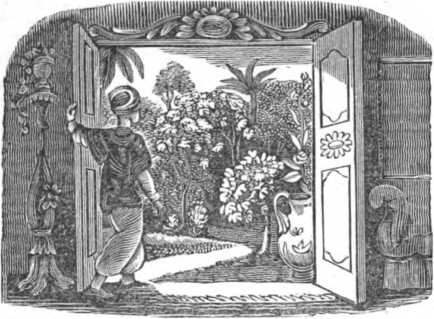
I promised myself not to forget the important advice they had given me, not to open the golden door; but as I was permitted to satisfy my curiosity in every thing else, I took the first of the keys of the other doors, which were hung in good order.
I opened the first door, and came into an orchard, which I believe the universe could not equal. I could not imagine any thing that could surpass it, but that which our religion promises us after death: the symmetry, the neatness, the admirable order of the trees, the abundance and diversity of a thousand sorts of unknown fruits, their freshness and beauty, ravished my sight.
I ought not to forget, madam, to acquaint you, that this delicious orchard, was watered after a very particular manner; there were channels so artificially and proportionably dug, that they carried water in abundance to the roots of such trees as wanted it for making them produce their leaves and flowers. Others carried it to those that had their fruit budded; some carried it in lesser quantities to those whose fruits were swelling, and others carried only so much as was just requisite to water those which had their fruit come to perfection, and only wanted to be ripened. They far exceeded the ordinary fruits of our gardens in bigness. Lastly, those channels that watered the trees, whose fruit was ripe, had no more moisture than just what would preserve them from withering.
I could never be weary of looking at and admiring so sweet a place; and I should never have left it, had I not conceived a great idea of the other things which I had not seen. I went out at last with my mind filled with those wonders; I shut that door, and opened the next.
Instead of an orchard, I found a flower-garden, which was no less extraordinary in its kind. It contained a spacious plot, not watered so profusely as the former, but with greater niceness, furnishing no more water than just what each flower required. The roses, jessamines, violets, daffodills, hyacinths, anemonies, tulips, crows-foots, pinks, lilies, and an infinite number of flowers, which do not grow in other places but at certain times, were there flourishing all at once, and nothing could be more delicious than the fragrant smell of this garden.
I opened the third door, where I found a large aviary, paved with marble of several fine uncommon colours. The cage was made of sandal wood and wood of aloes. It contained a vast number of nightingales, goldfinches, canary-birds, larks, and other rare singing-birds, which I never heard of; and the vessels that held their seed and water were of the most precious jasper or agate.
Besides, this aviary was so exceedingly neat, that considering its extent, one would think there could not be less than a hundred persons to keep it so clean; but all this while not one soul appeared, either here or in the gardens where I had been; and yet I could not perceive a weed, or any superfluous thing there. The sun went down, and I retired, charmed with the chirping notes of the multitude of birds, who then began to perch upon such places as suited them to repose on during the night. I went to my chamber, resolving to open all the rest of the doors the days following, excepting that of gold.
I failed not to open the fourth door next day, and if what I had seen before was capable of surprising me, that which I saw then put me in a perfect ecstasy. I went into a large court surrounded with buildings of an admirable structure, the description of which I will pass by, to avoid prolixity.
This building had forty doors, all open, and through each of them was an entrance into a treasury, several of which would purchase the largest kingdoms. The first contained heaps of pearls; and, what is almost incredible, the number of those stones which are most precious, and as large as pigeons’ eggs, exceeding the number of those of the ordinary size. In the second treasury there were diamonds, carbuncles, and rubies; in the third, emeralds; in the fourth, ingots of gold; in the fifth, money; in the sixth, ingots of silver; in the two following there was also money. The rest contained amethysts, chrysolites, topazes, opals, turquoises, and hyacinths, with all the other stones unknown to us, without mentioning agate, jasper, cornelian, and coral, of which there was a storehouse filled, not only with branches, but whole trees.
Transported with amazement and admiration, I cried out to myself, after having seen all these riches, If all the treasures of the kings of the universe were gathered together in one place, they could not come near this: what good fortune have I to possess all this wealth with so many admirable princesses.
I shall not stay, madam, to tell you the particulars of all the other rare and precious things I saw the following days. I shall only say that thirty-nine days afforded me but just as much time as was necessary to open ninety-nine doors, and to admire all that presented itself to my view; so that there was only the hundredth door left, the opening of which was forbidden to me.
Day began to appear in the apartments of the sultan of the Indies, which imposed silence upon Scheherazade. But Schahriar was too much taken with this pleasing story, not to hear the remainder of it next day, and accordingly he got up with that resolution.
SIXTY-SECOND NIGHT.
Dinarzade, who had as ardent a desire as Schahriar to hear what wonderful things were locked up by the key belonging to the golden door, called the sultaness very early. If you be not asleep, sister, pray make an end of that amazing story of the third calender. He went on thus, said Scheherazade; I was come to the fortieth day after the departure of those charming princesses, and had I but retained so much power over myself as I ought to have had, I should have been this day the happiest of all mankind, whereas now I am the most unfortunate. They were to return next day, and the pleasure of seeing them again ought to have restrained my curiosity: but through my weakness, which I shall ever repent, I yielded to the temptation of the evil spirit, who gave me no rest till I had involved myself in those misfortunes that I have since suffered.
I opened that fatal door, which I promised not to meddle with, and had not moved my foot to go in, when a smell that was pleasant enough, but contrary to my constitution, made me faint away. Nevertheless, I came to myself again, and instead of taking notice of this warning to shut the door, and forbear satisfying my curiosity, I went in, after I had stood some time in the air, to carry off the scent, which did not incommode me any more. I found a large place, very well vaulted; the pavement was strewed over with saffron; several candlesticks of massy gold, with lighted tapers that smelled of aloes and ambergris, lighted the place; and this light was augmented by lamps of gold and silver, that burnt with oil made of several sorts of sweet-scented materials.
Among a great many objects that engaged my attention, I perceived a black horse, of the handsomest and best shape that ever was seen. I went nearer, the better to observe him, and found he had a saddle and bridle of massy gold, curiously wrought. One side of his trough was filled with clean barley and sesame, and the other with rose-water: I took him by the bridle, and led him forth to view him by the light; I got on his back, and would have had him move; but he not stirring, I whipped him with a switch I had taken up in his magnificent stable; and he had no sooner felt the stroke, than he began to neigh with a horrible noise, and extending his wings which I had not seen before, he flew up with me into the air, quite out of sight. I thought on nothing then but to sit fast; and considering the fear that had seized upon me, I sat very well. He afterwards flew down again towards the earth, and lighting upon the terrace of a castle, without giving me any time to dismount, he shook me out of the saddle with such force, that he threw me behind him, and with the end of his tail struck out mine eye.
Thus I became blind of one eye; and then I began to remember the predictions of the ten young gentlemen. The horse flew again out of sight. I got up very much troubled at the misfortune I had brought upon myself; I walked upon the terrace, covering my eye with one of my hands, for it pained me exceedingly, and then came down, and entered into a hall, which I knew presently by the ten sofas in a circle, and the eleventh in the middle, lower than the rest, to be the same castle from whence I was taken away by the roc.
The ten half-blind gentlemen were not in the hall when I came in, but came soon after, with the old man. They were not at all surprised to see me again, nor at the loss of my eye; but said, We are sorry that we cannot congratulate you upon your return, as we could have desired; but we are not the cause of your misfortune. —I should be in the wrong to accuse you, said I; for I have drawn it upon myself, and I can charge the fault upon no other person. —If it be a consolation to the unfortunate, said they, to have companions, this example may afford us a subject of rejoicing. All that has happened to you, we have also undergone; we tasted all sorts of pleasure, during a year successively; and we had continued to enjoy the same happiness still, had we not opened the golden door, when the princesses were absent. You have been no wiser than us, and have had likewise the same punishment. We would gladly receive you among us, to perform such penance as we do, though we know not how long it may continue; but we have already declared the reasons that hinder us; therefore depart from hence, and go to the court of Bagdad, where you shall meet with him that can decide your destiny. They told me the way I was to travel, and I left them.
On the road I caused my beard and eyebrows to be shaven, and assumed a calender’s habit. I have had a long journey, but at last I arrived this evening in this city, where I met these my brother calenders at the gate, being strangers as well as myself. We wondered much at one another to see we were all three blind of the same eye; but we had not leisure to discourse long of our common calamities. We had only so much time as to come hither, to implore those favours which you have been generously pleased to grant us.
The third calender having finished this relation of his adventures, Zobeide addressed her speech to him and his fellow calenders thus: Go wherever you think fit; you are all three at liberty. But one of them answered, Madam, we beg you to pardon our curiosity, and permit us to hear those gentlemen’s stories, who have not yet spoke. Then the lady turned to that side where the caliph, the vizier Giafar, and Mesrour stood, whom she knew not; but said to them, It is now your turn to tell me your adventures, therefore speak.
The grand vizier Giafar, who had always been the spokesman, answered Zobeide thus: Madam, in order to obey you, we need only to repeat what we have said already, before we entered your house. We are merchants of Moussoul, that came to Bagdad to sell our merchandize that lies in the khan where we lodge. We dined to-day with several other persons of our profession, at a merchant’s house of this city; who, after he had treated us with choice dainties and excellent wines, sent for men and women dancers, and musicians. The great noise we made brought in the watch, who arrested some of the company, and we had the good fortune to escape; but it being already late, and the door of our khan shut up, we knew not whither to retire. It was our hap, as we passed along this street, to hear mirth at your house, which made us determine to knock at your gate. This is all the account that we can give you, in obedience to your commands.
Zobeide having heard this discourse, seemed to hesitate upon what she should say; which the calenders perceiving, prayed her to grant the same favour to the three Moussoul merchants as she had done to them. Well, then, said she, I give my consent, for you shall all be equally obliged to me: I pardon you all, provided you depart immediately out of this house, and go whither you please.
Zobeide having given this command in a tone that signified she would be obeyed, the caliph, the vizier, Mesrour, the three calenders, and the porter, departed, without saying one word; for the presence of the seven slaves with their weapons kept them in awe. When they were out of the house, and the door shut, the caliph said to the calenders, without making himself known, You gentlemen strangers, that are newly come to town, which way do you design to go, since it is not yet day? It is that which perplexes us, sir, said they. Follow us, replied the caliph, and we will bring you out of danger. After saying these words, he whispered to the vizier, Take them along with you, and to-morrow morning bring them to me; I will cause their history to be put in writing, for it deserves a place in the annals or my reign.
The vizier Giafar took the three calenders along with him, the porter went to his quarters, and the caliph and Mesrour returned to the palace. The caliph went to bed, but could not get a wink of sleep, his spirits were so perplexed by the extraordinary things he had seen and heard: but, above all, he was most concerned to know who Zobeide was, what reason she could have to be so severe to the two black bitches, and why Amine had her bosom so mortified. Day began to appear whilst he was thinking upon these things; he arose and went to his council-chamber, where he used to give audience, and sat upon his throne.
The grand vizier came in a little after, and paid his respects as usual. Vizier, said the caliph, the affairs that we have to consider at present are not very pressing; that of the three ladies and the two black bitches is much more so: my mind cannot be at ease till I am thoroughly satisfied in all those matters that have surprised me so much. —Go, bring these ladies and the calenders at the same time; make haste, and remember that I impatiently expect your return.
The vizier, who knew his master’s quick and fiery temper, made haste to obey, and went to the ladies, to whom he communicated, in a civil way, the orders he had to bring them before the caliph, without taking any notice of what had passed the night before at their house.
The ladies put on their veils, and went with the vizier. As he passed by his own house, he took the three calenders along with him; and they in the mean time, had got notice that they had both seen and spoke with the caliph without knowing him. The vizier brought them to the palace with so much diligence, that the caliph was much pleased. This prince, that he might keep decorum before all the officers of his court who were then present, gave orders that those ladies should be placed behind the hanging of the door of the room next his bedchamber, and kept by him the three calenders, who, by their respectful behaviour, gave sufficient proof, that they were not ignorant before whom they had the honour to appear.
When the ladies were placed, the caliph turned towards them, and said, Ladies, when I shall acquaint you that I came last night disguised in a merchant’s habit into your house, it will certainly alarm you, and make you fear that you have offended me; and perhaps you believe that I have sent for you for no other purpose but to show some marks of my resentment; but be not afraid; you may rest assured that I have forgotten all that has past, and am very well satisfied with your conduct. I wish that all the ladies of Bagdad had as much discretion as you have given proof of before me. I shall always remember the moderation you made use of, after the incivility that we had committed. I was then a merchant of Moussoul, but am at present Haroun Alraschid, the seventh caliph of the glorious house of Abbas, that holds the place of our great prophet. I have only sent for you to know who you are, and to ask you for what reason one of you, after severely whipping the two black bitches, did weep with them? And I am no less curious to know why another of you has her bosom so full of scars.
Though the caliph pronounced these words very distinctly, and the three ladies heard him well enough, yet the vizier Giafar did, out of ceremony, repeat them over again.
But, sir, said Scheherazade, it is day; and if your majesty thinks fit that I shall go on with the rest of this story, you will be pleased to prolong my life until to-morrow. The sultan agreed to it, knowing that Scheherazade would relate the history of Zobeide, which he had a great desire to hear.
SIXTY-THIRD NIGHT.
Dear sister, said Dinarzade, about break of day, if you be not asleep, pray tell us the story of Zobeide, for, doubtless, that lady told it to the caliph. She certainly did, said Scheherazade, after that prince by his discourse had encouraged her to it. And it was in this manner that she satisfied his curiosity:—
The story of Zobeide.
Commander of the faithful, said she, the relation which I am about to give your majesty is one of the strangest that ever was heard. The two black bitches and myself are sisters by the same father and mother; and I shall acquaint you by what strange accident they came to be metamorphosed. The two ladies who live with me, and are now here, are also my sisters by the father’s side, but by another mother; she that has the scars upon her breast is named Amine, the other’s name is Safie, and mine Zobeide.
After our father’s death, the estate that he left us was equally divided among us; and as soon as these two sisters received their portions, they went from me to live with their mother. My other two sisters and myself staid with our mother, who was then alive, and when she died, left each of us a thousand sequins. As soon as we received our portions, the two elder, (for I am the youngest,) being married, followed their husbands, and left me alone. Some time after, my eldest sister’s husband sold all that he had, and with that money and my sister’s portion, they went both into Africa, where her husband, by riotous living and debauchery, spent all; and, finding himself reduced to poverty, he found a pretext for divorcing my sister, and put her away.
She returned to this city; and, having suffered incredible hardships by the way, came to me in so lamentable a condition, that it would have moved the hardest heart to compassion. I received her with all the tenderness she could expect; and, inquiring into the cause of her sad condition, she told me with tears how inhumanly her husband had dealt by her. I was so much concerned at her misfortune that it drew tears from my eyes. I put her into a bath, and clothed her with my own apparel, and spoke to her thus: Sister, you are the elder, and I esteem you as my mother; during your absence, God has blest the portion that fell to my share, and the employment I follow to feed and bring up silk-worms. Assure yourself there is nothing I have but is at your service, and as much at your disposal as my own.
We lived very comfortably together for some months; and as we were often discoursing together about our third sister, and wondering we heard no news of her, she came in as bad a condition as the elder; her husband had treated her after the same manner, and I received her likewise with the same affection as I had done the former.
Some time after, my two sisters, on pretence that they would not be chargeable to me, told me they had thoughts to marry again. I answered them, that if their putting me to charge was all the reason, they might lay those thoughts aside, and be very welcome to stay with me; for what I had would be sufficient to maintain us all three in a manner answerable to our condition. —But, said I, I rather believe you have a mind to marry again; which if you have, I am sure it will very much surprise me; after the experience you have had of the small satisfaction there is in wedlock, is it possible you dare venture a second time? You know how rare it is to meet with a husband that is a real honest man. Believe what I say, and let us live together as comfortable as we can. All my persuasion was in vain; they were resolved to marry, and so they did. But after some months were past, they came back again, and begged my pardon a thousand times for not following my advice. You are our youngest sister, said they, and abundantly more wise than we; but if you will vouchsafe to receive us once more into your house, and account us your slaves, we shall never commit such a fault again. My answer was, Dear sisters, I have not altered my mind in respect to you since we last parted from one another; come again, and take part of what I have. Upon this I embraced them again, and we lived together as we did formerly.
We continued thus a whole year in perfect love and tranquillity; and, seeing that God had increased my small stock, I projected a voyage by sea, to hazard somewhat in trade. To this end I went with my two sisters to Balsora, where I bought a ship ready fitted for sea, and laded her with such merchandise as I brought from Bagdad. We set sail with a fair wind, and soon cleared the Persian gulf; and when we got into the ocean, we steered our course to the Indies, and the twentieth day saw land. —It was a very high mountain, at the bottom of which we saw a great town; and, having a fresh gale, we soon reached the harbour, where we cast anchor.
I had not patience to stay till my sisters were dressed to go along with me, but went ashore in the boat by myself; and making directly to the gate of the town, I saw there a great number of men upon guard, some sitting, and others standing with batons in their hands; and they had all such dreadful countenances that it frightened me; but perceiving they had no motion, not so much as with their eyes, I took courage, and went nearer, and then found they were all turned into stones. I entered the town, and passed through the several streets, wherein stood every where men in various attitudes, but all motionless and petrified. On that side where the merchants lived I found most of the shops shut, and in such as were open I likewise found the people petrified. I looked up to the chimnies, but saw no smoke, which made me conjecture that the inhabitants, both within and without, were all turned into stone.
Being come into a vast square, in the heart of the city, I perceived a great gate, covered with plates of gold, the two leaves of which stood open, and a curtain of silk stuff seemed to be drawn before it; I also saw a lamp hanging over the gate. After I had well considered the fabric, I made no doubt but it was the palace of the prince who reigned over that country; and being very much astonished that I had not met with one living creature, I went thither in hopes to find some. I entered the gate, and was still more surprised when I saw none but the guards in the porches, all petrified, some standing, some sitting, and some lying.
I crossed over a large court, where I saw a stately building just before me, the windows of which were inclosed with gates of massy gold. I supposed it to be the queen’s apartment, and went into a large hall, where there stood several black eunuchs turned into stone. I went from thence into a room richly hung and furnished, where I perceived a lady in the same situation. I knew it to be the queen by the crown of gold that hung over her head, and a necklace of pearl about her neck, each of them as big as a nut: I went up close to her to view it, and never beheld a finer sight.
I stood some time, and admired the riches and magnificence of the room; but, above all, the foot-cloth, the cushions, and the sofas, which were all lined with Indian stuff of gold, with pictures of men and beasts, in silver, admirably executed.
Scheherazade would have continued longer, but day-light put a stop to her discourse. The sultan was highly pleased with the story: I must, said he, as he was getting out of bed, know what all this wonderful petrifaction of men will come to.
SIXTY-FOURTH NIGHT.
Dinarzade was so extremely pleased with the beginning of this story of Zobeide, that she did not fail to call the sultaness before day. If you be not asleep, sister, pray let us know what Zobeide saw more in this strange palace. Scheherazade answered, The lady continued the story to the caliph in this manner:—
Sir, said she, I went out of the chamber where the petrified queen was, and passed through several other apartments and closets richly furnished, and at last came into a vast large room, where was a throne of massy gold, raised several steps above the floor, and enriched with large inchased emeralds, and a bed upon the throne of rich stuff, embroidered with pearls. What surprised me more than all the rest was a sparkling light which came from above the bed. Being curious to know from whence it came. I mounted the steps, and, lifting up my head, I saw a diamond as big as the egg of an ostrich, lying upon a low stool; it was so pure, that I could not find the least blemish in it, and it sparkled so bright, that I could not endure the lustre of it when I saw it by day.
On each side of the bed’s head there stood a lighted flambeau, but for what use I could not comprehend; however, it made me imagine that there was some living creature in this place, for I could not believe that these torches continued thus burning of themselves. Several other rarities detained my curiosity in this room, which was inestimable, were it only for the diamond I mentioned.
The doors being all open, or but half shut, I surveyed some other apartments, that were as fine as those I had already seen. I looked into the offices and store-rooms, which were full of infinite riches, and I was so much taken with the sight of all the wonderful things, that I forgot myself, and did not think on my ship or my sisters; my whole design was to satisfy my curiosity: mean time night came on, which put me in mind that it was time to retire. I was for returning the same way I came in, but I could not find it; I lost myself among the apartments; and finding I was come back again to that large room where the throne, the couch, the large diamond, and the torches stood, I resolved to take my night’s lodging there, and to depart the next morning betimes, to get aboard my ship. I laid myself down upon the couch, not without some dread to be alone in a desolate place; and this fear hindered my sleep.
About midnight I heard a voice like that of a man reading the Koran, after the same manner, and in the same tone which we read in our mosque. Being extremely glad to hear it, I got up immediately, and taking a torch in my hand to light me, I passed from one chamber to another, on that side where the voice came from: I came to the closet door, where I stood still, nowise doubting that it came from thence. I set down my torch upon the ground, and looking through a window, I found it to be an oratory. In short, it had, as we have in our mosques, a niche that shows where we must turn to say our prayers; there were also lamps hung up, and the two candlesticks with large tapers of white wax burning.
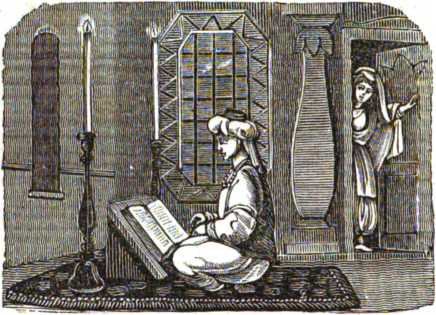
I saw a little carpet laid down, like those we have to kneel upon when we say our prayers, and a comely young man sat upon this carpet, reading with great devotion the Koran, which lay before him upon a desk. At the sight of this I was transported with admiration. I wondered how it came to pass that he should be the only living creature in a town where all the people were turned into stones, and I did not doubt but there was something in it very extraordinary.
The door being only half shut, I opened it and went in, and standing upright before the niche, I said this prayer aloud; “Praise be to God, who has favoured us with a happy voyage, and may he be graciously pleased to protect us in the same manner, until we arrive again in our own country. Hear me, O Lord, and grant my request.”
The young man cast his eyes upon me, and said, My good lady, pray let me know who you are, and what has brought you to this desolate city? And in return I will tell you who I am, what happened to me, why the inhabitants of this city are reduced to that state you see them in, and why I alone am safe and sound in the midst of such a terrible disaster.
I told him in few words from whence I came, what made me undertake the voyage, and how I safely arrived at the port after twenty days’ sailing; and when I had done, I prayed him to perform his promise, and told him how much I was struck by the frightful desolation which I had seen in all places as I came along.
My dear lady, said the young man, have patience for a moment. At these words he shut the Koran, put it into a rich case, and laid it in the niche. I took that opportunity to observe him, and perceived so much good nature and beauty in him, that I felt such strange emotions in myself as I had never done before. He made me sit down by him; and before he began his discourse, I could not forbear saying to him, with an air that discovered the sentiments I was inspired with, Amiable sir, dear object of my soul, I can scarce have patience to wait for an account of all those wonderful things that I have seen since the first time I came into your city; and my curiosity cannot be satisfied too soon; therefore, pray sir, let me know by what miracle you alone are left alive among so many persons that have died in so strange a manner.
Scheherazade broke off here, and said to Schahriar, Sir, perhaps your majesty does not perceive it is day; should I continue my discourse any longer, I should trespass on your patience. The sultan got up, resolving next night to hear the remainder of this wonderful story.
SIXTY-FIFTH NIGHT.
If you be not asleep, sister, said Dinarzade, next morning, before it was day, I would pray you to resume the story of Zobeide, and acquaint us with what passed between her and the young man that she found alive in the palace you gave us so fine a description of. —I will immediately satisfy you, said the sultaness. Zobeide went on with her story thus:
Madam, said the young man, you have given me to understand you have a knowledge of the true God, by the prayer you just now addressed to him. I will acquaint you with the most remarkable effect of his greatness and power. You must know, that this city was the metropolis of a mighty kingdom, over which the king my father did reign. That prince, his whole court, the inhabitants of the city, and all his other subjects, were magi, worshippers of fire, and of Nardoun, the ancient king of the giants, who rebelled against God.
And though I was begotten and born of an idolatrous father and mother, I had the good fortune in my youth to have a governess who was a good mussulman; I had the Koran by heart, and understood the explanation of it perfectly well. Dear prince, would she oftentimes say, there is but one true God; take heed that you do not acknowledge and adore any other. She taught me to read Arabic, and the book she gave me to preach upon was the Koran. As soon as I was capable of understanding it, she explained to me all the heads of this excellent book, and infused piety into my mind, unknown to my father, or any body else. She happened to die, but not before she had perfectly instructed me in all that was necessary to convince me of the mussulman religion. After her death, I persisted with constancy in the belief I was in; and I abhor the false god Nardoun, and the adoration of fire.
It is about three years and some months ago, that a thundering voice was heard all of a sudden so distinctly through the whole city, that nobody could miss hearing it. The words were these: ‘Inhabitants, abandon the worship of Nardoun, and of fire, and worship the only God that shows mercy.’
This voice was heard three years successively, but nobody was converted; so the last day of the year, at four o’clock in the morning, all the inhabitants in general were changed in an instant into stone, every one in the same condition and posture they happened to be then in. The king, my father, had the same fate, for he was metamorphosed into a black stone, as he is to be seen in this palace; and the queen, my mother, had the like destiny.
I am the only person that did not suffer under that heavy judgment, and ever since I have continued to serve God with more fervency than before. I am persuaded, dear lady, that he has sent you hither for my comfort, for which I render him infinite thanks; for I must own that this solitary life is very uneasy.
All these expressions, and particularly the last, increased my love to him extremely. Prince, said I, there is no doubt but Providence hath brought me into your port, to present you with an opportunity of withdrawing from this dismal place. The ship that I came in may in some measure persuade you that I am in some esteem at Bagdad, where I have left also a considerable estate; and I dare engage to promise you sanctuary there, until the mighty commander of the faithful, who is vice-regent to our prophet, whom you acknowledge, show you the honour that is due to your merit. This renowned prince lives at Bagdad, and as soon as he is informed of your arrival in his capital, you will find that it is not in vain to implore his assistance. It is impossible you can stay any longer in a city where all the objects you see must renew your grief: my vessel is at your service, where you may absolutely command as you shall think fit. He accepted the offer, and we discoursed the remaining part of the night about our embarkment.
As soon as it was day we left the palace, and came aboard my ship, where we found my sisters, the captain, and the slaves, all very much troubled for my absence. After I had presented my sisters to the prince, I told them what had hindered my return to the vessel the day before, how I had met with the young prince, his story, and the cause of the desolation of so fine a city.
The seamen were taken up several days in unlading the merchandise I brought along with me, and embarking, instead of that, all the precious things in the palace, as jewels, gold, and money. We left the furniture and goods, which consisted of an infinite quantity of plate, &c. because our vessel could not carry it, for it would have required several vessels more to carry all the riches to Bagdad that we might have chosen to take with us.
After we had laded the vessel with what we thought fit, we took such provisions and water aboard as were necessary for our voyage (for we had still a great deal of those provisions left that we had taken in at Balsora:) at last we set sail with a wind as favourable as we could wish.
Here Scheherazade saw day, and stopped her discourse; the sultan arose without speaking a word; but he proposed to himself to hear the end of Zobeide’s story, and the wonderful deliverance of this young prince.
SIXTY-SIXTH NIGHT.
When the ensuing night was almost past, Dinarzade, impatient to know the success of Zobeide’s voyage, called the sultaness: My dear sister, day begins to break; for God’s sake continue the story of yesternight, and tell us whether the prince and Zobeide arrived safe at Bagdad. I will, said Scheherazade.
Zobeide, addressing herself to the caliph, went on thus:
Sir, said she, the young prince, my sisters, and myself, enjoyed ourselves for some time very agreeably: but alas! this good understanding did not last long, for my sisters grew jealous of the friendship between the prince and me, and maliciously asked me one day, what we should do with him when we came to Bagdad? I perceived immediately that they put this question to me on purpose to discover my inclinations; therefore resolving to put it off with a jest, I answered them, I will take him for my husband; and upon that, turning myself to the prince, Sir, I humbly beg of you to give your consent; for as soon as we come to Bagdad, I design to offer you my person to be your slave, to do you all the service that is in my power, and to resign myself wholly to your commands.

The prince answered, I know not, madam, whether you be in jest or no; but for my own part, I seriously declare, before these ladies, your sisters, that from this moment I heartily accept your offer, not with any intention to have you as a slave, but as my lady and mistress; nor will I pretend to have any power over your actions. At these words my sisters changed colour, and I could perceive afterwards that they did not love me as formerly.
We were come into the Persian gulf, and not far from Balsora, where I hoped, considering the fair wind, we might have arrived the day following; but in the night, when I was asleep, my sisters watched their time, and threw me overboard. They did the same to the prince, who was drowned. I swam some minutes on the water; but by good fortune, or rather miracle, I felt ground. I went towards a black place, that, by what I could discern in the dark, seemed to be land, and actually was a flat on the coast; which, when day came, I found to be a desert island, lying about twenty miles from Balsora. I soon dried my clothes in the sun; and as I walked along, I found several sorts of fruit, and likewise fresh water, which gave me some hopes of preserving my life.
I laid myself down in a shade, and soon after I saw a winged serpent, very large and long, coming towards me, wriggling to the right and to the left, and hanging out his tongue, which made me think he had got some hurt. I arose, and saw a larger serpent following him, holding him by the tail, and endeavouring to devour him. I had compassion on him, and instead of flying away, I had the boldness and courage to take up a stone that by chance lay by me, and threw it with all my strength at the great serpent, whom I hit on the head and killed him. The other, finding himself at liberty, took to his wings and flew away. I looked a long while after him in the air, as an extraordinary thing; but he flew out of sight, and I lay down again in another place in the shade, and fell asleep.
When I awaked, judge how I was surprised to see by me a black woman, of a lively and agreeable complexion, who held tied together in her hand, two bitches of the same colour. I sat up and asked her who she was. I am, said she, the serpent whom you delivered not long since from my mortal enemy. I knew not how to acknowledge the great kindness you did me, but by doing what I have done. I knew the treachery of your sisters, and to avenge you on them, as soon as I was set at liberty by your generous assistance, I called several of my companions together, fairies like myself. We have carried into your storehouses at Bagdad all your lading that was in your vessel, and afterwards sunk it.
These two black bitches are your sisters, whom I have transformed into this shape, but this punishment is not sufficient; for I will have you treat them in such a manner as I shall direct.
At those words the fairy took me fast under one of her arms, and the two bitches in the other, and carried me to my house in Bagdad, where I found in my storehouses all the riches which were laden on board my vessel. Before she left me, she delivered me the two bitches, and told me, If you will not be changed into a bitch as they are, I ordain you, in the name of him that governs the sea, to give each of your sisters every night a hundred lashes with a rod, for the punishment of the crime they have committed against your person, and the young prince whom they drowned. I was forced to promise that I would obey her order. Since that time I have whipped them every night, though with regret, whereof your majesty has been a witness, I give evidence by my tears with how much sorrow and reluctance I must perform this cruel duty; and in this your majesty may see I am more to be pitied than blamed. If there be any thing else, with relation to myself, that you desire to be informed of, my sister Amine will give you the full discovery of it, by the relation of her story.
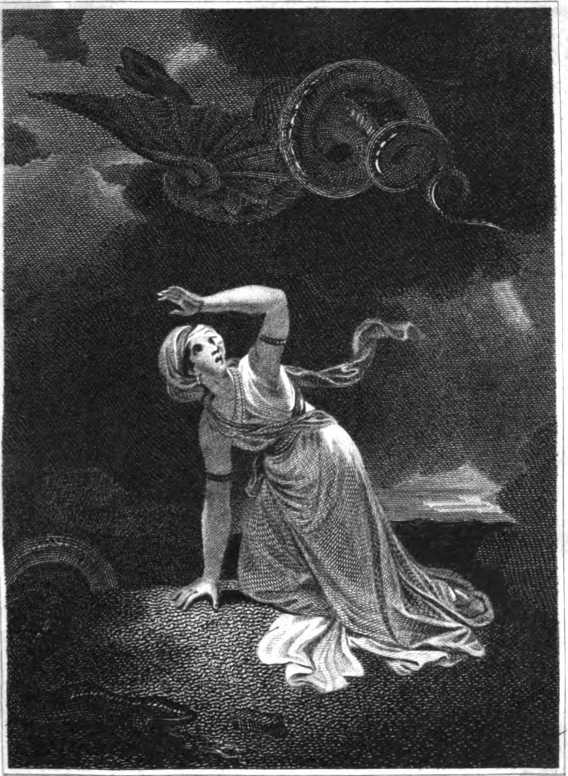
ZOBEIDE AFTER RESCUING THE FAIRY.
After the caliph had heard Zobeide with a great deal of astonishment, he desired his grand vizier to pray fair Amine to acquaint him wherefore her breast was marked with so many scars.
But, sir, said Scheherazade, it is day, and I dare not detain your majesty any longer. Schahriar being persuaded that the story which Scheherazade was to relate would explain the former, said to himself, I must have the pleasure of hearing this story out: upon which he arose, and resolved that Scheherazade should live one day longer.
SIXTY-SEVENTH NIGHT.
Dinarzade longed to hear the story of Amine, and therefore waked the sultaness a long while before day, saying, Dear sister, pray let us know why fair Amine had her breast so covered with scars. —I consent to it, said the sultaness; and that no time may be lost, you may know that Amine addressed herself to the caliph, and began her story after this manner:
The story of Amine.
Commander of the faithful, said she, to avoid repeating what your majesty has already heard by my sister’s story, I shall only add, that after my mother had taken a house for herself to live in during her widowhood, she gave me in marriage, with the portion my father left me, to a gentleman that had one of the best estates in the city.
I had scarce been a year married, when I became a widow, and was left in possession of all my husband’s estate, which amounted to ninety thousand sequins. The interest of this money was sufficient to maintain me very honourably. In the mean time, when my first six months’ mourning was over, I caused to be made me ten suits of clothes, very rich, so that each suit came to a thousand sequins; and when the year was past, I began to wear them.
One day as I was busy alone about my domestic affairs, I was told that a lady desired to speak to me. I ordered her to be brought in. She was a person advanced in years: she saluted me by kissing the ground, and told me, kneeling, dear lady, excuse the freedom I take to trouble you; the confidence I have in your charity makes me thus bold. I must acquaint your ladyship, that I have an orphan daughter, who is to be married this day: she and I are both strangers, and have no acquaintance in this town; which much perplexes me, for we wish the numerous family with whom we are going to ally ourselves to think we are not altogether strangers, and without credit; therefore, most beautiful lady, if you would vouchsafe to honour the wedding with your presence, we shall be infinitely obliged to you, because the ladies of your country will then know that we are not looked upon here as despicable wretches, when they shall come to understand that a lady of your quality did us that honour. But alas, madam, if you refuse this request, we shall be altogether disgraced, and dare not address ourselves to any other.
This poor woman’s discourse, mixed with tears, moved my compassion. Good woman, said I, do not afflict yourself; I am willing to grant you the favour you desire; tell me what place I must come to, and I will meet you as soon as I am dressed. The old woman was so transported with joy at my answer, that she kissed my feet without my being able to hinder it. Good charitable lady, said she, rising up, God will reward the kindness you have showed to your servants, and make your heart as joyful as you have made theirs. It is too soon yet to give yourself that trouble: it will be time enough when I come to call you in the evening. So farewell, madam, said she, till I have the honour to see you again.
As soon as she was gone, I took the suit I liked best, with a necklace of large pearl, bracelets, pendents in my ears, and rings set with the finest and most sparkling diamonds; for my mind presaged what would befal me.
When night drew on, the old woman came to call me, with a countenance full of joy; she kissed my hands, and said, My dear lady, the relations of my son-in-law, who are the principal ladies of the town, are now met together; you may come when you please, I am ready to wait on you. We went immediately, she going before, and I followed her, with a good number of my maids and slaves, very well dressed. We stopt in a wide street, newly swept and watered, at a spacious gate with a lantern before it, by the light of which I could read this inscription over the gate in golden letters: “Here is the abode of everlasting pleasures and content.” The old woman knocked, and the gate was opened immediately.
They brought me to the lower end of the court, into a large hall, where I was received by a young lady of admirable beauty. She came up to me, and after having embraced me, she made me sit down by her upon a sofa, where there was a throne of precious wood, set with diamonds. Madam, said she, you are brought hither to assist at a wedding; but I hope this marriage will prove otherwise than what you expected. I have a brother, one of the handsomest men in the world: he is fallen so much in love with the fame of your beauty, that his fate depends wholly upon you, and he will be the unhappiest of men if you do not take pity on him. He knows your quality, and I can assure you he is in nowise unworthy of your alliance. If my prayers, madam, can prevail, I shall join them with his, and humbly beg you will not refuse the offer of being his wife.
After the death of my husband, I had no thought of marrying again: but I had no power to refuse the offer made by so charming a lady. As soon as I had given consent by silence, accompanied with a blush, the young lady clapt her hands; and immediately a closet door opened, out of which came a young man of a majestic air, and so graceful a behaviour, that I thought myself happy to have made so great a conquest. He sat down by me, and by the discourse we had together, I found that his merits far exceeded the account his sister had given me of him. When she saw that we were satisfied with one another, she clapt her hands a second time, and out came a cadi, or scrivener, who wrote our contract of marriage, signed it himself, and caused it to be attested by four witnesses he brought along with him. The only thing that my new spouse made me promise, was, that I should not be seen by nor speak with any other man but himself; and he vowed to me, upon that condition, that I should have no reason to complain of him. Our marriage was concluded and finished after this manner; so I became the principal actress in a wedding whereunto I was only invited as a guest.
After we had been married a month, I had occasion for some stuffs. I asked my husband’s leave to go out and buy them, which he granted; and I took that old woman along with me, of whom I spoke before, she being one of the family, and two of my own female slaves.
When we came to the street where the merchants dwell, the old woman told me, Dear mistress, since you want silk stuffs, I must carry you to a young merchant of my acquaintance: he has of all sorts, and it will prevent your wearying yourself by going from one shop to another. I can assure you that he is able to furnish you with that which nobody else can. I was easily persuaded, and we entered into a shop belonging to a young merchant who was tolerably handsome. I sat down, and bade the old woman desire him to show me the finest silk stuffs he had. The woman bade me speak myself; but I told her it was one of the articles of my marriage contract, not to speak to any man but my husband, which I ought to keep.
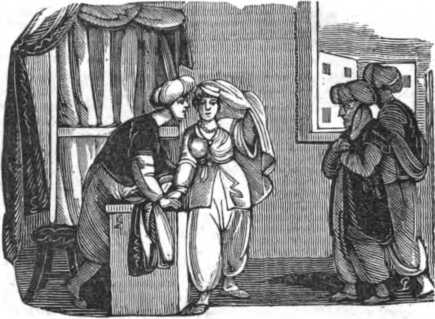
The merchant shewed me several stuffs, of which one pleased me better than the rest; but I bade her ask the price. He answered the old woman, I will not sell it for gold or money, but I will make her a present of it, if she will give me leave to kiss her cheek. I ordered the old woman to tell him that he was very rude to propose such a thing; but instead of obeying me, she said, What the merchant desires of you is no such great matter; you need not speak, but only present him your cheek, and the business will soon be done. The stuff pleased me so much that I was foolish enough to take her advice. The old woman and my slaves stood up, that nobody should see, and I put up my veil; but instead of a kiss, the merchant bit me till the blood came.
The pain and surprise were so great, that I fell down in a swoon, and continued in it so long, that the merchant had time to shut his shop, and fly for it. When I came to myself, I found my cheek all bloody; the old woman and my slaves took care to cover it with my veil, that the people who came about us could not perceive it, but supposed it to be only a fainting fit.
Scheherazade, as she spoke these words, perceived day, and held her peace. The sultan finding the story both extraordinary and pleasant, rose up, with a design to hear the rest of it.
SIXTY-EIGHTH NIGHT.
When next night was near at an end, Dinarzade awaked and called to the sultaness, If you please, sister, pray continue the story of Amine. Scheherazade answered, the lady resumed it thus:
The old woman who was with me, being extremely troubled at this accident, endeavoured to comfort me; My dear mistress, said she, I beg your pardon, for I am the cause of this misfortune, having brought you to this merchant, because he is my countryman; but I never thought he would be guilty of such a villanous action. But do not grieve: let us make haste to go home; I will give you a medicine that shall perfectly cure you in three day’s time, so that the least mark shall not be seen. The fit had made me so weak that I was scarce able to walk: but at last I got home, where I had a second fit, as I went into the chamber. Meanwhile, the old woman applied her remedy, so that I came to myself, and went to bed.
My husband came to me at night, and seeing my head bound up, asked me the reason. I told him I had the head-ache, and hoped he would inquire no further; but he took a candle, and saw my cheek was hurt. How comes this wound? said he. And though I was not very guilty, yet I could not think of owning the thing; besides, to make such a confession to a husband, I thought was somewhat indecent; therefore I told him, That as I was going to seek for that stuff you gave me leave to buy, a porter carrying a load of wood came so close by me, as I went through a narrow street, that one of the sticks gave me a rub on the cheek; but it is not much hurt. This put my husband in such a passion, that he vowed he should not go unpunished; for I will to-morrow give orders to the lieutenant of the police to seize upon all those brutes of porters, and cause them to be hanged. Being afraid to occasion the death of so many innocent persons, I told him, Sir, I should be sorry that so great a piece of injustice should be committed. Pray do not do it; for I should deem myself unpardonable if I were the cause of so much mischief. Then tell me sincerely, said he, how came you by this wound? I answered, That it came through the inadvertency of a broom-seller upon an ass, who coming behind me, and looking another way, his ass gave me such a push that I fell down, and hurt my cheek upon some glass. —Is it so? said my husband; then to-morrow morning, before sun-rising, the grand vizier Giafar shall have an account of this insolence, and he shall cause all the broom-sellers to be put to death. —For the love of God, sir, said I, let me beg of you to pardon them, for they are not guilty. —How, madam, said he, what is it I must believe? Speak, for I am absolutely resolved to know the truth from your own mouth. —Sir, said I, I was taken with a giddiness in my head, and fell down, and that is the whole matter.
At these last words, my husband lost all patience. Oh! cried he, I have given ear to your lies too long; with that, clapping his hands, in came three slaves: Pull her out of bed, said he, and lay her in the middle of the floor. The slaves obeyed his orders, one holding me by the head, and another by the feet: he commanded a third to fetch him a scimitar; and when he had brought it, Strike, said he; cut her in two in the middle, and then throw her into the Tigris to feed the fishes. This is the punishment I give to those to whom I have given my heart, if they falsify their promise. When he saw that the slave made no haste to obey his orders, Why do you not strike? said he. Who is it that holds you? What are you waiting for?
Madam, then said the slave, you are near the last moments of your life; consider if you have any thing to dispose of before you die. I begged leave to speak one word, which was granted me. I lifted up my head, and looking wistfully to my husband, Alas! said I, to what condition am I reduced! must I then die in the prime of my youth? I could say no more, for my tears and sighs prevented me. My husband was not at all moved, but, on the contrary, went on to reproach me; so that to have made answer would have been in vain. I had recourse to entreaties and prayers; but he had no regard to them, and commanded the slaves to proceed to execution. The old woman who had been his nurse came in just at that moment, fell down upon her knees, and endeavoured to appease his wrath. My son, said she, since I have been your nurse, and brought you up, let me beg the favour of you to grant me her life; consider that he who kills shall be killed, and that you will stain your reputation, and lose the esteem of mankind. What will the world say of such a bloody rage? She spoke these words in such an affecting manner, accompanied with tears, that she prevailed upon him at last.
Well then, said he to his nurse, for your sake I will spare her life; but she shall carry some marks along with her to make her remember the crime. With that, one of the slaves, by his order, gave me so many blows as hard as he could strike, with a little cane, upon my sides and breast, that he fetched both skin and flesh away, so that I lay senseless. After that he caused the same slaves, the executioners of his fury, to carry me into a house, where the old woman took care of me. I kept my bed four months; at last I recovered; the scars you saw yesterday, against my will, have remained ever since.
As soon as I was able to walk, and go abroad, I resolved to go to the house which was my own by my first husband, but I could not find the place. My second husband, in the heat of his wrath, was not content to have razed it to the ground, but caused all the street where it stood to be pulled down. I believe such a violent proceeding was never heard of before; but against whom should I make my complaint? The author had taken such care that he was not to be found, neither could I know him again if I saw him; and suppose I had known him, is it not easily seen that the treatment I met with proceeded from absolute power? How then dared I make any complaint?
Being desolate, and unprovided of every thing, I had recourse to my dear sister Zobeide, who gave your majesty just now an account of her adventures; to her I made known my misfortune; she received me with her accustomed goodness, and advised me to bear it with patience. This is the way of the world, said she, which either robs us of our means, our friends, or our lovers, and oftentimes of all at once. And at the same time, to confirm what she had said, she gave me an account of the loss of the young prince, occasioned by the jealousy of her two sisters; she told me also by what accident they were transformed into bitches; and in the last place, after a thousand testimonials of her love towards me, she showed me my youngest sister, who had likewise taken sanctuary with her after the death of her mother.
Thus we gave God thanks, who had brought us together again, resolving to live a single life, and never to separate any more, for we have enjoyed this peaceable way of living a great many years; and as it was my business to mind the affairs of the house, I always took pleasure to go myself, and buy in what we wanted. I happened to go abroad yesterday, and the things I bought I caused to be brought home by a porter, who proved to be a sensible and jocose fellow, and we kept him with us for a little diversion. Three calenders happened to come to our door as it began to grow dark, and prayed us to give them shelter till the next morning. We gave them entrance, but upon certain conditions, which they agreed unto; and after we had made them sit down at the table by us, they gave us a concert of music after their fashion, and at the same time we heard knocking at our gate. These were the three merchants of Moussoul, men of a very good mien, who begged the same favour which the calenders had obtained before. We consented to it upon the same conditions, but neither of them kept their promise; and though we had power as well as justice on our side to punish them, yet we contented ourselves with demanding from them the history of their lives, and consequently confined our revenge to dismissing them after they had done, and depriving them of the lodging they requested.
The caliph Haroun Alraschid was very well satisfied with these strange stories, and declared publicly his astonishment at what he had heard.
But, sir, said Scheherazade, day begins to break; so that I have not time to acquaint your majesty what the caliph did to put an end to the enchantment of the two black bitches. Schahriar supposing that the sultaness would finish the story of the five ladies and the three calenders the next night, rose up, and suffered her to live till next morning.
SIXTY-NINTH NIGHT.
For the love of heaven, sister, said Dinarzade, before it was day, if you be not asleep, tell us how the two black bitches were brought to their former shape, and what became of the three calenders. —I will satisfy your curiosity, said Scheherazade. Then addressing her discourse to Schahriar, she pursued it thus:
Sir, the caliph having satisfied his curiosity, thought himself obliged to give some marks of grandeur and generosity to the calender princes, and also to give the three ladies some proofs of his bounty. He himself, without making use of his minister, the grand vizier, spoke to Zobeide: Madam, this fairy, that shewed herself to you in the shape of a serpent, and imposed such a rigorous command upon you, did she not tell you where her place of abode was? Or rather, did she not promise to see you, and restore those bitches to their natural shape?
Commander of the faithful, answered Zobeide, I forgot to tell your majesty, that the fairy left with me a bundle of hair, saying withal, that her presence would one day be of use to me; and then, if I only burnt two tufts of this hair, she would be with me in a moment, though she were beyond mount Caucasus. —Madam, said the caliph, where is the bundle of hair? She answered, ever since that time, I have had such a particular care of it, that I always carry it about me. Upon which she pulled it out, just opened the case where it was, and showed it to him. Well then, said the caliph, let us make the fairy come hither; you could not call her in a better time, for I long to see her.
Zobeide having consented to it, fire was brought in, and she threw the whole bundle of hair into it. The palace began to shake at that very instant, and the fairy appeared before the caliph, in the shape of a lady very richly dressed.
Commander of the faithful, said she to the prince, you see I am ready to come and receive your commands. The lady who gave me this call by your order did me a particular piece of service; to make my gratitude appear, I revenged her of her sisters inhumanity by changing them into bitches; but if your majesty commands it, I will restore them to their former shape.
Handsome fairy, said the caliph, you cannot do me a greater pleasure; vouchsafe them that favour, and after that I will find some means to comfort them for their hard penance. But besides, I have another boon to ask in favour of that lady, who has had such cruel usage from an unknown husband; and as you undoubtedly know a great many things, we have reason to believe that you cannot be ignorant of this. Oblige me with the name of this barbarous fellow, who could not be contented to exercise his barbarous cruelty upon her person, but has also most unjustly taken from her all her substance. I only wonder how such an unjust and inhuman action could be performed in spite of my authority, and not come to my ears.
To oblige your majesty, answered the fairy, I will restore the two bitches to their former state, and I will so cure the lady of her scars, that it shall never appear she was so beaten; and at last I will tell you who it was that did it.
The caliph sent for the two bitches from Zobeide’s house; and when they came a glass of water was brought to the fairy by her desire; she pronounced over it some words, which nobody understood; then throwing some part of it upon Amine, and the rest upon the bitches, the latter became two ladies of surprising beauty, and the scars that were upon Amine vanished away. After which, the fairy said to the caliph, Commander of the faithful, I must now discover to you the unknown husband you inquire after; he is very near related to yourself, for it is prince Amin, your eldest son, who falling passionately in love with this lady, by the fame he had heard of her beauty, by an intrigue got her brought to his house, where he married her. As to the strokes he caused to be given her, he is in some measure excusable; for the lady, his spouse, had been a little too easy, and the excuses she had made were capable of making him believe she was more faulty than she really was. This is all I can say to satisfy your curiosity; and at these words she saluted the caliph, and vanished.
The prince being filled with admiration, and having much satisfaction in the changes that had happened through his means, did such things as will perpetuate his memory to all ages. First, he sent for his son Amin, and told him that he was informed of his secret marriage, and how he had wounded Amine upon a very slight cause. Upon this the prince did not wait for his father’s commands, but received her again immediately.
After which the caliph declared that he would give his own heart and hand to Zobeide, and offered the other three sisters to the calenders, who were sons of kings, who accepted them for their brides with much joy. The caliph assigned each of them a magnificent palace in the city of Bagdad, promoted them to the highest dignities of his empire, and admitted them to his counsels.
The town-clerk of Bagdad being called, with witnesses, wrote the contracts of marriage; and the famous caliph Haroun Alraschid, by making the fortune of so many persons that had suffered such incredible calamities, drew a thousand blessings upon himself.
The Story of Sindbad, the Sailor.
Dinarzade having awakened her sister the sultaness, as usual, and prayed her to tell another story, Scheherazade asked leave of the sultan, and having obtained it, began thus:
Sir, in the reign of the same caliph Haroun Alraschid, whom I formerly mentioned, there lived at Bagdad a poor porter called Hindbad. [4] One day, when the weather was excessively hot, he was employed to carry a heavy burden from one end of the town to the other. Being very weary, and having still a great way to go, he came into a street where a delicate western breeze blew on his face, and the pavement of the street being sprinkled with rose-water, he could not desire a better place to rest in; therefore, laying off his burden, he sat down by it, near a great house.
He was mightily pleased that he stopt in this place, for an agreeable smell of wood of aloes, and of pastils, that came from the house, mixing with the scent of rose-water, did completely perfume and embalm the air; besides, he heard from within a concert of several sorts of instrumental music, accompanied with the harmonious notes of nightingales, and other birds, peculiar to that climate. This charming melody, and the smell of several sorts of victuals, made the porter think there was a feast, and great rejoicings within.
His occasions leading him seldom that way, he knew not who dwelt in the house; but to satisfy his curiosity, he went to some of the servants, whom he saw standing at the gate in magnificent apparel, and asked the name of the master of the house. How, replied one of them, do you live in Bagdad, and know not that this is the house of Signor Sindbad, the sailor, that famous traveller, who has sailed round the world?
The porter, who had heard of this Sindbad’s riches, could not but envy a man whose condition he thought to be as happy as his own was deplorable; and his mind being fretted with those reflections, he lifted up his eyes to heaven, and said, loud enough to be heard, Almighty Creator of all things, consider the difference between Sindbad and me: I am every day exposed to fatigues and calamities, and can scarce get coarse barley-bread for myself and my family, whilst happy Sindbad profusely expends immense riches, and leads a life of continual pleasure. What has he done to obtain from thee a lot so agreeable? And what have I done to deserve one so miserable? Having finished his expostulation, he struck his foot against the ground, like a man swallowed up of grief and despair.
Whilst the porter was thus indulging his melancholy, a servant came out of the house, and taking him by the arm, bid him follow him, for Signor Sindbad, his master, wanted to speak with him. —Here day beginning to appear, Scheherazade broke off her story, but resumed it again next morning as follows:
SEVENTIETH NIGHT.
Sir, your majesty may easily imagine that poor Hindbad was not a little surprised at this compliment; for, considering what he had said, he was afraid Sindbad had sent for him to punish him; therefore he would have excused himself, alleging that he could not leave his burden in the middle of the street. But Sindbad’s servants assured him they would look to it, and pressed the porter so, that he was obliged to yield.
The servants brought him into a great hall, where abundance of people sat round a table covered with all sorts of fine dishes. At the upper end, there sat a grave, comely, venerable gentleman, with a long white beard, and behind him stood a number of officers and domestics, all ready to serve him; this grave gentleman was Sindbad. The porter, whose fear was increased at the sight of so many people, and of a banquet so sumptuous, saluted the company trembling. Sindbad bid him draw near, and sitting him down at his right hand, served him himself, and gave him excellent wine, of which there was a good store upon the side board.
When dinner was over, Sindbad began his discourse to Hindbad: and calling him brother, according to the manner of the Arabians when they are familiar one with another, he asked him his name and employment, —Signor, answered he, my name is Hindbad. —I am very glad to see you, replied Sindbad, and I dare say the same for all the company; but I would be glad to hear from your own mouth what it was you said awhile ago in the street. For Sindbad had heard it himself through the window, before he sat down at table, and that occasioned his calling for him.
Hindbad, being surprised at the question, hung down his head, and replied, Signor, I confess that my weariness put me out of humour, and occasioned me to speak some indiscreet words, which I beg you to pardon. —Oh! do not think I am so unjust, replied Sindbad, to resent such a thing as that; I consider your condition, and instead of upbraiding you with your complaints, I commiserate you: but I must rectify your mistake concerning myself. You think, no doubt, that I have acquired without labour and trouble the ease and conveniency which I now enjoy: but do not mistake; I did not attain to this happy condition without enduring more trouble of body and mind, for several years, than can well be imagined. Yes, gentlemen, added he, speaking to the whole company, I can assure you my troubles were so extraordinary, that they were capable of discouraging the most covetous man from undertaking such voyages as I did, to acquire riches. Perhaps you have never heard a distinct account of my wonderful adventures, and the dangers I met with in my seven voyages; and since I have this opportunity, I am willing to give you a faithful account of them, not doubting but it will be acceptable.
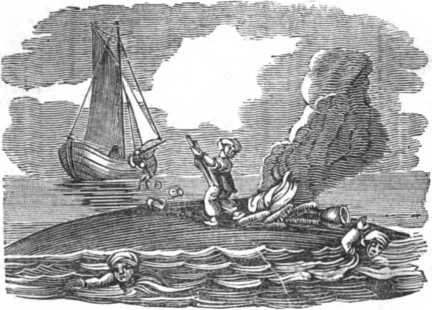
And because Sindbad was to tell this story, particularly upon the porter’s account, he ordered his burden to be carried to the place appointed, and began thus:
The story of Sindbad, the Sailor.
His first Voyage.
My father left me a considerable estate, the best part of which I spent in debauchery during my youth; but I perceived my error, and reflected that riches were perishable, and quickly consumed by such ill managers as myself. I farther considered, that by my irregular way of living I wretchedly mispent my time, which is the most valuable thing in the world. I remembered the saying of the great Solomon, which I had frequently heard from my father: That death is more tolerable than poverty. Struck with those reflections, I collected the remains of my furniture, and sold all my patrimony by public auction to the highest bidder. Then I entered into a contract with some merchants, who traded by sea: I took the advice of such as I thought most capable to give it me; and resolving to improve what money I had, I went to Balsora, [5] and embarked with several merchants on board a ship which we jointly fitted up.
We set sail, and steered our course towards the East Indies, through the Persian gulf, which is formed by the coasts of Arabia Felix on the right, and by those of Persia on the left, and, according to common opinion, is seventy leagues at the broadest place. The eastern sea, as well as that of the Indies, is very spacious; it is bounded on one side by the coasts of Abyssinia, and is 4500 leagues in length to the isles of Vakvaq. [6] At first I was troubled with the sea-sickness, but speedily recovered my health, and was not afterwards troubled with that disease.
In our voyage we touched at several islands, where we sold or exchanged our goods. One day, whilst under sail, we were becalmed near a little island, even almost with the surface of the water, which resembled a green meadow. The captain ordered his sails to be furled, and permitted such persons as had a mind to land upon the island, amongst whom I was one. But while we were diverting ourselves with eating and drinking, and recovering ourselves from the fatigue of the sea, the island on a sudden trembled, and shook us terribly.
Here Scheherazade stopped, because day appeared, but resumed her discourse next morning as follows.
SEVENTY-FIRST NIGHT.
Sir, Sindbad pursued his story thus: They perceived the trembling of the island on board the ship, and called us to re-embark speedily, or we should all be lost; for what we took for an island was only the back of a whale. The nimblest got into the sloop; others betook themselves to swimming; but, for my part, I was still upon the back of the whale when he dived into the sea, and had time only to catch hold of a piece of wood that we had brought out of the ship to make a fire. Meanwhile, the captain, having received those on board who were in the sloop, and taken up some of those that swam, resolved to improve the favourable gale that was just risen, and hoisting his sails, pursued his voyage, so that it was impossible to recover the ship.
Thus was I exposed to the mercy of the waves, and struggled for my life all the rest of the day and the following night. Next morning I found my strength gone, and despaired of saving my life, when happily a wave threw me against an island. [7] The bank was high and rugged, so that I could scarcely have got up, had it not been for some roots of trees, which fortune seemed to have preserved in this place for my safety. Being got up, I lay down upon the ground half dead, until the sun appeared: then, though I was very feeble, both by reason of my hard labour and want of food, I crept along to seek some herbs fit to eat, and had not only the good luck to find some, but likewise a spring of excellent water, which contributed much to recover me. After this I advanced farther into the island, and came at last into a fine plain, where I perceived a horse feeding at a great distance. I went towards him, between hope and fear, not knowing whether I was going to lose my life or save it. When I came near, I perceived it to be a very fine mare, tied to a stake. Whilst I looked upon her, I heard the voice of a man from under ground, who immediately appeared to me, and asked who I was. I gave him an account of my adventure; after which, taking me by the hand, he led me into a cave, where there were several other people, no less amazed to see me than I was to see them.
I eat some victuals which they offered me, and then, having asked them what they did in such a desert place, they answered, that they were grooms belonging to king Mihrage, sovereign of the island; and that every year, at the same season, they brought thither the king’s mares, and fastened them as I saw that mare, until they were covered by a horse that came out of the sea, who, after he had done so, endeavoured to destroy the mares; but they hindered him by their noise, and obliged him to return to the sea; after which they carried home the mares, whose foals were kept for the king’s use, and called sea-horses. They added, that they were to get home to-morrow, and had I been one day later, I must have perished, because the inhabited part of the island was at a great distance, and it would have been impossible for me to have got thither without a guide.