ARABIAN NIGHTS’ (continued 29)
Reading edition · Edition 2
Prince Ali, prince Houssain’s second brother, who designed to travel into Persia, in conformity to the intention of the sultan of the Indies, took that road, having three days after he parted with his brothers joined a caravan; and after four months travelling, arrived at Schiraz, which was then the capital of the kingdom of Persia; and having in the way contracted a friendship with some merchants, passed for a jeweller, and lodged in the same khan with them.
The next morning, while the merchants opened their bales of merchandises, prince Ali, who travelled only for his pleasure, and had brought nothing but necessaries with him, after he had dressed himself, took a walk into that quarter of the town where they sold precious stones, gold and silver works, brocades, silks, fine linens, and other choice and valuable merchandises, and which was at Schiraz called the bezestein. It was a spacious and well-built place, arched over, and the arches supported by large pillars, round which, as well as along the walls, within and without, were shops. Prince Ali soon rambled through the bezestein, and with admiration judged of the riches of the place by the prodigious quantities of the most precious merchandises that were there exposed to view.
But among all the criers who passed backwards and forwards with several sorts of goods, offering to sell them, he was not a little surprised to see one who held in his hand an ivory tube, of about a foot in length, and about an inch thick, and cried it at thirty purses. At first he thought the crier mad, and to inform himself, went to a shop, and said to the merchant, who stood at the door, Pray, sir, is not that man (pointing to the crier, who cried the ivory tube at thirty purses) mad? If he is not, I am very much deceived. Indeed, sir, answered the merchant, he was in his right senses yesterday; and I can assure you he is one of the ablest criers we have, and the most employed of any, as being to be confided in, when any thing valuable is to be sold; and, if he cries the ivory tube at thirty purses, it must be worth as much, or more, on some account or other which does not appear. He will come by presently, and we will call him, and you shall satisfy yourself: in the mean time, sit down on my sofa, and rest yourself.
Prince Ali accepted of the merchant’s obliging offer, and presently afterwards the crier passed by. The merchant called him by his name; and, pointing to the prince, said to him, Tell that gentleman, who asked me if you were in your right senses, what you mean by crying that ivory tube, which seems not to be worth much, at thirty purses. I should be very much amazed myself, if I did not know you were a sensible man. The crier, addressing himself to prince Ali, said, Sir, you are not the only person that takes me for a madman on the account of this tube: you shall judge yourself whether I am or no, when I have told you its property; and I hope you will value it at as high a price as those I have showed it to already, who had as bad an opinion of me as you have.
First, sir, pursued the crier, presenting the ivory tube to the prince, observe, that this tube is furnished with a glass at both ends; and consider, that, by looking through one of them, you see whatever object you wish to behold. I am, said the prince, ready to make you all proper reparation for the scandal I have thrown on you, if you will make the truth of what you advance appear; and, as he had the ivory tube in his hand, after he had looked at the two glasses, he said, Show me at which of these ends I must look, that I may be satisfied. The crier presently showed him; and he looked through, wishing, at the same time, to see the sultan his father, whom he immediately beheld in perfect health, sitting on his throne, in the midst of his council. Afterwards, as there was nothing in the world so dear to him, after the sultan, as the princess Nouronnihar, he wished to see her; and saw her sitting at her toilet, laughing, and in a pleasant humour, with her women about her. [106]
Prince Ali wanted no other proof to persuade him that this tube was the most valuable thing, not only in the city of Schiraz, but in all the world; and believed that, if he should neglect to purchase it, he should never meet again with such another rarity. He said to the crier, I am very sorry that I should have entertained so bad an opinion of you, but hope to make you amends by buying the tube, for I should be sorry if any body else had it: so tell me the lowest price the seller has fixed upon it; and do not give yourself any farther trouble to hawk it about, but go with me, and I will pay you the money. The crier assured him, with an oath, that his last orders were to take no less than forty purses; and, if he disputed the truth of what he said, he would carry him to his employer. The prince believed him, took him with him to the khan where he lodged, told him out the money, and received the tube.
Prince Ali was overjoyed at his bargain; and persuaded himself that, as his brothers would not be able to meet with any thing so rare and admirable, the princess Nouronnihar would be the recompense of his fatigue and trouble. He thought now of only visiting the court of Persia incognito, and seeing whatever was curious in and about Schiraz, till the caravan with which he came returned back to the Indies. He had satisfied his curiosity, when the caravan was ready to set out. The prince joined them, and arrived happily without any accident or trouble, otherwise than the length of the journey and fatigue of travelling, at the place of rendezvous, where he found prince Houssain, and both waited for prince Ahmed.
Prince Ahmed took the road of Samarcande; and the next day after his arrival there, went, as his brothers had done, into the bezestein; where he had not walked long, but he heard a crier, who had an artificial apple in his hand, cry it at five-and-thirty purses. He stopped the crier, and said to him, Let me see that apple, and tell me what virtue or extraordinary property it has, to be valued at so high a rate. Sir, said the crier, giving it into his hand, if you look at the outside of the apple, it is very inconsiderable; but if you consider its properties, virtues, and the great use, and benefit it is of to mankind, you will say it is invaluable, and it is certain that he who possesses it, is master of a great treasure. It cures all sick persons of the most mortal diseases, whether fever, pleurisy, plague, or other malignant distempers; and, if the patient is dying, it will recover him immediately, and restore him to perfect health: and this is done after the easiest manner in the world, merely by the patient’s smelling to the apple.
If one may believe you, replied prince Ahmed, the virtues of this apple are wonderful, and it is indeed invaluable: but what ground has a plain man like myself, who may wish to become the purchaser, to be persuaded that there is no disguise nor exaggeration in the high praises you bestow on it. Sir, replied the crier, the thing is known and averred by the whole city of Samarcande; but, without going any farther, ask all these merchants you see here, and hear what they say; you will find several of them will tell you, they had not been alive this day if they had not made use of this excellent remedy; and, that you may the better comprehend what it is, I must tell you, it is the fruit of the study and experience of a celebrated philosopher of this city, who applied himself all his lifetime to the knowledge of the virtues of plants and minerals, and at last attained to this composition, by which he performed such surprising cures in this city as will never be forgotten; but died suddenly himself, before he could apply his own sovereign remedy, and left his wife and a great many young children behind him in very indifferent circumstances; who, to support her family, and provide for her children, has resolved to sell it.
While the crier was telling prince Ahmed the virtues of the artificial apple, a great many persons came about them, and confirmed what he said; and one among the rest said he had a friend dangerously ill, whose life was despaired of, which was a favourable opportunity to show prince Ahmed the experiment. Upon which prince Ahmed told the crier, he would give him forty purses if he cured the sick person by smelling to it.
The crier, who had orders to sell it at that price, said to prince Ahmed, Come, sir, let us go and make the experiment, and the apple shall be yours; and I say this with the greater confidence, as it is an undoubted fact that it will always have the same effect as it already has had as often as it has been employed to recover from death so many sick persons whose life was despaired of. In short, the experiment succeeded; and the prince, after he had counted out to the crier forty purses, and the other had delivered the apple to him, waited with the greatest impatience for the first caravan that should return to the Indies. In the mean time he saw all that was curious at and about Samarcande, and principally the valley of Sogda, [107] so called from the river which waters it, and is reckoned by the Arabians to be one of the four paradises of the world, for the beauty of its fields and gardens, and the fine palaces, and for its fertility in fruit of all sorts, and all the other pleasures enjoyed there in the fine season.
At last prince Ahmed joined himself to the first caravan that returned to the Indies, and, notwithstanding the inevitable inconveniences of so long a journey, arrived in perfect health at the inn where the princes Houssain and Ali waited for him.
Prince Ali, who came there some time before prince Ahmed, asked prince Houssain, who got thither the first, how long he had been there; who told him, three months: to which he replied, Then certainly you have not been very far. I will tell you nothing now, said prince Houssain, where I have been, but only assure you I was above three months travelling to the place I went to. But then, replied prince Ali, you made a short stay there. Indeed, brother, said prince Houssain, you are mistaken: I resided at one place above four or five months, and might have stayed longer. Unless you flew back, replied prince Ali again, I cannot comprehend how you can have been three months here, as you would make me believe.
I tell you the truth, added prince Houssain, and it is a riddle which I shall not explain to you till our brother Ahmed comes; when I will let you know what rarity I have brought home from my travels. For your part, I know not what you have got, but believe it to be some trifle, because I do not perceive that your baggage is increased. And pray what have you brought? replied prince Ali; for I can see nothing but an ordinary piece of carpeting, with which you cover your sofa, and therefore I think I may return your raillery; and, as you seem to make what you brought a secret, you cannot take it amiss that I do the same with respect to what I have brought.
I look upon the rarity I have purchased, replied prince Houssain, to excel all others whatever, and should not make any difficulty to show it you, and make you agree that it is so, and at the same time tell you how I came by it, without being in the least apprehensive that that which you have got is to be preferred to it. But it is proper that we should stay till our brother Ahmed arrives, that we may all communicate our good fortune to each other.
Prince Ali would not enter into a dispute with prince Houssain on the preference he gave his rarity, but was satisfied and persuaded, that, if his perspective glass was not preferable, it was impossible it should be inferior to it; and therefore agreed to stay till prince Ahmed arrived, to produce his purchase.
When prince Ahmed came to his brothers, and they had embraced with tenderness, and complimented each other on the happiness of meeting together at the same place they set out from, prince Houssain, as the elder brother, assumed the discourse, and said to them, Brothers, we shall have time enough hereafter to entertain ourselves with the particulars of our travels; let us come to that which is of the greatest importance for us to know; and, as I do not doubt you remember the principal motive which engaged us to travel, let us not conceal from each other the curiosities we have brought home, but show them, that we may do ourselves justice beforehand, and see to which of us the sultan our father may give the preference.
To set the example, continued prince Houssain, I will tell you that the rarity which I have brought from my travels to the kingdom of Bisnagar, is the carpeting on which I sit, which looks but ordinary, and makes no show; but, when I have declared its virtues to you, you will be struck with admiration, and will confess you never heard of any thing like it. In short, whoever sits on it, as we do, and desires to be transported to any place, be it ever so far off, is immediately carried thither. I made the experiment myself before I paid down the forty purses, which I most readily gave for it; and when I had fully satisfied my curiosity, at the court of Bisnagar, and had a mind to return, I made use of no other carriage than this wonderful carpet for myself and servant, who can tell you how long we were coming hither. I will show you both the experiment whenever you please. I expect that you shall tell me whether what you have brought is to be compared with this carpet.
Here prince Houssain made an end of commending the excellency of his carpet; and prince Ali, addressing himself to him, said, I must own, brother, that your carpet is one of the most surprising things imaginable, if it has, as I do not doubt in the least, that property you speak of. But you must allow that there may be other things, I will not say more, but at least as wonderful, in another way; and to convince you there are, here is an ivory tube, which appears to the eye no more a rarity than your carpet, and yet merits great attention; it cost me as much, and I am as well satisfied with my purchase as you can be with yours; and you will be so just as to own that I have not been cheated, when you know by experience, that by looking at one end, you see whatever object you wish to behold. I would not have you take my word, added prince Ali, presenting the tube to him; take it, make trial of it yourself.
Prince Houssain took the ivory tube from prince Ali, and clapped that end to his eye which prince Ali showed him, with an intention to see the princess Nouronnihar, and to know how she did; when prince Ali and prince Ahmed, who kept their eyes fixed upon him, were extremely surprised to see his countenance change on a sudden in such a manner as expressed an extraordinary surprise and affliction. Prince Houssain would not give them time to ask what was the matter, but cried out, Alas! princes, to what purpose have we undertaken so long and fatiguing journeys, but with the hopes of being recompensed by the possession of the charming Nouronnihar, when in a few moments that lovely princess will breathe her last. I saw her in her bed, surrounded by her women and eunuchs, who were all in tears, and seem to expect nothing less than to see her give up the ghost. Take the tube, behold yourselves the miserable state she is in, and mingle your tears with mine.
Prince Ali took the tube out of prince Houssain’s hand, and after he had seen the same object with a sensible grief, presented it to prince Ahmed, who took it, to behold the melancholy sight which so much concerned them all.
When prince Ahmed had taken the tube out of prince Ali’s hands, and saw that the princess Nouronnihar’s end was so near, he addressed himself to his two brothers, and said, Princes, the princess Nouronnihar, equally the object of our vows, is indeed just at death’s door; but provided we make haste, and lose no time, we may preserve her life. Then he took the artificial apple out of his bosom, and showing it to the princes his brothers, said to them, This apple which you see here, cost me as much and more than either the carpet or tube. The opportunity which now presents itself to show you its wonderful virtue, makes me not regret the forty purses I gave for it. But, not to keep you longer in suspense, it has the virtue, if a sick person smells it, though in the last agonies, to restore him to perfect health immediately. I have made the experiment, and can show you its wonderful effect on the person of princess Nouronnihar, if we make all due haste to assist her.
If that is all, replied prince Houssain, we cannot make more despatch than by transporting ourselves instantly into her chamber by the means of my carpet. Come, lose no time; sit down on it by me; it is large enough to hold us all three: but first let us give orders to our servants to set out immediately, and join us at the palace.
As soon as the order was given, prince Ali and prince Ahmed went and sat down by prince Houssain, and as their interest was the same, they all three framed the same wish, and were transported into the princess Nouronnihar’s chamber.
The presence of the three princes, who were so little expected, frightened the princess’s women and eunuchs, who could not comprehend by what enchantment three men should be among them; for they did not know them at first; and the eunuchs were ready to fall upon them, as people who had got into a part of the palace where they were not allowed to come; but they presently recollected and found their mistake.
Prince Ahmed no sooner saw himself in Nouronnihar’s chamber, and perceived that princess dying, but he rose off the tapestry, as did also the other two princes, and went to the bed-side, and put the apple under her nose. Some moments after, the princess opened her eyes, and turned her head from one side to another, looking at the persons who stood about her; she then rose up in the bed and asked to be dressed, with the same freedom and recollection as if she had awaked out of a sound sleep. Her women presently informed her, in a manner that showed their joy, that she was obliged to the three princes her cousins, and particularly to prince Ahmed, for the sudden recovery of her health. She immediately expressed her joy to see them, and thanked them altogether, and afterwards prince Ahmed in particular. As she desired to dress, the princes contented themselves with telling her how great a pleasure it was to them, to have come soon enough to contribute each in any degree towards relieving her out of the immediate danger she was in, and what ardent prayers they had offered for the continuance of her life, and afterwards they retired.
Whilst the princess was dressing, the princes went to throw themselves at the sultan their father’s feet, and pay their respects to him; but when they came before him, they found he had been previously informed of their unexpected arrival by the chief of the princess’s eunuchs, and by what means, used by them, the princess had been perfectly cured. The sultan received and embraced them with the greatest joy, both for their return and the wonderful recovery of the princess his niece, whom he loved as if she had been his own daughter, and who had been given over by the physicians. After the usual compliments, the princes presented each the rarity which he had brought: prince Houssain his carpet, which he had taken care not to leave behind him in the princess’s chamber; prince Ali his ivory tube, and prince Ahmed the artificial apple; and after each had commended his present, when they put it into the sultan’s hands, they begged of him to pronounce their fate, and declare to which of them he would give the princess Nouronnihar for a wife, according to his promise.
The sultan of the Indies having kindly heard all that the princes had to say in favour of their rarities, without interrupting them, and being well informed of what had happened in relation to the princess Nouronnihar’s cure, remained some time silent, as if he was thinking on what answer he should make. At last he broke silence, and said to them, in terms full of wisdom, I would declare for one of you, my children, with a great deal of pleasure, if I could do it with justice; but consider whether I can. It is true, prince Ahmed, the princess my niece is obliged to your artificial apple for her cure; but let me ask you, whether you could have been so serviceable to her, if you had not known by prince Ali’s tube the danger she was in, and if prince Houssain’s carpet had not brought you to her so soon? Your tube, prince Ali, informed you and your brothers that you were likely to lose the princess your cousin, and so far she is greatly obliged to you.
You must also grant that that knowledge would have been of no service without the artificial apple and the carpet. And for you, prince Houssain, the princess would be very ungrateful, if she should not show her sense of the serviceableness of your carpet, which was as necessary a means towards producing a cure. But consider, it would have been of little use, if you had not been acquainted with the princess’s illness by prince Ali’s tube, and prince Ahmed had not applied his artificial apple. Therefore, as neither the carpet, the ivory tube, nor the artificial apple, have the least preference one before the other, but, on the contrary, there is a perfect equality, I cannot grant the princess to any one of you; and the only fruit you have reaped from your travels is the glory of having equally contributed to restore her to health.
If this be true, added the sultan, you see that I must have recourse to other means to determine me with certainty in the choice I ought to make among you; and as there is time enough between this and night, I will do it to-day. Go, and get each of you a bow and arrow, and repair to the great plain out of the city, where the horses are exercised. I will soon come to you; and I declare I will give the princess Nouronnihar to him that shoots the farthest.
I do not, however, forget to thank you all in general, and each in particular, for the present you brought me. I have a great many rarities in my closet already, but nothing that comes up to the singularity of the carpet, the ivory tube, and the artificial apple, which shall have the first places among them, and shall be preserved carefully, not only for pure curiosity, but to make an advantageous use of them upon all occasions.
The three princes had nothing to say against the decision of the sultan. When they were out of his presence, they each provided themselves with a bow and arrow, which they delivered to one of their officers, and went to the plain appointed, followed by a great concourse of people.
The sultan did not make them wait long for him; and as soon as he arrived, prince Houssain, as the eldest, took his bow and arrow, and shot first. Prince Ali shot next and much beyond him; and prince Ahmed last of all: but it so happened, that nobody could see where his arrow fell; and notwithstanding all the diligence that was used by himself and every body else, it was not to be found far or near. And though it was believed that he shot the farthest, and that he therefore deserved the princess Nouronnihar, it was however necessary that his arrow should be found, to make the matter more evident and certain; and, notwithstanding his remonstrances, the sultan determined in favour of prince Ali, and gave orders for preparations to be made for the solemnizing of the nuptials, which were celebrated a few days after with great magnificence.
Prince Houssain would not honour the feast with his presence; his passion for the Princess Nouronnihar was so sincere and lively, that he could scarce support with patience the mortification of seeing the princess in the arms of prince Ali, who, he said, did not deserve her better, nor loved her more, than himself. In short, his grief was so violent and insupportable, that he left the court, and renounced all right of succession to the crown, to turn dervise, and put himself under the discipline of a famous scheik, who had gained a reputation for his exemplary life, and had taken up his abode, and that of his disciples, whose number was great, in an agreeable solitude.
Prince Ahmed, urged by the same motive, did not assist at prince Ali and the princess Nouronnihar’s nuptials, any more than his brother Houssain, but did not renounce the world as he had done. But as he could not imagine what could become of his arrow, he stole away from his attendants, and resolved to search after it, that he might not have any thing to reproach himself with. With this intent, he went to the place where the princes Houssain and Ali’s were gathered up, and going straight forward from thence, looked carefully on both sides of him. He went so far, that at last he began to think his labour was in vain; yet he could not help going forwards, till he came to some steep craggy rocks, which would have obliged him to return, had he been ever so desirous to proceed. They were situated in a barren country, about four leagues distant from whence he set out.
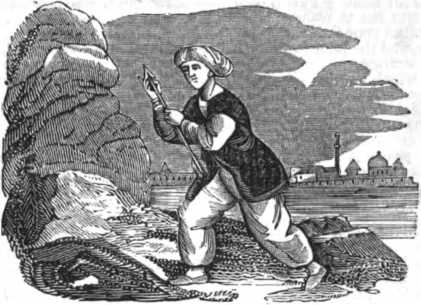
When prince Ahmed came nigh to these rocks, he perceived an arrow, which he gathered up, looked earnestly at it, and was in the greatest astonishment to find it was the same he shot. Certainly, said he to himself, neither I, nor any man living, could shoot an arrow so far; and finding it laid flat, not sticking into the ground, he judged that it had rebounded from the rock. There must be some mystery in this, said he to himself again, and it may be to my advantage. Perhaps fortune, to make me amends for depriving me of what I thought the greatest happiness of my life, may have reserved a greater blessing for my comfort.
As these rocks were full of sharp points and indentures between them, the prince, full of these thoughts, entered into one of the cavities, and looking about, cast his eyes on an iron door, which seemed to have no lock. He feared it was fastened: but pushing against it, it opened, and discovered an easy descent, but no steps, which he walked down with his arrow in his hand. At first he thought he was going into a dark place, but presently a quite different light succeeded that which he came out of; and entering into a spacious square, at about fifty or sixty paces distant, he perceived a magnificent palace, the admirable structure of which he had not time to look at: for at the same time, a lady of majestic port and air, and of a beauty to which the richness of her clothes and the jewels which adorned her person, added no advantage, advanced as far as the porch, attended by a troop of ladies, of whom it was difficult to distinguish which was the mistress.
As soon as prince Ahmed perceived the lady, he hastened to pay his respects; and the lady on her part, seeing him coming, prevented him. Addressing her discourse to him first, and raising her voice, she said to him, Come near, prince Ahmed; you are welcome.
It was no small surprise to the prince to hear himself named in a palace he had never heard of, though so nigh to his father’s capital, and he could not comprehend how he should be known to a lady who was a stranger to him. At last he returned the lady’s compliment, by throwing himself at her feet, and rising up again, said to her, Madam, I return you a thousand thanks for the assurance you give me of a welcome to a place where I had reason to believe my imprudent curiosity had made me penetrate too far. But, madam, may I, without being guilty of rudeness, presume to ask you by what adventure you know me? and that you, who live in the same neighbourhood with me, should be so little known by me? Prince, said the lady, let us go into the hall; there I will gratify you in your request more commodiously for us both.
After these words, the lady led prince Ahmed into the hall, the noble structure of which, and the gold and azure which embellished the dome, and the inestimable richness of the furniture, appeared so great a novelty to him, that he could not enough express his admiration, by crying out that he had never in his life beheld any thing like it, and believed that nothing was to be compared to it. I can assure you, replied the lady, that this is but a small part of my palace, and you will say so when you have seen all the apartments. Then she sat down on a sofa; and when the prince at her entreaty had seated himself by her, she said, You are surprised, you say, that I should know you, and not be known by you; but you will be no longer surprised when I inform you who I am. You cannot be ignorant that your religion teaches you to believe that the world is inhabited by genies as well as men: I am the daughter of one of the most powerful and distinguished of these genies, and my name is Pari Banou; therefore you ought not to wonder that I know you, the sultan your father, the princes your brothers, and the princess Nouronnihar. I am no stranger to your loves or your travels, of which I could tell you all the circumstances, since it was I myself who exposed to sale the artificial apple which you bought at Samarcande, the carpet which prince Houssain met with at Bisnagar, and the tube which prince Ali brought from Schiraz. This is sufficient to let you know that I am not unacquainted with any thing that relates to you. The only thing I have to add is, that you seemed to me worthy of a more happy fate than that of possessing the princess Nouronnihar; and that you might attain to it, I was present when you drew your arrow, and foresaw it would not go beyond prince Houssain’s. I took it in the air, and gave it the necessary motion, to strike against the rocks near which you found it. It is in your power to avail yourself of the favourable opportunity which it presents to make you happy.
As the fairy Pari Banou pronounced these last words with a different tone, and looked at the same time tenderly upon prince Ahmed, with downcast eyes and a modest blush on her cheeks, it was not difficult for the prince to comprehend what happiness she meant. He presently considered that the princess Nouronnihar could never be his, and that the fairy Pari Banou excelled her infinitely in beauty, attractions, agreeableness, transcendant wit, and, as far as he could conjecture by the magnificence of the palace where she resided, in immense riches. He blessed the moment that he thought of seeking after his arrow a second time, and yielding to his inclination, which drew him towards the new object which had fired his heart, Madam, replied he, should I, all my life, have had the happiness of being your slave, and the admirer of the many charms which ravish my soul, I should think myself the happiest of men. Pardon me the boldness which inspires me to ask this favour, and do not refuse to admit into your court a prince who is entirely devoted to you.
Prince, answered the fairy, as I have been a long time my own mistress, and have no dependence on my parents’ consent, it is not as a slave that I would admit you into my court, but as master of my person, and all that belongs to me, by pledging your faith to me, and taking me to be your wife. I hope you will not take it amiss that I anticipate you in making this proposal. I am, as I said, mistress of my will; and must add, that the same customs are not observed among fairies as among other ladies, in whom it would not have been decent to have made such advances: but it is what we do, and we suppose we confer obligation by it.
Prince Ahmed made no answer to this discourse, but was so penetrated with gratitude, that he thought he could not express it better than by coming to kiss the hem of her garment; which she would not give him time to do, but presented her hand, which he kissed a thousand times, and kept fast locked in his. Well, prince Ahmed, said she, will you not pledge your faith to me, as I do mine to you? Yes, madam, replied the prince, in an ecstasy of joy, what can I do better, and with greater pleasure? Yes, my sultaness, my queen, I will give it you with my heart, without the least reserve. Then, answered the fairy, you are my husband, and I am your wife. Our marriages are contracted with no other ceremonies, and yet are more firm and indissoluble than those among men with all their formalities. But as I suppose, pursued she, that you have eaten nothing to-day, a slight repast shall be served up for you while preparations are making for our nuptial feast this evening, and then I will show you the apartments of my palace, and you shall judge if this hall is not the smallest part of it.
Some of the fairy’s women who came into the hall with them, and guessed her intentions, went immediately out, and returned presently with some excellent meats and wines.
When prince Ahmed had eaten and drank as much as he cared for, the fairy Pari Banou carried him through all the apartments, where he saw diamonds, rubies, emeralds, and all sorts of fine jewels, intermixed with pearls, agate, jasper, porphyry, and all kinds of the most precious marbles; not to mention the richness of the furniture, which was inestimable; the whole disposed with such profusion, that the prince, instead of ever having seen any thing like it, acknowledged that there could not be any thing in the world that could come up to it. Prince, said the fairy, if you admire my palace so much, which is indeed very beautiful, what would you say to the palaces of the chief of our genies, which are much more beautiful, spacious, and magnificent? I could also charm you with my garden; but we will leave that till another time. Night draws near, and it will be time to go to supper.
The next hall which the fairy led the prince into, and where the cloth was laid for the feast, was the only apartment the prince had not seen, and it was not in the least inferior to the others. At his entrance into it, he admired the infinite number of wax candles perfumed with amber, the multitude of which, instead of being confused, were placed with so just symmetry, as formed an agreeable and pleasant sight. A large beaufet was set out with all sorts of gold plate, so finely wrought, that the workmanship was much more valuable than the weight of the gold. Several chorusses of beautiful women richly dressed, and whose voices were ravishing, began a concert, accompanied with all kinds of the most harmonious instruments he had ever heard. When they were set down to table, the fairy Pari Banou took care to help prince Ahmed to the most delicious meats, which she named as she invited him to eat of them, and which the prince had never heard of, but found so exquisite and nice, that he commended them in the highest terms, crying, that the entertainment which she gave him far surpassed those among men. He found also the same excellence in the wines, which neither he nor the fairy tasted of till the dessert was served up, which consisted of the choicest sweetmeats and fruits.
After the dessert, the fairy Pari Banou and prince Ahmed rose from the table, which was immediately carried away, and sat on a sofa, at their ease, with cushions of fine silk, curiously embroidered with all sorts of large flowers, laid at their backs. Presently after a great number of genies and fairies danced before them to the door of the chamber where the nuptial bed was made; and when they came there, they divided themselves into two rows, to let them pass, and after that retired, leaving them to go to bed.
The nuptial feast was continued the next day; or rather the days following the celebration were a continual feast, which the fairy Pari Banou, who could do it with the utmost ease, knew how to diversify, by new dishes, new meats, new concerts, new dances, new shows, and new diversions; which were all so extraordinary, that prince Ahmed, if he had lived a thousand years among men, could not have imagined.
The fairy’s intention was not only to give the prince essential proofs of the sincerity of her love, and the violence of her passion, by so many ways; but to let him see, that as he had no pretensions at his father’s court, he could meet with nothing comparable to the happiness he enjoyed with her, independent of her beauty and her charms, and to attach him entirely to herself, that he might never leave her. In this scheme she succeeded so well, that prince Ahmed’s passion was not in the least diminished by possession; but increased so much, that if he had been so inclined, it was not in his power to forbear loving her.
At the end of six months prince Ahmed, who always loved and honoured the sultan his father, conceived a great desire to know how he did; and as that desire could not be satisfied without his absenting himself to go and hear it in person, he mentioned it to the fairy, and desired she would give him leave.
This discourse alarmed the fairy, and made her fear it was only an excuse to leave her. She said to him, What disgust can I have given you to oblige you to ask me this leave? Is it possible you should have forgotten that you have pledged your faith to me, and that you no longer love one who is so passionately fond of you? Are not the proofs I have repeatedly given you of my affection sufficient?
My queen, replied the prince, I am perfectly convinced of your love, and should be unworthy of it, if I did not testify my gratitude by a reciprocal love. If you are offended at the leave I asked, I entreat you to forgive me, and I will make all the reparation I am capable of. I did not do it with any intention of displeasing you, but from a motive of respect towards my father, whom I wish to free from the affliction my so long absence must have overwhelmed him in; which must be the greater, as I have reason to presume he believes that I am dead. But since you do not consent that I should go and afford him that comfort, I will do what you will, and there is nothing in the world that I am not ready to do to please you.
Prince Ahmed, who did not dissemble, and loved her in his heart as much as he had assured her by these words, no longer insisted on the leave he had asked; and the fairy expressed her satisfaction thereat. But as he could not absolutely abandon the design he had formed to himself, he frequently took an opportunity to speak to her of the great qualifications of the sultan his father; and above all, of his particular tenderness towards him, in hopes he might at length be able to move her.
As prince Ahmed supposed, the sultan of the Indies, in the midst of the rejoicings on account of prince Ali’s and princess Nouronnihar’s nuptials, was sensibly afflicted at the absence of the other two princes his sons, though it was not long before he was informed of the resolution prince Houssain had taken to forsake the world, and the place he had made choice of for his retreat. As a good father, whose happiness consists in seeing his children about him, especially when they are deserving of his tenderness, he would have been better pleased had he stayed at his court, about his person; but as he could not disapprove of his choice of the state of perfection in which he had engaged, he supported his absence more patiently. He made the most diligent search after prince Ahmed, and despatched couriers to all the provinces of his dominions, with orders to the governors to stop him, and oblige him to return to court; but all the pains he took had not the desired success, and his trouble, instead of diminishing, increased. He would often talk with his grand vizier about it; and say to him, Vizier, thou knowest I always loved Ahmed the best of all my sons; and thou art not insensible of the means I have used to find him out, without success. My grief is so lively, I shall sink under it, if thou hast not compassion on me; if thou hast any regard for the preservation of my life, I conjure thee to assist and advise me.
The grand vizier, no less attached to the person of the sultan, than zealous to acquit himself well of the administration of the affairs of state, considering how to give his sovereign some ease, bethought himself of a sorceress, of whom he had heard wonders, and proposed to send for her to consult her. The sultan consented, and the grand vizier, after he had sent for her, introduced her to him himself.
The sultan said to the magician, The affliction I have been in since the marriage of my son prince Ali to the princess Nouronnihar, my niece, on account of the absence of prince Ahmed, is so well known, and so public, that undoubtedly thou canst be no stranger to it. By thy art and skill canst thou tell me what is become of him? If he is alive, where he is? What he is doing, and if I may hope ever to see him again? To this the sorceress made answer, It is impossible, sir, for me, though ever so skilful in my profession, to answer immediately the questions your majesty asks me; but if you allow till to-morrow, I will give an answer. The sultan granted her the time, and sent her away, with a promise to recompense her well, if her answer proved according to his desire.
The magician returned the next day, and the grand vizier presented her a second time to the sultan. Sir, said she, notwithstanding all the diligence I have used in applying the rules of my art, to obey your majesty in what you desire to know, I have not been able to discover any thing more than that prince Ahmed is alive. This is very certain, and you may depend on it; but as to the place where he is I cannot find it out.
The sultan of the Indies was obliged to be satisfied with this answer; which left him in the same uneasiness as before as to the prince’s fate.
To return to prince Ahmed. He so often entertained the fairy Pari Banou with talking about the sultan his father, without speaking any more of his desire to see him, that she fully comprehended what he meant; and perceiving this restraint he put upon himself, and his fear of displeasing her after her first refusal, she first inferred that his love for her was, by the repeated proofs he had given her, sincere; and then judging by herself the injustice she was guilty of in opposing a son’s tenderness for his father, and endeavouring to make him renounce that natural inclination, she resolved to grant him the leave which she saw he always so ardently desired. One day she said to him, Prince, the leave you have asked me to go and see the sultan your father, gave me a just fear that it was only a pretext to show your inconstancy, and to leave me, and that was the sole motive for my refusing you; but now I am so fully convinced by your actions and words, that I can depend on your constancy, and the steadiness of your love. I change my resolution, and grant you that leave, upon condition that you will swear to me first, that your absence shall not be long. You ought not to be concerned at this condition, as if I asked it out of distrust. I do it only because I know that it will give you no uneasiness, convinced as I am, as I have already told you, of the sincerity of your love.
Prince Ahmed would have thrown himself at the fairy’s feet, to show his gratitude, but she prevented him. My sultaness, said he, I am sensible of the great favour you grant me, but want words to return the thanks I wish. Supply this defect, I conjure you, and whatever you can suggest to yourself, be persuaded I think much more. You may believe that the oath will give me no uneasiness, and I take it more willingly, since it is not possible for me to live without you. I go, but the haste I shall make to return shall show you, that it is not for fear of being foresworn, but that I follow my inclination, which is to live with you for ever; and if I am absent some time with your consent, I shall always avoid the trouble a too long absence will create me.
Pari Banou was the more charmed with these sentiments of prince Ahmed, because they removed the suspicions she had entertained of him, fearing that his earnest desire to go to see the sultan his father was only a pretext to break his faith with her. —Prince, said she, go when you please; but first do not take it amiss that I give you some advice how you shall behave yourself where you are going. First, I do not think it proper for you to tell the sultan your father of our marriage, nor of my quality, nor the place where you are settled. Beg of him to be satisfied with knowing you are happy, and that you desire no more; and let him know that the sole end of your visit is to make him easy about your fate.
She appointed twenty horsemen, well mounted and equipped, to attend him. —When all was ready, prince Ahmed took his leave of the fairy, embraced her, and renewed his promise to return soon. Then his horse, which was most finely caparisoned, and was as beautiful a creature as any in the sultan of the Indies’ stables, was brought to him, and he mounted him with an extraordinary grace, with great pleasure to the fairy; and after he had bid her adieu, set forward on his journey.
As it was not a great way to his father’s capital, prince Ahmed soon arrived there. The people, glad to see him again, received him with acclamations of joy, and followed him in crowds to the sultan’s apartment. —The sultan received and embraced him with great joy; complaining at the same time, with a fatherly tenderness, of the affliction his long absence had been to him, which he said was the more grievous, for that fortune having decided in favour of prince Ali his brother, he was afraid he might have committed some act of despair.
Sir, replied prince Ahmed, I leave it to your majesty to consider, if, after having lost the princess Nouronnihar, who was the only object of my desires, I could resolve to be a witness of prince Ali’s happiness. If I had been capable of so unworthy an action, what would the court and city have thought of my love, or what your majesty? Love is a passion we cannot throw off when we will; it rules and governs us, and will not give a true lover time to make use of his reason. —Your majesty knows, that when I shot my arrow, the most extraordinary thing that ever befell any body happened to me, that in so large and level a plain as that where the horses are exercised, it should not be possible to find my arrow. I lost the cause, the justice of which was as much due to my love as to that of the princes my brothers. —Though thus vanquished by the caprice of fate, I lost no time in vain complaints; but, to satisfy my perplexed mind, in the adventure which I could not comprehend, I gave my attendants the slip, and returned back again alone to look for my arrow. I sought all about the place where prince Houssain’s and prince Ali’s arrows were found, and where I imagined mine must have fallen; but all my labour was in vain. I was not discouraged, but continued my search on the same ground in a direct line, and looked carefully about where I could guess it might have fallen; and after this manner had gone above a league, without being able to meet with any thing like an arrow, when I reflected that it was not possible that mine should fly so far. I stopped, and asked myself whether I was in my right senses, to flatter myself with having strength enough to shoot an arrow so much farther than any of the greatest heroes in the world were able to do. After I had argued thus with myself, I was ready to abandon my enterprise; but when I was on the point of putting my resolution in execution, I found myself drawn forward almost against my will; and after having gone four leagues to that part of the plain where it is bounded by rocks, I perceived an arrow. I ran and took it up, and knew it to be the same which I had shot, but which had not been found in the time or place that it should have been. Far from thinking your majesty had done me any injustice in declaring for my brother prince Ali, I interpreted what had happened to me quite otherwise, and never doubted but there was a mystery in it to my advantage; the discovery of which I ought not to neglect, and which I found out without going farther from the spot. But as to this mystery, I beg your majesty will not take it ill that I am silent, and that you will be satisfied to know from my own mouth that I am happy, and content with my fate.
In the midst of all my happiness, the only thing that troubled me, or was capable of disturbing me, was the uneasiness I feared your majesty was in, upon account of my leaving the court, and your not knowing what was become of me. I thought it my duty to satisfy you in this point. This was the only motive which brought me hither; the only favour I ask of your majesty is to give me leave to come often and pay you my respects, and inquire after your health.
Son, answered the sultan of the Indies, I cannot refuse you the leave you ask me, but, I should much rather you would resolve to stay with me. At least, tell me were I may hear of you, if you should fail to come, or when I may think your presence necessary. Sir, replied prince Ahmed, what your majesty asks of me is part of the mystery I spoke to your majesty of. I beg of you to give me leave to remain silent on this head; for I shall come so frequently where my duty calls, that I am afraid I shall sooner be thought troublesome, than be accused of negligence in my duty, when my presence may be necessary.
The sultan of the Indies pressed prince Ahmed no more, but said to him, Son, I penetrate no farther into your secrets, but leave you at your liberty. I can only tell you, that you could not do me a greater pleasure than to come, and, by your presence, restore to me the joy I have not felt for a long time; and that you shall always be welcome when you come, without interrupting your business or your pleasure.
Prince Ahmed stayed but three days at the sultan his father’s court, and the fourth returned to the fairy Pari Banou, who received him with the greater joy, as she did not expect him so soon. His diligence made her condemn herself for suspecting his want of fidelity. She never dissembled in the least, but frankly owned her weakness to the prince, and asked his pardon. So perfect was the union of these two lovers, that they had but one will between them.
A month after prince Ahmed’s return from paying a visit to his father, as the fairy Pari Banou had observed, that since the time that the prince gave her an account of his journey, and his conversation with his father, in which he asked his leave to come and see him from time to time, he had never spoken of the sultan, as if there had been no such person in the world, whereas before he was always speaking of him, she thought he forbore on her account; and therefore took an opportunity to say to him one day, Tell me, prince, have you forgotten the sultan your father? Do not you remember the promise you made to go and see him from time to time? For my part, I have not forgotten what you told me at your return, and put you in mind of it, that you may not be long before you acquit yourself of your promise for the first time.
Madam, replied prince Ahmed, with the same lively tone as the fairy spoke to him, as I know I am not guilty of the forgetfulness you speak of, I rather choose to be thus reproached, however undeservedly, than expose myself to a refusal, by showing unseasonably a desire for what it might have given you pain to grant. Prince, said the fairy, I would not have you in this affair have so much consideration for me, since it is a month since you have seen the sultan your father. I think you should not be longer than a month before you renew your visits. Pay him another visit to-morrow, and after that, go and see him once a month, without speaking to me, or waiting for my leave. I readily consent.
Prince Ahmed went the next morning with the same attendants as before, but much finer, and himself more magnificently mounted, equipped, and dressed, and was received by the sultan with the same joy and satisfaction. For several months he constantly paid him visits, and always in a richer and more brilliant equipage.
At last some viziers, the sultan’s favourites, who judged of prince Ahmed’s grandeur and power by the figure he made, abused the liberty the sultan gave them of speaking to him, to make him jealous of his son. They represented to him that it was but common prudence to know where the prince had retired, and how he could afford to live at such a rate, since he had no revenue nor income assigned him, and that he seemed to come to court only to brave him, by affecting to show that he wanted nothing of him to live like a prince, and that it was to be feared he might stir up the people’s favour, and dethrone him.
The sultan of the Indies was so far from thinking that prince Ahmed could be capable of so wicked a design, as his favourites would make him believe, that he said to them, You are mistaken; my son loves me, and I am the more assured of his tenderness and fidelity, as I have given him no reason to be disgusted.
Upon these last words, one of the favourites took an opportunity to say, Your majesty, in the opinion of the most sensible people, could not have taken a better method than what you have done with the three princes, respecting their marriage with the princess Nouronnihar; but who knows whether prince Ahmed has submitted to his fate with the same resignation as prince Houssain? May not he imagine that he alone deserved her, and that your majesty, by leaving that matter to be decided by chance, has done him injustice?
Your majesty may say, added the malicious favourite, that prince Ahmed has given no sign of dissatisfaction; that our fears are vain; that we are too easily alarmed, and are to blame to suggest to you suspicions of this sort, which may, perhaps, be unfounded, against a prince of your blood. But, sir, pursued the favourite, it may be also these suspicions may be well grounded. Your majesty is sensible, that in so nice and important an affair, you cannot be too much upon your guard, and should take the safest course. Consider, it is the prince’s business to dissemble, amuse, and deceive you; and the danger is the greater, as the prince resides not far from your capital; and if your majesty give but the same attention that we do, you may observe that every time he comes, he and his attendants are fresh, and their clothes and their horses’ housings are clean and bright, as if they were come from the maker’s hands, and their horses look as if they had only been walked out. These are sufficient signs that prince Ahmed does not come a great way; so that we should think ourselves wanting in our duty if we did not make our humble remonstrances, that, for your own preservation and the good of your people, you might take such measures as you shall think fit.
When the favourite had made an end of this long speech, the sultan said, Be it as it will, I do not believe my son Ahmed is so wicked as you would persuade me he is; however, I am obliged to you for your good advice, and do not doubt that it proceeds from a good intention.
The sultan of the Indies said this, that his favourites might not know the impressions their discourse had made on his mind. He was, however, so much alarmed by it, that he resolved to have prince Ahmed watched, unknown to his grand vizier. For this end, he sent for the female magician, who was introduced by a private door into his closet. You told me the truth, said he, when you assured me my son Ahmed was alive, for which I am obliged to you. You must do me another pleasure. I have seen him since, and he comes to my court every month; but I cannot learn from him where he resides, and I did not wish to force his secret out of him, but believe you are capable of satisfying my curiosity, without letting him, or any of my court, know any thing of the matter. You know that at this present time he is here with me, and is used to go away without taking leave of me, or any of my court. Go immediately upon the road, and watch him so well, as to find out where he retires, and bring me word.
The magician left the sultan, and knowing the place where prince Ahmed found his arrow, went immediately thither, and hid herself near the rocks, so that nobody could see her.
The next morning prince Ahmed set out by day-break, without taking leave either of the sultan or any of his court, according to custom. The magician seeing him coming, followed him with her eyes, till on a sudden she lost sight of him and his attendants.
The steepness of the rocks formed an insurmountable barrier to men, whether on horseback or on foot, so that the magician judged that there were but two ways; either that the prince retired into some cavern, or into some place under ground, the abode of genies or fairies. When she thought the prince and his attendants were out of sight, and returned into the cavern or subterraneous place she imagined, she came out of the place where she had hid herself, and went directly to the hollow way where she had seen them go in. She entered it, going and returning several times, and proceeding to the spot where it terminated in many windings, looking carefully about on all sides. But notwithstanding all her diligence, she could perceive no opening, nor the iron gate which prince Ahmed discovered: for this door was to be seen by and opened to none but men, and only to such men whose presence was agreeable to the fairy Pari Banou, and not at all to women.
The magician, who saw it was in vain for her to search any farther, was obliged to be satisfied with the discovery she had made, and returned to give the sultan an account. When she had told him what she had done, she added, Your majesty may easily understand, after what I have had the honour to tell you, it will be no difficult matter to give you the satisfaction you desire concerning prince Ahmed’s conduct. I will not tell you now what I think, but choose to let you know in a way that will not suffer you to doubt of it. To do this, I only ask time, and that you will have patience, and give me leave to do it, without inquiring what measures I design to take.
The sultan was very well pleased with the magician’s conduct, and said to her, Do you as you think fit; I will wait patiently the event of your promises. And to encourage her, he made her a present of a diamond of great value, telling her it was only an earnest of the ample recompense she should receive when she had done him that important piece of service, which he left to her management.
As prince Ahmed, after he had obtained the fairy Pari Banou’s leave to go to the sultan of the Indies’ court, never failed once a month, and the magician knowing the time, went a day or two before to the foot of the rock, where she lost sight of the prince and his attendants, and waited there with an intention to execute the project she had formed.
The next morning prince Ahmed went out as usual at the iron gate, with the same attendants as before, and passed by the magician, whom he knew not to be such; and seeing her lie with her head upon the rock, and complaining as if she was in great pain, he pitied her, turned his horse about, and went to her, and asked her what was the matter with her, and what he could do to relieve her.
The artful sorceress, without lifting up her head, looked at the prince in a manner to increase his compassion, already excited, and answered in broken words and sighs, as if she could hardly fetch her breath, that she was going to the city, but in the way thither was taken with so violent a fever, that her strength failed her, and she was forced to stop and lie down where he saw her, far from any habitation, and without any hopes of assistance.
Good woman, replied prince Ahmed, you are not so far from help as you imagine. I am ready to assist you, and convey you where you shall not only have all possible care taken of you, but where you will find a speedy cure; only get up, and let one of my people take you behind him.
At these words, the magician, who pretended sickness only to know where the prince lived, what he did, and what was his situation, did not refuse the charitable offer he made her so freely; and, to show her acceptance of it rather by her actions than by her words, she made many affected efforts to get up, pretending that the violence of her illness prevented her. At the same time, two of the prince’s attendants alighting off their horses, helped her up, and set her behind another. They mounted their horses again, and followed the prince, who turned back to the iron gate, which was opened by one of his retinue, who rode before. When he came into the outward court of the fairy’s palace, without dismounting himself, he sent to tell her he wanted to speak with her.
The fairy Pari Banou came with all imaginable haste, not knowing what made prince Ahmed return so soon; who, not giving her time to ask him the reason, said, My princess, I desire you would have compassion on this good woman, pointing to the magician, who was taken off the horse by two of his retinue: I found her in the condition you see her in, and promised her the assistance she stands in need of. I recommend her to your care, and am persuaded that you, from inclination, as well as at my request, will not abandon her.
The fairy Pari Banou, who had her eyes fixed upon the pretended sick woman all the time that the prince was talking to her, ordered two of her women who followed her to take her from the two men that held her, and carry her into an apartment of the palace, and take as much care of her as of herself.
Whilst the two women executed the fairy’s commands, she went up to prince Ahmed, and whispering him in the ear, said, Prince, I commend your compassion, which is worthy of you and your birth. I take great pleasure in gratifying your good intention; but give me leave to tell you, I am afraid it will be but ill rewarded. This woman is not so sick as she pretends to be; and I am very much mistaken if she is not sent hither on purpose to occasion you great trouble. But do not be concerned, let what will be devised against you; be persuaded that I will deliver you out of all the snares that shall be laid for you. Go and pursue your journey.
This discourse of the fairy’s did not in the least alarm prince Ahmed. My princess, said he, as I do not remember I ever did, or designed to do, any body an injury. I cannot believe any body can have a thought of doing me one; but if they have, I shall not forbear doing good, whenever I have an opportunity. So saying, he took leave of the fairy, and set forward again for his father’s capital, where he soon arrived, and was received as usual by the sultan, who constrained himself as much as possible, to disguise the trouble arising from the suspicions suggested by his favourites.
In the mean time, the two women to whom the fairy Pari Banou had given her orders carried the magician into a very fine apartment, richly furnished. First, they set her down upon a sofa, with her back supported with a cushion of gold brocade, while they made a bed on the same sofa before her, the quilt of which was finely embroidered with silk, the sheets of the finest linen, and the coverlid cloth of gold. When they had put her into bed, (for the old sorceress pretended that her fever was so violent, she could not help herself in the least,) one of the women went out, and returned soon again with a china cup in her hand, full of a certain liquor, which she presented to the magician, while the other helped her to sit up. Drink this liquor, said she; it is the water of the fountain of lions, and a sovereign remedy against all fevers whatsoever. You will find the effect of it in less than an hour’s time.
The magician, to dissemble the better, took it, after a great deal of entreaty, as if she was very much averse to take that potion; but at last she took the china cup, and shaking her head as if she did great violence to herself, swallowed the liquor. When she was laid down again, the two women covered her up. Lie quiet, said she who brought her the china cup, and get a little sleep if you can: we will leave you, and hope to find you perfectly cured when we come an hour hence.
The magician, who came not to act a sick part long, but only to discover prince Ahmed’s retreat, and what made him leave his father’s court, being fully satisfied in what she wanted to know, would willingly have declared that the potion had then had its effects, so great was her desire to return to the sultan, to inform him of the success of her commission: but as she had been told that the potion did not operate immediately, she was forced to wait the women’s return.
The two women came again at the time they said they should, and found the magician up and dressed, and seated on the sofa; who, when she saw them open the door of the apartment, cried out, O the admirable potion! it has wrought its cure much sooner than you told me it would, and I have waited a long time with impatience, to desire you to carry me to your charitable mistress, to thank her for her kindness, for which I shall always be obliged to her, since being thus cured as by a miracle, I would not lose time, but prosecute my journey.
The two women, who were fairies as well as their mistress, after they had told the magician how glad they were that she was cured so soon, walked before her, and conducted her through several apartments, all more superb than that wherein she lay, into a large hall, the most richly and magnificently furnished of all the palace.
Pari Banou was seated in this hall, on a throne of massy gold, enriched with diamonds, rubies, and pearls of an extraordinary size, and attended on each hand by a great number of beautiful fairies, all richly dressed. At the sight of so much majesty, the magician was not only dazzled, but was so struck, that after she had prostrated herself before the throne, she could not open her lips to thank the fairy, as she proposed. However, Pari Banou saved her the trouble, and said to her, Good woman, I am glad I had an opportunity to oblige you, and to see you are able to pursue your journey. I will not detain you; but perhaps you may not be displeased to see my palace: follow my women, and they will show it you.
The old sorceress, who had not power nor courage to say a word, prostrated herself a second time, with her head on the carpet that covered the foot of the throne, and so took her leave, and was conducted by the two fairies through all the same apartments which were shown to prince Ahmed at his first arrival there, and at sight of their uncommon magnificence, she made frequent exclamations. But what surprised her most of all was, that the two fairies told her, that all she saw and admired so much was a mere sketch of their mistress’s grandeur and riches; and that in the extent of her dominions she had so many palaces that they could not tell the number of them, all of different plans and architecture, and equally magnificent and superb. In talking of many other particulars, they led her at last to the iron gate at which prince Ahmed brought her in, and after she had taken her leave of them, and thanked them for their trouble, they opened it, and wished her a good journey.
After the magician had gone a little way, she turned back again to observe the door and know it again, but all in vain; for, as was before observed, it was invisible to her and all other women. Except in this circumstance, she was very well satisfied with executing the commission she had undertaken, and posted away to the sultan. When she came to the capital, she went by a great many by-ways to the private door of the palace. The sultan being informed of her arrival, sent for her into his apartment, and perceiving a melancholy hang upon her countenance, he thought she had not succeeded, and said to her, By your looks I surmise that your journey has been to no purpose, and that you have not made the discovery I expected from your diligence. Sir, replied the magician, your majesty must give me leave to represent to you, that you ought not to judge by my looks whether or no I have acquitted myself well in the execution of the commands you were pleased to honour me with; but by the faithful report I shall make you of all that has happened to me, and by which you will find that I have not neglected any thing that could render me worthy of your approbation. The melancholy you observe in my face proceeds from another cause than the want of success, which I hope your majesty will have all the reason in the world to be content with. I do not tell you the cause; the relation I am going to give will, if you have patience, inform you of it.
Then the magician related to the sultan of the Indies how she pretended to be sick, prince Ahmed compassionating her, had her carried into a subterraneous abode, and presented and recommended her himself to a fairy of incomparable beauty, desiring her by her care to restore her health. Then she told him with how much condescension the fairy presently ordered two fairies that attended her, to take care of her, and not to leave her till she was recovered; which great condescension, said she, could proceed from no other person but from a wife to a husband. Afterwards the old sorceress failed not to exaggerate on her surprise at the front of the palace, which she said had not its fellow in the world, while the two fairies held her by each arm, like a sick person, as she feigned to be, that could not walk or support herself. She gave a particular account of the care they took of her, after they had led her into another apartment; of the potion they made her drink, and of the quickness of her cure, which she pretended as well as her sickness, though she doubted not the virtue of the draught; the majesty of the fairy seated on a throne, brilliant with jewels, the value of which exceeded all the riches of the kingdom of the Indies, and all the other riches, beyond computation, contained in that vast palace.
Here the magician, finishing the relation of the success of her commission, and continuing her discourse, said, What does your majesty think of these unheard-of riches of the fairy? Perhaps you will say, you are struck with admiration, and rejoice at the good fortune of prince Ahmed your son, who enjoys them in common with the fairy. For my part, sir, I beg of your majesty to forgive me, if I take the liberty to remonstrate to you, that I think otherwise, and that I shudder when I consider the misfortunes which may happen to you from it. And this is the cause of the melancholy which I could not so well dissemble, but that you soon perceived it. I would believe that prince Ahmed, by his own good disposition, is incapable of undertaking any thing against your majesty; but who can answer that the fairy, by her attractions and caresses, and the influence she has already over him, may not inspire him with a dangerous design of dethroning your majesty, and seizing the crown of the Indies? This is what your majesty ought to consider as a serious affair of the utmost importance.
Though the sultan of the Indies was very well persuaded that prince Ahmed’s natural disposition was good, yet he could not help being moved at the discourse of the old sorceress, and said, I thank you for the pains you have taken, and your wholesome caution. I am so sensible of the great importance it is to me, that I shall take advice upon it.
He was consulting with his favourites, when he was told of the magician’s arrival. He ordered her to follow him to them. He acquainted them with what he had learnt, and communicated to them also the reason he had to fear the fairy’s influence over the prince, and asked them what measures they thought most proper to be taken to prevent so great a misfortune. One of the favourites, taking upon himself to speak for the rest, said, Your majesty knows who must be the author of this mischief. In order to prevent it, now he is in your court, and in your power, you ought not to hesitate to put him under arrest; I will not say, take away his life, for that would make too much noise; but make him a close prisoner while he lives. This advice all the other favourites unanimously applauded.
The magician, who thought it too violent, asked the sultan leave to speak, which being granted, she said, Sir, I am persuaded the zeal of your counsellors for your majesty’s interest makes them propose arresting prince Ahmed: but they will not take it amiss if I offer to your and their consideration, that if you arrest the prince you must also detain his retinue. But they are all genies. Do they think it will be so easy to surprise, seize, and secure their persons? Will they not disappear, by the property they possess of rendering themselves invisible, and transport themselves instantly to the fairy, and give her an account of the insult offered her husband? And can it be supposed she will let it go unrevenged? But would it not be better, if by any other means, which might not make so great a noise, the sultan could secure himself against any ill designs prince Ahmed may have against him, and not involve his majesty’s honour, or any body suspect him of any ill design? If his majesty has any confidence in my advice, as genies and fairies can do things impracticable to men, he will pique prince Ahmed’s honour, and engage him by means of the fairy to procure certain advantages, under pretence of deriving a great return, —for which he will be obliged to him. For example, every time your majesty takes the field, you are obliged to be at a great expense, not only in pavilions and tents for yourself and army, but likewise in mules and camels, and other beasts of burden, to carry their baggage. Might not you engage him to use his interest with the fairy, to procure you a tent which might be carried in a man’s hand, and which should be so large as to shelter your whole army.
I need say no more to your majesty. If the prince brings such a tent, you may make a great many other demands of the same nature, so that at last he may sink under the difficulties and the impossibility of executing them, however fertile in means and inventions the fairy, who has enticed him from you by her enchantments, may be; so that in time he will be ashamed to appear, and will be forced to pass the rest of his life with his fairy, excluded from any commerce with this world; and then your majesty will have nothing to fear from him, and cannot be reproached with so detestable an action as the shedding of a son’s blood, or confining him in a prison for life.
When the magician had finished her speech, the sultan asked his favourites if they had any thing better to propose; and finding them all silent, determined to follow the magician’s advice, as the most reasonable and most agreeable to his mild manner of government.
The next day, when the prince came into his father’s presence, who was talking with his favourites, and had sat down by him, after a conversation on different subjects, the sultan addressing himself to prince Ahmed, said, Son, when you came and dispelled those clouds of melancholy which your long absence had brought upon me, you made the place you had chosen for your retreat a mystery to me. I was satisfied with seeing you again, and knowing that you was content with your condition, and wished not to penetrate into your secret, which I found you did not care I should. I know not what reason you had thus to treat a father, who ever did and still continues to express what interest he takes in your happiness. I know your good fortune. I rejoice with you, and very much approve of your conduct in marrying a fairy so worthy of your love, and so rich and powerful, as I am informed. Powerful as I am, it was not possible for me to have procured so great a match for you. Now you are raised to so high a rank, as to be envied by every body, but a father like me, I not only desire you to preserve the good understanding we have lived in hitherto, but that you will use all your credit with your fairy to obtain for me her assistance, when I may want it. I therefore will make a trial of your interest this day.
You are not insensible at what a great expense, not to say trouble to my generals, officers, and myself, every time I take the field, they provide tents and pavilions, and mules and camels, and other beasts of burden, to carry them. If you consider the pleasure you would do me, I am persuaded you could easily procure from her a pavilion that might be carried in a man’s hand, and which would extend over my whole army; especially when you let her know it is for me. Though it may be a difficult thing, she will not refuse you. All the world, knows fairies are capable of doing most extraordinary things.
Prince Ahmed never expected that the sultan his father would have asked such a thing, which at first sight appeared to him so difficult, not to say impossible. Though he knew not absolutely how great the power of genies and fairies was, he doubted whether it extended so far as to furnish such a tent as his father desired. Moreover he had never asked any thing like it of the fairy Pari Banou, but was satisfied with the continual proofs she had given him of her passion, that he forgot nothing to persuade her that his heart perfectly corresponded without any views of interest, beyond maintaining himself in her good graces; therefore he was in the greatest embarrassment what answer to make. At last, he replied, If, sir, I have concealed from your majesty what happened to me, and what course I took after the finding my arrow, the reason was, that I thought it was of no great importance to you to be informed of them; and though I know not how this mystery has been revealed to you, I cannot deny but your information is very just. I have married the fairy you speak of. I love her, and am persuaded she loves me. But I can say nothing as to the influence your majesty believes I have over her. It is what I have not yet made an experiment of, nor thought of, and should be very glad you would dispense with my undertaking it, and let me enjoy the happiness of loving and being beloved, with all the disinterestedness I proposed to myself. But the demand of a father is a command upon every child, who, like me, thinks it his duty to obey him in every thing. And though it is with the greatest reluctance imaginable, I will not fail to ask my wife the favour your majesty desires, but will not promise you to obtain it; and if I should not have the honour to come again to pay you my respects, that shall be the sign that I have not had success: but beforehand, I desire you to forgive me, and consider that you yourself have reduced me to this extremity.
Son, replied the sultan of the Indies, I should be very sorry that what I ask of you should give you reason to cause me the grief of never seeing you more. I find you do not know the power a husband has over a wife; and yours would show that her love to you was very indifferent, if she, with the power she has as a fairy, should refuse you so trifling a request as this I desire you to ask of her for my sake. Lay aside your fears, which proceed from your believing yourself not to be loved so well as you love her. Go; only ask her. You will find the fairy loves you better than you imagine; and remember, that people, for want of asking, often lose great advantages. Think with yourself, that as you love her, you could refuse her nothing; therefore, if she loves you, she will not deny your requests.
All this discourse of the sultan of the Indies could not persuade prince Ahmed, who would rather he would have asked any thing else, than to expose him to the hazard of displeasing his dear Pari Banou; and so great was his vexation, that he left the court two days sooner than he used to do.
When he returned, the fairy, to whom he always before appeared with a gay countenance, asked him the cause of the alteration she perceived in his looks; and finding, that instead of answering her, he inquired after her health, to avoid satisfying her, she said to him, I will answer your question when you have answered mine. The prince declined it a long time, protesting that nothing was the matter with him; but the more he denied it, the more she pressed him, and said to him, I cannot bear to see you in this condition: tell me what makes you so uneasy, that I may remove the cause of it, whatever it may be; for it must be very extraordinary if it is out of my power, unless it be the death of the sultan your father; in that case, time, with all that I will contribute on my part, will comfort you.
Prince Ahmed could not long withstand the pressing instances of the fairy. Madam, said he, God prolong the sultan my father’s life, and bless him to the end of his days. I left him alive, and in perfect health; therefore that is not the cause of the melancholy you perceive in me. The sultan is the occasion of it, and I am the more concerned, because he has imposed upon me the disagreeable necessity of importuning you. First, you know the care I have taken, with your approbation, to conceal from him the happiness I have to see you, to love you, to deserve your favour and love, and to have received the pledge of your faith, after having pledged my faith with you. How he has been informed of it I cannot tell.
Here the fairy Pari Banou interrupted prince Ahmed, and said, But I know. Remember what I told you of the woman who made you believe she was sick, on whom you took so much compassion. It is she who has acquainted the sultan your father with what you have taken so much care to hide from him. I told you she was no more sick than you or I, and she has made it appear so; for, in short, after the two women, whom I charged to take care of her, had given her the water sovereign against all fevers, which, however, she had no occasion for, she pretended that water had cured her, and was brought to take her leave of me, that she might go the sooner to give an account of the success of her undertaking. She was in so much haste, that she would have gone away without seeing my palace, if I had not, by bidding my two women show it her, given her to understand that it was worth her seeing. But go on, and tell me what is the necessity your father has imposed on you to be so importunate, which I desire you will be persuaded you can be.
Madam, pursued prince Ahmed, you may have observed that hitherto I have been content with your love, and have never asked you any other favour: for what, after the possession of so amiable a wife, can I desire more? I know how great your power is, but I have taken care not to make trial of it. Consider then, I conjure you, that it is not me, but the sultan my father, who, indiscreetly, as I think, asks of you a pavilion large enough to shelter him, his court, and army, from the violence of the weather, when he takes the field, and which a man may carry in his hand. Once more, remember, it is not I, but the sultan my father, who asks this favour.
Prince, replied the fairy, smiling, I am sorry that so small a matter should disturb you, and make you so uneasy as you appeared to me. I see plainly two things have contributed towards it: one is, the law you have imposed upon yourself, to be content with loving me, and being beloved by me, and to deny yourself the liberty of asking me the least favour that might try my power. The other, I do not doubt, whatever you may say, was, you thought that what your father asked of me was out of my power. As to the first, I commend you for it, and shall love you the better, if possible, for it; and for the second, I must tell you, that what the sultan you father asks of me is a trifle; and upon occasions. I can do much more difficult things. Therefore be easy, and persuaded, that far from thinking myself importuned, I shall always take a great deal of pleasure in whatever you can desire me to do for your sake. Then the fairy sent for her treasurer, to whom, when she came, she said, Nourgihan, [108] (which was her name,) bring me the largest pavilion in my treasury. Nourgihan returned presently with a pavilion, which could not only be held, but concealed in the palm of the hand, when it was closed, and presented it to her mistress, who gave it prince Ahmed to look at.
When prince Ahmed saw the pavilion which the fairy called the largest in her treasury, he fancied she had a mind to banter him, and his surprise appeared presently in his countenance, which Pari Banou perceiving, burst out a laughing. What! prince, cried she, do you think I jest with you? You will see presently that I am in earnest. Nourgihan, said she to her treasurer, taking the tent out of prince Ahmed’s hand, go and set it up, that the prince may judge whether the sultan his father will think it large enough.
The treasurer went out immediately with it from the palace, and carried it to such a distance, that when she had set it up, one end reached to the palace. The prince, so far from thinking it small, found it large enough to shelter two armies as numerous as that of the sultan his father, and then said to Pari Banou, I ask my princess a thousand pardons for my incredulity: after what I have seen, I believe there is nothing impossible to you. You see, said the fairy, that the pavilion is larger than your father may have occasion for; but you are to observe, that it has one property, that it becomes larger or smaller, according to the army it is to cover, without applying any hands to it.
The treasurer took down the tent again, reduced it to its first size, and brought it and put it into the prince’s hands. He took it, and without staying any longer than till the next day, mounted his horse, and went with the usual attendants to the sultan his father.