ARABIAN NIGHTS’ (continued 7)
Reading edition · Edition 2
Farther, the king of Serendib is so just, that there are no judges in his dominions. His people have no need of them. They understand and observe justice exactly of themselves.
The caliph was much pleased with my discourse. The wisdom of that king, said he, appears in his letter, and after what you tell me, I must confess, that his wisdom is worthy of his people, and his people deserve so wise a prince. Having spoken thus, he dismissed me, and sent me home with a rich present.
Sindbad left off speaking, and his company retired, Hindbad having first received a hundred sequins; and next day they returned to hear the relation of his seventh and last voyage, as follows:
The seventh and last Voyage of Sindbad the Sailor.
Being returned from my sixth voyage, I absolutely laid aside all thoughts of travelling any farther; for, beside that my years now required rest, I was resolved no more to expose myself to such risk as I had run; so that I thought of nothing but to pass the rest of my days in quiet. One day as I was treating a parcel of my friends, one of my servants came, and told me, that an officer of the caliph asked for me. I rose from the table and went to him. The caliph, said he, has sent me to tell you, that he must speak with you. I followed the officer to the palace, where being presented to the caliph, I saluted him, by prostrating myself at his feet. Sindbad, said he to me, I stand in need of you; you must do me the service to carry my answer and present to the king of Serendib. It is but just I should return his civility.
This command of the caliph to me was like a clap of thunder. Commander of the faithful, replied I, I am ready to do whatever your majesty shall think fit to command me; but I beseech you most humbly to consider what I have undergone. I have also made a vow never to go out of Bagdad. Hence, I took occasion to give him a large and particular account of all my adventures, which he had the patience to hear out.
As soon as I had finished, I confess, said he, that the things you tell me are very extraordinary, yet you must, for my sake, undertake this voyage which I propose to you. You have nothing to do but to go to the isle of Serendib, and deliver the commission which I give you. After that you are at liberty to return. But you must go; for you know it would be indecent, and not suitable to my dignity, to be indebted to the king of that island. Perceiving that the caliph insisted upon it, I submitted, and told him that I was willing to obey. He was very well pleased at it, and ordered me a thousand sequins for the charge of my journey.
I prepared for my departure in a few days, and as soon as the caliph’s letter and present were delivered to me, I went to Balsora, where I embarked, and had a very happy voyage. I arrived at the isle of Serendib, where I acquainted the king’s ministers with my commission, and prayed them to get me speedy audience. They did so, and I was conducted to the palace in an honourable manner, where I saluted the king by prostration, according to custom. That prince knew me immediately, and testified very great joy to see me. O Sindbad, said he, you are welcome; I swear to you I have many times thought of you since you went hence; I bless the day upon which we see one another once more. I made my compliment to him, and after having thanked him for his kindness to me, I delivered the caliph’s letter and present, which he received with all imaginable satisfaction.
The caliph’s present was a complete set of cloth of gold, valued at one thousand sequins; fifty robes of rich stuff, a hundred other of white cloth, the finest of Cairo, Suez, Cusa, [51] and Alexandria; [52] a royal crimson bed, and a second of another fashion; a vessel of agate broader than deep, an inch thick, and half a foot wide, the bottom of which represented in bas-relief a man with one knee on the ground, who held a bow and an arrow, ready to let fly at a lion. He sent him also a rich table, which, according to tradition, belonged to the great Solomon. The caliph’s letter was as follows:
‘Greeting in the name of the sovereign guide of the right way, to the potent and happy sultan, from Abdallah Haroun Alraschid, whom God hath set in the place of honour, after his ancestors of happy memory:
‘We received your letter with joy, and send you this from the council of our port; the garden of superior wits. We hope, when you look upon it, you will find our good intention, and be pleased with it. Adieu.’
The king of Serendib was highly pleased that the caliph answered his friendship. A little time after this audience, I solicited leave to depart, and had much difficulty to obtain it. I obtained it however at last, and the king, when he dismissed me, made me a very considerable present. I embarked immediately to return to Bagdad, but had not the good fortune to arrive there as I hoped. God ordered it otherwise.
Three or four days after my departure, we were attacked by corsairs, who easily seized upon our ship, because it was no vessel of force. Some of the crew offered resistance, which cost them their lives. But for me and the rest, who were not so imprudent, the corsairs saved us, on purpose to make slaves of us.
Day beginning to appear, Scheherazade was obliged to keep silence, but next night resumed the story thus:
EIGHTY-NINTH NIGHT.
Sir, said she to the sultan of the Indies, Sindbad continuing his story, told the company, We were all stripped, and instead of our own clothes, they gave us sorry rags, and carried us into a remote island, where they sold us.
I fell into the hands of a rich merchant, who, as soon as he bought me, carried me to his house, treated me well, and clad me handsomely for a slave. Some days after, not knowing who I was, he asked me if I understood any trade? I answered, that I was no mechanic, but a merchant, and that the corsairs who sold me, robbed me of all I had. But tell me, replied he, can you shoot with a bow? I answered, that the bow was one of my exercises in my youth, and I had not yet forgot it. Then he gave me a bow and arrows, and taking me behind him upon an elephant, carried me to a vast forest some leagues from the town. We went a great way into the forest, and when he thought fit to stop, he bid me alight; then showing me a great tree, Climb up that tree, said he, and shoot at the elephants as you see them pass by, for there is a prodigious number of them in this forest, and if any of them fall, come and give me notice of it. Having spoken thus, he left me victuals, and returned to the town, and I continued upon the tree all night.
I saw no elephant during that time, but next morning, as soon as the sun was up, I saw a great number: I shot several arrows among them, and at last one of the elephants fell; the rest retired immediately, and left me at liberty to go and acquaint my patron with my booty. When I had told him the news, he gave me a good meal, commended my dexterity, and caressed me highly. We went afterwards together to the forest, where we dug a hole for the elephant; my patron designing to return when it was rotten, and to take his teeth, &c. to trade with.
I continued this game for two months, and killed an elephant every day, getting sometimes upon one tree, and sometimes upon another. One morning, as I looked for the elephants, I perceived with an extreme amazement, that, instead of passing by me across the forest as usual, they stopped, and came to me with a horrible noise, in such a number that the earth was covered with them, and shook under them. They encompassed the tree where I was, with their trunks extended, and their eyes all fixed upon me. At this frightful spectacle I continued immoveable, and was so much frightened, that my bow and arrows fell out of my hand.
My fears were not in vain; for after the elephants had stared upon me some time, one of the largest of them put his trunk round the foot of the tree, and pulled so strong, that he plucked it up, and threw it on the ground; I fell with the tree, and the elephant taking me up with his trunk, laid me on his back, where I sat more like one dead than alive, with my quiver on my shoulder: he put himself at the head of the rest, who followed him in troops, and carried me to a place where he laid me down on the ground, and retired with all his companions. Conceive, if you can, the condition I was in: I thought myself to be in a dream; at last, after having lain some time, and seeing the elephants gone, I got up, and found I was upon a long and broad hill, covered all over with the bones and teeth of elephants. I confess to you that this object furnished me with abundance of reflections. I admired the instinct of those animals; I doubted not but that was their burying-place, and that they carried me thither on purpose to tell me that I should forbear to persecute them, since I did it only for their teeth. I did not stay on the hill, but turned towards the city, and, after having travelled a day and a night, I came to my patron; I met no elephant in my way, which made me think they had retired farther into the forest, to leave me at liberty to come back to the hill without any obstacle.
As soon as my patron saw me; Ah, poor Sindbad, said he, I was in great trouble to know what had become of you. I have been at the forest, where I found a tree newly pulled up, and a bow and arrows on the ground, and after having sought for you in vain, I despaired of ever seeing you more. Pray, tell me what befell you, and by what good hap thou art still alive. I satisfied his curiosity, and going both of us next morning to the hill, he found to his great joy that what I had told him was true. We loaded the elephant upon which we came with as many teeth as he could carry; and when we were returned, Brother, said my patron, for I will treat you no more as my slave, after having made such a discovery as will enrich me, God bless you with all happiness and prosperity. I declare before him that I give you your liberty. I concealed from you what I am now going to tell you.
The elephants of our forest have every year killed us a great many slaves, whom we sent to seek ivory. For all the cautions we could give them, those crafty animals killed them one time or other. God has delivered you from their fury, and has bestowed that favour upon you only. It is a sign that he loves you, and has use for your service in the world. You have procured me incredible gain. We could not have ivory formerly, but by exposing the lives of our slaves, and now our whole city is enriched by your means. Do not think I pretend to have rewarded you by giving you your liberty; I will also give you considerable riches. I would engage all our city to contribute towards making your fortune, but I will have the glory of doing it myself.
To this obliging discourse I replied, Patron, God preserve you. Your giving me my liberty is enough to discharge what you owe me, and I desire no other reward for the service I had the good fortune to do to you and your city, but leave to return to my own country. Very well, said he, the monsoon [53] will in a little time bring ships for ivory. I will send you home then, and give you wherewith to bear your charges. I thanked him again for my liberty, and his good intentions towards me. I staid with him, expecting the monsoon; and during that time, we made so many journeys to the hill, that we filled all our warehouses with ivory. The other merchants, who traded in it, did the same thing, for it could not be long concealed from them. At these words Scheherazade, perceiving day, broke off.
NINETIETH NIGHT. [54]
Sir, said she to the sultan of the Indies, Sindbad went on with his seventh voyage thus:
The ships arrived at last, and my patron himself having made choice of the ship wherein I was to embark, he loaded half of it with ivory on my account, he laid in provisions in abundance for my passage, and besides obliged me to accept a present of the curiosities of the country of great value. After I had returned him a thousand thanks for all his favours, I went aboard. We set sail, and as the adventure which procured me this liberty was very extraordinary, I had it continually in my thoughts.
We stopped at some islands to take in fresh provisions. Our vessel being come to a port on the main land in the Indies, we touched there, and not being willing to venture by sea to Balsora, I landed my proportion of the ivory, resolving to proceed on my journey by land. I made vast sums of my ivory, I bought several rarities, which I intended for presents, and when my equipage was got ready, I set out in company of a large caravan of merchants. I was a long time on the way, and suffered very much; but endured all with patience, when I considered that I had nothing to fear from the seas, from pirates, from serpents, nor of the other perils I had undergone.
All these fatigues ended at last, and I came safe to Bagdad. I went immediately to wait upon the caliph, and gave him an account of my embassy. That prince told me he had been uneasy, by reason I was so long in returning, but that he always hoped God would preserve me. When I told him of the adventure of the elephants, he seemed to be much surprised at it, and would never have given any credit to it had he not known my sincerity. He reckoned this story, and the other relations I had given him, to be so curious, that he ordered one of his secretaries to write them in characters of gold, and lay them up in his treasury. I retired very well satisfied with the honours I received, and the presents which he gave me; and after that I gave myself up wholly to my family, kindred, and friends.
Sindbad here finished the relation of his seventh and last voyage, and then, addressing himself to Hindbad, Well, friend, said he, did you ever hear of any person that suffered so much as I have done, or of any mortal that has gone through so many perplexities? Is it not reasonable that, after all this, I should enjoy a quiet and pleasant life? As he said this, Hindbad drew near to him, and kissing his hand, said, I must acknowledge, sir, you have gone through terrible dangers; my troubles are not comparable to yours: if they afflict me for a time, I comfort myself with the thoughts of the profit I get by them. You not only deserve a quiet life, but are worthy besides of all the riches you enjoy, because you make such a good and generous use of them. May you therefore continue to live in happiness and joy, till the day of your death. Sindbad gave him a hundred sequins more, received him into the number of his friends, and desired him to quit his porter’s employment, and come and dine every day with him, that he might all his days have reason to remember Sindbad the sailor.
The three Apples.
The Caliph Haroun Alraschid one day commanded the grand vizier Giafar, to come to his palace the night following. Vizier, said he, I will take a walk around the town, to inform myself what people say, and particularly how they are pleased with my officers of justice. If there be any against whom they have reason of just complaint, we will turn them out, and put others in their stead who shall officiate better. If, on the contrary, there be any that have gained their applause, we will have that esteem for them which they deserve. The grand vizier being come to the palace at the hour appointed, the caliph, he, and Mesrour, the chief of the eunuchs, disguised themselves so that they could not be known, and went out all three together.
They passed through several places, and by several markets; and as they entered a small street, they perceived, by the light of the moon, a tall man, with a white beard, who carried nets on his head, and a club in his hand. The old man, said the caliph, does not seem to be rich; let us go to him, and inquire into his circumstances. Honest man, said the vizier, who art thou? The old man replied, Sir, I am a fisher, but one of the poorest and most miserable of the trade; I went from my house about noon to go a fishing, and from that time to this I have not been able to catch one fish; and at the same time I have a wife and small children, and nothing to maintain them.
The caliph, moved with compassion, said to the fisherman, Hast thou the courage to go back and cast thy net once more? We will give thee a hundred sequins for what thou shalt bring up. At this proposal, the fisherman, forgetting all his day’s toil, took the caliph at his word; and with him, Giafar and Mesrour, returned to the Tigris; he saying to himself: These gentlemen seem to be too honest and reasonable not to reward my pains; and if they give me the hundredth part of what they promise me, it will be a great deal.
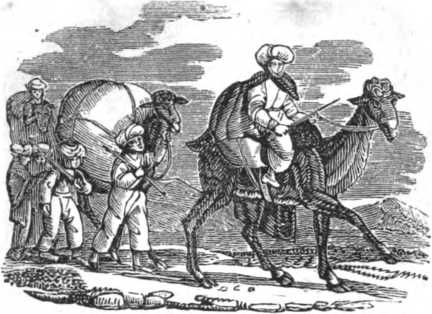
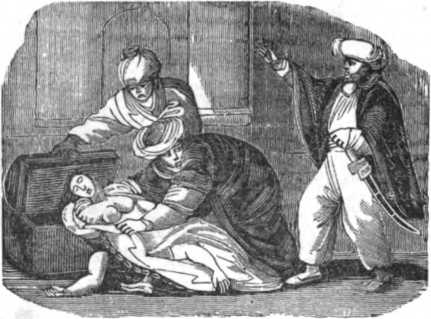
They came to the bank of the river, and the fisherman throwing in his net, when he drew it again, brought up a trunk, close shut, and very heavy. The caliph made the grand vizier pay him a hundred sequins immediately, and sent him away. Mesrour, by his master’s order, carried the trunk on his shoulder; and the caliph was so very eager to know what was in it, that he returned to the palace with all speed. When the trunk was opened, they found in it a large basket made of palm leaves, shut up, and the covering of it sewed with red thread. To satisfy the caliph’s impatience, they would not take time to unrip it, but cut the thread with a knife, and they took out of the basket a bundle wrapt up in a sorry piece of hanging, and bound about with a rope, which being untied, and the bundle opened, they found, to their great amazement, the corpse of a young lady, whiter than snow, all cut in pieces.
The astonishment of the caliph at this dreadful spectacle may be more easily imagined than expressed; his surprise was instantly changed into passion, and darting an angry look at the vizier, Ah! thou wretch, said he, is this your inspection into the actions of my people? Do they commit such impious murders under thy ministry in my capital city, and throw my subjects into the Tigris, that they may cry for vengeance against me at the day of judgment? If thou dost not speedily revenge the murder of this woman by the death of her murderer, I swear by heaven, that I will cause thee to be hanged, and forty more of thy kindred. Commander of the faithful, replied the grand vizier, I beg your majesty to grant me time to make inquiry. I will allow thee no more, said the caliph, than three days; therefore, thou must look to it.
The vizier Giafar went home in great confusion of mind. Alas! said he, how is it possible, that in such a vast and populous city as Bagdad, I should be able to detect a murderer, who undoubtedly committed the crime without witness, and perhaps may be already gone from hence? Any other but I would take some wretched person out of prison, and cause him to die, to satisfy the caliph; but I will not burden my conscience with such a barbarous action; I will rather die than save my life at that rate.
He ordered the officers of the police and justice to make strict search for the criminal; they sent their servants about, and they themselves were not idle, for they were no less concerned in this matter than the vizier. But all their endeavours amounted to nothing; what pains soever they took they could not find out the murderer; so that the vizier concluded his life to be gone, unless some remarkable providence hinder it.
The third day being come, an officer came to this unfortunate minister with a summons to follow him, which the vizier obeyed. The caliph asked him for the murderer. He answered, with tears in his eyes, Commander of the faithful, I have not found any person that could give me the least account of him. The caliph, full of fury and rage, gave him many reproachful words, and ordered that he and forty Bermecides [55] more should be hanged up at the gate of the palace.
In the mean while, the gibbets were preparing, and orders were sent to seize forty Bermecides more in their houses; a public crier was sent about the city to cry thus, by the caliph’s order:— Those who have a desire to see the grand vizier Giafar hanged, and forty more Bermecides of his kindred, let them come to the square before the palace.
When all things were ready, the criminal judge and a great many officers belonging to the palace, brought out the grand vizier with the forty Bermecides, and set each of them at the foot of the gibbet designed for them, and a rope was put about each of their necks. The multitude of people that filled the square, could not without grief and tears behold this tragical sight; for the grand vizier and the Bermecides were loved and honoured on account of their probity, bounty, and impartiality, not only in Bagdad, but through all the dominions of the caliph.
Nothing could prevent the execution of this prince’s too severe and irrevocable sentence, and the lives of the most honest people in the city were just going to be taken away, when a young man of handsome mien and good apparel, pressed through the crowd till he came where the grand vizier was, and after he had kissed his hand, said, Most excellent vizier, chief of the emirs of this court, and comforter of the poor, you are not guilty of the crime for which you stand here. Withdraw, and let me expiate the death of the lady that was thrown into the Tigris. It was I who murdered her, and I deserve to be punished for it.
Though these words occasioned great joy to the vizier, yet he could not but pity the young man, in whose look he saw something, that instead of being ominous, was engaging; but as he was about to answer him, a tall man, pretty well in years, who had likewise forced his way through the crowd, came up to him, saying, Sir, do not believe what this young man tells you; I killed that lady who was found in the trunk, and this punishment ought only to fall upon me. I conjure you in the name of God not to punish the innocent for the guilty. Sir, said the young man to the vizier, I do protest that I am he who committed this vile act, and nobody else had any hand in it. —My son, said the old man, it is despair that brought you hither, and you would anticipate your destiny. I have lived a long time in the world, and it is time for me to be gone; let me, therefore, sacrifice my life for yours. Sir, said he again to the vizier, I tell you once more I am the murderer; let me die without any more ado.
The controversy between the old man and the young one obliged the grand vizier Giafar to carry them both before the caliph, which the judge criminal consented to, being very glad to serve the vizier. When he came before the prince, he kissed the ground seven times, and spake after this manner: Commander of the faithful, I have brought here before your majesty this old man and this young man, who both confess themselves to be the sole murderers of the lady. Then the caliph asked the criminals, which of them it was that so cruelly murdered the lady, and threw her into the Tigris. The young man assured him it was he, but the old man maintained the contrary. Go, said the caliph to the grand vizier, and cause them both to be hanged. But, sir, said the vizier, if only one of them be guilty, it would be unjust to take the lives of both. At these words, the young man spoke again —I swear by the great God, who has raised the heaven so high, that I am the man who killed the lady, cut her in quarters, and threw her into the Tigris about four days ago. I renounce my part of happiness amongst the just at the day of judgment, if what I say be not true; therefore I am he that ought to suffer. The caliph being surprised at this oath, believed him, especially since the old man made no answer to this. Whereupon, turning to the young man, Thou wretch, said he, what was it that made thee commit that detestable crime, and what is it that moves thee to offer thyself voluntarily to die? Commander of the faithful, said he, if all that has passed between that lady and me were set down in writing, it would be a history that might be very useful for other men. I command thee, then, to relate it, said the caliph. The young man obeyed, and began. His history was thus:
The Story of the Lady that was murdered, and of the young Man, her Husband.
Commander of the faithful, your majesty may be pleased to know, that this murdered lady was my wife, the daughter of this old man you see here, who is my own uncle by the father’s side. She was not above twelve years old when he gave her to me, and it is now eleven years ago. I have three children by her, all boys, yet alive; and I must do her that justice to say, that she never gave me the least occasion for offence. She was chaste, of good behaviour, and made it her whole business to please me; and, for my part, I loved her entirely, and rather prevented her in granting any thing she desired, than opposed it.
About two months ago, she fell sick; I took all imaginable care of her, and spared nothing that could procure her a speedy recovery. After a month she began to grow better, and had a mind to go to the bath. Before she went out of the house, Cousin, said she, (for so she used to call me out of familiarity,) I long for some apples; if you would get me any, you would please me extremely. I have longed for them a great while; and I must own it is come to that height, that if I be not satisfied very soon, I fear some misfortune will befall me. With all my heart, said I, I will do all that is in my power to make you easy.
I went immediately round all the markets and shops in the town to seek for apples, but I could not get one, though I offered to pay a sequin a-piece. I returned home very much dissatisfied at my disappointment; and for my wife, when she returned from the bagnio, and saw no apples, she became so very uneasy, that she could not sleep all night I got up betimes in the morning, and went through all the gardens, but had no better success than the day before; only I happened to meet an old gardener, who told me that all my pains would signify nothing, for I could not expect to find apples any where but in your majesty’s garden at Balsora. As I loved my wife passionately, and would not have any neglect to satisfy her chargeable upon me, I dressed myself in a traveller’s habit, and after I had told her my design, I went to Balsora, and made my journey with so great diligence, that I returned at the end of fifteen days, with three apples, which cost me a sequin a-piece; there were no more left in the garden, so that the gardener would not let me have them cheaper. As soon as I came home, I presented them to my wife; but her longing was over, so she satisfied herself with receiving them, and laid them down by her. In the mean time, she continued sickly, and I knew not what remedy to get for her.
Some few days after I returned from my journey, I was sitting in my shop in the public place where all sorts of fine stuffs are sold, and saw an ugly, tall, black slave come in, with an apple in his hand, which I knew to be one of those I had brought from Balsora. I had no reason to doubt it, because I was certain there was not one to be had in all Bagdad, nor in any of the gardens about it. I called to him, and said, Good slave, prithee tell me where thou hadst this apple? It is a present, said he, smiling, from my mistress. I went to see her to-day, and found her out of order. I saw three apples lying by her, and asked her where she had them. She told me, the good man, her husband, had made a fortnight’s journey on purpose for them, and brought them her. We had a collation together, and when I took my leave of her, I brought away this apple that you see.
This discourse put me out of my senses. I rose, shut up my shop, ran home with all speed, and going to my wife’s chamber, looked immediately for the apples; and seeing only a couple, asked what was become of the third. Then my wife turning her head to the place where the apples lay, and perceiving there were but two, answered me coldly, Cousin, I know not what is become of it. At this answer, I did verily believe what the slave told me to be true; and at the same time, giving myself up to madness and jealousy, I drew my knife from my girdle, and thrust it into the unfortunate creature’s throat. I afterwards cut off her head, and divided her body into four quarters, which I packed up in a bundle, and hiding it in a basket, sewed it up with a thread of red yarn, put all together in a trunk, and when night came, I carried it on my shoulder down to the Tigris, where I sunk it.
The two youngest of my children were already put to bed and asleep, the third was gone abroad; but at my return, I found him sitting by my gate, weeping very sore. I asked him the reason: Father, said he, I took this morning from my mother, without her knowledge, one of those three apples you brought her, and I kept it a long while; but as I was playing some time ago with my little brother, in the street, a tall slave that went by, snatched it out of my hands, and carried it with him. I ran after him, demanded it back, and besides, told him, that it belonged to my mother, who was sick, and that you had made a fortnight’s journey to fetch it; but all to no purpose —he would not restore it. And as I still followed him, crying out, he turned and beat me, and then ran away as fast as he could from one lane to another, till at length I lost sight of him. I have since been walking without the town expecting your return, to pray you, dear father, not to tell my mother of it, lest it should make her worse; and when he had said these words, he fell a weeping again more bitterly than before.
My son’s discourse afflicted me beyond all measure. I then found myself guilty of an enormous crime, and repented too late of having so easily believed the calumnies of a wretched slave, who, from what he had learnt of my son, invented that fatal lie.
My uncle here present, came just at the time to see his daughter; but instead of finding her alive, understood from me that she was dead, for I concealed nothing from him; and without staying for his censure, declared myself the greatest criminal in the world.
Upon this, instead of reproaching me, he joined his tears with mine, and we wept three days together, without intermission; he for the loss of a daughter whom he always loved tenderly, and I for the loss of a dear wife, of whom I had deprived myself after so cruel a manner, by giving too easy credit to the report of a lying slave.
This, commander of the faithful, is the sincere confession your majesty commanded from me. You have heard now all the circumstances of my crime, and I most humbly beg of you to order the punishment due for it; how severe soever it may be, I shall not in the least complain, but esteem it too easy and gentle.
The caliph was very much astonished at the young man’s relation. But this just prince, finding that he was rather to be pitied than condemned, began to speak in his favour: This young man’s crime, said he, is pardonable before God, and excusable with men. The wicked slave is the sole cause of this murder —it is he alone that must be punished; wherefore, said he, looking upon the grand vizier, I give you three day’s time to find him out; if you do not bring him within that space, you shall die in his stead. The unfortunate Giafar, who thought himself now out of danger, was terribly perplexed at this new order of the caliph; but as he durst not return any answer to this prince, whose hasty temper he knew too well, he departed from his presence, and retired to his house with tears in his eyes, persuading himself he had but three days to live; for he was so fully persuaded that he should not find the slave, that he made not the least inquiry about him. Is it possible, said he, that in such a city as Bagdad, where there is an infinite number of negro slaves, I should be able to find him out that is guilty? So that unless God be pleased to bring it about, as he hath already detected the murderer, nothing can save my life.
He spent the two first days in mourning with his family, who sat around him weeping and complaining of the caliph’s cruelty. The third day being come, he prepared himself to die with courage, as an honest minister, and one that had nothing to trouble his conscience; he sent for notaries and witnesses, who signed the last will he made in their presence. After which, he took leave of his wife and children, and bid them the last farewell. All his family were drowned in tears, so that there never was a more sorrowful spectacle. At last, the messenger came from the caliph to tell him that he was out of all patience, haring heard nothing from him, nor concerning the negro slave which he had commanded him to search for; I am therefore ordered, said he, to bring you before his throne. The afflicted vizier made ready to follow the messenger; but as he was going out, they brought him his youngest daughter, about five or six years of age. The nurses that attended her, presented her to her father to receive his last blessing.
As he had a particular love for that child, he prayed the messenger to give him leave to stop for a moment; and taking his daughter in his arms, he kissed her several times. As he kissed her, he perceived she had somewhat in her bosom that looked bulky, and had a sweet scent. My dear little one, said he, what hast thou in thy bosom? My dear father, said she, it is an apple, upon which is written the name of our lord and master, the caliph; our slave Rihan [56] sold it me for two sequins.
At these words apple and slave, the grand vizier cried out with surprise, intermixed with joy, and putting his hand into the child’s bosom, pulled out the apple. He caused the slave, who was not far off, to be brought immediately; and when he came, Rascal, said he, where hadst thou this apple? My lord, said the slave, I swear to you, that I neither stole it in your house, nor out of the commander of the faithful’s garden, but the other day, as I was going along a street where three or four small children were at play, one of them having it in his hand, I snatched it from him, and carried it away. The child ran after me, telling me it was none of his own, but belonged to his mother, who was sick, and that his father, to save her longing, had made a long journey, and brought home three apples, whereof this was one, which he had taken from his mother, without her knowledge. He said what he could to make me give it him back, but I would not; and so I brought it home, and sold it for two sequins to the little lady, your daughter; and this is the whole truth of the matter.
Giafar could not enough admire, how the roguery of a slave had been the cause of an innocent woman’s death, and almost of his own. He carried the slave along with him; and when he came before the caliph, he gave that prince an exact account of all that the slave had told him, and the chance that had brought him to the discovery of his crime.
Never was any surprise so great as that of the caliph, yet he could not prevent himself from falling into excessive fits of laughter. At last, he recovered himself, and with a serious mien, told the vizier, that since his slave had been the occasion of a strange accident, he deserved an exemplary punishment. Sir, I must own it, said the vizier, but his guilt is not irremissible. I remember a strange story of a vizier of Cairo, called Nourreddin Ali, [57] and Bedreddin Hassan, [58] of Balsora; and since your majesty delights to hear such things, I am ready to tell it, upon condition, that if your majesty finds it more astonishing than that which gives me occasion to tell it, you will be pleased to pardon my slave. I am content, said the caliph; but you undertake a hard task, for I do not believe you can save your slave, the story of the apples being so very singular. Upon this, Giafar began his story thus:
The Story of Nourreddin Ali and Bedreddin Hassan.
Commander of the faithful, there was in former days a sultan of Egypt, a strict observer of justice, gracious, merciful, and liberal; and his valour made him terrible to his neighbours. He loved the poor, and protected the learned, whom he advanced to the highest dignities. This sultan had a vizier, who was prudent, wise, sagacious, and well versed in other sciences. This minister had two sons, very handsome men, and who, in every thing, followed his own footsteps. The eldest was called Schemseddin [59] Mohammed, and the younger Nourreddin Ali. The last especially was endowed with all the good qualities that any man could possess.
The vizier, their father, being dead, the sultan sent for them; and after he had caused them both to put on the usual robes of a vizier, I am as sorry, said he, for the loss of your father as you yourselves; and because I know you live together, and love one another entirely, I will bestow his dignity upon you conjunctly. Go, and imitate your father’s conduct.
The two new viziers humbly thanked the sultan, and went home to their house, to make due preparation for their father’s interment. They did not go abroad for a month, and then went to court, where they appeared continually on council days. When the sultan went out a hunting, one of the brothers went along with him, and this honour they had by turns. One evening, as they were talking after supper, the next day being the elder brother’s turn to go a hunting with the sultan, he said to his younger brother, Since neither of us is yet married, and we live so lovingly together, a thought is come into my head: let us both marry in one day, and let us choose two sisters out of some family that may suit our quality; —what do you think of this fancy? I must tell you, brother, answered Nourreddin Ali, that it is very suitable to our friendship —there cannot be a better thought; for my part, I am ready to agree to any thing you should think fit. But hold, this is not all, said Schemseddin Mohammed; my fancy carries me farther: suppose both our wives should conceive the first night of our marriage, and should happen to be brought to bed on one day, yours of a son, and mine of a daughter —we will give them to one another in marriage, when they come to age. Nay, said Nourreddin Ali, aloud, I must acknowledge that this prospect is admirable; such a marriage will perfect our union, and I willingly consent to it. But then, brother, said he farther, if this marriage should happen, would you expect that my son should settle a jointure on your daughter? There is no difficulty in that, replied the other; for I am persuaded, that besides the usual articles of the marriage contract, you will not fail to promise, in his name, at least three thousand sequins, three good manors, and three slaves. No, said the younger, I will not consent to that: are we not brethren, and equal in title and dignity? Do not you and I both know what is just? The male being nobler than the female, it is your part to give a large dowry with your daughter. By what I perceive, you are a man that would have your business done at another man’s charge.
Although Nourreddin Ali spoke these words in jest, his brother, being of an ill-temper, was offended at it, and falling into a passion, A mischief upon your son, said he, since you prefer him before my daughter! I wonder you had so much confidence as to believe him worthy of her; —you must needs have lost your judgment to think you are my equal, and say we are colleagues. —I would have you to know, you fool, that since you are so impudent, I would not marry my daughter to your son, though you would give him more than you are worth. This pleasant quarrel between two brothers about the marriage of their children before they were born, went so far, that Schemseddin Mohammed concluded with threatening: Were I not to-morrow, said he, to attend the sultan, I would treat you according as you deserve; but at my return, I shall make you sensible that it does not become a younger brother to speak so insolently to his elder brother, as you have done to me. Upon this, he retired to his apartment, and his brother went to bed.
Schemseddin Mohammed rose very early next morning, and goes to the palace to attend the sultan, who went to hunt about Cairo, near the pyramids. As for Nourreddin Ali, he was very uneasy all the night; and, considering that it would not be possible for him to live longer with a brother, who treated him with so much haughtiness, he provided a good mule, furnished himself with money, jewels, provisions and victuals, and having told his people that he was going on a private journey for two or three days, he departed.
When he was out of Cairo, he rode by the desert towards Arabia; but his mule happening to tire by the way, he was forced to continue his journey on foot. A courier that was going to Balsora, by good fortune, overtaking him, took him up behind him. As soon as the courier came to Balsora, Nourreddin Ali alighted, and returned him thanks for his kindness. As he went about to seek for a lodging, he saw a person of quality, with a great retinue, coming along, to whom all the people showed the greatest respect, and stood still till he passed by; Nourreddin Ali stopt among the rest. This was the grand vizier to the sultan of Balsora, who walked through the city to see that the inhabitants kept good order and discipline.
This minister casting his eyes by chance on Nourreddin Ali, found something extraordinary in his aspect, looked very attentively upon him, and as he came near him, and saw him in a traveller’s habit, he stood still, asked him who he was, and from whence he came. Sir, said Nourreddin Ali, I am an Egyptian, born at Cairo, and have left my country because of the unkindness of a near relation, and am resolved to travel through the world, and rather to die than to return home again. The grand vizier, who was a reverend old gentleman, after hearing these words, said to him, Son, beware; do not pursue your design; there is nothing but misery in the world; you are not sensible of the hardships you must endure: come, follow me; I may perhaps make you forget the thing that has forced you to leave your own country.
Nourreddin Ali followed the grand vizier who soon perceived his good qualities, and fell so much in love with him, that one day he said to him in private, My son, I am, as you see, so far gone in years, that there is no likelihood I shall live much longer. Heaven has bestowed only one daughter upon me, who is as beautiful as you are handsome, and now fit for marriage. Several people of the greatest quality at this court have desired her for their sons, but I could not grant their request. I have a love for you, and think you so worthy to be received into my family, that, preferring you before all those that have sought her, I am ready to accept you for my son-in-law. If you like the proposal, I will acquaint the sultan my master that I have adopted you by this marriage, and I will pray him to grant you the reversion of my dignity of grand vizier in the kingdom of Balsora. In the mean time nothing being more requisite for me than ease in my old age, I will not only put you in possession of my estate, but leave the administration of public affairs to your management.
When the grand vizier had made an end of this kind and generous proposal, Nourreddin Ali fell at his feet, and expressing himself in terms that demonstrated his joy and gratitude, told the vizier that he was at his command in every thing. Upon this the vizier sent for his chief domestics, ordered them to furnish the great hall of his palace, and prepare a great feast: he afterwards sent to invite the nobility of the court and city to honour him with their company; and when they were all met, (Nourreddin Ali having now told him who he was,) he said to those lords, for he thought it proper to speak thus on purpose to satisfy such of them to whom he had refused his alliance, —I am now, my lords, to discover a thing to you which hitherto I have kept secret. I have a brother, who is grand vizier to the sultan of Egypt, as I am to the sultan of this kingdom. This brother has but one son, whom he would not marry in the court of Egypt, but sent him hither to marry my daughter, that both our branches may be re-united. His son, whom I knew to be my nephew as soon as I saw him, is the young gentleman I here present to you, and is to be my son-in-law. I hope you will do me the honour to be present at this wedding, which I am resolved to celebrate this day. The noblemen, who could not take it ill that he preferred his nephew before all the great matches that had been proposed to him, said that he had very good reason for what he did, were willing to be witnesses to the ceremony, and wished that God might prolong his days to enjoy the satisfaction of the happy match.
The lords met at the vizier of Balsora’s house, having testified their satisfaction at the marriage of his daughter with Nourreddin Ali, sat down to dinner, which lasted a long while; and the latter course was sweetmeats, of which every one, according to custom, took what they thought fit. The notaries came in with the marriage contract, the chief lords signed it, and when the company departed, the grand vizier ordered his servants to prepare a bath, and had every thing in readiness for Nourreddin Ali to bathe. He had fine new linen, and every thing else provided for him in the most curious manner. When he had washed and dried himself, he was going to put on his former apparel, but had an extraordinary rich suit brought him. Being dressed and perfumed with the most odoriferous essences, he went to see the grand vizier, his father-in-law, who was exceedingly well pleased with his genteel mien; and having made him sit down, My son, said he, you have declared unto me who you are, and the quality you had at the court of Egypt. You have also told me of a difference betwixt you and your brother, which occasioned you to leave your country. I desire you to make me your entire confidant, and to acquaint me with the cause of your quarrel; for now you have no reason either to doubt me, or to conceal any thing from me.
Nourreddin Ali gave him an account of every circumstance of the quarrel; at which the vizier burst out into a fit of laughter, and said, This is one of the oddest things that I ever have heard: is it possible, my son, that your quarrel should rise so high about an imaginary marriage? I am sorry you fell out with your elder brother upon such a frivolous matter; but I find he is in the wrong to be angry at what you only spoke in jest, and I ought to thank Heaven for that difference which has procured me such a son-in-law. But, said the old gentleman, it is late, and time for you to retire; go to your bride, my son, she expects you; to-morrow I will present you to the sultan, and hope he will receive you in such a manner as shall satisfy us both.
Nourreddin Ali took leave of his father-in-law, and went to his spouse’s apartment. It is remarkable, continued Giafar, that Schemseddin Mohammed happened also to marry at Cairo the very same day that this marriage was solemnized at Balsora, the particulars of which are as fellow:
After Nourreddin Ali left Cairo, with an intention never to return, Schemseddin Mohammed, his elder brother, who was gone a hunting with the sultan of Egypt, did not come back in a month; for the sultan loved that game extremely, and therefore continued the sport all that while. Schemseddin at his return ran to Nourreddin Ali’s apartment, but was much surprised when he understood, that under pretence of taking a journey of two or three days, he went away on a mule the same day that the sultan went a hunting, and had never appeared since. It vexed him so much the more, because he did not doubt but the hard words he had given him were the cause of his going away. He sent a messenger in search of him, who went to Damascus, and as far as Aleppo, but Nourreddin was then at Balsora. When the courier returned, and brought word that he heard no news of him, Schemseddin Mohammed intended to make further inquiry after him in other parts, and in the mean time had a fancy to marry, and matched with the daughter of one of the greatest lords in Cairo, upon the same day his brother married the daughter of the grand vizier of Balsora.
But this is not all, said Giafar: at the end of nine months Schemseddin Mohammed’s wife was brought to bed of a daughter at Cairo, and on the same day Nourreddin’s wife brought forth a son at Balsora, who was called Bedreddin Hassan.
The grand vizier of Balsora testified his joy by great gifts and public entertainments for the birth of his grandson: and to show his son-in-law the great esteem he had for him, he went to the palace, and most humbly besought the sultan to grant Nourreddin Ali his office, that he might have the comfort before his death to see his son-in-law made grand vizier in his stead.
The sultan, who had taken a great liking to Nourreddin, when his father presented him after his marriage, and had ever since heard every body speak well of him, readily granted his father-in-law’s request, and caused Nourreddin immediately to put on the robe of grand vizier.
The next day, when the father saw his son-in-law preside in council, as he himself had done, and perform all the offices of grand vizier, his joy was complete. Nourreddin Ali behaved himself so well in every thing, that one would have thought he had been all his lifetime employed in such affairs. He continued afterwards to assist in council every time when the infirmities of age would not permit his father-in-law to appear.
The old gentleman died about four years after, with great satisfaction to see a branch of his family that promised so fair to support the grandeur of it.
Nourreddin Ali performed his last duty to him with all possible love and gratitude. And as soon as his son Bedreddin Hassan had attained to the age of seven years, he provided him a most excellent tutor, who taught him such things as became his birth. The child had a ready wit, and a genius capable of receiving all the good instructions that could be given.
After Bedreddin Hassan had been two years under the tuition of his master, who taught him perfectly to read, he learnt the Koran by heart. His father, Nourreddin Ali, put him afterwards to other tutors, by whom his mind was cultivated to such a degree, that when he was twelve years of age he had no more occasion for them; and then, as his physiognomy promised wonders, he was admired by all that looked upon him.
Hitherto, Nourreddin Ali had kept him to his study, and had not yet brought him in public; but now he carried him to the palace, on purpose to have the honour of kissing the sultan’s hand, who received him very graciously. The people that saw him in the streets were charmed with his gentle mien, and gave him a thousand blessings.
His father proposing to make him capable of supplying his place, spared no cost for that end, and brought him up to business of the greatest moment, on purpose to qualify him betimes. In short, he omitted nothing to advance a son he loved so well. But as he began to enjoy the fruits of his labour, he was all of a sudden taken with a violent fit of sickness; and finding himself past recovery, disposed himself to die a good mussulman.
In that last and precious moment he forgot not his son Bedreddin, but called for him, and said, My son, you see this world is transitory; there is nothing durable but in that which I shall speedily go to. You must therefore from henceforth begin to fit yourself for this charge, as I have done; you must prepare for it without murmuring, and so as to have no trouble of conscience for not acting the part of a real honest man. As for your religion, you are sufficiently instructed in it by what you have learnt from your tutors and your own study; and as to what belongs to an honest man, I shall give you some instructions, which I hope you will make good use of. As it is a necessary thing to know one’s self, and that you cannot come to that knowledge without you first understand who I am, I shall now tell it you.
I am, said he, a native of Egypt; my father, your grandfather, was first minister to the sultan of that kingdom. I myself had the honour to be vizier to that same sultan, and so has my brother, your uncle, who I suppose is yet alive; his name is Schemseddin Mohammed. I was obliged to leave him, and come into this country, where I have raised myself to the high dignity I now enjoy. But you will understand all these matters more fully by a manuscript that I shall give you.
At the same time Nourreddin Ali pulled out his pocket-book, which he had written with his own hand, and carried always about him, and giving it to Bedreddin Hassan, Take it, said he, and read it at your leisure; you will find, among other things, the day of my marriage, and that of your birth; these are such circumstances as perhaps you may hereafter have occasion to know, therefore you must keep it very carefully.
Bedreddin Hassan being most afflicted to see his father in that condition, and sensibly touched with this discourse, could not but weep when he received the pocket-book, and promised at the same time never to part with it.
That very moment Nourreddin Ali fainted, so that it was thought he would have expired; but he came to himself again, and uttered these words:
My son, said he, the first instruction I give you is, not to make yourself familiar with all sorts of people. The way to live happy is to keep your mind to yourself, and not to tell your thoughts easily.
Secondly, Not to do violence to any body whatever; for in that case you will draw every body’s hatred upon you. You ought to consider the world as a creditor, to whom you owe moderation, compassion, and forbearance.
Thirdly, Not to say a word when you are reproached: for, as the proverb says, He that keeps silence is out of danger. And in this case particularly you ought to practise it. You also know what one of our poets says upon this subject, That silence is the ornament and safeguard of life; That our speech ought not to be like a storm of rain that spoils all. Never did any man yet repent of having spoken too little, whereas many have been sorry that they spoke so much.
Fourthly, To drink no wine, for that is the source of all vices.
Fifthly, To be frugal in your way of living: if you do not squander your estate away, it will maintain you in time of necessity. I do not mean you should be either too liberal or too niggardly; for though you have never so little, if you husband it well, and lay it out on proper occasions, you shall have many friends; but if, on the contrary, you have great riches, and make but a bad use of them, all the world will forsake you, and leave you to yourself.
In short, Nourreddin Ali continued till the last moment of his breath to give good advice to his son; and when he was dead, he was magnificently interred with all the honours due to his quality. Bedreddin Hassan, of Balsora, for so he was called, because born in that town, was so overwhelmed with grief for the death of his father, that instead of a month’s time to mourn, according to custom, he kept himself close shut up in tears and solitude about two months, without seeing any body, or so much as going abroad to pay his duty to the sultan of Balsora; who, being displeased at his neglect, looked upon it as a slight put on his court and person, suffered his passion to prevail, and in his fury, called for the new grand vizier, (for he had created a new one as soon as Nourreddin Ali died,) commanded him to go to the house of the deceased, and seize upon it, with all his other houses, lands, and effects, without leaving any thing for Bedreddin Hassan, and to bring him prisoner along with him.
The new grand vizier, accompanied with a great many messengers belonging to the palace, justices, and other officers, went immediately to execute his commission. But one of Bedreddin Hassan’s slaves happening accidentally to come into the crowd, no sooner understood the vizier’s errand, but he ran before in all haste to give his master warning. He found him sitting in the porch of his house, as melancholy as if his father had been but newly dead. He fell down at his feet out of breath, and after he had kissed the hem of his garment, cried out, My lord, save yourself immediately. Bedreddin Hassan, lifting up his head, What is the matter? what news dost thou bring? —My lord, said he, there is no time to be lost; the sultan is horribly incensed against you, and he has sent people to take all you have, and also to seize your person.
The words of this faithful and affectionate slave put Bedreddin Hassan into great confusion. May not I have so much time, said he, as to take some money and jewels along with me? —No, sir, replied the slave; the grand vizier will be here this moment: begone immediately; save yourself. Bedreddin Hassan rose up from his sofa in all haste, put his feet in his sandals, and after he had covered his head with the tail of his gown, that his face might not be known, he fled, without knowing what way to go, to avoid the impending danger.
The first thought that came into his head was to get out of the next gate with all speed. He ran without stopping till he came to the public burying-ground, and since it was growing dark, he resolved to pass that night on his father’s tomb. It was a large edifice, in form of a dome, which Noureddin Ali built when he was alive. Bedreddin met a very rich Jew by the way, who was a banker and merchant, and was returning from a place where his affairs had called him to the city.
Isaac, the Jew, after he had paid his respects to Bedreddin Hassan, by kissing his hand, said, My lord, dare I be so bold as to ask whither you are going at this time of night all alone, and so much troubled? Has any thing disquieted you? —Yes, said Bedreddin; a while ago I was asleep, and my father appeared to me in a dream, looking very fiercely upon me, as if he were extraordinarily angry. I started out of my sleep very much frightened, and came out immediately to go and pray upon his tomb.
My lord, said the Jew (who did not know the true reason why Bedreddin left the town,) your father of happy memory, and my good lord, had store of merchandize in several vessels, which are yet at sea, and belong to you; I beg the favour of you to grant me the first refusal of them before any other merchant I am able to pay down ready money for all the goods that are in your ships: and to begin, if you will give me those that happen to come in the first ship that arrives in safety, I will pay you down in part of payment a thousand sequins. And drawing out a bag from under his gown, he showed it him, sealed up with one seal.
Bedreddin Hassan being banished from home, and dispossessed of all that he had in the world, looked upon this proposal of the Jew as a favour from heaven, and therefore accepted it with a great deal of joy. My lord, said the Jew, then you sell unto me, for a thousand sequins, the lading of the first of your ships that shall arrive in port. —Yes, answered Bedreddin, I sell it you for a thousand sequins; it is done. Upon this the Jew delivered him the bag of a thousand sequins, and offered to count them, but Bedreddin Hassan saved him the trouble, and said he would trust his word. Since it is so, my lord, said he, be pleased to favour me with a small note in writing of the bargain we have made. And having said this, he pulled the inkhorn from his girdle, and taking a small reed out of it neatly cut for writing, he presented it to him, with a piece of paper he took out of his letter-case; and whilst he held the inkhorn, Bedreddin Hassan wrote these words:
“This writing is to testify, that Bedreddin Hassan of Balsora has sold to Isaac the Jew, for the sum of one thousand sequins, received in hand, the lading of the first of his ships that shall arrive in this port.
“Bedreddin Hassan of Balsora.”
This note he delivered to the Jew, who put it in his letter-case, and then took his leave of him.
While Isaac pursued his journey to the city, Bedreddin Hassan made the best of his way to his father Nourreddin Ali’s tomb. When he came to it, he bowed his face to the ground, and, with his eyes full of tears, deplored his miserable condition. Alas! said he, unfortunate Bedreddin, what will become of thee? Whither canst thou fly for refuge against the unjust prince that persecutes thee? Was it not enough to be afflicted for the death of so dear a father? Must fortune needs add new misfortunes to just complaints? He continued a long time in this posture, but at last rose up again, and leaning his head upon his father’s sepulchre, his sorrows returned more violently than before; so that he sighed and mourned, till, overcome with heaviness, he stretched himself all along upon the floor, and fell asleep.
He had not slept long, when a genie, who had retired to that cemetery during the day, and was intending, according to his custom, to range about the world at night, espying this young man in Nourreddin Ali’s tomb, he entered, and finding Bedreddin lying on his back, was surprised at his beauty. When the genie had attentively considered Bedreddin Hassan, he said to himself, To judge of this creature by his good mien, he would seem to be an angel of the terrestrial paradise, whom God has sent to put the world in a flame with his beauty. At last after he had satisfied himself with looking upon him, he took a flight into the air, where meeting by chance with a fairy, they saluted one another; after which, he said to her, Pray descend with me into the cemetery, where I stay, and I will show you a prodigious beauty, which is worthy your admiration as well as mine. The fairy consented, and both descended; in an instant they came into the tomb. Look ye, said the genie to the fairy, showing her Bedreddin Hassan, did you ever see a young man of a better shape, and more beautiful than this?
The fairy having attentively observed Bedreddin, returned to the genie: I must confess, said she, that he is a very handsome man; but I just now came from seeing an object at Cairo, more admirable than this, and if you will hear me, I will tell you a strange story concerning her. You will very much oblige me in so doing, answered the genie. You must know then, said the fairy, (for I will tell it you at length), that the sultan of Egypt has a vizier called Schemseddin Mohammed, who has a daughter of about twenty years of age, the most beautiful and complete person that ever was known. The sultan having heard of this young lady’s beauty, sent the other day for her father, and told him, I understand you have a daughter to marry; I have a mind to marry her: will not you consent to it? The vizier, who did not expect this proposal, was troubled at it; and instead of accepting it joyfully, which another in his place would certainly have done, he answered the sultan, May it please your majesty, I am not worthy of the honour you confer upon me, and I most humbly beseech you to pardon me, if I do not agree to your request. You know I had a brother called Nourreddin Ali, who had the honour, as well as myself, to be one of your viziers: we had some difference together, which was the cause of his leaving me on a sudden, and since that time I have had no account of him till within these four days, that I heard he died at Balsora, being grand vizier to the sultan of that kingdom.
He has left a son behind him, and there having been an agreement between us to match our children together, if ever we had any, I am persuaded he intended that match when he died, and being desirous to fulfil the promise on my part, I conjure your majesty to grant me leave. You have in your court many other lords who have daughters as well as I, on whom you may please to bestow that honour.
The sultan of Egypt, provoked at this bold denial of Schemseddin Mohammed, said to him in a passion, which he could not restrain, Is this the way you requite my proposal to stoop so low as to desire your alliance? I know how to revenge your daring to prefer another to me, and I swear that your daughter shall be married to the most contemptible and ugly of all my slaves; and having spoken those words, he angrily bid the vizier begone, who went home to his house full of confusion, and extraordinarily sad.
This very day, the sultan sent for one of his grooms who is hump-backed, big-bellied, crook-legged, and as ugly as a hobgoblin; and after having commanded Schemseddin Mohammed to consent to marry his daughter to this ghastly slave, he caused the contract to be made and signed by witnesses in his own presence. The preparations for this fantastical wedding are all ready, and this very moment all the slaves belonging to the lords of the court of Egypt are waiting at the door of a bath, each with a flambeau in his hand, for the crook-backed groom, who is bathing himself, to go along with them to his bride, who is already dressed to receive him; and when I departed from Cairo, the ladies met for that purpose were going to conduct her in her nuptial attire to the hall, where she is to receive her hump-backed bridegroom, and is this minute now expecting him. I have seen her, and do assure you, that no person can look upon her without admiration.
When the fairy left off speaking, the genie said to her, Whatever you think or say, I cannot be persuaded that the girl’s beauty exceeds that of this young man. I will not dispute it with you, answered the fairy; for I must confess he deserves to be married to that charming creature which they design for hump-back. And I think it were a deed worthy of us to obstruct the sultan of Egypt’s injustice, and to put this young gentleman in the room of the slave. —You are in the right, answered the genie; I am extremely obliged to you for so good a thought, let us deceive him. I consent to your revenge upon the sultan of Egypt; let us comfort a distressed father, and make his daughter as happy as she thinks herself miserable. I will no my utmost endeavour to make this project succeed, and I am persuaded you will not be backward. I will be at the pains to carry him to Cairo before he awake, and afterwards leave it to your care to carry him elsewhere, when we have accomplished our design.
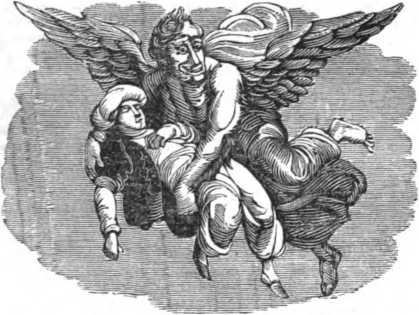
The fairy and the genie having thus concerted what they had to do, the genie lifted up Bedreddin Hassan gently, and with an inconceivable swiftness carried him through the air, and set him down at the door of a public house, next to the bath, whence hump-back was to come with the train of slaves that waited for him. Bedreddin Hassan awaked that very moment, and was mightily surprised to find himself in the middle of a city he knew not. He was going to cry out, and to ask where he was; but the genie touched him gently on the shoulder, and forbid him to speak a word. Then he put a torch in his hand, and bid him go and mix with the crowd at the door of the bath —follow them till you come into a hall, where they are going to celebrate a marriage. The bridegroom is a hump-backed fellow, and by that you will easily know him. Put yourself at the right hand as you go in, and then immediately open the purse of sequins you have in your bosom, and distribute them among the musicians and dancers as they go along; and when you are got into the hall, give money also to the female slaves you see about the bride, when they come near you; but every time you put your hand in your purse, be sure to take out a whole handful, and do not spare them. Observe to do every thing exactly as I have told you, with great presence of mind; be not afraid of any person or thing, and leave the rest to a superior power, who will order matters as he thinks fit.
Young Bedreddin being well instructed in all that he was to do, advanced towards the door of the bath; the first thing he did was to light his torch as that of a slave; and then mixing among them as if he belonged to some nobleman of Cairo, he marched along as they did, and followed hump-back, who came out of the bath, and mounted a horse out of the sultan’s own stable.
Bedreddin Hassan coming near to the musicians, and men and women dancers, who went just before the bridegroom, pulled out time after time whole handfuls of sequins, which he distributed among them; and as he thus gave his money with an unparalleled grace and engaging mien, all who received it cast their eyes upon him; and after they had a full view of his face, they found him so handsome and comely, that they could not look off again.
At last they came to Schemseddin Mohammed’s gate, who was Bedreddin Hassan’s uncle, and little thought his nephew was so near. The doorkeepers, to prevent any disorder, kept back all the slaves that carried torches, and would not let them come in. Bedreddin was likewise refused; but the musicians, who had free entrance, stood still, and protested they would not go in, if they hindered him from going along with them. He is not one of the slaves, said they: look upon him, and you will soon be satisfied as to that. He is certainly a young stranger who is curious to see the ceremonies observed at weddings in this city; and saying thus, they put him in the midst of them, and carried him in, whether the porters would or no; they took his torch out of his hand, and gave it to the first they met: having brought him into the hall, they placed him at the right hand of the hump-backed bridegroom, who sat near the vizier’s daughter on a throne most richly adorned.
She appeared very lovely in all her dresses, but in her face there was nothing to be seen but vexation and mortal grief. The cause of this was easy to be guessed at, when she had by her side a bridegroom so very deformed; and so unworthy of her love. The throne of that ill matched couple was in the midst of a sofa. The ladies of the emirs, viziers, and those of the sultan’s bedchamber, and several other ladies of the court and city, were placed on each side, a little lower, every one according to their quality, and all of them so finely and richly dressed, that it was one of the pleasantest sights that could be seen, each of them holding a large wax taper in their hand.
When they saw Bedreddin Hassan come into the room, they all fixed their eyes upon him, and admiring his shape, his behaviour, and the beauty of his face, they could not forbear looking upon him. When he was set down, every one left their seats and came near to him to have a full view of his face, and almost all of them, as they turned to their seats, found themselves moved with tender passion.
The disparity between Bedreddin Hassan and the hump-backed groom, who made such a horrible figure, occasioned a great murmuring among the company, insomuch that the ladies cried out, We must give our bride to this handsome young gentleman, and not to this ugly hump-back. Nor did they rest here, but uttered imprecations against the sultan, who, abusing his absolute power, would unite ugliness and beauty together. They did also upbraid the bridegroom, so as they put him quite out of countenance, to the great satisfaction of the spectators, whose shouts for some time put a stop to the concert of music in the hall. At last, the musicians began again, and the women who had dressed the bride came all about her.
At the sound of the instruments, the bride changed her dress seven different times, and each time that she did so, she rose up from her seat, followed by her bride-woman, and passed by hump-back, without giving him one look, and went towards Bedreddin Hassan, before whom she presented herself in her new attire. On this occasion, Bedreddin, according to the instructions given him by the genie, failed not to put his hands in his purse, and pulled out handfuls of sequins, which he distributed among the women that followed the bride. Nor did he forget the players and dancers, but also threw money to them. It was pleasant to see how they pushed one another to gather it up. They showed themselves very thankful, and made him signs that the young bride should be for him, and not for the hump-back fellow. The women that attended her, told her the same thing, and did not value whether the groom heard them or not; for they put a thousand tricks upon him, which very much pleased the spectators.
When the ceremony of changing habits was passed, the music ceased and went away, but made a sign to Bedreddin Hassan to stay behind. The ladies did the same, and went all home, but those that belonged to the house. The bride went into a closet, whither her woman followed to undress her, and none remained in the hall but the hump-back groom, Bedreddin Hassan, and some of the domestics.
Hump-back, who was furiously mad at Bedreddin, suspecting him to be his rival, gave him a cross look, and said, And thou, what dost thou wait for? Why art thou not gone as well as the rest? Begone. Bedreddin having no pretence to stay, withdrew, not knowing what to do with himself. But he was not gone out of the porch, when the genie and the fairy met and stopped him. Whither are you going? said the fairy; stay, for hump-back is not in the hall, he is gone out about some business; you have nothing to do but return, and introduce yourself into the bride’s chamber. As soon as you are alone with her, tell her boldly that you are her husband, that the sultan’s intention was only to make sport with the groom; and to make this pretended bridegroom some amends, you had caused to be prepared for him in the stable, a good dish of cream. And then tell her all the fine things you can think on to persuade her; for being so handsome as you are, little persuasion will do; she will think herself happy in being deceived so agreeably. In the mean time, we will take care that the hump-back shall not return, and let nothing hinder you from passing the night with your bride, for she is yours, and none of his.
While the fairy thus encouraged Bedreddin, and instructed him how he should behave himself, hump-back was really gone out of the room: for the genie went to him in the shape of a great cat mewing at a most fearful rate. The fellow called to the cat, he clapped his hands to make her flee; but instead of that the cat stood upon her hinder feet, staring with her eyes like fire, looking fiercely at him, mewing louder than she did at first, and growing bigger till she was as large as an ass. At this sight, hump-back would have cried out for help, but his fear was so great, that he stood gaping, and could not utter one word; and that he might have no time to recover, the genie changed himself immediately into a large buffalo, and in this shape, called to him with a voice that redoubled his fear, Thou hump-backed villain! At these words, the affrighted groom cast himself upon the ground, and covering his face with his gown, that he might not see this dreadful beast, Sovereign prince of buffaloes, said he, what is it you want of me? —Wo be to thee, replied the genie; hast thou the boldness to venture to marry my mistress? O my lord, said hump-back, I pray you to pardon me; if I am guilty, it is through ignorance; I did not know that this lady had a buffalo to her sweetheart; command me in any thing you please, I give you my oath that I am ready to obey you. —By death, replied the genie, if thou goest out from hence, or speakest a word till the sun rises, I will crush thy head to pieces; but then I give thee leave to go from hence: I warn thee to make despatch, and not to look back, but if thou hast the imprudence to return, it shall cost thee thy life. When the genie had done speaking, he transformed himself into the shape of a man, took hump-back by the legs, and after having set him against the wall, with his head downwards, if thou stir, said he, before the sun rise, as I have told thee already, I will take thee by the heels again, and dash thy head in a thousand pieces against the wall.
To return to Bedreddin Hassan, who being prompted by the genie and the presence of the fairy, got into the hall again, from whence he slipt into the bride-chamber, where he sat down, expecting the success of his adventure. After a while, the bride arrived, conducted by an old matron, who came no farther than the door, exhorting the bridegroom to do his duty like a man, without looking in to see if it was hump-back or another, and then locked the door, and retired.
The young bride was mightily surprised, instead of hump-back, to find Bedreddin Hassan, who came up to her with the best grace in the world. What! my dear friend, said she, by your being here at this time of night, you must be my husband’s comrade? —No, madam, said Bedreddin, I am of another sort of quality than that ugly hump-back. But, said she, you do not consider that you speak degradingly of my husband. —He your husband, madam! replied he; can you retain those thoughts so long? Be convinced of your mistake, madam, for so much beauty must never be sacrificed to the most contemptible of all mankind. It is I, madam, that am the happy mortal for whom it is reserved. The sultan had a mind to make himself merry by putting this trick upon the vizier your father, but he chose me to be your real husband. You might have observed how the ladies, the musicians, the dancers, your women, and all the servants of your family, were pleased with this comedy. We have sent that hump-backed fellow to his stable again, where he is just now eating a dish of cream; and you may rest assured that he will never appear any more before your eyes.
At this discourse, the vizier’s daughter, who was more like one dead than alive when she came into the bride-chamber, put on a gay air, which made her so handsome that Bedreddin was perfectly charmed with her.
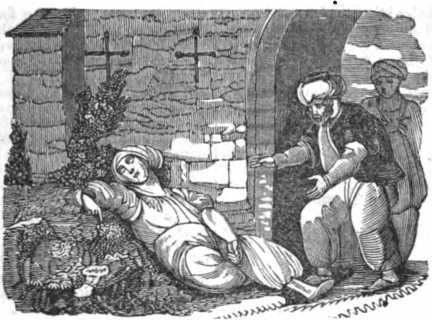
I did not expect, said she, to meet with so pleasing a surprise; and I had condemned myself to live unhappily all my days. But my good fortune is so much the greater that I possess in you a man that is worthy of my tenderest affection.
Having spoken thus, she undressed herself and stept into bed. Bedreddin Hassan, overjoyed to see himself possessor of so many charms, made haste to follow her, and laid his clothes upon a chair, with the bag that he got from the Jew; which, notwithstanding all the money he had pulled out, was still full. He likewise laid off his turban, and put on a night-cap that had been ordained for hump-back, and so went to bed in his shirt and drawers. [60] His drawers were of blue satin, tied with a lace of gold.
Whilst the two lovers were asleep, the genie, who had met again with the fairy, told her that it was high time to finish what was begun, and so successfully carried on hitherto: then let us not be overtaken by daylight, which will soon appear; go you and bring off the young man again without awaking him.
The fairy went into the bed-chamber where the two lovers were fast asleep, and took up Bedreddin Hassan just as he was, that is to say, in his shirt and drawers; and in company with the genie, with a wonderful swiftness flew away with him to the gates of Damascus, in Syria, where they arrived just at the time when the officers of the mosques, appointed for that end, were calling the people to come to prayers at break of day. The fairy laid Bedreddin Hassan softly on the ground, and leaving him close by the gate, departed with the genie.
The gate of the city being opened, and a great many people assembled to get out, they were mightly surprised to see Bedreddin Hassan lying in his shirt and drawers upon the ground. One said, He has been hard put to it to get away from his mistress, that he could not get time to put on his clothes. —Look ye, said another, how people expose themselves: sure enough he has spent most part of the night in drinking with his friends, till he has got drunk; and then, perhaps, having occasion to go out, instead of returning, is come this length, and not having his senses about him, was overtaken with sleep. Others were of another opinion; but nobody could guess what had been the occasion of his coming thither.
A small puff of wind happening to blow at the same time, uncovered his breast, that was whiter than snow. Every one being struck with admiration at the fineness of his complexion, they spoke so loud that it awaked the young man.
His surprise was as great as theirs, when he found himself at the gate of a city where he had never been before, and encompassed by a crowd of people gazing at him. Gentlemen, said he, for God’s sake tell me where I am, and what you would have of me? One of the crowd spoke to him, saying, Young man, the gates of the city were just now opened, and as we came out we found you lying here in this condition, and stood still to look on you: Have you lain here all night? and do not you know that you are at one of the gates of Damascus? —At one of the gates of Damascus! answered Bedreddin; sure you mock me. When I lay down to sleep last night I was at Cairo. When he said these words, some of the people, moved with compassion for him, said, It is pity that such a handsome young man should have lost his senses! and so went away.
My son, said an old gentleman to him, you know not what you say. How is it possible that you, being this morning at Damascus, could be last night at Cairo? —It is true, for all that, said Bedreddin; for I swear to you, that I was all day yesterday at Balsora. He had no sooner said these words, but all the people fell into a fit of laughter, and cried out, He’s a fool, he’s a madman. There were some, however, that pitied him because of his youth; and one among the company said to him, My son, you must certainly be crazed; you do not consider what you say. Is it possible that a man could yesterday be at Balsora, the same night at Cairo, and next morning at Damascus? Sure you are asleep still: come, rouse up your spirits. —What I say, answered Bedreddin Hassan, is so true, that last night I was married in the city of Cairo. All those that laughed before could not forbear laughing again, when he said so. Call yourself to mind, said the same person that spoke before; you have sure enough dreamt all this, and that fancy still possesses your brain. —I am sensible of what I say, answered the young man. Pray can you tell me how it was possible for me to go in a dream to Cairo, where I am very certain I was in person, and where my bride was seven times brought before me, each time dressed in a different habit: and where I saw an ugly hump-backed follow, to whom they intended to give her? Besides, I want to know what is become of my gown, my turban, and the bag of sequins I had at Cairo.
Though he assured them that all these things were matter of fact, yet they could not forbear to laugh at him; which put him into such confusion, that he knew not what to think of all those adventures.
After Bedreddin Hassan had confidently affirmed all that he said to be true, he rose up to go into the town, and every one that followed him called out, A madman, a fool. Upon this some looked out at their windows, some came to their doors, and others joined with those that were about him, calling out as they did, A madman; but not knowing for what In this perplexity of mind the young gentleman happened to come before a pastrycook’s shop, and went into it to avoid the rabble.
This pastrycook had formerly been captain to a troop of Arabian robbers, who plundered the caravans; and though he was become a citizen of Damascus, where he behaved himself to every one’s content, yet he was dreaded by all those that knew him; wherefore, as soon as he came out to the rabble that followed Bedreddin, they dispersed.
The pastrycook seeing them all gone, asked him who he was, and what brought him thither? Bedreddin Hassan told him all, not concealing his birth, nor the death of his father, the grand vizier. He afterwards gave him an account why he left Balsora; now, after he had fallen asleep the night following upon his father’s tomb, he found himself when he awaked at Cairo, where he had married a lady; and at last, in what amazement he was, when he found himself at Damascus, without being able to penetrate into all those wonderful adventures.
Your history is one of the most surprising, said the pastrycook; but if you will follow my advice, you shall let no man know those matters you have revealed to me, but patiently expect till heaven think fit to put an end to your misfortunes; you shall be free to stay with me till then; and since I have no children, I will own you for my son, if you consent to it; and after you are so adopted, you may freely walk up and down the city, without being exposed any more to the insults of the rabble.
Though this adoption was below the son of a grand vizier, Bedreddin was glad to accept of the pastrycook’s proposals, judging it the best thing he could do, considering his then circumstances. The cook clothed him, called for witnesses, and went before a notary, where he acknowledged him for his son. After this Bedreddin staid with him by the name of Hassan, and learned the pastry trade.