ARABIAN NIGHTS’ (continued 13)
Reading edition · Edition 2
The princess would not give him leave to go on, but cried out, Alas! you bring me the news of my son’s death. She and her women, at the same time, set up such a hideous cry as brought fresh tears into the jeweller’s eyes. She tormented and grieved herself a long while, before she would suffer him to resume his story. At length, she checked her sighs and groans, and begged of him to continue, without concealing from her the least circumstance of such a melancholy separation. He satisfied her, and when he had done, she farther demanded of him, if her son, the prince, had not given him in charge something more particular in his last moments. He assured her his last words were, that it was the greatest concern to him, that he must die so far distant from his dear mother; and that the only thing he wished was, that she would be pleased to have his corpse transported to Bagdad. Accordingly, early next morning the princess set out with her women, and great part of her slaves, to bring her son’s body to her own palace.
When the jeweller, whom she kept with her, saw she was gone, he returned home very sad and melancholy, at the reflection that so accomplished and amiable a prince was thus cut off in the flower of his age.
As he walked towards his house, dejected and musing, he saw a woman in mourning, drowned in tears, standing before him: on lifting up his eyes, he presently knew her to be Schemselnihar’s confidant. At the sight of her his tears began to flow afresh, but he said nothing to her; and going into his own house, she followed him.
They sat down; when the jeweller beginning the conversation, asked the confidant, with a deep sigh, if she had heard of the death of the prince of Persia, and if it was on his account that she grieved. Alas! answered she, what, is that charming prince then dead? He has not lived long after his dear Schemselnihar. Beauteous souls! continued she, in whatsoever place ye now are, ye must be happy that your loves will no more be interrupted. Your bodies were an obstacle to your wishes, but heaven has delivered you from them; ye may now form the closest union.
The jeweller, who had heard nothing of Schemselnihar’s death, and had not observed the confidant was in mourning, suffered fresh grief at hearing this news. Is Schemselnihar then dead? cried he. She is dead, replied the confidant, weeping afresh; and it is for her I wear these weeds. The circumstances of her death were extraordinary, continued she, and deserve to be known to you; but before I give you an account of them, I beg you to let me know those of the prince of Persia, whom, with my dearest friend and mistress, I shall lament as long as I live.
The jeweller then gave the confidant that satisfaction she desired; and after he had told her all, even to the departure of the prince’s mother, to bring her son’s body to Bagdad, she began and said, You have not forgot that I told you the caliph had sent for Schemselnihar to his palace; and it is true, as we had all the reason in the world to believe, he had been informed of the amour betwixt her and the prince, by the two slaves, whom he had examined apart. You will imagine, he would be exceedingly enraged at Schemselnihar, and express great tokens of jealousy and revenge against the prince: but this was by no means the case. He pitied Schemselnihar, and in some measure blamed himself for what had happened, in giving her so much freedom to walk about the city without being attended by his eunuchs. This is the only conclusion that could be drawn from his extraordinary behaviour towards her, as you will hear.
He received her with an open countenance; and when he observed that the melancholy which oppressed her did not lessen her beauty, (for she appeared thus before him without surprise or fear,) with a goodness worthy himself, he said, Schemselnihar, I cannot bear your appearing before me thus, with an air which gives me infinite pain. You must needs be sensible how much I have always loved you, and be convinced of the sincerity of my passion by the continued demonstrations I have given you of it. I can never change my mind, for I love you more than ever. You have enemies, Schemselnihar, proceeded he, and those enemies have insinuated things against your conduct; but all they have said against you has not made the least impression upon me. Shake off then this melancholy, and prepare to entertain me with some diverting and amusing conversation this night, after your accustomed manner. He said many other obliging things to hen and then desired her to step into a magnificent apartment near her own, and wait for him.
The afflicted Schemselnihar was very sensible of the kindness the caliph had for her; but the more she thought herself obliged to him, the more she was concerned that she was so far removed, perhaps for ever, from her prince, without whom she could not live.
This interview between the caliph and Schemselnihar, continued the confidant, was whilst I was come to speak with you, and I learned the particulars of it from my companions who were present. But I had no sooner left you, proceeded she, than I went to my dear mistress again, and was eye-witness to what happened in the evening. I found her in the apartment I told you of; and as she thought I came from you, she came up to me, and, whispering me in the ear, said, I am much obliged to you for the service you have done me, but feel it will be the last. She said no more; but I was not in a place proper to offer any thing to comfort her.
The caliph was introduced at night with the sound of instruments, which her women played upon, and the collation was immediately served up. He took his mistress by the hand, and made her sit down with him on the sofa. She put such a force upon herself to please him, that she expired a few minutes after. In short, she was hardly set down, but she fell backwards: the caliph believed she had only fainted, and so we all thought; but she never recovered, and in this manner we lost her.
The caliph did her the honour to weep over her, not being able to refrain from tears; and before he left the room, ordered all the musical instruments to be broken, which was immediately executed. I stayed with her corpse all night, and next morning washed and dressed her for her funeral, bathing her with my tears. The caliph had her interred next morning in a magnificent tomb he had erected for her in her lifetime, in a place she had desired to be buried in. Now, since you tell me, said she, the prince of Persia’s body is to be brought to Bagdad, I will use my best endeavours that he shall be interred in the same tomb.
The jeweller was much surprised at this resolution of the confidant, and said, Certainly you do not consider that the caliph will never suffer this. You think the thing impossible, replied she; it is not: you will alter your opinion when I tell you that the caliph has given liberty to all her slaves, with a pension to each for their maintenance, and has committed to me the care and keeping of my mistress’s tomb, and allotted me an annual income for that purpose, and for my maintenance. Besides, the caliph, who was not ignorant of the amour between Schemselnihar and the prince, as I have already told you, without being offended at it, will not be sorry if after her death he be buried with her. To all this the jeweller had not a word to say, yet earnestly entreated the confidant to conduct him to her mistress’s tomb, that he might say his prayers over her. When he came in sight of it, he was not a little surprised to find a vast concourse of people of both sexes, that were come thither from all parts of Bagdad. As he could not come near the tomb, he said his prayers at a distance; and then going to the confidant, who was waiting hard by, he said to her, Now I am so far from thinking that what you properly proposed cannot be put in execution, that you and I need only publish abroad what we know of the amour of this unfortunate couple, and how the prince died much about the same time with his mistress. Before his corpse arrives, all Bagdad will concur to desire that two such faithful lovers should not be separated when dead, whom nothing could divide in affection whilst they lived. As he said, so it came to pass; for as soon as it came to be known that the corpse was within a day’s journey of the city, an infinite number of people went out to meet it above twenty miles off, and afterwards walked before it till it came to the city gate; where the confidant, waiting for that purpose, presented herself before the prince’s mother, and begged of her, in the name of the whole city, who earnestly desired it, that she would be pleased to consent that the bodies of the two lovers, who had but one heart whilst they lived, from the time their mutual passion commenced, might be buried in the same tomb now they were dead. The princess immediately consented; and the corpse of the prince, instead of being deposited in his own burying-place, was laid by Schemselnihar’s side, after it had been carried along in procession at the head of an infinite number of people of all ranks. From that time all the inhabitants of Bagdad, and even strangers from all parts of the world where the Mahometan religion prevails, cease not to hold in the highest veneration that tomb, and pay their devotion at it.
The Story of the Amours of Carmaralzaman, Prince of the Isles of the Children of Khaledan, and of Badoura, Princess of China.
About twenty days’ sail on the coast of Persia, there are islands in the main ocean called the Islands of the Children of Khaledan. These islands are divided into four great provinces, which have all of them very flourishing and populous cities, forming together a powerful kingdom. It was formerly governed by a king named Schahzaman, [83] who had four lawful wives, all daughters of kings, and sixty concubines.
Schahzaman thought himself the most happy monarch of the world, on account of his peaceful and prosperous reign. One thing only disturbed his happiness; which was, that he was advanced in years, and had no children, though he had so many wives. He knew not to what to attribute this barrenness; and what increased his affliction was, that he was likely to leave his kingdom without a successor. He dissembled his discontent a long while; and this dissimulation only heightened his uneasiness. At length he broke silence; and one day, after he had complained bitterly of his misfortunes to his grand vizier, he asked him if he knew any remedy for it.
That wise minister replied, If what your majesty requires of me had depended on the ordinary rules of human wisdom, you had soon had an answer to your satisfaction; but my experience and knowledge fall far short of your question. The Divine Power alone, who, in the midst of our prosperities, which often tempt us to forget him, is pleased to mortify us in some instance, that we may address our thoughts to him, acknowledge his omnipotence, and ask of him what we can expect from him alone. Your majesty has subjects, proceeded he, who make a profession of honouring and serving God, and suffering great hardships for his sake; to them I would advise you to have recourse, and engage them, by alms, to join their prayers with yours: it may be, some one among them may be so pure and pleasing to God as to obtain a hearing from your prayers.
King Schahzaman approved this advice, and thanked his vizier for it. He immediately caused rich alms to be given to every community of these holy men in his dominions; and having sent for the superiors, and treated them with a frugal feast, declared to them his intention, and desired them to acquaint their devout men with it.
The king obtained of heaven what he requested; for in nine months’ time he had a son by one of his wives. To express his gratitude to heaven, he sent new alms to the communities of devout Mussulmen, and the prince’s birth-day was celebrated not only in his capital, but throughout his dominions for a whole week. The prince was brought to him as soon as born, and he found him so beautiful, that he gave him the name of Camaralzaman, or Moon of the Age.
He was brought up with all imaginable care; and when he came to a proper age, his father appointed him an experienced governor, and able preceptors. These persons, distinguished by their capacity, found in him a ready wit, capable of receiving all the instructions that were proper to be given him, as well in relation to morals as other knowledge which a prince ought to possess. As he grew up, he learned all his exercises, and acquitted himself with such grace and wonderful address, as charmed all that saw him, and particularly the sultan his father.
Having attained the age of fifteen years, the sultan, who loved him so tenderly, and gave him every day new marks of his affection, had thoughts of giving him a still greater, by resigning his throne to him, and acquainted his grand vizier with his intentions. I fear, said he, lest my son should lose in the inactivity of youth those advantages which nature and my education have given him: therefore, since I am advanced in age, and ought to think of retirement, I have thoughts of resigning the government to him, and passing the remainder of my days in the satisfaction of seeing him reign. I have undergone the fatigue of a crown a long while, and think it now proper for me to retire.
The grand vizier declined offering all the reasons he could have alleged to dissuade the sultan from such a proceeding; on the contrary, he agreed with him in opinion. Sir, replied he, the prince is yet but young, and it would not be, in my humble opinion, advisable to burthen him with the weight of a crown so soon. Your majesty fears, with great reason, his youth may be corrupted in indolence; but to remedy that, do not you think it would be proper to marry him? Marriage forms attachment, and prevents dissipation. Your majesty might then admit him of your council, where he would learn by degrees the art of reigning, and so be qualified to receive your authority, whenever, by your own experience, you shall think him qualified.
Schahzaman found this advice of his prime minister’s highly reasonable, therefore summoned the prince to appear before him at the same time that he dismissed the grand vizier.
The prince, who had been accustomed to see his father only at certain times, without being sent for, was a little startled at this summons; when, therefore, he came before him, he saluted him with great respect, and stood with his eyes fixed on the ground.
The sultan perceiving his constraint, said to him in a mild way, Do you know, son, for what reason I have sent for you? The prince modestly replied, God alone knows the heart; I shall hear it from your majesty with pleasure. I sent for you, said the sultan, to inform you I have an intention of providing a proper marriage for you; what do you think of it?
Prince Camaralzaman heard this with great uneasiness; it so surprised him, that he paused and knew not what answer to make. After a few moments’ silence, he replied, Sir, I beseech you to pardon me, if I seem surprised at the declaration you have made to me. I did not expect such proposals to one so young as I am; and I know not whether I could ever prevail on myself to marry, on account of the trouble incident to a married life, and the many treacheries of women, which I have read of. I may not be always of the same mind; yet I perceive it requires time to determine on what your majesty requires of me.
Prince Camaralzaman’s answer extremely afflicted his father. He was not a little grieved to see what an aversion he had to marriage; yet would not charge him with disobedience, nor exert his paternal authority. He contented himself with telling him he would not force his inclinations, but give him time to consider of the proposal, and reflect, that a prince like him, destined to govern a great kingdom, ought to take some care to leave a successor; and that, in giving himself that satisfaction, he communicated it to his father, who would be glad to see himself revive in his son and his issue.
Schahzaman said no more to the prince: he admitted him into his council, and gave him every reason to be satisfied. At the end of the year, he took him aside, and said to him, My son, have you thoroughly considered of what I proposed to you about marrying last year? Will you still refuse me that pleasure I expect from your obedience, and suffer me to die without giving me that satisfaction?
The prince seemed less disconcerted than before, and was not long answering his father to this effect: Sir, I have not neglected to consider of your proposal; but after the maturest reflection, find myself more confirmed in my resolution to continue as I am without engaging in marriage. In short, the infinite mischief I have read in histories caused in the world by women, and the continual mischiefs I still hear done by them, are powerful motives for me to have nothing to do with them: so that I hope your majesty will pardon me if I presume to tell you it will be in vain to solicit me any farther about marriage. He stopt here, and went out, without staying to hear what the sultan would answer.
Any monarch but Schahzaman would have been very angry at such freedom in a son, and would have made him repent it; but he loved him, and preferred gentle methods before he proceeded to compulsion. He communicated this new cause of discontent to his prime minister. I have followed your advice, said he, but Camaralzaman is farther than ever from complying with my desires. He delivered his resolution in such free terms, that it required all my reason and moderation to keep my temper. Fathers, who so earnestly desire children as I did this son, are fools who seek to deprive themselves of that rest which it is in their own power to enjoy without control. Tell me, I beseech you, how I shall reclaim a disposition so rebellious to my will.
Sir, answered the grand vizier, patience brings many things about that before seemed impracticable; but it may be this affair is of a nature not likely to succeed that way. Your majesty will have no cause to reproach yourself for precipitation, if you would give the prince another year to consider of the matter. If in this interval, he return to his duty, you will have the greater satisfaction, as you will have employed only paternal love to induce him; and if he still continue averse to your proposal when this is expired, your majesty may propose it to him in full council, that it is highly necessary for the good of the state that he should marry; and it is not likely he will refuse to comply with you before so grave an assembly, which you honour with your presence.
The sultan, who so passionately desired to see his son married, thought this long delay an age; however, though with much difficulty, he yielded to his grand vizier’s reasons, which he could not disapprove.
After the grand vizier was gone, sultan Schahzaman went to the apartment of the mother of prince Camaralzaman, to whom he had often expressed his desire to see the prince married. When he had told her, with grief, how his son had refused to comply with his wishes a second time, and the indulgence, which by the advice of his grand vizier, he was inclined to show him, he said, Madam, I know he has more confidence in, and will hearken more to you than me; therefore, I desire you would take an opportunity to talk to him seriously about it, and convince him, that if he persists in his obstinacy, he will oblige me to have recourse to extremities, which I should be sorry for, and which may give him cause to repent having disobeyed me.
Fatima, for so was the lady called, acquainted the prince the first time she saw him, that she had been informed of his second refusal to marry, and how much chagrin he had occasioned his father on that account. Madam, said the prince, I beseech you not to renew my grief upon that head. I fear, in my present uneasiness, something may escape me, which may not altogether correspond with the respect I owe you. Fatima knew by this answer that this was not a proper time to speak to him, and therefore deferred what she had to say to another opportunity.
Some considerable time after, Fatima thought she had found a more favourable opportunity, which gave her hopes of being heard upon that subject. Son, said she, I beg of you, if it be not disagreeable, to tell me what reason you have for your so great aversion to marriage? If it be only the wickedness of some women, nothing can be more unreasonable and weak. I will not undertake the defence of those that are bad; there are a great number of them undoubtedly; but it would be the height of injustice to condemn all the sex for their sakes. —Alas! my son, you have in your books met with many bad women, who have occasioned great mischief, and I will not excuse them; but you do not consider how many monarchs, sultans, and other princes, there have been in the world, whose tyrannies, barbarities, and cruelties astonished those that read of them, as well as myself. Now, for one wicked woman, you will meet with a thousand tyrants and barbarians; and what torment do you think a good woman must undergo, who is matched with any of these wretches?
Madam, replied Camaralzaman, I doubt not there are a great number of wise, virtuous, good, affable, and well-behaved women in the world: would to God they all resembled you! But what deters me is the doubtful choice a man is obliged to make; and oftentimes one has not the liberty of following his inclination.
Let us suppose then, madam, continued he, that I had a mind to marry, as the sultan my father so earnestly desires, what wife, think you, would he be likely to provide for me? Probably a princess whom he would demand of some neighbouring prince, and who would think it an honour done him to send him her. Handsome or ugly, she must be taken; nay, suppose no other princess excelled her in beauty, who can be certain that her temper would be good; that she would be affable, complaisant, easy, obliging, and the like? That her conversation would generally turn on solid subjects, and not on dress, fashions, ornaments, and a thousand such fooleries, which would disgust any man of sense? In a word, that she would not be haughty, proud, arrogant, impertinent, scornful, and waste an estate in frivolous expenses, such as gay clothes, jewels, toys, and foolish, mistaken magnificence?
You see, madam, continued he, by one single article, how many reasons a man may have to be disgusted at marriage. Let this princess be never so perfect, accomplished, and irreproachable in her conduct, I have yet a great many more reasons not to alter my opinion and resolution.
What, son, replied Fatima, have you then more reasons after those you have already alleged? I do not doubt of being able to answer them, and stop your mouth with a word. You may proceed, madam, replied the prince, and perhaps I may find a reply to your answer.
I mean, son, said Fatima, that it is easy for a prince who has had the misfortune to marry such a wife as you describe, to get rid of her, and take care that she may not ruin the state. Ah, madam, replied the prince, but you do not consider what a mortification it would be to a person of so great quality, to be obliged to come to such an extremity. Would it not have been more for his honour and quiet, that he had never run such a risk?
But, son, said Fatima once more, as you take the case, I apprehend you have a mind to be the last king of your race, who have reigned so long and gloriously over the isles of the children of Khaledan.
Madam, replied the prince, for myself I do not desire to survive the king, my father; and if I should die before him, it would be no great matter of wonder, since so many children have died before their parents. But it is always glorious to a race of kings, that it should end with a prince worthy to be so, as I should endeavour to make myself like my predecessors, and like the first of our race.
From that time Fatima had frequent conferences with her son the prince on the same subject; and she omitted no opportunity or argument to endeavour to root out his aversion to the fair sex; but he eluded all her reasonings by such arguments as she could not well answer, and continued in the same mind.
The year expired, and, to the great regret of the sultan, prince Camaralzaman gave not the least sign of having changed his sentiments. One day, therefore, when there was a great council held, the prime vizier, the other viziers, the principal officers of the crown, and the generals of the army being present, the sultan began to speak thus to the prince: My son, it is now a long while since I have expressed to you my earnest desire to see you married; and I imagined you would have had more complaisance for a father, who required nothing unreasonable of you, than to oppose him so long. But after so long resistance on your part, which has almost worn out my patience, I have thought fit to propose the same thing once more to you in the presence of my council. I would have you consider that you ought not to have refused this, if merely to oblige a parent; the well-being of my dominions requires it; and the assembly here present join with me to require it of you. Declare yourself, then; that according to your answer, I may take the proper measures.
The prince answered with so little reserve, or rather with so much warmth, that the sultan, enraged to see himself thwarted by him in full council, cried out, How, unnatural son! have you the insolence to talk thus to your father and sultan? He ordered the guards to take him away, and carry him to an old tower that had been unoccupied for a long while, where he was shut up, with only a bed, a little furniture, some books, and one slave to attend him.
Camaralzaman, thus deprived of liberty, was nevertheless pleased he had the freedom to converse with his books, and that made him look on his confinement with indifference. In the evening he bathed and said his prayers; and after having read some chapters in the Koran, with the same tranquillity of mind as if he had been in the sultan’s palace, he undressed himself and went to bed, leaving his lamp burning by him all the while he slept.
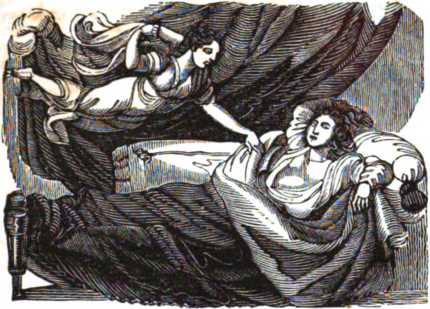
In this tower was a well, which served in the daytime for a retreat to a certain fairy, named Maimoune, daughter of Damriat, king or head of a legion of genies. It was about midnight when Maimoune sprang lightly to the mouth of the well, to wander about the world after her wonted custom, where her curiosity led her. She was surprised to see a light in prince Camaralzaman’s chamber. She entered, and without stopping at the slave who lay at the door, approached the bed, whose magnificence attracted her; but she was still more surprised at seeing any body in it.
Prince Camaralzaman had but half-covered his face with the bed-clothes, which Maimoune lifted up, and perceived the finest young man she had seen in all her rambles through the world. What beauty, or rather what prodigy of beauty, said she within herself, must this youth appear, when the eyes, concealed by so well-formed eyelids, shall be open! What crime can he have committed, that a man of his high rank can deserve to be treated thus rigorously? for she had already heard his story, and could hardly believe it.
She could not forbear admiring the prince, till, at length, having kissed him gently on both cheeks, and in the middle of the forehead, without waking him, she laid the bed-clothes in the order they were in before, and took her flight into the air. As she mounted high to the middle region, she heard a great flapping of wings, which made her fly that way; and when she approached, she knew it was a genie who made the noise, but it was one of those that are rebellious against God. As for Maimoune, she belonged to that class whom the great Solomon compelled to acknowledge him.
This genie, whose name was Danhasch, and son of Schamhourasch, knew Maimoune, and was seized with fear, being sensible how much power she had over him by her submission to the Almighty. He would fain have avoided her, but she was so near him, he must either fight or yield. He therefore broke silence first.
Brave Maimoune, said he, in the tone of a suppliant, swear to me in the name of the great God that you will not hurt me, and I swear also on my part not to do you any harm.
Cursed genie, replied Maimoune, what hurt canst thou do me? I fear thee not; but I will grant thee this favour —I will swear not to do thee any harm. Tell me then, wandering spirit, whence thou comest, what thou hast seen, and what thou hast done this night. Fair lady, answered Danhasch, you meet me in a good time to hear something very wonderful.
The History of the Princess of China.
Danhasch, the genie rebellious against God, proceeded, and said to Maimoune, Since you desire it, I will tell you. I come from the utmost limits of China, which look on the last islands of this hemisphere. —But, charming Maimoune, said Danhasch, who trembled with fear at the sight of this fairy, so that he could hardly speak, promise me at least you will forgive me, and let me go on after I have satisfied your demands.
Go on, go on, cursed spirit, replied Maimoune; go on, and fear nothing. Dost thou think I am as perfidious an elf as thyself, and capable of breaking the solemn oath I have made? Be sure you tell nothing but what is true, or I shall clip thy wings, and treat thee as thou deservest.
Danhasch, a little heartened at the words of Maimoune, said, My dear lady, I will tell you nothing but what is strictly true, if you will but have the goodness to hear me. The country of China, from whence I come, is one of the largest and most powerful kingdoms of the earth, on which depend the utmost islands of this hemisphere, as I have already told you. The king of this country is at present Gaiour, who has an only daughter, the finest woman that ever was seen in the world, since it was a world. Neither you nor I, nor your class nor mine, nor all our respective genies, have expressions strong enough, nor eloquence sufficient, to draw any resemblance of this brilliant lady. Her hair is brown, and of so great a length, that it reaches far below her feet, and so thick, that it may be fitly compared to one of those fine clusters of grapes, whose fruit is so very large, when she has fastened it in buckles on her head. Her forehead is as smooth as the best polished mirror, and admirably formed; her eyes, level with her head, are black, sparkling, and full of fire; her nose is neither too long nor too short, and her mouth small, and of a vermilion colour; her teeth are like two rows of pearls, and surpass the finest in whiteness. When she moves her tongue to speak, she utters a sweet and most agreeable voice, and expresses herself in such terms, as sufficiently indicate the vivacity of her wit. The whitest alabaster is not fairer than her neck. In a word, by this imperfect sketch, you may guess there is no beauty likely to exceed her in the world.
Any one that did not know the king, father of this incomparable princess, would be apt to imagine, from the great respect and kindness he shows her, that he was enamoured with her. Never did a lover more for the most beloved mistress than he has been seen to do for her. The most violent jealousy never suggested such measures as his care to keep her from every one but the man who is to marry her, has put him upon inventing and executing; and that the retreat which he has resolved to place her in may not seem irksome to her, he has built for her seven palaces, the most extraordinary and magnificent that ever were known.
The first palace is of rock crystal; the second of brass; the third of fine steel; the fourth of another sort of brass more valuable than the foregoing, or than steel; the fifth of touchstone; the sixth of silver; and the seventh of massy gold. He has furnished these palaces most sumptuously, each in a manner proportionable to the materials that it is built of. He has filled the gardens with parterres of grass and flowers, intermixed with pieces of water, waterworks, jets d’eau, canals, cascades, and several great groves of trees, where the eye is lost in prospect, and where the sun never enters, all of which are differently arranged. King Gaiour, in a word, has shown, that his paternal love has led him to spare no expense.
Upon the fame of this incomparable princess’s beauty, the most powerful neighbouring kings sent ambassadors to request her in marriage. The king of China received them all in the same obliging manner; but as he resolved not to marry his daughter without her consent, and she did not like any of the parties, the ambassadors were forced to return as they came, as to the subject of their embassy; but they were perfectly satisfied with the great honours and civilities they had received.
Sir, said the princess to the king, her father, you have an inclination to see me married, and think to oblige me by it; but where shall I find such stately palaces and delicious gardens as I have with your majesty? Through your good pleasure, I am under no constraint, and have the same honours shown to me, as are paid to yourself. These are advantages I cannot expect to find any where else, to whatsoever husband I should give my hand; men love ever to be masters, and I do not care to be commanded.
After divers more embassies on the same occasion, there came one from the most rich and potent king of all that had hitherto sent. This prince the king of China recommended to his daughter as a husband, urging many powerful arguments to show how much it would be to her advantage to accept him; but she entreated her father to dispense with her accepting him, for the same reason as before. He pressed her; but instead of complying, she lost all the respect due to the king, her father: Sir, said she, in anger, talk to me no more of this, or any other match, unless you would have me plunge this poniard in my bosom, to deliver myself from your importunities.
The king, greatly enraged, said, Daughter, you are mad, and I must treat you as such. In a word, he had her shut up in a single apartment of one of his palaces, and allowed her only ten old women to wait upon her, and keep her company, the chief whereof had been her nurse; and that the kings, his neighbours, who had sent embassies to him on this account, might not think any more of her, he despatched envoys to them severally, to let them know how averse his daughter was to marriage; and as he did not doubt but she was really mad, he charged them to make known in every court, that if there was any physician that would undertake to come and cure her, he should, if he succeeded, have her for his pains.
Fair Maimoune, continued Danhasch, all that I have told you is true: and I have not failed to go every day regularly to contemplate this incomparable beauty, to whom I would be very sorry to do the least harm, notwithstanding my natural inclination to mischief. Come and see her, I conjure you: it would be well worth your while, when you find by your own view I am no liar. I am ready to wait on you as a guide, and you have only to command me. I doubt not but you would think yourself obliged to me for the sight of a princess unequalled for beauty.
Instead of answering Danhasch, Maimoune burst out into violent laughter, which lasted for some time; and Danhasch, not knowing what might be the occasion of it, was astonished beyond measure. When she had laughed her fill, she cried, Good, good, very good! you would have me then believe all you have told me! I thought you designed to tell me something surprising and extraordinary, and you have been talking all this while of a mad woman. Fie, fie! —what would you say, cursed genie, if you had seen the beautiful prince that I am just come from seeing, and whom I love as he deserves? I am confident you would soon give up the contest, and not pretend to compare your choice with mine.
Agreeable Maimoune, replied Danhasch, may I presume to ask you who is this prince you speak of? Know, answered Maimoune, the same thing has happened to him as to your princess. The king, his father, would have married him against his will; but after much importunity, he frankly told him, he would have nothing to do with a wife. For this reason, he is at this moment imprisoned in an old tower, where I make my residence, and whence I came but just now from admiring him.
I will not absolutely contradict you, replied Danhasch; but my pretty lady, you must give me leave to be of opinion, till I have seen your prince, that no mortal upon earth can come up to the beauty of my princess. Hold thy tongue, cursed sprite, replied Maimoune. I tell thee once more that can never be. I will not contend with you, said Danhasch: but the way to be convinced whether what I say is true or false, is to accept of the proposal I made you to go and see my princess, and after that I will go with you to your prince.
There is no need I should take so much pains, replied Maimoune; there is another way to satisfy us both, and that is, for you to bring your princess, and place her at my prince’s bed-side; by this means, it will be easy for us to compare them together and determine the dispute.
Danhasch consented to what Maimoune had proposed, and determined to set out immediately for China, upon that errand. But Maimoune drew him aside, and told him she must first show him the tower whither he was to bring the princess. They flew together to the tower; and when Maimoune had shown it to Danhasch, she cried, Go, fetch your princess, and do it quickly, for you shall find me here; but hear me; I mean you should at least pay the wager, if my prince is more beautiful than your princess, and I will pay it if your princess is more beautiful than my prince.
Danhasch left Maimoune, and flew towards China, whence he soon returned with incredible speed, bringing the fair princess along with him asleep. Maimoune received him, and introduced him into the chamber of prince Camaralzaman, where they placed the princess by the prince’s side.
When the prince and princess were thus laid together, there arose a great contest between the genie and the fairy about the preference of their beauty. They were some time admiring and comparing them without speaking. At length Danhasch broke silence, and said to Maimoune, You see, and I have already told you, my princess was handsomer than your prince; now, I hope, you are convinced of it.
How! convinced of it! replied Maimoune; I am not convinced of it, and you must be blind, if you cannot see that my prince has the better in the comparison. The princess is fair, I do not deny; but if you compare them together without prejudice, you will quickly see the difference.
Though I should compare them never so often, said Danhasch, I could never change my opinion. I saw at first sight what I see now, and time will not make me see differently: however, this shall not hinder my yielding to you, charming Maimoune, if you desire it. I would not have you yield to me as a favour! I scorn it, said Maimoune: I would not receive a favour at the hand of such a wicked genie. I refer the matter to an umpire, and if you will not consent, I shall win by your refusal.
Danhasch, who was ready to have shown a different kind of complaisance for Maimoune, no sooner gave his consent, but Maimoune stamping with her foot, the earth opened, and out came a hideous, hump-backed, squinting, and lame genie, with six horns on his head, and claws on his hands and feet. As soon as he was come out, and the earth had closed up, he, perceiving Maimoune, cast himself at her feet; and then, rising up on one knee, asked her what she would please to have with him.
Rise, Caschcasch, said Maimoune; I brought you hither to determine a difference between me and this cursed Danhasch. —Look on that bed, and tell me, without partiality, which is the handsomest of those two that lie there asleep, the young man or the young lady.
Caschcasch looked on the prince and princess with great attention, admiration, and surprise; and after he had considered them a good while, without being able to determine which was the handsomer, he turned to Maimoune, and said, Madam, I must confess I should deceive you, and betray myself, if I pretended to say one was a whit handsomer than the other: the more I examine them, the more it seems to me each possesses, in a sovereign degree, the beauty which is betwixt them; and one has not the least detect by which to say it yields to the other. But if there be any difference, the best way to determine it is, to awaken them one after the other, and to agree that the person who shall express most love for the other by ardour, eagerness, and passion, shall be deemed to have less beauty in some respect.
This proposal of Caschcasch’s pleased equally both Maimoune and Danhasch. Maimoune then changed herself into a flea, and, leaping on the prince’s neck, stung him so smartly, that he awoke, and put up his hand to the place; but Maimoune skipped away, and resumed her pristine form, which, like those of the two genies, was invisible, the better to observe what he would do.
In drawing back his hand, the prince chanced to let it fall on that of the princess of China. He opened his eyes, and was exceedingly surprised to find a lady lying by him, a lady of the greatest beauty. He raised his head, and leaned on his elbow, the better to consider her. Her blooming youth and incomparable beauty fired him in a moment with a flame of which he had never yet been sensible, and from which he had hitherto guarded himself with the greatest attention.
Love seized on his heart in the most lively manner, insomuch that he could not help crying out, What beauty! what charms! my heart! my soul! In saying which, he kissed her forehead, both her cheeks, and her mouth, with so little caution, that she had certainly been awaked by it, had not she slept sounder than ordinary, through the enchantment of Danhasch.
How! my pretty lady, said the prince, do you not awake at these testimonies of love given you by prince Camaralzaman? Whosoever you are, he is not unworthy of your affection. He was going to awake her at that instant, but suddenly restrained himself. Is not this she, said he, that the sultan my father would have had me marry? He was in the wrong not to let me see her sooner; I should not have offended him by my disobedience and passionate language to him in public, and he would have spared himself the confusion which I have occasioned him.
The prince began to repent sincerely of the fault he had committed and was once more upon the point of awaking the princess of China. It may be, said he, recollecting himself, the sultan my father has a mind to surprise me, and has sent this young lady to try if I had really that aversion to marriage which I pretended. Who knows but he has brought her himself, and is hid behind the hangings, to discover himself and make me ashamed of my dissimulation? This second fault would be greater than the first. At all events, I will content myself with this ring, as a remembrance of her.
He then gently drew off a fine ring which the princess had on her finger, and immediately put on one of his own in the place. After this he turned his back, and was not long before he fell into a more profound sleep than before, through the enchantment of the genies.
As soon as prince Camaralzaman was in a sound sleep, Danhasch transformed himself into a flea in his turn, and went and bit the princess so rudely on the lip, that she forthwith awoke, started up, and opening her eyes, was not a little surprised to see a man lying by her side. From surprise she proceeded to admiration, and from admiration to a transport of joy, at seeing so beautiful and lovely a young man.
What! cried she, is it you the king my father has designed me for a husband? I am indeed most unfortunate for not knowing it before, for then I should not have made him so angry with me, nor been so long deprived of a husband, whom I cannot forbear loving with all my heart. Wake then, wake! proceeded she, for it does not become a husband to sleep so soundly the first night of his nuptials.
So saying, she took prince Camaralzaman by the arm, and shook him so violently, that he would have awaked, had not Maimoune increased his sleep, and augmented his enchantment. She shook him several times, and finding that he did not awake, she cried, What is come to thee? what jealous rival, envying thy happiness and mine, has had recourse to magic to throw thee into this unsurmountable drowsiness when thou shouldst be most awake? Then she seized his hand, and kissing it eagerly, perceived he had a ring upon his finger which greatly resembled hers, and which she was convinced was her own, by seeing she had another on her finger instead of it. She could not comprehend how this exchange could be made; yet she did not doubt but it was a certain token of their marriage. Tired with her fruitless endeavours to awake the prince, and assured, as she thought, he could not escape her; Since, said she, I find it is not in my power to awake thee, I will no longer try to disturb thy repose, but wait our next meeting. After having given him a hearty kiss on the cheek, she lay down again and soon fell asleep.
When Maimoune saw that she could now speak without fear of awaking the princess, she cried to Danhasch, Ah, cursed genie, dost thou not now see what thy contest is come to? Art thou not now convinced how much thy princess is inferior to my prince in charms? But I pardon thee thy wager. Another time believe me when I assert any thing. Then turning to Caschcasch, As for you, said she, I thank you for your trouble: take the princess, in conjunction with Danhasch, and convey her back again to her bed, from whence he has taken her. Danhasch and Caschcasch did as they were commanded, and Maimoune returned to her well.
Prince Camaralzaman waking next morning, looked to see if the lady whom he had seen the night before were by him. When he found she was gone, he cried out, I thought indeed this was a trick the king, my father, designed to play me. I am glad I was aware of it. Then he waked the slave, who was still asleep, and bid him come and dress him, without saying any thing to him. The slave brought a basin and water, and after he had washed and said his prayers, he took a book and read some time.
After those usual exercises, he called the slave, and said to him, Come hither, and look you do not tell me a lie. How came the lady hither who lay with me to-night, and who brought her?
My lord, answered the slave, with great astonishment, I know not what lady your highness speaks of. I speak, said the prince, of her that came, or rather that was brought hither, and lay with me to-night. My lord, replied the slave, I swear I know of no such lady; and how should she come in without my knowledge, since I lay at the door?
You are a lying rascal, replied the prince, and in the plot to vex and provoke me the more. So saying, he gave him a box on the ear, which knocked him down; and after having stamped upon him for some time, at length tying the well-rope under his arms, he plunged him several times into the water. I will drown thee, cried he, if thou dost not tell me speedily who this lady was, and who brought her.
The slave, perplexed and half dead, said within himself, the prince must have lost his senses through grief, and I shall not escape if I do not tell him a lie. My lord, then cried he, in a suppliant tone, I beseech your highness to spare my life, and I will tell you the truth.
The prince drew the slave up, and pressed him to tell him. As soon as he was out of the well, my lord, said he trembling, your highness must perceive it is impossible for me to satisfy you in my present condition; I beg you to give me leave to go and change my clothes first. I permit you, but do it quickly, said the prince; and be sure you conceal nothing.
The slave went out, and having locked the door upon the prince, ran to the palace just as he was. The king was at that time in discourse with his prime vizier, to whom he had just related the grief in which he had passed the night on account of his son’s disobedience, and opposition to his will.
The minister endeavoured to comfort his master, by telling him, the prince himself had given him opportunity to reduce him. Sir, said he, your majesty need not repent of having treated your son after this sort. Have but patience to let him continue awhile in prison, and assure yourself his heat of youth will abate, and he will submit to all you require.
The grand vizier had just made an end of speaking, when the slave came in, and cast himself at king Schahzaman’s feet. My lord, said he, I am very sorry to be the messenger of ill news to your majesty, which I know must create you fresh affliction. The prince is distracted, my lord; what he talks of a lady having lain with him all night, and his treatment to me, as you may see, too plainly proves it. Then he proceeded to tell all the particulars of what prince Camaralzaman had said to him, and the violence with which he had been treated, in terms that made his story credible.
The king, who did not expect to hear any thing of this afflictive kind, said to the prime minister, This is a very melancholy turn, very different from the hopes you gave me just now: go immediately, without loss of time, see what is the matter, and come and give me an account.
The grand vizier obeyed instantly; and coming into the prince’s chamber, he found him sitting on his bed in good temper, and with a book in his hand, which he was reading.
After mutual salutations, the vizier sat down by him, and said, My lord, I wish that a slave of yours was punished for coming to frighten the king, your father, by news that he has brought him.
What news is that, replied the prince, that could give my father so great alarm? I have much greater cause to complain of that slave.
Prince, answered the vizier, God forbid that the news which he has told your father concerning you should be true; indeed, I myself find it to be false, by the good temper I observe you in, and which I pray God to continue. It may be, replied the prince, he did not make himself well understood; but since you are come, who ought to know something of the matter, give me leave to ask you, who was that lady that lay with me last night?
The grand vizier was thunderstruck at this question: however, he recovered himself, and said, My lord, be not surprised at my astonishment at your question. Is it possible, that a lady, or any other person in the world, should penetrate by night into this place, without entering at the door, and walking over the body of your slave? I beseech you recollect yourself, and you will find it is only a dream which has made this impression on you.
I give no ear to what you say, said the prince, raising his voice; I must know of you absolutely what is become of the lady; and if you scruple to obey me, I am in a place where I shall soon be able to force you to obey me.
At these stern words, the grand vizier began to be under greater confusion than before, and was thinking how to extricate himself. He endeavoured to pacify the prince by good words, and begged of him, in the most humble and guarded manner, to tell him if he had seen this lady.
Yes, yes, answered the prince, I have seen her, and am very well satisfied you sent her to tempt me. She played the part you had given her admirably well, for I could not get a word out of her. She pretended to be asleep, but I was no sooner got into a slumber; than she arose and left me. You know all this: for I doubt not she has been to make her report to you.
My lord, replied the vizier, I swear to you nothing of this has been acted, which you seem to reproach me with; neither your father nor I have sent this lady you speak of; permit me, therefore, to remind your highness once more, you have only seen this lady in a dream.
Do you come to affront and contradict me, said the prince in a great rage, and to tell me to my face, that what I have told you is a dream? At the same time, he took him by the beard, and loaded him with blows, as long as he could stand.
The poor grand vizier endured with respectful patience all the violence of his lord’s indignation, and could not help saying within himself, Now am I in as bad a condition as the slave, and shall think myself happy if I can, like him, escape from farther danger. In the midst of repeated blows, he cried out for a moment’s audience, which the prince, after he had nearly tired himself with beating him, consented to give him.
I own, my prince, said the grand vizier, dissembling, there is something in what your highness suspects: but you cannot be ignorant of the necessity a minister is under to obey his royal master’s orders; yet if you will but be pleased to set me at liberty, I will go and tell him any thing on your part that you shall think fit to command me. Go, then, said the prince, and tell him from me, if he pleases, I will marry the lady he sent me, or rather that was brought to me last night Do this quickly, and bring me a speedy answer. The grand vizier made a profound reverence, and went away, not thinking himself altogether safe till he had got out of the tower, and shut the door upon the prince.
He came and presented himself before king Schahzaman, with a countenance that sufficiently showed he had been ill used, and which the king could not behold without concern. Well, said the king, in what condition did you find my son? Sir, answered the vizier, what the slave reported to your majesty is but too true. He then began to relate his interview with Camaralzaman, how he flew into a passion upon his endeavouring to persuade him it was impossible the lady he spoke of should have got in to him; the ill-treatment he had received from him; how he had used him, and by what means he made his escape.
Schahzaman, so much the more concerned as he loved the prince with excessive tenderness, resolved to find out the truth of this matter, and therefore proposed himself, to go and see his son in the tower, accompanied with the grand vizier.
Prince Camaralzaman received the king, his father, in the tower where he was confined, with great respect. The king sat down, and after he had made his son the prince sit down by him, put several questions to him, which he answered with great good sense. The king every now and then looked on the grand vizier, as intimating he did not find his son had lost his wits, but rather thought he had lost his.
The king at length spoke of the lady to the prince. My son, said he, I desire you to tell me what lady it was that lay with you the other night, as I have been told.
Sir, answered Camaralzaman, I beg your majesty not to give me more vexation on that head, but rather to oblige me by letting me have her in marriage: whatever aversion I may hitherto have discovered for women, this young lady has charmed me to that degree, that I cannot help confessing my weakness. I am ready to receive her at your majesty’s hands, with the deepest gratitude.
King Schahzaman was surprised at this answer of the prince, so remote, as he thought, from the good sense he had shown before. My son, said he to him, you fill me with the greatest astonishment imaginable by what you now say to me; I swear to you by my crown, that is to devolve upon you after me, I know not one word of the lady you mention; and if any such has come to you, it was altogether without my knowledge or privity. But how could she get into this tower without my consent? For whatever my grand vizier told you, it was only to appease you: it must therefore be a mere dream; and I beg of you not to believe otherwise, but recover your senses.
Sir, replied the prince, I should be for ever unworthy of your majesty’s favour, if I did not give entire credit to what you are pleased to say; but I humbly beseech you at the same time to give a patient hearing to what I shall say to you, and then to judge whether what I have the honour to tell you be a dream or not.
Then prince Camaralzaman related to the king his father after what manner he had been awaked, exaggerating the beauty and charms of the lady he found by his side, the instantaneous love he conceived for her, and the pains he took to awaken her without effect. He did not conceal what had obliged him to awake and fall asleep again, after he had made the exchange of his ring with that of the lady: showing the king the ring, he added, Sir, your majesty must needs know my ring very well, you have seen it so often. After this I hope you will be convinced that I have not lost my senses, as you have been almost made to believe.
King Schahzaman was so perfectly convinced of the truth of what his son had been telling him, that he had not a word to say, remaining astonished for some time, and not being able to utter a syllable.
The prince took advantage of this opportunity, and said farther, Sir, the passion I have conceived for this charming lady, whose precious image I bear continually in my mind, is so very great, that I cannot resist it. I entreat you therefore to have compassion on me, and procure me the happiness of enjoying her.
Son, replied the king, after what I have just heard, and what I see by the ring on your finger, I cannot doubt but that your passion is real, and that you have seen this lady, who is the object of it. Would to God I knew who she was, and I would make you happy from this moment, and I should be the happiest father in the world! But what means have I to come at the knowledge of her? Where shall I find her, and how seek for her? How could she get in here, and by what conveyance, without my consent? Why did she come to sleep with you only to show you her beauty, to kindle a flame of love while she slept, and then leave you while you were in a slumber? These things, I must confess, are past my finding out; and if Heaven is not so favourable to us as to give some light into them, we, I fear, must both go down to the grave together. So saying, and taking the prince by the hand, Come then, my son, let us go and afflict ourselves in conjunction; you with hopeless love, and I with seeing you grieve, and not being able to remedy your affliction.
King Schahzaman then led his son out of the tower, and conveyed him to the palace, where he was no sooner arrived, than in despair for loving an unknown object he fell sick, and took to his bed; the king shut himself up with him, and spent many a day in weeping, without attending to the affairs of his kingdom.
The prime minister, who was the only person that had admittance to him, came one day and told him, the whole court, and even the people, began to murmur at not seeing him, and that he did not administer justice every day as he was wont to do; adding, he knew not what disorder it might occasion. I humbly beg your majesty, therefore, proceeded he, to pay some attention, I am sensible your majesty’s company is a great comfort to the prince, and that his company is a mutual relief to your grief; but then you must not run the risk of letting all be lost. Permit me to propose to your majesty, to remove with the prince to the castle on a little island near the port, where you may give audience to your subjects twice a week only; during these absences the prince will be so agreeably amused with the beauty, prospect, and good air of the place, that he will bear them with the less uneasiness.
King Schahzaman approved this proposal; and after the castle, where he had not resided for some time, had been furnished, he removed thither with the prince; and, excepting the time that he gave audience, as aforesaid, he never left him, but passed all his time on his son’s pillow, endeavouring to comfort him in sharing his grief.
While matters passed thus in the capital of king Schahzaman, the two genies, Danhasch and Caschcasch, had carried the princess of China back to the palace where the king had shut her up, and laid her in her bed as before.
When she awaked next morning, and found by looking to the right and to the left, that prince Camaralzaman was not by her, she cried out with such a voice to her women as soon brought them to her bed. Her nurse, who presented herself first, desired to be informed what she would please to have, and if any thing disagreeable had happened to her.
Tell me, said the princess, what is become of the young man that has passed the night with me, and whom I love with all my soul? Madam, replied the nurse, we cannot understand your highness, unless you will be pleased to explain yourself.
A young man, the best made and most amiable, said the princess, slept with me last night, whom, with all my caresses, I could not awake; I ask you where he is?
Madam, answered the nurse, your highness asks us these questions to jest with us. I beseech you to rise. I am in earnest, said the princess, and I must know where this young man is. Madam, insisted the nurse, you were alone when you went to bed last night; and how any man could come to you without our knowledge, we cannot imagine, for we all lay about the door of your chamber, which was locked, and I had the key in my pocket.
At this the princess lost all patience, and catching her nurse by the hair of her head, and giving her two or three sound cuffs, she cried, You shall tell me where this young man is, old sorceress, or I will beat your brains out.
The nurse struggled to get from her, and at last succeeded; when she went immediately, with tears in her eyes, and her face all bloody, to complain to the queen her mother, who was not a little surprised to see her in this condition, and asked who had done this.
Madam, began the nurse, you see how the princess has treated me; she had certainly murdered me, if I had not had the good fortune to escape out of her hands. She then began to tell what had been the cause of all that violent passion in the princess. The queen was surprised to hear it, and could not guess how she came to be so infatuated, as to take that for a reality which could be no other than a dream. Your majesty must conclude from all this, madam, continued the nurse, that the princess is out of her senses. You will think so yourself, if you will go and see her.
The queen’s affection for the princess was too deeply interested in what she heard; she ordered the nurse to follow her; and they went together to the princess’s palace that very moment.
The queen of China sat down by her daughter’s bed-side, immediately upon her arrival in her apartment; and after she had informed herself about her health, began to ask her what had made her so angry with her nurse, as to treat her in the manner she had done. Daughter, said she, this is not right; and a great princess like you should not suffer herself to be so transported with passion.
Madam, replied the princess, I plainly perceive your majesty is come to mock me; but I declare I will never let you rest till you consent I shall marry the young man that lay with me last night. You must know where he is, and therefore I beg of your majesty to let him come in to me again.
Daughter, answered the queen, you surprise me; I know nothing of what you talk of. Then the princess lost all respect for the queen. Madam, replied she, the king my father and you have persecuted me about marrying, when I had no inclination; I now have an inclination, and I will have this young man I told you of, for my husband, or I will kill myself.
Here the queen endeavoured to calm the princess by soft words. Daughter, said she, you know well you are alone in this apartment; how then could any man come to you? But instead of hearing her, the princess interrupted her, and flew out into such extravagancies as obliged the queen to leave her, and retire in great affliction, to inform the king of all that had passed.
The king hearing it, had a mind likewise to be satisfied in person; and coming to his daughter’s apartment, asked her if what he had just heard was true. Sir, replied the princess, let us talk no more of that; I only beseech your majesty to grant me the favour that I may marry the young man I lay with last night.
What! daughter, said the king, has any one lain with you last night? How, sir, replied the princess, without giving him time to go on, do you ask me if any one lay with me last night? your majesty knows that but too well. He was the finest and best made youth the sun ever saw. I desire him of you for my husband: I entreat you do not refuse me. But that your majesty may not longer doubt whether I have seen this young man, whether he has lain with me, whether I have caressed him, or whether I did not do my utmost to awake him, without succeeding, see, if you please, this ring. She then reached forth her hand, and showed the king a man’s ring on her finger. The king did not know what to make of all this; but as he had confined her as mad, he began to think her more mad than ever: therefore, without saying any thing more to her, for fear she might do violence to herself or somebody about her, he had her chained, and shut up more close than ever, allowing her only the nurse to wait on her, with a good guard at the door.
The king, exceedingly concerned at this indisposition of his daughter, sought all possible means to get her cured. He assembled his council, and after having acquainted them with the condition she was in, If any of you, said he, is capable of undertaking her cure, and succeeds, I will give her to him in marriage, and make him heir to my dominions and crown after my decease.
The desire of enjoying a handsome young princess, and the hopes of one day governing so powerful a kingdom as that of China, had a strange effect on an emir, already advanced in age, who was present at this council. As he was well skilled in magic, he offered the king to cure his daughter, and flattered himself with success. I consent, said the king; but I forgot to tell you one thing, and that is, that if you do not succeed, you shall lose your head. It would not be reasonable you should have so great a reward, and yet run no risk on your part: and what I say to you, continued the king, I say to all others that shall come after you, that they may consider beforehand what they undertake.
The emir, however, accepted the condition, and the king conducted him where the princess was. She covered her face as soon as she saw them come in, and cried out, Your majesty surprises me, in bringing with you a man I do not know, and by whom my religion forbids me to be seen. Daughter, replied the king, you need not be scandalized, it is only one of my emirs who is come to demand you of me in marriage. It is not, I perceive, the person that you have already given me, and whose faith is plighted by the ring I wear, replied the princess: be not offended that I will never marry any other.
The emir expected the princess would have said or done some extravagant thing, and was not a little disappointed when he heard her talk so calmly and rationally; for then he knew her disease was nothing but a violent and deep-rooted love-passion. He dared not explain himself to the king, who would not have suffered the princess to give her hand to any other than the person to whom he wished to give her with his own hand. He therefore threw himself at his majesty’s feet, and said, After what I have heard and observed, sir, it will be to no purpose for me to think of curing the princess, since I have no remedies proper for her malady; for which reason I humbly submit my life to your majesty’s pleasure. The king, enraged at his incapacity, and the trouble he had given him, caused him immediately to be beheaded.
Some days after, his majesty, unwilling to have it said that he had neglected his daughter’s cure, put forth a proclamation in his capital, importing, that if there were any physician, astrologer, or magician, who would undertake to restore the princess to her senses, he need only come, and he should be employed, on condition of losing his head if he miscarried. He had the same published in the other principal cities and towns of his dominions, and in the courts of the princes his neighbours.
The first that presented himself was an astrologer and magician, whom the king caused to be conducted to the princess’s prison by a eunuch. The astrologer drew forth, out of a bag he carried under his arm, an astrolabe, a small sphere, a chafing-dish, several sorts of drugs proper for fumigations, a brass pot, with many other things, and desired he might have a fire lighted.
The princess demanded what all these preparations were for. Madam, answered the eunuch, they are to exorcise the evil spirit that possesses you, to shut him up in this pot, and throw him into the sea.
Foolish astrologer, replied the princess, I have no occasion for any of your preparations, but am in my perfect senses, and you alone are mad. If your art can bring him I love to me, I shall be obliged to you; otherwise you may go about your business, for I have nothing to do with you. Madam, said the astrologer, if your case be so, I shall desist from all endeavours, believing the king your father can only remedy your disaster in this particular. So putting up his trinkets again, he marched away, very much concerned that he had so easily undertaken to cure an imaginary malady.
Coming to give an account to the king of what he had done, he would not wait for the eunuch to speak for him, but began thus boldly: According to what your majesty published in your proclamation, and what you were pleased to confirm to me yourself, I thought the princess was distracted, and depended on being able to recover her by the secrets I have long been acquainted with; but I soon found she had no other disease than that of love, over which my art had no power: your majesty alone is the physician that can cure her, by giving her in marriage to the person whom she desires.
The king was very much enraged at the astrologer, and had his head cut off upon the spot. But his fate did not deter others from making a similar attempt, so that in a short time, a hundred and fifty astrologers, physicians, and magicians, who came upon this account, all underwent the same fate; and their heads were set upon poles on every gate of the city.
The Story of Marzavan, with the sequel of that of the Prince Camaralzaman.
The princess of China’s nurse had a son, whose name was Marzavan, and who had been foster-brother to the princess, and brought up with her. Their friendship was so great during their childhood, and all the time they had been together, that they treated each other as brother and sister, as they grew up, even some time after their separation.
This Marzavan, among other studies, had from his youth been much addicted to judicial astrology, geomancy, and the like secret arts, wherein he became exceeding skilful. Not content with what he had learned from masters, he travelled as soon as he was able to bear the fatigue; and there was hardly any person of note in any science of art, but he sought him in the most remote cities, and kept company with him long enough to obtain all the information he desired, so great was his thirst after knowledge.
After several years absence in foreign parts on this account, he returned to the capital city of his native country, China; where seeing so many heads on the gate by which he entered, he was exceedingly surprised; and coming home, demanded for what reason they had been placed there; but more especially he informed himself of the condition of the princess his foster-sister, whom he had not forgotten. As he could not receive an answer to one inquiry without the other, he heard at length the general account with much sorrow, waiting till he could learn more from his mother, the princess’s nurse.
Although the nurse, mother to Marzavan, was very much employed about the princess, yet she no sooner heard her dear son was returned, but she found time to come out, embrace him, and converse with him a little. Having told him, with tears in her eyes, what a sad condition the princess was in; and for what reason the king, her father, had confined her, he desired to know of his mother, if she could not procure him a private sight of her royal mistress, without the king knowing it. After some pause, she told him she could say nothing to him for the present, but if he would meet her next day at the same hour, she would give him an answer.
The nurse knowing none could approach the princess, but herself, without leave of the eunuch who commanded the guard at the gate, addressed herself to him, who she knew was so lately appointed, that he could know nothing of what had before passed at the court of China. You know, said she to him, I have brought up and suckled the princess, and you may likewise have heard that I had a daughter whom I brought up along with her. This daughter has been since married; yet the princess still does her the honour to love her, and would fain see her, but she would do it without any body’s perceiving her coming in or out.
The nurse would have gone on; but the eunuch cried, Say no more; I will with pleasure do any thing to oblige the princess: go and fetch your daughter, or send for her about midnight, and the gate shall be open to you.
As soon as night came, the nurse went to look for her son, Marzavan, and having found him, dressed him so artificially in women’s clothes, that nobody could know he was a man. She carried him along with her, and the eunuch verily believing it was her daughter, admitted them together.
The nurse, before she presented Marzavan went to the princess, and said, Madam, this is not a woman I have brought to you; it is my son, Marzavan, in disguise, newly arrived from his travels, who having a great desire to kiss your hand, I hope your highness will admit him to that honour.
What! my brother Marzavan, said the princess, with great joy; come hither, cried she, and take off that veil; for it is not unreasonable sure that a brother and a sister should see each other without covering their faces.
Marzavan saluted her with profound respect; when she, without giving him time to speak, cried out, I am rejoiced to see you returned in good health after so many years’ absence, and without sending the least account all the while of your welfare, even to your good mother.
Madam, replied Marzavan, I am infinitely obliged to your highness for your goodness in rejoicing at my health: I hoped to have heard a better account of yours than what, to my great affliction, I am now witness of; nevertheless, I cannot but rejoice that I am come seasonably enough to bring your highness that remedy which you stand so much in need of; and though I should reap no other fruit of my studies and long voyage, I should think myself fully recompensed.
Speaking these words, Marzavan drew forth out of his pocket a book and other things, which he judged necessary to be used, according to the account he had had from his mother of the princess’s distemper. The princess seeing him make all these preparations, cried out, What! brother, are you then one of those that believe me mad? Undeceive yourself, and hear me.
The princess then began to relate to Marzavan all the particulars of her story, without omitting the least circumstance, even to the ring which was exchanged for hers, and which she showed him. I have not concealed the least matter from you, quoth she; yet it is true, there is something that I cannot comprehend, which has given occasion for some persons to think me mad; but this is for want of attending to the rest, which is literally as I tell you.
After the princess had done speaking, Marzavan, filled with wonder and astonishment, continued for some time with his eyes fixed on the ground, without speaking a word; but at length he lifted up his head, and said, If it be as your highness says, and which I do not in the least doubt, I do not despair to procure you the satisfaction you desire; but I must first entreat your highness to arm yourself with patience for some time longer, till I shall return; till I have travelled over kingdoms which I have not yet visited; and when you hear of my return, be assured the object of your wishes is not far off. So saying, Marzavan took leave of the princess, and set out next morning on his intended voyage.
He travelled from city to city, from province to province, and from island to island; and in every place he passed through, he could hear of nothing but the princess Badoura, which was the princess of China’s name, and her history.
About four months after, our traveller arrived at Torf, a seaport town, great and populous, where he no more heard of the princess Badoura, but all the talk was of prince Camaralzaman, who was sick, and whose history very much resembled hers. Marzavan was extremely delighted to hear this, and informed himself of the place where the prince was to be found. There were two ways to it; one by land and sea, the other by sea only, which was the shortest way.
Marzavan chose the latter, and embarking on board a merchant ship, he arrived safe in sight of king Schahzaman’s capital; but just before it entered the port, the ship struck against a rock, by the unskilfulness of the pilot, and foundered. It went down in sight of prince Camaralzaman’s castle, where were at that time the king and his grand vizier.
Marzavan could swim very well, and immediately upon the ship’s sinking, cast himself into the sea, and got safe on shore under the castle, where he was soon relieved by the grand vizier’s order. After he had changed his clothes, and been well treated, and was recovered, he was introduced to the grand vizier, who had sent for him.
Marzavan being a young man of good air and address, this minister received him very civilly; and when he heard him give such just and pertinent answers to what was asked of him, conceived a great esteem for him. He also gradually perceived he possessed a great deal of knowledge; therefore said to him, From what I can understand, I perceive you are no common man; you have travelled a great way; would to God, you had learned any secret for curing a certain sick person, who has greatly afflicted this court for a long while.
Marzavan replied, If he knew what malady that was, he might perhaps find a remedy for it.
Then the grand vizier related to him the whole story of prince Carmaralzaman, from its origin, and concealed nothing; of his birth so earnestly desired, his education, the inclination the king, his father, had to see him early married, his resistance, and extraordinary aversion to marriage, his disobeying his father in full council, his imprisonment, his pretended extravagancies in prison, which were afterwards changed into a violent passion for a certain unknown lady, who, he pretended, had exchanged a ring with him, though, for his part, he verily believed there was no such person in the world.
Marzavan gave great attention to all the grand vizier said, and was infinitely rejoiced to find, that by means of his shipwreck, he had so fortunately lighted on the person he was looking after. He saw no reason to doubt that prince Camaralzaman was the man the princess of China was so violently in love with, and that this princess was equally the object of his passion; therefore, without explaining himself farther to the vizier, he desired to see him, that he might be better able to judge of his distemper and its cure. Follow me, said the grand vizier, and you will find the king with him, who has already desired I should introduce you to him.
The first thing that struck Marzavan on entering the prince’s chamber, was to find him upon his bed languishing, and with his eyes shut. Although he saw them in that condition, and although the king, his father was sitting by him, he could not help crying out, Heavens! was there ever a greater resemblance! He meant to the princess of China; for it seems the princess and prince were much alike.
The words of Marzavan excited the prince’s curiosity so far, that he opened his eyes and looked upon him. Marzavan, who had a ready wit, laid hold of that opportunity, and made his compliment in verse extempore, but in such a disguised manner, that neither the king nor grand vizier understood any thing of the matter. However, he represented so nicely what had happened to him with the princess of China, that the prince had no reason to doubt he knew her, and could give him tidings of her. This made him so joyful, that the effects of it showed themselves in his eyes and looks.
After Marzavan had finished his compliments in verse, which surprised prince Camaralzaman so agreeably, his highness took the liberty to make a sign to the king, his father, to go from the place where he was, and let Marzavan sit by him.
The king, overjoyed at this alteration, which gave him hopes of his son’s speedy recovery, quitted his place, and taking Marzavan by the hand, led him to it, obliging him to sit in it. Then his majesty demanded of him who he was, and whence he came; and upon Marzavan’s answering he was a subject of China, and came from that kingdom, the king cried out, Heaven grant you may be able to recover my son from this profound melancholy, and I shall be eternally obliged to you; all the world shall see now handsomely I will reward you. —Having said thus, he left the prince to converse at full liberty with the stranger, whilst he went and rejoiced with the grand vizier upon this happy rencontre.
Marzavan, leaning down to the prince, spoke low in his ear thus: Prince, said he, it is time you should cease to grieve. The lady for whom you suffer is the princess Badoura, daughter of Gaiour, king of China. This I can assure your highness from what she has told me of her adventure, and what I have learned of yours. She has suffered no less on your account, than you have on hers. Here he began to relate all that he knew of the princess’s story, from the fatal night of their extraordinary interview.
He omitted not to acquaint him, how the king had treated those who had failed in their pretensions to cure the princess of her indisposition. But your highness is the only person, added he, that can cure her effectually, and may present yourself without fear. However, before you undertake so great a voyage, I would have you perfectly recovered, and then we will take such measures as are necessary. Think then, immediately, of the recovery of your health.
This discourse had a marvellous effect on the prince: he found so great relief by the hopes he conceived of speedily fulfilling his desires, that he felt he had strength sufficient to rise, and begged leave of his father to dress himself with such an air, as gave the old king incredible pleasure.
King Schahzaman could not refrain from embracing Marzavan, without inquiring into the means he had used to produce this wonderful effect; and soon after went out of the prince’s chamber with the grand vizier, to publish this agreeable news. He ordered public rejoicings for several days together, and gave great largesses to his officers and the people, alms to the poor, and caused the prisoners to be set at liberty throughout his kingdom. The joy was soon general in the capital, and in every corner of his dominions.
Prince Camaralzaman, though extremely weakened by almost continual want of sleep, and long abstinence from almost all food, soon recovered his health. When he found himself in a condition to undertake the voyage, he took Marzavan aside, and said, Dear Marzavan, it is now time to perform the promise you have made me. I burn with impatience to see the charming princess; and if you do not speedily give me an opportunity to put an end to her torments and my own, by setting out on our journey immediately, I shall soon relapse into my former condition. One thing still afflicts me, continued he, and that is the difficulty I shall meet with in getting leave of my father to go. This would be a cruel disappointment to me, if you do not contrive a way to prevent it. You see he scarce ever leaves me.
At these words the prince fell to weeping; and Marzavan said, I foresaw this difficulty; let not your highness be grieved at that, for I will undertake to prevent it. My principal design in this voyage was to deliver the princess of China from her malady, and this from all the reasons of mutual affection which we have borne to each other from our birth, besides the zeal and affection I otherwise owe her; and I should be wanting in my duty to her, if I did not do my best endeavour to effect her cure and yours, and exert my utmost skill. This is then the means I have contrived to obtain your liberty: you have not stirred abroad for some time, therefore let the king, your father, understand you have a mind to take the air, and ask his leave to go out on a hunting party two or three days with me. No doubt he will grant your request; which when he has done, order two good horses to be got ready, one to mount, the other to change, and leave the rest to me.
Next day, prince Camaralzaman took his opportunity. He acquainted the king, he was desirous to take the air, and if he pleased, would go and hunt two or three days with Marzavan. The king gave his consent, but bid him be sure not to lie out above one night, since too much exercise at first might impair his health, and too long absence create his majesty uneasiness. He then ordered him to choose the best horses in his stable, and himself took particular care that nothing should be wanting. When all was ready, his majesty embraced the prince, and having recommended to Marzavan the care of him, he let him go. Prince Camaralzaman and Marzavan were soon mounted; when, to amuse the two grooms that led the fresh horses, they made as if they would hunt, and so got as far off the city and out of the road as was possible. When night began to approach, they alighted at a caravansera or inn, where they supped, and slept till about midnight, when Marzavan awaked the prince, without awaking the grooms, and desired his highness to let him have his suit, and to take another for himself, which was brought in his baggage. Thus equipped, they mounted the fresh horses, and after Marzavan had taken one of the groom’s horses by the bridle, they set out as hard as their horses could go.