ARABIAN NIGHTS’ (continued 16)
Reading edition · Edition 2
Though the vizier’s lady was informed by her women of Noureddin’s lying every night in the house, she durst not presume to entreat her husband to pardon him. At last she ventured; and one day said to him, I have hitherto been silent, sir, not daring before to take the liberty of talking to you about your son; but now give me leave to ask you what you design to do with him? It is impossible for a son to be more criminal towards a father than Noureddin has been towards you; he has robbed you of the honour and satisfaction of presenting the king with a slave so accomplished as the Fair Persian; this I acknowledge; but, after all, are you absolutely resolved to destroy him, and, instead of a light evil no more to be thought of, draw upon yourself a far greater than perhaps you at present imagine? Are you not afraid that the malicious world, which inquires after the reason of your son’s absconding, may find out the true cause, which you are so desirous of concealing? and if that should happen, you would certainly fall into a misfortune, which it is so much your interest justly avoid.
Madam, said the vizier, there is sound reasoning in what you have urged; however, I cannot think of pardoning Noureddin, till I have mortified him as he deserves. He will be sufficiently mortified, replied the lady, if you will put in execution what is just come into my mind: you must know then your son comes hither every night after you are in bed; he sleeps here, and steals out every morning before you are stirring. Wait for his coming in to-night, make as if you designed to kill him; upon which I will run to his assistance, and when he finds his life entirely owing to my prayers and entreaties, you may oblige him to take the Fair Persian on what condition soever you please: he loves her, and I am sensible the fair slave has no aversion for him.
Khacan was very willing to make use of this stratagem. So, when Noureddin came in at the usual hour, before the door was opened, he placed himself behind it: as soon as he entered, he rushed suddenly upon him, and got him down under his feet. Noureddin, lifting up his head, saw his father with a dagger in his hand, ready to stab him.
In that instant came his mother, and catching hold of the vizier’s arm, Sir, cried she, what are you doing? —Let me alone, replied the vizier, that I may kill this base unworthy son. —You shall kill me first, cried the mother; never will I suffer you to imbrue your hands in your own blood. Noureddin improved this moment. My father, cried he, with tears in his eyes, I implore your clemency and compassion; nor must you deny me pardon, since I ask it in his name before whom we must all appear at the last day.
Khacan suffered the dagger to be taken out of his hand; and as soon as Noureddin was released, he threw himself at his father’s feet and kissed them, to show how sincerely he repented of having offended him. Noureddin, said he, return thanks to your mother, since it is purely for her sake I pardon you. I design also to give you the Fair Persian, on condition that you will oblige yourself by an oath not to look upon her any longer as a slave, but as your wife; that you will not sell her, nor ever be divorced from her; for she having abundance of wit and prudence, and much better conduct than you, I am persuaded she will be able to moderate those rash sallies of youth, which are enough to ruin you.
Noureddin, who little expected to be treated after so kind and indulgent a manner, returned his father a thousand thanks, with all the gratitude and sincerity imaginable; and the vizier, the Fair Persian, and he, were very well pleased and satisfied with the match.
The vizier Khacan would not wait for the king’s asking him about the commission that he had given him, but took particular care to mention it often, representing to his majesty the many difficulties he met with in that affair, and how fearful he was of not acquitting himself to his majesty’s satisfaction. In short, he managed the business with so much address, that the king insensibly forgot it; and though Saouy had got some small information of the matter, yet Khacan was so much in the king’s favour, that he was afraid to speak of it.
It was now above a year that this nice affair had been kept with greater secrecy than the vizier at first expected, who being one day in the bath, and some important business obliging him to leave it, warm as he was, the air, which was then a little cold, struck to his breast, caused a defluxion to fall upon his lungs, which threw him into a violent fever, and confined him to his bed. His illness increasing every day, and perceiving he had but a short time to live, he thus addressed himself to his son Noureddin, who never stirred from him during his whole sickness: My son, said he, I know not whether I have made a good use of the riches Heaven has blessed me with, but you see they are not able to save me from the hands of death: the last thing I desire of you with my dying breath is, that you would be mindful of the promise you made me concerning the Fair Persian, and in this assurance I shall die content.
These were the vizier Khacan’s last words. He died a few moments after, and left his family, the court, and the whole city, in great affliction for his death. The king lamented him as a wise, zealous, and faithful minister; and the whole city bewailed him as their protector and benefactor. Never was there a funeral in Balsora solemnized with greater pomp and magnificence; the viziers and emirs, and in general all the grandees of the court, strove for the honour of bearing his coffin, one after another, upon their shoulders, to the place of burial; and both rich and poor accompanied him thither with tears in their eyes.
Noureddin gave all the demonstrations of a sorrow equal to the loss he had lately sustained, and lived a great while without ever seeing any company: at last he admitted of a visit from an intimate friend of his. His friend endeavoured to comfort him; and finding him inclined to hear reason, he told him, that having done what was due to the memory of his father, and fully satisfied all that decency required of him, it was now high time to appear again in the world, to converse with his friends, and maintain a character suitable to his birth and merit. For, continued he, we should sin both against the laws of nature and civil society, and be thought insensible, if upon the death of our fathers we neglect to pay them what filial love requires at our hands; but having once performed that duty, and put it out of the power of any man to reproach us on that account, we are obliged to return to our usual method of living. Dry up your tears then, and re-assume that wonted air of gaiety, which always inspires with joy those that have the honour of your conversation.
This advice seemed very reasonable. Noureddin was easily persuaded to follow it; and if he had followed it with all the regularity it required, he would certainly have avoided all the misfortunes that afterwards befell him. He treated his friend very nobly; and when he took his leave, Noureddin desired him to come the next day, and bring three or four friends of their acquaintance. By this means he insensibly fell into the society of about ten young men pretty near his own age, with whom he spent his time in continual feasting and entertainments; and scarce a day passed but he made every one of them some considerable present.
Sometimes, to oblige his friends, Noureddin would send for the Fair Persian, who, notwithstanding her obedience to his command, never approved of his extravagant way of living, but often spoke her mind freely. I question not, said she, but the vizier your father has left you an ample fortune; but great as it may be, be not displeased with your slave for telling you, that at this rate of living you will quickly see an end of it. We may sometimes indeed treat our friends, and be merry with them; but to make a daily practice of it, is certainly the high road to ruin and destruction: for your own honour and reputation, you would do better to follow the footsteps of your deceased father, that in time you may rise to that dignity by which he has acquired so much glory and renown.
Noureddin hearkened to the Fair Persian’s discourse with a smile: and when she had done, My charmer, said he, with the same air of mirth, say no more of that; let us talk of nothing but mirth and pleasure. In my father’s lifetime I was always under restraint; and I am now resolved to enjoy the liberty I so much sighed for before his death. It is time enough for me to think of leading the sober, regular life you talk of; and a man of my age ought to taste the pleasures of youth.
What contributed still more to the ruin of Noureddin’s fortune, was his unwillingness to reckon with his steward; for whenever he brought in his accounts, he still sent him away without examining them: Go, go, said he, I trust wholly to your honesty; only take care to let me have wherewith to make merry.
You are the master, sir, replied he, and I but the steward; however, you would do well to think upon the proverb, He that spends much, and has but little, must at last insensibly be reduced to poverty. You are not contented with keeping an extravagant table, but you must lavish away your estate with both hands: and were your coffers as large as mountains, they would not be sufficient to maintain you. Begone, replied Noureddin; I want not your grave lessons; only take care to provide good eating and drinking, and trouble your head no farther about the rest.
In the mean time, Noureddin’s friends were constant guests at his table, and never failed to take advantage of the easiness of his temper. They praised and flattered him, extolling his most indifferent actions: but, above all, they took particular care to commend whatever belonged to him; and in this they found their account. Sir, said one of them, I came the other day by your estate that lies in such a place; nothing can be so magnificent or so handsomely furnished as your house; and the garden belonging to it is a paradise upon earth. I am very glad it pleases you, said Noureddin; bring me pen, ink, and paper; without more words, it is at your service; I make you a present of it. No sooner had others commended one of his houses, baths, and public buildings erected for the use of strangers, the yearly revenue of which was very considerable, but he immediately gave them away. The Fair Persian could not forbear letting him know how much injury he did himself: but, instead of hearkening to her, he continued his extravagancies, and, the first opportunity that offered, squandered away the little he had left.
In short, Noureddin did nothing for a whole year but feast and make merry, wasting and consuming, after a prodigal manner, the great wealth that his predecessors, and the good vizier his father, had with so much pains and care acquired and preserved.
The year was but just expired, when somebody one day knocked at the hall door, where he and his friends were at dinner together by themselves, having sent away the slaves, that they might enjoy a greater liberty.
One of his friends offered to rise; but Noureddin, stepping before him, opened the door himself. It seems it was the steward; and Noureddin, going a little out of the hall to know his business, left the door half open.
The friend that offered to rise from his seat, seeing it was the steward, and being curious to know what he had to say to Noureddin, placed himself between the hangings and the door, where he plainly overheard the steward’s discourse to his master. Sir, said he, I ask a thousand pardons for coming to disturb you in the height of your pleasure; but what I have to say is of such importance, that I thought myself bound in duty to acquaint you with it. I am come, sir, to make up my last accounts, and to tell you, that what I all along foresaw, and have often warned you of, is at last come to pass. I have not the smallest piece left of all the sums I have received from you for your expenses; the other funds you assigned me are all exhausted. The farmers, and those that owe you rent, have made it so plainly appear to me, that you have assigned over to others what they held of you, that it is impossible for me to get any more of them on your account. Here are my books; if you please, examine them; and if you wish I should continue useful to you, assign me other funds, or else give me leave to quit your service. Noureddin was so astonished at his discourse, that he gave him no answer.
The friend, who had been listening all this while, and had heard every syllable of what the steward said, immediately came in, and told the company what he had overheard. It is your business, gentlemen, said he, to make your use of this caution; for my part, I declare to you this is the last visit I design ever to make Noureddin. Nay, replied they, if matters go thus, we have as little business here as you; and for the future shall take care not to trouble him with our company.
Noureddin returned presently after; yet, notwithstanding all his efforts to carry it pleasantly to his guests, he could not dissemble the matter; but they plainly perceived the truth of what they had heard. He was scarce sat down in his place, but one of his friends rose up: Sir, said he, I am sorry I cannot have the honour of keeping you company any longer; and therefore I hope you will excuse my rudeness in leaving you so soon. What urgent affair, replied Noureddin, obliges you to be going so soon? My wife, sir, said he, is brought to bed to-day; and, upon such an occasion, you know, a husband’s company is always necessary. So, making a very low bow, away he went. A minute afterwards a second took his leave, with another excuse. The rest did the same, one after another, till at last not one of those ten friends, that had hitherto kept Noureddin company, was left in the room.
As soon as they were gone, Noureddin, little suspecting the resolution they had formed never to see him again, went directly to the Fair Persian’s apartment; to whom, in private, he related all the steward had told him, and seemed extremely concerned at the ill state of his affairs. Sir, said the Fair Persian to him, allow me to say, you would never take my advice, but always managed your concerns after your own way, and now you see the fatal consequence of it. I find I was not mistaken when I presaged to what a miserable condition you would bring yourself at last: but what afflicts me the more is, that at present you do not see the worst of your misfortunes. Whenever I presumed freely to impart my thoughts to you, Let us be merry, said you, and improve the time that Fortune offers us: perhaps she will not always be so prodigal in her favours: but, was I now to blame in telling you that we are ourselves the makers of our own fortunes by a prudent management of them? You would not hearken to me, and I was forced to let you go on, however reluctantly.
I must own, replied Noureddin, I was extremely in the wrong in not following the advice that you, out of your admirable prudence, gave me. It is true, I have spent my estate; but do you not consider, it is among a chosen set of friends whom I have long known, and who, I am persuaded, have more generosity and gratitude in them than to abandon me in distress? Sir, replied the Fair Persian, if you have nothing but the gratitude of your friends to depend on, your case is desperate; for, believe me, that hope is ill-grounded, and you will tell me so yourself in time.
To this Noureddin replied, Charming Persian, I have a better opinion of my friends’ generosity than you: to-morrow I design to make a visit to them all, before the usual time of their coming hither; and you shall see me return with a round sum, that they will assist me with. I am resolved to alter my way of living, and, with the money they lend me, set up in some business.
Next morning Noureddin failed not to visit his ten friends, who lived in the very same street. He knocked at the first door he came at, where one of the richest of them lived. A slave came to the door: but before he would open it, he asked who was there. Tell your master, said he to the slave, it is Noureddin, the late vizier Kahcan’s son. The slave opened the door, and showed him into a hall, where he left him, to go tell his master, who was in an inner room, that Noureddin was come to wait on him. Noureddin! cried he, in a disdainful tone, loud enough for Noureddin to hear it, with surprise; go, tell him I am not at home; and, whenever he comes hither, be sure you give him the same answer. The slave came back, and told Noureddin he thought his master was within, but he was mistaken.
Noureddin came away in the greatest confusion. Ah! base, ungrateful wretch! cried he, to treat me so to-day after the vows and protestations of friendship that he made me yesterday. He went to another door, but that friend ordered his slaves also to say he was gone out. He had the same answer at the third; and, in short, all the rest denied themselves, though every one was at home at the same time.
Noureddin now began in earnest to reflect with himself, and see the folly of relying upon the protestations of attachment that his false friends had solemnly made him in the time of his prosperity, when he could treat them so sumptuously, and load them with favours. It is very true, said he to himself, with tears in his eyes, that a fortunate man, as I was, may be compared to a tree laden with fruit, which, as long as there is any on its boughs, people will be crowding round, and gathering; but, as soon as it is stripped of all, they immediately leave it, and go to another. He smothered his passion as much as possible white he was abroad; but no sooner was he got home, than he gave a loose to his affliction, and discovered it to the Fair Persian.
The Fair Persian, seeing him so extremely concerned, fancied he had not found his friends so ready to assist him as he expected. Well, sir, said she, are you now convinced of the truth of what I told you? Ah! cried he, my dear, thou hast been too true a prophetess; for not one of them would know me, see me, or speak to me. Who could ever have believed, that persons so highly obliged to me, and on whom I have spent my estate, could have used me so barbarously? I am distracted; and I fear committing some action unworthy myself, in the deplorable and desperate condition I am reduced to, without the assistance of your prudent advice. Sir, replied the Fair Persian, I see no other way of supporting yourself in your misfortunes, but selling off your slaves and furniture, and living on the money they produce, till Heaven points out some other means to deliver you from your present misery.
Noureddin was very loth to make use of this expedient; but what could he do in the necessitous circumstances he was in? He first sold off his slaves, those unprofitable mouths, which would have been a greater expense to him than in his present condition he could bear. He lived on the money for some time; and when it was all spent, he ordered his goods to be carried into the market-place, where they were sold for half their worth, though there were among them several valuable things that cost immense sums. Upon this he lived a considerable time; but that supply failing at last, he had nothing left by which he could raise any more money, of which he complained to the Fair Persian in the most sorrowful expressions.
Noureddin little expected the answer this prudent woman made him. Sir, said she, I am your slave: and you know that the late vizier your father gave ten thousand pieces of gold for me. I know I am a little sunk in value since that time; but I believe I shall sell for pretty near that sum. Let me entreat you then instantly to carry me to the market, and expose me to sale, and with the money that you get for me, which will be very considerable, you may turn merchant in some city where you are not known, and by that means find a way of living, if not in splendour, yet with happiness and content.
Lovely and adorable Persian, cried Noureddin, is it possible you can entertain such a thought? Have I given you such slender proofs of my love, that you should think me capable of so base an action? But suppose me so vile a wretch, could I do it without being guilty of perjury, after the oath I have taken to my late father never to sell you? I could sooner die than break it, and part with you, whom I love infinitely beyond myself: though, by the unreasonable proposal you have made me, you show me that your love is by no means reciprocal.
Sir, replied the Fair Persian, I am convinced that your passion for me is as violent as you say it is; and Heaven, who knows with what reluctance I have made this proposal, that makes you think so hardly of me, is my witness, that mine is as great as yours; but to silence your reasons at once, I need only bid you remember, that necessity has no law. I love you to that degree, that it is impossible for you to love me more; and be assured, that to what master soever I shall belong, my love for you will always continue the same; and if you are ever able to redeem me, as I hope you may, it will be the greatest pleasure in the world to be restored to you again. I confess it is a fatal and cruel necessity to which we are driven; but I see no other way of freeing ourselves from the misery that involves us both.
Noureddin, who was convinced of the truth of what the Fair Persian had said, and that there was no other way of avoiding a shameful poverty, was forced to yield to her proposal. Accordingly he led her to the market where the women slaves are exposed to sale, with a regret that cannot easily be expressed. He applied himself to a broker, named Hagi Hassan. Hagi Hassan, said he, here is a slave that I have a mind to sell; prithee see what they will give for her.
Hagi Hassan desired Noureddin and the Fair Persian to walk into the room; and when she pulled off the veil that covered her face, Sir, said Hagi Hassan to Noureddin, in a great surprise, if I am not mistaken, this is the slave your father, the late vizier, gave ten thousand pieces of gold for. Noureddin assured him it was the same; and Hagi Hassan gave him some hopes of selling her at a good rate, and promised to use all his art to raise her price as high as he could.
Hagi Hassan and Noureddin went out of the room; and Hagi Hassan locked the Fair Persian in. He went immediately after the merchants; but they being busy in buying slaves that came from different countries, Greeks, Franks, Africans, Tartars, and others, he was forced to stay till the market was done. When the sale was over, and the greatest part of them were got together again, My masters, said he to them, with an air of gaiety in his looks and actions, every thing that is round is not a nut: every thing that is long is not a fig; all that is red is not flesh, and all eggs are not fresh: it is true you have seen and bought a great many slaves in your lives, but you never yet saw one comparable to her I am going to tell you of. She is the very pearl of slaves. Come, follow me, and you shall see her yourselves, and judge at what rate I shall cry her.
The merchants followed Hagi Hassan into the apartment where the Fair Persian was; and as soon as they beheld her, they were so surprised at her beauty, that at the first word they unanimously agreed that four thousand pieces of gold was the very lowest price they could set upon her. The merchants left the room; and Hagi Hassan, who came out with them, without going any farther, proclaimed with a loud voice. ‘Four thousand pieces of gold for the Persian slave.’
None of the merchants had yet offered any thing, and they were consulting together about what they might afford to give for her, when the vizier Saouy appeared. Perceiving Noureddin in the market, said he to himself, Noureddin is certainly still making money of his goods (for he knew he had exposed them to sale,) and is come hither to buy a slave with it. He advanced forward just as Hagi Hassan began to proclaim a second time, ‘Four thousand pieces of gold for the Persian slave.’
The vizier Saouy, who concluded by the high price, that the slave must be extraordinarily beautiful, was very desirous to see her; so spurring his horse forward, he rode up to Hagi Hassan, who was surrounded by the merchants. Open the door, said he, and let me see the slave. It was not the custom to show a slave to a particular person after the merchants had seen her and were treating for her; but none of them durst dispute their right with the vizier: and Hagi Hassan was obliged to open the door, and made a sign to the Fair Persian to come forward, that Saouy might have a sight of her, without alighting from his horse.
The vizier was astonished at the sight of so beautiful a slave; and knowing the broker’s name, (having formerly dealt with him,) Hagi Hassan, said he, is it not at four thousand pieces of gold that you cry her? Yes, sir, answered he; the merchants just now agreed that I should put her up at that price. I wait their advance on it; and I question not but they will give a great deal more.
If nobody offers more, I will give that sum, replied Saouy, looking upon the merchants at the same time with a countenance that forbad them to advance any more. He was so universally dreaded, that nobody durst speak a word, even to complain of his encroaching upon their privilege.
The vizier Saouy having staid some time, and finding none of the merchants outbid him, What do you stay for? said he to Hagi Hassan. Go, look after the seller, and strike a bargain with him at four thousand pieces of gold, or inquire if he demands more; not knowing yet the slave belonged to Noureddin.
Hagi Hassan, having locked the chamber door, went to confer with Noureddin. Sir, said he to him, I am very sorry to bring you the ill news of your slave’s being just going to be sold for nothing. How so? replied Noureddin. Why, sir, said Hagi Hassan, you must know, that the business at first went on well; for as soon as the merchants had seen your slave, they ordered me, without hesitation, to cry her at four thousand pieces of gold: accordingly, I cried her at that price, and presently the vizier Saouy came, and his presence has stopped the mouths of all the merchants, who seemed inclinable to raise her, at least to the same price your deceased father gave for her. Saouy will give no more than four thousand pieces; and it is much against my inclination that I am come to tell you the despicable price he offers. The slave indeed is your own; but I will never advise you to part with her upon those terms, since you and every body else are sensible of her being worth infinitely more; besides, he is base enough to contrive a way to trick you out of the money.
Hagi Hassan, replied Noureddin, I am highly obliged to thee for thy advice; do not think I will ever sell my slave to any enemy of our family: my necessities, indeed, are at present very great; but I would sooner die in the utmost poverty than consent to the delivering her up to him. I have only one thing to beg of thee, who art skilful in all the turns and shifts of sale, that thou wouldst put me in a way to prevent the sale of her.
Sir, said Hagi Hassan, there is nothing more easy: you must pretend, that, being in a violent passion with your slave, you swore to expose her in the market; and for the sake of your oath, you have now brought her hither, without any intention of selling her. This will satisfy every body, and Saouy will have nothing to say against it. Come along with me, then; and just as I am presenting her to Saouy, as if it were by your own consent, pull her to you, give her two or three blows, and send her home. I thank thee for thy counsel, said Noureddin: and thou shalt see I will make use of it.
Hagi Hassan went back to the chamber; and having in two words acquainted the Fair Persian with their design, that she might not be surprised at it, he took her by the hand, and led her to the vizier Saouy, who was still on horseback at the door. Sir, said he, here is the slave; she is yours; take her.
The words were scarce out of Hagi Hassan’s mouth but Noureddin, catching hold of the Fair Persian, pulled her to him, and giving her a box on the ear, Come hither, impertinence, said he, and get you home again; for though your ill humour obliged me to swear I should bring you hither, yet I never intended to sell you. I have business for you to do yet; and it will be time enough to part with you when I have nothing else left.
This action of Noureddin put the vizier Saouy into a violent passion. Miserable debauchee, cried he, wouldst thou have me believe thou hast any thing else left to make money of but thy slave? And at the same instant, spurring his horse directly against him, endeavoured to have carried off the Fair Persian. Noureddin, nettled to the quick at the affront the vizier had put upon him, quitted the Fair Persian, and laying hold of his horse’s bridle, made him run two or three paces backwards. Vile dotard, said he to the vizier, I would tear thy soul out of thy body this moment, were it not out of respect for the crowd of people here present.
The vizier Saouy being loved by nobody, but hated by all, there was not one among them but was pleased to see Noureddin mortify him a little; and by signs they gave him to understand, that he might revenge himself upon him as much as he pleased, for nobody would interfere in their quarrel.
Saouy endeavoured to make Noureddin quit the bridle; but he being a lusty, vigorous man, and encouraged by those that stood by, pulled him off his horse, in the middle of a brook, gave him a thousand blows, and dashed his head against the stones, till it was all over blood. The slaves that waited upon the vizier would have drawn their scimitars, and have fallen upon Noureddin, but the merchants interposing, prevented them. What do you mean? said they to him; do you not see that one is a vizier, the other a vizier’s son? Let them fight it out between themselves; perhaps they will be reconciled one time or other: whereas, if you had killed Noureddin, your master, with all his greatness, could not have been able to protect you against the law.
Noureddin, having given over beating the vizier Saouy, left him in the middle of the brook; and taking the Fair Persian, marched home with her, attended by the people, with shouts and acclamations for the actions he had performed.
The vizier Saouy, cruelly bruised with the blows he had received, made shift to get up, by the assistance of his slaves, and had the mortification to see himself besmeared with blood and dirt. He leaned upon the shoulders of two slaves, and in that condition went straight to the palace, in the sight of all the people, with greater confusion, because nobody pitied him. As soon as he reached the king’s apartment, he began to cry out, and call for justice, after a lamentable manner. The king ordered him to be admitted; and as soon as he came, he asked him who it was that had abused and put him into that miserable pickle. Sire, cried Saouy, it is the favour of your majesty, and being admitted into your sacred counsels, that has occasioned me to have been so barbarously treated. Say no more of that, replied the king; only let me hear the whole story simply as it is, and who the offender is; and if he is in the wrong, you may depend upon it he shall be severely punished.
Sire, said Saouy then, telling the whole matter to his own advantage, having an occasion for a cook-maid, I went to the market of women slaves to buy me one: when I came thither, there was a slave just cried at four thousand pieces of gold: I ordered them to bring the slave before me; and I think my eyes never did nor will behold a more beautiful creature. I had no sooner examined her beauty with the highest satisfaction, but I immediately asked to whom she belonged; and upon inquiry I found that Noureddin, son to the late vizier Khacan, had the disposing of her.
Sire, your majesty may remember, that about two or three years ago you gave that vizier ten thousand pieces of gold, strictly charging him to buy you a slave with it. The money, indeed, was laid out upon this very slave; but instead of bringing her to your majesty, thinking his son deserved her better, he made him a present of her. Noureddin, since his father’s death, having wasted his whole fortune in riot and feasting, has nothing left but this slave, which he at last resolved to part with, and she was to be sold in his name. I sent for him; and without mentioning any thing of his father’s prevarication, or rather treachery, to your majesty, I in the civilest manner said to him, Noureddin, the merchants, I perceive, have put your slave up at four thousand pieces of gold; and I question not, but in emulation of each other, they will raise the price considerably; let me have her for the four thousand pieces; I am going to buy her for the king, our lord and master: this will be a handsome opportunity of making your court to him; and his favour will be worth a great deal more than the merchants can propose to give you.
Instead of returning me a civil answer, the insolent wretch, beholding me with a fierce air, Decrepit villain, said he, I would rather give my slave to a Jew for nothing, than to thee for money. Noureddin, replied I, without passion, though I had some reason to be a little warm, you do not consider, that in talking at this rate you affront the king, who raised both your father and me to the honours we have enjoyed.
This admonition, instead of softening him, only provoked him to a higher degree: so that, falling upon me like a madman, without regard to my age or rank, he pulled me off my horse, beat me as long as he could stand over me, and has put me into this miserable plight your majesty sees me in. I beseech you to consider, that upon your account I have been so publicly affronted. At the end of these words he held down his head and turned away, to shed a shower of tears.
The abused king, highly incensed against Noureddin by this relation, full of malice and artifice, discovered by his countenance the violence of his anger; and turning to the captain of his guards, who stood near him, Take forty of your soldiers, said he, and immediately go plunder Noureddin’s house; and having ordered it to be razed to the ground, bring him and his slave along with you to me.
The captain of the guards was not gone out of the king’s presence, when an officer belonging to the court, who overheard the order that had been given, got before him. His name was Sangiar; and he had been formerly a slave of the vizier Khacan, who had introduced him at court, where by degrees be raised himself.
Sangiar, full of gratitude for his old master, and affection for Noureddin, whom he remembered a child, and being no stranger to Saouy’s hatred to Khacan’s family, could not hear the order without concern. This action of Noureddin’s, said he to himself, may not be altogether so black as Saouy has represented it. He has prejudiced the king against him, who will certainly put him to death, without allowing him time to justify himself. He made so much haste to Noureddin’s house, as to get thither soon enough to acquaint him with what had passed at court, and give him time to provide for his own and the Fair Persian’s safety. He knocked so violently at the door, that Noureddin, who had been a great while without any servant, ran immediately to open it. My dear lord, said Sangiar, here is no more safety for you in Balsora; you must lose no time, but depart hence this moment.
How so? replied Noureddin. What is the reason I must be gone so soon? Make haste away, sir, said Sangiar, and take your slave with you. In short, Saouy has been just now acquainting the king, after his own way of telling it, all that passed between you and him; and the captain of the guard will be here in an instant, with forty soldiers, to seize you and the Fair Persian. Take these forty pieces of gold to assist you in finding out some other place of safety. I would give you more if I had it about me. Excuse my not staying any longer; I leave you with great reluctance; but it is for the good of us both. I have so much interest with the captain of the guards, that he will take no notice of me. Sangiar gave Noureddin but just time to thank him, and away he went.
Noureddin presently acquainted the Fair Persian with the absolute necessity of their going that moment. She only stayed to put on her veil, and then they both stole out of the house together, and were so lucky as not only to get clear of the city without the least notice being taken of their escape, but also safely to arrive at the mouth of the Euphrates, which was not far off, where they embarked in a vessel that lay ready to weigh anchor.
They were no sooner on shipboard, but the captain came on deck amongst his passengers. Children, said he to them, are you all here? have any of you any more business to do in the city, or have you left any thing behind you? They were all there, they answered him, and ready; so that he might sail as soon as he pleased.
When Noureddin came on board, the first question he asked was, whither the ship was bound? and being told for Bagdad, he rejoiced at it. The captain, having weighed anchor, set sail; and the vessel, with a very favourable wind, lost sight of Balsora.
Let us now see how matters went at Balsora, while Noureddin and the Fair Persian made their escape from the fury of the enraged king.
The captain of the guards came to Noureddin’s house, and knocked at the door; but nobody coming to open it, he ordered his soldiers to break it open, who immediately obeyed him, and rushed in. They searched every hold and comer of the house; but neither he nor the Fair Persian was to be found. The captain of the guards made them inquire of the neighbours; and he himself asked if they had seen them lately. It was all in vain; for if they had seen him go out of his house, so universally beloved was Noureddin, that not one of them would have said the least word to his prejudice. While they were rifling the house, and levelling it to the ground, he went to acquaint the king with the news. Look for them, said he, every where; for I am resolved to have them.
The captain of the guards made a second search after them, and the king dismissed the vizier Saouy with honour. Go home, said he to him; trouble yourself no farther to punish Noureddin: I will revenge his insolence.
Without delay the king ordered to be proclaimed throughout the whole city a reward of a thousand pieces of gold for any person that should apprehend Noureddin and the Fair Persian, with a severe punishment upon whoever should conceal them. But after all his pains and diligence, no tidings could be heard of them; and the vizier Saouy had only the comfort of seeing the king espouse his quarrel.
In the mean time, Noureddin and the Fair Persian, after a prosperous voyage, landed safe at Bagdad. As soon as the captain came within sight of that city, pleased that his voyage was at an end, Rejoice, my children, cried he to the passengers, yonder is that great and wonderful city, where there is a perpetual concourse of people from all parts of the world: there you shall meet with innumerable crowds, and never feel the extremity of cold in winter, nor the excess of heat in summer, but enjoy an eternal spring with all it flowers, and the delicious fruits of autumn. When the vessel came to anchor, a little below the city, the passengers went ashore, each to their respective place of abode. Noureddin gave the captain five pieces of gold for his passage, and went ashore also with the Fair Persian; but being a perfect stranger in Bagdad, he was at a loss for a lodging. They rambled a considerable time along by the gardens that bordered on the Tigris; and keeping close to one of them that was enclosed with a very fine long wall at the end of it, they turned into a street well paved, where they perceived a garden-door, and a charming fountain near it.
The door, which was very magnificent, happened to be shut, but the porch was open; in which there was a sofa on each side. This is a very convenient place for us, said Noureddin to the Fair Persian; night comes on apace: and though we have eaten nothing since our landing, I am for passing the night here, and to-morrow we shall have time enough to look for a lodging: what say you to it? —Sir, replied the Fair Persian, you know your wishes are mine; let us go no farther, since you are willing to stay here. Each of them having drank a draught of water at the fountain, they laid themselves down upon one of these sofas; and after a little chat, being invited by the agreeable murmur of the water, they fell fast asleep.
The garden belonged to the caliph: and in the middle of it there was a pavilion, called the Pavilion of Pictures, because its chief ornaments were pictures, after the Persian manner, drawn by the most celebrated painters in Persia, whom the caliph had sent for on purpose. The stately hall within this pavilion was lighted by fourscore windows, with a lustre in each: but these were only lighted when the caliph came thither to spend the evening; and the weather was so very calm, that not a breath of air was stirring. Then they made a glorious illumination, and could be seen at a great distance in the country on that side, and by great part of the city.
There was but one person that had the charge of this fine garden; and the office was at this time held by a very aged officer, named Scheich Ibrahim, whom the caliph himself, for some important service, put into that employment, with strict charge not to let all sorts of people in, but especially to suffer nobody either to sit or lie down on the sofas at the outward door, that they might always be clean; and whenever he found any body there, to punish them severely.
Some business had obliged this officer to go abroad, and he was not yet returned. When he came back, there was just daylight enough for him to discern two persons asleep upon one of the sofas, with both their heads under a piece of linen, to defend them from the gnats. Very well, said Scheich Ibrahim to himself, these people disobey the caliph’s orders: but I will take care to teach them better manners. Upon this he opened the door very softly, and a moment after returned with a swinging cane in his hand, and his sleeve tucked up to the elbow: he was just going to lay on them both with all his might, but withholding his arm, he began to reason with himself after this manner: Thou wast going to strike, without reflection, these people, who perhaps are strangers, destitute of a lodging, and utterly ignorant of the caliph’s order: so that it would be advisable to know first who they are. Upon this he gently lifted up the linen that covered their heads, and was astonished to see a young man so well shaped, and a young woman so beautiful; he then waked Noureddin, by pulling him softly by the feet.
Noureddin, presently lifting up his head, and seeing an old man with a long white beard standing at his feet, got up, and throwing himself upon his knees and taking his hand, kissed it. Good father, said he, Heaven preserve you! What do you want, my son? replied Scheich Ibrahim; who are you, and whence came you? We are strangers newly arrived, answered Noureddin, and we would fain tarry here till to-morrow. This is not a proper place for you, said Scheich Ibrahim; come in with me, and I will find one fitter for you to sleep in than this; and the sight of the garden which is very fine will please you, when you see it to-morrow by day-light. Is this garden your own? said Noureddin. Yes, replied Scheich Ibrahim, smiling; it is an inheritance left me by my father; pray walk in, for I am sure you will not repent seeing it.
Noureddin rose up to thank Scheich Ibrahim for the civility he had shown them; and afterwards the Fair Persian and he went into the garden. Scheich Ibrahim locked the door, and going before, led them to a spot from whence, at one view, they might see the disposition, grandeur, and beauty of the whole garden.
Noureddin had seen very fine gardens in Balsora, but never any comparable to this. Having satisfied his curiosity, as he was walking in one of the walks, he turned about to the officer that was with him, and asked him what his name was. As soon as he told him it was Scheich Ibrahim, Scheich Ibrahim, said he to him, I must confess this is a charming garden indeed. Heaven send you long to enjoy the pleasures of it! we cannot sufficiently thank you for the favour you have done us by showing us a place so well worth seeing; however, it is but just that we should make you some amends for your kindness: here are two pieces of gold; take them, and get us something to eat, that we may be merry together.
At the sight of the two pieces of gold, Scheich Ibrahim, who was a great admirer of that metal, laughed in his sleeve: he took them, and leaving Noureddin and the Fair Persian by themselves, went to provide what was necessary, for he was alone. Said he to himself with great joy, These are generous people; I should have done very wrong, if, through imprudence, I had ill-treated and driven them away. A tenth part of the money will suffice to treat them; and the rest I will keep for my pains.
While Scheich Ibrahim was gone to fetch something for his own supper, as well as for his guests, Noureddin and the Fair Persian walked up and down the garden, till at last they came to the pavilion of pictures that was in the middle of it. They stood awhile to admire its wonderful structure, size, and loftiness; and after taking a full view of it on every side, they went up a great many steps of fine white marble, to the hall-door, which they found locked.
They were but just got to the bottom of the steps as Scheich Ibrahim returned loaded with provisions. Scheich Ibrahim, said Noureddin, in great surprise, did you not tell us that this was your garden? I did, replied Scheich Ibrahim, and do so still. And does this magnificent pavilion also belong to you? said Noureddin. Scheich Ibrahim was staggered at this unexpected question. If, said he to himself, I should say it is none of mine, they will ask me how I can be master of the garden, and not of the pavilion. As he had made them believe the garden was his, he said the same of the pavilion. My son, said he, the pavilion is not distinct from the garden, but they both belong to me. If so, said Noureddin, since you invite us to be your guests to-night, do us the favour to show us the inside of it; for if we may judge by the outward appearance, it must certainly be extraordinarily magnificent.
It would have been a great piece of incivility in Scheich Ibrahim to have refused Noureddin that favour, after what he had already done for him: moreover, he considered that the caliph not having given him notice, according to his usual custom, it was likely he would not be there that night, and therefore resolved to treat his guests, and sup with them in that room. He laid the provisions upon the first step, while he went to his apartment for the key: he soon returned with a light and opened the door.
Noureddin and the Fair Persian entered the hall; and finding it so surprising, were never tired with admiring the beauty and richness of the place. Indeed, without saying any thing of the pictures, which were admirably well drawn, the sofas were very noble and costly; and besides lustres that were fixed to every window, there was between each bar a silver arm, with a wax candle in it. Noureddin could not behold these glorious objects without recollecting his former splendour, and sighing.
In the mean time Scheich Ibrahim was getting ready; and the cloth being laid upon a sofa, and every thing in order, Noureddin, the Fair Persian, and he, sat down and eat together. When supper was done, and they had washed their hands, Noureddin opened the casement, and calling the Fair Persian to him, Come hither, my dear, said he, and with me admire the charming prospect and beauty of the garden by moonlight; nothing can be more agreeable. She came to him; and they both enjoyed the view; while Scheich Ibrahim was busy in taking away the cloth.
When Scheich Ibrahim came to his guests again, Noureddin asked him whether he had any liquor to treat them with. What liquor would you have! replied Scheich Ibrahim: sherbet? I have the best in the world; but sherbet, you know, my son, is never drank after supper.
I know that very well, said Noureddin: It is not sherbet, but another sort of liquor that we ask you for: and I am surprised at your not understanding me. It is wine then you mean, said Scheich Ibrahim. You guess right, replied Noureddin; and if you have any, oblige us with a bottle: you know a bottle after supper is a very proper companion to spend the hours with till bed-time.
Heaven defend me from keeping wine in my house, cried Scheich Ibrahim, and from ever coming to a place where any is! A man who, like me, has been a pilgrimage four times to Mecca, has renounced wine for ever.
You would do us a singular kindness, said Noureddin, in getting a little for our own drinking; and if it be not too much trouble, I will put you in a way how you may do it, without going into an inn, or so much as laying your hand upon the vessel that contains it. Upon that condition I will do it, replied Scheich Ibrahim; only let me know what I am to do.
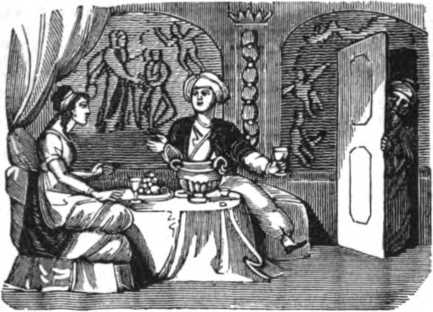
Why, then, said Noureddin to him, we just now saw an ass tied to the entrance of your garden, which certainly must be yours, and which you may make use of in this extremity. Here are two pieces of gold more: take them, and lead your ass with the panniers to the next inn; you may stand at as great a distance as you please; do but give something to the first person that comes by, and desire him to go with your ass to the inn, and get two pitchers of wine: put one in one pannier, and an other in another, which he must pay for out of the money you give him, and so let him bring the ass back to you: you will have nothing to do but to drive the beast hither before you; we will take the wine out of the panniers. By this means you will do nothing that will give you any scruple.
The two last pieces of gold that Scheich Ibrahim was going to receive wrought wonderfully upon his mind. Ah! my son, cried he, after Noureddin had done speaking, you have an excellent contrivance; and had it not been for your invention, I should never have thought of this way of getting you some wine without any scruple of conscience. Away he went to execute the orders, which he did in a little time; and, upon his return, Noureddin went down the stairs, and taking the pitchers out of the panniers, carried them into the hall.
Scheich Ibrahim, having led the ass back to the place from whence he took him, came back again. Scheich Ibrahim, said Noureddin to him, we cannot enough thank you for the trouble we have already given you, but we want something yet. What is that, replied Scheich: what more service can I do you? We have no cups to drink out of, said Noureddin; and a little fruit, if you had any, would be very acceptable. Do but say what you have a mind to, replied Scheich Ibrahim, and you shall have every thing to your heart’s content.
Down went Scheich Ibrahim, and in a short time spread a table for them with beautiful porcelain dishes, full of all sorts of delicious fruits, besides gold and silver cups to drink out of; and having asked them if they wanted any thing else, he withdrew, though they pressed him earnestly to stay.
Noureddin and the Fair Persian sat down again, and drank each a cup a-piece. They were mightily pleased with the wine. Well, my dear, said Noureddin to the Fair Persian, are we not the most fortunate persons in the world, after so many dangers, to meet with so charming and agreeable a place? Let us be merry, and think no more on the hardships of our voyage. Can my happiness be greater in this world, than to have you on one side of me, and my glass on the other? They drank freely, and diverted themselves with agreeable conversation, each singing a song.
Both having very good voices, but especially the Fair Persian, their singing attracted Scheich Ibrahim, who had stood hearkening a great while on the steps, without discovering himself. He could contain himself no longer, but thrusting his head in at the door, Courage, sir, said he to Noureddin, whom he took to be quite drunk, I am glad to see you so pleased.
Ah! Scheich Ibrahim, cried Noureddin, turning to him, you are a glorious man, and we are extremely obliged to you. We dare not ask you to drink a cup; but walk in; come, sit down, and let us have the honour at least of your company. Go on, go on, said Scheich Ibrahim; the pleasure of hearing your songs is sufficient for me. Upon this he immediately retired.
The Fair Persian perceiving Scheich Ibrahim, through one of the windows, standing upon the steps without the door, told Noureddin of it. Sir, said she, you see what an aversion he has for wine; yet I question not in the least to make him drink some, if you will do as I would have you. Noureddin asked her what it was. Do but say the word, replied he, and I am ready to do what you please. Prevail with him then only to come in, and bear us company; some time after fill up a bumper, and give it him; if he refuses it, drink it yourself, pretend to be asleep, and leave the rest to me.
Noureddin understood the Fair Persian’s design, and called to Scheich Ibrahim, who came again to the door. Scheich Ibrahim, said he, we are your guests; you have entertained us in the most obliging manner in the world, and will you now refuse our solicitations to honour us with your company? We do not ask you to drink, but only the favour of seeing you.
Scheich Ibrahim being at last prevailed upon, came into the hall, and sat down upon the edge of a sofa that stood nearest to the door. You do not sit well there, said Noureddin, and we cannot have the honour of seeing you; pray come nearer, and sit you down by the lady; she will like it much. I will obey you, replied Scheich Ibrahim; so coming forward, simpering, to think he should be seated near so beautiful a creature, he placed himself at some distance from the Fair Persian. Noureddin desired a song of her, in return for the honour that Scheich Ibrahim had done them; and she sung one that charmed him.
When the Fair Persian had ended her song, Noureddin poured out a cup of wine, and presented it to Scheich Ibrahim, Scheich Ibrahim, said he, I entreat you drink this to our healths. Sir, replied he, starting back, as if he abhorred the very sight of the wine, I beseech you to excuse me; I have already told you that I have forsworn the use of wine these many years. Then since positively you will not drink our healths, said Noureddin, give me leave to drink yours.
While Noureddin was drinking, the Fair Persian cut half an apple, and presented it to Scheich Ibrahim. Though you refused drinking, said she, yet I believe you will not refuse tasting this apple; it is very excellent. Scheich Ibrahim had no power to refuse it from so fair a hand, but taking it with a very low bow, put it in his mouth. She said a great many pleasant things upon the occasion; and Noureddin, falling back upon the sofa, pretended to fall fast asleep. The Fair Persian presently advanced towards Scheich Ibrahim, and speaking in a low voice, Look at him, said she; thus, in all our merry parties he constantly serves me; and no sooner has he drank a cup or two, but he falls asleep, and leaves me alone; but I hope you will have the goodness to keep me company till he awakes.
At this the Fair Persian took a cup, and filling it with wine, offered it to Scheich Ibrahim. Here, said she, drink off this to my health; I am going to pledge you. Scheich Ibrahim made a great many difficulties, and begged her to excuse him from drinking: but she pressed him so, that, overcome by her charms and entreaties, he took the cup, and drank off every drop of the wine.
The good old man loved a cheering cup in his heart, but was ashamed to drink among strangers. He often went to the tavern in private, as many other people do; and he did not take the precaution Noureddin recommended, but went directly to an inn, where he was well known (night serving him instead of a cloak), and saved the money that Noureddin had ordered him to give the messenger that was to have gone for it.
While Scheich Ibrahim was eating the half apple after his draught, the Fair Persian filled him out another, which he received with less difficulty than the former, but made none at all at the third. In short, a fourth was drank before Noureddin started up from his pretended sleep; and bursting out into a violent fit of laughter, and looking upon him, Ha! ha! said he, Scheich Ibrahim, have I caught you at last? Did you not tell me you had forsworn wine, and now you have drank it all up from me.
Scheich Ibrahim, not expecting to be surprised after that manner, blushed a little; however, that did not spoil his draught; but when he had done, Sir, said he to Noureddin, laughing, if there is any crime in what I have done, it lies at this fair lady’s door, not mine; for who could possibly resist so many charms?
The Fair Persian, who perfectly understood Noureddin, took Scheich Ibrahim’s part. Let him talk, said she: Scheich Ibrahim, take no notice of him, but let us drink on and be merry. A while after, Noureddin filled out a cup for himself and the Fair Persian; but when Scheich Ibrahim saw that Noureddin had forgot him in his turn, he took his cup, and presenting it to the Fair Persian, Madam, said he, do you pretend I cannot drink as well as you?
At these words of Scheich Ibrahim, Noureddin and the Fair Persian were ready to split their sides with laughing. Noureddin poured him out some wine, and they sat laughing, chatting, and drinking, till pretty near midnight. About that hour the Fair Persian began to take notice that there was but one candle upon the table. Scheich Ibrahim, said she to the good old officer, you have afforded us but one candle, when there are so many wax lights yonder; pray do us the favour to light some of them, that we may see a little better what we are doing.
Scheich Ibrahim, making use of the liberty that wine inspires when it gets into the head, and not caring to be interrupted in his discourse with Noureddin, bade the Fair Persian light them herself. It is fitter for a young person like you to do it, said he, than for me; but be sure not to light above five or six, for that is enough. Up rose the Fair Persian immediately, and taking a wax candle in her hand, lighted it with that which stood upon the table; and, without any regard to Scheich Ibrahim’s order, lighted up the whole fourscore.
By and by, while Scheich Ibrahim was entertaining the Fair Persian with some other discourse, Noureddin took his turn to desire him to light up some of the candles in the lustres, not taking notice that all the wax lights were already in a blaze. Certainly, replied Scheich Ibrahim, you must be very lazy, or less vigorous than I am, that you are not able to light them yourself: get you gone, and light them; but be sure you light no more than three. To work he went; but instead of that number, he lighted them all, and opened the shutters of the fourscore windows, before Scheich Ibrahim, who was deeply engaged with the Fair Persian, knew any thing of the matter.
The caliph Haroun Alraschid being not yet gone to bed, was in a room at his palace by the river Tigris, from whence he could command a view both of the garden and pavilion. He accidentally opened the casement, and was extremely surprised at seeing the pavilion illuminated; and at first by the greatness of the light, thought the city was on fire. The grand vizier Giafar was still with him, who only waited for his going to rest, and then designed to go home too. The caliph, in a great rage, called the vizier to him. Careless vizier, said he, come hither, come hither; look upon the pavilion of pictures, and tell me the reason of its being illuminated at this hour, now I am not there.
The grand vizier Giafar, upon this news, fell into a violent trembling, fearing something else was the matter: but when he came nearer, and with his own eyes saw the truth of what the caliph had told him, he was more alarmed than before. Some excuse must be made to appease the caliph’s anger. Commander of the true believers, said he, all that I can say to your majesty about this matter is, that some five or six days ago Scheich Ibrahim came to acquaint me, that he had a design to assemble the ministers of his mosque, to assist at a ceremony he was ambitious of performing in your majesty’s auspicious reign. I asked him if I could be any way serviceable to him in this affair; upon which he entreated me to get leave of your majesty to perform the ceremony in the pavilion. I sent him away with leave to hold the assembly, telling him I would take care to acquaint your majesty with it; and I ask pardon for having quite forgotten it Scheich Ibrahim, continued he, has certainly made choice of this day for the ceremony; and after treating the ministers of his mosque, he was willing to indulge them with the sight of this illumination.
Giafar, said the caliph, with a tone that plainly showed his anger was a little mollified, according to your own account you have committed three faults that are unpardonable; the first, in giving Scheich Ibrahim leave to perform this ceremony in my pavilion; for a person in such an office as his is not worthy of so great an honour; the second, in not acquainting me with it; and the third, in not diving into the good old man’s intention. For my part, I am persuaded he only did it to try if he could get any money towards bearing the charge of it; but that never came into your head; and sure I shall not wrong him in allowing him to revenge himself for not having obtained the expense of the night’s illumination.
The grand vizier Giafar, overjoyed to hear the caliph put the matter upon that footing, very willingly owned the faults he reproached him with, and freely confessed he was to blame in not giving Scheich Ibrahim a few pieces of gold. Since the case is so, added the caliph, it is just that thou shouldst be punished for thy mistakes, but thy punishment shall be light: thou shalt spend the remainder of the night, as I mean to do, with these honest people, whose company I shall be well pleased with; and while I am putting on a citizen’s habit, go thou and disguise thyself with Mesrour, and come both of you along with me. The vizier Giafar would have persuaded him it was late, and that all the company would be gone before he could get thither; but the caliph said he would positively go. The vizier, who knew that not a syllable of what he had said was true, began to be in great consternation; but there was no reply to be made, and go he must.
The caliph, then, disguised like a citizen, with the grand vizier Giafar and Mesrour, chief of the eunuchs, stole out of the palace together. They rambled through the streets of Bagdad till they came to the garden; the door, through the carelessness of Scheich Ibrahim, was open, he having forgot to shut it when he came back from buying the wine. The caliph was very angry at it. Giafar, said he to the grand vizier, what excuse have you for the door being open at this unseasonable hour? Is it possible that Scheich Ibrahim makes a custom of leaving it thus all night? I rather believe the hurry of the feast has been the occasion of this neglect.
The caliph went into the garden; and when he came to the pavilion, resolving not to go into the hall till he knew what was doing there, he consulted with the grand vizier whether it was not his best way to climb up into one of the trees that was near it, to make a discovery. The grand vizier, casting his eyes upon the door, perceived it stood half open, and told the caliph. It seems Scheich Ibrahim had left it so, when he was prevailed upon to come in and bear Noureddin and the Fair Persian company.
The caliph, laying aside his first design, stole softly up to the hall door, which standing half open, he could see all the company that were within, without being discovered himself.
But how was he surprised, when he saw a lady of incomparable beauty and a handsome young man sitting at the table, with Scheich Ibrahim by them. Scheich Ibrahim held a cup in his hand. My fair lady, said he to the Fair Persian, a true toper never drinks without singing a song first: if you please to hear, I will give you one of my best songs.
Scheich Ibrahim sung: and the caliph was the more surprised, because, till that moment, he never knew of his drinking wine, but always took him for a grave, solid man, as he seemed to be to outward appearance. The caliph retired from the door with the same caution as he made his approaches to it; and coming to the grand vizier Giafar, who was standing upon the steps a little lower, Come up, said he to him, and see if those within yonder are the ministers of the mosque, as you would have made me believe.
By the tone of voice in which the caliph spoke these last words, the vizier understood that things went ill on his side: however, he went up the steps; but when he had peeped in at the door, and saw all the three sitting in that condition, he trembled for fear of his life. He went back to the caliph, but in so great confusion, that he knew not what to say. What riotous doings are here? said the caliph to him: who are these people that have presumed to take the liberty of diverting themselves in my garden and pavilion? I must however confess, I never saw two persons more beautiful or better paired in my life; and therefore, before I discover my anger, I will inform myself better, and know who they are, and the reason of their being here. He went to the door again to observe them more narrowly; and the vizier, who followed, stood behind him, while he fixed his eyes upon them. They both plainly heard every word that Scheich Ibrahim said to the Fair Persian. Is there any thing, my charming lady, wanting to render the pleasure of the evening more complete? Nothing but a lute, replied the Fair Persian; and methinks, if you could get me one, all would be very well. Can you play upon it? said Scheich Ibrahim. Fetch me one, replied the Fair Persian; and you shall hear whether I can or not.
Scheich Ibrahim, without stirring very far from his place, took a lute out of a press, and presented it to the Fair Persian, who began to tune it. The caliph, in the mean time, turning to the grand vizier, Giafar, said he, the young lady is going to play upon the lute; and if she performs well, I will forgive her, and the young man for her sake; but as for thee, I will have thee hanged. Commander of the true believers, replied the grand vizier, if that is your intention, I wish to God she may play ill. Why so? said the caliph. Because, replied the grand vizier, the longer we live in this world, the more reason we shall have to comfort ourselves with the hopes of dying in good sociable company. The caliph, who loved a repartee began to laugh at this; and putting his ear to the opening of the door, he listened to hear the Fair Persian play.
The Fair Persian began in a style, that, from the moment of her touching the lute, the caliph perceived she did it with a masterly hand. Afterwards she began to sing an air; and accompanying the lute with her voice, which was admirably fine, she sung and played with so much skill and sweetness, that the caliph was quite ravished to hear her.
As soon as the Fair Persian had finished her song, the caliph went down the steps, and the vizier Giafar followed him. When he came to the bottom, I never, said he, to the vizier, heard a more charming voice, or a lute better touched in my life. Isaac, [88] whom I thought the most skilful player in the world, does not come up to her. I am so charmed with her music, that I will go in and hear her play before me. We must, therefore, consider how I can do it.
Commander of the true believers, said the grand vizier, if you should go in, and Scheich Ibrahim chance to know you, he would infallibly die with the fright. It is that hurts me, replied the caliph; and I should be loth to be the occasion of his death, after so many years’ service. A thought is just come into my head, that may succeed: stay here with Mesrour, and wait for me in the next walk.
The neighbourhood of the Tygris had given the caliph an opportunity of turning a sufficient quantity of water under a stately bridge into his garden, to make a piece of water well terraced, whither the choicest fish of the whole river used to retire. The fishermen knew it very well, and would have given the world to fish there; but the caliph had expressly charged Scheich Ibrahim not to suffer any of them to come near it. However, that very night, a fisherman, passing by the garden-door, which the caliph had left open as he found it, made use of this opportunity, and, going in, went directly to the canal.
The fisherman immediately fell to work with his casting nets, and was just ready to draw them, when the caliph, fearing what would be the effect of Scheich Ibrahim’s negligence, but willing to make use of it to bring his design about, came to the same place. The fisherman, in spite of his disguise, knew him, and, throwing himself at his feet, humbly implored his pardon, and excused himself upon the account of his poverty. Rise, said the caliph, and be not afraid; only draw your nets, that I may see what fish you have got.
The fisherman, recovered of his fright, quickly obeyed the caliph’s orders. He drew out five or six very large fishes; and the caliph choosing the two biggest, tied them together by the head with the twig of a tree. After this, said he to the fisherman, Give me thy clothes, and here take mine. The exchange was soon made; and the caliph being dressed like a fisherman, even to his boots and turban, Take thy nets, said he to the fisherman, and get thee about thy business.
When the fisherman, very well pleased with his good fortune, was gone, the caliph, taking the two fishes in his hand, went to look after the grand vizier Giafar and Mesrour; he stopped at the grand vizier, who not knowing him, asked him what he wanted, and bid him go about his business. The caliph fell a laughing; by which the vizier finding it to be him, Commander of the true believers, said he, is it possible it can be you? I knew you not; and I ask a thousand pardons for my rudeness. You are so disguised, that you may venture into the hall, without any fear of being discovered by Scheich Ibrahim. Stay you here with Mesrour, said the caliph, while I go yonder and play my part.
The caliph went up to the hall, and knocked at the door. Noureddin hearing him first, told Scheich Ibrahim of it, who asked who was there. The caliph opened the door, and stepping a little way into the hall to show himself, Scheich Ibrahim, said he, I am the fisherman Kerim, who, being informed of your design to treat some of your friends, have brought you two very fine fishes, fresh caught, to ask if you have any occasion for them.
Noureddin and the Fair Persian, mightily pleased to hear him name fish, Pray, said she to Scheich Ibrahim, let him come in, that we may look at them. Scheich Ibrahim, by this time, was incapable of asking this counterfeit fisherman how or which way he came thither, his whole thought being only to oblige the Fair Persian. With much ado he turned his head towards the door, being quite drunk, and, in a stammering tone, calling to the caliph, whom he took to be a fisherman, Come hither, thou nightly thief, said he, and let us see what thou hast got.
The caliph went forwards, and counterfeiting all the actions of a fisherman to a nicety, presented the two fishes. These are very fine ones indeed, said the Fair Persian; and if they were well dressed and seasoned, I should be glad to eat some of them. The lady is in the right on it, answered Scheich Ibraham; but what can you do with your fish, unless it were dressed? Go dress it thyself, and bring it to us; thou wilt find every thing necessary in my kitchen.
The caliph went back to the grand vizier, Giafar, said he, I have been very well received; but they want the fish to be dressed. I will take care to dress it myself, said the grand vizier, and they shall have it in a moment. Nay, replied the caliph, so eager am I to accomplish my design, that I will take that trouble myself; for since I have personated the fisherman so well, sure I can play the cook for once. In my younger days, I dealt a little in cookery, and always came off with credit. So saying, he went directly towards Scheich Ibrahim’s lodgings, and the grand vizier and Mesrour followed him.
They all three fell to work; and though Scheich Ibrahim’s kitchen was not very large, yet there was every thing in it that they wanted. The fish was quickly cooked; and the caliph served it up, putting to every one’s plate a lemon to squeeze in the sauce if they thought proper. They all eat very heartily, but especially Noureddin and the Fair Persian: and the caliph stood before them.
As soon as the repast was over, Noureddin looking upon the caliph, Fisherman, said he, there never was better fish eaten; and you have done us the greatest favour in the world. At the same time, putting his hand into his bosom, and pulling out a purse of thirty pieces of gold, the remainder of forty that Sangiar, the officer of the king of Balsora, had given him just upon his departure, Take it, said he to him; if I had any more, thou shouldst have it; had I known thee in my prosperity, I would have taken care to secure thee from ever wanting: do not refuse the small present I make thee, but accept of it as kindly as if it was much greater.
The caliph took the purse, and thanked Noureddin; and perceiving by the weight that it contained gold, Sir, said he to him, I cannot enough thank you for your liberality, and I think myself very fortunate in having to do with a person of your generosity; but before I take my leave I have a favour to ask, which I beg you not to deny me. Yonder is a lute, which makes me believe that the lady understands playing upon it; and if you can prevail with her to play but one tune, I shall go away perfectly satisfied; for a lute, sir, is an instrument I am particularly fond of.
Fair Persian, said Noureddin, immediately addressing himself to her, I ask that favour of you, and I hope you will not refuse me. She took up the lute without more entreaties, and putting it presently in tune, played and sung with such an air, as charmed the very soul of the caliph. Afterwards she played upon the lute without singing, but with so much strength and softness, that transported him into an ecstacy.
When the Fair Persian had given over playing, the caliph cried out, What a voice! what a hand! what skill! was there ever finer singing, or better playing upon the lute? Never was there any seen or heard like it.
Noureddin, who was accustomed to give all that belonged to him to persons who praised him, Fisherman, said he, I find thou hast some taste for music; since thou art so delighted with her performance, she is thine; I make thee a present of her. At the same time he rose up, and taking his robe, which he had laid by, was going away, and leaving the caliph, whom he believed to be no other than a fisherman, in possession of the Fair Persian.
The Fair Persian was extremely surprised at Noureddin’s liberality: she took hold of him, and, looking tenderly at him, Whither, sir, said she, are you going? Sit down in your place, I entreat you, and hearken to what I am going to sing and play. He did as she desired him; and then the Fair Persian, touching the lute, and looking upon him with tears in her eyes, sung some verses that she had made extempore, to reproach him with his indifference, and the easiness as well as cruelty with which he resigned her to Kerim. She only hinted without explaining herself any farther to a fisherman as Kerim was; for she, as well as Noureddin, was ignorant of his being the caliph. When she had done playing, she put the lute down by her, and clapped a handkerchief to her face, to hide the tears she could not help shedding.
Noureddin made no answer to all these reproaches, but by his silence seemed to declare he did not repent of what he had done. The caliph, surprised at what he had heard, Sir, said he, as far as I see, this beautiful, rare, and accomplished lady, that so generously you have made me a present of just now, is your slave, and you are her master. It is very true, Kerim, replied Noureddin; and thou wouldst be more surprised than thou art now, should I tell thee all the misfortunes that have happened to me upon her account. Ah! I beseech you, sir, replied the caliph, still behaving like a fisherman, oblige me so far as to let me hear part of your story.
Noureddin, who had already obliged him in several things of more consequence, was so complaisant as to relate the whole story to him. He began with the vizier his father’s buying the Fair Persian for the king of Balsora, and omitted nothing of what he had done, or what had happened to him from that time to their arrival at Bagdad, and to that very moment he was talking to him.
When Noureddin had ended his story And whither are you going now? said the caliph. Where Heaven shall direct me, answered Noureddin. If you will believe me, replied the caliph, you shall go no farther, but, on the contrary, you must return to Balsora. I will write a short letter, which you shall give the king in my name: you shall see, upon the reading it, he will give you a very handsome reception, and nobody will dare to speak against you.
Kerim, said Noureddin, what thou hast told me is very singular; I never heard that a poor fisherman, as thou art, had any correspondence with a king. Be not astonished at that, replied the caliph: you must know, that we both studied together under the same masters, and were always the best friends in the world. It is true, fortune has not been equally favorable to us; she has made him a king, and me but a fisherman. But this inequality has not lessened our friendship: he has often expressed a readiness and desire to advance my fortune, but I always refused it; and am better pleased with the satisfaction of knowing that he will never deny me whatever I ask for the service and advantage of my friends: let me do it, and you shall see the success.
Noureddin consented to what the caliph had proposed; and there being every thing necessary for writing in the hall, the caliph wrote a letter to the king of Balsora; at the top of which, near the edge of the paper, he placed this form, in three small characters, ‘In the name of the most merciful God,’ to show he would be absolutely obeyed.
The letter of Caliph Haroun Alraschid to the King of Balsora.
‘Haroun Alraschid, son of Mandi, sends this letter to Mahommed Zinebi, his cousin. As soon as Noureddin, son to the late vizier Khacan, the bearer, has delivered you this letter, and you have read it, pull off the royal mantle, put it on his shoulders, and place him in thy seat without fail. Farewell.’
The caliph folded up the letter, and sealed it; and giving it to Noureddin, without saying any thing of what was in it, Go, said he, embark immediately in a vessel that is ready to go off, (as there did constantly every every day at the same hour;) you may sleep when you are abroad.
Noureddin took the letter, and away he went, with the little money he had about him when Sangiar gave him his purse; and the Fair Persian, distracted with grief at his departure, retired to one of the sofas, and fell to weeping bitterly.
Noureddin was scarce gone out of the hall, when Scheich Ibrahim, who had been silent during the whole transaction, looking stedfastly upon the caliph, whom he still took for the fisherman Kerim, Hark’e, said he, Kerim, thou hast brought us two fishes that are worth twenty pieces of copper at most, and thou hast got a purse and a slave; but dost thou think to have it all for thyself? I here declare, that I will go halves with thee in the slave; and as for the purse, show me what is in the inside: if it is silver, thou shalt have one piece for thyself; but if it is gold, I will have it all, and give thee in exchange some pieces of copper which I have in my purse.
For the better understanding of what follows, Scheherazade, interrupting herself here, said, we must observe, that the caliph, before his serving up the fish, had despatched the grand vizier Giafar to his palace, with orders to get four slaves, with a rich habit, and to wait on the other side of the pavilion till he gave a signal with his finger against the window. The grand vizier performed his commission, and he, Mesrour, and the four slaves, waited at the appointed place, expecting the sign.
But to return to my story, said the sultaness. The caliph, still personating the fisherman, answered Scheich Ibrahim boldly, I know not what there is in the purse; gold or silver, you shall freely go my halves; but as to the slave, I will have her all to myself; and if you will not accept these conditions, you shall have nothing.
Scheich Ibrahim, enraged to the last degree at this insolence, considering him only as a fisherman, snatched up one of the china dishes which were on the table, and flung it at the caliph’s head. The caliph easily avoided the blow, being thrown by a person in liquor; but the dish striking against the wall, was dashed into a thousand pieces. Scheich Ibrahim grew more enraged at having missed his aim; and, catching up the candle that stood upon the table, rose from his seat, and went staggering down a pair of back stairs to look for a cane.
The caliph took this opportunity, and striking his hands against the window, the grand vizier, Mesrour, and the four slaves, were with him in a trice; the slaves quickly pulled off the fisherman’s clothes, and put him on the habit they had brought. They had not quite dressed the caliph, who had seated himself upon the throne that was in the hall, but were very busy about him, when Scheich Ibrahim, spurred on by interest, came back, with a swinging cane in his hand, with which he designed to pay the pretended fisherman soundly; but instead of finding him, he saw his clothes in the middle of the hall, and the caliph upon his throne, with the grand vizier and Mesrour on each side of him. He stood awhile gazing upon this unexpected sight, doubting whether he was awake or asleep. The caliph fell a laughing at his astonishment; and calling to him, Scheich Ibrahim, said he, what dost thou want? whom dost thou look after?
Scheich Ibrahim, no longer doubting that it was the caliph, immediately threw himself at his feet, with his face and long beard to the ground. Commander of the true believers, cried he, your vile slave has offended you; but he implores your clemency, and asks a thousand pardons for his offence. As soon as the slaves had made an end of dressing him, he came down from his throne, and advancing towards him, Rise, said he; I forgive thee.
The caliph then addressed himself to the Fair Persian, who had suspended her sorrow as soon as she understood that the garden and pavilion belonged to that prince, and not to Scheich Ibrahim, as he had all along made her believe, and that it was he himself disguised in the fisherman’s clothes. Fair Persian, said he, rise, and follow me: by what you have lately seen, you ought to know who I am, and to believe that I am above taking any advantage of the present which Noureddin, with a generosity not to be paralleled, has made me of your person. I have sent him to Balsora to be king there; and when I have given him the despatches necessary for his establishment, you shall go thither and be queen. In the mean time, I am going to order an apartment for you in my palace, where you shall be treated according to your desert.
This discourse encouraged the Fair Persian, and comforted her very sensibly. The joy for the advancement of Noureddin, whom she passionately loved, to so high an honour, made her sufficient amends for her affliction. The caliph kept his promise, and recommended her to the care of his lady Zobeide, whom he acquainted with the esteem he had lately entertained for Noureddin.
Noureddin’s return to Balsora was more fortunate, and speedier by some days, than he could have expected. Upon his arrival, without visiting any of his friends or relations, he went directly to the palace, where the king at that time was giving public audience. With the letter held up in his hand, he pressed through the crowd, who presently made way for him to come forward and deliver it. The king took and opened it, and his colour changed in reading it: he kissed it thrice, and was just about to obey the caliph’s orders, when he bethought himself of shewing it to the vizier Saouy, Noureddin’s irreconcilable enemy.
Saouy, who had discovered Noureddin, and began to conjecture, with great uneasiness, what might be the design of his coming, was no less surprised than the king at the order contained in the letter; and being as much concerned in it, he thought that very moment upon a way to evade it. He pretended not to have read the letter quite through, and therefore, desiring a second view of it, he turned himself a little on one side, as if he wanted a better light, and, without being perceived by any body, dexterously tore off from the top of it the form that showed the caliph would be absolutely obeyed, and putting it into his mouth, swallowed it.
After this egregious piece of villany, Saouy turned to the king, and giving him the letter, Sir, said he to him, in a low voice, what does your majesty intend to do? What the caliph has commanded me, replied the king. Have a care, sir, said the wicked vizier, what you do. It is true, this is the caliph’s hand, but the form is not to it. The king had observed that very well, but in his confusion, he thought his eyes deceived him when he saw it was gone.