ARABIAN NIGHTS’ (continued 22)
Reading edition · Edition 2
When Abon Hassan came home, he staid within doors some days, to recover his health by better living than he had found in the hospital. But when he had recovered his strength, and felt no more effect of the harsh treatment he had suffered in his confinement, he began to be weary of spending his evenings alone. He presently entered again upon the same way of living as before; which was, to provide enough every day to regale a new stranger at night.
The day on which Abon Hassan renewed his custom of going about sunset to the foot of Bagdad bridge to stop the first stranger that offered, and desire him to do him the honour of supping with him, happened to be the first day of the month, which was the day that the caliph always set apart to go in disguise out of some of the city-gates to observe with his own eyes what was committed contrary to the good government of the city, as he had established and regulated it at the beginning of his reign. He had not been long arrived at the bridge, and sat himself on a bench which was fixed to the parapet, when, looking about him, he perceived the caliph disguised again like a Moussol merchant, and followed by the same slave. Persuaded that all his misfortunes were owing to the caliph (whom he took for a merchant) leaving his door open, he shuddered at the sight of him. God preserve me! said he to himself; if I am not deceived, there is the magician again that enchanted me! and thereupon got up, and looked over the parapet into the river, that he might not see him till he was past.
The caliph, who had a mind to carry on the diversion he had received by Abon Hassan, had taken care to inform himself of all that had happened when Abon Hassan awaked at home, and conceived a great pleasure at the relation given him, especially at his being sent to a madhouse, and the treatment he received there. But as this monarch was both just and generous, and had taken a great liking to Abon Hassan, as capable of contributing further to his amusement, and had doubted whether, after renouncing his pretended character of a caliph, he would return to his usual manner of living, he designed, with a view to get him nearer him, to dress himself again like a merchant of Moussol, the better to execute his plan. He perceived Abon Hassan at the same time that he saw him, and presently guessed by his action that he was angry with him, and wanted to shun him. This made him walk close to the parapet Abon Hassan leaned over; and when he came nigh him, he put his head over to look him in the face. Ho, brother Abon Hassan, said he, is it you? I greet you! Give me leave to embrace you! Not I, replied Abon Hassan, briskly, without looking at the pretended Moussol merchant; I do not greet you; I will have neither your greeting nor your embraces. Go along!
What! answered the caliph, do you not know me? Do you not remember the evening we spent together at your house this day month, where you did me the honour to treat me very generously? No, replied Abon Hassan in the same tone, I do not know you, nor what you talk about; go, I say again, about your business.
The caliph was not to be dashed with this rude behaviour of Abon Hassan. He knew very well the law he had imposed on himself, never to have any commerce again with a stranger he had once entertained; but though Abon Hassan had declared so much to him, he pretended to be ignorant of it. I cannot believe, said he, but you must know me again; it is not possible that you should have forgotten me in so short a time. Certainly some misfortune has befallen you, which inspires you with this aversion for me. However, you ought to remember, that I showed my gratitude by my good wishes, and that I offered you my interest, which is not to be slighted, in an affair which you had very much at heart.
I do not know, replied Abon Hassan, what your interest may be, and I have no desire to make use of it; but I am sensible the utmost of your good wishes ended in making me mad. In God’s name, I say, once more, go your way, and trouble me no more.
Ah! brother Abon Hassan, replied the caliph, embracing him, I do not intend to part with you in this manner, since I have had the good fortune to meet with you a second time; you must exercise the same hospitality towards me again, that you showed me a month ago, when I had the honour to drink with you.
I have protested against it, said Abon Hassan, and have so much power over myself, not to receive a second time such an unlucky man as you. You know the proverb, ‘Take up your drum and begone.’ Make the application to yourself. How often must I repeat it? God be with you! You have been the cause of my misfortune, and I will not venture myself with you again. My good friend Abon Hassan, said the caliph, embracing him again, you treat me in a way I little expected. I beg of you not to talk to me in this harsh manner, but be persuaded of my friendship. Do me the favour to tell me what has happened to you; for I assure you, I wished you well, and still do so; and would be glad of an opportunity to make you any amends for the trouble I have caused you, if it has been really my fault. Abon Hassan yielded to the pressing instances of the caliph, and bid him sit down by him. Your incredulity and importunity, said he, have tired my patience; and what I am going to tell you will show you that I do not accuse you wrongfully.
The caliph sat down by Abon Hassan, while he told him all that had happened to him, from his waking in the palace to his waking again in his own house, all as a mere dream, with all the circumstances which the caliph knew as well as himself, and which renewed his pleasure. He enlarged afterwards upon the impression that dream of being caliph and commander of the faithful made upon him, which he said, threw him into such extravagancies, that his neighbours were obliged to bind him as a madman, and carry him to a madhouse, where he was treated in a way that must seem very barbarous. But, said he, what will surprise you, and what you little think of, is, that it was altogether your fault that these things fell out; for, if you remember, I desired you to shut the door after you, which you neglected, and the devil, finding it open, put this dream into my head, which, though it was very agreeable, was the cause of the misfortune I complain of: you, therefore, for your negligence, are answerable for the horrid and detestable crime I was guilty of in lifting my hand against my mother, whom I might have killed, and committed parricide (I blush for shame when I think of it,) only because she said I was her son, and she would not acknowledge me for the commander of the faithful, as I thought, and positively insisted on to her that I was. You are the cause of the offence I have given my neighbours, when, running in at the cries of my poor mother, they surprised me bent on knocking her down; which would never have happened, if you had taken care to shut my chamber door when you went away, as I desired you. They would not have come into my house without my leave; and, what troubles me most of all, they would not have been witness of my folly. I should not have been obliged to strike them in my own defence, and they would not have bound and fettered me to carry me and shut me up in the hospital for madmen, where I assure you every day that I remained confined in that hell, I received a score of strokes with a bull’s pizzle. Abon Hassan recounted his complaints with great heat and vehemence to the caliph, who knew better than he what had passed, and was delighted to find that he had succeeded so well in his plan to throw him into the vagaries he still was in. He could not help bursting out a laughing at the simplicity wherewith he related them.
Abon Hassan, who thought that his story should rather move compassion, and that every one ought to be as much concerned at it as himself, very much resented the pretended Moussol merchant’s laughter: What! said he, do you make a jest of me, and laugh in my face, or do you believe I laugh at you when I speak seriously? if you want proof of what I advance, look here yourself and see whether or no I tell you the truth: with that, stooping down and baring his shoulders, he showed the caliph the scars and weals the bull’s pizzle had made.
The caliph could not behold those objects without horror. He pitied poor Abon Hassan, and was sorry he had carried the jest so far. Come, rise, dear brother, said he to him very seriously, and embracing Abon Hassan heartily in his arms; let us go to your house, and enjoy the happiness of being merry with you to-night; and to-morrow, if it please God, all things will go well.
Abon Hassan, notwithstanding his resolution and oath never to admit the same stranger a second time, could not resist the caresses of the caliph, whom he always took for a merchant of Moussol. I will consent, said he, if you will swear to shut my door after you, that the devil may not come in to distract my brain again. The caliph promised that he would; upon which they both got up, walked towards the city, and followed by the caliph’s slave, reached Abon Hassan’s house by the time it was dark.
The caliph, the more to engage Abon Hassan, said to him, Place a confidence in me; I promise you on my honour I will not break my word. After this, you need not hesitate to trust in a person like me, who wishes you all happiness and prosperity, of which you will see the effects. I desire not that, said Abon Hassan, stopping him short. I yield to your importunity; but I dispense with your good wishes, and beg you in God’s name to form none for me. All the mischief that has hitherto befallen me arose purely from those you already expressed for me, and from your leaving the door open. Well, replied the caliph, still laughing at the misguided imagination of Abon Hassan, since you will have it so, be it so; I promise you I will form none. You do me pleasure by speaking so, said Abon Hassan; I desire no more; I shall be more than satisfied provided you keep your word, and I shall forgive you all the rest.
As soon as Abon Hassan entered the doors, he called for his mother and for candles, and desired his guest to sit down upon a sofa, and then placed himself by him. A little time after, supper was brought up, and they both fell to without ceremony. When they had done, Abon Hassan’s mother cleared the table, set on a small dessert of fruit, wine and glasses by her son, and withdrew, and appeared no more. Abon Hassan first filled his own glass, and then the caliph’s; and after they had drank some time, and talked of indifferent matters, the caliph perceiving that his host grew warm with liquor, began to talk of love, and asked him if he had ever felt that passion.
Brother, replied Abon Hassan, familiarly, thinking his guest was his equal, I never looked upon love or marriage but as a slavery, to which I was always unwilling to submit; and must own to you, that I never loved any thing but good cheer and good wine; in short, to divert and entertain myself agreeably with my friends. Yet I do not tell you that I am so indifferent to marriage or incapable of attachment, if I could meet with a woman of such beauty and sweetness of temper as her I saw in my dream on that fatal night I first received you into my house, and you, to my misfortune, left my door open, who would pass the whole night with me drinking, singing, and playing on some instrument, and in agreeable conversation, and who would study to please and divert me: I believe, on the contrary, I should change all my indifference into a perfect attachment to such a person, and, I think, should live very happily with her. But where is such a woman to be found but in the caliph’s palace, or in those of the grand vizier or some great lords of the court who want no money to provide them? I choose therefore to stick close to my bottle, which is a much cheaper pleasure, and which I can enjoy as well as they. Saying these words, he filled out his own and the caliph’s glass, and said, Come, take your glass, and let us pursue this charming pleasure.
When they had drank off their wine, It is great pity, said the caliph, that so gallant a man as you, who owns himself not insensible of love, should lead so solitary a life. I prefer the easy quiet life I live, replied Abon Hassan, before the company of a wife, whose beauty might not please me, and who, besides, might create me a great deal of trouble by her imperfections and ill-humour. The conversation lasted a long time, and the caliph seeing Abon Hassan had drank up to the pitch he desired, said, Let me alone, since you have the same good taste as every other honest man, I warrant you I will find you one that shall please you. Then taking Abon Hassan’s glass, and putting a pinch of the same powder into it again, filled him up a bumper and presenting it to him, said, Come let us drink beforehand the fair lady’s health, who is to make you happy. I am sure you will like her.
Abon Hassan took the glass laughing, and shaking his head, said, Be it so; since you desire it, I cannot be guilty of so great a piece of incivility, nor disoblige a guest of so much merit in such a trifling matter. I will drink the lady’s health you promise me, though I am very well contented as I am, and do not rely on your promise. But no sooner had Abon Hassan drank off his bumper, than he was seized with as deep a sleep as before, and the caliph ordered the same slave to take him and carry him to the palace. The slave did so, and the caliph, who did not intend to send back Abon Hassan as before, shut the door after him, as he had promised, and followed the slave carrying Abon Hassan.
When they arrived at the palace, the caliph ordered Abon Hassan to be laid on a sofa, in the fourth hall, from whence he was carried home fast asleep a month before; but first he bid them put him on the same habit which he acted the caliph in, which was done forthwith before him. He then sent every body to bed, and charged all the eunuchs, officers, ladies, and musicians who were in the hall, when he drank the last glass of wine which had put him to sleep, to be there by daybreak, and to take care to act their parts well when he should awake. He then went to bed, charging Mesrour to awake him before they went into the hall, that he might conceal himself in the closet as before.
Mesrour, at the hour appointed, awakened the caliph, who immediately rose and went to the hall where Abon Hassan lay fast asleep, and when he had placed himself in his closet, Mesrour and the other officers, ladies and musicians, who waited for him, went in, and placed themselves about the sofa, so as not to hinder the caliph from seeing what passed, and noticing all his actions.
Things being thus disposed, and the caliph’s powder having had its effect, Abon Hassan began to awake without opening his eyes, and threw off the phlegm, which was received in a gold basin as before. In that moment the seven bands of musicians joined their charming voices to the sound of hautboys, fifes, flutes and other instruments, forming a very agreeable concert. Abon Hassan was in great surprise to hear that delightful harmony; but when he opened his eyes, and saw the ladies and officers about him, whom he thought he knew again, his amazement increased. The hall that he was in, seemed to be the same he saw in his first dream, and he observed the same lustres, and the same furniture and ornaments.
The concert ceased, to give the caliph an opportunity of attending to the countenance of his new guest, and all that he might say in his surprise. The ladies, Mesrour, and all the officers of the chamber, waited in profound and respectful silence. Abon Hassan bit his finger, and cried loud enough for the caliph to hear him, Alas! I am fallen again into the same dream and illusion that happened to me a month ago, and must expect again the bull’s pizzle and iron cage at the madhouse. Almighty God, added he, I commit myself into the hands of thy divine providence. He was a wicked man that I entertained at my house last night, who has been the cause of this illusion, and the hardships I must undergo. The base wretch swore to shut the door after him, but did not, and the devil came in and has turned my brain with this wicked dream of being commander of the faithful, and other phantoms which bewitch my eyes. God confound thee, Satan, and crush thee under some mountain of stones.
After these last words, Abon Hassan closed his eyes, and remained sometime thoughtful and very much perplexed; then opening them again, and looking about him, cried out a second time with less surprise, and smiling at the various objects before him, Great God! I commit myself into the hands of thy providence; preserve me from the temptations of Satan. Then shutting them again, he said, I know what I will do: I will go to sleep until Satan leaves me, and returns as he came, were I to wait till noon. They did not give him time to go to sleep again, as he had promised himself: for Strength of Hearts, one of the ladies whom he had seen before, approached, and sitting down on the sofa by him, said to him respectfully, Commander of the faithful, I intreat your majesty to forgive me for taking the liberty to tell you not to go to sleep; day appears, and it is time to rise. Begone, Satan! answered Abon Hassan, raising his voice: but looking upon the lady, he said, is it me you call the commander of the faithful? Certainly you take me for somebody else. It is to your majesty I give that title, replied the lady, to whom it belongs, as you are sovereign of the Mussulman world, and I am your most humble slave. Undoubtedly, added she, your majesty means to divert yourself by pretending to have forgotten yourself, or this is the effect of some troublesome dream; but if you would but open your eyes, the mists which may disturb your imagination will soon be dispelled, and you will find yourself in your own palace, surrounded by your officers and slaves, who all wait your commands: and that your majesty may not be surprised to find yourself in this hall, and not in bed, I beg leave to tell you, that you fell so suddenly asleep last night, that we were unwilling to wake you, to conduct you to your chamber, but laid you carefully upon the sofa. In short, she said to him so many things that appeared probable, that at last he sat up, opened his eyes, and recollected her and all the ladies again. They all drew near, and she who spoke first, resuming the discourse, said, Commander of the faithful, and vicar of the prophet on earth, be not displeased if I acquaint your majesty once more that it is time to rise, for day appears.
You are very troublesome and importunate, replied Abon Hassan, rubbing his eyes: I am not the commander of the faithful, but Abon Hassan; I know it well, and you shall not persuade me otherwise. We do not know that Abon Hassan your majesty speaks of, nor desire to know him, answered the lady; but we know you to be commander of the believers, and you cannot persuade us to the contrary.
Abon Hasan looking about and finding himself in the same hall, attributed all he saw and heard to such a dream as he had before, and very much feared the dreadful consequences. God have mercy on me! said he, lifting up his hands and eyes, like a man who knew not where he was; I commit myself into his hands. I cannot doubt, after what I have seen, but that the devil, who came into my chamber, possesses me, and fills my imagination full of all these visions.
The caliph, who saw him all the time, and heard these acclamations, began laughing so heartily, that he had much ado to forbear bursting into loud laughter.
Abon Hassan laying himself down again, and shutting his eyes, the same lady again said, Commander of the faithful, since your majesty does not rise, after we have, according to our duty, informed you it was day, and the despatch of business requires your presence, we shall use the liberty you give us in such cases. Then taking him by one arm, and calling to one of the other ladies to do the same by the other, they lifted him up, and carried him into the middle of the hall, where they set him on his breech, and taking all hands, danced and skipped round him while the music played and rattled in his ears.
Abon Hassan was in an inexpressible perplexity of mind, and said, What! am I indeed caliph, and commander of the faithful? And in the uncertainty he was in, would have said something more, but the music was so loud, that he could not be heard. At last he made a sign to String of Pearls and Morning Star, two of the ladies who were dancing, that he wanted to speak with them; upon which they forbore, and went to him. Do not lie now, said he, but tell me truly who I am?
Commander of the faithful, replied Morning Star, your majesty means either to surprise us, by asking this question, as if you did not know that you are commander of the faithful, and the vicar on earth of the prophet of God, master of both worlds, that whereon we now are and that to come after death, or else you must have had some very extraordinary dream to-night, which has made you forget who you are; which may very well be, considering that your majesty has slept longer to-night than ordinary: however, if you will give me leave, I will refresh your memory with what passed yesterday. Then she told him how he went to the council, punished the iman, and the four old men, and sent a present by his grand vizier of a thousand pieces of gold to the mother of one Abon Hassan; what he did in the inner part of the palace, and what passed at the three meals which he took in the three halls, and how in the fourth your majesty did us the honour to make us sit down by you, to hear our songs, and receive wine from our hands, until your majesty fell so fast asleep, as Strength of Hearts has told you. From that time your majesty has continued, contrary to custom, in a sound sleep until now. —Strength of Hearts, all your other slaves, and the officers present, can confirm what I say, and it is now time you should go to prayers.
Very well, replied Abon Hassan, shaking his head, you would have me believe all this; but I tell you, you are all fools, or mad, and that is a great pity, for you are very pretty. Since I saw you I have been at home, where I used my mother so ill that they sent me to a mad-house, and kept me there three weeks against my will, and beat me every day with a bull’s pizzle, and yet you would make me believe all this to be a dream. Commander of the faithful, answered Morning Star, you are mistaken; we are all ready to swear by all that your majesty holds most dear that all you tell is a dream. You never stirred out of this hall since yesterday, but slept here all night long.
The confidence with which the lady assured Abon Hassan that all she said was truth, and that he had never been out of the hall since that time, made him not know what to believe, but bewildered his senses. O Heaven! said he to himself, am I Abon Hassan, or the commander of the faithful? Almighty God, enlighten my understanding, and inform me of the truth, that I may know what to trust to. Then he uncovered his shoulders, and shewed the ladies the livid weals of the blows he had received. Look, said he; judge whether these strokes could come to me in a dream, or when I was asleep. For my part, I can affirm, that they were real blows; I feel the smart of them yet, and that is a testimonial there is no room to doubt of. Now if I received these strokes in my sleep, it is the most extraordinary thing in the world, and surpasses my comprehension.
In this uncertainty Abon Hassan called to one of the officers that stood round him: Come hither, said he, and bite the tip of my ear, that I may know whether I am asleep or awake. The officer obeyed him, and bit so hard that he made him cry out horridly; the music struck up at the same time, and the officers and ladies all began to sing, dance, and skip about Abon Hassan, and made such a noise, that he was in perfect enthusiasm, and played a thousand merry tricks. He tore off his caliph’s habit, threw off his turban, and jumped up in his shirt and drawers, and taking hold of two of the ladies’ hands, fell a dancing and singing and jumping and cutting capers, that the caliph could not contain himself, but burst into such violent laughter at this sudden pleasantry of Abon Hassan, that he fell backwards, and made a greater noise than all the musicians together. He was so long before he could check himself, that it had like to have hurt him. At last he got up, and opened the lattice, and putting out his head, cried out, Abon Hassan, Abon Hassan, have you a mind to kill me with laughing?
As soon as the caliph’s voice was heard, every body was silent, and Abon Hassan, among the rest, who, turning his head to see from whence the voice came, knew the caliph, and the Moussol merchant, but was not in the least dashed; on the contrary, he found that he was awake, and all that had happened to him was matter of fact, and not a dream. He entered into the caliph’s pleasantry and intention. Ha! ha! said he, looking at him with good assurance, you are a merchant of Moussol, and complain that I would kill you; you have been the occasion of my using my mother so ill, and being sent to a mad-house. It was you who treated the iman and the four scheiks in the manner they were used, and not me; I wash my hands of it. It was you who have been the cause of all my disorders and sufferings: in short, you are the aggressor, and I the injured person.
Indeed, you are in the right of it, Abon Hassan, answered the caliph, laughing all the while; but to comfort you, and make you amends for all your troubles, I call Heaven to witness, I am ready and willing to make you what reparation you please to ask. After these words, he came out of the closet into the hall, and ordered one of his most magnificent habits to be brought, and commanded the ladies to dress Abon Hassan in it; and when they had done so, he said, embracing him, Thou art my brother; ask what thou wilt, and thou shalt have it.
Commander of the faithful, replied Abon Hassan, I beg of your majesty to do me the favour to tell me what you did to disturb my brain in this manner, and what was your design; for it is a thing of the greatest importance for me to know, that I may perfectly recover my senses.
The caliph was ready to give him that satisfaction, and said, First you are to know, that I often disguise myself, and particularly at night, to observe if all goes right in Bagdad; and as I wish to know what passes in its environs, I set apart the first day of every month to make a tour about it, sometimes on one side, and sometimes on another, and always return by the bridge. The evening that you invited me to supper, I had been taking my rounds, and in our conversation you told me, that the only thing you wished for was to be caliph for four-and-twenty hours, to punish the iman of your mosque and his four counsellors. I fancied that this desire of yours would afford me a great deal of diversion, and thought immediately how I might procure you that satisfaction. I had about me a certain powder, which immediately throws the person who takes it into a sound sleep for a certain time. I put a dose of it, without being perceived by you, into the last glass I presented you, upon which you fell fast asleep, and I ordered my slave to carry you to my palace, and came away without shutting the door. I have no occasion to repeat what happened at my palace when you awaked, and during the whole day till evening; but after you had been regaled by my orders, one of the slaves who waited on you put another dose of the same powder at night into a glass she gave you; you fell asleep as before, and the same slave carried you home, and left the door open. You have told me all that happened to you afterwards. I never imagined that you could have suffered so much as you have done. But as I have a great regard for you, I will do every thing to comfort you, and make you forget all your sufferings; think of what I can do to please you, and ask me boldly what you wish.
Commander of the faithful, replied Abon Hassan, how great soever my tortures may have been, they are all blotted out of my remembrance, as soon as I understand my sovereign lord and master had any share in them. I doubt not in the least of your majesty’s bounty; but as interest never governed me, and you give me liberty to ask a favour, I beg that it may be that of having access to your person, to have the happiness of admiring, all my lifetime, your grandeur.
This last proof of disinterestedness in Abon Hassan completed the esteem the caliph had entertained for him. I am pleased with your request, said the caliph, and grant you free access to my person at all times and all hours. At the same time, he assigned him an apartment in the palace, and, in regard to his pension, told him that he would not have him apply to his treasurer, but come always to him for an order upon him; and immediately ordered his private treasurer to give him a purse containing a thousand pieces of gold. Abon Hassan made a low bow; and the caliph left him to go to council.
Abon Hassan took this opportunity to go and inform his mother of his good fortune, and what had happened, which he told her was not a dream; for that he had actually been caliph, and had acted as such, and received all the honours, and that she had no reason to doubt it, since he had it confirmed by the caliph himself.
It was not long before this story of Abon Hassan was spread over Bagdad, and carried into all the provinces both far and near, without the omission of a single circumstance.
The new favourite, Abon Hassan, was always with the caliph; for, as he was a man of a pleasant temper, and created mirth wherever he went by his wit and pleasantry, the caliph could not live without him. He formed no party of diversion without him, and sometimes carried him along with him to see his consort Zobiede, to whom he had told his story, which so highly pleased him, as it did Zobiede; who observed that every time he came with the caliph, he had his eyes always fixed upon one of her slaves, called Nouzhatoul-aouadat, (which is to say, renewed pleasure,) and resolved to tell the caliph of it. Commander of the faithful, said that princess one day, you do not observe so well as I, that every time Abon Hassan attends you in your visits to me, he never keeps his eyes off Nouzhatoul-aouadat, and makes her blush, which is almost a certain sign that she entertains no aversion for him. If you approve of it, we will make a match between them.
Madam, replied the caliph, you put me in mind of a thing which I ought to have done before now. I know Abon Hassan’s opinion respecting marriage from himself, and have always promised him a wife that should please him. I am glad you mentioned it; for I know not now I came to forget it. But it is better that Abon Hassan should follow his own inclination, and choose for himself; and if Nouzhatoul-aouadat is not averse to it, we ought not to hesitate upon their marriage; and since they are both present, they have only to say that they consent.
Abon Hassan threw himself at the caliph’s and Zobeide’s feet to show the sense he had of their goodness to him; and, rising up, said, I cannot receive a wife from better hands, but dare not hope that Nouzhatoul-aouadat will give me her hand as readily as I give her mine. At these words he looked upon the princess’s slave, who showed by her respectful silence, and the sudden blush that arose in her cheeks, that she was disposed to obey the caliph and her mistress Zobiede.
The marriage was solemnized, and the nuptials celebrated in the palace with great rejoicings, which lasted several days. Zobeide, in pleasure to the caliph, made her slave considerable presents, and the caliph did the same to Abon Hassan. The bride was conducted to the apartment the caliph had assigned Abon Hassan, who waited for her with all the impatience of a bridegroom, and received her with the sound of all sorts of instruments, and musicians of both sexes, who made the air echo again with their concert.
After these feasts and rejoicings, which lasted several days, the new married couple were left to pursue their loves in peace. —Abon Hassan and his spouse were charmed with each other, and lived together in perfect union, and seldom were asunder, but when either he paid his respects to the caliph, or she to Zobeide. Indeed, Nouzhatoul-aouadat was endued with every qualification capable of gaining Abon Hassan’s love and attachment, and was just such a wife as he described to the caliph, and fit to sit at the head of his table. With these dispositions they could not fail to pass their lives agreeably. They kept a good table, covered with the nicest and choicest rarities in season, by an excellent cook, who took upon him to provide every thing. Their sideboard was always stored with exquisite wines, placed within their reach when at table, where they enjoyed themselves in an agreeable tete-a-tete, and afterwards entertained each other with some pleasantry or other, which made them laugh more or less, as they had in the day met with something to divert them; and in the evenings, which they consecrated to mirth, they had generally some slight repast of dried sweetmeats, choice fruits, and cakes; and at each glass invited each other by new songs to drink, and sometimes accompanied their voices with a lute, or other instruments, which they could both touch.
Abon Hassan and Nouzhatoul-aouadat led this pleasant life a long time, unattentive to expense, when the caterer, who disbursed all the money for these expenses, brought them in a long bill, in hope of having an advance of money. They found it, too late, to be so considerable a sum, including the wedding clothes and jewels for the bride, that all the presents that the caliph and the princess Zobiede had given them at their marriage were but just enough to pay him. This made them reflect seriously on what was passed, which, however, was no remedy for the present evil. But they agreed to pay the caterer; and having sent for him, paid him all they owed him, without considering the difficulty they would be in immediately after.
The caterer went away very well pleased to receive so large a sum of ready money, though Abon Hassan and his wife were not so well satisfied with seeing the bottom of their purse, but remained a long time silent, and very much embarrassed to find themselves reduced to that condition the very first year of their marriage. Abon Hassan remembered that the caliph, when he took him into the palace, promised never to let him want any thing; but when he considered how prodigal he had been of his money in so short a time, he was unwilling to expose himself to the shame of letting the caliph know the ill use he had made of what he had given him, and that he wanted more. Besides, he had made over his patrimony to his mother, as soon as the caliph received him near his person, and was afraid to go to her, lest she should find that he had returned to the same extravagance he had been guilty of after his father’s death. His wife, on the other hand, looked upon Zobeide’s generosity, and the liberty she had given her to marry, as more than a sufficient recompense for her service, and thought she had not a right to ask more.
Abon Hassan at last broke silence, and, looking upon his wife, said, I see you are in the same embarrassment as myself, and are thinking what we must do in this unhappy juncture, when our money fails us so unexpectedly. I do not know what your sentiments may be, but mine are, let what will happen, not to retrench our expenses in the least; and I believe you will come into my opinion. The point is, how to support them without stooping to ask the caliph or Zobeide; and I think I have fallen on the means; but we must both assist each other.
This discourse of Abon Hassan very much pleased his wife, and gave her some hopes. I was thinking so as well as you, said she, but durst not explain my thoughts, because I did not know how to help ourselves; and must confess, that what you tell me gives me a great deal of pleasure. But since you say you have found out a way, and my assistance is necessary, you need but to tell me, and I will do all that lies in my power.
I was sure, replied Abon Hassan, that you would not fail in this business, which concerns us both; and therefore I must tell you, this want of money has made me think of a plan which will supply us with some, at least for a time. It consists in a little trick we will put, I upon the caliph, and you upon Zobeide, and at which, I am sure, they will both be diverted, and it will answer very well to us. You and I will both die. Not I, indeed, interrupted Nouzhatoul-aouadat; you may die by yourself, if you will; I am not so weary of this life, and, whether you are pleased or not, will not die so soon. If you have nothing else to propose than that, you may do it by yourself; for I assure you I shall not join you.
You are a woman, I mean of such vivacity and wonderful quickness, replied Abon Hassan, that you scarce give me time to explain my design. Have but a little patience, and you shall find that you will be ready enough to die such a death as I mean; for surely you could not think I meant a real death? Well, said his wife, if it is but a sham death you design, I am at your service, and you may depend on my zeal to second you in this manner of dying; for I must tell you truly, I am very unwilling to die, as I apprehended you at first.
Be but easy a little, said Abon Hassan, and I will tell you what I propose. I will feign myself dead, and you shall lay me out in a white sheet, in the middle of my chamber, with my turban upon my face, my feet towards Mecca, and just ready to be carried out to burial. When you have done so, you must cry, and shed tears, as is usual in such cases, and tear your clothes and hair, or pretend to do it, and go all in tears, with your hair loose about your ears, to Zobeide. The princess will ask you the cause of your grief; and when you have told her, with words intermixed with sighs, she will pity you, and give you some money to defray the expense of my funeral, and a piece of good brocade to cover my body with, that my interment may be the more magnificent, and to make you a habit in the room of that she saw you had torn. As soon as you return with the money and the brocade, I will get up and lay you in my place, and go and act the same part with the caliph as you have done with Zobeide; and I dare say the caliph will be as generous to me as Zobeide has been to you.
When Abon Hassan had explained his plan, I think, replied Nouzhatoul-aouadat, it will be a pleasant trick, and I am much mistaken if the caliph and Zobeide will not like us for it. Let us put it in execution. Leave me to myself; I will play my part at least as well as I expect you will yours, and with as much zeal and attention, as the benefit we expect from it is great.
Nouzhatoul-aouadat liked this project very well, and said to Abon Hassan, Come, lose no time; strip to your shirt and breeches, while I prepare a sheet. I know how to bury as well as any body; for while I was in Zobeide’s service, and any of my fellow slaves died, I had the conducting of the funeral. Abon Hassan did as his wife bid him, and laid himself flat on his back on the sheet which his wife had spread on the carpet in the middle of the room. As soon as he had crossed his arms, his wife wrapped him up, turned his feet towards Mecca, and put a piece of fine muslin and his turban upon his face, so as to leave his breath free, so that nothing seemed wanting but to put him in a coffin, and carry him out to be buried. After this she pulled off her head-dress, and, with tears in her eyes, and her hair dishevelled, and seeming to tear it off, with a dismal cry and lamentation, beating her face and breast with all the marks of the most lively grief, ran across the court to Zobeide’s apartments; who, hearing the voice of a person crying very loud, commanded some of her women to see who it was; who returned and told her that it was Nouzhatoul-aouadat, who was coming in a deplorable condition.
The princess, impatient to know what had happened to her, rose up immediately, and went to meet her at the door of her ante-chamber. Nouzhatoul-aouadat played her part to perfection. As soon as she saw Zobeide, who held the door open, she redoubled her cries, tore her hair off by handfuls, beat her face and breast, and threw herself at her feet, bathing them with her tears.
Zobeide, amazed to see her slave in such extraordinary affliction, asked what had happened to her; but instead of answering, she continued her sighs and sobs, and, at last, feigning to strive to check them, said, with words interrupted with sighs, Alas! my most honoured lady and mistress, what greater misfortune could have befell me than this, which obliges me to throw myself at your highness’s feet? God prolong your days, my most respectable princess, in perfect health, and grant you many happy years! —Abon Hassan! poor Abon Hassan! whom you honoured with your esteem, and gave me for a husband, is no more!
At these last words, Nouzhatoul-aouadat redoubled her tears and sighs, and threw herself again at the princess’s feet. Zobeide was extremely surprised at this news. Abon Hassan dead! cried she; that healthy, agreeable, pleasant man! Indeed I did not in the least expect his death so soon; he seemed to promise a long life, and well deserved to enjoy it. Then she also burst into tears, as did all her women, who had been often witnesses of Abon Hassan’s pleasantries, when the caliph brought him to see the princess Zobeide; and all together continued a long time bewailing the loss of him. At length the princess Zobeide broke silence: Wicked woman! cried she, addressing herself to the false widow, perhaps you have occasioned his death! Your ill temper has given him so much vexation, that you have at last brought him to his grave. Nouzhatoul-aoudat seemed much hurt at the reproaches of Zobeide: Ah, madam, cried she, I do not think I ever gave your majesty, all the time I was your slave, the least reason to entertain so disadvantageous an opinion of my conduct to a husband who was so dear to me. I should think myself the most wretched of women if you were persuaded of this. I behaved to Abon Hassan as a wife should do to a husband for whom she has a sincere affection; and I may say, without vanity, that I had for him the same regard he had for me, which proved he loved me with equal affection. I am persuaded he would, were he alive, justify me fully to your majesty; but, madam, added she, renewing her tears, his time was come, and that was the only cause of his death.
Zobeide had really observed in her slave an uniformly equal temper and mildness, great docility and zeal for her service, which showed she was rather actuated by inclination than duty. She hesitated not to believe her on her word, and ordered her treasurer to fetch a hundred pieces of gold, and a piece of rich brocade.
The slave soon returned with the purse and piece of brocade, which, by Zobeide’s order, she put into Nouzhatoul-aouadat’s hand, who threw herself again at the princess’s feet, and thanked her with great satisfaction, to think she had succeeded so well. Go, said Zobeide, make use of that brocade to cover the corpse of your husband, and with that money bury him handsomely, and as he deserves. Moderate the transports of your afflictions; I will take care of you.
As soon as Nouzhatoul-aouadat got out of the princess’s presence, she dried up her tears, and returned with joy to Abon Hassan, to give him an account of her good success. When she came home, she burst out a laughing to see her husband still stretched out in the middle of the floor; she ran to him, and bid him rise and see the fruits of his trick. He rose, and rejoiced with his wife at the sight of the purse and brocade. Unable to contain herself at the success of her artifice, Come, husband, said she, laughing, let me act the dead part, and see if you can manage the caliph as well as I have done Zobeide.
That is the temper of all women, replied Abon Hassan, who, we may well say, have always the vanity to believe they can do things better than men, though, at the same time, what good they do is by their advice. It would be odd indeed if I, who laid this plot myself, could not carry it on as well as you. But let us lose no time in idle discourse; lie down in my place, and see if I do not come off with as much applause.
Abon Hassan wrapped up his wife as she had done him, and with his turban unrolled, like a man in the greatest affliction, ran to the caliph, who was holding a private council with the grand vizier Giafar, and other confidential viziers. He presented himself at the door, and the officer knowing he had free access, opened it. He entered holding with one hand his handkerchief before his eyes, to hide the feigned tears, which trickled down his cheeks, and striking his breast with the other, with exclamations expressing extraordinary grief.
The caliph, who was used to see Abon Hassan with a merry countenance, was very much surprised to see him in that sorrowful state. He interrupted the business of the council to ask him the cause of his grief. Commander of the faithful, answered Abon Hassan, with repeated sighs and sobs, God preserve your majesty on the throne, which you fill so gloriously! a greater calamity could not have befallen me than what I now lament. Alas! Nouzhatoul-aouadat, whom you in your bounty gave me for a wife, to pass the rest of my days with, alas! —at this exclamation Abon Hassan pretended to have his heart so full, that he could not utter one syllable more, but poured forth a flood of tears.
The caliph, who presently understood that Abon Hassan came to tell him of the death of his wife, seemed very much concerned, and said to him with an air which showed how much he regretted her loss, God be merciful to her: she was a good slave, and we gave her to you with an intention to make you happy: she deserved a longer life. Then the tears ran down his face, so that he was obliged to pull out his handkerchief to wipe them off. The grief of Abon Hassan, and the tears of the caliph, excited those of Giafar and the other viziers. They bewailed the death of Nouzhatoul-aouadat, who, on her part, was impatient to hear how Abon Hassan succeeded.
The caliph had the same thought of the husband that Zobeide had of the wife, and imagined that he had occasioned her death. Wretch! said he, in a tone of indignation, have you not been the cause of your wife’s death by your ill-treatment of her? Can I doubt it? You ought at least to have had some regard for the princess my consort, who loved her more than the rest of her slaves, and consented to give her to you. What a return for her kindness!
Commander of the faithful, replied Abon Hassan, affecting to weep more bitterly than before, can your majesty for a moment suppose that Abon Hassan, whom you have loaded with your favours and kindness, and on whom you have conferred honours he could never have aspired to, can have been capable of such ingratitude? I loved Nouzhatoul-aouadat my wife as much on these accounts, as for the many good qualities she possessed, and which drew from me all the attachment, tenderness, and love she deserved. But, my lord, added he, she was to die, and God would no longer suffer me to enjoy a happiness for which I was indebted to your majesty and your beloved consort.
In short, Abon Hassan dissembled so well, that the caliph, who had never heard how extravagantly he and his wife had lived, not in the least doubting his sincerity, ordered his treasurer, who was present, to give Abon Hassan a purse of a hundred pieces of gold, and a piece of brocade. Abon Hassan immediately cast himself at the caliph’s feet, and thanked him for his present. Follow the treasurer, said that monarch; throw the brocade over the corpse, and with the money show the last testimony of thy love for thy wife.
Abon Hassan made no reply to these obliging words of the caliph, but retired with a low bow, and followed the treasurer; and as soon as he had got the purse, and piece of brocade, went home very well pleased with having found out so quick and easy a way of supplying his necessity, which had given him so much uneasiness.
Nouzhatoul-aouadat, weary with lying so long in the posture, never waited till Abon Hassan bid her rise; but as soon as she heard the door open, got up and ran to her husband, and asked him if he had imposed on the caliph as well as she did on Zobeide? You see, said he, showing her the stuff, and shaking the purse, that I can act a sorrowful husband for a living wife, as well as you can a weeping widow for a husband not dead. Abon Hassan, however, was not without his fears, that this double trick of theirs might be attended with some ill consequences. He thought it would not be amiss to put his wife on her guard as to what might happen, that they might act in concert. For, added he, the better we succeed in embarrassing the caliph and Zobeide, the more they will be pleased at last, and perhaps may show their satisfaction by a greater liberality. And this last consideration induced them to carry on this feint farther.
The caliph, though he had a great deal of business to transact in council, was nevertheless so impatient to go and condole with the princess upon the death of her slave, that he rose up as soon as Abon Hassan was gone, and put off the council to another day. Follow me, said he to Mesrour, who always attended him wherever he went and was in all his councils; let us go and share with the princess the grief which the death of her slave, Nouzhatoul-aouadat, causes her.
Accordingly they went to Zobeide’s apartment, whom the caliph found sitting on a sofa, very much afflicted, and still in tears. Madam, said the caliph, going up to her, it is unnecessary to tell you how much I partake with you in your affliction; since you are not insensible that what gives you pleasure or trouble has the same effect on me. But we are all mortal, and must surrender up to God that life which he has given us, when he requires it. Nouzhatoul-aouadat, your faithful slave, was endued with qualifications that deserved your esteem, and I cannot but approve your expressing it after her death; but consider, all your grief will not bring her to life again. Therefore, madam, if you love me, and will take my advice, be comforted for this loss, and take more care of a life which you know is precious to me, and constitutes all the happiness of mine.
If the princess was charmed with these tender sentiments which the caliph expressed in his compliments, she was amazed to hear of Nouzhatoul-aouadat’s death. This news threw her into so great surprise, that she was not able to return an answer for some time. At last recovering, she replied, with an air expressive of surprise, Commander of the faithful, I am very sensible of all your tender sentiments; but give me leave to say, I cannot comprehend the news you tell me of the death of my slave, who is in perfect health. My affliction is for the death of Abon Hassan, her husband, your favourite, whom I esteem, as much for the regard you have for him, as because you were so kind to bring me acquainted with him, who has so often diverted me very agreeably, and for whom I have as great a value as yourself. But, sir, the little concern you show for his death, and your so soon forgetting a man in whose company you have so often told me you took so much pleasure, amazes and surprises me: and this insensibility seems the greater, by the deception you put upon me in changing his death for that of my slave.
The caliph, who thought that he was perfectly well informed of the death of the slave, and had just reason to believe so, because he had both seen and heard Abon Hassan, fell a laughing, and shrugging up his shoulders, to hear Zobeide talk after this manner. Mesrour, said he, turning himself about to that eunuch, what do you think of the princess’s discourse? Do not women sometimes lose their senses? For, in short, you have heard and seen all as well as myself. Then turning about to Zobeide, Madam, said he, shed no more tears for Abon Hassan, for I can assure you he is well: but rather bewail the death of your dear slave. It is not many moments since her husband came all in tears, and the most inexpressible affliction, to tell me the death of his wife. I gave him a purse of a hundred pieces of gold, and a piece of brocade, to comfort him, and bury her with; and Mesrour here, who was by, can tell you the same.
The princess took this discourse of the caliph’s to be all a jest, and thought he had a mind to impose upon her. Commander of the faithful, replied she, though you are used to banter, I must tell you, this is not a proper time for it. What I tell you is very serious; I do not talk of my slave’s death, but of Abon Hassan, her husband, whose fate I bewail, and so ought you too. I, madam, said the caliph, putting on a grave countenance, I tell you, without raillery, that you are deceived: Nouzhatoul-aouadat is dead, and Abon Hassan is alive and in perfect health.
Zobeide was very much piqued at this dry answer of the caliph. Commander of the faithful, replied she smartly, God preserve you from continuing longer in this mistake: surely you would make me think your mind is not as usual. Give me leave to repeat to you once more, that it is Abon Hassan who is dead, and that my slave Nouzhatoul-aouadat, his widow, is living. It is not an hour ago since she went from hence. She came here in so disconsolate a state, that the sight of her was enough to have drawn tears from my eyes, if she had not told me her affliction, accompanied with innumerable sighs. All my women, who wept with me, can bear me witness, and tell you also that I made her a present of a hundred pieces of gold, and a piece of brocade; and the grief which you found me in was upon the death of her husband; and just that instant that you came in, I was going to send you a compliment of condolence.
At these words of Zobeide, the caliph cried out in a fit of laughter, This, madam, is a strange piece of obstinacy; but, continued he seriously, you may depend upon Nouzhatoul-aouadat’s being dead. I tell you, no, sir, replied Zobeide instantly; it is Abon Hassan that is dead, and you shall never make me believe otherwise.
Upon this, the caliph’s anger rose in his countenance. He sat himself upon the sofa, at some distance from the princess, and speaking to Mesrour, said, Go immediately, and see which it is, and bring me word; for though I am certain that it is Nouzhatoul-aouadat, I would rather take this way than be any longer obstinately positive about a matter which I am perfectly satisfied of. No sooner had the caliph commanded than Mesrour was gone. You will see, continued he, addressing himself to Zobeide, in a moment, which of us is right. For my part, replied Zobeide, I know very well that I am in the right, and you will find it to be Abon Hassan. And for myself, replied the caliph, I am so sure that it is Nouzhatoul-aouadat, that I will lay you what wager you will, that Abon Hassan is well.
Do not think to come off so, said Zobeide; I accept your wager, and I am so well persuaded of his death, that I would willingly lay the dearest thing in the world against what you will, though it were of less value. You know what I have at my disposal, and what I value most; propose the bet, and I will stand to it.
Since it is come to that, said the caliph, I will lay my garden of pleasures against your palace of paintings, though the one is worth much more than the other. Is the question at present, replied Zobeide, if your garden is more valuable than my palace? That is not the point. You have made choice of what you thought fit belonging to me as an equivalent against what you lay; I accept the wager, and will not go back; I take God to witness. The caliph took the same oath, and both waited till Mesrour returned.
While the caliph and Zobeide were disputing so earnestly, and with so much warmth, Abon Hassan, who foresaw their difference, was very attentive to whatever might happen. As soon as he perceived Mesrour through a window, against which he sat talking with his wife, and observed that he was coming directly to their apartment, he presently guessed what he was coming about, and bid his wife make haste to act the dead part once more, as they had agreed on, without loss of time; in short, they were so pressed, that Abon Hassan had much ado to wrap up the wife and lay the piece of brocade which the caliph had given him upon her, before Mesrour came. As soon as he had done that, he opened the door of his apartment, and with a melancholy, dejected countenance, and his handkerchief before his eyes, went and sat down at the head of the pretended deceased.
By that time he was seated, Mesrour came into the room. The dismal sight which met his eyes gave him a secret joy, on account of the errand the caliph sent him on. As soon as Abon Hassan perceived him, he rose up to meet him, and kissing his hand out of respect, said, sighing and groaning, You see me, sir, in the greatest affliction that ever could befall me; the death of my dear wife, Nouzhatoul-aouadat, whom you honoured with your favours.
Mesrour, affected by this discourse, could not refuse some tears to the memory of the deceased. He lifted up the cloth a little at the head, which was uncovered, and peeping under it, let it down again, and said, with a deep sigh, There is no other God but God; we must all submit to his will, and every creature must return to him. —Nouzhatoul-aouadat, my good sister, added he, sighing, thy days have been very few: God have mercy on thee. Then turning to Abon Hassan, who was all the time in tears, We may well say, said he, that women sometimes have whims, and lose their senses in a most unpardonable manner; for Zobeide, good mistress as she is, is in that situation at present: she will maintain to the caliph that you are dead, and not your wife; and whatever the caliph can say to the contrary, he cannot persuade her otherwise. He called me to witness and confirm this truth; for you know I was by when you came and told him the sorrowful news: but all signifies nothing. They are both positive; and the caliph, to convince Zobeide, has sent me to know the truth, but I fear I shall not be believed; for when women once take up a thing, they are not to be beat out of it.
God keep the commander of the faithful in the possession and right use of his senses, replied Abon Hassan, still sighing and crying: you see how it is, and that I have not imposed upon his majesty. And I wish to heaven, continued he, to dissemble the better, that I had no occasion to tell him the melancholy and affecting news. Alas! I cannot enough express my irreparable loss! That is true, replied Mesrour, and I can assure you I take a great share in your affliction; but you must be comforted, and not abandon yourself to your grief. —I leave you with reluctance, to return to the caliph; but I beg the favour of you not to bury the corpse till I come again; for I will assist at the interment, and accompany it with my prayers. Mesrour went to give an account of his message. Abon Hassan waited on him to the door, and told him that he did not deserve the honour that he intended him: and for fear Mesrour should return to say something else to him, he followed him with his eyes for sometime, and when he saw him at a distance, returned to his wife, and released her. This is already, said he, a new scene of mirth, but I fancy it will not be the last; for certainly the princess Zobeide will not believe Mesrour, but will laugh at him, since she has too substantial a reason to the contrary; therefore we must expect some new event. While Abon Hassan was talking thus, Nouzhatoul-aouadat had time to put on her clothes again, and both went and sat down on a sofa opposite to the window, where they could see all that passed.
In the mean time, Mesrour reached Zobeide’s apartment, and going into her closet laughing, clapped his hands like one who had something very agreeable to tell.
The caliph, who was naturally impatient, would presently be informed of the truth of the matter, for he was piqued a little at the princess’s diffidence; therefore as soon as he met Mesrour, Vile slave, said he, is this a time to laugh? Why do not you tell me which is dead, the husband or the wife?
Commander of the faithful, answered Mesrour, putting on a serious countenance, it is Nouzhatoul-aouadat who is dead, for the loss of whom Abon Hassan is as much afflicted as when he appeared before your majesty. The caliph not giving him time to pursue his story, interrupted him, and cried out, laughing heartily, Good news! Zobeide, your mistress, was a moment ago possessed of the palace of paintings, and now it is mine. She staked it against my garden of pleasures, since you went; therefore you could not have done me a greater pleasure. I will take care to reward you: but give me a true account of what you saw.
Commander of the faithful, said Mesrour, when I came to Abon Hassan’s apartment, I found the door open, and he was bewailing the death of his wife Nouzhatoul-aouadat. He sat at the head of the deceased, who was laid out in the middle of the room, with her feet towards Mecca, and was covered with that piece of brocade which your majesty made a present of to Abon Hassan. After I had expressed the share I took in this grief, I went and lifted up the pall at the head, and knew Nouzhatoul-aouadat, though her face was very much swelled and changed. I exhorted Abon Hassan in the best manner I could to be comforted; and when I came away, I told him I would attend at his wife’s funeral, and desired him not to remove the corpse till I came. This is all I can tell your majesty. I ask no more, said the caliph, laughing heartily, and I am very well satisfied with your exactness. Then addressing himself to Zobeide, Well, madam, said he, have you yet any thing to say against so certain a truth? Will you always believe that Nouzhatoul-aouadat is alive, and that Abon Hassan is dead? And will you not own that you have lost your wager?
How, sir replied Zobeide, who would not believe one word that Mesrour said, do you think that I regard that impertinent follow of a slave, who knows not what he says? I am not blind or mad. With these eyes I saw Nouzhatoul-aouadat in the greatest affliction; I spoke to her myself, and she told me that her husband was dead. Madam, replied Mesrour, I swear to you by your own life, and that of the commander of the faithful, which are both dear to me, that Nouzhatoul-aouadat is dead, and Abon Hassan is living.
Thou liest, base despicable slave! said Zobeide in a rage, and I will confound thee immediately; and thereupon, clapping her hands together, she called her women, who all came in. Come hither, said the princess to them, and speak the truth. Who was that who came and spoke with me a little before the caliph came here? The women all answered that it was poor afflicted Nouzhatoul-aouadat. And what, added she, addressing herself to her that was treasurer, did I order you to give her? Madam, answered the treasurer, I gave Nouzhatoul-aouadat, by your orders, a purse of a hundred pieces of gold, and a piece of brocade, which she carried away with her. Well, then, sorry slave, said Zobeide to Mesrour, in a great passion, what have you to say to all this? Whom do you think now I ought to believe, you or my treasurer, my other women or myself.
Mesrour did not want for arguments to contradict the princess; but as he was afraid of provoking her too much, he chose rather to be silent, though he was satisfied within himself that the wife was dead, and not the husband.
All the time of this dispute between Zobeide and Mesrour, the caliph, who heard the evidence on both sides, which each party insisted on, and was persuaded of the contrary of what the princess said, because he had himself seen and spoken to Abon Hassan, and because of what Mesrour had told him, laughed heartily to see Zobeide so exasperated against Mesrour. Madam, said he to Zobeide, once more I repeat, that I know not who was the author of that saying, That women sometimes lose their wits, but I am sure you make it good. Mesrour came just now from Abon Hassan’s, and tells us that he saw Nouzhatoul-aouadat lying dead in the middle of the room, Abon Hassan alive, and sitting by her; and yet you will not believe this evidence, which nobody can reasonably refuse: I cannot comprehend this conduct.
Zobeide would not hear what the caliph represented. Pardon me, commander of the faithful, replied she, if I suspect you: I see very well that you have contrived with Mesrour to vex me, and to try my patience. And as I perceive that his report was concerted between you, I beg leave to send a person to Abon Hassan’s, to know whether or not I am in the wrong.
The caliph consented, and the princess charged with this important commission an old nurse, who had lived with her from her infancy, and was now present among the rest of her women. Hark ye, nurse, said she; you see my dispute with the commander of the faithful, and me and Mesrour; I need tell you no more. Go to Abon Hassan’s, or rather to Nouzhatoul-aouadat’s, for Abon Hassan is dead, and clear up this matter for me. If you bring me good news, a handsome present is your reward; make haste, and return immediately.
The nurse set out, to the great joy of the caliph, who was delighted to see Zobeide in this embarrassment; but Mesrour, extremely mortified to find the princess so angry with him, did all he could to appease her, and to make her and the caliph both satisfied with him. He was overjoyed when Zobeide sent the nurse; because he was persuaded that the report she would make would agree with his, and serve to justify him, and restore him to her favour.
In the mean time, Abon Hassan, who watched the window, perceived the nurse at a distance, and guessing that she was sent by Zobeide, called his wife, and told her that the princess’s nurse was coming to know the truth: therefore, said he, make haste and lay me out. Accordingly Nouzhatoul-aouadat did so, and covered him with the piece of brocade Zobeide had given her, and put his turban upon his face. The nurse, eager to acquit herself of her commission, came at a good round pace, and entering the room, perceived Nouzhatoul-aouadat all in tears, her hair dishevelled, and set at the head of her husband, beating her breast, and with all the expressions of violent grief.
The good old nurse went directly to the false widow. My dear Nouzhatoul-aouadat, said she with a sorrowful face, I come not to interrupt your grief and tears for a husband whom you loved so tenderly. Ah! good mother, replied the counterfeit widow, you see my misfortune, and how unhappy I am by the loss of my beloved Abon Hassan. Abon Hassan, my dear husband! cried she, what have I done that you should leave me so soon? Have I not always preferred your will to my own? Alas! what will become of poor Nouzhatoul-aouadat?
The nurse was in great surprise to see every thing quite the reverse of what the chief of the eunuchs had told the caliph. This black faced Mesrour, cried she, lifting up her hands, deserves to be confounded for having made so great a difference between my good mistress and the commander of the faithful, by the notorious lie he told them. I must tell you, daughter, said she, the wickedness of that villain Mesrour, who has asserted with an inconceivable impudence before our good mistress, that you were dead, and Abon Hassan was alive!
Alas! my good mother, cried Nouzhatoul-aouadat, I wish to heaven that it was true! I should not be in this sorrowful state, nor bewail a husband so dear to me! At these words she burst out into tears, and by her redoubled tears and cries, feigned most desperate sorrow.
The nurse was so much moved by her tears, that she sat down by her, and cried too. Then gently lifting up the turban and cloth, looked on the face of the corpse: Ah! poor Abon Hassan, she cried, covering his face again, God have mercy upon thee! Adieu, child, said she to Nouzhatoul-aouadat; if I could stay longer with you, I would with all my heart; but I am obliged to return immediately, to deliver my mistress from the uneasiness that black villain has occasioned her, by his impudent lie, assuring her with an oath that you was dead.
As soon as the nurse was gone, and had pulled the door after her, and Nouzhatoul-aouadat thought she would not come back again, she wiped her eyes, and released Abon Hassan; and then they both went and sat down on a sofa against the window, expecting what would be the end of this trick, and to be ready to act according as things should turn out.
The nurse, in the mean time, made all the haste she could to Zobeide. The pleasure of carrying the princess good news, and still more the hopes of a good reward, added wings to her feet, and running into the princess’s closet quite out of breath, she gave her a true account of all she had seen. Zobeide hearkened to the old woman’s relation with a most sensible pleasure; and when she had done, she said with a tone which showed she had won her cause, Repeat it once more before the caliph, who looks upon us all to be fools, and would make us believe we have no sense of religion, nor fear of God; and tell your story to that wicked black slave, who had the insolence to assert a falsity, though I knew it to be one.
Mesrour, who expected the nurse’s report would prove favourable on his side, was very much mortified to find it so much the contrary. He was also vexed at the anger Zobeide expressed against him, for a thing which he thought himself surer of than any body, that he was glad of having an opportunity of speaking his mind freely to the nurse, which he durst not do to the princess. Old toothless, said he to the nurse, you are a liar, and there is no truth in what you say; for I saw with my own eyes Nouzhatoul-aouadat laid out in the middle of the room.
You are a notorious liar yourself, replied the nurse with an insulting air, to dare to maintain so great a falsity before my face, who am just come from seeing Abon Hassan dead, and laid out, and left his wife alive. I am not an impostor, replied Mesrour, it is you who endeavour to lead us all into error.
What impudence, said the nurse, to dare to tell me I lie in the presence of their majesties, when I saw just now with my own eyes the fact I have had the honour to tell them. Indeed, nurse, answered Mesrour again, you had better hold your tongue, for you certainly doat.
Zobeide, who could not support this want of respect in Mesrour, who, without any regard to her, treated her nurse so injuriously in her presence, without giving the nurse time to reply to so gross an affront, said to the caliph, Commander of the faithful, I demand justice for this insolence to us both. She was so enraged she could say no more, but burst into tears.
The caliph, who had heard all this dispute, thought it very intricate. He mused some time, and could not tell what to think of so many contradictions. The princess, for her part, as well as Mesrour, the nurse, and all the women slaves, who were present, were as much puzzled, and remained silent. At last the caliph resumed the business, and addressing himself to Zobeide, said, I see very well we are all liars, myself first, and then you, Mesrour, and you, nurse; or at least it seems not one can be believed more than the other; therefore, let us go ourselves to know the truth, for I can see no other way to clear up these doubts.
So saying, the caliph rose up, the princess followed him, and Mesrour went before to open the doors: Commander of the faithful, said he, I am overjoyed that your majesty has taken this course; and shall be much more, when I shall make it plainly appear to the nurse, not that she doats, since the expression is unfortunately displeasing to my good mistress, but that her report is not true.
The nurse wanted not a reply: Hold your tongue, black face, said she; you doat yourself.
Zobeide, who was very much provoked at Mesrour, could not bear to hear him attack her nurse again, without taking her part: Vile slave, said she, say what you will, I maintain my nurse says the truth, and look upon you as a mere liar. Madam, replied Mesrour, if nurse is so very certain that Nouzhatoul-aouadat is alive, and Abon Hassan is dead, I will lay her what she dares of it. The nurse was as ready as he; I dare, said she, take you at your word; let us see if you dare unsay it. Mesrour stood to his word; and they laid a piece of gold brocade with silver flowers before the caliph and the princess.
The apartment the caliph and Zobeide came out of, though distant from Abon Hassan’s, was nevertheless just over against it, and Abon Hassan could perceive them coming, and told his wife he was very much mistaken if the caliph and Zobeide, preceded by Mesrour, and followed by a great number of women, were not coming to do them the honour of a visit. She looked through a lattice, and saw them. Though her husband told her beforehand, she seemed frightened, and cried out, What shall we do? We are ruined. Fear nothing, replied Abon Hassan; have you forgot already what we agreed on? We will both feign ourselves dead, and you shall see all will go well. At the slow rate they come, we shall be ready before they get to the door. Accordingly, Abon Hassan and his wife wrapped up and covered themselves with the pieces of brocade, and waited patiently for their visitors.
Mesrour, who came first, opened the door, and the caliph and Zobeide, followed by their attendants, entered the room; but were extremely surprised, and stood motionless, at the dismal sight which presented itself to their view, not knowing what to make of it. At last, Zobeide breaking silence, said to the caliph, Alas! they are both dead! You have done so much, continued she, looking at the caliph and Mesrour, to endeavour to make me believe that my dear slave was dead, that I find it is true at last: grief for losing her husband has certainly killed her. Say rather, madam, answered the caliph, prepossessed to the contrary, that Nouzhatoul-aouadat died first, and the afflicted Abon Hassan sunk under his grief, and could not survive his dear wife; you ought, therefore, to agree that you have lost your wager, and your palace of paintings is mine.
Hold there, answered Zobeide, warmed at being contradicted by the caliph; I will maintain it, you have lost your garden of pleasures to me. Abon Hassan died first; since my nurse told you as well as me, that she saw her alive, and crying for the death of her husband.
The dispute of the caliph and Zobeide brought on another between Mesrour and the nurse, who had wagered as well as they, and each pretended to win, and came at last to abuse each other very grossly.
At last the caliph, reflecting on what had passed, began to think that Zobeide had as much reason as himself to maintain that she had won. In this embarrassment of not being able to find out the truth, he advanced towards the two corpses, and sat down at the head, searching after some expedient that might gain him the victory over Zobeide. I swear, cried he, presently after, by the holy name of God, that I will give a thousand pieces of gold to him that can tell me which of these two died first.
No sooner were these words out of the caliph’s mouth, but he heard a voice under Abon Hassan’s piece of brocade, say, Commander of the faithful, I died first; give me the thousand pieces of gold. At the same time he saw Abon Hassan throw off the piece of brocade, and come and prostrate himself at his feet, while his wife did the same to Zobeide, keeping on her piece of brocade out of decency. The princess at first shrieked out, so that she frightened all about her; but recovering herself at last, expressed great joy to see her dear slave rise again, just when she was almost inconsolable at having seen her dead. Ah! wicked Nouzhatoul-aouadat, cried she, what have I suffered for your sake? However, I forgive you from my heart, since you are not dead.
The caliph for his part was not so much surprised when he heard Abon Hassan’s voice; but thought he should have died with laughing at this unravelling of the mystery, and to hear Abon Hassan ask so seriously for the thousand pieces of gold. What, Abon Hassan, said he, continuing to laugh aloud, hast thou conspired against my life, to kill me a second time with laughing? How came this thought into your head, to surprise Zobeide and me thus, when we least thought of such a trick?
Commander of the faithful, replied Abon Hassan, I will declare to your majesty the whole truth without the least reserve. Your majesty knows very well that I always loved to eat and drink well, and the wife you gave me rather increased than restrained that inclination. With these dispositions your majesty may easily suppose we might spend a good estate; and to make short of my story, we were not in the least sparing of what your majesty so generously gave us. This morning, accounting with our caterer, who took care to provide every thing for us, and paying what we owed him, we found we had nothing left. Then reflections on what was past, and resolutions to manage better for the future, crowded into our thoughts; we formed a thousand projects, all which we rejected. At last, the shame of seeing ourselves reduced to so low a condition, and not daring to tell your majesty, made us contrive this trick to relieve our necessities, and to divert you with it, which we hope your majesty will be pleased to pardon us.
The caliph and Zobeide were very well satisfied with Abon Hassan’s sincerity, and not sorry for what was done; and then Zobeide, who had all along been very serious, began to laugh at the thoughts of Abon Hassan’s scheme. The caliph, who had not ceased laughing at the singularity of thus adventure, rising up, said to Abon Hassan and his wife, Follow me; I will give you the thousand pieces of gold I promised you, for joy to find you are not dead. Zobeide desired him to let her make her slave a present of the same sum, for the same reason. By this means Abon Hassan and his dear wife Nouzhatoul-aouadat long preserved the favour of the caliph Haroun Alraschid and the princess Zobeide, and by their liberality were made capable of pursuing their pleasures.
The Story of Aladdin; or, the Wonderful Lamp.
In the capital of one of the large and rich provinces of the kingdom of China, the name of which I do not recollect, there lived a tailor, whose name was Mustapha, without any other distinction but that which his profession afforded him, and so poor, that he could hardly, by his daily labour, maintain himself and family, which consisted of a wife and son.
His son, who was called Aladdin, had been brought up after a very careless and idle manner, and by that means had contracted many vicious habits. He was wicked, obstinate, and disobedient to his father and mother, who, when he grew up, could not keep him within doors; but he would go out early in the morning, and stay out all day, playing in the streets and public places with little vagabonds of his own age.
When he was old enough to learn a trade, his father not being able to put him out to any other, took him into his own shop, and showed him how to use his needle: but neither good words nor the fear of chastisement were capable of fixing his lively genius. All that his father could do to keep him at home to mind his work was in vain; for no sooner was his back turned, but Aladdin was gone for that day. Mustapha chastised him, but Aladdin was incorrigible; and his father, to his great grief, was forced to abandon him to his libertinism; and was so much troubled at not being able to reclaim him, that it threw him into a fit of sickness, of which he died in a few months.
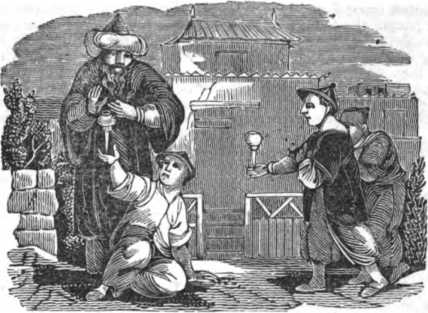
The mother of Aladdin, finding that her son would not follow his father’s business, shut up the shop, sold off the implements of that trade, and with the money she got for them, and what she could get by spinning cotton, thought to maintain herself and her son.
Aladdin, who was now no longer restrained by the fear of a father, and who cared so little for his mother, that whenever she chid him he would fly in her face, gave himself entirely over to dissipation, and was never out of the streets from his companions. This course he followed till he was fifteen years old, without giving his mind to any thing whatever, or the least reflection on what would become of him. In this situation, as he was one day playing according to custom, in the street, with his vagabond troop, a stranger passing by stood still to observe him.
This stranger was a famous magician, called by the writer of this story the African Magician; and by that name I shall call him with the more propriety, as he was a native of Africa, and had been but two days come from thence.
Whether the African magician, who was a good physiognomist, had observed in Aladdin’s countenance something which was absolutely necessary for the execution of the design he came about, he inquired artfully about his family, who he was, and what were his inclinations; and when he had learned all he desired to know, he went up to him, and taking him aside from his comrades, said to him, Child, was not your father called Mustapha the tailor? —Yes, sir, answered Aladdin, but he has been dead a long time.
At these words, the African magician threw his arms about Aladdin’s neck, and kissed him several times with tears in his eyes. Aladdin, who observed his tears, asked him, What made him weep? Alas! my son, cried the African magician with a sigh, how can I forbear? I am your uncle; your good father was my own brother. I have been a great many years abroad travelling, and now I am come home with the hopes of seeing him, you tell me he is dead. I assure you it is a sensible grief to me to be deprived of the comfort I expected. But it is some relief to my affliction, that as far as I can remember him, I knew you at first sight, you are so like him; and I see I am not deceived. Then he asked Aladdin, putting his hand into his purse, where his mother lived; and as soon as Aladdin had informed him, he gave him a handful of small money, saying to him, Go, my son, to your mother, give my love to her, and tell her that I will come and see her to-morrow, if I have time, that I may have the satisfaction of seeing where my good brother lived so long, and ended his days.
As soon as the African magician left his new-adopted nephew, Aladdin ran to his mother, overjoyed at the money his uncle had given him. Mother, said he, have I an uncle? No, child, replied his mother, you have no uncle by your father’s side or mine. I am just now come, answered Aladdin, from a man who says he is my uncle by my father’s side, assuring me that he is his brother. He cried and kissed me when I told him my father was dead; and to show you that what I tell you is truth, added he, pulling out the money, see what he has given me; he charged me to give his love to you, and to tell you, if he has any time to-morrow, he will come and pay you a visit, that he may see at the same time the house my father lived and died in. Indeed, child, replied the mother, your father had a brother, but he has been dead a long time, and I never heard of another.
The mother and son talked no more then of the African magician; but the next day Aladdin’s uncle found him playing in another part of the town with other children, and embracing him as before, put two pieces of gold into his hand, and said to him, Carry this, child, to your mother, and tell her that I will come and see her to-night, and bid her get us something for supper; but first show me the house where you live.
After Aladdin had showed the African magician the house, he carried the two pieces of gold to his mother, and when he had told her of his uncle’s intention, she went out and bought provisions; and considering she wanted various vessels, she went and borrowed them of her neighbours. She spent the whole day in preparing the supper; and at night, when it was ready, she said to Aladdin, Perhaps your uncle knows not how to find our house, go and see for him, and bring him if you meet with him.
Though Aladdin had showed the magician the house, he was very ready to go, when somebody knocked at the door, which Aladdin immediately opened; and the magician came in, loaded with wine and all sorts of fruits, which he brought for a dessert.
After the African magician had given what he brought into Aladdin’s hands, he saluted his mother, and desired her to show him the place where his brother Mustapha used to sit on the sofa; and when she had so done, he presently fell down and kissed it several times, crying out with tears in his eyes, My poor brother! how unhappy am I, not to have come soon enough to give you one last embrace! Aladdin’s mother desired him to sit down in the same place, but he would not. No, said he, I shall take care how I do that; but give me leave to sit here over against it, that if I am deprived of the satisfaction of seeing the master of a family so dear to me, I may at least have the pleasure of seeing the place where he used to sit. Aladdin’s mother pressed him no farther, but left him at his liberty to sit where he pleased.