ARABIAN NIGHTS’ (continued 28)
Reading edition · Edition 2
The Indian prostrated himself before the throne, and pointing to the horse, said to the king, Though, sir, I present myself the last before your majesty, yet I can assure you that nothing that has been shown to-day is so wonderful as this horse, on which I beg your majesty will be pleased to cast your eyes. I see nothing more in the horse, said the king, but the natural resemblance the workman has given him, which the skill of another workman may do as well or better.
Sir, replied the Indian, it is not for his outward form and appearance that I recommend my horse to your majesty’s examination as wonderful, but the use I know how to make of him, and what any other person, when I have communicated the secret to him, may do as well. Whenever I mount him, be it where it will, if I wish to transport myself through the air to the most distant part of the world, I can do it in a very short time. This, sir, is the wonder of my horse, a wonder which nobody ever heard speak of, and which I offer to show your majesty, if you command me. [102]
The king of Persia, who was fond of every thing that was curious, and, after the many wonderful things he had seen and desired to see, had never seen nor heard any thing that came up to this, told the Indian that nothing but the experience of what he told should convince him; and that withal he was ready to see him perform what he promised.
The Indian presently put his foot into the stirrup, and mounted his horse with a great deal of activity; and when he had got the other foot into the stirrup, and had fixed himself in the saddle, he asked the king of Persia where he pleased to send him.
About three leagues from Schiraz there was a high mountain, discernible from the large square before the palace, where the king and his court, and a great concourse of people then were. Do you see that mountain? said the king, pointing to the hill; go to it, it is not a great way off, but it is far enough to judge of the haste you can make in going and coming. But because it is not possible for the eye to follow you so far, for a certain sign that you have been there, I expect that you will bring me a branch of a palm tree that grows at the bottom of the hill.
The king of Persia had no sooner declared his will, but the Indian turned a peg, which was in the hollow of the horse’s neck, just by the pommel of the saddle, and in an instant the horse rose off the ground, and carried his rider into the air like lightning to such a height, that those who had the strongest sight could not discern him, to the admiration of the king and all the spectators. Within less than a quarter of an hour they saw him come again with the palm branch in his hand; but before he came quite down, he took two or three turns in the air over the spot, amid the acclamations of all the people, then descended upon the same spot of ground whence he set off, without receiving the least shock from the horse to disorder him. He dismounted, and going up to the throne, prostrated himself, and laid the branch of the palm-tree at the king’s feet.
The king of Persia, who was an eye-witness, with no less admiration than astonishment of this unheard-of sight, which the Indian had exhibited, conceived a great desire to have the horse; and as he persuaded himself that he should not find it a difficult matter to treat with the Indian about him, for whatever sum of money he should value him at, he began to look upon him as the most valuable thing in his treasury. To judge of thy horse by his outward appearance, said he to the Indian, I did not think him so much worth my consideration. As you showed me his merits, I am obliged to you for undeceiving me; and to show you how much I esteem him, I will buy him of you, if he is to be sold.
Sir, replied the Indian, I never doubted that your majesty, who has the character of the most judicious prince on earth, would set a just value on my work as soon as I had shown you on what account he was worthy your attention. I also foresaw that you would not only admire and commend him, but would desire to have him. For my part, sir, though I know the true value of him, and that my being master of him will render my name immortal in the world, yet I am not so fond of him but I can resign him, to gratify that noble passion of your majesty; but in making this declaration, I have another to add, without which I cannot resolve to part with him, and perhaps you may not approve of it.
Your majesty will not be displeased, continued the Indian, if I tell you that I did not buy this horse, but obtained him of the inventor and maker, by giving him my only daughter in marriage, and promising at the same time never to sell him; but, if I parted with him, to exchange him for something that I should like.
The Indian would have gone on, but at the word exchange, the king of Persia interrupted him: I am willing, said he, to give you what you will ask in exchange. You know my kingdom is large, and contains many great, rich, and populous cities; I will give you the choice of which you like best, in full sovereignty for the rest of your life.
This exchange seemed royal and noble to the whole court, but was much below what the Indian proposed to himself, who had raised his thoughts much higher. I am infinitely obliged to your majesty for the offer you make me, answered he, and cannot thank you enough for your generosity; yet I must beg of you not to be angry with me, if I have the boldness to tell you, that I cannot resign to you my horse, but by receiving the hand of the princess your daughter as my wife: this is the only price at which I can give up my property in him.
The courtiers about the king of Persia could not forbear laughing aloud at this extravagant demand of the Indian; but the prince Firouz Schah, the king’s eldest son, and presumptive heir to the crown, could not bear it without indignation. The king was of a very different opinion, and thought he might sacrifice the princess of Persia to the Indian, to satisfy his curiosity. He remained, however, undetermined, considering what he should do.
Prince Firouz Schah, who saw his father hesitating what answer he should make, began to fear lest he should comply with the Indian’s demand, and looked upon it as not only injurious to the royal dignity and his sister, but also to himself; therefore, to anticipate his father, he said, Sir, I hope your majesty will forgive me for daring to ask you, if it is possible that your majesty should hesitate a moment about a denial to so insolent a demand from such an insignificant fellow, and scandalous juggler; and that you should give him reason to flatter himself a moment with being allied to one of the most powerful monarchs in the world? I beg of you to consider what you owe to yourself, and to your own blood, and the high rank of your ancestors.
Son, replied the king of Persia, I very much approve of your remonstrance, and am very sensible of your zeal for preserving the lustre of your noble birth; but you do not consider enough the excellence of this horse, nor that the Indian, if I should refuse him, may make the offer somewhere else, where this nice point of honour may be waved. I shall be in the utmost despair if another prince should boast of having exceeded me in generosity, and deprived me of the glory of possessing a horse, which I esteem as the most singular and wonderful thing in the world. I will not say I consent to grant him what he asked. Perhaps he has not made up his mind upon this exorbitant demand; and, putting my daughter the princess out of the question, I may make another agreement with him that will answer his purpose as well. But before I strike the bargain with him, I should be glad that you would examine the horse; try him yourself, and give me your opinion; I doubt not he will permit.
As it is natural for us to flatter ourselves in what we desire, the Indian fancied, by what he heard the king of Persia say, he was not entirely averse to his alliance, by taking the horse at his price; and that the prince, who, instead of being against it, might become more favourable to him, and not oppose the desire the king seemed to have; and to show he consented to it with a great deal of pleasure, he expressed much joy, ran before the prince to help him to mount, and showed him how to guide and manage the horse.
The prince mounted the horse with wonderful address, without the Indian assisting him; and no sooner had he got his feet in both stirrups, but, without staying for the Indian’s advice, he turned the peg he had seen him use, and mounted into the air as quick as an arrow shot out of a bow by the stoutest and most adroit archer; and in a few moments the king, court, and the numerous assembly, lost sight of him. Neither horse nor prince were to be seen; and the king of Persia made vain efforts to discern them: when the Indian, alarmed at what had happened, prostrated himself before the throne, and forced the king to look at him, and give attention to what he said. Sir, said he, your majesty yourself saw that the prince was so hasty, that he would not permit me to give him the necessary instructions to govern my horse. From what he saw me do, he would show that he wanted not my advice to set off. He was too willing to show his address, but knows not the way which I was going to show him, how to turn the horse about and bring it back again. Therefore, sir, the favour I ask of your majesty is, not to make me accountable for what accidents may befall him; you are too just to impute to me any misfortune that may attend him.
This discourse of the Indian very much surprised and afflicted the king of Persia, who saw the danger his son was in to be inevitable, if, as the Indian said, there was another secret to bring him back again, that was different from that which carried him away; and asked, in a passion, why he did not call him back the moment he went.
Sir, answered the Indian, your majesty saw as well as I with what swiftness the horse and the prince flew away. The surprise I was then, and still am in, deprived me of the use of my speech; and, if I could have spoken, he was got too far to hear me. If he had heard me, he knew not the secret to bring him back, which, through his impatience, he would not stay to learn. But, sir, added he, there is room to hope that the prince, when he finds himself at a loss, will perceive another peg, and, as soon as he turns that, the horse will cease to rise, and will descend to the ground, and he may turn him to what place he pleases by guiding him with the bridle.
Notwithstanding all these arguments of the Indian, which carried great appearance of probability, the king of Persia was terribly frightened at the evident danger his son was in. I suppose, replied he, it is very uncertain whether my son perceives the other peg, and makes a right use of it: may not the horse, instead of lighting on the ground, fall upon some rock, or tumble into the sea with him?
Sir, replied the Indian, I can deliver your majesty from this apprehension, by assuring you that the horse crosses seas without ever falling into them, and always carries his rider wherever he has a mind to go. And your majesty may assure yourself, that, if the prince does not find out the other peg which I mentioned, the horse will carry him where he pleases to go. It is not to be supposed he will go any where but where he can find assistance, and make himself known.
Be it as it will, replied the king of Persia, as I cannot depend upon the assurance you give me, your head shall answer for my son’s life, if he does not return safe and sound in three days’ time, or that I can certainly hear that he is alive. Then he ordered his officers to secure his person, and keep him close prisoner; after which he retired to his palace, extremely grieved that the feast of Nevrouz should afford him and his court so much sorrow.
In the mean time prince Firouz Schah was carried through the air with prodigious swiftness, as was said before; and in less than an hour’s time he had got so high, that he could not distinguish any thing on the earth, but mountains and plains seemed confounded together. It was then he began to think of returning from whence he came, and thought to do it by turning the same peg the contrary way, and pulling the bridle at the same time. But when he found that the horse still rose with the same swiftness, his astonishment was extremely great. He turned the peg several times, one way and the other, but all in vain. It was then he grew sensible of his fault, in not taking the necessary precautions to guide the horse, before he mounted him. He immediately apprehended the great danger he was in, but that apprehension did not deprive him of his reason. He examined the horse’s head and neck with great attention, and perceived behind the horse’s right ear another peg, smaller and less discernible than the other. He turned that peg, and presently perceived that he descended in the same oblique manner as he mounted, but not so swiftly.
Night had overshadowed almost half an hour that part of the earth over which the prince then was, when he found out and turned the small peg; and as the horse descended, he by degrees lost sight of the sun, till it grew quite dark; insomuch that, instead of choosing what place he would go to, he was forced to let the bridle lie upon the horse’s neck, and wait patiently till he alighted, though not without the dread lest it should be in the desert, a river, or the sea.
At last the horse alighted and stopped after midnight, and prince Firouz Schah dismounted, very faint and hungry, having eaten nothing since the morning when he came out of the palace with his father to assist at the festival. The first thing he had to do in the darkness of the night was to endeavour to find out where he was; when he found himself to be on the terrace of a magnificent palace, surrounded with a balustrade of white marble, breast high; and groping about, found a pair of stairs which led down into the palace, the door of which was half open.
None but prince Firouz Schah would have ventured to go down those stairs, so dark as it was, and in the danger he exposed himself to from friends or foes. But no consideration could stop him. I do not come, said he to himself, to do any body any harm; and certainly, whoever meets or sees me first, and finds that I have no arms in my hands, will not attempt any thing against my life, before they hear what I have to say for myself. After this reflection he opened the door wider, without making any noise, and went softly down the stairs, that he might not awaken any body; and when he came to a landing place on the staircase, he found the door of a great hall, that had a light in it, open.
The prince stopped at the door, and listening, heard no other noise than the snoring of some people who were fast asleep. He advanced a little into the room, and, by the light of a lantern, saw that those persons whom he heard snore were black eunuchs, with naked sabres laid by them; which was enough to inform him that this was the guard chamber of some queen or princess: which latter it proved to be.
In the next room to this the princess lay, as appeared by the light he saw, the door being open, through a thin silken curtain, which drew before the door-way, whither prince Firouz Schah advanced on tip-toe, without waking the eunuchs. He put by the curtain, and went in; and without staying to observe the magnificence of the chamber, which was what he did not much regard, he gave his attention to something of greater importance. He saw a great many beds; only one of them on a sofa, the rest on the floor. The princess lay in the first, and her women in the others.
This distinction was enough to direct the prince in his choice. He crept softly to the bed without waking either the princess or her women, and beheld a beauty so extraordinary and surprising, that he was charmed and inflamed with love at the first sight. O heavens! said he to himself, has my fate brought me hither to deprive me of my liberty, which hitherto I have always preserved? How can I avoid a certain slavery, when those eyes shall open, since without doubt, they complete the lustre of this assemblage of charms? I must quickly resolve; since I cannot stir without being my own murderer; for so has necessity ordained.
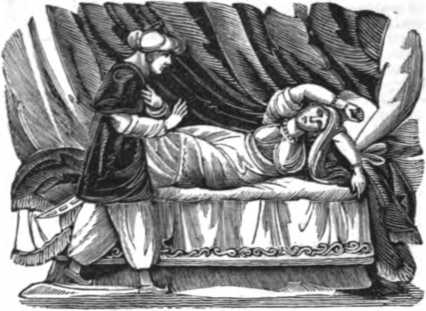
After these reflections on his situation, and on the princess’s beauty, and examining the condition of his heart, he fell on his knees, and taking hold of the princess’s shift sleeve, out of which came an arm as white as snow, pulled it gently towards him. The princess opened her eyes, and seeing a handsome, well-shaped, comely man on his knees, she was in great surprise; yet seemed to show no sign of fear.
The prince made use of this favourable moment, bowed his head down to the ground, and, rising, said, Respectable princess, by the most extraordinary and wonderful adventure imaginable, you see here at your feet a suppliant prince, the son of the king of Persia, who was yesterday morning with his father in his court, at the celebration of a solemn feast, and is now in a strange country, in danger of his life, if you have not the goodness and generosity to give him your assistance and protection. These I implore, adorable princess, with the confidence that you will not refuse me. I have the more ground to persuade myself that so much beauty and majesty, and such charms, cannot entertain the least inhumanity.
This princess, to whom prince Firouz Schah so happily addressed himself, was the princess of Bengal, eldest daughter of the king of that kingdom, who had built this palace a small distance from his capital, whither she went to take the benefit of the country. After she had heard the prince with all the candour he could desire, she replied with equal goodness, Prince, you are not in a barbarous country; take courage: hospitality, humanity, and politeness, are to be met with in the kingdom of Bengal, as well as in that of Persia. It is not I who grant you the protection you ask; you not only have found it in my palace, but throughout the whole kingdom; you may believe me, and depend upon what I say.
The prince of Persia would have thanked the princess of Bengal for her civility, and the favour she did him, and had already bowed down his head to return the compliment, but she would not give him leave to speak. Notwithstanding I desire, said she, to know by what miracle you have come hither from the capital of Persia in so short a time, and by what enchantment you have been able to penetrate so far as to come to my apartment, and to have deceived the vigilance of my guards, yet as it is impossible but you must want some refreshment, and looking upon you as a welcome guest, I will wave my curiosity, and give orders to my women to regale you, and show you an apartment, that you may rest yourself after your fatigue, and be better able to satisfy my curiosity.
The princess’s women, who awaked at the first words which the prince addressed to the princess, were in the utmost surprise to see a man at the princess’s bolster, as they could not conceive how he got thither without waking them or the eunuchs. They no sooner comprehended the princess’s intentions, than they dressed themselves presently, and were ready to obey her commands, as soon as she gave them. They each took a wax candle, of which there were great numbers lighted up in the room; and after the prince had taken leave very respectfully, they went before him, and conducted him into a handsome chamber; where, while some were preparing the bed, others went into the kitchen; and notwithstanding it was so unseasonable an hour, they did not make prince Firouz Schah wait long, but brought him presently all sorts of meat; and when he had eaten as much as he chose, they removed the table, and left him to taste the sweets of repose, after showing him several presses, where he might find whatever he wanted.
In the mean time, the princess of Bengal was so struck with the charms, wit, politeness, and other good qualities which she discovered in that short conversation with the prince, that she could not sleep: but when her women came into her room to go to bed, again asked them if they had taken care of him, and if he wanted any thing; and particularly what they thought of him.
The women, after they had satisfied her as to the first articles, answered as to the last: We do not know what you may think of him, but, for our parts, we think you would be very happy if the king your father would marry you to so amiable a prince; for there is not a prince in all the kingdom of Bengal to be compared to him; nor can we hear that any of the neighbouring princes are worthy of you.
This flattering discourse was not displeasing to the princess of Bengal; but as she had no mind to declare her sentiments to them, she imposed silence upon them, telling them they talked without reflection, bidding them to go to bed and let her sleep.
The next day, the first thing the princess did as soon as she was up, was to sit down to her toilet. She took more pains in dressing and adjusting herself at the glass than ever she had done in her life. She never had tried her women’s patience so much before, by making them do and undo the same thing several times: Certainly, said she to herself, if the prince, as I perceive, was taken with me in my dishabille, he will be charmed with me when I am dressed. She adorned her head, neck, arms, and waist, with the finest and largest diamonds she had. The habit she made use of was one of the richest stuffs of the Indies, of a most beautiful colour, and made only for kings, princes, and princesses. After she had consulted her glass a long time, and asked her women, one after another, if any thing was wanting to her attire, she sent to know if the prince of Persia was awake; and as she never doubted but that, if he was up and dressed, he would ask leave to come and pay his respects to her, she charged the messenger to tell him she would make him the visit, and she had her reasons for this.
The prince of Persia, who by that night’s rest had recovered the fatigue he had undergone the day before, had just dressed himself, when he received the princess of Bengal’s compliments by one of her women. Without giving the lady who brought the message leave to communicate it, he asked her if it was proper for him then to go and pay his respects to the princess; and when the lady had acquitted herself of the errand, he replied, it shall be as the princess thinks fit; I came here to be solely at her pleasure.
As soon as the princess of Bengal understood that the prince of Persia waited for her, she immediately went to pay him a visit. After mutual compliments on both sides, the prince asking pardon for having waked the princess out of a profound sleep, and the princess inquiring after his health, and how he rested, the princess sat down on a sofa, as did also the prince, though at some distance, out of respect.
Then the princess, resuming the discourse, said, I would have received you, prince, in the chamber in which you found me in bed last night; but as the chief of my eunuchs has the liberty of coming into it, and never comes further without my leave, through my impatience to hear the surprising adventure which procures me the happiness of seeing you, I chose to come hither, that we may not be interrupted; therefore I beg of you to give me that satisfaction, which will highly oblige me.
Prince Firouz Schah, to gratify the princess of Bengal, began his discourse with the solemn and annual feast of the Nevrouz, relating all the sights worthy of her curiosity, which had amazed the court of Persia and the whole town of Schiraz. Afterwards he came to the enchanted horse; the description of which, with the account of the wonders the Indian performed on him before so august an assembly, convinced the princess that nothing of that kind could be imagined more surprising in the world. You may well think, charming princess, continued the prince of Persia, that the king my father, who cares not what he gives for any thing that is rare and curious, would be very desirous to purchase such a horse, as indeed he was. He asked the Indian what he would have for him; who made him an extravagant reply, telling him, that he had not bought him, but taken him in exchange for his only daughter, and could not part with him but on the like condition, which was, to have his consent to marry the princess my sister.
The crowd of courtiers, who stood about the king my father, hearing the extravagance of this proposal, laughed loudly at it; and I, for my part, conceived so great indignation, that I could not disguise it; and the more, because I saw that the king my father was considering with himself what answer he should give him. In short, I believe he would have granted him what he asked, if I had not in the most lively terms represented to him how injurious it would be to his honour; yet my remonstrance could not bring him entirely to quit his design of sacrificing the princess my sister to so despicable a person. He fancied he should bring me over to his opinion, if once I could comprehend, as he imagined he did, the singular worth of his horse. With this view he would have me look at him, and mount him, and make a trial of him myself.
To please my father, I mounted the horse, and as soon as I was upon his back I put my hand upon a peg, as I had seen the Indian do before me, to make the horse mount into the air, never staying to take instructions of the owner. The instant I touched the peg, the horse mounted with me into the air as swift as an arrow shot out of a bow, and I was presently at such a distance from the earth that I could not distinguish any object. By the swiftness of the motion I was for some time unapprehensive of the danger to which I was exposed; but when I grew sensible of it, I endeavoured to turn the peg the contrary way. But the experiment would not answer my expectation, and still the horse mounted with me, and carried me a greater distance from the earth. At last I perceived another peg, which I turned, and then I grew sensible that the horse declined towards the earth, and presently found myself so surrounded with darkness, that it was impossible for me to guide the horse. In this condition I laid the bridle on his neck, and trusted myself to the will of God to dispose of my fate.
Not long after the horse alighted, and I got off his back, and examining whereabouts I might be, perceived myself on the terrace of this palace, and found the door of the staircase half open. I came softly down the stairs, and seeing a door open by a small light, put my head into the room, and saw some eunuchs asleep, and a great light in another room. The necessity I was under, notwithstanding the inevitable danger I was threatened with, if the eunuchs had waked, inspired me with the boldness, or rather rashness, to cross that room to get to the other.
It is needless, princess, added the prince, to tell you the rest, since you are not unacquainted with all that passed afterwards. But I am obliged in duty to thank you for your goodness and generosity, and to beg of you to let me know how I may show my gratitude. According to the law of nations, I am already your slave, and cannot make you an offer of my person; there only remains my heart: but, alas! princess, what do I say? My heart is no longer my own; your charms have forced it from me, but in such a manner, as I will never ask for it again, but yield it up: give me leave, therefore, to declare you mistress both of my heart and inclination.
These last words of the prince Firouz Schah were pronounced with such an air and tone, that the princess of Bengal never doubted a moment of the effect she expected from her charms; neither did she seem to resent the precipitate declaration of the prince of Persia. Her blushes served but to heighten her beauty, and render her more amiable in the eyes of the prince.
As soon as she had recovered herself, she replied, prince, you have given me a sensible pleasure by telling me those surprising, wonderful things. But, on the other hand, I can hardly forbear shuddering, when I think on the height you was in the air; and though I have the good fortune to see you here safe and well, I was in pain till you came to that part where the Indian horse alighted on my palace leads. The same thing might have happened in a thousand other places. I am glad that chance has given me the preference to the whole world, and the opportunity of letting you know that it could not have conducted you to any place where you could have been received more agreeably, and with greater pleasure.
But prince, continued she, I should think myself offended, if I believed that the thought you mentioned of being my slave was serious, and that it did not proceed from your politeness rather than from a sincerity of sentiment; for, by the reception I gave you yesterday, you might assure yourself, you are here as much at liberty as in the midst of the court of Persia.
As to your heart, added the princess of Bengal, in a tone which showed nothing less than a refusal, as I am persuaded that you have not lived so long without disposing of it, and that you could not fail of making choice of a princess who deserves it, I should be very sorry to give you an occasion to be guilty of infidelity to her.
Prince Firouz Schah would have protested, that when he left Persia, he was master of his own heart: but, at that instant, one of the princess’s ladies in waiting came to tell her that dinner was served up.
This interruption delivered the prince and princess from an explanation, which would have been equally embarrassing to both of them, and of which they stood not in need. The princess of Bengal was fully convinced of the prince of Persia’s sincerity; and the prince, though the princess had not explained herself, judged nevertheless by some words she let fall, and the favourable manner she heard him, that he had no reason to complain.
As the lady held the door open, the princess of Bengal said to the prince of Persia, rising off her seat, as he did also from his, I am not used to dine so early; but as I fancied you might have had but an indifferent supper last night, I ordered dinner to be got ready sooner than ordinary. After this compliment, she led him into a magnificent hall, where a table was laid, and set off with great plenty of choice and excellent viands; and as soon as they were sat down, a great many beautiful slaves of the princess, richly dressed, began a most agreeable concert of vocal and instrumental music, which lasted the whole time of dinner.
This concert was so sweet and well managed, that it did not in the least interrupt the prince and princess’s conversation. All dinner-time their sole concern was to help and invite each other to eat: the prince, for his part, served the princess with the choicest of every thing, and strove to outdo her in civility, both by words and actions, which she returned again, with a great many new compliments: and in this reciprocal commerce of mutual civilities and attentions, love made a greater progress in both, than a concerted interview would have promoted.
When they rose from the table, the princess carried the prince into a large and magnificent closet, finely embellished with paintings in blue and gold, of a just symmetry, and richly furnished; there they both sat down upon a sofa, which afforded a most agreeable prospect into the palace garden, which prince Firouz Schah admired for the vast variety of flowers, shrubs, and trees, which were full as beautiful as those of Persia, but quite different. Here taking the opportunity of entering into a conversation with the princess, he said, I always believed, madam, that no part of the world but Persia afforded such stately palaces and beautiful gardens; but now I see that other great monarchs know as well how to build mansions suitable to their power and greatness; and if there is a difference in the manner of building, there is none in the grandeur and magnificence.
Prince, replied the princess of Bengal, as I have no idea of the palaces of Persia, I cannot judge of the comparison you have made of mine, to tell you my opinion of it. But however sincere you seem to be, I can hardly think it just, but rather incline to believe it a compliment: I will not despise my palace before you: you have too good an eye, too good a taste, not to form a sound judgment. But I assure you I find it very indifferent, when I compare it with the king my father’s, which far exceeds it for grandeur, beauty, and richness: you shall tell me yourself what you think of it, when you have seen it; for since a chance has brought you so nigh to the capital of this kingdom, I do not doubt but you will see it, and make my father a visit, that he may pay you all the honour due to a prince of your rank and merit.
The princess flattered herself, that by exciting in the prince of Persia a curiosity to see the Palace of Bengal, and to visit her father in it, the king, seeing him so handsome, wise, and accomplished a prince, might perhaps resolve to propose an alliance with him, by offering her to him as a wife. And as she was well persuaded she was not indifferent to the prince, and that he would be pleased with the proposal, she hoped to attain to the utmost of her wishes, and preserve all the decorum becoming a princess, who would appear resigned to the will of her king and father; but the prince of Persia did not return her an answer according to her expectations.
Princess, replied the prince, the preference which you give to the king of Bengal’s palace to your own, is enough for me to believe it much exceeds it: but as to the proposal of my going and paying my respects to the king your father, I should not only do myself a pleasure, but an honour. But judge, princess, yourself, would you advise me to present myself before so great a monarch, like an adventurer, without attendants, and a train agreeable to my rank?
Prince, replied the princess, let not that give you any pain; if you will but go, you shall want no money to have what train and attendants you please: I will furnish you; and we have traders here of all nations in great numbers, and you may make what choice you please, to form your household.
Prince Firouz Schah penetrated into the princess of Bengal’s intention, and this sensible mark she gave him of her love, still augmented his passion, which, notwithstanding its violence, made him not forget his duty. But without any hesitation he replied, Princess, I should most willingly accept of the obliging offer you make me, for which I cannot enough show my gratitude, if the uneasiness my father must feel on account of my absence did not prevent me. I should be unworthy of the goodness and tenderness he has always had for me, if I should not return as soon as possible to calm his fears. I know him so well, that while I have the happiness of enjoying the conversation of so lovely a princess, I am persuaded that he is plunged into the deepest grief, and has lost all hopes of seeing me again. I hope you will do me the justice to believe, that I cannot, without ingratitude, and being guilty of a crime, dispense with going to restore to him that life, which a too long deferred return may have endangered.
After this, princess, continued the prince of Persia, if you will permit me, and think me worthy to aspire to the happiness of becoming your husband, as the king my father has always declared that he never would constrain me in my choice, I should find it no difficult matter to get leave to return, not as a stranger, but as a prince, to contract an alliance with him by our marriage; and I am persuaded that he will be overjoyed when I tell him with what generosity you received me, though a stranger in distress.
The princess of Bengal was too sensible, after what the prince of Persia had said, to insist any longer in persuading him to pay a visit to the king of Bengal, or to ask any thing contrary to his duty and honour. But she was very much alarmed to find that he thought of so sudden a departure; fearing, that if he took his leave of her so soon, instead of remembering his promise, he would forget her when he ceased to see her. To divert him from it, she said to him, Prince, my intention of proposing a visit to my father was not to oppose so just an excuse as that you give me, and which I did not foresee. I should have rendered myself an accomplice of the crime, had I thought of it, but I cannot approve of your thinking to go so soon as you propose; at least, grant me the favour I ask, of a little longer acquaintance; and since I have had the happiness to have you alight in the kingdom of Bengal, rather than in the midst of a desert, or on the top of some steep craggy rock, from which it would have been impossible for you to descend, I desire you will stay long enough to enable you to give a better account at the court of Persia of what you have seen here.
The sole end the princess of Bengal had in this discourse was, that the prince of Persia, by a longer stay, might become insensibly more passionately enamoured of her charms, hoping thereby that his ardent desire of returning would diminish, and then he might be brought to appear in public, and pay a visit to the king of Bengal. The prince of Persia could not well refuse her the favour she asked, after the kind reception she had given him: but was so complaisant as to comply with her request; and the princess’s thoughts were only how to render his stay agreeable by all the diversions she could imagine.
Nothing went forward for several days but festivals and balls, and concerts of music, accompanied with magnificent feasts, and collations, walks in the gardens, or hunting-parties in the palace-park, which abounded with all sorts of game, stags, hinds, and fallow-deer, and other beasts peculiar to the kingdom of Bengal, which the princess could pursue without danger. After the chase, the prince and princess met in some beautiful spot in the park, where a carpet was spread, and cushions laid for their accommodation. There resting themselves, after their violent exercise, and recovering themselves, they conversed on various subjects. The princess took great pains to turn the conversation on the grandeur, power, riches, and government of Persia; that from prince Firouz Schah’s discourse she might have an opportunity to talk of the kingdom of Bengal, and its advantages, and engage him to resolve to make a longer stay there; but she was disappointed in her expectations.
In short, the prince of Persia, without the least exaggerations, gave so advantageous an account of the extent of the kingdom of Persia, its magnificence and riches, its military force, its commerce by sea and land with the remote parts of the world, some of which were unknown to him; the vast number of large cities it contained, almost as populous as that which the king had chosen for his residence, where he had palaces furnished ready to receive him at all seasons of the year, so that he had his choice always to enjoy a perpetual spring; that before he had done, the princess found the kingdom of Bengal to be very much inferior to that of Persia, in a great many instances. When he had finished his relation, he begged of her to entertain him with a description of Bengal; which, after a great deal of entreaty from the prince, she complied with.
The princess gave prince Firouz Schah that satisfaction; but by lessening a great many advantages the kingdom of Bengal was well known to have over that of Persia, she let him know the disposition she felt to accompany him, so that he believed she would consent at the first proposition he should make; but he thought it would not be proper to make it till he had showed her so much complaisance as to stay with her long enough to make the blame fall on her, in case she wished to detain him longer from returning to his father, as he was in duty bound to do.
Two whole months the prince Firouz Schah abandoned himself entirely to the will of the princess of Bengal, yielding to all the amusements she contrived for him, for she neglected nothing to divert him, as if she thought he had nothing else to do but to pass his whole life with her in this manner. But after that time, he declared seriously he could not stay any longer, and begged of her to give him leave to return to his father; repeating again the promise he had made her to return soon in a style worthy of her and himself, and to demand her in form in marriage of the king of Bengal.
And princess, replied the prince of Persia, that you may not suspect the truth of what I say; and that by my asking this leave, you may not rank me among those false lovers who forget the objects of their love as soon as they are absent from them; but to show that my passion is real, and not feigned, and that life cannot be pleasant to me when absent from so lovely a princess, whose love to me I cannot doubt is mutual; I would presume, if I was not afraid you would be offended at my request, to ask the favour of taking you along with me.
As the prince Firouz Schah saw that the princess blushed at these last words, and that without any mark of anger she hesitated at the step she should take, he proceeded, and said, Princess, as for the king my father’s consent, and the reception he will give you, I venture to assure you he will receive you with pleasure into his alliance; and as for the king of Bengal, after all the love and tender regard he has always expressed for you, he must be the reverse of what you have described him, an enemy to your repose and happiness, if he should not receive in a friendly manner the embassy which my father will send to him for his approbation of our marriage.
The princess of Bengal returned no answer to this discourse of the prince of Persia; but her silence, and eyes cast down, were sufficient to inform him that she had no reluctance to accompany him into Persia, but consented. The only difficulty she had was, that the prince knew not well enough how to govern the horse, and she was apprehensive of being involved with him in the same difficulty as when he made the experiment. But the prince soon removed her fear by assuring her she might trust herself with him, for that after the experience he had had, he defied the Indian himself to manage him better. She thought therefore only of concerting measures to get off with him so secretly, that nobody belonging to the palace should have the least suspicion of their design.
The next morning, a little before daybreak, when all in the palace were asleep, they went upon the terrace of the palace. The prince turned the horse towards Persia, and placed him where the princess could easily get up behind him; which she had no sooner done, and was well settled with her arms about his waist, for her better security, but he turned the peg, and the horse mounted into the air, and making his usual haste, under the guidance of the prince, in two hours’ time the prince discovered the capital of Persia.
He would not alight at the great square from whence he set out, nor in the sultan’s palace, but directed his course towards a pleasure-house at a little distance from the town. He led the princess into a handsome apartment, where he told her, that to do her all the honour that was due to her, he would go and inform his father of their arrival, and return to her immediately. He ordered the housekeeper of the palace, who was then present, to provide the princess with what ever she had occasion for.
After the prince had taken his leave of the princess, he ordered a horse to be saddled, which he mounted, after sending back the housekeeper to the princess with orders to provide her breakfast immediately, and then set forwards for the palace. As he passed through the streets, he was received with acclamations by the people, who were overjoyed to see him again. The sultan his father was giving audience, when he appeared before him in the midst of his council, who, as well as the sultan and the whole court, had been in mourning ever since he had been absent. The sultan received him, and embracing him with tears of joy and tenderness, asked him, What was become of the Indian’s horse?
This question gave the prince an opportunity to tell him the embarrassment and danger he was in when the horse mounted into the air with him, and how he arrived at last at the princess of Bengal’s palace, with the kind reception he met with there: that the motive which obliged him to stay so long with her, was, the complaisance she had shown not to disoblige him, so that after promising to marry her, he had persuaded her to come with him into Persia. But, sir, added the prince, I have promised that you would not refuse your consent, and have brought her with me on the Indian’s horse, to a palace where your majesty often goes for your pleasure; and have left her there, till I could return and assure her that my promise was not in vain.
After these words, the prince prostrated himself before the sultan to gain his consent, but his father raised him up, embraced him a second time, and said to him, Son, I not only consent to your marriage with the princes of Bengal, but will go and meet her myself, and thank her for the obligation I in particular have to her, and will bring her to my palace, and celebrate your nuptials this day.
Then the sultan gave orders for his court to go out of mourning, and make preparations for the princess’s entry; that the rejoicings should begin with a grand concert of military music, and that the Indian should be fetched out of prison and brought before him. When the Indian was brought before the sultan, he said to him, I secured thy person, that thy life, though not a sufficient victim to my rage and grief, might answer for that of the prince my son, whom, thanks to God! I have found again: go, take your horse, and never let me see your face more.
As the Indian had learned of those who fetched him out of prison, that prince Firouz Schah was returned, and had brought a princess behind him on his horse, and was also informed of the place where he had alighted and left her, and that the sultan was making preparations to go and bring her to his palace; as soon as he got out of the sultan’s presence, he bethought himself of being beforehand with him and the prince; and, without losing any time, went directly to the palace, and addressing himself to the housekeeper, told him, he came from the sultan and prince of Persia, to fetch the princess of Bengal, and to carry her behind him through the air to the sultan, who waited in the great square of his palace to gratify the whole court and city of Schiraz with that wonderful sight.
The housekeeper, who knew the Indian, and that the sultan had imprisoned him, gave the more credit to what he said, because he saw that he was at liberty. He presented him to the princess of Bengal; who no sooner understood that he came from the prince of Persia, than she consented to what that prince, as she thought, desired of her.
The Indian, overjoyed at his success, and the ease with which he had accomplished his villany, mounted his horse, took the princess behind him, with the assistance of the housekeeper, turned the peg, and presently the horse mounted into the air with him and the princess.
At the same time the sultan of Persia, followed by his court, was on the road from his own palace to the palace where the princess of Bengal was left, and the prince of Persia was advanced before, to prepare the princess of Bengal to receive him, when the Indian to brave them both, and revenge himself for the ill-treatment he had received, as he pretended, passed over their heads with his prize.
When the sultan of Persia saw the ravisher, he stopped. His surprise and affliction was the more sensible, because it was not in his power to make him repent of so high an affront. He loaded him with a thousand imprecations, as also did all the courtiers, who were witnesses of so signal a piece of insolence and unparalleled villany.
The Indian, little moved with their curses, which just reached his ears, continued his way; while the sultan, extremely mortified at so great an injury, and to find he could not punish the author, returned back to his palace.
But what was prince Firouz Schah’s grief to see the Indian carry away the princess of Bengal, whom he loved so passionately, that he could not live without her! At the sight of an object so little expected, he was thunderstruck, and before he could deliberate with himself whether he should let fly all the reproaches his rage could invent against the Indian, or bewail the deplorable fate of the princess, or ask her pardon for not taking better precaution to preserve her, who had trusted herself to his care in a manner sufficiently expressive of her love, the horse was out of sight. He could not resolve what to do, whether he should return to the sultan’s palace, and shut himself up in his apartment to give himself entirely up to his affliction, without attempting to pursue the ravisher, to deliver the princess, and punish him as he deserved. But as his generosity, love, and courage, would not suffer this, he continued on his way to the palace where he had left his princess.
When he came there, the housekeeper, who was by this time convinced of his credulity, and that he was deceived by the Indian, threw himself at his feet with tears in his eyes, and accused himself of the crime, which he thought he had committed, and condemned himself to die by his hand. Rise up, said the prince to him, I do not impute the loss of my princess to thee, but to my own simplicity. But not to lose time, fetch me a dervise’s habit, and take care you do not give the least hint that it is for me.
Not far from this palace there stood a convent of dervises, the scheik or superior of which was the palace-keeper’s particular friend. He went to this scheik, and telling him that a considerable officer at court, and a man of worth, to whom he had been very much obliged, and wished to favour, by giving him an opportunity to withdraw from the sultan’s rage, he easily got a complete dervise’s habit, and carried it to prince Firouz Schah. The prince immediately pulled off his own clothes, and put it on; and being so disguised, and provided with a box of jewels, which he had brought as a present to the princess, he left the palace in the evening, uncertain which way to go, but resolved not to return till he had found out his princess, and brought her back again.
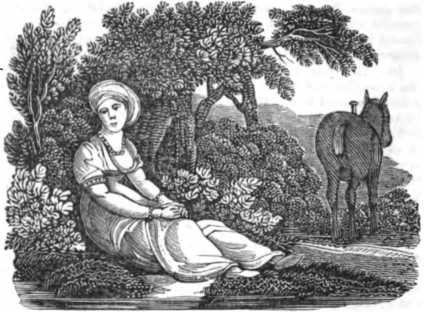
But to return to the Indian: he governed his enchanted horse so well that day, that he arrived early in a wood, near the capital of the kingdom of Caschmire. Being hungry, and concluding the princess was also, he alighted in that wood, in an open part of it, and left the princess on a grassy spot, by a rivulet of clear fresh water.
During the Indian’s absence, the princess of Bengal, who knew that she was in the power of a base ravisher, whose violence she dreaded, thought of getting from him, and seeking out some sanctuary. But as she had scarce eaten any thing on her arrival at the pleasant palace in the morning, she was so faint, that she could not execute her design, but was forced to abandon it, and to stay where she was, without any other resource than her courage, and a firm resolution rather to suffer death, than be unfaithful to the prince of Persia. When the Indian returned, she did not wait to be asked twice, but ate with him, and recovered herself enough to answer with courage to the insolent language he began to hold to her when they had done. After a great many threats, as she saw that the Indian was preparing to use violence, she rose up to make resistance, and, by her cries and shrieks, drew about them a company of horsemen, which happened to be the sultan of Caschmire and his attendants, who, as they were returning from hunting, happily for the princess of Bengal, passed through that part of the wood, and ran to her assistance, at the noise she made.
The sultan addressed himself to the Indian, and asked him who he was, and what he pretended to do with the lady? The Indian, with great impudence, replied, that she was his wife; and what had any one to do with his quarrel with her?
The princess, who neither knew the rank nor quality of the person who came so seasonably to her relief, told the Indian he was a liar; and said to the sultan, Sir, whoever you are that Heaven has sent to my assistance, have compassion on a princess, and give no credit to that impostor. Heaven forbid that I should be the wife of so vile and despicable an Indian! a wicked magician, that hath taken me away from the prince of Persia, to whom I was going to be married, and hath brought me hither on the enchanted horse that you see.
The princess of Bengal had no occasion to say any more to persuade the sultan of Caschmire that what she told him was truth. Her beauty, majestic air, and tears, spoke sufficiently for her. The sultan of Caschmire, justly enraged at the insolence of the Indian, ordered his guards to surround him, and cut off his head; which sentence was immediately executed, the more easily, as the Indian, just released from prison, was unprovided with any weapon to defend himself.
The princess, thus delivered from the persecution of the Indian, fell into another no less afflicting to her. The sultan, after he had ordered her a horse, carried her with him to his palace, where he lodged her in the most magnificent apartment, next his own, and gave her a great number of women-slaves to attend her, and a guard of eunuchs. He led her himself into the apartment he assigned her; where, without giving her time to thank him for the great obligation she had to him, he said to her, As I am certain, princess, that you must want rest, I will here take my leave of you till to-morrow, when you will be better able to give me all the circumstances of this strange adventure; and then left her.
The princess of Bengal’s joy was inexpressible to find she was so soon freed from the violence of a man she could not look upon without horror. She flattered herself that the sultan of Caschmire would complete his generosity by sending her back to the prince of Persia, when she told him her story, and asked that favour of him; but she was very much deceived in these hopes, for the sultan of Caschmire resolved to marry her the next day; and for that end had ordered rejoicings to be made by daybreak, by beating of drums and sounding of trumpets, and other instruments expressive of joy, which not only echoed through the palace, but throughout the city.
The princess of Bengal was awakened by those tumultuous concerts, but attributed them to a very different cause from the true one. When the sultan of Caschmire, who had given orders that he should be informed when the princess was ready to receive a visit, came to pay her one; and when he had inquired after her health, he acquainted her that all those rejoicings were to render their nuptials more solemn, and, at the same time, desired her to approve of them. This discourse put her into so great consternation that she fainted away.
The women-slaves who were present ran to her assistance; and the sultan did all he could to bring her to herself again, though it was a long time before they could. But when she recovered, rather than break the promise she had made to prince Firouz Schah, by consenting to marry the sultan of Caschmire, who had proclaimed their nuptials before he had asked her consent, she resolved to feign madness. She began to say the most extravagant things before the sultan, and even rose off her seat to fly upon him; insomuch that the sultan was very much surprised and afflicted that he had made such a proposal so unseasonably.
When he found that her frenzy rather increased than abated, he left her with her women, charging them never to leave her alone, but to take great care of her. He sent often that day to know how she did, but received no other answer but that she was rather worse than better. In short, at night she seemed much worse than she had been all day, insomuch that the sultan of Caschmire was disappointed of the happiness he promised himself.
The princess of Bengal continued to talk wildly, and show other marks of a disordered mind, next day and the following ones; so that the sultan was obliged to send for all the physicians belonging to his court, to consult them about her disease, and to ask them if they could cure her.
The physicians all agreed that there were several sorts and degrees of this distemper, some curable and others not; and told the sultan that they could not judge of the princess of Bengal’s, unless they saw her: upon which the sultan ordered the eunuchs to introduce them into the princess’s chamber, one after another, according to their rank.
The princess, who foresaw what would happen, and feared that, if she let the physicians come near her to feel her pulse, the least experienced of them would soon know that she was in a good state of health, and that her madness was only feigned, flew into such a rage and passion, that she was ready to tear out their eyes who came near her; so none of them durst approach her.
Some of them, who pretended to be more skilful than the rest, and boasted of judging of diseases only by sight, ordered her some potions, which she made the less difficulty to take, well knowing she could be sick or well at pleasure, and that they could do her no harm.
When the sultan of Caschmire saw that his court physicians could not cure her, he called in the most noted and experienced of the city, who had all no better success. Afterwards he sent for the most famous in the kingdom, who met with no better reception than the others from the princess, and what they ordered had no better effect. Afterwards he despatched expresses to the courts of neighbouring princes, with the princess’s case, to be distributed among the most famous physicians, with a promise of a handsome reward to any of them who should come and cure the princess of Bengal, besides travelling charges.
A great many physicians came from all parts, and undertook the cure; but none of them could boast of better success than their fellows, or of restoring the princess’s faculties, since it was a case that did not depend on their skill, but on the will of the princess herself.
During this interval, prince Firouz Schah, disguised in the habit of a dervise, had travelled through a great many provinces and towns, full of grief; and having endured a great deal of fatigue, not knowing which way to direct his course, or if he did not take the very opposite road from what he ought, to hear the tidings he sought. He made diligent inquiry after her at every place he came to, till at last, passing through a great town in India, he heard the people talk very much of a princess of Bengal, who ran mad on the day of the celebration of her nuptials with the sultan of Caschmire. At the name of the princess of Bengal, and supposing that there was no other princess of Bengal than her upon whose account he undertook his travels, he set forwards for the kingdom of Caschmire, on this common report; and on his arrival at the capital city, he went and lodged at a khan, where the same day he was told the story of the princess of Bengal, and the unhappy fate of the Indian, which he richly deserved. By all the circumstances, the prince knew he could not be deceived, but that she was the same princess he had sought so long after.
The prince of Persia, being informed of all these particulars, provided himself against the next day with a physician’s habit, and, having let his beard grow during his travels, he passed for a physician; and, through the greatness of his impatience to see the princess, went to the sultan’s palace, where, presenting himself to the chief of the officers, he told him that perhaps it might be looked upon as a very bold undertaking in him to offer himself as a physician to attempt the cure of the princess after so many had failed; but that he hoped some specifics, which he had had great experience of, and success from, would effect the cure. The chief of the officers told him he was very welcome, that the sultan would receive him with pleasure, and that if he should have the good fortune to restore the princess to her former health, he might expect a considerable reward from the sultan his master’s liberality: Stay a moment, added he, I will come to you again presently.
It had been a long time since any physician had offered himself; and the sultan of Caschmire with great grief had begun to lose all hope of ever seeing the princess of Bengal restored to her former health, that he might marry her, and show how much he loved her. He ordered the officer to introduce to him the physician he had announced.
The prince of Persia was presented to the sultan of Caschmire in the habit and disguise of a physician; and the sultan, without wasting time in superfluous discourse, after having told him the princess of Bengal could not bear the sight of a physician without falling into the most violent transports, which increased her distemper, carried him into a closet, from whence, through a window, he might see her without being seen.
There prince Firouz Schah saw his lovely princess sit carelessly singing a song with tears in her eyes, in which she deplored her unhappy fate, which deprived her, perhaps for ever, of the object she loved so tenderly.
The prince was so sensibly affected at the melancholy condition he found his dear princess in, that he wanted no other signs to comprehend that her distemper was feigned, and that it was for love of him that she was under so grievous a constraint. When he came out of the closet, he told the sultan that he had discovered the nature of the princess’s distemper, and that she was not incurable; but added withal, that he must speak with her in private, and by himself; and, notwithstanding her violent fits at the sight of physicians, he hoped she would hear and receive him favourably.
The sultan ordered the princess’s chamber door to be opened, and prince Firouz Schah went in. As soon as the princess saw him, (taking him by his habit to be a physician) she rose up in a rage, threatening him, and giving him the most abusive language. He made directly towards her; and when he was nigh enough for her to hear him, for he did not wish to be heard by any one else, he said to her, in a low voice, and in a most respectful manner, to make her believe him, Princess, I am not a physician, but the prince of Persia, and am come to procure you your liberty.
The princess, who presently knew the sound of the voice, and the upper features of his face, notwithstanding he had let his beard grow so long, grew calm at once, and a secret joy and pleasure overspread her face, the effect of seeing the person she so much desired so unexpectedly. Her agreeable surprise deprived her for some time of the use of her speech, and gave prince Firouz Schah time to tell her as briefly as possible how despair seized him when he saw the Indian carry her away; the resolution he took afterwards, to leave every thing to find her out wherever she was, and never to return home till he had found her, and forced her out of the hands of the perfidious wretch; and by what good fortune at last, after a long and fatiguing journey, he had the satisfaction to find her in the palace of the sultan of Caschmire. He then desired the princess to inform him of all that happened to her from the time she was taken away till that moment when he had the happiness to converse with her, telling her, that it was of the greatest importance to know this, that he might take the most proper measures to deliver her from the tyranny of the sultan of Caschmire.
The princess of Bengal told the prince how she was delivered from the Indian’s violence by the sultan of Caschmire, as he was returning home from hunting; but how ill she was treated the next day, by a declaration he had made of his precipitate design to marry her that very day, without the least civil office of asking her consent; that this violent and tyrannical conduct put her into a swoon; after which, she thought she had no other way than what she had taken to preserve herself for a prince to whom she had given her heart and faith, or die rather than marry the sultan, whom she neither loved, nor ever could love.
Then the prince of Persia asked her if she knew what was become of the horse after the Indian’s death. To which she answered, that she knew not what orders the sultan had given about it; but believed, after the account she had given him of it, he would take care of it.
As prince Firouz Schah never doubted but that the sultan had the horse, he communicated to the princess his design of making use of it to carry them both back into Persia; and after they had consulted together on the measures they were to take, and that nothing might prevent the execution of them, they agreed that the princess should dress herself the next day, and receive the sultan civilly when he brought him to her, but without speaking to him.
The sultan of Caschmire was overjoyed when the prince of Persia gave him an account what effect his first visit had towards the cure of the princess of Bengal. And the next day, when the princess received him after such a manner as persuaded him her cure was far advanced, he looked upon him as the greatest physician in the world; and seeing her in this state, contented himself with telling her how rejoiced he was to see her so likely soon to recover her health completely. He exhorted her to follow the directions of so thoughtful a physician, to complete what he had so well begun; and then retired, without waiting for her answer.
The prince of Persia, who attended the sultan of Caschmire out of the princess’s chamber, as he accompanied him, asked him if, without failing in due respect, he misfit inquire, How the princess of Bengal came into the dominions of Caschmire thus alone, since her own country lies so far off? This he said on purpose to introduce some discourse about the enchanted horse, and to know what was become of it.
The sultan of Caschmire, who could not penetrate into the prince of Persia’s motive for asking that question, concealed nothing from him; but told him much the same story as the princess of Bengal had done; adding, that he had ordered the enchanted horse to be kept safe in his treasury as a great curiosity, though he knew not the use of it.
Sir, replied the pretended physician, the information which your majesty gives me affords me a means of curing the princess. As she was brought hither on this horse, and the horse is enchanted, she hath contracted something of the enchantment, which can be dissipated only by certain incense which I am acquainted with. If your majesty would be pleased to entertain yourself, your court, and the people of your capital, with the most surprising sight that ever was seen, let the horse be brought into the great square before the palace, and leave the rest to me. I promise to show you, and all that assembly, in a few moments’ time, the princess of Bengal as well in body and mind as ever she was in her life. But, the better to effect what I propose, it would be proper that the princess should be dressed as magnificently as possible, and adorned with the best jewels your majesty has. The sultan would have undertaken much more difficult things to have arrived at the enjoyment of his desires, as he expected to do soon.
The next day the enchanted horse was, by his order, taken out of the treasury, and placed early in the great square before the palace. A report was spread through the town, that there was something extraordinary to be seen, and crowds of people flocked thither from all parts, insomuch that the sultan’s guards were placed to prevent disorder, and to keep space enough round the horse.
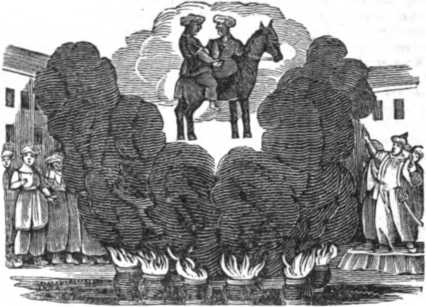
The sultan of Caschmire, surrounded with all his nobles and ministers of state, was placed on a scaffold erected on purpose. The princess of Bengal, attended by a vast number of ladies which the sultan had assigned her, went up to the enchanted horse, and the women helped her to get upon its back. When she was fixed in the saddle, and had the bridle in her hand, the pretended physician placed round the horse a great many vessels full of fire, which he had ordered to be brought, and going round it, he cast a strong and grateful perfume into those pots; then, collected in himself, with downcast eyes, and his hands upon his breast, he ran three times about the horse, making as if he pronounced certain words. The moment the pots sent forth a dark cloud of pleasant smell, which so surrounded the princess, that neither she nor the horse were to be discerned, watching his opportunity, the prince jumped nimbly up behind her, and, reaching his hand to the peg, turned it; and just as the horse rose with them into the air, he pronounced these words, which the sultan heard distinctly: Sultan of Caschmire, when you would marry princesses who implore your protection, learn first to obtain their consent.
Thus the prince of Persia recovered and delivered the princess of Bengal, and carried her that same day to the capital of Persia, where he alighted in the midst of the palace, before the king his father’s apartment, who deferred the solemnization of the marriage no longer than till he could make the preparations necessary to render the ceremony pompous and magnificent, and express the interest he took in it.
After the days appointed for the rejoicing were over, the king of Persia’s first care was to name and appoint an ambassador to go to give the king of Bengal an account of what was past, and to demand his approbation and ratification of the alliance contracted by this marriage; which the king of Bengal took as an honour, and granted with great pleasure and satisfaction.
The Story of Prince Ahmed, and the Fairy Pari Banou. [103]
There was a sultan who had peaceably filled the throne of India many years, and had the satisfaction in his old age to have three sons, the worthy imitators of his virtues, who, with the princess his niece, were the ornaments of his court. The eldest of the princes was called Houssain, the second Ali, the youngest Ahmed, and the princess his niece Nouronnihar. [104]
The princess Nouronnihar was the daughter of the younger brother of the sultan, to whom the sultan in his lifetime allowed a considerable revenue. But that prince had not been married long before he died, and left the princess very young. The sultan, in consideration of the brotherly love and friendship that had always subsisted between them, besides a great attachment to his person, took upon himself the care of his daughter’s education, and brought her up in his palace with the three princes; where her singular beauty and personal accomplishments, joined to a lively wit and irreproachable virtue, distinguished her among all the princesses of her time.
The sultan, her uncle, proposed to marry her when she arrived at a proper age, and to contract an alliance with some neighbouring prince by that means; and was thinking seriously on that affair, when he perceived that the three princes his sons loved her passionately. He was very much concerned, but his grief did not proceed from a consideration that their passion prevented his forming the alliance he designed, but the difficulty he foresaw to make them agree, and that the two youngest should consent to yield her up to their elder brother. He spoke to each of them apart; and after having remonstrated on the impossibility of one princess being the wife of three persons, and the troubles they would create if they persisted in their passion, he did all he could to persuade them to abide by a declaration of the princess in favour of one of them; or to desist from their pretensions, and to think of other matches, which he left them free liberty to choose, and suffer her to be married to a foreign prince. But as he found them obstinate, he sent for them altogether, and said to them, Children, since for your good and quiet I have not been able to persuade you no longer to aspire to marry the princess your cousin; and as I have no inclination to make use of my authority, to give her to one preferable before the other two, I fancy I have thought of a proper expedient which will please you all, and preserve the union among you, if you will but hear me, and follow my advice. I think it would not be amiss, if every one travelled separately into different countries, so that you might not meet each other: and as you know I am very curious, and delight in every thing that is rare and singular, I promise my niece in marriage to him that shall bring me the most extraordinary rarity; so that as chance may lead you to form your own judgment of the singularity of the things which you bring, by the comparison you make of them, you will have no difficulty to do yourselves justice by yielding the preference to him who has deserved it; and for the expense of travelling, I will give each of you a sum agreeable to your birth, and the purchase of the rarity you shall go in search after; which shall not be laid out in an equipage and attendants, which by discovering who you are, would not only deprive you of the liberty to acquit yourselves of the inquiry you go about, but prevent your observing those things which merit your attention, and may be most useful to you.
As the three princes were always submissive and obedient to the sultan’s will, and each flattered himself fortune might prove favourable to him, and give him the possession of the princess Nouronnihar, they all consented to it. The sultan gave them the money he promised them; and that very day they issued orders for the preparations for their travels, and took leave of the sultan, that they might be ready to set out early next morning. They all went out at the same gate of the city, each dressed like a merchant, attended by a trusty officer, dressed like a slave, and all well mounted and equipped. They went the first day’s journey together, and slept at the first inn, where the road divided into three different tracks. At night when they were at supper together, they all agreed to travel for a year, and to make that inn their rendezvous; and that the first that came should wait for the rest; that as they had all three taken leave together of the sultan, they might all return together. The next morning by break of day, after they had embraced and wished each other reciprocally good success, they mounted their horses, and took each a different road.
Prince Houssain, the eldest brother, who had heard wonders of the extent, strength, riches, and splendour of the kingdom of Bisnagar, bent his course towards the Indian coast; and, after three months’ travelling, joining himself to different caravans, sometimes over deserts and barren mountains, and sometimes through populous and fertile countries, arrived at Bisnagar, the capital of the kingdom of that name, and the residence of its king. He lodged at a khan appointed for foreign merchants, and having learnt that there were four principal divisions where merchants of all sorts kept their shops, in the midst of which stood the castle, or rather the king’s palace, on a large extent of ground, as the centre of the city, and surrounded with three courts, and each gate distant two leagues from the other, he went to one of these quarters the next day.
Prince Houssain could not view this quarter without admiration. It was large, and divided into several streets, all vaulted and shaded from the sun, and yet very light. The shops were all of the same size and proportion; and all that dealt in the same sort of goods, as well as all the artists, lived in one street.
The multitude of shops stocked with all kinds of merchandises, such as the finest linens from several parts of India, some painted in the most lively colours, and representing men, landscapes, trees, and flowers; silks and brocades, from Persia, China, and other places; porcelain from Japan and China; foot carpets of all sizes; surprised him so much, that he knew not how to believe his own eyes; but when he came to the shops of the goldsmiths and jewellers, (for those two trades were exercised by the same merchants,) he was in a kind of ecstasy, to behold such prodigious quantities of wrought gold and silver, and was dazzled by the lustre of the pearls, diamonds, rubies, emeralds, and other precious stones exposed to sale. But if he was amazed at seeing so many riches in one place, he was much more surprised when he came to judge of the wealth of the whole kingdom, by considering, that except the bramins, and ministers of the idols, who profess a life retired from worldly vanity, there was not an Indian man or woman, through the extent of that kingdom, but wore necklaces, bracelets, and ornaments about their legs and feet, made of pearls, and other precious stones, which appeared with the greater lustre, as they were blacks, which colour admirably set off their brilliancy.
Another thing prince Houssain particularly admired, was the great number of rose sellers, who crowded the streets; for the Indians are so great lovers of that flower, that not one will stir without a nosegay of them in his hand, or a garland of them on his head; and the merchants keep them in pots in the shops, so that the air of the whole quarter, however large, is perfectly perfumed.
After prince Houssain had run through that quarter, street by street, his thoughts fully employed on the riches he had seen, he was very much tired; which a merchant perceiving, civilly invited him to sit down in his shop. He accepted his offer; but had not been seated long before he saw a crier pass by with a piece of carpet on his arm, about six feet square, and cry it at thirty purses. The prince called to the crier, and asked to see the carpeting, which seemed to him to be valued at an exorbitant price, not only for the size of it, but the meanness of the stuff. When he had examined it well, he told the crier, that he could not comprehend how so small a piece of carpeting, and of so indifferent an appearance, could be set at so high a price.
The crier, who took him for a merchant, replied, Sir, if this price seems so extravagant to you, your amazement will be greater when I tell you I have orders to raise it to forty purses, and not to part with it under. Certainly, answered prince Houssain, it must have something very extraordinary in it, which I know nothing of. You have guessed it, sir, replied the crier, and will own it when you come to know, that whoever sits on this piece of carpeting may be transported in an instant wherever he desires to be, without being stopped by any obstacle. [105]
At this discourse of the crier, the prince of the Indies, considering that the principal motive of his travel was to carry the sultan his father home some singular rarity, thought that he could not meet with any which would give more satisfaction. If the carpeting, said he to the crier, has the virtue you assign it, I shall not think it too much; but shall make you a present besides. Sir, replied the crier, I have told you the truth; and it will be an easy matter to convince you of it, as soon as you have made the bargain for forty purses, on condition I show you the experiment. But as I suppose you have not so much with you, and to receive them I must go with you to the khan where you lodge, with the leave of the master of the shop, we will go into the back shop, and I will spread the carpeting; and when we have both sat down, and you have formed the wish to be transported into your apartment at the khan, if we are not transported thither it shall be no bargain, and you shall be at your liberty. As to your present, as I am paid for my trouble by the seller, I shall receive it as a favour, and be very much obliged to you for it.
On the credit of the crier, the prince accepted the conditions, and concluded the bargain; and having obtained the master’s leave, they went into his back-shop: they both sat down on the carpeting; and as soon as the prince formed his wish to be transported into his apartment at the khan, he presently found himself and the crier there in the same situation; and as he wanted not a more sufficient proof of the virtue of the carpeting, he counted to the crier forty purses of gold, and gave him twenty pieces for himself.
In this manner prince Houssain became the possessor of the carpeting, and was overjoyed that at his arrival at Bisnagar he had found so rare a piece, which he never doubted would gain the possession of Nouronnihar. In short, he looked upon it as an impossible thing for the princes, his younger brothers, to meet with any thing to be compared with it. It was in his power, by sitting on this carpeting, to be at the place of rendezvous that very day; but as he was obliged to stay there for his brothers, as they had agreed, and as he was curious to see the king of Bisnagar and his court, and to inform himself of the strength, laws, customs, and religion of the kingdom, he chose to make a longer abode there, and to spend some months in satisfying his curiosity.
It was a custom of the king of Bisnagar to give all strange merchants access to his person once a week; and by that title prince Houssain, who would not be known, saw him often: and as this prince was handsome, witty, and extremely polite, he easily distinguished himself among the merchants, and was preferred before them all by the sultan, who addressed himself to him, to be informed of the person of the sultan of the Indies, and of the government, strength, and riches of his dominions.
The rest of his time the prince spent in seeing what was most remarkable in and about the city; and among those things which were most worthy of admiration, he visited a temple of idols, remarkable for being built all of brass. It was ten cubits square, and fifteen high; and the greatest ornament to it was an idol of the height of a man, of massy gold; its eyes were two rubies, set so artificially, that it seemed to look at those who looked at it, on which side soever they turned: besides this, there was another not less curious, in a village, in the midst of a plain of about ten acres, which was a delicious garden full of roses and the choicest flowers, surrounded with a small wall breast high, to keep the cattle out. In the midst of this plain was raised a terrace, a man’s height, so nicely paved, that the whole pavement seemed to be but one single stone. A temple was erected in the middle of this terrace, with a dome about fifty cubits high, which might be seen for several leagues round. It was thirty cubits long, and twenty broad, built of red marble, highly polished. The inside of the dome was adorned with three rows of fine paintings, in good taste; and there was not a place in the whole temple but what was embellished with paintings, basso relievos, and figures of idols from top to bottom.
Every night and morning there were superstitious ceremonies performed in this temple, which were always succeeded by sports, concerts of music, dancing, singing, and feasts. The ministers of the temple, and the inhabitants of the place, had nothing to subsist on but the offerings of pilgrims, who came in crowds from the most distant parts of the kingdom to perform their vows.
Prince Houssain was also spectator of a solemn feast, which was celebrated every year at the court of Bisnagar, at which all the governors of provinces, commanders of fortified places, all governors and judges of towns, and the bramins most celebrated for their learning, were obliged to be present; and some lived so far off that they were four months in coming. This assembly, composed of such innumerable multitudes of Indians, met in a plain of vast extent, was a glorious sight, as far as the eye could reach. In the centre of this plain was a square of great length and breadth, closed on one side by a large scaffolding of nine stories, supported by forty pillars, raised for the king and his court, and those strangers he admitted to audience once a week; within it was adorned and furnished magnificently; and on the outside were painted fine landscapes, wherein all sorts of beasts, birds, and insects, even flies and gnats, were drawn very naturally. Other scaffolds of at least four or five stories, and painted almost all alike, formed the other three sides. But what was more particular in these scaffolds, they could turn them, and make them change their situation and decorations every hour.
On each side of the square, at some little distance from each other, were ranged 1000 elephants, sumptuously harnessed, and each having upon his back a square wooden castle, finely gilt, in which were musicians and stage-players. The trunks, ears, and bodies of these elephants were painted with cinnabar and other colours, representing grotesque figures.
But what prince Houssain most of all admired, as a proof of the industry, address, and inventive genius of the Indians, was to see the largest of these elephants stand with his four feet on a post fixed into the earth, and standing out of it above two feet, playing and beating time with his trunk to the music. Besides this, he admired another elephant as big as this, set upon a board, which was laid across a strong beam about ten feet high, with a great weight at the other end, which balanced him, while he kept time, by the motions of his body and trunk, with the music, as well as the other elephant. The Indians, after having fastened on the counterpoise, had drawn the other end of the board down to the ground, and made the elephant get upon it.
Prince Houssain might have made a longer stay in the kingdom and court of Bisnagar, where he would have been agreeably diverted by a great variety of other wonders, till the last day of the year, whereon he and his brothers had appointed to meet. But he was so well satisfied with what he had seen, and his thoughts ran so much upon the object of his love, that after his good success in meeting with this carpeting, the beauty and charms of the princess Nouronnihar increased every day the violence of his passion, and he fancied he should be the more easy and happy the nearer he was to her. After he had satisfied the master of the khan for his apartment, and told him the hour when he might come for the key, without telling him how he should go, he shut the door, put the key on the outside, and spreading the carpeting, he and the officer he had brought with him sat down on it, and as soon as he had formed his wish, were transported to the inn at which he and his brothers were to meet, and where he passed for a merchant till they came.