ARABIAN NIGHTS’ (continued 20)
Reading edition · Edition 2
Not questioning but that Fetnah was there, with Abou Ayoub’s widow and daughter, he caused them to be called in. They prostrated themselves before him; he made them rise; and was so taken with Alcolomb’s beauty, that after viewing her very attentively, he said, I am so sorry for having treated your charms so unworthily, that I owe them such a satisfaction as may surpass the injury I have done them. I take you to wife; and by that means shall punish Zobeide, who shall become the first cause of your good fortune, as she was of your past sufferings. This is not all, added he, turning towards Ganem’s mother: you are still young; I believe you will not disdain to be allied to my grand vizier: I give you to Giafar, and you, Fetnah, to Ganem. Let a cadi and witnesses be called, and the three contracts be drawn up and signed immediately. Ganem would have represented to the caliph, that it would be honour enough for his sister to be one of his favourites; but that prince was resolved to marry her.
He thought this such an extraordinary story, that he ordered a famous historian to commit it to writing with all its circumstances. It was afterwards laid up in his library, and many copies being transcribed from that original, it became public.
After Scheherazade had finished the history of Ganem, son of Abou Ayoub, the sultan of the Indies expressed his satisfaction: Sir, said the sultaness, since this story has pleased you, I humbly intreat your majesty to be pleased to hear that of Zeyn Alasnam and the King of the Genii, which will afford you equal pleasure: Schahriar consented; but as day began to appear, it was deferred till the following night, when she began as follows:
The History of Prince Zeyn Alasnam and the King of the Genii.
A king of Balsora, who possessed great wealth, and was well beloved by his subjects, had no children, which was a great affliction to him; and therefore he made presents to all the holy persons in his dominions, to engage them to beg a son for him of heaven: and their prayers being effectual, the queen proved with child, and was happily delivered of a prince, who was named Zeyn Alasnam, which signifies Ornament of the Statues.
The king caused all the astrologers in his kingdom to be assembled, and ordered them to calculate the infant’s nativity. They found by their observations that he would live long, and be very brave; but that all his courage would be little enough to carry him through the misfortunes that threatened him. The king was not daunted at this prediction: My son, said he, is not to be pitied, since he will be brave: it is fit that princes should have a taste of misfortunes; for adversity tries virtue, and they are the better qualified to reign.
He rewarded the astrologers, and dismissed them; and caused Zeyn to be educated with the greatest care imaginable, appointing him able masters as soon as he was of age to receive their instructions. In short, he proposed to make him an accomplished prince, when on a sudden this good king fell sick of a distemper, which all the skill of his physicians could not cure. Perceiving his disease was mortal, he sent for his son, and among other things advised him rather to endeavour to be beloved than to be feared by his people; not to give ear to flatterers; to be as slow in rewarding as in punishing, because it often happens that monarchs, misled by false appearances, load wicked men with favours, and oppress the innocent.
As soon as the king was dead, prince Zeyn went into mourning, which he wore seven days, and the eighth he ascended the throne, taking his father’s seal off the royal treasury, and putting on his own, beginning thus to taste the sweets of ruling, the pleasure of seeing all his courtiers bow down before him, and make it their whole study to show their zeal and obedience. In a word, the sovereign power was too agreeable to him. He only regarded what his subjects owed to him, without considering what was his duty towards them, and consequently took little care to govern them well. He wallowed in all sorts of debauchery among the voluptuous youth, on whom he conferred the prime employments of the kingdom. He lost all command of his power. Being naturally prodigal, he set no bounds to his grants, so that his women and his favourites insensibly drained his treasury.
The queen his mother was still living, a discreet wise princess. She had several times unsuccessfully tried to check her son’s prodigality and debauchery, giving him to understand, that, if he did not soon take another course, he would not only squander his wealth, but would also alienate the minds of his people, and occasion some revolution, which perhaps might cost him his crown and his life. What she had foretold was very near falling out: the people began to murmur against the government, and their murmurs had certainly been followed by a general revolt, had not the queen had the address to prevent it. But that princess being acquainted with the ill posture of affairs, informed the king, who at last suffered himself to be prevailed upon. He committed the government to discreet aged men, who knew how to keep the people within the bounds of duty.
Zeyn, seeing all his wealth consumed, repented that he had made no better use of it. He fell into a deadly melancholy, and nothing could comfort him. One night he saw in a dream a venerable old man coming towards him, who with a smiling countenance said, Know, Zeyn, that there is no sorrow but what is followed by mirth, no misfortune but what in the end brings some happiness. If you desire to see the end of your affliction, get up, set out for Egypt, go to Grand Cairo; a great fortune attends you there.
The prince, when he awaked in the morning, was struck with this dream, and spoke of it very seriously to his mother, who only laughed at it. My son, said she to him, would you now go into Egypt on the faith of that fine dream? Why not, madam? answered Zeyn: do you imagine all dreams are chimerical? No, no, some of them are mysterious. My preceptors have told me a thousand stories, which will not permit me to doubt of it. Besides, though I were not otherwise convinced, I could not forbear giving some credit to my dreams. The old man that appeared to me had something supernatural: he was not one of those men whom nothing but age makes venerable; there appeared a divine air about his person. In short, he was such a one as our great prophet is represented; and it you will have me tell you what I think, I believe it was he, who, pitying my affliction, designs to relieve it. I rely on the confidence he has inspired me with. I am full of his promises, and have resolved to follow his advice. The queen endeavoured to dissuade him, but in vain. The prince committed to her the government of the kingdom, set out one night very privately from his palace, and took the road to Cairo, without suffering any person to attend him.
After much trouble and fatigue, he arrived at that famous city, like which there are few in the world, either for extent or beauty. He alighted at the gate of a mosque, where, being spent by weariness, he lay down. No sooner was he fallen asleep, than he saw the same old man, who said to him, I am pleased with you, my son; you have given credit to my words. You have come hither without being deterred by the length or the difficulties of the way: but know I have not put you upon undertaking such a long journey with any other design than to try you. I find you have courage and resolution. You deserve I should make you the richest and happiest prince in the world. Return to Balsora, and you shall find immense wealth in your palace. No king ever possessed so much as there is.
The prince was not pleased with that dream. Alas! thought he to himself, when he awaked, how much was I mistaken? That old man, whom I took for our prophet, is no other than the production of my disturbed imagination. My fancy was so full of him, that it is no wonder I have seen him again. I had best return to Balsora: what should I do here any longer? It is very happy that I told none but my mother the motive of my journey: I should become a jest to my people, if they knew it.
Accordingly, he set out again for his kingdom, and as soon as he arrived there, the queen asked him whether he returned well pleased? He told her all that had happened, and was so much concerned for having been so credulous, that the queen, instead of adding to his vexation, by reproving or laughing at him, comforted him. Forbear afflicting yourself, my son, said she: if God has appointed you riches, you will have them without any trouble. Be easy; all that I recommend to you is, to be virtuous; renounce the delights of dancing, music, and high coloured wine: shun all these pleasures; they have already almost ruined you; apply yourself to make your subjects happy; by securing their happiness, you will establish your own.
Prince Zeyn swore he would for the future follow his mother’s advice, and be directed by the wise viziers she had made choice of to assist him in supporting the weight of the government. But the very night after he returned to his palace, he saw the old man the third time in a dream, who said to him, The time of your prosperity is come, brave Zeyn: to-morrow morning, as soon as you are up, take a little pick-axe, and go dig in the late king’s closet; you will there find a mighty treasure.
As soon as the prince awaked, he got up, ran to the queen’s apartment, and with much eagerness told her the new dream of that night. Really, my son, said the queen, smiling, that is a very positive old man; he is not satisfied with having deceived you twice; have you a mind to believe him again? No, madam, answered Zeyn, I give no credit to what he has said; but I will, for my own satisfaction, search my father’s closet. I really fancied so, cried the queen, laughing heartily; go, my son, satisfy yourself; my comfort is, that work is not so fatiguing as the journey to Egypt.
Well, madam, answered the king, I must own that this third dream has restored my confidence, for it is connected with the two others: let us examine the old man’s words. He first directed me to go into Egypt; there he told me he had put me upon taking that journey only to try me. Return to Balsora, said he; that is the place where you are to find treasures: this night he has exactly pointed out to me the place where they are: these three dreams, in my opinion, are connected. After all, they may be chimerical: but I would rather search in vain than blame myself as long as I live, for having perhaps missed of great riches by being unseasonably incredulous.
Having spoken these words, he left the queen’s apartment, caused a pick-axe to be brought him, and went alone into the late king’s closet. He fell to breaking up the ground, and took up above half the square stones it was paved with, and yet saw not the least appearance of what he sought after. He ceased working to take a little rest, thinking within himself, I am much afraid my mother had cause enough to laugh at me. However, he took heart, and went on with his labour, nor had he cause to repent; for on a sudden he discovered a white stone, which he took up, and under it found a door, made fast with a steel padlock; this he broke with the pick-axe, and opened the door, which covered a staircase of white marble. He immediately lighted a candle, and went down those stairs into a room, the floor whereof was laid with tiles of china-ware, and the roof and walls were of crystal; but he particularly fixed his eyes upon four shelves, a little raised above the rest of the floor, on each of which there were ten urns of porphyry. He fancied they were full of wine: Well, said he, that wine must be very old; I do not question but it is excellent. He went up to one of the urns, took off the cover, and with no less joy than surprise perceived it was full of pieces of gold. [92] He searched all the forty, one after another, and found them full of the same coin, took out a handful, and carried it to the queen.
That princess, it may be imagined, was amazed when the king gave her an account of what he had seen. O! my son, said she, take heed you do not lavish away all that treasure foolishly, as you have already done the royal treasure. Let not your enemies have so much occasion to rejoice. No, madam, answered Zeyn, I will from henceforward live after such a manner as shall be pleasing to you.
The queen desired the king her son to conduct her to that wonderful subterraneous place, which the late king her husband had made with such secrecy, that she had never heard the least of it. Zeyn led her to the closet, down the marble stairs, and into the chamber where the urns were. She observed every thing with the eye of curiosity, and in a corner spied a little urn of the same sort of stone as the others. The prince had not before taken notice of it, but opening, found in it a golden key. My son, said the queen, this key certainly belongs to some other treasure: let us look all about; perhaps we may discover the use it is designed for.
They examined the chamber with the utmost exactness, and at length found a key-hole in one of the pannels of the wall, and guessed it to be that to which the key belonged. The king immediately tried, and as readily opened the door, which led into a chamber, in the midst of which were nine pedestals of massy gold, on eight of which stood as many statues, each of them made of a single diamond, and from them came such a brightness, that the whole room was perfectly light.
O Heavens! cried Zeyn, in astonishment, where could my father find such rarities? The ninth pedestal redoubled this amazement, for it was covered with a piece of white satin, on which were written these words, ‘Dear son, it cost me much toil to get these eight statues; but though they are extraordinarily beautiful, you must understand that there is a ninth in the world, which surpasses them all: that alone is worth more than a thousand such as these: if you desire to be master of it, go to the city of Cairo in Egypt: one of my old slaves, whose name is Mobarec, [93] lives there; you will easily find him; the first person you meet will show you his house; find him out, and tell him all that has befallen you: he will know you to be my son, and he will conduct you to the place where that wonderful statue is, which you will get with safety.’
The prince having read these words, said to the queen, I should be sorry to be without that ninth statue; it must certainly be a very rare piece, since all these together are not of so great value. I will set out for Grand Cairo; nor do I believe, madam, that you will oppose my design. No, my son, answered the queen, I am not against it: you are certainly under the special protection of our great prophet; he will not suffer you to perish in this journey. Set out when you think fit: your viziers and I will take care of the government during your absence. The prince made ready his equipage, but would take only a small number of slaves with him.
Nothing remarkable befell him by the way, but arriving at Cairo, he inquired for Mobarec. The people told him he was one of the wealthiest inhabitants of the city; that he lived like a great lord; and that his house was open, especially for strangers. Zeyn was conducted thither, knocked at the gate, which a slave opened, and said, What is it you want, and who are you? I am a stranger, answered the prince, and having heard much of the lord Mobarec’s generosity, am come to take up my lodging with him. The slave desired Zeyn to stay awhile, and went to acquaint his master, who ordered him to desire the stranger to walk in. The slave returned to the gate, and told the prince he was welcome.
Zeyn went in, crossed a large court, and entered into a hall magnificently furnished, where Mobarec expected him, and received him very courteously, returning thanks for the honour he did him in accepting a lodging in his house. The prince, having answered his compliment, said to Mobarec, I am son to the late king of Balsora, and my name is Zeyn Alasnam. That king, said Mobarec, was formerly my master; but, my lord, I never knew of any children he had: what is your age? I am twenty years old, answered the prince. How long is it since you left my father’s court? Almost two and twenty years, replied Mobarec: but how can you convince me that you are his son? My father, rejoined Zeyn, had a subterraneous place under his closet, in which I have found forty porphyry urns of gold. And what more is there? said Mobarec. There are, answered the prince, nine pedestals of massive gold; on eight whereof there are eight diamond statues; and on the ninth is a piece of white satin, on which my father has written what I am to do to get another statue, more valuable than all those together. You know where that statue is; for it is mentioned on the satin that you will conduct me to it.
As soon as he had spoke these words, Mobarec fell down at his feet, and kissing one of his hands several times, said, I bless God for having brought you hither: I know you to be the king of Balsora’s son. If you will go to the place where the wonderful statue is, I will conduct you; but you must first rest here a few days. This day I treat the great men of the court; we were at table when word was brought me of your being at the door. Will you vouchsafe to come and be merry with us? I shall be very glad, replied Zeyn, to be admitted to your feast. Mobarec immediately led him under a dome where the company was, seated him at the table, and served him on the knee. The great men of Cairo were surprised, and whispered to one another, Who is this stranger, to whom Mobarec pays so much respect?
When they had dined, Mobarec, directing his discourse to the company, said, Great men of Cairo, do not think much to see me serve this young stranger after this manner; know that he is the son of the king of Balsora, my master. His father purchased me with his money, and died without making me free; so that I am still a slave, and consequently all I have of right belongs to this young prince, his sole heir. Here Zeyn interrupted him: Mobarec, said he, I declare, before all these lords, that I make you free from this moment, and that I renounce all right to your person, and all you possess. Consider what you would have me do more for you. Mobarec then kissed the ground, and returned the prince most hearty thanks. Wine was then brought in; they drank all day; and towards the evening presents were distributed among the guests, who then went away.
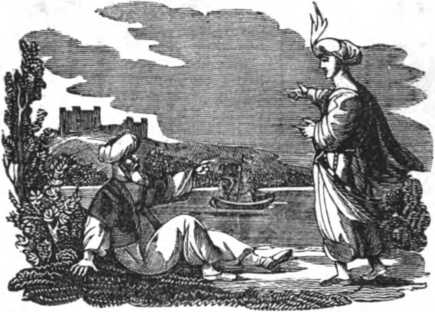
The next day Zeyn said to Mobarec, I have taken rest enough. I came not to Cairo to take my pleasure: my design is to get the ninth statue; it is time for us to set out in search of it. Sir, said Mobarec, I am ready to comply with your desires; but you know not what dangers you must encounter to make this precious conquest. Whatsoever the danger may be, answered the prince, I have resolved to undertake it: I will either perish or succeed. All that happens in this world is by God’s direction. Do you but bear me company, and let your resolution be equal to mine.
Mobarec, finding him determined to set out, called his servants, and ordered them to make ready his equipage. Then the prince and he performed the ablution, or washing, and the prayer enjoined, which is called Farz; and that done, they set out. By the way they took notice of abundance of strange and wonderful things, and travelled many days; at the end whereof, being come to a delightful spot, they alighted from their horses. Then Mobarec said to all the servants that attended them, Do you stay in this place, and take care of our equipage till we return. Then he said to Zeyn, Now, sir, let us two go on by ourselves. We are near the dreadful place, where the ninth statue is kept. You will stand in need of all your courage.
They soon came to a lake: Mobarec sat down on the brink of it, saying to the prince, We must cross this sea. How can we cross it, answered Zeyn, when we have no boat? You will see one appear in a moment, replied Mobarec; the enchanted boat of the king of the genii will come for us. But do not forget what I am going to say to you: you must observe a profound silence: do not speak to the boatman, though his figure seem never so strange to you: whatsoever extraordinary circumstance you observe, say nothing; for I tell you beforehand, that if you utter the least word, when we are embarked, the boat will sink down. I shall take care to hold my peace, said the prince, you need only tell me what I am to do, and I will strictly observe it.
While they were talking, he spied on a sudden a boat in the lake, and it was made of red sandal wood. It had a mast of fine amber, and a blue satin flag: there was only one boatman in it, whose head was like an elephant’s, and his body like a tiger’s. When the boat was come up to the prince and Mobarec, the monstrous boatman took them up one after another with his trunk, and put them into his boat, and carried them over the lake in a moment. He then again took them up with his trunk, set them on shore, and immediately vanished with his boat.
Now we may talk, said Mobarec: the island we are on belongs to the king of the genii; there are no more such in the world. Look round you, prince: can there be a more delightful place? It is certainly a lively representation of the charming place God has appointed for the faithful observers of our law. Behold the fields adorned with all sorts of flowers and odoriferous plants; admire those beautiful trees, whose delicious fruit makes the branches bend down to the ground; enjoy the pleasures of those harmonious songs formed in the air, by a thousand birds of as many various sorts unknown in other countries. Zeyn could not sufficiently admire the beauties of those with which he was surrounded, and still found something new, as he advanced farther into the island.
At length they came before a palace made of fine emeralds, encompassed with a ditch, on the banks whereof at certain distances, were planted such tall trees, that they shaded the whole palace. Before the gate, which was of massy gold, was a bridge, made of one single shell of a fish, though it was at least six fathoms long, and three in breadth. At the head of the bridge stood a company of genii, of a prodigious height, who guarded the entrance into the castle with great clubs of China steel.
Let us go no farther, said Mobarec; these genii will knock us down: and in order to prevent their coming to us, we must perform a magical ceremony. He then drew out of a purse, which he had under his garment, four long slips of yellow taffety; one he put about his middle, and laid the other on his back, giving the other two to the prince, who did the like. Then Mobarec laid on the ground two large table-cloths, on the edges whereof he scattered some precious stones, musk, and amber. Then he sat down on one of those cloths, and Zeyn on the other; and Mobarec said to the prince, I shall now, sir, conjure the king of the genii, who lives in the palace that is before us: may he come in a peaceable mood to us! I confess I am not without apprehension about the reception he may give us. If our coming into this island is displeasing to him, he will appear in the shape of a dreadful monster; but if he approves of your design, he will show himself in the shape of a handsome man. As soon as he appears before us, you must rise and salute him, without going off your cloth; for you would certainly perish should you stir off it. You must say to him, Sovereign lord of the genii, my father, who was your servant, has been taken away by the angel of death: I wish your majesty may protect me, as you always protected my father. If the king of the genii, added Mobarec, ask you what favour you desire of him, you must answer, Sir, I must humbly beg of you to give me the ninth statue.
Mobarec, having thus instructed prince Zeyn, began his conjuration. Immediately their eyes were dazzled with a long flash of lightning, which was followed by a clap of thunder. The whole island was covered with a thick darkness, a furious storm of wind blew, a dreadful cry was heard, the island felt a shock, and there was such an earthquake as that which Asrayel is to cause on the day of judgment.
Zeyn was startled, and began to look upon that noise as a very ill omen; when Mobarec, who knew better than he what to think of it, began to smile, and said, Take courage, my prince; all goes well. In short, that very moment the king of the genii appeared in the shape of a very handsome man, yet there was something of a sternness in his air.
As soon as prince Zeyn had made him the compliment he had been taught by Mobarec, the king of the genii smiling, answered, My son, I loved your father, and every time he came to pay me his respects, I presented him with a statue, which he carried away with him. I have no less kindness for you. I obliged your father some days before he died, to write that which you read on the piece of white satin. I promised him to receive you under my protection, and to give you the ninth statue, which in beauty surpasses those you have already. I have begun to perform my promise to him. It was I whom you saw in a dream, in the shape of an old man: I caused you to open the subterraneous place, where the urns and the statues are: I have a great share in all that has befallen you, or rather am the occasion of it. I know the motive that brought you hither: you shall obtain what you desire. Though I had not promised your father to give it, I would willingly grant it to you: but you must first swear to me by all that is sacred, that you will return to this island, and that you will bring a maid that is in her fifteenth year, and who has never known man, nor desired to know any. She must also be perfectly beautiful; and you so much a master of yourself, as not even to desire to enjoy her, as you are conducting her hither.
Zeyn took the rash oath that was required of him. But, my lord, said he then, suppose I should be so fortunate as to meet with such a maid as you require, how shall I know that I have found her? I own, answered the king of the genii, smiling, that you might be mistaken in her appearance: that knowledge is above the sons of Adam, and therefore I do not mean to depend upon your judgment in that particular: I will give you a looking-glass, which will be more certain than your conjectures. When you shall have seen a maiden fifteen years of age, perfectly beautiful, you shall only need look into the glass, in which you shall see her figure. If she be chaste, the glass will remain clean and unsullied; but if, on the contrary, it sullies, that will be a certain sign that she has not always been prudent, or at least that she has desired to cease to be so. Do not forget the oath you have taken: keep it like a man of honour; otherwise I will take away your life, as much kindness as I have for you. Prince Zeyn Alasnam protested again that he would faithfully keep his word.
Then the king of the genii delivered to him a looking-glass, saying, My son, you may return when you please; there is the glass you are to make use of. Zeyn and Mobarec took leave of the king of the genii, and went towards the lake. The boatman with the elephant’s head brought the boat, and carried them over the lake as he had done before. They joined their servants, and returned with them again to Cairo.
Prince Alasnam rested a few days at Mobarec’s house, and then said to him, Let us go to Bagdad to seek a maiden for the king of the genii. Why, are we not at Grand Cairo? said Mobarec: shall we not there find beautiful maidens enough? You are in the right, answered the prince; but how shall we do to find where they are? Do not trouble yourself about that, sir, answered Mobarec; I know a very shrewd old woman, whom I will entrust with that affair, and she will acquit herself well.
ZEYN ALASNAM & THE KING OF THE GENII.
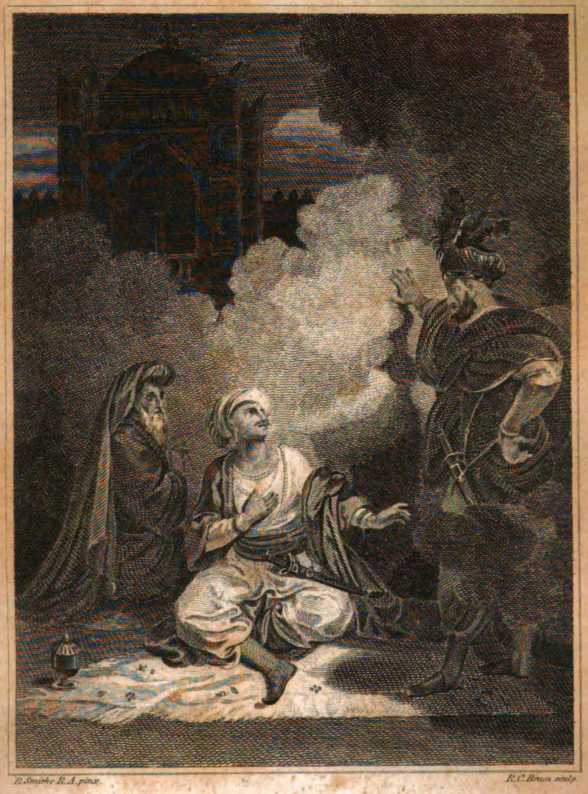
Accordingly the old woman found means to show the prince a considerable number of beautiful maidens of fifteen years of age; but when he had viewed them, and came to consult his looking-glass, the faithful touchstone of their virtue, the glass always appeared sullied. All the maidens in the court and city, that were in their fifteenth year, underwent the trial one after another, and the glass never remained bright and clear.
When they saw there were no chaste maids to be found in Cairo, they went to Bagdad, where they hired a magnificent palace in one of the chief quarters of the city, and began to live splendidly. They kept open house; and after all people had eaten in the palace, the fragments were carried to the dervises, who by that means had comfortable subsistence.
There lived in that quarter an iman, whose name was Boubekir Muezin, a vain, haughty, and envious person: he hated the rich, only because he was poor, his misery making him angry at his neighbour’s prosperity. He heard talk of Zeyn Alasnam, and of the plenty his house afforded. This was enough for him to take an aversion to that prince; and it proceeded so far, that one day after the evening prayer in the mosque, he said to the people, Brethren, I have been told there is come to live in our ward a stranger, who every day gives away immense sums. How do we know but that this unknown person is some villain, who has committed a great robbery in his own country, and comes hitherto enjoy himself? Let us take care, brethren: if the caliph should be informed that such a man is in our ward, it is to be feared he will punish us for not acquainting him with it. I declare, for my part, I wash my hands of it; and if any thing should happen amiss, it shall not lie at my door. The multitude, who are easily led away, with one voice cried to Boubekir, It is your business, doctor: do you acquaint the council with it. The iman went home well pleased, and drew up a memorial, resolving to present it to the caliph next day.
But Mobarec, who had been at prayers, and heard all that was said by the doctor, as well as the rest of the company, put five hundred pieces of gold into a handkerchief, made up with a parcel of several silks, and went away to Boubekir’s house. The doctor asked him in a harsh tone, what he wanted. Doctor, answered Mobarec, with an obliging air, and at the same time putting into his hand the gold and the silk, I am your neighbour and your servant: I come from prince Zeyn, who lives in this ward: he has heard of your worth, and has ordered me to come and tell you that he desires to be acquainted with you, and in the mean time desires you to accept of this small present. Boubekir was transported with joy, and answered Mobarec thus: Be pleased, sir, to beg the prince’s pardon for me: I am ashamed I have not yet been to see him, but I will atone for my fault, and wait on him to-morrow.
Accordingly the next day, after morning prayer, he said to the people, You must understand, brethren, that no man is without some enemies: envy pursues those chiefly who are very rich. The stranger I spoke to you about yesterday in the evening is no ill man, as some ill-designing persons would have persuaded me: he is a young prince endowed with every virtue. It behoves us to take care how we go and give any ill account of him to the caliph.
Boubekir having thus wiped off the ill impression he had the day before given the people concerning Zeyn, returned home, put on his best apparel, and went to visit that young prince, who gave him a courteous reception. After several compliments had passed on both sides, Boubekir said to the prince, sir, do you design to stay long at Bagdad? I shall stay, answered Zeyn, till I can find a maid, fifteen years of age, perfectly beautiful, and so chaste, that she has not only never known a man, but even never desired to know him. You seek after a great rarity, replied the iman; and I should be apt to fear your search would prove unsuccessful, did I not know where there is a maid of that character. Her father was formerly vizier; but he has left the court; and lived a long time in a house by itself, where he applies himself solely to the education of his daughter. If you please, I will go ask her of him for you: I do not question but he will be overjoyed to have a son-in-law of your quality. Not so fast, said the prince, I shall not marry that maid before I know whether I like her. As for her beauty, I can depend on you: but what assurance can you give me in relation to her virtue? What assurance do you require? said Boubekir. I must see her face, answered Zeyn; that is enough for me to form a resolution. You are skilful then in physiognomy? replied the iman, smiling. Well, come along with me to her father’s: I will desire him to let you see her one moment in his presence.
Muezin conducted the prince to the vizier’s; who, as soon as he was acquainted with the prince’s birth and design, called his daughter, and made her take off her veil. Never had the young king of Balsora beheld such a perfect and striking beauty. He stood amazed, and since he could then try whether the maid was as chaste as fair, he pulled out his glass, which remained bright and unsullied.
When he perceived he had at length found such a person as he desired, he entreated the vizier to grant her to him. Immediately the lady was sent for, and came; the contract was signed, and the marriage prayer said. After which ceremony, Zeyn carried the vizier to his house, where he treated him magnificently, and gave him considerable presents. Next he sent a prodigious quantity of jewels to the bride by Mobarec, who brought her to his house, where the wedding was kept with all the pomp that became Zeyn’s quality. When all the company was dismissed, Mobarec said to his master, Let us begone, sir; let us not stay any longer at Bagdad, but return to Cairo; remember the promise you made the king of the genii. Let us go, answered the prince; I must take care to perform it exactly: yet I must confess, my dear Mobarec, that if I obey the king of the genii, it is not without reluctance. The person I have married is charming, and I am tempted to carry her to Balsora, and place her on the throne. Alas! sir, answered Mobarec, take heed how you give way to your inclination: make yourself master of your passions, and whatsoever it cost you, be as good as your word to the king of the genii. Well, then, Mobarec, said the prince, do you take care to conceal that lovely maid from me; let her never appear in my sight; perhaps, I have already seen too much of her.
Mobarec made all ready for their departure; they returned to Cairo, and thence set out for the island of the king of the genii. When they were there, the maid who had performed the journey in a horse-litter, and whom the prince had never seen since his wedding-day, said to Mobarec, where are we? Shall we be soon in the dominions of the prince, my husband? Madam, answered Mobarec, it is time to undeceive you. Prince Zeyn married you only in order to get you from your father: he did not engage his faith to you, to make you sovereign of Balsora, but to deliver you to the king of the genii, who asked of him a virgin of your character. At these words she began to weep bitterly, which moved the prince and Mobarec. Take pity on me, said she; I am a stranger; you will be accountable to God for your treachery towards me.
Her tears and complaints were of no effect, for she was presented to the king of the genii, who having gazed on her with attention, said to Zeyn, Prince, I am satisfied with your behaviour; the virgin you have brought me is beautiful and chaste, and I am pleased with the force you have put upon yourself to be as good as your word to me. Return to your dominions, and when you shall enter the subterraneous room, where the eight statues are, you shall find the ninth which I promised you. I will make my genii carry it thither. Zeyn thanked the king, and returned to Cairo with Mobarec, but did not stay long there; his impatience to see the ninth statue made him hasten his departure. However, he could not but often think of the young virgin he married; and blaming himself for having deceived her, he looked upon himself as the cause and instrument of her misfortune. Alas, said he to himself, I have taken her from a tender father, to sacrifice her to a genie. Oh, incomparable beauty! you deserve a better fate.
Prince Zeyn, disturbed with these thoughts, at length reached Balsora, where his subjects made extraordinary rejoicings for his return. He went directly to give an account of his journey to his mother, who was in a rapture to hear he had obtained the ninth statue. Let us go, my son, said she, let us go see it, for it is certainly in the chamber under ground, since the king of the genii told you you should find it there. The young king and his mother, being both impatient to see that wonderful statue, went down to the subterraneous place, and into the room of the statues; but how great was their surprise, when, instead of a statue of diamonds, they espied on the ninth pedestal a most beautiful virgin, whom the prince knew to be the same he had conducted to the island of the genii! Prince, said the young maid, you are surprised to see me here; you expected to have found something more precious than me, and I question not but that you now repent having taken so much trouble: you expected a better reward. Madam, answered Zeyn, Heaven is my witness, that I more than once was like to have broken my word with the king of the genii, to keep you to myself. Whatsoever be the value of a diamond statue, is it worthy the satisfaction of enjoying you? I love you above all the diamonds and wealth in the world.
Just as he was done speaking, a clap of thunder was heard, which shook that subterraneous place. Zeyn’s mother was frightened, but the king of the genii immediately appearing, dispelled her fear, Madam, said he to her, I protect and love your son: I had a mind to try whether, at his age, he could subdue his passions. I know the charms of this young lady have wrought on him, and that he did not punctually keep the promise he had made me, not to desire to enjoy her; but I am too well acquainted with the frailty of the human nature. This is the ninth statue I designed for him; it is more rare and precious than the others. Live, said he, directing his discourse to the young prince, live happy, Zeyn, with this young lady, who is your wife; and if you would have her true and constant to you, love her always, and love her only. Give her no rival, and I will answer for her fidelity. Having spoke these words, the king of the genii vanished, and Zeyn, enchanted with that young lady, consummated the marriage the same day, and caused her to be proclaimed queen of Balsora. Those two ever-faithful and loving consorts lived together many years.
The History of Codadad and his Brothers.
Those who have written the history of the kingdom of Diarbekir inform us, that there formerly reigned in the city of Harran a most magnificent and potent king, who loved his subjects, and was equally beloved by them. He was endued with all virtues, and wanted nothing to complete his happiness but an heir. Though he had the finest women in the world in his seraglio, yet was he destitute of children. He continually prayed to heaven for them; and one night in his sleep, a comely person, or rather a prophet, appeared to him, and said, Your prayers are heard; you have obtained what you desired: rise as soon as you awake, go to your prayers, and make two genuflexions; then walk into the garden of your palace, call your gardener, and bid him bring you a pomegranate; eat as many of the seeds as you please, and your wishes shall be accomplished.
The king calling to mind his dream when he awaked, returned thanks to heaven, got up, went to prayers, made two genuflexions, and then went down into his garden, where he took fifty pomegranate seeds, which he counted, and eat. He had fifty wives who shared his bed; they all proved with child; but there was one called Pirouze, who did not appear to be pregnant. He took an aversion to that lady, and would have her put to death. Her barrenness, said he, is a certain token that Heaven does not judge Pirouze worthy to bear a prince; it is my duty to deliver the world from an object that is odious to the Lord. He had taken this cruel resolution, but his vizier diverted him from putting it in execution; representing to him, that all women were not of the same constitution, and that it was not impossible but that Pirouze might be with child, though it did not yet appear. Well, answered the king, let her live; but let her depart my court, for I cannot endure her. Your majesty, replied the vizier, may send her to prince Samer, your cousin. The king approved of his advice; he sent Pirouze to Samaria, with a letter, in which he ordered his cousin to treat her well, and in case she proved with child, to give him notice of her being brought to bed.
No sooner was Pirouze arrived in that country, but it appeared that she was with child, and at length she was delivered of a most beautiful prince. The prince of Samaria wrote immediately to the king of Harran, to acquaint him with the birth of that son, and to congratulate him on that occasion. The king was much rejoiced at it, and answered prince Samer as follows: ‘Cousin, all my other wives have each been delivered of a prince; so that we have a great number of children here. I desire you to breed up that of Pirouze, to give him the name of Codadad, [94] and to send him to me when I send for him.’
The prince of Samaria spared nothing that might improve the education of his nephew. He taught him to ride, draw the bow, and all the other things becoming the son of a king: so that Codadad, at eighteen years of age, was looked upon as a prodigy. The young prince being inspired with a courage worthy his birth, said one day to his mother, Madam, I begin to grow weary of Samaria; I feel a passion for glory; give me leave to go seek it amidst the perils of war. My father, the king of Harran, has many enemies: some neighbouring princes wish to disturb his repose. Why does he not call me to his assistance? Why does he leave me here so long in infancy! Must I spend my life here in sloth, when all my brothers have the happiness to be fighting by his side? —My son, answered Pirouze, I am no less impatient to have your name become famous; I could wish you had already signalized yourself against your father’s enemies; but we must wait till he requires it. No, madam, replied Codadad; I have already waited but too long. I long to see the king, and am tempted to go offer him my service, as a young stranger: no doubt but he will accept of it, and I will not discover myself till I have performed a thousand glorious actions: I desire to merit his esteem before he knows who I am. Pirouze approved of his generous resolution, and Codadad one day departed from Samaria, as if he had been going a hunting, without acquainting prince Samer, for fear he should thwart his design.
He was mounted on a white horse, who had a gold bit and shoes; his housing was of blue satin embroidered with pearls; the hilt of his scimitar was of one single diamond, and the scabbard of sandal-wood, all adorned with emeralds and rubies, and on his shoulder he carried his bow and quiver. In this equipage, which greatly set off his good person, he arrived at the city of Harran, and soon found means to offer his service to the king; who, being charmed with his beauty and advantageous presence, and perhaps, indeed by natural sympathy, gave him a favourable reception, and asked his name and quality. Sir, answered Codadad, I am son to an emir of Grand Cairo: an inclination to travel has made me quit my country, and understanding, in my passage through your dominions, that you were engaged in war with some of your neighbours, I am come to your court to offer your majesty my service. The king showed him extraordinary kindness, and gave him an employment in his troop.
The young prince soon signalized his bravery. He gained the esteem of the officers, and was admired by the soldiers. And having no less wit than courage, he so far advanced himself in the king’s affection, as to become his favourite. All the ministers and other courtiers daily resorted to Codadad, and were so eager to purchase his friendship, that they neglected the king’s other sons. Those princes could not but resent it; and imputing it to the stranger, they all conceived an implacable hatred against him; but the king’s affection daily increasing, he was never weary of giving him fresh testimonies of it. He always would have him near him; he admired his discourse, ever full of wit and discretion; and to show his high opinion of his wisdom and prudence, he committed to his care the other princes, though he was of the same age as they; so that Codadad was made governor of his brothers.
This only served to heighten their hatred. Is it come to this, said they, that the king, not satisfied with loving a stranger more than us, will have him to be our governor, and not allow us to do any thing without his leave? This is not to be endured. We must rid ourselves of this stranger. Let us go together, said one of them, and despatch him. No, no, answered another; we had better be cautious how we sacrifice ourselves. His death would render us odious to the king, who in return would declare us all unworthy to reign. Let us destroy the stranger artfully. We will ask his leave to go hunting, and when at a distance from the palace, we will proceed to some other city, and stay there some time. The king will wonder at our absence, and perceiving we do not return, he may perhaps put the stranger to death, or at least will turn him out of the court, for suffering us to leave the palace.
All the princes applauded this artifice. They went together to Codadad, and desired him to give them leave to take the diversion of hunting, promising to return the same day. Pirouze’s son was taken in the snare, and granted the leave his brothers desired. They set out, but never returned. They had been three days absent, when the king asked Codadad where the princes were, for it was long since he had seen them. Sir, answered Codadad, after making a profound reverence, they have been hunting these three days, but they promised me they would return sooner. The king grew uneasy, and his uneasiness increased when he perceived the princes did not return the next day. He could not check his anger: Indiscreet stranger, said he to Codadad, why did you let my sons go without bearing them company? Is it thus you discharge the trust I have reposed in you? Go seek them immediately, and bring them to me, or you are a dead man.
These words chilled with fear Pirouze’s unfortunate son. He armed himself, went out of the city, and, like a shepherd who had lost his flock, searched all the country for his brothers, inquiring at every village whether they had been seen: and hearing no news of them, abandoned himself to the most lively grief. Alas! my brothers, said he, what is become of you? Are you fallen into the hands of our enemies? Am I come to the court of Harran to be the occasion of giving the king so much anxiety? He was inconsolable for having given the princes leave to go a hunting, or for not having borne them company.
After some days spent in fruitless search, he came to a plain of prodigious extent, in the midst whereof was a palace built of black marble. He drew near, and at one of the windows spied a most beautiful lady, but set off with no other ornament than her own beauty; for her hair was dishevelled, her garments torn, and on her countenance appeared all the marks of the greatest affliction. As soon as she saw Codadad, and judged he might hear her, she directed her discourse to him, saying, Young man, get away from this fatal place, or you will soon fall into the hands of the monster that inhabits it: a black, who feeds only on human blood, resides in this palace; he seizes all persons whom their ill fate conducts to this plain, and shuts them up in his dark dungeons, whence they are never released but to be devoured by him.
Madam, answered Codadad, tell me who you are, and be not concerned for any more. I am a young woman of quality of Grand Cairo, replied the lady; I was passing by this castle yesterday, in my way to Bagdad, and met with the black, who killed all my servants, and brought me hither: I wish I had nothing but death to fear; but to add to my calamity, this monster would persuade me to love him, and, in case I do not yield to-morrow to his brutality, I must expect the last violence. Once more, added she, make your escape: the black will soon return; he is gone out to pursue some travellers he espied at a distance on the plain. Lose no time; I know not whether you can escape him by a speedy flight.
She had scarce done speaking these words, before the black appeared. He was a man of monstrous bulk, and of a dreadful aspect, mounted on a mighty Tartar horse, and bore such a large and heavy scimitar, that none but himself could make use of it. The prince seeing him, was amazed at his monstrous stature, directed his prayers to Heaven to assist him, then drew his scimitar, and firmly awaited the black; who, despising so inconsiderable an enemy, called to him to yield himself without fighting: but Codadad by his countenance showed that he was resolved to defend his life; for he drew near, and gave him a great cut on the knee. The black, feeling himself wounded, uttered such a dreadful shriek as made all the plain resound. He grew furious, and foamed with rage, and raising himself in his stirrups, made at Codadad with his dreadful scimitar. The blow was so violent, that it would have put an end to the young prince, had not he avoided it by a sudden spring which he made his horse take. The scimitar made a horrible hissing in the air: but before the black could have time to make a second blow, Codadad let fall one on his right arm with such fury, that he cut it off. The dreadful scimitar fell with the hand that held it, and the black, yielding under the violence of the stroke, lost his stirrups, and made the earth shake with the noise of his fall. The prince alighted at the same time, and cut off his enemy’s head. Just then the lady, who had been a spectator of that combat, and was still offering up her earnest prayers to Heaven for that young hero, whom she admired, gave a shriek of joy, and said to Codadad, Prince (for the dangerous victory you have obtained convinces me, as well as your noble air, that you are of no common rank,) finish the work you have begun: the black has the keys of this castle; take them, and deliver me out of prison. The prince searched the wretch’s pockets, as he lay stretched on the ground, and found several keys.
He opened the first door, and went into a court, where he met the lady coming to meet him: she would have cast herself at his feet, the better to express her gratitude; but he would not permit it. She commended his valour, and extolled him above all the heroes in the world. He returned her compliments, and she appeared still more lovely to him near at hand than at a distance. I know not whether she felt more joy at being delivered from the desperate danger she had been in, than he for having done so considerable a service to so beautiful a person.
Their discourse was interrupted by dismal cries and groans. What do I hear? said Codadad: Whence come those miserable cries, which pierce my ears? My lord, said the lady to him, pointing to a little door in the court, they come from thence. There are I know not how many wretched persons whom fate has made to fall into the hands of the black. They are all chained, and the monster drew out one every day to devour.
It is an addition to my joy, answered the young prince, to understand that my victory will save the lives of those unfortunate persons. Come along with me, madam, to partake in the satisfaction of giving them their liberty. You may judge by yourself how welcome we shall be to them. Having so said, they advanced towards the door of the dungeon, and the nearer they drew, the more distinctly they heard the complaints of the prisoners. Codadad pitying them, and impatient to put an end to their sufferings, presently put one of the keys into the lock. He did not take the right at first, and therefore he took another; which noise made all those unfortunate creatures, concluding it was the black who came, according to custom, to bring them some meat, and at the same time to seize one of them to eat himself, redoubled their cries and groans. Lamentable voices were heard, which seemed to come from the centre of the earth.
In the mean time, the prince had opened the door, and went down a very steep staircase into a large and deep vault, which received some feeble light from a little window, and in which there were above a hundred persons, bound to stakes, and their hands tied. Unfortunate travellers, said he, to them, wretched victims, who only expected the moment of an approaching cruel death, give thanks to Heaven, which has this day delivered you by my means. I have slain the black by whom you were to be devoured, and am come to knock off your irons. The prisoners hearing these words, all together gave a shout mingled with joy and surprise. Codadad and the lady began to unbind them; and as soon as any of them were loose, they helped to take off the fetters from the rest; so that in a short time they were all at liberty.
They then kneeled down, and having returned thanks to Codadad for what he had done for them, went out of that dungeon; and when they were come into the court, how was the prince surprised to see among the prisoners those he was in search of, and almost without hopes to find! Princes, cried he, am I not deceived? Is it you whom I behold? May I flatter myself that it will be in my power to restore you to the king your father, who is inconsolable for the loss of you? But will he not have some one to lament? Are you all here alive? Alas! the death of one of you will suffice to damp the joy I feel for having delivered you.
The forty-nine princes all made themselves known to Codadad, who embraced them one after another, and told them how uneasy their father was on account of their absence. They gave their deliverer all the commendations he deserved, as did the other prisoners, who could not find words expressive enough to declare their gratitude. Codadad, with them, took a view of the whole castle, where was immense wealth; curious silks, gold brocades, Persian carpets, China satins, and an infinite quantity of other goods, which the black had taken from the caravans he had plundered; a considerable part whereof belonged to the prisoners Codadad had then set free. Every man knew and claimed his property. The prince restored them their own, and divided the rest of the merchandize among them. Then he said to them, How will you do to carry away your goods? We are here in a desert place, and there is no likelihood of your getting horses. My lord, answered one of the prisoners, the black robbed us of our camels as well as our goods, and perhaps they may be in the stables of this castle. This is not unlikely, replied Codadad; let us see. Accordingly they went to the stables, where they not only found the camels, but also the horses belonging to the king of Harran’s sons. There were some black slaves in the stables, who, seeing all the prisoners released, and guessing thereby that their master had been killed, fled through by-ways well known to them. Nobody minded to pursue them. All the merchants, overjoyed that they had recovered their goods and camels, together with their liberty, thought of nothing but prosecuting their journey; but first repeated their thanks to their deliverer.
When they were gone, Codadad, directing his discourse to the lady, said, What place, madam, do you desire to go to? Whither were you bound when you were seized by the black? I intend to bear you company to the place you shall choose for your retreat, and I question not but that all these princes will do the same. The king of Harran’s sons protested to the lady that they would not leave her till she was restored to her friends.
Princes, said she, I am of a country too remote from hence; and, besides that, it would be abusing your generosity to oblige you to travel so far. I must confess that I have left my native country for ever. I told you awhile ago that I was a lady of Grand Cairo; but since you have shown me so much favour, and I am so highly obliged to you, added she, looking upon Codadad, I should be much in the wrong in concealing the truth from you. I am a king’s daughter. An usurper has possessed himself of my father’s throne, after having murdered him, and I have been forced to fly to save my life.
Then Codadad and his brothers desired the princess to tell them her story, assuring her they felt a particular interest in her misfortunes, and were determined to spare for nothing that might contribute to render her more happy. After thanking them for their repeated protestations of readiness to serve her, she could not refuse to satisfy their curiosity, and began the recital of her adventures in the following manner:—
History of the Princess of Deryabar.
There is in a certain island a great city called Deryabar; it has been long governed by a potent, magnificent, and virtuous king. That prince had no children, which was the only thing wanting to make him happy. He continually addressed his prayers to Heaven, but Heaven granted his requests by halves; for the queen his wife, after a long expectation, brought forth a daughter.
I am the unfortunate princess: my father was rather troubled than pleased at my birth; but he submitted to the will of God, and caused me to be educated with all possible care, being resolved, since he had no son, to teach me the art of ruling, that I might supply his place after his death.
One day, when he was taking the diversion of hunting, he espied a wild ass, which he chased, lost his company, and was carried away so far by his eagerness, as to ride on till night. He then alighted, and sat down at the entrance of a wood, into which he observed the ass had taken. No sooner was the day shut in than he discovered among the trees a light, which made him conclude that he was not far from some village. He rejoiced at it, hoping that he might pass the night there, and find some person to send to his followers to acquaint them where he was; and accordingly he got up and walked towards the light, which served to guide him.
He soon found he had been deceived, that light being no other than a fire lighted in a hut; however, he drew near, and, with amazement, beheld a great black man, or rather a dreadful giant, sitting on a sofa. Before the monster was a great pitcher of wine, and he was roasting an ox he had newly killed. Sometimes he drank out of the pitcher, and sometimes he cut slices off the ox, and eat them. But that which most drew the king my father’s attention was a beautiful woman whom he saw in the hut. She seemed overwhelmed with grief; her hands were bound, and at her feet was a little child, about two or three years old, who, as if he was sensible of his mother’s misfortunes, wept without ceasing, and rent the air with his cries.
My father, moved with that pitiable object, thought at first to have gone into the hut, and attacked the giant; but considering how unequal the combat would be, he stopped, and resolved, since he had not strength enough to prevail by open force, to use art. In the mean time, the giant having emptied the pitcher, and devoured above half the ox, turned to the woman, and said, Beautiful princess, why do you oblige me by your obstinacy to treat you with severity? It is in your own power to be happy. You need only to resolve to love and be true to me, and I shall treat you with more mildness. Thou hideous satyr, answered the lady, never expect that time should wear away my abhorrence of thee. Thou wilt ever be a monster in my eyes. To these words she added so many reproaches, that the giant grew enraged. This is too much, cried he, in a furious tone; my love despised is turning into rage. Your hatred has at last excited mine; I find it triumphs over my desires, and that I now wish your death more ardently than your enjoyment. Having spoken these words, he took the wretched lady by the hair, held her up with one hand in the air, and drawing his scimitar with the other, was just going to strike off her head, when the king my father let fly an arrow which pierced the giant’s breast, so that he staggered and dropped down dead.
My father entered the hut, unbound the lady’s hands, inquired who she was, and how she came thither. My lord, said she, there are along the sea-coast some families of Saracens, who live under a prince, who is my husband: this giant you have killed was one of his principal officers. The wretch fell desperately in love with me, but took especial care to conceal his passion till he could put in execution the design he had formed of stealing me away. Fortune oftener favours wicked designs than virtuous resolutions. The giant one day surprised me and my child in a by-place. He seized us both, and, to disappoint the search he well knew my husband would cause to be made for me, he removed from the country inhabited by those Saracens, and brought us into this wood, where he has kept me some days. Deplorable as my condition is, it is still a great satisfaction to me to think that the giant, though so brutal and amorous, never used force to obtain what I always refused to his entreaties. Not but that he has a hundred times threatened that he would have recourse to the worst of extremities, in case he could not otherwise prevail upon me; and I must confess to you, that awhile ago, when I provoked his anger by my words, I was less concerned for my life than for my honour.
This, my lord, said the prince of the Saracens’ wife, is the faithful account of my misfortunes; and I question not but you will think me worthy of your compassion, and that you will not repent having so generously relieved me. Madam, answered my father, be assured your troubles have affected me, and I will do all in my power to make you happy again. To-morrow, as soon as day appears, we will quit this wood, and endeavour to fall into the road which leads to the great city of Deryabar, of which I am sovereign; and if you think fit, you shall be lodged in my palace, till the prince your husband comes to claim you.
The Saracen lady accepted the offer, and the next day followed the king my father, who found all his retinue upon the skirts of the wood, they having spent the night in searching after him, and being very uneasy because they could not find him. They were no less rejoiced to meet with than amazed to see him with a lady, whose beauty surprised them. He told them how he had found her, and the risk he run in approaching the hut, where he must certainly have lost his life had the giant spied him. One of his servants took up the lady behind him, and another carried the child.
Thus they arrived at the palace of the king my father, who assigned the beautiful Saracen lady an apartment, and caused her child to be carefully educated. The lady was not insensible of the king’s goodness to her, and expressed as much gratitude as he could desire. She had at first appeared very uneasy, and impatient that her husband did not claim her; but by degrees she lost that uneasiness. The respect my father paid her dispelled her impatience; and I am of opinion she would at last have blamed fortune more for restoring her to her kindred than she did for removing her from them.
In the mean time, the lady’s son grew up; he was very handsome, and not wanting wit, found means to please the king my father, who conceived a great friendship for him. All the courtiers perceived it, and guessed that that young man might in the end be my husband. In this idea, and looking on him already as heir to the crown, they made their court to him, and every one endeavoured to gain his favour. He soon saw into their designs, grew conceited of himself, and, forgetting the distance there was between our conditions, flattered himself with the hopes that my father was fond enough of him to prefer him before all the princes in the world. He went farther; for the king not being forward enough in offering me to him as soon as he could have wished, he had the boldness to ask me of him. Whatsoever punishment his insolence deserved, my father was satisfied with telling him he had other thoughts in relation to me, and showed him no farther resentment. The youth was incensed at this refusal; the vain fellow resented the contempt, as if he had asked some maid of ordinary extraction, or as if his birth had been equal to mine. Nor did he stop here, but resolved to be revenged on the king, and, with unparalleled ingratitude, conspired against him. In short, he murdered him, and caused himself to be proclaimed king of Deryabar, by a great number of malecontents, whom he encouraged. The first thing he did, after ridding himself of my father, was to come into my apartment, at the head of a party of the conspirators. His design was either to take my life, or oblige me to marry him. Whilst he was busy murdering my father, the grand vizier, who had been always loyal to his master, came to carry me away from the palace, and secured me in a friend’s house, till a vessel he had provided was ready to sail. I then left the island, attended only by a governess and that generous minister, who chose rather to follow his master’s daughter, and share in her misfortunes, than to submit to a tyrant.
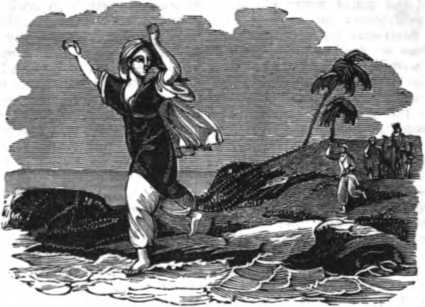
The grand vizier designed to carry me to the courts of the neighbouring kings to implore their assistance, and excite them to revenge my father’s death; but Heaven did not approve a resolution we thought so just. When we had been but a few days at sea, there arose such a furious storm, that, in spite of all the mariners’ art, our vessel, carried away by the violence of the winds and waves, was dashed in pieces against a rock. I will not spend time in describing our shipwreck. I can but faintly represent to you how my governess, the grand vizier, and all that attended me, were swallowed up by the sea. The dread I was seized with did not permit me to observe all the horror of our condition. I lost my senses; and whether I was thrown upon the coast upon any part of the wreck of our ship, or whether Heaven, which reserved me for other misfortunes, wrought a miracle for my deliverance, I found myself on shore when my senses returned.
Misfortunes very often make us forget our duty. Instead of returning thanks to God for so singular a favour shewn me, I only lifted up my eyes to Heaven, to complain because I had been preserved. I was so far from bewailing the vizier and my governess, that I envied their fate; and dreadful imaginations by degrees prevailing over my reason, I resolved to cast myself into the sea: I was upon the point of doing so, when I heard behind me a great noise of men and horses. I looked about to see what it might be, and espied several armed horsemen, among whom was one mounted on an Arabian horse. He had on a garment embroidered with silver, a girdle set with precious stones, and a crown of gold on his head. Though his habit had not convinced me that he was chief of the company, I should have judged it by the air of grandeur which appeared in his person. He was a young man extraordinarily well shaped, and perfectly beautiful. Surprised to see a young lady alone in that place, he sent some of his officers to ask who I was. I answered only by weeping. The shore being covered with the wreck of our ship, they concluded some vessel had been cast away there, and that I was certainly some person that had escaped with my life. This conjecture, and my inconsolable condition, excited the curiosity of those officers; who began to ask me a thousand questions, with assurances that their king was a generous prince, and that I should receive consolation in his court.
The king, impatient to know who I was, grew weary of expecting the return of his officers, and drew near to me. He gazed on me very earnestly, and observing that I did not give over weeping and afflicting myself, without being able to return an answer to their questions, he forbid them troubling me any more: and directing his discourse to me, Madam, said he, I conjure you to moderate your excessive affliction. Though Heaven in its wrath has laid this calamity upon you, it does not behove you to despair. I beseech you show more resolution. Fortune, which has hitherto persecuted you, is inconstant, and may soon change. I dare assure you, that if your misfortunes are capable of receiving any relief, you shall find it in my dominions. My palace is at your service. You shall live with the queen my mother, who will endeavour by her kindness to ease your affliction. I know not yet who you are; but I find I already take an interest in you.
I thanked the young king for his goodness to me, accepted the obliging offers he made me; and to convince him that I was not unworthy of them, told him my condition. I described to him the insolence of the young Saracen, and found it was enough to recount my misfortunes, to excite compassion in him, and all his officers who heard me. When I had done speaking, the prince began again, assuring me that he was deeply concerned at my misfortunes. Then he conducted me to his palace, and presented me to the queen his mother, to whom I was obliged again to repeat my misfortunes, and to renew my tears. The queen seemed very sensible of my trouble, and conceived extreme affection for me. On the other hand, the king her son fell desperately in love with me, and soon offered me his person and his crown. I was so taken up with the thoughts of my calamities, that the prince, though so lovely a person, did not make so great an impression on me as he might have done at another time. However, gratitude prevailed on me, I did not refuse to make him happy, and our wedding was kept with all imaginable splendour.
When all the people were taken up with the celebration of their sovereign’s nuptials, a neighbouring prince, his enemy, made a descent by night on the island with a great number of troops. That formidable enemy was the king of Zanguebar. He surprised those people, and cut to pieces all the king my husband’s subjects. He was very near taking us both. We escaped very narrowly, for he had already entered the palace with some of his followers; but we found means to slip away, and to get to the sea-coast, where we threw ourselves into a fishing-boat we had the good fortune to meet with. Two days we were driven about by the winds, without knowing what would become of us. The third day we espied a vessel making towards us under sail. We rejoiced at first, believing it had been a merchant ship which might take us aboard; but what was our astonishment, when, as it drew near, we saw ten or twelve armed pirates appear on the deck. Having boarded, five or six of them leaped into our boat, seized us, bound the prince, and conveyed us into their ship, where they immediately took off my veil. My youth and features touched them, and they all declared how much they were charmed at the sight of me. Instead of casting lots, each of them claimed the preference, and me as his right. The dispute grew warm, and they came to blows about me, and fought like madmen. The deck was soon covered with dead bodies, and they were all killed but one, who being left sole possessor of me, said, You are mine. I will carry you to Grand Cairo, to deliver you to a friend of mine, to whom I have promised a beautiful slave. But who, added he, looking upon the king my husband, is that man? What relation does he bear to you? Are you allied by blood or love? Sir, answered I, he is my husband. If so, replied the pirate, in pity I must rid myself of him: it would be too great an affliction to him to see you in my friend’s arms. Having spoken these words, he took up the unhappy prince, who was bound, and threw him into the sea, notwithstanding all my endeavours to hinder him.
I shrieked in a dreadful manner at the sight of that cruel action, and had certainly cast myself headlong into the sea, but that the pirate held me. He plainly saw that was my design, and therefore bound me with cords to the main-mast, and then hoisting sail, made towards the land, and got ashore. He unbound me, and led me to a little town, where he bought camels, tents, and slaves, and then set out for Grand Cairo, designing, as he still said, to present me to his friend, according to his promise.
We had been several days upon the road, when, as we were crossing this plain yesterday, we espied the black who inhabited this castle. At a distance we took him for a tower, and when near us could scarce believe him to be a man. He drew his vast scimitar, and summoned the pirate to yield himself prisoner, with all his slaves, and the lady he was conducting. The pirate was daring, and being seconded by all his slaves, who promised to stand by him, he attacked the black. The combat lasted a considerable time; but at length the pirate fell under his enemy’s deadly blows, as did all his slaves, who chose rather to die than to forsake him. The black then conducted me to the castle, whither he also brought the pirate’s body, which he eat that night for his supper. After that inhuman meal, perceiving that I ceased not weeping, he said to me, Young lady, prepare to satisfy my desires, rather than continue thus to afflict yourself. Make a virtue of necessity, and comply: I will give you till to-morrow to consider. Let me then find you comforted for all your misfortunes, and overjoyed for having been reserved for my bed. Having spoke these words, he conducted me to a chamber, and went to bed in his own, after locking up all the castle doors. He opened them this morning, and presently locked them again, to pursue some travellers he perceived at a distance; but it is likely they made their escape, since he was coming alone, and without any booty, when you attacked him.
As soon as the princess had put an end to the recital of her adventures, Codadad declared to her that he was deeply concerned at her misfortunes. But, madam, added he, it shall be your own fault if you do not live at ease for the future. The king of Harran’s sons offer you a safe retreat in the court of the king their father; be pleased to accept of it. You will be there cherished by that prince, and respected by all; and if you do not disdain the affection of your deliverer, permit me to make you a present of it, and to marry you before all these princes; let them be witnesses to our contract. The princess consented to it, and the marriage was concluded that very day in the castle, where they found all sorts of provisions. The kitchens were full of flesh and other eatables the black used to feed on when he was weary of feeding on human bodies. There was also a variety of fruits excellent in their kinds; and to complete their pleasure, abundance of delicious wine and other liquors.
They all sat down at table; and after having eaten and drank plentifully, they took along with them the rest of the provisions, and set out for the king of Harran’s court; they travelled several days, encamping in the pleasantest places they could find, and they were within one day’s journey of Harran, when, having halted and drank all their wine, being no longer under concern to make it hold out, Codadad directing his discourse to all his company, Princes, said he, I have too long concealed from you who I am. Behold your brother Codadad! I have received my being, as well as you, from the king of Harran; the prince of Samaria has brought me up, and the princess Pirouze is my mother. Madam, added he, addressing himself to the princes, of Deryabar, do you also forgive me for having concealed my birth from you? Perhaps, by discovering it sooner, I might have prevented some disagreeable reflections, which may have been occasioned by a match you may have thought unequal. No, sir, answered the princess, the opinion I at first conceived of you heightened every moment, and you did not stand in need of the extraction you now discover to make me happy.
The princes congratulated Codadad on his birth, and expressed much satisfaction at the knowledge of it. But in reality, instead of rejoicing, their hatred of so amiable a brother was increased. They met together at night in a by-place, whilst Codadad and the princess his wife lay last asleep in their tent. Those ungrateful, those envious brothers, forgetting that, had it not been for the brave son of Pirouze, they must have been devoured by the black, agreed among themselves to murder him. We have no other course to choose, said one of those wicked brethren; for the moment our father shall come to understand that this stranger he is already so fond of, is our brother, and that he alone has been able to destroy a giant, whom we could not all of us together conquer, he will heap favours and a thousand praises on him, and declare him his heir, to the prejudice of all his brothers, who will be obliged to obey and fall down before him. Besides those, he added many other words, which made such an impression on their jealous minds, that they immediately repaired to Codadad, then fast asleep, stabbed him in a thousand places, and leaving him for dead in the arms of the princess of Deryabar, proceeded on their journey for the city of Harran, where they arrived the next day.
The king, their father, conceived the greater joy at their return, because he had despaired of ever seeing them again: he asked what had been the occasion of their stay? But they took care not to acquaint him with it, making no mention either of the black or of Codadad; and only said, that being curious to see different countries, they had spent some time in the neighbouring cities.
In the mean time Codadad lay in his tent drowned in his own blood, and little differing from a dead man, with the princess his wife, who seemed to be in not much better condition than he. She rent the air with her dismal shrieks, tore her hair, and bathing her husband’s body with her tears, —Alas! Codadad, my dear Codadad, cried she, is it you whom I behold just departing this life? What cruel hands have put you into this condition? Can I believe these are your brothers who have treated you so unmercifully, these brothers whom thy valour has saved? No, they are rather devils, who under the characters so dear, came to murder you. O barbarous wretches! whosoever you are, how could you make so ungrateful a return for the service he has done you? But why should I complain of your brothers, unfortunate Codadad! I alone am to blame for your death. You would join your fate with mine, and all the ill-fortune that attends me since I left my father’s palace, has fallen upon you. O Heaven! which has condemned me to lead a life full of adventures and calamities, if you will not permit me to have a consort, why do you permit me to find one? Behold, you have now robbed me of two, just as I began to be attached to them.
By these and other moving expressions, the wretched princess of Deryabar vented her sorrow, fixing her eyes on the deplorable Codadad, who could not hear her; but he was not dead, and his consort observing that he still breathed, ran to a large town she espied in the plain, to inquire for a surgeon. She was directed to one, who went immediately with her; but when they came to the tent they could not find Codadad, which made them conclude he had been dragged away by some wild beast to devour him. The princess renewed her complaints and lamentations in a most dismal manner. The surgeon was moved, and being unwilling to leave her in that frightful condition, proposed to her to return to the town, offering her his house and service.
She suffered herself to be prevailed on. The surgeon conducted her to his house, and without knowing, as yet, who she was, treated her with all imaginable courtesy, and respect. He used all his rhetoric to comfort her, but it was in vain to think of removing her sorrow, which was rather heightened than diminished. Madam, said he to her one day, be pleased to recount to me your misfortunes; tell me your country and your condition. Perhaps I may give you some advice, when I am acquainted with all the circumstances of your calamity. You do nothing but afflict yourself, without considering that remedies may be found for the most desperate diseases.
The surgeon’s words were so efficacious that they wrought on the princess, who recounted to him all her adventures; and when she had done, the surgeon directed his discourse to her: Madam, said he, since they are so, give me leave to tell you that you ought not thus to give way to your sorrow; you ought rather to arm yourself with resolution, and perform what the name and the duty of a wife require of you. You are bound to avenge your husband. If you please, I will wait on you as your squire. Let us go to the king of Harran’s court; he is a good and a just prince. You need only represent to him in lively colours, how prince Codadad has been treated by his brothers; I am persuaded he will do you justice. I submit to your reasons, answered the princess; it is my duty to endeavour to avenge Codadad; and since you are so obliging and so generous as to offer to bear me company, I am ready to set out. No sooner had she fixed this resolution, than the surgeon ordered two camels to be made ready, on which the princess and he mounted and repaired to Harran.
They alighted at the first caravansera they found, and inquiring of the host what news at court: It is, said he, in very great perplexity. The king had a son, who lived a long time with him as a stranger, and none can tell what is become of that young prince. One of the king’s wives, called Pirouze, is his mother; she has made all possible inquiry, but to no purpose. All men are concerned at the loss of that prince, because he had great merit. The king has forty-nine other sons, all by different mothers, but not one of them has virtue enough to comfort the king for the death of Codadad; I say his death, because it is impossible he should be still alive, since no news has been heard of him, notwithstanding so much search has been made after him.
The surgeon having heard this account from the host, concluded that the best course the princess of Deryabar could take was to wait upon Pirouze: but that step was not without some danger, and required much precaution; for it was to be feared, that if the king of Harran’s sons should happen to hear of the arrival of their sister-in-law, and her design, they might cause her to be conveyed away before she could speak to Codadad’s mother. The surgeon weighed all these circumstances, and considered what risk he might run himself; and therefore that he might manage matters with discretion, he desired the princess to stay in the caravansera, whilst he went to the palace, to observe which might be the safest way to conduct her to Pirouze.
He went accordingly into the city, and was walking towards the palace, like one led only by curiosity to see the court, when he espied a lady mounted on a mule richly accoutred. She was followed by several ladies mounted also on mules, with a great number of guards and black slaves. All the people made a lane to see her pass along, and saluted her by prostrating themselves on the ground. The surgeon paid her the same respect, and then asked a calendar, who happened to stand by him, whether that lady was one of the king’s wives? Yes, brother, answered the calender, she is one of the king’s wives, and the most honoured and beloved by the people, because she is mother to prince Codadad, of whom you must have heard.
The surgeon asked no more questions, but followed Pirouze to a mosque, into which she went to distribute alms, and assist at the public prayers the king had ordered to be made for the safe return of Codadad. The people, who were highly concerned for that young prince, ran in crowds to join their vows to the prayers of the priests, so that the mosque was quite full. The surgeon broke the throng, and advanced towards Pirouze’s guards. He stayed out the prayers and when that princess went out he stepped up to one of her slaves, and whispered him in the ear, Brother, I have a secret of moment to impart to the princess Pirouze; may not I, by your means, be introduced into her apartment? If that secret, answered the slave, relates to prince Codadad, I dare promise you shall have audience of her this very day; but if it concerns not him, it is needless for you to endeavour to be introduced to her; for her thoughts are all engrossed by her son, and she will not hear talk of any other subject. It is only about that dear son, replied the surgeon, that I wish to speak to her. If so, said the slave, you need only follow us to the palace, and you shall soon speak to her.
Accordingly, as soon as Pirouze was returned to her apartment, that slave acquainted her that a person unknown had some important matter to communicate to her, and that it related to prince Codadad. No sooner had he uttered these words, than Pirouze expressed her impatience to see that stranger. The slave immediately conducted him into the princess’s closet, who ordered all her women to withdraw, except two, from whom she concealed nothing. As soon as she saw the surgeon, she asked him eagerly what news he had to tell her of Codadad? Madam, answered the surgeon, after having prostrated himself on the ground, I have a long account to give you, and such as will surprise you. Then he told her all the particulars of what had passed between Codadad and his brothers, which she listened to with eager attention; but when he came to speak of the murder, that tender mother fainted away on the sofa, as if she had herself been stabbed like her son. Her two women used proper means, and soon brought her to herself. The surgeon continued his relation; and when he had ended it, Pirouze said to him. Go back to the princess of Deryabar, and assure her from me that the king shall soon own her for his daughter-in-law; and as for yourself be assured that your services shall be well rewarded.