ARABIAN NIGHTS’ (continued 25)
Reading edition · Edition 2
The private door, which was just under the princess’s apartment, was soon opened, and Aladdin was conducted up into the princess’s chamber. It is impossible to express the joy of those lovers at seeing each other, after a separation which they both thought was for ever. They embraced several times, and showed all the marks of a sincere love and tenderness, after an event so unforeseen and melancholy. After these embracings, and shedding tears of joy, they sat down, and Aladdin assuming the discourse, said, I beg of you, princess, in God’s name, before we talk of any thing else, to tell me, both for your own sake, and the sultan your father’s, and mine, what is become of an old lamp which I left upon the cornice in the hall of the four-and-twenty windows, before I went to hunting?
Alas! dear husband, answered the princess, I am afraid our misfortune is owing to that lamp: and what grieves me most is, that I have been the cause of it. Princess, replied Aladdin, do not blame yourself, since it was entirely my fault, and I ought to have taken more care of it. But let us now think only of repairing the loss; tell me what has happened, and into whose hands it has fallen.
Then the princess Badroulboudour gave Aladdin an account how she changed the old lamp for a new one, which she ordered to be fetched, that he might see it, and how the next morning she found herself in the unknown country they were then in, which she was told was Africa by the traitor who had transported her thither by his magic art.
Princess, said Aladdin, interrupting her, you have informed me who the traitor is, by telling me we are in Africa. He is the most perfidious of all men; but this is neither a time nor place to give you a full account of his villanies. I desire you only to tell me what he has done with the lamp, and where he has put it. He carries it carefully wrapt up in his bosom, said the princess; and this I can assure you, because he pulled it out before me, and showed it to me in triumph.
Princess, said Aladdin, do not be displeased that I trouble you with so many questions, since they are equally important both to you and me. But to come to what most particularly concerns me. Tell me, I conjure you, how so wicked and perfidious a man treats you. Since I have been here, replied the princess, he comes once every day to see me; and I am persuaded the little satisfaction he receives from his visits makes him come no oftener. All his discourse tends to persuade me to break that faith I have pledged to you, and to take him for a husband; giving me to understand, I ought not to entertain any hopes of ever seeing you again, for that you were dead, and had had your head struck off by the sultan my father’s order. He added, to justify himself, that you were an ungrateful wretch; that your good fortune was owing to him, and a great many other things of that nature, which I forbear to repeat: but as he received no answer from me but grievous complaints and tears, he was always forced to retire with as little satisfaction as he came. I doubt not his intention is to allow me time to vanquish my grief, in hopes afterwards that I may change my sentiments; and if I persevere in an obstinate refusal, to use violence. But my dear husband’s presence removes all my disquiets.
I am confident it is not in vain, replied Aladdin, since my princess’s fears are removed, and I think I have found the means to deliver you from both your enemy and mine: to execute this design, it is necessary for me to go to the town. I shall return by noon, and then will communicate my design to you, and tell you what must be done by you to ensure success. But that you may not be surprised, I think it proper to acquaint you that I shall change my apparel, and beg of you to give orders that I may not wait long at the private door, but that it may be opened at the first knock: all which the princess promised to observe.
When Aladdin was got out of the palace by that door, he looked round about him on all sides, and perceiving a peasant going into the country, he hastened after him; and when he had overtaken him, made a proposal to him to change clothes, which the man agreed to: they went behind a hedge, and there made the exchange. The countryman went about his business, and Aladdin to the city. After traversing several streets, he came to that part of the town where all sorts of merchants and artisans had their particular streets according to their trades. He went into that of the druggists; and going into one of the largest and best furnished shops, asked the druggist if he had a certain powder which he named.
The druggist looking upon Aladdin by his habit to be very poor, and that he had not money enough to pay for it, told him he had it, but that it was very dear; upon which Aladdin, penetrating into his thoughts, pulled out his purse, and allowing him some gold, asked for half a drachm of the powder; which the druggist weighed, and wrapt up in a piece of paper, and gave him, telling him the price was a piece of gold. Aladdin put the money into his hand, and staying no longer in the town but just to get a little refreshment, returned to the palace, where he waited not long at the private door. When he came into the princess’s apartment, he said to her, Princess, perhaps the aversion you tell me you have for your ravisher, may be an objection to your executing what I am going to propose to you; but give me leave to tell you, it is proper that you should at this juncture dissemble a little, and do violence to your inclinations, if you would deliver yourself from him, and give my lord the sultan your father the satisfaction of seeing you again.
If you will take my advice, continued he, dress yourself this moment in one of your richest habits, and when the African magician comes, make no difficulty to give him the best reception; receive him with an open countenance, without affectation or constraint, yet so as that, if there remains any cloud of affliction, he may imagine time will dissipate it. In your conversation, let him understand that you strive to forget me; and that he may be the more fully convinced of your sincerity, invite him to sup with you, and give him to understand you should be glad to taste some of the best wines of his country. He will presently go to fetch you some. During his absence, put into one of the cups like that you are accustomed to drink out of, this powder, and setting it by, charge the slave you design that night to attend you, upon a signal you shall agree upon with her, to bring that cup to you. When the magician and you have eaten and drank as much as you choose, let her bring you the cup, and change cups with him. He will take it as so great a favour that he will not refuse you, and will empty the cup; but no sooner will he have drank it off, than you will see him fall backwards. If you have any reluctance to drink out of his cup, you may pretend only to do it, without fear of being discovered; for the effect of the powder is so quick, that he will not have time enough to know whether you drink or not.
When Aladdin had finished, I own, answered the princess, I shall do myself a great violence in consenting to make the magician such advances as I see are absolutely necessary for me to make; but what cannot one resolve to do against a cruel enemy? I will therefore follow your advice, since both my repose and yours depend on it. After the princess had agreed to the measures proposed by Aladdin, he took his leave of her, and went and spent the rest of the day in the neighbourhood of the palace till it was night, when he might safely return to the private door.
The princess Badroulboudour, who was not only inconsolable to be separated from her dear husband, whom she loved from the first moment, and still continued to love more out of inclination than duty, but also from the sultan her father, who had always showed a tender and paternal love for her, had, ever since that cruel separation, lived in great neglect of her person. She had almost, as one may say, forgot the neatness so becoming persons of her sex and quality, particularly after the first time the magician paid her a visit; and she understood by some of the women, who knew him again, that it was he who took the old lamp in exchange for a new one, which notorious cheat rendered the sight of him more abhorred. However, the opportunity of taking the revenge he deserved sooner than she durst hope for, made her resolve to gratify Aladdin. As soon, therefore, as he was gone, she sat down at her toilet, and was dressed by her women to the best advantage, in the richest habit, most suitable to her design. Her girdle was of the finest and largest diamonds set in gold, which she suited with a necklace of pearls, six on a side, so well proportioned to that in the middle, which was the largest and most valuable, that the greatest sultanesses and queens would have been proud to have been adorned with only two of the smallest. Her bracelets, which were of diamonds and rubies intermixed, answered admirably to the richness of the girdle and necklace.
When the princess Badroulboudour was completely dressed, she consulted her glass and women upon her adjustment; and when she found she wanted no charms to flatter the foolish passion of the African magician, she sat down on a sofa, expecting his arrival.
The magician came at the usual hour, and as soon as he entered the great hall, where the princess waited to receive him, she rose up in all her beauty and charms, and pointed with her hand to the most honourable place, waiting till he sat down, that she might sit at the same time, which was a piece of civility she had never shown him before.
The African magician, dazzled more with the lustre of the princess’s eyes than the glittering of the jewels with which she was adorned, was very much surprised. The majestic and graceful air with which she received him, so opposite to her former behaviour, quite confounded him.
When he was sat down, the princess, to free him from his embarrassment, broke silence first, looking at him all the time in a manner sufficient to make him believe that he was not so odious to her as she had given him to understand before, said to him, You are doubtless amazed to find me so much altered to-day from what I used to be; but your surprise will not be so great when I acquaint you that I am naturally of a disposition so opposite to melancholy and grief, sorrow and uneasiness, that I always strive to put them as far away as possible when I find the subject of them is past. I have reflected on what you told me of Aladdin’s fate, and know the sultan my father’s temper so well, that I am persuaded, with you, that Aladdin could not escape the terrible effects of his rage; therefore, should I continue to lament him all my life —my tears cannot recall him. For this reason, after I have paid all the duties my love requires of me to his memory, now he is in the grave, I think I ought to endeavour to comfort myself. These are the motives of the change you see in me; and to begin to cast off all melancholy, I am resolved to banish it entirely; and persuaded you will bear me company to-night, I have ordered a supper to be prepared; but as I have no wines but of China, I have a great desire to taste of the product of Africa, where I now am, and doubt not you will get some of the best.
The African magician, who looked upon the happiness of coming so soon and so easily into the princess Badroulboudour’s good graces as impossible, could not think of words expressive enough to testify how sensible he was of her favours; but to put an end the sooner to a conversation which would have embarrassed him, if he had engaged farther in it, he turned it upon the wines of Africa, and said, of all the advantages Africa can boast, that of producing the most excellent wines is one of the principal. I have a vessel of seven years old, which has never been broached; and it is indeed not praising it too much to say it is the finest wine in the world. If my princess, added he, will give me leave, I will go and fetch two bottles, and return again immediately. I should be sorry to give you that trouble, replied the princess, you had better send for them. It is necessary I should go myself, answered the African magician; for nobody but myself knows where the key of the cellar is laid, or has the secret to unlock the door. If it be so, said the princess, make haste back again; for the longer you stay, the greater will be my impatience, and we shall sit down to supper as soon as you come back.
The African magician, full of hopes of his expected happiness, rather flew than ran, and returned quickly with the wine. —The princess not doubting in the least but he would make haste, put with her own hand the powder Aladdin gave her into the cup that was set apart for that purpose. They sat down at the table opposite to each other, the magician’s back towards the beaufet. The princess presented him with the best at the table, and said to him, If you please, I will entertain you with a concert of vocal and instrumental music; but as we are only two. I think conversation may be more agreeable. This the magician took as a new favour.
After they had eaten some time, the princess called for some wine, and drank the magician’s health; and afterwards said to him, Indeed you was in the right to commend your wine, since I never tasted of any so delicious in my life. Charming princess, said he, holding in his hand the cup which had been presented to him, my wine becomes more exquisite by your approbation of it. Then drink my health, replied the princess; you will find I understand wines. He drank the princess’s health, and returning the cup, said, I think myself happy, princess, that I reserved this wine for so good an occasion; and I own I never before drank any so excellent in every respect.
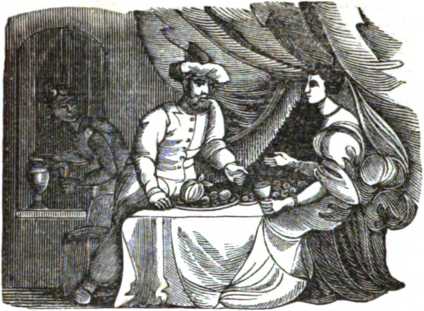
When they had drank two or three cups more a-piece, the princess, who had completely charmed the African magician by her civility and obliging behaviour, gave the signal to the slave who served them with wine, bidding her bring the cup which had been filled for herself, and at the same time bring the magician a full cup. When they both had their cups in their hands, she said to him, I know not how you here express your love when drinking together as we are: with us in China, the lover and his mistress reciprocally exchange cups, and drink each other’s health; at the same time she presented to him the cup which was in her hand, and held out her hand to receive his. He for his part hastened to make the exchange with the more pleasure, as he looked upon this favour as the most certain token of an entire conquest over the princess, which raised his happiness to its height. Before he drank, he said to her, with the cup in his hand, Indeed, princess, we Africans are not so refined in the art of love as you Chinese; and instructing me in a lesson I was ignorant of, informs me how sensible I ought to be of the favour done me. I shall never, lovely princess, forget my recovering, by drinking out of your cup, that life, which your cruelty, had it continued, would have made me despair of.
The princess Badroulboudour, who began to be tired with this barefaced declaration of the African magician, interrupted him, and said, Let us drink first, and then say what you will afterwards; and at the same time set the cup to her lips, while the African magician, who was eager to get his wine off first, drank up the very last drop. In finishing it, he had reclined his head back to show his eagerness, and remained some time in that state. The princess kept her cup at her lips, till she saw his eyes turn in his head, and he fell backwards lifeless.
The princess had no occasion to order the back-door to be opened to Aladdin; for her women were so disposed from the great hall to the foot of the staircase, that the word was no sooner given, that the African magician was fallen backwards, but the door opened that instant.
As soon as Aladdin entered the hall, he saw the magician stretched backwards on the sofa. The princess Badroulboudour rose from her seat and ran overjoyed to him to embrace him; but he stopped her, and said, Princess, it is not yet time; oblige me by retiring to your apartment, and let me be left alone a moment, while I endeavour to transport you back to China as soon as you were brought from thence.
When the princess, her women, and eunuchs, were gone out of the hall, Aladdin shut the door, and going directly to the dead body of the magician, opened his vest, and took out the lamp carefully wrapt up, as the princess told him, and unfolding and rubbing it, the genie immediately appeared. Genie, said Aladdin, I have called thee to command thee on the part of thy good mistress this lamp, to transport this palace presently into China, to the same place from whence it was brought hither. The genie bowed his head in token of obedience, and disappeared. Immediately the palace was transported into China, and its removal was only felt by two little shocks, the one when it was lifted up, the other when it was set down, and both in a very short interval of time.
Aladdin went down to the princess’s apartment, and embracing her, said, I can assure you, princess, that your joy and mine will be complete to-morrow morning. The princess, who had not quite supped, guessing that Aladdin might be hungry, ordered the meats that were served up in the hall, and were scarcely touched, to be brought down. The princess and Aladdin eat as much as they thought fit, and drank in like manner of the African magician’s old wine; during which time their discourse could not be any otherwise than satisfactory, and then they retired to their own chamber.
From the time of the transportation of Aladdin’s palace, and of the princes Badroulboudour in it, the sultan, that princess’s father, was inconsolable for the loss of her, as he considered it. He hardly slept night or day, and instead of taking measures to avoid every thing that could keep up his affliction, he, on the contrary, indulged it; for whereas before he used to go every morning into his closet to please himself with that agreeable prospect, he went now many times in the day to renew his tears, and plunge himself into the deepest melancholy, by the idea of no more seeing that which once gave him so much pleasure, and reflecting how he had lost what was the most dear to him in this world.
The very morning of the return of Aladdin’s palace, the sultan went, by break of day, into his closet to indulge his sorrows. Collected in himself, and in a pensive mood, he cast his eyes in a melancholy manner towards the place where he remembered the palace once stood, expecting only to see an open space; but perceiving that vacuum filled up, he at first imagined it to be the effect of a fog; but looking more attentively, he was convinced beyond the power of doubt that it was his son-in-law’s palace. Then joy and gladness succeeded to sorrow and grief. He returned immediately into his apartment, and ordered a horse to be saddled and brought to him in all haste, which he mounted that instant, thinking he could not make haste enough to get to Aladdin’s palace.
Aladdin, who foresaw what would happen, rose that morning by daybreak, put on one of the most magnificent habits his wardrobe afforded, and went up into the hall of twenty-four windows, from whence he perceived the sultan coming, and got down soon enough to receive him at the foot of the great staircase, and to help him to dismount. Aladdin, said the sultan, I cannot speak to you till I have seen and embraced my daughter.
He led the sultan into the princess Badroulboudour’s apartment, who having been told by him when he rose, that she was no longer in Africa, but in China, and in the capital of the sultan her father, had just done dressing herself. The sultan embraced her with his face bathed in tears of joy; and the princess, on her side, gave him all the testimonies of the extreme pleasure the sight of him gave her.
The sultan was some time before he could open his lips, so great was his surprise and joy to find his daughter again, after he had given her up for lost; and the princess, after seeing her father, let fall tears of joy.
At last the sultan broke silence, and said, I would believe, daughter, your joy to see me makes you seem so little changed, as if no misfortune had befallen you; for a large palace cannot be so suddenly transported as yours has been, without great fright and terrible anguish. I would have you tell me all that has happened, and conceal nothing from me.
The princess, who took great pleasure in giving the sultan the satisfaction he demanded, said, Sir, if I appear so little altered, I beg of your majesty to consider, that I received new life yesterday morning by the presence of my dear husband and deliverer Aladdin, whom I looked upon and bewailed as lost to me; and the happiness of seeing and embracing whom has almost recovered me to my former state of health. But my greatest trouble was only to find myself forced from your majesty, and my dear husband; not only in resect to the inclination I bore to my husband, but from the uneasiness I laboured under besides, for fear that he, though innocent, should feel the effects of your anger, to which I knew he was left exposed. I suffered but little from the insolence of the wretch who had carried me off; for having secured the ascendant over him, I always put a stop to his disagreeable discourse, and was as little constrained as I am at present.
As to what relates to my transportation, Aladdin had no hand in it; I myself am the innocent cause of it. To persuade the sultan of the truth of what she said, she gave him a full account how the African magician disguised himself like a seller of lamps, and offered to change new lamps for old ones; and how she amused herself in making that exchange, being entirely ignorant of the secret and importance of that lamp; how the palace and herself were carried away and transported into Africa, with the African magician, who was recollected by two of her women, and the eunuch who made the exchange of the lamp, when he had the boldness to pay her the first visit, after the success of his audacious enterprise, to propose himself for her husband; how he persecuted her till Aladdin’s arrival; how he and she concerted measures together to get the lamp from him again, which he carried about him; and the success they had; and particularly by her dissimulation, inviting him to supper, and giving him the cup with the powder prepared for him. For the rest, added she, I leave it to Aladdin to give you an account.
Aladdin had not much to tell the sultan, but only said, When the private door was opened, I went up into the great hall, where I found the magician lying dead on the sofa; as I thought it not proper for the princess to stay there any longer, I desired her to go down into her own apartment, with her women and eunuchs. As soon as I was alone, and had taken the lamp out of the magician’s breast, I made use of the same secret he had done, to remove the palace, and carry off the princess; and by that means the palace was brought into the same place where it stood before; and I have the happiness to bring back the princess to your majesty, as you commanded me. But that your majesty may not think that I impose upon you, if you will give yourself the trouble to go up into the hall, you shall see the magician punished as he deserved.
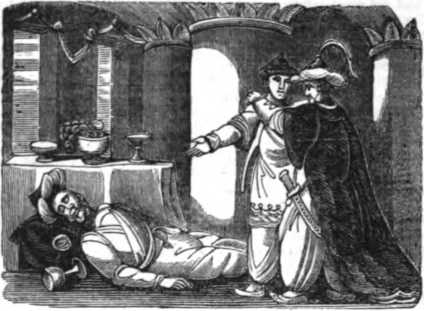
The sultan, to be assured of the truth, rose up instantly, and went up into the hall, where, when he saw the African magician dead, and his face already livid by the strength of the poison, he embraced Aladdin with great tenderness, and said, My son, be not displeased at my proceedings against you; they arose from my paternal love, and therefore you ought to forgive the excesses to which it hurried me. Sir, replied Aladdin, I have not the least reason to complain of your majesty’s conduct, since you did nothing but what your duty required of you. This infamous magician, the basest of men, was the sole cause of my misfortune. When your majesty has leisure, I will give you an account of another villanous action he was guilty of to me, which was no less black and base than this, from which I was preserved by the grace of God in a very particular manner. I will take an opportunity, and that very shortly, replied the sultan, to hear it; but in the mean time let us think only of rejoicing, and the removal of this odious object.
Aladdin ordered the magician’s dead carcass to be removed and thrown on the dunghill, for the birds and beasts to prey upon. In the mean time the sultan commanded the drums, trumpets, cymbals, and other instruments of music, to announce the public joy, and a feast of ten days to be proclaimed for joy of the return of the princess Badroulboudour, and Aladdin with his palace.
Thus Aladdin escaped a second time the almost inevitable danger of losing his life: but this was not the last, since he ran as great a hazard a third time; the circumstances of which I shall relate.
The African magician had a younger brother, who was as great a necromancer, and even surpassed him in villany, and pernicious designs. As they did not live together, or in the same city, but oftentimes when one was in the east the other was in the west, they failed not every year to inform themselves, by their art of necromancy, where each other was, how they did, and whether they stood in need of each other’s assistance.
Some time after the African magician had failed in his enterprise against Aladdin’s happiness, his younger brother, who had not heard any tidings of him for a year, and was not in Africa, but in a distant country, had the curiosity to know in what part of the world he was, how he did, and what he was doing; and as he, as well as his brother, always carried a geomantic square instrument about him, he prepared the sand, [98] cast the points, and drew the figures. On examining the houses, he found that his brother was no longer living; by another house, that he had been poisoned, and died suddenly; and by another, that it was in the capital of the kingdom of China; and that the person who poisoned him was of mean birth, and married to a princess, a sultan’s daughter.
When the magician had after this manner informed himself of his brother’s fate, he lost no time in useless regret, which could not restore him to life again; but resolving immediately to revenge his death, he took horse, and set forwards for China: where, after crossing plains, rivers, mountains, deserts, and a long tract of country, without stopping, he arrived after incredible fatigues.
When he came to the capital of China, which his knowledge of geomancy pointed out to him, and being certain he had not mistaken any other kingdom for it, he took a lodging. The next day he went out, and walked through the town, not so much to observe the beauties, which were indifferent to him, but with an intention to take proper measures to execute his pernicious designs. He introduced himself into the most frequented places, where he listened to every body’s discourse. In a place where people resorted to divert themselves with all sorts of games, and where some are conversing while others play, he heard some persons talk of the virtue and piety of a woman called Fatima, who was retired from the world, and of the miracles she performed. As he fancied that this woman might be serviceable to him in the project he had in his head, he took one of the company aside, and desired him to tell him more particularly who that holy woman was, and what sort of miracles she performed.
What! said the person to whom he addressed himself, have you never seen or heard talk of her? She is the admiration of the whole town; first, for her fasting, her austerities, and her exemplary life. Except Mondays and Fridays, she never stirs out of her little cell; and on those days on which she comes into the town, she does an infinite deal of good; for there is not a person who has the head-ache, but is cured by her laying her hand upon them.
The magician wanted no further information. He only asked the person in what part of the town this holy woman’s cell was. After he had shown him it, and he had concluded and determined on the detestable design he had in his head, and that he might know the way again, and be fully informed, he watched all her steps the first day she went out after he had made this inquiry, without losing sight of her till evening, when he saw her re-enter her cell. When he had fully observed the place, he went to one of those houses where they sell a certain hot liquor, and where any person may pass the night, particularly in the great heats, when the people of that country prefer lying on a mat to a bed. About midnight, after the magician had satisfied the master of the house for what little he had called for, he went out, and proceeded directly to the cell of Fatima, the holy woman, the name she was known by throughout the town. He had no difficulty to open the door, which was only fastened with a latch, and he shut it again after he had got in, without any noise; and when he entered the cell, perceived Fatima by moonlight lying in the air on a sofa, covered only by an old mat, with her head leaning against the wall. He awakened her and clapped a dagger to her breast.
Poor Fatima, opening her eyes, was very much surprised to see a man with a dagger at her breast ready to stab her, and who said to her, If you cry out, or make the least noise, I will kill you; but get up and do as I bid you.
Fatima, who had lain down in her clothes, got up trembling with fear. Do not be so much frightened, said the magician; I only want your habit; give it me presently, and take mine. Accordingly Fatima and he changed clothes. Then he said, colour my face as yours is, that I may be like you; but perceiving that the poor creature could not help trembling, to encourage her, he said, I tell you again, you need not fear any thing: I swear by the name of God I will not take away your life. Fatima lighted her lamp, made him come into the cell, and taking a pencil and dipping it into a certain liquor, rubbed it over his face, and assured him the colour would not change, and that his face was of the same dye as her own: after which she put her own head-dress on his head, with a veil, with which she showed him how to hide his face as he passed through the town. After this, she put a long string of beads about his neck, which hung down to the middle of his body, and giving him the stick she used to walk with, in his hand, brought him a looking-glass, and bid him look if he was not as like her as possible. The magician found himself disguised as he wished to be; but he did not keep the oath he so solemnly swore to the good Fatima; but instead of stabbing her, for fear the blood might discover him, he strangled her; and when he found she was dead, threw her body into a cistern just by the cell.
The magician thus disguised like the holy woman Fatima, spent the remainder of the night in the cell, after he had committed so horrid a murder. The next morning, two hours after sunrise, though it was not a day the holy woman used to go out on, he crept out of the cell, being well persuaded that nobody would ask him any questions about it; or, if they should, he had an answer ready for them. As one of the first things he did after his arrival was to find out Aladdin’s palace, where he was to execute his designs, he went directly thither.
As soon as the people saw the holy woman, as they imagined him to be, they presently gathered about him in a great crowd. Some begged his blessing, others kissed his hand, and others more reserved, only the hem of his garment; while others, whether their heads ached, or they had a mind to be preserved against that distemper, stooped for him to lay his hands upon them; which he did, muttering some words in form of prayer: and, in short, counterfeited so well, that every body took him for the holy woman.
After frequently stopping to satisfy these kind of people, who received neither good nor harm from this imposition of hands, he came at last to the square before Aladdin’s palace. The crowd was so great that the eagerness to get at him increased in proportion. Those who were the most zealous and strong forced their way through the crowd to get room. There were such quarrels, and so great a noise, that the princess, who was in the hall of four-and-twenty windows, heard it, and asked what was the matter; but nobody being able to give her an account, she ordered them to go and see, and inform her. One of her women looked out of a window, and then told her it was a great crowd of people that were gathering about the holy woman, to be cured of the head-ache by the imposition of her hands.
The princess, who had for a long time heard a great deal of this holy woman, but had never seen her, conceived a great curiosity to have some conversation with her, which the chief of the eunuchs perceiving, told her it was an easy matter to bring her to her, if she desired and commanded it; and the princess showing a desire, he immediately sent four eunuchs for the pretended holy woman.
As soon as the crowd saw the eunuchs coming, they made way, and the magician perceiving also that they were coming for him, advanced to meet them, overjoyed to find his plot took so well. Holy woman, said one of the eunuchs, the princess wants to see you, and has sent us for you. The princess does me too great an honour, replied the false Fatima. I am ready to obey her command, and at the same time followed the eunuchs to the palace.
When the magician, who under a holy garment disguised a wicked heart, was introduced into the great hall, and perceived the princess, he began a prayer, which contained a long enumeration of vows and good wishes for the princess’s health and prosperity, and that she might have every thing she desired. Then he displayed all his deceitful, hypocritical rhetoric, to insinuate himself into the princess’s favour under the cloak of piety, which it was no hard matter for him to do; for as the princess herself was naturally good, she was easily persuaded that all the world was like her, especially those who made profession of serving God in solitary retreat.
When the pretended Fatima had made an end of his long harangue, the princess said to him, I thank you, good mother, for your prayers; I have great confidence in them, and hope God will hear them. Come, and sit by me. The false Fatima sat down with affected modesty: then the princess resuming her discourse, said, My good mother, I have one thing to ask you, which you must not refuse me; which is, to stay with me, that you may entertain me with your way of living; and that I may learn from your good example how to serve God. Princess, said the counterfeit Fatima, I beg of you not to ask what I cannot consent to, without neglecting my prayers and devotion. That shall be no hindrance to you, answered the princess; I have a great many apartments unoccupied; you shall choose which you like best, and shall have as much liberty to perform your devotions, as if you were in your own cell.
The magician, who wanted nothing more than to introduce himself into Aladdin’s palace, where it would be a much easier matter for him to execute his pernicious designs, under the favour and protection of the princess, than if he had been forced to come and go from the cell to the palace, did not urge much to excuse himself from accepting the obliging offer the princess made him. Princess, said he, whatever resolution a poor wretched woman, as I am, may have made to renounce the pomp and grandeur of this world, I dare not presume to oppose the will and commands of so pious and charitable a princess.
Upon this the princess rising up, said, Come along with me, I will show you what empty apartments I have, that you may make choice of which you like best. The magician followed the princess Badroulboudour, and of all the apartments she showed him, made choice of that which was the worst furnished, saying, That it was too good for him, and that he only accepted of it to please her.
Afterwards the princess would have brought him back again into the great hall to make him dine with her; but he considering that then he should be obliged to show his face, which he had always taken care to hide; and fearing that the princess should find out that he was not Fatima, he begged of her earnestly to dispense with him, telling her that he never eat any thing but bread and dried fruits, and desiring to eat that slight repast in his own apartment; that the princess granted him, saying, You may be as free here, good mother, as if you were in your own cell: I will order you a dinner, But remember I expect you as soon as you have finished your repast.
After the princess had dined, and the false Fatima had been informed by one of the eunuchs that she was risen from the table, he failed not to wait upon her. My good mother, said the princess, I am overjoyed to have the company of so holy a woman as yourself, who will confer a blessing upon this palace. But now I am speaking of this palace, pray how do you like it? And before I show you it all, tell me first what you think of this hall.
Upon this question, the counterfeit Fatima, who, to act his part the better, affected to hang down his head, without so much as ever once lifting it up, at last looked up, and surveying the hall from one end to the other, when he had examined it well, said to the princess, As far as such a solitary being as I can judge, who am unacquainted with what the world calls beautiful, this hall is truly admirable and most beautiful; there wants but one thing. What is that, good mother? answered the princess Badroulboudour; tell me, I conjure you. For my part I always believed, and have heard say, it wanted nothing; but if it does, it shall be supplied.
Princess, said the false Fatima, with great dissimulation, forgive me for the liberty I have taken; but my opinion is, if it can be of any importance, that if a roc’s egg was hung up in the middle of this dome, this hall would have no parallel in the four quarters of the world, and your palace would be the wonder of the universe.
My good mother, said the princess, what bird is a roc, and where may one get an egg? Princess, replied the pretended Fatima, it is a bird of prodigious size, which inhabits the top of mount Caucasus: the architect who built your palace can get you one.
After the princess Badroulboudour had thanked the false Fatima for what she believed her good advice, she conversed with her upon other matters; but could not forget the roc’s egg, which she made account to tell Aladdin of when he returned from hunting. He had been gone six days, which the magician knew, and therefore took advantage of his absence: but he returned that evening, after the false Fatima had taken leave of the princess, and retired to his apartment. As soon as he arrived, he went directly up to the princess’s apartment, saluted and embraced her, but she seemed to receive him coldly. My princess, said he, I think you are not so cheerful as you used to be; has any thing happened during my absence, which has displeased you, or given you any trouble or dissatisfaction? In the name of God, do not conceal it from me; I will leave nothing undone that is in my power to please you. It is a trifling matter, replied the princess, which gives me so little concern that I could not have thought you could have perceived it in my countenance; but since you have unexpectedly discovered some alteration, I will no longer disguise a matter of so little consequence from you.
I always believed, as well as you, continued the princess Badroulboudour, that our palace was the most superb, magnificent, and complete in the world: but I will tell you now what I find fault with, upon examining the hall of four-and-twenty windows. Do not you think with me, that it would be complete, if a roc’s egg was hung up in the midst of the dome? Princess, replied Aladdin, it is enough that you think there wants such a thing; you shall see by the diligence used to repair that deficiency, that there is nothing which I would not do for your sake.
Aladdin left the princess Badroulboudour that moment, and went up into the hall of four-and-twenty windows, where pulling out of his bosom the lamp, which, after the danger he had been exposed to, he always carried about him, he rubbed it; upon which the genie immediately appeared. Genie, said Aladdin, there wants a roc’s egg to be hung up in the midst of the dome: I command thee, in the name of this lamp, to repair the deficiency. Aladdin had no sooner pronounced these words, but the genie gave so loud and terrible a cry, that the hall shook, and Aladdin could scarce stand upright. What! wretch, said the genie, in a voice that would have made the most undaunted man tremble, is it not enough that I and my companions have done every thing for you, but you, by an unheard-of ingratitude, must command me to bring my master, and hang him up in the midst of this dome? This attempt deserves that you, your wife, and your palace, should be immediately reduced to ashes; but you are happy in not being the author of this request, and that it does not come from yourself. Know then, that the true author is the brother of the African magician, your enemy, whom you have destroyed as he deserved. He is now in your palace, disguised in the clothes of the holy woman Fatima, whom he murdered; and it is he who has suggested to your wife to make this pernicious demand. His design is to kill you, therefore take care of yourself. After these words, the genie disappeared.
Aladdin lost not a word of what the genie had said. He had heard talk of the holy woman Fatima, and how she pretended to cure the head-ache. He returned to the princess’s apartment, and without mentioning a word of what had happened, he sat down, and complained of a great pain which had suddenly seized his head; upon which the princess ordered the holy woman to be presently fetched, and then told him how that holy woman came to the palace, and that she had appointed her an apartment.
When the pretended Fatima came, Aladdin said, Come hither, good mother; I am glad to see you here at so fortunate a time: I am tormented with a violent pain in my head, and request your assistance, by the confidence I have in your good prayers, and hope you will not refuse me that favour which you do to so many persons afflicted with this distemper. So saying, he rose up, but held down his head. The counterfeit Fatima advanced towards him, with his hand all the time on a dagger concealed in his girdle under his gown; which Aladdin observing, he seized his hand before he had drawn it, pierced him to the heart with his own dagger, and then threw him down on the floor dead.
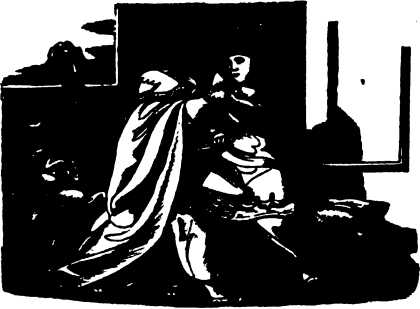
My dear husband, what have you done? cried the princess in surprise. You have killed the holy woman. No, my princess, answered Aladdin, without emotion, I have not killed Fatima, but a wicked wretch, that would have assassinated me, if I had not prevented him. This wicked man, added he, uncovering his face, has strangled Fatima, whom you accused me of killing, and disguised himself in her clothes, to come and murder me: but that you may know him better, he is brother to the African magician. Then Aladdin told her how he came to know those particulars, and afterwards ordered the dead body to be taken away.
Thus was Aladdin delivered from the persecution of two brothers, who were magicians. Within a few years afterwards the sultan died in a good old age, and as he left no male children, the princess Badroulboudour, as lawful heir of the crown, succeeded him, and communicating the power to Aladdin, they reigned together many years, and left a numerous and illustrious posterity behind them.
Sir, said the sultaness Scheherazade, after she had finished the story of the Wonderful Lamp, your majesty without doubt has observed in the person of the African magician a man abandoned to the unbounded passion for possessing immense treasures by the most unworthy means. On the contrary, your majesty sees in Aladdin, a person of mean birth raised to the regal dignity by making use of the same treasures, which came to him without his seeking, but just as he had an occasion for them to compass the end proposed; and in the sultan you will have learnt what dangers a just and equitable monarch runs, even to the risk of being dethroned, when, by crying injustice, and against all the rules of equity, he dares, by an unreasonable precipitation, condemn an innocent person to death, without giving him leave to justify himself. In short, you must abhor those two wicked magicians, one of whom sacrificed his life to attain great riches, the other his life and religion to revenge him, and both received the chastisements they deserved.
The sultan of the Indies signified to his spouse the sultaness Scheherazade, that he was very much delighted with the prodigies he had heard of the Wonderful Lamp, and that the stories which she told him every night gave him a great deal of pleasure. Indeed they were all diverting, and for the most part seasoned with a good moral. He found that the sultaness knew how to introduce them, and was not sorry that she gave him an opportunity of suspending, by this means, the execution of a vow he had made, never to keep a woman above one night, and put her to death next day. His only thought was to see if he could exhaust her store.
With this intention, the next morning he prevented Dinarzade, and awakened the sultaness himself, asking her if she was at the end of all her stories. —At the end of my stories, sir! replied the sultaness, surprised at the question, I am far from that and the number of them is so great, that I cannot tell your majesty how many I have yet left; but am afraid you will be sooner tired with hearing, than I with telling them.
Do not let that fear disturb you, answered the sultan; but let us hear what you have now to tell me.
The sultaness Scheherazade, encouraged with these words, said, I have often entertained your majesty with the adventures of the famous caliph Haroun Alraschid, who had a great many in his time; but, among the rest, I think none more worthy of your hearing than the following:
The Adventures of the Caliph Haroun Alraschid.
Your majesty cannot be insensible, but must have experienced, that we are sometimes in such extraordinary transports of joy, that we presently communicate that passion to those about us, or easily partake of theirs; and sometimes our melancholy is so great, that we are insupportable to ourselves, and are so incapable of giving any one a reason, that should ask it, that we cannot account for it ourselves.
The caliph was one day in one of these latter fits, when his faithful and favourite grand vizier Giafar came to him. That minister finding him alone, which was seldom the case, and perceiving as he came nearer to him, that he was in a very melancholy humour, and never lifted up his eyes, he stopt till he would vouchsafe to look at him.
At last the caliph cast his eyes upon Giafar, but presently turned them away again, and remained in the same posture, motionless as before.
The grand vizier observing nothing in the caliph’s eyes which regarded him personally, took the liberty to speak to him, and said, Commander of the faithful, will your majesty give me leave to ask whence proceeds this melancholy, of which you always seemed to me so little susceptible?
Indeed, vizier, answered the caliph, clearing up his countenance, I am very little subject to it, and had not perceived it but for you, and will remain no longer in it. If no new affair brought you hither, you will do me a pleasure by inventing something to dispel it.
Commander of the faithful, replied the grand vizier, my duty obliged me to wait on you, and I take the liberty to remind your majesty, that this is the day which you have appointed to inform yourself of the good government of your capital and its environs; and this occasion very opportunely presents itself to dispel those clouds which obscure your natural gaiety.
You do well to remind me, replied the caliph, for I had entirely forgotten it: go and change your dress, while I do the same.
They each put on the habit of a foreign merchant, and under that disguise went out by a private door of the palace-garden, which led into the fields. After they had gone round the outside of the city to the banks of the Euphrates, at a sufficient distance from the city gate, on that side, without having observed any thing disorderly, they crossed the river in the first boat they met with, and making another tour on the other side, came over the bridge, which formed the communication betwixt the two parts of the town.
At the foot of the bridge they met with an old blind man, who asked alms of them; the caliph turned about, and put a piece of gold into his hand. The blind man presently caught hold of his hand, and stopped him. Charitable person, said he, whoever you are, whom God hath inspired to bestow alms on me, do not refuse the favour I ask you, to give me a box on the ear, for I deserve that and a greater punishment. After these words, he let the caliph’s hand go, that he might strike, but, for fear he should pass on without doing it, held him fast by his clothes.
The caliph, surprised both at the request and action of the blind man, said, I cannot acquiesce with your request. I will not lessen the merit of my charity, by treating you as you would have me. After these words, he endeavoured to get away from the blind man.
The blind man, who expected this reluctance of his benefactor, by the long experience he had, exerted himself to hold him. Sir, said he, forgive my boldness and importunity; I desire you would either give me a box on the ear, or take your alms back again, for I cannot receive it but on that condition, without breaking a solemn oath which I have sworn to God; and if you knew the reason, you would agree with me, that the punishment is very slight.
The caliph, not caring to be detained any longer, yielding to the importunity of the blind man, gave him a very slight blow: whereupon he immediately let him go, and thanked and blessed him. When the caliph and vizier had got some small distance from the blind man, the caliph said to the vizier, This blind man must certainly have some very substantial reasons, which make him behave himself in this manner to all who give him alms. I should be glad to know them; therefore return and tell him who I am, and bid him not fail to come to my palace about prayer-time in the afternoon, that I may have some talk with him.
The grand vizier went back, bestowed his alms on the blind man, and after he had given him a box on the ear, told him the caliph’s order, and then returned again to the caliph.
When they came into the town, they found in a square a great concourse of spectators, looking at a handsome well-shaped young man, who was mounted on a mare, which he rode full speed round the place, spurring and whipping the poor creature so barbarously, that she was all over sweat and blood.
The caliph, amazed at the inhumanity of the young man, stopped to ask the people if they knew why he used the mare so ill; but could learn nothing, except that for some time past he had every day, at the same hour, treated her after the same manner.
As they went along, the caliph bid the grand vizier take particular notice of the place, and not fail to order the young man to come the next day, at the hour appointed to the blind man. But before the caliph got to his palace, he observed in a street, which he had not passed through a long time before, an edifice newly built, which seemed to him to be the palace of some of the great lords of the court. He asked the grand vizier if he knew to whom it belonged; who answered he did not, but would inquire; and thereupon asked a neighbour, who told him that the house was one Cogia Hassan’s, surnamed Alhabbal, upon account of his profession of rope-making, which he had seen him work at himself, when poor, and that without knowing how fortune had favoured him, he had got such great wealth, that he defrayed honourably and splendidly the expenses he had been at in building.
The grand vizier rejoined the caliph, and gave him a full account of what he had heard. I must see this Cogia Hassan Alhabbal, said the caliph, therefore go and tell him, vizier, to come to my palace, at the same hour you have ordered the other two. Accordingly the vizier obeyed.
The next day, after afternoon prayers, the caliph retired to his own apartment, and the grand vizier introduced the three persons we have been speaking of, and presented them to the caliph.
They all three prostrated themselves before the caliph, and when they rose up again, the caliph asked the blind man his name, who answered, it was Baba Abdalla.
Baba Abdalla, replied the caliph, your manner of asking alms seemed so strange to me yesterday, that if it had not been for some certain considerations, I should not have complied with your request, but should have prevented you from giving any more offence to the public. I ordered you to come hither, to know from yourself what induced you to make that indiscreet oath you have told me of, that I may judge whether you have done well, and if I ought to suffer you to continue a practice that appears to me to set so ill an example. Tell me freely how so extravagant a thought came into your head, and do not disguise any thing from me, for I will absolutely know the truth.
Baba Abdalla, intimidated by this reprimand, cast himself a second time at the foot of the caliph’s throne, with his face to the ground, and when he rose up again, said, Commander of the faithful, I most humbly ask your majesty’s pardon for my boldness, in daring to require, and almost force you to do a thing which indeed appears so contrary to reason. I acknowledge my crime; but as I did not then know your majesty, I implore your clemency, and hope you will consider my ignorance.
As to the extravagance of my action, I own it, and that it must seem strange to mankind; but in the eye of God it is a very slight penance I have enjoined myself, for an enormous crime I am guilty of, and for which, if all the people in the world were each to give me a box on the ear, it would not be a sufficient atonement. Your majesty will judge of it yourself, when, in telling my story, in obedience to your commands, I shall let you know what that heinous crime was.
The Story of the Blind Man Baba Abdalla.
Commander of the faithful, continued Baba Abdalla, I was born at Bagdad, and had a pretty fortune left me by my father and mother, who died a few days after each other. Though I was then but very young, I did not squander away my fortune as most young men do, in idle expenses and debauchery; on the contrary, I neglected no opportunity to increase it by my industry. At last I became rich enough to purchase fourscore camels, which I let out to merchants for caravans, who paid me well for every journey I went with them throughout the extent of your majesty’s dominions.
In the midst of this happiness, and with an ardent desire of growing much richer, as I was returning one day with my camels unloaded from Balsora, whither I had carried some merchandises that were to be embarked for the Indies, I met with good pasturage, at some distance from any habitation; made a halt there, and let them graze for some time. While I was seated, a dervise, who was walking to Balsora, came and sat down by me to rest himself. I asked him from whence he came, and where he was going, and he put the same questions to me; and when we had satisfied each other’s curiosity, we produced our provisions and eat together.
During our repast, after we had talked of many indifferent things, the dervise told me that he knew of a treasure a small distance from thence, where there were such immense riches, that if all my fourscore camels were loaded with gold and jewels that might be taken from it, it would not seem as if any thing had been taken away.
This good news surprised and charmed me at the same time; and I was so overjoyed, that I could scarce contain myself. I could not believe that the dervise was capable of telling me a falsity; therefore I fell upon his neck, and said, Good dervise, I know you value not the riches of this world, therefore what service can the knowledge of this treasure be to you? You are alone, and cannot carry much of it away with you; show me where it is; I will load all my camels, and as an acknowledgement of the favour done me, will present you with one of them.
Indeed I offered very little, but after he had communicated that secret to me, my desire of riches was become so violent, that I thought it a great deal, and looked upon the seventy-nine camel loads which I reserved for myself, as nothing in comparison of what I allowed him.
The dervise, though he saw my avarice, was not however angry at the unreasonable offer I had made him, but replied, without the least concern, You are sensible, brother, that what you offer me is not proportionable to the kindness you ask of me. I might have chosen whether I would communicate my secret to you, and have kept the treasure to myself: but what I have told you is sufficient to show you my good intentions, and that it is still in my power to oblige you, and make you remember me, by making both our fortunes. I have another proposition more just and equitable to make to you; it lies in your own breast whether or no you will agree to it.
You say, continued the dervise, that you have fourscore camels: I am ready to carry you to the place where the treasure lies, and we will load them with as much jewels and gold as they can well carry, on condition, that when they are so loaded, you will let me have one half, and you take the other; after which we will separate, and carry our camels where we think fit. You see there is nothing but what is strictly equitable in this division; for if you give me forty camels, you will get by my means wherewithal to purchase thousands more.
I could not but agree there was a great deal of justice in what the dervise said: but, without considering what riches I should gain in accepting of the condition he proposed, I could not without reluctance think of parting with my forty camels, especially when I considered that the dervise would then be as rich as myself, and that I was beforehand making an ungrateful return for a favour, purely gratuitous, which I had not yet received from the dervise. But there was no time to hesitate; I must either accept of the proposal, or resolve to repent all my lifetime after of losing, by my own fault, an opportunity of obtaining a great fortune. That instant I went and collected all my camels; and after we had travelled some time, we came into a large spacious valley, the entrance into which was so narrow, that two camels could not go abreast. The two mountains which formed this valley terminated in a semicircle, but were so high, craggy, and impracticable, that there was no fear of being seen by any one.
When we came between these two mountains, the dervise said to me, Stop your camels, and make them lie down, that we may load them the easier, and I will proceed to discover the treasure.
I did as the dervise bid me; and going to him soon after, found him with a match in one hand, gathering sticks to light a fire; which he had no sooner done, than he cast some incense into it, and pronouncing certain words, which I did not understand, there presently arose a thick cloud. He divided this cloud, when the rock, though of a prodigious perpendicular height, opened like two folding-doors, and exposed to view a magnificent palace in the hollow of the mountain, which seemed to be rather the workmanship of genies than men; for no man could ever have thought of such a bold and surprising work.
But this, I must tell your majesty, was an after-thought, which did not occur to me at the moment. I did not even stop to admire the immense riches which I saw on all sides; and, without staying to observe the just regularity in which the treasures were ranged, like an eagle seizing her prey, I fell upon the first heap of golden money that I was near to, and began to fill the sack I had in my hand as full as I could carry it. The sacks were all large, and with my good-will I would have filled them all; but I was obliged to proportion my burden to the strength of my camels. The dervise did the same; but I perceived he paid more attention to the jewels, and as he told me the reason, I followed his example, and we took away much more jewels than gold —When we had filled our sacks, and loaded our camels, we had nothing left to do but to shut up the treasure, and go our way.
But before we parted, the dervise went again into the treasury, where there were a great many wrought vessels of gold of different shapes and materials. I observed that he took out of one of these vessels a little box of a certain wood, which I knew not, and put it into his breast; but first showed me that it contained only a kind of pomatum.
The dervise used the same ceremony to shut the treasury as he had done to open it; and after he pronounced some certain words, the doors of the treasury shut again, and the rock seemed as whole and entire as before.
Then we divided our camels. I put myself at the head of the forty which I reserved for myself, and the dervise at the head of the rest which I had given him. We came out of the valley by the same way we went in, and travelled together till we came to the great road, where we were to part; the dervise to go to Balsora, and I to Bagdad. To thank him for so great a kindness, I made use of the most expressive terms, testifying my gratitude for the preference he had given me before all other men, in letting me have a share of such riches. We embraced each other with great joy, and taking our leave, went our different ways.
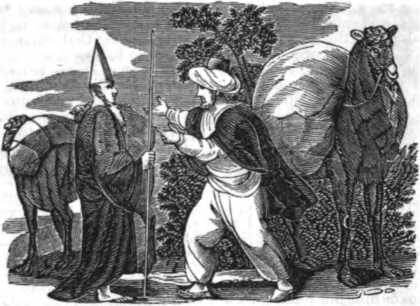
I had not gone many paces to overtake my camels, which went on the track I put them into, before the demon of ingratitude and envy took possession of my heart, and I deplored the loss of my forty camels, and much more the riches wherewith they were loaded. The dervise, said I to myself, has no occasion for all these riches; he is master of the treasure, and may have as much as he pleases. So I gave myself up to the blackest ingratitude, and determined immediately to take the camels with their loading from him.
To execute this design, I first stopped my own camels, and afterwards ran after the dervise, and called to him as loud as I could, giving him to understand that I had something material to say to him, and made a sign to him to stop his, and stay for me; which he accordingly did.
When I came up to him, I said, Brother, I had no sooner parted from you, but a thought came into my head, which neither of us had reflected on before. You are a good dervise, used to live in tranquillity, disengaged from all the cares of the world, and intent only upon serving God. You know not, perhaps, what trouble you have taken upon yourself, to take care of so many camels. If you would take my advice, you would keep but thirty; you will find them sufficiently troublesome to manage. Take my word; I have had experience.
I believe you are right, replied the dervise, who found he was not able to contend with me; I own I never thought of it. I begin already to be uneasy at what you have represented to me. Choose which ten you please, and take them, and go on in God’s keeping.
I set ten apart; and after I had driven them off, I put them in the road to follow my others. I could not have imagined that the dervise would be so easily persuaded to part with his camels, which increased my covetousness, and made me flatter myself that it would be no hard matter to get ten more. Wherefore, instead of thanking him for his present, I said to him again, Brother, the interest I take in your repose is so great, that I cannot resolve to part with you without desiring you to consider once more how difficult a thing it is to govern thirty loaded camels, especially for you, who are not used to such work; you will find it much better to return me as many more back as you have done already. What I tell you is not for my own sake and interest, but to do you the greater pleasure. Ease yourself then of the camels, and leave them to me, who can manage a hundred as well as one.
My discourse had the desired effect upon the dervise, who gave me, without any hesitation, the other ten camels; so that he had but twenty left, and I was master of sixty, and might boast of greater riches than many sovereign princes. Any one would have thought I should now have been content; but, as a person afflicted with a dropsy, the more he drinks the more thirsty he is, so I became more greedy and desirous of the other twenty camels.
I redoubled my solicitations, prayers, and importunities, to make the dervise condescend to grant me ten of the twenty, which he did with a good grace; and as to the other ten he had left, I embraced him, kissed him, and caressed him, conjuring him not to refuse me, but to complete the obligation I should ever have to him, so that he crowned my joy by giving me them also. Make a good use of them, brother, said the dervise: and remember that God can take away riches as well as give them, if we do not assist the poor, whom he reduces to their situation on purpose that the rich may merit by their charity a greater recompense in the other world.
My blindness was so great that I could not profit by so wholesome advice. I was not content, though I had my forty camels again, and knew they were loaded with an inestimable treasure. But a thought came into my head, that the little box of pomatum which the dervise showed me had something in it more precious than all the riches which I was obliged to him for. The place from whence the dervise took it, said I to myself, and his care to secure it, makes me believe there is something mysterious in it. This determined me to do something to obtain it. I had just embraced him, and bade him adieu; and as I turned about from him, I said, What will you do with that little box of pomatum? It seems such a trifle, said I, it is not worth your carrying away. I entreat you to make me a present of it; for what occasion has a dervise, as you are, who has renounced the vanities of the world, for pomatum?
Would to heaven he had refused me that box! But if he had, I was stronger than him, and was resolved to have taken it from him by force; that for my complete satisfaction it might not be said he had carried away the smallest part of the treasure.
The dervise, far from denying me, presently pulled it out of his bosom, and presenting it to me with the best grace in the world, said, Here, take it, brother, and be content: if I could do more for you, you needed but to have asked for it; I am ready to satisfy you.
When I had the box in my hand, I opened it, and looking at the pomatum, said to him, Since you are so good, I am sure you will not refuse me this one favour, to tell me the particular use of this pomatum.
The use is very surprising and wonderful, replied the dervise: if you apply a little of this pomatum round the left eye, and upon the lid, you will see all the treasures contained in the bosom of the earth; but if you apply it to the right eye, it will make you blind.
I would make the experiment myself: Take the box, said I to the dervise, and apply some of this pomatum to my left eye; you understand now to do it better than I, for I long to experience what seems so incredible to me. Accordingly, I shut my left eye, and the dervise took the trouble to apply the pomatum. When he had done, I opened my eye, and was convinced he had told me truth. I saw immense treasures, and such prodigious riches, so diversified, that it is impossible for me to give an account of them; but as I was obliged to keep my right eye shut with my hand, and that tired me, I desired the dervise to apply some of the pomatum to that eye.
I am ready to do it, said the dervise; but you must remember what I told you, that if you put any of it upon your right eye, you would immediately be blind; such is the virtue of the pomatum.
Far from being persuaded of the truth of what the dervise said, I imagined, on the contrary, that there was some new mystery which he meant to hide from me. Brother, replied I, smiling, I see plainly you wish to mislead me: it is not natural that this pomatum should have two such contrary effects.
The thing is as I tell you, replied the dervise, taking the name of God to bear witness; you ought to believe me, for I cannot disguise the truth.
I would not believe the dervise, who spoke like an honest man. My insurmountable desire of seeing at my ease all the treasures in the world, and perhaps of enjoying that pleasure as often as I had a mind, had such an effect upon me, that I could not hearken to his remonstrances, nor be persuaded of what was, however, but too true, as to my great misfortune I soon experienced.
I persuaded myself that if that pomatum, by being applied to the left eye, had the virtue of showing me all the treasures of the earth, by being applied to the right, it might have the power of putting them in my disposal. Possessed with this thought, I obstinately pressed the dervise to apply the pomatum to my right eye; but he as positively refused me. Brother, said he, after I have done you so much service, I cannot resolve to do you so great an injury: consider with yourself what a misfortune it is to be deprived of one’s eye-sight; do not reduce me to the hard necessity of obliging you in a thing which you will repent of all your life after.
I persisted in my obstinacy, and said to him, in strong terms, Brother, I earnestly desire you to lay aside all the difficulties you start. You have granted me most generously all that I have asked of you hitherto, and would you have me go away dissatisfied with you at last about a thing of so little consequence? For God’s sake, grant me this last favour: whatever happens, I will not lay the blame on you, but take it upon myself alone.
The dervise made all the resistance possible; but seeing that I was able to force him to do it, he said, Since you will absolutely have it so, I will satisfy you; and thereupon he took a little of the fatal pomatum, and applied it to my right eye, which I kept shut; but, alas! when I came to open it, I could distinguish nothing with either eye but thick darkness, and became blind as you see me now.
Ah! dervise, cried I that moment, what you foretold me is but too true. Fatal curiosity! added I, insatiable desire of riches! into what an abyss of miseries have you cast me! I am now sensible what a misfortune I have brought upon myself; but you, dear brother, cried I, addressing myself to the dervise, who are so charitable and good, among the many wonderful secrets you are acquainted with, have you not one to restore to me my sight again?
Miserable wretch! answered the dervise, if you would have been advised by me, you would have avoided this misfortune, but you have your deserts; the blindness of your mind was the cause of the loss of your eyes. It is true I have secrets, and you, in the little time I have been with you, might know I have; but I have none to restore you to your sight. Pray to God, if you believe there is one; it is He alone that can restore it to you. He gave you riches, of which you were unworthy, and takes them from you again, and will, by my hands, give them to men not so ungrateful as you.
The dervise said no more, and I had nothing to reply. He left me to myself, overwhelmed with confusion, and plunged in inexpressible grief. After he had collected my camels, he carried them away, and pursued the road to Balsora.
I desired him not to leave me in that miserable condition, but to conduct me at least to the first caravan; but he was deaf to my prayers and entreaties. Thus, deprived of sight, and all I had in the world, I should have died with affliction and hunger, if the next day a caravan returning from Balsora had not received me charitably, and brought me back to Bagdad.
After this manner was I reduced without remedy from a condition worthy the envy of princes for riches and magnificence, though not for power, to beggary without resource. I had no other way to subsist, but must resolve to ask charity, which I have done till now. But to expiate my offence against God, I enjoined myself, by way of penance, a box on the ear from every charitable person that should commiserate my condition.
This, commander of the faithful, is the motive which seemed so strange to your majesty yesterday, and for which I ought to incur your indignation. I ask your pardon once more as your slave, and submit to receive the chastisement I deserve. And if you vouchsafe to pronounce any thing on the penance I have imposed upon myself, I am ready to undergo it, since I am persuaded you think it too slight and much too little for my crime.
When the blind man had made an end of his story, the caliph said, Baba Abdalla, your sin is great; but God be praised, you know both the enormity of that; and your penance —It is enough. You must continue it henceforth, not ceasing to ask of God pardon for it in every prayer your religion obliges you to say daily; and that you may not be prevented by the care of getting your living, I will settle a charity on you during your life of four silver drachmas a day, which my grand vizier shall give you; therefore do not go away, but wait till he has executed my orders.
At these words, Baba Abdalla prostrated himself before the caliph’s throne, and rising up, returned him thanks, and wished him all happiness and prosperity.
The caliph Haroun Alraschid, very well satisfied with the story of Baba Abdalla and the dervise, addressed himself to the young man who used his mare so ill, and asked him his name; to which he replied, it was Sidi Nonman. [99]
Sidi Nonman, then, said the caliph, I have seen horses exercised all my life, and have often exercised them myself, but never after so barbarous a manner as you yesterday treated your mare in the full square, to the great offence of all the spectators, who murmured loudly at it. I myself was not less displeased, and had like, contrary to my intention, to have discovered who I was, to have remedied that disorder. By your air and behaviour you do not seem to be a barbarous and cruel man; and therefore I would fain believe that you had reason for what you did, since I am informed that this was not the first time, but that you practise the same thing every day. I would know what is the cause, and sent for you for that purpose, that you should tell me the truth, and disguise nothing from me.
Sidi Nonman soon understood what the caliph demanded of him. The relation was painful to him. He changed colour several times, and could not help showing how greatly he was embarrassed. However, he must resolve to tell his story; but before he spoke, he prostrated himself before the caliph’s throne, and after he rose up again, endeavoured to speak, to satisfy the caliph, but was so confounded, not so much at the presence of the caliph, as by the nature of his relation, that he was speechless.
The caliph, notwithstanding his natural impatience to be obeyed, showed not the least anger at Sidi Nonman’s silence: he saw plainly, that he either had not assurance to speak before him, or was intimidated by the tone of his voice; or, in short, that there was something to be concealed in his story.
Sidi Nonman, said the caliph, to encourage him, recollect yourself; but tell your story as if you were speaking, not to me, but to your most familiar friend. If there is any thing in your relation which troubles you, and you think I may be offended at it, I pardon you now: therefore be not uneasy, but speak boldly and freely, and disguise nothing.
Sidi Nonman, encouraged by these last words of the caliph, said, Commander of the faithful, whatever apprehensions a man may be under at your majesty’s presence, I am sensible that respectful apprehension would not deprive me of the use of my speech, so as to fail in my obedience to you, in giving you satisfaction in any other matter but this you now ask of me. I dare not say I am the most perfect of men; yet I am not wicked enough to have committed, or to have had an intention of committing any thing against the laws, to fear their severity; and yet I cannot say I am exempt from sin through ignorance. In this case I do not say that I depend upon your majesty’s pardon, but will submit myself to your justice, and receive the punishment I deserve. I own that the manner in which I have for some time treated my mare, and which your majesty was witness of, is strange and cruel, and sets an ill example: but I hope you will think the motive well grounded, and that I am more worthy of compassion than chastisement: but not to keep your majesty any longer in suspense by a long preamble, I will tell you my story.
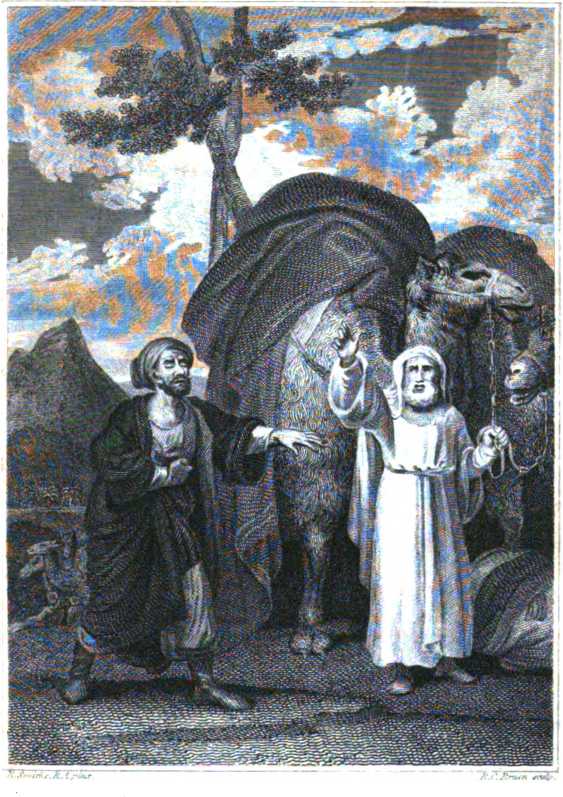
BABA ABDALLAH PUNISHED.
The Story of Sidi Nonman.
Commander of the faithful, said Sidi Nonman, I shall not trouble your majesty with my birth, which is not illustrious enough to merit your attention. For my fortune, my parents, by their good economy, left me enough to live on like an honest man, free from ambition, or being burdensome to any one.
With these advantages, the only thing that I wanted to render my happiness complete, was an amiable wife, who might share them with me; but that was a blessing it did not please God to grant me: on the contrary, it was my misfortune to have one, who, the very next day after our wedding, began to exercise my patience in a manner not to be conceived by any one that has not had the same trial.
As it is a custom for us to marry without seeing or knowing whom we are to marry, your majesty is sensible that a husband has no reason to complain, when he finds that the wife that has been chosen for him, is not horribly ugly and deformed, and that her carriage, wit, and behaviour, make amends for any slight imperfections of the body.
The first time I saw my wife with her face uncovered, after she was brought home with the usual ceremonies to my house, I rejoiced to find that I had not been imposed upon in the description of her person, which pleased me, and she was perfectly agreeable to my inclination.
The next day after our wedding, when our dinner was served up, which consisted of several dishes, I went into the room where the cloth was laid, and not finding my wife there, ordered her to be called. After making me wait a long time, at last she came. I dissembled my impatience, and we sat down to table, and I began with the rice, which I took up with a spoon, as usual.
On the other hand, my wife, instead of making use of a spoon, as every body does, pulled a little case out of her pocket, and took out of it a kind of ear-picker, with which she picked up the rice, and put it into her mouth, grain by grain.
Surprised at this manner of eating, I said to her, Amina, which was her name, are you used to eat rice so in your family, or do you do it because you are a little eater, or would you count the grains, that you may not eat more at one time than another? If you do it out of savingness, or to teach me not to be extravagant, you have no reason to fear that, and I can assure you we shall not ruin ourselves that way. We have, God be thanked, enough to live at our ease, without depriving ourselves of necessaries. Do not restrain yourself, my dear Amina, but eat as you see me eat. The kind manner in which I made these remonstrances might have produced some obliging answer; but she, without saying a word, continued to eat after the same manner. At last, to make me the more uneasy, she ate a grain of rice occasionally; and instead of eating any of the other meats with me, she only now and then put some crumbs of bread into her mouth, but not so much as a sparrow would have eaten.
I was very much provoked at her obstinacy; but yet, to indulge and excuse her, I imagined that she had not been used to eat with men, much more with a husband, before whom she might perhaps have been taught to restrain herself; but at the same time thought she carried it too far out of pure simplicity. I fancied again that she might have breakfasted late, or that she might have a mind to eat alone, and more at liberty. These considerations prevented me from saying any more to her then, to ruffle her temper, or to show any sign of dissatisfaction. After dinner I left her, but not with an air that showed any displeasure.
At supper she did the same thing; and the next day, and every time we ate together, behaved herself after the same manner. I knew it was impossible for a woman to live on so little food as she took, and that there was some mystery in it, which I did not understand. This made me resolve to dissemble; I appeared to take no notice of her actions, in hopes that time would bring her to live with me as I desired she should. But my hopes were in vain, and it was not long before I was convinced they were so.
One night, when Amina thought me fast asleep, she got out of bed softly, dressed herself with great precaution, avoiding any noise for fear of waking me. I could not comprehend what her design was, but curiosity made me feign a sound sleep; and as soon as she had dressed herself, she went softly out of the room without making any noise.
As soon as she was gone out, I got up, threw my gown over my shoulders, and had time enough to see by a window, that looked into my court-yard, that she opened the street-door and went out.
I ran presently down to the door, which she left half open, and followed her by moonlight, till I saw her go into a burying-ground just by our house. I got to the end of the wall, taking care not to be seen, and looking over, saw Amina with a goule.
Your majesty knows that the goules of both sexes are wandering demons, which generally infest old buildings; from whence they rush out, by surprise, on people that pass by, kill them, and eat their flesh; and for want of such prey, will sometimes go in the night into burying-grounds, and feed upon dead bodies, which they dig up.
I was in a terrible surprise to see my wife with this goule. They dug up a dead body which had been buried but that day, and the goule cut off pieces of the flesh, which they ate together by the grave-side, conversing together very quietly during their cruel and inhuman repast. But I was too far off to hear their discourse, which must have been as strange as their repast, the remembrance of which still makes me shudder.
When they had made an end of this horrible feast, they threw the dead body into the grave again, and filled it up with the earth they had dug out. I left them at their work, and made haste home, and leaving the door half open, as I found it, went into my chamber, and to bed again, where I pretended to be fast asleep.
Soon afterwards Amina returned without the least noise, undressed herself, and came to bed again, rejoiced, as I imagined, that she had succeeded so well without being discovered.
My mind was so full of the idea of so barbarous and abominable an action as I had seen, that I felt a great reluctance to lie by a person who had been guilty of it, and was a long time before I could fall asleep again. However. I got a short nap; but waked at the first call to public prayers at daybreak, got up, dressed myself, and went to the mosque.
After prayers, I went out of the town, and spent the morning in walking in the gardens, and thinking what I should do to oblige my wife to change her manner of life. I rejected all the violent measures that came into my thoughts, and I resolved to use all gentle means to cure that unhappy inclination of hers; and these thoughts brought me insensibly home by dinner-time.
As soon as Amina saw me come in, she ordered dinner to be served up; and as I saw she persisted in the same manner of eating rice by single grains, I said to her, with all the moderation possible, You know, Amina, what reason I have to be surprised, when the next day after our marriage I saw you eat rice in so small a quantity, and in a manner which would have offended any other husband but me: you know also, I contented myself with telling you, that I was uneasy at it, and desired you to eat of the other meats, which I ordered to be dressed several ways, to endeavour to suit your taste: and I am sure my table did not want for variety: but all my remonstrances have had no effect upon you, and you persist in your old way. I have said nothing, because I would not constrain you, and should be sorry that any thing I now say should make you uneasy; but tell me, Amina, I conjure you, are not the meats served up at my table better than dead flesh?
I had no sooner pronounced these last words, but Amina, who perceived that I had watched her last night, flew into a rage beyond imagination. Her face was as red as scarlet, her eyes ready to start out of her head, and she foamed with passion.
The terrible condition I saw her in frightened me so much, that I stood motionless, and was not able to defend myself against the horrible wickedness she meditated against me, and which will surprise your majesty. In the violence of her passion, she dipped her hand into a basin of water, which stood just by her, and muttering between her teeth some words, which I could not hear, she threw some water in my face, and said to me in a furious tone, Wretch, receive the punishment of thy curiosity, and become a dog.