ARABIAN NIGHTS’ (continued 8)
Reading edition · Edition 2
Whilst this passed at Damascus, Schemseddin Mohammed’s daughter awaked, and finding Bedreddin gone out of bed, supposed he had risen softly for fear of disturbing her, but he would soon return. As she was in expectation of him, her father, the vizier (who was mightily vexed at the affront put upon him by the sultan) came and knocked at her chamber-door with a resolution to bewail her sad destiny. He called her by her name, and she knowing him by his voice, immediately got up, and opened the door. She kissed his hand, and received him with so much satisfaction in her countenance as surprised the vizier, (who expected to find her drowned in tears, and as much grieved as himself.) Unhappy wretch! said he in a passion, do you appear before me thus? After the hideous sacrifice you have just consummated, can you see me with so much satisfaction?
The new bride seeing her father angry at her pleasant countenance, said to him, For God’s sake, sir, do not reproach me wrongfully; it is not the hump-back fellow, whom I abhor more than death; it is not that monster I have married; every body laughed him to scorn, and put him so out of countenance, that he was forced to run away and hide himself, to make room for a charming young gentleman, who is my real husband. —What fable do you tell me? said Schemseddin Mohammed, roughly. What! did not crook-back lie with you to-night? —No, sir, said she; it was that young gentleman I told you of, who has large eyes and black eyebrows. At these words, the vizier lost all patience, and fell into a terrible passion. —Ah! wicked woman, said he, you will make me distracted! —It is you, father, said she, that put me out of my senses by your incredulity. —So it is not true, replied the vizier, that hump-back —Let us talk no more of hump-back, said she; a curse upon hump-back! must I always have him cast in my dish? Father, said she, I tell you once more, that I did not bed with him, but with my dear spouse, who, I believe, is not very far off.
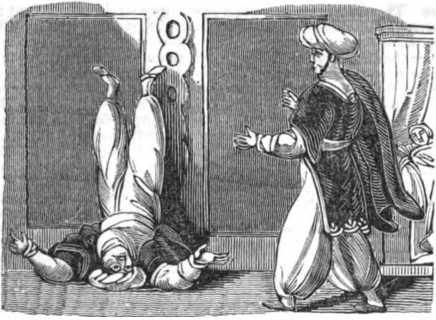
Schemseddin Mohammed went out to seek him, but instead of seeing him was mightily surprised to find hump-back with his head on the ground, and his heels uppermost, as the genie had set him against the wall. What is the meaning of this? said he; who placed you thus? Crook-back, knowing it to be the vizier, answered, Alas! alas! it is you then that would marry me to the mistress of a buffalo, the sweetheart of an ugly genie; I won’t be your fool; you shan’t put a trick upon me.
Schemseddin Mohammed, when he heard hump-back speak thus, thought he was raving, and bid him move, and stand upon his legs. I will take care how I do that, said hump-back, unless the sun be risen. —Know, sir, that when I came hither last night, on a sudden, a black cat appeared to me, and in an instant grew as big as a buffalo. I have not forgot what he said to me; therefore, you may go about your business, and leave me here. The vizier, instead of going away, took him by the heels, and made him get up. Then hump-back ran off as fast as he could, without looking behind him; and coming to the palace, presented himself to the sultan, who laughed heartily when he told him the story how the genie had served him.
Schemseddin Mohammed returned to his daughter’s chamber more astonished than before. Well, then, my abused daughter, said he, can you give me no farther light into this matter? —Sir, said she, I can give you no other account than what I have done already. Here are my husband’s clothes, which he left upon the chair; perhaps you may find somewhat there, that may solve your doubt. Then she showed him Bedreddin’s turban, which he took and examined narrowly on all sides. I should take this to be a vizier’s turban, if it were not made after the Moussoul [61] fashion. But perceiving somewhat to be sewed between the stuff and the lining, he called for scissors, and having unript it, found the paper which Nourreddin Ali gave Bedreddin, his son, as he was dying, and which he had put into his turban for more security.
Schemseddin Mohammed having opened the paper, knew his brother Nourreddin’s hand, and found this superscription, ‘For my son, Bedreddin Hassan.’ Before he could make any reflections upon it, his daughter delivered him the bag that lay under his clothes, which he likewise opened, and found it full of sequins; for, as I told you before, notwithstanding all the liberality of Bedreddin, it was still kept full by the genie and fairy. He read these following words upon a note in the bag: ‘A thousand sequins belonging to Isaac the Jew.’ And these lines underneath, which the Jew wrote before he parted from Bedreddin Hassan. ‘Delivered to Bedreddin Hassan, for the cargo of the first of those ships that formerly belonged to Nourreddin Ali, his father, of worthy memory, sold unto me upon its arrival in this place.’ He had scarce read these words, when he gave a shout, and fainted away.
The vizier, Schemseddin Mohammed, being recovered from his fit by the help of his daughter, and the woman she called to her assistance. Daughter, said he, do not frighten yourself at this accident; the reason of it is such as you can scarcely believe. Your bridegroom is your cousin, the son of Nourreddin Ali. The thousand sequins in the bag puts me in mind of a quarrel I had with my dear brother; it is, without doubt, the dowry he gives you. God be praised for all things, and particularly for this miraculous adventure, which demonstrates his almighty power. Then looking again upon his brother’s writing, he kissed it several times, shedding abundance of tears.
He looked over the book from one end to the other, where he found the date of his brother’s arrival at Balsora, of his marriage, and of the birth of Bedreddin Hassan; and when he compared the same with the day of his own marriage, and the birth of his daughter at Cairo, he admired how every thing did agree so exactly.
The happy discovery put him into such a transport of joy, that he took up the book, with the ticket of the bag, and showed it to the sultan, who pardoned what was past, and was so much pleased with the relation of this adventure, that he caused it, with all its circumstances, to be put in writing for the use of posterity.
Meanwhile, the vizier Schemseddin Mohammed could not comprehend the reason why his nephew did not appear; he expected him every moment, and was impatient to have him in his arms. After he had expected him seven days in vain, he searched for him through all Cairo, but could hear no news of him, which perplexed him very much. This is the strangest adventure, said he, that ever man met with, and not knowing what alteration might happen, he thought fit to draw up in writing with his own hand, after what manner the wedding had been solemnized; how the hall and his daughter’s bed-chamber were furnished, and other circumstances. He likewise made the turban, the bag, and the rest of Bedreddin’s things, into a bundle, and locked them up.
After some days were past, the vizier’s daughter perceived herself with child, and was brought to bed of a son after nine months. A nurse was provided for the child, besides other women and slaves to wait upon him; and his grandfather called him Agib. [62]
When young Agib had attained the age of seven, the vizier, instead of teaching him to read at home, put him to school with a master, who was in great esteem; and two slaves were ordered to wait upon him. Agib used to play with his schoolfellows, and as they were all inferior to him in quality, they showed him great respect, according to the example of their master, who many times would pass by faults in him, that he would not pass by in the rest. This complaisance spoiled Agib, so that he became proud and insolent, would have his playfellows bear all from him, and would bear nothing from them, but be master every where; and if any one took the liberty to thwart him, he would call them a thousand names, and many times beat them.
In short, all the scholars were weary of his company, and complained of him to their master. He answered, that they must have patience. But when he saw that Agib still grew more and more insolent, and occasioned him a great deal of trouble, Children, said he to his scholars, I find Agib is a little insolent gentleman; I will show you a way how to mortify him, so as he shall never torment you any more: nay, I believe it will make him leave the school. When he comes again to-morrow, and that you have a mind to play together, set yourselves round him, and do one of you call out, Come, let us play, but upon condition, that they who desire to play shall tell his own name, and the names of his father and mother, and they who refuse it shall be esteemed bastards, and not suffered to play in our company.
Next day, when they were gathered together, they failed not to follow their master’s instructions; they placed themselves round Agib, and one of them called out, Let us begin a play, but on condition, that he who cannot tell his own name, and that of his father and mother, shall not play at all. They all cried out, and so did Agib, We consent to it. Then he that spoke first asked every one the question, and all fulfilled the condition except Agib, who answered, my name is Agib; my mother is called the lady of beauty, and my father Schemseddin Mohammed, vizier to the sultan.
At these words all the children cried out, Agib, what did you say? That is not the name of your father, but your grandfather. A curse on you, said he in a passion; what! dare you say that the vizier Schemseddin Mohammed is not my father? No, no, cried they, with great laughter, he is but your grandfather, and you shall not play with us. Nay, we will take care how we come into your company. Having spoken thus, they all left him, scoffing him, and laughing among themselves, which mortified Agib so much that he wept.
This schoolmaster, who was near, and heard all that passed, came just at the nick of time, and speaking to Agib, said he, Agib, do not you know that the vizier Schemseddin Mohammed is none of your father, but your grandfather, and the father of your mother, the lady of beauty? We know not the name of your father no more than you do. We only know that the sultan was going to marry your mother to one of his grooms, a hump-back fellow; but a genie lay with her. This is hard upon you, and ought to teach you to treat your schoolfellows with less haughtiness than you have done hitherto.
Little Agib being nettled at this, ran hastily out of the school, and went home crying. He came straight to his mother’s chamber, who being alarmed to see him thus grieved, asked him the reason. He could not answer for tears, his grief was so great; and it was but now and then he could speak plain enough to repeat what had been said to him, and occasioned his sorrow.
When he came to himself, Mother, said he, for the love of God be pleased to tell me who is my father. My son, said she, Schemseddin Mohammed, that every day makes so much of you, is your father. You do not tell me truth, said he; he is your father, and none of mine. But whose son am I? At this question, the lady of beauty calling to mind her wedding-night, which had been succeeded by a long widowhood, began to shed tears, repining bitterly at the loss of so lovely a husband as Bedreddin.
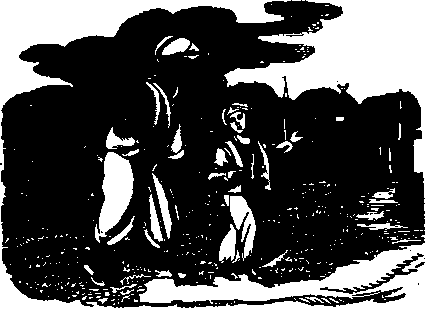
Whilst the lady of beauty and Agib were both weeping, in comes the vizier, who demanded the reason of their sorrow. The lady told him the shame Agib had undergone at school, which so much affected the vizier, that he joined his tears with theirs, and judging from this, that the misfortune which had happened to his daughter was the common discourse of the town, he was quite out of patience.
Being thus afflicted, he went to the sultan’s palace, and falling prostrate at his feet, most humbly prayed him to give him leave to make a journey into the provinces of the Levant, and particularly to Balsora, in search of his nephew Bedreddin Hassan. For he could not bear any longer that the people of the city should believe a genie had got his daughter with child.
The sultan was much concerned at the vizier’s affliction, approved his resolution, and gave him leave to go. He caused a passport also to be written for him, praying, in the most obliging terms that could be, all kings and princes, in whose dominions the said Bedreddin might sojourn, to grant that the vizier might bring him along with him.
Schemseddin Mohammed, not knowing how to express his thankfulness to the sultan for this favour, thought it his duty to fall down before him a second time, and the floods of tears he shed gave him sufficient testimony of his gratitude. At last, having wished the sultan all manner of prosperity, he took his leave, and went home to his house, where he disposed every thing for his journey; and the preparations for it were carried on with so much diligence, that in four days after he left the city, accompanied by his daughter the lady of beauty, and his grandson, Agib.
They travelled nineteen days without stopping any where; but on the twentieth, arriving in a very pleasant mead, at a small distance from the gate of Damascus, they stopped there, and pitched their tents upon the banks of a river, that runs through the town, and gives a very agreeable prospect to its neighbourhood.
The vizier Schemseddin Mohammed declared he would stay in that pleasant place two days, and pursue his journey on the third. In the mean time he gave leave to his retinue to go to Damascus: and almost all of them made use of it: some influenced by curiosity to see a city they had heard so much of, and others by the opportunity of vending there the Egyptian goods they had brought with them, or buying stuffs, and the rarities of the country. The beautiful lady desiring her son Agib might share in the satisfaction of viewing that celebrated city, ordered the black eunuch that acted in quality of his governor, to conduct him thither, and take care he came to no harm.
Agib, in magnificent apparel, went along with the eunuch, who had a large cane in his hand. They had no sooner entered the city, than Agib, fair and glorious as the day, attracted the eyes of the people. Some got out of their houses to gain a nearer and narrower view of him; others put their heads out of the windows, and those who passed along the street were not satisfied in stopping to look upon him; but kept pace with him, to prolong the pleasure of the agreeable sight: in fine, there was nobody that did not admire him, and bestow a thousand benedictions on the father and mother that had given being to so fine a child. By chance the eunuch and he passed by the shop where Bedreddin Hassan was, and there the crowd was so great, that they were forced to halt.
The pastrycook, that had adopted Bedreddin Hassan, had died some years before, and left him his shop and all his estates. So Bedreddin became master of the shop, and managed the pastry trade so dexterously, that he gained great reputation in Damascus. Bedreddin seeing so great a crowd before his door, that were gazing so attentively upon Agib, and the black eunuch, stepped out to see them himself; and having cast his eyes particularly upon Agib, presently found himself moved, he knew not how, nor why. He was not struck, like the people, with the brilliant beauty of the boy: another cause, unknown to him, gave rise to the uneasiness and emotion he felt. It was the force of blood that wrought in this tender father; who laying aside his business, made up to Agib, and with an engaging air, said to him: My little lord, who hast won my soul, be so kind as to come into my shop, and eat a bit of such fare as I have; that I may have the pleasure of admiring you at my ease. These words he pronounced with such tenderness, that tears trickled from his eyes. Little Agib was moved when he saw it, and turning to the eunuch, This honest man, said he, has a face that pleases me; he speaks in such an affectionate manner, that I cannot avoid complying with his request; let us step into his house and taste his pastry. It would be a fine thing truly, replied the slave, to see the son of a vizier, like you, go into a pastrycook’s shop to eat; do not imagine that I will suffer any such thing. —Alas! my little lord, cried Bedreddin, it is a great piece of cruelty to trust the conduct of you in the hands of a person who treats you so harshly. Then applying himself to the eunuch, My good friend, continued he, pray do not hinder this young lord from granting me the favour I ask; do not put that piece of mortification upon me: rather do me the honour to walk in along with him, and by so doing, you will let the world know, that, though your outside is brown like a chestnut, your inside is as white. Do you know, continued he, that I am master of the secret to make you white, instead of being black as you are? This set the eunuch a laughing, and then he asked Bedreddin what that secret was. I will tell you, replied Bedreddin, and so he repeated some verses in praise of black eunuchs, implying, that it was by their ministry that the honour of princes and of all great men was secured. The eunuch was so charmed with these verses, that, without further hesitation, he suffered Agib to go into the shop, and went in with him himself.
Bedreddin Hassan was overjoyed in having obtained what he had so passionately desired, and falling again to the work he had thus discontinued, I was making, said he, cream-tarts; and you must, with submission, eat of them. I am persuaded you will find them very good; for my own mother, who makes them incomparably well, taught me to make them, and the people send to buy them of me from all quarters of the town. This said, he took a cream tart out of the oven, and after strewing upon it some pomegranate kernels and sugar, set it before Agib, who found it very delicious.
Another was served up to the eunuch, and he gave the same judgment.
While they were both eating, Bedreddin Hassan minded Agib very attentively; and after looking upon him again and again, it came into his mind, that for any thing he knew, he might have such a son by his charming wife, from whom he had been so soon and so cruelly separated; and the very thought drew tears from his eyes. He was thinking to have put some question to little Agib about his journey to Damascus; but the child had no time to gratify his curiosity, for the eunuch pressing him to return to his grandfather’s tents, took him away as soon as he had done eating. Bedreddin Hassan, not contented with looking after him, shut up his shop immediately, and went after him.
Bedreddin Hassan ran after Agib and the eunuch, and overtook them before they were got to the gate of the city. The eunuch perceiving he followed them was extremely surprised. You impertinent fellow, you, said he, with an angry tone, what do you want? My dear friend, replied Bedreddin, do not you trouble yourself. I have a little business out of town, that is just come into my head, and I must needs go and look after it. This answer, however, did not at all satisfy the eunuch, who, turning to Agib, said, This is all owing to you; I foresaw I should repent of my complaisance; you would needs go into the man’s shop —it was not wisely done in me to give you leave. Perhaps, replied Agib, he has real business out of town, and the road is free to every body. While this passed, they kept walking together, without looking behind them, till they came near the vizier’s tents, upon which they turned about to see if Bedreddin followed them. Agib, perceiving he was within two paces of him, reddened and whitened alternately, according to the different emotions that affected him. He was afraid the grand vizier, his grandfather, should come to know he had been in the pastry shop, and had eaten there. In this dread, he took up a pretty large stone that lay at his foot, and throwing it at Bedreddin Hassan, hit him in the forehead, which gave him such a wound, that his face was covered with blood. Then he took to his heels, and ran under the eunuch’s tent. The eunuch gave Bedreddin to understand, he had no reason to complain of a mischance that he had merited and brought upon himself.
Bedreddin turned towards the city, stanching the blood of this wound with his apron, which he had not put off. I was a fool, said he within himself, for leaving my house, to take so much pains about this brat; for doubtless he would never have used me after this manner, if he had not thought I had some ill design against him. When he got home, he had his wound dressed, and softened the sense of his mischance by the reflection, that there was an infinite number of people upon the earth that were yet more unfortunate than he.
Bedreddin kept on the pastry trade at Damascus, and his uncle, Schemseddin Mohammed, went from thence three days after his arrival. He went by way of Emaus, Hanah, and Halep; then crossed the Euphrates, and, after passing through Mardin, Moussoul, Singier, Diarbeker, and several other towns, arrived at last at Balsora; and immediately after his arrival, desired audience of the sultan, who was no sooner informed of Schemseddin’s quality than he gave him audience, received him very favourably, and asked him the occasion of his journey to Balsora. Sir, replied the vizier Schemseddin Mohammed, I come to know what is become of the son of Nourreddin Ali, my brother, who has had the honour to serve your majesty. Nourreddin Ali, said the sultan, has been dead a long while; as for his son, all I can tell you of him is, that he disappeared all on a sudden, about two months after his father’s death, and nobody has seen him since, notwithstanding all the inquiry I ordered to be made. But his mother, who is daughter of one of my vizier’s, is still alive. Schemseddin Mohammed desired leave of the sultan to see her, and carry her to Egypt; and having obtained his request, without tarrying till the next day for the satisfaction of seeing her, inquired after her place of abode, and that very hour went to her house, accompanied with his daughter and his grandson.
The widow of Nourreddin Ali lived still in the same place where her husband had lived. It was a fine stately house, adorned with marble pillars; but Schemseddin did not stop to view it. At his entry, he kissed the gate, and the piece of marble upon which his brother’s name was written in letters of gold. He asked to speak with his sister-in-law, and was told by her servants that she was in a small building in form of a dome, which they showed to him, in the middle of a very spacious court. This tender mother used to spend the greatest part of the day and night in that room, which she had built for a representation of the tomb of Bedreddin Hassan, whom she took to be dead after so long absence. At that very minute she was pouring tears over the thoughts of that dear child, and Schemseddin Mohammed entering, found her buried in the deepest affliction.
He made his compliment, and after beseeching her to suspend her tears and sighs, informed her, he had the honour to be her brother-in-law, and acquainted her with the reason of his journey from Cairo to Balsora. He also acquainted his sister-in-law with all that had passed at Cairo on his daughter’s wedding night, and after informing her of the surprise occasioned by the discovery of the paper sewed up in Bedreddin’s turban, presented to her Agib and the beautiful Lady.
The widow of Nourreddin Ali, who had still continued sitting like a woman dejected and weaned from the affairs of this world, no sooner understood by his discourse that her dear son, whom she lamented so bitterly, might still be alive, than she arose, and repeatedly embraced the beautiful lady and her grandchild, Agib, and perceiving in the youth the features of Bedreddin, shed tears of a quite different stamp from what she had been so long accustomed to shed. She could not forbear kissing the youth, who, for his part, received her embraces with all the demonstrations of joy he was capable of. Madam, said Schemseddin Mohammed, it is time to wipe off your tears, and cease your groans; you must think of going along with us to Egypt. The sultan of Balsora gives me leave to carry you thither, and I doubt not you will agree to it. I am in hopes we shall at last find out your son, my nephew; and if that comes to pass, the history of him, of you, of my own daughter, and of my own adventures, will deserve to be committed to writing, and transmitted to posterity.
The widow of Nourreddin Ali heard this proposal with pleasure, and from that minute, ordered preparations to be made for her departure. While that was doing, Schemseddin Mohammed desired a second audience; and after taking leave of the sultan, who dismissed him with ample marks of respect, and gave him a considerable present for himself and another of great value for the sultan of Egypt, set out from Balsora for the city of Damascus.
When he arrived in the neighbourhood of Damascus, he ordered his tents to be pitched without the gate, at which he designed to enter the city; and gave out he would tarry there three days, to give his suite rest, and buy up the best curiosities he could meet with, and such as were worthy of being presented to the sultan of Egypt.
While he was employed in looking upon and picking out the finest stuffs that the principal merchants had brought to his tents, Agib begged the black eunuch, his governor, to carry him through the city, in order to see what he had not leisure to view as he passed before, and to know what was become of the pastry cook that he had wounded with a stone. The eunuch complying with his request, went along with him towards the city, after leave obtained of the beautiful lady his mother.
They entered Damascus by the Paradise gate, which lay next to the tents of the vizier Schemseddin Mohammed. —They walked through the great squares and the public places where the richest goods were sold, and took a view of the ancient mosque of the Ommiadæ, [63] at the hour of prayer, between noon and sunset. [64] After that they passed by the shop of Bedreddin Hassan, whom they found still employed in making cream tarts. I salute you, sir, said Agib. Do you know me? do you remember you ever saw me before? Bedreddin, hearing these words, cast his eyes upon him, and knowing him, (such was the surprising effect of paternal love!) felt the same emotion as when he saw him first of all. He was confused, and, instead of making an answer, continued a long time without uttering one word. But after all, recovering himself, My little lord, said he, be so kind as to come once more with your governor into my house, and taste a cream tart, I beg your lordship’s pardon for the trouble I gave you in following you out of town; I was at that time not myself, I did not know what I did. You drew me after you, and the violence of the attraction was so strong, that I could not withstand it.
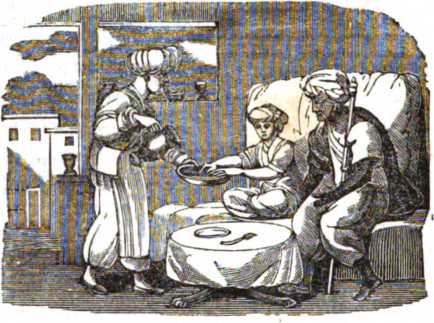
Agib, astonished at what Bedreddin said, replied thus: There is an excess in the kindness you express, and unless you engage, under oath, not to follow me when I go from hence, I will not enter into your house. If you give me your promise, and prove a man of your word, I will visit you again to-morrow, since the vizier, my grandfather, is still employed in buying up things for a present to the sultan of Egypt. My little lord, replied Bedreddin, I will do whatever you would have me to do. This said, Agib and the eunuch went into the shop.
Presently after, Bedreddin set before them a cream tart that was full as good as what they had eaten of when they saw him before. Come, said Agib, addressing himself to Bedreddin, sit down by me, and eat with us. Bedreddin sat down, and made offers to embrace Agib, as a testimony of the joy he conceived upon his sitting by him. But Agib shoved him off, desiring him to be quiet, not to be too familiar in his friendship, and to content himself with seeing and conversing with him. Bedreddin obeyed, and fell to singing a song, the words of which he composed off-hand, in praise of Agib. He did not eat, but made it his business to serve his guests. When they had done eating, he brought them water to wash with, [65] and a very white napkin to wipe their hands. Then he filled a large china cup with sherbet, and put snow into it; [66] and offering it to Agib, This, said he, is sherbet of roses, and the pleasantest you will meet with all the town over; I am sure you never tasted better. Agib having drank of it with pleasure, Bedreddin Hassan took the cup from him, and presented it to the eunuch, who drank it all off at once.
In fine, Agib and his governor having fared well, returned thanks to the pastrycook for their good entertainment, and moved homewards, it being then late. When they arrived at the tents of Schemseddin Mohammed, they repaired immediately to the lady’s tent. Agib’s grandmother received him with transports of joy: her son, Bedreddin, ran always in her mind, and in embracing Agib, the remembrance of him drew tears from her eyes. Ah! my child said she, my joy would be perfect if I had the pleasure of embracing your father, Bedreddin Hassan, as I now embrace you. Then sitting down to supper, she made Agib sit by her, and put several questions to him, relating to the walk he had been taking along with the eunuch; and when he complained of his weak stomach, she gave him a piece of cream tart, which she had made for herself, and was indeed very good, for I told you before that she could make them better than the best pastry cooks. She likewise gave some to the eunuch; but both of them had eaten so heartily at Bedreddin’s house, that they could not taste a bit.
Agib no sooner touched the piece of cream tart that had been set before him, than he pretended he did not like it, and left it uncut; and Schaban, [67] (such was the eunuch’s name,) did the same thing. The widow of Nourreddin Ali observed with regret that her grandson did not like the tart. What! said she, does my child thus despise the work of my hands! Be it known to you, no one in the world can make such cream tarts besides myself and your father, Bedreddin Hassan, whom I myself taught to make them. My good mother, replied Agib, give me leave to tell you, if you do not know how to make better, there is a pastry-cook in this town that out-does you in that point. We were at his shop but now, and eat of one that is much better than yours.
This said, the grandmother, frowning upon the eunuch, How now, Schaban, said she, was the care of my grandchild committed to you, to carry him to eat at pastry-shops like a beggar? Madam, replied the eunuch, it is true, we did stop a little while and talked with the pastry-cook, but we did not eat with him. Pardon me, said Agib, we went into his shop, and there eat a cream tart. Upon this, the lady more incensed against the eunuch than before, rose in a passion from the table, and running to the tent of Schemseddin Mohammed, informed him of the eunuch’s crime, and that in such terms, as tended more to inflame the vizier, than to dispose him to excuse it.
Schemseddin Mohammed, who was naturally passionate, did not fail, on this occasion, to display his anger. He went forthwith to his sister-in-law’s tent, and making up to the eunuch, What! said he, you pitiful wretch, have you the impudence to abuse the trust I repose in you? Schaban, though sufficiently convicted by Agib’s testimony, denied the fact still. But the child persisting in what he had affirmed, Grandfather, said he, I can assure you we not only eat, but we eat both of us so heartily, that we have no occasion for supper; besides, the pastry-cook treated us also with a great bowl of sherbet. Well, cried Schemseddin, turning to Schaban, after all this, will you continue to deny that you entered the pastry-cook’s house, and eat there? Schaban had still the impudence to swear it was not true. Then you are a liar, said the vizier, I believe my grandchild before I believe you; but after all, said he, if you can eat up this cream tart that is upon the table, I shall be persuaded you have truth on your side.
Though Schaban had crammed himself up to the throat before, he agreed to stand that test, and accordingly took a piece of tart; but his stomach rising against it, he was obliged to spit it out of his mouth. Yet he still pursued the lie, and pretended he had over-eat himself the day before, so that he had not recovered his appetite. The vizier, irritated with all the eunuch’s frivolous pretences, and convinced of his guilt, ordered him to lie flat upon the ground, and to be soundly bastinadoed. In undergoing this punishment, the poor wretch shrieked out aloud, and at last, confessed the truth. I own, cries he, that we did eat a cream tart at the pastry-cook’s, and that it was much better than that upon the table.
The widow of Nourreddin Ali thought it was out of spite to her, and with a design to mortify her, that Schaban commended the pastry-cook’s tart: and accordingly said, I cannot believe the cook’s tarts are better than mine: I am resolved to satisfy myself upon that head. Where does he live? Go immediately, and buy me one of his tarts.
The eunuch having received of her what money was sufficient for that purpose, repaired to Bedreddin’s shop, and addressing himself to Bedreddin, Good Mr. Pastry-cook, said he, take this money here, and let me have one of your cream tarts; one of our ladies wants to taste them. Bedreddin chose one of the best, and gave it to the eunuch: Take this, said he; I will engage it is an excellent one, and I can assure you that no person is able to make the like, unless it be my mother, who perhaps is still alive.
Schaban returned speedily to the tents, and gave the tart to Nourreddin’s widow, and she, snatching it greedily, broke a piece off; but no sooner put it to her mouth, than she cried out, and swooned away. Schemseddin Mohammed, who was present, was extremely surprised at the accident: he threw water himself upon her face, and was very active in succouring her. As soon as she came to herself, My God! cried she, it must needs be my dear son, my dear Bedreddin, that made this tart.
When the vizier Schemseddin Mohammed heard his sister-in-law say, that the maker of the tart, brought by the eunuch, must needs be Bedreddin Hassan, he was overjoyed; but reflecting that his joy might prove groundless, and in all likelihood the conjecture of Nourreddin’s widow was false, Madam, said he, why are you of that mind? Do you think there may not be a pastrycook in the whole world, that knows how to make cream tarts as well us your son? —I own, replied she, there may be pastrycooks that can make as good tarts as he; but forasmuch as I make them after a peculiar manner, and nobody but my son is let into the secret, it must absolutely be he that made this. Come, my brother, added she, in a transport, let us call up mirth and joy; we have at last found what we have been so long looking for. —Madam, said the vizier in answer, I entreat you to moderate your impatience, for we shall quickly know the bottom of it. All we have to do, is to bring the pastrycook hither; and then you and my daughter will readily distinguish whether it is Bedreddin or not. But you must both be hid, so as to have a view of Bedreddin, while he cannot see you; for I would not have our interview and mutual discovery laid at Damascus. My design is to delay the discovery till we return to Cairo, where I promise to regale you with very agreeable diversion.
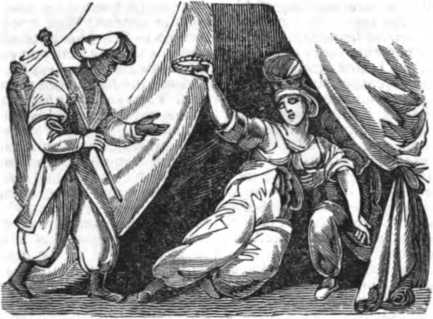
This said, he left the ladies in their tent, and retired to his own; where he called for fifty of his men, and said to them, Take each of you a stick in your hands, and follow Schaban, who will conduct you to a pastrycook’s in this city. When you arrive there, break and dash in pieces all you find in the shop: if he asks you why you commit that disorder, only ask him again if it was not he that made the cream tart, that was brought from his house. If he says he is the man, seize his person, fetter him, and bring him along with you; but take care you do not beat him, nor do him the least harm. Go, and lose no time.
The vizier’s orders were immediately executed. The detachment conducted by the black eunuch, went with expedition to Bedreddin’s house, and broke in pieces the plates, kettles, copper-pans, tables, and all the other moveables and utensils they met with, and drowned the sherbet-shop with cream and comfits. Bedreddin, astonished at the sight, said with a pitiful tone, Pray, good people, why do you serve me so? What is the matter? What have I done? Was it not you, said they, that sold this eunuch the cream tart? —Yes, replied he, I am the man: and who says any thing against it? I defy any one to make a better. Instead of giving him an answer, they continued to break all around them, and the oven itself was not spared.
In the mean time the neighbours took the alarm, and surprised to see fifty armed men commit such a disorder, asked the reason of such violence; and Bedreddin said once more to the actors of it, Pray tell me what crime I am guilty of, to have deserved this usage? —Was it not you, replied they, that made the cream tart you sold to the eunuch? —Yes, yes, it is I, replied he; I maintain it is a good one. I do not deserve such usage as you give me. However, without listening to him, they seized his person, and snatching the cloth off his turban, tied his hands with it behind his back, and, after dragging him by force out of his shop, marched off.
The mob gathering, and taking compassion for Bedreddin, took his part, and offered opposition to Schemseddin’s men; but that very minute up came some officers from the governor of the city, who dispersed the people, and favoured the carrying off of Bedreddin; for Schemseddin Mohammed had in the mean time gone to the governor’s house to acquaint him with what order he had given, and to demand the interposition of force to favour the execution; and the governor, who commanded all Syria in the name of the sultan of Egypt, was unwilling to refuse any thing to his master’s vizier. So Bedreddin was carried off, after all his cries and tears.
It was needless for Bedreddin Hassan to ask by the way those who carried him off, what fault had been found with his cream tart; they gave him no answer. In short, they carried him to the tents, and made him stay there till Schemseddin Mohammed returned from the governor of Damascus’s house.
Upon the vizier’s return, Bedreddin Hassan was brought before him. My lord, said Bedreddin, with tears in his eyes, pray do me the favour to let me know wherein I have displeased you. —Why, you wretch you, said the vizier, was it not you that made the cream tart you sent me? —I own I am the man, replied Bedreddin; but pray what crime is that? —I will punish you according to your deserts, said Schemseddin; it shall cost you your life, for sending me such a sorry tart. —Good God! cried Bedreddin, what news is this! Is it a capital crime to make a bad cream tart? —Yes, said the vizier, and you are to expect no other usage from me.
While this interview lasted, the ladies, who were hid, minded Bedreddin narrowly, and readily knew him, notwithstanding he had been so long absent. They were so transported with joy, that they swooned away; and, when they recovered, would fain have ran up and fallen upon Bedreddin’s neck; but the promise they had made to the vizier of not discovering themselves, restrained the tender emotions of love and of nature.
Schemseddin Mohammed, having resolved to set out that very night, ordered the tents to be struck, and the necessary preparations to be made for his journey. And as for Bedreddin, he ordered him to be clapped into a chest or box well locked, and laid on a camel. When every thing was got ready, the vizier and his retinue began their march, and travelled the rest of that night, and all the next day, without stopping. In the evening they halted, and Bedreddin was taken out of his cage, in order to be served with the necessary refreshments, but still carefully kept at a distance from his mother and his wife; and during the whole expedition, which lasted twenty days, was served in the same manner.
When they arrived at Cairo, they encamped in the neighbourhood of that place. Schemseddin called for Bedreddin, gave orders, in his presence, to a carpenter to get some wood with all expedition, and make a stake. Heyday, said Bedreddin, what do you mean to do with a stake? —Why to nail you to it, replied Schemseddin, then to have you carried through all the quarters of the town, that the people may have the spectacle of a worthless pastrycook, who makes cream tarts without pepper. This said, Bedreddin cried out so comically, that Schemseddin had enough to do to keep his countenance. Good God! cried he, must I suffer a death, as cruel as it is ignominious, for not putting pepper in a cream tart? and must I be rifled, and have all the goods in my house broken to pieces? Must I be imprisoned in a chest, and at last nailed to a stake, and all for not putting pepper in a cream tart? Good God! who ever heard of such a thing? Are these the actions of Mussulmen, of persons that make a profession of probity and justice, and practise all manner of good works? —With these words, he shed tears, and then renewing his complaint; No, continued he, never was man used so unjustly, nor so severely. Is it possible they should be capable of taking a man’s life for not putting pepper in a cream tart? Cursed be all cream tarts, as well as the hour in which I was born! —Would to God I had died that minute!
Disconsolate Bedreddin did not cease his lamentations; and when the stake was brought, and the nails to fasten him to it, he cried out bitterly at the horrid sight. Heaven! said he, can you suffer me to die an ignominious and painful death? And all this, for what crime? not for robbery or murder, or renouncing my religion, but for not putting pepper in a cream tart.
Night being then pretty far advanced, the vizier Schemseddin Mohammed ordered Bedreddin to be clapped up again in his cage, saying to him, Stay there till to-morrow; the day shall not be spent before I give orders for your death. Then the chest or cage was carried away and laid upon the camel that had brought it from Damascus: at the same time, all the other camels were loaded again; and the vizier mounting his horse, ordered the camel that carried his nephew to march before him, and so entered the city with all his suite. After passing through several streets, where nobody appeared, every one being in bed, he arrived at his house, where he ordered the chest to be taken down, but not opened till farther orders.
While his retinue were unlading the other camels, he took Bedreddin’s mother and his daughter aside, and addressed himself to the latter: God be praised, said he, my child, for this happy occasion of meeting your cousin and your husband. You remember, to be sure, what order your chamber was in on your wedding-night: go and put every thing in the very same order they were then in; and in the mean time, if your memory do not serve you, I can supply it by a written account, which I caused to be taken upon that occasion: as for what else is to be done, I will take care of that.
The beautiful lady went joyfully about her father’s orders; and he at the same time, began to put the things in the hall in the same order they were in when Bedreddin Hassan was there with the sultan of Egypt’s hunch backed groom. As he went over his manuscript, his domestics placed every moveable accordingly. The throne was not forgot, nor the lighted wax candles. When every thing was put to rights in the hall, the vizier went into his daughter’s chamber, and put in their due place Bedreddin’s clothes, with the purse of sequins. This done, he said to the beautiful lady, Undress yourself, my child, and go to bed. As soon as Bedreddin enters your room, complain of his being from you so long, and tell him, that when you awaked you were astonished you did not find him by you. Press him to come to bed again; and to-morrow morning you will divert your mother-in-law and me, in telling us what passes between you and him this night. This said, he went from his daughter’s apartment, and left her to undress herself and go to bed.
Schemseddin Mohammed ordered all his domestics to depart the hall, excepting two or three, whom he ordered to stay there. These he commanded to go and take Bedreddin out of the chest, to strip him to his shirt and drawers, to conduct him in that condition to the hall, to leave him there all alone, and to shut the door upon him.
Bedreddin Hassan, though overwhelmed with grief, had been asleep all the while, insomuch that the vizier’s domestics had taken him out of the chest, and stripped him before he awaked, and carried him so suddenly into the hall, that they did not give him time to bethink himself where he was. When he found himself all alone in the hall, he looked round him, and the objects of his sight recalling to memory the circumstances of his marriage, he perceived, with astonishment, that it was the same hall where he had seen the sultan’s groom of the stables. His surprise was still the greater, when approaching softly to the door of a chamber which he found open, he spied within his own clothes in the same place where he remembered to have left them on his wedding-night. My God! said he, rubbing his eyes, am I asleep or awake?
The beautiful lady, who in the mean time was diverting herself with his astonishment, opened the curtains of her bed all on a sudden, and bending her head forward, My dear lord, said she, with a soft, tender air, what do you do at the door? Prithee come to bed again! You have been out of bed a long time. I was strangely surprised when I awaked in not finding you by me. Bedreddin Hassan’s countenance changed when he perceived that the lady who spoke to him was that charming person that he had lain with before: so he entered the room, but calling up the thoughts of all that had passed for a ten years’ interval, and not being able to persuade himself that it all could have happened in the compass of one night, he went to the place where his clothes lay, and the purse of sequins, and after examining them very carefully, By the living God, cried he, these are things that I can by no means comprehend! The lady, who was pleased to see his confusion, said, once more, My lord, come to bed again; what do you stand at? Then he stepped towards the bed, and said to her, Pray; madam, tell me, is it long since I left you? —The question, answered she, surprises me. Did not you rise from me but now? Sure your thoughts are very busy. —Madam, replied Bedreddin, I do assure you my thoughts are not very composed. I remember indeed to have been with you, but I remember, at the same time, that I have lived since ten years at Damascus. Now, if I was actually in bed with you this night, I cannot have been with you so long. These two things are inconsistent. Pray tell me what I am to think; whether my marriage with you is an illusion, or whether my absence from you is only a dream? —Yes, my lord, cried she, doubtless, you were light-headed when you thought you were at Damascus. Upon this, Bedreddin laughed out heartily, and said, What a comical fancy is this! I assure you, madam, this dream will be very pleasant to you. Do but imagine, if you please, that I was at the gate of Damascus in my shirt and drawers, as I am here now, that I entered the town with a halloo of a mob that followed and insulted me; that I fled to a pastry cook’s, who adopted me, taught me his trade, and left me all he had when he died; that after his death, I kept a shop. In fine, madam, I had an infinity of other adventures too tedious to recount: and all I can say, is, that it was well that I awaked, for they were going to nail me to a stake. —Oh lord! and for what, cried the lady, feigning astonishment, would they have used you so cruelly? Sure you must have committed some enormous crime. —Not in the least, replied Bedreddin; it was for nothing in the world but a mere trifle, the most ridiculous thing you can think of. All the crime I was charged with was selling a cream tart that had no pepper in it. —As for that matter, said the beautiful lady, laughing heartily, I must say they did you great injustice. —Ah! madam, replied he, that was not all. For this cursed cream tart, was every thing in my shop broke to pieces, myself bound and fettered, and flung into a chest, where I lay so close, that methinks I am there still. In fine, a carpenter was sent for, and he was ordered to get ready a stake for me; but thanks be to God, all those things are no more than a dream.
Bedreddin was not easy all night; he waked from time to time, and put the question to himself, whether he dreamed or was awake: he distrusted his felicity, and to be sure whether it was true or not, opened the curtains, and looked round the room. I am not mistaken, sure, said he, this is the same chamber where I entered instead of the hunch-backed groom of the stables, and I am now in bed with the fair lady that was designed for him. Daylight, which then appeared, had not yet dispelled his uneasiness, when the vizier Schemseddin Mohammed, his uncle, knocked at the door, and at the same time went in to bid him good-morrow.
Bedreddin Hassan was extremely surprised to see, all on a sudden, a man that he knew so well, and that now appeared with a quite different air from that with which he pronounced the terrible sentence of death against him. Ah! cried Bedreddin, it was you that condemned me so unjustly, to a kind of death, the thoughts of which make me shudder; and all for a cream tart without pepper. The vizier fell a laughing, and to put him out of suspense, told him, how, by the ministry of a genie, (for hunch-back’s relation made him suspect the adventure,) he had been at his house, and had married his daughter instead of the sultan’s groom of the stables; then he acquainted him, that he had discovered him to be his nephew by a book written by the hand of Nourreddin Ali, and pursuant to that discovery, had gone from Cairo to Balsora in quest of him. My dear nephew, added he, embracing him with every expression of tenderness, I ask your pardon for all I have made you undergo since I discovered you. I had a mind to bring you to my house before I told you your happiness; which ought now to be so much the dearer to you, as it has cost you so much perplexity and affliction. To atone for all your afflictions, comfort yourself with the joy of being in the company of those who ought to be dearest to you. While you are dressing yourself, I will go and acquaint your mother, who is beyond measure impatient to see you: and will likewise bring to you your son, whom you saw at Damascus, and for whom you showed so much affection without knowing him.
No words are of sufficient energy to express the joy of Bedreddin, when he saw his mother and his son. These three embraced and showed all the transports that love and tenderness could inspire. The mother spoke to Bedreddin in the most moving terms; she mentioned the grief she had felt for his long absence, and the tears she had shed. —Little Agib, instead of flying his father’s embraces, as at Damascus, received them with all the marks of pleasure. And Bedreddin Hassan, divided between two objects so worthy of his love, thought he could not give sufficient marks of his affection.
While this passed at Schemseddin Mohammed’s, the vizier was gone to the palace to give the sultan an account of the happy success of his voyage; and the sultan was so charmed with the recital of the story, that he ordered it to be taken down in writing, and carefully preserved among the archives of the kingdom. After Schemseddin’s return to his house, having prepared a noble feast, he sat down to table with his family, and all the household passed the day in festivity and mirth.
The vizier Giafar, having thus made an end of the story of Bedreddin Hassan, told the caliph Haroun Alraschid, that this was what he had to relate to his majesty. The caliph found the story so surprising, that without farther hesitation, he granted his slave Rihan’s pardon; and to condole the young man for the grief of having unhappily deprived himself of a woman whom he loved so tenderly, married him to one of his slaves, bestowed liberal gifts upon him, and maintained him till he died.
The Story of the Little Hunch-back.
There was in former times at Casgar, upon the utmost skirts of Tartary, a tailor, that had a pretty wife, whom he doted on, and was reciprocally loved by her. One day as he sat at work, a little hunch-back came and eat down at the shop-door, and fell to singing and playing upon a tabor. The tailor took pleasure to hear him, and resolved to take him into his house to please his wife. This little fellow, said he to his wife, will divert us both this evening. He invited him in, and the other readily accepted of the invitation; so the tailor shut up his shop, and carried him home. As soon as they came in, the tailor’s wife having before laid the cloth, it being supper time, set before them a good dish of fish; but as the little man was eating, he unluckily swallowed a large bone, of which he died in a few minutes, notwithstanding all that the tailor and his wife could do to prevent it. Both were heartily frightened at the accident, knowing it happened in their house; and there was reason to fear that if the magistrates happened to hear of it they would be punished as murderers. However, the husband found an expedient to get rid of the corpse: he reflected there was a Jewish doctor that lived just by, and having presently contrived a scheme, his wife and he took the corpse, the one by the feet, and the other by the head, and carried it to the physician’s house. They knocked at the door, from which a steep pair of stairs led to his chamber. The servant maid came down without any light, and opening the door, asked what they wanted. Go up again, said the tailor, if you please, and tell your master, we have brought him a man who is very ill, and wants his advice. Here, said he, putting a piece of money into her hand, give him that beforehand, to convince him that we do not mean to impose on him. While the servant was gone up to acquaint her master with the welcome news, the tailor and his wife nimbly conveyed the hunch-backed corpse to the head of the stairs, and leaving it there, hurried away.
In the mean time, the maid told the doctor, that a man and a woman waited for him at the door, desiring he would come down and look at a sick man, whom they had brought with them, and clapping into his hand the money she had received, the doctor was transported with joy: being paid beforehand, he thought it was a good patient, and should not be neglected. Light, light, cried he to the maid; follow me nimbly. So saying, without staying for the light, he gets to the stair-head in such haste, that, stumbling against the corpse, he gave him a kick that made him tumble down to the stair-foot; he had almost fallen himself along with him. A light! a light! cried he to the maid; quick, quick! At last, the maid came with a light, and he went down stairs with her; but when he saw that what he had kicked down was a dead man, he was so frightened, that he invoked Moses, Aaron, Joshua, Esdras, and all the other prophets of the law. Unhappy man that I am! said he, why did I attempt to come down without a light! I have killed the poor fellow that was brought to me to be cured; questionless, I am the cause of his death, and unless Esdras’s ass [68] comes to assist me, I am ruined. Mercy on me! they will be here out of hand, and drag me out of my house for a murderer.
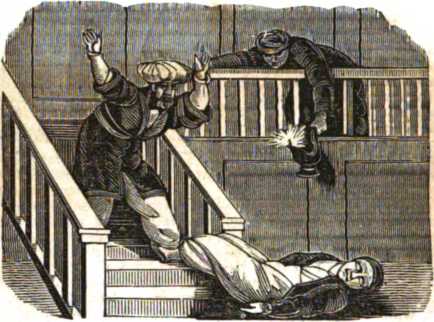
Notwithstanding the perplexity and jeopardy he was in, he had the precaution to shut his door, for fear any one passing by in the street should observe the mischance of which he reckoned himself to be the author. Then he took the corpse into his wife’s chamber, who was ready to swoon at the sight. Alas! cried she, we are utterly ruined and undone, unless we fall upon some expedient to get the corpse out of our house this night. Beyond all question, if we harbour it till morning, our lives must pay for it. What a sad mischance is this! What did you do to kill this man? That is not the question, replied the Jew; our business now is to find out a remedy for such a shocking accident.
The doctor and his wife consulted together how to get rid of his dead corpse that night. The doctor racked his brain in vain, he could not think of any stratagem to get clear; but his wife, who was more fertile in invention, said, I have a thought just come into my head: let us carry the corpse to the leads of our house, and tumble him down the chimney into the house of the Mussulman, our next neighbour.
This Mussulman was one of the sultan’s purveyors for furnishing oil, butter, and all sorts of fat articles, and had a magazine in his house, where the rats and mice made prodigious havoc.
The Jewish doctor approving the proposed expedient, his wife and he took the little hunch-back up to the roof of the house; and, clapping ropes under his arm-pits, let him down the chimney into the purveyor’s chamber so softly and dexterously, that he stood upright against the wall, as if he had been alive. When they found he had reached the bottom, they pulled up the ropes, and left the corpse in that posture. They were scarce got down into their chamber, when the purveyor went into his, being just come from a wedding-feast, with a lantern in his hand. He was greatly surprised when, by the light of his lantern, he descried a man standing upright in his chimney; but being naturally a stout man, and apprehending it was a thief, he took up a good stick, and making straight up to the hunch-back, Ah, said he, I thought it was the rats and mice that eat my butter and tallow, and it is you come down the chimney to rob me! But I think you will not come here again upon this errand. This said, he falls upon the man, and gives him many strokes with his stick. The corpse fell down flat on the ground, and the purveyor redoubled his blows; but, observing the body not to move, he stood to consider a little, and then, perceiving it was a dead corpse, fear succeeded his anger. Wretched man that I am, said he, what have I done! I have killed a man! Alas! I have carried my revenge too far. Good God, unless thou pity me, my life is gone! Cursed, ten thousand times accursed, be the fat and the oil that gave occasion to this my commission of such a criminal action! He stood pale and thunderstruck: he thought he saw the officers already come to drag him to condign punishment, and could not tell what resolution to take.
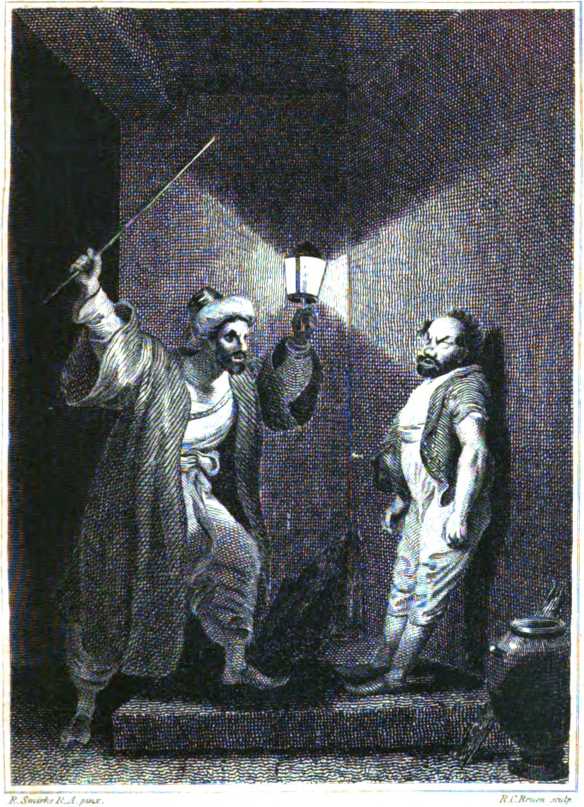
HUNCHBACK AND THE SULTAN’S PURVEYOR.
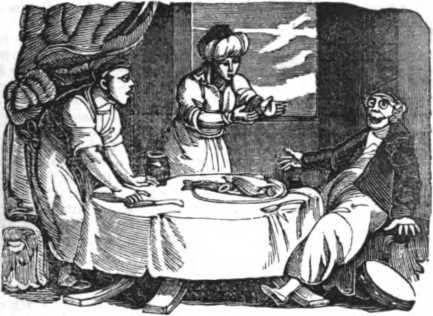
The sultan of Casgar’s purveyor had never noticed the little man’s hump-back when he was beating him; but as soon as he perceived it, he threw out a thousand imprecations against him. Ah, you cursed hunch-back, cried he, you crooked son of a bitch! would to God you had robbed me of all my fat, and I had not found you here! I had not then been so much perplexed for the sake of you and your vile hunch. Oh! ye stars that twinkle in the heavens, give light to none but me in this dangerous juncture. As soon as he had uttered these words, he took the crooked corpse upon his shoulders, and carried him out of doors to the end of the street, where he set him upright, resting against a shop, and so trudged home again, without looking behind him.
A few minutes before the break of day, a Christian merchant, who was very rich, and furnished the sultan’s palace with various articles —this merchant, I say, having sat up all night at a debauch, stepped at that instant out of his house to go to bathe. —Though he was drunk, he was sensible that the night was far spent, and that the people would quickly be called to the morning prayers, at break of day; therefore he quickened his pace to get in time to the bath, for fear any Mussulman meeting him in his way to the mosque should carry him to prison for a drunkard. As he came to the end of the street, he stopped upon some necessary occasion against the shop where the sultan’s purveyor had put the hunch-backed corpse, which being jostled, tumbled upon the merchant’s back. The merchant, thinking it was a robber that came to attack him, knocked him down with a swinging box on the ear, and after redoubling his blows, cried out “thieves.”
The outcry alarmed the watch, who came up immediately; and finding a Christian beating a Mussulman, (for hump-back was of our religion,) What reason have you, said he, to abuse a Mussulman after this rate? He would have robbed me, replied the merchant, and jumped upon my back with intent to take me by the throat. If he did, said the watch, you have revenged yourself sufficiently; come, get off him. At the same time he stretched out his hand to help little hump-back up; but observing he was dead, Oh! said he, is it thus that a Christian dares to assassinate a Mussulman? So saying, he laid hold of the Christian, and carried him to the house of the lieutenant of the police, where he was kept till the judge was stirring, and ready to examine him. In the mean time, the Christian merchant grew sober, and the more he reflected upon his adventure, the less could he conceive how such single blows of his fist could kill the man.
The judge having heard the report of the watch, and viewed the corpse, which they had taken care to bring to his house, interrogated the Christian merchant upon it, and he could not deny the crime, though he had not committed it. But the Judge, considering that little hump-back belonged to the sultan, for he was one of his buffoons, would not put the Christian to death, till he knew the sultan’s pleasure. For this end he went to the palace, and acquainted the sultan with what had happened, and received from the sultan this answer: I have no mercy to show to a Christian that kills a Mussulman; go, do your office. Upon this the judge ordered a gibbet to be erected, and sent criers all over the city to proclaim, that they were about to hang a Christian for killing a Mussulman.
At length the merchant was brought out of jail to the foot of the gallows; and the hangman having put the rope about his neck, was going to give him a swing, when the sultan’s purveyor pushing through the crowd, made up to the gibbet, calling to the hangman to stop, for that the Christian had not committed the murder, but himself had done it. Upon that the officer who attended the execution began to question the purveyor, who told him every circumstance of his killing the little hump-back, and how he conveyed his corpse to the place where the Christian merchant found him. You were about, added he, to put to death an innocent person; for how can he be guilty of the death of a man who was dead before he came at him? It is enough for me to have killed a Mussulman, without loading my conscience with the death of a Christian, who is not guilty.
The sultan of Casgar’s purveyor having publicly charged himself with the death of the little hunch-backed man, the officer could not avoid doing justice to the merchant. Let the Christian go, said he to the executioner, and hang this man in his room, since it appears by his own confession that he is guilty. Thereupon, the hangman released the merchant, and clapped the rope around the purveyor’s neck; but just when he was going to pull him up, he heard the voice of the Jewish doctor, earnestly entreating him to suspend the execution, and make room for him to come to the foot of the gallows.
When he appeared before the judge, My lord, said he, this Mussulman you are going to hang is not guilty; all the guilt lies at my door. Last night, a man and a woman, unknown to me, came to my door with a sick man they had brought along; my maid went and opened it without a light, and received from them a piece of money, with a commission to come and desire me, in their name, to step down, and look at the sick person. While she was delivering her message to me, they conveyed the sick person to the stair-head, and disappeared. I went down without staying till my servant had lighted a candle, and in the dark happened to stumble upon the sick person, and kick him down stairs. At length, I saw he was dead, and that it was the crooked Mussulman, whose death you are now about to avenge. So my wife and I took the corpse, and after conveying it up to the roof of our house, shoved it to the roof of the purveyor, our next neighbour, whom you were going to put to death unjustly, and let it down the chimney into his chamber. The purveyor, finding it in his house, took the little man for a thief; and after beating him, concluded he had killed him; but that it was not so, you will be convinced by this my deposition; so that I am the only author of the murder; —and though it was committed undesignedly, I have resolved to expiate my crime, that I may not have to charge myself with the death of two Mussulmen, and hinder you from executing the sultan’s purveyor, whose innocence I have now revealed. So pray dismiss him, and put me in his place, for I alone am the cause of the death of the little man.
The chief justice being persuaded that the Jewish doctor was the murderer, gave orders to the executioner to seize him, and release the purveyor. Accordingly the doctor was just going to be hung up, when the tailor appeared, crying to the executioner to hold his hand, and make room for him, that he might come and make his confession to the chief judge. Room being made, My lord, said he, you have narrowly escaped taking away the lives of three innocent persons; but if you will have the patience to hear me, I will discover to you the real murderer of the crook-backed man. If his death is to be expiated by another, that must be mine. Yesterday, towards the evening, as I was at work in my shop, and was disposed to be merry, the little hunch-back came to my door half-drunk, and sat down before it. He sung a little, and so I invited him to pass the evening at my house. He accepted of the invitation, and went in with me. We sat down to supper, and I gave him a plate of fish; but in eating, a bone stuck in his throat; and though my wife and I did our utmost to relieve him, he died in a few minutes. His death afflicted us extremely; and for fear of being charged with it, we carried the corpse to the Jewish doctor’s house, and knocked at the door. The maid coming down and opening the door, I desired her to go up again forthwith, and ask her master to come down and give his advice to a sick person that we had brought along with us; and withal, to encourage him, I charged her to give him a piece of money, which I had put into her hand. When she was gone up again, I carried the hunch-back up stairs, and laid him upon the uppermost step, and then my wife and I made the best of our way home. The doctor coming down, made the corpse fall down stairs, and thereupon he took himself to be the author of his death. This being the case, continued he, release the doctor, and let me die in his room.
The chief justice and all the spectators could not sufficiently admire the strange events that ensued upon the death of the little crooked man. Let the Jewish doctor go, said the judge, and hang up the tailor, since he confesses the crime. It is certain, this history is very uncommon, and deserves to be recorded in letters of gold. The executioner having dismissed the doctor, made every thing ready to tie up the tailor.
While the executioner was making ready to hang up the tailor, the sultan of Casgar, wanting the company of his crooked jester, asked where he was; and one of his officers told him, The Hunchback, sir, whom you inquire after, got drunk last night, and contrary to his custom, slipped out of the palace, and went strolling about the city, and this morning was found dead. A man was brought before the chief justice and charged with the murder of him; but when he was going to be hanged, up came a man, and after him another, who took the charge upon themselves, and cleared one another. This lasted some time, and the judge is now examining a third man, who gives himself out for the real author of the murder.
Upon this intelligence, the sultan of Casgar sent an officer to the place of execution. Go, said he, in all haste, and tell the judge to bring the accused persons before me immediately; and, withal, bring the corpse of poor Humpback, that I may see him once more. Accordingly, the officer went, and happened to arrive at the place of execution at the very time that the executioner was going to tie up the tailor. —He cried aloud to the executioner to suspend the execution. The hangman knowing the officer, did not dare to proceed, but untied the tailor; and then the officer acquainted the judge with the sultan’s pleasure. The judge obeyed, and went straight to the palace, accompanied by the tailor, the Jewish doctor, and the Christian merchant; and made four of his men carry the hunch-backed corpse along with him.
When they appeared before the sultan, the judge threw himself at the prince’s feet, and after recovering himself, gave him a faithful relation of what he knew of the story of the hump-backed man. The story appeared so extraordinary to the sultan, that he ordered his own historian to write it down with all its circumstances; then addressing himself to the audience: Did you ever hear, said he, such a surprising event as this, that has happened upon the account of my little crooked buffoon? Then the Christian merchant, after falling down, and touching the earth with his forehead, spoke as follows: Most puissant monarch, said he, I know a story yet more astonishing than that you have now spoken of; if your majesty will give me leave, I will tell it you. The circumstances are such, that nobody can hear them without emotion. —Well, said the sultan, I give you leave; and so the merchant went on as follows:
The Story told by the Christian Merchant.
Sir, before I commence the recital of the story you have permitted me to relate, I beg leave to acquaint you that I have not the honour to be born in any part of your majesty’s empire. I am a stranger, born at Cairo, in Egypt, a Copt by nation, and by religion a Christian. My father was a broker, and got a good estate, which he left me at his death. I followed his example, and took up the same employment; and one day at Cairo, as I was standing in the public inn for the corn merchants, there came up to me a young handsome man, well dressed, and mounted upon an ass. He saluted me, and pulling out a handkerchief, in which he had a sample of sesame, or Turkey corn, asked me what a bushel of such sesame would fetch? I examined the corn that the young man showed me, and told him, it was worth a hundred drachms of silver per bushel. Pray, said he, look out for some merchant to take it at that price, and come to me at the Victory gate, where you will see a khan at a distance from the houses. So saying, he left me the sample, and I showed it to several merchants, who told me, that they would take as much as I could spare at a hundred and ten drachms per bushel, so that I made an account to get ten drachms per bushel for my share. Full of the expectation of this profit, I went to the Victory gate, where I found the young merchant expecting me, and he carried me into his granary, which was full of sesame. He had a hundred and fifty bushels of it, which I measured out, and having carried them off upon asses, sold them for five thousand drachms of silver. Out of this sum, said the young man, there is five hundred drachm; coming to you, at the rate of ten drachms per bushel. This I give to you, and as for the rest which is to come to me, do you take it out of the merchant’s hand, and keep it till I call or send for it, for I have no occasion for it at present. I made answer, it should be ready for him whenever he pleased to call for it; and so, kissing his hand, took leave of him with a grateful sense of his generosity.
A month passed before he came near me; then he asked for his four thousand five hundred drachms of silver. I told him they were ready, and should be told down to him immediately. He was then mounted on his ass, and I desired him to alight, and do me the honour to eat a mouthful with me before he received his money. No, said he, I cannot alight at present; I have urgent business that obliges me to be at a place just by here; but I will return this way, and then take the money, which I desire you would have in readiness. This said, he disappeared, and I still expected his return, but it was a full month before he came again. I thought to myself, the young man has great confidence in me, leaving so great a sum in my hands without knowing me; any other man would have been afraid I should have run away with it. To be short, he came again at the end of the third month, and was still mounted on his ass, but finer dressed than before.
As soon as I saw the young man, I entreated him to alight, and asked him if he would not take his money? There is no hurry, said he, with a pleasant easy air, I know it is in good hands; I will come and take it when my other money is all gone: Adieu, continued he, I will come again towards the latter end of the week. With that, he struck the ass, and was soon out of sight. Well, thought I to myself, he says he will see me towards the latter end of the week, but it is likely I may not see him in a great while; I will go and make the most of his money, and shall get a good profit by it.
And as it happened, I was not out in my conjecture; for it was a full year before I saw my young merchant again. Then he appeared indeed, with richer apparel than before, but seemed to have something on his mind. I asked him to do me the honour to walk into my house. For this time, replied he, I will go in; but upon this condition, that you shall put yourself to no extraordinary charge upon my account. I will do just as you please, said I; only do me the favour to alight and walk in. Accordingly, he complied, and I gave orders for an entertainment; and while that was getting ready, we fell into discourse together. When the entertainment was got ready, we sat down to table. I observed he took the first mouthful with his left hand, and not with the right. I could not tell what to think of it. Said I to myself, ever since I knew this young man, he always appeared very polite; is it possible he can do this out of contempt of me? What can be the matter, that he does not make use of his right hand?
I was very anxious to know, why my guest ate with the left hand. After we had done eating, and every thing was taken away, we sat down upon a sofa, and I presented him with a lozenge by way of dainty, and still he took it with his left hand. Then I said to him, Pardon, sir, the liberty I take, in asking you what reason you have for not making use of your right hand? Perhaps you have some complaint in that hand. Instead of answering, he fetched a deep sigh, and pulling out his right arm, which he had hitherto kept under his garment, showed me, to my great astonishment, that his hand had been cut off. Doubtless, you were alarmed, said he, to see me feed myself with the left hand; but I leave you to judge whether it was in my power to do otherwise. May one ask you, said I, by what mischance it was that you lost your right hand? Upon that, he burst into tears, and after wiping his eyes, gave me the following relation.
You must know, said he, that I am a native of Bagdad, the son of a rich father, the most eminent in that city for quality and for riches. I had scarce launched into the world, when falling into the company of travellers, and hearing their wonderful accounts of Egypt, especially Grand Cairo, I was moved by their discourse, and felt a longing desire to travel. But my father was then alive, and had not given me leave. At length, he died; and being now my own master, I resolved to take a journey to Cairo. I laid out a large sum of money upon several sorts of fine stuffs of Bagdad and Moussoul, and so undertook my journey.
Arriving at Cairo, I went to the khan, called the khan of Mesrour, and there took lodgings, with a warehouse for my bales, which I brought along with me upon camels. This done, I retired to my chamber, to rest myself after the fatigue of my journey, and gave some money to my servants, with orders to go and buy some provisions, and dress them. After I had eaten, I went and saw the castle, some mosques, the public squares, and the other places that were curious.
Next day, I dressed myself, and ordered some of the finest and richest of my bales to be picked out and carried by my slaves to the Circassian bezestein, [69] whither I went myself. I no sooner got there, than I was surrounded with brokers and criers, who had heard of my arrival. I gave patterns of my stuffs to several of the criers, who went and cried them, and showed them all over the bezestein; but none of the merchants offered near so much as they had cost me in prime cost and carriage. This vexed me, and the criers observing I was dissatisfied, If you will take our advice, said they, we will put you in a way to sell your stuffs without loss.
The brokers and the criers having thus promised to put me in a way of losing nothing by my goods, I asked them, what course they would have me take. Divide your goods, said they, among several merchants, and they will sell them by retail; and twice a week, that is, on Mondays and Thursdays, you may receive what money they take. By this means, you will get instead of losing, and the merchants will gain by you; and in the mean while, you will have time to take your pleasure, and walk about the town, or go upon the Nile.
I took their advice, and carried them to my warehouse; from whence I brought all my goods to the bezestein, and there divided them among the merchants whom they represented as most reputable and able to pay; and the merchants gave me a formal receipt before witnesses, stipulating withal, that I should not make any demands upon them for the first month.
Having thus regulated my affairs, my mind was taken up with other things than the ordinary pleasures. I contracted friendship with divers persons almost of the same age with myself, who took care to make the time pass pleasantly. After the first month was expired. I began to visit my merchants twice a week, taking along with me a public officer to inspect their books of sale, and a banker to see they paid me in good money, and to regulate the value of the several species; and so every pay day I had a good sum of money to carry home to my lodging at the khan of Mesrour. I went, nevertheless, on the other days, to pass the morning sometimes at one merchant’s house, and sometimes at another. In short, I diverted myself in conversing with them, and seeing what passed in the bezestein.
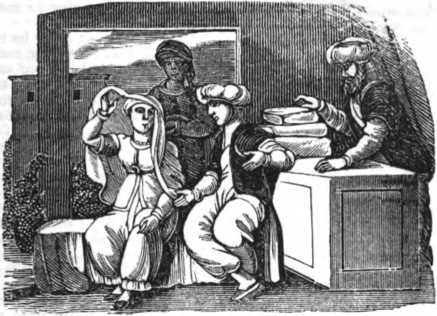
One Monday, as I sat in a merchant’s shop, whose name was Bedreddin, a lady of quality, as one might easily perceive by her air, her habit, and by a well-dressed slave, came into the shop, and sat down by me. Her external appearance, joined to a natural grace that shone in all her actions, prejudiced me in her favour, and inspired me with a longing desire to be better acquainted with her. I know not whether she observed that I took pleasure in gazing upon her, and whether this attention on my part was not agreeable to her; but she let down the crape that hung over the muslin which covered her face, and so gave me the opportunity of seeing her large black eyes, which perfectly charmed me. In fine, she inflamed my love to its height by the agreeable sound of her voice, and her genteel, graceful carriage in saluting the merchant, and asking him how he did since she saw him last.
After conversing with him some time upon indifferent subjects, she gave him to understand that she wanted a sort of stuff with a gold ground; that she came to his shop, as affording the best choice of any in all the bezestein; and that if he had any such as she asked for, he would oblige her in showing them. Bedreddin showed her several pieces, one of which she pitched upon, and he asked for it eleven hundred drachms of silver. I agree, said she, to give you so much, but I have not money enough about me; so I hope you will give me credit till to-morrow, and in the mean time allow me to carry off the stuff. I shall not fail, added she, to send to you to-morrow the eleven hundred drachms I agreed for. Madam, said Bedreddin, I would give you credit with all my heart, and allow you to carry off the stuff if it were mine; but it belongs to the young man you see here, and this is the day on which we settle our accounts. Why, said the lady in surprise, why do you offer to use me so! Am I not a customer to your shop? And as often as I have bought of you, and carried home the things without paying ready money for them, did I ever fail to send you your money next morning? Madam, said the merchant, it is true; but this very day I have occasion for the money. There, said she, throwing the stuff to him, take your stuff; I care not for you nor all the merchants. You are all alike; you respect nobody. This said, she rose up in a passion, and walked out.
When I saw, said the young man, that the lady walked away, I felt a great concern for her; so I called her back, saying, Madam, do me the favour to return; perhaps I can find a way to content you both. She returned, saying, it was for my sake that she complied. Mr. Bedreddin, said I to the merchant, what do you say you must have for this stuff that belongs to me? I must have, said he, eleven hundred drachms; I cannot take less. Give it to the lady then, said I, let her take it home with her; I allow a hundred drachms profit to yourself, and shall now write you a note, empowering you to discount that sum upon the other goods you have of mine. In fine, I wrote, signed, and delivered the note, and then handed the stuff to the lady. Madam, said I, you may take the stuff with you, and as for the money, you may either send it to-morrow or next day; or, if you will, accept the stuff as a present from me. I beg your pardon, sir, said she, I mean no such thing. You treat me with so much civility, that I ought never to show myself in the world again, if I did not show my gratitude to you. May God reward you by an increase of your fortune; may you live many years when I am dead; may the gate of heaven be open to you when you remove to the other world, and may all the city proclaim your generosity.
These words inspired me with some assurance. Madam, said I, I desire no other reward for the service I have done you, than the happiness of seeing your face; that will repay me with interest. I had no sooner spoken than she turned towards me, took off the muslin that covered her face, and discovered to my eyes a wonderful beauty. I was so struck, that I could not express my thoughts to her. I could have looked upon her for ever: but fearing any one should observe her, she quickly covered her face, and letting down the crape, took up the piece of stuff and went away, leaving me in a very different state of mind from what I was in when I came to the shop. I continued for some time in great disorder and perplexity. Before I took leave of the merchant, I asked him if he knew the lady: Yes, said he; she is the daughter of an emir, who left her an immense fortune at his death.
I went back to the khan of Mesrour, and sat down to supper, bat could not eat, neither could I shut my eyes all the night, which seemed the longest night in my life. As soon as it was day I got up, in hopes to see once more the object that disturbed my repose; and to engage her affection, I dressed myself yet more nicely than I had done the day before.
I had but just got to Bedreddin’s shop, when I saw the lady coming in more magnificent apparel than before, and attended by her slave. When she came in, she did not mind the merchant, but addressing herself to me, Sir, said she, you see I am punctual to my word. I am come on purpose to pay the sum you were so kind as to pass your word for yesterday, though you had no knowledge of me. Such uncommon generosity I shall never forget. —Madam, said I, you had no occasion to be so hasty; I was well satisfied as to my money, and am sorry you should put yourself to so much trouble about it. —I had been very unjust, answered she, if I had abused your generosity. With these words she put the money into my hand, and sat down by me.
Having this opportunity of conversing with her, I made the best use of it, and mentioned to her the love I had for her; but she rose and left me very abruptly, as if she had been angry with the declaration I had made. I followed her with my eyes as long as she was in sight, and as soon as she was out of sight, I took leave of the merchant, and walked out of the bezestein, without knowing where I went. I was musing upon this adventure, when I felt somebody pulling me behind, and turning about to see who it was, I had the agreeable surprise to perceive it was the lady’s slave. My mistress, said the slave, I mean the young lady you spoke with but now in the merchant’s shop, wants to speak a word with you if you please to give yourself the trouble to follow me. Accordingly I followed her, and found her mistress sitting waiting for me in a banker’s shop.