ARABIAN NIGHTS’ (continued 10)
Reading edition · Edition 2
The old lady, having talked to me thus, paused, expecting my answer; but though what she had said had made a strong impression upon me, I durst not lay open to her the bottom of my heart: I only turned to her, and fetched a deep sigh, without saying any thing. Is it bashfulness, said she, that keeps you from speaking? or is it want of confidence in me? Do you doubt the effect of my promise? I could mention to you a number of young men of your acquaintance that have been in the same condition with you, and have received relief from me.
The good lady told me so many more circumstances, that I broke silence, declared to her my complaint, pointed out to her the place where I had seen the object which occasioned it, and unravelled all the circumstances of my adventure. If you succeed, said I, and procure me the happiness of seeing that charming beauty, and revealing to her the passion with which I burn for her, you may depend upon it I will be grateful. —My son, said the old woman, I know the lady you speak of; she is, as you rightly judge, the daughter of the first cadi of this city. I am not surprised that you are in love with her: she is the handsomest and most lovely lady in Bagdad; but what I most hesitate about is, that she is very proud, and of difficult access. You know now strict our judges are in enjoining the punctual observance of the severe laws that confine women in such a strict constraint; and they are yet more strict in the observation of them in their own families: the cadi you saw is more rigid in that point than all the other magistrates together. They are always preaching to their daughters what a heinous crime it is to shew themselves to men; and the girls themselves are so prepossessed with the notion, that they make no other use of their own eyes but to conduct them along the street, when necessity obliges them to go abroad. I do not say absolutely that the first cadi’s daughter is of that humour; but that does not hinder my fearing to meet with as great obstacles on her side as on her father’s. Would to God you had loved any other! then I should not have had so many difficulties to surmount. However, I shall employ all my wits to compass the matter; but it requires time. In the mean time, take courage, and trust in me.
The old woman took leave of me; and as I weighed within myself all the obstacles she had been talking of, the fear of her not succeeding in her undertaking inflamed my disorder. Next day she came again, and I read in her countenance that she had no favourable news to impart. She spoke thus; My son, I was not mistaken; I have somewhat else to conquer besides the vigilance of a father: you love an insensible object, who takes pleasure in making every one burn with love who suffer themselves to be charmed by her; but she will not deign them the least comfort. She heard me with pleasure, when I spoke of nothing but the torment she made you undergo; but I no sooner opened my mouth to engage her to allow you to see her, and converse with her, but casting at me a terrible look, You are very bold, said she, to make such a proposal to me; I charge you never to see me again with such language.
Do not let this cast you down, continued she; I am not easily disheartened; and if your patience does but hold out, I am hopeful I shall compass my end. To shorten my story, said the young man, this good go-between made several fruitless attacks in my behalf on the proud enemy of my rest. The vexation I suffered inflamed my distemper to that degree, that my physicians gave me over. I was considered as a dead man, when the old woman came to recall me to life.
That nobody might hear what was said, she whispered in my ear, —Remember the present you owe for the good news I bring you. These words produced a marvellous effect; I raised myself up in the bed, and with transport made answer. You shall not go without a present; but what is the news you bring me? —Dear sir, said she, you shall not die; I shall speedily have the pleasure to see you in perfect health, and very well satisfied with me. Yesterday, being Monday, I went to see the lady you love, and found her in a very good humour. As soon as I came in, I put on a sad countenance, and fetched many deep sighs, and began to squeeze out some tears: My good mother, said she, what is the matter with you? why are you so cast down? —Alas, my dear and honourable lady, said I, I have been just now with the young gentleman I spoke to you of the other day; his business is done; he is giving up his life for love of you; it is a pity, I assure you, and you have been very cruel. —I am at a loss to know, replied she, how you charge me to be the cause of his death. How can I have contributed to it? —How, replied I, did not you tell me the other day, that he sat down before your window, when you opened it to water your flower-pot? He then saw that prodigy of beauty, those charms that your mirror represents to you every day. From that moment he languished, and his disorder is risen to such a height, that he is reduced to the deplorable condition I have mentioned.
You remember well, added I, how rigorously you treated me the last time I was here, when I was offering to speak to you of his illness, and to propose a means to rescue him from the danger he was in: when I took leave of you, I went straight to his house, and he, knew no sooner by my countenance that I had brought no favourable answer, than his distemper increased. From that time, madam, he has been ready to die, and I do not know whether you can save his life now, though you should take pity on him. This is just what I said to her, continued the old woman. The fear of your death alarmed her, and I saw her face change colour. Is what you say true? said she. Has he actually no other disorder but what was occasioned by the love of me? —Ah! madam, said I, it is too true; would to God it were false! —Do you believe, said she, that the hopes of seeing me would at all contribute to rescue him from the danger he is in? —Perhaps it may, said I; and if you will give me orders, I will try the remedy. —Well, said she, sighing, give him hopes of seeing me; but he must pretend to no other favour from me, unless he aspires to marry me, and my father gives his consent to it. —Madam, replied I, your goodness overcomes me: I will go and seek the young gentleman, and tell him he is to have the pleasure of an interview with you. —The properest time I can think of, said she, for granting him that favour, is next Friday, at the time of noon prayers. Let him take care to observe when my father goes out, and then come and plant himself over-against the house, if his health permits him to come abroad. When he comes, I shall see him through my window, and shall come down and open the door to him: we shall then converse together during prayer-time, and he must be gone before my father returns.
It is now Tuesday, continued the old lady; you have from this time to Friday to recover your strength, and make the necessary dispositions for the interview. While the good old lady was speaking, I felt my illness decrease; or rather, by the time she had done. I found myself perfectly well. Here, take this, said I, reaching out to her my purse, which was full; it is to you alone that I owe my cure. I reckon this money better employed than all that I gave to the physicians, who have only tormented me during the whole course of my illness.
When the lady was gone, I found I had strength enough to get up; and my relations finding me so well, complimented me upon it, and went home.
Friday morning the old woman came, just when I was dressing myself, and choosing out the finest clothes in my wardrobe. I do not ask you, said she, how you do: what you are about is intimation enough of your health: but will not you bathe before you go to the first cadi’s house? —That will take up too much time, said I; I will content myself with sending for a barber to shave my head and beard. Immediately I ordered one of my slaves to call a barber that could do his business cleverly and expeditiously.
The slave brought me this wretch you see here; who came, and after saluting me, Sir, said he, you look as if you were not well. I told him I was just recovered from a fit of sickness. I wish, said he, God may deliver you from all mischance; may his grace always go along with you. —I hope, said I, he will grant your wish, for which I am very much obliged to you. —Since you are recovering of a fit of sickness, said he, I pray God preserve your health; but now pray let me know what I am to do; I have brought my razors and my lancets; do you desire to be shaved or to be bled? I replied, I am just recovered of a fit of sickness, I told you, and so you may readily judge I only want to be shaved. Come, make haste, do not lose time in prattling; for I am in haste, and precisely at noon I am to be at a place.
The barber spent much time in opening his case and preparing his razors; instead of putting water into the basin, he took a very handsome astrolabe out of his case, and went very gravely out of my room to the middle of the yard to take the height of the sun, then he returned with the same grave pace, and entering my room, Sir, said he, you will be pleased to know this day is Friday, the 18th of the moon Safar, in the year 653 [73] from the retreat of our great prophet from Mecca to Medina, and in the year 7320 [74] of the epocha of the great Iskender with two horns; and that the conjunction of Mars and Mercury signifies you cannot choose a better time than this very day and hour for being shaved. But on the other hand, the same conjunction is a bad presage to you. I learn from thence, that this day you run a great risk, not indeed of losing your life, but of an inconvenience which will attend you while you live. You are obliged to me for the advice I now give you, to take care to avoid it; I should be sorry if it befell you.
You may guess, gentlemen, how vexed I was at having fallen into the hands of such a prattling, impertinent barber; what an unseasonable adventure it was for a lover preparing for an interview! I was quite angry. I care not, said I, in anger, for your advice and predictions; I did not call you to consult your astrology; you came hither to shave me; shave me, or begone. I will call another barber. —Sir, said he, with a phlegm that put me out of all patience, what reason have you to be angry with me? You do not know that all barbers are not like me; and that you would scarce find such another, if you made it your business to search. You only sent for a barber; but here in my person, you have the best barber in Bagdad, an experienced physician, a very profound chemist, an infallible astrologer, a finished grammarian, a complete orator, a subtle logician, a mathematician perfectly well versed in geometry, arithmetic, astronomy, and all the refinements of algebra; an historian fully master of the histories of all the kingdoms of the universe. Besides, I know all parts of philosophy. I have all our law traditions at my fingers’ ends. I am a poet; I am an architect; and what is it I am not? There is nothing in nature hidden from me. Your deceased father, to whose memory I pay a tribute of tears every time I think of him, was fully convinced of my merit; he was fond of me, and spoke of me in all companies as the first man in the world. Out of gratitude and friendship for him, I am willing to attach myself to you, to take you into my protection, and guard you from all the evils that your stars may threaten.
When I heard all this stuff I could not forbear laughing, notwithstanding my anger. You impertinent prattler! said I, will you have done, and begin to shave me?
Sir, replied the barber to me, you affront me in calling me a prattler; on the contrary, all the world gives me the honourable title of Silent. I had six brothers that you might justly have called prattlers; and that you may know them the better, the name of the first was Bacbouk, of the second, Bakbarah, of the third, Bacbac, of the fourth, Alcouz, of the fifth, Alnascar, and of the sixth, Schacabac. These, indeed, were impertinent chatterers; but for me, who am a younger brother, I am grave and concise in my discourse.
For God’s sake, gentlemen, do but suppose you had been in my place. What could I say, when I saw myself so cruelly situated? Give him three pieces of gold, said I to the slave that was my house-keeper, and send him away, that he may disturb me no more; I will not be shaved this day. —Sir, said the barber, pray what do you mean by that? I did not come to seek for you, it was you sent for me; and since it is so, I swear by the faith of a Mussulman, I will not stir out of these doors till I have shaved you. If you do not know my value, it is not my fault. Your deceased father did me more justice. Every time he sent for me to let him blood, he made me sit down by him, and he was charmed with hearing what fine things I said to him. I kept him in a continual strain of admiration; I elevated him; and when I had finished my discourse, My God, cried he, you are an inexhaustible source of science; no man can reach the depth of your knowledge. My dear sir, said I again, you do me more honour than I deserve. If I say any thing that is fine, it is owing to the favourable audience you vouchsafe me; it is your liberality that inspires me with the sublime thoughts that have the happiness to please you. One day, when he was charmed with an admirable discourse I had made him, Give him, said he, a hundred pieces of gold, and invest him with one of my richest robes. I received the present upon the spot, and presently I drew his horoscope, and found it the happiest in the world. Nay, I carried my gratitude farther; I let him blood with cunning-glasses.
This was not all; he spun out another harangue that was a full half hour long. Tired with hearing him, and fretted at the loss of time, which was almost spent before I was half ready, I did not know what to say. It is impossible, said I, there should be such another man in the world, who takes pleasure, as you do, in making people mad.
I thought that I should succeed better, if I dealt mildly with my barber. In the name of God, said I, leave off all your fine talking, and despatch me presently; business of the last importance calls me, as I have told you already. At this, he fell a laughing; it would be a laudable thing, said he, if our minds were always in the same state; if we were always wise and prudent; however, I am willing to believe, that if you are angry with me, it is your distemper has caused that change in your humour; and for that reason you stand in need of some instructions, and you cannot do better than to follow the example of your father and grandfather. They came and consulted me upon all occasions, and I can say, without vanity, that they always prized my advice highly. Pray, observe, sir, men never succeed in their undertakings, without the advice of men of understanding. A man cannot, says the proverb, be wise, without receiving advice from the wise. I am entirely at your service, and you have only to command me.
What! cannot I prevail with you then? said I, interrupting him, to leave off these long speeches, that tend to nothing but to split my head in pieces, and to detain me from my business? Shave me, I say, or begone! With that, I started up in anger, stamping my foot against the ground.
When he saw I was angry in earnest, Sir, said he, do not be angry; we are going to begin. He lathered my head, and fell to shaving me; but he had not given me four strokes of his razor when he stopped, saying, Sir, you are hasty; you should avoid these transports, that only come from the devil. I am entitled to some consideration on account of my age, my knowledge, and my great virtues.
Go on, and shave me, said I, interrupting him again, and talk no more. That is to say, replied he, you have some urgent business to go about; I will lay you a wager, I guess right. Why, I told you so these two hours, said I: you ought to have shaved me before. Moderate your passion, replied he, perhaps you have not maturely weighed what you are going about: when things are done precipitately, they are generally repented of. I wish you would tell me what mighty business this is you are so earnest upon; I would tell you my opinion of it; besides, you have time enough, since your appointment is not till noon, and it wants three hours of that yet. I do not mind that, said I, persons of honour and of their word are rather before their time than after. But I forget, that in amusing myself with reasoning with you, I give into the faults of you prattling barbers: have done, have done; shave me.
The more haste I was in, the less haste he made. He laid down the razor, and took up his astrolabe; then laid down his astrolabe, and took up his razor again.
The barber quitted his razor again and took up his astrolabe a second time; and so left me half shaved, to go and see precisely what o’clock it was. Back he came, and then, Sir, said he, I knew I was not mistaken; it wants three hours of noon. I am sure of it; or else, all the rules of astronomy are false. Just heaven! cried I, my patience is at an end. I can bear it no longer. You cursed barber! you barber of mischief! I can scarce help falling upon you and strangling you. Softly, sir, said he, very calmly, without being moved by my passion: You are not afraid of a relapse; be not in a passion; I am going to shave you this minute. In speaking these words, he clapped his astrolabe in his case, and took up his razor, and passing it over the strap which was fixed to his belt, fell to shaving me again; but all the while he shaved, the dog could not forbear prattling. If you please, sir, said he, to tell me what is the business you are going about at noon, I could give you some advice that may be of use to you. To satisfy the fellow, I told him I was going to meet some friends at an entertainment at noon, to make merry with me upon the recovery of my health.
When the barber heard me talk of regaling, God bless you this day, as well as all other days, cried he: You put me in mind that yesterday I invited four or five friends to come and eat with me as this day; indeed I had forgot it, and I have as yet made no preparation for them. Do not let that trouble you, said I; though I dine abroad, my larder is always well furnished. I make you a present of all that it contains; and besides, I will order you as much wine as you have occasion for, for I have excellent wine in my cellar; only you must dispatch shaving me: and pray remember it; whereas my father made you presents to encourage you to speak, I give you mine to make you hold your tongue.
He was not satisfied with my promise: God reward you, sir, said he, for your kindness; but pray show me these provisions now, that I may see if there will be enough to entertain my friends: I would have them satisfied with the good fare I make them. —I have, said I, a lamb, six capons, a dozen chickens, and enough to make four courses. I ordered a slave to bring all before him, with four great pitchers of wine. It is very well, said the barber; but we shall want fruit, and sauce for the meat. That I ordered likewise; but then he gave over shaving, to look over every thing, one after another; and this survey lasted almost half an hour. I raged and stormed like a madman, but it signified nothing; the wretch made not the more haste. However, he took up his razor again, and shaved me for some minutes; then stopping all on a sudden, I could not have believed, sir, that you would have been so liberal; I begin to perceive that your deceased father lives again in you. Most certainly, I do not deserve the favours with which you have loaded me; and I assure you I shall have them in perpetual remembrance; for, sir, to let you know it, I have nothing but what comes from the generosity of such gentleman as you: in which respect, I am like to Zantout, who rubs the people in the baths; to Sali, who cries boiled peas in the streets; to Salout, who sells beans; to Akerscha, who sells greens; to Aboumecarez, who sprinkles the streets to lay the dust; and to Cassem, the caliph’s life-guard man. Of all these persons, not one is apt to be melancholy; they are neither impertinent nor quarrelsome; they are more contented with their lot than the caliph in the midst of his court; they are always gay, ready to sing and dance, and have each of them their peculiar song and dance, with which they divert the city of Bagdad; but what I esteem most in them is, that they are no great talkers, no more than your slave, that has now the honour to speak to you. Here, sir, is the song and dance of Zantout, who rubs the people in the baths; mind me, pray, and see if I do not imitate it exactly.
The barber sung the song, and danced the dance of Zantout, and let me say what I could to oblige him to make an end of his buffooneries, he did not give over till he imitated, in like manner, the songs and dances of the other people he had named. After that, addressing himself to me, I am going, said he, to invite all these honest men to my house: if you will take my advice, you will join us, and disappoint your friends yonder, who perhaps are great talkers, that will only tease you to death with their impertinent discourse, and make you relapse into a distemper worse than that you are so lately recovered of; whereas at my house you shall have nothing but pleasure.
Notwithstanding my anger, I could not forbear laughing at the fellow’s impertinence. I wish I had no business upon my hands, said I; I would accept of the proposal you make me; I would go with all my heart to be merry with you: but I beg to be excused; I am too much engaged this day; another day I shall be more at leisure, and then we shall make up that company. Come, finish shaving me, and make haste home; perhaps your friends are already come to your house. —Sir, said he, do not refuse me the favour I ask of you; come and be merry with the good company I am to have: if you were but once in our company, you would be so pleased with it, you would forsake your friends to come to us. Let us talk no more of that, said I; I cannot be your guest.
I found I gained no ground by mild terms. Since you will not come to my house, replied the barber, you must allow me to go along with you: I will go and carry these things to my house, where my friends may eat of them, if they like them, and I will return immediately: I would not be so uncivil as to leave you alone. You deserve this piece of complaisance at my hands. —Heavens! cried I, then I shall not get clear of this troublesome fellow to-day. In the name of the living God, said I, leave off your unreasonable jargon; go to your friends, drink, eat, and be merry with them, and leave me at liberty to go to mine. I have a mind to go alone: I have no occasion for company: besides, I must needs tell you, the place to which I go is not a place where you can be received; nobody must come there but I. —You jest, sir, said he: if your friends have invited you to a feast, what should prevent you from allowing me to accompany you? You will please them, I am sure, by carrying thither a man that can talk comically like me, and knows how to divert company. But say what you will, I am determined I will go along with you, in spite of you.
These words, gentlemen, perplexed me much. How shall I get rid of this cursed barber? thought I to myself. If I persist in contradicting him, we shall never have done.
Besides, I heard then the first call to noon prayers, and it was time for me to go. In fine, I resolved to say nothing at all, and to make as if I consented to his accompanying me. He then made an end of shaving me, and I said to him, Take some of my servants to carry these provisions along with you, and return hither; I will stay for you and shall not go without you.
At last he went, and I dressed myself quickly. I heard the last call to prayers, and made haste to set out: but the malicious barber, who guessed my intention, went with my servants only within sight of the house, and stood there till he saw them enter his house; having hid himself at the corner of the street, with an intent to observe and follow me. In fine, when I arrived at the cadi’s door, I looked back and saw him at the head of the street, which fretted me to the last degree.
The cadi’s door was half open, and as I went in I saw an old woman waiting for me, who after she had shut the door, conducted me to the chamber of the young lady I was in love with; but we had scarce began our interview, when we heard a noise in the streets. The young lady put her head to the window, and saw through the gate, that it was the cadi her father returning already from prayers. At the same time I looked through the window, and saw the barber sitting over-against the house, in the same place where I had seen the young lady before.
I had then two things to fear, the arrival of the cadi, and the presence of the barber. The young lady mitigated my fear of the first, by assuring me, the cadi came but very seldom to her chamber, and as she had foreseen that this misadventure might happen, she had contrived a way to convey me out safe: but the indiscretion of the accursed barber made me very uneasy; and you shall hear that this my uneasiness was not without ground.
As soon as the cadi was come in, he caned one of his slaves that had deserved it. This slave made a horrid noise, which was heard in the streets: the barber thought it was I that cried out, and was maltreated. Prepossessed with this thought, he roared out aloud, rent his clothes, threw dust upon his head, and called the neighbourhood to his assistance. The neighbourhood came, and asked what assistance he wanted. Alas! cried he, they are assassinating my master, my dear patron; and without saying any thing more, he ran all the way to my house, with the very same cry in his mouth. From thence he returned, followed by all my domestics armed with sticks. They knocked with inconceivable fury at the cadi’s door, and the cadi sent a slave to see what was the matter; but the slave being frightened, returned to his master, crying, Sir, above ten thousand men are going to break into your house by force.
Immediately the cadi himself ran, opened the door, and asked what they wanted. His venerable presence could not inspire them with respect. They insolently said to him, You cursed cadi, you dog of a cadi, what reason have you to assassinate our master? What has he done to you? —Good people, replied the cadi, for what should I assassinate your master, whom I do not know, and who has done me no harm? My house is open to you; come, see and search. —You bastinadoed him, said the barber; I heard his cries not a minute ago. —But once more, replied the cadi, what harm could your master do to me, to oblige me to abuse him after that rate? Is he in my house? If he is, how came he in, or who could have introduced him? —Ah! wretched cadi, cried the barber, you and your long beard shall never make me believe what you say. I know what I say; your daughter is in love with our master, and appointed him a meeting during the time of noon prayer: you without doubt have had notice of it; you returned home, and surprised him, and made your slaves bastinado him: but this your wicked action shall not pass with impunity; the caliph shall be acquainted with it, and he will give true and brief justice. Let him come out; deliver him to us immediately; or if you do not, we will go and take him out to your shame. —There is no occasion for so many words, replied the cadi, nor to make so great a noise: if what you say is true, go and find him out; I give you free liberty. Thereupon the barber and my domestics rushed into the house like furies, and looked for me all about.
As I heard all that the barber said to the cadi, I sought for a place to hide myself, and could find nothing but a great empty trunk, in which I lay down, and shut it upon me. The barber, after he had searched every where, came into the chamber where I was, and opening the trunk, as soon as he saw me, he took it upon his head and carried it away. He came down a high staircase into a court, which he crossed hastily, and got to the street door. While he carried me, the trunk unhappily flew open, and I, not being able to endure the shame of being exposed to the view and shouts of the mob that followed us, leaped out into the street with so much haste that I hurt my leg so, that I have been lame ever since. I was not sensible how bad it was at first, and therefore got up quickly to get away from the people, who laughed at me; nay, I threw handfulls of gold and silver among them, and whilst they were gathering it up, I made my escape by cross streets and alleys. But the cursed barber, availing himself of the stratagem that I had made use of to get away from the mob, followed me close, crying, Stay, sir; why do you run so fast? If you knew how much I am afflicted at the ill treatment you received from the cadi, —you, who are so generous, and to whom I and my friends are so much obliged! Did I not tell you truly, that you would expose your life by your obstinate refusal to let me go with you? See what has happened to you, by your own fault; and if I had not resolutely followed you, to see whither you went, what would have become of you? Whither do you go, sir? Stay for me.
Thus the wretched barber cried aloud in the streets; it was not enough for him to have occasioned so great a scandal in the quarter where the cadi lived, but he would have it known through the whole town. I was in such a rage, that I had a great mind to have staid and cut his throat; but considering that that would have perplexed me farther, I chose another course; for, perceiving that his calling after me exposed me to vast numbers of people, who crowded to the doors or windows, or stopped in the street to gaze on me, I entered into a khan or inn, [75] the chamberlain of which knew me; and finding him at the gate, whither the noise had brought him, I prayed him, for the sake of heaven, to hinder that madman from coming in after me. He promised to do so, and was as good as his word, but not without a great deal of trouble, for the obstinate barber would go in, in spite of him, and did not retire without calling him a thousand names; and after the chamberlain shut the gate, the barber continued telling all he met what great service he had done me. Thus I rid myself of that troublesome fellow. After that, the chamberlain prayed me to tell him my adventure, which I did, and then desired him to let me have an apartment until I was cured. But, sir, said he, will it not be more convenient for you to go home? I will not return thither, said I; for the detestable barber will continue plaguing me there, and I shall die of vexation to be continually teased with him. Besides, after what has befallen me to-day, I cannot think of staying any longer in this town; I must go whither my ill-fortune leads me; and actually, when I was cured, I took all the money I thought necessary for my travels, and gave the rest of my estate among my kindred.
Thus, gentlemen, I left Bagdad, and came hither. I had ground to hope that I should not meet this pernicious barber in a country so far from my own, and yet I find him amongst you. Be not surprised then at my haste to be gone; you may easily judge how unpleasant to me is the sight of a man, who was the occasion of my lameness, and of my being reduced to the melancholy necessity of living so far from my kindred, friends, and country. When he had spoken these words, the lame young man rose up and went out. The master of the house conducted him to the gate, and told him he was sorry that he had given him, though innocently, so great a subject of mortification.
When the young man was gone, continued the tailor, we were all astonished at the story, and, turning to the barber, told him he was very much to blame, if what we had just heard were true. Gentlemen, answered he, raising up his head, which till then he had held down, my silence during the young man’s discourse is sufficient to testify that he advanced nothing that was not true: but for all that he has said to you, I maintain that I ought to have done what I did; I leave you to be judges of it. Did not he throw himself into danger, and could he have come off so well without my assistance? He may think himself happy to get off with the lame leg. Did not I expose myself to greater danger to get him out of a house, where I thought he was ill-treated? Has he any reason to complain of me, and abuse me so? This is what one gets by serving unthankful people. He accuses me of being a prattling fellow, which is a mere slander: of seven brothers, I speak least, and have most wit to my share; and to convince you of it, gentlemen, I need only to tell my own story and theirs. Honour me, I beseech you, with your attention.
The Story of the Barber.
In the reign of the caliph Monstanser Bilah, [76] continued he, a prince so famous for his vast liberality towards the poor, ten highwaymen infested the roads about Bagdad, and for a long time committed unheard-of robberies and cruelties. The caliph, having notice of this, sent for the judge of the police, some days before the feast of Bairam, and ordered him, on pain of death, to bring all the ten to him.
The judge of the police used so much diligence, and sent so many people in pursuit of the ten robbers, that they were taken on the very day of Bairam. I was walking then on the banks of the Tigris, and saw ten men richly apparelled go into a boat. I might have known they were robbers, had I observed the guards that were with them; but I looked only to them, and thinking they were people that had a mind to spend the festival-day in jollity, I entered the boat with them, without saying one word, in hopes they would allow me to be one of the company. We went down the Tigris, and landed before the caliph’s palace: I had time then to consider with myself, and to find my mistake. When we came out of the boat, we were surrounded by a new troop of the judge of the police’s guard, who bound us all, and carried us before the caliph. I suffered myself to be bound as well as the rest, without speaking one word: for to what purpose should I have spoken, or made any resistance? That had been the way to have got myself ill-treated by the guards, who would not have listened to me; for they are brutish fellows, who will hear no reason: I was with the robbers, and that was enough to make them believe me to be one of them.
When we came before the caliph, he ordered the ten highwaymen’s heads to be cut off immediately. The executioner drew us up in a file within reach of his arm, and by good fortune I was the last. He cut off the heads of the ten highwaymen, beginning at the first; and when he came to me, he stopt. The caliph perceiving that he did not strike me, grew angry: Did not I command thee, said he, to cut off the heads of ten highwaymen, and why hast thou cut off but nine? —Commander of the faithful, said he, Heaven preserve me from disobeying your majesty’s orders: here are ten corpses upon the ground, and as many heads which I cut off; your majesty may count them. When the caliph saw that what the executioner said was true, he looked upon me with amazement, and perceiving that I had not the face of a highwayman, said to me, Good old man, how came you to be among those wretches, who have deserved a thousand deaths? I answered, Commander of the faithful, I shall make a true confession. This morning I saw those ten persons, whose punishment is a proof of your majesty’s justice, take boat: I embarked with them, thinking they were men going to celebrate this day, which is the most distinguished in our religion.
The caliph could not forbear laughing at my adventure; and instead of treating me as a prattling fellow, as this lame young man did, he admired my discretion and steady silence. Commander of the faithful, said I, your majesty need not wonder at my keeping silence on such an occasion as would have made another apt to speak: I make it a particular profession of holding my peace, and upon that account I have acquired the glorious title of Silent; by which I am distinguished from my six brothers. This is the effect of my philosophy; and, in a word, in this virtue consists my glory and happiness. I am very glad, said the caliph, smiling, that they gave you a title that you know how to make such good use of. But tell me, what sort of men were your brothers: were they like you? By no means, said I; they were all of them more given to prating one than another. And as to their persons, there was still a greater difference betwixt them and me. The first was hump-backed; the second had rotten teeth; the third had but one eye; the fourth was blind; the fifth had his ears cut off, and the sixth had hare-lips. They have met with such adventures as would enable you to judge of their characters, had I the honour to tell them to your majesty; and since the caliph seemed desirous to hear their several stories, I went on without waiting his commands.
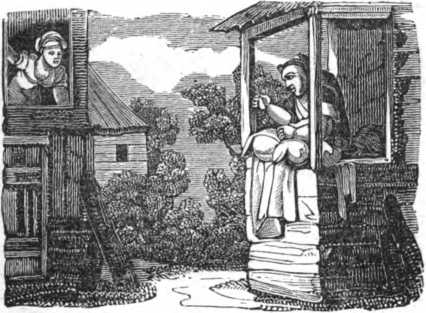
The Story of the Barber’s eldest Brother.
Sir, said I, my eldest brother whose name was Bacbouc the Hump-back, was a tailor by trade: when he came out of his apprenticeship, he hired a shop over against a mill, and having but very little business, he could scarcely maintain himself. The miller, on the contrary, was very wealthy, and had a very handsome wife. One day, as my brother was at work in his shop, he lifted up his head and saw the miller’s wife looking out of the window, and was charmed with her beauty. The woman took no notice of him, but shut her window, and came no more to it all that day. The poor tailor did nothing but lift up his eyes towards the mill all day long. He pricked his finger oftener than once, and his work that day was not very regular. At night, when he was to shut his shop, he could scarce tell how to do it, because he still hoped the miller’s wife would come to the window once more; but at last he was forced to shut up, and go home to his little house, where he passed but a very uncomfortable night. He got up betimes in the morning, and ran to his shop, in hopes to see his mistress again; but he was no happier than the day before, for the miller’s wife did not appear at the window above a minute in the whole day, but that minute made the tailor the most amorous man that ever lived. The third day he had some more ground of satisfaction, for the miller’s wife cast her eyes upon him by chance, and surprised him as he was gazing at her, which convinced her what passed in his mind.
No sooner did the miller’s wife perceive my brother’s inclination, than instead of being vexed at it, she resolved to divert herself with it. She looked upon him with a smiling countenance, and my brother looked upon her in the same manner, but after such an odd sort, that the miller’s wife presently shut her window, lest her loud laughter should have made him sensible that she only ridiculed him. Poor Bacbouc interpreted her carriage to his own advantage, and flattered himself that she looked upon him with pleasure.
The miller’s wife resolved to make sport with my brother: she had a piece of very fine stuff, with which she had a long time designed to make her a suit; she wrapt it up in a fine embroidered silk handkerchief, and sent it him by a young slave whom she kept; who being taught her lesson, comes to the tailor’s shop, and tells him, My mistress gives you her service, and prays you to make her a suit of this stuff according to this pattern; she changes her clothes often, so that her custom will be profitable to you. My brother doubted not that the miller’s wife loved him, and thought that she sent him work so soon after what had passed betwixt them, only to signify that she knew his mind, and to convince him that he had obtained her favour. My brother being of this opinion, charged the slave to tell her mistress, that he would lay aside all work for her’s, and that the suit should be ready next morning. He worked at it with so much diligence, that he finished it the same day. Next morning, the young slave came to see if the suit was ready. Bacbouc gave it to her neatly folded up, telling her, I am too much concerned to please your mistress to neglect her suit; I would engage her by my diligence to employ no other but myself for the time to come. The young slave went some steps as if she had intended to go away, and then coming back, whispered to my brother, I had forgot part of my commission; my mistress charged me to make her compliments to you, and to ask, how you passed the night; as for her, poor woman, she loves you so, that she could not sleep. —Tell her, answered my silly brother, I have so strong a passion for her, that for these four nights I have not slept one wink. —After such a compliment from the miller’s wife, my brother thought she would not let him languish long in the expectation of her favours.
About a quarter of an hour after, the slave returned to my brother with a piece of satin: My mistress, said she, is very well pleased with her suit; nothing in the world can fit her better; and as it was very handsome, she would not wear it without a new petticoat; she prays you to make her one, as soon as you can, of this piece of satin. —Enough, said Bacbouc; I will do it before I leave my shop; you shall have it in the evening. The miller’s wife showed herself often at her window, and was very prodigal of her charms, to encourage my brother. You would have laughed to have seen him work. The petticoat was soon made, and the slave came for it, but brought the tailor no money, neither for the trimming he had bought for the suit, nor for the making. In the mean time, this unfortunate lover, whom they only amused, though he could not see it, had eat nothing all that day, and was forced to borrow money at night to buy his supper. Next morning, as soon as he arrived at his shop, the young slave came to tell him, that the miller wanted to speak to him. My mistress, said she, has told him so much in your praise, when she showed him your work, that he has a mind you should work also for him; she does it on purpose, that the connexion she wished to form betwixt you and him may crown your mutual wishes with success. My brother was easily persuaded, and went to the mill with the slave. The miller received him very kindly, and showed him a piece of cloth, told him he wanted shirts, bid him make it into twenty, and give him again what was left.
My brother had work enough for five or six days to make twenty shirts for the miller, who afterwards gave him another piece of cloth to make him as many pair of drawers. When they were finished, Bacbouc carried them to the miller, who asked him what he must have for his pains. My brother answered, he would be content with twenty drachms of silver. The miller immediately called the young slave, and bid her bring him his weights, to see if his money was right. The slave, who had her lesson, looked at my brother with an angry countenance, to signify to him that he would spoil all if he took any money. He knew her meaning, and refused to take any, though he wanted it so much, that he was forced to borrow money to buy the thread that sewed the shirts and drawers. When he left the miller, he came to me to borrow money to live on, and told me they did not pay him. I gave him some copper money I had in my purse, and upon that he subsisted for some days: it is true, indeed, he lived upon nothing but broth, nor had he his fill of that.
One day he went to the miller, who was busy at his work, and thinking my brother came for money, he offered him some; but the young slave being present, made him another sign not to take it, which he complied with, and told the miller he did not come for his money, but only to know how he did. The miller thanked him, and gave him an upper garment to make. Bacbouc carried it him next day. When the miller drew out his purse, the young slave gave my brother the usual sign; on which he said to the miller, Neighbour, there is no haste; we will reckon another time: so that the poor ninny went to his shop again, with three terrible distempers upon him, love, hunger, and want of money. The miller’s wife was not only avaricious, but ill-natured; for, not content to cheat my brother of his due, she provoked her husband to revenge himself upon him for making love to her, which they accomplished thus. The miller invited Bacbouc one night to supper, and after giving him a very sorry treat, said to him, Brother, it is too late for you to go home; you had better stay here all night; and then he carried him to a place in the mill, where there was a bed: there he left him, and went to bed with his wife. About the middle of the night, the miller went to my brother, and said, Neighbour, are you asleep? My mule is ill, and I have a quantity of corn to grind; you will do me a great kindness if you will turn the mill in her stead. Bacbouc, to shew his good-nature, told him he was ready to do him that piece of service, if he would show him how. Then the miller tied him by the middle to the mule’s place, and whipping him soundly over the back, said to him, Go, neighbour. —Ho! said my brother, why do you beat me? —It is to make you brisk, said the miller; for without a whip my mule will not go. Bacbouc was amazed at this sort of treatment, but durst not complain. When he had gone five or six rounds, he would fain have rested; but the miller gave him a dozen sound lashes, saying, Courage, neighbour! do not stop, pray; you must go on without taking breath, otherwise you will spoil my meal.
The miller obliged my brother to turn the mill thus all night. About break of day he left him without untying him, and went to his wife’s chamber. Bacbouc continued there for some time, and at last the young slave came and untied him. Ah! said the treacherous wretch, how my mistress and I pitied you! We had no hand in this wicked trick which her husband has played you. The wretched Bacbouc answered her not a word, he was so much fatigued with work and blows; but crept home to his house, resolving never to think more of the miller’s wife.
The telling of this story, said the barber, made the caliph laugh. Go home, said he to me; I have ordered something to be given you to make up for the loss of the good dinner you expected. —Commander of the faithful, said I, I pray your majesty to let me stay till I have told the story of my other brothers. The caliph having signified by his silence that he was willing to hear me, I went on thus:
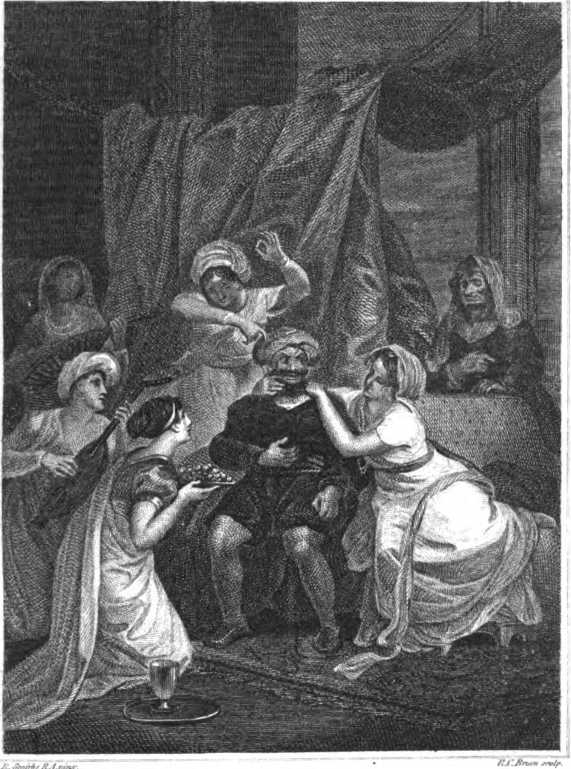
BAKBARAH IN THE LADY’S APARTMENT.
The Story of the Barber’s second Brother.
My second brother, who was called Backbarah the toothless, going one day through the city, met an old woman in a distant street: she came up to him, and said, I want one word with you; pray stop a moment. He did so, and asked her what she would have. If you have time to come along with me, said she, I will bring you into a stately palace, where you shall see a lady as fair as the day. She will receive you with much pleasure, and give you a treat with excellent wine. I need say no more to you. —But is what you say true? replied my brother. —I am no lying hussy, replied the old woman: I say nothing to you but what is true. But hark, I have something to ask of you. You must be prudent, say but little, and be extremely polite. Backbarah agreed to all this. The old woman went before, and he followed after. They came to the gate of a great palace, where there was abundance of officers and domestics. Some of them would have stopt my brother, but no sooner did the old woman speak to them, than they let him pass. Then turning to my brother, she said to him, You must remember that the young lady I bring you to loves good-nature and modesty, and cannot endure to be contradicted; if you please her in that, you may be sure to obtain of her what you please. Backbarah thanked her for this advice, and promised to follow it.
She brought him into a fine apartment of a great square building, answerable to the magnificence of the palace. There was a gallery round it, and a very fine garden in the middle. The old woman made him sit down upon a handsome sofa, and bid him stay a moment, till she went to tell the young lady of his being come.
My brother, who had never been in such a stately palace before, gazed upon the fine things that he saw; and judging of his good fortune by the magnificence of the palace, he was scarcely able to contain himself for joy. By and by he heard a great noise, occasioned by a troop of merry slaves, who came towards him with loud fits of laughter, and in the middle of them, he perceived a young lady of extraordinary beauty, who was easily known to be their mistress by the respect they paid her. Backbarah, who expected private conversation with the lady, was extremely surprised when he saw so much company with her. In the mean time the slaves put on a grave countenance when they drew near; and when the young lady came up to the sofa, my brother rose up and made her a low bow. She took the upper hand, prayed him to sit down, and said to him with a smiling countenance, I am mightily glad to see you, and wish you all the happiness you can desire. —Madam, replied Backbarah, I cannot desire a greater happiness than to be in your company. —You seem to be of a pleasant humour, said she, and to be disposed to pass the time pleasantly.
She forthwith commanded a collation to be brought; and immediately a table was covered with several baskets of fruits and sweetmeats. The lady sat down at the table with the slaves and my brother; and he being placed just over-against her, when he opened his mouth to eat, she perceived he had no teeth; and taking notice of it to her slaves, she and they laughed at him heartily. Backbarah from time to time lifted up his head to look at her, and perceiving her laugh, thought it was for joy of his company, and flattered himself that she would speedily send away her slaves, and be with him alone. She guessed his thoughts, and pleasing herself to flatter him in his mistake, she gave him abundance of pleasant language, and presented him the best of every thing with her own hand. The treat being ended, they rose from the table; ten slaves took musical instruments, and began to play and sing, and others to dance. My brother, to please them, danced likewise, and the lady danced with them. After they had danced some time, they sat down to take breath, and the young lady, calling for a glass of wine, looked upon my brother with a smiling countenance, to signify that she was going to drink his health. He rose up, and stood while she drank. When she had done, instead of giving back the glass, she ordered it to be filled, and presented it to my brother, that he might pledge her.
My brother took the glass from the young lady’s hand, which he kissed at the same time, and stood and drank to her, in return for the favour she had done him. Then the young lady made him sit down by her, and began to caress him. She put her hand behind his head, and gave him some tips from time to time with her fingers. Ravished with those favours, he thought himself the happiest man in the world, and had a great mind to toy also with the charming lady, but durst not take the liberty before so many slaves, who had their eyes upon him, and laughed at their lady’s wanton tricks. The young lady continued to tip him with her fingers, but at last gave him such a sound box on the ear, that he grew angry at it; the colour came in his face, and he rose up to sit at a greater distance from such a rude play-fellow. Then the old woman who brought him thither gave him a look, to let him know that he was in the wrong, and that he had forgot the advice she gave him to be very complaisant. He owned his fault, and, in order to make amends, he went near the young lady again, and pretended that he did not go away out of any ill-humour. She drew him by the arm, made him sit down by her again, and gave him a thousand malicious squeezes. Her slaves took their part in the diversion: one gave poor Backbarah several fillips on the nose with all her might; another pulled him by the ears, as if she would have pulled them off; and others boxed him so, as might show they were not in jest. My brother bore all this with admirable patience, affecting a gay air, and looking at the old woman, said to her with a forced smile, You told me, indeed, that I should find the lady perfectly kind, pleasant, and charming; I am mightily obliged to you! —All this is nothing, replied the old woman: let her go on; you will see other things by and by. Then the young lady said to him, Brother, you are a brave man; I am glad to find you are so good humoured and complaisant to bear with my little caprices, and that your humour is so conformable to mine. —Madam, replied Backbarah, who was charmed with this discourse, I am no more myself, I am wholly yours; you may dispose of me as you please. —How you oblige me, said the lady, by such submission! I am very well pleased with you, and would have you be so with me. Bring him perfume, said she, and rose water. Upon this, two slaves went out, and returned speedily; one with a silver casket, filled with the best of aloes-wood, with which she perfumed him; and the other with rose-water, which she sprinkled on his face and hands. My brother was quite beside himself at this handsome treatment. After this ceremony, the young lady commanded the slaves, who had already played on their instruments and sung, to renew their concerts. They obeyed, and in the mean time the lady called another slave, and ordered her to carry my brother with her, and do what she knew, and bring him back to her again. Backbarah, who heard this order, got up quickly, and going to the old woman, who also rose up to go along with him and the slave, prayed her to tell him what they were to do with him. My mistress is only curious, replied the old woman, softly; she has a mind to see how you look in a woman’s dress; and this slave, who has orders to carry you with her, has orders to paint your eyebrows, to cut off your whiskers, and to dress you like a woman. —You may paint my eyebrows as much as you please, said my brother; I agree to that, because I can wash it off again; but to shave me, you know I must not allow. How can I appear abroad again without mustachios? —Beware of refusing what is asked of you, said the old woman: you will spoil your fortune, which is now in as favourable a train as heart can wish. The lady loves you, and has a mind to make you happy; and will you, for a nasty whisker, renounce the most delicious favours that man can obtain? —Backbarah listened to the old woman, and without saying a word, went to a chamber with the slave, where they painted his eyebrows with red, cut off his whiskers, and were going to do the like with his beard. My brother’s patience then began to fail: Oh! said he, I will never part with my beard. The slave told him that it was to no purpose to have parted with his whiskers, if he would not also part with his beard, which could never agree with a woman’s dress; and she wondered that a man, who was upon the point to enjoy the finest lady in Bagdad, should be concerned about his beard. The old woman threatened him with the loss of the young lady’s favour; so that at last he let them do what they would. When he was dressed like a woman, they brought him before the young lady, who laughed so heartily when she saw him, that she fell backward on the sofa where she sat. The slaves laughed and clapped their hands, so that my brother was quite out of countenance. The young lady got up, and still laughing, said to him, After so much complaisance for me, I should be very much to blame not to love you with all my heart: but there is one thing more you must do for me, and that is, to dance as we do. He obeyed, and the young lady and her slaves danced with him, laughing as if they had been mad. After they had danced some time with him, they all fell upon the poor wretch, and did so box and kick him, that he fell down like one out of his senses. The old woman helped him up again; and that he might not have time to think of his ill treatment, she bid him take courage, and whispered in his ear, that all his sufferings were at an end, and that he was just about to receive his reward.
You have only one thing more to do, and that is but a small one. You must know that my mistress has a custom, when she has drank a little, as you see she has done to-day, to let nobody that she loves come near her, except they be stripped to their shirt; and when they have done so, she takes a little advantage of them, and begins running before them through the gallery, and from chamber to chamber, till they catch her. This is one more of her humours. What advantage soever she takes of you, considering your nimbleness and inclination, you will soon overtake her: strip yourself then to your shirt; undress yourself without ceremony.
My silly brother, said the barber, had done too much to hesitate at any thing now. He undressed himself; and in the mean time the young lady was stripped to her shift and under-petticoat, that she might run the more nimbly. When they were ready to run, the young lady took the advantage of twenty paces, and then fell to running with surprising swiftness: my brother followed her as fast as he could, the slaves in the mean time laughing heartily, and clapping their hands. The young lady, instead of losing ground, gained upon my brother; she made him run two or three times round the gallery, and then running into a long dark entry, got away by a passage which she knew. Backbarah, who still followed her, having lost sight of her in the entry, was obliged to slacken his pace, because of the darkness of the place: at last perceiving a light he ran towards it, and went out at a door, which was immediately shut upon him. You may imagine how he was surprised to find himself in a street inhabited by curriers; and they were no less surprised to see him in his shirt, his eyes painted red, and without beard or mustachios. They began to clap their hands and shouted at him, and some of them ran after him and lashed his buttocks with leather straps. They then took him and set him upon an ass which they met by chance, and carried him through the town, exposed to the laughter of the people.
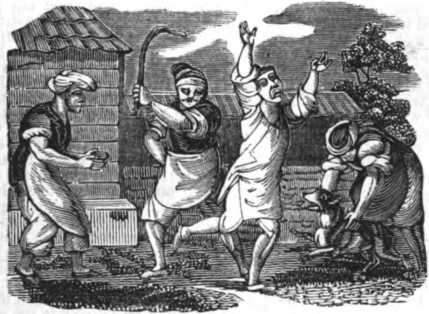
To complete his misfortune, as he went by the judge’s house, he would needs know the cause of the tumult. The curriers told him, that they saw him come in that condition out at the gate of the apartment of the grand vizier’s women, which opened into the street; upon which the judge ordered unfortunate Backbarah to have a hundred blows with a cane on the soles of his feet, and sent him out of the town, with orders never to return again.
Thus, commander of the faithful, said I to the caliph Monstanser Billah, I have given an account of the adventure of my second brother, who did not know that our greatest ladies divert themselves sometimes by putting such tricks upon young people, who are so foolish as to be caught in the snare.
The barber, without leaving off, told the story of his third brother in the following manner.
The Story of the Barber’s third Brother.
Commander of the faithful, said he to the caliph, my third brother, whose name was Backbac, was blind, and his evil destiny reduced him to beg from door to door. He had been so long accustomed to walk through the streets alone, that he wanted none to lead him. He had a custom to knock at people’s doors, and not to answer till they opened to him. One day he knocked thus at a door, and the master of the house, who was alone, cried, Who is there? My brother gave no answer, and knocked a second time. The master of the house asked again and again, Who is there? but to no purpose: nobody answered. Upon which he came down, opened the door, and asked my brother what he wanted. Give me something for Heaven’s sake, said Backbac. —You seem to be blind, replied the master of the house. Yes, to my sorrow, said my brother. Give me your band, said the master of the house. My brother did so, thinking he was going to give him alms; but he only took him by the hand to lead him up to his chamber. Backbac thought he had been carrying him to dine with him, as many other people had done. When they came up to the chamber, the man let go his hand, and sitting down, asked him again what he wanted. I have already told you, said Backbac, that I want something for God’s sake. —Good blind man, replied the master of the house, all that I can do for you is to wish that God may restore you your sight. —You might have told me that at the door, said my brother, and not have given me the trouble to have come up stairs. —And why, fool, said the man of the house, do not you answer at first, when people ask you who is there? Why do you give any body the trouble to come and open the door when they speak to you? —What will you do with me then? said my brother. —I tell you again, said the man of the house, I have nothing to give you. —Help me down the stairs then, replied Backbac, as you helped me up. —The stairs are before you, said the man of the house, and you may go down by yourself if you will. My brother attempted to go down, but missing a step about the middle of the stairs, he fell to the bottom, and hurt his head and his back: he got up again with a great deal of difficulty, and went out cursing the master of the house, who laughed at his fall.
As my brother went out of the house, two blind men, his companions, were going by, knew him by his voice, and asked him what was the matter. He told them what had happened to him, and afterwards said, I have eat nothing to day: I conjure you to go along with me to my house, that I may take some of the money that we three have in common to buy me something for supper. The two blind men agreed to it, and they went home with him.
You must know that the master of the house where my brother was so ill used was a highwayman, and of a cunning and malicious disposition. He heard at his window what Backbac had said to his companions, and therefore came down and followed them to my brother’s house. The blind men being sat down, Backbac said to them, Brothers, we must shut the door, and take care there be no stranger with us. At this the highwayman was much perplexed; but perceiving by chance a rope hanging down from a beam, he caught hold of it, and hung by it, while the blind men shut the door, and felt about the room with their sticks. When they had done this, and sat down again in their places, the highwayman left his rope, and sat down softly by my brother; who thinking himself alone with his blind comrades, said to them, Brothers, since you have trusted me with the money which we all three have been gathering a long time, I will show you that I am not unworthy of the trust that you repose in me. The last time we reckoned, you know we had ten thousand drachms, and that we put them into ten bags; I will show you that I have not touched one of them; and having said so, he put his hand among some old clothes, and taking out the bags one after another, gave them to his comrades, saying, There they are; you may judge by their weight that they are whole, or you may tell them if you please. His comrades answered there was no need, they did not mistrust him; so he opened one of the bags, and took out ten drachms, and each of the other blind men did the like.
My brother put the bags into their place again: after which, one of the blind men said to him, There is no need to lay out any thing for supper, for I have got as much victuals from good people as will serve us all three. At the same time he took out of his bag bread and cheese, and some fruit, and, putting all upon the table, they began to eat. —The highwayman, who sat at my brother’s right hand, picked out the best, and eat with them; but, whatever care he took to make no noise, Backbac heard his chaps going, and cried out immediately, We are undone; there is a stranger among us: and having said so, he stretched out his hand, and caught hold of the highwayman by the arm, cried out, Thieves, fell upon him, and boxed him. The other blind men fell upon him in like manner, and the highwayman defended himself as well as he could; and being young and vigorous, and having the advantage of his eyes, he gave furious blows, sometimes to one, sometimes to another, as he could come at them, and cried out, Thieves, louder than they did. The neighbours came running at the noise, broke open the door, and had much ado to separate the combatants; but having at last succeeded, they asked the cause of their quarrel. My brother, who still had hold of the highwayman, cried out. Gentlemen, this man I have hold on is a thief, and stole in with us on purpose to rob us of the little money we have. The thief, who shut his eyes as soon as the neighbours came, feigned himself blind, and cried out, Gentlemen, he is a liar. I swear to you by Heaven, and by the life of the caliph, that I am their companion, and they refuse to give me my just share. They have all three fallen upon me, and I demand justice. The neighbours would not interfere in their quarrel, but carried them all before the judge.
When they came before the magistrate, the highwayman, without staying to be examined, cried out, still feigning himself blind, Sir, since you are deputed to administer justice by the caliph, whom God prosper, I declare to you that we are equally criminal, my three comrades and I; but we have all engaged, upon oath, to confess nothing except we be bastinadoed; so that if you would know our crime, you need only order us to be bastinadoed, and begin with me. My brother would have spoken, but was not allowed to do so; and the highwayman was put under the bastinado.
The robber being under the bastinado, had the courage to bear twenty or thirty blows; when, pretending to be overcome with pain, he first opened one eye, and then the other, and crying out for mercy, begged the judge would put a stop to the blows. —The judge perceiving that he looked upon him with his eyes open, was much surprised at it, and said to him, Rogue, what is the meaning of this miracle? Sir, replied the highwayman, I will discover to you an important secret, if you pardon me, and give me, as a pledge that you will keep your word, the seal-ring which you have on your finger: I am ready to declare the whole mystery. The judge consented, gave him his ring, and promised him pardon. Under this promise, said the highwayman, I must confess to you, sir, that I and my three comrades do all of us see very well. We feigned ourselves to be blind, that we might freely enter people’s houses, and into women’s apartments, where we abuse their weakness. I must further confess to you, that by this trick we have gained together ten thousand drachms. This day I demanded of my partners two thousand five hundred that belonged to me as my share; but they refused because I told them I would leave them, and they were afraid I should accuse them. Upon my pressing still to have my share, they all three fell upon me; for which I appeal to those people who brought us before you. I expect from your justice, sir, that you will make them deliver me the two thousand five hundred drachms which is my due; and if you have a mind that my comrades should confess the truth, you must order them three times as many blows as I have had, and you will find they will open their eyes as well as I did.
My brother and the other two blind men would have cleared themselves of this horrid cheat, but the judge would not hear them: Villains, said he, do you feign yourselves blind then, and, under that pretext of moving their compassion, cheat people, and commit such crimes? He is a cheat, cried my brother, and we take God to witness that none of us can see.
All that my brother could say was in vain, his comrades and he received each of them two hundred blows. The judge looked when they should have opened their eyes and ascribed to their obstinacy what really they could not do. All the while, the highwayman said to the blind men, Poor fools that you are, open your eyes, and do not suffer yourselves to be beat to death. Then addressing himself to the judge, said, I perceive, sir, that they will be maliciously obstinate to the last, and will never open their eyes. They have a mind certainly to avoid the shame of reading their own condemnation in the face of every one that looks upon them; it were better, if you think fit, to pardon them, and to send some person along with me for the ten thousand drachms they have hid.
The judge did so, gave the highwayman two thousand five hundred drachms, and kept the rest himself; and as for my brother and his two companions, he thought he showed them a great deal of pity by sentencing them only to be banished. As soon as I heard what befell my brother, I ran after him; he told me his misfortune, and I brought him back secretly to the town. I could easily have justified him to the judge, and have got the highwayman punished as he deserved, but durst not attempt it, for fear of bringing myself into trouble. Thus I finished the sad adventure of my honest blind brother. The caliph laughed at it as much as at those he had heard before, and ordered again, that something should be given me; but without staying for it, I began the story of my fourth brother.
The story of the Barber’s fourth Brother.
Alcouz was the name of the fourth brother, who lost one of his eyes upon an occasion that I shall have the honour to relate to your majesty. He was a butcher by profession, and had a particular way of teaching rams to fight, by which he gained the acquaintance and friendship of the chief lords of the country, who loved that sport, and for that end kept rams at their houses; he had, beside, a very good trade, and had his shop always full of the best meat, because he was very rich, and spared no cost for the best of every sort. One day, when he was in his shop, an old man, with a long white beard, came and bought six pounds of meat of him, gave him money for it, and went his way. My brother thought the money so fine, so white, and so well coined, that he put it apart by itself. The same old man came every day for five months together, bought a like quantity of meat, and paid for it in the same sort of money, which my brother continued to lay apart by itself.
At the end of five months, Alcouz having a mind to buy a parcel of sheep, and to pay for them in this fine money, opened his chest; but instead of finding his money, was extremely surprised to see nothing in the place where he had laid it but a parcel of leaves clipped round: he beat his head and cried out aloud, which presently brought the neighbours about him, who were as much surprised as he, when he told them the story. Oh! cried my brother, weeping, that this treacherous old fellow would come now with his hypocritical looks! He had scarce done speaking when he saw him coming at a distance, ran to him, and laid hands on him: Mussulmen! cried he, as load as he could, help! hear what a cheat this wicked fellow has put upon me, and, at the some time, told a great crowd of people who came about him, what he had formerly told his neighbours. When he had done, the old man said to him very gravely and calmly, You had better let me go, and by that means make amends for the affront you have put upon me before so many people, for fear I should put a greater affront upon you, which I should be sorry to do. How, said my brother, what have you to say against me? I am an honest man in my business, and fear not you, nor any body. You would have me speak out then, said the old man, in the same tone; and turning to the people, said to them, Know, good people, that this fellow, instead of selling mutton, as he ought to do, sells man’s flesh. You are a cheat, said my brother. No, no, said the old man; good people, this very minute that I am speaking to him, there is a man with his throat cut hung up in the shop like a sheep; do any of you go thither, and see if what I say be not true.
Just before my brother had opened his chest he had killed a sheep, dressed it, and exposed it in the shop, according to custom. He protested that what the old man said was false; but notwithstanding all his protestations, the credulous mob, prejudiced against a man accused of such a heinous crime, would go to see whether the matter was true. They obliged my brother to quit the old man, laid hold of him, and ran like madmen into his shop, where they saw a man hung up with his throat cut, as the old man had told them; for he was a magician and deceived the eyes of all people, as he did my brother, when he made him take leaves instead of money. At this sight, one of those who held Alcouz, gave him a great blow with his fist, and said to him, Thou wicked villain! Dost thou make us eat men’s flesh instead of mutton? And at the same time, the old man gave him another blow, which beat out one of his eyes, and every body that could get near him beat him; and not content with that, they carried him before a judge, with the pretended carcass of the man to be evidence against him. Sir, said the old magician to the judge, we have brought you a man, who is so barbarous as to murder people, and to sell their flesh instead of mutton; the public expects that you shall punish him in an exemplary manner. The judge heard my brother with patience, but would believe nothing of the story of the money changed into leaves, called my brother a cheat, told him he would believe his own eyes, and ordered him to receive five hundred blows. He afterwards made him tell where his money was, took it all from him, and banished him for ever, after having made him ride three days through the city upon a camel, exposed to the insults of the people.
I was not at Bagdad when this tragical adventure befell my fourth brother. He retired into a remote place, where he lay concealed till he was cured of the blows with which his back was terribly mauled. When he was able to walk, he went by night to a certain town where nobody knew him; and there he took a lodging, from whence he seldom went out. But being weary of this confined life, he went to walk in one of the suburbs, where all of a sudden he heard a great noise of horsemen coming behind him. He was then by chance near the gate of a great house; and fearing, after what had befallen him, that these horsemen were pursuing him, he opened the gate, in order to hide himself; and after he shut it, came into a great court, where immediately two servants came, and collaring him, said, Heaven be praised, that you have come of your own accord to surrender yourself to us! You have frightened us so much these three last nights, that we could not sleep nor would you have spared our lives, if we had not prevented you. You may very well imagine my brother was much surprised at this compliment. Good people, said he, I know not what you mean; you certainly take me for some body else. No, no, replied they: we know that you and your comrades are great robbers: you were not contented to rob our master of all that he had, and to reduce him to beggary, but you had a mind to take his life. Let us see a little if you have not a knife about you, which you had in your hand when you pursued us last night; and having said this, they searched him, and found he had a knife. Ho! ho! cried they, laying hold of him, and dare you say that you are not a robber? Why, said my brother, cannot a man carry a knife about him without being a highwayman? If you will hearken to my story, continued he, instead of having so bad an opinion of me, you will be touched with compassion at my misfortunes. But far from hearkening to him, they fell upon him, trod upon him, took away his clothes, and tore his shirt. Then seeing the scars on his back, O dog! said they, redoubling their blows, would you have us believe you are an honest man when your back shows us the contrary? —Alas! said my brother, my crimes must be very great, since after having been abused already so unjustly, I am abused again a second time without being more culpable!
The two servants, no way moved with this complaint, carried him before the judge, who asked him, how he durst be so bold as to go into their house, and pursue them with a drawn knife? Sir, replied poor Alcouz, I am the most innocent man in the world, and am undone, if you will not be pleased to hear me patiently; nobody deserves more compassion. Sir, replied one of the domestics, will you listen to a robber, who enters people’s houses to plunder and murder them? If you will not believe us, only look upon his back. And when he said so, he uncovered my brother’s back, and showed it to the judge; who, without any other information, commanded immediately to give him a hundred lashes with a bull’s pizzle over the shoulders, and made him afterwards be carried through the town on a camel, with one crying before him, ‘Thus are such men punished as enter people’s houses by force.’ After haring treated him thus, they banished him the town, and forbid him ever to return to it again. Some people who met him after the second misfortune, brought me word where he was, and I went and fetched him to Bagdad privately, and gave him all the assistance I could. The caliph, continued the barber, did not laugh so much at this story as at the other. He was pleased to pity the unfortunate Alcouz, and ordered something to be given me. But, without giving his servants time to obey his orders, I continued my discourse, and said to him, My sovereign lord and master, you see that I do not talk much; and since your majesty has been pleased to do me the favour to listen to me so far, I beg you would likewise hear the adventures of my two other brothers. I hope they will be as diverting as those of the former. You may make a complete history of them, that will not be unworthy of your library. I shall do myself the honour then to acquaint you, that the fifth brother was called Alnaschar.
The Story of the Barber’s fifth Brother.
Alnaschar, as long as our father lived, was very lazy; instead of working for his hiving, he used to go begging in the evening, and to live next day upon what he got. Our father died in a very old age, and left among us seven hundred drachms of silver: we divided it equally, so that each of us had a hundred for our share. Alnaschar, who had never so much money before in his lifetime, was very much perplexed to know what he should do with it. He consulted a long time with himself, and at last resolved to lay it out in glasses, bottles, and other glass-ware, which he bought of a wholesale dealer. He put all in an open basket, and chose a very little shop, where he sat with the basket before him, and his back against the wall, expecting while somebody should come and buy his ware. In this posture he sat, with his eyes fixed on his basket, and began to meditate; during which he spoke as follows, loud enough to be heard by a neighbouring tailor: This basket, said he, cost me a hundred drachms, which is all I have in the world; I shall make two hundred of it by retailing my glass, and of these two hundred drachms, which I will again lay out in glass-ware, I shall make four hundred; —and going on thus, I shall at last make four thousand drachms; of four thousand I shall easily make eight thousand, and when I come to ten thousand, I will leave off selling glass, and turn jeweller. I will trade in diamonds, pearls, and all sorts of precious stones. Then, when I am rich as I can wish, I will buy a fine house, a great estate, slaves, eunuchs, and horses. I will keep a good house, and make a great figure in the world; I will send for all the musicians and dancers of both sexes in town. —Nor will I stop here: I will, by the favour of heaven, go on till I get a hundred thousand drachms; and when I have got so much, I will think myself as great as a prince, and send to demand the grand vizier’s daughter in marriage; and represent to that minister that I have heard much of the wonderful beauty, understanding, wit, and all the other qualities of his daughter. In a word, that I will give him a thousand pieces of gold the first night after we are married; and if the vizier be so uncivil as to refuse his daughter, which cannot be supposed, I will go and carry her off before his face, and take her to my house, whether he will or no. —As soon as I have married the grand vizier’s daughter, I will buy her ten young black eunuchs, the handsomest that can be had. I will clothe myself like a prince, and, mounted upon a fine horse, with a saddle of fine gold, and housings of cloth of gold, finely embroidered with diamonds and pearls, I will ride through the city, attended by slaves before and behind; and I will go to the vizier’s palace, in view of all the people, great and small, who will show me the most profound respect. When I alight at the foot of the vizier’s staircase, I will go up the same through my own people, ranged in files on the right and left; and the grand vizier, receiving me as his son-in-law, shall give me the right hand, and set me above him, to do me the more honour. If this comes to pass, as I hope it will, two of my people shall each of them have a purse with a thousand pieces of gold, which they shall carry with them. I will take one, and presenting it to the grand vizier, will tell him, There is the thousand pieces of gold that I promised the first night of marriage; and I will offer him the other, and say to him, There is as much more, to shew you that I am a man of my word, and even better than my promise. After such an action as this, all the world will talk of my generosity. I will return to my own house in the same pomp. My wife will send some officer to compliment me, on account of my visit to the vizier, her father; I will honour the officer with a fine robe, and send him back with a rich present. If she thinks to send me one, I will not accept it, but dismiss the bearer. I will not suffer her to go out of her apartment on any account whatever, without giving me notice; and when I have a mind to come to her apartment, it shall be in such a manner as to make her respect me. In short, no house shall be better ordered than mine. I will be always richly clad. When I retire with my wife in the evening, I will sit on the upper hand; I will affect a grave air, without turning my head to one side or other. I will speak little; and whilst my wife, beautiful as the full moon, stands before me in all her charms, I will make as if I did not see her. Her women about her will say to me, Our dear lord and master, here is your spouse, your humble servant, before you, ready to receive your caresses, and much mortified that you do not vouchsafe to look upon her; she is wearied with standing so long; bid her, at least, sit down. I will give no answer to this discourse, which will increase their surprise and grief. They will prostrate themselves at my feet; and after they have for a considerable time entreated me to relent, I will at last lift up my head, and give her a careless look, and resume my former posture: they will suppose that my wife is not well enough, nor handsomely enough dressed, and will carry her to her closet to change her apparel. At the same time I will get up, and put on a more magnificent suit than before: they will return, and hold the same discourse with me as before, and I will have the pleasure not so much as to look upon my wife, till they have prayed and entreated as long as they did at first. Thus I will begin on the first day of marriage to teach her what she is to expect during the rest of her life.