ARABIAN NIGHTS’ (continued 12)
Reading edition · Edition 2
Ebn Thaher was scarce at his own house when Schemselnihar’s confidant arrived with a melancholy countenance, which he reckoned a bad omen. He asked news of her mistress: Tell me yours first, said the confidant, for I was in great trouble to see the prince of Persia go away in that condition. Ebn Thaher told her all that she wished to know, and when he had done, the slave began thus:— If the prince of Persia, said she, has suffered, and does still suffer, for my mistress, she suffers no less for him. After I departed from you, continued she. I returned to the saloon, where I found Schemselnihar not yet recovered from her swoon, notwithstanding all the help they endeavoured to give her. The caliph was sitting near her with all the signs of real grief; he asked all the women, and me in particular, if we knew the cause of her distemper; but we kept all secret, and told him we were altogether ignorant of it. In the mean time, we all wept to see her suffer so long, and forgot nothing that might any way help her. In a word, it was almost midnight before she came to herself. The caliph, who had the patience to wait the event, was rejoiced at her recovery, and asked Schemselnihar the cause of her distemper. As soon as she heard him speak, she endeavoured to recover her seat; and after she had kissed his feet, before he could hinder her, Sir, said she, I have reason to complain of heaven, that it did not allow me to expire at your majesty’s feet, to testify thereby how sensible I am of your favours.
I am persuaded you love me, said the caliph to her, and I command you to preserve yourself for my sake. You have probably exceeded in something to-day, which has occasioned this indisposition: take care, I entreat you; abstain from it for the future. I am very glad to see you better, and I advise you to stay here to-night, and not to return to your chamber, for fear the motion affect you. He then commanded a little wine to be brought her, in order to strengthen her; and taking leave of her, returned to his apartment.
As soon as the caliph was gone, my mistress gave me a sign to come near her. She asked me earnestly concerning you; I assured her that you had been gone a long time, which made her easy on that head: I took care not to speak of the prince of Persia’s fainting, lest it should make her fall into the same state, from which we had so much trouble to recover her; but my precautions were in vain, as you shall hear. Prince, said she, I henceforth renounce all pleasure us long as I am deprived of the sight of you. If I have understood your heart right, I only follow your example. You will not cease to weep until you see me again; it is but just that I weep and mourn until I see you. At these words, which she uttered in a manner expressive of the violence of her passion, she fainted a second time in my arms.
Schemselnihar’s confidant continued to tell Ebn Thaher all that had happened to her mistress after the first fainting. My companions and I, said she, were a long time recovering her; at last, she came to herself; and then I said to her, Madam, are you resolved to kill yourself, and to make us also die with you? I entreat you, in the name of the prince of Persia, who is so deeply interested in your life, to preserve it, as you love yourself; be persuaded to this effort, as you love the prince, and for our fidelity to you. I am very much obliged to you, replied she, for your care, your zeal, and your advice; but, alas! they are useless to me: you are not to flatter us with any hopes, for we can expect no end of our torment but in the grave.
One of my companions would have diverted these sad thought by playing on the lute, but she commanded her to be silent, and ordered all of them to retire except me, whom she kept all night with her. O heavens! what a night it was! she passed it in tears and groans, and incessantly naming the prince of Persia. She lamented her lot, that had destined her to the caliph, whom she could not love, and not for him whom she loved so dearly.
Next morning, because she was not commodiously lodged in the saloon, I helped her to her chamber, where she no sooner arrived than all the physicians of the palace came to see her by order of the caliph, who was not long in coming himself. The medicines which the physicians prescribed to Schemselnihar were ineffectual, because they were ignorant of the cause of her distemper; and the presence of the caliph augmented it. She got a little rest, however, this night, and as soon as she awoke, she charged me to come to you, to hear news of the prince of Persia. I have already informed you of his case, said Ebn Thaher; so return to your mistress, and assure her, that the prince of Persia waits for news from her with the like impatience that she does from him; above all, exhort her to moderation, and to overcome herself, for fear she drop before the caliph some word which may prove fatal to us all. As for me, replied the confidant, I confess I dread her transports; I have taken the liberty to tell her my mind, and am persuaded that she will not take it ill that I tell her again this from you.
Ebn Thaher, who had but just come from the prince of Persia’s lodgings, thought it not convenient to return so soon, and neglect his own important affairs, and therefore went not till the evening; the prince was alone, and no better than in the morning; Ebn Thaher said he to him, as soon as he saw him, you have doubtless many friends, but they do not know your worth, which you discover to me by your zeal, your care, and the trouble you give yourself to oblige me. I am confounded with all that you do for me with so great affection, and I know not how I shall be able to express my gratitude. Prince, answered Ebn Thaher, do not speak so, I entreat you; I am ready, not only to give one of my eyes, to save one of yours, but to sacrifice my life for you. But this is not the present business; I come to tell you that Schemselnihar sent her confidant to ask me about you, and at the same time, to inform me of her condition. You may assure yourself, that I said nothing but what might confirm the excess of your passion for her mistress, and the constancy with which you love her. Then Ebn Thaher gave him a particular account of all that had passed betwixt the trusty slave and him.
The prince listened with all the different emotions of fear, jealousy, affection, and compassion, which this conversation could inspire him with, making upon every thing which he heard, all the afflicting or comforting reflections that so passionate a lover was capable of.
Their conversation continued so long, that the night was far advanced, so that the prince of Persia obliged Ebn Thaher to stay with him. The next morning, as his trusty friend returned home, there came to him a woman, whom he knew to be Schemselnihar’s confidant, and immediately she spoke to him thus: My mistress salutes you, and I am come to entreat you in her name to deliver this letter to the prince of Persia. The zealous Ebn Thaher took the letter, and returned to the prince, accompanied by the confidant slave.
When Ebn Thaher entered the prince of Persia’s house, with Schemselnihar’s confidant, he prayed her to stay, and wait for him a moment in the drawing room. As soon as the prince of Persia saw him, he asked earnestly what news he had to tell him? The best you can expect, answered Ebn Thaher. You are as dearly beloved as you love; Schemselnihar’s confidant is in your drawing room; she has brought you a letter from her mistress, and waits for your orders to come in. Let her come in, cried the prince, with a transport of joy; and so saying, he sat up to receive her.
The prince’s attendants went from him as soon as they saw Ebn Thaher, and left him alone with their master. Ebn Thaher went and opened the door himself, and brought in the confidant. The prince knew her, and received her with great politeness. My lord, said she to him, I am sensible of the affliction you have endured since I had the honour to conduct you to the boat which waited to bring you back; but I hope the letter I have brought will contribute to your cure. So saying, she presented him the letter. He took it, and after he had kissed it several times, he opened and read it as follows:
A Letter from Schemselnihar to Ali Ebn Becar, Prince of Persia.
‘The person who brings you this letter will give you a better account concerning me than I can do, for I have not been myself since I saw you; being deprived of your presence, I sought to deceive myself by conversing with you by these ill-written lines, with the same pleasure as if I had the good fortune to speak to you.
‘It is said, that patience is a cure for all evils, but it heightens my sufferings, instead of relieving them. Although your picture be deeply engraven in my heart, my eyes, desire speedily once more to see the original, and they will lose all their light if they be any considerable time deprived of it. May I flatter myself that yours have the same impatience to see me? Yes, I can; their tender glances have sufficiently discovered it to me. How happy, prince, should you and Schemselnihar both be, if our united desires were not thwarted by invincible obstacles, which afflict me the more sensibly as they have that effect on you.
‘Those thoughts which my fingers write, and which I express with incredible pleasure, repeating them again and again, proceed from the bottom of my heart, and from the incurable wound which you have made in it, a wound which I bless a thousand times, notwithstanding the cruel torments I endure for your absence. I would reckon all that opposes our love nothing, were I only allowed to see you sometimes with freedom; I should then enjoy you, and what could I desire more?
‘Do not imagine that I say more than I think. Alas! whatever expressions I make use of, I feel that I think more than I can tell you. My eyes, which are continually watching and weeping for your return; my afflicted heart, which desires you alone; the sighs that escape me as often as I think on you, that is every moment; my imagination, which represents no other object to me than my dear prince; the complaints that I make to heaven for the rigour of my destiny; in a word, my grief, my distress, my torments, which give me no ease ever since I lost sight of you, will vouch for what I write.
‘Am I not unhappy to be born to love, without hope of enjoying him whom I love? This afflicting thought oppresses me so that I should die were I not persuaded that you love me: but this sweet comfort balances my despair, and preserves my life. Tell me that you love me always; I will keep your letter carefully, and read it a thousand times a day; I should endure my afflictions with less impatience: I pray heaven may cease to be angry at us, and grant us an opportunity to say, that we love one another without fear; and that we shall never cease to love one another. Adieu. I salute Ebn Thaher, to whom we are so much obliged.’
The prince of Persia was not satisfied with reading the letter once; he thought he had read it with too little attention, and therefore read it again with more leisure; and as he read, sometimes he uttered deep sighs, sometimes he shed tears, and sometimes he broke out into transports of joy and tenderness, as he was affected with what he read. In short, he could not keep his eyes off those characters drawn by so beloved a hand, and was beginning to read it a third time, when Ebn Thaher observed to him, that the confidant had no time to lose, and that he ought to think of giving an answer. Alas! cried the prince, how would you have me answer so kind a letter? In what terms shall I express myself in the disturbed state I am in? My mind is tossed with a thousand tormenting thoughts, which are lost the same moment they are conceived, to make way for others. So long as my body is influenced by the impressions of my mind, how shall I be able to hold the paper, or guide my reed to write? [81]
So saying, he took out of a little desk which was near him, paper, a cane ready cut, and an inkhorn.
The prince of Persia, before he began to write, gave Schemselnihar’s letter to Ebn Thaher, and prayed him to hold it open while he wrote, that by casting his eyes upon it, he might the better see what to answer. He began to write; but the tears that fell from his eyes upon the paper, obliged him several times to stop, that they might fall the more freely. At last, he finished his letter, and giving it to Ebn Thaher, Read it, I pray, said he to him, and do me the favour to see if the disorder of my mind has allowed me to give a favourable answer. Ebn Thaher took it, and read as follows:
The Prince of Persia’s answer to Schemselnihar’s Letter.
‘I was plunged in the deepest grief when I received your letter, at the sight of which, I was transported with unspeakable joy; and at sight of the characters written by your lovely hand, my eyes were enlightened by a stronger light than they lost, when yours were closed on a sudden at the feet of my rival. These words contained in your kind letter are so many rays of light, which have dispelled the darkness wherewith my soul was obscured; they show me how much you suffer for love of me, and that you are not ignorant of what I endure for you, and thereby comfort me in my afflictions. On the one hand, they make me shed tears in abundance; and on the other, they inflame my heart with a fire which supports it, and prevents my dying of grief. I have not had one moment’s rest since our cruel separation. Your letter alone gave me some ease. I kept a mournful silence till the moment I received it, and then it restored my speech. I was buried in profound melancholy, but it inspired me with joy, which immediately appeared in my eyes and countenance. But my surprise at receiving a favour which I had not yet deserved was so great, that I knew not how to begin to testify my thankfulness for it. In a word, after having kissed it several times as a precious pledge of your goodness, I read it over and over, and was confounded at the excess of my good fortune. You would have me signify to you, that I always love you. Ah! though I did not love you so perfectly as I do, I could not forbear adoring you, after all the marks you have given me of a love so uncommon; yes, I love you my dear soul, and shall account it my glory to burn all my days with that sweet fire you have kindled in my heart. I will never complain of that ardour with which I feel it consumes me: and how rigorous soever the evils be which I suffer, I will bear them with fortitude, in hopes to see you some time or other. Would to heaven it were to-day, and that, instead of sending you my letter, I might be allowed to come and assure you, that I die for love of you! My tears hinder me from saying any more. Adieu.’
Ebn Thaher could not read those last lines without weeping. He returned the letter to the prince of Persia, and assured him it wanted no correction. The prince closed it, and when he had sealed it, he desired the trusty slave to come near, and said to her, This is my answer to your dear mistress’s letter. I conjure you to carry it to her, and to salute her in my name. The slave took the letter, and retired with Ebn Thaher.
After Ebn Thaher had walked some way with the slave, he left her, and went to his house, and began to think in earnest upon the amorous intrigue into which he found himself unhappily engaged. He considered, that the prince of Persia and Schemselnihar, notwithstanding their interest to conceal their correspondence, conducted themselves with so little discretion, that it could not be long a secret. He drew all the consequences from it, which a man of good sense ought to do. Were Schemselnihar, said he to himself, a lady of common rank, I would contribute all in my power to make her and her lover happy; but she is the caliph’s favourite, and no man can without danger attempt to engage the affections of the object of his choice. His anger would fall in the first instance on Schemselnihar; it will next cost the prince of Persia his life, and I shall be involved in his misfortune. —In the mean time, I have my honour, my quiet, my family, and my estate to preserve. I must, while I can, extricate myself out of such a risk.
These thoughts occupied his mind all that day; next morning, he went to the prince of Persia, with a design to make one more effort to oblige him to conquer his passion. He represented to him what he had before represented in vain; that it would be much better for him to call up all his resolution, to overcome his inclination for Schemselnihar, than to suffer himself to be hurried away by it; and that his passion was so much the more dangerous, as his rival was powerful. In short, sir, added he, if you will hearken to me, you ought to think of nothing but to triumph over your love; otherwise, you run the risk of destroying yourself with Schemselnihar, whose life ought to be dearer to you than your own. I give you this advice as a friend, for which you will some time or other thank me.
The prince heard Ebn Thaher with great impatience, but suffered him to speak his mind, and then replied to him thus: Ebn Thaher, said he, do you think I can cease to love Schemselnihar, who loves me so tenderly? She is not afraid to expose her life for me, and would you have me regard mine? No; whatever misfortunes befall me, I will love Schemselnihar to my last breath.
Ebn Thaher, shocked at the obstinacy of the prince of Persia, left him hastily, and going to his own house, recalled to his mind his former reflections, and began to think seriously what he should do. In the mean time, a jeweller, one of his intimate friends, came to see him. The jeweller had perceived that Schemselnihar’s confidant came oftener to Ebn Thaher than usual, and that he was constantly with the prince of Persia, whose sickness was known to every one, though not the cause of it. This had awakened the jeweller’s suspicions, and finding Ebn Thaher very pensive, he presently judged that he was perplexed with some important affair, and fancying that he knew the cause, he asked, what Schemselnihar’s confidant wanted with him? Ebn Thaher being struck with this question, would have dissembled, and told him, that it was for a trifle she came so frequently to him. You do not tell me the truth, said the jeweller, and you think to persuade me, by your dissimulation, that this trifle is a more important affair than at first I thought it to be. Ebn Thaher perceiving that his friend pressed him so much, said to him, it is true, that it is an affair of the greatest consequence! I had resolved to keep it secret, but since I know how much you are my friend, I choose rather to make you my confidant, than to suffer you to be under a mistake about it. —I do not recommend to you secrecy, for you will easily judge by what I am going to tell you, how important it is to keep it. After this preamble, he told him the amour between Schemselnihar, and the prince of Persia. You know, continued he, in what esteem I am at court, in the city, and with lords and ladies of the greatest quality; what a disgrace it would be for me, should this rash amour come to be discovered? But what do I say; should not I and my family be completely ruined? That is what perplexes my mind; but I have just formed my resolution: I will go immediately and satisfy my creditors, and recover my debts, and when I have secured my property, will retire to Balsora, and stay till the storm that I foresee is blown over. My friendship for Schemselnihar and the prince of Persia makes me very sensible to what dangers they are exposed. I pray heaven to convince them of it, and to preserve them; but if their evil destiny should bring their amours to the knowledge of the caliph, I shall, at least, be out of the reach of his resentment; for I do not think them so wicked as to design to involve me in their misfortunes. It would be the height of ingratitude, and a bad reward for the service I have done them, and the good advice I have given them, particularly to the prince of Persia, who may save both himself and his mistress from this precipice, if he pleases: he may as easily leave Bagdad as I; and absence will insensibly disengage him from a passion, which will only increase whilst he continues in this place.
The jeweller was extremely surprised at what Ebn Thaher told him. What you say to me, says he, is of so great importance, that I cannot understand how Schemselnihar and the prince could have abandoned themselves to such a violent passion; what inclination soever they may have for one another, instead of yielding to it, they ought to resist it, and make a better use of their reason. Is it possible they can be insensible of the dangerous consequence of their correspondence? How deplorable is their blindness! I perceive all the consequences of it as well as you; but you are wise and prudent, and I approve your resolution; the only way to deliver yourself from the fatal events which you have reason to fear. After this conversation, the jeweller rose up, and took his leave of Ebn Thaher.
Before the jeweller retired, Ebn Thaher conjured him by the friendship betwixt them, to say nothing of this to any body. Fear not, said the jeweller; I will keep this secret on peril of my life.
Two days after, the jeweller went to Ebn Thaher’s shop, and seeing it shut, he doubted not but he had executed the design he spoke of; but, to be more sure, he asked a neighbour, if he knew why it was shut? The neighbour answered that he knew not, unless Ebn Thaher was gone a journey. There was no need of his inquiring farther, and he immediately thought of the prince of Persia: Unhappy prince, said he to himself, what will be your grief when you hear this news? How will you now carry on your correspondence with Schemselnihar? I fear you will die of despair. I pity you, and must make up your loss of a too timid confidant.
The business that obliged him to come abroad was of no consequence, so that he neglected it: and though he had no knowledge of the prince of Persia, but only by having sold him some jewels, he went to his house; he addressed himself to one of his servants, and prayed him to tell his master, that he desired to speak with him about business of very great importance. The servant returned immediately to the jeweller, and introduced him to the prince’s chamber, who was leaning on a sofa, with his head upon a cushion. As soon as the prince saw him, he rose up to receive and welcome him, and intreated him to sit down; asked if he could serve him in any thing, or if he came to tell him any thing interesting concerning himself. Prince, answered the jeweller, though I have not the honour to be particularly acquainted with you, yet the desire of testifying my zeal has made me take the liberty to come to your house, to impart to you a piece of news that concerns you. I hope you will pardon my boldness for my good intention.
After this introduction, the jeweller entered upon the matter, and continued thus: Prince, I shall have the honour to tell you, that it is a long time since the conformity of disposition, and some business we have had together, united Ebn Thaher and me in strict friendship. I know you are acquainted with him, and that he has employed himself in obliging you to his utmost; I have learnt this from himself for he keeps nothing secret from me, nor I from him. I went just now to his shop, and was surprised to find it shut: I addressed myself to one of his neighbours, to ask the reason; he answered me, that two days ago Ebn Thaher took leave of him, and other neighbours, offering them his service at Balsora, whither he is gone, said he, about an affair of great importance. Not being satisfied with this answer, my concern for his welfare determined me to come and ask if you knew any thing particularly concerning this his sudden departure.
At this discourse, which the jeweller accommodated to the subject, the better to compass his design, the prince of Persia changed colour, and looked at the jeweller in a manner which convinced him how much he was disconcerted with the news. I am surprised at what you inform me, said he; a greater misfortune could not befal me. Ah! said he, with tears in his eyes, if what you tell me be true, I am undone! Has Ebn Thaher, who was all my comfort, in whom I put all my confidence, left me? I cannot think of living after so cruel a blow.
The jeweller needed no more to convince him fully of the prince of Persia’s violent passion, which Ebn Thaher told him of: mere friendship would not make him speak so; nothing but love could produce such lively sensations.
The prince continued some moments absorbed in those melancholy thoughts; at last he lifted up his head, and calling one of his servants, Go, said he, to Ebn Thaher’s house, and ask some of his domestics if he be gone to Balsora: run, and come back quickly, and tell me what you hear. While the servant was gone, the jeweller endeavoured to entertain the prince of Persia with indifferent subjects; but the prince gave little heed to him: he was a prey to fatal grief. Sometimes he could not persuade himself that Ebn Thaher was gone, and at other times he did not doubt of it, when he reflected upon the conversation he had with him the last time he saw him, and the abrupt manner in which he left him.
At last the prince’s servant returned, and reported that he had spoken with one of Ebn Thaher’s servants, who assured him that he had been gone two days to Balsora. As I came from Ebn Thaher’s house, added the servant, a slave well dressed met me; and after she had asked me if I had the honour to belong to you, she told me she wanted to speak with you, and begged at the same time that she might come along with me: she is in the outer room, and I believe she has a letter to give you from some person of consequence. The prince commanded her to be immediately introduced, not doubting but it was Schemselnihar’s confidant slave, as indeed it was. The jeweller knew who she was, having seen her several times at Ebn Thaher’s house. She could not have come in a better time to save the prince from despair. She saluted him.
The prince of Persia returned the salute of Schemselnihar’s confidant. The jeweller arose as soon as he saw her appear, and retired, to leave them at liberty to converse together. The confidant, after she had conversed some time with the prince, took her leave and departed. She left him quite another person from what he was before; his eyes appeared brighter, and his countenance more gay; which satisfied the jeweller that the good slave came to tell him something favourable to his amour.
The jeweller having taken his place again near the prince, said to him, smiling, I see, prince, you have business of importance at the caliph’s palace. The prince of Persia, astonished and alarmed at this discourse, answered the jeweller, What leads you to suppose that I have business at the caliph’s palace? —I judge so, replied the jeweller, by the slave that is gone forth. And to whom, think you, belongs this slave? replied the prince. —To Schemselnihar, the caliph’s favourite, answered the jeweller. I know, continued he, both the slave and her mistress, who has several times done me the honour to come to my house and buy jewels. Besides, I know that Schemselnihar keeps nothing secret from this slave; and I have seen her go and come for several days along the streets, as I thought, very much troubled: I imagined that it was for some affair of consequence concerning her mistress.
The jeweller’s words did much trouble the prince of Persia. He would not say so, said he to himself, if he did not suspect, or rather was not acquainted with my secret. He remained silent for some time, not knowing what course to take. At last he began, and said to the jeweller, You have told me things which make me believe that you know yet more than you have acquainted me with; it concerns my repose, that I be perfectly informed; I conjure you, therefore, not to conceal any thing from me.
Then the jeweller, who desired nothing more, gave him a particular account of what had passed betwixt Ebn Thaher and himself: he let him know that he was informed of his correspondence with Schemselnihar, and forgot not to tell him that Ebn Thaher, alarmed at the danger of being his confidant in the matter, had communicated to him his intention of retiring to Balsora, to stay there until the storm which he dreaded should be blown over. This he has executed, added the jeweller; and I am surprised how he could determine himself to abandon you, in the condition he informed me you was in. As for me, prince, I confess I am moved with compassion towards you, and am come to offer you my service; and if you do me the favour to accept of it, I engage myself to be as faithful to you as Ebn Thaher; besides, I promise to be more resolute. I am ready to sacrifice my honour and life for you; and, that you may not doubt of my sincerity, I swear by all that is sacred in our religion, to keep your secret inviolable. Be persuaded then, prince, that you will find in me the friend whom you have lost. This discourse encouraged the prince, and comforted him under Ebn Thaher’s absence. I am very glad, said he to the jeweller, to find in you a reparation of my loss: I want words to express the obligations I am under to you. I pray God to recompense your generosity, and I accept your obliging offer with all my heart. Believe me, continued he, Schemselnihar’s confidant came to speak to me concerning you: she told me that it was you who advised Ebn Thaher to go from Bagdad: these were the last words she spoke to me when she went away, and she seemed persuaded of what she said; but they do not do you justice. I doubt not, after what you have told me, she is deceived. Prince, replied the jeweller, I have had the honour to give you a faithful account of my conversation with Ebn Thaher. It is true, when he told me he meant to retire to Balsora, I did not oppose his design, but said he was a wise and prudent man; but let not this prevent your putting confidence in me. I am ready to serve you with all imaginable zeal. If you do not make any use of my service, this shall not hinder me from keeping your secret religiously, according to my oath. —I have already told you, replied the prince, that I did not believe what the confidant said: it is her zeal which inspired her with this groundless suspicion, and you ought to excuse it, as I do.
They continued their conversation for some time, and consulted together about the most convenient means to keep up the prince’s correspondence with Schemselnihar. They agreed to begin by undeceiving the confidant, who was so unjustly prepossessed against the jeweller. The prince engaged to remove her mistake the first time he saw her again, and to entreat her to address herself to the jeweller whenever she might bring letters, or any other information, from her mistress to him. In short, they agreed that she ought not to come so frequently to the prince’s house, because thereby she might lead to the discovery of what it was of so great importance to conceal. At last the jeweller arose, and after having again entreated the prince of Persia to place an unreserved confidence in him, he withdrew.
The jeweller returning to his house, perceived before him a letter, which somebody had dropped in the street. He took it up, and as it was not sealed, he opened it, and found it conceived in these terms:
A Letter from Schemselnihar to the Prince of Persia.
‘I learn from my confidant a piece of news, which gives me no less concern than it must give you. By losing Ebn Thaher, we have indeed suffered a great loss; but let not this hinder you, dear prince, from thinking to preserve yourself. If our confidant has abandoned us through a panic fear, let us consider that it is a misfortune which we could not avoid. I confess Ebn Thaher has left us at a time when we most needed his assistance; but let us fortify ourselves by patience against the unexpected stroke, and let us not forbear to love one another constantly. Fortify your heart against this misfortune. The object of our wishes is not to be obtained without trouble. Let us not be discouraged, but hope that heaven will favour us: and that, after so many afflictions, we shall see a happy accomplishment of our desires. Adieu.’
While the jeweller was conversing with the prince of Persia, the confidant had time to return to the palace, and communicate to her mistress the ill news of Ebn Thaher’s departure. Schemselnihar immediately wrote this letter, and sent back her confidant with it to the prince of Persia, but she negligently dropped it.
The jeweller was glad to find it, for it furnished him with an opportunity of justifying himself to the confidant, and bringing her to the point he desired. When he had read it, he perceived the slave seeking for it with the greatest anxiety, and looking about every where. He closed it again quickly, and put it into his bosom; but the slave observed him, and running to him, —Sir, said she, I have dropped a letter, which you had just now in your hand; I beseech you to restore it. The jeweller, taking no notice that he heard her, continued his way till he came to his house. He did not shut the door after him, that the confidant, who followed him, might come in. She did so; and when she came to his chamber, Sir, said she to him, you can make no use of that letter you have found; and you would not hesitate to return it to me, if you knew from whom it came, and to whom it is directed. Besides, allow me to tell you, you cannot honestly keep it.
Before the jeweller answered the confidant, he made her sit down, and then he said to her, Is not this letter from Schemselnihar, and is it not directed to the prince of Persia? The slave, who expected no such question, blushed. The question embarrasses you, replied he; but I assure you I do not put it rashly. I could have given you the letter in the street, but I wished you to follow me, on purpose that I might come to some explanation with you. Is it just, tell me, to impute an unhappy accident to people who no ways contributed towards it? Yet this you have done, in telling the prince of Persia that it was I who advised Ebn Thaher to leave Bagdad for his own safety. I do not intend to lose time in justifying myself to you; it is enough that the prince of Persia is fully persuaded of my innocence in this matter: I will only tell you, that instead of contributing to Ebn Thaher’s departure, I have been extremely afflicted at it; not so much from my friendship to him, as out of compassion for the condition he left the prince of Persia in, whose correspondence with Schemselnihar he has discovered to me. As soon as I knew certainly that Ebn Thaher was gone from Bagdad, I went and presented myself to the prince, in whose house you found me, to inform him of this news, and to offer him the same service which he did him; and provided you put the same confidence in me that you did in Ebn Thaher, it will be your own fault if you do not make my assistance of use to you. Inform your mistress of what I have told you; and assure her that though I should die for engaging in so dangerous an intrigue, I should not repent of having sacrificed myself for two lovers so worthy of one another.
The confidant, after having heard the jeweller with great satisfaction, begged him to pardon the ill opinion she had conceived of him, for the zeal she had for her mistress’s interest. I am beyond measure glad, added she, that Schemselnihar and the prince have found in you a person so fit to supply Ebn Thaher’s place. I will not fail to convince my mistress of the good will you bear her.
After the confidant had testified to the jeweller her joy to see him so well disposed to serve Schemselnihar and the prince of Persia, the jeweller took the letter out of his bosom, and restored it to her, saying, Go, carry it quickly to the prince of Persia, and come back this way, that I may see the answer. Forget not to give him an account of our conversation.
The confidant took the letter and carried it to the prince, who answered it immediately. She returned to the jeweller’s house to show him the answer, which was in these words:
The Prince of Persia’s Answer to Schemselnihar.
‘Your precious letter had a great effect upon me, but not so great as I could have wished. You endeavour to comfort me for the loss of Ebn Thaher; alas! however sensible I am of this, it is but the least of my troubles. You know these troubles, and you know also that your presence alone can cure me. When will the time come that I shall enjoy it without fear of being deprived of it? how long does it seem to me! or shall we flatter ourselves that we may ever see it? You command me to preserve myself; I will obey you, since I have renounced my own will to follow only yours. Adieu.’
After the jeweller had read this letter, he gave it again to the confidant; who said, as she was going away, I will desire my mistress to put the same confidence in you that she did in Ebn Thaher: you shall hear of me to-morrow. Accordingly next day she returned with a pleasant countenance. Your very looks, said he to her, inform me that you have brought Schemselnihar to the point you wished for. It is true, said the confidant, and you shall hear how I effected it. I found yesterday, continued she, Schemselnihar expecting me with impatience; I gave her the prince of Persia’s letter, and she read it with tears in her eyes; and when she had done, I saw that she had abandoned herself to her usual sorrow. Madam, said I to her, it is doubtless Ebn Thaher’s removal that troubles you; but suffer me to conjure you, in the name of God, to alarm yourself no farther on that head. We have found another who offers himself to oblige you with equal zeal, and, what is yet more important, with greater courage. Then I spoke to her of you, continued the slave, and acquainted her with the motive which led you to the prince of Persia’s house: in short, I assured her that you would inviolably keep the secret betwixt her and the prince of Persia, and that you was resolved to favour their amour with all your might. She seemed to be much relieved by my discourse. Ah! what obligations, said she, are the prince of Persia and I under to that honest man you speak of! I must be acquainted with him and see him, that I may hear from his own mouth what you tell me, and thank him for such an unheard-of piece of generosity towards persons that he is no way obliged to concern himself with. The sight of him will give me pleasure, and I shall omit nothing to confirm him in those good sentiments. Fail not to bring him to me to-morrow. Therefore, sir, be so good as to go with me to the palace.
The confidant’s discourse perplexed the jeweller. Your mistress, replied he, must allow me to say, that she has not duly considered what she requires of me. Ebn Thaher’s access to the caliph gave him admission every where, and the officers who knew him, allowed him free access to Schemselnihar’s palace; but as for me, how dare I enter? You see clearly that it is impossible. I entreat you to represent to Schemselnihar the reasons which prevent me from giving her that satisfaction, and acquaint her with all the ill consequences that would attend it. If she considers it ever so little, she would find that it would expose me needlessly to very great danger.
The confidant endeavoured to encourage the jeweller: Can you believe, said she, that Schemselnihar is so unreasonable as by bringing you to her, to expose you to the least danger, from which she expects so important services? Consider with yourself that there is not the least appearance of risk for you; my mistress and I are too much interested in this affair to involve you in any danger. You may depend upon me, and leave yourself to my conduct. After the thing is over, you will be the first to confess that your fear was groundless.
The jeweller yielded to the confidant’s discourse, and rose up to follow her; but notwithstanding his boasted courage, he was seized with such terror, that his whole body trembled. In your present state, said she, I perceive it will be better for you to stay at home, and that Schemselnihar should take other measures to see you. It is not to be doubted, but that to satisfy her desire, she will come hither herself; the case being so, sir, I would not have you go. I am persuaded it will not be long ere you see her come to you. The confidant foresaw this; for she no sooner informed Schemselnihar of the jeweller’s fear, but she prepared to go to his house.
He received her with all the expressions of profound respect. When she sat down, being a little fatigued with coming, she unveiled herself, and let the jeweller see such beauty, as convinced him that the prince of Persia was excusable in giving his heart to the caliph’s favourite. Then she saluted the jeweller with a graceful air, and said to him, I could not hear with what zeal you have engaged in the prince of Persia’s concerns and mine, without immediately forming a design to express my gratitude in person. I thank heaven for having so soon made up Ebn Thaher’s loss.
Schemselnihar said many other obliging things to the jeweller, after which, she returned to her palace. The jeweller went immediately to give an account of this visit to the prince of Persia, who said to him as soon as he saw him, I have expected you impatiently. The trusty slave has brought me a letter from her mistress, but it does not relieve me. Whatever the lovely Schemselnihar says, I dare not hope for any thing; my patience is at an end; I know not now what measures to take. Ebn Thaher’s departure makes me despair: he was my only support —I lost all by losing him; I flattered myself with some hopes by reason of his access to Schemselnihar.
After these words, which the prince pronounced with so much eagerness, that he gave the jeweller no time to interrupt him, he said to the prince, No man can take more interest in your affliction than I do; and if you will have patience to hear me, you will perceive that I can relieve you. Upon this, the prince held his peace, and listened to him. I see very well, said the jeweller, that the only way to give you satisfaction is to fall upon a plan that will afford you an opportunity to converse freely with Schemselnihar. This I wish to procure you, and tomorrow will set about it. You must by no means expose yourself to enter Schemselnihar’s palace; you know by experience the danger of that step: I know a fitter place for this interview, where you will be safe. When the jeweller had finished speaking, the prince embraced him with transports of joy. You revive, said he, by this charming promise, a wretched lover, who was condemned to die. I see that you have fully repaired the loss of Ebn Thaher: whatever you do will be well done; I leave myself entirely to your conduct.
After the prince had thus thanked him for his zeal, the Jeweller returned home, and next morning Schemselnihar’s confidant came to him. He told her that he had given the prince of Persia hopes that he should see Schemselnihar speedily. I am come on purpose, answered she, to concert measures with you for that end. I think, continued she, this house will be convenient enough for their interview. I could receive them very well here, replied he; but I think they will have more liberty in another house of mine, where nobody lives at present; I will quickly furnish it for their reception. There remains nothing then for me to do, replied the confidant, but to bring Schemselnihar to consent to it. I will go and speak to her, and return speedily with an answer.
She was as diligent as her promise; and returning to the jeweller, told him that her mistress would not fail to keep the appointment in the evening. In the mean time, she gave him a purse, and told him it was to prepare a collation. He carried her immediately to the house where the lovers were to meet, that she might know whither to bring her mistress; and when she was gone, he went to borrow from his friends gold and silver plate, tapestry, rich cushions, and other furniture, with which he furnished the house very magnificently; and when he had put all things in order, he went to the prince of Persia.
You may easily conceive the prince of Persia’s joy, when the jeweller told him that he came to conduct him to the house he had prepared to receive him and Schemselnihar. This news made him forget all his former troubles. He put on a magnificent robe, and went without his retinue along with the jeweller, who led him through several by-streets, that nobody might observe them, and at last brought him to the house, where they conversed together until Schemselnihar came.
They did not stay long for this passionate lover; she came after evening prayer with her confidant and two other slaves. It is impossible to express the excess of joy that seized those two lovers when they saw one another: they sat down together upon a sofa, looking upon one another for some time, without being able to speak, they were so much overjoyed, but when their speech returned, they soon made up for their silence. They said to each other so many tender things, as made the jeweller, the confidant, and the two other slaves weep. The jeweller, however, restrained his tears, to attend to the collation, which he brought in himself. The lovers ate and drank little, after which they sat down again upon the sofa. Schemselnihar asked the jeweller if he had a lute, or any other instrument. —The jeweller, who took care to provide all that could please her, brought her a lute; she spent some time in tuning it, and then sung.
While Schemselnihar was charming the prince of Persia, and expressing her passion by words composed extempore, a great noise was heard, and immediately the slave whom the jeweller had brought with him, came in a great fright, to tell him, that some people were breaking in at the gate, that he asked who it was, but instead of any answer, the blows were redoubled. The jeweller being alarmed, left Schemselnihar and the prince to go and inform himself of the truth of this bad news. No sooner was he got into the court, than he saw, notwithstanding the darkness of the night, a company of men, armed with bayonets and scimitars, who had broken the gate, and came directly towards him. He stood close to a wall for fear of his life, and saw ten of them pass without being perceived by them. Finding he could give no great assistance to the prince of Persia and Schemselnihar, he contented himself with lamenting their fate, and fled for refuge to a neighbour’s house, who was not yet gone to bed. He did not doubt but this unexpected violence was by the caliph’s order, who, he thought, had been informed of his favourite’s meeting the prince of Persia there. He heard a great noise in his own house, which continued till midnight; and when all was quiet, as he thought, he desired his neighbour to lend him a scimitar; and being thus armed, went on till he came to the gate of his own house. He entered the court full of fear, and perceived a man, who asked him who he was; he knew by his voice, that it was his own slave. How did you manage, said he, to avoid being taken by the watch? Sir, answered the slave, I hid myself in a corner of the court, and I went out so soon as I heard the noise. But it was not the watch who broke into your house; they were robbers, who, within these few days, robbed another house in the neighbourhood; they, doubtless, had notice of the rich furniture you brought hither, and had that in view.
The jeweller thought his slave’s conjecture probable enough; he visited the house, and saw that the robbers had taken all the furniture out of the chamber where he received Schemselnihar and her lover; that they had also carried off the gold and silver plate, and, in a word, had left nothing. —Being in this condition, O heaven! cried he, I am irrecoverably undone! What will my friends say, and what excuse can I make, when I shall tell them that the robbers have broken into my house, and robbed me of all they had generously lent me? I shall never be able to make up their loss. Besides, what is become of Schemselnihar and the prince of Persia? This business will be so public, that it will be impossible but it must reach the caliph’s ears. He will get notice of this meeting, and I shall fall a sacrifice to his fury! The slave, who was very much attached to him, endeavoured to comfort him. As to Schemselnihar, said he, the robbers probably would content themselves with stripping her, and you have reason to think, that she is retired to her palace with her slaves. The prince of Persia is probably in the same condition; so that you have reason to hope the caliph will never know this adventure. As for the loss your friends have sustained, that is a misfortune that you could not avoid. They know very well the robbers are numerous, that they have not only pillaged the house I have already spoken of, but many other houses of the principal noblemen of the court; and they are not ignorant, that notwithstanding the orders given to apprehend them, nobody has been yet able to seize any of them. You will be acquitted by restoring your friends the value of the things that are stolen, and blessed be God, you will have enough left.
Waiting till day, the jeweller ordered the slave to mend the street door, which was broken, as well as he could; after which he returned to his usual residence with his slave, making melancholy reflections upon what had happened. Ebn Thaher, said he to himself, has been wiser than I: he foresaw the misfortune into which I have blindly thrown myself; would to God I had never meddled in this intrigue, which will, perhaps, cost me my life!
It was scarce day when the report of the robbery spread through the city, and a great many of his friends and neighbours came to his house to express their concern for his misfortune, but were curious to know the particulars. He thanked them for their affection, and had at least the consolation, that he heard nobody mention Schemselnihar or the prince of Persia, which made him believe they were at their houses, or in some secure place.
When the jeweller was alone, his servants brought him something to eat, but he could not eat a bit. About noon one of his slaves came to tell him there was a man at the gate, whom he knew not, that desired to speak with him. The jeweller, not choosing to receive a stranger into his house, rose up, and went to speak with him. Though you do not know me, said the man, yet I know you, and I am come to talk to you about an important affair. The jeweller desired him to come in. No, answered the stranger; if you please, rather take the trouble to go with me to your other house. How know you, replied the jeweller, that I have another house? I know very well, answered the stranger; follow me, and do not fear any thing: I have something to communicate to you which will please you. The jeweller went immediately with him; and after he had considered by the way how the house they were going to was robbed, he said to him, that it was not fit to receive him.
When they were before the house, and the stranger saw the gate half broken down, said he to the jeweller, I see you have told me the truth; I will carry you to a place where we shall be better accommodated. —When he had said this, he went on, and walked all the rest of the day without stopping. The jeweller being weary with walking, vexed to see night approach, and that the stranger went on without telling him where he was going, began to lose his patience, when they came to a path which led to the Tigris; and as soon as they came to the river, they embarked in a little boat, and went over. The stranger led the jeweller through a long street, where he had never been before in his life: and after he had brought him through I know not how many by-streets, he stopped at a gate, which he opened. He caused the jeweller to go in: then he shut and bolted the gate with a huge iron bolt, and conducted him to a chamber, where there were ten other men, all of them as great strangers to the jeweller as he that brought him hither.
These ten men received the jeweller without any compliments. They bade him sit down, of which he had great need: for he was not only out of breath with walking so far, but the fear he was in, to find himself with people whom he thought he had reason to be afraid of, would have disabled him from standing. They waited for their leader to go to supper, and as soon as he came it was served up. They washed their hands, obliged the jeweller to do the like, and to sit at table with them. After supper, the men asked him if he knew whom he spoke to? He answered, No, and that he knew not the place he was in. Tell us your last night’s adventure, said they to him, and conceal nothing from us. The jeweller, being astonished at this discourse, answered, Gentlemen, it is probable you know it already. That is true, replied they; the young man and the young lady, who were at your house yester-night, told it us; but we would know it from your own mouth. The jeweller needed no more to inform him that he spoke to the robbers who had broken into and plundered his house. Gentlemen, said he, I am much troubled for that young man and lady; can you give me any tidings of them?
Upon the jeweller’s inquiry of the thieves, if they knew any thing of the young man and the young lady, they answered, Be not concerned for them —they are safe and well. So saying, they showed him two closets, where they assured him they were separately shut up. They added, We are informed you alone know what relates to them, which we no sooner came to understand, but we showed them all imaginable respect, and were so far from doing them any injury, that we treated them with all possible kindness on your account. We answer for the same, proceeded they, for your own person; you may put unlimited confidence in us.
The jeweller being encouraged at this, and overjoyed to hear that the prince of Persia and Schemselnihar were safe, resolved to engage the robbers yet farther in their interest. He commended them, flattered them, and gave them a thousand benedictions. —Gentlemen, said he, I must confess I have not the honour to know you, yet it is no small happiness to me that I am not wholly unknown to you; and I can never be sufficiently grateful for the favours which that knowledge has procured me at your hands. Not to mention your great humanity, I am fully persuaded now that persons of your character are capable of keeping a secret faithfully; and none are so fit to undertake a great enterprise, which you can best bring to a good issue by your zeal, courage, and intrepidity. Confiding in these qualities, which are so much your due, I hesitate not to tell you my whole history, with that of those two persons you found in my house, with all the fidelity you desire me.
After the jeweller had thus secured, as he thought, the confidence of the robbers, he made no scruple to relate to them the whole amour of the prince of Persia and Schemselnihar, from the beginning of it to the time he received them into his house.
The robbers were greatly astonished at all the particulars they heard, and could not forbear crying out, How! is it possible that the young man should be the illustrious Ali Ebn Becar, prince of Persia, and the young lady the fair and celebrated beauty Schemselnihar? The jeweller assured them nothing was more certain, and that they needed not to think it strange, that persons of so distinguished a character should wish not to be known.
Upon this assurance of their quality, the robbers went immediately, one after another, and threw themselves at their feet, imploring their pardon, and protesting that nothing of the kind would have happened to them, had they been informed of the quality of their persons before they broke into the house; and that they would by their future conduct endeavour to make amends for the crime they had thus ignorantly committed. Then turning to the jeweller, they told him, they were heartily sorry they could not restore to him all that had been taken from him, part of it being no longer in their possession; but as for what remained, if he would content himself with his plate, it should be forthwith put into his hand.
The jeweller was overjoyed at the favour done him, and after the robbers had delivered to him the plate, they required of the prince, Schemselnihar, and him, to promise them upon oath, that they would not betray them, and they would carry them to a place whence they might easily go to their respective homes. The prince, Schemselnihar, and the jeweller, replied, that they might rely on their words; but, since they desired an oath of them, they solemnly swore not to discover them. The thieves, satisfied with this, immediately went out with them.
By the way, the jeweller, uneasy at not seeing the confidant and the two slaves, came up to Schemselnihar, and begged her to inform him what was become of them. She answered, she knew nothing of them, and that all she could tell him was, that she was carried away from his house, ferried over the river, and brought to the place from whence they were just now come.
Schemselnihar and the jeweller had no farther discourse: they let the robbers conduct them with the prince to the river’s side, when the robbers immediately took boat, and carried them over to the other side.
While the prince, Schemselnihar, and the jeweller, were landing, they heard the noise of the horse-patrol coming towards them, just as the boat arrived, and had conveyed the robbers back by dint of rowing.
The commander of the brigade demanded of the prince, Schemselnihar, and the jeweller, who they were, and whence they came so late. Frightened as they were, and apprehensive of saying any thing that might prejudice them, they could not speak; but at length it was necessary they should: the jeweller found his tongue, his mind being freer, and said, Sir, I can assure you, we are very honest people of the city, and that those people who have just landed us, and are got back to the other side of the water, are thieves, who having last night broken open the house where we were, pillaged it, and afterwards carried us to their quarters, where, by fair words, we prevailed on them to let us have our liberty; and they brought us hither. They have restored us part of the booty they had taken from us. At which words he showed the parcel of plate he had recovered.
The commander, not satisfied with what the jeweller had told him, came up to him and the prince of Persia, and looking stedfastly at them, said, Tell me truly, who is this lady? How came you to know her? and whereabouts do you live?
This question embarrassed them so much, that neither of them could answer; till at length Schemselnihar extricated them from their difficulty, and taking the commander aside, told him who she was; which he no sooner knew, but he alighted with great expressions of respect and politeness, and ordered his men to bring two boats.
When the boats were come, he put Schemselnihar into one, and the prince of Persia and the jeweller into the other, with two of his people in each boat; with orders to accompany each of them whithersoever they were bound. The two boats took different routes; but we shall at present speak only of that wherein was the prince and jeweller.
The prince, to save his guides trouble, bid them land the jeweller at his house, naming the place. The guide, by this direction, stopped just before the caliph’s palace, which put both him and the jeweller into a mortal fright, though he durst not show it: although they had heard the commander’s orders to his men, they could not help imagining they were to be delivered up to the guard, to be brought before the caliph next morning.
This, nevertheless, was not the intention of the guides; for after they had landed them, they, by their master’s command, recommended them to an officer of the caliph’s guard, who assigned them two soldiers to conduct them by land to the prince’s house, which was at some distance from the river. They arrived there, but so tired and weary that they could hardly move.
The prince being come home, with the fatigue of his journey, and this misadventure to himself and Schemselnihar, which deprived him of all hope of ever seeing her more, fell into a swoon on his sofa. While the greatest part of his servants were endeavouring to recover him, the rest gathered about the jeweller, and begged him to tell them what had happened to the prince their lord, whose absence had occasioned them such inexpressible uneasiness.
Whilst the greatest part of the prince’s domestics were endeavouring to recover him from his swoon, others of them were got about the jeweller, desiring to know what had happened to their lord. The jeweller, who took care to discover nothing to them that was not proper for them to know, told them it was an extraordinary case, but that it was not a time to relate it, and that they would do better to go and assist the prince. By good fortune the prince came to himself that moment, and those that had but just before required his history with so much earnestness, began to keep a respectful distance, and pay that respect which was due from them.
Although the prince had in some measure recovered his senses, he continued so weak, that he could not open his mouth to speak. He answered only by signs, even to his nearest relations, when they spoke to him. He remained in the same condition till next morning, when the jeweller came to take leave of him. His answer was only with a wink, and holding forth his right hand; but when he saw he was laden with the bundle of plate which the thieves had returned to him, he made a sign to his servants that they should take it and carry it to his house.
The jeweller had been expected with great impatience by his family the day he went forth with a man who came to ask for him, and whom he did not know; but now he was quite given over, and it was no longer doubted but some disaster had befallen him. His wife, children, and servants, were in the greatest alarm, and were lamenting him. When he arrived, their joy was very great; yet they were troubled to see that he was so much altered in the short interval, that he was hardly to be known. This was occasioned by the great fatigue of the preceding day, and the fears he had undergone all night, which would not let him sleep. Finding himself much disordered, he continued at home two days, and would admit only one of his intimate friends to visit him.
The third day, finding himself something better, he thought he might recover strength by going abroad to take the air; and therefore went to the shop of a rich merchant his acquaintance, with whom he continued long in discourse. As he was rising to take leave of his friend and go home, he observed a woman making a sign to him, whom he presently knew to be the confidant of Schemselnihar. Between fear and joy, he made what haste he could away, without looking at her; but she followed him, as he feared she would, the place they were in being by no means proper to hold a conversation. As he walked a little faster than ordinary, she not being able to overtake him, every now and then she called out to him to stay.
He heard her; but after what had happened, he did not think fit to speak to her in public, for fear of giving cause to suspect that he was connected with Schemselnihar. It was known to every body in Bagdad that this woman belonged to her, and executed all her little commissions. He continued the same pace, and at length came to a mosque, where he knew but few people came. He entered it, and she followed him, and they had a long conversation together, without any body overhearing them.
Both the jeweller and confidant expressed mutual joy at seeing each other, after the strange adventure of the robbers, and their reciprocal apprehension for each other, without regarding their own particular persons.
The jeweller wished her to relate to him how she escaped with the two slaves, and what she knew of Schemselnihar from the time he lost sight of her; but so great was her eagerness to know what had happened to him from the time of their unexpected separation, that he found himself obliged to satisfy her. Having given you the detail you desired, said he, oblige me in your turn, which she did in the following manner:
When I first saw the robbers, said she, I hastily imagined that they were soldiers of the caliph’s guard, and that the caliph being informed of Schemselnihar’s going out, had sent them to take away her life, the life of the prince, and of us all. Under this impression I immediately got up to the leads of your house, when the thieves entered the chamber where the prince and Schemselnihar were, and I was soon after followed by that lady’s two slaves. From leads to leads, we came at last to a house of very honest people, who received us with much civility, and with whom we lodged that night.
Next morning, after thanking the master of the house for our good usage, we returned to Schemselnihar’s palace, where we entered in great disorder and distress, because we could not learn the fate of the two unfortunate lovers. The other women of Schemselnihar were astonished to see me return without their lady. We told them we had left her at the house of one of her female friends, and that she would send for us when she had a mind to come home; with which excuse they seemed well satisfied.
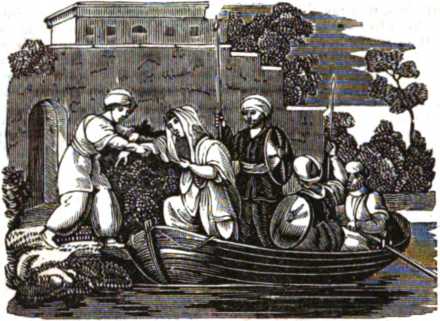
For my part, I spent the day in great uneasiness, and when night came, opening a small private gate, I espied a little boat on the canal which seemed driven by the stream. I called to the waterman and desired him to row up each side of the river, and look if he could see a lady; if he found her, to bring her along with him. The two slaves and I waited impatiently for his return, and at length about midnight, we saw the boat coming down with two men in it and a woman lying along in the stern. When the boat was come up, the two men helped the woman to rise, and then it was I knew her to be Schemselnihar. I cannot express my joy at seeing her.
I gave my hand to Schemselnihar to help her out of the boat; she had great need of my assistance, for she could hardly stand. When she was landed, she whispered to me in a tone expressive of her affliction, and bid me go and take a purse of a thousand pieces of gold and give to the two soldiers that had accompanied her. I committed her to the two slaves to support her, and having ordered the two soldiers to wait for me a moment, I took the purse, and returned instantly: I gave it to the soldiers, and having paid the waterman, shut the door.
I then followed my lady, and overtook her before she was got up to her chamber. We immediately undressed her, and put her to bed, where she had not long been, before she seemed ready to give up the ghost all the rest of the night. The day following, her other women expressed a great desire to see her; but I told them she had been greatly fatigued, and wanted rest to restore her strength. The other two women and I gave her all the assistance in our power, and that she could expect from our attention. She persisted in taking nothing that we offered her: and we should have despaired of her life, if I had not at last perceived that the wine which we gave her every now and then had a sensible effect in restoring her strength. By importunity we overcame her obstinacy, and at length prevailed with her to eat.
When she came to the use of her speech, for she had hitherto only wept, groaned, and sighed, I begged of her to tell me how she had escaped out of the hands of the robbers. Why would you require of me, said she, with a profound sigh, to renew my grief? Would to God the robbers had taken away my life, rather than preserved it; my misfortunes would then have had an end, whereas I live but to increase my sufferings.
Madam, replied I, I beg you would not refuse me this favour. You cannot but know that the wretched feel a consolation in relating their greatest misfortunes; what I ask would alleviate yours, if you will have the goodness to gratify me.
Hear then, said she, the most afflicting adventure that could possibly have happened to one so deeply in love as myself, who considered myself as at the utmost point of my wishes. You must know, when I first saw the robbers enter, sword in hand, I considered it as the last moment of our lives; but death was not an object of regret, since I thought I was to die with the prince of Persia. However, instead of murdering us, as I expected, two of the robbers were ordered to take care of us, whilst their companions were busied in packing up the goods they found in the house. When they had done, and got their bundles upon their backs, they went out, and carried us along with them.
As we went along, one of those that had charge of us demanded of me who I was. I answered, I was a dancer. He put the same question to the prince, who replied, he was a citizen.
When we were come to the place whither they were going, a new alarm seized us. They gathered about us, and after having considered my dress, and the rich jewels I was adorned with, they seemed to doubt that I disguised my quality. Dancers, said they, do not use to be dressed as you are. Tell us truly who you are.
When they saw I answered nothing, they asked the prince once more who he was, for they told him they plainly perceived he was not the person he pretended to be. He did not satisfy them much more than I had done: he only told them he came to see the jeweller, naming him who was the owner of that house where they found them. I know this jeweller, replied one of the rogues, who seemed to have some authority over the rest: I have some obligations to him, which he knows nothing of, and I take upon me to bring him hither to-morrow morning, from another house he has: but you must not expect, continued he, to be released till he comes and tells us who you are: in the mean time, I promise you there shall be no injury offered to you.
The jeweller was brought next morning, who thinking to oblige us, as he really did, declared to the robbers the whole truth. They immediately came and asked my pardon, and I believe did the like to the prince, who was shut up in another room. They protested to me they would not have broken open the house where we were, had they known it was the jeweller’s. They soon after took us, (the prince, the jeweller, and myself,) carried us to the river side, put us aboard the boat, and rowed us across the water: but we were no sooner landed, than a party of horse patrol came up to us.
The robbers fled: I took the commander aside, and told him my name, and that the night before I had been seized by robbers, who forced me along with them; but having been told who I was, released me, and the two persons he saw with me, on my account. He alighted out of respect to me, and, expressing great joy for being able to oblige me, he caused two boats to be brought, putting me and two of his soldiers, whom you have seen, into one, escorted me hither, and the prince and jeweller, with two others, in another, to conduct them home in safety. My guides have conducted me hither; but what is become of the prince and his friend I cannot tell.
I trust, added she, melting into tears, no harm has happened to them since our separation; and I do not doubt, but the prince’s concern for me is equal to mine for him. The jeweller, to whom we have been so much obliged, ought to be recompensed for the loss he has sustained on our account. Fail not, therefore, to take two purses of a thousand pieces of gold in each, and carry them to him to-morrow morning in my name, and be sure to inquire after the prince’s welfare.
When my good mistress had done speaking, I endeavoured, as to the last article of inquiring into the prince’s welfare, to persuade her to endeavour to triumph over her passion, after the danger she had so lately escaped almost by miracle. —Make no answer to me, said she, but do what I command you.
I was obliged to be silent, and am come hither to obey her commands. I have been at your house, and not finding you at home, and uncertain as I was of finding where you were said to be, was about going to the prince of Persia; but not daring to attempt the journey, I have left the two purses with a particular friend of mine, and if you will wait here, I will go and fetch them immediately.
The confidant returned quickly to the jeweller in the mosque, where she had left him, and giving him the two purses, bid him out of them satisfy his friends. They are much more than is necessary, said the jeweller, but I dare not refuse the present from so good and generous a lady to her very humble servant; but I beseech you to assure her from me, that I shall preserve an eternal remembrance of her goodness. He then agreed with the confidant, that she should find him at the house where she had first seen him, whenever she had occasion to impart any thing from Schemselnihar, or to hear any tidings of the prince of Persia: and so they parted.
The jeweller returned home very well satisfied, not only that he had got wherewithal so fully to satisfy his friends, but also to think that no person in Bagdad could possibly know that the prince and Schemselnihar had been in his house when it was robbed. It is true, he had acquainted the thieves with it, but their secresy he thought he might very well depend on: they, he imagined, had not sufficient communication with the world to fear any danger from their divulging it. Next morning he visited the friends who had obliged him, and found no difficulty in satisfying them. He had money in hand to furnish his other house, in which he placed servants. Thus he forgot all his past danger, and the next evening waited on the prince of Persia.
The prince’s domestics told the jeweller, that he came in very luckily, for that the prince ever since he saw him was reduced to such a state that his life was in danger, and they had not been able to get a word out of him. They introduced him softly into his chamber, and he found him in a condition that excited his pity. He was lying upon his bed, with his eyes shut; but when the jeweller saluted him, and exhorted him to take courage, he recollected him, and opened his eyes, and gave him a look that sufficiently declared the greatness of his affliction, infinitely beyond what he felt after he first saw Schemselnihar. He took and grasped him by the hand, to testify his friendship, and told him in a feeble voice, that he was extremely obliged to him, for coming so far to seek one so unhappy and wretched.
Prince, replied the jeweller, mention not, I beseech you, any obligations you have to me: I wish the good offices I have endeavoured to do you had had a better effect: but at present, let us talk only of your health; which, in the state I see you, I fear you greatly injure, by unreasonably abstaining from proper nourishment.
The prince’s servants took this opportunity to tell him, it was with the greatest difficulty they had prevailed on their master to take the smallest refreshment, and that for some time he had taken nothing at all. This obliged the jeweller to entreat the prince to let his servants bring him something to eat; which he obtained after much importunity.
After the prince had eaten more than he had hitherto done, through the persuasion of the jeweller, he commanded the servants to leave him alone with his friend. When the room was clear, he said, Besides my misfortune that distracts me, I have been exceedingly concerned to think what a loss you have suffered on my account; and it is but just I should make you some recompense; but before I do this, after begging your pardon a thousand times, I conjure you to tell me whether you have learnt any thing of Schemselnihar, since I had the misfortune to be parted from her.
Here the jeweller, instructed by the confidant, related to him all that he knew of Schemselnihar’s arrival at her palace, her state of health from that time till she recovered, and how she had sent her confidant to him to inquire after his welfare.
To all this the prince replied only by sighs and tears; he made an effort to get up, and calling his servants, went himself to his wardrobe, and having caused several bundles of rich furniture and plate to be packed up, he ordered them to be carried to the jeweller’s house.
The jeweller would fain have declined this kind offer: but although he represented that Schemselnihar had already made him more than sufficient amends for what he had lost, the prince would be obeyed. The jeweller was therefore obliged to make all possible acknowledgments, and protested how much he was confounded at his highness’s liberality. He would then have taken his leave, but the prince desired him to stay, and so they passed a good part of the night in talking together.
Next morning, the jeweller waited again on the prince, who made him sit down by him. You know, said he, there is an end proposed in all things: the end the lover proposes, is, to enjoy the beloved object in spite of all opposition. If once he loses that hope, he must not think to live. Such is my hard case; for when I had been twice at the very point of fulfilling my desires, I was on a sudden torn from her I loved in the most cruel manner imaginable. It remains for me only to think of death, and I had sought it, but that our holy religion forbids suicide; but I need not anticipate it; I need not wait long. Here he stopped, and vented his passion in groans, signs, sobs, and tears, which flowed plentifully.
The jeweller, who knew no better way of diverting him from his despair than by bringing Schemselnihar into his mind, and giving him some shadow of hope, told him, he feared the confidant might be come from her lady, and therefore it would not be proper to stay any longer from home. I will let you go, said the prince, but conjure you that if you see her, you recommend to her, to assure Schemselnihar, that if I die, as I expect to do shortly, I shall love her to the last moment, even in the grave.
The jeweller returned home, and waited in expectation of seeing the confidant, who came some hours after, but all in tears, and in great affliction. The jeweller, alarmed, asked her what was the matter. She answered, that Schemselnihar, the prince, herself and he were all ruined. Hear the sad news, said she, as it was told me just upon my entering the palace after I had left you.
Schemselnihar had for some fault chastised one of the slaves you saw with her when we met in your other house; the slave enraged at the ill treatment, ran presently away, and finding the gate open, went forth; so that we have just reason to believe, she has discovered all to an eunuch of the guard who has given her protection.
But this is not all; the other slave, her companion, is fled too, and has taken refuge in the caliph’s palace; so that we may well fear she has borne her part in this discovery: for just as I came away, the caliph had sent twenty of his eunuchs for Schemselnihar, and they carried her to the palace. I just found means to come and tell you this. I know not what has passed, yet I fear no good; but, above all, I recommend it to you as a secret.
The confidant added to what she had said before to the jeweller, that it was proper he should go immediately and acquaint the prince with the whole affair, that he might be prepared for every event, and keep faithful to the common cause. She went away in haste, without staying for any answer.
What answer could the jeweller have made in the condition he was in? He stood motionless as if thunderstruck. He found, however, that there was no time to be lost, and immediately went to give the prince an account. He addressed himself to him with an air that sufficiently showed the bad news he brought him. Prince, said he, arm yourself with courage and patience, and prepare to receive the most terrible shock that ever you had to encounter.
Tell me in a few words, said the prince, what is the matter, without keeping me in suspense: I am prepared to die if necessary. Then the jeweller told him all that he had learnt from the confidant. You see, continued he, your destruction is inevitable. Up, rise, save yourself by flight, for the time is precious. You, of all men, must not expose yourself to the anger of the caliph, and should much less confess any thing in the midst of torments.
At these words, the prince was almost ready to expire through grief, affliction, and fear; however, he recovered himself, and asked the jeweller, what resolution he would advise him to take in this conjuncture, every moment of which was to be made use of. The jeweller told him, he thought nothing remained but that he should immediately take horse, and haste away towards Anbar, [82] that he might get thither before day. Take what servants and swift horses you think necessary, continued he, and suffer me to escape with you.
The prince, seeing nothing more to be done, immediately gave orders to prepare such an equipage as would be least troublesome, took money and jewels, and having taken leave of his mother, he departed with the jeweller, and such servants as he had chosen.
They travelled all that day and the night following without stopping; till at length, about two or three hours before daybreak, both their horses and themselves being spent with so long a journey, they stopt to rest themselves.
They had hardly sat down before they found themselves surrounded and assaulted by a great band of robbers. They defended their lives for some time courageously; but, at length, the prince’s servants being all killed, both he and the jeweller were obliged to yield at discretion. The robbers, however, spared their lives; but after they had seized on the horses and baggage, they took away their clothes, and left them naked on the spot.
When the thieves were gone from them, the prince said to the jeweller, What think you of our adventure and condition? Had I not better have tarried in Bagdad, and awaited my death? Prince, replied the jeweller, it is the decree of heaven that we should thus suffer. It has pleased God to add affliction to affliction, and we must not murmur at it, but receive his chastisements with submission. Let us stay no longer here, but seek for some retreat where we may perhaps be relieved.
Let me die, said the prince; for what signifies it whether I die here or elsewhere? perhaps, while we are talking, Schemselnihar is no more; and why should I endeavour to live after she is dead? The jeweller by his entreaty at length prevailed on him, and they had not gone far before they came to a mosque, which was open; they entered it, and passed there the remainder of the night.
At daybreak a man came into the mosque. When he had ended his prayer, as he turned about to go away, he perceived the prince and jeweller, who were sitting in a corner. He came up to them, and after having saluted them with a great deal of civility, said, I perceive you are strangers.
The jeweller answered, You are not deceived; we have been robbed to-night in coming from Bagdad, as you may see, and are retired hither for shelter, but we know not whom to apply to. If you think fit to come along with me to my house, answered the man, I will give you all the assistance in my power.
Upon this obliging offer, the jeweller turned to the prince, and whispered him, This man, as you perceive, sir, does not know us; and we have reason to fear, that somebody else may come who may know us. We cannot, I think, refuse his offer. Do as you please, said the prince; I am willing to be guided by your discretion.
The man observing the prince and jeweller consulting together, and thinking they made some difficulty to accept his offer, asked them if they were resolved what to do. The jeweller answered, We are ready to follow you; all that we make a difficulty about is, that we are ashamed to appear thus naked.
Fortunately the man had it in his power to cover them sufficiently till they could get to his house; and they were no sooner got to the house, but he brought forth a very handsome suit for each of them. As he thought they must be hungry, and wish to be alone, he had several dishes brought to them by a slave; but they ate little, especially the prince, who was so dejected and dispirited, that he gave the jeweller cause to fear he would die. Their host visited them several times in the day, and in the evening, as he knew they wanted rest, he left them early; but he was no sooner in bed, than the jeweller was forced to call him again to assist at the death of the prince of Persia. He found him breathe short, and with difficulty, which gave him just reason to fear he had but few minutes to live. Coming near him, the prince said, It is all over, and I am glad you are witness of my last words. I quit life with a great deal of satisfaction; I need not tell you the reason, for you know it already. All my concern is, that I cannot die in the arms of my dear mother, who has always loved me tenderly, and for whom I had a reciprocal affection. She will undoubtedly not be a little grieved that she could not close my eyes, and bury me with her own hands. Let her know how much I was concerned at this, and pray her in my name to have my body transported to Bagdad, that she may have an opportunity to bedew my tomb with her tears, and assist my departed soul with her prayers. He then took notice of the master of the house, and thanked him for his kindness in taking him in; and after desiring him to let his body rest with him till it should be conveyed to Bagdad, he expired.
The day after the prince’s death, the jeweller took the opportunity of a numerous caravan that was going to Bagdad, and arrived there soon after in safety. He first went home to change his clothes, and then hastened to the prince’s palace, where every body was alarmed at not seeing the prince with him. He desired them to acquaint the prince’s mother, that he wished to speak with her, and it was not long before he was introduced to her in a hall, with several of her women about her. Madam, said he to her, with an air that sufficiently denoted the ill news he brought, God preserve you, and shower down the choicest of his blessings upon you. You cannot be ignorant that he alone disposes of us at his pleasure.