ARABIAN NIGHTS’ (continued 3)
Reading edition · Edition 2
The enchantress, filled with hopes from these words, cried out in a transport of joy, My heart! my soul! you shall soon be restored to your health, for I will immediately do what you command me. Accordingly she went that moment; and when she came to the brink of the pond, she took a little water in her hand, and sprinkling it —Here Scheherazade saw day, and stopped.
Dinarzade says to the sultaness, Sister, I am much rejoiced to hear that the young king of the four Black Islands was disenchanted, and I already consider the town and the inhabitants as restored to their former state; but I long to know what will become of the enchantress. Have a little patience, replies the sultaness; you shall have the satisfaction you desire tomorrow, if the sultan, my lord, will consent to it. Schahriar, having resolved on this already, as was said before, rose up, and went about his business.
TWENTY-SEVENTH NIGHT.
At the usual hour, Dinarzade called upon the sultaness thus: Dear sister, pray tell us what was the fate of the magician queen, as you promised us. Upon which Scheherazade went on thus: The enchantress had no sooner sprinkled the water, and pronounced some words over the fishes and the pond, but the city was immediately restored. The fishes became men, women, and children: Mahometans, Christians, Persians, or Jews; freemen or slaves, as they were before; every one having recovered their natural form. The houses and shops were immediately filled with their inhabitants, who found all things as they were before the enchantment. The sultan’s numerous retinue, who found themselves encamped in the largest square, were astonished to see themselves in an instant in the middle of a large, handsome, well-peopled city.
To return to the enchantress: as soon as she had effected this wonderful change, she returned with all diligence to the Palace of Tears, that she might reap the fruits of it. My dear lord, cried she, as she entered, I come to rejoice with you for the return of your health. I have done all that you required of me; then pray rise, and give me your hand. Come near, said the sultan, still counterfeiting the language of the blacks. She did so. You are not near enough, replied he; come nearer. She obeyed. Then he rose up, and seized her by the arm so suddenly, that she had not time to discover who it was, and with a blow of his scimitar cut her in two, so that one half fell one way and the other another. This done, he left the carcass upon the place; and going out of the Palace of Tears, he went to seek the young king of the Black Isles, who waited for him with great impatience; and when he found him, Prince, said he, embracing him, rejoice; you have nothing to fear now, your cruel enemy is dead.
The young prince returned thanks to the sultan in such a manner as shewed that he was thoroughly sensible of the kindness that he had done him, and in return, wished him a long life and all happiness. You may henceforward, said the sultan, dwell peaceably in your capital, except you will go to mine, which is so near, where you shall be very welcome, and have as much honour and respect shewn you as if you were at home. Potent monarch, to whom I am so much indebted, replied the king, you think, then, that you are very near your capital? Yes, said the sultan, I know it; it is not above four or five hours’ journey. It will take you a whole year’s journey, said the prince. I do believe, indeed, that you came hither from your capital in the time you spoke of, because mine was enchanted; but since the enchantment is taken off, things are changed: however, this shall not prevent my following you, were it to the utmost corners of the earth. You are my deliverer; and that I may give you proofs of my acknowledging this during my whole life, I am willing to accompany you, and to leave my kingdom without regret.
The sultan was extremely surprised to understand that he was so far from his dominions, and could not imagine how it could be. But the young king of the Black Isles convinced him beyond the possibility of doubt. Then the sultan replied, It is no matter, the trouble of returning to my own country is sufficiently recompensed by the satisfaction of having obliged you, and by acquiring you for a son: for since you will do me the honour to accompany me, as I have no child, I look upon you as such; and from this moment I appoint you my heir and successor.
This discourse between the sultan and the king of the Black Islands concluded with the most affectionate embraces; after which the young prince was totally taken up in making preparations for his journey, which were finished in three weeks’ time, to the great regret of his court and subjects, who agreed to receive at his hands one of his nearest kindred for their king.
At last the sultan and the young prince began their journey, with a hundred camels laden with inestimable riches from the treasury of the young king, followed by fifty handsome gentlemen on horseback, perfectly well mounted and dressed. They had a very happy journey; and when the sultan, who had sent couriers to give advice of his delay, and of the adventure which had occasioned it, came near his capital, the principal officers he had left there came to receive him, and to assure him that his long absence had occasioned no alteration in his empire. The inhabitants came out also in great crowds, receiving him with acclamations, and made public rejoicings for several days.
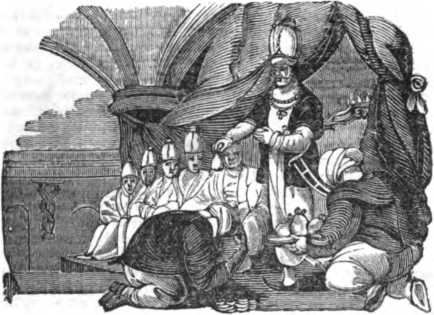
Next day after his arrival, the sultan gave all his courtiers a very ample account of the events which, contrary to his expectation, had detained him so long. He acquainted them with his having adopted the king of the four Black Islands, who was willing to leave a great kingdom, to accompany and live with him; and, in short, in reward of their loyalty, he made each of them presents according to their rank.
As for the fisherman, as he was the first cause of the deliverance of the young prince, the sultan gave him a plentiful fortune, which made him and his family happy the rest of their days.
Here Scheherazade made an end of the story of the Fisherman and the Genie. Dinarzade signified that she had taken a great deal of pleasure in it; and Schahriar having said the same thing, the sultaness told them, that she knew another which was much finer, and if the sultan would give her leave, she would tell it them next morning, for day began to appear. Schahriar, bethinking himself that he had granted the sultaness a month’s reprieve, and being curious moreover to know if this new story would be as agreeable as she promised, got up, with a desire to hear it next night.
TWENTY-EIGHTH NIGHT.
Dinarzade, according to custom, did not forget to call the sultaness when it was time. Madam, said she, I know not what is the matter with me, but I know very well, that one of the stories which you tell so agreeably would be a great relief against that melancholy which eats me up. Scheherazade, without answering her, began immediately, and told the sultan the following story:
The Story of the Three Calendars, [3] sons of Kings, and of the Five Ladies of Bagdad.
Sir, said she, in the reign of Caliph Haroun Alraschid, there was at Bagdad, the place of his residence, a porter, who, notwithstanding his mean and laborious business, was a fellow of wit and good humour. One morning, as he was at the place where he usually plied, with a great basket, waiting for employment, a handsome young lady, covered with a great muslin veil, accosted him, and said, with a pleasant air, Hark ye, porter, take your basket, and follow me. The porter, charmed with those few words, pronounced in so agreeable a manner, took his basket immediately, set it on his head, and followed the lady, saying, O, happy day! O, day of good luck!
The lady stopped presently before a gate that was shut, and knocked: a Christian, with a venerable long white beard, opened the gate, and she put money into his hand, without speaking one word: but the Christian, who knew what she wanted, went in, and in a little time after brought a large jug of excellent wine. Take this jug, said the lady to the porter, and put it in your basket. This being done, she commanded him to follow her; and as she went on, the porter said still, O, happy day! this is a day of agreeable surprise and joy!
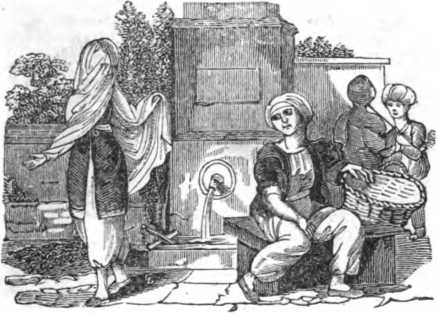
The lady stopped at a fruit shop, where she bought several sorts of apples, apricots, peaches, quinces, lemons, citrons, oranges, myrtles, sweet basil, lilies, jessamin, and some other sorts of flowers and fragrant plants; she bade the porter put all into his basket, and follow her. As she went by a butcher’s stall, she made him weigh her twenty-five pounds of his best meat, which she ordered the porter to put also into his basket. At another shop she took capers, tarragon, cucumbers, sasafras, and other herbs, to be preserved in vinegar; at another shop she bought pistachios, walnuts, filberts, almonds, kernels of pine apples, and such other fruits; and at another she bought all sorts of confectionary. When the porter had put all those things into his basket, and perceived that it grew full, My good lady, said he, you ought to have given me notice that you had so much provision to carry, and then I would have got a horse, or rather a camel, to have carried them; for if you buy ever so little more, I shall not be able to carry it. The lady laughed at the fellow’s pleasant humour, and ordered him still to follow her.
Then she went to a druggist, where she furnished herself with all manner of sweet-scented waters, cloves, musk, pepper, ginger, and a great piece of ambergris, and several other Indian spices. This quite filled the porter’s basket, and she ordered him to follow her. They walked till they came to a magnificent house, whose front was adorned with fine columns, and which had a gate of ivory. There they stopped, and the lady knocked softly. Here Scheherazade, perceiving day, broke off.
I must own, sister, says Dinarzade, the beginning of this story has a great deal of curiosity; I fancy the sultan will not deprive himself of the pleasure of hearing the rest of it. And, indeed, Schahriar was so far from ordering the sultaness to be put to death, that he longed impatiently for next night, to know what passed in the fine house.
TWENTY-NINTH NIGHT.
Dinarzade being awake before day, addressed the sultaness thus: Sister, if you be awake, I would pray you to continue the history you began yesterday; and Scheherazade went on with it thus:
While the young lady and the porter staid for the opening of the gate, the porter had a thousand thoughts: he wondered that such a fine lady should come abroad to buy provisions: he concluded she could not be a slave, her air was too noble; and therefore he thought she must needs be a woman of quality. Just as he was about to ask her some questions upon that head, another lady came to open the gate, and appeared to him so beautiful, that he was perfectly surprised, or rather so much struck with her charms, that he had like to have let his basket fall, for he had never seen any beauty that equalled her.
The lady who brought the porter with her, perceiving his disorder, and what occasioned it, diverted herself with it, and took so much pleasure to examine his looks, that she forgot the gate was opened. Upon this the beautiful lady said to her, Pray, sister, come in; what do you stay for? Do you not see this poor man so heavily laden, that he is scarcely able to stand under it?
When she entered with the porter, the lady who opened the gate shut it, and all three, after having gone through a very fine porch, came into a spacious court, encompassed with an open gallery, which had a communication with several apartments on a floor, and extraordinarily magnificent. There was at the farther end of the court a sofa richly adorned, with a throne of amber in the middle of it, supported by four columns of ebony, enriched with diamonds and pearls of an extraordinary size, and covered with red satin embroidered with Indian gold of admirable workmanship. In the middle of the court there was a great fountain, faced with white marble, and full of clear water, which fell into it abundantly out of the mouth of a lion of brass.
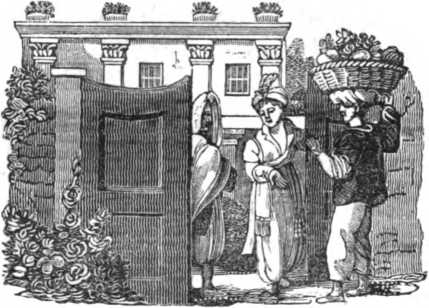
The porter, though heavy laden, could not but admire the magnificence of this house, and the excellent order that every thing was placed in; but that which particularly captivated his attention was a third lady, who seemed to be a greater beauty than the second, and was seated upon the throne just now mentioned. She came down from it, as soon as she saw the two former ladies, and advanced towards them; he judged by the respect which the others showed her, that she was the chief, in which he was not mistaken. This lady was called Zobeide, she who opened the gate was called Safie, and Amine was the name of her who went out to buy the provisions.
Zobeide said to the two ladies, when she came to them, Sisters, do not you see that this honest man is ready to sink under his burden? Why do not you ease him of it? Then Amine and Safie took the basket, the one before and the other behind, and Zobeide also lent her hand, and all three together set it on the ground; then emptied it; and when they had done, the beautiful Amine took out money, and paid the porter liberally. Day-light appearing, Scheherazade was obliged to keep silence; but Schahriar, having a great desire to hear the rest of the story, ordered the sultaness to go on with it next night.
THIRTIETH NIGHT.
Next morning Dinarzade being awaked by her impatience to hear the rest of the story, said to the sultaness: For the sake of heaven, sister, if you be not asleep, give us an account of what the ladies did with the provisions brought by Amine. You shall quickly hear it, said Scheherazade, if you listen to my story, which she resumed as follows:
The porter, very well satisfied with the money he had received, was to have taken up his basket, and be gone; but he could not tell how to think on it. Do what he could, he found himself stopped by the pleasure of seeing three such beauties, who appeared to him equally charming; for Amine having now laid aside her veil, was as handsome as either of them. What surprised him most was, that he saw no man about the house, yet most of the provisions he brought in, as the dry fruits, and the several sorts of cakes and confections, were fit chiefly for those who could drink and make merry.
Zobeide thought at first, that the porter staid only to take breath; but perceiving that he staid too long, What do you wait for? said she: are you not well enough paid? And turning to Amine, said, Sister, give him something more, that he may depart satisfied. Madam, replied the porter, it is not that which keeps me, I am over and above paid; I am sensible that I am unmannerly to stay longer than I ought, but I hope you will be so good as to pardon me, if I tell you, that I am astonished to see that there is no man with three ladies of such extraordinary beauty; and you know that a company of women without men is as melancholy a thing as a company of men without women. To this he added several other pleasant things, to prove what he said, and did not forget the Bagdad proverb, That the table is not completely furnished, except there be four in company: and so concluded that since they were but three, they wanted a fourth.
The ladies fell a laughing at the porter’s discourse; after which, Zobeide said to him very gravely, Friend, you are a little too bold; and though you do not deserve that I should enter into particulars with you, yet I am willing to tell you, that we are three sisters, who do our business so secretly, that no body knows any thing of it. We have too great reason to be cautious of acquainting indiscreet persons with it; and a good author that we have read, says, “Keep your secret and do not reveal it to any body. He that reveals it is no longer master of it. If your own breast cannot keep your secret, how do you think that another person will keep it?”
My ladies, replied the porter, by your very air, I judged at first that you were persons of extraordinary merit, and I conceive that I am not mistaken; though fortune has not given me wealth enough to raise me above my mean profession, yet I have not failed to cultivate my mind as much as I could, by reading books of science and history: and allow me, if you please, to tell you, that I have also read in another author a maxim which I have always happily practised: “We do not conceal our secrets,” says he, “but from such persons as are known to all the world to want discretion, and would abuse the confidence we put in them; but we make no scruple to discover them to prudent persons, because we know they can keep them.” A secret with me is as sure as if it were in a closet, whose key is lost, and the door sealed up.
Zobeide perceiving that the porter did not want sense, but conceiving he had a mind to share in their treat, she replied to him, smiling, You know that we are about to have a treat, and you know also that we have been at a considerable expense, and it is not just that you should have a share of it, without contributing towards it. The beautiful Safie seconded her sister, and said to the porter, Friend, have you never heard that which is commonly said, “If you bring any thing with you, you shall be welcome; but if you bring nothing, you must get you gone with nothing?”
The porter, notwithstanding his rhetoric, must in all probability have retired in confusion, if Amine had not taken his part, and said to Zobeide and Safie, My dearest sisters, I conjure you to let him stay with us; I need not tell you that he will divert us, you see well enough that he is capable of that; I must needs tell you, that unless he had been very willing, as well as nimble, and hardy enough to follow me, I could not have done so much business in so little time: besides, should I repeat to you all the obliging expressions he used to me by the way, you would not be surprised at my protecting him.
At these words of Amine, the porter was so much transported with joy, that he fell on his knees, kissed the ground at the feet of that charming person, and raising himself up, said, Most beautiful lady, you began my good fortune to-day, and now you complete it by this generous action; I cannot enough testify my acknowledgment for it. As to what remains, my ladies, said he, addressing himself to all three sisters, since you do me so great honour, do not think that I will abuse it, or look upon myself as a person that deserves it. No, I shall always look upon myself as one of your most humble slaves. When he had spoken these words, he would have returned the money he had received, but the grave Zobeide ordered him to keep it. That which we have once given, said she, to reward those who have served us, we never take again. —Here day began to dawn, which put Scheherazade to silence.
Dinarzade, who listened with a great deal of attention, was much troubled at it, but had this comfort, however, that the sultan, who was as curious as she to know what passed betwixt the three beautiful ladies and the porter, ordered the sultaness to go on with the rest of the story next night, and rose up to go about his business.
THIRTY-FIRST NIGHT.
The next morning, Dinarzade did not fail to awaken the sultaness at the ordinary time, and said, Dear sister, if you are not asleep, I would pray you, (until break of day, which is near at hand,) to go on with that agreeable story you began. Upon which Scheherazade addressed the sultan thus: Sir, with your leave, I am willing to satisfy my sister’s curiosity; and at the same time, went on with the story of the Three Calenders.
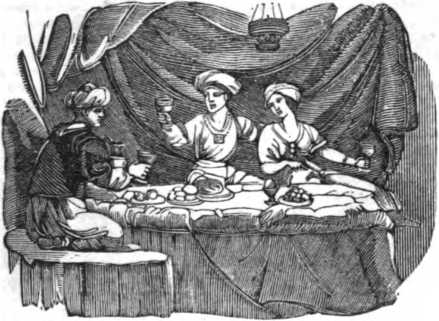
Zobeide would not take back the money from the porter, but said, My friend, in consenting that you stay with us, I must forewarn you, that it is not only on condition that you keep secret what we have required you, but also that you observe exactly the rules of good manners and civility. In the mean time the charming Amine put off the apparel she went abroad with, put on her night-gown that she might be more easy, and covered the table, which she furnished with several sorts of meat, and upon a side-board she set bottles of wine and cups of gold. Soon after the ladies took their places, and made the porter sit down by them, who was overjoyed to see himself at table with three such admirable beauties. After they had eaten a little, Amine, who sat next the sideboard, took up a bottle and a cup, filled out wine, and drank first herself, according to the custom of the Arabians; then she filled the cup to her sisters, who drank in course as they sat; and at last she filled it the fourth time to the porter, who, as he received it, kissed Amine’s hand; and before he drank, sung a song to this purpose: That as the wind brings along with it the sweet scents of the perfumed places through which it passes, so the wine he was going to drink, coming from her fair hands, received a more exquisite taste than what it had of its own nature. This song pleased the ladies so much, that each of them sung another in their turn. In short, they were very merry all dinner-time, which lasted a long while, and nothing was wanting that could make it agreeable. The day being almost spent, Safie spoke in the name of the three ladies, and said to the porter, Arise, and be gone; it is time for you to depart. But the porter, not willing to leave so good company, cried, Alas! ladies, whither do you command me to go in the condition I am in? I am quite beside myself, by what I have seen since I came hither, and having also drank above my usual quantity, I shall never find the way home: allow me this night to repose in any place where you please, for no less time is necessary for me to recover myself; but go when I will, I shall leave the best part of myself behind me.
Amine pleaded the second time for the porter, saying, Sisters, he is in the right; I am pleased with the request, he having already diverted us so well; and, if you will take my advice, or if you love me as much as I think you do, let us keep him, to pass away the remaining part of the night. Sister, answered Zobeide, we can refuse you nothing; and then turning to the porter, said, We are willing once more to grant your request, but upon this new condition, that whatever we do in your presence relating to ourselves or any thing else, take heed you do not once open your mouth to ask the reason of it; for if you ask questions about that which does not belong to you, you may chance to know that which will be no way pleasing to you; beware, therefore, and do not be too curious to dive into the motives of our actions.
Madam, replied the porter, I promise to observe this condition with such exactness, that you shall have no cause to reproach me with breaking it, and far less to punish my indiscretion: my tongue shall be immoveable on this occasion, and my eye like a looking-glass, which retains nothing of the object that is set before it. And to show you, said Zobeide with a serious countenance, that what we demand of you is not a new thing among us, rise up, and read what is written over our gate on the inside.
The porter went thither, and read these words, written in large characters of gold: “He who speaks of things that do not concern him, shall hear of things that will not please him.” Returning again to the three sisters, Ladies, said he, I give you my oath, that you shall never hear me speak any thing which does not concern me, or wherein you may have any concern.
This agreement being made, Amine brought in supper, and after the room was set round with tapers, that were mixed with aloes and ambergris, which gave a most agreeable scent, as well as a delicate light, she sat down at table with her sisters and the porter. They began again to eat and drink, sing, and repeat verses. The ladies took pleasure to fuddle the porter, under pretext of causing him to drink their healths, and abundance of witty sentences passed on both sides. In short, as they were all in the best humour in the world, they heard a knocking at the gate.
Scheherazade was obliged to stop here, because she observed day-light appearing.
The sultan, not doubting the sequel of this history deserved to be heard, put it off till the day following, and so arose.
THIRTY-SECOND NIGHT.
The next night being almost at an end, Dinarzade called to the sultaness; for heaven’s sake, sister, if you are awake, let me pray you to continue the story of the three fair ladies: I am very impatient till I know who it was that knocked at their gate. You shall hear it immediately, said she; I am sure that what I am now going to relate is worthy of my lord the sultan’s attention.
When the ladies, said she, heard the knocking, they all three got up to open the gate; but Safie, to whom this office particularly belonged, was the nimblest; which her other two sisters perceiving, sat down till she came back, to acquaint them who it could be that had any business with them so late. Safie returning, said, Sisters, we have here a very fine opportunity to pass a good part of the night with much satisfaction, and if you be of the same mind with me, we shall not let it slip. There are three calenders at our gate, at least they appear to be such by their habit; but that which you will most admire is, they are all three blind of the right eye, and have their heads, beards, and eye-brows shaved, and, as they say, are but just come to Bagdad, where they never were before; and it being night, and not knowing where to find any lodging, they happened by chance to knock at this gate, and pray us, for the love of heaven, to have compassion on them, and receive them into the house; they care not what place we put them in, provided they may be under shelter; they would be satisfied with a stable; they are young and handsome enough, and seem also to be men of good sense; but I cannot without laughing think of their pleasant and uniform figure. Here Safie fell a laughing so heartily, that it put the two sisters and the porter into the same mood. My dear sisters, said she, are you content that they come in? it is impossible but with such persons as I have already described them to be, we shall finish the day better than we began it; they will afford us diversion enough, and put us to no charge, because they desire shelter only for this night, and resolve to leave us as soon as day appears.
Zobeide and Amine made some difficulty to grant Safie’s request, for reasons they well knew; but she having so great a desire to obtain this favour, they could not refuse her. Go then, said Zobeide, and bring them in; but do not forget to acquaint them that they must not speak of any thing which does not concern them, and cause them to read what is written over the gate. Safie ran out with a great deal of joy, and in a little time after returned with the three calenders in her company.
At their entrance they made a profound bow to the ladies, who rose up to receive them, told them most obligingly that they were very welcome, that they were glad to have met with an opportunity to oblige them, and to contribute towards relieving them from the fatigue of their journey, and at last invited them to sit down with them.
The magnificence of the place, and the civility they received in it, made the calenders conceive a great idea of these handsome ladies; but, before they sat down, having by chance cast their eyes upon the porter, whom they saw clad almost like one of those other calenders with whom they are in controversy about several points of discipline, because they never shave their beards nor eyebrows; one of them said, Look here, I believe we have got one of our revolted Arabian brethren.
The porter being half asleep, and having his head warm with wine, was affronted at these words, and with a fierce look, without stirring from his place, answered, Sit you down, and do not meddle with what does not concern you. Have you not read the inscription over the gate? Do not pretend to make people live after your fashion, but follow ours.
Honest man, said the calender, do not put yourself in a passion; we should be very sorry to give you the least occasion; on the contrary, we are ready to receive your commands. Upon which, to put an end to the dispute, the ladies interposed, and pacified them. When the calenders sat down at table, the ladies served them with meat; and Safie, being most pleased with them, did not let them want for drink.
Scheherazade stopped her discourse, because she saw day appear, and the sultan got up to follow his affairs, and promised to hear the rest of the story next day; for he had a great desire to know why those three calenders were blind, and all three of the same eye.
THIRTY-THIRD NIGHT.
An hour before day, Dinarzade being awake, said to the sultaness, Dear sister, pray let me know what passed between the ladies and the calenders. With all my heart, replied Scheherazade, and continued her story in the manner following:
After the calenders had eaten and drank liberally, they signified to the ladies, that they had a great desire to entertain them with a concert of music, if they had any instruments in the house, and would cause them to be brought: they willingly accepted the proffer, and fair Safie going to fetch them, returned again in a moment, and presented them with a flute of her own country fashion, another of the Persian sort, and a tabor. Each man took the instrument he liked, and all three together began to play a tune. The ladies, who knew the words of a merry song that suited the air, joined the concert with their voices; but the words of the song made them now and then stop, and fall into excessive laughter.
In the height of this diversion, and when the company were in the midst of their jollity, somebody knocked at the gate. Safie left off singing, and went to see who it was. But, sir, said Scheherazade to the sultan, it is fit your majesty should know why this knocking happened so late at the ladies’ house. Now the reason was this: The Caliph Haroun Alraschid was accustomed to walk abroad in disguise very often by night, that he might see with his own eyes if every thing was quiet in the city, and that no disorders were committed in it.
This night the caliph went out pretty early on his rambles, accompanied by Giafar his grand vizier, and Mesrour the chief of the eunuchs of his palace, all disguised in merchant’s habits; and passing through the street where the three ladies dwelt, he heard the sound of the music and great fits of laughter; upon which he commanded the vizier to knock, because he would go in, to know the reason of that jollity. The vizier told him in vain, that it was some women merry making; that without question their heads were warm with wine, and that it would not be proper he should expose himself to be affronted by them; besides, it was not yet an unlawful hour, and therefore he ought not to disturb them in their mirth. —No matter, said the caliph, I command you to knock. So it was the grand vizier Giafar that knocked at the ladies’ gate by the caliph’s order, because he himself would not be known. Safie opened the gate, and the vizier perceiving, by the light that she held in her hand, that she was an incomparable beauty, he acted his part very well, and with a very low bow and respectful behaviour, told her, Madam, we are three merchants of Mossoul, who arrived about ten days ago with rich merchandize, which we have in a warehouse at a khan, or inn, where we have also our lodging. We happened this day to be with a merchant of this city, who invited us to a treat at his house, where we had a splendid entertainment; and the wine having put us in humour, he sent for a company of dancers. Night being come on, and the music and dancers making a great noise, the watch came by in the mean time, caused the gate to be opened, and some of the company to be taken up; but we had the good fortune to escape by getting over a wall. Now, said the vizier, being strangers, and somewhat overcome with wine, we are afraid of meeting another, and perhaps the same watch, before we get home to our khan, which lies a good way from hence. Besides, when we come there, the gates will be shut, and not opened till morning: wherefore, madam, hearing, as we passed by this way, the sound of music, we supposed you were not yet going to rest, and made bold to knock at your gate, to beg the favour of lodging ourselves in the house till morning; and if you think us worthy of your good company, we will endeavour to contribute to your diversion to the best of our power, to make some amends for the interruption we have given you; if not, we only beg the favour of staying this night under your porch.
Whilst Giafar held this discourse, fair Safie had time to observe the vizier and his two companions, who were said to be merchants like himself, and told them that she was not mistress of the house; but if they would have a minute’s patience, she would return with an answer.
Safie acquainted her sisters with the matter, who considered for some time what to conclude upon: but being naturally of a good disposition, and having granted the same favour to the three calenders, they at last consented to let them in. Scheherazade intending to continue her story, saw daylight appear, which made her break off: but the quality of these new actors which the sultaness had brought upon the stage excited the curiosity of Schahriar, who looking for some singular event, expected the next night with impatience.
THIRTY-FOURTH NIGHT.
Dinarzade, being as curious as the sultan to know what the arrival of the caliph at the house of those three ladies might produce, did not forget to awaken the sultaness very early next morning, and prayed her earnestly to resume the story of the calenders, whilst Scheherazade, with leave of the sultan, pursued in the following manner:
The caliph, his grand vizier, and the chief of the eunuchs, being introduced by the fair Safie, very courteously saluted the ladies and the calenders. The ladies returned them the like civilities, supposing them to be merchants. Zobeide, as the chief, said to them with a grave and serious countenance, which was natural to her, You are welcome. But before I proceed farther, I hope you will not take it ill if we desire one favour of you. —Alas! said the vizier, what favour? We can refuse nothing to such fair ladies. —Zobeide replied, It is, that you would only have eyes, but no tongues; that you put no question to us about the reason of any thing you may happen to see, and speak not of any thing that does not concern you, lest you come to hear of things that will by no means please you.
Madam, replied the vizier, you shall be obeyed. We are not censorious, nor impertinently curious; it is enough for us to take notice of that which concerns us, without meddling with that which does not belong to us. Upon this they all sat down, and the company being united, they drank to the health of the new comers.
While the vizier Giafar entertained the ladies in discourse, the caliph could not forbear admiring their extraordinary beauty, graceful behaviour, pleasant humour, and ready wit; on the other hand, nothing was more surprising to him than the calenders being all three blind of the right eye. He would gladly have been informed of this singularity; but the conditions so lately imposed upon himself and his companions would not allow him to speak. This, with the richness of the furniture, the exact order of every thing, and the neatness of the house, made him think it was some enchanted place.
Their conversation happening to turn upon diversions and different ways of making merry, the calenders arose, and danced after their fashion, which augmented the good opinion the ladies had conceived of them, and procured them the esteem of the caliph and his companions.
When the three calenders had made an end of their dance, Zobeide arose, and taking Amine by the hand, said, Pray, sister, rise up, for the company will not take it ill if we use our freedom, and their presence need not hinder our performance of what we are wont to do. Amine, understanding her sister’s meaning, rose from her seat, carried away the dishes, the table, the flasks and cups, together with the instruments which the calenders had played upon.
Safie was not idle, but swept the room, put every thing again in its place, snuffed the candles, and put fresh aloes and ambergris to them, and then prayed the three calenders to sit down upon the sofa on one side, and the caliph with his companions on the other. As to the porter, she said to him, Get up and prepare yourself to serve in what we are going about; a man like you, who is one of the family, ought not to be idle. The porter, being somewhat recovered from his wine, got up immediately, and having tied the sleeve of his gown to his belt, answered, Here am I, ready to obey your commands in any thing. Very well, replied Safie, stay till you are spoken to; you shall not be idle very long. A little time after, Amine came in with a chair, which she placed in the middle of the room; and then went to a closet, which having opened, she beckoned to the porter, and said to him, Come hither and help me; which he obeying, entered the closet, and returned immediately, leading two black bitches, with each of them a collar and chain; they looked as if they had been severely whipped with rods, and he brought them into the middle of the room.
Then Zobeide rising from her seat between the calenders and the caliph, marched very gravely towards the porter:— Come on, said she, with a great sigh; let us perform our duty; then tucking up her sleeves above her elbows, and receiving a rod from Safie, Porter, said she, deliver one of the bitches to my sister Amine, and come to me with the other.
The porter did as he was commanded; the bitch that he held in his hand began to cry, and turning towards Zobeide, held her head up in a begging posture; but Zobeide, having no regard to the sad countenance of the bitch, which would have moved pity, nor her cries, that resounded through the house, whipped her with the rod till she was out of breath; and having spent her strength, that she could strike no more, she threw down the rod, and taking the chain from the porter, lifted up the bitch by her paws, and looking upon her with a sad and pitiful countenance, they both wept; after which, Zobeide, with her handkerchief, wiped the tears from the bitch’s eye, kissed her, returned the chain to the porter, bade him carry her to the place whence he took her, and bring her the other. The porter led back the whipped bitch to the closet, and receiving the other from Amine, presented her to Zobeide, who bade the porter hold her as he did the first, took up the rod, and treated her after the same manner; and when she had wept over her, dried her eyes, and kissed her, and returned her to the porter: but lovely Amine spared him the trouble of leading her back into the closet, and did it herself. The three calenders and the caliph, with his companions, were extremely surprised at this execution, and could not comprehend why Zobeide, after having so furiously whipped those two bitches, that by the mussulman religion are reckoned unclean animals, should cry with them, wipe off their tears, and kiss them: they muttered among themselves, and the caliph, who being more impatient than the rest, longed exceedingly to be informed of the cause of so strange an action, and could not forbear making signs to the vizier to ask the question; the vizier turned his head another way; but being pressed by repeated signs, he answered by others, that it was not yet time for the caliph to satisfy his curiosity.
Zobeide sat still some time in the middle of the room, where she had whipped the two bitches, to recover herself of the fatigue; and fair Safie called to her, Dear sister, will you not be pleased to return to your place, that I may also act my part? Yes, sister, replied Zobeide; and then went, and sat down upon the sofa, having the caliph, Giafar, and Mesrour on her right hand, and the three calenders, with the porter, on her left.
Here, said Scheherazade to the sultan, Sir, what has been hitherto told your majesty must, without doubt, appear very strange; but what yet remains is more wonderful; and I am persuaded your majesty will think so, if you will be pleased to give me leave to finish the story next night: the sultan agreed to it, and got up because it was day.
THIRTY-FIFTH NIGHT.
Dinarzade was no sooner awake next morning, but she called, Sister, if you are not asleep, pray continue the fine story of the three sisters. The sultaness remembering where she left off, addressed herself to the sultan, and went on as follows: Sir, after Zobeide sat down, the whole company was silent for a while; at last Safie, sitting on a chair in the middle of the room, spoke to her sister Amine —Dear sister, I conjure you to rise up; you know well enough what I would say. Amine rose, and went into another closet, near to that where the bitches were, and brought out a case covered with yellow satin, richly embroidered with gold, and green silk: she came near Safie, and opened the case, from whence she took a lute, and presented it to her; and after some time spent in tuning it, Safie began to play, and accompanying it with her voice, she sung a song about the torments that absence creates to lovers, with so much sweetness, that it charmed the caliph and all the company. Having sung with a great deal of passion and action, she said to lovely Amine, Pray take it sister, for I can do no more; my voice fails me: oblige the company with a tune, and a song, in my room. Very willingly, replied Amine, who, taking the lute from her sister Safie, sat down in her place.
Amine, after some small trial, to see whether the instrument was in tune, played and sung almost as long upon the same subject, but with so much vehemency, and she was so much affected, or rather transported, by the words of the song, that her strength failed her as she made an end of it.
Zobeide, willing to testify her satisfaction, said, Sister, you have done wonders, and we may easily see that you feel the grief you have expressed in so lively a manner. Amine was prevented from answering this civility, her heart being so sensibly touched at the same moment, that she was obliged, for air, to uncover her neck and breast, which did not appear so fair as might have been expected from such a lady as she, but on the contrary, black and full of scars, which frighted all the spectators. However, this gave her no ease, but she fell into a fit. —Here Scheherazade stopped, saying, Sir, I had almost forgot that it is day. With this she ended her discourse, and the sultan arose from bed. And though this prince had not resolved to defer the death of the sultaness, he could not, at this time, have determined to take away her life; his curiosity was so great to hear out the story, which had so many unheard-of events.
THIRTY-SIXTH NIGHT.
Dinarzade awaked her sister as formerly, saying, Dear sister, I pray you to continue the story of the ladies and the calenders. Upon which she resumed her discourse in the manner following:—
When Zobeide and Safie ran to help their sister, one of the calenders could not forbear to say, We had better have slept in the streets than have come hither, had we thought to have seen such spectacles. The caliph, who heard this, came to him and the other calenders, and asked them what might be the meaning of all this. They answered, Sir, we know no more than you do. What! says the caliph, are you not of the family? nor can you resolve us concerning the two black bitches, and the lady that fainted away, and has been so basely abused? Sir, said the calenders, this is the first time that ever we were in the house, and we came in but a few minutes before you.
This increased the caliph’s astonishment. It may be, says, he, this other man that is with you may know something of it. One of the calenders made a sign for the porter to come near, and asked him whether he knew why those two black bitches had been whipped, and why Amine’s bosom was so scarred? Sir, said the porter, I can swear by heaven, that if you know nothing of all this, I know as little as you do. It is true, I live in this city, but I never was in the house until now; and if you are surprised to see me here, I am as much to find myself in your company; —and that which increases my wonder is, that I have not seen one man with these ladies.
The caliph and his company, as well as the calenders, supposed the porter had been one of the family, and hoped he could inform them of what they desired to know; but finding he could not, and resolving to satisfy his curiosity, cost what it would, he said to the rest, Look ye, we are here seven men, and have but three women to deal with; let us try if we can oblige them to satisfy us, and if they refuse it by fair means, we are in a condition to force them to it.
The grand vizier Giafar was against this method, and shewed the caliph what might be the consequence of it; but, without discovering the prince to the calenders, addressed him as if he had been a merchant, thus: Sir, consider, I pray you, that our reputation lies at stake. You know very well upon what conditions these ladies were ready to receive us, and we also agreed to them; what will they say of us if we break them? We shall be still more to blame, if any mischief befall us, for it is not likely that they would demand such a promise of us, if they did not know themselves to be in a condition to make us repent the breaking of it.
Here the vizier took the caliph aside, and whispered to him thus: Sir, the night will soon be at an end; and if your majesty will only be pleased to have so much patience, I will take these ladies to-morrow morning, and bring them before your throne, where you may be informed of all that you desire to know. Though this advice was very judicious, the caliph rejected it, bade the vizier hold his tongue, and said he would not stay till then, but would have satisfaction in the matter presently.
The next business was to know who should carry the message. The caliph endeavoured to prevail with the calenders to speak first, but they excused themselves; and at last they agreed that the porter should be the man: and as they were consulting how to word this fatal question, Zobeide returned from her sister Amine, who was recovered of her fit, drew near them, and, having overheard them speaking pretty loud, and with some passion, said, Gentlemen, what is the subject of your discourse? what are you disputing about?
The porter answered immediately, Madam, these gentlemen pray you to let them understand wherefore you wept over your two bitches after you whipped them so severely, and how that lady’s bosom, who lately fainted away, comes to be so full of scars? This is what I am ordered to ask in their name.
At these words, Zobeide looked with a stern countenance; and, turning towards the caliph and the rest of the company, Is this true, gentlemen, said she, that you have given him order to ask me this question? All of them, except the vizier Giafar, who spoke not a word, answered, Yes. On which she told them, in a tone that sufficiently expressed her resentment, Before we granted you the favour of being received into our house, and to prevent all occasion of trouble from you, because we are alone, we did it upon condition that you should not speak of anything that did not concern you, lest you might come to hear that which would not please you; and yet, after having received and entertained you as well as we possibly could, you make no scruple to break your promise. It is true that our easy temper has occasioned this, but that shall not excuse you, for your proceedings are very unhandsome. As she spoke these words, she gave three hard knocks with her foot, and clapping her hands as often together, cried, Come quick. Upon this, a door flew open, and seven strong, sturdy black slaves, with scimetars in their hands, rushed in; every one seized a man, threw him on the ground, and dragged him into the middle of the room, in order to cut off his head.
We may easily conceive what a fright the caliph was in: he then repented, but too late, that he had not taken his vizier’s advice. In the mean time, this unhappy prince, Giafar, Mesrour, the porter, and the calenders, were upon the point of losing their lives by their indiscreet curiosity. —But before they would strike the fatal blow, one of the slaves said to Zobeide and her sisters, High, mighty, and adorable mistresses, do you command us to cut their throats? Stay, says Zobeide, I must examine them first. The frightened porter interrupted her thus: In the name of heaven, do not make me die for another man’s crime! I am innocent —they are to blame. Alas! said he, crying, how pleasantly did we pass our time! Those blind calenders are the cause of this misfortune; there is no town in the world but suffers wherever these inauspicious fellows come. Madam, I beg you not to destroy the innocent with the guilty, and consider, that it is more glorious to pardon such a wretch as I am, who have no way to help myself, than to sacrifice me to your resentment.
Zobeide, notwithstanding her anger, could not but laugh within herself at the porter’s lamentation; but, without answering him, she spoke a second time to the rest: Answer me, said she, and tell me who you are, otherwise you shall not live one moment longer. I cannot believe you to be honest men, nor persons of authority or distinction in your own countries; for if you were, you would have been modest and more respectful to us.
The caliph, who was naturally impatient, was infinitely more impatient than the rest, to find his life depend upon the command of a lady justly incensed; but he began to conceive some hopes, when he saw she would know who they were; for he imagined she would not take away his life, when once she came to be informed who he was; —therefore he spoke with a low voice to the vizier, who was near him, to declare speedily who he was; but the vizier, being more prudent, resolved to save his master’s honour, and not let the world know the affront he had brought upon himself by his own weakness; and therefore answered, We have what we deserve.
But if he would have spoke in obedience to the caliph, Zobeide did not give him time, for, having turned to the calenders, and seeing them all three blind with one eye, she asked if they were brothers. One of them answered, No, madam, no otherwise than as we are calenders; that is to say, as we observe the same rules. —Were you born blind of the right eye? replied she. No, madam, answered he; I lost my eye in such a surprising adventure, that it would be instructive to every body were it in writing. After that misfortune, I shaved my beard and eyebrows, and took the habit or a calender, which I now wear.
Zobeide asked the other two calenders the same question, and had the same answer; but he who spoke last added, Madam, to show you that we are no common fellows, and that you may have some consideration for us, be pleased to know, that we are all three sons of kings; and though we never met together till this evening, yet we have had tune enough to make that known to one another; and I assure you, that the kings from whom we derive our being made some noise in the world.
At this discourse, Zobeide assuaged her anger, and said to the slaves, Give them their liberty awhile, but stay here. Those who tell us their history, and the occasion of their coming, do them no hurt, let them go where they please: but do not spare those who refuse to give us that satisfaction. —Here Scheherazade stopped; and her silence, as well as day-light, giving the sultan to know that it was time for him to rise, he got up, and resolved to hear the rest of the story next night; for he was impatient to know who these three one-eyed calenders were.
THIRTY-SEVENTH NIGHT.
Dinarzade, who also took a great deal of pleasure to hear the sultaness’s stories, said to her, about the close of the following night, Dear sister, if you be not asleep, I conjure you to go on with the agreeable story of the three calenders.
Scheherazade asked leave of the sultan, and having obtained it, Sir, said she, the three calenders, the caliph, the grand vizier Giafar, the eunuch Mesrour, and the porter, were all in the middle of the hall, seated upon a foot-carpet, in the presence of the three ladies, who sat upon a sofa, and the slaves stood ready to do whatever their mistresses should command.
The porter, understanding that he might extricate himself from danger by telling his history, spoke first, and said, Madam, you know my history already, and the occasion of my coming hither; so that what I have to say will be very short. My lady, your sister there, called me this morning at the place where I plied as porter to see if any body would employ me, that I might get my bread. I followed her to a vintner’s, then to an herb-shop, then to one that sold oranges, lemons, and citrons, then to a grocer’s, next to a confectioner’s, and a druggist’s, with my basket upon my head as full as I was able to carry it: then I came hither, where you had the goodness to suffer me to continue till now, a favour that I shall never forget. This, madam, is my history.
When the porter had done, Zobeide said to him, Go, march, let us see you no more here. Madam, replied the porter, I beg you to let me stay: it would not be just, after the rest have had the pleasure to hear my history, that I should not also have the satisfaction to hear their’s. And, having spoken thus, sat down at the end of the sofa, glad at heart to have escaped the danger that had frightened him so much. After him, one of the three calenders, directing his speech to Zobeide, as the principal of the three ladies, and the person that commanded him to speak, began his story thus:—
The History of the First Calender, a King’s Son.
Madam, in order to inform you how I lost my right eye, and why I was obliged to put myself into a calender’s habit, I must tell you, that I am a king’s son born: the king my father had a brother that reigned, as he did, over a neighbouring kingdom; and the prince his son and I were nearly of the same age.
After I had learned my exercises, and the king my father granted me such liberty as suited my dignity, I went regularly every year to see my uncle, at whose court I amused myself for a month or two, and then returned again to my father’s. These several journies cemented a firm and intimate friendship between the prince my cousin and myself. The last time I saw him he received me with greater demonstrations of tenderness than he had done at any time before; and, resolving one day to give me a treat, he made great preparations for that purpose. We continued a long time at table; and after we had both supped, Cousin, said he, you will hardly be able to guess how I have been employed since your last departure from hence, now about a year past. I have had a great many men at work to perfect a design I have in my mind: I have caused an edifice to be built, which is now finished so as to be habitable; you will not be displeased if I show it you. But first you are to promise me, upon oath, that you will keep my secret, according to the confidence I repose in you.
The affection and familiarity that subsisted between us would not allow me to refuse him any thing. I very readily took the oath required of me: upon which he said to me, Stay here till I return —I will be with you in a moment; and accordingly he came with a lady in his hand, of singular beauty, and magnificently apparelled. He did not intimate who she was, neither did I think it was polite in me to inquire. We sat down again with this lady at table, where we continued some time, conversing upon indifferent subjects, and now and then filling a glass to each other’s health. After which the prince said, Cousin, we must lose no time; therefore pray oblige me by taking this lady along with you, and conducting her to such a place, where you will see a tomb newly built in form or a dome. You will easily know it, the gate is open; go in there together, and tarry till I come, which will be very speedily.
Being true to my oath, I made no farther inquiry, but took the lady by the hand, and, by the directions which the prince my cousin had given me, I brought her to the place, by the light of the moon, without missing one step of the way. We were scarcely got thither, when we saw the prince following after, carrying a little pitcher with water, a hatchet, and a little bag with plaster.
The hatchet served him to break down the empty sepulchre in the middle of the tomb; he took away the stones one after another, and laid them in a corner. When all this was taken away, he digged up the ground, where I saw a trap-door under the sepulchre, which he lifted up, and underneath perceived the head of a staircase leading into a vault. Then my cousin, speaking to the lady, said, Madam, it is by this way that we are to go to the place I told you of. Upon which the lady drew nigh, and went down, and the prince began to follow; but first, turning to me, said, My dear cousin, I am infinitely obliged to you for the trouble you have taken; I thank you. Adieu. I cried, Dear cousin, what is the meaning of this? Be content, replied he; you may return back the same way you came.
Scheherazade having proceeded thus far, saw day appear, which prevented her proceeding any farther. The sultan got up, but longed very much to know the design of the prince and his lady, who seemed as if they had a mind to bury themselves alive; and impatiently waited for next night, that he might be thoroughly informed of it.
THIRTY-EIGHTH NIGHT.
Dinarzade awaked the sultaness next night as usual, and prayed her to continue the history of the first calender. Schahriar having also signified to the sultaness, that it would be very pleasing to him, she resumed the thread of her discourse as follows:
Madam, said the calender to Zobeide, I could get nothing farther from him, but was obliged to take leave of him. As I returned to my uncle’s palace, the vapours of the wine got up into my head; however, I got to my apartment, and went to bed. Next morning, when I awaked, I began to reflect upon what had happened the night before; and after recollecting all the circumstances of such a singular adventure, I fancied it was nothing but a dream. Full of these thoughts, I sent to see if the prince, my cousin, was ready to receive a visit from me; but when they brought word back that he did not lie in his own lodgings that night, they knew not what was become of him, and were in much trouble about it, I conceived that the strange event of the tomb was but too true. I was sensibly afflicted at it; and stealing away privately from my people, I went to the public burying-place, where there was a vast number of tombs like that which I had seen. I spent the day in viewing them one after another, but could not find that I sought for, and thus I spent four days successively in vain.
You must know, that all this while the king my uncle was absent, and had been hunting for several days; and I grew weary of staying for him, and having prayed his ministers to make my apology to him at his return, I left his palace, and set out towards my father’s court, from which I had never been so long absent before. I left the ministers of the king my uncle in great trouble, to think what was become of the prince my cousin: but because of the oath I had made to keep his secret, I durst not tell them of any thing that I had seen or knew, in order to make them easy.
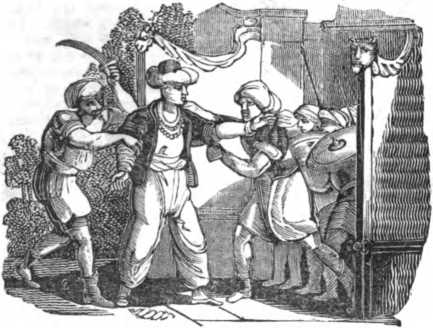
I arrived at my father’s capital, the usual place of his residence, where, contrary to custom, I found a great guard at the gate of the palace, who surrounded me as I entered. I asked the reason, and the commanding officer replied, Prince, the army has proclaimed the grand vizier king, instead of your father, who is dead, and I take you prisoner in the name of the new king. At these words the guards laid hold of me, and carried me before the tyrant. I leave you to judge, madam, how much I was surprised and grieved.
This rebel vizier had long entertained a mortal hatred against me, for this reason: when I was a stripling, I loved to shoot in a cross-bow; and being one day upon the terrace of the palace with my bow, a bird happening to come by, I shot, but missed him, and the ball by misfortune hit the vizier, who was taking the air upon the terrace of his own house, and put out one of his eyes. As soon as I understood it, I not only sent to make my excuses to him, but did it in person: yet he always resented it, and, as opportunity offered, made me sensible of it: but now, madam, that he had me in his power, he expressed his resentment in a very barbarous manner; for he came to me like a madman, as soon as ever he saw me, and thrusting his finger into my right eye, pulled it out himself; and so, madam, I became blind of one eye.
But the usurper’s cruelty did not stop here; he ordered me to be shut up in a box, and commanded the executioner to carry me into the country, to cut off my head, and leave me to be devoured by the birds of prey. The executioner and another man carried me thus shut up on horseback into the country, in order to execute the usurper’s barbarous sentence; but by my prayers and tears, I moved the executioner’s compassion. Go, said he to me, get you speedily out of the kingdom, and take heed of ever returning to it, otherwise you will certainly meet your own ruin, and be the cause of mine. I thanked him for the favour he did me; and as soon as I was left alone, I comforted myself for the loss of my eye, by considering that I had very narrowly escaped much greater danger.
Being in such a condition, I could not travel far at a time: I retired to remote places while it was day, and travelled as far by night as my strength would allow me. At last I arrived in the dominions of the king my uncle, and came to his capital.
I gave him a long detail of the tragical cause of my return, and of the sad condition he saw me in. Alas! cried he, was it not enough for me to have lost my son, but must I have news also of the death of a brother I loved so dearly, and see you also reduced to this deplorable condition? He told me how uneasy he was, that he could hear nothing of his son, notwithstanding all the diligence and inquiry he could make. At these words the unfortunate father burst out into tears, and was so much afflicted, that, pitying his grief, it was impossible for me to keep the secret any longer; so that, notwithstanding my oath to the prince my cousin, I told the king his father all that I knew.
His majesty listened to me with some sort of comfort; and when I had done, Nephew, said he, what you tell me gives me some hope. I knew that my son ordered that tomb to be built, and I can guess pretty near at the place; and with the idea you still have of it, I fancy we shall find it; but since he ordered it to be built privately, and you took your oath to keep his secret, I am of opinion that we ought to go in quest of it alone, without saying any thing. But he had another reason for keeping the matter secret, which he did not then tell me, and an important reason it was, as you will perceive by the sequel of my discourse.
We disguised ourselves, and went out by a door of the garden which opened into the field, and soon found what we sought for. I knew the tomb, and was the more rejoiced at it, because I had formerly sought it a long time in vain. We entered, and found the iron trap pulled down upon the entrance of the staircase; we had much ado to raise it, because the prince had fastened it on the inside with the water and plaster formerly mentioned, but at last we did get it up.
The king my uncle descended first, I followed, and we went down about fifty steps. When we came to the foot of the stairs, we found a sort of ante-chamber, full of a thick smoke, of an ill scent, which obscured the lamp that gave a very faint light.
From this ante-chamber we came into another, very large, supported by great columns, and lighted by several branched candlesticks. There was a cistern in the middle, and provisions of several sorts standing on one side of it; but we were very much surprised to see nobody. Before us there appeared an high sofa, which we mounted by several steps, and over this, there appeared a very large bed, with the curtains drawn close. The king went up, and opening the curtains, perceived the prince his son and the lady in bed together, but burnt and changed to a coal, as if they had been thrown into a great fire, and taken out again before they were consumed.
But what surprised me most of all was, that though this spectacle filled me with horror, the king my uncle, instead of testifying his sorrow to see the prince his son in such a frightful condition, spit on his face, and said to him with a disdainful air, ‘This is the punishment of this world, but that of the other will last to eternity;’ and not content with this, he pulled off his sandal, and gave his son a great blow on the cheek with it.
But, sir, said Scheherazade, it is day. I am sorry your majesty’s time will not allow you to hear me farther. This story appearing very strange to the sultan, he got up resolved to hear the rest of it next night.
THIRTY-NINTH NIGHT.
Dinarzade being awake sooner than ordinary, called her sister Scheherazade. My good sultaness, said she, I pray you make an end of your story of the first calender, for I am ready to die with impatience till I know the issue of it. Well then, said Scheherazade, you remember how the first calender continued his story to Zobeide: I cannot enough express, madam, said he, how much I was astonished when I saw the king my uncle abuse the prince his son thus after he was dead. Sir, said I, whatever grief this dismal sight is capable to impress upon me, I am forced to suspend it, on purpose to ask your majesty what crime the prince my cousin may have committed, that his corpse should deserve this sort of treatment? —Nephew, replied the king, I must tell you, that my son (who is unworthy of that name) loved his sister from his infancy, as she did him; I did not hinder their growing love, because I did not foresee the pernicious consequence of it. This tenderness increased as they grew in years to such a height, that I dreaded the end of it. At last I applied such remedies as were in my power. I not only gave my son a severe reprimand in private, laying before him the horrible nature of the passion he entertained, and the eternal disgrace he would bring upon my family, if he persisted in such criminal courses, but I also represented the same to my daughter; and I shut her up so close that she could have no conversation with her brother. But that unfortunate creature had swallowed so much of the poison, that all the obstacles which by my prudence I could lay in the way served only to inflame her love.
My son, being persuaded of his sister’s constancy, on pretence of building a tomb, caused this subterraneous habitation to be made, in hopes to find one day or other an opportunity to possess himself of that object which was the cause of his flame, and to bring her hither. He took advantage of my absence to enter by force into the place of his sister’s confinement; but this was a circumstance which my honour would not suffer me to make public: and after so damnable an action, he came and shut himself up with her in this place, which he has supplied, as you see, with all sorts of provisions, that he might enjoy his detestable pleasures for a long time, which ought to be a subject of horror to all the world; but God, who would not suffer such an abomination, has justly punished them both. At these words, he melted into tears, and I joined mine with his.
After a while, casting his eyes upon me, Dear nephew, cried he, embracing me, if I have lost that unworthy son, I shall haply find in you what will better supply his place. The reflections he made on the doleful end of the prince and princess his daughter, made us both fall into a new fit of weeping.
We went up the same stairs again, and departed at last from that dismal place. We let down again the trap-door, and covered it with earth, and such other materials as the tomb was built of, on purpose to hide, as much as lay in our power, so terrible an effect of the wrath of God.
We had not been very long got back to the palace, unperceived by any one, but we heard a confused noise of trumpets, drums, and other instruments of war. We soon understood by the thick cloud of dust, which almost darkened the air, that it was the arrival of a formidable army: and it proved to be the same vizier that had dethroned my father, and usurped his throne, who, with a vast number of troops, was also come to possess himself of that of the king my uncle.
That prince, who then had only his usual guards about him, could not resist so many enemies; they invested the city, and the gates being opened to them without any resistance, they very soon became masters of the city, and broke into the palace where the king my uncle was, who defended himself till he was killed, and sold his life at a dear rate: for my part, I fought as well as I could for a while; but seeing we were forced to submit to a superior power, I thought on my retreat and safety, which I had the good fortune to effect by some back ways, and got to one of the king’s servants, on whose fidelity I could depend.
Being thus surrounded with sorrows, and persecuted by fortune, I had recourse to a stratagem, which was the only means left me to save my life; I caused my beard and eyebrows to be shaved, and putting on a calender’s habit, I passed, unknown by any, out of the city; after that, by degrees, I found it easy to get out of my uncle’s kingdom, by taking the by-roads.
I avoided passing through towns, until I was got into the empire of the mighty governor of the mussulmen, the glorious and renowned Caliph Haroun Alraschid, when I thought myself out of danger; and considering what I was to do, I resolved to come to Bagdad, intending to throw myself at the feet of that monarch, whose generosity is every where applauded. I shall move him to compassion, said I to myself, by the relation of my extraordinary misfortunes, and without doubt he will take pity on such an unfortunate prince, and not suffer me to implore his assistance in vain.
In short, after a journey of several months, I arrived yesterday at the gate of this city, into which I entered about the dusk of the evening; and stopping a little while to revive my spirits, and to consider which way I was to turn, this other calender you see here next to me came up: he saluted me, and I him. —You appear, said I, to be a stranger, as I am. —You are not mistaken, replied he. He had no sooner returned this answer, but that third calender you see there overtook us. He saluted us, and told us he was a stranger newly come to Bagdad; so as brethren we joined together, resolving not to separate from one another.
Meanwhile it was late, and we knew not where to seek a lodging in the city, where we had no acquaintance, and had never been before. But good fortune having brought us before your gate, we made bold to knock, when you received us with so much kindness, that we are incapable to return you suitable thanks. This, madam, said he, is in obedience to your commands, the account I was to give you why I lost my right eye, wherefore my beard and eyebrows are shaved, and how I came to be with you at this present time.
It is enough, said Zobeide; you may retire to what place you think fit. The calender made his excuse, and begged the ladies’ leave to stay till he had heard the relations of his two comrades, whom I cannot, said he, leave with honour; and till he might also hear those of the three other persons that were in company.
Here Scheherazade said to the sultan, Sir, the daylight which you see prevents me from going on with the story of the second calender; but if your majesty will hear it to-morrow, you will find as much satisfaction in that as in the story of the first. To which the sultan gave consent, and so got up, in order to go to council.
FORTIETH NIGHT.
Dinarzade, not doubting to find as much delight in the story of the second calender as she had in the first, failed not to call upon the sultaness before day. If you be not asleep, sister, said she, I would pray you to begin the story that you promised me; upon which Scheherazade addressed her discourse to the sultan, and spoke as follows:
Sir, the story of the first calender seemed very strange to the whole company, but especially to the caliph; who, notwithstanding the slaves stood by with their scimeters in their hands, could not forbear whispering to the vizier —Many stories have I heard, but never any thing that came near the story of the calender. Whilst he was saying this, the second calender began, addressing his speech to Zobeide.
Story of the Second Calender, a King’s Son.
Madam, said he, to obey your command, and to show you by what strange accident I became blind of the right eye, I must of necessity give you the whole account of my life.
I was scarce past my infancy, when the king my father (for you must know, madam, I am a prince by birth) perceived that I was endowed with a great deal of sense, and spared nothing that was proper for improving it: he employed all the men in his dominions that excelled in science and art, to be constantly about me.
No sooner was I able to read and write, but I learnt the Alcoran from the beginning to the end by heart; that admirable book, which contains the foundation, the precepts, and the rules of our religion; and that I might be thoroughly instructed in it, I read the works of the most approved authors, by whose commentaries it had been explained. I added to this study that of all the traditions collected from the mouth of our prophet, by the great men that were contemporary with him. I was not satisfied with the knowledge of all that had any relation to our religion, but made also a particular search into our histories. I made myself perfect in polite learning, in the works of poets, and versification. I applied myself to geography, chronology, and to speak our Arabian language in its purity; not forgetting in the mean time all such exercises as were proper for a prince to understand. But one thing which I was fond of, and succeeded in to admiration, was, to form the characters of our Arabian language, wherein I surpassed all the writing masters of our kingdom that had acquired the greatest reputation.
Fame did me more honour than I deserved, for she not only spread the renown of my talents through all the dominions of the king my father, but carried it as far as the Indian court, whose potent monarch, desirous to see me, sent an ambassador with rich presents, to demand me of my father, who was extremely glad of this embassy for several reasons; he was persuaded that nothing could be more commendable in a prince of my age, than to travel and visit foreign courts; and he was very glad to gain the friendship of the Indian sultan. I departed with the ambassador, but with no great retinue, because of the length and difficulty of the journey.
When we had travelled about a month, we discovered at a distance a great cloud of dust, and under that we saw very soon fifty horsemen, well armed, that were robbers, coming towards us on full gallop. Scheherazade perceiving day, told the sultan of it, who got up; but desiring to know what passed between the fifty men on horseback and the Indian ambassador, this prince was somewhat impatient till next night came.
FORTY-FIRST NIGHT.
It was almost day when Dinarzade awoke next morning, and called to her sister, If you be not asleep, dear sister, I pray you continue the story of the second calender. Scheherazade began in this manner:
Madam, said the calender, (always speaking to Zobeide,) as we had ten horses laden with baggage and other presents, that I was to carry to the Indian sultan from the king my father, and my retinue was but small, you may easily judge that these robbers came boldly up to us; and not being in a posture to make any opposition, we told them, that we were ambassadors belonging to the sultan of the Indies, and hoped they would attempt nothing contrary to that respect that is due to them, thinking by this means to save our equipage and our lives: but the robbers most insolently replied, For what reason would you have us show any respect to the sultan your master? We are none of his subjects, nor are we upon his territories. Having spoken thus, they surrounded and fell upon us: I defended myself as long as I could; but finding myself wounded, and seeing the ambassador, with his servants and mine, lying on the ground, I made use of what strength was yet remaining in my horse, who was also very much wounded, and separated myself from the crowd, and rode away as fast as he could carry me; but he happening all of a sudden to fall under me, by weariness and the loss of blood, he fell down dead. I got rid of him in a trice; and finding that I was not pursued, it made me judge the robbers were not willing to quit the booty they had got.
Scheherazade, perceiving day coming on, was obliged to stop here. O sister, said Dinarzade, to-morrow I shall be more diligent, in hopes you will make reparation to the sultan for the loss that his curiosity has sustained through my neglect. Schahriar arose without saying one word, and went to his usual consultation.
FORTY-SECOND NIGHT.
Dinarzade failed not to call the sultaness a good while before day. My dear sister, said she, if you be not asleep, I pray you resume the story of the calender. I consent to it, said Scheherazade; and so continued it in these words:
Here you see me, said the calender, alone, wounded, destitute of help, and in a strange country: I durst not betake myself to the high road, fearing I might fall again into the hands of these robbers. When I had bound up my wound, which was not dangerous, I walked on the rest of the day, and arrived at the foot of a mountain, where I perceived a passage into a cave; I went in, and staid there that night with little satisfaction, after I had eaten some fruits that I gathered by the way.
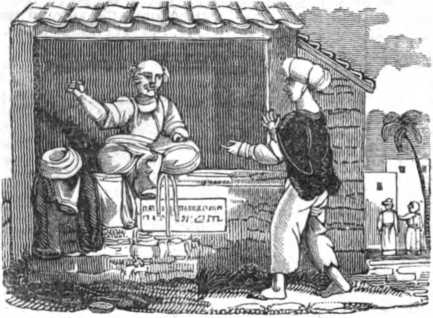
I continued my journey for several days following, without finding any place of abode; but after a month’s time, I came to a large town, well inhabited, and situated so much the more advantageously, as it was surrounded with several rivers, so that it enjoyed perpetual spring.
The pleasant objects which then presented themselves to my view afforded me some joy, and suspended for a time the sorrow with which I was overwhelmed to find myself in such a condition. My face, hands, and feet, were black and sun-burnt; and, by my long journey, my shoes and stockings were quite worn out, so that I was forced to walk bare-footed; and besides, my clothes were all in rags. I entered into the town to inform myself where I was, and addressed myself to a tailor that was at work in his shop; who, perceiving by my air that I was a person of more note than my outward appearance bespoke me to be, made me sit down by him, and asked me who I was, from whence I came, and what had brought me thither? I did not conceal any thing of all that had befallen me, nor made I any scruple to discover my quality.
The tailor listened with attention to my words; but after I had done speaking, instead of giving me any consolation, he augmented my sorrow. Take heed, said he, how you discover to any person what you have now declared to me; for the prince of this country is the greatest enemy that the king your father has, and he will certainly do you some mischief, when he comes to hear of your being in this city. I made no doubt of the tailor’s sincerity, when he named the prince: but since the enmity which is between my father and him has no relation to my adventures, I must beg your pardon, madam, if I pass it over with silence.
I returned the tailor thanks for his good advice, and showed myself inclinable wholly to follow his counsel, and assured him that his favours should never be forgotten by me. And as he believed I could not but be hungry, he ordered something to be brought for me to eat, and offered me at the same time a lodging in his house, which I accepted. Some days after, finding me pretty well recovered of the fatigue I had endured by a long and tedious journey, and reflecting that most princes of our religion did apply themselves to some art or calling that might be serviceable to them upon occasion, he asked me if I had learned any thing whereby I might get a livelihood, and not be burdensome to any man? I told him that I understood the laws, both divine and human; that I was a grammarian and poet; and above all, that I understood writing perfectly well. By all this, said he, you will not be able in this country to purchase yourself one morsel of bread: nothing is of less use here than those sciences; but if you will be advised by me, said he, dress yourself in a labourer’s habit; and since you appear to be strong, and of a good constitution, you shall go into the next forest, and cut fire wood, which you may bring to the market to be sold: and I can assure you it will turn to so good an account that you may live by it, without dependance upon any man; and by this means you will be in a condition to wait for the favourable minute, when Heaven shall think fit to dispel those clouds of misfortune that thwart your happiness, and oblige you to conceal your birth: I will take care to supply you with a rope and a hatchet.
The fear of being known, and the necessity I was under of getting a livelihood, made me agree to this proposal, notwithstanding all the meanness and hardships that attended it. The day following the tailor bought me a rope, a hatchet, and a short coat, and recommended me to some poor people who gained their bread after the same manner, that they might take me into their company. They conducted me to the wood, and the first day I brought in as much upon my head as brought me half a piece of gold, which is the money of that country: for though the wood is not far distant from the town, yet it was very scarce there, by reason that few or none would be at the trouble to go and cut it. I gained a good sum of money in a short time, and repaid my tailor what he had advanced for me.
I continued this way of living for a whole year; and one day, that by chance I was gone farther into the wood than usual, I happened to light on a very pleasant place, where I began to cut down wood; and in pulling up the root of a tree, I espied an iron ring, fastened to a trap-door of the same metal. I took away the earth that covered it, and having lifted it up, saw stairs, which I went down, with my axe in my band.
When I was come to the bottom of the stairs, I found myself in a large palace, which put me into great consternation, because of a great light, which appeared as clear in it as if it had been above ground, in the open air. I went forward along a gallery, supported by pillars of jasper, the base and capitals of massy gold; but seeing a lady of a noble and free air, and extremely beautiful, coming towards me, my eyes were taken off from beholding any other object but her alone.
Here Scheherazade stopped, because day appeared: but Dinarzade said, Dear sister, I confess I am extremely well pleased with what you have told us to-day, and I imagine that the following part must be no less surprising. —You are not mistaken, said the sultaness, for the remainder of this story of the second calender is better worth my ford the sultan’s attention, than all that he has hitherto heard. —I doubt that, said Schahriar, as he was getting up; but we shall know that to-morrow.
FORTY-THIRD NIGHT.
The sultaness being awakened as usual, gave the sultan an account that the second calender continued his story thus: Being desirous, said he, to spare the lady the trouble to come to me, I made haste to meet her: and as I was saluting her with a low bow, she asked me, What are you, a man or a genie? —A man, madam, said I: I have no correspondence with genies. —By what adventure, said she, fetching a deep sigh, are you come hither? I have lived here these twenty-five years, and never saw any man but yourself during that time.
Her great beauty, which had already smitten me, and the sweetness and civility wherewith she received me, emboldened me to say to her, Madam, before I have the honour to satisfy your curiosity, give me leave to tell you, that I am infinitely satisfied with this unexpected meeting, which offers me an occasion of consolation in the midst of my affliction; and perhaps it may give me an opportunity to make you also more happy than you are. I gave her a true account by what strange accident she saw me, the son of a king, in such a condition as then I appeared in her presence; and how fortune directed that I should discover the entrance into that magnificent prison where I had found her, but, according to appearance, in an unpleasant situation.
Alas! prince, said she, sighing once more, you have just cause to believe this rich and pompous prison cannot be otherwise than a most wearisome abode; the most charming place in the world being no way delightful when we are detained there contrary to our will. It is not possible but you have heard of the great Epitimarus, king of the isle of Ebene, so called from that precious wood it produces in abundance; I am the princess his daughter.
The king, my father, had chosen for me a husband, a prince that was my cousin: but, on my wedding-night, in the midst of the rejoicing that was in the court and the capital city of the kingdom of the isle of Ebene, before I was given to my husband, a genie took me away. I fainted at the same moment, and lost my senses; but when I came to myself again, I found myself in this place. I was a long time inconsolable, but time and necessity have accustomed me to see and receive the genie. Twenty-five years, as I told you before, I have continued in this place; where, I must confess, I have every thing that I can wish for necessary to life, and also every thing that can satisfy a princess fond of dress and fashions.