ARABIAN NIGHTS’ (continued 6)
Reading edition · Edition 2
Whilst they entertained me thus, the horse came out of the sea, as they had told me, covered the mare, and afterwards would have devoured her; but upon a great noise made by the grooms, he left her, and went back to the sea.
Next morning, they returned with their mares to the capital of the island, took me with them, and presented me to king Mihrage. [8] He asked me who I was? By what adventure I came into his dominions? And, after I had satisfied him, he told me he was much concerned for my misfortune, and at the same time ordered that I should want nothing; which his officers were so generous and careful as to see exactly fulfilled.
Being a merchant, I frequented with men of my own profession, and particularly inquired for those who were strangers, if perhaps I might hear any news from Bagdad, or find an opportunity to return thither: for king Mihrage’s capital is situated on the bank of the sea, and has a fine harbour, where ships arrive daily from the different quarters of the world. I frequented also the society of the learned Indians, and took delight to hear them discourse; but withal, I took care to make my court regularly to the king, and conversed with the governors and petty kings, his tributaries, that were about him. They asked me a thousand questions about my country; and I being willing to inform myself as to their laws and customs, asked them every thing that I thought worth knowing.
There belongs to this king an island named Cassel: they assured me, that every night a noise of drums [9] was heard there, whence the mariners fancied that it was the residence of Degial. [10] I had a great mind to see this wonderful place, and in my way thither saw fishes of 100 and 200 cubits long, [11] that occasion more fear than hurt; for they are so fearful, that they will fly upon the rattling of two sticks or boards. I saw likewise other fishes about a cubit in length, that had heads like owls. [12]
As I was one day at the port, after my return, a ship arrived, and, as soon as she cast anchor, they began to unload her, and the merchants on board ordered their goods to be carried into the magazine. As I cast my eye upon some bales, and looked to the name, I found my own, and perceived the bales to be the same that I had embarked at Balsora. I also knew the captain: but being persuaded that he believed me to be drowned, I went and asked him whose bales these were. He replied, that they belonged to a merchant of Bagdad, called Sindbad, who came to sea with him; but one day, being near an island, as we thought, he went ashore, with several other passengers, upon this supposed island, which was only a monstrous whale that lay asleep upon the surface of the water: but as soon as he felt the heat of the fire they had kindled upon his back to dress some victuals, he began to move, and dived under water: most of the persons who were upon him perished, and among them unfortunate Sindbad. Those bales belonged to him, and I am resolved to trade with them until I meet with some of his family, to whom I may return the profit. Captain, said I, I am that Sindbad whom you thought to be dead, and those bales are mine. —Here Scheherazade stopt till next morning, and went on as follows:
SEVENTY-SECOND NIGHT.
Sindbad, pursuing the story, said to the company, When the captain heard me speak thus, O heaven! said he, whom can we ever trust now-a-days? There is no faith left among men. I saw Sindbad perish with my own eyes, and the passengers on board saw it as well as I; and yet you tell me you are that Sindbad. What impudence is this! To look on you, one would take you to be a man of probity; and yet you tell a horrible falsehood, in order to possess yourself of what does not belong to you. Have patience, captain, replied I; do me the favour to hear what I have to say. Very well, said he, speak; I am ready to hear you. Then I told him how I escaped, and by what adventure I met with the grooms of king Mihrage, who brought me to his court.
He began to abate of his confidence upon my discourse, and was soon persuaded that I was no cheat; for there came people from his ship who knew me, paid me great compliments, and expressed much joy to see me alive. At last he knew me himself, and, embracing me, Heaven be praised, said he, for your happy escape; I cannot enough express my joy for it. There are your goods; take and do with them what you will. I thanked him, acknowledged his probity, and, in requital, offered him part of my goods as a present, which he generously refused.
I took out what was most valuable in my bales, and presented it to king Mihrage, who, knowing my misfortune, asked me how I came by such rarities? I acquainted him with the whole story. He was mightily pleased at my good luck, accepted my present, and gave me one much more considerable in return. Upon this, I took leave of him, and went aboard the same ship, after I had exchanged my goods for the commodities of that country. I carried with me wood of aloes, sandal, camphire, nutmegs, cloves, pepper, and ginger. We passed by several islands, and at last arrived at Balsora, from whence I came to this city, with the value of 100,000 sequins. [13] My family and I received one another with all the transports of sincere friendship. I bought slaves of both sexes, fine lands, and built me a great house; and thus I settled myself, resolving to forget the miseries I had suffered, and to enjoy the pleasures of life.
Sindbad stopped here, and ordered the musicians to go on with their concerts, which his story had interrupted. The company continued to eat and drink till the evening, when it was time to retire; when Sindbad sent for a purse of one hundred sequins, and giving it to the porter, said, Take this, Hindbad; return to your home, and come back to-morrow to hear some more of my adventures. The porter went home, astonished at the honour done him, and the present made him. The relation of it was very agreeable to his wife and children, who did not fail to return thanks to God for what providence had sent him by the hand of Sindbad.
Hindbad put on his best clothes next day, and returned to the bountiful traveller, who received him with a pleasant air, and caressed him heartily. When all the guests were come, dinner was set upon the table, and continued a long time. When it was ended, Sindbad, addressing himself to the company, said, Gentlemen, be pleased to give me audience, and listen to the adventures of my second voyage; they deserve your attention better than the first. Upon which every one held his peace, and Sindbad went on thus:—
Second Voyage of Sindbad, the Sailor.
I designed, after my first voyage, to spend the rest of my days at Bagdad, as I had the honour to tell you yesterday; but it was not long ere I grew weary of a quiet life. My inclination to trade revived. I bought goods proper for the commerce I intended, and put to sea a second time, with merchants of known probity. We embarked on board a good ship, and, after recommending ourselves to God, set sail. We traded from island to island, and exchanged commodities with great profit. One day we landed on an island covered with several sorts of fruit-trees, but so unpeopled, that we could neither see man nor beast upon it. We went to take a little fresh air in the meadows, and along the streams that watered them. Whilst some diverted themselves with gathering flowers, and others with gathering fruits, I took my wine and provisions, and sat down by a stream betwixt two great trees, which formed a curious shape. I made a very good meal, and afterwards fell asleep. I cannot tell how long I slept, but when I awaked the ship was gone. Here Scheherazade broke off, because day appeared, but next night continued the story thus:
SEVENTY-THIRD NIGHT.
I was very much surprised, said Sindbad, to find the ship gone. I got up, and looked about every where, and could not see one of the merchants who landed with me. At last I perceived the ship under sail, but at such a distance, that I lost sight of her in a very little time.
I leave you to guess at my melancholy reflections in this sad condition; I was ready to die with grief. I cried out sadly, beat my head and breast, and threw myself down upon the ground, where I lay some time in a terrible agony, one afflicting thought being succeeded by another still more afflicting. I upbraided myself a hundred times for not being content with the produce of my first voyage, that might well have served me all my life. But all this was in vain, and my repentance out of season.
At last I resigned myself to the will of God; and not knowing what to do, I climbed up to the top of a great tree, from whence I looked about on all sides to see if there was any thing that could give me hopes. When I looked towards the sea, I could see nothing but sky and water; but looking towards the land, I saw something white; and coming down from the tree, I took up what provisions I had left, and went towards it, the distance being so great that I could not distinguish what it was.
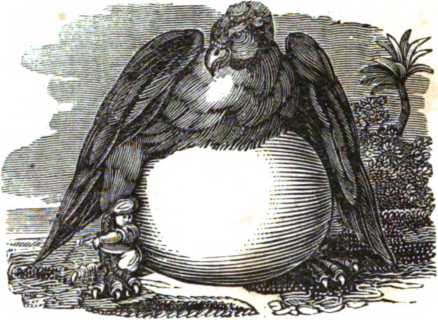
When I came nearer, I thought it to be a white bowl, of a prodigious height and bigness; and when I came up to it, I touched it, and found it to be very smooth. I went round to see if it was open on any side, but saw it was not, and that there was no climbing up to the top of it, it was so smooth. It was at least fifty paces round.
By this time the sun was ready to set, and all of a sudden the sky became as dark as if it had been covered with a thick cloud. I was much astonished at this sudden darkness, but much more when I found it occasioned by a bird of a monstrous size, that came flying towards me. I remembered a fowl, called roc, that I had often heard mariners speak of, and conceived that the great bowl, which I so much admired, must needs be its egg. In short, the bird alighted, and sat over the egg to hatch it. As I perceived her coming, I crept close to the egg, so that I had before me one of the legs of the bird, which was as big as the trunk of a tree. I tied myself strongly to it with the cloth that went round my turban, in hopes that when the roc [14] flew away next morning, she would carry me with her out of this desert island. And after having passed the night in this condition, the bird actually flew away next morning, as soon as it was day, and carried me so high that I could not see the earth; she afterwards descended all of a sudden, with so much rapidity that I lost my senses: but when the roc was settled, and I found myself upon the ground, I speedily untied the knot, and had scarce done so when the bird, having taken up a serpent of a monstrous length in her bill, flew away. [15]
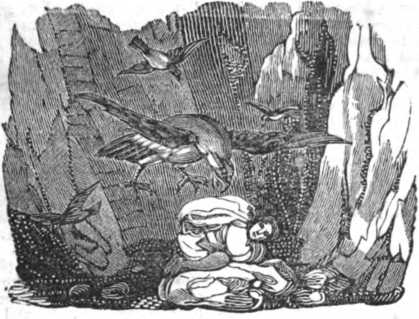
The place where it left me was a very deep valley, encompassed on all sides with mountains, so high that they seemed to reach above the clouds, and so full of steep rocks that there was no possibility of getting out of the valley. This was a new perplexity; so that when I compared this place with the desert island from which the roc brought me, I found that I had gained nothing by the change.
As I walked through this valley, I perceived it was strewed with diamonds, some of which were of a surprising bigness. I took a great deal of pleasure to look upon them; but speedily I saw at a distance such objects as very much diminished my satisfaction, and which I could not look upon without terror; that was, a great number of serpents, so big and so long, that the least of them was capable of swallowing an elephant. They retired in the day-time to their dens, where they hid themselves from the roc, their enemy, and did not come out but in the night-time.
I spent the day in walking about the valley, resting myself at times in such places as I thought mast commodious. When night came on, I went into a cave, where I thought I might be in safety. I stopped the mouth of it, which was low and strait, with a great stone, to preserve me from the serpents, but not so exactly fitted as to hinder light from coming in. I supped on part of my provisions; but the serpents, which began to appear, hissing about in the mean time, put me into such extreme fear, that you may easily imagine I did not sleep. When day appeared the serpents retired, and I came out of the cave trembling. I can justly say, that I walked a long time upon diamonds, without feeling an inclination to touch any of them. At last I sat down, and notwithstanding my uneasiness, not having shut my eyes during the night, I fell asleep, after having eaten a little more of my provisions: but I had scarce shut my eyes, when something, that fell by me with great noise, awaked me. This was a great piece of fresh meat; and at the same time I saw several others fall down from the rocks in different places.
I always looked upon it to be a fable, when I heard mariners and others discourse of the valley of diamonds, and of the stratagems made use of by merchants to get jewels from thence; but then I found it to be true. For, in reality, those merchants come to the neighbourhood of this valley when the eagles have young ones, and throwing great joints of meat into the valley, the diamonds, upon whose points they fall, stick to them; the eagles, which are stronger in this country than any where else, pounce with great force upon those pieces of meat, and carry them to their nests upon the top of the rocks, to feed their young with; at which time the merchants, running to their nests, frighten the eagles by their noise, and take away the diamonds that stick to the meat. [16] And this stratagem they make use of to get the diamonds out of the valley, which is surrounded with such precipices that nobody can enter it.
I believed till then that it was not possible for me to get out of this abyss, which I looked upon as my grave; but then I changed my mind, for the falling in of those pieces of meat put me in hopes of a way of saving my life. —Here day began to appear, which obliged Scheherazade to break off; but she went on with it next night as follows:
SEVENTY-FOURTH NIGHT.
Sir, said she to the sultan, Sindbad continued the story of the adventure of his second voyage thus: I began to gather together the largest diamonds that I could see, and put them into the leathern bag in which I used to carry my provisions. I afterwards took the largest piece of meat I could find, tied it close round me with the cloth of my turban, and then laid myself upon the ground, with my face downward, the bag of diamonds being tied fast to my girdle, so that it could not possibly drop off.
I had scarce laid me down before the eagles came: each of them seized a piece of meat, and one of the strongest having taken me up, with a piece of meat on my back, carried me to his nest on the top of the mountain. The merchants fell straightway to shouting, to frighten the eagles; and when they had obliged them to quit their prey, one of them came to the nest where I was. He was very much afraid when he saw me; but recovering himself, instead of inquiring how I came thither, he began to quarrel with me, and asked why I stole his goods. You will treat me, replied I, with more civility, when you know me better. Do not trouble yourself; I have diamonds enough for you and myself too, more than all the other merchants together. If they have any, it is by chance; but I chose myself in the bottom of the valley all those which you see in this bag: and having spoken these words, I showed them to him. I had scarce done speaking, when the other merchants came trooping about us, much astonished to see me; but they were much more surprised when I told them my story. Yet they did not so much admire my stratagem to save myself, as my courage to attempt it.
They carried me to the place where they staid all together, and there having opened my bag, they were surprised at the largeness of my diamonds, and confessed that in all the courts where they had been they never saw any that came near them. I prayed the merchant to whom the nest belonged whither I was carried (for every merchant had his own) to take as many for his share as he pleased. He contented himself with one, and that too the least of them; and when I pressed him to take more, without fear of doing me any injury: No, said he, I am very well satisfied with this, which is valuable enough to save me the trouble of making any more voyages, to raise as great a fortune as I desire.
I spent the night with those merchants, to whom I told my story a second time, for the satisfaction of those who had not heard it. I could not moderate my joy when I found myself delivered from the danger I have mentioned: I thought myself to be in a dream, and could scarce believe myself to be out of danger.
The merchants had thrown their pieces of meat into the valley for several days: and each of them being satisfied with the diamonds that had fallen to his lot, we left the place next morning all together, and travelled near high mountains, where there were serpents of a prodigious length, which we had the good fortune to escape. We took the first port we came at, and came to the isle of Roha, where the trees grow that yield camphire. This tree is so large, and its branches so thick, that a hundred men may easily sit under its shade. The juice, of which the camphire is made, runs out from a hole bored in the upper part of the tree, is received in a vessel, where it grows to a consistency, and becomes what we call camphire; and the juice thus drawn out, the tree withers and dies.
There is in this island the rhinoceros, a creature less than the elephant, but greater than the buffalo; they have a horn upon their nose, about a cubit long; this horn is solid, and cleft in the middle from one end to the other, and there is upon it white lines, representing the figure of a man. The rhinoceros fights with the elephant, runs his horn into his belly, and carries him off upon his head; but the blood and the fat of the elephant running into his eyes, and making him blind, he falls to the ground; and then, strange to relate, the roc comes and carries them both away in her claws, to be food for her young ones.
I pass over many other things peculiar to this island, lest I should be troublesome to you. Here I exchanged some of my diamonds for good merchandise. From thence we went to other isles; and at last, having touched at several trading towns of the main land, we landed at Balsora, from whence I went to Bagdad. There I immediately gave great alms to the poor, and lived honourably upon the vast riches I had brought, and gained with so much fatigue. Thus Sindbad ended the story of the second voyage, gave Hindbad another hundred sequins, and invited him to come next day to hear the story of the third. The rest of the guests returned to their houses, and came again the next day at the same hour; and one may be sure the porter did not fail, having by this time almost forgot his former poverty. When dinner was over, Sindbad demanded attention, and gave them an account of his third voyage, as follows:
Sindbad, the Sailor’s third Voyage.
The pleasures of the life which I then led soon made me forget the risks I had run in my two former voyages; but being then in the flower of my age, I grew weary of living without business; and hardening myself against the thought of any danger I might incur, I went from Bagdad, with the richest commodities of the country, to Balsora: there I embarked again with the merchants. We made a long voyage, and touched at several ports, where we drove a considerable trade. One day, being out in the main ocean, we were attacked by a horrible tempest, which made us lose our course. The tempest continued several days, and brought us before the port of an island, where the captain was very unwilling to enter; but we were obliged to cast anchor there. When we had furled our sails, the captain told us that this and some other neighbouring islands [17] were inhabited by hairy savages, who would speedily attack us; and though they were but dwarfs, yet our misfortune was such that we must make no resistance, for they were more in number than the locusts; and if we happened to kill one of them, they would all fall upon us, and destroy us. —Here day beginning to appear, Scheherazade broke off her story, and continued it next night, as follows:
SEVENTY-FIFTH NIGHT.
This discourse of the captain, said Sindbad, put the whole company into a great consternation; and we found very soon, to our cost, that what he had told us was but too true: an innumerable multitude of frightful savages, covered all over with red hair, and about two feet high, [18] came swimming towards us, and encompassed our ship in a little time. They spoke to us as they came near, but we understood not their language; they climbed up the sides of the ship with so much agility as surprised us. We beheld all this with mortal fear, without daring to offer to defend ourselves, or to speak one word to divert them from their mischievous design. In short, they took down our sails, cut the cable, and hauled to the shore, made us all get out, and afterwards carried the ship into another island, from whence they came. All travellers carefully avoided that island where they left us, it being very dangerous to stay there, for a reason you shall hear anon; but we were forced to bear our affliction with patience.
We went forward into the island, where we found some fruits and herbs to prolong our lives as long as we could; but we expected nothing but death. As we went on, we perceived at a distance a great pile of building, and made towards it. We found it to be a palace, well built, and very lofty, with a gate of ebony of two leaves, which we thrust open. We entered the court, where we saw before us a vast apartment, with a porch, having on one side a heap of men’s bones, and on the other a vast number of roasting spits. We trembled at this spectacle, and being weary with travelling, our legs failing under us, we fell to the ground, being seized with deadly fear, and lay a long time motionless.
The sun was set, and whilst we were in the lamentable condition just mentioned, the gate of the apartment opened with a great noise, and there came out the horrible figure of a black man, as high as a tall palm tree. He had but one eye, and that in the middle of his forehead, where it looked as red as a burning coal. His foreteeth were very long and sharp, and stood out of his mouth, which was as deep as that of a horse; his upper lip hung down upon his breast; his ears resembled those of an elephant, [19] and covered his shoulders; and his nails were as long and crooked as the talons of the greatest birds. At the sight of so frightful a giant we lost all sense, and lay like dead men. [20]
At last we came to ourselves, and saw him sitting in the porch, looking at us. When he had considered us well, he advanced towards us, and laying his hands upon me, he took me up by the nape of my neck, and turned me round as a butcher would do a sheep’s head. After having viewed me well, and perceiving me to be so lean that I had nothing but skin and bone, he let me go. He took up all the rest, one by one, viewed them in the same manner, and the captain being the fattest, he held him with one hand, as I would do a sparrow, and thrusting a spit through him, kindled a great fire, roasted, and eat him in his apartment for his supper; which being done, he returned to his porch, where he lay and fell asleep, snoring louder than thunder. He slept thus till morning. For our parts, it was not possible for us to enjoy any rest; so that we passed the night in the most cruel fear that can be imagined. Day being come, the giant awaked, got up, went out, and left us in the palace.
When we thought him at a distance, we broke the melancholy silence we had kept all night, and every one grieving more than another, we made the palace resound with our complaints and groans. Though there were a great many of us, and we had but one enemy, we had not at first the presence of mind to think of delivering ourselves from him by his death. This enterprise, however, though hard to put in execution, was the only design we ought naturally to have formed.
We thought of several other things, but determined nothing; so that submitting to what it should please God to order concerning us, we spent the day in running about the island for fruit and herbs to sustain our lives. When evening came, we sought for a place to lie in, but found none; so that we were forced, whether we would or not, to return to the palace.
The giant failed not to come back, and supped once more upon one of our companions; after which he slept, and snored till day, and then went out, and left us as formerly. Our condition was so very terrible, that several of my comrades designed to throw themselves into the sea, rather than die so strange a death; and those who were of this mind argued with the rest to follow their example: upon which one of the company answered, that we were forbidden to destroy ourselves; but allowing it to be lawful, it was more reasonable to think of a way to rid ourselves of the barbarous tyrant who designed so cruel a death for us.
Having thought of a project for that end, I communicated the same to my comrades, who approved it. Brethren, said I, you know there is a great deal of timber floating upon the coast: if you will be advised by me, let us make several floats of it that may carry us; and when they are done, leave them there till we think fit to make use of them. In the mean time we will execute the design to deliver ourselves from the giant; and if we succeed, we may stay here with patience till some ship pass by, that may carry us out of this fatal island; but if it happen to miscarry, we will speedily get to our floats, and put to sea. I confess, that by exposing ourselves to the fury of the waves, we run a risk of losing our lives; but if we do, is it not better to be buried in the sea, than in the entrails of this monster, who has already devoured two of us? My advice was relished, and we made floats capable of carrying three persons each.
We returned to the palace towards the evening, and the giant arrived a little while after. We were forced to conclude on seeing another of our comrades roasted. But at last we revenged ourselves on the brutish giant thus: After he had made an end of his cursed supper, he lay down on his back and fell asleep. As soon as we heard him snore, [21] according to his custom, nine of the boldest among us, and myself, took each of us a spit, and putting the points of them into the fire till they were burning hot, we thrust them into his eye all at once, and blinded him. The pain occasioned him to make a frightful cry, and to get up and stretch out his hands, in order to sacrifice some of us to his rage: but we ran to such places as he could not find us; and after having sought for us in vain, he groped for the gate, and went out, howling dreadfully. —Scheherazade stopped here, but next night resumed her story thus:
SEVENTY-SIXTH NIGHT.
We went out of the palace after the giant, continued Sindbad, and came to the shore, where we had left our floats, and put them immediately into the sea. We waited till day, in order to get upon them, in case the giant came towards us with any guide of his own species; but we hoped if he did not appear by sun-rising, and gave over his howling, which we still heard, that he would die; and if that happened to be the case, we resolved to stay in that island, and not to risk our lives upon the floats; but day had scarce appeared, when we perceived our cruel enemy, accompanied with two others almost of the same size, leading him, and a great number more coming before him with a very quick pace.
When we saw this, we made no delay, but got immediately upon our floats, and rowed off from the shore. The giants, who perceived this, took up great stones, and running to the shore, entered the water up to the middle, and threw so exactly, that they sunk all the floats but that I was upon, and all my companions, except the two with me, were drowned. We rowed with all our might, and got out of the reach of the giants: but when we got out to sea, we were exposed to the mercy of the waves and winds, and tossed about, sometimes on one side, and sometimes on another, and spent that night and the following day under a cruel uncertainty as to our fate; but next morning we had the good luck to be thrown upon an island, where we landed with much joy. We found excellent fruit there, that gave us great relief, so that we pretty well recovered our strength.
In the evening we fell asleep on the bank of the sea, but were awaked by the noise of a serpent as long as a palm tree, whose scales made a rustling as he crept along. He swallowed up one of my comrades, notwithstanding his loud cries, and the efforts he made to rid himself of the serpent; which, shaking him several times against the ground, crushed him; and we could hear him gnaw and tear the poor wretch’s bones, when we had fled a great distance from him. Next day we saw the serpent again, to our great terror; when I cried out, O Heaven, to what dangers are we exposed! We rejoiced yesterday at our having escaped from the cruelty of a giant and the rage of the waves, and now are we fallen into another danger altogether as terrible.
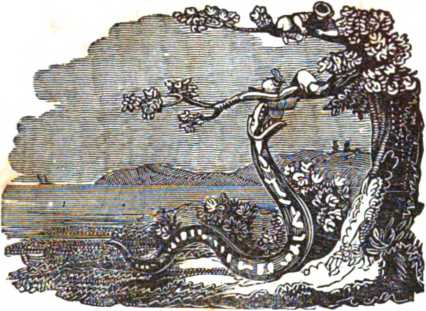
As we walked about we saw a large tall tree, upon which we designed to pass the following night, for our security; and having satisfied our hunger, we mounted it accordingly. A little while after the serpent came hissing to the root of the tree, raised itself up against the trunk of it, and meeting with my comrade, who sat lower than I, swallowed him at once, and went off.
I staid upon the tree till it was day, and then came down, more like a dead man than one alive, expecting the same fate with my two companions. This filled me with horror, so that I was going to throw myself into the sea; but nature prompting us to a desire to live as long as we can, I withstood this temptation to despair, and submitted myself to the will of God, who disposes of our lives at his pleasure.
In the mean time I gathered together a great quantity of small wood, brambles, and dry thorns, and making them up into faggots, made a great circle with them round the tree, and also tied some of them to the branches over my head. Having done this, when the evening came I shut myself up within this circle, with this melancholy piece of satisfaction, that I had neglected nothing which could preserve me from the cruel destiny with which I was threatened. The serpent failed not to come at the usual hour, and went round the tree, seeking for an opportunity to devour me, but was prevented by the rampart I had made; so that he lay till day, like a cat watching in vain for a mouse that has retired to a place of safety. When day appeared he retired, but I dared not leave my fort until the sun arose.
I was fatigued with the toil he had put me to, and suffered so much by his poisonous breath, that death seemed more eligible to me than the horror of such a condition. I came down from the tree, and not thinking on the resignation I had made to the will of God the preceding day, I ran towards the sea, with a design to throw myself into it headlong. —Here Scheherazade stopt, because day appeared; and next night continued her story thus:
SEVENTY-SEVENTH NIGHT.
Sindbad pursued the account of his third voyage thus: God, said he, took compassion on my desperate state; for just as I was going to throw myself into the sea, I perceived a ship at a considerable distance. I called as loud as I could, and taking the linen from my turban, displayed it, that they might observe me. This had the desired effect; all the crew perceived me, and the captain sent his boat for me. As soon as I came aboard, the merchants and seamen flocked about me to know how I came to that desert island; and after I had told them of all that befell me, the oldest of them said to me, they had several times heard of the giants that dwelt in that island, that they were cannibals, and eat men raw as well as roasted; and as to the serpents, they added, that there were abundance in the isle, that hid themselves by day, and came abroad by night. After having testified their joy at my escaping so many dangers, they brought me the best of what they had to eat; and the captain, seeing that I was all in rags, was so generous as to give me one of his own suits. We were at sea for some time, touched at several islands, and at last landed on that of Salabat, [22] where there grows sanders, a wood of great use in physic. We entered the port, and came to an anchor. The merchants began to unload their goods, in order to sell or exchange them. In the mean time, the captain came to me, and said, Brother, I have here a parcel of goods that belonged to a merchant, who sailed some time on board this ship; and he being dead, I design to dispose of them for the benefit of his heirs, when I know them. The bales he spoke of lay on the deck, and showing them to me, he said, There are the goods; I hope you will take care to sell them, and you shall have factorage. I thanked him that he gave me an opportunity to employ myself, because I hated to be idle.
The clerk of the ship took an account of all the bales, with the names of the merchants to whom they belonged: and when he asked the captain in whose name he should enter those he gave me the charge of, Enter them, said the captain, in the name of Sindbad the sailor. I could not hear myself named without some emotion; and looking steadfastly at the captain, I knew him to be the person who, in my second voyage, had left me in the island where I fell asleep by a brook, and set sail without me, or sending to see for me: but I could not remember him at first, he was so much altered since I saw him.
And as for him, who believed me to be dead, I could not wonder at his not knowing me. But, captain, said I, was the merchant’s name to whom these bales belonged, Sindbad? —Yes, replied he, that was his name; he came from Bagdad, and embarked on board my ship at Balsora. One day, when we landed at an island to take in water and other refreshments, I know not by what mistake, I set sail without observing that he did not re-embark with us; neither I nor the merchants perceived it till four hours after. We had the wind in our stern, and so fresh a gale, that it was not then possible for us to tack about for him. —You believe him then to be dead? said I. —Certainly, answered he. —No, captain, said I; look upon me, and you may know that I am Sindbad, whom you left in that desert island. I fell asleep by a brook, and when I awaked, I found all the company gone. At these words the captain looked steadfastly upon me. —Here Scheherazade perceiving day, broke off her story, and next day resumed it thus:
SEVENTY-EIGHTH NIGHT.
The captain, continued Sindbad, having considered me attentively, knew me at last, embraced me, and said, God be praised that fortune has supplied my defect. There are your goods, which I always took care to preserve, and to make the best of them at every port where I touched. I restore them to you, with the profit I have made of them. I took them from him, and at the same time acknowledged how much I owed to him.
From the isle of Salabat we went to another, where I furnished myself with cloves, cinnamon, and other spices. As we sailed from that island we saw a tortoise that was twenty cubits in length and breadth. [23] We observed also a fish which looked like a cow, and gave milk, [24] and its skin is so hard that they usually make bucklers of it. I saw another which had the shape and colour of a camel. [25] in short, after a long voyage, I arrived at Balsora, and from thence returned to the city of Bagdad, with so much riches that I knew not what I had. I gave a great deal to the poor, and bought another great estate in addition to what I had already.
Thus Sindbad finished the history of his third voyage; gave another hundred sequins to Hindbad, and invited him to dinner again next day, to hear the story of his fourth voyage. Hindbad and the company retired, and next day, when they returned, Sindbad, after dinner, continued the story of his adventures.
Sindbad, the Sailor’s, fourth Voyage.
The pleasure, said he, and the divertisements I took after my third voyage, had not charms enough to divert me from another. I was again prevailed upon by my passion for traffic, and curiosity to see new things. I therefore settled my affairs, and having provided a stock of goods fit for the places where I designed to trade, I set out on my journey. I took the way of Persia, of which I travelled over several provinces, and then arrived at a port, where I embarked. We set sail, and having touched at several ports of the main land, and some of the eastern islands, we put out to sea, and were overtaken by such a sudden gust of wind as obliged the captain to furl his sails, and to take all other necessary precautions to prevent the danger that threatened us: but all was in vain; our endeavours had no effect, the sails were torn in a thousand pieces, and the ship was stranded; so that a great many of the merchants and seaman were drowned, and the cargo lost.
Scheherazade perceiving day, held her peace; but resumed her story next night, as follows:
SEVENTY-NINTH NIGHT.
I had the good fortune, continued Sindbad, with several of the merchants and mariners, to get a plank, and we were carried by the current to an island which lay before us; there we found fruit and spring-water, which preserved our lives. We staid all night near the place where the sea cast us ashore, without consulting what we should do, our misfortune had dispirited us so much.
Next morning, as soon as the sun was up, we walked from the shore, and advancing into the island, saw some houses, to which we went; and as soon as we came thither we were encompassed by a great number of blacks, who seized us, shared us among them, and carried us to their respective habitations. [26]
I, and five of my comrades, were carried to one place: they made us sit down immediately, and gave us a certain herb, which they made signs to us to eat. My comrades not taking notice that the blacks eat none themselves, consulted only the satisfying of their own hunger, and fell to eating with greediness: but I, suspecting some trick, would not so much as taste it, which happened well for me; for in a little time after I perceived my companions had lost their senses, and that when they spoke to me they knew not what they said.
The blacks fed us afterwards with rice, prepared with oil of cocoa-nuts; and my comrades, who had lost their reason, eat of it greedily. I eat of it also, but very sparingly. The blacks gave us that herb at first on purpose to deprive us of our senses, [27] that we might not be aware of the sad destiny prepared for us; and they gave us rice on purpose to fatten us; for, being cannibals, their design was to eat us as soon as we grew fat. They did accordingly eat my comrades, who were not sensible of their condition; but my senses being entire, you may easily guess, gentlemen, that instead of growing fat, as the rest did, I grew leaner every day. The fear of death under which I laboured, turned all my food into poison. I fell into a languishing distemper, which proved my safety; for the blacks, having killed and eat up my companions, seeing me to be withered, lean, and sick, deferred my death till another time.
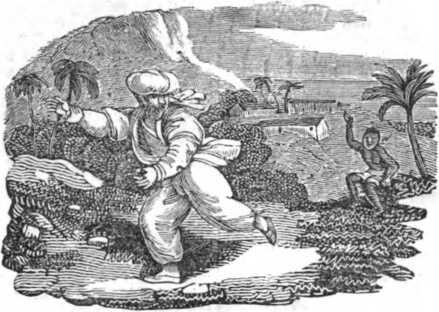
Mean while I had a great deal of liberty, so that there was scarce any notice taken of what I did; and this gave me an opportunity one day to get at a distance from the houses, and to make my escape. An old man who saw me, and suspected my design, called to me as loud as he could to return; but instead of obeying him, I redoubled my pace, and quickly got out of sight. At that time there was none but the old man about the houses, the rest being abroad, and not to come home till night, which was pretty usual with them: therefore, being sure that they could not come time enough to pursue me, I went on till night, when I stopped to rest a little, and to eat some of the provisions I had taken care of; but I speedily set forward again, and travelled seven days, avoiding those places which seemed to be inhabited, and lived for the most part upon cocoa-nuts, which served me both for meat and drink. On the eighth day I came near the sea, and saw all of a sudden white people like myself gathering pepper, [28] of which there was great plenty in that place. This I took to be a good omen, and went to them without any scruple. —Scheherazade broke off here, and went on with the story next night, as follows:
EIGHTIETH NIGHT.
The people who gathered pepper, continued Sindbad, came to meet me as soon as they saw me, and asked me, in Arabic, who I was, and whence I came. I was overjoyed to hear them speak in my own language, and satisfied their curiosity by giving them an account of my shipwreck, and how I fell into the hands of the blacks. Those blacks, replied they, eat men; and by what miracle did you escape their cruelty? I told them the same story I now tell you, at which they were wonderfully surprised.
I staid with them till they had gathered their quantity of pepper, and then sailed with them to the island from whence they came. They presented me to their king, who was a good prince. He had the patience to hear the relation of my adventures, which surprised him; and he afterwards gave me clothes, and commanded care to be taken of me.
The island was very well peopled, plentiful in every thing, and the capital was a place of great trade. This agreeable retreat was very comfortable to me after my misfortune, and the kindness of this generous prince towards me completed my satisfaction. In a word, there was not a person more in favour with him than myself; and, by consequence, every man in court and city sought to oblige me; so that in a very little time I was looked upon rather as a native than a stranger.
I observed one thing which to me appeared very extraordinary. All the people, the king himself not excepted, rode their horses without bridle or stirrups. This made me one day take the liberty to ask the king how that came to pass. His majesty answered, that I talked to him of things which nobody knew the use of in his dominions.
I went immediately to a workman, and gave him a model for making the stock of a saddle. When that was done, I covered it myself with velvet and leather, and embroidered it with gold. I afterwards went to a locksmith, who made me a bridle according to the pattern I showed him, and then he made me also some stirrups. When I had all things completed, I presented them to the king, and put them upon one of his horses. His majesty mounted immediately, and was so pleased with them, that he testified his satisfaction by large presents to me. I could not avoid making several others for his ministers and principal officers of his household, who all of them made me presents that enriched me in a little time. I also made for the people of best quality in the city, which gained me great reputation and regard.
As I made my court very constantly to the king he said to me one day, Sindbad, I love thee; and all my subjects who know thee treat thee according to my example. I have one thing to demand of thee, which thou must grant. —Sir, answered I, there is nothing but what I will do, as a mark of my obedience to your majesty, whose power over me is absolute. —I have a mind thou shouldst marry, replied he, that so thou mayst stay in my dominion, and think no more of thy own country. —I dared not resist the prince’s will, and so he gave me one of the ladies of his court, a noble, beautiful, chaste, and rich lady. The ceremonies of marriage being over, I went and dwelt with the lady, and for some time we lived together in perfect harmony. I was not, however, very well satisfied with my condition, and therefore designed to make my escape on the first occasion, and to return to Bagdad, which my present settlement, how advantageous soever, could not make me forget.
While I was thinking on this, the wife of one of my neighbours, with whom I had contracted a very strict friendship, fell sick, and died. I went to see and comfort him in his affliction, and finding him swallowed up with sorrow, I said to him as soon as I saw him, God preserve you and grant you a long life. —Alas! replied he, how do you think I should obtain that favour you wish me? I have not above an hour to live. —Pray, said I, do not entertain such a melancholy thought; I hope it will not be so, but that I shall enjoy your company for many years. —I wish you, said he, a long life; but for me, my days are at an end, for I must be buried this day with my wife. [29] This is a law which our ancestors established in this island, and always observed it inviolably. The living husband is interred with the dead wife, and the living wife with the dead husband. Nothing can save me; every one must submit to this law.
While he was entertaining me with an account of this barbarous custom, the very hearing of which frighted me cruelly, his kindred, friends, and neighbours came in a body to assist at the funerals. They put on the corpse the woman’s richest apparel, as if it had been her wedding-day, and dressed her with all her jewels; then they put her into an open coffin, and lifting it up, began their march to the place of burial. The husband walked at the head of the company, and followed the corpse. They went up to a high mountain, and when they came thither, took up a great stone, which covered the mouth of a very deep pit, and let down the corpse, with all its apparel and jewels. Then the husband, embracing his kindred and friends, suffered himself to be put into another open coffin without resistance, with a pot of water, and seven little loaves, and was let down in the same manner as they let down his wife. The mountain was pretty long, and reached to the sea. The ceremony being over, they covered the hole again with the stone, and returned.
It is needless, gentlemen, for me to tell you that I was the only melancholy spectator of this funeral, whereas the rest were scarcely moved at it, the practice was so customary to them. I could not forbear speaking my thoughts of this matter to the king: Sir, said I, I cannot but wonder at the strange custom in this country, of burying the living with the dead. I have been a great traveller, and seen many countries, but never heard of so cruel a law. —What do you mean, Sindbad? said the king: it is a common law. I shall be interred with the queen, my wife, if she die first. —But, sir, said I, may I presume to ask your majesty, if strangers be obliged to observe this law? —Without doubt, replied the king, (smiling at the occasion of my question,) they are not exempted, it they be married in this island.
I went home very melancholy at this answer; for the fear of my wife’s dying first, and that I should be interred alive with her, occasioned me very mortifying reflections. But there was no remedy; I must have patience, and submit to the will of God. I trembled, however, at every little indisposition of my wife: but alas! in a little time my fears came upon me all at once, for she fell sick, and died in a few days.
Scheherazade stopt here for that time, and resumed the thread of her story next night thus:
EIGHTY-FIRST NIGHT.
You may judge at my sorrow, continued Sindbad; to be interred alive, seemed to me as deplorable an end as to be devoured by cannibals. But I must submit; the king and all his court would honour the funeral with their presence, and the most considerable people of the city did the like. When all was ready for the ceremony, the corpse was put into a coffin, with all her jewels and magnificent apparel. The cavalcade began, and as second actor in this doleful tragedy, I went next the corpse, with my eyes full of tears, bewailing my deplorable fate. Before I came to the mountain, I made an essay on the minds of the spectators: I addressed myself to the king in the first place, and then to all those who were round me and bowing before them to the earth, to kiss the border of their garments, I prayed them to have compassion upon me. Consider, said I, that I am a stranger, and ought not to be subject to this rigorous law, and that I have another wife and children in my own country. [30] It was to no purpose for me to speak thus, no soul was moved at it; on the contrary, they made haste to let down my wife’s corpse into the pit, and put me down the next moment in an open coffin, with a vessel full of water, and seven loaves. In short, the fatal ceremony being performed, they covered up the mouth of the pit, notwithstanding the excess of my grief, and my lamentable cries.
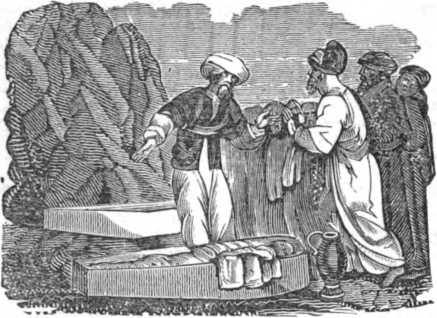
As I came near the bottom, I discovered, by help of the little light that came from above, the nature of this subterraneous place; it was a vast long cave, and might be about fifty fathom deep. I immediately smelt an insufferable stench, proceeding from the multitude of dead corpses which I saw on the right and left; nay, I fancied that I heard some of them sigh out their last. However, when I got down, I immediately left my coffin, and getting at a distance from the corpses, held my nose, and lay upon the ground, where I staid a long time, bathed in tears. Then, reflecting on my sad lot, It is true, said I, that God disposes all things according to the decrees of his providence; but, poor Sindbad, art not thou thyself the cause of thy being brought to die so strange a death? Would to God thou hadst perished in some of those tempests which thou hast escaped! Then thy death had not been so lingering and terrible in all its circumstances. But thou hast drawn all this upon thyself by thy cursed avarice. Ah! unfortunate wretch, shouldst thou not rather have staid at home, and quietly enjoyed the fruits of thy labour?
Such were the vain complaints with which I made the cave to echo, beating my head and stomach out of rage and despair, and abandoning myself to the most afflicting thoughts. Nevertheless, I must tell you, that instead of calling death to my assistance in that miserable condition, I felt still an inclination to live, and to do all I could to prolong my days. I went groping about, with my nose stopped, for the bread and water that was in my coffin, and I took some of it. Though the darkness of the cave was so great that I could not distinguish day and night, yet I always found my coffin again, and the cave seemed to be more spacious and fuller of corpses than it appeared to me at first. I lived for some days upon my bread and water, which being all spent at last, I prepared for death. —At these words Scheherazade left off, but resumed the story next night thus:
EIGHTY-SECOND NIGHT.
As I was thinking of death, continued Sindbad, I heard the stone lifted up from the mouth of the cave, and immediately the corpse of a man was let down. When men are reduced to necessity, it is natural for them to come to extreme resolutions. While they let down the woman, I approached the place where her coffin was to be put, and as soon as I perceived they were covering again the mouth of the cave, I gave the unfortunate wretch two or three great blows over the head, with a large bone that I found; which stunned, or, to say the truth, killed her. I committed this inhuman action merely for the sake of the bread and water that was in her coffin, and thus I had provisions for some days more. When that was spent, they let down another dead woman, and a live man: I killed the man in the same manner, and, as good luck would have it for me, there was then a sort of mortality in the town, so that by this means I did not want for provisions.
One day, as I despatched another woman, I heard something walking, and blowing or panting as it walked. I advanced towards that side from whence I heard the noise, and upon my approach the thing puffed and blew harder, as if it had been running away from me. I followed the noise, and the thing seemed to stop sometimes, but always fled and blew as I approached. I followed it so long, and so far, till at last I perceived a light, resembling a star; I went on towards that light, and sometimes lost sight of it, but always found it again, and at last discovered that it came through a hole in the rock, large enough for a man to get out at.
Upon this I stopped some time to rest myself, being much fatigued with pursuing this discovery so fast: afterwards coming up to the hole, I went out of it, and found myself upon the bank of the sea. I leave you to guess the excess of my joy: it was such, that I could scarce persuade myself of its being real.
But when I was recovered from my surprise, and convinced of the truth of the matter, I found the thing which I had followed, and heard puff and blow, to be a creature which came out of the sea, and was accustomed to enter at that hole to feed upon the dead carcasses. [31]
I examined the mountain, and perceived it to be situated betwixt the sea and the town, but without any passage or way to communicate with the latter, the rocks on the side of the sea were so rugged and steep. I fell down upon the shore to thank God for this mercy, and afterwards entered the cave again to fetch bread and water, which I did by day-light, with a better appetite than I had done since my interment in the dark hole.
I returned thither again, and groped about among the biers for all the diamonds, rubies, pearls, gold bracelets, and rich stuffs I could find; these I brought to the shore, and tying them up neatly into bales, with the cords that let down the coffins, I laid them together upon the bank, waiting till some ship passed by, without fear of rain, for it was not then the season.
After two or three days, I perceived a ship that had but just come out of the harbour, and passed near the place where I was. I made a sign with the linen of my turban, and called to them as loud as I could. They heard me, and sent a boat to bring me on board, when the mariners asked by what misfortune I came thither: I told them that I had suffered shipwreck two days ago, and made shift to get ashore with the goods they saw. It was happy for me that those people did not consider the place where I was, nor inquire into the probability of what I told them; but, without more ado, took me on board with my goods. When I came to the ship, the captain was so well pleased to have saved me, and so much taken up with his own affairs, that he also took the story of my pretended shipwreck upon trust, and generously refused some jewels which I offered him.
We passed by several islands, and among others that called the isle of Bells, [32] about ten days’ sail from Serendib, with a regular wind, and six from that of Kela, where we landed. This island produces lead mines, Indian canes, [33] and excellent camphire.
The king of the isle of Kela is very rich and potent, and the isle of Bells, which is about two days’ journey in extent, is also subject to him. The inhabitants are so barbarous that they still eat human flesh. After we had finished our commerce in that island, we put to sea again, and touched at several other ports: at last I arrived happily at Bagdad with infinite riches, of which it is needless to trouble you with the detail.
Out of thankfulness to God for his mercies, I gave great alms for the support of several mosques, and for the subsistence of the poor, and employed myself wholly in enjoying my kindred and friends, and making merry with them.
Here Sindbad finished the relation of his fourth voyage, which was more surprising to the company than all the three former. He gave a new present of a hundred sequins to Hindbad, whom he prayed to return with the rest next day at the same hour, to dine with him, and hear the story of his fifth voyage. Hindbad and the rest of his guests took leave of him, and retired. Next morning when they all met, they sat down at table, and when dinner was over, Sindbad began the relation of his fifth voyage, as follows:
The fifth voyage of Sindbad the sailor.
The pleasures I enjoyed had again charms enough to made me forget all the troubles and calamities I had undergone, without curing me of my inclination to make new voyages. Therefore I bought goods, ordered them to be packed up and loaded, and set out with them for the best sea-port; and there, that I might not be obliged to depend upon a captain, but have a ship at my own command, I staid till one was built on purpose, at my own charge. When the ship was ready, I went on board with my goods; but not having enough to load her, I took on board with me several merchants of different nations, with their merchandize.
We sailed with the first fair wind, and, after a long navigation, the first place we touched at was a desert island, where we found an egg of a roc, equal in bigness to that I formerly mentioned. There was a young roc in it, just ready to be hatched, and the bill of it began to appear.
At these words Scheherazade stopt, because day began to enter the sultan’s apartment; but next night she resumed her story thus:
EIGHTY-THIRD NIGHT.
Sindbad, the sailor, said she, continued the relation of his fifth voyage as follows: The merchants whom I had taken on board my ship, and who landed with me, broke the egg with hatchets, and made a hole in it, from whence they pulled out the young roc, piece after piece, and roasted it. I had earnestly persuaded them not to meddle with the egg, but they would not listen to me.
Scarcely had they made an end of their treat, when there appeared in the air, at a considerable distance from us, two great clouds. The captain whom I hired to manage my ship, knowing, by experience, what it meant, cried that it was the male and female roc that belonged to the young one, and pressed us to re-embark with all speed, to prevent the misfortune which he saw would otherwise befall us. We made haste to do so, and set sail with all possible diligence.
In the mean time, the two rocs approached with a frightful noise, which they redoubled when they saw the egg broken, and their young one gone. But having a mind to avenge themselves, they flew back towards the place from whence they came, and disappeared for some time, while we made all the sail we could, to prevent that which unhappily befell us.
They returned, and we observed that each of them carried between their talons, stones, or rather rocks, of a monstrous size. When they came directly over my ship, they hovered, and one of them [34] let fall a stone; but by the dexterity of the steersman, who turned the ship with the rudder, it missed us, and, falling by the side of the ship into the sea, divided the waters so, that we almost could see to the bottom. The other roc, to our misfortune, threw the stone so exactly upon the middle of the ship, that it split in a thousand pieces. The mariners and passengers were all killed by the stone, or sunk. I myself had the last fate; but as I came up again, I fortunately caught hold of a piece of the wreck, and sometimes swimming with one hand, and sometimes with the other, but always holding fast my board, the wind and the tide favouring me, I came to an island, whose shore was very steep. I overcame that difficulty, however, and got ashore.
I sat down upon the grass, to recover myself a little from the fatigue; after which I got up, and went into the island to view it. It seemed to be a delicious garden. I found trees every where, some of them bearing green, and others ripe fruits, and streams of fresh pure water, with pleasant windings and turnings. I ate of the fruits, which I found excellent, and drank of the water, which was very pleasant.
Night being come, I lay down upon the grass in a convenient place enough, but I could not sleep an hour at a time, my mind was so disturbed with the fear of being alone in so desert a place. Thus I spent the best part of the night in fretting, and reproached myself for my imprudence in not staying at home, rather that undertaking this last voyage. These reflections carried me so far, that I began to form a design against my own life; but daylight dispersed those melancholy thoughts, and I got up, and walked among the trees, but not without apprehensions of danger.
When I was a little advanced into the island, I saw an old man, [35] who appeared very weak and feeble. He sat upon the bank of a stream, and at first I took him to be one who had been shipwrecked like myself. I went towards him and saluted him, but he only bowed his head a little. I asked him what he did there; but, instead of answering me, he made a sign for me to take him upon my back, and carry him over the brook, signifying that it was to gather fruit.
I believed him really to stand in need of my help, so took him upon my back, and, having carried him over, bid him get down, and for that end stooped, that he might get off with ease; but instead of that, (which I laugh at every time I think of it,) the old man, who to me appeared very decrepit, clasped his legs nimbly about my neck, and then I perceived his skin to resemble that of a cow. He sat astride upon my shoulders, and held my throat so tight, that I thought he would have strangled me, the fright of which made me faint away, and fall down.
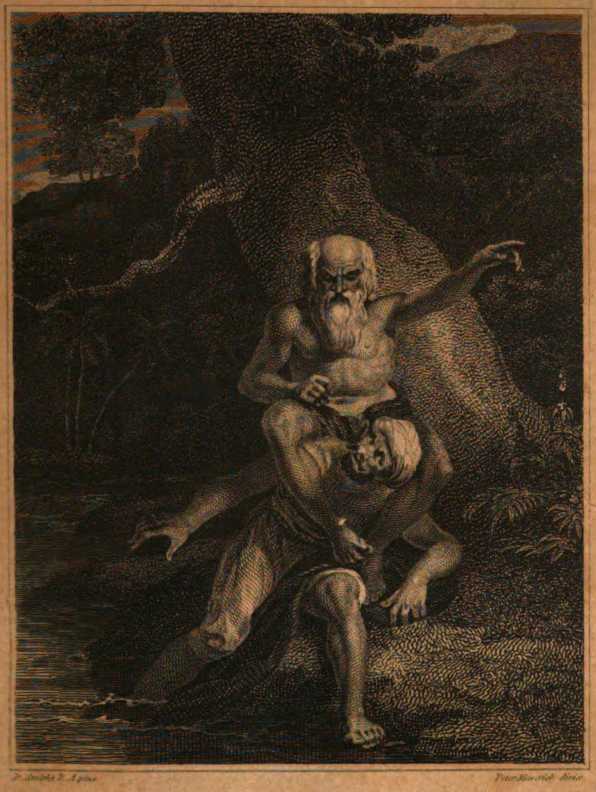
THE OLD MAN OF THE SEA.
Day appearing, Scheherazade was obliged to stop here, but pursued her story thus next night:
EIGHTY-FOURTH NIGHT.
Notwithstanding my fainting, continued Sindbad, the ill-natured old fellow kept fast about my neck, but opened his legs a little to give me time to recover my breath. When I had done so, he thrust one of his feet against my stomach, and struck me so rudely on the side with the other, that he forced me to rise up against my will. Being got up, he made me walk under the trees, and forced me now and then to stop, to gather and eat fruit such as we found. He never left me all day, and when I lay down to rest me by night, he laid himself down with me, holding always fast about my neck. Every morning he pushed me to make me awake, and afterwards obliged me to get up and walk, and pressed me with his feet. You may judge, then, gentlemen, what trouble I was in, to be loaded with such a burden, which I could by no means rid myself from.
One day I found in my way several dry calabashes that had fallen from a tree; I took a large one, and after cleaning it, pressed into it some juice of grapes, [36] which abounded in the island; having filled the calabash, I set it in a convenient place, and coming hither again some days after, I took up my calabash, and setting it to my mouth, found the wine to be so good, that it made me presently not only forget my sorrow, but I grew vigorous, and was so light-hearted, that I began to sing and dance as I walked along.
The old man perceiving the effects which this drink had upon me, and that I carried him with more ease than I did before, made a sign to me to give him some of it. I gave him the calabash, and the liquor pleasing his palate, he drank it all off. There being enough of it to fuddle him, he became drunk immediately, and the fumes getting up into his head, he began to sing after his manner, and to dance with his breech upon my shoulders. His jolting made him vomit, and he loosened his legs from about me by degrees; so finding that he did not press me as before, I threw him upon the ground, where he lay without motion, and then I took up a great stone, with which I crushed his head to pieces.
I was extremely rejoiced to be freed thus for ever from this cursed old fellow, and walked upon the bank of the sea, where I met the crew of a ship that had cast anchor to take in water to refresh themselves. They were extremely surprised to see me, and to hear the particulars of my adventures. You fell, said they, into the hands of the old man of the sea, and are the first that ever escaped strangling by him. He never left those he had once made himself master of, till he destroyed them, and he had made this island famous by the number of men he has slain; so that the merchants and mariners who landed upon it dared not to advance into the island but in numbers together.
After having informed me of those things, they carried me with them to the ship: the captain received me with great satisfaction when they told him what had befallen me. He put out again to sea, and after some days’ sail we arrived at the harbour of a great city, whose houses were built with good stone.
One of the merchants of the ship who had taken me into his friendship, obliged me to go along with him, and carried me to a place appointed for a retreat for foreign merchants. He gave me a great bag, and having recommended me to some people of the town, who used to gather cocoa-nuts, he desired them to take me with them to do the like: “Go,” said he, “follow them, and do as you see them do, and do not separate from them, otherwise you endanger your life.” Having thus spoke, he gave me provisions for the journey, and I went with them.
We came to a great forest of trees, extremely straight and tall, and their trunks so smooth, that it was not possible for any man to climb up to the branches that bore the fruit. All the trees were cocoa-trees, and when we entered the forest, we saw a great number of apes, of several sizes, that fled as soon as they perceived us, and climbed up to the top of the trees with surprising swiftness.
Scheherazade would have gone on, but day appearing, prevented her, and next night she resumed her discourse as follows:
EIGHTY-FIFTH NIGHT.
The merchants with whom I was, continued Sindbad, gathered stones, and threw them at the apes on the top of the trees. I did the same, and the apes, out of revenge, threw cocoa-nuts at us as fast, and with such gestures, as sufficiently testified their anger and resentment: we gathered up the cocoa-nuts, and from time to time threw stones to provoke the apes; so that by this stratagem we filled our bags with cocoa-nuts, which it had been impossible for us to have done otherwise.
When we had gathered our number, we returned to the city, where the merchant who sent me to the forest gave me the value of the cocoas I brought: Go on, said he, and do the like every day, until you have got money enough to carry you home. I thanked him for his good advice, and insensibly gathered together so many cocoa-nuts as amounted to a considerable sum.
The vessel in which I came, sailed with merchants, who loaded her with cocoa-nuts. I expected the arrival of another, which landed speedily for the like loading. I embarked on board the same all the cocoa-nuts that belonged to me, and when she was ready to sail, I went and took leave of the merchant who had been so kind to me; but he could not embark with me, because he had not finished his business.
We set sail towards the islands, [37] where pepper grows in great plenty. From thence we went to the isle of Comari, [38] where the best sort of wood of aloes grows, and whose inhabitants have made it an inviolable law to themselves, to drink no wine, nor to suffer any place of debauch. I exchanged my cocoa, in those two islands, for pepper and wood of aloes, and went, with other merchants, a pearl fishing. [39] I hired divers, who fetched me up those that were very large and pure. I embarked joyfully, in a vessel that happily arrived at Balsora; from thence I returned to Bagdad, where I made vast sums of my pepper, wood of aloes, and pearls. I gave the tenth of my gains in alms, as I had done upon my return from other voyages, and endeavoured to ease myself from my fatigues by diversions of all sorts.
When Sindbad had finished his story, he ordered one hundred sequins to Hindbad, who retired with all the other guests; but next morning, the same company returned to dine with rich Sindbad, who, after having treated them as formerly, demanded audience, and gave the following account of his sixth voyage:
The sixth Voyage of Sindbad the Sailor.
Gentlemen, said he, you long, without doubt, to know, how after being shipwrecked five times, and escaping so many dangers, I could resolve again to try my fortune, and expose myself to new hardships: I am astonished at it myself when I think on it, and must certainly have been induced to it by my stars. But be that as it will, after a year’s rest, I prepared for a sixth voyage, notwithstanding the entreaties of my kindred and friends, who did all that was possible to prevent me.
Instead of taking my way by the Persian gulf, I travelled once more through several provinces of Persia and the Indies, and arrived at a sea-port, where I embarked on board a ship, the captain of which was resolved on a long voyage.
It was very long indeed, but at the same time so unfortunate, that the captain and pilot lost their course, and knew not where they were. They found it at last, but we had no reason to rejoice at it. We were all seized with extraordinary fear, when we saw the captain quit his post, and cry out. He threw off his turban, pulled the hair of his beard, and beat his head like a madman. We asked him the reason, and he answered, that he was in the most dangerous place in all the sea. A rapid current carries the ship along with it, and we shall all of us perish in less than a quarter of an hour. Pray to God to deliver us from this danger; we cannot escape it, if he does not take pity on us. At these words, he ordered the sails to be changed; but all the ropes broke, and the ship, without its being possible to help it, was carried by the current to the foot of an inaccessible mountain, where she run ashore, and was broken to pieces, yet so that we saved our lives, our provisions, and the best of our goods.
This being over, the captain said to us, God has done what pleased him; we may every man dig our grave here, and bid the world adieu; for we are all in so fatal a place, that none shipwrecked here did ever return to their homes again. His discourse afflicted us sorely, and we embraced each other with tears in our eyes, bewailing our deplorable lot.
The mountain, at the foot of which we were cast, was the coast of a very long and large island. This coast was covered all over with wrecks, and by the vast number of men’s bones we saw every where, and which filled us with horror, we concluded, that abundance of people had died there. It is also incredible to tell, what a quantity of goods and riches we found cast ashore there. All those objects served only to augment our grief. Whereas, in all other places, rivers run from their channels into the sea, here a great river of fresh water [40] runs out of the sea into a dark cave, whose entrance is very high and large. What is most remarkable in this place is, that the stones of the mountain are of crystal, rubies, or other precious stones. Here is also a sort of fountain of pitch or bitumen, [41] that runs into the sea, which the fishes swallow, and then vomit it up again, turned into ambergris; and this the waves throw up on the beach in great quantities. Here also grow trees, most of which are wood of aloes, equal in goodness to those of Comari.
To finish the description of this place, which may well be called a gulf, since nothing ever returns from it —it is not possible for ships to get off from it, when once they come within such a distance of it. If they be driven thither by a wind from the sea, the wind and the current ruin them; and it they come into it when a land-wind blows, which might seem to favour their getting out again, the height of the mountain stops the wind, and occasions a calm, so that the force of the current runs them ashore, where they are broken to pieces, as ours was; and that which completes the misfortune is, that there is no possibility to get to the top of the mountain, or to get out any manner of way.
We continued upon the shore like men out of their senses, and expected death every day. At first, we divided our provisions as equally as we could, and thus every one lived a longer or shorter time, according to their temperance, and the use they made of their provisions.
Scheherazade perceiving day, left off speaking, but next night she resumed the story as follows:
EIGHTY-SIXTH NIGHT.
Those who died first, continued Sindbad, were interred by the rest, and as for my part, I paid the last duty to all my companions: nor are you to wonder at this, for besides that I husbanded the provision that fell to my share better than they, I had provisions of my own, which I did not share with my comrades, yet when I buried the last, I had so little remaining, that I thought I could not hold out long, so that I dug a grave, resolving to lie down in it, because there was none left alive to inter me. I must confess to you at the same time, that while I was thus employed, I could not but reflect upon myself as the cause of my own ruin, and repented that I had ever undertaken this last voyage; nor did I stop at reflections only, but had well nigh hastened my own death, and began to tear my hands with my teeth.
But it pleased God once more to take compassion on me, and put it in my mind to go to the bank of the river which ran into the great cave; where, considering the river with great attention, I said to myself, This river, which runs thus under ground, must come out somewhere or other. If I make a float, and leave myself to the current, it will bring me to some inhabited country, or drown me. If I be drowned, I lose nothing, but only change one kind of death for another; and if I get out of this fatal place, I shall not only avoid the sad fate of my comrades, but perhaps find some new occasion of enriching myself. Who knows but fortune waits upon my getting off this dangerous shelf, to compensate my shipwreck with usury?
I immediately went to work on a float. I made it of large pieces of timber and cables, for I had choice of them, and tied them together so strong, that I had made a very solid little float. When I had finished, I loaded it with some bales of rubies, emeralds, ambergris, rock-crystal, and rich stuffs. Having balanced all my cargo exactly, and fastened them well to the float, I went on board it with two little oars that I had made, and leaving it to the course of the river, I resigned myself to the will of God.
As soon as I came into the cave, I lost all light, and the stream carried me I knew not whither. Thus I floated some days in perfect darkness, and once found the arch so low that it very nigh broke my head, which made me very cautious afterwards to avoid the like danger. All this while I eat nothing but what was necessary to support nature; yet, notwithstanding this frugality, all my provisions were spent. Then a pleasing sleep seized upon me. I cannot tell how long it continued; but when I awakened, I was surprised to find myself in the middle of a vast country, at the brink of a river, where my float was tied amidst a great number of negroes. I got up as soon as I saw them, and saluted them. They spoke to me, but I did not understand their language. I was so transported with joy, that I knew not whether I was asleep or awake; but being persuaded that I was not asleep, I recited the following words in Arabic, aloud: Call upon the Almighty, he will help thee; thou needest not perplex thyself about any thing else: shut thy eyes, and while thou art asleep, God will change thy bad fortune into good.
One of the blacks, who understood Arabic, hearing me speak thus, came towards me, and said, Brother, be not surprised to see us; we are inhabitants of this country, and came hither to-day to water our fields, by digging little canals from this river, which comes out of the neighbouring mountain. We perceived something floating upon the water, went speedily to see what it was, and perceiving your float, one of us swam into the river, and brought it hither, where we fastened it, as you see, until you should awake. Pray tell us your history, for it must be extraordinary; how did you venture yourself into this river, and whence did you come? I begged of them first to give me something to eat, and then I would satisfy their curiosity. They gave me several sorts of food; and when I had satisfied my hunger, I gave them a true account of all that had befallen me, which they listened to with admiration. As soon as I had finished my discourse, they told me, by the person who spoke Arabic, and interpreted to them what I said, that it was one of the most surprising stories they ever heard, and that I must go along with them, and tell it their king myself; the story is too extraordinary to be told by any other than the person to whom it happened. I told them I was ready to do whatever they pleased.
They immediately sent for a horse, which was brought in a little time; and having made me get upon him, some of them walked before me to show me the way, and the rest took my float and cargo, and followed me.
Here, Scheherazade was obliged to stop, because day appeared; but towards the close of the next night, resumed the thread of her story thus:
EIGHTY-SEVENTH NIGHT.
We marched thus altogether, till we came to the city of Serendib, [42] for it was in that island I landed. The blacks presented me to their king; I approached his throne, and saluted him as I used to do the kings of the Indies; that is to say, I prostrated myself at his feet, and kissed the earth. The prince ordered me to rise up, received me with an obliging air, and made me come up, and sit down near him. He first asked me my name, and I answered, They call me Sindbad the sailor, because of the many voyages I had undertaken, and I am a citizen of Bagdad. But, replied he, how came you into my dominions, and from whence came you last?
I concealed nothing from the king; I told him all that I have now told you, and his majesty was so surprised and charmed with it, that he commanded my adventure to be written in letters of gold, and laid up in the archives of his kingdom. At last my float was brought in, and the bales opened in his presence: he admired the quantity of wood of aloes and ambergris; but, above all, the rubies and emeralds, for he had none in his treasury that came near them.
Observing that he looked on my jewels with pleasure, and viewed the most remarkable among them one after another, I fell prostrate at his feet, and took the liberty to say to him, Sir, not only my person is at your majesty’s service, but the cargo of the float, and I would beg of you to dispose of it as your own. He answered me with a smile, Sindbad, I will take care not to covet any thing of yours, nor take any thing from you that God has given you; far from lessening your wealth, I design to augment it, and will not let you go out of my dominions without marks of my liberality. All the answer I returned, was prayers for the prosperity of that prince, and commendations of his generosity and bounty. He charged one of his officers to take care of me, and ordered people to serve me at his own charge. The officer was very faithful in the execution of his orders, and caused all the goods to be carried to the lodgings provided for me.
I went every day, at a set hour, to make my court to the king, and spent the rest of my time in seeing the city, and what was most worthy of notice.
The isle of Serendib is situated just under the equinoctial line; [43] so that the days and nights there are always of twelve hours each, and the island is eighty parasangs [44] in length, and as many in breadth.
The capital city stands in the end of a fine valley, formed by a mountain in the middle of the island, which is the highest in the world. [45] It is seen three days sail off at sea. There are rubies and several sorts of minerals in it, and all the rocks are for the most part emery, a metalline stone made use of to cut and smooth other precious stones. There grow all sorts of rare plants and trees, especially cedars and cocoa-trees. There is also a pearl fishery in the mouth of its river, and in some of its valleys there are found diamonds. I made, by way of devotion, a pilgrimage to the place where Adam was confined after his banishment from paradise, and had the curiosity to go to the top of it.
When I came back to the city, I prayed the king to allow me to return to my country, which he granted me in the most obliging and most honourable manner. He would needs force a rich present upon me; and when I went to take my leave of him, he gave me one much more considerable, and at the same time charged me with a letter for the commander of the faithful, our sovereign, saying to me, I pray you give this present from me, and this letter, to Caliph Haroun Alraschid, and assure him of my friendship. I took the present and letter in a very respectful manner, and promised his majesty punctually to execute the commission with which he was pleased to honour me. Before I embarked, this prince sent for the captain and the merchants who were to go with me, and ordered them to treat me with all possible respect.
The letter from the king of Serendib was written on the skin of a certain animal, of great value, because of its being so scarce, and of a yellowish colour. [46] The characters of the letters were of azure, and the contents as follows:
‘The king of the Indies, before whom march a hundred elephants, who lives in a palace that shines with a hundred thousand rubies, and who has in his treasury twenty thousand crowns, enriched with diamonds, to Caliph Haroun Alraschid:
‘Though the present we send you be inconsiderable, receive it however as a brother and a friend, in consideration of the hearty friendship which we bear for you, and of which we are willing to give you proof. We desire the same part in your friendship, considering that we believe it to be our merit being of the same dignity with yourself. We conjure you this in quality of a brother. Adieu.’
The present consisted, first, of one single ruby [47] made into a cup, about half a foot high, an inch thick, and filled with round pearls of half a dram each. Second, the skin of a serpent, whose scales were as large as an ordinary piece of gold, and had the virtue to preserve from sickness those who lay upon it. [48] Third, fifty thousand drams of the best wood of aloes, with thirty grains of camphire as big as pistachios. And fourth, a she slave of ravishing beauty, whose apparel was all covered over with jewels.
The ship set sail, and after a very long and successful navigation, we landed at Balsora; from thence I went to Bagdad, where the first thing I did was to acquit myself of my commission. Scheherazade stopt because day appeared, and next night proceeded thus:
EIGHTY-EIGHTH NIGHT.
I took the king of Serendib’s letter, continued Sindbad, and went to present myself at the gate of the commander of the faithful, followed by the beautiful slave, and such of my own family as carried the presents. I gave an account of the reason of my coming, and was immediately conducted to the throne of the caliph. I made my reverence by prostration, and after a short speech, gave him the letter and present. When he had read what the king of Serendib wrote to him, he asked me if that prince was really so rich and potent as he had said in his letter? I prostrated myself a second time, and rising again, Commander of the faithful, said I, I can assure your majesty he doth not exceed the truth on that head. I am witness of it. There is nothing more capable of raising a man’s admiration than the magnificence of his palace. When the prince appears in public, he has a throne fixed on the back of an elephant, and marches betwixt two ranks of his ministers, favourites, and other people of his court; before him, upon the same elephant, an officer carries a golden lance in his hand; and behind the throne there is another, who stands upright, with a column of gold, on the top of which there is an emerald half a foot long, and an inch thick; before him march a guard of a thousand men, clad in cloth of gold and silk, and mounted on elephants richly caparisoned.
While the king is on his march, the officer who is before him on the same elephant, cries, from time to time, with a loud voice, Behold the great monarch, the potent and redoubtable sultan of the Indies, whose palace is covered with a hundred thousand rubies, and who possesses twenty thousand crowns of diamonds. Behold the crowned monarch greater than the great Solima [49] and the great Mihrage. [50] After he had pronounced those words, the officer behind the throne cries in his turn, This monarch, so great and so powerful, must die, must die, must die. And the officer before replies, Praise be to him who lives for ever.