ARABIAN NIGHTS’ (continued 4)
Reading edition · Edition 2
Every ten days, said the princess, the genie comes hither to lie with me one night, which he never exceeds; and the excuse he makes for it is, that he is married to another wife, who would grow jealous if she came to know how unfaithful he was to her. Meanwhile, if I have occasion for him by day or night, as soon as I touch a talisman, which is at the entrance into my chamber, the genie appears. It is now the fourth day since he was here, and I do not expect him before the end of six more: so, if you please, you may stay five days and keep me company, and I will endeavour to entertain you according to your quality and merit. I thought myself too fortunate, to have obtained so great a favour without asking it, to refuse so obliging a proffer. The princess made me go into a bagnio, which was the most handsome, the most commodious, and the most sumptuous that could be imagined; and when I came forth, instead of my own clothes, I found another very costly suit, which I did not esteem so much for its richness, as because it made me look worthy to be in her company. We sat down on a sofa covered with rich tapestry, with cushions to lean upon of the rarest Indian brocade; and some time after she covered a table with several dishes of delicate meats. We ate together, and passed the remaining part of the day with much satisfaction; and at night she received me to her bed.
The next day, as she contrived every means to please me, she brought in, at dinner, a bottle of old wine, the most excellent that ever was tasted; and out of complaisance, she drank some part of it with me. When my head grew hot with the agreeable liquor, Fair princess, said I, you have been too long thus buried alive: follow me, and enjoy the real day, from which you have been deprived so many years, and abandon this false light that you have here. —Prince, replied she, with a smile, leave this discourse; if you out of ten days will grant me nine, and resign the last to the genie, the fairest day that ever was would be nothing in my esteem. —Princess, said I, it is the fear of the genie that makes you speak thus; for my part, I value him so little, that I will break in pieces his talisman, with the conjuration that is written about it. Let him come, I will expect him; and how brave or redoubtable soever he be, I will make him feel the weight of my arm: I swear solemnly that I will extirpate all the genies in the world, and him first. The princess, who knew the consequence, conjured me not to touch the talisman; for that would be a means, said she, to rum both you and me: I know what belongs to genies better than you. The fumes of the wine did not suffer me to hearken to her reasons; but I gave the talisman a kick with my foot, and broke it in several pieces.
At these words Scheherazade perceiving day, grew silent, and the sultan got up, not doubting but the breaking of the talisman had some remarkable event, and therefore resolved to hear that story to the end.
FORTY-FOURTH NIGHT.
Dinarzade being awaked somewhat before day, said to the sultaness, Sister, if you are not asleep, I pray you acquaint us with what happened in the subterranean palace after the prince had broken the talisman. —I am just going to relate it, said Scheherazade. Upon which, resuming her narrative, she continued her discourse thus, in the person of the second calender.
The talisman was no sooner broken, but the palace began to shake, and was ready to fall, with a hideous noise like thunder, accompanied with flashes of lightning, and a great darkness. This terrible noise in a moment dispelled the fumes of my wine, and made me sensible, but too late, of the folly I had committed. Princess, cried I, what means all this? She answered in a fright, and without any concern for her own misfortune, Alas! you are undone, if you do not escape presently.
I followed her advice, and my fears were so great, that I forgot my hatchet and cords. I was scarcely got to the stairs by which I came down, when the enchanted palace opened at once, and made a passage for the genie; he asked the princess, in great anger, What has happened to you, and why did you call me? —A qualm at my stomach, said the princess, made me fetch this bottle which you see here, out of which I drank twice or thrice, and by mischance made a false step, and fell upon the talisman, which is broken, and that is all.
At this answer, the furious genie told her, You are a false woman, and a liar: how came that axe and those cords there? —I never saw them till this moment, said the princess. Your coming in such an impetuous manner has, it may be, forced them up in some place, as you came along, and so brought them hither without your knowing it.
The genie made no other answer but what was accompanied with reproaches and blows, of which I heard the noise. I could not endure to hear the pitiful cries and shouts of the princess, so cruelly abused: I had already laid off the suit she made me put on, and taken my own, which I had laid on the stairs the day before, when I came out of the bagnio: I made haste up stairs, more distracted with sorrow and compassion, as I had been the cause of so great a misfortune; and by sacrificing the fairest princess on earth to the barbarity of a merciless genie, I was become the most criminal and ungrateful of mankind. It is true, said I, she has been a prisoner these twenty-five years; but, liberty excepted, she wanted nothing that could make her happy. My folly has put an end to her happiness, and brought upon her the cruelty of an unmerciful devil: I let down the trap-door, covered it again with earth, and returned to the city with a burden of wood, which I bound up without knowing what I did, so great was my trouble and sorrow.
My landlord, the tailor, was very much rejoiced to see me: Your absence, said he, has disquieted me very much, by reason you had entrusted me with the secret of your birth, and I knew not what to think; I was afraid somebody had discovered you: God be thanked for your return. I thanked him for his zeal and affection, but not a word durst I say of what had passed, nor the reason why I came back without my hatchet and cords.
I retired to my chamber, where I reproached myself a thousand times, for my excessive imprudence: Nothing, said I, could have paralleled the princess’s good fortune and mine, had I forborne to break the talisman.
While I was thus giving myself over to melancholy thoughts, the tailor came in. An old man, said he, whom I do not know, brings me here your hatchet and cords, which he found in his way, as he tells me, and understood by your comrades that go along with you to the woods, that you lodge here; come out and speak to him, for he will deliver them to none but yourself.
At this discourse I changed colour, and fell a trembling. While the tailor was asking me the reason, my chamber door opened at once, and the old man, having no patience to stay, appeared to us with my hatchet and cords. This man was the genie, the ravisher of the fair princess of the isle of Ebene, who had thus disguised himself, after he had treated her with the utmost barbarity. I am a genie, said he, son of the daughter of Eblis, prince of genies: is not this your hatchet? said he, speaking to me, and are not these your cords?
Here Scheherazade saw day, and left off. The sultan found the story of the second calender too curious not to desire that he might hear it out; and therefore got up, with an intention to hear the rest next morning.
FORTY-FIFTH NIGHT.
The day following, Dinarzade called upon the sultaness, My dear sister, pray tell us how the genie treated the prince. —I wish to satisfy your curiosity, replied Scheherazade; and then resumed her story of the second calender thus:
The calender continuing his discourse to Zobeide, Madam, said he, after the genie had put the question to me, he gave me no time to answer, nor was it in my power, so much had his terrible aspect disordered me. He grasped me by the middle, dragged me out of the chamber, and mounting into the air, carried me up to the skies with such swiftness, that I perceived I was got so high without being able to take notice of the way he carried me in so few moments. He descended again in like manner to the earth, which on a sudden he caused to open with a stroke of his foot, and so sunk down at once, where I found myself in the enchanted palace, before the fair princess of the isle of Ebene. But alas! what a spectacle was there! I saw what pierced me to the heart; this poor princess was quite naked, weltering in her blood, and laid upon the ground, more like one dead than alive, with her cheeks bathed in tears.
Perfidious wretch, said the genie to her, pointing at me, is not this your gallant? She cast her languishing eyes upon me, and answered mournfully, I do not know him; I never saw him till this moment. —What! said the genie, he is the cause of thy being in the condition thou art justly in; and yet darest thou say thou dost not know him? —If I do not know him, said the princess, would you have me make a lie on purpose to ruin him? —Oh then, said the genie, pulling out a scimitar, and presenting it to the princess, if you never saw him before, take the scimitar and cut off his head. —Alas! replied the princess, how is it possible that I should execute what you would force me to do? My strength is so far spent that I cannot lift up my arm; and if I could, how should I have the heart to take away the life of an innocent man, and one whom I do not know? —This refusal, said the genie to the princess, sufficiently informs me of your crime. Upon which, turning to me, And thou, said he, dost thou not know her?
I should have been the most ungrateful wretch, and the most perfidious of all mankind, if I had not shown myself as faithful to the princess as she was to me, who had been the cause of her misfortunes; therefore I answered the genie, How should I know her, when I never saw her till now? —If it be so, said he, take the scimitar, and cut off her head: on this condition I will set thee at liberty, for then I shall be convinced that thou didst never see her till this very moment, as thou sayest. —With all my heart, replied I, and took the scimitar in my hand.
But sir, said Scheherazade, it is day, and I ought not to abuse your majesty’s patience. —These are wonderful events, said the sultan to himself. We shall know tomorrow if the prince was so cruel as to pay obedience to the genie’s command.
FORTY-SIXTH NIGHT.
When the night was near at an end, Dinarzade said to the sultaness, Sister, if you be not asleep, I would pray you to continue the story which you could not finish yesterday. —I will, says Scheherazade, and without loss of time you shall understand that the second calender went on thus:
Do not think, madam, that I drew near to the fair princess of the isle of Ebene to be the executioner of the genie’s barbarity. I did it only to demonstrate by my behaviour, as much as possible, that as she had shown her resolution to sacrifice her life for my sake, I would not refuse to sacrifice mine for her’s. The princess, notwithstanding her pain and suffering, understood my meaning; which she signified by an obliging look, and made me understand her willingness to die for me; and that she was satisfied to see how willing I was also to die for her. —Upon this, I stepped back and threw the scimitar on the ground. I shall forever, said I to the genie, be hateful to all mankind, should I be so base as to murder, I do not only say a person whom I do not know, but a lady like this, who is ready to give up the ghost: do with me what you please, since I am in your power: I cannot obey your barbarous commands.
I see, said the genie, that you both outbrave me, and insult my jealousy; but both of you shall know, by the treatment I give you, what I am capable to do. At these words the monster took up the scimitar, and cut off one of her hands, which left her only so much of life as to give me a token with the other that she bid me adieu for ever: for the blood she had lost before, and that which gushed out then, did not permit her to live above one or two moments after this barbarous cruelty, the sight of which threw me into a fit. When I was come to myself again, I expostulated with the genie, why he made me languish in expectation of death; Strike, cried I, for I am ready to receive the mortal blow, and expect it as the greatest favour you can show me. But instead of agreeing to that, Look ye, said he, how genies treat their wives whom they suspect of unfaithfulness: she has received thee here; and were I certain that she had put any further affront upon me, I would put thee to death this minute: but I will content myself to transform thee into a dog, ape, lion, or bird; take thy choice of any of these, I will leave it to thyself.
These words gave me some hopes to mollify him: O genie, said I, moderate your passion, and since you will not take away my life, give it me generously: I shall always remember your clemency, if you pardon me, as one of the best men in the world pardoned one of his neighbours that bore him a mortal hatred. The genie asked me what had passed between those two neighbours and said he would have patience till he heard the story, which I told him thus; and I believe, madam, you will not take it ill if I also relate it to you.
The Story of the envious Man, and of him that he envied.
In a considerable town, two persons dwelt next door to one another: one of them conceived such a violent hatred against the other, that he who was hated resolved to remove his dwelling farther off, being persuaded that their being neighbours was the only cause of his animosity; for though he had done him several pieces of service, he found, nevertheless, that his hatred was nothing diminished; therefore he sold his house, with what goods he had left, and retired to the capital city of that kingdom, which was not far distant. He bought a little spot of ground, which lay about half a league from the city; he had a house convenient enough, with a fine garden, and a pretty spacious court, wherein there was a deep well, which was not in use.
The honest man having made this purchase, put on a dervise’s or monk’s habit, to lead a retired life, and caused several cells to be made in the house, where in a short time he established a numerous society of dervises. He soon came to be publicly known by his virtue, through which he acquired the esteem of many people, as well of the commonalty as of the chief of the city: in short, he was extremely honoured and cherished by every one. People came from afar to recommend themselves to his prayers; and all who came to live with him published what blessings they received through his means.
The great reputation of this honest man having spread to the town from whence he came, it touched the envious man so much to the quick, that he left his house and affairs with a resolution to go and ruin him. With this intent he went to the new convent of dervises, of which his former neighbour was the head, who received him with all imaginable tokens of friendship. The envious man told him that he was come on purpose to communicate a business of importance to him, which he could not do but in private; and that nobody may hear us, let us, said he, take a walk in your court; and seeing night begins to draw on, command your dervises to retire to their cells. The head of the dervises did as he required.
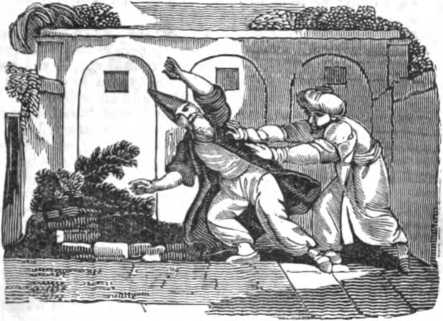
When the envious man saw that he was alone with this good man, he began to tell his errand, walking side by side in the court, till he saw his opportunity; and getting the good man near the brink of the well, he gave him a thrust, and pushed him into it, without any body being witness to so wicked an action. Having done thus, he marched off immediately, got out at the gate of the convent without being known to any one, and went home to his own house, well satisfied with his journey, being fully persuaded that the object of his hatred was no more in this world; but he found himself highly mistaken.
Scheherazade could go no farther, because day began to appear. The sultan conceived great indignation against the envious man, and said to himself, I heartily wish that no hurt may have come to this honest man: I hope to hear to-morrow that Heaven did not forsake him on this occasion.
FORTY-SEVENTH NIGHT.
If you be not asleep, sister, said Dinarzade, next morning, I conjure you to tell us if the honest dervise came safe and sound out of the well. —Yes, replied Scheherazade, and the second calender pursued his story thus: This old well, said he, was inhabited by fairies and genies, which happened luckily for the relief of the head of the convent: for they received and supported him, and carried him to the bottom, so that he got no hurt. He perceived well enough that there was something extraordinary in his fall, which must otherwise have cost him his life; whereas he neither saw nor felt any thing. But he soon heard a voice, which said, Do you know what honest man this is, to whom we have done this piece of service? Another voice answered, No. To which the first replied, Then I will tell you. This man, out of charity, the greatest that ever was known, left the town he lived in, and has established himself in this place, in hopes to cure one of his neighbours of the envy he had conceived against him; he had acquired such a general esteem, that the envious man, not able to endure it, came hither on purpose to ruin him, which he had performed, had it not been for the assistance which we have given this honest man, whose reputation is so great, that the sultan, who keeps his residence in the neighbouring city, was to pay him a visit tomorrow, to recommend the princess his daughter to his prayers.
Another voice asked, What need had the princess of the dervise’s prayers? To which the first answered, You do not know, it seems, that she is possessed by genie Maimoun, the son of Dimdim, who is fallen in love with her. But I know well how this good head of the dervises may cure her; the thing is very easy, and I will tell it you. He has a black cat in his convent, with a white spot at the end of her tail, about the bigness of a small piece of Arabian money; let him only pull seven hairs out of the white spot, burn them, and smoke the princess’s head with the fume, she will not only be presently cured, but be so safely delivered from Maimoun, the son of Dimdim, that he will never dare to come near her a second time.
The head of the dervises remembered every word of the discourse between the fairies and the genies, who were very silent all the night after. The next morning by break of day, when he could discern one thing from another, the well being broken down in several places, he saw a hole, by which he crept out with ease.
The other dervises, who had been seeking for him, were rejoiced to see him: he gave them a brief account of the wickedness of that man to whom he had given so kind a reception the day before, and retired into his cell. It was not long till the black cat, of whom the fairies and the genies had made mention in their discourses the night before, came to fawn upon her master, as she was accustomed to do: he took her up, and pulled out seven hairs of the white spot that was upon her tail, and laid them aside for his use when occasion should serve.
The sun was not high, when the sultan, who would leave no means untried that he thought could restore the princess to perfect health, arrived at the gate of the convent. He commanded his guards to halt, whilst he with his principal officers went in. The dervises received him with profound respect.
The sultan called their head aside, and said, Good sheich, it may be you know already the cause of my coming hither. —Yes, sir, replied he very gravely, if I do not mistake, it is the disease of the princess which procures me this unmerited honour.
That is the very thing, replied the sultan. You will give me new life, if your prayers, as I hope they will, can procure my daughter’s health. —Sir, said the good man, if your majesty will be pleased to let her come hither, I am in hopes, through God’s assistance and favour, she shall return in perfect health.
The prince, transported with joy, sent immediately to fetch his daughter, who very soon appeared with a numerous train of ladies and eunuchs, but masked, so that her face was not seen. The chief of the dervises caused a pall to be held over her head, and he had no sooner thrown the seven hairs upon the burning coals, but the genie Maimoun, the son of Dimdim, gave a great cry, without any thing being seen, and left the princess at liberty; upon which she took off the veil from her face, and rose up to see where she was, saying, Where am I, and who brought me hither? At which words, the sultan, overcome with excess of joy, embraced his daughter, and kissed her eyes? he also kissed the chief of the dervises’ hands, and said to his officers, Tell me your opinion, what reward does he deserve, that has thus cured my daughter? They all cried, he deserves her in marriage. —This is what I had in my thoughts, said the sultan; and I make him my son-in-law from this moment. Some time after the prime vizier died, and the sultan conferred the place on the dervise. The sultan himself also died without heirs male; upon which, the religious orders and the militia gathered together, and the good man was declared and acknowledged sultan by general consent.
Day light appearing, Scheherazade was obliged to break off her story. Schahriar looked upon the dervise to be worthy of the crown he had got, but was desirous to know if the envious man did not die for spite; and got up with an intention to hear it next night.
FORTY-EIGHTH NIGHT.
Dinarzade, when it was time, addressed her speech to the sultaness thus: My dear sister, said she, if you be not asleep, I would pray you to continue the story of the hated and envious man. With all my heart, answered Scheherazade. The second calender continued his story thus: The honest dervise, said he, being mounted on the throne of his father-in-law, as he was one day in the midst of his courtiers upon a march, he espied the envious man among the crowd of people that stood as he passed along, and calling one of the viziers that attended him, whispered him in his ear thus; Go bring me that man you see there; but, take care you do not frighten him. The vizier obeyed, and when the envious man was brought into his presence, the sultan said, Friend, I am extremely glad to see you. Upon which he called an officer, Go immediately, said he, and cause to be paid the man out of my treasury one hundred pieces of gold: let him have also twenty loads of the richest merchandize in my storehouses, and a sufficient guard to conduct him to his house. After he had given this charge to the officer, he bid the envious man farewell, and proceeded on his march.
When I had finished the recital of this story to the genie, the murderer of the princess of the isle of Ebene, I made the application to himself thus: O genie! you see here, that this bountiful sultan did not content himself with forgetting the design of the envious man to take away his life, but treated him kindly, and sent him back with all the favours which I just now related. In short, I made use of all my eloquence, praying him to imitate so good an example, and to grant me pardon; but it was impossible for me to move his compassion.
All that I can do for thee, said he, is, that I will not take thy life: do not flatter thyself that I will send thee safe and sound back; I must let thee feel what I am able to do by my enchantments. So saying, he laid violent hands on me, and carried me across the vault of the subterranean palace, which opened to give him passage; he flew up with me so high, that the earth seemed to be only a little white cloud; from thence he came down again like lightning, and alighted upon the ridge of a mountain.
There he took up a handful of earth, and pronounced or rather muttered some words which I did not understand, and threw it upon me: Quit the shape of a man, said he to me, and take on thee that of an ape. He vanished immediately, and left me alone, transformed into an ape, overwhelmed with sorrow, in a strange country, not knowing whether I was near or far from my father’s dominions.
I went down from the top of the mountain, and came into a plain country, which took me a month’s time to travel through, and then I came to the sea-side. It happened to be then a great calm, and I espied a vessel about half a league from the shore: unwilling to lose this good opportunity, I broke off a large branch from a tree, which I carried with me to the sea-side, and set myself astride upon it, with a stick in each hand to serve me for oars.
I launched out in this posture, and advanced near the ship. When I was nigh enough to be known, the seamen and passengers that were upon the deck thought it an extraordinary sight, and all of them looked upon me with great astonishment. In the mean time I got aboard, and laying hold of a rope, I jumped upon the deck, but having lost my speech, I found myself in great perplexity; and indeed the risk I ran then was nothing less than when I was at the mercy of the genie.
The merchants, being both superstitious and scrupulous, believed I should occasion some mischief to their voyage, if they received me; therefore, said one, I will knock him down with a handspike; says another, I will shoot an arrow through his guts: says a third, Let us throw him into the sea. Some of them would not have failed to have executed their design, if I had not got to that side where the captain was, when I threw myself at his feet, and took him by the coat in a begging posture. This action, together with the tears which he saw gush from my eyes, moved his compassion, so that he took me under his protection, threatening to be revenged on him that would do me the least hurt; and he himself made very much of me, while I on my part, though I had no power to speak, showed all possible signs of gratitude by my gestures.
The wind that succeeded the calm was gentle and favourable, and did not change for fifty days, but brought us safe to the port of a fine city, well peopled, and of great trade, the capital of a powerful state, where we came to an anchor.
Our vessel was speedily surrounded with an infinite number of boats full of people, who came to congratulate their friends upon their safe arrival, or to inquire for those they had left behind them in the country from whence they came, or out of curiosity to see a ship that came from a far country.
Amongst the rest, some officers came on hoard, desiring to speak with the merchants, in the name of the sultan. The merchants appearing, one of the officers told them, The sultan, our master, hath commanded us to acquaint you, that he is glad of your safe arrival, and prays you to take the trouble, every one of you, to write some lines upon this roll of paper: and that his design by this may be understood, you must know that we had a prime vizier, who, besides a great capacity to manage affairs, understood writing to the highest perfection. This minister is lately dead, at which the sultan is very much troubled: and since he can never behold his writing without admiration, he has made a solemn vow, not to give the place to any man but to him who can write as well as he did. Many people have presented their writings; but, to this day, nobody in all this empire, has been judged worthy to supply the vizier’s place.
Those merchants that believed they could write well enough to pretend to this high dignity, wrote one after another what they thought fit. After they had done, I advanced, and look the roll out of the gentleman’s hand; but all the people, especially the merchants, cried out, He will tear it, or throw it into the sea; till they saw how properly I held the roll, and made a sign that I would write in my turn: then they were of another opinion, and their fear turned into admiration. However, since they had never seen an ape that could write, nor could be persuaded that I was more ingenious than other apes, they offered to snatch the roll out of my hand; but the captain took my part once more. Let him alone, said he; suffer him to write. If he only scribbles the paper, I promise you that I will punish him upon the spot; if, on the contrary, he writes well, as I hope he will, because I never saw an ape so clever and ingenious, and so quick of apprehension, I do declare that I will own him as my son. I had one that had not half the wit that he has. Perceiving that nobody opposed my design, I took the pen, and wrote six sorts of hands used among the Arabians, and each specimen contained an extemporary distich or quatrain in praise of the sultan. My writing did not only excel that of the merchants, but, I venture to say, they had not before seen any such fair writing in that country. When I had done, the officers took the roll, and carried it to the sultan.
Thus far was Scheherazade come in her story, when day-light appeared. Sir, said she to Schahriar, if I had time to continue, I would give your majesty an account of things far more surprising than what I have already told. The sultan, who had resolved to hear the end of the story, got up without saying a word.
FORTY-NINTH NIGHT.
The next morning, Dinarzade, being awake before day, called the sultaness, and said, Sister, if you be not asleep, pray let us hear the rest of the adventures that befel the ape. I believe my lord the sultan is no less curious to know it than myself. You shall both be soon satisfied, answered Scheherazade. The second calender continued his story thus:—
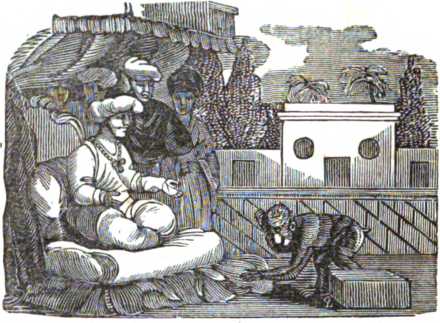
The sultan took little notice of any of the other writings, but considered mine, which was so much to his liking, that he said to the officers, Take the finest horse in my stable, with the richest harness, and a robe of the most sumptuous brocade, to put upon that person who wrote the six hands, and bring him hither to me. At this command the officers could not forbear laughing; the sultan grew angry at their boldness, and was ready to punish them; till they told him, Sir, we humbly beg your majesty’s pardon: these hands were not written by a man, but by an ape. What do you say? said the sultan: those admirable characters, are they not written by the hands of a man? No, sir, replied the officers: we do assure your majesty that it was an ape, who wrote them in our presence. The sultan was too much surprised at this account not to desire a sight of me; and therefore said, Do what I command you, and bring me speedily that wonderful ape.
The officers returned to the vessel, and shewed the captain their order, who answered, The sultan’s command must be obeyed. Whereupon they clothed me with that rich brocade robe, and carried me ashore, where they set me on horseback, whilst the sultan waited for me at his palace, with a great number of courtiers, whom he gathered together to do me the more honour.
The cavalcade being begun, the harbour, the streets, the public places, windows, terraces, palaces, and houses, were filled with an infinite number of people of all sorts, who flocked from all parts of the city to see me; for the rumour was spread in a moment, that the sultan had chosen an ape to be his grand vizier; and after having served for a spectacle to the people, who could not forbear to express their surprise by redoubling their shouts and cries, I arrived at the palace of the sultan.
I found the prince on his throne in the midst of the grandees: I made my bow three times very low, and at last kneeled and kissed the ground before him, and afterwards sat down on my seat in the posture of an ape. The whole assembly admired me, and could not comprehend how it was possible that an ape should understand so well to pay the sultan his due respect; and he himself was more astonished than any. In short, the usual ceremony of the audience would have been complete, could I have added speech to my behaviour; but apes do never speak, and the advantage I had of having been a man did not allow me that privilege.
The sultan dismissed his courtiers, and none remained by him but the chief of the eunuchs, a little young slave, and myself. He went from his chamber of audience into his own apartment, where he ordered dinner to be brought. As he sat at table, he gave me a sign to come near and eat with them: to show my obedience, I kissed the ground, stood up, sat down at table, and ate with discretion and moderation.
Before the table was uncovered, I espied a writing-desk, which I made a sign should be brought me: having got it, I wrote upon a large peach some verses after my way, which testified my acknowledgment to the sultan; who having read them after my presenting him the peach, it increased his astonishment. When the table was uncovered, they brought him a particular liquor, of which he caused them to give me a glass. I drank and wrote upon it some new verses, which explained the state I was reduced to, after many sufferings. The sultan read them likewise, and said, A man that was capable of doing so much would be above the greatest of men.
The sultan caused them to bring in a chess-board, and asked me by a sign, if I understood that game, and would play with him? I kissed the ground, and laying my hand upon my head, signified that I was ready to receive that honour. He won the first game, but I won the second and third; and perceiving he was somewhat displeased at it, I made a quatrain to pacify him; in which I told him, that two potent armies had been fighting furiously all day, but that they made up a piece towards the evening, and passed the remaining part of the night very peaceably together upon the field of battle.
So many circumstances appearing to the sultan far beyond what ever any one had either seen or known of the cleverness or sense of apes, he determined not to be the only witness of those prodigies himself, but having a daughter, called the Lady of Beauty, on whom the chief of the eunuchs, then present waited, Go, said the sultan to him, and bid your lady come hither: I am desirous she should share my pleasure.
The eunuch went, and immediately brought the princess, who had her face uncovered; but she was no sooner come into the room, than she put on her veil, and said to the sultan, Sir, your majesty must needs have forgotten yourself: I am very much surprised that your majesty has sent for me to appear among men. How, daughter! said the sultan, you do not know what you say: here is nobody but the little slave, the eunuch your governor, and myself, who have the liberty to see your face; and yet you lower your veil, and blame me for having sent for you hither. —Sir, said the princess, your majesty shall soon understand that I am not in the wrong. That ape you see before you, though he has the shape of an ape, is a young prince, son of a great king; he has been metamorphosed into an ape by enchantment. A genie, the son of the daughter of Eblis, has maliciously done him this wrong, after having cruelly taken away the life of the princess of the isle of Ebene, daughter to the king Epitimarus.
The sultan, astonished at this discourse, turned towards me, and spoke no more by signs, but in plain words asked me, if it was true what his daughter said? Seeing I could not speak, I put my hand to my head to signify that what the princess spoke was true. Upon this the sultan said again to his daughter, How do you know that this prince has been transformed by enchantment into an ape? —Sir, replied the Lady of Beauty, your majesty may remember that when I was past my infancy, I had an old lady waited upon me; she was a most expert magician, and taught me seventy rules of magic, by virtue of which I can transport your capital city into the midst of the sea in the twinkling of an eye, or beyond mount Caucasus. By this science I know all enchanted persons at first sight; I know who they are, and by whom they have been enchanted; therefore do not be surprised if I should forthwith relieve this prince, in spite of the enchantment, from that which hinders him to appear in your sight what he naturally is. Daughter, said the sultan, I did not believe you to have understood so much. —Sir, replied the princess, these things are curious and worth knowing: but I think I ought not to boast of them. —Since it is so, said the sultan, you can dispel the prince’s enchantment. —Yes, sir, said the princess, I can restore him to his first shape again. —Do it then, said the sultan, you cannot do me a greater pleasure; for I will have him to be my vizier, and he shall marry you. —Sir, said the princess, I am ready to obey you in all that you should be pleased to command me.
Scheherazade, as she spoke, espied day, and broke off her story of the second calender: and Schahriar, judging the sequel would be as diverting as the former part of it, resolved to hear it next day.
FIFTIETH NIGHT.
Dinarzade called the sultaness at the usual hour, saying, Sister, if you be not asleep, pray do us the favour to tell us how the Lady of Beauty restored the second calender to his former shape. You shall hear it, said Scheherazade: The calender resumed his discourse thus:
The princess, the Lady of Beauty, went into her apartment, from whence she brought in a knife, which had some Hebrew words engraven on the blade; she made the sultan, the master of the eunuchs, the little slave, and myself, go down into a private court of the palace, and there left us under a gallery that went round it. She placed herself in the middle of the court, where she made a great circle, and within it she wrote several words in Arabian characters, some of them ancient, and others of those which they call the characters of Cleopatra.
When she had finished and prepared the circle as she thought fit, she placed herself in the centre of it, where she began abjurations, and repeated verses out of the Koran. The air grew insensibly dark, as if it had been night, and the whole world about to be dissolved: we found ourselves struck with a panic, and this fear increased the more when we saw the genie, the son of the daughter of Eblis, appear on a sudden in the shape of a lion of a frightful size.
As soon as the princess perceived this monster, You dog, said she, instead of creeping before me, dare you present yourself in this shape, thinking to frighten me? —And thou, replied the lion, art thou not afraid to break the treaty which was solemnly made and confirmed between us by oath, not to wrong or do one another any hurt? —O! thou cursed creature! replied the princess, I can justly reproach thee with doing so. —The lion answered fiercely, Thou shalt quickly have thy reward for the trouble thou hast given me to return: with that he opened his terrible throat, and ran at her to devour her; but she, being on her guard, leaped backward, got time to pull out one of her hairs, and by pronouncing three or four words, changed herself into a sharp sword, wherewith she cut the lion through the middle in two pieces.
The two parts of the lion vanished, and the head only was left, which changed itself into a large scorpion. Immediately the princess turned herself into a serpent, and fought the scorpion, who, finding himself worsted, took the shape of an eagle, and flew away; but the serpent at the same time took also the shape of an eagle, that was black and much stronger, and pursued him, so that we lost the sight of them both.
Some time after they had disappeared, the ground opened before us, and out of it came forth a cat, black and white, with her hair standing upright, and mewing in a frightful manner; a black wolf followed her close, and gave her no time to rest. The cat, being thus hard beset, changed herself into a worm, and being nigh to a pomegranate that had accidentally fallen from a tree that grew on the side of a canal, which was deep, but not broad, the worm pierced the pomegranate in an instant, and hid itself, but the pomegranate swelled immediately, and became as big as a gourd, which mounting up to the roof of the gallery, rolled there for some space, backward and forward, fell down again into the court, and broke into several pieces.
The wolf, who had in the meantime transformed itself into a cock, fell to picking up the seeds of the pomegranate one after another; but finding no more, he came towards us with his wings spread, making a great noise, as if he would ask us whether there was any more seed. There was one lying on the brink of the canal, which the cock perceiving as he went back, ran speedily thither; but just as he was going to pick it up, the seed rolled into the river, and turned into a little fish.
But I see day, sir, said Scheherazade; had it not come so suddenly, I am persuaded what I had farther to say would have given your majesty a great deal of satisfaction. Upon this she stopped, and the sultan arose: but his thoughts being altogether taken up with such unheard-of adventures, he was extremely impatient till he heard the rest of the story.
FIFTY-FIRST NIGHT.
Dinarzade made no scruple to disturb the sultaness next morning, and called to her, Sister, if you be not asleep, pray begin where you left off that wonderful story last night: I am very desirous to know what followed after all those metamorphoses. Scheherazade recollected where she had stopped, and addressing her discourse to the sultan, Sir, said she, the second calender continued his story after this manner.
The cock jumped into the river and was turned into a pike, that pursued the small fish; they continued both under water above two hours, and we knew not what was become of them, but all on a sudden we heard terrible cries, which made us tremble, and a little while after we saw the genie and princess all in flames. They threw flashes of fire out of their mouths at each other, till they came to close quarters; then the two fires increased, with a thick burning smoke, which mounted so high, that we had reason to fear it would set the palace on fire. But we very soon had a more pressing occasion of fear, for the genie having got loose from the princess, came to the gallery where we stood, and blew flames of fire upon us. We had all perished if the princess, running to out assistance, had not by her cries forced him to retire, and defend himself against her; yet, notwithstanding all her exertions, she could not hinder the sultan’s beard from being burnt, and his face spoiled, the chief of the eunuchs from being stifled, and burnt on the spot, and a spark from entering my right eye, and making it blind. The sultan and I expected nothing but death, when we heard a cry of Victory, victory! and on a sudden the princess appeared in her natural shape, but the genie was reduced to a heap of ashes.
The princess came near to us, that she might not lose time, called for a cup-full of water, which the young slave, who had received no damage, brought her. She took it, and after pronouncing some words over it, threw it upon me, saying, if thou art become an ape by enchantment, change thy shape, and take that of a man, which thou hadst before. These words were hardly uttered, till I became a man as I was before, one eye only excepted.
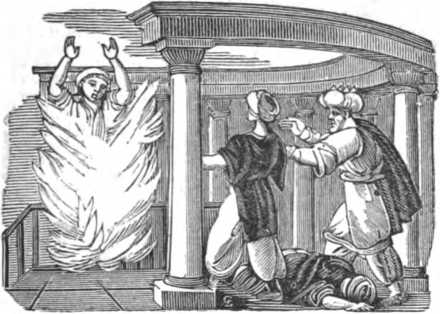
I was preparing myself to give thanks to the princess, but she prevented me by addressing herself to her father, thus; Sir, I have gained the victory over the genie, as your majesty may see; but it is a victory that costs me dear; I have but a few minutes to live, and you will not have the satisfaction to make the match you intended; the fire has pierced me during the terrible combat, and I find it consumes me by degrees. This would not have happened, had I perceived the last of the pomegranate seeds, and swallowed it, as I did the other when I was changed into a cock; the genie had fled thither as to his last entrenchment, and upon that the success of the combat depended, which would have been successful, and without danger to me. This slip obliged me to have recourse to fire, and to fight with those mighty arms as I did between heaven and earth, in your presence: for, in spite of all his redoubtable art and experience, I made the genie know that I understood more than he: I have conquered and reduced him to ashes, but I cannot escape death, which is approaching.
Here Scheherazade broke off the story of the second calender, and said to the sultan, Sir, daylight appears, which forbids me to say any more; but if your majesty thinks fit to let me live till to morrow, you shall hear the end of this story. Schahriar consented, and got up according to custom to take care of the affairs of his empire.
FIFTY-SECOND NIGHT.
Dinarzade awaking some time before day, called upon the sultaness, and said, My dear sister, if you be not asleep, I would pray you to finish the story of the second calender. Scheherazade resumed her discourse, and went on as follows:
The calender always directing his speech to Zobeide, told her, Madam, the sultan suffered the princess, the Lady of Beauty, to go on with the recital of her combat, and when she had done, he spoke to her in a tone that sufficiently testified his grief. My daughter, said he, you see in what condition your father is; alas! I wonder that I am yet alive! Your governor, the eunuch, is dead; and the prince whom you have delivered from his enchantment has lost one of his eyes. He could speak no more, for his tears, sighs, and sobs, made him speechless; his daughter and I were exceeding sensible of his sorrow, and wept with him.
In the mean time, while we were vying with each other in grief, the princess cried, I burn! I burn! She found that the fire which consumed her, had at last seized upon her whole body, which made her still cry, I burn, until death had made an end of her intolerable pains. The effect of that fire was so extraordinary, that in a few moments she was wholly reduced to ashes, as was the genie.
I cannot tell you, madam, how much I was grieved at so dismal a spectacle; I had rather all my life have continued an ape or a dog, than to have seen my benefactress thus miserably perish. The sultan being afflicted beyond all that can be imagined, cried out piteously, and beat himself on his head and stomach, until being quite overcome with grief, he fainted away, which made me fear for his life. In the mean time the eunuchs and officers came running at the sultan’s cries, and with very much ado brought him to himself again. There was no need for that prince and me to give them a long narrative of this adventure, in order to convince them of their great loss. The two heaps of ashes, into which the princess and the genie had been reduced, were sufficient demonstration. The sultan was hardly able to stand, but was forced to be supported by them till he could get to his apartment.
When the noise of the tragical event had spread itself through the palace and the city, all the people bewailed the misfortune of the princess, the Lady of Beauty, and were much affected by the sultan’s affliction. Every one was in deep mourning for seven days, and many ceremonies were performed. The ashes of the genie were thrown into the air, but those of the princess were gathered into a precious urn, to be kept, and the urn was set in a stately tomb, which was built for that purpose on the same place where the ashes had lain.
The grief which the sultan conceived for the loss of his daughter threw him into a fit of sickness, which confined him to his chamber for a whole month. He had not fully recovered strength when he sent for me: Prince, said he, hearken to the orders that I now give you; it will cost you your life if you do not put them into execution. I assured him of exact obedience; upon which he went on thus: I have constantly lived in perfect felicity, and was never crossed by any accident; but by your arrival all the happiness I possessed is vanished: my daughter is dead, her governor is no more, and it is through a miracle that I am yet alive. You are the cause of all those misfortunes, for which it is impossible that I should be comforted; therefore depart from hence in peace, without further delay, for I myself must perish, if you stay any longer: I am persuaded that your presence brings mischief along with it. This is all I have to say to you. Depart, and take care of ever appearing again in my dominions; no consideration whatsoever shall hinder me from making you repent of it. I was going to speak, but he stopped my mouth by words full of anger: and so I was obliged to remove from his palace, rejected, banished, an outcast from the world, and not knowing what would become of me. Before I left the city I went into a bagnio, where I caused my beard and eyebrows to be shaved, and put on a calender’s habit. I began my journey, not so much deploring my own miseries, as the death of the two fair princesses, of which I have been the occasion. I passed through many countries without making myself known; at last I resolved to come to Bagdad, in hopes to get myself introduced to the commander of the faithful, to move his compassion by giving him an account of my strange adventures. I came hither this evening, and the first man I met was this calender, our brother, who spoke before me. You know the remaining part, madam, and the cause of my having the honour to be here.
When the second calender made an end of his story, Zobeide, to whom he had addressed his speech, told him, It is well, you may go which way you please; I give you leave: but instead of departing, he also petitioned the lady to show him the same favour she had vouchsafed to the first calender, and went and sat down by him. But, sir, said Scheherazade, as she spoke these words, it is day, and I must not proceed: I dare however assure you, that how agreeable soever this story of the second calender may seem to you, that of the third will be no less worthy of your hearing, if your majesty be pleased to have patience. The sultan being desirous to know whether it would appear so wonderful as the last, got out of bed with a resolution to prolong Scheherazade’s life farther, though the delay he had granted was determined several days before.
FIFTY-THIRD NIGHT.
About the latter end of the following night, Dinarzade addressed herself to the sultaness thus: Dear sister, I pray, until day appear, which will be very soon, be pleased to relate some of the fine stories you have read. —I would willingly, said Schahriar, hear the story of the third calender. —Sir, replied Scheherazade, you shall be obeyed. The third calender, perceiving it was his turn to speak, addressed his speech as the rest had done, to Zobeide, and began in this manner:
The History of the Third Calender, a King’s Son.
My story, most honourable lady, very much differs from what you have heard already. The two princes that spoke before me have each lost an eye by the pure effects of their destiny, but mine I lost through my own fault, and by hastening to seek my own misfortune, as you shall hear by the sequel of the story. My name is Agib, and I am the son of a king who was called Cassib. After his death I took possession of his dominions, and resided in the same city where he lived before. The city is situated on the sea-coast, has one of the finest and safest harbours in the world, an arsenal capable of fitting out for sea one hundred and fifty men of war that are always ready, and fifty merchantmen, and light frigates, and pleasure-boats besides. My kingdom is composed of several fine provinces upon the main land, besides a number of spacious islands, every one of which lies almost in sight of my capital city.
The first thing I did was to visit the provinces. I afterwards caused my whole fleet to be fitted out and manned, and went to my islands to gain the hearts of my subjects by my presence, and to confirm them in their loyalty; and some time after I returned, I went thither again. These voyages giving me some taste for navigation, I took so much pleasure in it, that I resolved to make some discoveries beyond my islands; to which end I caused only ten ships to be fitted out, embarked on board them, and set sail.
Our voyage was very successful for forty days together: but on the forty-first night the wind became contrary, and withal so boisterous, that we were near being lost in the storm. About break of day the wind grew calm, the clouds dispersed, and the sun having brought back fair weather, we came close to an island, where we remained two days to take in fresh provisions; after which we put off again to sea. After ten days’ sail, we were in hopes of seeing land; for the tempests we had gone through had so much abated my curiosity, that I gave orders to steer back to my own coast; but I perceived at the same time, that my pilot knew not where we were. Upon the tenth day, a seaman being sent to look out for land from the main-mast head, gave notice that on starboard and larboard he could see nothing but the sky and the sea, which bounded the horizon; but just before us, upon the stern, he saw a great blackness.
The pilot changed colour at this relation; and, throwing his turban on the deck with one hand, and beating his breast with the other, cried, Oh, sir! we are all lost! not one of us will escape! and, with all my skill, it is not in my power to prevent it. —Having spoke thus, he fell to crying like a man who foresaw unavoidable ruin: his despair put the whole ship’s crew in fear. I asked him what reason he had thus to despair? He told me the tempest, which he had outlived, had brought us so far out of our course, that to-morrow about noon we should come near to that black place, which is nothing else but the black mountain, that is, a mine of adamant, which at this very minute draws all your fleet towards it, by virtue of the iron and the nails that are in your ships; and when we come to-morrow at a certain distance, the strength of the adamant will have such a force, that all the nails will be drawn out of the sides and bottoms of the ships, and fasten to the mountain; so that your vessel will fall to pieces, and sink to the bottom: and as the adamant has a virtue to draw all iron to it, whereby its attraction becomes stronger, this mountain on the side of the sea is covered over with nails, drawn out of an infinite number of vessels that have perished by it; and this preserves and augments its virtue at the same time.
This mountain, continued the pilot, is very rugged: on the top of it there is a dome of fine brass, supported by pillars of the same; and upon the top of that dome there stands a horse of the same metal, with a rider on his back, who has a plate of lead fixed to his breast, upon which some talismanic characters are engraven. Sir, the tradition is, that this statue is the chief cause that so many ships and men have been lost and sunk in this place, and that it will ever continue to be fatal to all those who have the misfortune to come near to it, until it shall be thrown down.
The pilot, having ended his discourse, began to weep afresh, and all the rest of the ship’s company did the like. I had no other thought but that my days were there to have an end. In the mean time, every one began to provide for his own safety, and to that end took all imaginable precautions; and, being uncertain of the event, they all made one another their heirs, by virtue of a will, for the benefit of those that should happen to be saved.
The next morning we perceived the black mountain very plain, and the idea we had conceived of it made it appear more frightful than it was. About noon we were come so near, that we found what the pilot had foretold to be true; for we saw all the nails and iron about the ships fly towards the mountain, where they fixed, by the violence of the attraction, with a horrible noise: the ships split asunder, and sunk into the sea, which was so deep about the place, that we could not sound it. All my people were drowned; but God had mercy on me, and permitted me to save myself by means of a plank, which the wind drove ashore just at the foot of the mountain. I did not receive the least hurt; and my good fortune brought me to a landing place, where there were steps that went up to the top of the mountain.
Scheherazade would have gone on with her story, but day appearing, she was obliged to keep silence. The sultan was convinced by this beginning that the sultaness had not deceived him; and therefore we are not to wonder that he did not order her to die that day.
FIFTY-FOURTH NIGHT.
For heaven’s sake, cried Dinarzade, next morning, if you be not asleep, sister, go on with the story of the third calender. My dear sister, said Scheherazade, the prince renewed his discourse thus:—
At the sight of these steps, said he, for there was not a bit of ground, either on the right or left, whereon a man could set his foot, I gave thanks to God, and recommended myself to his holy protection, as I began to mount the steps, which were so narrow, rugged, and hard to get up, that had the wind blown ever so little, it would have thrown me down into the sea. But at last I got up to the top, without any accident. I came into the dome, and, kneeling on the ground, gave God thanks for his mercies to me.
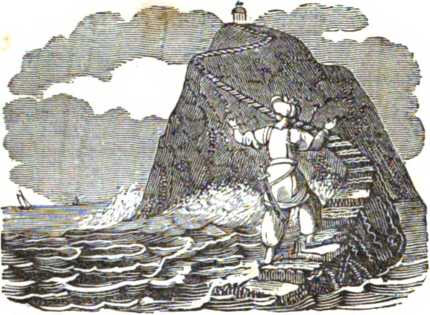
I passed the night under the dome; and in my sleep, an old grave man appeared to me, and said, Hearken, Agib: as soon as thou art awake, dig up the ground under thy feet; thou shalt find a bow of brass, and three arrows of lead, that are made under certain constellations, to deliver mankind from the many calamities that threaten them. Shoot the three arrows at the statue, and the rider shall fall into the sea, but the horse will fall down by thy side, which thou must bury in the same place from whence thou tookest the bow and arrows. This being done, the sea will swell and rise up to the foot of the dome that stands upon the top of the mountain: when it comes up so high, thou shalt see a boat with one man holding an oar in each hand; —this man is also of metal, but different from that thou hast thrown down; step on board to him, without mentioning the name of God, and let him conduct thee. He will in ten days’ time bring thee into another sea, where thou shalt find an opportunity to get home to thy country safe and sound, provided, as I have told thee, thou dost not mention the name of God during the whole voyage.
This was the substance of the old man’s discourse. When I awoke, I was very much comforted by the vision, and did not fail to observe every thing that he had commanded me. I took the bow and arrows out of the ground, shot at the horseman, and, with the third arrow, I overthrew him: he fell into the sea, and the horse fell by my side, which I buried in the place whence I took the bow and arrows. In the mean time, the sea swelled, and rose up by degrees; when it came as high as the foot of the dome that stood upon the top of the mountain, I saw afar off a boat rowing towards me, and I returned God thanks that every thing succeeded according to my dream.
At last the boat made land, and I saw the man was made of metal, as I had dreamt. I stepped aboard, and took great heed not to pronounce the name of God, neither spoke I one word. I sat down, and the man of metal began to row off from the mountain. He rowed without ceasing till the ninth day, when I saw some islands, which gave me hopes that I should escape all the danger that I feared. The excess of my joy made me forget what I was forbidden to do: Blessed be God! said I; God be praised!
I had no sooner spoken these words, but the boat sunk with the man of metal; and, leaving me upon the surface, I swam the remaining part of the day towards that land which appeared nearest to me. A very dark night succeeded; and not knowing where I was, I swam at a venture. My strength at last began to fail, and I despaired of being able to save myself; when the wind began to blow hard, and a wave, as big as a mountain, threw me on a flat, where it left me, and drew back. I made haste to get ashore, fearing another wave might wash me back again. The first thing I did was to strip, and wring the water out of my clothes, and then laid them down on the dry sand, which was still pretty warm by the heat of the day.
Next morning the sun dried my clothes early; I put them on, and went forward to see where I was. I had not walked very far, till I found I was got upon a little desert island, though very pleasant, where there grew several sorts of trees and wild fruits; but I perceived it was very far from the continent, which much diminished the joy I conceived for having escaped the danger of the seas. I notwithstanding recommended myself to God, and prayed him to dispose of me according to his good will and pleasure. At the same time I saw a vessel coming from the main land, before the wind, directly to the island. I doubted not but they were coming to anchor there; and being uncertain what sort of people they might be, whether friends or foes, I thought it not safe for me to be seen. I got up into a very thick tree, from whence I might safely view them. The vessel came into a little creek, where ten slaves landed, carrying a spade and other instruments fit for digging up the ground. They went towards the middle of the island, where I saw them stop and dig the ground a long while; after which I thought I saw them lift up a trap-door. They returned again to the vessel, and unladed several sorts of provisions and furniture, which they carried to that place where they had broken ground, and so went downward; which made me suppose it was a subterraneous dwelling.
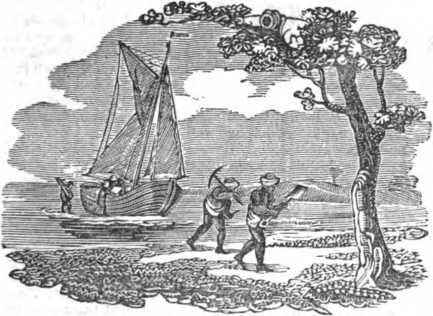
I saw them once more go to the ship, and return soon after with an old man, who led a very handsome young lad in his hand, of about fourteen or fifteen years of age —They all went down at the trap-door; and, being come up again, having let down the trap-door, and covered it over with earth, they returned to the creek where the ship lay: but I saw not the young man in their company. This made me believe that he staid behind in that place under ground, at which I could not but be extremely astonished.
The old man and the slaves went aboard again, and the vessel being got under sail, steered its course towards the main land. When I perceived they were at such distance that they could not see me, I came down from the tree, and went directly to the place where I had seen the ground broken. I removed the earth by degrees, till I found a stone that was two or three feet square. I lifted it up, and saw that it covered the head of the stairs, which were also of stone. I went down, and came into a large room, where there was laid a foot-carpet, and a couch covered with tapestry, and cushions covered with rich stuff, upon which the young man sat, with a fan in his hand. I saw all this by the light of two tapers, together with the fruits and flower-pots he had standing about him. The young lad was startled at the sight of me; but to rid him of his fear, I said to him as I came in, Whoever you be, sir, do not fear any thing: a king, and the son of a king, as I am, is not capable of doing you any prejudice; on the contrary, it is probable that your good destiny has brought me hither to deliver you out of this tomb, where it seems they have buried you alive, for reasons unknown to me. But that which makes me wonder, and what I cannot conceive, (for you must know that I have been witness to all that hath passed since your coming into this island), is, that you suffered yourself to be buried in this place without any resistance.
Scheherazade broke off here, and the sultan arose, very impatient to know why this young lad was thus abandoned in a desert island, as to which he promised himself satisfaction next night.
FIFTY-FIFTH NIGHT.
Dinarzade perceiving it was time to call upon the sultaness, said, Sister, if you be not asleep, pray resume the story of the third calender. Scheherazade gave her no occasion to repeat her request, and went on in this manner:—
The young man, continued the third calender, recovered himself at these words, and prayed me, with a smiling countenance, to sit down by him; which when I had done, he said, Prince, I am to acquaint you with a matter so extraordinary in itself, that it cannot but surprise you.
My father is a merchant jeweller, who, through his ingenuity in his calling, has acquired a great estate. He has many slaves and also deputies, whom he employs to go as supercargoes to sea with his own ships, on purpose to maintain the correspondence he has at several courts, which he furnishes with such precious stones as they want.
He had been married a long while, and without issue, when he understood by a dream that he should have a son, though his life would be but short; at which he was very much concerned when he awoke. —Some days after, my mother acquainted him that she was with child: and what she supposed to be the time of her conception agreed exactly with the day of his dream. She was brought to bed of me at the end of nine months, which occasioned great joy in the family.
My father, who had observed the very moment of my birth, consulted astrologers about my nativity, who told him, Your son shall live very happily till the age of fifteen, when he will be in danger of losing his life, and hardly be able to escape it: but if his good destiny preserve him beyond that time, he will live to grow very old. It will be (said they) when the statue of brass, that stands upon the top of the mountain of adamant, shall be thrown down into the sea by prince Agib, son of king Cassib; and, as the stars prognosticate, your son shall be killed fifty days afterwards by that prince.
As the event of this part of the prediction about the statue agrees exactly with my father’s dream, it afflicted him so much, that he was struck to the very heart with it. In the mean time, he took all imaginable care of my education until this present year, which is the fifteenth of my age; and he had notice given him yesterday, that the statue of brass had been thrown into the sea about ten days ago, by that same prince I told you of. This news has cost him so many tears, and has alarmed him so much, that he looks not like himself.
Upon these predictions of the astrologers, he has sought by all means possible to falsify my horoscope, and to preserve my life. It is not long since he took the precaution to build me this subterranean habitation to hide me in till the expiration of the fifty days after the throwing down of the statue; and therefore, since it was ten days ago that this had happened, he came hastily hither to hide me, and promised at the end of forty days to come again, and fetch me out. As for my own part, I am in good hope, and cannot believe that prince Agib will come to seek for me in a place under ground in the midst of a desert island. This, my lord, is what I have to say to you.
While the jeweller’s son was telling me this story, I laughed within myself at those astrologers who had foretold that I should take away his life; for I thought myself so far from being likely to verify what they said, that he had scarce done speaking, when I told him, with great joy, Dear sir, put your confidence in the goodness of God, and fear nothing: you may consider it as a debt you was to pay, but that you are acquitted of it from this very hour. I am glad that, after my shipwreck, I came so fortunately hither to defend you against all those that would attempt your death. I will not leave you till the forty days are expired, of which the foolish astrologers have made you apprehensive; and, in the mean while, I will do you all the service that lies in my power; after which, I shall have the benefit of getting to the main land in your vessel, with leave of your father, and yourself; and when I am returned into my kingdom, I shall remember the obligations I owe you, and endeavour to demonstrate my acknowledgments in a suitable manner.
This my discourse encouraged the jeweller’s son, and inspired him with confidence in me. I took care not to tell him I was the very Agib whom he dreaded, lest I should put him into a fright, and took as much care not to give him any cause to suspect it. We passed the time in several discourses till night came on: I found the young lad of ready wit, and partook with him of his provisions, of which he had enough to have lasted beyond the forty days, though he had more guests than myself. After supper we continued some time in discourse: at last we went to bed. The next day, when we got up, I held the basin and water to him; I also provided dinner, and set it on the table in due time; after we had done, I invented a play to divert ourselves, not only for that day, but for those that followed. I prepared supper after the same manner as I had prepared dinner; and having supped, we went to bed as formerly. We had time enough to contract friendship. I found he loved me, and for my part, I had so great a respect for him, that I have often said to myself, Those astrologers who predicted to his father, that his son should die by my hand, were impostors; for it is not possible that I could commit so base an action. In short, madam, we spent thirty-nine days in the pleasantest manner that could be, in a place like that under ground.
The fortieth day appeared; and in the morning, when the young man awoke, he said to me, with a transport of joy that he could not restrain, Prince, this is the fortieth day; I am not dead, thanks to God and your good company. My father will not fail to be here anon, to give you a testimony of his gratitude for it, and shall furnish you with all that is necessary for your return to your kingdom: but in the mean time, said he, I beg you to get ready some water very warm, to wash my whole body in that portable bagnio, that I may clean myself, and change my clothes, to receive my father more cheerfully.
I set the water on the fire, and when it was hot, put it into the moveable bagnio; the youth went in, and I myself washed and rubbed him. At last he came out, and laid himself down in his bed that I had prepared, and covered him with his bed clothes. After he had slept a while, he awoke, and said, Dear prince, pray do me the favour to fetch me a melon and some sugar, that I may eat some, and refresh me.
Out of several melons that remained, I took the best, and laid it on a plate; and because I could not find a knife to cut it with, I asked the young man if he knew where there was one. There is one, said he, upon this cornice over my head. I accordingly saw it there, and made so much haste to reach it, that while I had it in my hand, my foot being entangled in the covering, I fell most unhappily upon the young man, and the knife run into his heart in a minute.
At this spectacle I cried out most hideously; I beat my head, my face, and breast; I tore my clothes; I threw myself on the ground with unspeakable sorrow and grief. Alas! I cried, there were only some hours wanting to have put him out of that danger from which he sought sanctuary here; and when I myself thought the danger past, then I became his murderer, and verified the prediction. But, O Lord! said I, lifting up my face and hands to heaven, I intreat thy pardon, and if I be guilty of his death, let me not live any longer.
Scheherazade perceiving day, was obliged to break off this doleful story. The sultan of the Indies was moved with it, and felt very uneasy to think what would become of the calender after this; and resolved that Scheherazade should not die that day, because she was the only person that could resolve him.
FIFTY-SIXTH NIGHT.
Dinarzade awaked the sultaness next morning as usual. If you be not asleep, sister, said she, pray tell us what passed after the death of the young man. She went on as follows:
Madam, continued the third calender, addressing himself to Zobeide, after this misfortune, I would have embraced death without any reluctance, had it presented itself to me. But what we wish to ourselves, whether good or bad, will not always happen. Nevertheless, considering with myself that all my tears and sorrows would not bring the young man to life again, and the forty days being expired, I might be surprised by his father, I quitted the subterranean dwelling, laid down the great stone upon the entry of it, and covered it with earth.
I had scarce done, when casting my eyes upon the sea towards the main land, I perceived the vessel coming to fetch home the young man. I began then to consider what I had best do; I said to myself, if I am seen by the old man, he will certainly lay hold of me, and perhaps cause me to be massacred by his slaves when he has seen that his son is killed: all that I can allege to justify myself will not persuade him of my innocence. It is better for me then to withdraw, since it is in my power, than to expose myself to his resentment.
There happened to be near that subterranean habitation a large tree with thick leaves, which I thought fit to hide me in —I got up to it, and was no sooner fixed in a place where I could not be seen, than I saw the vessel come to the same place where she lay the first time.
This old man and his slaves landed immediately, and advanced towards the subterranean dwelling, with a countenance that showed some hope; but when they saw the earth had been newly removed, they changed colour, particularly the old man. They lifted up the stone, and went down; they called the young man by his name, but he not answering, their fears increased; they went down to seek him, and at length found him lying upon the bed, with the knife in his heart, for I had not power to take it out. At this sight they cried out lamentably, which increased my sorrow: the old man fell down in a swoon. The slaves, to give him air, brought him up in their arms, and laid him at the foot of the tree where I was; but notwithstanding all the pains they took to recover him, the unfortunate father continued a long while in that condition, and made them oftener than once despair of his life, but at last he came to himself. Then the slaves brought up his son’s corpse, dressed in his best apparel, and when they had made a grave, they put him into it. —The old man, supported by two slaves, and his face covered with tears, threw the first earth upon him, after which the slaves filled up the grave.
This being done, all the furniture was brought up from under ground, and, with the remaining provisions, put on board the vessel. The old man, overcome with sorrow, and not being able to stand, was laid upon a sort of litter, and carried to the ship which stood out to sea, and in a short time was out of sight. The daylight which began to enter the sultan’s apartment, obliged Scheherazade to stop here; Schahriar arose at the usual hour; and for the same reason as before, he prolonged the sultaness’s life, and left her with Dinarzade.
FIFTY-SEVENTH NIGHT.
The next morning, before day, Dinarzade addressed herself to the sultaness in these words; My dear sister, if you be not asleep, be pleased to continue the adventures of the third calender. You must know then, sister, said Scheherazade, that the prince went on with the relation of his story to Zobeide and the company as follows:
After the old man and his slaves were gone with the vessel, I was left alone upon the island. I lay that night in the subterranean dwelling, which they had shut up; and when the day came, I walked round the island, and stopped in such places as I thought most proper to repose in.
I led this wearisome life for a whole month; after which I perceived the sea to be mightily fallen, the island to be much larger, and the main land seemed to be drawing near me. In fact, the water grew so low, that there was but a small stream between me and the main land. I crossed it, and the water did not come above the middle of my leg. I walked so long upon the slime and sand, that I was very weary; at last I got upon firm ground, and when at a good distance from the sea, I saw a good way before me somewhat like a great fire, which gave me some comfort; for I said to myself, I shall find somebody or other, it not being possible that this fire should kindle of itself; but when I came nearer hand, I found my error, and saw that what I had taken for a fire was a castle of red copper, which the beams of the sun made to look at a distance as if it had been in flames.
I stopped near the castle, and sat down to admire its admirable structure, and to rest awhile: I had not taken such a full view of this magnificent building as it deserved, when I saw ten handsome young men coming along, as if they had been taking a walk; but what most surprised me was, that they were all blind of the right eye: they accompanied an old man, who was very tall, and of a venerable aspect.
I could not but wonder at the sight of so many half-blind men all together, and every one blind of the same eye; as I was thinking in my mind by what adventure all these men could come together, they came up to me, and seemed very glad to see me. After the first compliments, they inquired what had brought me thither? I told them my story would be somewhat tedious, but if they would take the trouble to sit down, I would satisfy their request. They did so, and I related to them all that had happened unto me since I left my kingdom, which filled them with astonishment.
After I had ended my discourse, the young gentlemen prayed me to go with them into the castle; I accepted the proffer, and we passed through a great many halls, antechambers, bedchambers, and closets, very well furnished, and came at last into a spacious hall, where there were ten small blue sofas set round, separate from one another, upon which they sat by day, and slept by night. In the middle of this circle stood an eleventh sofa, not so high as the rest, but of the same colour, upon which the old man before mentioned sat down, and the young gentlemen made use of the other ten; but as each sofa could only contain one man, one of the young men said to me, Comrade, sit down upon that carpet in the middle of the room, and do not inquire into any thing that concerns us, nor the reason why we are all blind of the right eye; be content with what you see, and let not your curiosity go any farther.
The old man having sat a little while, rose up and went out; but he returned in a minute or two, brought in supper to those ten gentlemen, distributed to each man his portion by himself, and likewise brought me mine, which I eat by myself, as the rest did; and when supper was almost ended, he presented to each of us a cup of wine.
They thought my story so extraordinary, that they made me repeat it after supper, and it furnished conversation for a good part of the night. One of the gentlemen observing that it was late, said to the old man, You see it is time to go to bed, and you do not bring us that with which we may acquit ourselves of our duty. At these words the old man arose, and went into a closet, from whence he brought out upon his head ten basins one after another, all covered with blue stuff: he set one before every gentleman, together with a light.
They uncovered their basins, in which there were ashes, coal-dust, and lamp-black; they mixed all together, and rubbed and bedaubed their faces with it, in such a manner that they looked very frightful. After having thus blacked themselves they fell a weeping and lamenting, beating their heads and breasts, and cried continually, This is the fruit of our idleness and debauches.
They continued thus almost the whole night, and when they left off, the old man brought them water, with which they washed their faces and hands; they changed all their clothes, which were spoiled, and put on others; so that they did not look in the least as if they had been doing so strange an action.
You may judge, madam, how uneasy I was all the while: I wished a thousand times to break the silence which those young gentlemen had imposed upon me, and ask questions; nor was it possible for me to sleep that night.
After we got up next day we went out to walk, when I told them, Gentlemen, I declare to you, that I must renounce that law which you prescribed to me last night, for I cannot observe it. You are men of sense, and do not want wit; you have convinced me of this; yet I have seen you do such actions as none but madmen could be capable of. Whatever misfortune befals me, I cannot forbear asking, why you bedaubed your faces with black? How it comes that each of you have but one eye? Some singular circumstance must certainly be the cause of it; therefore I conjure you to satisfy my curiosity. To these pressing instances they answered only, that it was no business of mine to ask such questions, and that I should do well to hold my peace.
We passed that day in conversation upon indifferent subjects; and when night was come, and every man had supped, the old man brought in his blue basins, and the young gentlemen bedaubed their faces, wept and beat themselves, crying, This is the fruit of our idleness and debauches, as before, and continued the same actions the following night. At last, not being able to resist my curiosity, I earnestly prayed them to satisfy me, or show me how to return to my own kingdom; for it was impossible for me to keep them company any longer, and to see every night such an odd spectacle, without being permitted to know the reason.
One of the gentlemen answered in behalf of the rest, Do not wonder at our conduct in regard to yourself, and that hitherto we have not granted your request: it is out of mere kindness to save you the pain of being reduced to the same condition with us. If you have a mind to try our unfortunate destiny, you need but speak, and we will give you the satisfaction you desire. I told them I was resolved on it, let what would be the consequence. Once more, said the same gentleman, we advise you to restrain your curiosity: it will cost you the loss of your right eye. No matter, said I; I declare to you, that if such a misfortune befal me, I will not impute it to you but to myself.
He farther represented to me, that when I had lost an eye, I must not hope to stay with them, if I were so minded, because their number was so complete, and no addition could be made to it. I told them, that it would be a great satisfaction to me never to part from such honest gentlemen, but if there were necessity for it, I was ready to submit; and let it cost what it would, I begged them to grant my request.
The ten gentlemen perceiving that I was so fixed in my resolution, took a sheep and killed it, and after they had taken off the skin, presented me with a knife, telling me it would be useful to me on a certain occasion, which they should tell me of presently. We must sew you into this skin, said they, and then leave you; upon which a fowl of monstrous size, called a roc, will appear in the air, and taking you to be a sheep, will come down upon you, and carry you up to the very sky; but let not that frighten you; he will come down with you again, and lay you on the top of a mountain. When you find yourself upon the ground, cut the skin with the knife, and throw it off. As soon as the roc sees you, he will fly away for fear, and leave you at liberty: do not stay, but walk on till you come to a prodigious large castle, covered with plates of gold, large emeralds, and other precious stones: go up to the gate, which always stands open, and walk in: we have been in the castle as long as we have been here; we will tell you nothing of what we saw, or what befel us there: you will learn it yourself; all that we can inform you, is, that it hath cost each of us our right eye, and the penance which you have been witness to, is what we are obliged to do, because we have been there. The history of each of us in particular is so full of extraordinary adventures, that a large volume would not contain them. But we must explain ourselves no farther.
Here Scheherazade broke off the discourse, and said to the sultan of the Indies, Sir, my sister called upon me this morning sooner than ordinary; I fear I have wearied your majesty’s patience. But now day appears in very good time, and commands my silence. Schahriar’s curiosity still prevailed upon him to dispense with his cruel oath.