TEN THOUSAND WONDERFUL THINGS.
Reading edition
PUNISHMENTS IN PROVINCIAL TOWNS IN THE OLDEN TIME.
The instruments most in vogue with our ancestors were three—the cucking-stool, the brank, and the tumbrel.
The Cucking-stool was used by the pond in many village greens about one hundred years ago or little more, and then deemed the best corrective of a scolding woman.
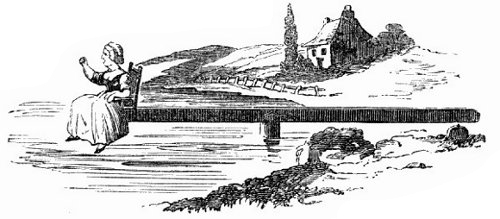
The CUCKING-STOOL.
By the sea, the quay offered a convenient spot. The barbican, at Plymouth, was a locality, doubtless terrible to offenders, however careless of committing their wordy nuisance of scolding. Two pounds were paid for a cucking-stool at Leicester in 1768. Since that it has been placed at the door of a notorious scold as a warning. Upon admission to the House of Correction at Liverpool, a woman had to undergo the severity of the cucking-stool till a little before the year 1803, when Mr. James Neild wrote to Dr. Lettsom. The pump in the men's court was the whipping-post for females, which discipline continued, though not weekly.
Kingston-upon-Thames.
s. d.
1572, The making of the cucking-stool 8 0
Iron work for the same 3 0
Timber for the same 7 6
Three brasses for the same, and three wheels 4 10
—— ——
£1 3 4
At Marlborough, in 1625, a man had 4d. for his help at the cucking of Joan Neal.
Gravesend.
s. d.
1636, The porters for ducking of Goodwife Campion 2 0
Two porters for laying up the ducking-stool 0 8
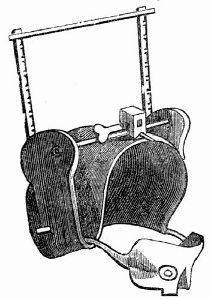
THE BRANK.
The Brank, for taming shrews, was preferred to the cucking-stool in some counties, and was used there for the same purpose. The brank was in favour in the northern counties, and in Worcestershire, though there were, notwithstanding, some of the other instruments of punishment used, called in that county gum-stools.
The brank was put over the head, and was fastened with a padlock. There are entries at Worcester about mending the "scould's bridle and cords for the same."
The cucking-stool not only endangered the health of the party, but also gave the tongue liberty 'twixt every dip. The brank was put over the head, and was fastened with a padlock.
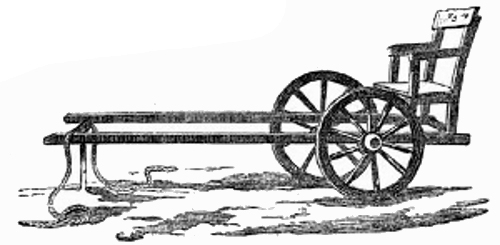
THE TUMBREL.
The tumbrel was a low-rolling cart or carriage (in law Latin, tumberella) which was used as a punishment of disgrace and infamy. Millers, when they stole corn, were chastised by the tumbrel. Persons were sometimes fastened with an iron chain to a tumbrel, and conveyed bareheaded with din and cry through the principal streets of towns.
Court of Hustings Book, 1581. (Lyme.)
"The jury present that the tumbrel be repaired and maintained from time to time, according to the statute."
In 1583, Mr. Mayor was to provide a tumbrel before All Saints Day, under a penalty of 10s.
ANCIENT METHOD OF KEEPING A WASHING ACCOUNT.
Shakerley Marmion, in his "Antiquary," says:—
"I must rev'rence and prefer the precedent Times before these, which consum'd their wits in Experiments; and 'twas a virtuous Emulation amongst them, that nothing Which, might profit posterity should perish."
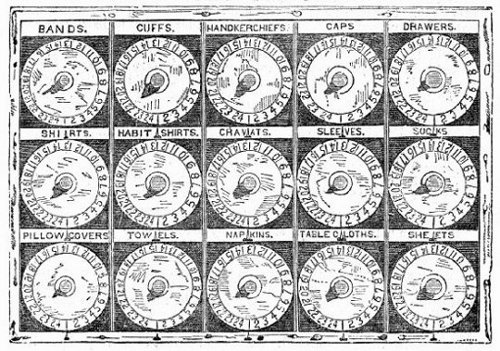
Without a full adherence to this dictum, we would nevertheless admit that we are indebted to the past for the germ of many of our most important discoveries. The ancient washing tablet, although of humble pretensions to notice, is yet a proof of the simple and effective means frequently adopted in olden times for the economy of time and materials.
A reference to the engraving obviates a lengthened explanation. It will there be seen that if the mistress of a family has fifteen pillow-covers, or so many collars, or so many bands, to be mentioned in the washing account, she can turn the circular dial, by means of the button or handle, to the number corresponding with the rough mark at the bottom of the dial, above which is written sheets, table-cloths, &c. This simple and ingenious contrivance, obviates the necessity of keeping a book.
The original "washing board," from which the engraving is taken, was of a larger size, and showed the numbers very distinctly. Similar dials may be made of either ivory or metal.
THE HAIR.
The quality and colour of the hair was a subject of speculative theory for the ancients. Lank hair was considered indicative of pusillanimity and cowardice; yet the head of Napoleon was guiltless of a curl! Frizzly hair was thought an indication of coarseness and clumsiness. The hair most in esteem, was that terminating in ringlets. Dares, the historian, states that Achilles and Ajax Telamon had curling locks; such also was the hair of Timon, the Athenian. As to the Emperor Augustus, nature had favoured him with such redundant locks, that no hair-dresser in Rome could produce the like. Auburn or light brown hair was thought the most distinguished, as portending intelligence, industry, a peaceful disposition, as well as great susceptibility to the tender passion. Castor and Pollux had brown hair; so also had Menelaus. Black hair does not appear to have been esteemed by the Romans; but red was an object of aversion. Ages before the time of Judas, red hair was thought a mark of reprobation, both in the case of Typhon, who deprived his brother of the sceptre of Egypt, and Nebuchadnezzar who acquired it in expiation of his atrocities. Even the donkey tribe suffered from this ill-omened visitation, according to the proverb of "wicked as a red ass." Asses of that colour were held in such detestation among the Copths, that every year they sacrificed one by hurling it from a high wall.
THE FIRST COFFEE HOUSE IN LONDON.
Coffee is a native of Arabia, supposed by some to have been the chief ingredient of the old Lacedemonian broth. The use of this berry was not known in England till the year 1657, at which time Mr. D. Edwards, a Turkey merchant, on his return from Smyrna to London, brought with him one Pasquet Rossee, a Greek of Ragusa, who was used to prepare this liquor for his master every morning, who, by the way, never wanted company. The merchant, therefore, in order to get rid of a crowd of visitants, ordered his Greek to open a coffee-house, which he did in St. Michael's Alley, in Cornhill. This was the first coffee-house opened in London.
EATING FOR A WAGER.
The handbill, of which the subjoined is a literal copy, was circulated by the keeper of the public-house at which the gluttony was to happen, as an attraction for all the neighbourhood to witness:—
"Bromley in Kent, July 14, 1726.—A strange eating worthy is to perform a Tryal of Skill on St. James's Day, which is the day of our Fair for a wager of Five Guineas,—viz.: he is to eat four pounds of bacon, a bushel of French beans, with two pounds of butter, a quartern loaf, and to drink a gallon of strong beer!"
FOX KILLED BY A SWAN.
At Peusey, a swan sitting on her eggs, on one side of the river, observed a fox swimming towards her from the opposite side; rightly judging she could best grapple with the fox in her own element, she plunged into the water, and after beating him off for some time with her wings, at length succeeded in drowning him.
HIGHWAYMEN IN 1782.
On Wednesday, the 9th January, 1782, about four o'clock in the afternoon, as Anthony Todd, Esq., Secretary to the Post-office, was going in his carriage to his house at Walthamstow to dinner, and another gentleman with him, he was stopt within a small distance of his house by two highwaymen, one of whom held a pistol to the coachman's breast, whilst the other, with a handkerchief over his face, robbed Mr. Todd and the gentleman of their gold watches and what money they had about them. As soon as Mr. Todd got home all his men-servants were mounted on horses, and pursued the highwaymen; they got intelligence of their passing Lee-bridge, and rode on to Shoreditch; but could not learn anything farther of them.
The same evening a gentleman going along Aldermanbury, near the church, was accosted by a man with an enquiry as to the time; on which the gentleman pulled out his gold watch. The man immediately said, "I must have that watch and your money, sir, so don't make a noise." The gentleman seeing nobody near, he delivered his gold watch and four guineas, with some silver. The thief said he was in distress, and hoped the gentleman would not take away his life if ever he had the opportunity.
Sunday, the 13th January, 1782, about twelve o'clock, a man was, by force, dragged up the yard of the French-Horn Inn, High Holborn, by some person or persons unknown, and robbed of his watch, four guineas, and some silver; when they broke his arm and otherwise cruelly treated him. He was found by a coachman, who took him to the hospital.
AN ARCHBISHOP WASHING THE FEET OF THE POOR.
In the Gentleman's Magazine, we find the following observance:—Thursday, April 15, 1731.—Being Maunday-Thursday, there was distributed at the Banquetting-house, Whitehall, to forty-eight poor men, and forty-eight poor women (the King's age 48) boiled beef and shoulders of mutton, and small bowls of ale, which is called dinner; after that, large wooden platters of fish and loaves, viz., undress'd, one large old ling, and one large dry'd cod; twelve red herrings, and nineteen white herrings, and four half quartern loaves; each person had one platter of this provision: after which was distributed to them shoes, stockings, linnen and woolen cloath, and leathern bags, with one penny, two penny, three penny, and four penny pieces of silver, and shillings: to each about £4 in value. His Grace the Lord Archbishop of York, Lord High Almoner, performed the annual ceremony of washing the feet of a certain number of poor in the Royal Chapel, Whitehall, which was formerly done by the Kings themselves, in imitation of our Saviour's pattern of humility, &c. James II. was the last King who performed this in person. His doing so was thus recorded in the Chapel Royal Register.—"On Maunday Thursday April 16 1685 our gracious King James ye 2d wash'd wip'd and kiss'd the feet of 52 poor men wth wonderful humility. And all the service of the Church of England usuall on that occasion was performed, his Maty being psent all the time."
A LUCKY FIND.
Sunday, April 1.—A few days ago, Sir Simon Stuart, of Hartley, in Hampshire, looking over some old writings, found on the back of one of them a memorandum noting that 1,500 broad pieces were buried in a certain spot in an adjoyning field. Whereupon he took a servant, and after digging a little in the place, found the treasure in a pot, hid there in the time of the late civil wars, by his grandfather, Sir Nicholas Stuart.—Gentleman's Magazine, 1733.
HOOPS IN 1740.
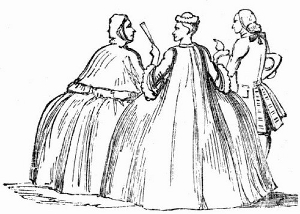
The monstrous appearance of the ladies' hoops, when viewed behind, may be seen from the following cut, copied from one of Rigaud's views. The exceedingly small cap, at this time fashionable, and the close up-turned hair beneath it, give an extraordinary meanness to the head, particularly when the liberality of gown and petticoat is taken into consideration: the lady to the left wears a black hood with an ample fringed cape, which envelopes her shoulders, and reposes on the summit of the hoop. The gentleman wears a small wig and bag; the skirts of his coat are turned back, and were sometimes of a colour different from the rest of the stuff of which it was made, as were the cuffs and lappels.
SIEGE OF GIBRALTAR.
Gibraltar had been taken by a combined English and Dutch fleet in 1704, and was confirmed as a British possession, in 1713, by the peace of Utrecht; but in 1779 it was assailed by the united forces of France and Spain, and the siege continued till the 2nd of February, 1783. The chief attack was made on the 13th September, 1782. On the part of the besiegers, besides stupendous batteries on the land side, mounting two hundred pieces of ordnance, there was an army of 40,000 men, under the command of the Duc de Crillon. In the bay lay the combined fleets of France and Spain, comprising forty-seven sail of the line, beside ten battering ships of powerful construction, that cost upwards of £50,000 each. From these the heaviest shells rebounded, but ultimately two of them were set on fire by red-hot shot, and the others were destroyed to prevent them from falling into the hands of the British commander. The rest of the fleet also suffered considerably; but the defenders escaped with very little loss. In this engagement 8,300 rounds were fired by the garrison, more than half of which consisted of red-hot balls. During this memorable siege, which lasted upwards of three years, the entire expenditure of the garrison exceeded 200,000 rounds,—8,000 barrels of powder being used. The expenditure of the enemy, enormous as this quantity is, must have been much greater; for they frequently fired, from their land-batteries, 4,000 rounds in the short space of twenty-four hours. Terrific indeed must have been the spectacle as the immense fortress poured forth its tremendous volleys, and the squadron and land-batteries replied with a powerful cannonade. But all this waste of human life and of property was useless on the part of the assailants; for the place was successfully held, and Gibraltar still remains one of the principal strongholds of British power in Europe.
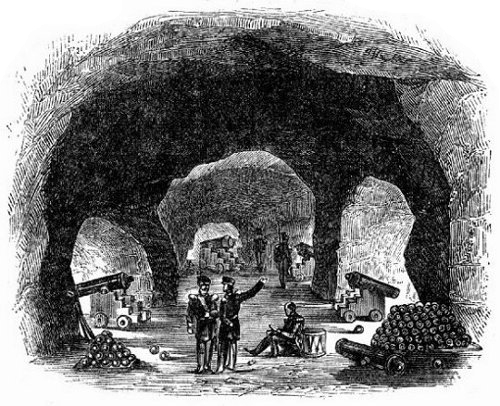
SAINT GEORGE'S HALL, GIBRALTAR.
During the progress of the siege, the fortifications were considerably strengthened, and numerous galleries were excavated in the solid rock, having port-holes at which heavy guns were mounted, which, keeping up an incessant fire, proved very efficacious in destroying the enemy's encampments on the land side. Communicating with the upper tier of these galleries are two grand excavations, known as Lord Cornwallis's and St. George's Halls. The latter, which is capable of holding several hundred men, has numerous pieces of ordnance pointed in various directions, ready to deal destruction on an approaching enemy.
KEEPING WHITSUNTIDE AT DURHAM CATHEDRAL.
The following curious account of the consumption of provisions in the cathedral of Durham, during Whitsun week, in 1347, together with the prices of the articles, is taken from the rolls of the cellarer, at present in the treasury at Durham:—six hundred salt herrings, 3s.; four hundred white herrings, 2s. 6d.; thirty salted salmon, 7s. 6d.; twelve fresh salmon, 5s. 6d.; fourteen ling, fifty-five "kelengs;" four turbot, 23s. 1d.; two horse loads of white fish, and a "congr," 5s. 10d.; "playc," "sparlings," and eels, and fresh water fish, 2s. 9d.; nine carcases of oxen, salted, so bought, 36s.; one carcase and a quarter, fresh, 6s. 11-3/4d.; a quarter of an oxe, fresh, bought in the town, 3s. 6d.; seven carcases and a half of swine, in salt, 22s. 2-1/4d.; six carcases, fresh, 12s. 9d.; fourteen calves, 28s. 4d.; three kids, and twenty-six sucking porkers, 9s. 7-1/2d.; seventy-one geese with their feed, 11s. 10d.; fourteen capons, fifty-nine chickens, and five dozen pidgeons, 10s. 3d.; five stones of hog's lard, 4s. 2d.; four stones of cheese, butter, and milk, 6s. 6d.; a pottle of vinegar, and a pottle of honey, 6-1/2d.; fourteen pounds of figs and raisins, sixteen pounds of almonds, and eight pounds of rice, 3s. 7d.; pepper, saffron, cinnamon, and other spices, 2s. 6d.; one thousand three hundred eggs, 15s. 5d.—sum total, £11 4s. Similar consumptions took place during the week of the feast of St. Cuthbert, and other feasts, among the monks of Durham, for a long period of years.
CURIOUS LAW.
The following curious law was enacted during the reign of Richard I. for the government of those going by sea to the Holy Land:—"He who kills a man on shipboard, shall be bound to the dead body and thrown into the sea; if the man is killed on shore, the slayer shall be bound to the dead body and buried with it. He who shall draw his knife to strike another, or who shall have drawn blood from him, to lose his hand; if he shall have only struck with the palm of his hand without drawing blood, he shall be thrice ducked in the sea."
DECAPITATION BY THE GUILLOTINE.
A gentleman of intelligence and literary attainments, makes, in an account of his travels on the continent, the following most singular remarks on an execution he witnessed, in which the culprit was beheaded by the guillotine:—"It appears," says he, "to be the best of all possible modes of inflicting the punishment of death; combining the greatest impression on the spectator, with the least possible suffering to the victim. It is so rapid, that I should doubt whether there were any suffering; but from the expression of the countenance, when the executioner held up the head, I am inclined to believe that sense and consciousness may remain for a few seconds after the head is off. The eyes seemed to retain speculation for a moment or two, and there was a look in the ghastly stare with which they stared upon the crowd, which implied that the head was aware of its ignominious situation."
ALDERMAN BOYDELL.
It was the regular custom of Mr. Alderman Boydell, who was a very early riser, at five o'clock, to go immediately to the pump in Ironmonger Lane. There, after placing his wig upon the ball at the top of it, he used to sluice his head with its water. This well-known and highly respected character, who has done more for the British artist than all the print-publishers put together, was also one of the last men who wore a three-cornered hat.
FEATS OF STRENGTH IN 1739.
April 21.—The following notice was given to the public:—"For the benefit of Thomas Topham, the strong man, from Islington, whose performances have been looked upon by the Royal Society and several persons of distinction, to be the most surprising as well as curious of any thing ever performed in England; on which account, as other entertainments are more frequently met with than that he proposes, he humbly hopes gentlemen and ladies, &c., will honour him with their presence at the Nag's Head, in Gateshead, on Monday the 23d of this instant, at four o'clock, where he intends to perform several feats of strength, viz.:—He bends an iron poker three inches in circumference, over his arm, and one of two inches and a quarter round his neck; he breaks a rope that will bear two thousand weight, and with his fingers rolls up a pewter dish of seven pounds hard metal; he lays the back part of his head on one chair, and his heels on another, and suffering four men to stand on his body, he moves them up and down at pleasure; he lifts a table six feet in length, by his teeth, with a half hundred weight hanging at the further end of it; and, lastly, to oblige the publick, he will lift a butt full of water." "Each person to pay one shilling." This "strong man" fell a victim to jealousy, as is proved by the following:—"August 10th, 1749, died, Mr. Thomas Topham, known by the name of the strong man, master of a publick house in Shoreditch, London. In a fit of jealousy, he stabbed his wife, then cut his own throat and stabbed himself, after which he lived two days."
ELEPHANTS FRIGHTENED AT PIGS.
"Then on a tyme there were many grete clerkes and rad of kyng Alysaunder how on a tyme as he sholde have a batayle with ye kynge of Inde. And this kynge of Inde broughte with hym many olyphauntes berynge castelles of tree on theyr backes as the kynde of the is to haue armed knyghtes in ye castell for the batayle, them ne knewe Alysaunder the kynge, of the olyphauntes that they drad no thynge more than the jarrynge of swyne, wherefore he made to gader to gyder all ye swyne that myghte be goten, and caused them to be dryuen as ny the olyphauntes as they myghte well here the jarrynge of the swyne, and thenne they made a pygge to crye, and whan the swyne herde the pygges a none they made a great jarrynge, and as soone as the olyphauntes herde that, they began to fle eche one, and keste downe the castelles and slewe the knyghtes that were in them, and by this meane Alysaunder had ye vyctory."—Liber Festivalis, printed by W. Caxton in 1483.
A VISIT TO THE OBSERVATORY OF SIR ISAAC NEWTON.
The memory of a great and good man is imperishable. A thousand years may pass away, but the fame that has survived the wreck of time remains unsullied, and is even brighter with age.
"The actions of the just Smell sweet, and blossom in the dust."
In an age of progress like our own we have frequently to regret the destruction (sometimes necessary) of places associated with the genius of the past; but in the case of Sir Isaac Newton we have several relics existing, none of which, perhaps, are more interesting than the house in which he resided, still standing in St. Martin's Street, on the south side of Leicester Square. The engravings of the interior and exterior of this building have been made from drawings made on the spot. The house was long occupied as an hotel for foreigners, and was kept by a M. Pagliano. In 1814 it was devoted to the purposes of education. The Observatory, which is at the top, and where Sir Isaac Newton made his astronomical researches, was left in a dilapidated condition until 1824, when two gentlemen, belonging to a committee of the school, had it repaired at their own expense, and wrote a brief memoir of the philosopher, which was placed in the Observatory, with a portrait of him.
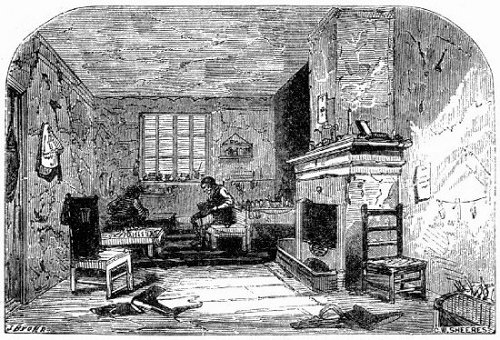
INTERIOR OF SIR ISAAC NEWTON'S OBSERVATORY.
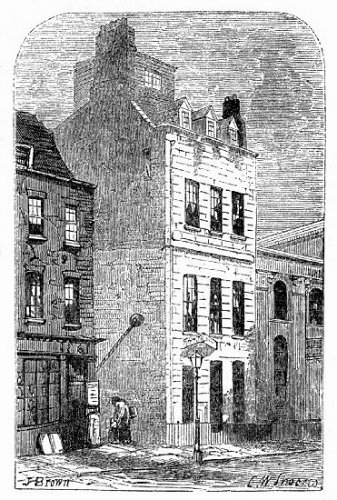
HOUSE OF SIR ISAAC NEWTON, ST. MARTIN'S STREET, LEICESTER SQUARE.
In this house Sir Isaac Newton resided for many years; and it was here, according to his biographer, that he dispensed, under the superintendence of his beautiful niece, an elegant hospitality. Our sketch gives a good idea of the appearance of the exterior of the house at the present day; the front, it will be seen, has been well plastered, which, although clean and pleasant-looking to some eyes, seems to us to destroy the character of the building. The old doorway, with a projecting top, has also been removed. The interior of the house is in excellent repair, and has undergone very little change. The cornices, panelling, and the spacious staircase, are not altered since the days of Newton. The rooms are very large. Tradition states it was in the back drawing-room that the manuscript of his work, the "New Theory of Light and Colours," was destroyed by fire, caused by a favourite little dog in Sir Isaac's absence. The name of this canine incendiary was Diamond. The manner in which the accident occurred is thus related:—The animal was wantoning about the philosopher's study, when it knocked down a candle, and set fire to a heap of manuscript calculations upon which he had been employed for years. The loss was irretrievable; but Sir Isaac only exclaimed with simplicity, "Ah, Diamond, Diamond, you little know what mischief you have been doing!"
Passing upstairs, and looking slightly at the various rooms, which are all well panelled, but which do not require particular notice, we reached the little observatory shown in the engraving. There, in the room in which Sir Isaac has quietly studied, and in which he may have held conferences with the most distinguished of his contemporaries, we found two shoemakers busily at work, with whom we had some pleasant conversation. Our artist has represented the interior of the observatory, with its laborious occupants, worthy sons of St. Crispin. Shoemakers are well known to be a thoughtful class of men, although sometimes they unfortunately do not make the best use of their knowledge. Brand, the historian and author of the excellent book on "Popular Antiquities," was at one time a shoemaker; so was Bloomfield, the poet, who, when working at the "last" in Bell Alley, near the Bank, strung together the charming recollection of his plough-boy life. We could give a long list of shoemakers who have been eminent for talents.
We have not the exact date at which Newton came to reside here, but certainly he was living in this house, at intervals, after 1695, when he was appointed Warder of the Mint, of which establishment he rose to be Master in the course of three years. The emoluments of this office amounted to £1200 a-year, which enabled him to live in ease and dignity.
In 1703 he was chosen President of the Royal Society—an honourable post, to which he was annually elected until the time of his death.
POISONING THE MONARCH.
An idea of the popular notions about poisoning in the middle of the seventeenth century, may be formed from the following extract from an old tract, published in 1652, with the title of "Papa Patris, or the Pope in his Colours":—"Anno Dom: 1596; one Edward Squire, sometimes a scrivener at Grenewich, afterwards a deputy purveyor for the Queene's stable, in Sir Francis Drake's last voyage was taken prisoner and carried into Spaine, and being set at liberty, one Walpole, a Jesuite, grew acquainted with him, and got him into the Inquisition, whence he returned a resolved Papist, he persuaded Squire to undertake to poyson the pummell of the Queene (Elizabeth's) saddle, and, to make him constant, made Squire receive the Sacrament upon it; he then gave him the poyson, showing that he should take it in a double bladder, and should prick the bladder full of hoales in the upper part, when he should use it (carrying it within a thick glove for the safety of his hand) should after turne it downward, pressing the bladder upon the pummell of the Queene's saddle. This Squire confest. Squire is now in Spaine, and for his safer dispatch into England it was devised that two Spanish prisoners taken at Cales should be exchanged for Squire and one Rawles, that it might not be thought that Squire came over but as a redeemed captive. The Munday sennight after Squire returned into England, he, understanding the horses were preparing for the Queene's riding abroad, laid his hand, and crushed the poyson upon the pummell of the Queene's saddle, saying, 'God save the Queene,' the Queene rode abroad, and as it should seem laid not her hand upon the place, or els received no hurt (through God's goodnesse) by touching it. Walpole, counting the thing as done, imparted it to some principall fugitives there, but being disappointed of his hope, supposing Squire to have been false, to be revenged on him sent one hither (who should pretend to have stolne from thence) with letters, wherein the plot of Squires was contained; this letter was pretended to be stolne out of one of their studies. Squire, being apprehended, confessed all without any rigor, but after denied that he put it in execution, although he acknowledged he consented to it in the plot, at length he confessed the putting it in execution also."
GRINNING FOR A WAGER.
June 9, 1786.—On Whit-Tuesday was celebrated at Hendon, in Middlesex, a burlesque imitation of the Olympic Games. One prize was a gold-laced hat, to be grinned for by six candidates, who were placed on a platform, with horses' collars to exhibit through. Over their heads was printed in capitals,—
Detur Tetriori; or The ugliest grinner Shall be the winner.
Each party grinned five minutes solus, and then all united in a grand chorus of distortion. This prize was carried by a porter to a vinegar merchant, though he was accused by his competitors of foul play, for rinsing his mouth with verjuice. The whole was concluded by a hog, with has tail shaved and soaped, being let loose among nine peasants; any one of which that could seize him by the queue, and throw him across his shoulders, was to have him for a reward. This occasioned much sport: the animal, after running some miles, so tired his hunters that they gave up the chase in despair. A prodigious concourse of people attended, among whom were the Tripoline Ambassador, and several other persons of distinction.
BITE OF THE TARANTULA SPIDER.
A Neapolitan soldier who had been bitten by a tarantula, though apparently cured, suffered from an annual attack of delirium, after which he used to sink into a state of profound melancholy; his face becoming livid, his sight obscure, his power of breathing checked, accompanied by sighs and heavings. Sometimes he fell senseless, and devoid of pulsation; ejecting blood from his nose and mouth, and apparently dying. Recourse was had to the influence of music; and the patient began to revive at the sound, his hands marking the measure, and the feet being similarly affected. Suddenly rising and laying hold of a bystander, he began to dance with the greatest agility during an uninterrupted course of four-and-twenty hours. His strength was supported by administering to him wine, milk, and fresh eggs. If he appeared to relapse, the music was repeated, on which he resumed his dancing. This unfortunate being used to fall prostrate if the music accidentally stopped, and imagine that the tarantula had again stung him. After a few years he died, in one of these annual attacks of delirium.
BYGONE CHRISTMAS CUSTOMS.
——————"Now, too, is heard The hapless cripple, tuning through the streets His carol new; and oft, amid the gloom Of midnight hours, prevail th' accustom'd sounds Of wakeful waits, whose harmony (composed Of hautboy, organ, violin, and flute, And various other instruments of mirth), Is meant to celebrate the coming time."
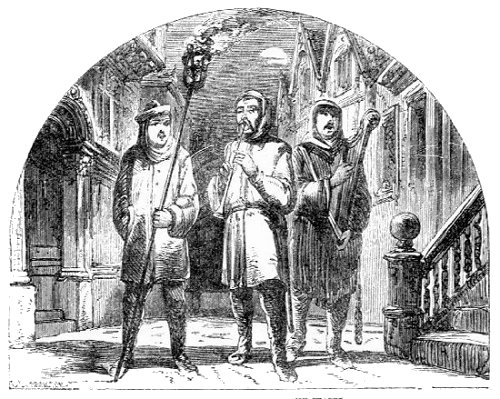
THE MUMMERS, OR ANCIENT WAITS.
The manner in which this period of the year has been observed has often varied. The observances of the day first became to be pretty general in the Catholic church about the year 300. By some of our ancestors it was viewed in the double light of a religious and joyful season of festivities. The midnight preceding Christmas-day every person went to mass, and on Christmas-day three different masses were sung with much solemnity. Others celebrated it with great parade, splendour, and conviviality. Business was superseded by merriment and hospitality; the most careworn countenance brightened on the occasion. The nobles and the barons encouraged and participated in the various sports: the industrious labourer's cot, and the residence of proud royalty, equally resounded with tumultuous joy. From Christmas-day to Twelfth-day there was a continued run of entertainments. Not only did our ancestors make great rejoicings on, but before and after Christmas-day. By a law in the time of Alfred, the "twelve days after the nativity of our Saviour were made festivals;" [1] and it likewise appears from Bishop Holt, that the whole of the days were dedicated to feasting.
Our ancestors' various amusements were conducted by a sort of master of the ceremonies, called the "Lord of Misrule," whose duty it was to keep order during the celebration of the different sports and pastimes. The universities, the lord mayor and sheriffs, and all noblemen and gentlemen, had their "lords of misrule." These "lords" were first preached against at Cambridge by the Puritans, in the reign of James I., as unbecoming the gravity of the university.
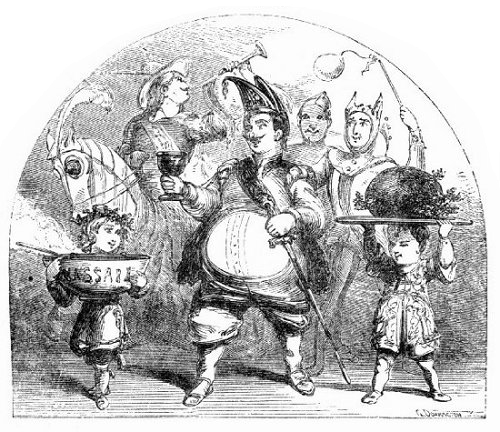
THE LORD OF MISRULE.
The custom of serving boars' heads at Christmas bears an ancient date, and much ceremony and parade has been occasionally attached to it. Henry II. "served his son (upon the young prince's coronation) at the table as server, bringing up the boar's head with trumpets before it."
The custom of strolling from street to street with musical instruments and singing seems to have originated from a very ancient practice which prevailed, of certain minstrels who were attached to the king's court and other great persons, who paraded the streets, and sounded the hour—thus acting as a sort of watchmen. Some slight remains of these still exist, but they no longer partake of the authoritative claim as they originally did, as the "lord mayor's music," &c. It may not, perhaps, be generally known, that even at the present day "waits" are regularly sworn before the "court of burgesses" at Westminster, and act under the authority of a warrant, signed by the clerk, and sealed with the arms of the city and liberty; in addition to which, they were bound to provide themselves with a silver badge, also bearing the arms of Westminster.
In the north they have their Yule log, or Yuletide log, which is a huge log burning in the chimney corner, whilst the Yule cakes are baked on a "girdle," (a kind of frying-pan) over the fire; little lads and maidens assemble nightly at some neighbouring friends to hear the goblin story, and join in "fortune-telling," or some game. There is a part of an old song which runs thus:
"Now all our neighbours' chimneys smoke. And Christmas logs are burning; Their ovens they with baked meate choke, And all their spits are turning."
Among the plants usual to Christmas are the rosemary, the holly, and the mistletoe. Gay says:
"When rosemary and bays, the poet's crown, Are bawled in frequent cries through all the town, Then judge the festival of Christmas near— Christmas, the joyous period of the year. Now with bright holly all your temples strow, With laurel green and sacred mistletoe."
A MERMAN.
"The wind being easterly, we had thirty fathoms of water, when at ten o'clock in the morning a sea monster like a man appeared near our ship, first on the larboard, where the master was, whose name is William Lomone, who took a grappling iron to pull him up; but our captain, named Oliver Morin, hindered him, being afraid that the monster would drag him away into the sea. The said Lomone struck him on the back, to make him turn about, that he might view him the better. The monster, being struck, showed his face, having his two hands closed as if he had expressed some anger. Afterwards he went round the ship: when he was at the stern, he took hold of the helm with both hands, and we were obliged to make it fast lest he should damage it. From thence he proceeded to the starboard, swimming still as men do. When he came to the forepart of the ship, he viewed for some time the figure that was in our prow, which represented a beautiful woman, and then he rose out of the water as if he had been willing to catch that figure. All this happened in the sight of the whole crew. Afterwards he came again to the larboard, where they presented to him a cod-fish hanging down with a rope; he handled it without spoiling it, and then removed the length of a cable and came again to the stern, where he took hold of the helm a second time. At that very moment, Captain Morin got a harping-iron ready, and took it himself to strike him with it; but the cordage being entangled, he missed his aim, and the harping-iron touched only the monster, who turned about, showing his face, as he had done before. Afterwards he came again to the fore part, and viewed again the figure in our prow. The mate called for the harping-iron; but he was frightened, fancying that this monster was one La Commune, who had killed himself in the ship the year before, and had been thrown into the sea in the same passage. He was contented to push his back with the harping-iron, and then the monster showed his face, as he had done at other times. Afterwards he came along the board, so that one might have given him the hand. He had the boldness to take a rope held up by John Mazier and John Deffiete, who being willing to pluck it out of his hands, drew him to our board; but he fell into the water and then removed at the distance of a gun's shot. He came again immediately near our board, and rising out of the water to the navel, we observed that his breast was as large as that of a woman of the best plight. He turned upon his back and appeared to be a male. Afterwards he swam again round the ship, and then went away, and we have never seen him since. I believe that from ten o'clock till twelve that this monster was along our board; if the crew had not been frighted, he might have been taken many times with the hand, being only two feet distant. That monster is about eight feet long, his skin is brown and tawny, without any scales, all his motions are like those of men, the eyes of a proportionable size, a little mouth, a large and flat nose, very white teeth, black hair, the chin covered with a mossy beard, a sort of whiskers under the nose, the ears like those of men, fins between the fingers of his hands and feet like those of ducks. In a word, he is a well-shaped man. Which is certified to be true by Captain Oliver Morin, and John Martin, pilot, and by the whole crew, consisting of two and thirty men."—An article from Brest, in the Memoirs of Trevoux.—This monster was mentioned in the Gazette of Amsterdam, October 12, 1725, where it is said it was seen in the ocean in August, same year.
A SHAVED BEAR.
At Bristol I saw a shaved monkey shown for a fairy; and a shaved bear, in a check waistcoat and trousers, sitting in a great chair as an Ethiopian savage. This was the most cruel fraud I ever saw. The unnatural position of the beast, and the damnable brutality of the woman-keeper who sat upon his knee, put her arm round his neck, called him husband and sweet-heart, and kissed him, made it the most disgusting spectacle I ever witnessed! Cottle was with me.—Southey.
THE ORIGIN OF WIGS.
As for the origin of wigs, the honour of the invention is attributed to the luxurious Sapygians in Southern Italy. The Louvain theologians, who published a French version of the Bible, affected, however, to discover the first mention of perukes in a passage in the fourth chapter of Isaiah. The Vulgate has these words: "Decalvabit Dominus verticem filiarum Sion, et Dominus crinem earum nudabit." This, the Louvain gentlemen translated into French as follows: "Le Seigneur déchèvelera les têtes des filles de Sion, et le Seigneur découvrira leurs perruques;" which, done into English, implies that "The Lord will pluck the hair from the heads of the daughters of Sion, and will expose their periwigs."
DRESS IN 1772.
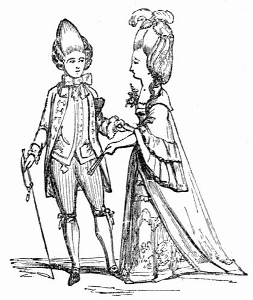
The year 1772 introduced a new style for gentlemen, imported by a number of young men of fashion who had travelled into Italy, and formed an association called the Maccaroni Club, in contradistinction to the Beef-steak Club of London. Hence these new-fashioned dandies were styled Maccaronies, a name that was afterwards applied to ladies of the same genus. The accompanying cut delineates the peculiarities of both. The hair of the gentleman was dressed in an enormous toupee, with very large curls at the sides; while behind it was gathered and tied up into an enormous club, or knot, that rested on the back of the neck like a porter's knot; upon this an exceedingly small hat was worn, which was sometimes lifted from the head with the cane, generally very long, and decorated with extremely large silk tassels; a full white handkerchief was tied in a large bow round the neck; frills from the shirt-front projected from the top of the waistcoat, which was much shortened, reaching very little below the waist, and being without the flap-covered pockets. The coat was also short, reaching only to the hips, fitting closely, having a small turn-over collar as now worn; it was edged with lace or braid, or decorated with frog-buttons, tassels, or embroidery; the breeches were tight, of spotted or striped silk, with enormous bunches of strings at the knee. A watch was carried in each pocket, from which hung bunches of chains and seals: silk stockings and small shoes with little diamond buckles completed the gentleman's dress. The ladies decorated their heads much like the gentlemen, with a most enormous heap of hair, which was frequently surmounted by plumes of large feathers and bunches of flowers, until the head seemed to overbalance the body. The gown was open in front; hoops were discarded except in full-dress; and the gown gradually spread outward from the waist, and trailed upon the ground behind, shewing the rich laced petticoat ornamented with flowers and needlework; the sleeves widened to the elbow, where a succession of ruffles and lappets, each wider than the other, hung down below the hips.
CHRISTMAS OBSERVANCES PUT DOWN BY THE PURITANS.
During the Commonwealth, when puritanical feelings held iron sway over the rulers of the land, and rode rampant in high places, many strong attempts were made to put down what they were pleased to term superstitious festivals, and amongst these was that of Christmas Day. So determined was the Puritan party to sweep away all vestiges of evil creeds and evil deeds, that they were resolved to make one grand attempt upon the time-honoured season of Christmas. The Holly and the Mistletoe-bough were to be cut up root and branch, as plants of the Evil One. Cakes and Ale were held to be impious libations to superstition; and the Roundheads would have none of it.
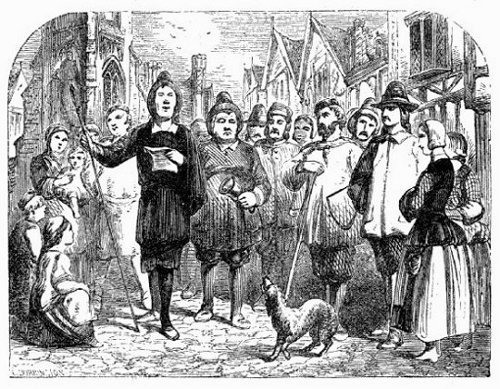
PROCLAIMING THE NON-OBSERVANCE OF CHRISTMAS.
Accordingly, we learn that, in the year 1647, the Cromwell party ordered throughout the principal towns and cities of the country, by the mouth of the common crier, that Christmas Day should no longer be observed—it being a superstitious and hurtful custom; and that in place thereof, and the more effectually to work a change, markets should be held on the 25th day of December.
This was attacking the people, especially the country folks, in their most sensitive part. It was hardly to be expected that they would quietly submit to such a bereavement; nor did they, as the still-existing "News-letters" of those days amply testify.
THE MANNER OF WATCHMEN INTIMATING THE CLOCK AT HERRENHUTH IN GERMANY.
VIII. Past eight o'clock! O, Herrenhuth, do thou ponder; Eight souls in Noah's ark were living yonder. IX. 'Tis nine o'clock! ye brethren, hear it striking; Keep hearts and houses clean, to our Saviour's liking. X. Now, brethren, hear, the clock is ten and passing; None rest but such as wait for Christ embracing. XI. Eleven is past! still at this hour eleven, The Lord is calling us from earth to heaven. XII. Ye brethren, hear, the midnight clock is humming; At midnight, our great Bridegroom will be coming. I. Past one o'clock; the day breaks out of darkness: Great Morning-star appear, and break our hardness! II. 'Tis two! on Jesus wait this silent season, Ye two so near related, will and reason. III. The clock is three! the blessed Three doth merit The best of praise, from body, soul, and spirit. IV. 'Tis four o'clock, when three make supplication, The Lord will be the fourth on that occasion. V. Five is the clock! five virgins were discarded, When five with wedding garments were rewarded. VI. The clock is six, and I go off my station; Now, brethren, watch yourselves for your salvation.
A DOG EXTINGUISHING A FIRE.
On the evening of the 21st February, 1822, the shop of Mr. Coxon, chandler, at the Folly, Sandgate, in Newcastle, was left in charge of his daughter, about nine years of age, and a large mastiff, which is generally kept there as a safeguard since an attempt was made to rob the shop. The child had on a straw bonnet lined with silk, which took fire from coming too near the candle. She endeavoured to pull it off, but being tied, she could not effect her purpose, and in her terror shrieked out, on which the mastiff instantly sprang to her assistance, and with mouth and paws completely smothered out the flame by pressing the bonnet together. The lining of the bonnet and the child's hair only were burnt.
CAMBRIDGE CLODS.
About sixty years since, two characters, equally singular in their way, resided at Cambridge: Paris, a well-known bookseller, and Jackson, a bookbinder, and principal bass-singer at Trinity College Chapel in that University; these two gentlemen, who were both remarkably corpulent, were such small consumers in the article of bread, that their abstemiousness in that particular was generally noticed; but, to make amends, they gave way to the greatest excess and indulgence of their appetites in meat, poultry, and fish, of almost every description. So one day, having taken an excursion, in walking a few miles from home, they were overtaken by hunger, and, on entering a public-house, the only provision they could procure was a clod of beef, weighing near fourteen pounds, which had been a day or two in salt; and this these two moderate bread consumers contrived to manage between them broiled, assisted by a due proportion of buttered potatoes and pickles. The landlord of the house, having some knowledge of his guests, the story got into circulation, and the two worthies were ever after denominated the Cambridge Clods!
WITCH-TESTING AT NEWCASTLE IN 1649.
March 26.—Mention occurs of a petition in the common council books of Newcastle, of this date, and signed, no doubt, by the inhabitants, concerning witches, the purport of which appears, from what followed, to have been to cause all such persons as were suspected of that crime to be apprehended and brought to trial. In consequence of this, the magistrates sent two of their sergeants, viz.—Thomas Shevill and Cuthbert Nicholson, into Scotland, to agree with a Scotchman, who pretended knowledge to find out witches, by pricking them with pins, to come to Newcastle, where he should try such who should be brought to him, and to have twenty shillings a piece, for all he should condemn as witches, and free passage thither and back again. When the sergeants had brought the said witch-finder on horseback to town, the magistrates sent their bellman through the town, ringing his bell and crying, all people that would bring in any complaint against any woman for a witch, they should be sent for, and tried by the person appointed. Thirty women were brought into the town-hall, and stripped, and then openly had pins thrust into their bodies, and most of them were found guilty. The said reputed witch-finder acquainted Lieutenant-Colonel Paul Hobson, deputy-governor of Newcastle, that he knew women whether they were witches or no by their looks; and when the said person was searching of a personable and good-like woman, the said colonel replied, and said, surely this woman is none, and need not be tried, but the Scotchman said she was, and, therefore, he would try her; and presently, in the sight of all the people, laid her body naked to the waist, with her cloathes over her head, by which fright and shame all her blood contracted into one part of her body, and then he ran a pin into her thigh, and then suddenly let her cloathes fall, and then demanded whether she had nothing of his in her body, but did not bleed! but she being amazed, replied little; then he put his hands up her cloathes and pulled out the pin, and set her aside as a guilty person, and child of the devil, and fell to try others, whom he made guilty. Lieutenant-Colonel Hobson, perceiving the alteration of the aforesaid woman, by her blood settling in her right parts, caused that woman to be brought again, and her cloathes pulled up to her thigh, and required the Scot to run the pin into the same place, and then it gushed out of blood, and the said Scot cleared her, and said she was not a child of the devil. The witch-finder set aside twenty-seven out of the thirty suspected persons, and in consequence, fourteen witches and one wizard, belonging to Newcastle, were executed on the town moor.
ALEXANDER SELKIRK AND THE DANCING GOATS.
The adventures of Alexander Selkirk, an English sailor, who, more than one hundred and fifty years since, was left alone on the island of Juan Fernandez are very wonderful.
This extraordinary man sought to beguile his solitude by rearing kids, and he would often sing to them, and dance with his motley group around him. His clothes having worn out, he dressed himself in garments made from the skins of such as run wild about the island; these he sewed together with thongs of the same material. His only needle was a long slender nail; and when his knife was no longer available, he made an admirable substitute from an iron hoop that was cast ashore.
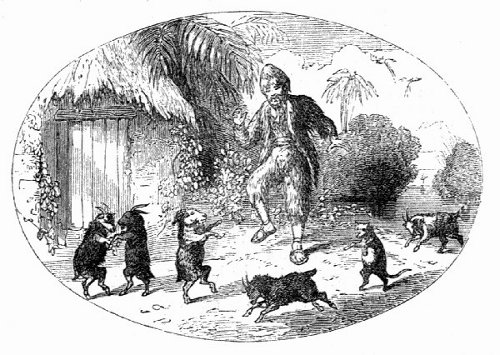
Upon the wonderful sojourn of this man, Defoe founded his exquisite tale of "Robinson Crusoe," a narrative more extensively read and better known than perhaps any other ever written.
JACOB BOBART.
A curious anecdote of Jacob Bobart, keeper of the physic garden at Oxford, occurs in one of Grey's notes to Hudibras—"He made a dead rat resemble the common picture of dragons, by altering its head and tail, and thrusting in taper sharp sticks, which, distended the skin on each side till it resembled wings. He let it dry as hard as possible. The learned immediately pronounced it a dragon; and one of them sent an accurate description of it to Dr. Magliabecchi, librarian to the Grand Duke of Tuscany; several fine copies of verses were wrote on so rare a subject; but at last Mr. Bobart owned the cheat. However, it was looked upon as a masterpiece of the art; and, as such, deposited in the Museum."
BLIND JACK.
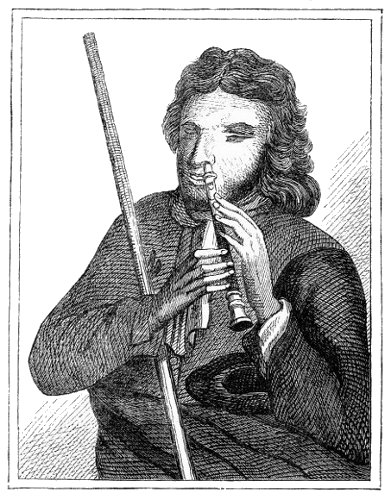
The streets of London, in the reigns of Queen Anne and Georges I. and II., were infested with all sorts of paupers, vagabonds, impostors, and common adventurers; and many, who otherwise might be considered real objects of charity, by their disgusting manners and general appearance in public places, rather merited the interference of the parish beadles, and the discipline of Bridewell, than the countenance and encouragement of such persons as mostly congregated around common street exhibitions. One-eyed Granny and Blind Jack were particular nuisances to the neighbourhoods in which the first practised her mad-drunk gambols, and the latter his beastly manner of performing on the flageolet. John Keiling, alias Blind Jack, having the misfortune to lose his sight, thought of a strange method to insure himself a livelihood. He was constitutionally a hale, robust fellow, without any complaint, saving blindness, and having learnt to play a little on the flageolet, he conceived a notion that, by performing on that instrument in a different way to that generally practised, he should render himself more noticed by the public, and be able to levy larger contributions on their pockets.
The manner of Blind Jack's playing the flageolet was by obtruding the mouthpiece of the instrument up one of his nostrils, and, by long custom, he could produce as much wind as most others with their lips into the pipe; but the continued contortion and gesticulation of his muscles and countenance rendered him an object of derision and disgust, as much as that of charity and commiseration.
THE YORKSHIRE TIKE.
Ah iz i truth a country youth, Neean us'd teea Lunnon fashions; Yet vartue guides, an' still presides, Ower all mah steps an' passions. Neea coortly leear, bud all sincere, Neea bribe shall ivver blinnd me, If thoo can like a Yorkshire tike, A rooague thoo'll nivver finnd me. Thof envy's tung, seea slimlee hung, Wad lee aboot oor country, Neea men o' t' eearth booast greter wurth, Or mare extend ther boounty. Oor northern breeze wi' uz agrees, An' does for wark weel fit uz; I' public cares, an' all affairs, Wi' honour we acquit uz. Seea gret a moind is ne'er confiand, Tu onny shire or nation; They geean meeast praise weea weel displays A leearned iddicasion. Whahl rancour rolls i' lahtle souls, By shallo views dissarning, They're nobbut wise 'at awlus prize Gud manners, sense, and leearnin.
TWO OF THE FATHERS ON FALSE HAIR.
Tertullian says, "If you will not fling away your false hair, as hateful to Heaven, cannot I make it hateful to yourselves, by reminding you that the false hair you wear may have come not only from a criminal, but from a very dirty head; perhaps from the head of one already damned?" This was a very hard hit indeed; but it was not nearly so clever a stroke at wigs as that dealt by Clemens of Alexandria. The latter informed the astounded wig-wearers, when they knelt at church to receive the blessing, that they must be good enough to recollect that the benediction remained on the wig, and did not pass through to the wearer! This was a stumbling-block to the people; many of whom, however, retained the peruke, and took their chance as to the percolating through it of the benediction.
FOOD OF ANIMALS.
Linnæus states the cow to eat 276 plants, and to refuse 218; the goat eats 449, and declines 126; the sheep takes 387, and rejects 141; the horse likes 262, and avoids 212; but the hog, more nice in its provision than any of the former, eats but 72 plants, and rejects 171.
SLAVE ADVERTISEMENTS.
The following announcements are curious, as showing the merchandise light in which the negro was regarded in America while yet a colony of Great Britain:—
FRANCIS LEWIS, Has for SALE,
A Choice Parcel of Muscovado and Powder Sugars, in Hogsheads, Tierces, and Barrels; Ravens, Duck, and a Negro Woman and Negro Boy.—The Coach-House and Stables, with or without the Garden Spot, formerly the Property of Joseph Murray, Esq; in the Broad Way, to be let separately or together:—Inquire of said Francis Lewis.
New York Gazette, Apr. 25, 1765.
This Day Run away from John M' Comb, Junier, an Indian Woman, about 17 Years of Age, Pitted in the face, of a middle Stature and Indifferent fatt, having on her a Drugat, Wastcoat, and Kersey Petticoat, of a Light Collour. If any Person or Persons, shall bring the said Girle to her said Master, shall be Rewarded for their Trouble to their Content.
American Weekly Mercury, May 24, 1726.
A Female Negro Child (of an extraordinary good Breed) to be given away; Inquire of Edes and Gill.
Boston Gazette, Feb. 25, 1765.
To be Sold, for want of Employ.
A Likely Negro Fellow, about 25 Years of Age, he is an extraordinary good Cook, and understands setting or tending a Table very well, likewise all Kind of House Work, such as washing, scouring, scrubbing, &c. Also a Negro Wench his Wife, about 17 Years old, born in this City, and understands all Sorts of House Work. For farther Particulars inquire of the Printer.
New York Gazette, Mar. 21, 1765.
PRESERVATIVE POWER OF COAL-PIT WATER.
The following is extracted from the register of St. Andrew's, in Newcastle:—"April 24th, 1695, wear buried, James Archer and his son Stephen, who, in the moneth of May, 1658, were drowned in a coal-pit in the Galla-Flat, by the breaking in of water from an old waste. The bodys were found intire, after they had lyen in the water 36 years and 11 months."
THE QUEEN BEE.
Reaumur relates the following anecdote of which he was a witness:—A queen bee, and some of her attendants, were apparently drowned in a brook. He took them out of the water, and found that neither the queen bee, nor her attendants were quite dead. Reaumur exposed them to a gentle heat, by which they were revived. The plebeian bees recovered first. The moment they saw signs of animation in their queen, they approached her, and bestowed upon her all the care in their power, licking and rubbing her; and when the queen had acquired sufficient force to move, they hummed aloud, as if in triumph!
DREAM OF KING HENRY I.
A singular dream, which happened to this monarch when passing over to Normandy in 1130, has been depicted in a manuscript of Florence of Worcester, in Corpus Christi College, Oxford. The rapacity and oppressive taxation of his government, and the reflection forced on him by his own unpopular measures, may have originated the vision. He imagined himself to have been visited by the representatives of the three most important grades of society—the husbandmen, the knights, and the clergy—who gathered round his bed, and so fearfully menaced him, that he awoke in great alarm, and, seizing his sword, loudly called for his attendants. The drawings that accompany this narrative, and represent each of these visions, appear to have been executed shortly afterwards, and are valuable illustrations of the general costume of the period. One of them is introduced in this place.
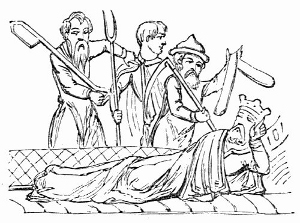
The king is here seen sleeping; behind him stand three husbandmen, one carrying a scythe, another a pitchfork, and the third a shovel. They are each dressed in simple tunics, without girdles, with plain close-fitting sleeves; the central one has a mantle fastened by a plain brooch, leaving the right arm free. The beards of two of these figures are as ample as those of their lords, this being an article of fashionable indulgence within their means. The one with the scythe wears a hat not unlike the felt hat still worn by his descendants in the same grade: the scroll in his left hand is merely placed there to contain the words he is supposed to utter to the king.
SEPULCHRAL BARROW OF THE ANGLO-SAXONS.
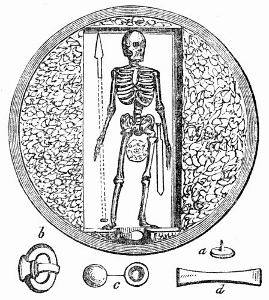
The engraving on the next page is copied from a plate in Douglas's Neniæ and represents one of the most ancient of the Kentish barrows opened by him in the Chatham Lines, Sept. 1779; and it will enable the reader at once to understand the structure of these early graves, and the interesting nature of their contents. The outer circle marks the extent of the mound covering the body, and which varied considerably in elevation, sometimes being but a few inches or a couple of feet from the level of the ground, at others of a gigantic structure. In the centre of the mound, and at the depth of a few feet from the surface, an oblong rectangular grave is cut, the space between that and the outer circle being filled in with chalk, broken into small bits, and deposited carefully and firmly around and over the grave. The grave contained the body of a male adult, tall and well-proportioned, holding in his right hand a spear, the shaft of which was of wood, and had perished, leaving only the iron head, 15 inches in length, and at the bottom a flat iron stud (a), having, a small pin in the centre, which would appear to have been driven into the bottom of the spear-handle; an iron knife lay by the right side, with remains of the original handle of wood. Adhering to its under side were very discernible impressions of coarse linen cloth, showing that the warrior was buried in full costume. An iron sword is on the left side, thirty-five and a quarter inches in its entire length, from the point to the bottom of the handle, which is all in one piece, the wood-work which covered the handle having perished; the blade thirty inches in length and two in breadth, flat, double-edged, and sharp-pointed, a great portion of wood covering the blade, which indicates that it was buried with a scabbard, the external covering being of leather, the internal of wood. A leathern strap passed round the waist, from which hung the knife and sword, and which was secured by the brass buckle (b), which was found near the last bone of the vertebræ, or close to the os sacrum. Between the thigh-bones lay the iron umbo of a shield, which had been fastened by studs of iron, four of which were found near it, the face and reverse of one being represented at (c.) A thin plate of iron (d), four and a half inches in length, lay exactly under the centre of the umbo, having two rivets at the end, between which and the umbo were the remnants of the original wooden (and perhaps hide-bound) shield; the rivets of the umbo having apparently passed through the wood to this plate as its bracer or stay. In a recess at the feet was placed a vase of red earth, slightly ornamented round the neck with concentric circles and zigzag lines.
AN OLD GANDER.
Willoughby states in his work on Ornithology, that a friend of his possessed a gander eighty years of age; which in the end became so ferocious that they were forced to kill it, in consequence of the havock it committed in the barn-yard. He also talks of a swan three centuries old; and several celebrated parrots are said to have attained from one hundred to one hundred and fifty years.
EXTRAORDINARY SLEEPER.
M. Brady, Physician to Prince Charles of Lorraine, gives the following particulars of an extraordinary sleeper:—
"A woman, named Elizabeth Alton, of a healthful strong constitution, who had been servant to the curate of St. Guilain, near the town of Mons, about the beginning of the year 1738, when she was about thirty-six years of age grew extremely restless and melancholy. In the month of August, in the same year, she fell into a sleep which held four days, notwithstanding all possible endeavours to awake her. At length she awoke naturally, but became more restless and uneasy than before; for six or seven days, however, she resumed her usual employments, until she fell asleep again, which continued eighteen hours. From that time to the year 1753, which is fifteen years, she fell asleep daily about three o'clock in the morning, without waking until about eight or nine at night. In 1754 indeed her sleep returned to the natural periods for four months, and, in 1748, a tertian ague prevented her sleeping for three weeks. On February 20, 1755, M. Brady, with a surgeon, went to see her. About five o'clock in the evening, they found her pulse extremely regular; on taking hold of her arm it was so rigid, that it was not bent without much trouble. They then attempted to lift up her head, but her neck and back were as stiff as her arms. He hallooed in her ear as loud as his voice could reach; he thrust a needle into her flesh up to the bone; he put a piece of rag to her nose flaming with spirits of wine, and let it burn some time, yet all without being able to disturb her in the least. At length, in about six hours and a half, her limbs began to relax; in eight hours she turned herself in the bed, and then suddenly raised herself up, sat down by the fire, ate heartily, and began to spin. At other times, they whipped her till the blood came; they rubbed her back with honey, and then exposed it to the stings of bees; they thrust nails under her finger-nails; and it seems these triers of experiments consulted more the gratifying their own curiosity than the recovery of the unhappy object of the malady."
A FAT ENGLISHMAN.
Keysler, in his travels, speaks of a corpulent Englishman, who in passing through Savoy, was obliged to make use of twelve chairmen. He is said to have weighed five hundred and fifty pounds, or thirty-nine stone four pounds.
A HAPPY FAMILY.
A gentleman travelling through Mecklenburg, some years since, witnessed a singular association of incongruous animals. After dinner, the landlord of the inn placed on the floor a large dish of soup, and gave a loud whistle. Immediately there came into the room a mastiff, an Angora cat, an old raven, and a remarkably large rat, with a bell about its neck. They all four went to the dish, and, without disturbing each other, fed together; after which the dog, cat, and rat, lay before the fire, while the raven hopped about the room. The landlord, after accounting for the familiarity of these animals, informed his guest that the rat was the most useful of the four; for the noise he made had completely freed his house from the rats and mice with which it was before infested.
ANCIENT FIRE-ARMS IN THE TOWER OF LONDON ARMORY.
We have just now before us a drawing of an old piece of ordnance, formed of bars of iron, strongly hooped with the same material, which forms a striking contrast with the finely-wrought cannons which may be seen in store at Woolwich Arsenal, and elsewhere, at the present day. The exact date and manner of the introduction of cannon is a matter which has caused much dispute. The earliest mention of the use of cannon on shipboard is in Rymer's "Fœdera." It is an order to Henry Somer, Keeper of the Private Wardrobe in the Tower, to deliver to Mr. Goveney, Treasurer to Queen Philippa, Queen of Sweeden, Denmark, and Norway, (who was then sent by her uncle, Henry the Fourth, to her husband, in the ship called the Queen's Hall,) the following military stores: 11 guns, 40 petras pro gunnes, 40 tumpers, 4 torches, 1 mallet, 2 fire-pans, 40 pavys, 24 bows, 40 sheaves of arrows.
After the old cannon composed of bars of iron, hooped together, had been some time in use, hand-cannon, a simple tube fixed on a straight stake, was used in warfare, charged with gunpowder and an iron bullet. This was made with trunnions and casabel precisely like the large cannon. In course of time, the touch-hole was improved, and the barrel cast in brass. This, fixed to a rod, had much the appearance of a large sky-rocket. What is now called the stock was originally called the frame of the gun.
Various improvements were from time to time made in the hand-gun, amongst which was a pan fixed for containing the touch-powder. In rainy weather, this became a receptacle for water; to obviate which, a small piece of brass made to turn on a pin was placed as a cover. This done, there was a difficulty in preserving the aim in consequence of the liability of the eye to be diverted from the sight by the motion of the right hand when conveying the lighted match to the priming. This was, to a certain extent, prevented by a piece of brass being fixed to the breech and perforated. The improved plan for holding the lighted match for firing the hand-guns is shown in the engraving of the Buckler and Pistol; it consists of a thin piece of metal something in shape of an S reversed, the upper part slit to hold the match, the lower pushed up by the hand when entended to ignite the powder.
After the invention of the hand-cannon, its use became general in a very short space of time in most parts of the civilized world.
Philip de Comines, in his account of the battle of Morat, in 1476, says he encountered in the confederate army 10,000 arquebusiers.
The arquebusiers in Hans Burgmain's plates of the "Triumph of Maximilian the First," have suspended from their necks large powder flasks or horns, a bullet bag on the right hip, and a sword on the left, while they carry the matchlock in their hands.
Henry the Eighth's Walking-stick, as the Yeomen of Guard at the Tower call it, is a short spiked mace, in the head of which are three short guns or pistols, which may be fired at very primitive touch-holes by a match.
The Revolver has four barrels, and although clumsy in construction, is not very different in principles from those recently introduced.
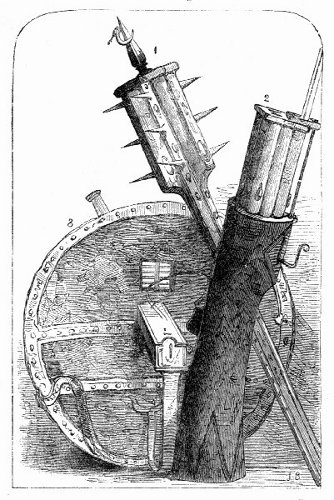
1. Henry the Eighth's Walking-stick. 2. A Revolver of the Fifteenth century. 3. Buckler, with Pistol inserted.
The use of the pistol inserted inside the buckler is obvious as the latter affords protection to the person while using the former.
WIGS.
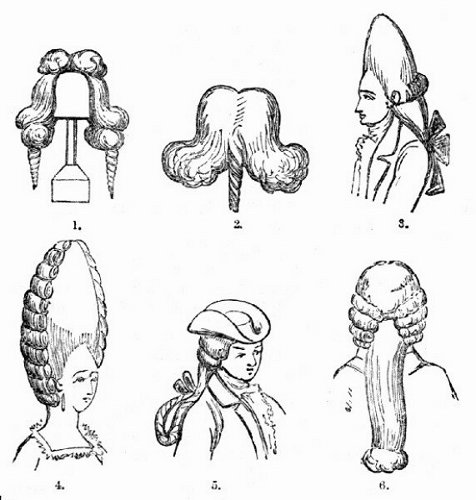
In 1772 the Maccaronies, as the exquisites of that time were called, wore wigs similar to 1, 2, 3, with a large toupee, noticed as early as 1731, in the play of the Modern Husband: "I meet with nothing but a parcel of toupet coxcombs, who plaster up their brains upon their periwigs," alluding to the pometum with which they were covered. Those worn by the ladies in 1772 are given as 4, showing the rows of curls at the sides. The pig-tails were worn hanging down the back, or tied up in a knot behind, as in 5. About 1780 the hair which formed it was allowed to stream in a long lock down the back, as in 6, and soon afterwards was turned up in a knot behind. Towards the end of the century, the wig, as a general and indispensable article of attire to young and old, went out of fashion.
A FALSE FIND.
At Falmouth, some years ago, the sexton found coal in digging a grave; he concluded it must be a mine, and ran with the news and the specimen to the clergyman. The surgeon explained that they had stolen a French prisoner who died, and filled his coffin with coal that the bearers might not discover its emptiness.
BELLS.
As far back as the Anglo-Saxon times, before the conclusion of the seventh century, bells had been in use in the churches of this country, particularly in the monastic societies of Northumbria; and were, therefore, in use from the first erection of parish churches among us. Those of France and England appear to have been furnished with several bells. In the time of Clothaire II., King of France, and in the year 610, the army of that king was frightened from the siege of the city of Sens, by ringing the bells of St. Stephen's Church. They were sometimes composed of iron in France; and in England, as formerly at Rome, they were frequently made of brass. And as early as the ninth century many were cast of a large size and deep note.
Weever, in his work on funeral monuments, says—"In the little sanctuary at Westminster, King Edward III., erected a clochier, and placed therein three bells, for the use of St. Stephen's Chapel. About the biggest of them were cast in the metal these words:—
"King Edward made mee thirty thousand weight and three; Take me down and wey mee, and more you shall find mee."
"But these bells being taken down in the reign of Henry VIII., one wrote underneath with a coal:—
"But Henry the Eight, Will bait me of my weight."
This last distich alludes to a fact mentioned by Stow, in his survey of London—ward of Farringdon Within to wit—that near to St. Paul's School stood a clochier, in which were four bells, called Jesus' bells, the greatest in all England, against which Sir Miles Partridge staked an hundred pounds, and won them of Henry VIII., at a cast of dice.
Matthew Paris observes, that anciently the use of bells was prohibited in time of mourning. Mabillon adds, that it was an old practice to ring the bells for persons about to expire, to advertise the people to pray for them—whence our passing-bell. The passing-bell, indeed, was anciently for two purposes—one to bespeak the prayers of all good Christians for a soul just departing; the other to drive away the evil spirits who were supposed to stand at the bed's foot.
This dislike of spirits to bells is mentioned in the Golden Legend, by Wynkyn de Worde. "It is said, evill spirytes that ben in the regyon of thayre, doubte moche when they here the belles rongen; and this is the cause why the belles ben rongen when it thondreth, and when grete tempeste and outrages of wether happen; to the ende that the fiends and wycked spirytes shold be abashed and flee, and cease of the movynge of tempeste." Another author observes, that the custom of ringing bells at the approach of thunder is of some antiquity; but that the design was not so much to shake the air, and so dissipate the thunder, as to call the people to church, to pray that the parish might be preserved from the terrible effect of lightning.
Warner, in his history of Hampshire, enumerates the virtues of a bell, by translating the lines from the "Helpe to Discourse:—
"Men's death's I tell by doleful knell; Lightning and thunder I break asunder. On Sabbath all to church I call; The sleepy head I raise from bed; The winds so fierce I doe disperse; Men's cruel rage I doe assuage."
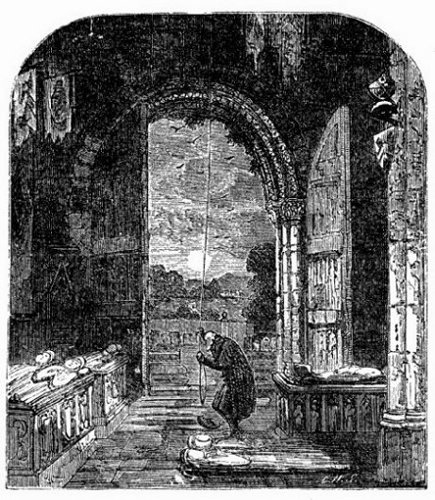
THE CURFEW BELL.
Four of the bells of the ancient Abbey of Hexham were dedicated or baptised; and although the old bells no longer exist, the legends upon the whole six have been preserved, and a free translation given by Mr. Wright, is as follows:—
1. Even at our earliest sound, The light of God is spread around. 2. At the echo of my voice, Ocean, earth and air, rejoice. 3. Blend thy mellow tones with mine, Silver voice of Catherine! 4. Till time on ruin's lap shall nod. John shall sound the praise of God. 5. With John in heavenly harmony, Andrew, pour thy melody. 6. Be mine to chant Jehovah's fame, While Maria is my name.
These epigraphs or legends on bells, are not uncommon. The Rev. W. C. Lukis, in his notices on church bells, read at the Wilts Archæological Meeting, gave the following instances:—
At Aldbourne, on the first bell, we read, "The gift of Jos. Pizzie and Wm. Gwynn.
"Music and ringing we like so well, And for that reason we gave this bell."
On the fourth bell is,—
"Humphry Symsin gave xx pound to buy this bell, And the parish gave xx more to make this ring go well."
A not uncommon epigraph is,—
"Come when I call To serve God all."
At Chilton Foliatt, on the tenor, is,—
"Into the church the living I call, And to the grave I summon all. Attend the instruction which I give, That so you may for ever live."
At Devizes, St. Mary, on the first bell, is,—
"I am the first, altho' but small. I will be heard above you all."
And on the second bell is,—
"I am the second in this ring, Therefore next to thee I will sing."
Which, at Broadchalk, is thus varied:—
"I in this place am second bell, I'll surely do my part as well."
On the third bell at Coln is,—
"Robert Forman collected the money for casting this bell Of well-disposed people, as I do you tell."
At Bath Abbey, on the tenth bell, is,—
"All you of Bath that hear me sound, Thank Lady Hopton's hundred pound."
On the fifth bell at Amesbury is,—
"Be strong in faith, praise God well, Frances Countess Hertford's bell."
And, on the tenor,—
"Altho' it be unto my loss, I hope you will consider my cost."
At Stowe, Northamptonshire, and at St. Mary the Virgin, Oxford, we find,—
"Be it known to all that doth me see, That Newcombe, of Leicester, made me."
At St. Michael's, Coventry, on the fourth bell, is,—
"I ring at six to let men know When to and from their work to go."
On the seventh bell is,—
"I ring to Sermon with a lusty bome, That all may come and none can stay at home."
On the eighth bell is—
"I am and have been called the common bell To ring, when fire breaks out to tell."
At St. Peter's-le-Bailey, Oxford, four bells were sold towards finishing the tower, and in 1792 a large bell was put up, with this inscription:—
"With seven more I hope soon to be For ages joined in harmony."
But this very reasonable wish has not yet been realized; whereas at St. Lawrence's, Reading, when two bells were added to form a peal of ten, on the second we find—
"By adding two our notes we'll raise, And sound the good subscribers' praise."
The occasion of the erection of the Westminster Clock-tower, is said to have been as follows:—A certain poor man, in an action for debt, being fined the sum of 13s. 4d., Radulphus Ingham, Chief Justice of the King's Bench, commiserating his case, caused the court roll to be erased, and the fine reduced to 6s. 8d., which being soon after discovered, Ingham was amerced in a pecuniary mulct of eight hundred marks, which was employed in erecting the said bell-tower, in which was placed a bell and a clock, which, striking hourly, was to remind the judges in the hall of the offence of their brother. This bell was originally called Edward; "but," says a writer in the "Antiquarian Repertory," "when the Reformation caused St. Edward and his hours to be but little regarded; as other bells were frequently called Tom, as fancied to pronounce that name when stricken—that at Lincoln, for instance, and that at Oxford—this also followed the fashion, of which, to what I remember of it before it was hung up, I may add another proof from a catch made by the late Mr. Eccles, which begins—
"'Hark, Harry, 'tis late—'tis time to be gone, For Westminster Tom, by my faith, strikes one."
Hawkins, in his "History of Music," says,—"The practice of ringing bells in change, or regular peals, is said to be peculiar to England: whence Britain has been termed the ringing island. The custom seems to have commenced in the time of the Saxons, and was common before the Conquest. The ringing of bells, although a recreation chiefly of the lower sort, is, in itself, not incurious. The tolling of a bell is nothing more than the producing of a sound by a stroke of the clapper against the side of the bell, the bell itself being in a pendant position, and at rest. In ringing, the bell, by means of a wheel and a rope, is elevated to a perpendicular; in its motion, the clapper strikes forcibly on one side, and in its return downwards, on the other side of the bell, producing at each stroke a sound." There are still in London several societies of ringers. There was one called the College Youths (bell-ringers, like post-boys, never seem to acquire old age). Of this it is said Sir Matthew Hale, Lord Chief Justice of the King's Bench, was, in his youthful days, a member; and in the life of that upright judge, by Burnet, some facts are mentioned which favour this relation. In England the practice of ringing has been reduced to a science, and peals have been composed which bear the names of their inventors; some of the most celebrated of these were composed about fifty years ago by one Patrick. This man was a maker of barometers. In the year 1684, one Abraham Rudhall, of the city of Gloucester, brought the art of bell-founding to great perfection. His descendants in succession have continued the business of casting bells; and by a list published by them at Lady Day, 1774, the family, in peals and odd bells, had cast to the amount of 3,594. The peals of St. Dunstan's in the East, St. Bride's, London, and St. Martin's-in-the-Fields, are among the number. The following "Articles of Ringing" are upon the walls of the belfry in the pleasant village of Dunster, in Somersetshire. They are dated 1787:—
"1. You that in ringing take delight, Be pleased to draw near; These articles you must observe, If you mean to ring here. "2. And first, if any overturn A bell, as that he may, He forthwith for that only fault In beer shall sixpence pay. "3. If any one shall curse or swear When come within the door, He then shall forfeit for that fault As mentioned before. "4. If any one shall wear his hat When he is ringing here, He straightway then shall sixpence pay In cyder or in beer. "5. If any one these articles Refuseth to obey, Let him have nine strokes of the rope, And so depart away."
BILL OF SALE FOR A NEGRO IN 1770.
"Know all Men by these Presents, That I, Elizabeth Treat, of Boston, in the county of Suffolk, widow, in consideration of the sum of £25 13s. 4d. to me in hand, paid before the ensealing hereof by Samuel Breck, of Boston aforesaid, merchant, the receipt whereof I do hereby acknowledge, have granted, bargained, and sold, and by these presents do fully and absolutely grant, bargain, and sell unto the said Samuel Breck, my Negro man named Harry, aged about forty years, with his apparel, to have and to hold the said Negro man Harry, with his apparel, unto the said Samuel Breck, his executors, administrators, and assigns, to his and their only proper use, benefit, and behoof for ever; And I, the said Elizabeth Treat, for myself, my heirs, executors, and administrators, do covenant, that at the time of ensealing, and until the delivery hereof, I am the true and lawful owner of the said Negro man, and that he is free from all former sales, charges, and incumbrances whatsoever, and that I will warrant and defend the said Negro man unto the said Samuel Breck, his heirs, and assigns for ever, against the lawful claims and demands of all persons whomsoever.
"Witness my hand and seal, this tenth day of October, Anno Domini, one thousand seven hundred and seventy, in the tenth year of His Majesty's reign.
"Signed, sealed, and delivered in presence of us.
"Thomas Melville. "Mary White. "Elizabeth Treat."
THE AZTEC CHILDREN.
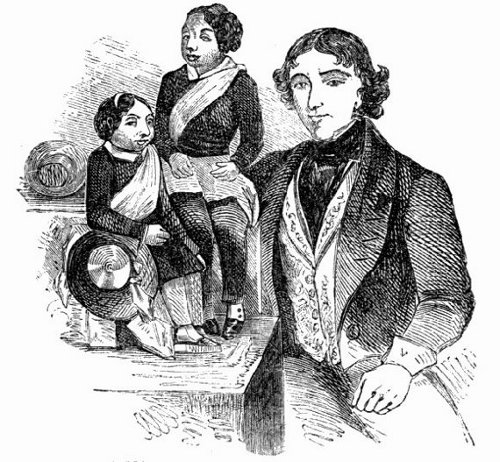
THE AZTEC CHILDREN, AS EXHIBITED IN ENGLAND.
Among the animated curiosities which are occasionally exposed to the gaze of the wonder-loving public, we may prominently notice the Aztec Children—two singular Lilliputians who were recently exhibited throughout the kingdom. Maximo and Bartolo (for by these names the two Aztec children have been baptized) are by some medical men supposed to be of the respective ages of twenty-two and sixteen. Professor Owen, stated them to be ten or twelve, and seven or nine in 1853. The height of the boy (the elder is about three feet, and the girl does not reach quite two feet six inches). Their limbs, though slender, are proportionate and well formed, and the general development of their figures is remarkably graceful. The cranium is peculiar, being narrower than that of any other races of beings known to the world; and though the face is somewhat prominent, the features are regular and the countenances agreeable, and, after a short acquaintance, highly interesting. Each has a beautiful head of jet black hair, which flows gracefully in curls. They are lively and intelligent, showing considerable aptitude for mental training, and have already learned to give utterance to several expressions which can be readily understood by visitors.
Since the arrival of these prodigies from the United States, they have been the objects of curious ethnological speculations. Dr. Latham does not consider them as a new species of the genus homo. Professor Owen regards them as instances of impeded development, and Dr. Conolly was struck with their resemblance to idiots.
NOTICES TO TAR AND FEATHER.
The original handbills of the committee for Tarring and Feathering subjoined, are of singular interest, as they were the earliest emanations of the spirit that led to England's losing her American colonies, and the consequent rise of the United States:—
To the Delaware Pilots.
The Regard we have for your Characters, and our Desire to promote your future Peace and Safety, are the Occasion of this Third Address to you.
In our second Letter we acquainted you, that the Tea Ship was a Three Decker; We are now informed by good Authority, she is not a Three Decker, but an old black Ship, without a Head, or any Ornaments.
The Captain is a short fat Fellow, and a little obstinate withal.—So much the worse for him.—For, so sure as he rides rusty, We shall heave him Keel out, and see that his Bottom be well fired, scrubb'd and paid.—His Upper-Works too, will have an Overhawling—and as it is said, he has a good deal of Quick Work about him, We will take particular Care that such Part of him undergoes a thorough Rummaging.
We have a still worse Account of his Owner;—for it is said, the Ship Polly was bought by him on Purpose, to make a Penny of us: and that he and Captain Ayres were well advised, of the Risque they would run, in thus daring to insult and abuse us.
Captain Ayres was here in the Time of the Stamp-Act, and ought to have known our People better, than to have expected we would be so mean as to suffer his rotten TEA to be funnel'd down our Throats, with the Parliament's Duty mixed with it.
We know him well, and have calculated to a Gill and a Feather, how much it will require to fit him for an American Exhibition. And we hope, not one of your Body will behave so ill, as to oblige us to clap him in the Cart along Side of the Captain.
We must repeat, that the SHIP POLLY is an old black Ship, of about Two Hundred and Fifty Tons burthen, without a Head, and without Ornaments,—and, that CAPTAIN AYRES is a thick chunky Fellow.—As such, Take Care to avoid THEM.
Your Old Friends, The Committee for Tarring and Feathering. Philadelphia, December 7, 1773.
To Capt. Ayres, of the Ship Polly, on a Voyage from London to Philadelphia.
Sir,
We are informed that you have, imprudently, taken Charge of a Quantity of Tea; which has been sent out by the India Company, under the Auspices of the Ministry, as a Trial of American Virtue and Resolution.
Now, as your Cargo, on your Arrival here, will most assuredly bring you into hot water; and as you are perhaps a Stranger to these Parts, we have concluded to advise you of the present Situation of Affairs in Philadelphia—that, taking Time by the Forelock, you may stop short in your dangerous Errand—secure your Ship against the Rafts of combustible Matter which may be set on Fire, and turned loose against her: and more than all this, that you may preserve your own Person, from the Pitch and Feathers that are prepared for you.
In the first Place, we must tell you, that the Pennsylvanians are, to a Man, passionately fond of Freedom; the Birthright of Americans; and at all Events are determined to enjoy it.
That they sincerely believe, no Power on the Face of the Earth has a Right to tax them without their Consent.
That in their Opinion, the Tea in your Custody is designed by the Ministry to enforce such a Tax, which they will undoubtedly oppose; and in so doing, give you every possible Obstruction.
We are nominated to a very disagreeable, but necessary Service.—To our Care are committed all Offenders against the Rights of America; and hapless is he, whose evil Destiny has doomed him to suffer at our Hands.
You are sent out on a diabolical Service; and if you are so foolish and obstinate as to compleat your Voyage; by bringing your Ship to Anchor in this Port; you may run such a Gauntlet, as will induce you, in your last Moments, most heartily to curse those who have made you the Dupe of their Avarice and Ambition.
What think you Captain, of a Halter around your Neck—ten Gallons of liquid Tar decanted on your Pate—with the Feathers of a dozen wild Geese laid over that to enliven your Appearance?
Only think seriously of this—and fly to the Place from whence you came—fly without Hesitation—without the Formality of a Protest—and above all, Captain Ayres let us advise you to fly without the wild Geese Feathers.
Your Friends to serve The Committee as before subscribed. Philadelphia, Nov. 27, 1773.
B. FRANKLIN'S CELEBRATED LETTER TO STRAHAN.
As a sequel to the foregoing notices, we give Dr. Franklin's celebrated letter, written in the actual heat of the first outbreak.
Philadelphia, July 5, 1775.
Mr. Strahan,—You are a member of Parliament, and one of that majority which has doomed my country to destruction. You have begun to burn our towns, and murder our people. Look upon your hands! They are stained with the blood of your relations! You and I were long friends; you are now my enemy, and
I am, yours, B. Franklin.
HENRY II. STRIPT WHEN DEAD.
1189. Immediately upon his death, those that were about him applied their market so busilie in catching and filching awaie things that laie readie for them, that the king's corps laie naked a long time, till a child covered the nether parts of his body with a short cloke, and then it seemed that his surname was fulfilled that he had from his childhood, which was Shortmantell, being so called, because he was the first who brought short clokes out of Anjou into England.
TRANSPLANTATION OF HAIR.
The Signor Dottore Domenico Nardo addressed a letter to the Academy of Padua, in 1826, on the subject of the growth of hair after death, and even after its separation from the body. The latter property had been previously observed by Krafft. The Signor Nardo recounts the results of experiments made on his own person in the transplantation of hair, and relates, that by transplanting quickly a hair, with its root, from a pore of his head, into a pore of his chest, easily to be accomplished by widening the pore somewhat with the point of a needle, introducing the root with nicety, and exciting within the pore itself, by friction, a slight degree of inflammation, the hair takes root, continues to vegetate, and grows; in due season changes colour, becomes white, and falls.
ANCIENT CANNON RAISED FROM THE SEA.
A fisherman of Calais some time since, drew up a cannon, of very ancient form, from the bottom of the sea, by means of his nets. M. de Rheims has since removed the rust from it, and on taking off the breech was much surprised to find the piece still charged. Specimens of the powder have been taken, from which, of course, all the saltpetre has disappeared after a submersion of three centuries. The ball was of lead, and was not oxidized to a depth greater than that of a line.
COFFEE-HOUSE ATTRACTIONS IN 1760.
The great attraction of Don Saltero's Coffee-house was its collection of rarities, a catalogue of which was published as a guide to the visitors. It comprehends almost every description of curiosity, natural and artificial. "Tigers' tusks; the Pope's candle; the skeleton of a Guinea-pig; a fly-cap monkey; a piece of the true Cross; the Four Evangelists' heads cut on a cherry-stone; the King of Morocco's tobacco-pipe; Mary Queen of Scot's pincushion; Queen Elizabeth's prayer-book; a pair of Nun's stockings; Job's ears, which grew on a tree; a frog in a tobacco-stopper;" and five hundred more odd relics! The Don had a rival, as appears by "A Catalogue of the Rarities to be seen at Adams's, at the Royal Swan, in Kingsland Road, leading from Shoreditch Church, 1756." Mr. Adams exhibited, for the entertainment of the curious, "Miss Jenny Cameron's shoes; Adam's eldest daughter's hat; the heart of the famous Bess Adams, that was hanged at Tyburn with Lawyer Carr, January 18, 1736-7; Sir Walter Raleigh's tobacco-pipe; Vicar of Bray's clogs; engine to shell green pease with; teeth that grew in a fish's belly; Black Jack's ribs; the very comb that Abraham combed his son Isaac and Jacob's head with; Wat Tyler's spurs; rope that cured Captain Lowry of the head-ach, ear-ach, tooth-ach and belly-ach; Adam's key of the fore and back door of the Garden of Eden, &c., &c." These are only a few out of five hundred others equally marvellous.
A WOMAN TAKES THE LIGHTED MATCH FROM A BOMB.
During the siege of Gibraltar, in 1782, the Count d'Artois came to St. Roch, to visit the place and works. While his highness was inspecting the lines, in company with the Duke de Crillon, they both alighted with their suite, and all lay flat upon the ground, to avoid the effects of a bomb that fell near a part of the barracks where a Frenchwoman had a canteen. This woman, who had two children in her arms at the time, rushed forth with them, and having seated herself, with the utmost sang-froid, on the bomb-shell, she put out the match, thus extricating from danger all that were around her, many of whom witnessed this courageous and devoted act. His highness rewarded this intrepid female by bestowing on her a pension of three francs a day, and engaged to promote her husband after the siege; while the Duke de Crillon, imitating the generous example of the prince, ensured to her likewise a daily payment of five francs.
THE SUMMERS MAGNET, OR LOADSTONE.
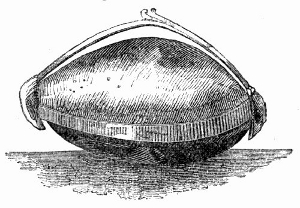
Among the great naval officers of Elizabeth's reign must be ranked Sir George Summers, the discoverer of the Bermudas, often called the Summers Islands from that circumstance. Here is a representation given of what the descendants of Sir George Summers call the "Summers magnet, or loadstone." It is in the possession of Peter Franklin Bellamy, Esq., surgeon, second son of Dr. Bellamy, of Plymouth. The tradition in the family is that the admiral before going to sea used to touch his needle with it. The stone is dark-coloured, the precise geological formation doubtful. This curious stone, with armature of iron, was probably an ancient talisman.
SWALLOWING LIZARDS.
Bertholin, the learned Swedish doctor, relates strange anecdotes of lizards, toads, and frogs; stating that a woman, thirty years of age, being thirsty, drank plentifully of water at a pond. At the end of a few months, she experienced singular movements in her stomach, as if something were crawling up and down; and alarmed by the sensation, consulted a medical man, who prescribed a dose of orvietan in a decoction of fumitory. Shortly afterwards, the irritation of the stomach increasing, she vomited three toads and two young lizards, after which, she became more at ease. In the spring following, however, her irritation of the stomach was renewed; and aloes and bezoar being administered, she vomited three female frogs, followed the next day by their numerous progeny. In the month of January following, she vomited five more living frogs, and in the course of seven years ejected as many as eighty. Dr. Bertholin protests that he heard them croak in her stomach!
IMMENSE SEA SERPENT.
A species of sea-serpent was thrown on shore near Bombay in 1819. It was about forty feet long, and must have weighed many tons. A violent gale of wind threw it high above the reach of ordinary tides, in which situation it took nine months to rot; during which process travellers were obliged to change the direction of the road for nearly a quarter of a mile, to avoid the offensive effluvia. It rotted so completely that not a vestige of bone remained.
THE ROYAL TOUCH.
For many ages one of the regal prerogatives in this country was to touch for the cure of regius morbus, or scrofula; a disease too well known to need any description. At different periods hundreds of persons assembled from all parts of the country annually to receive the royal interposition. Lists of the afflicted were published, to afford a criterion for determining as to its success; and from Edward the Confessor to the reign of Queen Anne, its efficacy appears to have obtained a ready and general belief.