TEN THOUSAND WONDERFUL THINGS. (continued 5)
Reading edition
John Bunyan was buried in Bunhill Fields burying-ground, City-road; and the tablet on his tomb, which the engraving very correctly represents is as follows:—"Mr. John Bunyan, author of the 'Pilgrim's Progress,' ob. 12 Aust. 1688, æt. 60." Formerly there were also the following lines:—
"The Pilgrim's Progress now is finished. And death has laid him in his earthly bed."
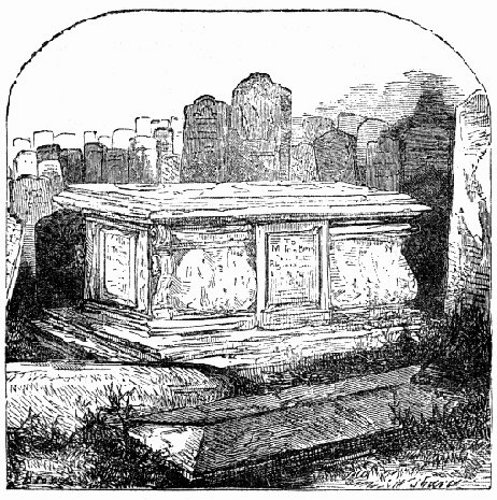
Bunhill Fields burying-ground was opened as a suburban cemetery in 1665, in the time of the great plague, and was a favourite burying-place with the Dissenters. Here are buried Daniel Defoe; Dr. Isaac Watts; Joseph Ritson the antiquary; Dr. Thomas Goodwin, the chaplain who attended Cromwell's death-bed; George Fox, the founder of the Quakers; the mother of John Wesley; Lieut.-General Fleetwood, son-in-law of Oliver Cromwell; Thomas Stothard, R.A., and other eminent men.
SPIDERS FOND OF MUSIC.
Spiders hear with great acuteness, and it is affirmed that they are attracted by music. Disjonval relates the instance of a spider which used to place itself on the ceiling of a room over the spot where a lady played the harp, and which followed her if she removed to another part; and he also says that the celebrated violinist Berthome, when a boy, saw a spider habitually approach him as soon as he began to play, and which eventually became so familiar that it would fix itself on his desk, and on his arm. Bettina noticed the same effect with a guitar, on a spider which accidentally crossed over it as she was playing.
BREAKFASTING HUT IN 1745.
This quaint announcement, in a handbill of the time, shows how cheaply those who lived a century or so past could enjoy suburban pleasures in merrie Islington:—
"This is to give notice to all Ladies and Gentlemen, at Spencer's original Breakfasting-Hut, between Sir Hugh Middleton's Head and St. John Street Road, by the New River side, fronting Sadler's Wells, may be had every morning, except Sundays, fine tea, sugar, bread, butter, and milk, at fourpence per head; coffee at threepence a dish. And in the afternoon, tea, sugar, and milk, at threepence per head, with good attendance. Coaches may come up to the farthest garden-door next to the bridge in St. John Street Road, near Sadler's Wells back gate.—Note. Ladies, &c., are desired to take notice that there is another person set up in opposition to me, the next door, which is a brick-house, and faces the little gate by the Sir Hugh Middleton's, and therefore mistaken for mine; but mine is the little boarded place by the river side, and my backdoor faces the same as usual; for
I am not dead, I am not gone, Nor liquors do I sell; But, as at first, I still go on, Ladies, to use you well. No passage to my hut I have, The river runs before; Therefore your care I humbly crave, Pray don't mistake my door.
"Yours to serve, S. Spencer."
SPONTANEOUS COMBUSTION.
In Leroux's Journal de Medicine, is an account of a very fat woman, twenty-eight years of age, who was found on fire in her chamber, where nothing else was burning. The neighbours heard a noise of something like frying, and when the body was removed it left a layer of black grease. The doctor conceives that the combustion began in the internal parts, and that the clothes were burnt secondarily.
MOTHER MAPP THE BONE-SETTER.
She was the daughter of a man named Wallis, a bone-setter at Hindon, in Wiltshire, and sister to the celebrated "Polly Peachem," who married the Duke of Bolton. Upon some family quarrel, Sally Wallis left her professional parent, and wandered up and down the country in a miserable manner, calling herself "Crazy Sally," and pursuing, in her perambulations, a course that fairly justified the title. Arriving at last at Epsom, she succeeded in humbugging the worthy bumkins of that place, so decidedly, that a subscription was set on foot to keep her among them; but her fame extending to the metropolis, the dupes of London, a numerous class then as well as now, thought it no trouble to go ten miles to see the conjuror, till at length, she was pleased to bless the afflicted of London with her presence, and once a week drove to the Grecian Coffee-house, in a coach and six with out-riders! and all the appearance of nobility. It was in one of these journeys, passing through Kent-street, in the Borough, that being taken for a certain woman of quality from the Electorate in Germany, a great mob followed and bestowed on her many bitter reproaches, till Madame, perceiving some mistake, looked out of the window, and accosted them in this gentle manner, "Confound you, don't you know me? I am Mrs. Mapp, the bone-setter!" upon which, they instantly changed their revilings into loud huzzas.
TWO CERTIFICATES OF GRETNA-GREEN MARRIAGES AT DIFFERENT DATES.
"This is to sartfay all persons that my be consernid, that A B from the parish of C in the County of D and E F from the parish of G and in the county of H and both comes before me and declayred themseless both to be single persons, and now mayried by the form of the Kirk of Scotland, and agreible to the Church of England, and givine ondre my hand, this 18th day of March 1793."
"Kingdom of Scotland "County of Dumfries "Parish of Gretna
"These are to certify, to all whom it may concern, that John N.... from the parish of Chatham in the County of Kent, and Rosa H.... from the Parish of St. Maries in the County of Nottingham, being both here now present and having declared to me that they are single persons, but have now been married conformable to the Laws of the Church of England, and agreeable to the Kirk of Scotland. As witness our hands at Springfield this 4th day of October 1822.
"Witness"Witness me. Jane RaeDavid Lang. John Ainslie."John N.... Rosa H...."
THE WOMEN OF ENGLAND.
The women here are generally more handsome than in other places, sufficiently endowed with natural beauties, without the addition of adulterate sophistications. In an absolute woman, say the Italians, are required the parts of a Dutch woman, from the girdle downwards; of a French woman, from the girdle to the shoulders: over which must be placed an English face. As their beauties, so also their prerogatives are greater than any nation; neither so servilely submissive as the French, nor so jealously guarded as the Italians; but keeping so true a decorum, that as England is termed the Pergatorie of Servants, and the Hell of Horses, so is it acknowledged the Paradise of Women. And it is a common by-word amongst the Italians, that if there were a bridge built across the narrow seas, all the women in Europe would run into England. For here they have the upper hand in the streets, the upper place at the table, the thirds of their husband's estates, and their equal share of all lands; privileges with which other women are not acquainted. They were in high esteem in former times amongst foreign nations, for the modestie and gravitie of their conversation; but of late so much addicted to the light garb of the French, that they have lost much of their ancient honour and reputation amongst knowing and more sober men of foreign countries who before admired them.—Peter Heylin's Cosmographie, 1652.
PRICES FOR SEATS AT CORONATIONS.
On consulting Stowe, Speed, and other antiquaries, it appears that the price of a good place at the coronation of William the Conqueror was a blank; and probably the same at that of his son William Rufus. At that of Henry I. it was a crocard, and at King Stephen's and Henry the Second's a pillard. At King Richard's and King John's, it was a fuskin; and rose at Henry the Third's to a dodkin. In the reign of Edward I. the coins began to be more intelligible; and we find that for seeing his coronation a Q was given, or the half of a ferling, or farthing, which was, as now, the fourth part of a sterling, or penny. At the coronation of Edward II. it was a farthing; and at that of Edward III. a halfpenny, which was very generally given. In the reign of Richard II. it was a penny, and continued the same at that of Henry IV. But at that of Henry V. it was two pennies, or half of a grossus, or groat; and the same at that of Henry VI. and of Edward IV.; nor do we find it raised at the coronation of Richard III. or that of Henry VII.
At that of Henry VIII. it was the whole grossus, or groat, nor was the price altered at those of Edward VI. and Queen Mary; but at Queen Elizabeth's it was a teston, tester, or sixpence. At those of James I. and Charles I. a shilling was given; which sum was advanced to half a crown at the coronations of Charles and James II. At King William's and Queen Anne's, it was a crown; and at George the First's the show was seen by many at the same price.
At the coronation of George II. some gave half a guinea; but at that of George III. and Queen Charlotte, anno 1761, curiosity seems to have risen to an amazing height. On this occasion the price given for single seats were almost incredible; in some houses ten guineas, and in ordinary houses five guineas. Great and universal anxiety prevailed to see this grand spectacle, from the reflection how improbable it was that many who were there could ever have an opportunity of witnessing the like again. As an instance of this extreme anxiety, it is confidently related, that a gentleman was prevailed on to take a room for his lady, at the price of one hundred and forty guineas; but the appointment of the solemnity of the coronation falling unluckily at the exact time when she expected to be delivered, she actually further prevailed on her husband to let a skilful man-midwife, nurse, &c., attend her, and to hire another room, lest the hurry of the day should bring on her labour, when it might be impossible for her to be removed without endangering her life.
ANCIENT HOUSE AT BLACKWALL—SAID TO BE THE RESIDENCE OF SIR WALTER RALEIGH.
The house shown in the engraving is interesting from two causes; first, that it was the house in which Sir Walter Raleigh smoked his first pipe of tobacco in England, and secondly, that it is one of the few relics remaining of those picturesque old houses of the days of Queen Bess. The house is built of strongly framed timber, which, in recent years, has been plastered over; and the carved heads that ornament the gables, and which are good both in design and execution, show that this house is at least 350 years old.
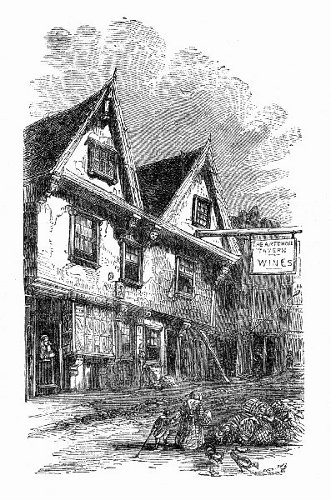
At the present time a tavern has been built between this house and the river. Formerly, however, there was, no doubt, a trimmed garden and terrace towards the Thames, from which the inhabitants may have watched the progress of Queen Elizabeth from the Tower to her palace at Greenwich.
It is singular to notice the fashion of these old houses, arising from the value of space within walled towns; each floor projects over the other, so that the upper apartments have more room than the lower. While, in an artistic point of view, we cannot help regretting the disappearance of the venerable and quaint gables, for sanitary and other reasons we must be content with the change.
AMBASSADORS—WHY HELD BY THE ARMS AT THE OTTOMAN COURT.
A dervise addressed Bajazet, emperor of the Turks, 1495, for alms, and while the charitable Sultan searched for his money, the treacherous beggar wounded him with a dagger, and was instantly slain by the royal attendants. This incident is rendered memorable by its having occasioned the ungracious restraint under which even the ambassadors of Christian powers were subject to in former times when they received an audience from the Ottoman Emperor.
They were held by the arms by two attendants, when they approached the throne, nor were their arms loosed till they had quitted the presence.
TRAVELLING IN 1760.
The nobility and gentry were accustomed to make their long journeys in ponderous family-carriages, drawn by four horses. These vehicles would be laden at the top with an array of trunks and boxes, while perhaps six or seven persons, with a lapdog, would be stowed within. The danger of famine on the road was averted by a travelling larder of baskets of various condiments; the risk of thirst would be provided against by bottles of usquebaugh, black cherry-brandy, cinnamon-water, sack, port, or strong beer: while the convoy would be protected by a basket-hilted sword, an old blunderbuss, and a bag of bullets and a great horn of gunpowder.
OLD ST. PAUL'S.
In the old cathedral was a tower of stone, in height from the ground 260 feet, on which was a spire of wood, covered with lead, 274 feet high. In the tower was a celebrated peal of bells; and somewhat above the stone-work was a "faire dial," from which there was order taken in the eighteenth year of Edward III. that the rich chasing and gilding should be always kept in good preservation. On this dial was the figure of an angel pointing to the hours of both day and night—a device more appropriate than most of the clock-hands in present use. From this lofty steeple, which formed such an important feature of old London, the chimes rung merrily on saints' days and holidays; and at times the choristers mounted up aloft and chaunted forth their orisons at dawn and sunset—a custom still observed at Durham Cathedral. Before the fire of London, the spire of St. Paul's was more than once destroyed or damaged by fire and lightning.
On Candlemas Eve, 1444, about two o'clock in the afternoon, the lightning fired the steeple. The citizens came forth and succeeded in overcoming the fire; it, however, broke forth again at night, and but little of the spire was saved. In the year 1561, in the month of June, there fell a prodigious quantity of rain, attended with thunder and lightning. St. Paul's steeple was struck within a yard of the top. At first, a little fire appeared, resembling the light of a torch, and in eight minutes the weather-cock fell; and the wind rising high, the fire within an hour afterwards destroyed the steeple down to the very battlements, and then, in consequence of the mass of burning timber that fell from the spire, burnt so violently that the iron-work and the bells melted and fell upon the stairs in the church; the east and west roofs catching fire communicated with the north and south, and destroyed them all. Much damage was also done to other parts.
The spire was again reared, and the damaged bells properly replaced. In addition to the bells in the tower of old St. Paul's there was a common bell, the property of the city, hung in a suitable building, closely adjoining to the Cathedral, which was rung that the inhabitants might assemble at wardmotes and other important occasions. Another fire damaged the ancient church, and then the great fire of 1666, swept steeples, bells, churches, and all before it.
THE BEDFORD MISSAL.
In January, 1786, when the Bedford Missal was on sale, with the rest of the Duchess of Portland's collection, King George III. sent for his bookseller, and expressed his intention to become the purchaser. The bookseller ventured to submit to his majesty, that the article in question, as one highly curious, was likely to fetch a high price. "How high?" exclaimed the king. "Probably two hundred guineas," replied the bookseller. "Two hundred guineas for a Missal!" exclaimed the Queen, who was present, and lifted up her hands with astonishment. "Well, well," said his Majesty, "I'll have it still; but since the Queen thinks two hundred guineas so enormous a price for a Missal, I'll go no further." The biddings for the royal library did actually stop at that point; and Mr. Edwards carried off the prize by adding three pounds more. The same Missal was afterwards sold at Mr. Edwards's sale, in 1815, and purchased by the Duke of Marlborough, for £637 15s.
FORMATION OF THE VOLCANO OF JORULLO.
The Mexican volcanoes of Orizaba, Popocatepetl, Jorullo, and Colima appear to be connected with each other, being placed in the direction of a line running transverse to the former, and passing east and west from sea to sea.
As was first observed by Humboldt, these mountains are all situated between north latitude 18° 59' and 19° 12'. In an exact line of direction with the other volcanoes, and over the same transverse fissure, Jorullo was suddenly elevated on the 29th of September, 1759. The circumstances attending the production of this volcano are so remarkable, that we shall here notice them in some detail.
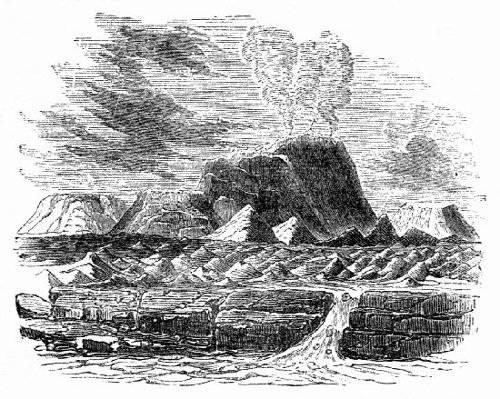
VOLCANO OF JORULLO, MEXICO.
An extensive plain, called the Malpays, was covered by rich fields of cotton, sugar-cane, and indigo, irrigated by streams, and bounded by basaltic mountains, the nearest active volcano being at the distance of eighty miles. This district, situated at an elevation of about 2600 feet above the level of the sea, was celebrated for its beauty and extreme fertility. In June, 1759, alarming subterranean sounds were heard, and these were accompanied, by frequent earthquakes, which were succeeded by others for several weeks, to the great consternation of the neighbouring inhabitants. In September tranquillity appeared to be re-established, when, in the night of the 28th, the subterranean noise was again heard, and part of the plain of Malpays, from three to four miles in diameter, rose up like a mass of viscid fluid, in the shape of a bladder or dome, to a height of nearly 1700 feet; flames issued forth, fragments of red-hot stones were thrown to prodigious heights, and, through a thick cloud of ashes, illumined by volcanic fire, the softened surface of the earth was seen to swell up like an agitated sea. A huge cone, above 500 feet high, with five smaller conical mounds, suddenly appeared, and thousands of lesser cones (called by the natives hornitos, or ovens,) issued forth from the upraised plain. These consisted of clay intermingled with decomposed basalt, each cone being a fumarolle, or gaseous vent, from which issued thick vapour. The central cone of Jorullo is still burning, and on one side has thrown up an immense quantity of scoriaceous and basaltic lavas, containing fragments of primitive rocks. Two streams, of the temperature of 186° of Fahrenheit, have since burst through the argillaceous vault of the hornitos, and now flow into the neighbouring plains. For many years after the first eruption, the plains of Jorullo were uninhabitable from the intense heat that prevailed.
CRATER OF VESUVIUS IN 1829.
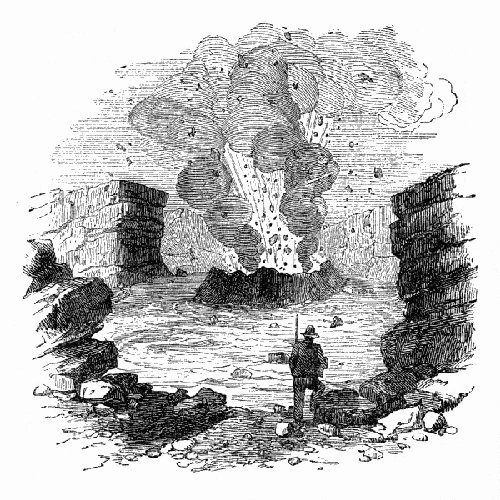
The crater Stromboli, which has been in activity since the most ancient times, presents at present the same appearances as those which were described by Spallanzani, in 1788. It is constantly filled with lava in a state of fusion, which alternately rises and falls in the cavity. Having ascended to ten or twelve yards below the summit of the walls, this boiling fluid is covered with large bubbles, which burst with noise, letting enormous quantities of gas escape from them, and projecting on all sides scoriaceous matter. After these explosions, it again subsides, but only to rise again and produce like effects—these alternations being repeated regularly at intervals of some minutes. In craters where the lava is less fluid than in that of Stromboli, new cones are sometimes formed in the midst of the Crater, which first rise in the form of a dome, and then burst out so as to form a small active volcano in the middle of the crater of the great one. This phenomenon is often presented within the crater of Vesuvius, and was more particularly witnessed in 1829.
LOAF SUGAR.
In 1553 a sugar-loaf was presented to Mr. Waldron, of Bovey House, which weighed 7 lbs., at 1s. 1d. per lb. (7s. 7d.)
The late Lord Rolle married the last of that branch of the Waldron family. The house remains about ten miles west of Lyme. The sugar-loaf was charged at a high rate, considering the greater value of money in Queen Mary's reign. This article began to be highly prized. The sugar-cane, which had been grown from the year 1148 in Sicily, had been imported into Madeira A.D. 1419. About the year 1503 the art of refining sugar, before called "blanch powdre," was discovered by a Venetian; before which the juice, when selected instead of honey for sweetening, was used as it came from the cane. Only twenty-seven years from this date, in 1526, it was imported from St. Lucar in Spain by Bristol merchants. Let not the present of the Mayor of Lyme be considered as a cheap article produced in abundance in the islands of the West Indies. The sugar-cane was not imported thither into Barbadoes from the Brazils till the year 1641. How surprising the result of official inquiries in the year 1853 into the consumption of sugar! It amounted to 7,523,187 cwts., or 30 lbs. each individual of the United Kingdom.
SUSPENSION BRIDGES AT FREYBOURG.
There are two suspension bridges in Freybourg; one remarkable for its great length, the other for its extreme beauty. The latter connects the top of two mountains, swinging over a frightful gulf that makes one dizzy to look down into. There are no buttresses or masonwork in sight at a little distance; shafts are sunk in the solid rock of the mountains, down which the wires that sustain it are dropped. There it stretches, a mere black line, nearly three hundred feet in the heavens, from summit to summit. It looks like a spider's web flung across a chasm; its delicate tracery showing clear and distinct against the sky. While you are looking at the fairy creation suspended in mid-heaven, almost expecting the next breeze will waft it away, you see a heavy waggon driven on it; you shrink back with horror at the rashness that could trust so frail a structure at that dizzy height; but the air-hung cobweb sustains the pressure, and the vehicle passes in safety. Indeed, weight steadies it; while the wind, as it sweeps down the gulf, makes it swing under you. The large suspension bridge is supported on four cables of iron wire, each one composed of one thousand and fifty-six wires. As the Menai bridge of Wales is often said to be longer than this, I give the dimensions of both as I find them in Mr. Murray:—Freybourg: length, nine hundred and five feet; height, one hundred and seventy-four feet; breadth, twenty eight feet. Menai: length, five hundred and eighty feet; height, one hundred and thirty feet; breadth, twenty-five feet. A span of nine hundred and five feet, without any intermediate pier, seems impossible at first, and one needs the testimony of his own eyes before he can fully believe it.
WONDERFUL CLOCK.
Towards the end of the last century, a clock was constructed by a Genevan mechanic named Droz, capable of performing a variety of surprising movements, which were effected by the figures of a negro, a shepherd, and a dog. When the clock struck, the shepherd played six tunes on his flute, and the dog approached and fawned upon him. This clock was exhibited to the King of Spain, who was highly delighted with the ingenuity of the artist. The king, at the request of Droz, took an apple from the shepherd's basket, when the dog started up and barked so loud that the king's dog, which was in the same room, began to bark also. We are moreover informed that the negro, on being asked what hour it was, answered the question in French, so that he could be understood by those present.
MANDRIN THE SMUGGLER, 1757.
Mandrin was the son of a peasant in Dauphiny who dealt in cattle. His first employment was buying and selling horses, by which he subsisted several years. But having on some occasion committed a murder, he was obliged to fly from justice, and in his absence was condemned by the Parliament of Grenoble to be broken on the wheel. Being now a fugitive, and destitute of employment, he learned to counterfeit money, and by this fraud made considerable gain, till, being discovered, the officers of the Mint at Lyons issued a warrant for apprehending him, and he was again obliged to quit the country. While he was wandering about from place to place, and hiding himself in caves and woods, he became acquainted with a gang of smugglers, and associating with them was, after some time, made their captain. As this gang was very numerous, he was less cautious of being seen, and having at length lost his sense of fear by habitual danger, he frequently entered towns and cities, raised contributions on the king's officers by force, and spread the same terror among others that others had brought upon him. But in proportion as he became more formidable he was, in fact, less secure; for the Government found it necessary to detach after him such a force as he could not resist, and the Farmers-General offered 48,000 livres reward for taking him. After many times attacking his party in a running fight, in which several were cut off, Mandrin, with eight of his men, took shelter in a castle on the frontiers of Savoy. They were closely pursued by several detachments, under the command of Colonel de Molière, who entered the King of Sardinia's territory after him, without having first obtained leave. Molière was immediately opposed by a great number of peasants: whether they were instigated by Mandrin, or whether they were jealous of their privilege, is not known; but all his expostulations being fruitless, and being determined not to relinquish his prey, for whom he hoped to receive so considerable a reward, he forced his way against them, killing twelve and wounding many others. Mandrin waited the issue of this contest in his castle, where he was soon besieged by 150 men, who attacked the place with great vigour. Mandrin and his partisans defended themselves like men who had nothing to fear in a battle equal to being taken alive; and after several of them were killed, and the castle gates burst open, they retreated, fighting from chamber to chamber, and from story to story, till, reaching the garret, and being able to proceed no further, they were at last overpowered by numbers, having killed twenty of their adversaries, and spent all their ammunition. Mandrin, with those that survived of his little party, were carried prisoners to Valence in Dauphiny. * * * Mandrin was examined every day from the 13th of May to the 25th, in order to discover his accomplices. In the mean time several of his associates were put to the torture to discover what they knew of him, and were afterwards broken on the wheel, that death might give a sanction to their testimony.
He himself was subjected to torture, but without eliciting anything further than he had previously revealed. Throughout he steadfastly refused to betray his comrades, and conducted himself with much dignity and heroism. On the day of his execution he received absolution from Father Gasperini, a Jesuit, who had administered to him the consolations of religion during his confinement.
Before he was led out of the prison, his shoes and stockings were taken from him; but, though barefooted, he walked along with great firmness and a good grace. When he came to the cathedral to perform the amende honorable, he asked forgiveness of the monks and priests for his want of respect to their order, and was then conducted to the scaffold. He mounted with great composure, and addressed himself in a short and pathetic exhortation to the spectators, especially the young persons of both sexes; he then sat down on the nave of the wheel, and loosened the buttons of his shirt-sleeves himself. Then he entreated pardon of the custom-house officers, whom he had so often and so grossly injured; and turning to the penitents who surrounded the scaffold—with his confessor and two other eminent persons of his order—he earnestly recommended himself as the object of their prayer, and immediately delivered himself up to the executioner. He received eight blows on his arms and legs, and one on his stomach, and was intended to have been left to expire of the wounds; but as the executioner was going down from the scaffold, an order came to strangle him; the bishop and all the considerable persons at Valence having interceded for this mitigation of his punishment. Mandrin was twenty-nine years of age, about five feet five inches high, well made, had a long visage, blue eyes, and sandy chesnut hair; he had something rough in his countenance, and a strong robust port; he was perpetually smoking tobacco, with which he drank plentifully of any liquor that was at hand, and ate till the last with a good appetite.
SUDDEN RECOVERY FROM MADNESS.
The following extraordinary account is taken from the Gentleman's Magazine of 1784:—"About six years since, a seafaring person was taken into the Asylum for Maniacs at York; during the space of five years and six months he never expressed any desire for sustenance, and was fed in the manner of an infant. The servants undressed him at night, and dressed him in the morning; he never spoke, and remained with his body bent all day, and was regarded by all about him as an animal nearly converted into a vegetable. About the middle of May, 1783, he suddenly astonished the people round him with saying, 'Good morrow to you all.' He then thanked the servants for the care they had taken of him, and appeared perfectly sane. A few days after, he wrote a letter to his wife, in which he expressed himself with great propriety. On the 28th of May following he was allowed to leave the hospital, and return to his family; and has now the command of a ship in the Baltic trade, and is in full enjoyment of perfect health, both in mind and body. This very singular case is attested by Dr. Hunter, F.E.S., of York, in a letter to Dr. Percival, of Manchester, and by the servants now at the Asylum in York."
SUMMARY OF THE BIBLE.
The following table is published, as containing accurate particulars of the English version of the Bible:—
In the Old Testament. In the New Testament. Total.
Books, 39 Books, 27 Books, 66
Chapters, 929 Chapters, 260 Chapters, 1,189
Verses, 23,214 Verses, 7,959 Verses, 31,173
Words, 592,493 Words, 181,253 Words, 773,746
Letters, 2,728,100 Letters, 838,380 Letters, 3,566,480
The middle chapter and the shortest in the Bible is the hundred and seventeenth Psalm; the middle verse is the eighth of the hundred and eighteenth Psalm. The twenty-first verse of the seventh chapter of Ezra, in the English version, has all the letters of the alphabet in it. The nineteenth chapter of the second book of Kings and the thirty-seventh chapter of Isaiah are alike.
THE LEPROSY.—LAZARS.—LAZAR-HOUSES.
That loathsome disorder, leprosy, was introduced into England in the reign of Henry I., and was supposed to have been brought out of Egypt, or perhaps the East, by means of the crusaders. To add to the horror, it was contagious, which enhanced the charity of a provision for such miserables, who were not only naturally shunned, but even chased by royal edict, from the society of their fellow-creatures.
Lepers, or Lazars, were sick persons removed out of monasteries to cells or hospitals, always built out of cities and towns. Their usual maintainence was, from liberty allowed them to go upon every market-day, to the market, where with a dish, called a clap dish, they would beg corn.
Their sickness and loathsome appearance giving great disgust, many withheld their charity, upon which account they were afterwards restrained from begging at large, but permitted to send the proctor of the hospital, who came with his box one day in every month to the churches, and other religious houses, at time of service; and there received the voluntary charity of the congregations. This custom is said to be the origin of the present practice of collecting briefs.
The leprosy was much more common formerly, in this part of the globe, than at present. It is said, that there were in Europe fifteen thousand hospitals founded for them. Perhaps near half the hospitals that were in England were built for lepers.
Lepers were so numerous in the twelfth century, that by a decree of the Lateran Council under pope Alexander III., A.D. 1179, they were empowered to erect churches for themselves, and to have their own ministers to officiate in them. This shows at once how infectious and offensive their distemper was.
And on this account, "In England where a man was a leper, and was dwelling in a town, and would come into the churches, or among his neighbours when they were assembled, to talk to them to their annoyance or disturbance, a writ lay De Leproso amovendo."—What follows is remarkable. The writ is for those lepers "who appear to the sight of all men, they are lepers, by their voice and their sores, the putrefaction of their flesh, and by the smell of them."
And so late as the reign of Edward VI. multitudes of lepers seem to have been in England; for in 1 Edw. 6. c. 3. in which directions are given for carrying the poor to the places where they were born, &c. we read the following clause: "Provided always, that all leprous and poor bed-red creatures may, at their liberty, remain and continue in such houses appointed for lepers, or bed-red people, as they now be in."
1184 to 1191.—The leprosy was at this period, and long after, a cruel epidemic in our country, possibly brought by the crusaders from the Holy Land, and spread here by filth and bad diet. It was supposed to be infectious, and was shunned as the plague; so that, had it not been for these pious institutions, multitudes must have perished under this loathsome disorder.
Among other wild fancies of the age, it was imagined that the persons afflicted with leprosy, a disease at that time (1327, Edward II.) very common, probably from bad diet, had conspired with the Saracens to poison all springs and fountains; and men being glad of any pretence to get rid of those who were a burthen to them, many of those unhappy people were burnt alive on the chimerical imputation.
Every one of the lazar-houses had a person, called a fore-goer, who used to beg daily for them.
THE CONDOR IN PERU.
Dr. Pickering, of the United States Antarctic Expedition of 1839, being in the vicinity of the Andes, attempted the ascent of one of the summits; by noon he had reached a high elevation, and looking up, he espied a huge condor soaring down the valley. He stopped to observe the majestic bird as it sailed slowly along. To his surprise it took a turn around him, then a second and a third, the last time drawing so near that he began to apprehend that it meditated an attack. He describes himself as being in the worst possible condition for a fight, his strength being exhausted by climbing, and his right hand having been lamed for some days from a hurt. The nature of the ground, too, was anything but favourable for defence; but there was nothing left but to prepare for a fight, and with this intent he took a seat and drew his knife. At the instant, as if intimidated by the sight of the weapon, the bird whirled off in another direction. Dr. Pickering confessed, however humiliating the acknowledgment, that he was at the time very well satisfied with the condor's determination to let him alone.
COST OF SIR CHRISTOPHER WREN'S CHURCHES.
The following is an account of what the undermentioned churches cost building, the designs for which were furnished by Sir Christopher Wren :—
£ s. d.
St. Paul's 736,752 2 3¼
Allhallows the Great 5,641 9 9
—— Bread-street 3,348 7 2
—— Lombard-street 8,058 15 6
St. Alban's, Wood-street 3,165 0 8
St. Anne and Agnes 2,448 0 10
St. Andrew's, Wardrobe 7,060 16 11
—— Holborn 9,000 0 0
St. Antholin's 5,685 5 10¾
St. Austin's 3,145 3 10
St. Benet, Grailchurch 3,583 9 5¼
—— Paul's Wharf 3,328 18 10
—— Fink 4,129 16 10
St. Bride's 11,430 5 11
St. Bartholomew's 5,077 1 1
Christ Church 11,778 9 6
St. Clement, Eastcheap 4,365 3 4½
—— Danes 8,786 17 0½
St. Dionis Back Church 5,737 10 8
St. Edmund the King 5,207 11 0
St. George, Botolph-lane 4,509 4 10
St. James, Garlick-hill 5,357 12 10
—— Westminster 8,500 0 0
St. Lawrence, Jewry 11,872 1 9
St. Michael, Basinghall 2,822 17 1
—— Royal 7,455 7 9
St. Michael, Queenhithe 4,354 3 8
—— Wood-street 2,554 2 11
—— Crooked-lane 4,641 5 11
—— Cornhill 4,686 5 11
St. Martin, Ludgate 5,378 18 8
St. Matthew, Friday-str 2,301 8 2
St. Margaret Pattens 4,986 10 4
—— Lothbury 5,340 8 1
St. Mary, Abchurch 4,922 2 4½
—— Magdalen 4,291 12 9¼
—— Somerset 6,579 18 1¼
—— at Hill 3,980 12 3
—— Aldermanbury 5,237 3 6
—— le Bow 8,071 18 1
—— le Steeple 7,388 8 7¾
St. Magnus, Lond. bridge 9,579 19 10
St. Mildred, Bread-street 3,705 13 6¼
—— Poultry 4,654 9 7¾
St. Nicholas Cole Abbey 5,042 6 11
St. Olav, Jewry 5,580 4 10
St. Peter's, Cornhill 5,647 8 2
St. Swithin, Canon-street 4,687 4 6
St. Stephen, Wallbrook 7,652 13 8
—— Coleman-str 4,020 16 6
St. Vedast, Foster-lane 1,853 15 6
EARLY CLOCKS.
The first clock which appeared in Europe, was probably that which Eginhard (the secretary of Charlemagne), describes as sent to his royal master by Abdalla, King of Persia. "A horologe of brass, wonderfully constructed, for the course of the twelve hours, answered to the hourglass, with as many little brazen balls, which drop down on a sort of bells underneath, and sounded each other."—The Venetians had clocks in 872, and sent a specimen of them that year to Constantinople.
SINGULAR SPECIMEN OF ORTHOGRAPHY IN THE SIXTEENTH CENTURY.
The following letter was written by the Duchess of Norfolk to Cromwell, Earl of Essex. It exhibits a curious instance of the monstrous anomalies of our orthography in the infancy of our literature, when a spelling book was yet a precious thing:—
"My ffary gode lord,—her I sand you in tokyn hoff the neweyer, a glasse hoff Setyl set in Sellfer gyld, I pra you tak hit in wort. An hy wer babel het showlde be bater. I woll hit war wort a m crone."
Thus translated:—
"My very good lord,—Here I send you, in token of the new year, a glass of setyll set in silver gilt; I pray you take it in worth. An I were able it should be better. I would it were worth a thousand crown."
DEATH OF THE EARL OF KILDARE.
In 1513, died the most powerful baron and active soldier of his age, Fitzgerald, Earl of Kildare. He had been, during thirty years, at different times, chief governor of Ireland, and was too potent to be set aside, otherwise his strong attachment to the house of York would probably have been his ruin. The untameable spirit of the earl sometimes involved him in trouble, from which he was extricated by a lucky bluntness; as when once, when charged before Henry VIII. with setting fire to the cathedral of Cashel, "I own it," said the earl, "but I never would have done it had I not believed that the archbishop was in it." The king laughed, and pardoned the ludicrous culprit. The Bishop of Meath was his bitterest foe. He accused him to Henry of divers misdeeds, and closed his accusation with "Thus, my liege, you see that all Ireland cannot rule the earl." "Then," said the perverse monarch, "the earl shall rule all Ireland," and instantly made him lord-deputy. The English loved the earl because he was brave and generous, and because his good humour equalled his valour. Once, when he was in a furious paroxysm, a domestic who knew his temper, whispered in his ear, "My lord, yonder fellow has betted me a fine horse, that I dare not take a hair from your lordship's beard; I pray, my lord, win me that wager." The earl's features relaxed, and he said to the petitioner, "Take the hair, then, but if thou exceedest thy demand, my fist shall meet thy head."
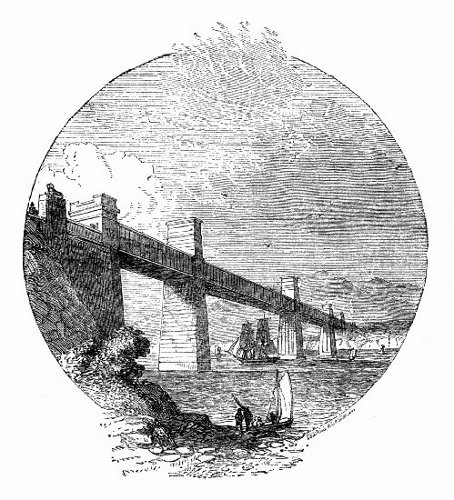
THE BRITANNIA TUBULAR BRIDGE.
This is one of the most remarkable structures in the world, the design of the celebrated architect, Sir R. Stephenson. This bridge is on the line of the Chester and Holyhead Railway, crossing the Menai Straits, within sight of Telford's Chain Suspension Bridge. It is made of cast iron of a tubular form, in the tube of which the railway passes. Four of these span the Strait, and are supported by piles of masonry; that on the Anglesea side is 143 feet 6 inches high, and from the front to the end of the wing walls is 173 feet. These wing walls terminate in pedestals, on which repose colossal lions of Egyptian character. The Anglesea pier is 196 feet high, 55 feet wide, and 32 feet long. In the middle of the Strait is the Britannia Rock, from which the bridge derives its name; on this the Britannia pier is raised. It is equi-distant from the Anglesea and Carnarvon piers, being 460 feet in the clear from each, and sustains the four ends of the four long tubes, which span the distance from shore to shore. There are two pairs of short and two of long tubes, the lengths of these pairs being 250 feet and 470 respectively. The Egyptian lions are 25 feet 6 inches long, 12 feet 6 inches high, 8 feet wide, and weigh 80 tons. Two thousand cubic feet of stone were required for each lion. The total quantity of stone in the bridge is 1,400,000 cubic feet. The weight of malleable iron in the tubes is 10,000 tons; of cast iron, 1,400 tons. The whole length of the entire bridge, measuring from the extreme front of the wing walls, is 1,833 feet, and its greatest elevation at Britannia pier, 240 feet above low-water-mark. The total cost of the structure is £601,865. This wonderful structure was begun April 13, 1846, and completed July 25, 1850; opened for traffic Oct. 21, 1850.
DAFFEY'S ELIXIR.
In the Postboy, Jan. 1, 1707-8, is the following curious advertisement:—"Daffey's famous Elixir Salutis by Catherine Daffey, daughter of Mr. Thomas Daffy, late rector of Redmile, in the valley of Belvoir, who imparted it to his kinsman, Mr. Anthony Daffy, who published the same to the benefit of the community and his own great advantage. The original receipt is now in my possession, left to me by my father. My own brother, Mr. Daniel Daffy, apothecary in Nottingham, made the Elixir from the said receipt, and sold it there during his life. Those who know it, will believe what I declare; and those who do not, may be convinced that I am no counterfeit, by the colour, taste, smell, and operation of my Elixir. To be had at the Hand and Pen, Maiden-Lane, Covent Garden."
JENNY'S WHIM.
"This was a tea garden, situated, after passing over a wooden bridge on the left, previous to entering the long avenue, the coach way to where Ranelagh once stood. This place was much frequented, from its novelty, being an inducement to allure the curious, by its amusing deceptions, particularly on their first appearance there. Here was a large garden, in different parts of which were recesses; and if treading on a spring, taking you by surprise, up started different figures, some ugly enough to frighten you—a harlequin, a Mother Shipton, or some terrific animal. In a large piece of water, facing the tea alcoves, large fish or mermaids, were showing themselves above the surface. This queer spectacle was first kept by a famous mechanist, who had been employed at one of the winter theatres, there being then two."—Angelo's Pic Nic or Table Talk, p. 106.
Horace Walpole, more than once alludes to this place of entertainment in his Letters; and in 1755 a 4to. satirical tract appeared entitled Jenny's Whim; or a Sure Guide to the Nobility, Gentry, and other Eminent Persons, in this Metropolis.
ANECDOTE RELATIVE TO THE MASKED EXECUTIONER OF CHARLES I.
It is universally known, that, at the execution of King Charles I., a man in a vizor performed the office of executioner. This circumstance has given rise to a variety of conjectures and accounts. In the Gentleman's Magazine for November, 1767, and January, 1768, are accounts of one William Walker, who is said to be the executioner. In the same magazine for June, 1784, it is supposed to be a Richard Brandon, of whom a long account is copied from an Exeter newspaper. But William Lilly, in his "History of his Life and Times," has the following remarkable passage:—"Many have curiously inquired who it was that cut off his [the king's] head: I have no permission to speak of such things: only thus much I say, he that did it is as valiant and resolute a man as lives, and one of a competent fortune." To clear up this passage, we shall present our readers with Lilly's examination (as related by himself) before the first parliament of King Charles II. in June, 1660.
"At my first appearance, many of the young members affronted me highly, and demanded several scurrilous questions. Mr. Weston held a paper before his mouth; bade me answer nobody but Mr. Prinn; I obeyed his command, and saved myself much trouble thereby, and when Mr. Prinn put any difficult or doubtful query unto me, Mr. Weston prompted me with a fit question. At last, after almost one hour's tugging, I desired to be fully heard what I could say as to the person that cut Charles I.'s head off. Liberty being given me to speak, I related what follows, viz.:—
"That the next Sunday but one after Charles I. was beheaded, Robert Spavin, Secretary to Lieutenant-General Cromwell at that time, invited himself to dine with me, and brought Anthony Pearson, and several others, along with him to dinner. That their principal discourse all dinner-time was only who it was that beheaded the king; one said it was the common hangman; another, Hugh Peters; others were also nominated; but none concluded. Robert Spavin, so soon as dinner was done, took me by the hand, and carried me to the south window: saith he. 'These are all mistaken; they have not named the man that did the fact; it was Lieutenant-Colonel Joice. I was in the room when he fitted himself for the work, stood behind him when he did it; when done, went in with him again. There is no man knows this but my master, viz., Cromwell, Commissary Ireton, and myself.'—'Doth Mr. Rushworth know it?' saith I.—'No, he doth not know it,' saith Spavin. The same thing Spavin since has often related to me when we were alone."
WHIPPING PRISONERS.
Mr. Ellesdon, Mayor of Lyme, in 1595, paid for—
s. d.
Four yards of canvas to make a coat to whip the rogues in 3 0
Making the same 0 6
Whipping of three of the ship boys for stealing of Mr. Hassard's salmon fish in the Cobb 1 0
(N.B.—Salmon was plentiful in the west at this epoch.)
The charge of fourpence made for whipping a boy continued for many years the same. The whipping of a woman who was a stranger was little more costly; but the inflicting such a punishment upon a townswoman was remunerated at a higher rate, as may well be supposed, from a consideration of several circumstances. To take a violent, noisy woman from her chamber, tie madam to the tumbrel and whip her round the town, was an undertaking that demanded assistance and protection to the official or hireling that wielded the thong. In the Town Accompt Book are found such entries as those which are given in illustration:—
s. d.
1625. For whipping William Wynter's boy 0 4
" Agnes Abbott twice 2 4
1644. Paid two soldiers to attend the whipping of a woman 2 6
Paid to whipping four women 4 0
THE INIQUITIES OF THE SLAVE TRADE.
We may form some idea of the temptations which the trade in human beings held out, even to people who held an honourable position in the world, from the fact that the captain of a frigate, within a few years before the slave trade was abolished, was known to purchase slaves in the West India market, have them entered as able seamen, and compel the artificers to teach them a trade; so that when the ship returned each was sold at a high rate as a valuable piece of property. The worst, however, has to be told. Upon sailing from Portsmouth, some of the best men were sent away upon duty in a ship's boat, in order that they might be returned "run," by which they lost pay and clothes, but made room for the negroes lately kidnapped, who were entered, though they did no work for the ship, as able seamen! We have all heard of a naval officer who had his pocket picked at a Westminster election, and who openly professed his vow, which he rigidly performed, of flogging every Londoner that joined his ship for this act. This, it is said, was no idle vow!
DISCOVERY OF THE BODY OF CANUTE THE GREAT.
In June 1766, some workmen who were repairing Winchester Cathedral discovered a monument, wherein was contained the body of King Canute. It was remarkably fresh, had a wreath round the head, and several other ornaments of gold and silver bands. On his finger was a ring, in which was set a large and remarkably fine stone; and in one of his hands a silver penny. Archæologia, vol. iii. The penny found in the hand is a singular instance of a continuance of the pagan custom of always providing the dead with money to pay Charon.
M.P.'S AND MAYORS PRIVATEERS.
William Morfote, who represented Winchelsea in Parliament in 1428, was a privateer with a hundred men under him. He found it necessary to obtain the king's pardon in 1435, by the advice of Parliament, there being a legal difficulty about his having broken prison at Dover Castle.
Two merchants of Sherborne in Dorsetshire were robbed of their cargo, worth £80, A.D. 1322, by Robert de Battyle. This transaction did not lose him the good opinion of his townsmen, who chose him Mayor of Winchelsea a few years later.
ALGERINE INVASION OF IRELAND.
The Algerines landed in Ireland in 1627, killed 50 persons, and carried off about 400 into slavery. One vessel captured by them was worth £260,000. They made purchases of stores and provisions they wanted in the western parts of Ireland by Baltimore, and in 1631 carried off 100 captives from that town. They landed their poor captives at Rochelle, and marched them in chains to Marseilles. Twenty-six children are said to have been carried off at one time from Cornwall. In 1633, Lord Wentworth, appointed lord deputy of Ireland, named noted pirate vessels off the coast of Ireland and their captures. Persons in their wills used to leave sums of money for redeeming well-known captives from bondage in Algiers and other places.
WILLIAM JOY, THE ENGLISH SAMPSON.
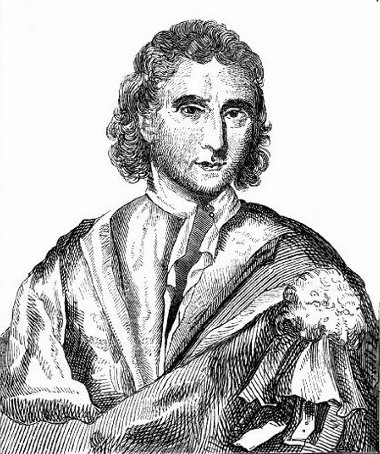
William Joy was a native of Kent, and born May 2, 1675, at St. Lawrence, a small village one mile from Ramsgate, in the Isle of Thanet. When very young, he distinguished himself among his juvenile companions and playmates, by his amazing superiority in strength, over any antagonist that dare to come in competition with his power, whether in play or earnest When about twenty-four years of age, he first began to exhibit in public his astonishing feats, in a display of personal prowess inferior to none but the Hebrew champion recorded in holy writ. Among many other of this man's extraordinary performances may be recorded:—1. A strong horse, urged by the whip to escape his powerful rein, is restrained and kept from escape solely by the check of his pull, aided by a strong rope, and this without any stay or support whatever. 2. Seated upon a stool, with his legs horizontally elevated, solely by muscular power, he jumps clearly from his seat. 3. To prove the agility and flexibility of his joints, he places a glass of wine on the sole of his foot, and, in an erect posture, without the least bending of his head or body, raises the glass to his mouth, and drinks the contents, turning his foot with both hands, to accommodate his draught. 4. Aided by a strong leather girdle, or belt, and supporting himself by pressing his arms on a railing, he lifts from the ground a stone of the enormous weight of 2,240 lbs. 5. A rope fastened to a wall, which had borne 3,500 lbs. weight, without giving way, is broke asunder by his amazing strength. The celebrity of this man attracted the curiosity of King William III., before whom he exhibited at Kensington Palace; likewise before George, Prince of Denmark, and his royal consort, the Princess, afterwards Queen Anne, and their son William, Duke of Gloucester, called the Hope of England. He also went through a regular course of performances at the Duke's Theatre, in Dorset-gardens, Salisbury-square, which was attended by the first nobility and gentry in the kingdom.
PRICE OF SHELL-FISH IN 1675.
A bill for shell-fish enables us to ascertain the prices paid in Charles II.'s reign for these delicacies. Mr. Walter Tucker, mayor of Lyme, Dorset, paid for the judges, for—
30 lobsters £1 10 0
6 crabs 0 6 0
100 scallops 0 5 0
300 oysters 0 4 0
50 oranges 0 2 0
— — —
£2 7 0
DISTRIBUTING HAND-BILLS.
The month of July 1736 afforded a singular popular explosion, contrived in the following strange manner:—A brown paper parcel, which had been placed unobserved near the side-bar of the Court of King's-bench, Westminster-hall, blew up during the solemn proceedings of the Courts of Justice assembled, and scattered a number of printed bills, giving notice, that on the last day of Term five Acts of Parliament would be publicly burnt in the hall, between the hours of twelve and one, at the Royal Exchange, and at St. Margaret's hill, which were the Gin Act, the Smuggling Act, the Mortmain Act, the Westminster Bridge Act, and the Act for borrowing 600,000l. on the Sinking fund.
One of the bills was immediately carried to the Grand Jury then sitting, who found it an infamous libel, and recommended the offering of a reward to discover the author.
RANZ DES VACHES.
The "Ranz des Vaches," which is commonly supposed to be a single air, stands in Switzerland for a class of melodies, the literal meaning of which is cow-rows. The German word is Kureihen—rows of cows. It derives its origin from the manner the cows march home along the Alpine paths at milking time. The shepherd goes before, keeping every straggler in its place by the tones of his horn, while the whole herd wind along in Indian file, obedient to the call. From its association it always creates home-sickness in a Swiss mountaineer, when he hears it in a foreign land. It is said, these melodies are prohibited in the Swiss regiments attached to the French army, because it produces so many desertions. One of the "Ranz des Vaches" brings back to his imagination his Alpine cottage—the green pasturage—the bleating of his mountain goats—the voices of the milkmaids, and all the sweetness and innocence of a pastoral life; till his heart turns with a sad yearning to the haunts of his childhood, and the spot of his early dreams and early happiness.
The Swiss retain their old fondness for rifle-shooting, and there is annually a grand rifle match at some of the large towns, made up of the best marksmen in all Switzerland. There are also yearly contests in wrestling, called Zwing Feste, the most distinguished wrestlers at which are from Unterwalden, Appenzel, and Berne.
MONSOONS.
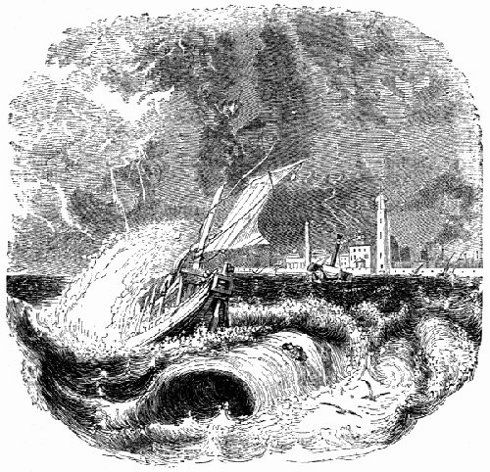
These are periodical winds which blow over the Indian Ocean, between Africa and Hindustan for nearly six months from the north-east, and during an equal period from the south-west. The region of the monsoons lies a little to the north of the northern border of the trade-winds, and they blow with the greatest force and with most regularity between the eastern coast of Africa and Hindustan. When the sun is in the southern hemisphere a north-east wind, and when it is in the northern hemisphere, a south-west wind blows over this sea. The north-east monsoon blows from November to March. It extends one or two degrees south of the equator. It becomes regular near the coasts of Africa sooner than in the middle of the sea, and near the equator sooner than in the vicinity of the coasts of Arabia. This wind brings rain on the eastern coasts of Africa. The south-west monsoon does not extend south of the equator, but usually begins a short distance north of it. It blows from the latter end of April to the middle of October. Along the coast of Africa, it appears at the end of March; but along the coast of Malabar, not before the middle of April; it ceases, however, sooner in the former than in the latter region. The rainy season on the west coast of Hindustan commences with the first approach of the south-west monsoon. The monsoons prevail also on the seas between Australia and China.
The effect of the struggle which precedes the change in the direction of the wind in this part of the world is thus described in "Forbes's Oriental Memoirs." The author was encamped with the English troops:
"The shades of evening approached as we reached the ground, and just as the encampment was completed, the atmosphere grew suddenly dark, the heat became oppressive, and an unusual stillness presaged the immediate setting-in of the monsoon. The whole appearance of external nature resembled those solemn preludes to earthquakes and hurricanes in the West Indies, from which the East in general is providentially free. We were allowed very little time for conjecture. In a few minutes the heavy clouds burst over us. I had witnessed seventeen monsoons in India, but this surpassed them all in its awful appearance and dreadful effects. Encamped in a low situation on the borders of a lake formed to collect the surrounding water, we found ourselves in a few hours in a liquid plain; tent-pins giving way in a loose soil—the tents fell down—and left the whole army exposed to the contending elements. It requires a lively imagination to conceive the situation of a hundred thousand human beings of every description, with more than two hundred thousand elephants, camels, horses, and oxen, suddenly overwhelmed by this dreadful storm in a strange country, without any knowledge of high or low ground, the whole being covered by an immense lake, and surrounded by thick darkness, which rendered it impossible for us to distinguish a single object except such as the vivid glare of the lightning occasionally displayed in horrible forms. No language can adequately describe the wreck of a large encampment thus instantaneously destroyed, and covered with water, amid the cries of old men and helpless women, terrified by the piercing shrieks of their expiring children, unable to afford them relief. During this dreadful night more than two hundred persons and three thousand cattle perished miserably, and the morning dawn exhibited a shocking spectacle!"
UNUSUAL LOCALITY FOR SAYING PRAYERS.
Francis Atkins was porter at the palace gate, at Salisbury, from the time of Bishop Burnet to the period of his death in 1761, at the age of 104 years. It was his office every night to wind up the clock, which he was capable of performing regularly till within a year of his decease, though on the summit of the palace. In ascending the lofty flight of stairs, he usually made a halt at a particular place and said his evening prayers. He lived a regular and temperate life, and took a great deal of exercise; he walked well, and carried his frame upright and well balanced to the last.
BILLY IN THE SALT BOX.
Political caricatures are generally well worth preserving, they familiarize us with the features and peculiarities of celebrated men, and they tell us what was the popular feeling of the day. We regret that in general they are too large for our pages, but now and then we meet with a small one which we are glad to present to our readers.
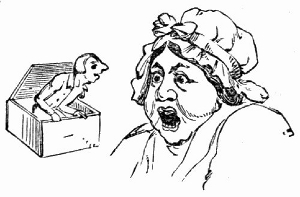
Mr. Pitt's budget of 1805 was not allowed to pass without severe remarks, and a heavily increased duty on salt excited general dissatisfaction. People said that the grand contriver of taxes had visited every corner of the house above stairs, and that he had now descended into the kitchen; and the annexed caricature, by Gilray, which was published at this period, represents the premier alarming the poor cook by popping his head out of the salt-box, with the unexpected salutation—"How do you do, cookey?" The person thus apostrophised cries out in consternation, "Curse the fellow, how he has frightened me!—I think, on my heart, he is getting in everywhere!—who the deuce would have thought of finding him in the salt-box?"
DANGEROUS FEAT.
An extraordinary instance of the rash feats which men with cool heads and courageous hearts will sometimes perform, was witnessed at Nottingham on January 22, 1789.—The vane at the top of St. Peter's spire, which was placed there in 1735, and measured thirty-three inches in length, having become insecure, the parish officers agreed with Mr. Robert Wooton, of Kegworth, to take it down and reinstate it.
This venturous man, henceforth known as "the steeple climber," commenced his undertaking by placing a ladder against the steeple, and securing it to the wall with tenters: he then mounted that with another on his shoulder, which he fastened above it in like manner; and so on till he reached the top. To prevent himself falling, he was girded round with belts, which he connected with the ladders by means of hooks. In this manner he replaced the vane and cock, and rebuilt four yards of the steeple.
The celerity with which the man placed the ladders was remarkable. He began to affix the first at eleven in the morning, and brought the vane down in triumph by two in the afternoon. The bells were then set a-ringing, the congregation of people became very great, and Wooton re-ascended the spire, to exhibit his daring. He extended himself on its summit, only thirteen inches in diameter, and spread out his arms and legs. He afterwards balanced himself on the uppermost stave of the top ladder, and for a quarter of an hour capered about in every imaginable posture, the admiring crowd beneath expecting momentarily to witness his descent in a manner much less agreeable than precipitate.
Subsequently, when his undertaking was accomplished, to excite admiration and obtain money, he again balanced himself on the apex of the spire, beat a drum, and drank a bottle of ale, in the sight of thousands of people, on a market-day; but the reprobation of the man's temerity so far preponderated over public approval, as in a considerable degree to diminish his expected reward.
POST-HASTE ONE HUNDRED YEARS AGO.
Glasgow is now within one minute of London; in the last century it was scarcely within a fortnight of it. It is a positive fact that when the post arrived there a hundred years ago, the firing of a gun announced its coming in. The members of the clubs who heard it tumbled out of bed, and rushed down to the club-room, where a tankard of hot herb ale, or a beverage which was a mixture of rum and sugar, was ready for them before breakfast. How forcibly do these things bring before us the size of Glasgow at that time, and the habits of its citizens.
EXECUTION OF ADMIRAL BYNG.
The horrid details of the execution of criminals are wholly unfitted for our pages, but Admiral Byng was not a criminal; his life was sacrificed to party spirit and party interests, and an account of his murder—for such it really was—is therefore highly interesting, as it enables us to see the dauntless manner in which a brave man can meet a dreadful fate, which he knew to be wholly undeserved. The execution took place on board the "St. George," man-of-war in Portsmouth harbour, on the 14th of March, 1757. The Admiral, accompanied by a clergyman who attended him during his confinement, and two gentlemen, his relations, walked out of the great cabin to the quarterdeck, where he suffered, on the larboard side, a few minutes before twelve o'clock. He was dressed in a light grey coat, white waistcoat, and white stockings, and a large white wig, and had in each hand a white handkerchief. He threw his hat on the deck, kneeled on a cushion, tied one handkerchief over his eyes, and dropped the other as a signal, on which a volley from six marines was fired, five of whose bullets went through him, and he was in an instant no more. The sixth went over his head. From his coming out of his cabin could not be two minutes till he fell motionless on his left side. He died with great resolution and composure, not showing the least sign of timidity. The Ramillies, the ship the admiral had in the Mediterranean, was riding at her moorings in the harbour, and about half an hour before he suffered, she broke her mooring chain, and only held by her bridle, which is looked on as a wonderful incident by people who do not consider the high wind at that time.
EXTRAORDINARY TREE.
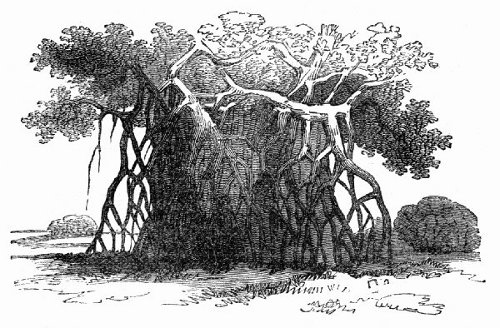
The Samoan group of islands in the South Sea lies between the latitudes of 13° 30' and 14° 30' S, and the longitudes of 168° and 173° W. In some of these islands there is a most remarkable tree which well deserves a place in our roll of extraordinary productions. It is a species of banyan (Ficus religiosa), and is called by the natives Ohwa. Our sketch gives a good idea of some of these trees. The pendant branches of many of them take root in the ground to the number of thousands, forming stems from an inch to two feet in diameter, uniting in the main trunk more than eighty feet above the ground, and supporting a vast system of horizontal branches, spreading like an umbrella over the tops of the other trees.
THE PLAGUE IN ENGLAND.
The Register of Ramsay, in Huntingdonshire, mentions 400 people who died there of the plague, in or about February 1665, and that it was introduced into the place by a gentleman, who first caught the infection by wearing a coat, the cloth of which came from London: the tailor who made the coat, with all his family, died, as did no less than the number above mentioned.
But the ravages made by the plague in London, about 1665, are well known: it was brought over from Holland, in some Levant goods, about the close of the year 1664: its progress was arrested, in a great degree, by a hard frost which set in in the winter; but as the spring of 1665 advanced, its virulence advanced. Infected houses were shut up and red crosses painted on the doors, with this inscription, "Lord have mercy upon us." Persons going to market took the meat off the hooks themselves, for their own security, and for the Butcher's, dropped their money into pans of vinegar; for it was supposed that even their provisions were tainted with the infection. In the months of August and September the greatest mortality occurred; for the deaths of one week have been estimated at 10,000! It may be supposed, that no great accuracy existed in the Registers, to afford a correct estimate; for, in the parish of Stepney, it is said they lost, within the year, 116 sextons, grave-diggers and their assistants; and, as the disorder advanced, the churchyards were incapable of holding more bodies, and large pits were therefore dug in several parts, to which the dead were brought by cartloads, collected by the ringing of a bell and the mournful cry of "Bring out your dead." Add to this, that these carts worked in the night, and no exact account was kept, as the clerks and sextons were averse to a duty exposing them to such dangerous consequences, and often carried off before such accounts as they had taken were delivered in. All the shops were shut up, grass grew in the most public streets, until about December 1665, when the plague abated, and the citizens who had left their abodes for the country, crowded back again to their residences. The computation is, that this horrible disease carried off 100,000 persons in London: it is singular, that the only parish quite exempt from infection was St. John the Evangelist, in Watling Street.
LANDSLIP AT COLEBROOK, SHROPSHIRE.
A most remarkable circumstance happened there in the morning of the 27th of May, 1773, about four o'clock. Near 4,000 yards from the river Severn stood a house, where a family dwelt; the man got up about three o'clock, heard a rumbling noise, and felt the ground shake under him, on which he called up his family. They perceived the ground begin to move, but knew not which way to run; however, they providentially and wonderfully escaped, by taking an immediate flight, for just as they got to an adjacent wood, the ground they had left separated from that on which they stood. They first observed a small crack in the ground about four or five inches wide, and a field that was sown with oats to heave up and roll about like waves of water; the trees moved as if blown with wind, but the air was calm and serene; the Severn (in which at that time was a considerable flood) was agitated very much, and the current seemed to run upwards. They perceived a great crack run very quick up the ground from the river. Immediately about thirty acres of land, with the hedges and trees standing (except a few that were overturned), moved with great force and swiftness towards the Severn, attended with great and uncommon noise, compared to a large flock of sheep running swiftly. That part of the land next the river was a small wood, less than two acres, in which grew twenty large oaks; a few of them were thrown down, and as many more were undermined and overturned; some left leaning, the rest upright, as if never disturbed. The wood was pushed with such velocity into the channel of the Severn (which at that time was remarkably deep), that it forced the waters up in columns a considerable height, like mighty fountains, and drove the bed of the river before it on the opposite shore, many feet above the surface of the water, where it lodged, as did one side of the wood; the current being instantly stopped, occasioned a great inundation above, and so sudden a fall below, that many fish were left on dry land, and several barges were heeled over, and when the stream came down were sunk, but none were damaged above. The river soon took its course over a large meadow that was opposite the small wood, and in three days wore a navigable channel through the meadow. A turnpike road was moved more than thirty yards from its former situation, and to all appearance rendered for ever impassable. A barn was carried about the same distance, and left as a heap of rubbish in a large chasm; the house received but little damage. A hedge that was joined to the garden was removed about fifty yards. A great part of the land was in confused heaps, full of cracks, from four inches to more than a yard wide. Several very long and deep chasms were formed in the upper part of the land, from about fourteen to upwards of thirty yards wide, in which were many pyramids of earth standing, with the green turf remaining on the tops of some of them. Hollows were raised into mounts, and mounts reduced into hollows. Less than a quarter of an hour completed this dreadful scene.
CURIOUS CUSTOM AT STRASBOURG.
At Strasbourg they show a large French horn, whose history is as follows:—About 400 years ago, the Jews formed a conspiracy to betray the city, and with this identical horn they intended to give the enemy notice when to attack.
The plot, however, was discovered; many of the Jews were burnt alive, the rest were plundered of their money and effects, and banished the town; and this horn is sounded twice every night from the battlements of the steeple in gratitude for the deliverance.
The Jews deny the fact of this story, except the murdering and pillaging their countrymen. They say the whole story is fabricated to furnish a pretext for these robberies and murders, and assert that the steeple of Strasbourg, as has been said of the Monument of London,—
"Like a tall bully lifts the head and lies."
DOWN AMONG THE DEAD MEN.
The following is an extraordinary instance of the recklessness of sailors when in the pursuit of what they call pleasure. In the year 1779, a Mr. Constable, of Woolwich, passing through the churchyard there at midnight, heard people singing jovially. At first he thought they were in the church, but the doors were locked, and it was all silent there:—on looking about he found some drunken sailors who had got into a large family vault, and were regaling with bread, cheese, tobacco, and strong beer. They belonged to the Robust, man of war, and having resolved to spend a jolly night on shore, had kept it up in a neighbouring alehouse till the landlord turned them out, and then they came here to finish their evening. They had opened some of the coffins in their dare-devil drunkenness and crammed the mouth of one of the bodies with bread, and cheese, and beer. Constable, with much difficulty, prevailed on them to return to the ship. In their way one fell down in the mud, and was suffocated, as much from drunkenness as the real danger. The comrades took him on their shoulders, and carried him back to sleep in company with the honest gentlemen with whom he had passed the evening.
CHAIR BROUGHT OVER TO AMERICA IN THE MAYFLOWER BY THE PILGRIM FATHERS.
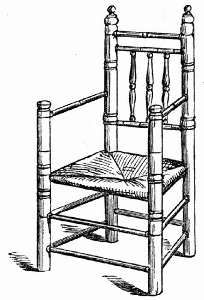
How frequently do we obtain, from the ordinary articles of domestic life which they were accustomed to use, a correct idea of the habits and tastes of whole communities which have long since passed away. A striking instance of this is the chair, of which the above is a correct sketch. It belonged to John Carver, who was one of the band of single-hearted men who constituted the Pilgrim Fathers, and who after first setting out from Holland, eventually sailed from Plymouth in England, in August, 1620. They landed in Cape Cod Harbour, New England, on the 9th of November following. Carver, was one of the chief spirits of the band, and the chair which we have sketched was one of his best articles of furniture, which he took with him in the Mayflower. He was elected the first governor of the community, and died in the year following his election. How forcibly does it show the simplicity of taste, and the freedom from pomp and vanity which characterised the devoted and fearless men who left their native shores, and sought "freedom to worship God" in a land to them unknown, that they should have selected as their first governor, an individual, the best chair in whose house was the homely article which we have here depicted.
A HARMLESS ECCENTRIC.
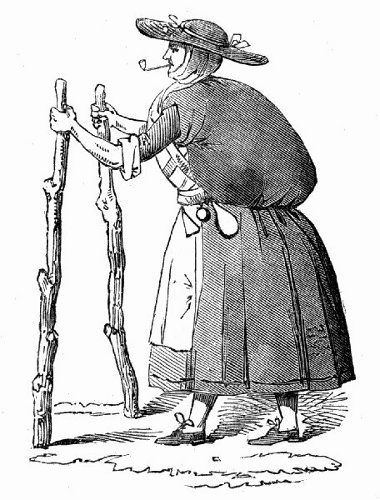
The annexed cut represents a singular character who was well known about the year 1790 in the southern part of the county of Cumberland. Her appearance is thus described by a correspondent of the Gentleman's Magazine of that date:—"Though I have seen her at various times, and frequently conversed with her, for these 20 years, I have never been able to learn any particulars respecting her family, friends, or name. The country people know her by the appellation of Jenny Darney, from the manner, I presume, in which she used to mend her clothes. Her present garb is entirely of her own manufacture. She collects the small parcels of wool which lie about the fields in sheep farms, spins it on a rock and spindle of her own making; and as she cannot find any other method of making the yarn into cloth, she knits it on wooden needles, and by that means procures a warm comfortable dress. In the lifetime of the late Charles Lutwidge, Esq., of Holm Rook, she took possession of an old cottage, or rather cow-house, on his estate, in which she has ever since been suffered to continue. Her intellects seem at certain times greatly deranged, but her actions are harmless, and her language inoffensive. On that score she is caressed by all the villagers, who supply her with eatables, &c., for money she utterly refuses. She seems a person in her lucid intervals, of much shrewdness, and her understanding is above the common level. This has also been improved by a tolerable education. Her appearance has been much the same for these 20 years, so that she must now be nearly 90 years of age; but of this, as well as her family and name, she is always silent. She seems to have chosen out the spot where she now lives, to pass the remainder of her days unknown to her friends, and in a great measure from a distaste of a wicked world, to 'prepare herself,' as she often in her quiet hours says, 'for a better.'"
THE RULING PASSION.
A remarkable instance of the irresistible strength of the ruling passion was to be seen a few years ago in a Londoner, who had kept are retail spirit-shop, and retired into the adjoining county when he had made a fortune, to enjoy himself. This man used to amuse himself by having one puncheon filled with water, and measuring it off by pints into another. There was also another retired cit who used every day to angle in his round wash-hand-basin sized fish-pond for gold-fish. One fish he knew, because it had once lost its eye in being caught—and he used to say "Confound that fellow, this is the fifth, sixth, &c., time that I have caught him this season." It used to provoke him.
INTERESTING REPORT WRITTEN BY SIR CHRISTOPHER WREN.
In the history of public buildings and monuments, it is always curious to note the original plans of those who designed them, and to mark the different proposals and suggestions which were taken into consideration. On this account our readers will no doubt be gratified by perusing the following Report of Sir Christopher Wren, on the ornament which it would, in his opinion, be most desirable to place on summit of the Monument, on Fish Street-hill. The Report was drawn up for the use of the Committee of City Lands:—
"In pursuance of an Order of the Comittee for City Landes, I doe heerwith offer the several designes which some monthes since I showed His Mtie. for his approbation; who was then pleased to thinke a large Ball of metall, gilt, would be most agreeable, in regard it would give an Ornament to the Town at a very great distance; not that His Mtie. disliked a statue; and if any proposall of this sort be more acceptable to the City, I shall most readily represent the same to His Mtie.
"I cannot but comend a large Statue, as carrying much dignitie with it, and that wch would be more valewable in the eyes of Forreiners and strangers. It hath been proposed to cast such a one in Brasse, of 12 foot high for £1,000. I hope (if it be allowed) wee may find those who will cast a figure for that mony of 15 foot high, wch will suit the greatnesse of the pillar, & is (as I take it) the largest at this day extant, and this would undoubtedly be the noblest finishing that can be found answerable to soe goodly a worke in all men's judgements.
"A Ball of Copper, 9 foot diameter, cast in severall peeces with the Flames and gilt, may well be don with the iron worke and fixing for 350lb., and this will be most acceptable of any thing inferior to a statue, by reason of the good appearance at distance, and because one may goe up into it, & upon occasion use it for fireworkes.
"A Phœnix was at first thought of, & is the ornament in the wooden modell of the pilar wch I caused to be made before it was begun; but upon second thoughtes I rejected it, because it will be costly, not easily understood at that highth, and worse understood at a distance, and lastly dangerous, by reason of the sayle, the spread winges will carry in the winds.
"The Belcony must be made of substantial well forged worke, there being noe need at that distance of filed worke, and I suppose (for I cannot exactly guesse the weight) it may be well performed and fixed according to a good designe for fourscore & ten poundes, including painting, All wch is humbly submitted to your consideration.
"July 28, 1675. "Chr. Wren."
CHANGE OF SEX.
Connected with the plumage of birds is an extraordinary problem which has baffled all research, and towards the solution of which not the slightest approach has been made. Among certain of the gallinaceous birds, and it has been observed in no other family, the females occasionally assume the male plumage. Among pheasants in a wild state, the hen thus metamorphosed, assumes with the livery a disposition to war with her own race, but in confinement she is spurned and buffeted by the rest. From what took place in a hen pheasant in the possession of a lady, a friend of the late Sir Joseph Banks, it would seem probable that this change arises from some alteration in the temperament at a late period of the animal's life. This lady had paid particular attention to the breeding of pheasants. One of the hens, after having produced several broods, moulted, and the succeeding feathers were exactly those of a cock. This animal never afterwards laid an egg. The pea-hen, has sometimes been known to take the plumage of the cock bird. Lady Tynte had a favourite pea-hen, which at eight several times produced chicks. Having moulted when about eleven years old, the lady and her family were astonished by her displaying the feathers peculiar to the other sex, and appearing like a pied peacock. In this process the tail, which was like that of the cock, first appeared. In the following year she moulted again, and produced similar feathers. In third year she did the same, and then had also spurs resembling those of the cock. The bird never bred after this change of her plumage.
TILBURY FORT.
The chief fame of Tilbury rests on the formation of the camp here, in the reign of Queen Elizabeth, to defend London against the Spanish invasion. Although it is unnecessary to recount the well-known circumstances which led to the formation of the Tilbury camp, it may not be out of place to give the famous speech of Queen Elizabeth on the occasion of her visit:—
"My loving People,—We have been persuaded by some that are careful of our safety, to take heed how we trust ourselves to armed multitudes for fear of treachery; but assure you I do not desire to live to distrust my faithful and loving people. Let tyrants fear. I have always so behaved myself that under God I have placed my chiefest strength and safeguard in the loyal hearts and goodwill of my subjects; and therefore I am come among you at this time, not as for my recreation or sport, but being resolved, in the midst and heat of the battle, to live or die amongst you all—to lay down for my God, and for my kingdom, and for my people, my honour and my blood even in the dust. I know that I have but the body of a weak and feeble woman, but I have the heart of a king, and a king of England too; and I think foul scorn that Parma or Spain, or any prince of Europe, should dare to invade the borders of my realms to which, rather than any dishonour shall grow by me, I will myself take up arms—I myself will be your general, judge, and rewarder of every one of your victories in the field."
The most full description of Elizabeth's reception at Tilbury is printed in a sort of doggrel poem, headed, "Elizabetha Triumphans, briefly, truly, and effectually set forth, declared, and handled by James Aske."
The poem mentions, that when about 20,000 well-appointed men had arrived at Tilbury, orders were sent to the various shires to cause the troops in each to remain until further notice; and so great was the desire to meet the enemy, that one thousand men of Dorsetshire offered £500 to be allowed to march to the camp at Tilbury.
The alarm of the Spanish invasion was, however, not the last to threaten the Londoners, and direct attention to Tilbury.
On the 8th of June, 1667, Ruyter, the Dutch admiral, sailed out of the Texel with fifty ships, and came to the mouth of the Thames, from whence he detached Vice-Admiral Van Ghent, with seventeen of his lightest ships and some fire-ships. Van Ghent in the same month sailed up the Medway, made himself master of the fort of Sheerness, and, after burning a magazine of stores to the value of £40,000, blew up the fortifications. This action alarmed the City of London; so that to prevent similar mischief, several ships were sunk, and a large chain put across the narrowest part of the Medway. But by means of an easterly wind and a strong tide, the Dutch ships broke through the chain, and sailed between the sunk vessels. They burnt three ships, and carried away with them the hull of the "Royal Charles," besides burning and damaging several others. After this they advanced as far as Upnor Castle, and burnt the "Royal Oak," the "Loyal London," and the "Great James." Fearing that the whole Dutch fleet would sail to London Bridge, the citizens caused thirteen ships to be sunk at Woolwich, and four at Blackwall, and platforms furnished with artillery to defend them were raised in several places. The consternation was very great, and the complaints were no less so. It was openly said the king, out of avarice, had kept the money so generously given to him to continue the war, and left his ships and subjects exposed to the insults of the enemy. After this exploit, Ruyter sailed to Portsmouth, with a design to burn the ships in that harbour; but finding them secured, he sailed to the west, and took some ships in Torbay. He then sailed eastward, beat the English force before Harwich, and chased a squadron of nineteen men-of-war, commanded by Sir Edward Spragg, who was obliged to retire into the Thames. In a word, he kept the coasts of England in a continual alarm all July, till he received news of the conclusion of peace.
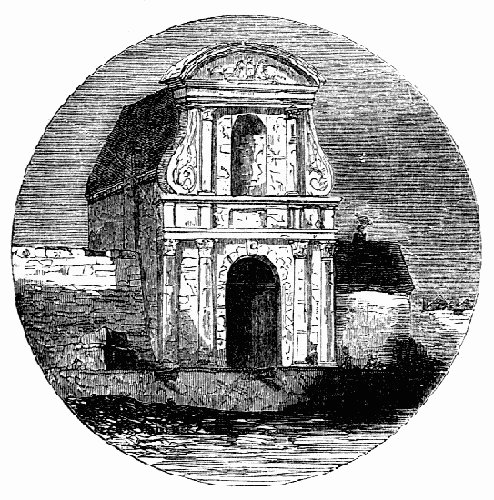
WATER-GATE OF TILBURY FORT.
This daring attack was no doubt the cause of Tilbury Fort being made to assume its present form. It is now a regular fortification, and may be justly looked upon as the key to the City of London. The plan of the building was laid out by Sir Martin Beckman, chief engineer to Charles II., who also designed the works at Sheerness. The foundation is laid upon piles driven down, two on end of each other, till they were assured they were below the channel of the river, and that the piles, which were pointed with iron, entered into the solid chalk rock. On the land side, the works are complete; the bastions are faced with brick. There is a double ditch, or moat, the innermost of which is 180 feet broad, with a good counterscarp, and a covered way marked out with ravelins and tenailles. There are some small brick redoubts; the chief strength, however, of this part of the fort consists in being able to lay the whole level under water, and, by that means, make it impossible for an enemy to carry on approaches that way. On the river side is a very strong curtain, with the picturesque water-gate shown in our engraving in the middle. Before this curtain is a platform, in the place of a counterscarp, on which are planted cannon of large size. These completely command the river, and would no doubt cripple the ships of an enemy attempting to pass in this direction. A few years ago there were placed on the platform 106 cannon, carrying from 24 to 46 pounds each, besides smaller ones planted between them. The bastions and curtains are also planted with guns.
The circular tower shown in the engraving was in existence in the time of Queen Elizabeth, and was called the Block-house.
RINGING THE CHANGES.
It is curious to note the number of changes which may be rung on different peals. The changes on seven bells are 5,040; on twelve 479,001,600, which it would take ninety-one years to ring at the rate of two strokes in a second. The changes on fourteen bells could not be rung through at the same rate in less than 16,575 years: and upon four-and-twenty, they would require more than 117,000 billions of years.
DISGRACEFUL STATE OF THE LONDON POLICE IN 1724.
That notorious burglar, Jack Sheppard, finished his disgraceful career at Tyburn in the year 1724, and we notice the event, not with the view of detailing the disgusting particulars of an execution, but because the outrages which were allowed to take place after the dreadful scene was over, exhibit in a striking light the miserable police regulations which existed at that period, and the manner in which the mob were allowed to have it nearly all their own way. The Sheriff's officers, aware of the person they had to contend with, thought it prudent to secure his hands on the morning of execution. This innovation produced the most violent resistance on Sheppard's part; and the operation was performed by force. They then proceeded to search him, and had reason to applaud their vigilance, for he had contrived to conceal a penknife in some part of his dress. The ceremony of his departure from our world passed without disorder; but, the instant the time expired for the suspension of the body, an undertaker, who had followed by his friends' desire with a hearse and attendants, would have conveyed it to St. Sepulchre's churchyard for interment; but the mob, conceiving that surgeons had employed this unfortunate man, proceeded to demolish the vehicle, and attack the sable dependants, who escaped with difficulty. They then seized the body, and, in the brutal manner common to those wretches, beat it from each to the other till it was covered with bruises and dirt, and till they reached Long-acre, where they deposited the miserable remains at a public-house called the Barley-mow. After it had rested there a few hours the populace entered into an enquiry why they had contributed their assistance in bringing Sheppard to Long-acre; when they discovered they were duped by a bailiff, who was actually employed by the surgeons; and that they had taken the corpse from a person really intending to bury it. The elucidation of their error exasperated them almost to phrensy, and a riot immediately commenced, which threatened the most serious consequences, The inhabitants applied to the police, and several magistrates attending, they were immediately convinced the civil power was insufficient to resist the torrent of malice ready to burst forth in acts of violence. They therefore sent to the Prince of Wales and the Savoy, requesting detachments of the guards; who arriving, the ringleaders were secured, the body was given to a person, a friend of Sheppard, and the mob dispersed to attend it to the grave at St. Martin's in the fields, where it was deposited in an elm coffin, at ten o'clock the same night, under a guard of soldiers, and with the ceremonies of the church.
A TRIUMPH OF ENERGY.
After the accession of Tippoo Saib to the throne of Mysore in 1782, the English made overtures for a termination of the war which had been commenced by his father; but flushed by the possession of a large army, a well-filled treasury, a passion for war, and an inordinate sense of his own importance, Tippoo refused all terms of pacification, and left the English no alternative but to battle against him as they could. Lord Macartney, who was at that time the Governor of Madras, on becoming acquainted with the determination of Tippoo, resolved to prosecute hostilities with the greatest vigour, and having placed Col. Fullerton at the head of his force, he provided him with an army, collected from various parts, of 16,000 good troops, and afforded that excellent officer all available assistance in carrying the war into Tippoo's territory. Fullerton laid his plans with considerable skill; he encouraged the natives to bring and sell provisions to him on his march, effectually checked devastation and plundering, scrupulously respected the religious opinions of the Hindus, consolidated and improved the mode of march, and availed himself of the subtle cunning and nimble feet of the natives to establish a remarkably complete courier-system, whereby he could receive and communicate intelligence with a rapidity never before attained by any European officer in India. He had to choose between two systems of strategy—either to march through the Mysore territory, and frustrate Tippoo in his siege of Mangalore; or boldly to attack Seringapatam, in order to compel Tippoo to leave Mangalore as a means of defending his own capital. The colonel decided on the adoption of the latter course, as promising more fruitful results. Being at Daraporam, 200 miles south of Seringapatam, Fullerton resolved to divert the route, and take a circuit nearer the western coast, where the capture of the strong fort of Palagatcherry would afford him a valuable intermediate depôt, commanding one of the chief roads from the Malabar to the Coromandel coasts. On the 18th of October he started. After capturing a few small forts, he ascended to high ground, where dense forests, deep ravines, and tortuous water courses embarrassed every yard of his progress: to fill up the ravines before he could drag his artillery over them, to throw trees across them where the depth was too great for filling up, to clear gaps through forests with the axe, to contend against tremendous rains—were only part of the difficulties he had to meet; but he met them like a skilful commander, reached Palagatcherry on the 5th of November, and captured the fort on the 15th, obtaining with it a welcome supply of money, grain, guns, powder, shot, and military stores. When the difficulties which Colonel Fullerton had to encounter, and the triumphant manner in which he overcame them, are taken into consideration, it will be readily admitted, we think, that his enterprise is well deserving of being recorded as a striking example of what may be accomplished by a union of professional skill and invincible energy. Our engraving represents one of the devices which Colonel Fullerton employed for the purpose of enabling his forces to pass over a mountain torrent.