TEN THOUSAND WONDERFUL THINGS. (continued 9)
Reading edition
John Cooke, by will, dated 12th September, 1662, gave to the churchwardens, &c., of St. Michael's, Crooked Lane, £76, to be laid out to the most profit and advantage, for various uses, and amongst them, for the maintenance of a lantern and candle, to be eight in the pound at least, to be kept and hanged out at the corner of St. Michael's Lane, next Thames Street, from Michaelmas to Lady-Day, between the hours of nine and ten o'clock at night, until the hours of four or five in the morning, for affording light to passengers going through Thames Street, or St. Michael's Lane.
EXTRAORDINARY INSTANCE OF CREDULITY.
To the honour of the lords of the creation, there are some husbands who so grieve at the death of their partners, that they will not part with them when actually dead; and even go so far as to wish, and try hard, for their resurrection; witness Sir John Pryse, of Newtown, Montgomeryshire, who married three wives, and kept the first two who died, in his room, one on each side of his bed; his third lady, however, declined the honour of his hand till her defunct rivals were committed to their proper place. Sir John was a gentleman of strange singularities. During the season of miracles worked by Bridget Bostock, of Cheshire, who healed all diseases by prayer, faith, and an embrocation of fasting spittle, multitudes resorted to her from all parts, and kept her salivary glands in full employ. Sir John, with a high spirit of enthusiasm, wrote to this wonderful woman to make him a visit at Newtown Hall, in order to restore to him his third and favourite wife (above mentioned), now dead. His letter will best tell the foundation on which he built his strange hope, and very uncommon request:—
Purport of Sir J. Pryse's letter to Mrs. Bridget Bostock, 1748.
Madam,—Having received information, by repeated advices, both public and private, that you have, of late, performed many wonderful cures, even where the best physicians have failed, and that the means used appeared to be very inadequate to the effects produced, I cannot but look upon you as an extraordinary and highly-favoured person; and why may not the same most merciful God, who enables you to restore sight to the blind, hearing to the deaf, and strength to the lame, also enable you to raise the dead to life? Now, having lately lost a wife, whom I most tenderly loved; my children an excellent step-mother, and our acquaintances a very dear and valuable friend, you will lay us all under the highest obligations; and I earnestly entreat you, for God Almighty's sake, that you will put up your petitions to the Throne of Grace, on our behalf, that the deceased may be restored to us, and the late dame Eleanor Pryse be raised from the dead. If your personal attendance appears to you to be necessary, I will send my coach and six, with proper servants, to wait on you hither, whenever you please to appoint. Recompense of any kind, that you could propose, would be made with the utmost gratitude; but I wish the bare mention of it is not offensive to both God and you.
I am, madam, your obedient, &c. John Pryse. (Pennant's Wales, vol. 3, p. 190.)
HIGH PRICE OF FISH IN LONDON.
It is on record that on January 4, 1809, there being only four cod-fish in Billingsgate, a fishmonger gave fourteen guineas for them, and salmon soon after was sold at a guinea a pound!
THE GREAT AQUEDUCT OF PONT DU GARD.
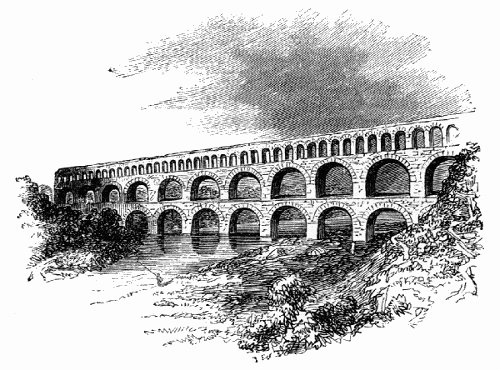
The remains of Roman aqueducts, of great extent and massiveness, occur in various parts of Europe, over which the Roman dominion once extended. Among these, the most celebrated are the Pont du Gard, near Nismes, in the Department du Gard, in the south of France; the aqueduct over the Moselle, near Metz; and the aqueduct of Segovia, in Old Castile. The Pont du Gard (of which we here give an engraving) was designed to convey the waters of the fountain of Aure to the town of Nismes, the ancient Nemausus. This aqueduct crosses the beautiful valley, and the stream of the river Gardon, uniting two steep hills, by which the valley is bounded at this place. It consists of two tiers of large arches, the lower of which are eighty feet in span, and a third tier of small arches, which support the trunk of the aqueduct. The channel for the water is above four feet wide, and five deep, and is lined with cement three inches thick, and covered with a thin coating of red clay. The whole work, with the exception of the above-mentioned channel for the water, is built without mortar or any other cement; and its elevation above the bed of the river Gardon, is not less than a hundred and fifty feet. The extremities of this splendid structure are in a dilapidated condition, but the remainder is in a very good state of preservation.
EXTRAORDINARY SITUATION FOR A TREE.
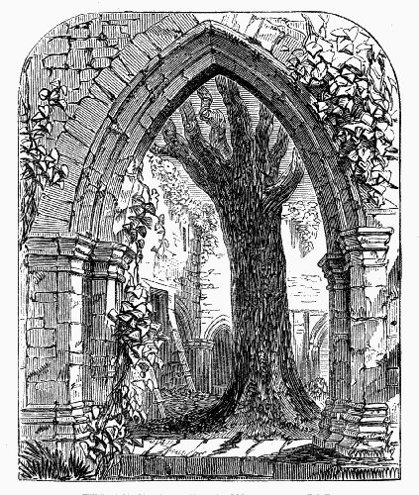
The Lower and Middle Lakes at Killarney are separated by a peninsula, upon which stands the ruin of the Abbey of Muckross, which was founded in 1440, and re-edified in 1602. The ruin, which consists of parts of the convent and church, is not remarkable either for extent, or for beauty of workmanship, but its preservation, seclusion, beauty of situation, and accompanying venerable trees, render it one of the most interesting abbey remains in Ireland. The entire length of the church is about 100 feet, its breadth 24. The cloister, which consists of twenty-two arches, ten of them semicircular, and twelve pointed, is the best preserved portion of the abbey. In the centre grows a magnificent yew-tree, as represented in our engraving, which covers as a roof the whole area; its circumference is thirteen feet, and its height in proportion. It is more than probable that the tree is coeval with the abbey, and that it was planted by the hands of the monks who first inhabited the building. It is believed by the common people that any person daring to pluck a branch, or in any way attempting to injure this tree, will not be alive on that day twelvemonth.
PRAYING BY MACHINERY.
Mr. Moorcroft informs us, in his "Journey to Lake Manasawara, in Undés, a province in Little Thibet," that the inhabitants used the following most extraordinary way of saying their prayers:—It is done by motion, which may be effected by the powers of steam, wind, or water. A large hollow cylinder, like a drum, is erected, within which is inclosed all the written prayers the people choose to offer, and then it is set going, by being whirled round its own axis; thus saving the trouble of repeating them. Mr. Turner, whose travels in Thibet are before the public, corroborates the account of these whirligigs. They are common, also, among the Monguls, the Calmucs, and the Kalkas; so that the engineers for these pious wheels must have a tolerably extensive trade, as this national mode of worship is naturally liable to wear out. But even this mode is innocence itself, compared with that of a set of savages, who pray people to death; for Lisiansky, in his Voyage round the World, gives us an account of an extra-religious sect, in the Sandwich Islands, who arrogate to themselves the power of praying people to death. Whosoever incurs their displeasure, receives notice that the homicide-litany is about to begin; and such are the effects of imagination, that the very notice is frequently sufficient, with these weak people, to produce the effect, or to drive them to acts of suicide.
TOPING IN THE LAST CENTURY.
At a Somersetshire hunt dinner, seventy years since, thirteen toasts used to be drunk in strong beer; then every one did as he liked. Some members of the hunt occasionally drank a glass of wine at the wind up, who were not themselves previously wound up. In country towns, after a dinner at one o'clock P.M., friends used to meet to discuss the local news over their glasses of strong beer, the merits of which furnished a daily theme. At Bampton one knot of gentlemen took four times the duration of the Trojan war, and even then failed to settle which of the party brewed the best beer.
A FINE OLD SOLDIER.
Jeremiah Atkins, of the Scar, near Bromyard, Herefordshire, died in 1796, aged 102. He had been a soldier through all the earlier periods of his manhood, and had seen much service; was present at the taking of Martinico, and at the Havannah; and, on one occasion, being taken prisoner by the Indians of North America, was very near being scalped, as he was only rescued at the moment they were about to perform the operation. He was likewise at the taking of Crown Point, in America, and in the battle of Fontenoy with the Duke of Cumberland, whom he also accompanied in his resistance to the advance of the Scotch rebels, being in several of the skirmishes and battles fought on that occasion. He afterwards went again to America, and took part in the storming of Quebec, when Wolfe was killed. The last battle in which he was engaged was that of Tournay, in Flanders. This extraordinary man retained the full use of all his natural faculties, save hearing, to the very close of his life.
POPULAR FALLACY OF THE VIRTUES OF A SEVENTH SON.
It is believed that a seventh son can cure diseases, but that a seventh son of a seventh son, and no female child born between, can cure the king's evil. Such a favoured individual is really looked on with veneration. An artist visiting Axminster in 1828, noticing the indulgence granted to one urchin in preference to others, and seeing something particular in this child, addressed his mother as follows:—"This little man appears to be a favourite: I presume he is your little Benjamin." "He's a seventh son, sir," said the mother. Affecting an air of surprise, I expressed myself at the instant as being one very anxious to know what a seventh son could do? The mother, a very civil woman, told me that "she did think, to cure all diseases, should be the seventh son of a seventh son; but many folk do come to touch my son." In April, 1826, a respectable looking woman was engaged in collecting a penny from each of thirty young women, unmarried; the money to be laid out in purchasing a silver ring, to cure her son of epileptic fits. The money was to be freely given, without any consideration, or else the charm would have been destroyed. The young women gave their pence, because it would have been a pity for the lad to continue afflicted if the charm would cure him.
SELF-NOURISHMENT.
That animals may sometimes be kept alive for a long time solely on nourishment supplied from their own bodies, is evident from the fact that after a great fall of earth on one occasion from the cliff at Dover, which buried a whole family, a hog was found alive five months and nine days after it had thus been buried! It weighed about seven score when the accident happened, and had wasted to about thirty pounds, but was likely to do well.
CHINESE METHOD OF FISHING.
There is nothing more extraordinary in the history of the different nations of the world than the ingenuity of the Chinese. They are the most handy people on the face of the earth, and the lower orders are just as clever as the higher. A proof of this may be seen at a fishing village which is contiguous to the town of Victoria, in Hong Kong. It remains in much the same state as that in which it existed prior to the British occupation of the island. Old worn-out boats, and torn mat-sails, bamboos and dried rushes,—these are the principal materials employed in the construction of their domiciles. The fishing boats are most ingeniously built. Each of these has a long projecting bamboo, which is rigged out from the stem in the form of a bowsprit, only working on a pivot. From the extremity of this outrigger, a strong rope communicates with a balance-board, that exactly poises the bamboo outrigger, when the net is immersed in water, and the fisherman has only to walk up and down this plank to raise the net and let it drop again in the water. But opposite to the island, and on many of the little insular rocks which constitute the "ten thousand isles," of which the emperor of China, amongst his vast pretensions to titles, lays claim to be lord, fishing is conducted on a larger scale, though worked upon the same principles. Huge poles are driven into the ground where the water is comparatively shallow, and leading ropes, which pass over a block-wheel inserted in the tops of these poles, communicate at one end with large circular nets, (constructed somewhat in the shape of a funnel, the upper rim being attached to floats, whilst from the centre are pendant weights,) the other end being fastened on shore to a balance plank, which the weight of one man suffices to work.
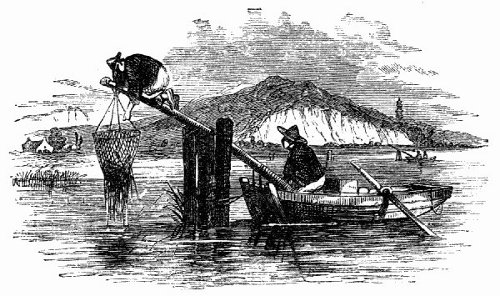
CHINESE METHOD OF FISHING.
MOSQUE OF OMAR.
The opposite engraving represents the Great Mosque at Jerusalem. It is built on the exact site of Solomon's Temple, and takes its name from its original founder, the Caliph Omar. It is a Turkish edifice, and is devoted to the worship of Mahomet.
Titus having taken Jerusalem in the second year of Vespasian's reign, not one stone was left upon another of that Temple where Christ had done such glorious things, and the destruction of which he had predicted. When the Caliph Omar took Jerusalem, in 636 A.D., it appears that the site of the Temple, with the exception of a very small part, had been abandoned by the Christians. Said-Eben-Batrick, an Arabian historian, relates that the Caliph applied to the Patriarch Sophronius, and enquired of him what would be the most proper place at Jerusalem for building a mosque. Sophronius conducted him to the ruins of Solomon's Temple. Omar, delighted with the opportunity of erecting a mosque on so celebrated a spot, caused the ground to be cleared, and the earth to be removed from a large rock, where God is said to have conversed with Jacob. From that rock the new mosque took its name of Gameat-el-Sakhra, and became almost as sacred an object to the Mussulmans, as the mosques of Mecca and Medina. The Caliph El-Oulid contributed still more to the embellishment of El-Sakhra, and covered it with a dome of copper, gilt, taken from a church at Balbeck. In the sequel, the crusaders converted the Temple of Mahomet into a sanctuary of Christ; but when Saladin re-took Jerusalem, he restored this edifice to its original use.
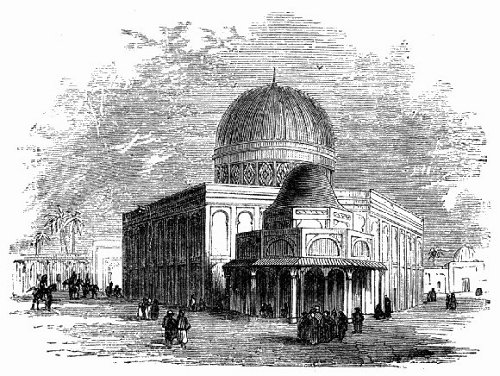
GREAT MOSQUE AT JERUSALEM.
The form is an octagon, either side being seventy feet in width; it is entered by four spacious doors, the walls are white below, intermingled with blue, adorned with pilasters, but above, it is faced with glazed tiles of various colours. The interior is described as paved with grey marble, the plain walls are covered with the same material in white. It contains many noble columns, in two tiers. The dome is painted, and gilt in arabesque, whence depend antique vessels of gold and silver; immediately beneath it stands a mass of limestone, reported to have fallen from heaven when the spirit of prophecy commenced. On this sat the destroying angel, during the slaughter caused by David's numbering the people. From this Mahomet ascended to heaven. Within the storied walls, moreover, are the scales for weighing the souls of men, the shield of Mahomet, and other relics, besides the entrance to the infernal regions; seventy thousand angels ever guard the precious stone.
Entrance to this hallowed edifice has been gained only by two or three Europeans; indeed, the Turks will not allow infidels to approach the sacred enclosure around it, which measures about sixteen hundred feet in length, by one thousand in width, and is adorned with fountains, orange, cypress, and other trees.
The mosque itself is esteemed the finest piece of Saracenic architecture in existence, far surpassing St. Sophia in beauty. Its view, combined with the distinguished monuments in the City of the Sultan, in Egypt, Greece, and Italy, strongly induces a belief in the accuracy of an able article in the Quarterly Review, in which the origin of the five predominant styles of architecture throughout the world, viz., the Byzantine, Chinese, Egyptian, Grecian, and Gothic are assigned respectively to the convex and concave curves, to the oblique, horizontal, and perpendicular lines.
A COUPLE OF ECCENTRICS.
Mr. Day, the eccentric founder of Fairlop fair, had a housekeeper, who had lived with him for thirty years, and was equally eccentric. She had two very strong attachments; one to her wedding-ring and garments, and the other to tea. When she died, Mr. Day would not permit her ring to be taken off; he said, "If that was attempted, she would come to life again;" and directed that she should be buried in her wedding-suit, and a pound of tea in each hand; and these directions were literally obeyed.
THE UNIVERSALITY OF TAXATION.
The following extract, from the Edinburgh Review, is not inappropriate to our pages, inasmuch as it is both a rare specimen of effective composition, and also serves to show us what the state of taxation was in England even within the last forty years.—Taxes upon every article which enters into the mouth, or covers the back, or is placed upon the feet—taxes upon every thing which it is pleasant to see, hear, feel, smell, or taste—taxes upon warmth, light, and locomotion—taxes on everything on earth, and the waters under the earth—on every thing that comes from abroad, or is grown at home—taxes on the raw material—taxes on every fresh value that is added to it by the industry of man—taxes on the sauce which pamper's man's appetite, and the drug that restores him to health—on the ermine which decorates the judge, and the rope which hangs the criminal—on the poor man's salt, and the rich man's spice—on the brass nails of the coffin, and the ribands of the bride at bed or board, couchant or levant, we must pay;—the schoolboy whips his taxed top—the beardless youth manages his taxed horse, with a taxed bridle, on a taxed road:—and the dying Englishman, pouring his medicine, which has paid seven per cent., into a spoon that has paid fifteen per cent., flings himself back upon his chintz bed, which has paid twenty-two per cent.—makes his will on an eight-pound stamp, and expires in the arms of an apothecary, who has paid a license of an hundred pounds for the privilege of putting him to death. His whole property is then immediately taxed from two to ten per cent. Besides the probate, large fees are demanded for burying him in the chancel; his virtues are handed down to posterity on taxed markle; and he is then gathered to his fathers—to be taxed no more.
SHAM PROPHETS.
William Hackett, a fanatic of the sixteenth century, after a very ill life, turned prophet, and signified the desolation of England. He prophesied at York and at Lincoln; where, for his boldness, he was whipped publicly, and condemned to be banished. He had an extraordinary fluency of speech, and much assurance in his prayers; for he said, that if all England should pray for rain, and he should pray to the contrary, it should not rain. Hackett had two brother-prophets joined with him, Edward Coppinger, named the prophet of mercy, and Henry Arthington, the prophet of judgment. Coppinger, the merciful prophet, declared that Hackett was the sole monarch of Europe; and at length they proclaimed him, July 16, 1592. On the 28th of the same month, however, the monarch of the whole earth, who had also personated divinity, was hanged and quartered. Coppinger famished himself in prison, and Arthington was pardoned. Fitz Simon relates, that in a quarrel Hackett had at Oundle, "He threw down his adversary, and bit off his nose; and, instead of returning it to the surgeon, who pretended to set it on again, while the wound was fresh, ate it." Hackett, on the scaffold, made a blasphemous prayer, which is recorded by Fitz Simon and Camden, too horrid to be repeated. He hated Queen Elizabeth, and tried to deprive her of her crown; he confessed to the judges that he had stabbed the effigies of this princess to the heart, with an iron pin; and a little before he was hanged, being an accomplished swearer, he cursed her with all manner of imprecations.
HOOKING A BOY INSTEAD OF A FISH.
About five and thirty years ago, as Mr. George Moor was fishing in the river Tyne at Pipewellgate, Gateshead, he espied something in the water which seemed like a drowned dog, but the day being clear, and the sun shining, he thought he perceived a face, upon which he threw his line to it (which had but three hairs at the hook) and hooked a coat, by which he found it was a boy, but the hook loosing hold, he again cast his line and struck him in the temple and drew him to the shore, and in less than quarter of an hour he revived.
CHILDREN OF AGED PARENTS.
Margaret Krasiowna, of the village of Koninia, Poland, died 1763, aged 108. The following extraordinary circumstances are stated, by Eaton, as connected with the life of this woman:—"At the age of ninety-four she married her third husband, Gaspard Raycolt, of the village of Ciwouszin, then aged one hundred and five. During the fourteen years they lived together she brought him two boys and a girl; and, what is very remarkable, these three children, from their very birth, bore evident marks of the old age of their parents—their hair being grey, and a vacuity appearing in their gums, like that which is occasioned by the loss of teeth, though they never had any. They had not strength enough, even as they grew up, to chew solid food, but lived on bread and vegetables, they were of a proper size for their age, but their backs were bent, their complexions sallow, with all the other external symptoms of decrepitude. Though most of these particulars," he adds, "may appear fabulous, they are certified by the parish registers. The village of Ciwouszin is in the district of Stenzick, in the palatinate of Sendonier. Gaspard Raycolt, the father, died soon after, aged 119."
SEPULCHRAL VASE FROM PERU.
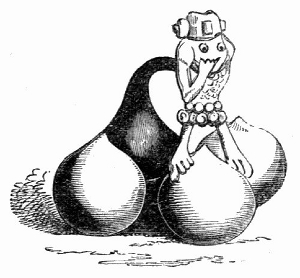
The vessel of which the annexed is an engraving, was taken from the tomb of one of the ancient inhabitants of Peru; the subjects of the Incas, or princes who ruled over that country before it was conquered by the Spaniards. Vases of this sort were probably placed in the sepulchres of the Peruvians to contain the ashes of the dead, or offerings to their disembodied spirits;—usages which are familiar to us through the frequent allusions to them which we meet with in the works of the poets of ancient Rome, and the discovery of urns and lachrymatories in Roman tombs which have been in our own and other cemeteries. The specimen which we have engraved is quadruple, but forms one vessel.
FIRST IRON CANNON.
The first cannon was cast in Sussex in 1535. In after years bonds were taken in £1,000 from the owners of the charcoal furnaces, that none should be sold till a license for the sale or issue of the ordnance had been procured. Fears were entertained that the enemy would purchase them.
PROLIFIC AUTHOR.
No one need despair, after the following instance, of shining in quantity, if not in quality:—"Hans Sacks was a Nuremberg shoemaker, born there in 1494; he was instructed, by the master-singers of those days, in the praiseworthy art of poetry; he, therefore, continued to make verses and shoes, and plays and pumps, boots and books, until the seventy-seventh year of his age; when he took an inventory of his poetical stock in trade, and found, according to his narrative, that his works filled thirty folio volumes, all written with his own hand; and consisted of four thousand two hundred mastership songs, two hundred and eight comedies, tragedies, and farces (some of which were extended to seven acts), one thousand seven hundred fables, tales, and miscellaneous poems, and seventy-three devotional, military, and love songs; making a sum total of six thousand and forty-eight pieces, great and small." Out of these, we are informed, he culled as many as filled three massy folios, which were published in the year 1558-61; and, another edition being called for, he increased this three volumes folio abridgement of his works, in the second, from his other works. None but Lope de Vega exceeded him in quantity of rhyme-making.
THE ART OF POTTERY IN CHINA.
The Chinese traditions carry back the practice of the potter's art to a very remote epoch. Father Entrecolles, a French missionary, resided in China at the beginning of the last century, and his letters published in Paris, in 1741, supply some curious and interesting information on this subject. Writing in 1712, he says that at that time ancient porcelain was very highly prized, and bore large prices. Articles were extant which were reputed to have belonged to the Emperors Yao and Chun, two of the most ancient mentioned in the Chinese annals. Yao reigned in 2357 and Chun in 2255 before Christ. Other authorities place the reign of Chun in 2600 before Christ. It appears from the researches of M. Stanislaus Julian that, from the time of the Emperor Hoang-ti, who reigned 2698 to 2599 before Christ, there had always existed a public officer bearing the title of the Intendant of Pottery, and that it was under the reign of Hoang-ti that the potter's art was invented by Kouen-ou. It is also certain that porcelain, or fine pottery, was common in China in the time of the Emperors Han, 163 B.C.
In digging the foundations of the palaces, erected by the dynasties of Han and Thang, from 163 B.C. to 903 A.D. great quantities of ancient vases were found which were of a pure whiteness, but exhibited little beauty of form or fabrication. It was only under the dynasty of Song, that is to say, from 960 to 1278 A.D., that Chinese porcelain began to attain a high degree of perfection.
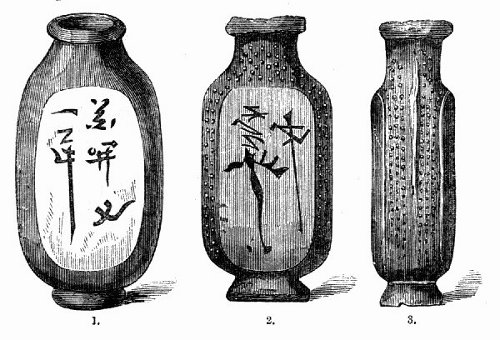
Further evidence of the antiquity of the potter's art in China, as well as of the existence of intercommunication between that country and Egypt, is supplied by the discoveries of Rossellina, Wilkinson, and others, who found numerous vases of Chinese fabrication, and bearing Chinese inscriptions, in the tombs at Thebes. Professor Rossellini found a small vase of Chinese porcelain with a painting of a flower on one side, and on the other Chinese characters not differing much from those used at the present day. The tomb was of the time of the Pharaohs, a little later than the eighteenth dynasty.
This vase, with its Chinese inscription, is represented in Fig. 1, from an exact cast made by Mr. Francis Davis.
Another of the Chinese vases, found in the Theban tombs, is represented in Fig. 2. This is preserved in the Museum of the Louvre. The shape of the vase is that of a flat-sided flask. A side view is given in Fig. 3.
These flasks are very small. The engravings represent them of their proper dimensions. Mr. Wilkinson thinks it probable that they were brought to Egypt from India, the Egyptians having had commercial relations with that country at a very remote epoch, and that they came not as pieces of porcelain, but as vessels containing some articles of importation.
STRONG ATTACHMENT TO SMOKING.
The following is a curious case of extreme fondness for smoking in a very poor and very old man. In the year 1810, there died in Dartford workhouse, aged 106, one John Gibson. He had been an inmate of the house for ten years, and till within two months of his death used daily to perambulate the town. His faculties were entire to the last. He was so much attached to smoking, that he requested his pipe, together with his walking-stick, might be placed in his coffin, which request was complied with.
EXTRAORDINARY LETTER.
The following strange and curious epistle, we are assured, was sent to a surgeon of eminence by a malefactor who had been sentenced to death. It has a degree of character and quaintness about it which is rarely found in the letters of convicts. Whether or not the surgeon complied with his request we do not know.
"Sir,—Being informed that you are the only surgeon in this county, in the habit of dissecting dead bodies—being very poor, I am desirous of passing what remains to me of life, with as much comfort as my unhappy condition admits of. In all probability I shall be executed in the course of a month; having no friend to intercede for me, nor even to afford me a morsel of bread, to keep body and soul together till the fatal moment arrives, I beg you will favour me with a visit; I am desirous of disposing of my body, which is healthy and sound, for a moderate sum of money. It shall be delivered to you on demand, being persuaded that on the day of general resurrection, I shall as readily find it in your laboratory, as if it were deposited in a tomb. Your speedy answer will much oblige your obedient servant,
James Brown."
A MATTRESS FOR A BANK.
In the month of April, 1822, Mrs. Motley, broker, Bedford-street, North Shields, purchased an old mattress for 2s. from a shipowner, who was going to reside with his daughter; in arranging some papers a few days ago, he found a document in the hand-writing of his deceased wife, not intended for his perusal, but that of her son by a former husband, in which it was stated that property to a considerable amount was deposited in the said mattress. His daughter in consequence waited on Mrs. Motley, and offered her a few shillings to return it. Mrs. M. naturally supposed that this seeming generosity was not without a cause, but having sold it to a Mrs. Hill for 3s., for a small consideration she regained possession of the prize, but on entering her house the original proprietor and a constable were ready to receive her, and without ceremony cut open the mattress, when a purse, said to contain 100gs., two gloves filled with current silver coin, several valuable rings, trinkets, silver spoons, &c., were discovered. Mrs. Hill had considerably reduced the mattress to fit a small bedstead without finding the hidden treasure.
ARCHITECTURE FOR EARTHQUAKES.
Sumatra is one of the largest islands in the Indian Archipelago, and the houses of the inhabitants are deserving of notice, inasmuch as they furnish a correct and curious specimen of the style of building, which the frequent occurrence of earthquakes renders the safest in the countries where such visitations are common.
The frames of the houses are of wood, the under-plates resting on pillars six or eight feet high, which have a sort of capital, but no base, and are wider at top than at bottom. The people appear to have no idea of architecture as a science, though much ingenuity is often shown in working up their materials. The general appearance of their houses is accurately represented in the annexed plate. For the floorings they lay whole bamboos, four or five inches in diameter, close to each other, and fasten them at the ends to the timbers. Across these are laid laths of split bamboo, about an inch wide and of the length of the room, which are tied down with filaments of the rattan, and over these are usually spread mats of different kinds. This sort of flooring has an elasticity alarming to strangers when they first tread on it.
The sides of the houses are generally closed in with bamboo, opened and rendered flat by notching or splitting the circular joints on the outside, chipping away the corresponding divisions within, and laying it to dry in the sun pressed down with weights. This is sometimes nailed to the upright timbers or bamboos, but in the country parts it is more commonly interwoven or matted in breadths of six inches, and a piece or sheet formed at once of the size required. In some places they use for the same purpose the inner bark procured from some particular trees. When they prepare to take it, the outer bark is first torn or cut away; the inner is then marked out with a proper tool to the requisite size, usually three cubits by one; it is afterwards beaten for some time with a heavy stick to loosen it from the stem, and being peeled off, laid in the sun to dry, care being taken to prevent its warping. The bark used in building has nearly the texture and hardness of wood; but the pliable and delicate bark of which clothing is made is procured from a bastard species of the bread-fruit.
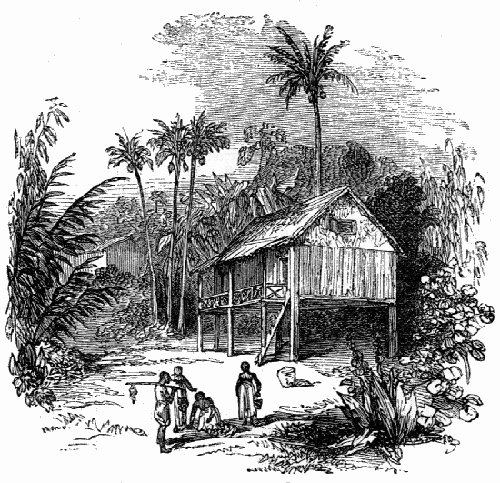
The most general mode of covering houses is with the leaf of a kind of palm called nipah. These, before they are laid on, are formed into sheets about five feet long, and as deep as the length of the leaf will admit, which is doubled at one end over a slip or lath of bamboo. They are then disposed on the roof so that one sheet shall lap over the other, and are tied to the bamboos which serve for rafters.
THE NOSS IN SHETLAND.
Off Bressay is the most remarkable of the rock phenomena of Shetland, the Noss, a small high island, with a flat summit, girt on all sides by perpendicular walls of rock. It is only 500 feet in length, and 170 broad, and rises abruptly from the sea to the height of 160 feet. The communication with the coast of Bressay is maintained by strong ropes stretched across, along which a cradle or wooden chair is run, in which the passenger is seated. It is of a size sufficient for conveying across a man and a sheep at a time. The purpose of this strange contrivance is to give the tenant the benefit of putting a few sheep upon the Holm, the top of which is level, and affords good pasture. The animals are transported in the cradle, one at a time, a shepherd holding them upon his knees in crossing.
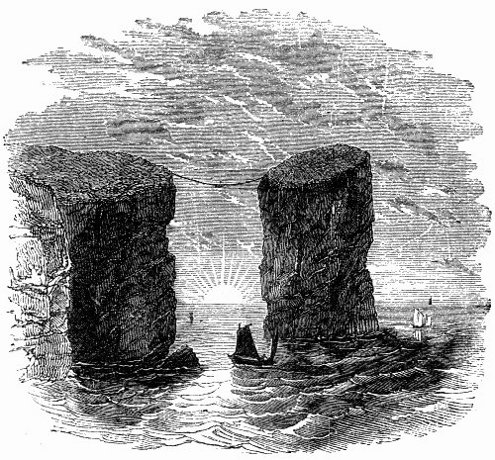
CRADLE OF NOSS.
The temptation of getting access to the numberless eggs and young of the sea-fowl which whiten the surface of the Holm, joined to the promised reward of a cow, induced a hardy and adventurous fowler, about two centuries ago, to scale the cliff of the Holm, and establish a connexion by ropes with the neighbouring main island. Having driven two stakes into the rock and fastened his ropes, the desperate man was entreated to avail himself of the communication thus established in returning across the gulf. But this he refused to do, and in attempting to descend the way he had climbed, he fell, and perished by his foolhardiness.
SWALLOWED UP BY AN EARTHQUAKE AND THROWN OUT AGAIN.
A tombstone in the island of Jamaica has the following inscription:—
"Here lieth the body of Lewis Galdy, Esq., who died on the 22nd of September, 1737, aged 80. He was born at Montpellier, in France, which place he left for his religion, and settled on this island, where, in the great earthquake, 1672, he was swallowed up, and by the wonderful providence of God, by a second shock was thrown out into the sea, where he continued swimming until he was taken up by a boat, and thus miraculously preserved. He afterwards lived in great reputation, and died universally lamented."
CUSTOMS OF THE BORDER BETWEEN ENGLAND AND SCOTLAND.
In the courts held by the lords wardens of the Marches, a jury was established: the English lord chose six out of Scotland, and the Scotch six out of England. The defendant, upon the trials, was acquitted upon his own oath; these oaths are singular: we transcribe them.—1. Juror's Oath. You shall clean no bills worthy to be fouled: you shall foul no bills worthy to be cleaned; but shall do that which appeareth with truth, for the maintenance of truth, and suppressing of attempts. So help you God.—2. Plaintiff's Oath. You shall leile (little) price make, and truth say, what your goods were worth at the time of their taking, to have been bought and sold in the market, taken all at one time, and that you know no other recovery but this. So help you God.—3. Defendant's Oath. You shall swear, by heaven above you, hell beneath you, by your part in Paradise, by all that God made in six days and seven nights, and by God himself, you are whart and sackless, of art, part, way, witting, ridd, kenning, having, or reciting, of any of the goods and chattles named in this bill. So help you God. These oaths and proceedings arose from the frequent incursions of both Scotch and English, on both sides the wall, to where they had no right.
TURKISH MODE OF REPARATION.
On April 25th, 1769, at Constantinople, the Turks were removing the standard of Mahomet, making a grand procession through the city; all Christians, upon this occasion, were forbid to appear in the streets or at their windows. But the wife and daughter of the Imperial minister, being excited by curiosity, placed themselves at a secret window to observe the procession; which was no sooner discovered by the Turks, than they attacked the ambassador's house, and endeavoured to force an entrance. But the servants of the minister opposing them, well-armed, a dreadful fray ensued, in which no less than one hundred persons lost their lives, and the ambassador's lady was very severely treated. Some of the rioters dragged her down into the court-yard, and made preparations to strangle her; when a party of Janissaries, who were despatched to her assistance by an aga in the neighbourhood, happily came and preserved her. Upon complaint being made of this outrage, by her husband, to the grand vizier, that minister expressed great sorrow for the insult that had been offered, and assured him he should have all the reparation it was possible to procure. A few hours after the vizier sent the Imperial minister a rich present of jewels for his lady, and a bag, which was found to contain the heads of the three principal rioters.
HAIR TURNED GREY BY FRIGHT.
There is an interesting anecdote of a boy, in one of the rudest parts of the County of Clare, in Ireland, who, in order to destroy some eaglets, lodged in a hole one hundred feet from the summit of a rock, which rose four hundred feet perpendicular from the sea, caused himself to be suspended by a rope, with a scimitar in his hand for his defence, should he meet with an attack from the old ones; which precaution was found necessary; for no sooner had his companions lowered him to the nest, than one of the old eagles made at him with great fury, at which he struck, but, unfortunately missing his aim, nearly cut through the rope that supported him. Describing his horrible situation to his comrades, they cautiously and safely drew him up; when it was found that his hair, which a quarter of an hour before was a dark auburn, was changed to grey.
MEMORABLE SNOW-STORM.
The following characteristic account is taken literatim from the parish register of the village of Youlgrave in Derbyshire:—"This year 1614-5 Jan. 16 began the greatest snow which ever fell uppon the earth, within man's memorye. It cover'd the earth five quarters deep uppon the playne. And for heapes or drifts of snow, they were very deep, so that passengers, both horse and foot, passed over yates hedges and walles. It fell at ten severall tymes, and the last was the greatest, to the greate admiration and fear of all the land, for it came from the foure pts of the world, so that all c'ntryes were full, yea, the south p'te as well as these mountaynes. It continued by daily encreasing until the 12th day of March, (without the sight of any earth, eyther uppon hilles or valleys) uppon wch daye, being the Lordes day, it began to decrease; and so by little and little consumed and wasted away, till the eight and twentyth day of May, for then all the heapes or drifts of snow were consumed, except one uppon Kinder-Scout, wch lay till Witson week."
ROADS IN 1780.
A squire from the neighbourhood of Glastonbury, journeying to Sarum in his carriage, about 1780, took care that his footman was provided with a good axe to lop off any branches of trees that might obstruct the progress of the vehicle.
WONDERFUL PEDESTRIAN FEAT.
Captain Cochrane, who set out from St. Petersburg in May, 1820, to walk through the interior of Russia to the east of Asia, with a view of ascertaining the fact of a north-east cape, travelled at the rate of forty-three miles a day for one hundred and twenty-three successive days. He afterwards walked upwards of four hundred miles without meeting a human being. Wherever he went he seems to have accommodated himself to the habits of the people, however rude and disgusting. With the Kalmucks, he ate horse-flesh, elks, and wolves; and with the Tchutski he found as little difficulty in pasturing upon bears, rein-deer, and raw frozen fish, the latter of which he considered a great delicacy.
BOOK-SHAPED WATCH.
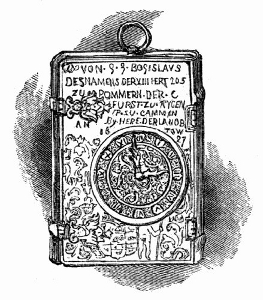
The unique curiosity, of which the annexed is an accurate representation, was one of the choicest rarities of the Bernal collection, and is, therefore, highly appropriate to our pages. It once belonged to, and was made for, Bogislaus XIV., Duke of Pomerania, in the time of Gustavus Adolphus. On the dial-side there is an engraved inscription of the Duke and his titles, with the date 1627, and the engraving of his armorial bearings; on the back of the case there are engraved two male portraits, buildings, &c.; the dial-plate is of silver, chased in relief; the insides are chased with birds and foliage. This watch has apparently two separate movements, and a large bell; at the back, over the bell, the metal is ornamentally pierced in a circle, with a dragon and other devices, and the sides are pierced and engraved in scrolls. It bears the maker's name, "Dionistus Hessichti."
THE RULING PASSION.
Mr. Henry Stribling, farmer, who died at Goodleigh, near Barnstaple, August 1st, 1800, in the eightieth year of his age, was one of the greatest fox-hunters in Devonshire, and had collected such a number of foxes pads, all of which he had himself cut off when in at the death, that they entirely covered his stable door and door-posts. At his own particular request, a pad was placed in each of his hands in his coffin, and he was attended to the grave by the huntsmen and whippers-in of the packs with which he had hunted.
EDICTS AGAINST FIDDLERS.
An idea may be formed of the strictness with which all popular amusements were prohibited when the Puritans had the ascendancy, from the fact that in 1656-7 Oliver Cromwell prohibited all persons called fiddlers or minstrels from playing, fiddling, or making music in any inn, alehouse, or tavern, &c. If they proffered themselves or offered to make music, they were to be adjudged to be rogues, vagabonds, and sturdy vagabonds, and were to be proceeded against as such.
SCENE OF DESOLATION.
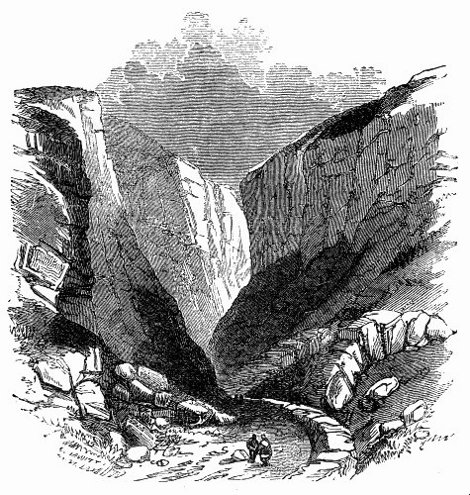
The pass of Keim-an-eigh is one of the numerous wonders of nature. It is situated on the road from Macroom to Bantry, in the county of Cork, and winds through a deep and narrow rocky defile, about two English miles in length. Its name means, in Irish, "The Path of the Deer." Perhaps, in no part of the kingdom, is there to be found a place so utterly desolate and gloomy. A mountain has been divided by some convulsion of nature, and the narrow pass is overhung on either side, as seen in our engraving, by perpendicular cliffs clothed in wild ivy and underwood, with, occasionally, a stunted yew-tree or arbutus growing among them. At every step advance seems impossible—some huge rock jutting out into the path, or sweeping round it, seeming to conduct only to some barrier still more insurmountable; while from all sides rush down the "wild fountains," and forming for themselves a rugged channel, make their way onward, the first tributary to the gentle and fruitful Lee. Nowhere has Nature assumed a more apalling aspect, or manifested a more stern resolve to dwell in her own loneliness and grandeur, undisturbed by any living thing; for even the birds seem to shun a solitude so awful, and the hum of bee or chirp of grasshopper is never heard within its precincts.
THE FIRST ENGLISH NUN.
Face, widow of Edwin, king of Northumberland, is said to have been the first English nun; and the first nunnery in England appears to have been at Barking, in Essex, which was founded by Erkenwald, Bishop of London, wherein he placed a number of Benedictine or black nuns. The most rigid nuns are those of St. Clara, of the order of St. Francis, both of which individuals were born and lived in the same town: the nuns are called poor Clares, and both they and the monks wear grey clothes. Abbesses had formerly seats in parliament. In one, held in 694, says Spelman, they sat and deliberated, and several of them subscribed the decrees made in it. They sat, says Ingulphus, in a parliament held in 855. In the reigns of Henry III. and Edward I. four of them were summoned to a national council, viz. those of Shaftesbury, Barking, Winchester, and Wilton.
PRESENCE OF MIND—ESCAPE FROM A TIGER.
In 1812, a party of British naval and military officers were dining in a jungle at some distance from Madras, when a ferocious tiger rushed in among them, seized a young midshipman, and flung him across his back. In the first emotion of terror, the other officers had all snatched up their arms, and retired some paces from their assailant, who stood lashing his sides with his tail, as if doubtful whether he should seize more prey, or retire with that which he had already secured. They knew that it is usual with the tiger, before he seizes his prey, to deprive it of life, by a pat on the head, which generally breaks the skull; but this is not his invariable practice. The little midshipman lay motionless on the back of his enemy; but yet the officers, who were uncertain whether he had received the mortal pat or not, were afraid to fire, lest they should kill him together with the tiger. While in this state of suspense, they perceived the hand of the youth gently move over the side of the animal, and conceiving the motion to result from the convulsive throbs of death, they were about to fire, when, to their utter astonishment, the tiger dropped stone dead; and their young friend sprung from the carcass, waving in triumph a bloody dirk drawn from the heart, for which he had been feeling with the utmost coolness and circumspection, when the motion of his hand had been taken for a dying spasm.
COST OF ARTICLES IN THE FOURTEENTH CENTURY.
The following article is taken from Martin's History of Thetford. It is copied from an original record in that borough, when John le Forester was mayor, in the tenth year of Edward the Third, A.D. 1336. It is so far curious, as it exhibits an authentic account of the value of many articles at that time; being a bill, inserted in the town book, of the expenses attending the sending two light-horsemen from Thetford to the army, which was to march against the Scots that year.
£ s. d.
To two men chosen to go into the army against Scotland 1 0 0
For cloth, and to the tailor for making it into two gowns 0 6 11
For two pair of gloves, and a stick or staff 0 0 2
For two horses 1 15 0½
For shoeing these horses 0 0 4
For two pair of boots for the light-horsemen 0 2 8
Paid to a lad for going with the mayor to Lenn (Lynn), to take care of the horses (the distance between Thetford and Lynn is 53 miles) 0 0 3
To a boy for a letter at Lenn (viz., carrying it thither) 0 0 3
Expenses for the horses of two light-horsemen for four days before they departed 0 1 0
LAW AND ORDER IN THE STREETS OF LONDON IN 1733.
What an extraordinary state of things does the following extract from the Weekly Register of December 8th, 1733, disclose! The stages and hackney-coaches actually made open war upon private carriages. "The drivers," says the paragraph, "are commissioned by their masters to annoy, sink, and destroy all the single and double horse-chaises they can conveniently meet with, or overtake in their way, without regard to the lives or limbs of the persons who travel in them. What havoc these industrious sons of blood and wounds have made within twenty miles of London in the compass of a summer's season, is best known by the articles of accidents in the newspapers: the miserable shrieks of women and children not being sufficient to deter the villains from doing what they call their duty to their masters; for besides their daily or weekly wages, they have an extraordinary stated allowance for every chaise they can reverse, ditch, or bring by the road, as the term or phrase is." Verily, we who live in the present day have reason to rejoice that in some things there is a decided improvement upon "the good old times."
NEVER SLEEPING IN A BED.
Christopher Pivett, of the city of York, died 1796, aged 93. He was a carver and gilder by trade; but during the early part of his life served in the army, and was in the retinue of the Duke of Cumberland, under whose command he took part in the battle of Fontenoy, as he did at the battle of Dettingen under the Earl of Stair; he was likewise at the siege of Carlisle, and the great fight of Culloden. His house, after he had settled at York, being accidentally burnt down, he formed the singular resolution of never again sleeping in a bed, lest he should be burned to death whilst asleep, or not have time sufficient, should such a misfortune again befall him, to remove his property; and this resolution he rigidly acted upon during the last forty years of his life. His practice was to repose upon the floor, or on two chairs, or sitting in a chair, but always with his clothes on. During the whole of this period he lived entirely alone, cooked his own victuals, and seldom admitted any one into his habitation: nor would he ever disclose to any the place of his birth, or to whom he was related. He had many singularities, but possessed, politically as well as socially, a laudable spirit of independence, which he boldly manifested on several trying occasions. Among other uncommon articles which composed the furniture of his dwelling, was a human skull, which he left strict injunctions should be interred with him.
AMULET BROTCHE.
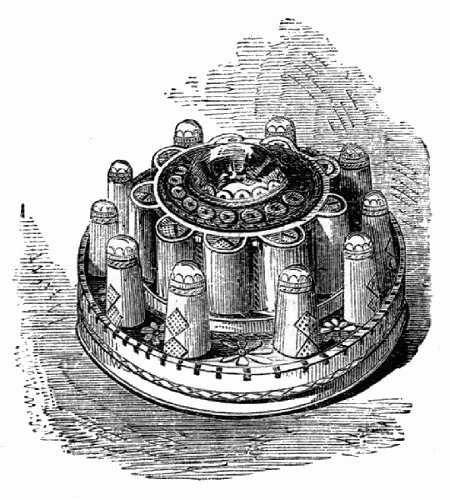
The subjoined engraving represents an ancient Gaelic Brotche, which was made in the reign of Queen Elizabeth, and once belonged to a Highland Chief, Maclean of Lochbuy in the Isle of Mull, being formed of silver found on his estate. It is of circular form, scolloped, and surrounded by small upright obelisks, each set with a pearl at top; in the centre is a round crystalline ball, considered a magical gem; the top may be taken off, showing a hollow, originally for reliques. On the reverse side of the brotche are engraved the names of the three kings of Cologne, with the word consummation. It was probably a consecrated brotche, and worn not only for the purpose of fastening the dress, but as an amulet.
THE GOLYNOS OAK.
This wonderful tree grew on the estate from which it takes its name, about four miles from Newport, Monmouth. It was purchased by Thomas Harrison, Esq., in the year 1810, for 100 guineas, and was felled and converted by him the same year. Five men were twenty days stripping and cutting it down; and a pair of sawyers were employed 138 days in its conversion. The expense of stripping, felling, and sawing was £82. The trunk of the tree was 9½ feet in diameter, and no saw could be found long enough to cut it down; two saws were therefore brazed together. The rings in its butt being reckoned, it was discovered that this tree had been improving upwards of 400 years! and, as many of its lateral branches were dead, and some broken off, it is presumed it must have stood a century after it had attained maturity. When standing it overspread 452 square yards of ground, and produced 2,426 feet of timber. When all its parts were brought to market they produced nearly £600.
CARFAX CONDUIT.
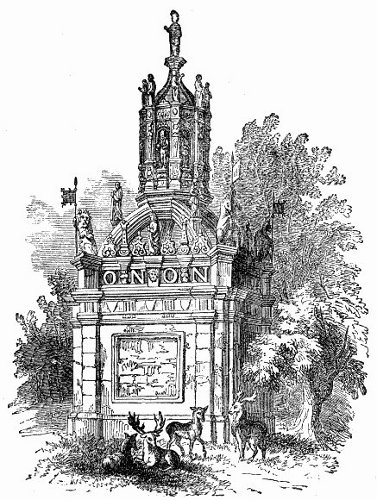
In the grounds at Nuneham Courtenay, near Oxford, belonging to Mr. Harcourt, on one of the slopes that ascend directly from the river Thames, stands the ancient and far-famed Carfax Conduit, which formerly stood as a kind of central point to the four principal streets of Oxford. Certain alterations requiring its removal, it was, with the most perfect propriety, presented to the Earl Harcourt.
It was built in 1610, by Otho Nicholson—a liberal and enterprising gentleman—in order to supply the city with pure water, brought from a hill above North Hinksey; and although the conduit is removed, the pipes still remain, and afford a partial supply that will be superseded by the new City Waterworks. It is a square, decorated in accordance with the taste of the time—mermaids holding combs and mirrors, and dragons, antelopes, unicorns, being scattered about, while the Empress Maude is introduced riding an ox over a ford, in allusion to the name of the city. The letters O. N., the initials of the founder, are conspicuous; while above the centres of the four arches are the cardinal virtues—Justice, Temperance, Fortitude, and Prudence.
Carfax is from a Bishop of that name, who presided over the diocese of Tours in France, and died in the year 399. He was canonized, and is the tutelar saint of Carfax, or St. Martin's church, in the city of Oxford.
DESTRUCTION OF LIBRARIES IN THE TIME OF HENRY VIII., AT THE DISSOLUTION OF THE MONASTERIES.
It is a circumstance well known, to every one at all conversant in English history, that the suppression of the lesser monasteries by that rapacious monarch Henry the Eighth took place in 1536. Bishop Fisher, when the abolition was first proposed in the convocation, strenuously opposed it, and told his brethren that this was fairly shewing the king how he might come at the great monasteries. "And so my lords," continued he, "if you grant the king these smaller monasteries, you do but make him a handle whereby he may cut down all the cedars within your Lebanon." Fisher's fears were borne out by the subsequent act of Henry, who, after quelling a civil commotion occasioned by the suppression of the lesser monasteries, immediately abolished the remainder, and in the whole suppressed six hundred and forty-five monasteries, of which twenty-eight had abbots who enjoyed seats in Parliament. Ninety colleges were demolished; two thousand three hundred and seventy-four charities and free chapels, and one hundred and ten hospitals. The havoc that was made among the libraries cannot be better described than in the words of Bayle, Bishop of Ossory, in the preface to Leland's "New Year's Gift to King Henry the Eighth."
"A greate nombre of them whyche purchased those superstychouse mansyons (monesteries) reserved of those librarye bookes, some to serve theyr jokes, some to scoure thyr candlestyckes, and some to rubbe theyr bootes. Some they solde to the grossers and sope-sellers, and some they sent over see to the book bynders, not in small nombre, but at tymes whole shyppes full to the wonderynge of foren nacyons: yea ye universytes of thys realme are not alle clere in this detestable fact, but cursed is that bellye whych seketh to be fedde with suche ungodlye gaynes, and so depelye shameth hys natural conterye. I knowe a merchant manne whyche shall at thys tyme be namelesse, that boughte ye contentes of two noble lybraryes for forty shyllinges pryce: a shame it is to be spoken: Thys stuffe hath he occupyed in the stede of grey paper by the space of more than these ten yeares and yet he hath store ynoughe for as manye yeares to come. A prodygyouse example is thys to be abhorred of all men whych love thyr nacyon as they shoulde do. The monkes kept them undre dust, ye ydle headed prestes regarded them not, theyr latter owners have most shamefully abused them, and ye covetouse merchantes have solde them awaye into foren nacyons for moneye."
CURIOUS MENTAL AFFECTION.
Singular faculties have been developed during somnambulism in the mental condition. Thus a case is related of a woman in the Edinburgh infirmary who, during her paroxysm, not only mimicked the manner of the attendant physicians, but repeated correctly some of their prescriptions in Latin.
Dr. Dyce, of Aberdeen, describes the case of a girl, in which this affection began with fits of somnolency, which came upon her suddenly during the day, and from which she could at first be roused by shaking or by being taken into the open air. During these attacks she was in the habit of talking of things that seemed to pass before her like a dream, and was not at the time sensible of anything that was said to her. On one occasion she repeated the entire of the baptismal service, and concluded with an extempore prayer. In her subsequent paroxysms she began to understand what was said to her, and to answer with a considerable degree of consistency, though these replies were in a certain measure influenced by her hallucination. She also became capable of following her usual employment during her paroxysm. At one time she would lay out the table for breakfast, and repeatedly dress herself and the children, her eyes remaining shut the whole time. The remarkable circumstance was now discovered, that, during the paroxysm, she had a distinct recollection of what had taken place in former attacks, though she had not the slightest recollection of it during the intervals. She was taken to church during the paroxysm, and attended the service with apparent devotion, and at one time was so affected by the sermon that she actually shed tears; yet in the interval she had no recollection whatever of the circumstance, but in the following paroxysm she gave a most distinct account of it, and actually repeated the passage of the sermon that had so much affected her. This sort of somnambulism, relating distinctly to two periods, has been called, perhaps erroneously, a state of double consciousness.
This girl described the paroxysm as coming on with a dimness of sight and a noise in the head. During the attack, her eyelids were generally half shut, and frequently resembled those of a person labouring under amaurosis, the pupil dilated and insensible. Her looks were dull and vacant, and she often mistook the person who was speaking to her. The paroxysms usually lasted an hour, but she often could be roused from them. She then yawned and stretched herself like a person awakening from sleep, and instantly recognised those about her. At one time, Dr. Dyce affirms, she read distinctly a portion of a book presented to her, and she would frequently sing pieces of music more correctly and with better taste than when awake.
DECORATIVE DRINKING VESSEL.
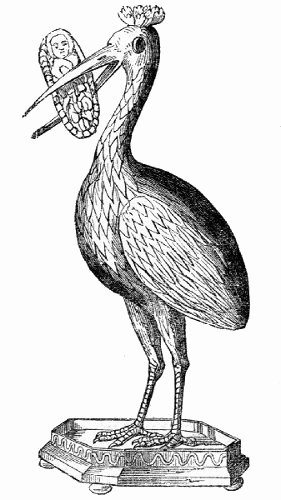
The above represents a German decorative drinking vessel of the early part of the seventeenth century. It is a stork bearing in its beak an infant; in accordance with the old German nursery tale that the king of the Storks is the bringer and protector of babies. It is of silver, chased all over; the eyes are formed of rubies; and one wing takes off that liquid may be placed in the body, and imbibed through the neck, by a hole in the crown of the bird. It was probably a quaint fancy for some German noble nursery.
EXAMPLES OF ANCIENT VASES.
The Vases which are grouped in the annexed engraving are highly deserving of a place in our collection of curiosities, inasmuch as they are truly unique and beautiful specimens of the degree of perfection to which the art of glass-making had been carried at the period when Rome was mistress of the world. They all belong to that period, and in elegance of form and skill of workmanship they equal—we had almost said, surpass, the most artistic productions of the present day.
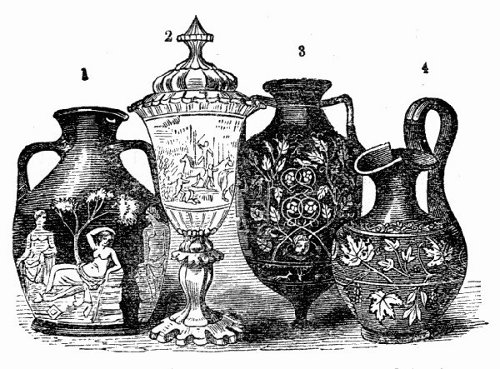
Figure 1 is that celebrated vase which for more than two centuries was the principal ornament of the Barberini palace at Rome. It was thence generally known as the "Barberini Vase;" but having been purchased by Sir W. Hamilton, and then sold by him to the Duchess of Portland, it was at her death munificently presented by her son, the Duke of Portland, to the British Museum, where it has ever since remained as one of its choicest gems, and is now known as the "Portland Cinerary Vase." It was found about the middle of the sixteenth century, enclosed in a marble sarcophagus, within a sepulchral chamber under the Monte del Grane, two miles and a half from Rome, on the road to Frascati. The tomb is believed to have been that of the Emperor Alexander Severus, and his mother Mammæa. The vase is made of purple glass, ornamented with white opaque figures in bas-relief. The execution of the design is most admirable. In the first place, the artist must have had the aptitude to blow in purple glass a beautiful form of vase, with handles attached: and, even thus far, this is considered in our day a masterpiece of skill at our best glass-houses. Secondly, with the oxide of tin forming an opaque white glass, the artist managed to cover the whole of the purple vase with this white opaque glass, to at least the thickness of a quarter of an inch. The artist then, in the manner of cutting a cameo on the onyx stone, cut the opaque glass away, leaving the white figures and allegory embossed upon the purple. The figures in relief are in two groups: in the former of these, a female is represented in a recumbent posture, with a cupid hovering above her head, and a serpent in her lap; a young man on one side supporting her stretched out arm, and on the other a bearded personage of more mature age, attentively regarding her. The latter group, on the opposite side of the vase, consists of a female reclining on a pile of tablets, with her right hand placed on her head, and holding in her hand a lighted torch with the flame downwards—a young man being seated on a pile on one side of her, and a female, holding a rod or staff in the right hand, sitting on the other. The subject of the bas-relief has created much difference of opinion, but it is generally supposed to have reference to the birth of Severus. A few years ago this vase was broken by a madman, but it has since been repaired in a most artistic manner.
Figure 2 is the "Alexandrian Vase," of the Museo Borbonico, Naples.
Figure 3 is the "Pompeii Vase," also of the Museo Borbonico. It was discovered in a sepulchre of Pompeii in 1839, and is of the same character in the colours and quality of the glass as the Portland Vase, but of a more recent date. It is probably the production of Greek artists working in Rome.
Figure 4 is the "Aldjo Vase," which was found in 1833 at Pompeii, in the house of the Fauna. The ground of the vase is of a deep sapphire blue, on which, in opaque white glass, the ornaments are cut. It was found broken. Part is in the possession of Mr. Auldjo; the other in the British Museum. The shape of this vase is elegant, the handle and lip of exquisite form, and the taste and execution of the ornamental work in the purest style.
MINUTENESS OF INSECT LIFE.
As the telescope enables the eye of man to penetrate into far-distant space, and reveals to him myriads of suns and systems which otherwise would have remained for ever hidden from his natural sight, so the microscope opens up a world of life everywhere around us, but altogether unsuspected, astounding us as much by the inappreciable minuteness of its discoveries, as the former by the stupendous magnitude and remoteness of the objects. If we go to any ditch or pool which the summer sun has covered with a mantle of stagnant greenness, and lift from it a minute drop of water, such as would adhere to the head of a pin, we shall find it, under a high magnifying power, swarming with living beings, moving about with great rapidity, and approaching or avoiding each other with evident perception and will.
"Vain would it be," observes Professor Jones, "to attempt by words to give anything like a definite notion of the minuteness of some of these multitudinous races. Let me ask the reader to divide an inch into 22,000 parts, and appreciate mentally the value of each division: having done so, and not till then, shall we have a standard sufficiently minute to enable us to measure the microscopic beings upon the consideration of which we are now entering. Neither is it easy to give the student of nature, who has not accurately investigated the subject for himself, adequate conceptions relative to the numbers in which the Infusoria sometimes crowd the waters they frequent; but let him take his microscope, and the means of making a rough estimate, at least, are easily at his disposal. He will soon perceive that the animalcule-inhabitants of a drop of putrid water, possessing, as many of them do, dimensions not larger than the 2,000th part of a line, swim so closely together, that the intervals separating them are not greater than their own bodies. The matter, therefore, becomes a question for arithmetic to solve, and we will pause to make the calculation.
"The Monas termo, for example—a creature that might be pardonably regarded as an embodiment of the mathematical point, almost literally without either length, or breadth, or thickness—has been calculated to measure about the 22,000th part of an inch in its transverse diameter; and in water taken from the surface of many putrid infusions, they are crowded as closely as we have stated above. We may therefore safely say, that, swimming at ordinary distances apart, 10,000 of them would be contained in a linear space one inch in length, and consequently a cubic inch of such water will thus contain more living and active organized beings than there are human inhabitants upon the whole surface! However astounding such a fact may seem when first enunciated, none is more easily demonstrated with the assistance of a good microscope."
The term Infusoria has been by some naturalists applied to these diminutive animals, because they are invariably found in the infusions of vegetable or animal substances. They can thus be obtained at all times, by simply steeping a little hay, or chaff, or leaves or stems of any plant, in a vessel of water, and placing the infusion in the sun for a week or ten days.
LEGENDS OF JUDAS ISCARIOT.
It was believed in Pier della Valle's time, that the descendants of Judas Iscariot still existed at Corfu, though the persons who suffered this imputation stoutly denied the truth of the genealogy.
When the ceremony of washing the feet is performed in the Greek Church at Smyrna, the bishop represents Christ, and the twelve apostles are acted by as many priests. He who personates Judas must be paid for it, and such is the feeling of the people, that whoever accepts this odious part, commonly retains the name of Judas for life (Hasselquist, p. 43).
Judas serves in Brazil for a Guy Faux to be carried about by the boys, and made the subject of an auto-da-fe. The Spanish sailors hang him at the yard arm. It is not long since a Spaniard lost his life at Portsmouth, during the performance of this ceremony, by jumping overboard after the figure.
The Armenians, who believe hell and limbo to be the same place, say that Judas, after having betrayed our Lord, resolved to hang himself, because he knew Christ was to go to limbo, and deliver all the souls which he found there, and therefore he thought to get there in time. But the Devil was cunninger than he, and knowing his intent, held him over limbo till the Lord had passed through, and then let him fall plum into hell. (Thevenot.)
QUEEN ELIZABETH'S SIDE-SADDLE.
In a retired part of the county of Essex, at a short distance from the road, in a secluded and lovely spot, stands the picturesque residence called Horeham Hall. The mansion is in the parish of Thaxted, and is about two miles south-west of the church. It was once in the possession of the important family of the De Wauton's; it afterwards belonged to Sir John Cutts, and eventually it became the property of Sir W. Smijth, of Hill Hall, in whose family it has remained up to the present time.
Of the learned Sir Thomas Smijth, the secretary to King Edward VI. and Queen Elizabeth, there is still preserved an ancient portrait on panel, which is let into a circle over the carved fire-place of one of the parlours. It is remarkable as being one of the very few portraits painted by Titian.
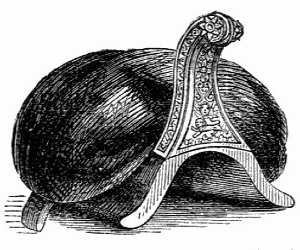
Another interesting relic is represented in the annexed cut. It is preserved in the Great Hall, and is the side-saddle of Queen Elizabeth; the pommel is of wrought metal, and has been gilt; the ornament upon it is in the then fashionable style of the Renaissance; the seat of velvet is now in a very ruinous condition; but it is carefully kept beneath a glass case, as a memento of the Queen's visits to this place. When princess, Elizabeth retired to Horeham as a place of refuge during the reign of her sister Mary; the loveliness of the situation and its distance from the metropolis rendered it a seclusion befitting the quietude of one anxious to remain unnoticed in troublous times. A room on the first floor in the square tower is shown as that in which Queen Elizabeth resided. She found the retirement of Horeham so agreeable, that often after she had succeeded to the throne she took a pleasure in re-visiting the place.
THE WINFARTHING OAK, IN NORFOLK.
A writer in the "Gardener's Magazine" gives the following account of this remarkable tree:—"Of its age I regret to be unable to give any correct data. It is said to have been called the 'Old Oak' at the time of William the Conqueror, but upon what authority I could never learn. Nevertheless, the thing is not impossible, if the speculations of certain writers on the age of trees be at all correct. Mr. South, in one of his letters to the Bath Society (vol. x.) calculates that an oak tree forty-seven feet in circumference cannot be less than fifteen hundred years old; and Mr. Marsham calculated the Bentley Oak, from its girting thirty-four feet, to be of the same age. Now, an inscription on a brass plate affixed to the Winfarthing Oak gives us the following as its dimensions:—'This oak, in circumference, at the extremities of the roots, is seventy feet; in the middle, forty feet, 1820.' Now, I see no reason, if the size of the rind is to be any criterion of age, why the Winfarthing should not, at least, equal the Bentley oak; and if so, it would be upwards of seven hundred years old at the Conquest; an age which might very well justify its then title of the 'Old Oak.' It is now a mere shell, a mighty ruin, bleached to a snowy white; but it is magnificent in its decay. The only mark of vitality it exhibits is on the south side, where a narrow strip of bark sends forth a few branches, which even now occasionally produce acorns. It is said to be very much altered of late; but I own I did not think so when I saw it about a month ago (May 1836); and my acquaintance with the veteran is of more than forty years' standing: an important portion of my life, but a mere span of its own."
CURIOUS PIECE OF ANCIENT ARMOUR.
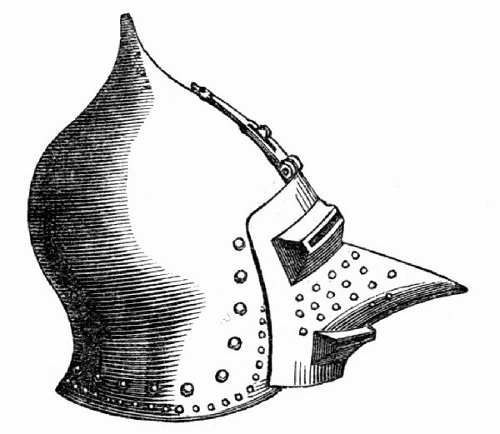
The above engraving represents a helmet, of the time of Richard II., which was termed by ancient armourers a bascinet. This extremely rare specimen was obtained from Her von Hulshoff, at his castle, near Munster, in Westphalia. The visor lifts upward on a hinge, and its position may be further regulated by the screw which slips in the groove above it. The row of holes on the lower edge of the bascinet was made to secure the camail, or tippet of chain-mail which covered the neck of the wearer.
EXTRAORDINARY ECHO.
Beneath the suspension-bridge across the Menai Strait in Wales, close to one of the main piers, is a remarkably fine echo. The sound of a blow on the pier with a hammer, is returned in succession from each of the cross beams which support the roadway, and from the opposite pier, at a distance of 576 feet; and in addition to this, the sound is many times repeated between the water and the roadway. The effect is a series of sounds, which may be thus described:—The first return is sharp and strong from the roadway overhead, the rattling which succeeds dies rapidly away; but the single repercussion from the opposite pier is very strong, and is succeeded by a faint palpitation, repeating the sound at the rate of twenty-eight times in five seconds, and which, therefore, corresponds to a distance of 180 feet, or very nearly the double interval from the roadway to the water. Thus it appears, that in the repercussion between the water and the roadway, that from the latter only affects the ear, the line drawn from the auditor to the water being too oblique for the sound to diverge sufficiently in that direction. Another peculiarity deserves especial notice,—viz., that the echo from the opposite pier is best heard when the auditor stands precisely opposite to the middle of the breadth of the pier, and strikes just on that point. As it deviates to one or the other side, the return is proportionably fainter, and is scarcely heard by him when his station is a little beyond the extreme edge of the pier, though another person stationed on the same side of the water, at an equal distance from the central point, so as to have the pier between them, hears it well.
JUGGLERS OF MODERN EGYPT.
Performers of sleight-of-hand tricks, who are called hhowa'h (in the singular, hha'wee) are numerous in Cairo. They generally perform in public places, collecting a ring of spectators around them; from some of whom they receive small voluntary contributions during and after their performances. They are most frequently seen on the occasions of public festivals; but often also at other times. By indecent jests and actions, they attract as much applause as they do by other means. The hha'wee performs a great variety of tricks, the most usual of which we will here mention. He generally has two boys to assist him. From a large leather bag, he takes out four or five snakes, of a largish size. One of these he places on the ground, and makes it erect its head and part of its body; another he puts round the head of one of the boys, like a turban, and two more over the boy's neck. He takes these off, opens the boy's mouth, apparently passes the bolt of a kind of padlock through his cheek, and locks it. Then, in appearance, he forces an iron spike into the boy's throat; the spike being really pushed up into a wooden handle. He also performs another trick of the same kind as this. Placing the boy on the ground, he puts the edge of a knife upon his nose, and knocks the blade until half its width seems to have entered. The tricks which he performs alone are more amusing. He draws a great quantity of various-coloured silk from his mouth, and winds it on his arm; puts cotton in his mouth, and blows out fire; takes out of his mouth a great number of round pieces of tin, like dollars; and, in appearance, blows an earthen pipe-bowl from his nose. In most of his tricks he occasionally blows through a large shell (called the hha'wee's zoomma'rah), producing sounds like those of a horn. Most of his sleight-of-hand performances are nearly similar to those of exhibitors of the same class in our own and other countries. Taking a silver finger-ring from one of the bystanders, he puts it in a little box, blows his shell, and says, "'Efree't change it!" He then opens the box, and shows, in it, a different ring: shuts the box again; opens it, and shows the first ring: shuts it a third time: opens it, and shows a melted lump of silver, which he declares to be the ring melted, and offers to the owner. The latter insists upon having his ring in its original state. The hha'wee then asks for five or ten fud'dahs to recast it; and having obtained this, opens the box again (after having closed it, and blown his shell), and takes out of it the perfect ring. He next takes a larger covered box; puts one of his boy's skull-caps in it, blows his shell, opens the box, and out comes a rabbit: the cap seems to be gone. He puts the rabbit in again; covers the box; uncovers it, and out run two little chickens. These he puts in again, blows his shell, uncovers the box, and shows it full of fatee'rehs (or pancakes), and koona'feh (which resembles vermicelli): he tells his boys to eat its contents; but they refuse to do it without honey. He then takes a small jug, turns it upside-down, to show that it is empty; blows his shell, and hands round the jug full of honey. The boys, having eaten, ask for water to wash their hands. The hha'wee takes the same jug, and hands it filled with water, in the same manner. He takes the box again, and asks for the cap; blows his shell, uncovers the box, and pours out from it, into the boy's lap (the lower part of his shirt held up), four or five small snakes. The boy, in apparent fright, throws them down, and demands the cap. The hha'wee puts the snakes back into the box; blows his shell, uncovers the box, and takes out the cap. Another of his common tricks is to put a number of slips of white paper into a tinned copper vessel (the tisht of a seller of sherbet), and to take them out dyed of various colours. He pours water into the same vessel; puts in a piece of linen; then gives to the spectators, to drink, the contents of the vessel, changed to sherbet of sugar. Sometimes he apparently cuts in two a muslin shawl, or burns it in the middle, and then restores it whole. Often he strips himself of all his clothes, excepting his drawers; tells two persons to bind him, hands and feet, and put him in a sack. This done, he asks for a piaster; and some one tells him that he shall have it if he will put out his hand and take it. He puts out his hand free; draws it back, and is then taken out of the sack, bound as at first. He is put in again, and comes out unbound, handing to the spectators a small tray, upon which are four or five little plates filled with various eatables; and, if the performance be at night, several small lighted candles placed round. The spectators eat the food.
ORIGIN OF ATTAR OF ROSES.
"In the Histoire Generale de l'Empire du Mogol, (T. 1, p, 327,) compiled by Catrou the Jesuit, from Manouchi's papers, this perfume is said to have been discovered by accident. Nur-Jahan, the favorite wife of the Mogul Jahan-Ghur, among her other luxuries, had a small canal of rose water. As she was a walking with the Mogul upon its banks, they perceived a thin film upon the water,—it was an essential oil made by the heat of the sun. They were delighted with its exquisite odour, and means were immediately taken for preparing by art a substance like that which had been thus fortuitously produced."
A MAGICIAN'S MIRROR AND BRACELET.
A strange blending of pure science and gross superstition is remarkably illustrated in the history of the celebrated Dr. Dee. Born in London in 1527, John Dee raised himself at an early age to a great reputation for his learning, in the mathematical sciences especially, in the most celebrated universities in his own country and of the continent. He is said to have imbibed a taste for the occult sciences while a student at Louvain, but there was evidently in his temper much of an enthusiastic and visionary turn, which must have given him a taste for such mysterious pursuits, without the necessity of an external impulse. One of the oldest and most generally credited of magical operations, was that of bringing spirits or visions into a glass or mirror, a practice which has continued to exist in the East even to the present day, and which prevailed to a very considerable extent in all parts of Western Europe during the sixteenth century. The process was not a direct one, for the magician did not himself see the vision in the mirror, but he had to depend upon an intermediate agent, a sort of familiar, who in England was known by the name of a skyrer, and whose business it was to look into the mirror and describe what he saw. Dr. Dee's principal skyrer was one Edward Kelly, and during his connexion with him, Dee kept an exact diary of all his visions, a portion of which was printed in a folio volume by Merio Casaubon in 1659. In this journal more than one magical mirror is evidently mentioned, and that which we here engrave is believed to have been of the number. It is now in the collection of Lord Londesborough.
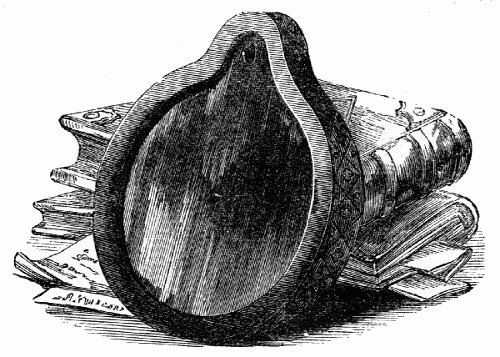
It is a polished oval slab of black stone, of what kind we have not been able to ascertain, but evidently of a description which was not then common in Western Europe, and Dr. Dee, who died in 1608, may have considered it as extremely precious, and as only to be obtained by some extraordinary means. It was one of the ornaments of the museum of Horace Walpole at Strawberry Hill; and Walpole has attached to it a statement of its history in his own hand-writing, from which we learn that it was "long" in the possession of the Mordaunts, earls of Peterborough, in whose catalogue it was described as "the black stone into which Dr. Dee used to call his spirits." It passed from that collection to Lady Elizabeth Germaine, from whom it went to John Campbell, Duke of Argyll, whose son, Lord Frederick Campbell, presented it to Horace Walpole. This interesting relic was bought at the Strawberry Hill sale for the late Mr. Pigott; and at the more recent sale of that gentleman's collection, it passed into the hands of Lord Londesborough. Its history and authenticity appear, therefore, to be very well made out. The family of the Mordaunts held a prominent place in English history during the whole of the seventeenth century, and it is hardly probable that they would have received an object like this without having good reason for believing that its history was authentic. It is believed that Butler alluded to this identical stone in his well-known lines:—
"Kelly did all his feats upon The devil's looking-glass or stone, When, playing with him at bo-peep, He solv'd all problems ne'er so deep."
Hudibras. Part II. Canto 3.
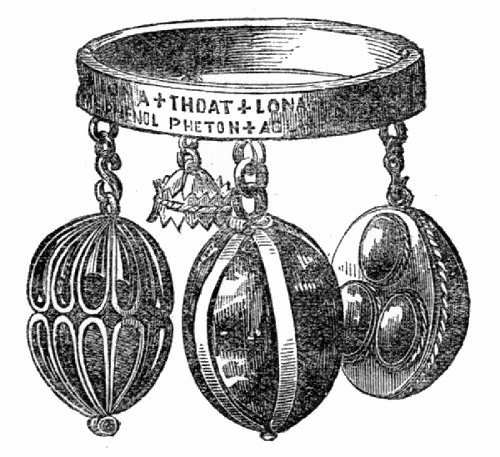
The regular fitting out of the magician at this period was a complicated process. He required his implements of various kinds, and, in addition to these, various robes, made especially for the occasion, with girdles and head-pieces, and magical rings and bracelets. A very curious example of the last-mentioned article of the magician's accoutrements, is represented in the preceding cut, about one-third the size of the original. It was purchased by Lord Londesborough in 1851, and had formerly been in the possession of Charles Mainwaring, Esq., of Coleby, near Lincoln. It is of silver, the letters of the inscription round the bracelet being engraved and filled with niello. This inscription may be distinctly read as follows:—
+ IONA + IHOAT + LONA + HELOI + YSSARAY + || + MEPHENOLPHETON + AGLA + ACHEDION + YANA + BACHIONODONAVALI M[*] ILIOR + || BACHIONODONAVALI M[**] ACH +
Some explanation of this mysterious inscription might, no doubt, be obtained by a diligent comparison of some of the numerous works on magic compiled in the age of Dr. Dee, and in the seventeenth century. The bracelet has had four pendants on it, of which three still remain, with the silver setting of the fourth. One of the pendants which remain is a brownish pebble, secured by three flat bands of silver; another is an oval cage of strong silver wire, containing a nut of some kind and some other vegetable substance; the third has on one side a circular convex pebble set in silver, and on the back three smaller pebbles.
LUNAR INFLUENCE IN DEATH.
Many modern physicians have stated the opinions of the ancients as regards lunar influence in diseases, but none have pushed their inquiries with such indefatigable zeal as the late Dr. Moseley; he affirms that almost all people in extreme age die at the new or at full moon, and this he endeavours to prove by the following records:—
Thomas Parr died at the age of 152, two days after the full moon. Henry Jenkins died at the age of 169, the day of the new moon. Elizabeth Steward, 124, the day of the new moon. William Leland, 140, the day after the new moon. John Effingham, 144, two days after full moon. Elizabeth Hilton, 121, two days after the full moon. John Constant, 113, two days after the new moon.
The doctor then proceeds to show, by the deaths of various illustrious persons, that a similar rule holds good with the generality of mankind:
Chaucer, 25th October, 1400, the day of the first quarter. Copernicus, 24th May, 1543, day of the last quarter. Luther, 18th February, 1546, three days after the full. Henry VIII., 28th January, 1547, the day of the first quarter. Calvin, 27th May, 1564, two days after the full. Cornaro, 26th April, 1566, day of the first quarter. Queen Elizabeth, 24th March, 1603, day of the last quarter. Shakspeare, 23rd April, 1616, day after the full. Camden, 2nd November, 1623, day before the new moon. Bacon, 9th April, 1626, one day after last quarter. Vandyke, 9th April, 1641, two days after full moon. Cardinal Richelieu, 4th December, 1642, three days before full moon. Doctor Harvey, 30th June, 1657, a few hours before the new moon. Oliver Cromwell, 3rd September, 1658, two days after full moon. Milton, 15th November, 1674, two days before the new moon. Sydenham, 29th December, 1689, two days before the full moon. Locke, 28th November, 1704, two days before the full moon. Queen Anne, 1st August, 1714, two days after the full moon. Louis XIV., 1st September, 1715, a few hours before the full moon. Marlborough, 16th June, 1722, two days before the full moon. Newton, 20th March, 1726, two days before the new moon. George I., 11th June, 1727, three days after new moon. George II., 25th October, 1760, one day after full moon. Sterne, 13th September, 1768, two days after new moon. Whitfield, 18th September, 1770, a few hours before the new moon. Swedenburg, 19th March, 1772, the day of the full moon. Linnæus, 10th January, 1778, two days before the full moon. The Earl of Chatham, 11th May, 1778, the day of the full moon. Rousseau, 2nd July, 1778, the day after the first quarter. Garrick, 20th January, 1779, three days after the new moon. Dr. Johnson, 14th December, 1784, two days after the new moon. Dr. Franklin, 17th April, 1790, three days after the new moon. Sir Joshua Reynolds, 23rd February, 1792, the day after the new moon. Lord Guildford, 5th August, 1722, three days after the full moon. Dr. Warren, 23rd June, 1797, a day before the new moon. Burke, 9th July, 1797, at the instant of the full moon. Macklin, 11th July, 1797, two days after full moon. Wilkes, 26th December, 1797, the day of the first quarter. Washington, 15th December, 1790, three days after full moon. Sir W. Hamilton, 6th April, 1803, a few hours before the full moon.
The doctor winds up this extract from the bills of mortality by the following appropriate remark: "Here we see the moon, as she shines on all alike, so she makes no distinction of persons in her influence:
"——æquo pulsat pede pauperum tabernas, Regumque turres."
GLUTTONY OF THE MONKS.
King John, pointing to a fat deer said, "See how plump he is, and yet he has never heard mass!" John might have alluded to the gluttony of the monks, which was notorious in his days; for Giraldus Cambrensis says, that from the monks of St. Swithin's, Winchester, Henry II. received a formal complaint against the abbot for depriving his priests of three out of thirteen dishes at every meal. The monks of Canterbury exceeded those of St. Swithin; they had seventeen dishes every day, and each of these cooked with spices and the most savoury and rich sauces.
ANCIENT BELL-SHRINE.
The annexed engraving represents one of the most valuable and curious ecclesiastical relics of the early Christian Period that has ever been discovered. It consists of a bronze bell-shrine and bell, found about the year 1814, on the demolition of the ruined wall at Torrebhlaurn farm, in the parish of Kilmichael-Glassrie, Argyleshire, and now one of the most valued treasures in the Museum of the Scottish Antiquaries.
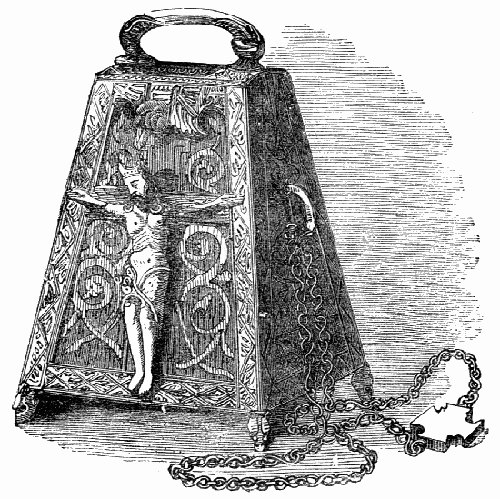
That it must have been deposited in the wall where it was found, for the purpose of concealment at a period of danger and alarm, seems abundantly obvious; but of the occasion of this concealment no tradition has been preserved. Within the beautiful case is a rude iron bell, so greatly corroded that its original form can only be imperfectly traced; yet this, and not the shrine, was obviously the chief object of veneration, and may, indeed, be assumed, with much probability, to be some centuries older than the ornamental case in which it is preserved. Whether it shall be thought to have been an ancient reliquary or a mass-bell, or whatever else may be conjectured of its nature and use, it may fairly be presumed to have remained in the neglected spot in which it was found since the subversion of the Roman Catholic worship in the sixteenth century, when the favoured objects of external adoration and reverence, under the former superstition, came to be regarded with impatient contempt and abhorrence.
It is deserving of attention that the figure of our crucified Saviour in invested with a regal crown, and not with a crown of thorns, as is usually the case. The brass chain or collar, of rude workmanship, about three feet six inches long, now attached to the case, and the extremities of which are connected with a small cross of the same metal, was discovered at the same time, not far from the case.
EGYPTIAN GARDEN.
The diagram which accompanies this article is an Egyptian sketch of an Egyptian garden; and it is expressly curious, both as an example of the pictorial art of the period, and as giving us an idea of the pleasure-gardens of Egypt in its most flourishing days.
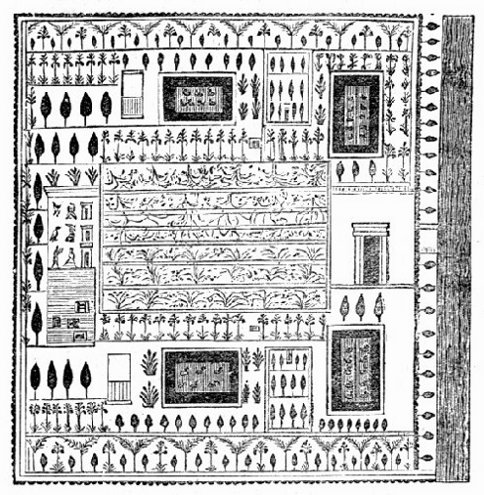
The garden here represented stood beside a canal of the Nile, with an avenue of trees between it and the bank, on which side was the entrance. It was surrounded by an embattled wall, through which a noble gateway gave access to the garden. The central space was occupied by the vineyard, surrounded by its own wall, in which the vines were trained on trellises supported by slender pillars. At the further end of the vineyard was a building of three storeys, the windows from which opened over the luxurious foliage and purple clusters, regaling the senses both of sight and smell. Four large tanks of water kept the vegetation well supplied with nutritive moisture; and, with the smooth and verdant turf which borders them, the water-fowl that sported over the surface, and the lotus-flowers that sprang from their clear depths, added a new beauty to the scene. Near the tanks stood summer-houses, overlooking beds of various flowers, and sheltered from the sun by surrounding trees. Two enclosed spaces between the tanks, being filled with trees, were probably devoted to some species of particular rarity, or remarkable for the excellence of their fruit. Rows of date trees and Theban palms, alternating with other trees, bordered the whole garden, and environed the vineyard wall.
The very numerous allusions to gardens in the Sacred Scriptures show that the Hebrews inherited the same taste as the Egyptians. In these allusions we find the same characteristics that are so observable in those depicted on the monuments; such as the absolute necessity of water, the custom of having pools in them, the advantage of a situation by the side of a river, the practice of enclosing them from intrusion, and appropriation of enclosures to particular productions.
With the early Egyptians the love of flowers seems to have been almost a passion; they appear to have been in constant request in offerings to the gods, and as ornaments of the person, as decorations of furniture; as graceful additions to several entertainments, they occur at every turn. Flowers were painted on walls, furniture, dresses, chairs, boxes, boats, and, in short, on whatever was wished to be ornamental. Wreaths and chaplets were likewise in common use among the Egyptians, and artificial flowers were not uncommon.