TEN THOUSAND WONDERFUL THINGS. (continued 10)
Reading edition
STATE OF THE MIND DURING SLEEP.
The following is an instance of phantasms being produced by our associations with bodily sensations, and tends to show how alive our faculties continue during sleep to the highest impressions:—
The subject of this observation was an officer in the expedition to Louisburg in 1758, who had this peculiarity in so remarkable a degree, that his companions in the transport were in the constant habit of amusing themselves at his expense. They could produce in him any kind of dream by whispering in his ear, especially if this was done by a friend with whose voice he had become familiar. One time they conducted him through the whole progress of a trial, which ended in a duel; and when the parties were supposed to have met, a pistol was put into his hand, which he fired, and was awakened by the report. On another occasion they found him asleep on the top of a locker in the cabin, when they made him believe he had fallen overboard, and exhorted him to save himself by swimming. They then told him that a shark was pursuing him, and entreated him to dive for his life. He instantly did so, and with so much force as to throw himself from the locker upon the cabin floor, by which he was much bruised, and awakened of course. After the landing of the army at Louisburg, his friends found him one day asleep in his tent, and evidently annoyed by the cannonading. They then made him believe that he was engaged, when he expressed great fear, and showed an evident disposition to run away. Against this they remonstrated, but at the same increased his fears by imitating the groans of the wounded and the dying; and when he asked, as he often did, who was hit, they named his particular friends. At last they told him that the man next himself in his company had fallen, when he instantly sprung from his bed, rushed out of the tent, and was only roused from his danger and his dream by falling over the tent-ropes. A remarkable thing in this case was, that after these experiments he had no distinct recollection of his dreams, but only a confused feeling of oppression or fatigue, and used to tell his friends that he was sure they had been playing some trick upon him. It has been observed that we seldom feel courageous or daring in our dreams, and generally avoid danger when menaced by a foe, or exposed to any probable peril.
MUSIC OF THE SEA.
The mysterious music that is heard in the bay at West Pascagoula, is described by those who have listened to it as being singularly beautiful. "It has, for a long time," says Mrs. Child, an American authoress, "been one of the greatest wonders of the south-west. Multitudes have heard it, rising, as it were, from the water, like the drone of a bagpipe, then floating away, away, away, in the distance, soft, plaintive, and fairy-like, as if Æolian harps sounded with richer melody through the liquid element; but none have been able to account for the beautiful phenomenon. There are several legends touching these mysterious sounds; but in these days few things are allowed to remain mysterious." These strange sounds, which thus assume the beauty and the harmony of regular music, are stated to proceed from the cat-fish. A correspondent of the Baltimore Republican thus explains the phenomenon:—"During several of my voyages on the Spanish main, in the neighbourhood of Paraguay and San Juan de Nicaragua, from the nature of the coast, we were compelled to anchor at a considerable distance from the shore; and every evening, from dark to late night, our ears were delighted with Æolian music, that could be heard beneath the counter of our schooner. At first I thought it was the sea-breeze sweeping through the strings of my violin (the bridge of which I had inadvertently left standing); but after examination I found it was not so. I then placed my ear on the rail of the vessel, when I was continually charmed with the most heavenly strains that ever fell upon my ear. They did not sound as close to us, but were sweet, mellow, and aerial, like the soft breathings of a thousand lutes, touched by fingers of the deep sea nymphs, at an immense distance. Although I have considerable "music in my soul," one night I became tired, and determined to fish. My luck, in half-an-hour, was astonishing. I had half filled my bucket with the finest white cat-fish I ever saw; and it being late, and the cook asleep, and the moon shining, I filled my bucket with water, and took fish and all into my cabin for the night. I had not yet fallen asleep, when the same sweet notes fell upon my ear; and, getting up, what was my surprise to find my cat-fish discoursing sweet sounds to the sides of my bucket! I examined them closely, and discovered that there was attached to each lower lip an excrescence, divided by soft wiry fibres. By the pressure of the upper lip thereon, and by the exhalation and discharge of breath, a vibration was created, similar to that produced by the breath on the tongue of the Jews' harp."
THE ROCK OF CASHEL.
Any work which professed to be a record of what is rare and curious, would surely be incomplete if it did not contain an account of the celebrated Rock of Cashel; for the venerable buildings which crown its summit are, from their number, variety, preservation, and site, decidedly the most interesting ruins in the Emerald Isle, and, to use the words of Sir Walter Scott, "such as Ireland may be proud of." Cashel, which is distant about one hundred miles from Dublin, appears to be a place of high antiquity, and was long the residence of the kings of Munster; but as its early history is involved in much obscurity, it is uncertain at what period it became a diocesan site. It is stated that previous to the year 1101 the buildings on the Rock were occupied as a royal residence, and that in that year the hitherto royal seat was dedicated solely to ecclesiastical uses.
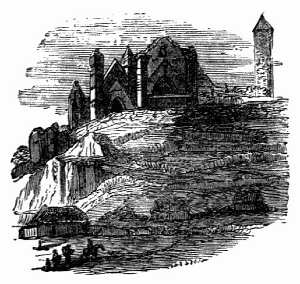
The buildings consist of a round tower, Cormack's chapel, cathedral, castle and monastery; the latter is a few yards detached, and the least remarkable of the number; all the former are closely connected. The Round Tower, the date and uses of which are in common with those of all other similar structures involved in much obscurity, raises its tall and yet scarce dilapidated head far above its younger and more decaying companions. It is fifty-six feet in circumference, and ninety feet in height. Cormack's Chapel, which, with the exception of the Round Tower, is the most ancient structure of the group, was built by Cormack M'Carthy, king of Munster, in 1136. It is roofed with stone, and in its capitals, arches, and other features and details, the Norman style is distinctly marked. The numerous ornaments, grotesque heads, and other curious sculptures, which adorn the arches, columns, and pilasters, are all in uniformity of style. The building altogether is a perfect gem, and the architectural antiquary and the artist will find in it a most valuable addition to their studies. The cathedral is a noble remnant of what is usually termed the pointed Gothic, and contains many interesting relics.
The rock, which is here presented as it appears from the plain below, has the buildings we have just mentioned on its very summit; it rises abruptly from a widely extended fertile country, to a considerable height above the town, and from many parts at a distance it forms a very striking object. On the top of the rock, and around the ruins, an area of about three acres has been enclosed, which is open to the public.
INSTANCE OF INCREMATION.
Last night (26th September, 1769), say the chronicles of the day, the will of Mrs. Pratt, a widow lady, who lately died at her house in George Street, Hanover Square, was punctually fulfilled, by the burning of her body to ashes in her grave, in the new burying-ground adjoining to Tyburn turnpike.
THE HAWTHORNDEN SWORD.
The great antiquity of the Scottish claymore is proved by its being figured in the sculptures both of Iona and Oronsay, with considerable variety of details. In some the blade is highly ornamented, and the handle varies in form, but all present the same characteristic, having the guards bent back towards the blade. A curious variety of this peculiar form is seen in a fine large two-handed sword preserved at Hawthornden, the celebrated castle of the Drummonds, where the Scottish poet entertained Ben Johnson during his visit to Scotland in 1619. It is traditionally affirmed to have been the weapon of Robert Bruce, though little importance can be attached to a reputation which it shares with one-half the large two-handed swords still preserved. Our engraving is a correct representation of it.
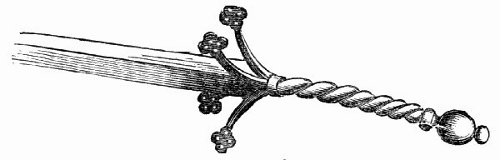
The handle appears to be made from the tusk of the narwhal, and it has four reverse guards, as shown in the cut. The object aimed at by this form of guard, doubtless, was to prevent the antagonist's sword glancing off, and inflicting a wound ere he recovered his weapon, and, in the last example especially, it seems peculiarly well adapted for the purpose.
INSTINCT IN A CAT.
The following anecdote almost places the cat on a level with the dog:—"A physician of Lyons was requested to inquire into a murder that had been committed on a woman of that city. In consequence of this request he went to the habitation of the deceased, where he found her extended lifeless on the floor, weltering in her blood. A large white cat was mounted on the cornice of a cupboard, at the far end of the apartment, where he seemed to have taken refuge. He sat motionless, with his eyes fixed on the corpse, and his attitude and looks expressing horror and affright. The following morning he was found in the same station and attitude, and when the room was filled with officers of justice, neither the clattering of the soldiers' arms, nor the loud conversation of the company, could in the least degree divert his attention. As soon, however, as the suspected persons were brought in, his eyes glared with increased fury, his hair bristled, he darted into the middle of the apartment, where he stopped for a moment to gaze at them, and then precipitately retreated under the bed. The countenances of the assassins were disconcerted, and they were now, for the first time, abandoned by their atrocious audacity."
A TRANCE.
Mrs. Godfrey, sister to the Duke of Marlborough, had nearly been buried alive; the physicians all declaring that the breath of life was irrecoverably gone. Her husband, Colonel Godfrey, had, however, the pleasure to see her revive, seven days after (that day week, and same hour), and what is more, she never knew till the day of her death the length of her trance, or sleep.
THE NUMBER SEVEN.
The number is composed of the first two perfect numbers, equal and unequal, 3 and 4; for the number 2, consisting of repeated unity, which is no number, is not perfect, it comprehends the primary numerical triangle or trine, and square or quartile conjunction, considered by the favourers of planetary influence as of the most benign aspect. In six days creation was completed, and the 7th was consecrated to rest. On the 7th day of the 7th month, a holy observance was ordained to the children of Israel, who feasted 7 days, and remained 7 days in tents; the 7th year was directed to be a Sabbath of rest for all things; and at the end of 7 times 7 years commenced the grand jubilee. Every 7th year the land lay fallow; every 7th year there was a general release from all debts, and all bondmen were set free. From this law may have originated the custom of our binding young men to 7 years' apprenticeship, and punishing incorrigible offenders by transportation for 7, twice 7, and three times 7, years. Every 7 years the law was to be read to the people. Jacob served 7 years for the possession of Rachael; and also other 7. Noah had 7 days' warning of the flood, and was commanded to take the fowls of the air in by 7, and the clean beasts by 7. The ark touched ground on the 7th month; and in 7 days the dove was sent out, and again in 7 days after. The 7 years of plenty, and 7 years of famine were foretold in Pharaoh's dream by 7 fat and 7 lean beasts, and the 7 full and 7 blasted ears of corn. Nebuchadnezzar was 7 years a beast; and the fiery furnace was 7 times hotter to receive Shadrach, &c. A man defiled was, by the Mosaic law, unclean 7 days; the young of both animals was to remain with the dam 7 days, and at the end of the 7th was to be taken away. By the old law, man was commanded to forgive his offending brother 7 times; but the meekness of the revealed law extended his humility to 70 times 7: if Cain shall be avenged 7 times, truly Lamech 70 times 7. In the destruction of Jericho, 7 priests bore 7 trumpets 7 days; on the 7th they surrounded the wall 7 times; after the 7th, the walls fell. Balaam prepared 7 years for a sacrifice; and 7 of Saul's sons were hanged to stay a famine. Laban pursued Jacob 7 days' journey. Job's friends sat 7 days and 7 nights, and offered 7 bullocks and 7 rams, as an atonement for their wickedness. In the 7th year of his reign, King Ahazuerus feasted 7 days, and on the 7th deputed his 7 chamberlains to find a queen, who was allowed 7 maidens to attend her. Miriam was cleansed of her leprosy by being shut up 7 days. Solomon was 7 years in building the Temple, at the dedication of which he feasted 7 days; in the Temple were 7 lamps; 7 days were appointed for an atonement upon the altar, and the priest's son was ordained to wear his father's garments 7 days. The children of Israel eat unleavened bread 7 days. Abraham gave 7 ewe-lambs to Abimelech, as a memorial for a well. Joseph mourned 7 days for Jacob. Naaman was cleansed of his leprosy by bathing 7 times in Jordan. The Rabbins say that God employed the power of this number to perfect the greatness Of Samuel, his name answering the value of the letters in the Hebrew word, which signifies 7; whence Hannah his mother, in her thanksgiving, says, the barren hath brought forth 7. In Scripture are enumerated 7 resurrections: the widow's son, by Elias; the Shunamite's son, by Elisha; the soldier who touched the bones of the prophet; the daughter of the ruler of the synagogue; the widow's son of Nain; Lazarus, and our Lord. The apostles chose 7 deacons. Enoch, who was translated, was the 7th from Adam; and Jesus Christ was the 77th in a direct line. Our Lord spoke 7 times on the cross, on which he was 7 hours; he appeared 7 times; and after 7 times 7 days sent the Holy Ghost. In the Lord's prayer are 7 petitions, contained in 7 times 7 words, omitting those of mere grammatical connexion; within this number are concealed all the mysteries of apocalypse revealed to the 7 churches of Asia. There appeared seven golden candlesticks and 7 stars in the hand of him that was in the midst; 7 lambs before the 7 spirits of God; the book with 7 seals; the lamb with 7 horns and 7 eyes; 7 angels with 7 trumpets; 7 kings; 7 thunders; 7,000 men slain. The dragon with 7 heads and 7 crowns; and the beast with 7 heads; 7 angels bearing 7 plagues, and 7 vials of wrath. The vision of Daniel was of 70 weeks and the elders of Israel were 70. There were also 7 heavens, 7 planets (query), 7 stars, 7 wise men, 7 champions of Christendom, 7 notes in music, 7 primary colours, 7 deadly sins, and 7 sacraments in the Catholic church. The 7th son was considered as endowed with pre-eminent wisdom; and the 7th son of a 7th son is still thought to possess the power of healing diseases spontaneously. Perfection is likened to gold 7 times purified in the fire; and we yet say you frightened me out of my 7 senses. The opposite sides of a dice make 7, whence the players at hazard make 7 the main. Hippocrates says the septenary number, by its occult virtues, tends to the accomplishment of all things, to be the dispense of life, and fountain of all its changes; and, like Shakespeare, he divided the life of man into 7 ages; for as the moon changes her phases every seven days, this number influences all sublunary beings. The teeth spring out on the 7th month, and are shed and renewed in the 7th year, when infancy is changed into childhood; at twice 7 years puberty begins; at three times 7 the faculties are developed, and manhood commences, and we are become legally competent to all civil acts; at four times 7 man is in full possession of all his strength; at five times 7 he is fit for the business of the world; at six times 7 he becomes grave and wise, or never: at 7 times 7 he is in his apogee, and from that time decays; at eight times 7 he is in his first climacterick; at nine times 7, or 63, he is in his last or grand climacterick, or year of danger; and ten times 7, or three score and ten, has, by the royal prophet, been pronounced the natural period of human life.
SUPERSTITIOUS LEGEND.
We are told that when St. Helena, of pious memory, had discovered the true Cross of Christ, she permitted various fragments to be taken from it, which were encased, some in gold, and some in gems, and conveyed to Europe, leaving the principal or main part of the wood in the charge of the Bishop of Jerusalem, who exhibited it annually at Easter, until Chosroes, king of Persia, plundered Jerusalem in the reign of the emperor Phocas, and took away this holy relic.
Before this fatal event we are taught to believe, by Rigordus, an historian of the thirteenth century, that the mouths of Christians used to be supplied with 30, or in some instances, no doubt according to their faith, with 32 teeth; but that after the Cross was stolen by the infidels no mortal has ever been allowed more than 23!
ORÆFA MOUNTAIN IN ICELAND.
This mountain, which is the loftiest in Iceland, has been rendered celebrated by an eruption which took place about a century ago. Nothing can be more striking than the account given of this calamity by the aged minister of the parish. He was in the midst of his service on the Sabbath, when the agitation of the earth gave warning that some alarming event was to follow. Rushing from the church, he saw a peak of the neighbouring mountain alternately heaved up and sinking; till at last, the stone, of which this portion of the mountain was composed, ran down in a melted state into the plain, like melted metal from a crucible, filling it to such a height, that no more of the mountain, which formerly towered to such a height, remains, than about the size of a bird; volumes of water being in the meantime thrown forth in a deluge from the crater, and sweeping away whatever they encountered in their course. The Oræfa then broke forth, hurling large masses of ice to a great distance; fire burst out in every direction from its side; the sky was darkened by the smoke and ashes, so that the day could hardly be distinguished from the night. This scene of horror continued for more than three days, during which the whole region was converted into utter desolation.
THE SETON SWORD.
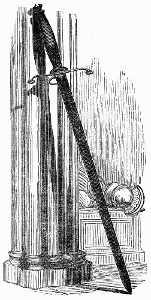
The two-handed sword, which was introduced later than the claymore, though still so familiar to us, is perhaps the most interesting, in an archaeological point of view, of all the military relics pertaining to the Medieval Period. The huge, ponderous, and unwieldy weapon, seems the fittest emblem that could be devised, of the rude baron of the thirteenth century, who lived by "the good old rule" of physical force, and whose hardy virtues, not unsuited to an illiterate age—are strangely mistaken for a chivalry such as later ages have not seen. Calmly reasoning from this characteristic heirloom, we detect in it the evidence of just such hardy, skilless, overbearing power, as history informs us was the character of the medieval baron, before the rise of the burgher class readjusted the social balance by the preponderance of rival interests. The weapon figured here is a remarkably fine and unusually large specimen of the old Scottish two-handed sword, now in the possession of George Seton, Esq., representative of the Setons of Cariston. It measures forty-nine inches in the blade, five feet nine inches in entire length, and weighs seven and a half pounds. But the chief interest of this old relic arises from the well-authenticated family traditions which associate it with the memory of its first knightly owner, Sir Christopher Seton of that Ilk, from whom some of the oldest scions of the Scottish peerage have been proud to trace their descent. He was married to Christian, sister of King Robert the Bruce, whom he bravely defended at the battle of Methven. He was shortly after taken prisoner by Edward I., and basely hanged as a traitor.
STYLE OF LIVING IN THE SIXTEENTH CENTURY.
The most perfect notion of the living and domestic arrangements of the old English nobility and gentry will be found in the entries of what were called the Household Books of the times. One of the most celebrated of these records is the Northumberland Household Book, being the regulations of the establishment of the fifth earl of Northumberland, at his castles of Wrenill and Lekinfield, in Yorkshire, begun in 1512. No baron's family was on a nobler or more splendid footing. It consisted of one hundred and sixty-six persons, masters and servants; fifty-seven strangers were reckoned upon every day; on the whole two hundred and twenty-three. During winter they fed mostly on salt meat and salt fish; and with that view there was a provision of one hundred and sixty gallons of mustard per year; so that there cannot be any thing more erroneous than the magnificent ideas formed of "the roast beef of Old England." On flesh days, (that is, when meat was not forbidden by the Catholic religion), through the year, breakfast for my lord and lady was a loaf of bread, two manchets, a quart of beer, a quart of wine, half a chine of mutton, or a chine of beef boiled. On meagre days (or when meat was forbidden), a loaf of bread, two manchets, a quart of beer, a quart of wine, a dish of butter, a piece of salt fish, or a dish of buttered eggs. During Lent, a loaf of bread, two manchets, a quart of beer, a quart of wine, two pieces of salt fish, six baconed herrings, four white herrings, or a dish of sprats. There was as little variety in other meals, except on festival days; and this way of living was, at the time, high luxury. There were but two cooks to dress victuals for two hundred persons; and fowls, pigeons, plovers, and partridges were prohibited as delicacies, except at my lord's table. The table-cloth was washed about once a month; no sheets were used; and only forty shillings were allowed for washing throughout the year. The family rose at six in the morning, dined at ten, and supped at four in the afternoon; and the castle gates were shut at nine. Mass was said in the chapel at six o'clock, that all the servants might rise early. The earl passed the year at three country seats, but he had furniture only for one: he carried every thing along with him, beds, tables, chairs, kitchen utensils; and seventeen carts and one waggon conveyed the whole: one cart sufficed for all his kitchen utensils, cooks' beds, &c. There were in the establishment eleven priests, besides seventeen persons, chanters, musicians, &c., belonging to the chapel. No mention is made of plate, but only of the hiring of pewter vessels. Wine was allowed in abundance for the lord's table, but the beer for the hall was poor indeed, only a quarter of malt being allowed for two hogsheads. The servants seem all to have bought their own clothes from their wages. Every thing in the household was done by order, with the pomp of proclamation; and laughable as it may now seem, an order was issued for the right making of mustard, beginning "It seemeth good to us and our council."
ANECDOTE OF A TERRIER.
A terrier, known to Professor Owen, was taught to play at hide and seek with his master, who summoned him, by saying "Let us have a game;" upon which the dog immediately hid his eyes between his paws, in the most honourable manner, and when the gentleman had placed a sixpence, or a piece of cake in a most improbable place, he started up and invariably found it. His powers were equalled by what was called a fox-terrier, named Fop, who would hide his eyes, and suffer those at play with him to conceal themselves before he looked up. If his play-fellow hid himself behind a window-curtain, Fop would, for a certain time, carefully pass that curtain, and look behind all the others, behind doors, etc., and when he thought he had looked long enough, seize the concealing curtain and drag it aside in triumph. The drollest thing, however, was to see him take his turn of hiding; he would get under a chair, and fancy that he was not seen; of course, those at play with him pretended not to see him, and it was most amusing to witness his agitation as they passed. When he was ill he had been cured by some homœopathic globules, and ever after, if anything were the matter with him, he would stand near the medicine box, and hold his mouth open.
CUTTING A WIFE OFF WITH A SHILLING.
In the year 1772, died at Lambeth, J—— G——e, Esq. In his will was found the following remarkable clause:—"Whereas, it was my misfortune to be made very uneasy by Elizabeth G——, my wife, for many years, from our marriage, by her turbulent behaviour; for she was not content with despising my admonitions, but she contrived every method to make me unhappy; she was so perverse in her nature, that she would not be reclaimed, but seemed only to be born to be a plague to me; the strength of Sampson, the knowledge of Homer, the prudence of Augustus, the cunning of Pyrrhus, the patience of Job, the subtlety of Hannibal, and the watchfulness of Hermogenes, could not have been sufficient to subdue her; for no skill or force in the world would make her good; and, as we have lived several years separate, and apart from each other eight years, and she having perverted her son to leave and totally abandon me; therefore I give her one shilling only."
WEALTH OF THE JEWS.
About the year 1707, the Jews offered Lord Godolphin, Minister of Queen Anne, to pay £500,000, (and they would have made it a million,) if the government would allow them to purchase the town of Brentford, with leave of settling there entirely, with full privileges of trade, &c. Lord Godolphin did not comply with the request, and a curious reason is assigned by Dean Lockier, because it would provoke two of the most powerful bodies in the nation, the clergy and the merchants. The Jews had better success with Oliver Cromwell: they offered him £60,000 to have a synagogue in London. He took the money, and they had their temple.
GAMBLING EXTRAORDINARY.
The following instance of frantic or drunken gambling appeared in the Times of April 17, 1812:—
"On Wednesday evening an extraordinary investigation took place at Bow Street. Croker, the officer, was passing the Hampstead Road; he observed at a short distance before him two men on a wall, and directly after saw the tallest of them, a stout man about six feet high, hanging by his neck from a lamp-post, attached to the wall, being that instant tied up and turned off by the short man. This unexpected and extraordinary sight astonished the officer; he made up to the spot with all speed, and just after he arrived there, the tall man who had been hanged, fell to the ground, the handkerchief with which he had been suspended having given way. Croker produced his staff, said he was an officer, and demanded to know of the other man the cause of such conduct; in the mean time the man who had been hanged recovered, got up, and on Croker interfering, gave him a violent blow on the nose, which nearly knocked him backward. The short man was endeavouring to make off; however, the officer procured assistance, and both were brought to the office, when the account they gave was, that they worked on canals. They had been together on Wednesday afternoon, tossed up for money, and afterwards for their clothes, the tall man who was hanged won the other's jacket, trowsers and shoes; they then tossed up which should hang the other, and the short one won the toss. They got upon the wall, the one to submit, and the other to hang him on the lamp-iron. They both agreed in this statement. The tall one who had been hanged said, if he won the toss, he would have hanged the other. He said, he then felt the effects on his neck at the time he was hanging, and his eyes was so much swelled that he saw double. The magistrates expressed their horror and disgust, and ordered the man who had been hanged to find bail for the violent and unjustifiable assault upon the officer, and the short one for hanging the other. Not having bail, they were committed to Bridewell for trial."
OLD BOOKS.
The Pentateuch and the history of Job are the most ancient books in the world; and in profane literature the works of Homer and Hesiod. The first book known to have been written in our own vernacular was "The Confessions of Richard, Earl of Cambridge," temp. 1415; and the earliest English ballad is supposed to be the "Cuckoo Song," which commences in the following style:—
"Sumer is icumen in Lhudé sing cuccu, Groweth sed, and bloweth med, And springth ye wedé nu: Singe cuccu."
FOSSIL REPTILE; THE PTERODACTYLUS.
The pterodactylus was a flying animal. It had the wings of a bat, and the structure of a reptile; jaws with sharp teeth, and claws with long hooked nails. The power which it had of flying was not by means of its ribs, nor by wings without fingers, as in birds, but by wings supported by one very elongated toe, the others being short and furnished with claws. The remains of this animal were brought under examination by M. Collini, director of the Museum of the Elector Palatine at Manheim. There was at first some discussion as to the actual character of the animal. M. Blumenbach supposed it to be a bird, and M. de Soemmering classed it among the bats. M. Cuvier, however, maintained that it was a reptile, and showed that all its bones, from the teeth to the claws, possessed the characters which distinguish that class of animals. But still it differed from all other reptiles in possessing the capability of flying. It is probable that it could at pleasure fold up its wings in the same manner as birds, and might suspend itself on branches of trees by its fore toes, though it possessed the power of sitting upright on its hind feet. This is the most anomalous of all the fossil reptiles.
TIGER CAVE AT CUTTACK.
The geographical distribution of the rock-cut caves of the Buddhists in India is somewhat singular, more than nine-tenths of those now known being found within the limits of the Bengal Presidency. The remainder consist of two groups, those of Behar and Cuttack, neither of which are important in extent, in Bengal; one only, that of Mahavellipore, in Madras; and two or three not very important groups which have been traced in Afghanistan and the Punjaub.
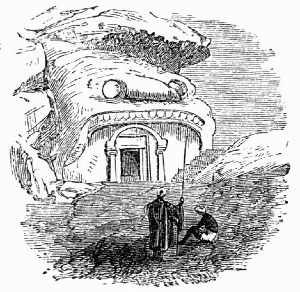
One of the most remarkable of these caves is that at Cuttack, which is called the Tiger cave—being in fact a large mass of rock, carved into a form intended to represent the head of that animal, whose extended jaws form the verandah leading into a small apartment excavated in the interior of the skull: our engraving is a correct representation of it.
Generally speaking, these single cells have a porch of two pillars to protect the doorway, which leads into a small room, 10 or 12 ft. square, constituting the whole cave. Buildings on precisely the same plan are still very common in India, except that now, instead of being the abode of a hermit, the cell is occupied by an image of some god or other, and is surmounted by a low dome, or pyramidal spire, converting it into a temple of some pretensions. The lower part, however, of these small temples is very similar to the rock-cut hermitages of which we are speaking.
THE JEWS IN ENGLAND.
William the Conqueror permitted great numbers of Jews to come over from Rouen, and to settle in England in the last year of his reign. Their number soon increased, and they spread themselves throughout most of the cities and capital towns in England where they built synagogues. There were fifteen hundred at York about the year 1189. At Bury, in Suffolk, is a very complete remain of a Jewish synagogue of stone in the Norman style, large and magnificent. Hence it was that many of the learned English ecclesiastics of those times became acquainted with their books and their language. In the reign of William Rufus, the Jews were remarkably numerous at Oxford, and had acquired considerable property; and some of their Rabbis were permitted to open a school in the university, where they instructed not only their own people, but many Christian students in Hebrew literature, about the year 1094. Within 200 years after their admission or establishment by the Conqueror, they were banished from the kingdom. This circumstance was highly favourable to the circulation of their learning in England. The suddenness of their dismission obliged them for present subsistence, and other reasons, to sell their moveable goods of all kinds, among which were large quantities of all Rabbinical books. The monks in various parts availed themselves of the distribution of these treasures. At Huntingdon and Stamford there was a prodigious sale of their effects, containing immense stores of Hebrew manuscripts, which were immediately purchased by Gregory of Huntingdon, Prior of the abbey of Ramsey. Gregory speedily became an adept in the Hebrew, by means of these valuable acquisitions, which he bequeathed to his monastery about the year 1250. Other members of the same convent, in consequence of these advantages, are said to have been equal proficients in the same language, soon after the death of Prior Gregory, among whom were Robert Dodford, Librarian of Ramsey, and Laurence Holbech, who compiled a Hebrew Lexicon. At Oxford a great number of their books fell into the hands of Roger Bacon, or were bought by his brethren the Franciscan friars of that university.
GAME PRESERVES AT CHANTILLY.
The establishment at Chantilly, which formerly belonged to the great family of Condé, included 21 miles of park, and 48 miles of forest. The horses, when the family were at that place, were above 500. The dogs, 60 to 80 couple: the servants, above 500. The stables the finest and best in Europe. We shall now present to the sporting and un-sporting reader, for both will lift up their eyes, a list of game killed, year by year, through a series of thirty-two years—beginning with the year 1748, ending with the year 1779:—
List of the Game.
54,878 24,029 37,209 19,932
37,160 27,013 42,902 27,164
58,712 26,405 31,620 30,429
39,892 33,055 25,994 30,859
32,470 50,812 18,479 25,813
39,893 40,234 18,550 50,666
32,470 26,267 26,371 13,304
16,186 25,953 19,774 17,566
Now let us give (of birds and beasts) their bill of mortality; that is the numbers, in detail, of each specific description, registered as below, and detailed to have been killed at Chantilly, in the above-mentioned series of years. Hares, 77,750; rabbits, 587,470; partridges, 117,574; red ditto, 12,426; pheasants, 86,193; quails, 19,696; rattles (the male quail), 449; woodcocks, 2,164; snipes, 2,856; ducks, 1,353; wood-piquers, 317; lapwings, 720; becfique (small birds like our wheatear), 67; curlews, 32; oyes d'Egypte, 3; oyes sauvage, 14; bustards, 2; larks, 106; tudells, 2; fox, 1; crapeaux, 8; thrushes, 1,313; guynard, 4; stags, 1,712; hinds, 1,682; facons, 519; does, 1,921; young does, 135; roebucks, 4,669; young ditto, 810; wild boars, 1,942; marcassins (young boars), 818. A magnificent list of animal slaughter, carefully and systematically recorded as achievements.
BRITISH PEARLS.
The river Conway, in North Wales, was of considerable importance, even before the Roman invasion, for the pearl mussel (the Mya Margaritifera of Linnæus) and Suetonius acknowledged that one of his inducements for undertaking the subjugation of Wales was the pearl fishery carried forward in that river. According to Pliny, the mussels, called by the natives Kregindilin, were sought for with avidity by the Romans, and the pearls found within them were highly valued; in proof of which it is asserted that Julius Cæsar dedicated a breastplate set with British pearls to Venus Genetrix, and placed it in her temple at Rome. A fine specimen from the Conway is said to have been presented to Catherine, consort of Charles II., by Sir Richard Wynne, of Gwydir; and it is further said that it has since contributed to adorn the regal crown of England. Lady Newborough possessed a good collection of the Conway pearls, which she purchased of those who were fortunate enough to find them, as there is no regular fishery at present. The late Sir Robert Vaughan had obtained a sufficient number to appear at Court with a button and loop to his hat, formed of these beautiful productions, about the year 1780.
FUNERAL ORATION OF FRANCIS THE FIRST.
Pierre Duchatel, in a funeral oration on the death of Francis I., published 1547, took upon himself to affirm, that the soul of the king had gone direct to Paradise. This passing over of purgatory gave offence to the doctors of the Sorbonne, who sent a deputation to warn him of his error. The prelate being absent, one of his friends received them, and, in reply, gaily said—"Be not uneasy, gentlemen, every one knows that the late king, my master, never stopped long in any one place, however agreeable. Supposing, then, that he went to purgatory, be assured that his stay would be very short." This pleasantry disarmed the severity of the doctors, and the affair went no farther.
GRAVES OF THE STONE PERIOD.
Stone Chambers, which once formed places of interment, are frequently discovered within large barrows of earth raised by the hands of man. They are to be referred to the period of the Danish Invasion, which is generally termed among antiquaries the "Stone Period," because the use of metals was then in a great measure unknown; and while a few are to be found in Great Britain, there are many more of them in Denmark. These tombs, which are covered with earth, have most probably contained the remains of the powerful and the rich. They are almost all provided with long entrances, which lead from the exterior of the mound of earth to the east or south side of the chambers. The entrances, like the chambers, are formed of large stones, smooth on the side which is turned inwards, on which very large roof-stones are placed. The chambers, and even the entrances, which are from sixteen to twenty feet in length, are filled with trodden earth and pebbles, the object of which, doubtless, was to protect the repose of the dead in their graves, and the contents which are found in them consist of unburnt human skeletons (which were occasionally placed on a pavement of flat or round stones), together with implements and weapons, and tools of flint or bone, ornaments, pieces of amber, and urns of clay. In some cases smaller chambers have been discovered, annexed to one side of the passage which leads to the larger chamber, and one of these smaller chambers we have engraved as a specimen of the sort of tombs we are now describing.
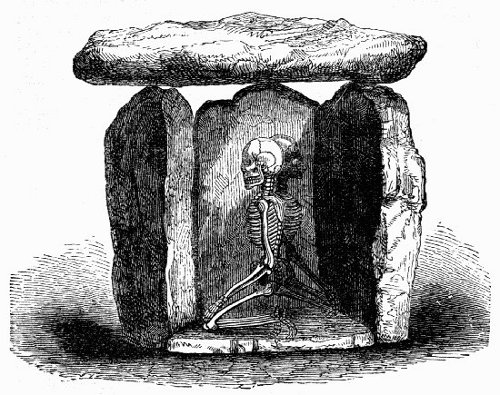
The above sketch represents a chamber which was discovered in a barrow, situated near Paradis, in the parish of the Vale, in the island of Guernsey. On digging into the mound, a large flat stone was soon discovered; this formed the top, or cap-stone, of the tomb, and on removing it, the upper part of two human skulls were exposed to view. One was facing the north, the other the south, but both disposed in a line from east to west. The chamber was filled up with earth mixed with limpet-shells, and as it was gradually removed, while the examination was proceeding downwards into the interior, the bones of the extremities became exposed to view, and were seen to greater advantage. They were less decomposed than those of the upper part; and the teeth and jaws, which were well preserved, denoted that they were the skeletons of adults, and not of old men. The reason why the skeletons were found in this extraordinary position it is impossible to determine. Probably the persons who were thus interred were prisoners, slaves, or other subordinates, who were slain—perhaps buried alive—on occasion of the funeral of some great or renowned personage, who was placed in the larger chamber at the end of the passage; and this view of the case is considerably strengthened by the fact that the total absence of arms, weapons, or vases, in the smaller chamber, denotes that the quality of the persons within it was of less dignity or estimation.
WAR CHARIOT OF ANCIENT EGYPT.
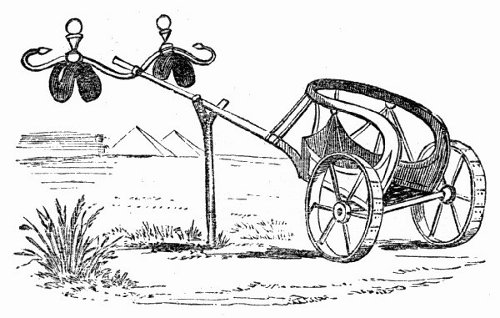
This chariot, which is mentioned in various parts of Scripture, and more especially in the description of the pursuit of the Israelites by Pharaoh, and of his overthrow in the Red Sea, was a very light structure, consisting of a wooden framework strengthened and adorned with metal, and leather binding, answering to the descriptions which Homer has given of those engaged in the Trojan war.
The sides were partly, and the back wholly open; and it was so low that a man could easily step into it from behind; for there was no seat, the rider always standing in war or hunting, though when wearied he might occasionally sit on the sides, or squat, in eastern fashion, on his heels. The body of the car was not hung on the axle in equilibrio, but considerably forward, so that the weight was thrown more upon the horses. Its lightness, however, would prevent this from being very fatiguing to them, and this mode of placing it had the advantage of rendering the motion more easy to the driver. To contribute further to this end, the bottom or floor consisted of a network of interlaced thongs, the elasticity of which in some measure answered the purpose of modern springs.
The Egyptian chariots were invariably drawn by two horses abreast, which were richly caparisoned; it is, perhaps, to the extreme elegance and magnificence of their trappings, no less than to their own beauty, that allusion is made in the Song of Songs (1-9), where the royal bridegroom addresses his spouse thus: "I have compared thee, O my love, to a company of horses in Pharaoh's chariots." The chariot of Egypt ordinarily carried two persons, one of whom acted as the warrior, the other as the charioteer. Occasionally we find three persons in a chariot, as when two princes of the blood, each bearing the royal sceptre, or flabellum, accompanying the king in a state procession, requiring a charioteer to manage the reins.
PEACOCKS.
India, says Mr. Pennant, gave us peacocks, and we are assured by Knox, in his "History of Ceylon," that they are still found in the wild state, in vast flocks, in that island and in Java. So beautiful a bird could not be permitted to be a stranger in the more distant parts; for so early as the days of Solomon (1 Kings, x. 22) we find among the articles imported in his Tarshish navies, apes and peacocks. A monarch so conversant in all branches of natural history, would certainly not neglect furnishing his officers with instructions for collecting every curiosity in the country to which they made voyages, which gave him a knowledge that distinguished him from all the princes of his time. Ælian relates that they were brought into Greece from some barbarous country, and that they were held in such high estimation that a male and female were valued at Athens at 1,000 drachmæ, or £32 5s. 10d. Their next step might be to Samos, where they were preserved about the temple of Juno, being the birds sacred to that goddess; and Gellius, in his "Noctes Atticæ" commends the excellency of the Samian peacocks. It is, therefore probable that they were brought there originally for the purposes of superstition, and afterwards cultivated for the uses of luxury. We are also told, when Alexander was in India, he found vast numbers of wild ones on the banks of the Hyarotis, and was so struck with their beauty as to appoint a severe punishment on any person that killed them.
Peacocks' crests, in ancient times, were among the ornaments of the kings of England. Ernald de Aclent (Acland) paid a fine to King John in a hundred and forty palfries, with sackbuts, lorains, gilt spurs, and peacocks' crests, such as would be for his credit.—Some of our regiments of cavalry bear on their helmets, at present, the figure of a peacock.
ROMAN THEATRE AT ORANGE.
One of the most striking Roman provincial theatres is that of Orange, in the south of France. Perhaps it owes its existence, or at all events its splendour, to the substratum of Grecian colonists that preceded the Romans in that country. Its auditorium is 340 ft. in diameter, but much ruined, in consequence of the princes of Orange having used this part as a bastion in some fortification they were constructing.
The stage is tolerably preserved. It shows well the increased extent and complication of arrangements required for the theatrical representations of the age in which it was constructed, being a considerable advance towards the more modern idea of a play, as distinguished from the stately semi-religious spectacle in which the Greeks delighted. The noblest part of the building is the great wall at the back, an immense mass of masonry, 340 ft. in extent, and 116 ft. in height, without a single opening above the basement, and no ornament except a range of blank arches, about midway between the basement and the top, and a few projecting corbels to receive the footings of the masts that supported the velarium. Nowhere does the architecture of the Romans shine so much as when their gigantic buildings are left to tell their own tale by the imposing grandeur of their masses. Whenever ornament is attempted, their bad taste comes out. The size of their edifices, and the solidity of their construction, were only surpassed by the Egyptians, and not always by them; and when, as here, their mass stands unadorned in all its native grandeur, criticism is disarmed, and the spectator stands awe-struck at its majesty, and turns away convinced that truly "there were giants in those days." This is not, it is true, the most intellectual way of obtaining architectural effect, but it is the easiest and the most certain to secure the desired result.
A PISCATORIAL DOG.
Mr. Jukes, in his "Excursions in and about Newfoundland," speaks of a dog which appeared to be of the pure breed, and which he thought to be more intelligent than the mixed race. This animal caught his own fish, for which purpose he sat on a projecting rock, beneath a fish stage, on which the fish were laid to dry, watching the water, the depth being from six to eight feet, and the bottom quite white with fish-bones. On throwing a piece of cod-fish into the water, three or four heavy, clumsy-looking fish, called in Newfoundland sculpins, would swim to catch it. The instant one turned his broadside towards him, he darted down, and seldom came up without the fish in his mouth. He regularly carried them as he caught them to a place a few yards off, where he deposited them, sometimes making a pile of fifty or sixty in the day. As he never attempted to eat them, he appeared to fish for his amusement.
PHENOMENA OF SOUND.
In the gardens of Les Rochas, once the well-known residence of Madame de Sevigné, is a remarkable echo, which illustrates finely the conducting and reverberating powers of a flat surface. The Château des Rochas is situated not far from the interesting and ancient town of Vitre. A broad gravel walk on a dead flat conducts through the garden to the house. In the centre of this, on a particular spot, the listener is placed at the distance of about ten or twelve yards from another person, who, similarly placed, addresses him in a low and, in the common acceptation of the term, inaudible whisper, when, "Lo! what myriads rise!" for immediately, from thousands and tens of thousands of invisible tongues, starting from the earth beneath, or as if every pebble was gifted with powers of speech, the sentence is repeated with a slight hissing sound, not unlike the whirling of small shot passing through the air. On removing from this spot, however trifling the distance, the intensity of the repetition is sensibly diminished, and within a few feet ceases to be heard. Under the idea that the ground was hollow beneath, the soil has been dug up to a considerable depth; but without discovering any clue to the solution of the mystery.
ANTIQUE WATCH.
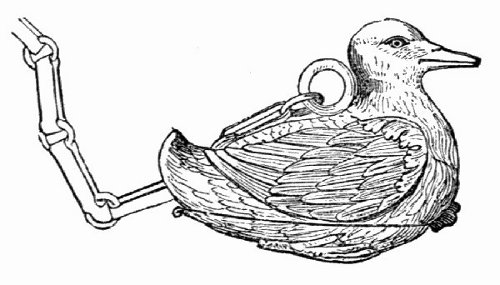
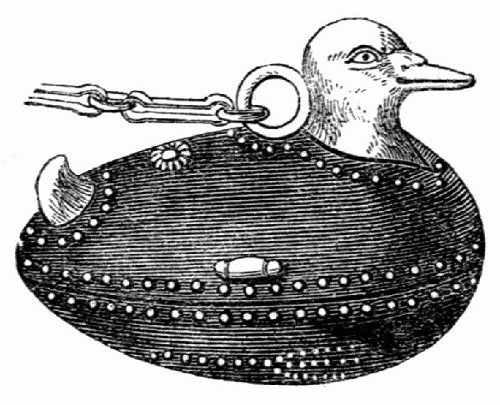
The above engraving represents a fancy silver watch of the time of Queen Elizabeth. It is shaped like a duck; the feathers chased. The lower part opens, and the dial plate, which is also of silver, is encircled with a gilt ornamental design of floriated scrolls and angels' heads. The wheels work on small rubies. It has no maker's name. It is preserved in the original case of thin brass, covered with black leather, and ornamented with silver studs, as represented in the woodcut below. It forms one of the curiosities in the Museum of Lord Londesborough.
HORSES FEEDING ONE ANOTHER.
M. de Bossanelle, captain of cavalry in the regiment of Beauvilliers, relates in his "Military Observations," printed in Paris, 1760, "That, in the year 1757, an old horse of his company, that was very fine and full of mettle, had his teeth all on a sudden so worn down, that he could not chew his hay and corn; and that he was fed for two months, and would still have been so had he been kept, by two horses on each side of him, that ate in the same manger. These two horses drew hay from the rack, which they chewed, and afterwards threw before the old horse; that they did the same with the oats, which they ground very small, and also put before him. This (adds he) was observed and witnessed by a whole company of cavalry, officers and men."
CROSS OF MUIREDACH.
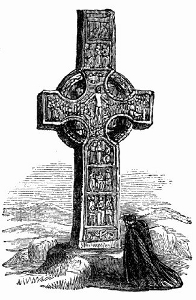
From the rude pillar-stone marked with the symbol of our faith, enclosed within a circle, the emblem of Eternity, the finely-proportioned and elaborately-sculptured crosses of a later period are derived. In the latter, the circle, instead of being simply cut on the face of the stone, is represented by a ring, binding, as it were, the shaft, arms, and upper portion of the cross together. There are two beautiful specimens of this style of cross at Monasterboice, near Drogheda, about thirty-five miles from Dublin. The smaller, more beautiful, and more perfect of these we here engrave. The figures and ornaments with which its various sides are enriched appear to have been executed with an unusual degree of artistic skill. It is now almost as perfect as it was when, nearly nine centuries ago, the artist, we may suppose, pronounced his work finished, and chiefs and abbots, bards, shanachies, warriors, and ecclesiastics, and, perhaps, many a rival sculptor, crowded round this very spot full of wonder and admiration for what they must have considered a truly glorious, and, perhaps, unequalled work. An inscription in Irish upon the lower part of the shaft, desires "A prayer for Muiredach, by whom was made this cross," and there is reason for assigning it to an abbot of that name who died in the year 924. Its total height is exactly fifteen feet, and it is six in breadth at the arms. The shaft, which at the base measures in breadth two feet six inches, and in thickness one foot nine inches, diminishes slightly in its ascent, and is divided upon its various sides by twisted bands into compartments, each of which contains either sculptured figures, or tracery of very intricate design, or animals, probably symbolical.
CHINESE THERAPEUTICS.
In the treatment of disease, the Chinese, so fond of classification, divide the medicinal substances they employ into heating, cooling, refreshing, and temperate: their materia medica is contained in the work called the Pen-tsaocang-mou in fifty-two large volumes, with an atlas of plates; most of our medicines are known to them and prescribed; the mineral waters, with which their country abounds, are also much resorted to; and their emperor, Kang-Hi, has given an accurate account of several thermal springs. Fire is a great agent, and the moxa recommended in almost every aliment, while acupuncture is in general use both in China and Japan; bathing and champooing are also frequently recommended, and bloodletting is seldom resorted to.
China has also her animal magnetisers, practising the Cong fou, a mysterious manipulation taught by the bonzes, in which the adepts produce violent convulsions.
The Chinese divide their prescriptions into seven categories:
1. The great prescription. 2. The little prescription. 3. The slow prescription. 4. The prompt prescription. 5. The odd prescription. 6. The even prescription. 7. The double prescription.
Each of these receipts being applied to particular cases, and the ingredients that compose them being weighed with the most scrupulous accuracy.
Medicine was taught in the imperial colleges of Pekin; but in every district, a physician, who had studied six years, is appointed to instruct the candidate for the profession, who was afterwards allowed to practise, without any further studies or examination; and it is said, that, in general, the physician only receives his fee when the patient is cured. This assertion, however, is very doubtful, as the country abounds in quacks, who, under such restrictions as to remuneration, would scarcely earn a livelihood. Another singular, but economical practice prevails amongst them—a physician never pays a second visit to a patient unless he is sent for. Whatever may be the merits of Chinese practitioners both in medicine and surgery, or their mode of receiving remuneration, it appears that they are as much subject to animadversion as in other countries:—A missionary having observed to a Chinese, that their medical men had constantly recourse to fire in the shape of moxa, red-hot iron, and burning needles; he replied, "Alas! you Europeans are carved with steel, while we are martyrized with hot iron; and I fear that in neither country will the fashion subside, since the operators do not feel the anguish they inflict, and are equally paid to torment us or to cure us!"
MARY QUEEN OF SCOTS TO SIR FRANCIS KNOLLYS, FROM BOLTON, SEPT. 1ST, 1568: HER FIRST LETTER IN ENGLISH. (MS. Cotton. Calig. C. I. fol. 161 b. Orig.)
Mester Knoleis, y heuv har (I have heard) sum neus from Scotland; y send zou the double off them y vreit (wrote) to the quin (queen) my gud Sister, and pres (pray) zou to du the lyk, conforme to that y spak zesternicht vnto zou, and sut hesti ansur y refer all to zour discretion, and wil lipne beter in zour gud delin (dealing) for mi, (me) nor y kan persuad zou, nemli in this langasg (language) excus my ivil vreitin (writing) for y neuver vsed it afor, and am hestit (hasted). Ze schal si my bel (bill) vhuilk (which) is opne, it is sed Seterday my unfrinds wil be vth (with) zou, y sey nething bot trests weil, and ze send oni to zour wiff ze mey asur schu (she) wald a bin weilcom to apur (poor) strenger hua (who) nocht bien (not being) aquentet vth her, wil nocht bi ouuer bald (bold) to vreit bot for the aquentans betuix ous (us: i. e. herself and Sir Francis Knolles). Y wil send zou letle tokne (token) to rember (remember) zou off the gud hop y heuu (have) in zou guef (gif—if) ze fend (find) a mit (meet) mesager y wald wish ze bestouded (bestowed) it reder (rather) apon her non (than) ani vder; thus effter my commendations y prey God heuu zou in his kipin.
"Zour asured gud frind. "Marie R.
"Excus my ivel vreitin thes furst tym."
PHILOSOPHY OF THE BRAMINS.
The order of creation, which is described in the Institutes of Menu (c. 1, pp. 75-8), is remarkable. "First emerges the subtle ether, to which philosophers ascribe the quality of conveying sound: from ether, effecting a transmutation in form, springs the pure and potent air, a vehicle of all scents; and air is held endued with the quality of touch: then from air, operating a change, rises light, or fire, making objects visible, dispelling gloom, spreading bright rays; and it is declared to have the quality of figure: but from light, a change being effected, comes water, with the quality of taste: and from water is deposited earth, with the quality of smell; such were they created in the beginning." This passage bears at least as strong a resemblance to the chemical philosophy of our days, as certain parts of the Hindoo fables bear to the mysteries of the Christian religion. But it is more difficult to account for the philosophy, (if, indeed, it be any thing more than mere theory,) than to explain how the distorted traces of Christianity found their way into the fables of Hindostan.
FOREIGNERS IN LONDON IN 1567.
"We learn from the Bishop of London's certificate, that, in December, 1567, there were then in London and its immediate vicinity, or places which are now included in the word 'London,' 3838 Dutchmen; 720 Frenchmen; 137 Italians; 14 Venetians; 56 Spaniards; 25 Portuguese; 2 Grecians; 2 Blackamores; 1 Dane; and but 58 Scots! making a total of 4851 foreigners."
CHANGES OF FORTUNE.
In 1454, Sir Stephen Forster was Lord Mayor of London. He had been long in prison and penury, on account of his inordinate profuseness. It chanced that a most fantastical widow, who knew not how to get rid of her immense wealth, saw him begging at the gate; she admired his fine person, learnt his history, paid his debts, and married him; asking of him only this one favour, that he would lavish away her fortune as fast as he could. Forster, probably from perverseness, became a sober husband and a prudent manager, and only expended large sums in adding a chapel and other advantageous appendages to Ludgate, where he had suffered so many hardships.
ROMAN VASES IN BLACK WARE.
The principal subjects represented on vases of ancient Roman pottery of black ware are hunting scenes—such as dogs chasing stags, deer, hares,—also, dolphins, ivy wreaths, and engrailed lines; and engine-turned patterns. In a few instances men with spears are represented, but in a rude and debased style of art. The principal form is the cup of a jar shape, sometimes with deep oval flutings, as on one found at Castor; but dishes, cups, plates, and mortars are not found in this ware.
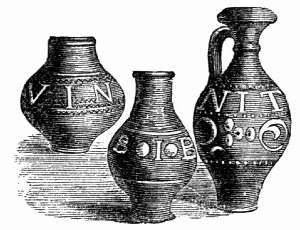
Some of the vases of this ware have ornaments, and sometimes letters painted on them in white slip upon their black ground, as represented in our engraving. They are generally of a small size, and of the nature of bottles or cups, with inscriptions, such as AVE, hail! VIVAS, may you live! IMPLE, fill; BIBE, drink; VINVM, wine; VIVA, life; VIVE BIBE MVLTIS; showing that they were used for purposes purely convivial. Such are the vases found at Etaples, near Boulogne, the ancient Gessoriacum, and at Mesnil.
Some rarer and finer specimens from Bredene, in the department of Lis, have a moulding round the foot. Great quantities are found in England, Holland, Belgium, and France. It is found on the right bank of the Rhine. A variety of this ware has been lately found at a spot called Crockhill, in the New Forest, together with the kilns in which it was made, and a heap of potter's sherds, or pieces spoilt in the baking. The paste was made of the blue clay of the neighbourhood, covered with an alkaline glaze of a maroon colour, perhaps the result of imperfect baking; for the pieces when submitted again to the action of the fire, decrepitated and split. They were so much vitrified as to resemble modern stone ware, yet as all of them have proofs of having been rejected by the potters, it is probable that this was not the proper colour of the ware. Almost all were of the pinched up fluted shape, and had no bas-reliefs, having been ornamented with patterns laid on in white colour. The kilns are supposed to be of the third century of our era, and the ware was in local use, for some of it was found at Bittern.
FRENCH BIBLE.
There was a French Bible, printed at Paris in 1538, by Anthony Bonnemere, wherein is related "that the ashes of the golden calf which Moses caused to be burnt, and mixed with the water that was drank by the Israelites, stuck to the beards of such as has had fallen down before it; by which they appeared with gilt beards, as a peculiar mark to distinguish those which had worshipped the calf." This idle story is actually interwoven with the 32nd chapter of Exodus. And Bonnemere says, in his preface, this French Bible was printed in 1495, at the request of his most Christian Majesty Charles VIII.; and declares further that the French translator "has added nothing but the genuine truths, according to the express terms of the Latin Bible; nor omitted anything but what was improper to be translated!" So that we are to look upon this fiction of the gilded beards as matter of fact; and another of the same stamp, inserted in the chapter above mentioned, viz., that, "Upon Aaron's refusing to make gods for the Israelites, they spat upon him with so much fury and violence that they quite suffocated him."
SARDONYX RING WITH CAMEO HEAD OF QUEEN ELIZABETH, IN THE POSSESSION OF REV. LORD THYNNE.
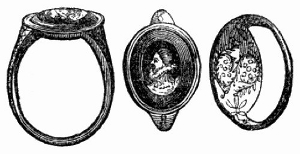
This is said to be the identical ring given by Queen Elizabeth to Essex, and so fatally retained by Lady Nottingham. It has descended from Lady Frances Devereux, Essex's daughter, in unbroken succession from mother and daughter to the present possessor. The ring is gold, the sides engraved, and the inside of blue enamel; the execution of the head of Elizabeth is of a high order, and whether this be the ring or not, it is valuable as a work of art.
CURIOUS WAGERS.
There have been travelling wagers, and none of the least singular of such was that of Mr. Whalley, an Irish gentleman (and who we believe edited Ben Johnson's works), who, for a very considerable wager (twenty thousand pounds, it was said,) set out on Monday the 22nd of September, 1788, to walk to Constantinople and back again in one year. This wager, however whimsical, is not without a precedent. Some years ago a baronet of good fortune (Sir Henry Liddel) laid a considerable wager that he would go to Lapland, bring home two females of that country, and two rein-deer, in a given time. He performed the journey, and effected his purpose in every respect. The Lapland women lived with him about a year, but desiring to go back to their own country, the baronet furnished them with means and money.
CONFECTIONERY ART IN 1660.
The following is extracted from a work on Cookery, by Robert May, published in 1660. It is entitled the "Accomplisht Cook, &c., &c.
"Triumphs and Trophies in Cookery, to be used in Festival Times, as Twelfth Day, &c.:—Make the likeness of a ship in pasteboard with flags and streamers, the guns belonging to it of kickses, bind them about with pack-thread and cover them with paste proportionable to the fashion of a cannon with carriages; lay them in places convenient, as you see them in ships of war, with such holes and trains of powder that they may all take fire. Place your ships firm in a great charger; then make a salt round about it, and stick therein egg-shells full of sweet water; you may by a great pin take out all the meat out of the egg by blowing, and then fill it with rose-water. Then in another charger have the proportion of a stag made of coarse paste, with a broad arrow in the side of him, and his body filled up with claret wine. In another charger at the end of the stag have the proportion of a castle with battlements, percullices, gates, and drawbridges, made of pasteboard, the guns of kickses, and covered with coarse paste as the former; place it at a distance from the ship to fire at each other. The stag being placed betwixt them, with egg-shells full of sweet water (as before) placed in salt. At each side of the charger wherein is the stag, place a pie made of coarse paste, in one of which let there be some live frogs, in the other live birds; make these pies of coarse paste, filled with bran, and yellowed over saffron, or yolks of eggs: gild them over in spots, as also the stag, the ship and castle; bake them, and place them with gilt bay leaves on the turrets and tunnels of the castle and pies; being baked make a hole in the bottom of your pies, take out the bran, put in your frogs and birds, and close up the holes with the same coarse paste; then cut the lids neatly up to be taken off by the tunnels. Being all placed in order upon the table, before you fire the trains of powder, order it so that some of the ladies may be persuaded to pluck the arrow out of the stag; then will the claret wine follow, as blood running out of a wound. This being done with admiration to the beholders, after some short pause, fire the train of the castle, that the pieces all of one side may go off; then fire the trains of one side of the ship as in a battle; next turn the chargers, and by degrees fire the trains of each other side, as before. This done, to sweeten the stink of the powder, the ladies take the egg-shells full of sweet waters, and throw them at each other, all dangers being seemed over, and by this time you may suppose they will desire to see what is in the pies; when lifting first the lid off one pie, out skip some frogs, which makes the ladies to skip and shriek; next after the other pie, whence comes out the birds; who by a natural instinct flying at the light, will put out the candles; so that what with the flying birds and skipping frogs, the one above, the other beneath, will cause much delight and pleasure to the whole company: at length the candles are lighted and a banquet brought in, the music sounds, and every one with much delight and content rehearses their actions in the former passages. These were formerly the delights of the nobility, before good house-keeping had left England, and the sword really acted that which was only counterfeited in such honest and laudable exercises as these."
SUSPENDED ANIMATION.
David Beck, the celebrated portrait painter, and pupil of Vandyke, travelling through Germany, was suddenly taken ill, and to all appearance died, and was laid out as a corpse. His servants, sitting round the bed, grieved heartily for the loss of so good a master; and, as grief is thirsty, drank as heartily at the same time. One of them, becoming more fuddled than the rest, then addressed his companions thus: "Our master when alive was fond of his glass, let us now, out of gratitude, then give him one now he is dead." Assent was given, the head of the dead painter was raised up, and some wine poured down or spilt about, the fragrance or spirit of which caused Beck to open his eyes; upon which the servant, who, being drunk, half forgetting his master was dead, forced down the remainder of the glass. The painter gradually revived, and thus escaped a living interment.
FUNERAL OF MARAT.
The funeral of Marat was celebrated at Paris, July 17th, 1793, with the greatest pomp and solemnity. All the sections joined the procession. An immense crowd of people attended it. Four women bore the bathing machine in which Marat was standing when he was assassinated; his shirt, stained with blood, was carried by a fury, in the shape of a woman, at the top of a pike. After this followed a wooden bedstead, on which the corpse of Marat was carried by citizens. His head was uncovered, and the gash he had received could be easily distinguished. The procession was paraded through several streets, and was saluted on its march by several discharges of artillery.
EXECUTION OF ANNE BOLEYN.
In Houssaie's "Memoirs," Vol. I. p. 435, a little circumstance is recorded concerning the decapitation of the unfortunate Anne Boleyn, which illustrates an observation of Hume. Our historian notices that her executioner was a Frenchman of Calais, who was supposed to have uncommon skill; it is probable that the following incident might have been preserved by tradition in France, from the account of the executioner himself. Anne Boleyn being on the scaffold, would not consent to have her eyes covered with a bandage, saying that she had no fear of death. All that the divine who assisted at her execution could obtain from her was, that she would shut her eyes. But as she was opening them at every moment, the executioner could not bear their tender and mild glances. Fearful of missing his aim, he was obliged to invent an expedient to behead the queen. He drew off his shoes, and approached her silently; while he was at her left hand, another person advanced at her right, who made a great noise in walking, so that this circumstance drawing the attention of Anne, she turned, her face from the executioner, who was enabled by this artifice to strike the fatal blow without being disarmed by that pride of affecting resignation which shone in the eyes of the lovely Anne Boleyn.
MEXICAN TENNIS.
The Mexicans had one singular law in their play with the ball. In the walls of the court where they played certain stones, like mill-stones were fixed, with a hole in the middle, just large enough to let the ball pass through; and whoever drove it through, which required great skill, and was, of course, rarely effected, won the cloaks of the lookers-on. They, therefore, took to their heels to save their cloaks, and others pursued to catch them, which was a new source of amusement.
CURIOUSLY-SHAPED VESSEL.
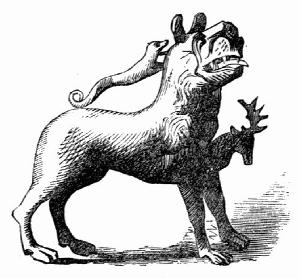
There is a singular class of Northern relics, of the Christian Period, of which analogous types have been found in Scotland, which well deserve our attention. The relics of which we speak consist of a curious variety of vessels, presumed to have been designed for holding liquors, but invariably made in the form of some animal or monstrous hybrid. The annexed figure represents one of these, in the collection of Charles Kirkpatrick Sharp, Esq., and found by him among a hoard of long-forgotten family heirlooms, in a vault of his paternal mansion of Hoddam Castle, Dumfriesshire. Of its previous history nothing is known. It is made of bronze. The principal figure is a lion, without a tail, measuring fourteen inches in length, and nearly fourteen inches in greatest height. On the back is perched a nondescript animal, half greyhound, half fish, apparently intended for a handle to the whole, while from the breast projects a stag's head with large antlers. This has a perforation in the back of the neck, as if for the insertion of a stop-cock, and it appears probable was designed for running off the liquid contained within the singular vessel to which it is attached. A small square lid on the top of the lion's head, opening with a hinge, supplies the requisite aperture for whatever liquor it was designed to hold. A similar relic, possessed by Sir John Maxwell, Bart., was dug up a few years since on the Pollock estate; and another, in the collection of the late E. W. A. Drummond Hay, Esq., was also in the form of a lion.
A SENSIBLE DOG.
Professor Owen was walking with a friend, the master of the dog, by the side of a river, near its mouth, on the coast of Cornwall, and picked up a small piece of seaweed. It was covered with minute animals, and Mr. Owen observed to his companion, throwing the weed into the water,—"If this small piece afforded so many treasures, how microscopically rich the whole plant would be! I should much like to have one!" The gentleman walked on; but hearing a splashing in the water, turned round and saw it violently agitated. "It is Lion!" both exclaimed. "What can he be about? He was walking quietly enough by our side a minute ago." At one moment they saw his tail above the water, then his head raised for a breath of air, then the surrounding element shook again, and at last he came ashore, panting from his exertions, and laid a whole plant of the identical weed at Mr. Owen's feet. After this proof of intelligence, it will not be wondered at, that when Lion was joyfully expecting to accompany his master and his guest on an excursion, and was told to go and take care of and comfort Mrs. Owen, who was ill, that he should immediately return to the drawing-room, and lay himself by her side, which he never left during the absence of his owner; his countenance alone betraying his disappointment, and that only for a few minutes.
THE CROWN OF CHARLEMAGNE.
As the emblem of sovereignty which once adorned the brows of one of earth's mightiest men, and as a unique specimen of the state at which the goldsmith's art had arrived as early as the ninth century, we here present our readers with an engraving of the crown of Charlemagne.
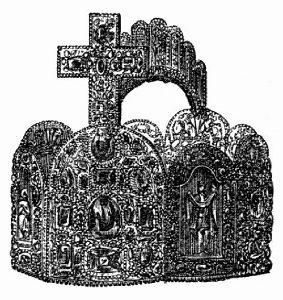
This great man was the eldest son of Pepin the Short, and grandson of Charles Martel, and was born at the castle of Ingelheim, near Metz, in the year 742. His father dying in 768 he succeeded to the crown in conjunction with his brother Carloman, whose death in 771 left him sole monarch of the Franks. By his alliances, negociations, and principally by his numerous and glorious wars, he so enlarged his dominions, that at length they extended from the Ebro to the mouth of the Elbe, from the Atlantic to the mountains of Bohemia and the Saal, and from the British Channel to the Volturno. In the year 800 he was crowned at Rome, as Emperor of the West, by Pope Leo III., and died of a pleurisy in 814, at Aix-la-Chapelle, in the cathedral of which city he was buried with extraordinary magnificence. Equally illustrious in the cabinet and in the field, a wise legislator, and a great warrior, the patron of men of letters, and the restorer of learning, Charlemagne has united in his favour the suffrages of statesmen and soldiers, and of ecclesiastics, lawyers, and men of letters, who have all vied with one another in bestowing the homage of their praise on the celebrated founder of the Western Empire.
The crown of this illustrious man, of which our engraving is a correct representation, is now preserved at Vienna in the Imperial Treasury. It is composed of eight plates of gold, four large and four small, connected by hinges. The large ones, studded with precious stones, form the front, the back, and the intermediate points of the crown; the small ones, placed alternately with these, are ornamented with enamels representing Solomon, David, King Hezekiah seated on his throne, and Christ seated between two flaming seraphim, such as the Greeks usually represent them. The costume of the figures resembles that of the Emperors of the Lower Empire, and although the inscriptions which accompany the figures are in Latin, the whole bears the impress of Greek workmanship. The ground of the figures is formed by the metal itself, which has been hollowed out to receive the enamel; but all the details of the design are traced out with fine fillets of gold. The flesh-tints are in rose-coloured enamel; the colours employed in the draperies and accessories are deep and light blue, red, and white. The crown has unquestionably been retouched at various periods, but yet there is nothing to invalidate the tradition which assigns the more ancient portions to the time of Charlemagne. The enamels must belong to the same early period.
SPENT BY THE CORPORATION OF COVENTRY AT THE ENTERTAINMENT OF KING JAMES II. IN HIS PROGRESS THROUGH COVENTRY, 1687. (Mr. Richard Haywood, Treasurer.)
£ s. d.
Gave a gold cup 171 17 6
Mr. Septimus Butt, mayor, for sweetmeats 27 17 0
Meat 13 14 0
Wine 21 12 6
Homage fee 41 6 8
King's cook 10 0 0
City cook 9 8 6
Steward Fielding, for making a speech to his Majesty 5 7 6
For linen spoiled, borrowed of Mrs. Smith, Spon-street 2 12 6
The aldermen that went to Worcester to invite him 3 18 9
Several companies for waiting on the King 27 9 4
Alderman Webster, for meat 3 6 0
Alderman Bradney for corn 3 5 6
His Majesty's clerk of the market 1 1 6
The King's trumpeters 2 0 0
Richard Howcott, for carrying the city streamer 0 7 0
The city bailiff's bill for fish, fowl, and wine 88 18 2
—— —— ——
£434 2 9
—— —— ——
TRAVELLING EXPENSES IN THE THIRTEENTH CENTURY.
Of travelling expenses in the thirteenth century, a roll is in existence, and is too interesting to be passed over. It contains a steward's accompts of the daily expenses of a person of rank in the reign of Edward I, on a journey from Oxford to Canterbury, and during his sojourn in London, about the year 1289; while the record throws much light upon the mode of our ancestors' living, at a period concerning which we have very few similar memorials. One day's expenses are as follow: "In bread, sixpence. Two gallons of wine, a gift of hospitality from the rector of Berton. Item in bread, sixpence. Two gallons of wine, a gift of hospitality from the rector of Mistern. Beer, sixpence. Herrings, threepence. Stockfish, fourpence. Porpoise and fish, fourpence. Perch and roach, seven-pence. Large eels, seven-pence. Vegetables, threepence farthing. Figs and raisins, twopence. Fuel, five-pence. A bed for two nights, twopence. Hay for seven horses, seven-pence. A bushel of oats, twenty-pence. Apples, a halfpenny. Sum, six shillings and eight-pence halfpenny." The most expensive day in the roll is on a Sunday, "in expenses of my lord at Westminster, when he held a breakfast there for knights, clerks, and squires. Bread, two shillings. Beer, twelve-pence. Wine, three shillings and eight-pence. Half a salmon, for the standard, with the chine, three shillings and eight-pence. A fresh conger eel, three shillings. Three fat pikes, five fat eels, and twenty-seven fat roaches, twelve shillings and fourpence. Half a hundred lamprorns, twelve-pence. Oysters, threepence. Vegetables, twopence. The hire of a boy to prepare the breakfast, one penny. Fare to Westminster, one penny. A basket, one penny farthing. On the same day at the inn: bread, five-pence farthing. Beer from the store. Two gallons of beer for the boys, twopence. Fish from the store. Candles, a halfpenny. Fuel, a halfpenny. Hay bought, five-pence three farthings. Straw, sixpence. Two bushels of oats, eight-pence. Two pair of shoes for my lord, twelve-pence. Sum, thirty shillings and threepence farthing."
DUNS IN THE MAHRATTA COUNTRY.
The Mahratta mode of recovering debts is curious. When the creditor cannot get his money, and begins to see the debt as rather desperate, he sits dhurna upon his debtor; that is, he squats down at the door of the tent, and becomes, in a certain mysterious degree, the master of it. No one goes in or out without his approbation. He neither eats himself, nor suffers his debtor to eat; and this famishing contest is carried on till the debt is paid, or till the creditor begins to feel that want of food is a greater punishment than the want of money. This curious mode of enforcing a demand is in universal practice among the Mahrattas; Scindiah himself, the chieftain, not being exempt from it. The man who sits the dhurna, goes to the house, or tent, of him whom he wishes to bring to terms, and remains there till the affair is settled; during which time, the one under restraint is confined to his apartment, and not suffered to communicate with any persons but those whom the other may approve of. The laws by which the dhurna is regulated are as well defined and understood as those of any other custom whatever. When it is meant to be very strict, the claimant carries a number of his followers, who surround the tent, sometimes even the bed of his adversary, and deprive him altogether of food; in which case, however, etiquette prescribes the same abstinence to himself: the strongest stomach, of course, carries the day. A custom of this kind was once so prevalent in the province and city of Benares, that Brahmins were trained to remain a long time without food. They were then sent to the door of some rich individual, where they made a vow to remain without eating, till they should obtain a certain sum of money. To preserve the life of a Brahmin is so absolutely a duty, that the money was generally paid; but never till a good struggle had taken place, to ascertain whether the man was staunch or not; for money is the life and soul of all Hindoos.
VAUXHALL.
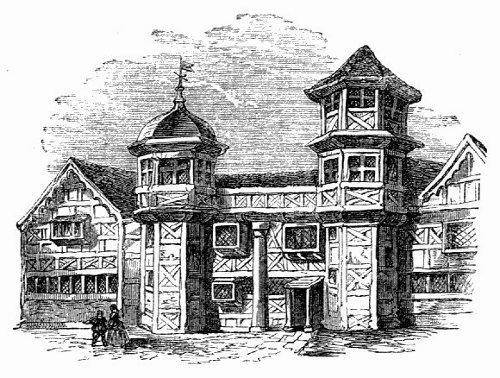
The trees seen above the houses at the foot of the Surrey side of Westminster Bridge are those of Vauxhall Gardens, the site of which will soon be covered with buildings. These grounds were once the glory of English pleasure-gardens, frequented by the highest in the land from the gay days of Charles II. to those of "the Regency," and were celebrated in musical history for talent of the highest kind here introduced. In the old orchestra, whose towering summit may be seen from the Thames, the greatest musical celebrities have sung. Handel, Dr. Arne, and Hook superintended its concerts; and Hogarth decorated its walls with paintings. It obtained its name from a very old mansion that once stood near it. This old manor-house of Fawkes Hall, as it existed in the reign of Charles I., is shown in our engraving; at that time it was described as a "fair dwelling-house, strongly built, of three stories high, and a pier staircase breaking out from it nineteen feet square." This staircase occupied one of the towers, in accordance with the ancient plan, and the house was a curious specimen of the old timber houses of the gentry in the sixteenth century.
It appears to have obtained its name from Foukes de Breut, who married the heiress of the manor, the Countess of Albemarle, sister to Baldwin, Archbishop of Canterbury; and it was granted by the name of the manor of Foukeshall, by Edward III. to his favourite Hugh le Despenser. In 1615 the records of the Duchy of Cornwall prove the premises known as Vauxhall Gardens to have been the leasehold property of Jane Vaux, widow of John Vaux, citizen and vintner of London, and a benefactor to the parish of Lambeth. It has always remained, with the manor of Kennington, as the property of the crown, and belongs to the Prince of Wales as part of his Duchy of Cornwall. Vauxhall Gardens closed for ever on July 25th, 1859, with an al fresco fête.
EGYPTIAN TOILET BOXES.
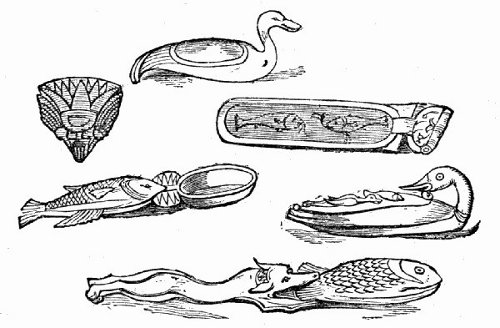
The ladies of ancient Egypt were very fond of having their apartments set off with a profusion of knick-knacks, and among other articles of that sort, they usually had several different kinds of toilet-boxes on their dressing-tables. The above engraving represents a group of them. They have been found in considerable numbers among the ruins of the palaces, and they form interesting objects among the Egyptian curiosities in many of our museums. They were made of wood, or of ivory, often inlaid, and always elaborately carved. Sometimes they partook of the nature of spoons, the containing part being shallow, at the end of a long solid handle; the handle was carved into the most fanciful forms—a grotesque human figure, a woman, a fox, or a fish—and the spoon part was generally covered with a lid, which turned on a pivot. In one of those in the engraving, the spoon takes the form of a fish, the cover being carved to resemble its scales, while another, also in the form of a fish, has two cavities, the one covered, the other permanently open. Sometimes the body of a goose formed the box, either trussed for the table, or in the posture of life, and other forms were devised from the fancy of the artist. Some of these shallow boxes are supposed to have been used for holding small quantities of ointments and cosmetics upon the toilet-table.
SPACIOUS KITCHEN.
One of the most spacious kitchens in England is that of Raby Castle, the magnificent seat of the Duke of Cleveland. It is a square of thirty feet, having three chimneys, one for the grate, a second for stoves, and the third, (now stopped up,) for the great cauldron. The roof is arched, with a small cupola in the centre: it has likewise five windows, from each of which steps descend, but only in one instance to the floor; and a gallery runs round the whole interior of the building. The ancient oven is said to have allowed a tall person to stand upright in it, its diameter being fifteen feet. It has since been converted into a wine cellar, the sides being divided into ten parts, and each holding a hogshead of wine in bottles. Vast as is this kitchen, it must have been but suitable to the hospitality of former ages: for, in one of the apartments of Raby Castle, seven hundred knights are stated to have been entertained at one time.
THE HAWTHORNDEN CAVES.
In almost every country on the earth there are natural or artificial caves, which have supplied hiding-places, retreats for anchorites, and even permanent native dwellings. Such caves abound in Scotland, and especially along the coast, but in general their interest arises rather from the associations of popular traditions, than from any intrinsic peculiarity of character pertaining to them. Few such retreats are more remarkable, either for constructive art, or historic associations, than the well-known caves beneath the old tower of Hawthornden, near Edinburgh. They have been hewn, with great labour and ingenuity, in the rocky cliff which overhangs the river Esk. No tradition preserves the history or date of their execution, but concealment was evidently the chief design of the excavators. The original entrance is most ingeniously made in the shaft of a very deep draw-well, sunk in the court-yard of the castle, and from its manifest utility as the ordinary and indispensable appendage of the fortress, it most effectually conceals its adaptation as a means of ingress and communication with the rock chambers beneath. These are of various forms and sizes, and one in particular is pierced with a series of square recesses, somewhat resembling the columbaria of a Roman tomb, but assigned by popular tradition as the library of its later owner, Drummond, the Scottish poet. Whatever was the purpose for which these were thus laboriously cut, the example is not singular. A large cave in Roxburghshire, hewn out in the lofty cliff which overhangs the Teviot, has in its sides similar recesses, and from their supposed resemblance to the interior of a pigeon-house, the cavern has received the name of the Doo-cave. Authentic notices of the Hawthornden caves occur so early as the reign of David II., when a daring band of Scottish adventurers made good their head-quarters there, while Edward held the newly-fortified castle of Edinburgh, and the whole surrounding district. In the glen of the little river Ale, which falls into the Teviot at Ancrum, extensive groups of caves occur, all indicating, more or less, artificial adaptation as human dwellings; and in many other districts similar evidences may be seen of temporary or permanent habitation, at some remote period, in these rude recesses. Along the coast of Arran there are several caves of various dimensions, one of which, at Drumandruin, or Drumidoon, is noted in the older traditions of the island as the lodging of Fin M'Coul, the Fingal of Ossian, during his residence in Arran. Though low in the roof, it is sufficiently capacious for a hundred men to sit or lie in it. In this, as in other examples, we find evidences of artificial operations, proving its connexion with races long posterior to those with whose works we have chiefly to do in this section of archaeological inquiry. In the further end a large detached column of rock has a two-handed sword engraved on it, surmounted by a deer, and on the southern side of the cave a lunar figure is cut, similar in character to those frequently found on the sculptured pillars and crosses which abound in Scotland. It is now more frequently styled the king's cave, and described as the retreat of Robert the Bruce, while he lurked as a fugitive in the Western Isles; but, like many other traditions of the Bruce, this seems to be of very recent origin. Other caves in the same island are also of large dimensions, and variously associated with popular traditions, as, indeed, is generally the case where subterranean retreats of any considerable extent occur. Some are the supposed dwellings of old mythic chiefs, whose names still live in the traditional songs of the Gael. Others are the retreats which the primitive confessors of Scotland excavated or enlarged for their oratories or cells. Of the latter class are the caves of St. Molio, on the little island of Lamlash, or the Holy Isle, on the east coast of Arran; of St. Columba and St. Cormac, on the Argyleshire coast; of St. Ninian, in Wigtonshire; of St. Serf, at Dysart, on the Fifeshire coast; and the celebrated "ocean cave of St. Rule, in Saint Andrew's Bay." This last oratory consists of two chambers hewn out of the sandstone cliffs of that exposed coast. The inner apartment is a plain cell, entered from the supposed oratory of the Greek saint. The latter is nearly circular, measuring about ten feet in diameter, and has a stone altar hewn in the solid rock on its eastern side.
MONKISH PRAYERS.
The Monks used to pray heartily, or rather say their prayers no less than seven times in the twenty-four hours. We will give their names:—
1st.—Nocturnal, at cock-crowing, or two o'clock in the morning. 2nd.—Matins, at six o'clock in the morning. 3rd.—Tierce, at nine o'clock in the morning. 4th.—Sext, at twelve o'clock at noon. 5th.—None, at three o'clock in the afternoon. 6th.—Vespers, at six o'clock in the afternoon. 7th.—Compline, soon after seven.
Quarles has a neat epigram on the subject:—
For all our prayers th' Almighty does regard The judgment of the balance, not the yard; He loves not words, but matter; 'tis his pleasure To buy his wares by weight, and not by measure.
THE TRAP-DOOR SPIDER.
There are few insects of such extraordinary habits as the Trap-door Spider, and the following account of it by Professor Jones is so interesting, that we are glad to extract it from his excellent work on insect Architecture:—
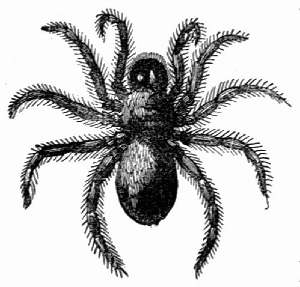
TRAP-DOOR SPIDER.
In the Ionian islands, and also in the West Indies [as well as in the south of France, and in Corsica], there are found certain spiders (Cteniza) commonly known as Trap-door Spiders, which make a cylindrical nest in the earth, and cover the entrance with a door of their own construction, framed of alternate layers of silk and earth, and fastened to the opening by a hinge of stout silk. These spiders also line their nests throughout with numerous layers of silken web to the thickness of stout cartridge paper, and finish it with the greatest care. This beautiful lining is yet further strengthened in particular parts, where the nest is likely to be exposed to danger. But the greatest amount of skill and care is bestowed upon the trap-door and its silken hinge. The door is about the eighth of an inch thick, rough on the outside, not much unlike an oyster-shell, which it also resembles in being thick and strong near the hinge, but thinner towards the circumference. The breadth of this hinge is various, but sometimes it is very considerable, as shown in the figure accompanying. It also possesses great elastic force, so that, on being opened, it closes again of itself. This is principally accomplished by a fold or doubling of the web, at each end of the hinge, which permits the door to be opened nearly to a right angle with the aperture, but no further, unless violence be used. The underside of the door is perfectly smooth and firm, being shaped so as to fit accurately, and yet to offer no resistance when pushed open by the insect.