TEN THOUSAND WONDERFUL THINGS. (continued 2)
Reading edition
The ceremony was announced by public proclamations; one of which we copy from "The Newes," of the 18th of May, 1664. "His Sacred Majesty" (Charles II.) "having declared it to be his royal will and purpose to continue the healing of his people for the Evil during the month of May, and then to give over until Michaelmas next, I am commanded to give notice thereof, that the people may not come up to town in the interim, and lose their labour."
An extract from the "Mercurius Politicus" affords additional information. "Saturday," says that paper, "being appointed by His Majesty to touch such as were troubled with the Evil, a great company of poor afflicted creatures were met together, many brought in chairs and flaskets, and being appointed by His Majesty to repair to the banqueting-house, His Majesty sat in a chair of state, where he stroked all that were brought unto him, and then put about each of their necks a white ribbon, with an angel of gold on it. In this manner His Majesty stroked above six hundred; and such was his princely patience and tenderness to the poor afflicted creatures, that, though it took up a very long time, His Majesty, who is never weary of well-doing, was pleased to make inquiry whether there were any more who had not yet been touched. After prayers were ended, the Duke of Buckingham brought a towel, and the Earl of Pembroke a basin and ewer, who, after they had made obeisance to His Majesty, kneeled down, till His Majesty had washed."
This sovereign is said to have touched nearly one hundred thousand patients.
With Queen Anne the practice was discontinued. But so late as the 28th of February, 1712, little more than two years before her death, the following proclamation appeared in the "Gazette":—"It being Her Majesty's royal intention to touch for the Evil on Wednesday, the 19th of March next, and so to continue weekly during Lent, it is Her Majesty's command that tickets be delivered the day before at the office in Whitehall; and that all persons shall bring a certificate signed by the Minister and Churchwardens of their respective parishes, that they have never received the royal touch." Dr. Johnson, when an infant, was brought, with others, for this purpose; "and when questioned upon the subject, confessed he had a faint recollection of an old lady with something black about her head."
A religious service, of which Dr. Heylin, Prebendary of Westminster, in his "Examen Historicum," has given us the particulars, accompanied the ceremony; which, as a document of pious interest, we transcribe:—"The first Gospel is the same as that on the Ascension-day, Mark xvi. 14, to the end. At the touching of every infirm person these words are repeated: 'They shall lay their hands on the sick, and they shall recover.' The second Gospel begins with the first of St. John, and ends a these words: (John i. 14:) 'Full of grace and truth.' At the putting the angel about their necks were repeated, 'That light was the true light, which lighteth every man that cometh into the world.'
"'Lord, have mercy upon us.'
"'Christ have mercy upon us.'
"'Lord have mercy upon us. Our Father, &c.'
"'Minister.—O Lord, save thy servants:'
"'Response.—Which put their trust in thee.'
"'M.—Send unto them help from above:'
"'R.—And ever more defend them.'
"'M.—Help us, O God, our Saviour!'
"'R.—And for the glory of thy name sake deliver us: be merciful unto us, sinners, for thy name sake!'
"'M.—O Lord, hear our prayer:'
"'R.—And let our cry come unto thee.'
"'The Collect.—Almighty God, the eternal health of all such as put their trust in thee, hear us, we beseech thee, on the behalf of these thy servants, for whom we call for thy merciful help; that they receiving health, may give thanks unto thee in thy holy Church, through Jesus Christ our Lord! Amen.'
"'The peace of God,' &c."
PEG TANKARDS.
The pegging, or marking the drinking cups, was introduced by St. Dunstan, to check the intemperate habits of the times, by preventing one man from taking a larger draught than his companions. But the device proved the means of increasing the evil it was intended to remedy; for, refining upon Dunstan's plan, the most abstemious were required to drink precisely to a peg or pin, whether they could soberly take such a quantity of liquor or not. To the use of such cups may be traced the origin of many of our popular phrases. When a person is much elated, we still say, "He is in a merry pin;" and, "He is a peg too low," when he is not in good spirits. On the same principle we talk of "taking a man down a peg," when we would check forwardness.
NORMAN CAPS.
There is nothing more amusing to the traveller on the continent, than to observe the extraordinary variety of those head-appendages, many of them heirlooms for generations in some families, all more or less prized according to the richness of materials employed upon them, and the peculiarity of shape. There is no article of dress more important to the Normande, whatever may be her means, than the cap which so jauntily and triumphantly asserts the dignity of the wearer. The wives of fermières who can afford such luxuries as expensive lace and trimmings, spend a little income in the decoration of their caps. Many cost upwards of three thousand francs for the materials and manufacture; and these, as we have before observed, are handed from mother to daughter through successive years, and are highly prized.
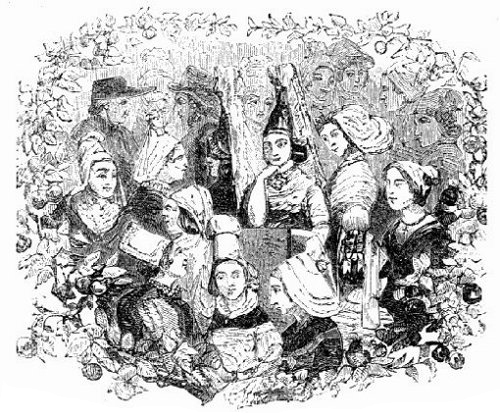
In the primitive villages of Normandy, on some holidays, it is a pleasing sight to see the dense army of caps, with flaps fanning the air, and following the gesticulatory movements of their talkative and volatile owners. When the weather is doubtful, the cap-wearers take care to be provided with a red umbrella of a clumsy construction, remarkably heavy, and somewhat similar, perhaps, to the original with which Jonas Hanway braved the jeers of a London populace in first introducing it.
NORTH AMERICAN INDIAN WAR DESPATCH.
The following is a facsimile of a gazette of a tribe of North American Indians, who assisted the French forces in Canada, during the war between France and England:—
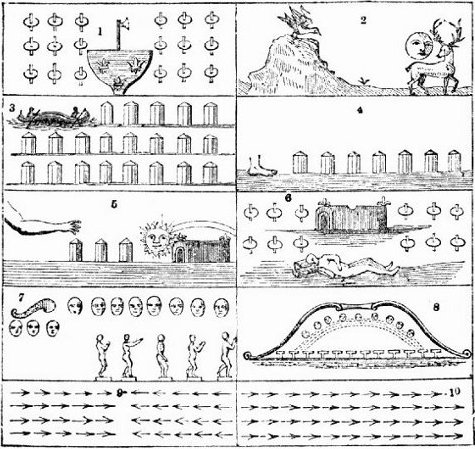
Explanation of the Gazette, giving an account of one of their expeditions. The following divisions explain those on the plate, as referred to by the numbers:—
1. Each of these figures represents the number ten. They all signify, that 18 times 10, or 180 American Indians, took up the hatchet, or declared war, in favour of the French, which is represented by the hatchet placed over the arms of France.
2. They departed from Montreal—represented by the bird just taking wing from the top of a mountain. The moon and the buck show the time to have been in the first quarter of the buck-moon, answering to July.
3. They went by water—signified by the canoe. The number of huts, such as they raise to pass the night in, shows they were 21 days on their passage.
4. Then they came on shore, and travelled seven days by land—represented by the foot and the seven huts.
5. When they arrived near the habitations of their enemies, at sunrise—shown by the sun being to the eastward of them, beginning, as they think, its daily course, there they lay in wait three days—represented by the hand pointing, and the three huts.
6. After which, they surprised their enemies, in number 12 times 10, or 120. The man asleep shows how they surprised them, and the hole in the top of the building is supposed to signify that they broke into some of their habitations in that manner.
7. They killed with the club eleven of their enemies, and took five prisoners. The former represented by the club and the eleven heads, the latter by the figures on the little pedestals.
8. They lost nine of their own men in the action—represented by the nine heads within the bow, which is the emblem of honour among the Americans, but had none taken prisoners—a circumstance they lay great weight on, shown by all the pedestals being empty.
9. The heads of the arrows, pointing opposite ways, represent the battle.
10. The heads of the arrows all pointing the same way, signify the flight of the enemy.
RECEIPTS FROM ALBERTUS MAGNUS.
If thou wylt make a Carbuckle stone, or a thyng shyning in the nyght.—Take verye many of the lyttle beastes shyninge by nyghte, and put them beaten smale in a bottel of glasse, and close it, and burye it in hoate horses doung, and let it tarye xv dayes, afterwarde thou shalte destyll water of them Peralembicum, which thou shalt put in a vessel of Christal or glasse. It giueth so great clearnesse, that euery man may reade and write in a darke place where it is. Some men make this water of the gall of a snale, the gal of a wesel, the gall of a feret, and of a water dogge: they burie them in doung and destyll water out of them.
If thou wylt see that other men can not see.—Take the gall of a male cat, and the fat of a hen all whyte, and mixe them together, and anoint thy eyes, and thou shalt see it that others cannot see.
If the hart, eye, or brayne of a lapwyng or blacke plover be hanged vpon a mans necke it is profitable agaynste forgetfulnesse, and sharpeth mans vnderstanding.—"Albertus Magnus." Black Letter: very old.
ADVERTISEMENT OF ROAST PIG IN 1726.
"On Tuesday next, being Shrove Tuesday, there will be a fine hog barbyqu'd whole, at the house of Peter Brett, at the Rising Sun, in Islington Road, with other diversions.—Note. It is the house where the ox was roasted whole at Christmas last."
A hog barbecu'd is a West Indian term, and means a hog roasted whole, stuffed with spice, and basted with Madeira wine. Oldfield, an eminent glutton of former days, gormandised away a fortune of fifteen hundred pounds a-year. Pope thus alludes to him,—
"Oldfield, with more than harpy throat endu'd, Cries, 'Send me, O, gods, a whole hog barbecu'd!'"
DYING OF OLD AGE AT SEVENTEEN YEARS.
March 19th, 1754, died, in Glamorganshire, of mere old age and a gradual decay of nature, at seventeen years and two months, Hopkins Hopkins, the little Welchman lately shown in London. He never weighed more than seventeen pounds, but for three years past no more than twelve. The parents have still six children left, all of whom no way differ from other children, except one girl of twelve years of age, who weighs only eighteen pounds, and bears upon her most of the marks of old age, and in all respects resembles her brother when at that age.
"WE HAE BEEN."
In Ayrshire there is a tradition, that the family motto of De Bruce—"We have been," originated from a lady named Fullarton, married to a cadet of the family of Cassilis. They had been gained to favour England during the chivalrous achievements of Wallace, and still continued zealous partisans of Edward. Before Bruce avowed his purpose to emancipate his country, he came, disguised as a palmer, to acquaint himself how far he could rely on aid from the people. A storm compelled him, and a few faithful adherents, to take shelter on the coast of Ayrshire. Extreme darkness, and the turbulence of the billows, deprived them of all knowledge where they landed; and as, in those unhappy times, the appearance of a few strangers would create alarm, the chiefs dispersed in different directions. Bruce chanced to go into the house of Mr. Kennedy, where the servants treated him with great reverence. The lady had gone to bed, and the prince wished they would not disturb her, but permit him to sit by the fire till day; however, one damsel had given her immediate notice of the visitor. He was ushered into her presence. She eyed him with scrutinizing earnestness. "We hae been—we hae been fause," said she, in the Scottish dialect, "but a royal ee takes me back to haly loyalty. I seid ye, mes royal de Bruce, I ken ye weel. We hae been baith untrue to Scotland, but rest ye safe: and albiet a' that's gane, Meg Fullarton wad dee in your cause."
ORIGIN OF THE PENNY POST.
The penny-post was devised in 1683, by one Mr. David Murray, an upholder in Paternoster Row. It soon became an object of attention to Government; but so low were its profits that one Dockwra, who succeeded Murray, had a pension of only £200 a year given him in lieu of it. This occurred in 1716.
A RAFFLE IN 1725.
May 8. The following copy of an advertisement, in the Newcastle Courant of this date, may be considered curious:—"On Friday in the race week, being the 28th of May, at the Assembly House, in Westgate, will be raffled for, 12 fine Fans, the highest three guineas, the worst 5s., at half a Crown per Ticket. Note: the lowest throw is to have the second best Fan, value £3, the other according to the height of the numbers which shall be thrown. There will be an assembly after for those who raffle."
A VISIT TO THE RESIDENCE OF DR. JOHNSON, IN INNER TEMPLE LANE, LONDON.
In one of the dreary, old-fashioned houses leading from the arched entrance to the Temple, which almost every passenger through Temple Bar must have remarked, whether he is a stranger, or a resident in the metropolis, Dr. Johnson, who occupies one of the most distinguished positions in the literature of our country, resided for several years.
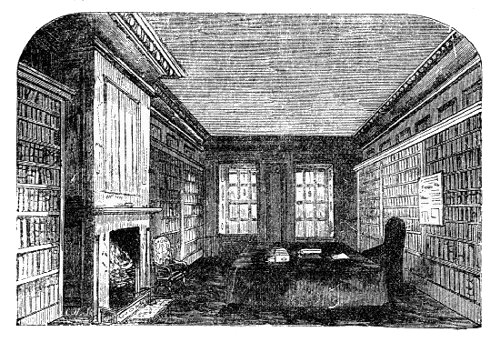
DR. JOHNSON'S RESIDENCE IN INNER TEMPLE LANE.
It was in this place that Dr. Johnson became acquainted with his future biographer, Boswell, who thus describes their first meeting:—
"A few days afterwards I called on Davies, and asked him if he thought I might take the liberty of waiting on Mr. Johnson at his chambers in the Temple. He said I certainly might, and that Mr. Johnson would take it as a compliment. His chambers were on the first floor of No. 1, Inner Temple Lane, and I entered them with an impression given me by the Rev. Dr. Blair, of Edinburgh, who described his having found the giant in his den. He received me very courteously; but it must be confessed, that his apartment, and furniture, and morning dress, were sufficiently uncouth. His brown suit of clothes looked very rusty; he had on a little, old, shrivelled, unpowdered wig, which was too small for his head; his shirt neck and knees of his breeches were loose, his black worsted stockings ill drawn up, and he had a pair of unbuckled shoes by way of slippers;—but all these slovenly particulars were forgotten the moment he began to talk."
The "den" in which the "giant" lived, the staircase leading to it, and indeed the whole appearance of the locality, has recently undergone demolition, and its interesting features knocked down to the highest bidder, to be, let us hope, preserved in some museum or other place of safety.
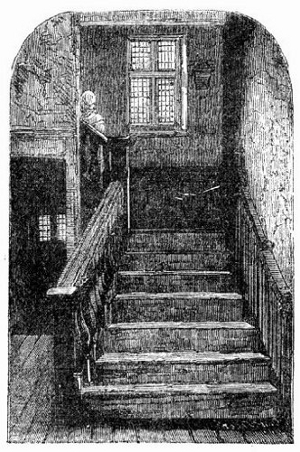
OLD STAIRCASE IN THE RESIDENCE OF DR. JOHNSON.
Dr. Johnson resided at various times in Holborn, the Strand, and other places, and died, as it is well known, in No. 8, Bolt Court, Fleet Street, in 1784. His remains were placed in a grave under the statue of Shakspere, in Westminster Abbey, and near the resting-place of his friend and companion, David Garrick.
ORIGIN OF THE STUFF BALL AT LINCOLN.
During the want of employment in the manufactories in 1801, Mrs. Chaplain, of Blankney, in Lincolnshire, formed a patriotic institution for the encouragement of the local trade of the district. A ball was given at Lincoln for the benefit of the stuff manufactory, at which ladies were admitted gratis, on their appearance in a stuff gown and petticoat, spun, wove, and finished within the county, and producing a ticket signed by the weaver and dyer at Louth, one of which tickets was delivered with every twelve yards of stuff. The gentlemen were required to appear without silk or cotton in their dress, stockings excepted. The impulse thus given to trade, was of the most signal service in relieving distress, and at the same time promoting habits of industry.
STEVENS'S SPECIFIC.
In the reign of Charles II., Dr. Jonathan Goddard obtained 5,000l. for disclosing his secret for making a medicine, called "Guttæ Anglicanæ." And in 1739, the Parliament of England voted 5,000l. to Mrs. Stevens for a solvent for stone.
The celebrated David Hartley was very instrumental in procuring this grant to Joanna Stevens. He obtained also a private subscription to the amount of £1,356, published one hundred and fifty-five successful cases, and, by way of climax to the whole, after eating two hundred pounds weight of soap! David himself died of the stone.
AN IMPOSTOR.
From the Testament of Jerome Sharp, printed in 1786:—"I entered," says the narrator, "with one of my friends, and found a man resembling an ourang-outang crouched upon a stool in the manner of a tailor. His complexion announced a distant climate, and his keeper stated that he found him in the island of Molucca. His body was bare to the hips, having a chain round the waist, seven or eight feet long, which was fastened to a pillar, and permitted him to circulate out of the reach of the spectators. His looks and gesticulations were frightful. His jaws never ceased snapping, except when sending forth discordant cries, which were said to be indicative of hunger. He swallowed flints when thrown to him, but preferred raw meat, which he rushed behind his pillar to devour. He groaned fearfully during his repast, and continued groaning until fully satiated. When unable to procure more meat, he would swallow stones with frightful avidity; which, upon examination of those which he accidentally dropped, proved to be partly dissolved by the acrid quality of his saliva. In jumping about, the undigested stones were heard rattling in his stomach."
The men of science quickly set to work to account for these feats, so completely at variance with the laws of nature. Before they had hit upon a theory, the pretended Molucca savage was discovered to be a peasant from the neighbourhood of Besançon, who chose to turn to account his natural deformities. When staining his face for the purpose, in the dread of hurting his eyes, he left the eyelids unstained, which completely puzzled the naturalists. By a clever sleight of hand, the raw meat was left behind the pillar, and cooked meat substituted in its place. Some asserted his passion for eating behind the pillar to be a proof of his savage origin; most polite persons, and more especially kings, being addicted to feeding in public. The stones swallowed by the pretended savage were taken from a vessel left purposely in the room full of them; small round stones, encrusted with plaster, which afterwards gave them the appearance of having been masticated in the mouth. Before the discovery of all this, the impostor had contrived to reap a plentiful harvest.
PERUVIAN BARK.
In 1693, the Emperor Kanghi (then in the thirty-second year of his reign, and fortieth of his age) had a malignant fever, which resisted the remedies given by his physicians; the emperor recollected that Tchang-tchin, (Father Gerbillon), and Pe-tsin, (Father Bouret) two jesuit missionaries, had extolled to him a remedy for intermittents, brought from Europe, and to which they had given the name of chin-yo (two Chinese words, which signify "divine remedies;") and he proposed to try it, but the physicians opposed it. The emperor, however, without their knowledge took it, and with good effect. Sometime afterwards, he experienced afresh several fits of an intermittent, which, though slight, made him uneasy; this led him to proclaim through the city, that any person possessed of a specific for this sort of fever, should apply without delay at the palace, where patients might also apply to get cured. Some of the great officers of his household were charged to receive such remedies as might be offered, and to administer them to the patients. The Europeans, Tchang-tching, (Gerbillon) Hang-jo, (Father de Fontenay, jesuit) and Pe-tsin, (Bouret) presented themselves among others, with a certain quantity of quinquina, offered it to the grandees, and instructed them in the manner of using it. The next day it was tried on several patients, who were kept in sight, and were cured by it. The officers, or grandees who had been appointed to superintend the experiment, gave an account to the Emperor of the astonishing effect of the remedy, and the monarch decided instantly on trying it himself, provided the hereditary prince gave his consent. The prince, however, not only refused, but was angry with the grandees for having spoken so favourably of a remedy, of which only one successful trial had been made; at last, after much persuasion, the Prince reluctantly grants his consent, and the emperor takes the bark without hesitation, and permanently recovers. A house is given by the emperor to the Europeans, who had made known the remedy, and through the means of Pe-tsin (Father Bouret) presents were conveyed to the King of France, accompanied with the information, that the Europeans (that is, the French jesuits) were in high favour.—Histoire Generale de la Chine, &c. tome xi. p. 168, 4to. Paris, 1780.
WHITE CATS.
In a number of "Loudon Gardener's Magazine," it is stated that white cats with blue eyes are always deaf, of which extraordinary fact there is the following confirmation in the "Magazine of Natural History," No. 2, likewise conducted by Mr. Loudon:—Some years ago, a white cat of the Persian kind (probably not a thorough-bred one), procured from Lord Dudley's at Hindley, was kept in a family as a favourite. The animal was a female, quite white, and perfectly deaf. She produced, at various times, many litters of kittens, of which, generally, some were quite white, others more or less mottled, tabby, &c. But the extraordinary circumstance is, that of the offspring produced at one and the same birth, such as, like the mother, were entirely white, were, like her, invariably deaf; while those that had the least speck of colour on their fur, as invariably possessed the usual faculty of hearing.
A WOMAN DEFENDS A FORT SINGLY.
Lord Kames in his "Sketches of the History of Man," relates an extraordinary instance of presence of mind united with courage.
Some Iroquois in the year 1690, attacked the fort de Verchères, in Canada, which belonged to the French, and had approached silently, hoping to scale the palisade, when some musket-shot forced them to retire: on their advancing a second time they were again repulsed, in wonder and amazement that they could perceive no person, excepting a woman who was seen everywhere. This was Madame de Verchères, who conducted herself with as much resolution and courage as if supported by a numerous garrison. The idea of storming a place wholly undefended, except by women, occasioned the Iroquois to attack the fortress repeatedly, but, after two days' siege, they found it necessary to retire, lest they should be intercepted in their retreat.
Two years afterwards, a party of the same nation so unexpectedly made their appearance before the same fort, that a girl of fourteen, the daughter of the proprietor, had but just time to shut the gate. With this young woman there was no person whatever except one soldier, but not at all intimidated by her situation, she showed herself sometimes in one place, sometimes in another, frequently changing her dress, in order to give some appearance of a garrison, and always fired opportunely. In short, the faint-hearted Iroquois once more departed without success. Thus the presence of mind of this young girl was the means of saving the fort.
INDENTURE OF A HORSE-RACE BETWIXT THE EARLS OF MORTON AND ABERCORN AND THE LORD BOYDE.
As indicating the state of the English language amongst the nobility of Scotland in 1621, the following is curious:—
"Ane Indentour of ane Horse-raise betuix my Lords Mortoun, Abercorne, and Boyde.—The erle of Mortoun obleissis himselff to produce George Rutherfuirdis Barb Naig: The erle of Abercorne obleissis him to produce his gray Naig: My lord Boyd obleissis him to produce his bay horse; Upone the conditions following. Thay ar to run the first Thursday November nixtocum, thrie mett myleis of Cowper raise in Fyff. The waidger to be for euery horse ten dowbill Anegellis. The foirmest horse to win the hail thretty. Ilk rydare to be aucht scottis stanewecht. And the pairtie not comperaud, or refuisand to consigne the waidger, sall undergo the foirfaltour of this sowme, and that money foirfaltit salbe additt to the staik to be tane away be the wynner. Forder, we declair it to be lesum to ony gentilman to produce ane horse and the lyk waidger, and thay salbe welcum. Subscrybith with all our handis, at Hammiltoune the fyfteine day off August 1621. Morton, Abercorne, Boyde."
EARLY USE OF CHOCOLATE.
An advertisement in "The Public Adviser," from Tuesday, June 16th, to Tuesday, June 23d, 1657, informs us that "in Bishopsgate-street, in Queen's-head-alley, at a Frenchman's House, is an excellent West India drink, called Chocolate, to be sold, where you may have it ready at any time, and also unmade, at reasonable rates."
MATTHEW BUCKINGER.
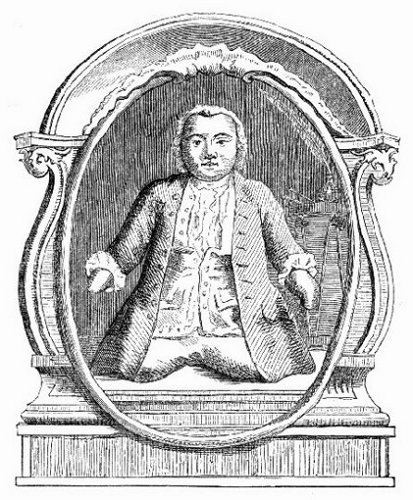
Of all the imperfect beings brought into the world, few can challenge, for mental and acquired endowments, any thing like a comparison to vie with this truly extraordinary little man. Matthew Buckinger was a native of Nuremberg, in Germany, where he was born, June 2, 1674, without hands, feet, legs, or thighs; in short, he was little more than the trunk of a man, saving two excrescences growing from the shoulder-blades, more resembling fins of a fish than arms of a man. He was the last of nine children, by one father and mother, viz. eight sons and one daughter; after arriving at the age of maturity, from the singularity of his case, and the extraordinary abilities he possessed, he attracted the notice and attention of all persons, of whatever rank in life, to whom he was occasionally introduced.
It does not appear, by any account extant, that his parents exhibited him at any time for the purposes of emolument, but that the whole of his time must have been employed in study and practice, to attain the wonderful perfection he arrived at in drawing, and his performance on various musical instruments; he played the flute, bagpipe, dulcimer, and trumpet, not in the manner of general amateurs, but in the style of a finished master. He likewise possessed great mechanical powers, and conceived the design of constructing machines to play on all sorts of musical instruments.
If Nature played the niggard in one respect with him she amply repaid the deficiency by endowments that those blessed with perfect limbs could seldom achieve. He greatly distinguished himself by beautiful writing, drawing coats of arms, sketches of portraits, history, landscapes, &c., most of which were executed in Indian ink, with a pen, emulating in perfection the finest and most finished engraving. He was well skilled in most games of chance, nor could the most experienced gamester or juggler obtain the least advantage at any tricks, or game, with cards or dice.
He used to perform before company, to whom he was exhibited, various tricks with cups and balls, corn, and living birds; and could play at skittles and ninepins with great dexterity; shave himself with perfect ease, and do many other things equally surprising in a person so deficient, and mutilated by Nature. His writings and sketches of figures, landscapes, &c., were by no means uncommon, though curious; it being customary, with most persons who went to see him, to purchase something or other of his performance; and as he was always employed in writing or drawing, he carried on a very successful trade, which, together with the money he obtained by exhibiting himself, enabled him to support himself and family in a very genteel manner. The late Mr. Herbert, of Cheshunt, in Hertfordshire, editor of "Ames's History of Printing," had many curious specimens of Buckinger's writing and drawing, the most extraordinary of which was his own portrait, exquisitely done on vellum, in which he most ingeniously contrived to insert, in the flowing curls of the wig, the 27th, 121st, 128th, 140th, 149th, and the 150th Psalms, together with the Lord's Prayer, most beautifully and fairly written. Mr. Isaac Herbert, son of the former, while carrying on the business of a bookseller in Pall-Mall, caused this portrait to be engraved, for which he paid Mr. Harding fifty guineas.
Buckinger was married four times, and had eleven children, viz., one by his first wife, three by his second, six by his third, and one by his last. One of his wives was in the habit of treating him extremely ill, frequently beating and other ways insulting him, which, for a long time, he very patiently put up with; but once his anger was so much aroused, that he sprung upon her like a fury, got her down, and buffeted her with his stumps within an inch of her life; nor would he suffer her to arise until she promised amendment in future, which it seems she prudently adopted, through fear of another thrashing. Mr. Buckinger was but twenty-nine inches in height, and died in 1722.
WONDERFUL PROVISION OF NATURE.
The insects that frequent the waters, require predaceous animals to keep them within due limits, as well as those that inhabit the earth; and the water-spider (Argyroneta aquatica) is one of the most remarkable upon whom that office is devolved. To this end, her instinct instructs her to fabricate a kind of diving-bell in the bosom of that element. She usually selects still waters for this purpose. Her house is an oval cocoon, filled with air, and lined with silk, from which threads issue in every direction, and are fastened to the surrounding plants. In this cocoon, which is open below, she watches for her prey, and even appears to pass the winter, when she closes the opening. It is most commonly, yet not always, under water; but its inhabitant has filled it for her respiration, which enables her to live in it. She conveys the air to it in the following manner: she usually swims on her back, when her abdomen is enveloped in a bubble of air, and appears like a globe of quicksilver. With this she enters her cocoon, and displacing an equal mass of water, again ascends for a second lading, till she has sufficiently filled her house with it, so as to expel all water. How these little animals can envelope their abdomen with an air-bubble, and retain it till they enter their cells, is still one of Nature's mysteries that has not been explained. It is a wonderful provision, which enables an animal that breathes the atmospheric air, to fill her house with it under water, and by some secret art to clothe her body with air, as with a garment, which she can put off when it answers her purpose. This is a kind of attraction and repulsion that mocks all inquiries.
STOMACH BRUSH.
One of the Court Physicians, in the reign of Charles II., invented an instrument to cleanse the stomach, and wrote a pamphlet on it; and ridiculous as a chylopoietic-scrubbing-brush may appear, it afterwards got a place among surgical instruments, and is described as the Excutor Ventriculi, or cleanser of the stomach; but the moderns not having stomach for it, have transferred it to the wine merchant, who more appropriately applies it to the scouring the interior of bottles. Heister gives a minute description of it, and very gravely enters on the mode and manner of using it: the patient is to drink a draught of warm water, or spirit of wine, that the mucus and foulness of the stomach may be washed off thereby: then, the brush being moistened in some convenient liquor, is to be introduced into the œsophagus, and slowly protruded into the stomach, by twisting round its wire handle. When arrived in the stomach, it is to be drawn up and down, and through the œsophagus, like the sucker in a syringe, till it be at last wholly extracted. Some recommend plentiful drinking in the operation, to be continued till no more foulness is discharged. But though this contrivance is greatly extolled, and said to prolong life to a great age, especially if practiced once a week, month, or fortnight; yet, there are very few (probably, because tried by very few) instances of its happy effects.
POPULAR AMUSEMENTS IN 1743.
In Merrie England of the Olden Time, we find the following copy of a handbill announcing performances:—
By a company of English, French, and Germans, at Phillips's New Wells, near the London Spa, Clerkenwell, 20th August, 1743.
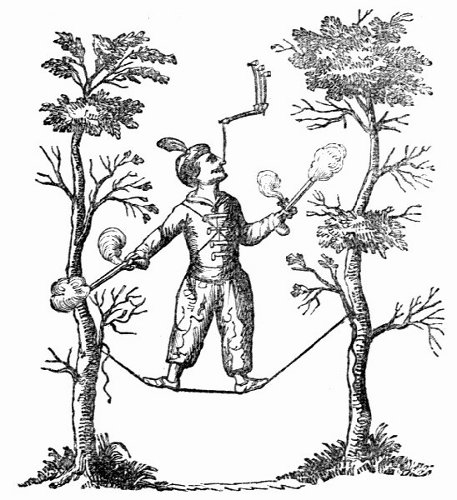
This evening, and during the Summer Season, will be performed several new exercises of Rope-dancing, Tumbling, Vaulting, Equilibres, Ladder-dancing, and Balancing, by Madame Kerman, Sampson Rogetzi, Monsieur German, and Monsieur Dominique; with a new Grand Dance, called Apollo and Daphne, by Mr. Phillips, Mrs. Lebrune, and others; singing by Mrs. Phillips and Mrs. Jackson; likewise the extraordinary performance of Herr Von Eeckenberg, who imitates the lark, thrush, blackbird, goldfinch, canary-bird, flageolet, and German flute; a Sailor's Dance by Mr. Phillips; and Monsieur Dominique flies through a hogshead, and forces both heads out. To which will be added The Harlot's Progress. Harlequin by Mr. Phillips; Miss Kitty by Mrs. Phillips. Also, an exact representation of the late glorious victory gained over the French by the English at the battle of Dettingen, with the taking of the White Household Standard by the Scots Greys, and blowing up the bridge, and destroying and drowning most part of the French army. To begin every evening at five o'clock. Every one will be admitted for a pint of wine, as usual.
DANCING ROOMS.
Dancing rooms were much frequented a century or so ago in London, which was then pretty well supplied with this means of recreation. We find that there were rare dancing doings at the original dancing room
in the year
at the field-end of King-Street, Bloomsbury, 1742
Hickford's great room, Panton-Street, Haymarket, 1743
Mitre Tavern, Charing-Cross, 1743
Barber's Hall, 1745
Richmond Assembly, 1745
Lambeth Wells, 1747
Duke's long room, Paternoster Row, 1748
Large Assembly Room at the Two Green Lamps, near Exeter Change, (at the particular desire of Jubilee Dickey!) 1749
The large room next door to the Hand and Slippers, Long-lane, West Smithfield, 1750
Lambeth Wells, where a Penny Wedding, in the Scotch manner, was celebrated for the benefit of a young couple, 1752
Old Queen's Head, in Cock-lane, Lambeth, 1755
and at Mr. Bell's, at the sign of the Ship, in the Strand, where, in 1755, a Scotch Wedding was kept. The bride "to be dressed without any linen; all in ribbons, and green flowers, with Scotch masks. There will be three bagpipes; a band of Scotch music, &c. &c. To begin precisely at two o'clock. Admission, two shillings and sixpence."
ORIGIN OF THE USE OF TOBACCO.
"Maister John Nicot, Counsellor to the Kyng, beeyng Embassadour for the Kyng in Portugall, in the yeres of our Lorde, 1559, 60, 61, wente one daye to see the Prysons of the Kyng of Portugall, and a gentleman beeyng the keeper of the saide Prisons presented hym this hearbe, as a strange Plant brought from Florida; the same Maister Nicot, hauyng caused the saide hearbe to be set in his garden, where it grewe and multiplied marveillously, was vpon a tyme aduertised, by one of his Pages, that a young man, a kinne to that Page, made a saye of that hearbe bruised, both the herbe and the joice together upon an ulcer whiche he had vpon his cheeke nere vnto his nose, coming of a Noli me tangere whiche bega to take roote already at the gristles of the Nose, wherewith he founde hym self marveillously eased. Therefore the said Maister Nicot caused the sicke yong man to be brought before hym, causing the said herbe to be continued to the sore eight or tenne daies, this saide Noli me tangere, was vtterly extinguished and healed: and he had sent it, while this cure was a working to a certaine Physition of the Kyng of Portugall of the moste fame, for to see the further workyng and effect of the said Nicotiane, and sending for the same yong man at the end of tenne daies, the said Phisition seeyng the uisage of the said sicke yong man certified, that the saide Noli me tangere was utterly extinguished, as in deede he never felt it since. Within a while after, one of the Cookes of the said Embassadour hauyng almost cut off his Thombe, with a great choppyng knife, the steward of the house of the saide gentleman ranne to the saide Nicotiane, and dresssed him there with fyve or sixe times, and so in the ende thereof he was healed: from that time forwarde this hearbe began to bee famous throughout all Lisborne, where the court of the Kyng of Portugall was at that presente, and the vertue of this saide hearbe was preached, and the people beganne to name it the Ambassadour's hearbe! Wherefore there came certaine daies after, a gentleman of the country, Father to one of the Pages of the Ambassadour, who was troubled with an vlcer in his Legge, hauyng had the same two yeres, and demaunded of the saide Ambassadour for his hearbe, and vsing the same in suche order as is before written, at the ende of tenne or twelve daies he was healed. From that time fourth the fame of that hearbe encreased in such sorte, that manye came from all places to have that same herbe. Emong all others there was a woman that had her face covered with a Ringworme rooted, as though she had a Visour on her face, to whom the saide L: Ambassadour caused the herbe to be given her, and told how she should vse it, and at the ende of eight or tenne daies, this woman was thoroughleye healed, she came and shewed herself to the Ambassadour, shewing him of her healyng. After there came a captain to presente his sonne, sick of the Kinges euill to the saide L: Ambassadour, for to send him into France, vnto whom there was saye made of the saide hearbe, whiche in fewe daies did beginne to shewe greate signes of healing, and finally was altogether healed of the kinges euill. The L: Ambassadour seeing so great effectes proceeding of this hearbe, and hauing heard say that the Lady Montigny that was, dyed at Saint Germans, of an vlcer bredde in her breast, that did turn to a Noli me tangere, for which there could never be remedey bee founde, and likewise that the Countesse of Ruffe, had sought for all the famous Phisitions of that Realme, for to heale her face, unto whom they could give no remedy, he thought it good to communicate the same into Fraunce, and did send it to Kyng Fraunces the seconde; and to the Queen Mother, and to many other Lords of the Courte with the maner of governyng the same: and how to applie it vnto the said diseases, even as he had found it by experience; and chiefly to the lorde of Jarnac governour of Rogell, with whom the saide Lorde Ambassadour had great amitie for the service of the Kyng. The whiche Lorde of Jarnac, told one daye at the Queenes Table, that he had caused the saide Nicotiane to be distilled, and caused the water to be dronke, mingled with water Euphrasie, otherwise called eyebright, to one that was shorte breathed, and was therewith healed."—Joyfvll News ovt of the newe found worlde, &c., 1577.—Black Letter.
ANCIENT INSTRUMENTS OF PUNISHMENT AND TORTURE IN THE TOWER OF LONDON.
There are few things among the valuable collection of antiquities preserved in the Tower of London, which excite so much interest as the grim-looking objects forming the group figured in the accompanying engraving.
With the executioner's axe, that long list of unfortunates who have met their fate within the walls of the Tower, or on Tower Hill, since the time of Henry VIII., have been beheaded. Among them may be enumerated Queen Anne Boleyn, whom Henry first presented to his people as their Queen while standing with her on the Tower Stairs, after she had been conveyed thither from Greenwich with every possible pomp. Crowds of gilded barges, with gay banners waving at their sterns, then lined the stream. The noblest of the land were in the young Queen's train or were waiting to receive her. Loud rounds of cannon, and soft, merry strains, announced her arrival; and the burly King stepped forward to kiss her in the sight of the assembled multitude. On the same day, three short years afterwards, she was led forth to execution within the Tower walls. The good Sir Thomas More and the chivalrous Earl of Surrey, Lady Jane Grey and her young husband, the gallant Raleigh, and a host of others, also perished by that sad symbol of the executioner's office.
The block is said to be of less ancient date, but is known to have been used at the execution of three Scotch lords—the unfortunate adherents of the Pretender—a little more than a century ago. On the top part of the block, there are three distinct cuts, two of them very deep and parallel, and the other at an angle and less effective.
The horrible instrument of torture called the "Scavenger's Daughter," was, in the "good old days," used as a means of extorting confession. The head of the culprit was passed through the circular hole at the top, and the arms through those below. The whole of this part of the machine opens in somewhat the same manner as a pair of tongs, the upper part being fixed round the neck and arms, and the semicircular irons placed on the legs. The body was then bent, and a strong iron bar was passed through the irons connected with the head and arms, and those in which the legs were placed. "The culprit would then," as one of the "Beefeaters" who attends on visitors makes a point of observing, "be doubled up into very small compass, and made exceedingly uncomfortable."
The Bilboes need little explanation, being only a strong rod of iron, with a nob at one end, on which are two moveable hoops, for the purpose of holding the legs; these being fixed, and a heavy iron padlock put on the proper part—the wearer was said to be in a Bilboe. Instruments of this description were much used on board of ship for the purpose of securing prisoners of war.
The Iron Collar is a persuader of a formidable description, for it weighs upwards of 14 lbs., and is so made that it can be fixed on the neck and then locked. Such a necklace would, we think, be sufficiently inconvenient; but it is rendered still more uncomfortable by sundry prickles of iron knowingly placed.
The Thumb-screw, also preserved in the Tower, is a characteristic example of a species of torture at one time much resorted to. The engraved example has been constructed so as to press both thumbs; nevertheless, it is a convenient little instrument, which might be easily carried about in the pocket. We have met with varieties of the thumb-screw in several collections—some for the accommodation of one thumb only. In the Museum of the Royal Antiquarian Society of Scotland there are some thumb-screws which are said to have been used upon the Covenanters.
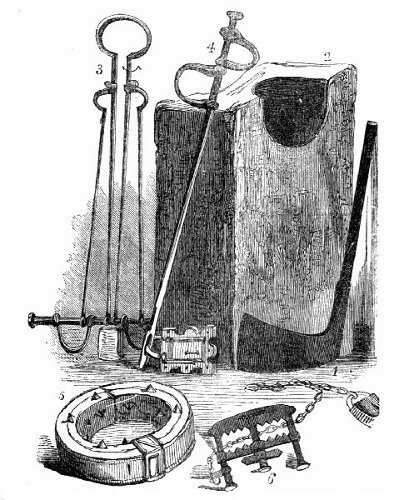
1. The Executioner's Axe. 2. The Block on which Lords Balmerino, Lovat, &c., were beheaded. 3. The Scavenger's Daughter. 4. Spanish Bilboes. 5. Massive Iron Collar for the Neck. 6. Thumb-Screw.
Times have changed for the better since the "Scavenger's Daughter," and the other matters represented, were amongst the mildest of the methods used for the purposes of punishment and intimidation. The stocks, the public whipping-posts, boilings, and burnings in Smithfield and elsewhere, the exhibition of dead men's heads over gateways, the boot, the rack, the pillory, the practice of making men eat their own books in Cheapside, drawing on hurdles to the place of execution, and then hanging, drawing, and quartering, chopping off hands and ears, and other revolting punishments, have gone out of use, and it is gratifying to know that we are all the better for it.
A BEAU BRUMMELL OF THE 17TH CENTURY.
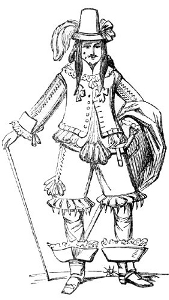
This very curious representation of a first-rate exquisite is copied from a very rare broadside, printed in 1646, and styled The Picture of an English Anticke, with a List of his ridiculous Habits and apish Gestures. The engraving is a well-executed copperplate, and the description beneath is a brief recapitulation of his costume: from which we learn that he wears a tall hat, with a bunch of riband on one side, and a feather on the other; his face spotted with patches; two love-locks, one on each side of his head, which hang upon his bosom, and are tied at the ends with silk riband in bows. His beard on the upper lip encompassing his mouth; his band or collar edged with lace, and tied with band-strings, secured by a ring; a tight vest, partly open and short in the skirts, between which and his breeches his shirt protruded. His cloak was carried over his arm. His breeches were ornamented by "many dozen of points at the knees, and above them, on either side, were two great bunches of riband of several colours." His legs were incased in "boot-hose tops, tied about the middle of the calf, as long as a pair of shirt-sleeves, double at the ends like a ruff-band; the tops of his boots very large, fringed with lace, and turned down as low as his spurres, which gingled like the bells of a morrice-dancer as he walked;" the "feet of his boots were two inches too long." In his right hand he carried a stick, which he "played with" as he "straddled" along the streets "singing."
PRAYING FOR REVENGE.
In North Wales, when a person supposes himself highly injured, it is not uncommon for him to go to some church dedicated to a celebrated saint, as Llan Elian in Anglesea, and Clynog in Carnarvonshire, and there to offer his enemy. He kneels down on his bare knees in the church, and offering a piece of money to the saint, calls down curses and misfortunes upon the offender and his family for generations to come; in the most firm belief that the imprecations will be fulfilled. Sometimes they repair to a sacred well instead of a church.
A FEMALE SAMPSON: FROM A HANDBILL.
September 4th, 1818, was shown at Bartholomew Fair, "The strongest woman in Europe, the celebrated French Female Hercules, Madame Gobert, who will lift with her teeth a table five feet long and three feet wide, with several persons seated upon it; also carry thirty-six weights, fifty-six pounds each, equal to 2,016 lbs., and will disengage herself from them without any assistance; will carry a barrel containing 340 bottles; also an anvil 400 lbs. weight, on which they will forge with four hammers at the time she supports it on her stomach; she will also lift with her hair the same anvil, swing it from the ground, and suspend it in that position to the astonishment of every beholder; will take up a chair by the hind stave with her teeth, and throw it over her head, ten feet from her body. Her travelling caravan, (weighing two tons,) on its road from Harwich to Leominster, owing to the neglect of the driver, and badness of the road, sunk in the mud, nearly up to the box of the wheels; the two horses being unable to extricate it she descended, and, with apparent ease, disengaged the caravan from its situation, without any assistance whatever."
TREES THAT GROW SHIRTS.
"We saw on the slope of the Cerra Dnida," says M. Humboldt, "shirt trees, fifty feet high. The Indians cut off cylindrical pieces two feet in diameter, from which they peel the red and fibrous bark, without making any longitudinal incision. This bark affords them a sort of garment which resembles a sack of a very coarse texture, and without a seam. The upper opening serves for the head, and two lateral holes are cut to admit the arms. The natives wear these shirts of Marina in the rainy season; they have the form of the ponchos and manos of cotton which are so common in New Grenada, at Quito, and in Peru. As in this climate the riches and beneficence of nature are regarded as the primary causes of the indolence of the inhabitants, the missionaries do not fail to say in showing the shirts of Marina, 'in the forests of Oroonoko, garments are found ready made upon the trees.'"
A FEMALE VENTRILOQUIST.
A female ventriloquist, named Barbara Jacobi, narrowly escaped being burnt at the stake in 1685, at Haarlem, where she was an inmate of the public Hospital. The curious daily resorted thither to hear her hold & dialogue with an imaginary personage with whom she conversed as if concealed behind the curtains of her bed. This individual, whom she called Joachim, and to whom she addressed a thousand ludicrous questions, which he answered in the same familiar strain, was for some time supposed to be a confederate. But when the bystanders attempted to search for him behind the curtains, his voice instantly reproached them with their curiosity from the opposite corner of the room. As Barbara Jacobi had contrived to make herself familiar with all the gossip of the city of Haarlem, the revelations of the pretended familiar were such as to cause considerable embarrassment to those who beset her with impertinent questions.
CALMUC OPINION OF LIGHTNING.
The Calmucs hold the lightning to be the fire spit out of the mouth of a dragon, ridden and scourged by evil Dæmons, and the thunder they make to be his roarings.
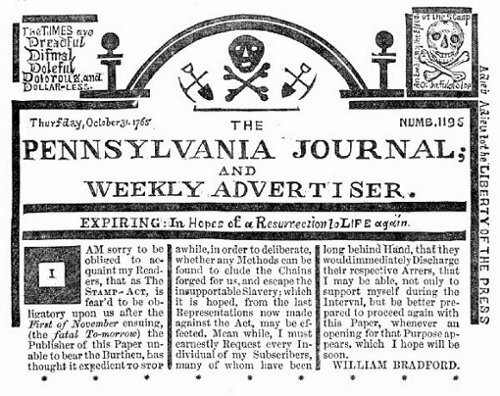
THE HEADING OF THE EXPIRING PENNSYLVANIA JOURNAL.
Journalism has had its trials and difficulties in England as well as in America; but we do not remember to have ever seen a more quaint last Number, than the subjoined facsimile exhibits:—
NOSTRUMS.
Unsuccessful gamesters used formerly to make a knot in their linen, of late years they have contented themselves with changing their chair as a remedy against ill-luck. As a security against cowardice, it was once only necessary to wear a pin plucked from the winding sheet of a corpse. To insure a prosperous accouchement to your wife, you had but to tie her girdle to a bell and ring it three times. To get rid of warts, you were to fold up in a rag as many peas as you had warts, and throw them upon the high road; when the unlucky person who picked them up became your substitute. In the present day, to cure a toothache, you go to your dentist. In the olden time you would have solicited alms in honour of St. Lawrence, and been relieved without cost or pain.
PRECOCIOUS CHILDREN.
Baillet mentions one hundred and sixty-three children endowed with extraordinary talents, among whom few arrived at an advanced age. The two sons of Quintilian, so vaunted by their father, did not reach their tenth year. Hermogenes, who, at the age of fifteen, taught rhetoric to Marcus Aurelius, who triumphed over the most celebrated rhetoricians of Greece, did not die, but at twenty-four, lost his faculties, and forgot all he had previously acquired. Pica di Mirandola died at thirty-two; Johannes Secundus at twenty-five; having at the age of fifteen composed admirable Greek and Latin verses, and become profoundly versed in jurisprudence and letters. Pascal, whose genius developed itself at ten years old, did not attain the third of a century.
In 1791, a child was born at Lubeck, named Henri Heinekem, whose precocity was miraculous. At ten months of age, he spoke distinctly; at twelve, learnt the Pentateuch by rote, and at fourteen months, was perfectly acquainted with the Old and New Testaments. At two years of age, he was as familiar with Ancient History as the most erudite authors of antiquity. Sanson and Danville only could compete with him in geographical knowledge; Cicero would have thought him an "alter ego," on hearing him converse in Latin; and in modern languages he was equally proficient. This wonderful child was unfortunately carried off in his fourth year. According to a popular proverb—"the sword wore out the sheath."
EFFECT OF MUSIC ON A PIGEON.
Bingley gives a singular anecdote of the effect of music on a pigeon, as related by John Lockman, in some reflections concerning operas, prefixed to his musical drama of Rosalinda. He was staying at a friend's house, whose daughter was a fine performer on the harpsichord, and observed a pigeon, which, whenever the young lady played the song of "Speri-si," in Handel's opera of Admetus (and this only), would descend from an adjacent dove-house to the room-window where she sat, and listen to it apparently with the most pleasing emotions; and when the song was finished it always returned immediately to the dove-house.
POWER OF FASCINATION IN SNAKES.
Some animals are held in universal dread by others, and not the least terrible is the effect produced by the rattle-snake. Mr. Pennant says, that this snake will frequently lie at the bottom of a tree, on which a squirrel is seated. He fixes his eyes on the animal, and from that moment it cannot escape: it begins a doleful outcry, which is so well known that a passer by, on hearing it, immediately knows that a snake is present. The squirrel runs up the tree a little way, comes down again, then goes up and afterwards comes still lower. The snake continues at the bottom of the tree, with his eyes fixed on the squirrel, and his attention is so entirely taken up, that a person accidentally approaching may make a considerable noise, without so much as the snake's turning about. The squirrel comes lower, and at last leaps down to the snake, whose mouth is already distended for its reception. Le Vaillant confirms this fascinating terror, by a scene he witnessed. He saw on the branch of a tree a species of shrike trembling as if in convulsions, and at the distance of nearly four feet, on another branch, a large species of snake, that was lying with outstretched neck and fiery eyes, gazing steadily at the poor animal. The agony of the bird was so great that it was deprived of the power of moving away, and when one of the party killed the snake, it was found dead upon the spot—and that entirely from fear—for, on examination, it appeared not to have received the slightest wound. The same traveller adds, that a short time afterwards he observed a small mouse in similar agonizing convulsions, about two yards from a snake, whose eyes were intently fixed upon it; and on frightening away the reptile, and taking up the mouse, it expired in his hand.
SECOND SIGHT.
About the year 1725, the marvellous history of a Portuguese woman set the whole world of science into confusion, as will be found by referring to the "Mercure de France." This female was said to possess the gift of discovering treasures. Without any other aid than the keen penetration of her eyes, she was able to distinguish the different strata of earth, and pronounce unerringly upon the utmost distances at a single glance. Her eye penetrated through every substance, even the human body; and she could discern the mechanism, and circulation of all animal fluids, and detect latent diseases; although less skilful than the animal magnetisers, she did not affect to point out infallible remedies. Ladies could learn from her the sex of their forthcoming progeny.
The King of Portugal, greatly at a loss for water in his newly built palace, consulted her; and after a glance at the spot, she pointed out an abundant spring, upon which his Majesty rewarded her with a pension, the order of Christ, and a patent of nobility.
In the exercise of her miraculous powers, certain preliminaries were indispensable. She was obliged to observe a rigid fast; indigestion, or the most trifling derangement of the stomach, suspending the marvellous powers of her visual organs.
The men of science of the day were of course confounded by such prodigies. But instead of questioning the woman, they consulted the works of their predecessors; not forgetting the inevitable Aristotle. By dint of much research, they found a letter from Huygens asserting that there was a prisoner of war at Antwerp, who could see through stuffs of the thickest texture provided they were not red. The wonderful man was cited in confirmation of the wonderful woman, and vice versâ.
CHARACTER INDICATED BY THE EARS.
According to Aristotle, large ears are indicative of imbecility; while small ones announce madness. Ears which are flat, point out the rustic and brutal man. Those of the fairest promise, are firm and of middling size. Happy the man who boasts of square ears; a sure indication of sublimity of soul and purity of life. Such, according to Suetonius, were the ears of the Emperor Augustus.
GROANING BOARDS.
Groaning boards were the wonder in London in 1682. An elm plank was exhibited to the king, which, being touched by a hot iron, invariably produced a sound resembling deep groans. At the Bowman Tavern, in Drury Lane, the mantel-piece did the same so well that it was supposed to be part of the same elm-tree; and the dresser at the Queen's Arm Tavern, St. Martin le Grand, was found to possess the same quality. Strange times when such things were deemed wonderful; even to meriting exhibition before the monarch.
ANCIENT PLOUGHING AND THRESHING.
The ancient plough was light, the draught comparatively easy; but then the very lightness required that the ploughman should lean upon it with his whole weight, or else it would glide over the soil without making a single furrow. "Unless," said Pliny, "the ploughman stoop forward, to press down the plough, as well as to conduct it, truly it will turn aside."
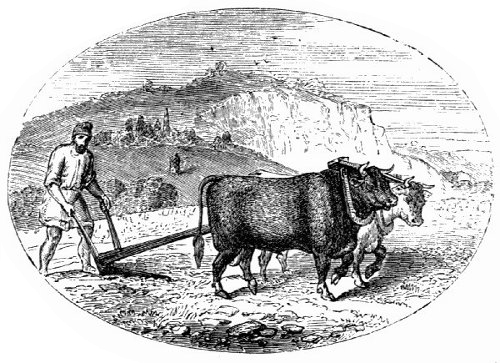
Oxen were anciently employed in threshing corn, and the same custom is still retained in Egypt and the east. This operation is effected by trampling upon the sheaves, and by dragging a clumsy machine, furnished with three rollers that turn on their axles. A wooden chair is attached to the machine, and on this a driver seats himself, urging his oxen backwards and forwards among the sheaves, which have previously been thrown into a heap of about eight feet wide and two in height. The grain thus beaten out, is collected in an open place, and shaken against the wind by an attendant, with a small shovel, or, as it is termed, a winnowing fan, which disperses the chaff and leaves the grain uninjured:—
"Thus, with autumnal harvests covered o'er, And thick bestrewn, lies Ceres' sacred floor; While round and round, with never-wearied pain, The trampling steers beat out th' unnumber'd grain."
Homer.
Horace further tells us, that the threshing floor was mostly a smooth space, surrounded with mud walls, having a barn or garner on one side; occasionally an open field, outside the walls, was selected for this purpose, yet uniformly before the town or city gates. Such was the void place wherein the king of Israel, and Jehoshaphat, king of Judah, sat each of them on his throne, clothed in his robes, at the entering in of the gate of Samaria, and all the prophets prophesied before them. In the marginal reading we are informed, that this void space was no other than a threshing floor; and truly the area was well adapted for such an assemblage, being equally suited to accommodate the two kings and their attendants, and to separate them from the populace.
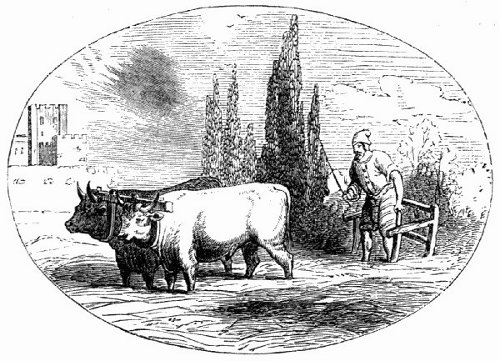
OXEN THRESHING CORN.
Eastern ploughshares were of a lighter make than ours, and those who notice the shortness and substance of ancient weapons, among such as are preserved in museums, will understand how readily they might be applied to agricultural uses.
FROST FAIRS.
In 1788-9, the Thames was completely frozen over below London-bridge. Booths were erected on the ice; and puppet-shows, wild beasts, bear-baiting, turnabouts, pigs and sheep roasted, exhibited the various amusements of Bartholomew Fair multiplied and improved. From Putney-bridge down to Redriff was one continued scene of jollity during this seven weeks' saturnalia. The last frost fair was celebrated in the year 1814. The frost commenced on 27th December, 1813, and continued to the 5th February, 1814. There was a grand walk, or mall, from Blackfriars-bridge to London-bridge, that was appropriately named The City Road, and lined on each side with booths of all descriptions. Several printing-presses were erected, and at one of these an orange-coloured standard was hoisted, with "Orange Boven" printed in large characters. There were E O and Rouge et Noir tables, tee-totums, and skittles; concerts of rough music, viz. salt-boxes and rolling-pins, gridirons and tongs, horns, and marrow-bones and cleavers. The carousing booths were filled with merry parties, some dancing to the sound of the fiddle, others sitting round blazing fires smoking and drinking. A printer's devil bawled out to the spectators, "Now is your time, ladies and gentlemen,—now is your time to support the freedom of the press! Can the press enjoy greater liberty? Here you find it working in the middle of the Thames!"
MAGIC RAIN STONE.
The Indian magi, who are to invoke Yo He Wah, and mediate with the supreme holy fire that he may give seasonable rains, have a transparent stone of supposed great power in assisting to bring down the rain, when it is put in a basin of water, by a reputed divine virtue, impressed on one of the like sort, in time of old, which communicates it circularly. This stone would suffer a great decay, they assert, were it even seen by their own laity; but if by foreigners, it would be utterly despoiled of its divine communicative power.
THE BOMBARDIER BEETLE.
The bombardier beetle (Carabus crepitans) when touched produces a noise resembling the discharge of a musket in miniature, during which a blue smoke may be seen to proceed from its extremity. Rolander says that it can give twenty discharges successively. A bladder placed near its posterior extremity, is the arsenal that contains its store. This is its chief defence against its enemies; and the vapour or liquid that proceeds from it is of so pungent a nature, that if it happens to be discharged into the eyes, it makes them smart as though brandy had been thrown into them. The principal enemy of the bombardier is another insect of the same tribe, but three or four times its size. When pursued and fatigued it has recourse to this stratagem; it lies down in the path of its enemy, who advances with open mouth to seize it; but on the discharge of the artillery, this suddenly draws back, and remains for a while confused, during which the bombardier conceals itself in some neighbouring crevice, but if not lucky enough to find one, the other returns to the attack, takes the insect by the head, and bears it off.
THE PILLORY FOR EATING FLESH IN LENT.
Even in this kingdom, so late as the Reformation, eating flesh in Lent was rewarded with the pillory. An instance of this occurs in the "Patriot King," the particulars of which, quoted in "Clavis Calendaria," are somewhat amusing. Thomas Freburn's wife, of Paternoster-row, London, having expressed a particular inclination for pig, one was procured, ready for the spit; but the butter-woman who provided it, squeamish as to the propriety of what she had done, carried a foot of it to the Dean of Canterbury. The Dean was at dinner, and one of his guests was Freburn's landlord, and Garter King at Arms, who sent to know if any of his family were ill, that he ate flesh in Lent. 'All well,' quoth Freburn, (perhaps too much of a Dissenter for the times,) 'only my wife longs for pig.' His landlord sends for the Bishop of London's apparitor, and orders him to take Freburn and his pig before Stocksly, the Bishop, who sent them both to Judge Cholmley; but he not being at home, they were again brought back to the Bishop, who committed them to the Compter. Next day, being Saturday, Freburn was carried before the Lord Mayor, who sentenced him to stand in the pillory on the Monday following, with one half of the pig on one shoulder, and the other half on the other. Through Cromwell's intercession, the poor man at last gained his liberty by a bond of twenty pounds for his appearance. The mischief-making pig was, by the order of the Bishop, buried in Finsbury-field, by the hand of his Lordship's apparitor; but Freburn was turned out of his house, and could not get another in four years. Hence we may infer his ruin.
HUGE CANNON AT THE SIEGE OF CONSTANTINOPLE.
In 1432, several kinds of artillery are mentioned, cannons, bombards, vulgaires, coulverins. The vulgaires were ordinary artillery. In the year 1460, James II. of Scotland was killed by the accidental bursting of a cannon. The artillery of the Turks, in the year 1453, surpassed whatever had yet appeared in the world. A stupendous piece of ordnance was made by them; its bore was twelve palms, and the stone bullet weighed about 600 lbs.; it was brought with great difficulty before Constantinople, and was flanked by two almost of equal magnitude: fourteen batteries were brought to bear against the place, mounting 130 guns; the great cannon could not be loaded and fired more than seven times in one day. Mines were adopted by the Turks, and counter-mines by the Christians. At this siege, which was in 1453, ancient and modern artillery were both used. Cannons, intermingled with machines for casting stones and darts, and the battering-ram was directed against the walls. The fate of Constantinople could no longer be averted: the diminutive garrison was exhausted by a double attack; the fortifications were dismantled on all sides by the Ottoman cannon; a spirit of discord impaired the Christian strength. After a siege of fifty-three days, Constantinople, which had defied the power of Chosroes, the Chagan, and the Caliphs, was subdued by the arms of Mahomet II.
A MAN IN A VAULT ELEVEN DAYS.
St. Benedict Fink.—"1673, April 23, was buried Mr Thomas Sharrow, Cloth-worker, late Churchwarden of this parish, killed by an accidental fall into a vault, in London Wall, Amen Corner, by Paternoster Row, and was supposed had lain there eleven days and nights before any one could tell where he was, Let all that read this take heed of drink."—Truly, a quaint warning!
BLIND GRANNY.
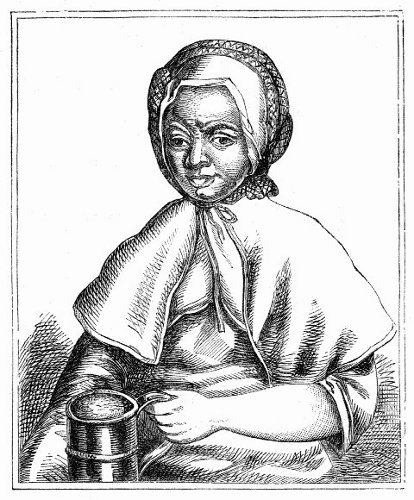
This miserable, wretched, drunken object, who was blind of one eye, used to annoy the passengers in the streets of London, while sober, with licking her blind eye with her tongue, which was of a most enormous length, and thickness; indeed, it was of such a prodigious size, that her mouth could not contain it, and she could never close her lips, or to use a common expression, keep her tongue within her teeth. This wonderful feat of washing her eye with her tongue was exhibited with a view of obtaining money from such as crowded around her, and no sooner had she obtained sufficient means, but she hastened to the first convenient liquor-shop, to indulge her propensity in copious libations, and when properly inspired, would rush into the streets with all the gestures of a frantic maniac, and roll and dance about, until she became a little sobered, which was sometimes accelerated by the salutary application of a pail of water, gratuitously bestowed upon her by persons whose doorway she had taken possession of, as shelter from the persecuting tormentings of boys and girls who generally followed her.
ANCIENT FEMALE COSTUME.
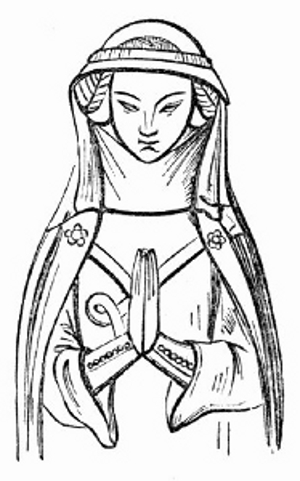
A good specimen of the costume of a female of the higher classes is here given, from an effigy of a lady of the Ryther family, in Ryther church, Yorkshire, engraved in Hollis's Monumental Effigies. She wears a wimple, covering the neck and encircling the head, the hair of which is gathered in plaits at the sides, and covered with a kerchief, which falls upon the shoulders, and is secured by a fillet passing over the forehead. The sleeves of the gown hang midway from the elbow and the wrist, and display the tight sleeve with its rows of buttons beneath. The mantle is fastened by a band of ribbon, secured by ornamental studs. The lower part of the dress consists of the wide gown, lying in folds, and completely concealing the feet, which have been omitted, in order to display the upper part of this interesting effigy to greater advantage.
CHILCOTT, THE GIANT.
1815. Died at Trenaw, in Cornwall, a person known by the appellation of Giant Chilcott. He measured at the breast six feet nine inches, and weighed four hundred and sixty pounds. One of his stockings held six gallons of wheat.
DR. LETTSOM'S REASONS FOR DISMISSING A SERVANT.
The Doctor was in the practice of carrying the produce of his fees carelessly in his coat-pocket. His footman being aware of this, used to make free with a guinea occasionally, while it hung up in the passage. The Doctor, having repeatedly missed his gold, was suspicious of the footman, and took an opportunity of watching him. He succeeded in the detection, and, without even noticing it to the other servants, called him into his study, and coolly said to him, "John, art in want of money?" "No;" replied John. "Oh! then, why didst thou make so free with my pocket? And since thou didst not want money, and hast told me a lie, I must part with thee. Now, say what situation thou wouldst like abroad, and I will obtain it for thee; for I cannot keep thee; I cannot recommend thee; therefore thou must go." Suffice it to say, the Doctor procured John a situation, and he went abroad.
HANDBILL FROM PECKHAM FAIR IN 1726.
Our ancestors just 133 years ago had but limited opportunities for gratifying a taste for Natural History if we may judge from the supply of animals deemed sufficient to attract attention in 1726:—
"Geo. I. R.
"To the lovers of living curiosities. To be seen during the time of Peckham Fair, a Grand Collection of Living Wild Beasts and Birds, lately arrived from the remotest parts of the World.
"1. The Pellican that suckles her young with her heart's blood, from Egypt.
"2. The Noble Vultur Cock, brought from Archangell, having the finest tallons of any bird that seeks his prey; the fore part of his head is covered with hair, the second part resembles the wool of a Black; below that is a white ring, having a Ruff, that he cloaks his head with at night.
"3. An Eagle of the Sun, that takes the loftiest flight of any bird that flies. There is no bird but this that can fly to the face of the Sun with a naked eye.
"4. A curious Beast, bred from a Lioness, like a foreign Wild Cat.
"5. The He-Panther, from Turkey, allowed by the curious to be one of the greatest rarities ever seen in England, on which are thousands of spots, and not two of a likeness.
"6 & 7. The two fierce and surprising Hyænas, Male and Female, from the River Gambia. These Creatures imitate the human voice, and so decoy the Negroes out of their huts and plantations to devour them. They have a mane like a horse, and two joints in their hinder leg more than any other creature. It is remarkable that all other beasts are to be tamed, but Hyænas they are not.
"8. An Ethiopian Toho Savage, having all the actions of the human species, which (when at its full growth) will be upwards of five feet high.
"Also several other surprising Creatures of different sorts. To be seen from 9 in the morning till 9 at night, till they are sold. Also, all manner of curiosities of different sorts, are bought and sold at the above place by John Bennett."
SOMNAMBULISM.
Some years ago a Hampshire Baronet was nearly driven to distraction by the fact that, every night, he went to bed in a shirt, and every morning awoke naked, without the smallest trace of the missing garment being discovered.
Hundreds of shirts disappeared in this manner; and as there was no fire in his room, it was impossible to account for the mystery. The servants believed their master to be mad; and even he began to fancy himself bewitched. In this conjuncture, he implored an intimate friend to sleep in the room with him; and ascertain by what manner of mysterious midnight visitant his garment was so strangely removed. The friend, accordingly, took up his station in the haunted chamber; and lo! as the clock struck one, the unfortunate Baronet, who had previously given audible intimation of being fast asleep, rose from his bed, rekindled with a match the candle which had been extinguished, deliberately opened the door, and quitted the room. His astonished friend followed: saw him open in succession a variety of doors, pass along several passages, traverse an open court, and eventually reach the stable-yard; where he divested himself of his shirt, and disposed of it in an old dung-heap, into which he thrust it by means of a pitchfork. Having finished this extraordinary operation, without taking the smallest heed of his friend who stood looking on, and plainly saw that he was walking in his sleep, he returned to the house, carefully reclosed the doors, re-extinguished the light, and returned to bed; where the following morning he awoke as usual, stripped of his shirt!
The astonished eye-witness of this extraordinary scene, instead of apprising the sleep-walker of what had occurred, insisted that the following night, a companion should sit up with him; choosing to have additional testimony to the truth of the statement he was about to make; and the same singular events were renewed, without the slightest change or deviation. The two witnesses, accordingly, divulged all they had seen to the Baronet; who, though at first incredulous, became of course convinced, when, on proceeding to the stable-yard, several dozens of shirts were discovered; though it was surmised that as many more had been previously removed by one of the helpers, who probably looked upon the hoard as stolen goods concealed by some thief.
KILLED BY EATING MUTTON AND PUDDING.
Teddington.—"James Parsons, who had often eat a shoulder of mutton or a peck of hasty pudding, at a time, which caused his death, buried March 7, 1743-4, aged 36."
CORAL REEFS.
Coral reefs are produced by innumerable small zoophytes, properly called Coral-insects. The Coral insect consists of a little oblong bag of jelly closed at one end, but having the other extremity open, and surrounded by tentacles or feelers, usually six or eight in number, set like the rays of a star. Multitudes of these diminutive animals unite to form a common stony skeleton called Coral, or Madrepore, in the minute openings of which they live, protruding their mouths and tentacles when under water; but suddenly drawing them into their holes when danger approaches. These animals cannot exist at a greater depth in the sea than about ten fathoms, and as the Coral Islands often rise with great steepness from a sea more than three hundred fathoms deep, it would seem that a great alteration must have taken place in the depth of the ocean since the time when these little architects commenced their labours. Throughout the whole range of the Polynesian and Australasian islands, there is scarcely a league of sea unoccupied by a coral reef, or a coral island; the former springing up to the surface of the water, perpendicularly from the fathomless bottom, "deeper than did ever plummet sound;" and the latter in various stages, from the low and naked rock, with the water rippling over it, to an uninterrupted forest of tall trees.
"Every one," says Mr. Darwin, "must be struck with astonishment when he first beholds one of these vast rings of coral rock, often many leagues in diameter, here and there surmounted by a low verdant island with dazzling white shores, bathed on the outside by the foaming breakers of the ocean, and on the inside surrounding a calm expanse of water, which, from reflection, is of a bright but pale green colour. The naturalist will feel this astonishment more deeply after having examined the soft and almost gelatinous bodies of these apparently insignificant creatures; and when he knows that the solid reef increases only on the outer edge, which, day and night, is lashed by the breakers of an ocean never at rest."
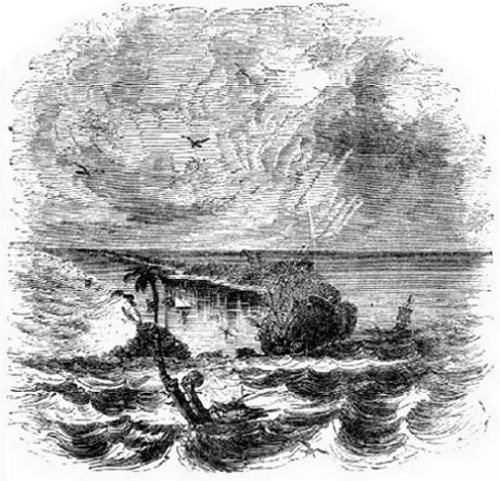
Coral being beautiful in form and colour, is sought after for purposes of ornament; and its fishery or gathering gives employment to many persons in the Red Sea, the Persian Gulf, the Mediterranean, and other places. In the Straits of Messina, the rocks which yield coral are from about 350 to 650 feet below the surface of the water. The coral here grows to about the height or length of twelve inches, and requires eight or ten years to come to perfection. In the general mode of fishing for coral, the instrument used consists of two heavy beams of wood, secured together at right angles, and loaded with stones to sink them.
MILITARY HATS IN OLDEN TIME.
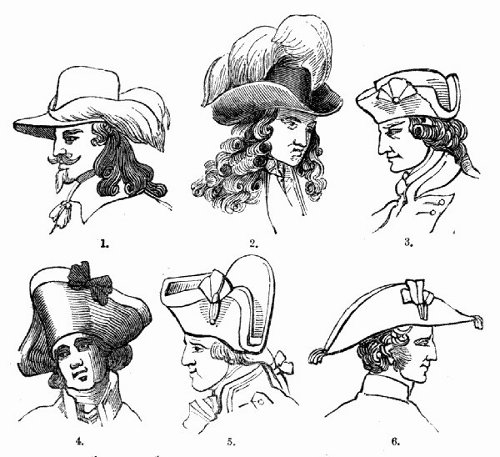
No. 1, Charles I. No. 2, William III. No. 3, Nivernois. No. 4, Kevenhuller. No. 5, Ramilies. No. 6, Wellington.
WHY A MAN MEASURES MORE IN THE MORNING THAN IN THE EVENING, &c.
There is an odd phenomenon attending the human body, as singular as common: that a person is shorter standing than lying; and shorter in the evening when he goes to bed, than in the morning when he rises.
This remark was first made in England, and afterwards confirmed at Paris, by M. Morand, a member of the Royal Academy of Sciences in France, and by the Abbot Fontana likewise.
The last-mentioned person found, from a year's experience, that ordinarily in the night he gained five or six lines, and lost nearly as much in the day.
The cause of which effect, so ancient, so common, but so lately perceived, proceeds from the different state or condition of the intervertebral annular cartilages.
The vertebræ, or joints of the spine, are kept separate, though joined by particular cartilages, every one of which has a spring. These yield on all sides, without any inflexion on the spine, to the weight of the head and upper extremities; but this is done by very small and imperceptible degrees, and most of all when the upper parts of the body are loaded with any exterior weight. So that a man is really taller after lying some time, than after walking, or carrying a burthen a great while.
For this reason it is that, in the day and evening, while one is sitting or standing, the superior parts of the body that weigh or press upon the inferior, press those elastic annular cartilages, the bony jointed work is contracted, the superior parts of the body descend towards the inferior, and proportionably as one approaches the other, the height of the stature diminishes.
Hence it was, that a fellow enlisting for a soldier, by being measured over-night, was found deficient in height, and therefore refused; but by accident being gauged again the next morning, and coming up to the stature, he was admitted.
On the contrary, in the night-time, when the body is laid a-bed, as it is in an horizontal situation, or nearly so, the superior parts do not weigh, or but very little, upon the inferior; the spring of the cartilages is unbent, the vertebræ are removed from one another, the long jointed work of the spine is dilated, and the body thereby prolonged; so that a person finds himself about half an inch, or more, higher in stature in the morning than when going to bed. This is the most natural and simple reason that can be given, for the different heights of the same person at different times.
A SENSIBLE DOG REFUSING TO BAIT A CAT.
A dustman of the name of Samuel Butcher, residing at Mile-end, who kept a large dog, having taken it into his head to divert himself and others, a few days ago, by the cruel sport of cat baiting, which the dog refusing to perform to the satisfaction of his master, was beat by him in a most brutal manner, when the animal at length, in retaliation, flew at his unmerciful keeper, and inflicted very severe wounds about his face, limbs, and body, in some instances tearing large mouthfuls of his flesh quite clean out, and at one time clung so fast to the man, that before he disengaged from him the animal's throat was obliged to be cut. The man was promptly conveyed to the London Hospital, and there died of the injuries he received.
A HORSE GETTING HIMSELF SHOD.
A horse having been turned into a field by its owner, Mr. Joseph Lane, of Fascombe, in the parish of Ashelworth, was missed therefrom the next morning, and the usual inquiries set afoot, as to what could have become of him. He had, it seems, been shod (all fours) a few days before, and as usual got pinched in a foot. Feeling, no doubt, a lively sense of proper shoeing, and desirous of relieving the cause of pain, he contrived to unhang the gate of his pasture with his mouth, and make the best of his way to the smithy, a distance of a mile and a half from Fascombe, waiting respectfully at the door until the bungling artist got up. The smith relates that he found him there at opening his shed; that the horse advanced to the forge and held up his ailing foot; and that he himself, upon examination, discovered the injury, took off the shoe, and replaced it more carefully, which having done, the sagacious creature set off at a merry pace homewards. Soon after, Mr. Lane's servants passed by the forge in quest of the animal, and upon inquiry, received for answer—"Oh, he has been here and got shod, and is gone home again."
MAN WITHOUT HANDS.
The following account is extracted from a letter sent to the Rev. Mr. Wesley by a person named Walton, dated Bristol, October 14, 1788:—
"I went with a friend to visit this man, who highly entertained us at breakfast, by putting his half-naked foot upon the table as he sat, and carrying his tea and toast between his great and second toe to his mouth, with as much facility as if his foot had been a hand, and his toes fingers. I put half a sheet of paper upon the floor, with a pen and ink-horn: he threw off his shoes as he sat, took the ink-horn in the toes of his left foot, and held the pen in those of his right. He then wrote three lines, as well as most ordinary writers, and as swiftly. He writes out all his own bills, and other accounts. He then showed how he shaves himself with a razor in his toes, and how he combs his own hair. He can dress and undress himself, except buttoning his clothes. He feeds himself, and can bring both his meat or his broth to his mouth, by holding the fork or spoon in his toes. He cleans his own shoes; can clean the knives, light the fire, and do almost every other domestic business as well as any other man. He can make his hen-coops. He is a farmer by occupation; he can milk his own cows with his toes, and cut his own hay, bind it up in bundles, and carry it about the field for his cattle. Last winter he had eight heifers constantly to fodder. The last summer he made all his own hay-ricks. He can do all the business of the hay-field (except mowing), as fast and as well, with only his feet, as others can with rakes and forks. He goes to the field and catches his horse; he saddles and bridles him with his feet and toes. If he has a sheep among his flock that ails anything, he can separate it from the rest, drive it into a corner, and catch it when nobody else can. He then examines it, and applies a remedy to it. He is so strong in his teeth, that he can lift ten pecks of beans with them. He can throw a great sledge-hammer as far with his feet as other men can with their hands. In a word, he can nearly do as much without, as others can with, their arms. He began the world with a hen and chicken; with the profit of these he purchased an ewe; the sale of these procured him a ragged colt (as he expressed it) and then a better; after this he raised a few sheep, and now occupies a small farm."
THE THIEF CAUGHT IN HIS OWN TRAP.
A man having, some years since, stolen a sheep at Mitcham, in Surrey, tied its hind legs together, and put them over his forehead to carry it away, but in getting over a gate the sheep, it is thought, struggled, and, by a sudden spring, slipped its feet down to his throat; for they were found in that posture, the sheep hanging on one side of this gate and the man dead on the other.
COSTUME OF THE LADIES IN THE TIME OF THE PLANTAGENETS.
The ladies' costume may be seen to advantage in the annexed engraving from the Sloane MSS., No. 3983. A wimple or gorget is wrapped round the neck, and is fastened by pins at the sides of the face, which are covered above the ears; a gown of capacious size, unconfined at the waist and loose in the sleeves, trails far behind in the dirt. The under-garment, which is darker, has sleeves that fit closely; and it appears to be turned over, and pinned up round the bottom. The unnecessary amount of stuff that was used in ladies' robes rendered them obnoxious to the satirists of that period.
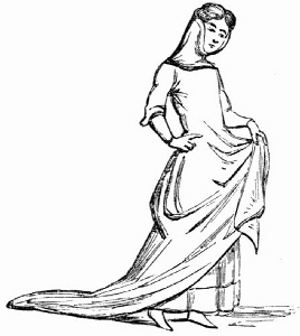
In Mr. Wright's collection of Latin stories, published by the Percy Society, there is one of the fourteenth century, which is so curious an instance of monkish satire, and is so apt an illustration of the cut before us, that I cannot resist presenting it to my readers. It runs thus:—
"Of a Proud Woman.—I have heard of a proud woman who wore a white dress with a long train, which, trailing behind her, raised a dust as far as the altar and the crucifix. But, as she left the church, and lifted up her train on account of the dirt, a certain holy man saw a devil laughing; and having adjured him to tell why he laughed, the devil said, "A companion of mine was just now sitting on the train of that woman, using it as if it were his chariot, but when she lifted her train up, my companion was shaken off into the dirt: and that is why I was laughing."
CORPULENT MAN. NOTTINGHAM, 1819.
November 10.—Death of Mr. Henry Bucknall, confectioner, Chandlers-lane, aged forty-nine. He was excessively corpulent, weighing more than twenty-five stone, and died very suddenly, immediately after eating a hearty breakfast. In Lord Howe's memorable engagement, on the 1st of June, 1794, he had served as a marine on board the Brunswick. His interment, at St. Mary's New Burial-ground, on the 14th, drew together a large concourse of spectators. The coffin was of enormous size, and nearly equalled the body in weight. It was made of excellent oak, was 6 feet 8 inches in length, and 2 feet 11 inches across the breast; the bottom was 2½ inches thick, the sides 1½, and the lid 1. The whole, including the body, considerably exceeded five hundred-weight.
TAKING A MAN TO PIECES AND SETTING HIM UP AGAIN.
"Don John, of Austria," says Staveley, "Governor of the Netherlands for Philip the 2d of Spain, dying at his camp at Buge (Bouges, a mile from Namur), was carried from thence to the great church at Havre, where his funeral was solemnised, and a monument to posterity erected for him there by Alexander Farnese, the Prince of Parma. Afterwards his body was taken to pieces, and the bones, packed in mails, were privately carried into Spain, where being set together with small wires, the body was rejointed again, which being filled or stuffed with cotton, and richly habited, Don John was presented to the king entire, leaning on his commander's staff. Afterwards the corpse being carried to the church of St. Laurence, at the Escurial, was there buried near his father, Charles V., with a fitting monument for him."
ORNAMENTS OF FEMALE DRESS IN THE TIMES OF THE ANCIENT BRITONS.
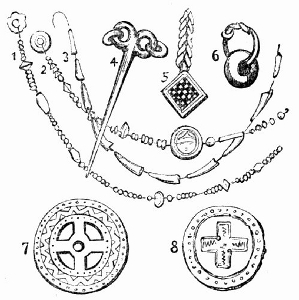
Fig. 1 is a necklace of beads, each bead being cut so as to represent a group of several, and give the effect of many small round beads to what are in reality long and narrow ones. Fig. 2 is a necklace of simpler construction, consisting of a row of rudely-shaped beads, its centre being remarkable for containing a rude attempt at representing a human face, the only thing of the kind Hoare discovered of so ancient a date in Britain. Fig. 3 is another necklace, consisting of a series of curious little shells, like the hirlas horn used by the Britons, which are perforated lengthways, and thus strung together. Fig. 4 is a pin of iron, supposed to have been used as a fastening for a mantle; it is ornamented with two movable rings. Fig. 5 is a small gold ornament, checkered like a chessboard, and suspended from a chain of beautiful workmanship, which, in taste and execution, bears a striking similarity to our modern curb-chains. Fig. 6 is an ear-ring, a bead suspended from a twisted wire of gold. Fig. 7 is a brass ornament, and Fig. 8 a similar one of gold: such ornaments are usually found upon the breasts of the exhumed skeletons of our barrows, and were probably fastened on their clothes as ornaments. Their cruciform character might lead to a doubt of their high antiquity, if we were not aware of the fact, that the symbol of the cross was worn, as an amulet or ornament, ages before the Christian era.
LARGE EEL.
Lately, near Malden, an eel was taken, measuring five feet six inches in length, seventeen in girth, and weighing 26 pounds, the largest of the species ever caught, or described in natural history.
PERSEVERING DOG.
A boast being made of the obedience of a Newfoundland dog in fetching and carrying, the master put a marked shilling under a large square stone by the road side, and, having ridden on three miles, ordered the dog to go back and fetch it. The dog set off, but did not return the whole day. He had gone to the place, and being unable to turn the stone, sat howling by it. Two horsemen came by and saw his distress, and one of them alighting removed the stone, and finding the shilling, put it in his pocket, not supposing that the dog could possibly be looking for that. The dog followed the horses for upwards of twenty miles, stayed in the room where they supped, got into the bed-room, got the breeches in which the fatal shilling had been put, made his escape with them, and dragged them through mud and mire, hedge and ditch, to his master's house.
CURE FOR CORPULENCE.
A few years ago, a man of about forty years of age, hired himself as a labourer, in one of the most considerable ale-breweries in the City: at this time he was a personable man; stout, active, and not fatter than a moderate-sized man in high health should be. His chief occupation was to superintend the working of the new beer, and occasionally to set up at night to watch the sweet-wort, an employment not requiring either activity or labour; of course, at these times, he had an opportunity of tasting the liquor, of which, it appears, he always availed himself; besides this, he had constant access to the new beer. Thus leading a quiet inactive life, he began to increase in bulk, and continued to enlarge, until, in a very short time, he became of such an unwieldy size, as to be unable to move about, and was too big to pass up the brewhouse staircase; if by any accident he fell down, he was unable to get up again without help. The integuments of his face hung down to the shoulders and breast: the fat was not confined to any particular part, but diffused over the whole of his body, arms, legs, &c., making his appearance such as to attract the attention of all who saw him. He left this service to go into the country, being a burthen to himself, and totally useless to his employers. About two years afterwards he called upon his old masters in very different shape to that above described, being reduced in size nearly half, and weighing little more than ten stone. The account that he gave of himself was, that as soon as he had quitted the brewhouse he went into Bedfordshire, where having soon spent the money he had earned, and being unable to work, he was brought into such a state of poverty, as to be scarcely able to obtain the sustenance of life, often being a whole day without food; that he drank very little, and that was generally water. By this mode of living he began to diminish in size, so as to be able to walk about with tolerable ease. He then engaged himself to a farmer, with whom he stayed a considerable time, and in the latter part of his service he was able to go through very hard labour, being sometimes in the field ploughing and following various agricultural concerns, for a whole day, with no other food than a small pittance of bread and cheese. This was the history he gave of the means by which this extraordinary change was brought about. He added, his health had never been so good as it then was.
WORSHIP OF THE SUN AND MOON.
The Sun was first worshipped, probably, as a bright manifestation of God, but soon began to be regarded as the Deity himself. The Moon, in the absence of the Sun, and next in splendour, would succeed it in superstitious attention. And so we find the Romans, as well as the Saxons, dedicating the first and second days of the week respectively to these "great lights." Formerly, festivals were held on the appearance of a New Moon; and in some parts of England it is still customary to bless it, and in Scotland at the same time to drop a courtesy. And in times not long past, the influence of the Moon was considered to be so great as to regulate the growth of air, and the effect of medicine, and to cause steeples and other elevated buildings to bend from their upright positions.