TEN THOUSAND WONDERFUL THINGS. (continued 14)
Reading edition
TATTOOED ABYSSINIAN LADY.
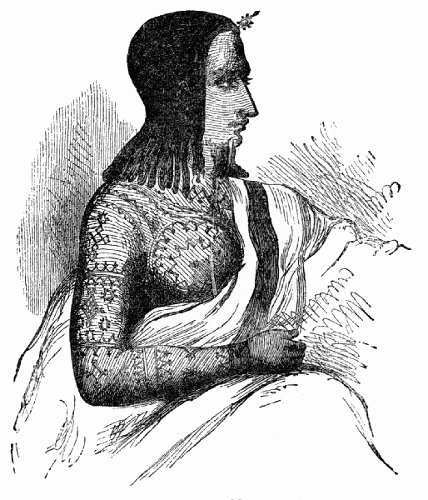
The annexed cut is a sketch of an Abyssinian lady, tattooed in the height of the fashion. The following extract from that interesting work "Parkyns's Abyssinia" gives a good account of the custom as it prevails in the larger cities there, and of the manner in which the operation is performed. "The men seldom tattoo more than one ornament on the upper part of the arm, near the shoulder, while the women cover nearly the whole of their bodies with stars, lines, and crosses, often rather tastefully arranged. I may well say nearly the whole of their persons, for they mark the neck, shoulders, breasts, and arms, down to the fingers, which are enriched with lines to imitate rings, nearly to the nails. The feet, ankles, and calves of the legs, are similarly adorned, and even the gums are by some pricked entirely blue, while others have them striped alternately blue and the natural pink. To see some of their designs, one would give them credit for some skill in the handling of their pencil; but, in fact, their system of drawing the pattern is purely mechanical. I had one arm adorned; a rather blind old woman was the artist; her implements consisted of a little pot of some sort of blacking, made, she told me, of charred herbs; a large home-made iron pin, about one-fourth of an inch at the end of which was ground fine; a bit or two of hollow cane, and a piece of straw; the two last-named items were her substitutes for pencils. Her circles were made by dipping the end of a piece of a cane of the required size into the blacking, and making its impression on the skin; while an end of the straw, bent to the proper length, and likewise blackened, marked all the lines, squares, diamonds, &c., which were to be of equal length. Her design being thus completed, she worked away on it with her pin, which she dug in as far as the thin part would enter, keeping the supply of blacking sufficient, and going over the same ground repeatedly to ensure regularity and unity in the lines. With some persons, the first effect of this tattooing is to produce a considerable amount of fever, from the irritation caused by the punctures; especially so with the ladies, from the extent of surface thus rendered sore. To allay this irritation, they are generally obliged to remain for a few days in a case of vegetable matter, which is plastered all over them in the form of a sort of green poultice. A scab forms over the tattooing, which should not be picked off, but allowed to fall off of itself. When this disappears, the operation is complete, and the marks are indelible; nay more, the Abyssinians declare that they may be traced on the person's bones even after death has bared them of their fleshy covering."
BULGARIAN FISHERMEN.
The following interesting account of the Bulgarian fishermen on the shores of the Black Sea is taken from the translation of a narrative of a boat excursion made in 1846 by M. Xavier Hommaire, along part of the northern coast of the Black Sea:—
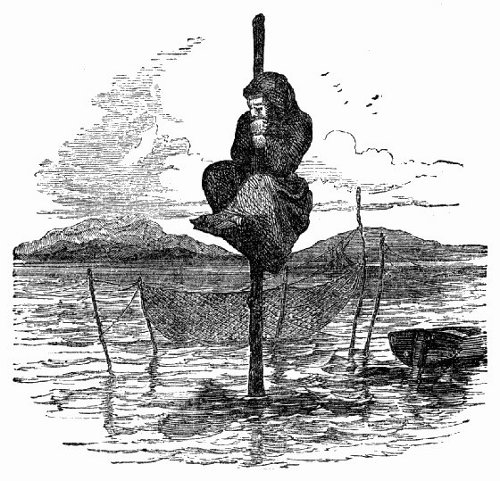
"The fishermen are, almost without exception, Bulgarians—a population at once maritime and agricultural, very closely resembling, in race and costume, the Bretons of France—and they enjoy a monopoly of all the fisheries in the Bosphorus and the adjacent parts of the Black Sea. Their elegant barks appeared on stated days and hours, shooting along with extraordinary rapidity through the waters of the Gulf of Buyuk Déreh, which appears to be their head-quarters, and sustaining the test of comparison even with the famous caiques of Constantinople. The most important object of their fishery is a delicious kind of small thunny, called palamede. They are Bulgarians, also, who own the singular fisheries which form such admirable subjects for the artist's sketch-book. They are found throughout the Bosphorus, from Bechiktusch and Scutari to the lighthouses of Europe and Asia. They might be called dog-kennels, but rickety and worm-eaten with antiquity, and are suspended by means of cords, pegs, and tatters to the top of an indescribable framework of props. There on high, petrified in motionless and uninterrupted silence, in company with some old pots of mignionette (where will not the love of flowers find a home!), a man, with the appearance of a wild beast or savage, leans over the sea, at the bottom of which he watches the passage of its smallest inhabitants, and the capricious variations of the current. At a certain distance is arranged, in the form of a square, a system of nets, which, at the least signal from the watcher, fall on the entire shoal of fish. A contrivance yet more primitive than these airy cells, if not so picturesque, was that of simple posts, which we encountered some time before in the channel of the Bosphorus, rising about fifteen feet above the surface of the water. Half-way up is perched, crouching (one cannot see how), something having the human form, and which is found to be a Bulgarian. For a long time I watched them without being able to make them out, either pole or its tenant; and often have I seen them in the morning, and observed them again in the evening, not having undergone the least change of posture.
"On returning to our encampment, the commandant of the fort, to whom we paid a visit, gave us a very different report of the fishermen of the morning, whom he described as an assemblage of all the vagabonds of the neighbourhood. Convinced even that the fact of their having fallen in with us must have inspired them with the project of coming to prowl by night round our camp, he wished us to accept some of the men in his garrison as a guard."
HORSES OF THE ARABS.
Arabs make intimate friends of their horses, and so docile are these creatures that they are ridden without a bit, and never struck or spurred. They share their owner's diet, and are as well cared for as a child. They divide their horses, however, into two kinds: The one they call kadischi, that is, horses of an unknown birth; the other, they call kochlani, that is, horses whose genealogy is known for thousands of years. They are direct descendants, so they say, of the stud of Solomon. The pedigree of an Arabian horse is hung round his neck soon after his birth, which is always properly witnessed and attested.
The following is the pedigree of a horse purchased by a French officer in Arabia:—"In the name of God, the merciful and compassionate, and of Saed Mahomed, agent of the high God, and of the companions of Mahommed, and of Jerusalem. Praised be the Lord, the Omnipotent Creator. This is a high-bred horse, and its colt's tooth is here in a bag about his neck, with his pedigree, and of undoubted authority, such as no infidel can refuse to believe. He is the son of Rabbamy, out of the dam Labadah, and equal in power to his sire of the tribe of Zazhalah; he is finely moulded, and made for running like an ostrich. In the honours of relationship, he reckons Zuluah, sire of Mahat, sire of Kallac, and the unique Alket sire of Manasseh, sire of Alsheh, father of the race down to the famous horse, the sire of Lahalala; and to him be ever abundance of green meat, and corn, and water of life, as a reward from the tribe of Zazhalah; and may a thousand branches shade his carcass from the hyæna of the tomb, from the howling wolf of the desert; and let the tribe of Zazhalah present him with a festival within an enclosure of walls; and let thousands assemble at the rising of the sun in troops hastily, where the tribe holds up under a canopy of celestial signs within the walls, the saddle with the name and family of the possessor. Then let them strike the bands with a loud noise incessantly, and pray to God for immunity for the tribe of Zoab, the inspired tribe."
DILEMMA.
Protagoras, an Athenian rhetorician, had agreed to instruct Evalthus in rhetoric, on condition that the latter should pay him a certain sum of money if he gained his first cause. Evalthus when instructed in all the precepts of the art, refused to pay Protagoras, who consequently brought him before the Areopagus, and said to the Judges—"Any verdict that you may give is in my favour: if it is on my side, it carries the condemnation of Evalthus; if against me, he must pay me, because he gains his first cause." "I confess," replied Evalthus, "that the verdict will be pronounced either for or against me; in either case I shall be equally acquitted: if the Judges pronounce in my favour, you are condemned; if they pronounce for you, according to our agreement, I owe you nothing, for I lose my first cause." The Judges being unable to reconcile the pleaders, ordered them to reappear before the Court a hundred years afterwards.
ORIENTAL EXTRAVAGANCE.
Mr. Forbes has given a curious picture of the kind of magnificence affected by Asuf ul Dowlah, who succeeded his father on the throne of Oude. This nabob was fond of lavishing his treasures on gardens, palaces, horses, elephants, European guns, lustres, and mirrors. He expended annually about £200,000 in English manufactures. He had more than one hundred gardens, twenty palaces, one thousand two hundred elephants, three thousand fine saddle horses, one thousand five hundred double-barrel guns, seventeen hundred superb lustres, thirty thousand shades of various forms and colours; seven hundred large mirrors, girandoles and clocks. Some of the latter were very curious, richly set with jewels, having figures in continual movement, and playing tunes every hour; two of these clocks only, cost him thirty thousand pounds. Without taste or judgment, he was extremely solicitous to possess all that was elegant and rare; he had instruments and machines of every art and science, but he knew none; and his museum was so ridiculously arranged that a wooden cuckoo-clock was placed close to a superb timepiece which cost the price of a diadem; and a valuable landscape of Claude Lorraine suspended near a board painted with ducks and drakes. He sometimes gave a dinner to ten or twelve persons, sitting at their ease in a carriage drawn by elephants. His jewels amounted to about eight millions sterling. Amidst this precious treasure, he might be seen for several hours every day handling them as a child does his toys.
ANCIENT SCOTTISH CHIEFTAIN.
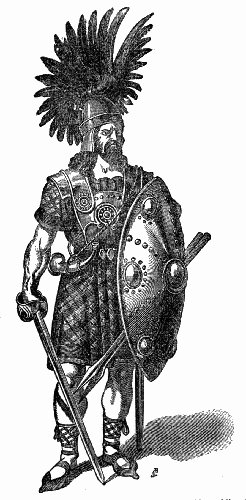
Annexed is a Scottish costume of the eighth or ninth century, after a drawing on parchment, extracted from an old book, which, according to the characters on the back, appears to have been written in Gaelic or Erse. According to the assertion of the possessor, this Caledonian document was brought to Germany in the year 1596, during the devastating Reformation in Scotland, when all cloisters and religious endowments were destroyed, and a perfect victory obtained over the episcopacy, so that many persons took refuge with their treasures, on the Continent, where the Scottish monks possessed many religious houses; some being at Nuremberg. Our figure represents a Highland chief, whose dress is picturesque and extremely beautiful. The Scottish tunic or blouse, checkered or striped in light and dark green, with violet intermixed, and bordered with violet stripes, is covered with a steel breastplate, accompanied by a back-piece, judging from the iron brassarts—positively a bequest of the Romans, by whom the Scots were once subjugated; this, indeed, is also attested by the offensive weapon the javelin; the sword, however, must be excepted, for it is national and like that of the present time. The strong shield may also have descended from the Romans, as well as the helmet, which is decorated with an eagle's wing; these, together with the hunting-horn, give to the figure a very imposing appearance. The national plaid is wanting, this was borne by attendants or squires. We are involuntarily reminded of the heroes of Fingal and Ossian, and we might almost think that this figure belonged to the time of the Scottish king, Kenneth the Second, grandson of King Achaias, and the sister of the Pictish king, Hang.
GREEK VASES.
Vases of various shapes have been found in the sepulchres of Greece, such as the œnochoe, or jug; the askos, or wine-skin; the phiale omphalotos, or saucer having a boss in the centre; rhyta, or jugs, imitated from the keras, or horn, as well as some moulded in the shape of the human bust. Vases of this class, however, occur more frequently in Italy than in Greece. Some are of remarkable shape. One in the Durand collection has its interior receded, and in the centre a medallion of the Gorgon's head; at the edge is the head of a dog or fox, and to it is attached a long handle terminating in the head of an animal. Similar handles are often found. Another vase from Sicily, also in the same collection, with a conical cover, is ornamented externally with moulded subjects of wreaths, heads of Medusa, &c., painted and gilded.
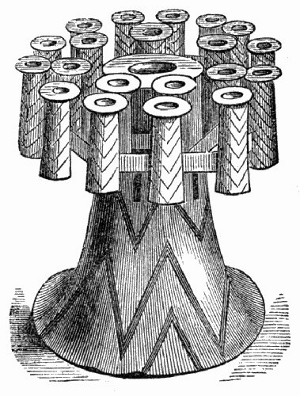
Many of the vases intended for ornamental purposes are covered with a white coating, and painted with colours of the same kind as those used on the figures before described, but with few and simple ornaments, plain bands, mæanders, chequered bands and wreaths. A vase found at Melos affords a curious example. We here annex a sketch of it. It consists of a number of small vases united together and arranged in a double circle round a central stand. This kind of vase is supposed to be the kernos, used in the mystic ceremonies to hold small quantities of viands. By some persons, however, it is thought to have been intended for eggs or flowers. It is covered with a white coating of clay, and the zigzag stripes are of a maroon colour. Such vases might have been used for flower-pots, and have formed small temporary gardens like those of Adonis, or have been employed as lamps.
QUEEN ELIZABETH'S DRESSES.
The list of the Queen's wardrobe, in 1600, shows us that she had then only 99 robes, 126 kirtles, 269 gowns (round, loose, and French), 136 foreparts, 125 petticoats, and 27 fans, not to mention 96 cloaks, 83 save guards, 85 doublets, and 18 lap mantles.
Her gowns were of the richest materials—purple, gold tissue, crimson satin, cloth of gold, cloth of silver, white velvet, munsy cloth, tawney satin, horse-flesh coloured satin, Isabella coloured satin dove coloured velvet, lady blush satin, drake coloured satin, and [...] coloured satin.
The cloaks are of perfumed leather, black taffety; the petticoats of blue satin; the jupes of orange coloured satin; the doublets of straw coloured satin; the mantles of white blush, striped with red swan's down.
The most characteristic dresses are the following:—
A frock of cloth of silver, checquered with red silk, like bird's eyes, with demi sleeves, a cut of crimson velvet twisted on with silver, lined with crimson velvet.
A mantle of white lawn, cut and turned in, embroidered all over with works of silver, like pomegranates, roses, honeysuckles, and acorns.
One French kirtle of white satin, cut all over, embroidered with loops, flowers, and clouds of Venice gold, silver, and silk.
One round kirtle of white satin, embroidered all over with the work like flames, peascods, and pillars, with a border likewise embroidered with roses.
The stomacher (fore part) of white satin, embroidered very fair with borders of the sun, moon, and other signs and planets of Venice gold, silver, and silk of sundry colours, with a border of beasts beneath, likewise embroidered.
Other gowns we find adorned with bees, spiders, flies, worms, trunks of trees, pansies, oak leaves, and mulberries; so that "Bess" must have looked like an illustrated edition of Æsop's Fables.
In one case she shines in rainbows, clouds, flames of fire, and suns; in another, with fountains and trees, snakes, and grasshoppers; the buttons themselves, in one instance, assume the shape of butterflies, in another of birds of Paradise.
The fans were of white and coloured feathers, with gold handles set with precious stones, or of crystal and heliotrope; one of them contained a looking-glass, another Leicester's badge of the bear and ragged staff. Her swords had gilt handles and blood-stone studs; her poniards were gold and ivory, ornamented with tassels of blue silk; her slippers of cloth of silver, and of orange-coloured velvet, embroidered with seed pearls; her parasol was of crimson velvet damask, striped with Venetian gold and silver lace, the handle mother-of-pearl.
Her jewels were both numerous and curious: the head ornaments resembling a white lion with a fly on his side, a golden fern-branch with a lizard, ladybird, and a snail upon it, an Irish dart of gold set with diamonds, a golden rose with a fly and spider upon it, a golden frog set with jewels, a golden daisy, and emerald buttons, gown studs of rubies and pearls, and a chain of golden scallop shells, with chains of agate and jet. A sumptuous magnificence was the characteristic of the costume of this reign. When Elizabeth visited the Earl of Hertford, at Elvetham, that nobleman met her with 3,000 followers, with black and yellow feathers in their hats, and most of them wearing gold chains. When she visited Suffolk, 200 bachelors in white velvet, with as many burghers in black velvet coats and gold chains, and 1800 serving-men received on horseback. For the French ambassador's amusement, in 1559, 1400 men-at-arms, clad in velvet, with chains of gold, mustered in arms in Greenwich Park; and on another occasion there was a tournament on Midsummer (Sunday) Night at the palace of Westminster, between ten knights in white, led by the Earl of Essex, and ten knights in blue, led by the Earl of Rutland.
CARE OF THE BEARD.
The Mahometans are very superstitious touching the beard. They bury the hairs which come off in combing it, and break them first, because they believe that angels have charge of every hair, and that they gain them their dismissal by breaking it. Selim I. was the first Sultan who shaved his beard, contrary to the law of the Koran. "I do it," said he apologetically to the scandalized and orthodox mufti, "to prevent my vizier leading me by it." He cared less for it than some of our ancestors, two centuries ago, did for their own. They used to wear pasteboard covers over them in the night, lest they should turn upon them and rumple them in their sleep!
The famous Raskolniki schismatics had a similar superstition to the Mahometan one mentioned above. They considered the divine image in man to reside in the beard.
DOLE IN CONSEQUENCE OF A DREAM.
At Newark-upon-Trent, a curious custom, founded upon the preservation of Alderman Clay and his family by a dream has prevailed since the days of Cromwell. On 11th March every year, penny-loaves are given away to every one who chooses to appear at the Town Hall and apply for them, in commemoration of the Alderman's deliverance, during the siege of Newark by the Parliamentary forces. This gentleman, by will, dated 11th December, 1694, gave to the Mayor and Aldermen, one hundred pounds, the interest of which was to be given to the Vicar yearly, on condition of his preaching an annual sermon. Another hundred pounds were also appropriated for the behoof of the poor, in the way above-mentioned. The origin of this bequest is singular. During the bombardment of Newark by Oliver Cromwell's forces, the Alderman dreamed three nights successively that his house had taken fire, which produced such a vivid impression upon his mind, that he and his family left it, and in a few days the circumstances of his vision actually took place, by the house being burned down by the besiegers.
GLOVE MONEY.
Gloves were popular new-year's gifts, or sometimes "glove-money" in place of them; occasionally, these gloves carried gold pieces in them. When Sir Thomas More was Chancellor, he decided a case in favour of Mrs. Croaker against Lord Arundel; the former, on the following new-year's day, gratefully presented the judge with a pair of gloves with forty angels in them. "It would be against good manners," said the Chancellor, "to forsake a gentlewoman's new-year's gift, and I accept the gloves. The lining you will elsewhere bestow."
GLAIVES.
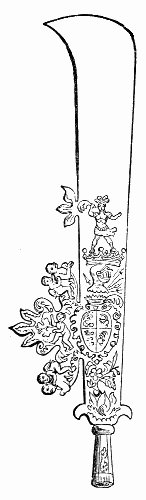
The glaive was derived from the Celtic custom of placing a sword with a hollow handle at the end of a pole, called by the natives of Wales "llavnawr"—the blade weapon, and takes its name from the Cleddyv, or Gleddyv, of the Welsh. In an abstract of the grants of the 1st of Richard III., among the Harleian MSS., No. 443, is a warrant to Nicholas Spicer, authorising him to impress smiths for making 2,000 Welsh glaives; and 20s. 6d. are charged for 30 glaives, with their staves, made at Abergavenny and Llanllolved. In the romaunt of Guy, Earl of Warwick, by Walter of Exeter, written in the time of Edward II., also in the Harleian Library of the British Museum, they are called gleves; thus—
"Grant coupes de gleves trenchant Les escurs ne lur vailut gans."
"Such powerful strokes from cutting gleves, That the shields were not worth a glove."
They were also in frequent use on the Continent, and the "Chronicle of Flanders" mentions an instance of the cavalry having armed themselves with glaives, which they ornamented with pennoncels. The specimen which we have here engraved is one which was made for the Doge of Venice, during the time that the Emperor Charles V. had the command there, in compliment to whom the centre ornament is the Austrian eagle. Upon this the arms of the succeeding Doge, Francisco Veneri, who held the office from 1554 to 1556, have been deeply incised, no doubt to commemorate the expulsion of the Germans. The pole, at the top of which the weapon was fixed, is omitted in our engraving.
CRUELTY OF FRANCIS CARRARA.
Francis Carrara, the last Lord of Padua, was famous for his cruelties. They shew (at Venice) a little box for a toilette, in which are six little guns, which are so ordered with springs, and adjusted in such a manner, that upon the opening of the trunk, the guns fired and killed the lady to whom Carrara sent it for a present. They show also with this, some little pocket cross-bows and arrows of steel, with which he took pleasure to kill those he met, so secretly, that they could hardly either perceive the blow, or him that gave it.
IRISH PIPES.
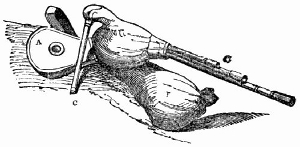
COMMON BAGPIPES.
The accompanying figures represent the Irish bagpipes in their primitive and improved forms. We have here the earliest pipes, originally the same as the Scotch, as appears from a drawing made in the sixteenth century, and given in Mr. Bunting's work; but they now differ, in having the mouthpiece supplied by the bellows A, which, being filled by the motion of the piper's arm, to which it is fastened, fills the bag B; whence, by the pressure of the other arm, the wind is is conveyed into the chanter C, which is played on with the fingers, much like a common pipe. By means of a tube, the wind is conveyed into drones a, a, a, which, tuned at octaves to each other, produce a kind of cronan, or bass, to the chanter. The second cut represents the improved, or union pipes, the drones of which, tuned at thirds and fifths by the regulator, have keys attached to them, which not only produce the most delightful accords, but enable the player to perform parts of tunes, and sometimes whole tunes, without using the chanter at all. Both drones and chanter can be rendered quiescent by means of stops.
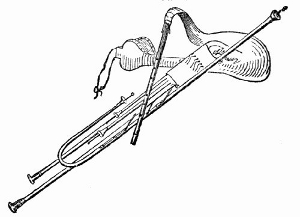
UNION PIPES.
The pipers were at one period the "great originals" of Ireland. The race is gradually departing, or at least "sobering" down into the ranks of ordinary mortals; but there was a time when the pipers stood out very prominently upon any canvas that pictured Irish life. Anecdotes of their eccentricities might be recorded that would fill volumes. For many years past their power has been on the wane; temperance committed sad havoc on their prospects; and at length the introduction of "brass bands" effectually destroyed the small balance that remained to them of hope.
NOVEL WAY OF CURING VICIOUS HORSES.
Burckhardt tells us of a strange mode of curing a vicious horse. He has seen, he says, vicious horses in Egypt cured of the habit of biting by presenting to them, while in the act of doing so, a leg of mutton just taken from the fire. The pain which the horse feels in biting through the hot meat causes it to abandon the practice.
GROUND ICE.
Every one who has watched the freezing of a lake or pond, or any other collection of still water, must be well aware that the ice begins to form on the surface in thin plates or layers, which on the continuance of the frost gradually become thicker and more solid, until the water is affected in a downward direction, and becomes, perhaps, a solid mass of ice. This is universally the case in stagnant water, but it has been repeatedly proved that in rapid and rugged streams the process of freezing is often very different. In direct opposition, as it would seem, to the laws of the propagation of heat, the ice in running water frequently begins to form at the bottom of the stream instead of the top; and this fact, while it is received with doubt by some, even among the scientific, is frequently attested by those whose business leads them to observe the phenomenon connected with rivers. Millers, fishermen, and watermen find that the masses of ice with which many rivers are crowded in the winter season rise from the bottom or bed of the stream. They say that they have seen them come up to the surface, and have also borne them up with their hooks. The under part of these masses of ice they have found covered with mud or encrusted with gravel, thus bearing plain marks of the ground on which the ice had rested. The testimony of people of this class in our country agrees with that of a similar class in Germany, where there is a peculiar term made use of to designate floating ice, i. e. grundeis (ground-ice).
A striking example of the formation of ground-ice is mentioned by the Commander Steenk, of Pillau. On the 9th of February, 1806, during a strong south-east wind, and a temperature a little exceeding 34° Fahr., a long iron chain, to which the buoys of the fair-way are fastened, and which had been lost sight of at Schappeiswrack in a depth of from fifteen to eighteen feet, suddenly made its appearance at the surface of the water and swam there; it was, however, completely encrusted with ice to the thickness of several feet. Stones, also, of from three to six pounds' weight, rose to the surface; they were surrounded with a thick coat of ice. A cable, also, three and a half inches thick, and about thirty fathoms long, which had been lost the preceding summer in a depth of thirty feet, again made its appearance by swimming to the surface; but it was enveloped in ice to the thickness of two feet. On the same day it was necessary to warp the ship into harbour in face of an east wind; the anchor used for that purpose, after it had rested an hour at the bottom, became so encrusted with ice, that it required not more than half the usual power to heave it up.
M. Hugi, president of the Society of Natural History at Soleure, observed, in February, 1827, a multitude of large icy tables on the river Aar. These were continually rising from the bottom, over a surface of four hundred and fifty square feet, and the phenomenon lasted for a couple of hours. Two years afterwards he witnessed a similar occurrence. On the 12th of February, 1829, at sunrise, and after a sudden fall in the temperature, the river began to exhibit numerous pieces of floating ice, although there was no sign of freezing on the surface, either along the banks, or in shady places where the water was calm. Therefore it could not be said that the floating masses were detached from the banks. Nor could they have proceeded from any large sheet of ice farther up the river, because, higher up, the river exhibited hardly any ice. Besides, flakes of ice commenced soon to rise up above the bridge; towards mid-day, islands of ice were seen forming in the centre of the river; and by the next day these were twenty-three in number, the largest being upwards of two hundred feet in diameter. They were surrounded with open water, resisting a current which flowed at the rate of nearly two hundred feet in a minute, and extending over a space of one-eighth of a league. M. Hugi visited them in a small boat. He landed, examined them in every direction, and discovered that there was a layer of compact ice on their surface a few inches in thickness, resting on a mass having the shape of an inverted cone, of a vertical height of twelve or thirteen feet, and fixed to the bed of the river. These cones consisted of half-melted ice, gelatinous, and much like the spawn of a frog. It was softer at the bottom than at the top, and was easily pierced in all directions with poles. Exposed to the open air, the substance of the cones became quickly granulated, like the ice that is formed at the bottom of rivers.
In the same year the pebbles in a creek of shallow water, near a very rapid current of the Rhine, were observed to be covered with a sort of transparent mass, an inch or two in thickness, and which, on examination, was found to consist of icy spicula, crossing each other in every direction. Large masses of spongy ice were also seen in the bed of the stream, at a depth of between six or seven feet. The watermen's poles entered these with ease, and often bore them to the surface. This kind of ice forms most quickly in rivers whose bed is impeded with stones and other foreign bodies.
HINDOO COMPUTATION.
The Hindoos call the whole of their four ages a divine age; a thousand divine ages form a calpa, or one of Brahma's days, who, during that period, successively invested fourteen menus, or holy spirits, with the sovereignty of the earth. The menu transmits his empire to his posterity for seventy-one divine ages, and this period is called manawantara, and as fourteen manawantara make but nine hundred and ninety-four divine ages, there remain six, which are the twilight of Brahma's day. Thirty of these days form his month; twelve of these months one of his years; and one hundred of these years the duration of his existence. The Hindoos assert that fifty of these years have already elapsed, so that we are in the first day of the first month of the fifty-first year of Brama's age, and in the twenty-eighth divine age of the seventh manawantara. The first three human ages of this age, and five thousand years of the fourth are past. The Hindoos therefore calculate that it is 131,400,007,205,000 years since the birth of Brahma, or the beginning of the world.
CHINESE TOMB.
Like all people of Tartar origin, one of the most remarkable characteristics of the Chinese is their reverence for the dead, or, as it is usually called, their ancestral worship. In consequence of this, their tombs are not only objects of care, but have frequently more ornament bestowed upon them than graces the dwellings of the living.
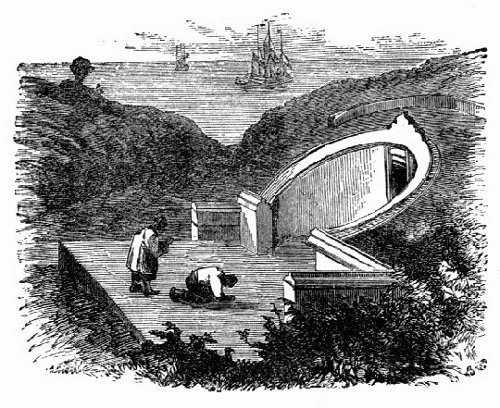
Their tombs are of different kinds; but the most common arrangement is that of a horseshoe-shaped platform, cut out of the side of a hill, as represented in our engraving. It consequently has a high back, in which is the entrance to the tomb, and slopes off to nothing at the entrance to the horseshoe, where the wall generally terminates with two lions or dragons, or some fantastic ornament common to Chinese architecture. When the tomb is situated, as is generally the case, on a hillside, this arrangement is not only appropriate, but elegant. When the same thing is imitated on a plain, it is singular, misplaced, and unintelligible. Many of the tombs are built of granite, finely polished, and carved with a profusion of labour that makes us regret that the people who can do such things should have so great a predilection for ephemeral wooden structures, when capable of employing the most durable materials with such facility.
ABYSSINIAN ARMS.
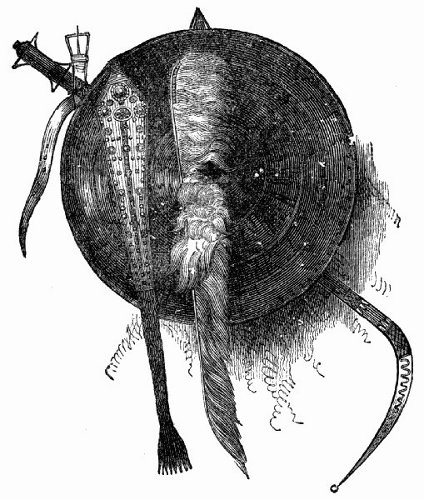
The above engraving represents a group of Abyssinian arms. The sword, spear, and shield are essentially the weapons of the Abyssinians, firearms being only of comparatively recent introduction, and not generally used. The shields are round, and nearly a yard in diameter; they are very neatly made of buffalo's hide, and of the form most calculated to throw off a lance-point; namely, falling back gradually from the boss or centre (which protrudes) to the edges. At the centre, in the inside, is fixed a solid leather handle, by which the shield is held in the hand when fighting, or through which the arm is passed to the elbow, for convenience of carrying on a journey. The edge is perforated with a number of holes, through which leather loops are passed, and by these it is hung up in the houses. The face of the shield is often ornamented in various ways, according to the wealth or fancy of the owner. Some have simply a narrow strip of lion's skin on each side of the boss, but crossing each other above and below it, the lower ends being allowed to hang at some length; others have a large broad strip of the mane down the centre of the shield, and hanging several inches below it. This is, of course, usually made of two or three pieces stitched together, as it would be difficult to get a single piece of sufficient length and beauty of fur. Others to this add a lion's paw or tail, fastened on the left side of the mane, and often highly adorned with silver. The beautiful long black and white fur of a sort of monkey, called "goréza," occasionally supplies the place of that of the nobler yet scarcely so beautiful animal. A shield almost completely covered with plates and bosses of silver, is usually the mark of the chief of some district. Those similarly plated in brass were likewise formerly used only by chiefs, though now they are carried by every soldier who can afford to buy them. The plated shield is called "tebbora." Those in brass are not much approved of, as they usually cover a bad skin; for a man possessed of a good handsome shield would never think of thus hiding its intrinsic beauties.
In former times a beautiful crooked knife was used in Tigrè, the sheath and handle of which were profusely enriched with silver and gilt. These, however, are never worn now, the long "shotel" in Tigrè, and the European-shaped sword among the Amhàra and most of the soldiers, have entirely superseded them.
The "shotel" is an awkward-looking weapon. Some, if straight, would be nearly four feet long: they are two-edged, and curved to a semicircle, like a reaper's sickle. They are principally used to strike the point downwards over the guard of an adversary, and for this the long curved shape is admirably adapted. It is, however, a very clumsy weapon to manage. The sheath is of red morocco leather, its point being often ornamented with a hollow silver ball, called "lomita," as large as a small apple. Many of the swords used are made in Europe, and are such as would be carried by the light cavalry, though lighter than ours. Being, however, cheap, showy articles, they are apt to break, and therefore the Abyssinians are getting tired of them, preferring those made of soft iron in their own country. These they make also with the faible considerably broader than the forte, to give force to the blow. Of course, they bend on the least stress; but, in defence of this failing, their owners say that, if a sword breaks, who is to mend it?—while, if it bends, you have only to sit on it, and it gets straight again. The handles of both this and the "shotel" are made of the horn of the rhinoceros. They are cut out of the horn at great loss of material, and hence they fetch a good price. It should be remembered that the heart of the horn is black, outside of which there is a coating, not quite an inch thick, of a semi-transparent white colour. To make a sword-handle, a piece of horn of the requisite length is first sawn off. This is then re-sawn longitudinally into three pieces, of which the inner one only is eligible for handles. This piece is about an inch and a half thick, four or five inches broad at the broader extremity, and three at the narrower. As it lies sawn flat before us we can distinctly see the black stripe in the centre, with the white on each side. Next, a nearly semicircular piece is cut out at each side, leaving only four points of the white as four corners, and the grasp black. The handle is then finished, bored for the shank of the blade, and polished. The shank is usually clinched over a half-dollar beaten convex; a fil-et-grain boss, called "timbora," is, however, sometimes substituted. A sword-hilt thus made is obviously a very clumsy one to handle, as the points are parallel to the edge, and those farthest from the blade are longest.
GEORGIANS AS TOPERS.
It is as unsurpassable topers, as well as for their military qualities, which have always been acknowledged, that the Georgians have acquired notoriety. At their frequent drinking parties it is said they will pass several days and nights, almost without intermission, in quaffing the productions of the vineyards of Kakheti, a district in the mountains east of Tiflis. This wine is by no means of bad quality; it is of a deep red colour, so deep that one fancies it has been tinged with some dye to produce so intense a hue. They are said to consume incredible quantities of wine on these occasions, and in a fashion that would put to shame the drinking triumphs of Ireland, recorded by Sir Jonah Barrington, in days of old, when intoxication was the standard of spirit. The drinking vessel is a cow's horn, of considerable length, and the point of honour is to drain it at a draught. The brethren and convivial rivals of the Georgians in the neighbouring provinces of Imeretia and Mingrelia, instead of a horn, use a delicately-hollowed globe of walnut tree, with a long narrow tube at the orifice. It holds fully a pint, and like its companion, the horn, the contents are consumed at a single gulp. How these globes are hollowed is as great a marvel as the construction of the ingenious Chinese puzzle of ball within ball.
STAG-HUNT IN THE SIXTEENTH CENTURY.
The following vivid picture of a stag-hunt is taken from the page of an old author, and refers to the days of the unfortunate Mary Queen of Scots:—"In the year 1567, the Earl of Athol, a prince of the blood royal, had, with much trouble and vast expense, a hunting-match for the entertainment of our most illustrious and gracious queen. Our people called this a royal hunting. I was then a young man, and present on that occasion. Two thousand Highlanders, or wild Scotch, as you call them, were employed to drive to the hunting-ground all the deer from the woods and hills of Athol, Badenoch, Marr, Murray, and the counties about. As these Highlanders use a light dress, and are very swift of foot, they went up and down so nimbly, that in less than two months' time, they brought together two thousand red deer, besides roes and fallow deer. The queen, the great men, and a number of others, were in a glen when these deer were brought before them. Believe me, the whole body moved forward in something like battle order. The sight delighted the queen very much; but she soon had cause for fear. Upon the earl—(who had been accustomed from his early days to such sights)—addressing her thus:—'Do you observe that stag who is foremost of the herd? There is danger from that stag; for if either fear or rage should force him from the ridge of that hill, let every one look to himself, for none of us will be out of the way of harm; for the rest will follow this one, and having thrown us under foot, they will open a passage to this hill behind us.' What happened a moment after confirmed this opinion; for the queen ordered one of the best dogs to be let loose on one of the deer: this the dog pursues; the leading stag was frighted; he flies by the same way he had come there; the rest rush after him, and break out where the thickest body of Highlanders are; they had nothing for it but to throw themselves flat on the heath, and allow the deer to pass over them. It was told the queen that several of the Highlanders had been wounded, and that two or three had been killed outright; and the whole body had got off, had not the Highlanders, by their skill in hunting, fallen upon a stratagem to cut off the rear from the main body. It was of those that had been separated that the queen's dogs and those of the nobility made slaughter. There were killed that day three hundred and sixty deer, besides some roes."
TIME WASTED IN TAKING SNUFF.
A vast quantity of valuable time is wasted by the votaries of tobacco, especially by the smokers; and that the devotees of snuff are not greatly behind in this respect, will be shown by the following singular calculation of Lord Stanhope:—
"Every professed, inveterate, and incurable snuff-taker," says his lordship, "at a moderate computation, takes one pinch in ten minutes. Every pinch, with the agreeable ceremony of blowing and wiping the nose and other incidental circumstances, consumes one minute and a half. One minute and a half out of every ten, allowing sixteen hours to a snuff-taking day, amounts to two hours and twenty-four minutes out of every natural day, or one day out of ten. One day out of every ten, amounts to thirty-six days and a half in a year. Hence, if we suppose the practice to be persisted in forty years, two entire years of the snuff-taker's life will be dedicated to tickling his nose, and two more to blowing it. The expense of snuff, snuff-boxes, and handkerchiefs, will be the subject of a second essay, in which it will appear that this luxury encroaches as much on the income of the snuff-taker as it does on his time; and that by proper application of the time and money thus lost to the public, a fund might be constituted for the discharge of the national debt."
VALUE OF A LONG PSALM.
Formerly a psalm was allowed to be sung at the gallows by the culprit, in case of a reprieve. It is reported of one of the chaplains to the famous Montrose, that being condemned in Scotland to die, for attending his master in some of his glorious exploits, and being upon the ladder, ordered to set out a psalm, he expecting a reprieve, named the 119th Psalm (with which the officer attending the execution complied, the Scotch Presbyterians being great psalm-singers): and it was well for him he did so, for they had sung it half through before the reprieve came: any other psalm would have hanged him.
ANCIENT INCENSE CHARIOT.
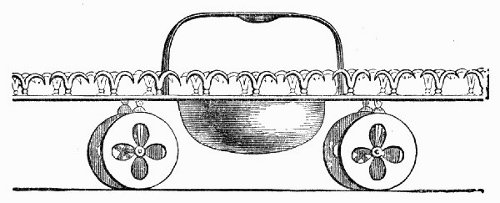
The implement which we have engraved was found in a tomb at Cervetri in Etruria, and unquestionably belongs to a very remote date of the archaic period. It was used in the ritual services of the ancients, and seems to have been destined for burning incense. The perfume was, no doubt, placed in the concave part, and the fact of the whole being mounted upon four wheels proves that it was intended to be moved about, which, in religious services, may have been a great convenience. The borders are adorned by a row of flower-shaped ornaments, the graceful forms of which will be appreciated in the side-view we have given of it. It must be confessed, indeed, that this monument, which is marked by the stamp of an antiquity so exceedingly remote, displays within the limits of its archaic character much elegance, conveying the idea of a highly refined taste, suitable to a person of dignified position, as the priest or king may be supposed to have been, to whom the article belonged.
TOO MUCH PARENTAL AUTHORITY.
All the world over, the current of natural affection flows strongly downwards to posterity. Love for children, in most nations, seems to be stronger than the love for parents. But in China, the current of natural affection is thrown back towards parents with undue strength. The love of posterity is in danger of being checked and weakened by their excessive veneration for parents. The father has absolute power, even the power of life and death, over his children. A few years ago, a Chinese father said to his wife, "What shall we do with our young son? He is undutiful and rebellious, and will bring disgrace on our family name; let us put him to death." Accordingly, having tied a cord round the boy's neck, the father pulled one end of it, and the mother the other, and thus they strangled their son. The magistrates took no notice of the occurrence. A wealthy Chinese gentleman at Ningpo shut up one of his orphan grandchildren and starved her to death. He could not be troubled rearing her up. Another man at the same place, having commanded two of his sons one day to follow him, entered a boat, and rowed out to the middle of the stream. He then deliberately tied a stone to the neck of one of his sons, and threw him into the river. The other lad was compelled to assist his father in the cruel proceeding. These facts are well known to the missionaries at that place. They heard the cries of the poor girl, and rescued her sister from a similar fate, and they saw the youth drowned by his father. But the authorities never thought of interfering.
POPULAR PASTIMES.
The popular pastimes of the time of James the First are enumerated in the following lines, in a little work entitled "The Letting of Humour's Blood in the Head-vaine; with a New Morisco daunced by seven Satyres upon the bottome of Diogenes' tubbe:" 8vo, Lond. 1611.
"Man, I dare challenge thee to Throw the Sledge, To jump or Leape over ditch or hedge, To Wrastle, play at Stooleball, or to Runne: To Pitch the Barre, or to Shoote Off a Gunne: To play at Loggets, Nine Holes, or Ten Pinnes: To try it out at Foot-ball by the shinnes: At Ticktacke, Irish Noddie, Maw, and Ruffe, At Hot-cockles, Leap-frog, or Blindman-buffe; To drinke halfe-pots, or deale at the whole can: To play at Base, or Pen-and-Ynkhorne Sir Juan; To daunce the Morris, play at Barley-breake, At all exploytes a man can thinke or speake; At Shove-groate, Venter-poynt, or Crosse & Pile, At Beshrow him that's last at yonder style; At Leaping o'er a Midsommer-bon-fier, Or at the Drawing Dun out of the myer: At any of those, or all these presently, Wagge but your finger, I am for you, I!"
VACILLATING NEWSPAPERS.
The newspapers of Paris, submitted to the censorship of the press, in 1815, announced in the following terms, Bonaparte's departure from the Isle of Elba, his march across France, and his entry into the French Capital:—9th March—The Cannibal has escaped from his den. 10th—The Corsican ogre has just landed at Cape Juan. 11th—The Tiger has arrived at Gap. 12th—The Monster has passed the night at Grenoble. 13th—The Tyrant has crossed Lyons. 14th—The Usurper is directing his course towards Dijon, but the brave and loyal Burgundians have risen in a body, and they surround him on all sides. 18th—Bonaparte is sixty leagues from the Capital; he has had skill enough to escape from the hands of his pursuers. 19th—Bonaparte advances rapidly, but he will never enter Paris. 20th—To-morrow, Napoleon will be under our ramparts. 21st—The Emperor is at Fontainebleau. 22nd—His Imperial and Royal Majesty last evening made his entrance into his Palace of the Tuileries, amidst the joyous acclamations of an adoring and faithful people.
PRESSING TO DEATH, AND PRAYING AND FASTING.
In a number of Oliver Cromwell's Newspaper, "The Perfect Account of the Daily Intelligence," dated April 16th, 1651, we find this horrid instance of torture:—
"Mond. April 14th.—This session, at the Old Bailey, were four men pressed to death that were all in one robbery, and, out of obstinacy and contempt of the court, stood mute and refused to plead; from whence we may perceive the exceeding great hardness some men are grown unto, who do not only swerve from instructions, exhortations, and goodnesse, but become so lewd and insolent that they render themselves the proper subjects for whom severe laws were first invented and enacted."
The very next paragraph in the paper is to the following effect:—
"Those of the congregate churches, and many other godly people in London and parts adjacent, have appointed Friday, the 25th instant, as a day of solemn fasting and prayer, for a blessing upon the armies at land, the fleet at sea, and negociations abroad."
THE FIRST WATCHES IN ENGLAND.
In 1584 watches began to come from Germany, and the watchmaker soon became a trader of importance. The watches were often of immense size, and hung in a rich case from the neck, and by fops wound up with great gravity and ceremony in Paul's or at the ordinary dinner. Catgut mainsprings must have been slightly affected by changes of weather, and sometimes a little out of time in wet Novembers; but, Sessa, let the world live! An early specimen of the watch that we have seen engraved was, however, not larger than a walnut, richly chased, and enclosed in a pear-shaped case. It had no minute hand, but was of beautiful workmanship. Country people, like Touchstone, sometimes carried pocket dials, in the shape of brass rings, with a slide and aperture, to be regulated to the season.
EXTRAORDINARY CIRCUMSTANCE.
Jesse, in his interesting "Gleanings in Natural History," gives the following remarkable instance of an extraneous substance being found imbedded in the solid timber of an ash:—"A person on whose accuracy and veracity I can place every reliance, informed me that hearing from some of his brother workmen, that in sawing up the butt of a large ash-tree, they had found a bird's nest in the middle of it; he immediately went to the spot, and found an ash cut in two longitudinally on the saw-pit, and the bird's nest nearly in the centre of the tree. The nest was about two-thirds of a hollow globe, and composed of moss, hair, and feathers, all seemingly in a fresh state. There were three eggs in it, nearly white and somewhat speckled. On examining the tree most minutely with several other workmen, no mark or protuberance was found to indicate the least injury. The bark was perfectly smooth and the tree quite sound." In endeavouring to account for this curious fact, we can only suppose that some accidental hole was made in the tree before it arrived at any great size, in which a bird had built its nest, and forsaken it after she had laid three eggs. As the tree grew larger, the bark would grow over the hole, and in process of time the nest would become embedded in the tree.
PORT COON CAVE.
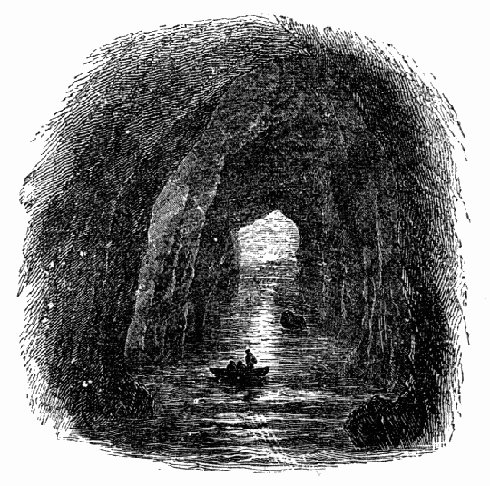
The above is a sketch of a cave which well deserves a place among our collection of Wonders. It is called Port Coon Cave, and is in the line of rocks near the Giants' Causeway. It may be visited either by sea or by land. Boats may row into it to the distance of a hundred yards or more, but the swell is sometimes dangerous; and although the land entrance to the cave is slippery, and a fair proportion of climbing is necessary to achieve the object, still the magnificence of the excavation, its length, and the formation of the interior, would repay greater exertion; the stones of which the roof and sides are composed, and which are of a rounded form, and embedded, as it were, in a basaltic paste, are formed of concentric spheres resembling the coats of an onion; the innermost recess has been compared to the side aisle of a Gothic cathedral; the walls are most painfully slimy to the touch; the discharge of a loaded gun reverberates amid the rolling of the billows, so as to thunder a most awful effect; and the notes of a bugle, we are told, produced delicious echoes.
ANECDOTE IN PORCELAIN.
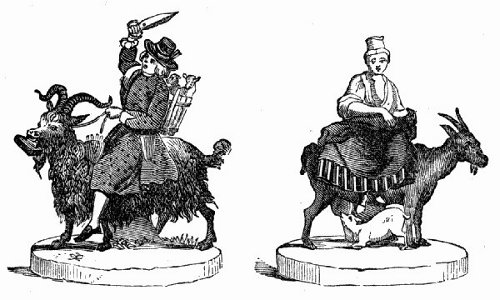
The finest specimens of Dresden porcelain were undoubtedly made previously to the Seven Years' War, when no expense was spared, and when any price might be obtained. Count Brühl, the profligate minister of Augustus III., whose splendid palace and terrace is the great ornament of Dresden, was importuned by his tailor to be allowed to see the manufactory, admission to which was strictly prohibited. At length he consented, and the tailor upon his entrance was presented with the two last new pieces made, which were—one a grotesque figure, a portrait of himself mounted upon a he-goat, with the shears, and all his other implements of trade; and the other, his wife upon a she-goat, with a baby in swaddling clothes. The poor tailor was so annoyed with these caricatures, that he turned back without desiring to see more. These pieces, known as Count Brühl's Tailor and his Wife, are now much sought after, from their historical interest. They were made in 1760, by Kändler.
ANGLO-SAXON FEASTS.
It is a mark of Anglo-Saxon delicacy, that table-cloths were features at Anglo-Saxon feasts; but, as the long ends were used in place of napkins, the delicacy would be of a somewhat dirty hue, if the cloth were made to serve at a second feast. There was a rude sort of display upon the board; but the order of service was of a quality that would strike the "Jeameses" of the age of Victoria with inexpressible disgust. The meat was never "dished," and "covers" were as yet unknown. The attendants brought the viands into the dining-hall on the spits, knelt to each guest, presented the spit to his consideration; and, the guest having helped himself, the attendant went through the same ceremony with the next guest. Hard drinking followed upon these same ceremonies; and even the monasteries were not exempt from the sins of gluttony and drunkenness. Notwithstanding these bad habits, the Anglo-Saxons were a cleanly people; the warm bath was in general use. Water, for hands and feet, was brought to every stranger on entering a house wherein he was about to tarry and feed; and, it is said that one of the severest penances of the church was the temporary denial of the bath, and of cutting the hair and nails.
HOUSEHOLD RULES IN THE SIXTEENTH CENTURY.
From Sir J. Harrington's (the translator of Ariosto) rules for servants, we obtain a very clear conception of the internal government of a country gentleman's house in 1566.
A servant who is absent from prayers to be fined. For uttering an oath, 1d.; and the same sum for leaving a door open.
A fine of 2d., from Lady Day to Michaelmas, for all who are in bed after six, or out after ten.
The same fine, from Michaelmas to Lady Day, for all who are in bed after seven, or out after nine.
A fine of 1d. for any bed unmade, fire unlit, or candle-box uncleaned after eight.
A fine of 4d. for any man detected teaching the children obscene words.
A fine of 1d. for any man waiting without a trencher, or who is absent at a meal.
For any one breaking any of the butler's glass, 12d.
A fine of 2d. for any one who has not laid the table for dinner by half-past ten, or the supper by six.
A fine of 4d. for any one absent a day without leave.
For any man striking another, a fine of 1d.
For any follower visiting the cook, 1d.
A fine of 1d. for any man appearing in a foul shirt, broken hose, untied shoes, or torn doublet.
A fine of 1d, for any stranger's room left for four hours after he be dressed.
A fine of 1d. if the hall be not cleansed by eight in winter and seven in summer.
The porter to be fined 1d. if the court-gate be not shut during meals.
A fine of 3d. if the stairs be not cleaned every Friday after dinner.
All these fines were deducted by the steward at the quarterly payment of the men's wages. If these laws were observed, the domestic discipline must have been almost military in it.
THE QUEEN OF SHEBA.
Belkis, according to the Arabs, was the famous Queen of Sheba or Saba, who visited, and afterwards married, Solomon, in the twenty-first year of her reign. Tabari has introduced her story with such gorgeous embellishments as to resemble a fairy tale rather than episode in serious narrative. She is said to have been subdued by the Jewish monarch, who discovered her retreat among the mountains, between Hejaz and Yemen by means of a lapwing, which he had despatched in search of water during his progress through Arabia. This princess is called Nicolaa by some writers. The Abyssinians claim the same distinction for one of their queens; and have preserved the names of a dynasty alleged to have been descended from her union with Solomon.
SUPERSTITION IN FRANCE.
In France, superstition at this day is even more prevalent than it is in England. Garinet, in his history of Magic and Sorcery in that country, cites upwards of twenty instances which occurred between the years 1805 and 1818. In the latter year no less than three tribunals were occupied with trials originating in this humiliating belief: we shall cite only one of them. Julian Desbourdes, aged fifty-three, a mason, and inhabitant of the village of Thilouze, near Bourdeaux, was taken suddenly ill, in the month of January 1818. As he did not know how to account for his malady, he suspected at last that he was bewitched. He communicated this suspicion to his son-in-law Bridier, and they both went to consult a sort of idiot, named Boudouin, who passed for a conjuror or white-witch. This man told them that Desbourdes was certainly bewitched, and offered to accompany them to the house of an old man named Renard, who, he said, was undoubtedly the criminal. On the night of the 23rd of January all three proceeded stealthily to the dwelling of Renard, and accused him of afflicting persons with diseases by the aid of the devil. Desbourdes fell on his knees and earnestly entreated to be restored to his former health, promising that he would take no measures against him for the evil he had done. The old man denied in the strongest terms that he was a wizard; and when Desbourdes still pressed him to remove the spell from him, he said he knew nothing about the spell, and refused to remove it. The idiot Boudouin, the white-witch, now interfered, and told his companions that no relief for the malady could ever be procured until the old man confessed his guilt. To force him to confession they lighted some sticks of sulphur which they had brought with them for the purpose, and placed them under the old man's nose. In a few moments he fell down suffocated and apparently lifeless. They were all greatly alarmed; and thinking that they had killed the man, they carried him out and threw him into a neighbouring pond, hoping to make it appear that he had fallen in accidentally. The pond, however, was not very deep, and the coolness of the water reviving the old man, he opened his eyes and sat up. Desbourdes and Bridier, who were still waiting on the bank, were now more alarmed than before, lest he should recover and inform against them. They therefore waded into the pond, seized their victim by the hair of the head, beat him severely, and then held him under water till he was drowned.
They were all three apprehended on the charge of murder a few days afterwards. Desbourdes and Bridier were found guilty of aggravated manslaughter only, and sentenced to be burnt on the back, and to work in the galleys for life. The white-witch Boudouin was acquitted on the ground of insanity.
HELMET OF SIR JOHN CROSBY.
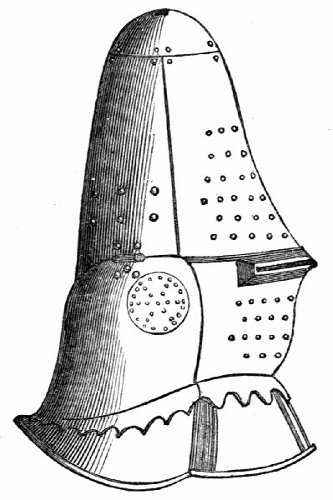
We here present our readers with a sketch of the helmet of Sir John Crosby, as it originally appeared when suspended over his tomb in St. Helen's Church, Bishopsgate. He was an eminent merchant of London; but is represented upon his tomb in a full suit of armour. He died in 1475. The extreme height of the crown of the helmet resembles that on the tomb of the Earl of Warwick, in the Beauchamp Chapel at Warwick; and was intended to support the crest of the wearer, the holes for affixing it being still visible.
EARTHQUAKE PANIC.
A panic terror of the end of the world seized the good people of Leeds and its neighbourhood in the year 1806. It arose from the following circumstances. A hen, in a village close by, laid eggs, on which were inscribed the words, "Christ is coming." Great numbers visited the spot, and examined these wondrous eggs, convinced that the day of judgment was near at hand. Like sailors in a storm, expecting every instant to go to the bottom, the believers suddenly became religious, prayed violently, and flattered themselves that they repented them of their evil courses. But a plain tale soon put them down, and quenched their religion entirely. Some gentlemen, hearing of the matter, went one fine morning and caught the poor hen in the act of laying one of her miraculous eggs. They soon ascertained beyond doubt that the egg had been inscribed with some corrosive ink, and cruelly forced up again, into the bird's body. At this explanation, those who had prayed, now laughed, and the world wagged as merrily as of yore.
OLD ENGLISH SACK-POT.
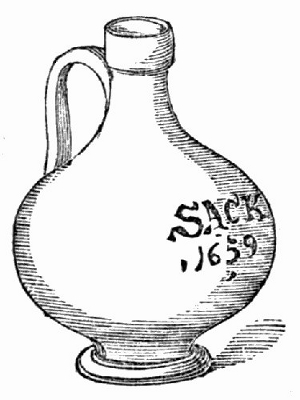
Sack was such a national beverage of the jolly old England of the seventeenth century, that we are sure our readers will thank us for giving them an idea of the vessel in which it was commonly used. The bottle here engraved, and inscribed "Sack," was found in Old Tabley Hall, Cheshire, and is a veritable specimen of the sort of vessel from which the topers of the "good old times" poured into their cups the drink with which they so loved to warm their heart-strings. It is of a dull-white, with blue letters, and it is in the possession of the Hon. Robert Curzon, jun., author of the interesting work on the Monasteries of the Levant. Two old English bottles of similar character, one lettered Sack, the other Claret, dated 1646, were sold at Strawberry Hill.
AGE OF TREES.
Mr. Twining was engaged, in the year 1827, in measuring and inspecting a large lot of hemlock timber cut from the north-eastern slope of East Rock, New Haven (America), and destined for the foundation of a wharf. While thus employed he took particular notice of the successive layers, each of which constitutes a year's growth of the tree, and which in that kind of wood are very distinct. These layers were of various breadths, and plainly showed that in some seasons the trees made a much greater advance than in others, some of the layers being five or six times broader than others. Every tree had thus preserved a record of the seasons for the period of its growth, whether thirty years or two hundred—and what was worthy of notice, every tree told the same story. Thus, by beginning at the outer layer of two trees, the one young the other old, and counting back twenty years, if the young tree indicated, by a full layer, a growing season for that kind of timber, the other tree indicated the same.
"I had then before me," (says this intelligent observer) "two or three hundred meteorological tables, all of them as unerring as nature; and by selecting one tree from the oldest, and sawing out a thin section from its trunk, I might have preserved one of the number to be referred to afterwards. It might have been smoothed on the one side by the plane, so as to exhibit its record to the eye with all the neatness and distinctness of a drawing. On the opposite side might have been minuted in indelible writing the locality of the tree, the kind of timber, the year and month when cut, the soil where it grew, the side and point which faced the north, and every other circumstance which can possibly be supposed ever to have the most remote relation to the value of the table in hand. The lover of science will not be backward to incur such trouble, for he knows how often, in the progress of human knowledge, an observation or an experiment has lost its value by the disregard of some circumstance connected with it, which at the time was not thought worthy of notice. Lastly, there might be attached to the same section a written meteorological table compiled from the observations of some scientific person, if such observations had been made in the vicinity. This being done, why, in the eye of science, might not this natural, unerring, graphical record of seasons past deserve as careful preservation as a curious mineral, or a new form of crystals?"
THE CAMEL AS A SCAPE-GOAT.
A very singular account of the use to which a camel is sometimes put, is given by the traveller Bruce. He tells us that he saw one employed to appease a quarrel between two parties, something in the same way as the scape-goat was used in the religious services of the Jewish people. The camel being brought out was accused by both parties of all the injuries, real or supposed, which belonged to each. All the mischief that had been done, they accused this camel of doing. They upbraided it with being the cause of all the trouble that had separated friends, called it by every opprobious epithet, and finally killed it, and declared themselves reconciled over its body.
SUSPENDED VOLITION.
A young lady, an attendant of the Princess ——, after having been confined to her bed for a great length of time with a violent nervous disorder, was at last, to all appearance, deprived of life. Her lips were quite pale, her face resembled the countenance of a dead person, and the body grew cold.
She was removed from the room in which she lay, was put in a coffin, and the day of her funeral fixed on. The day arrived, and, according to the custom of the country, funeral songs and hymns were sung before the door. Just as the people were about to nail on the lid of the coffin, a kind of perspiration was observed to appear on the surface of her body. It grew greater every moment, and at last a kind of convulsive motion was observed in the hands and feet of the corpse. A few minutes after, during which time fresh signs of returning life appeared, she at once opened her eyes and uttered a most pitiable shriek. Physicians were quickly procured, and in the course of a few days she was considerably restored.
The description which she gave of her situation is extremely remarkable, and forms a curious and authentic addition to psychology.
She said it seemed to her, as if in a dream, that she was really dead; yet she was perfectly conscious of all that happened around her in this dreadful state. She distinctly heard her friends speaking, and lamenting her death, at the side of her coffin. She felt them pull on the dead-clothes, and lay her in them. This feeling produced a mental anxiety which is indescribable. She tried to cry, but her soul was without power, and could not act on her body. She had the contradictory feeling as if she were in her body, and yet not in it, at one and the same time. It was equally impossible for her to stretch out her arm or to open her eyes, or to cry, although she continually endeavoured to do so. The internal anguish of her mind was, however, at its utmost height when the lid of the coffin was about to be nailed on. The thought that she was to be buried alive was the one that gave activity to her soul, and caused it to operate on her corporeal frame.
FASHIONS FOR THE DEAD.
The following advertisement appeared in a Glasgow paper about the middle of the last century. "James Hodge, who lives in the first close above the Cross, on the west side of the street, Glasgow, continues to sell burying Crapes ready made; and his wife's niece, who lives with him, dresses dead Corpses at as cheap a rate as was formerly done by her aunt, having been educated by her, and perfected at Edinburgh, from whence she is lately arrived, and has all the newest and best fashions."
COMMON USE OF PLATE IN THE TIME OF HENRY VIII.
A writer in the early part of the sixteenth century tells us that in his time, in the reign of Henry the Eighth, the luxury of the table had descended even to citizens, and that there were few whose tables were not daily provided with spoons, cups, and a salt-cellar of silver. Those of a higher sphere affected a greater profusion of plate; but the quantity accumulated by Cardinal Wolsey, though the precious metals are now so copious, still continues to excite our surprise. At Hampton Court, where he feasted the French ambassadors and their splendid retinue in 1528, two cupboards, extending across the banquet chambers, were piled to the top with plate and illuminated; yet, without encroaching on these ostentatious repositories, a profuse service remained for the table. Two hundred and eighty beds were provided for the guests; every chamber had a bason and ewer of silver, beside other utensils.
DIOGENES IN A PITHOS, NOT TUB.
A pithos is a description of earthen vessel or jar, distinguished from the amphora by its large mouth, and comparatively flattened base. Its shape was more that of a gourd, or pot; its size large enough to have rendered it applicable to the purposes of a cistern, or water butt. Such, indeed, appear in some instances to have been its dimensions, that it has long been a matter of dispute amongst the learned whether, if Diogenes dwelt in a tub at all (a point by no means settled), his humble habitation were of wood or earthenware. Brougniart adopts the latter opinion, and has illustrated it by a partial copy from a print in Winckelmann. In the original, the philosopher is shown holding his well-known chat with Alexander the Great, at the gate of the Metroum, or Temple of the Mother of the Gods at Athens; but his tub has there the addition of a dog lying on the outside, above his master's head, evidently on the watch to defend him, if necessary, against any attack from the royal warrior. Winckelmann's engraving, which we here present, is taken from a bas-relief discovered in the Villa Albani; in which the cynic's tub is clearly of earthenware, having a large fracture on one side, which has been repaired with some other material dovetailed across the crack. This, Winckelmann concludes to have been lead (commesso col piombo), simply, however, upon the authority of the following lines in Juvenal:—
"Si Fregeris, altera fiet Cras domus, aut eadem plumbo commissa manebit." Sat. xiv 310.
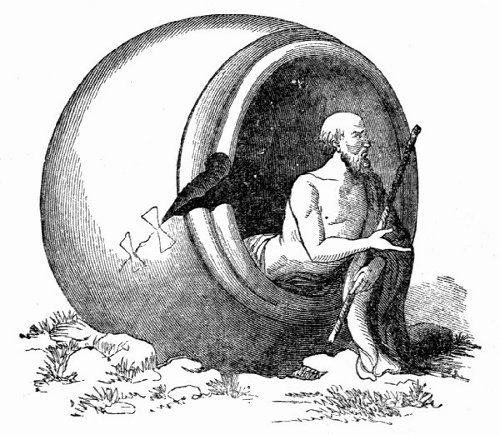
Be all this, however, as it may, the controversy is not without its value in connexion with the ceramic productions of the period. If the "dolia" and "[Greek: pithaknê]." of the ancients had not been of sufficient capacity, however kennel-like, to have served as a dwelling, or shelter, for the philosopher, the tale would hardly have existed. Nor does it seem probable that Juvenal, in allusion to the story, would have used the term testâ (testâ cum vidit in illâ magnum habitatorem), or have dwelt upon their fragility, or have said that they would not burn (dolia nudi non ardent Cynici), if vessels of the sort had not been commonly of earthenware. These vessels, both ancient and modern, have a thickness and strength which enables them to be rolled on a ladder to and from the top of the kiln, where they are baked, without injury.
CHINESE SCHOOL.
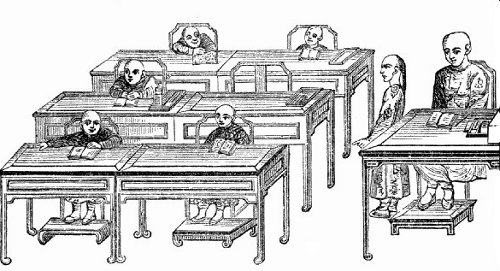
The annexed engraving is a curiosity both in itself and in what it represents. It is taken from a sketch by a native Chinese artist, and depicts the internal arrangements of a native Chinese school. The extraordinary nature of the Chinese language renders it impossible for a schoolmaster to instruct more than a very few scholars at a time, since the meaning of the words actually depends on their correct intonation. Every vocable in the language is capable of being pronounced in six different tones of voice, and of conveying six meanings, totally different from each other, according to the tone given to it. Pronounced in one tone, it conveys one meaning, and is represented by one written character; pronounced in another tone, it conveys an entirely distinct meaning, and is represented in writing by another character altogether different. The correct and distinct enunciation of these tones is the chief difficulty in learning to speak the language. These tones are stereotyped and fixed, and must be learned, as part of the word, at the same time that its form and signification are mastered. Moreover, they are all arranged upon system, like the notes in a gamut, and when thoroughly mastered, the theory of the tones is really beautiful. If a wrong tone, then, is given to a word in reading or in conversation, it grates upon a Chinese ear like a false note in playing the fiddle. Further, if the voice be not correctly modulated, and the words correctly intoned, not only is a jarring note pronounced, but actually a wrong word is uttered, and a different meaning conveyed from what was intended. A missionary to the Chinese, therefore, should be possessed of a musical ear. Without this, the acquisition of the spoken language will be attended by very arduous labour; and, perhaps, after years of toil, he will find that he still frequently fails in correctly conveying his meaning.
LONDON LOCALITIES IN THE SIXTEENTH CENTURY.
At Ludgate was a gaol, where the prisoners clamoured for alms at the barred grate; and it was here that Sir Thomas Wyatt had been repulsed. The city wall that joined this gate to its other fellow gates ran from the Tower through the Minories to Aldgate, Houndsditch, and Bishopsgate, through Cripplegate to Aldersgate, and so past Christ's Hospital by Newgate and Ludgate to the Thames.
Pimlico was a country place where citizens used to repair to eat "pudding pies" on a Sunday, as they did to Islington or Hogsden to take tobacco and drink new milk; as Islington was famous for its dairy, where Sir Walter Raleigh is said to have lived in an old house still standing, so Holloway was famous for its cheese cakes; and it is these peculiarities that, after all, confer immortality upon a place. Chelsea was the mere village of Chelsea, known from Sir Thomas More's house, where Henry VIII. had walked with his arm round that great statesman's doomed neck; as Holborn was then a country road leading to the pleasant village of St. Giles, and trending on to the way that led to Oxford and to fatal Tyburn, so called from its burn or brook, then well known to patient city anglers. The triple tree or gallows stood at the corner of the present Edgware Road. The same Oxford Street led also, if you turned up one side of the Hampstead Road, to the Tottenham Court, which stood there alone far in the country, and Primrose Hill was an untrodden hillock, surrounded by wide paths and ditches between this court and Hampstead.
A cheerful little stream, known by the pleasant name of the Fleet, rose near Hampstead Hill, and joined by the Old Bourne and recruited by sparkling Clerken Well, emptied itself in the Thames. Though even then merely a sewer, it was open, and had four bridges of its own, while the Thames had but one; and these were known as Holborn Bridge, Fleet-lane Bridge, Fleet Bridge, and Bridewell Bridge.
Spitalfields was a grassy open space, with artillery grounds and a pulpit and cross, where fairs were held and sermons preached. There were also Tothill Fields, and Finsbury Fields, and Moor Fields, just outside the city walls, laid out in walks, and planted, as far as Hoxton. Round these squares there were windmills and everything equally rural. As for Piccadilly, it was everywhere known as a road to Reading, and by many herbalists, as harbouring the small wild foxglove in its dry ditches.
Outside Temple Bar, before the wooden gatehouse was built, lay the Strand, the road leading from the city to the houses of Court. This river bank was the chosen residence of the nobility, whose gardens stretched to the edge of the then undefiled river. The sky then was pure and bright, for our ancestors burnt wood fires, and the water was gay with thousands of boats. Each house had its terrace, its water stairs, and garden. The street houses were so scattered that the river could be seen between them, and there were three water courses there traversed by bridges, besides two churches and a maypole. Here stood York House, where Bacon was born, and Durham Place, where Raleigh lived, with his study in a turret overlooking the river; there also were Arundel House and Essex House, where great men pined and plotted.
At Whitehall stood Wolsey's Palace, enlarged by Henry VIII., and Elizabeth's favourite residence when not at Nonsuch in Surrey, Windsor, Greenwich, or Richmond. The tilt-yard stood where the Horse Guards now stands. St. James's Palace, also built by Henry VIII., where the Queen's melancholy-bigot sister had died, was seldom inhabited by the Court; but the park was even then existing. As for the old palace of Richard III. (Baynard's Castle), that had been let to the Earl of Pembroke, and the same king's dwelling of Crosby Hall had fallen into the hands of an alderman.
WARWICK THE KING-MAKER.
On the right-hand side of Newgate-street are various streets and courts leading into Paternoster-row. Of these, Warwick and Ivy lanes, Panyer-alley, and Lovel's-court, merit the attention of the lover of literary and historical antiquities. Warwick-lane, now the abode of butchers and tallow-chandlers, took its name from the inn or house of the celebrated Warwick, the king-maker.
Stow mentions his coming to London in the famous convention of 1458, with 600 men, all in red jackets, embroidered, with ragged staves, before and behind, and was lodged in Warwick-lane; "in whose house there was often six oxen eaten at a breakfast, and every taverne was full of his meate, for hee that had any acquaintance in that house, might have there so much of sodden and roaste meate, as he could pricke and carry upon a long dagger."
The memory of the earl was long preserved by a small stone statue, placed in the side front of a tobacconist's, at the corner of this lane; and there is a public-house which has the earl's head for its sign.
THANKSGIVING DAY IN 1697.
The following is an extract from the "Post Boy" of the above date:—
"Thursday, December 2, 1697. Thursday being appointed for the day of Thanksgiving, the same was ushered in with ringing of bells; the king went to the Chapel Royal, where, &c., and at night we had bonfires and illuminations. The fine fireworks in St. James's Square were lighted after this manner:—About twelve o'clock, the Foot Guards lined the avenues; the rockets and all things being fixed on the rails the day before: a little after six, the king, attended by his guards, came to the Earl of Romney's house, from whence soon after a signal was given, by firing a rocket, for the fireworks to go off, which were immediately lighted; the performance was extraordinary fine, and much applauded; the same continued somewhat better than half an hour, and there were divers sorts of fireworks; some had the king's name, others the arms of England; in a word, they were very curious. There was a man and a woman unfortunately killed, and divers others hurt by the falling down of sticks. About half an hour after, His Majesty went to St. James's there being a fine ball."
THE GREY MAN'S PATH.
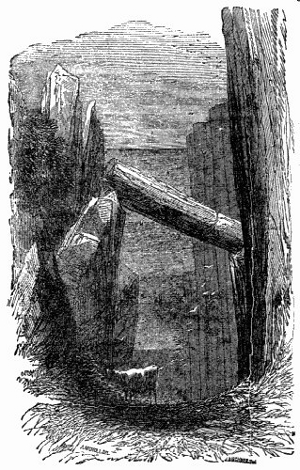
The annexed sketch depicts a scene in the coast rocks at Fairhead, near Ballycastle in Ireland. Fhir Leith, or "The Grey Man's Path," (a fissure in the precipice,) viewed either from land or sea, is never to be forgotten: it seems as though some supernatural power, determined to hew for itself a pathway through the wonderful formations that tower along the coast—so that it might visit or summon the spirits of the deep, without treading a road made by mortal hands—had willed the fearful chasm that divides the rocky promontory in two. The singular passage, in its narrow part, is barred across by the fragment of a pillar, hurled, as it were, over the fissure, and supported on both sides at a considerable elevation. If you descend, you perceive the passage widens, and becomes more important; its dark sides assume greater height, and a more wild and sombre magnificence; and at last they extend upwards, above 220 feet, through which the tourist arrives at the massive débris which crowd the base of the mighty promontory, where the northern ocean rolls his threatening billows. From the cragsmen and boatmen of this wild coast you hear no tales of Faery, no hints of the gentle legends and superstitions collected in the south, or in the inland districts of the north; not that they are a whit less superstitious, but their superstition is, as the superstition of the sea kings, of a bold and peculiar character; their ghosts come from out the deep, before or after the rising of the moon, and climb, or rather stalk up the rocks, and, seated upon those mysterious pillars, converse together; so that, in the fisherman's huts, they say, "it thunders." Even mermaids are deemed too trifling in their habits and manners for this stupendous scenery, where spirits of the gigantic world congregate, and where the "Grey Man" of the North Sea stalks forth, silently and alone, up his appropriate path, to witness some mighty convulsion of nature.
ANCIENT JET NECKLACE.
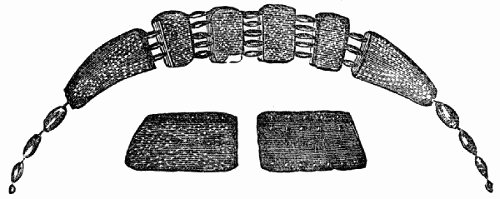
Various interesting ornaments, belonging to the Archaic, or Bronze period in Scotland, are preserved in the Museum of Scottish Antiquaries, and one set in particular, found enclosed in an urn within a rude stone cist, on the demolition of a tumulus near the Old House of Assynt, Rossshire, in 1824, we here engrave. They include a necklace of irregular oval jet beads, which appear to have been strung together like a common modern string of beads, and are sufficiently rude to correspond with the works of a very primitive era. The other ornaments which are represented here about one-fourth the size of the original, are curiously studded with gold spots, arranged in patterns similar to those with which the rude pottery of the British tumuli are most frequently decorated, and the whole are perforated with holes passing obliquely from the back through the edge, evidently designed for attaching them to each other by means of threads.
JUGGLERS IN JAPAN.
The perfection of jugglery in Japan entitles it to be ranked amongst the fine arts. An eye-witness thus describes the performance of a Japanese juggler. "Here are some of his feats:—No. 1. He took an ordinary boy's top, spun it in the air, caught it on his hand, and then placed it (still spinning) upon the edge of a sword, near the hilt. Then he dropped the sword point a little, and the top moved slowly towards it. Arrived at the very end, the hilt was lowered in turn, and the top brought back. As usual, the sword was dangerously sharp. No. 2 was also performed with the top. He spun it in the air, and then threw the end of the string back towards it with such accuracy that it was caught up and wound itself all ready for a second cast. By the time it had done this it had reached his hand, and was ready for another spin. No. 3 was still performed with the top. There was an upright pole, upon the top of which was perched a little house, with a very large front door. The top was spun, made to climb the pole, knock open the said front door, and disappear. As well as I remember, the hand end of the string was fastened near the door, so that this was almost a repetition of the self-winding feat. But feat No. 4 was something even more astonishing than all this. He took two paper butterflies, armed himself with the usual paper fan, threw them into the air, and, fanning gently, kept them flying about him as if they had been alive. 'He can make them alight wherever you wish! Try him!' remarked the Kami (Prince), through the interpreter. Mr. H—— requested that one might alight upon each ear of the juggler. No sooner expressed than complied with. Gentle undulations of the fan waved them slowly to the required points, and there left them comfortably seated. Now, whether this command over pieces of paper was obtained simply by currents of air, or by the power of a concealed magnet, Mr. H—— could not tell or ascertain. One thing, however, was certain, the power was there."
may-fair play bill in the time of william iii. WILLIAM REX. MAY-FAIR. MILLER'S, or the Loyal Association Booth, at the upper end of Brook-field Market, near Hyde Park Corner. During the time of MAY-FAIR, will be presented an excellent droll, called KING WILLIAM'S HAPPY DELIVERANCE and Glorious Triumph over his Enemies, or the Consultation of the POPE, DEVIL, FRENCH KING, and the GRAND TURK, with the whole Form of the Siege of Namur, and the humours of a Renegade FRENCH MAN and BRANDY JEAN, with the conceits of Scaramouch and Harlequin, together with the best Singing and Dancing that was ever seen in a Fair, also a Dialogue song. VIVAT REX.
BELLS.
Bells were formerly a prolific source of superstition. There is a valley in Nottinghamshire, where a village is said to have been swallowed up by an earthquake, and it was the custom on Christmas Day morning for the people to assemble in this valley and listen to the fancied ringing of the church bells underground. At Abbot's Morton there is a tradition that the silver bells belonging to the abbot are buried in the site of his old residence there. At Ledbury, a legend relates that St. Katharine had a revelation that she was to travel about, and not rest at any place, till she heard the bells ringing of their own accord. This was done by the Ledbury bells on her approaching that town. When the church at Inkberrow was rebuilt on a new site in ancient days, it was believed that the fairies took umbrage at the change, as they were supposed to be averse to bells; they accordingly endeavoured to obstruct the building, but, as they did not succeed, the following lamentation was occasionally heard by the startled rustics:
"Neither sleep, neither lie, For Inkbro's ting-tangs hang so nigh."
Many years ago the twelve parish churches in Jersey each possessed a beautiful and valuable peal of bells; but during a long civil war, the states determined on selling these bells to defray the heavy expenses of their army. The bells were accordingly collected, and sent to France for that purpose; but, on the passage, the ship foundered, and everything was lost, to show the wrath of Heaven at the sacrilege. Since then, before a storm, these bells ring up from the deep; and, to this day, the fishermen of St. Ouen's Bay always go to the edge of the water before embarking, to listen if they can hear "the bells upon the wind;" and, if those warning notes are heard, nothing will induce them to leave the shore; if all is quiet they fearlessly set sail. As a gentleman, who has versified the legend, says:
"'Tis an omen of death to the mariner, Who wearily fights with the sea; For the foaming surge is his winding sheet, And his funeral knell are we: His funeral knell our passing bells beat, And his winding sheet the sea."
BRIBING THE DEMONS.
The rich inhabitants of the Celestial Empire, it is almost needless to say, make an exorbitant display at funerals. They invite as many relations and friends as they can, in order to muster an imposing procession, and the mourning dresses worn by the whole party are at the cost of the family of the deceased, who are also bound to provide them for several days together with splendid repasts. A great number of musicians are hired for the occasion, and also of weepers, for though most people in China are pretty well skilled in the art of shedding tears, there exist mourners by profession, who have carried it to still greater perfection, and are absolutely inimitable at sobs and groans. They follow the coffin in long white robes, hempen girdles, and dishevelled hair; and their lamentations are accompanied by the beating of gongs, by the sharp and discordant sounds of rude instruments of music, and the discharge of fireworks. The sudden explosion and the smell of the powder are supposed to be efficacious in frightening away the demons, and hindering them from seizing on the soul of the defunct, which never fails to follow the coffin; and as these malevolent spirits have also the reputation of being extremely covetous and fond of money, people endeavour to get on their weak side. They let fall, for this purpose, all along the road, sapecks and bank-notes, that the wind carries away in all directions; and as the demons in China are by no means so cunning as the men, they are taken in by this device, and fall into the trap with charming simplicity, though, the supposed bank-notes are in fact only bits of white paper. Whilst they are engaged in pursuing these deceitful appearances of riches, the soul of the defunct proceeds quietly and comfortably after its coffin without any danger of its being stopped by the way.
HOLY-WATER SPRINKLER.
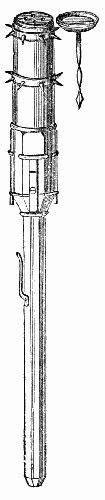
To sprinkle the holy water was, in ancient times, the cant phrase for fetching blood, which will account for the appellation of a certain class of weapons, as there is no resemblance whatever between them and the aspergillum used by Roman Catholics. The specimen we have here sketched is a demi holy-water-sprinkler—to speak in the language of the time—"with gonnes at the ende." This awkward weapon, prior, in point of date, to the invention of the matchlock, and, therefore, not later than the time of Edward IV., was made to hang at the saddle-bow instead of a mace. The iron cap at the end is furnished with a spear-like blade, and opens on an hinge, or is held in its place by a hook. It contains four short barrels, each of which is fired by a match, and its touch-hole is protected by a sliding piece of wood.
In using this weapon the intention was first to fire at the enemy with the "gonnes at the ende," and then to club him on coming to close quarters. To effect all this, however, in a satisfactory manner, much time must have been lost, and many accidents, no doubt, were liable to happen to the person who used such a weapon as this, which was almost as dangerous to the man who possessed it, as to the enemy against whom he directed it. The lid at the top must first have been opened, and not only so, but must have been kept open all the time the weapon was used as a gun, and then, previously to closing with the foe, it must have been necessary to secure it, lest, in brandishing the instrument as a club, the open lid should strike against the head of the man who wielded it. No wonder that this dangerous compound of club and gun soon went out of fashion, and survived its invention only a very few years.
FIRST TEA-DRINKERS PUZZLED.
The first brewers of tea were often sorely perplexed with the preparation of the new mystery. "Mrs. Hutchinson's great grandmother was one of a party who sat down to the first pound of tea that ever came into Penrith. It was sent as a present, and without directions how to use it. They boiled the whole at once in a bottle, and sat down to eat the leaves with butter and salt, and they wondered how any person could like such a diet."
COLUMN AT CUSSI.
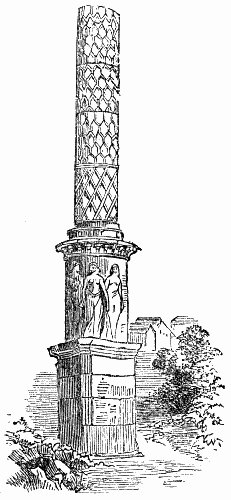
The great object of the erection of pillars of victory was to serve as vehicles for sculpture; though, as we now see them, or as they are caricatured at Paris and elsewhere, they are little more than instances of immense labour bestowed to very little purpose. In the original use of these pillars, they were placed in small courts surrounded by open porticos, whence the spectator could at two, or perhaps at three different levels examine the sculpture at his leisure at a convenient distance, while the absurdity of a pillar supporting nothing was not apparent, from its not being seen from the outside. A good specimen of this class is that at Cussi, near Beaune, in France. It is represented in the annexed cut. It probably belongs to the time of Aurelian, and no doubt was first erected within a court; but it is not known either by whom it was erected, or what victory it was designed to celebrate. Still that it is a pillar of victory is certain, and its resemblance to pillars raised with the same object in India is quite striking. The arrangement of the base, serving as a pedestal for eight statues, is not only elegant, but appropriate. The ornament which covers the shaft takes off from the idea of its being a mere pillar, and, at the same time, is so subdued as not to break the outline or interfere with constructive propriety. The capital of the Corinthian order is found in the neighbourhood, used as the mouth of a well. In its original position it no doubt had a hole through it, which being enlarged suggested its application to its present comparatively ignoble purpose, the hole being no doubt intended either to receive or support the statue or emblem that originally crowned the monument, but of that no trace now remains.