TEN THOUSAND WONDERFUL THINGS. (continued 13)
Reading edition
In Savoy, near the lake of Bourget, is another spring of this kind, but it differs from those which have been already mentioned in being very uncertain in its intervals.
CURIOUS JEWEL WHICH BELONGED TO JAMES I.
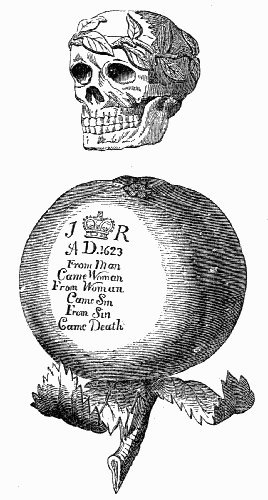
In former times it was a common practice with princes and nobles to have elaborate articles of jewellery constructed in such forms as had a religious and emblematical signification. An inventory of the Dukes of Burgundy, made in 1396, speaks of a fleur-de-lys which opened, and contained inside a picture of the Crucifixion. In 1416, the Duke of Berri had "a fair apple," which opened, and contained within on one side the figure of Christ, and on the other that of the Virgin. Among the jewels of the Dukes of Burgundy in 1392 there were two pears of gold, enamelled, each containing an image of Our Lady. We find similar entries in the other different inventories of the Dukes of Burgundy: An apple of silver, enamelled, containing in the inside a picture of St. Catherine, in 1400; a pine-apple of gold, which contained figures of the birth of Christ, and of the three kings, in 1467; and, in the same year, two apples of gold, one containing, on the opposite halves, Our Lady and St. Paul, the other, St. Peter and St. Paul—the latter suspended by three small chains. These kinds of devices continued in fashion till a much later period, and a very curious example, from the collection of Lord Londesborough, which appears to have belonged to King James I., is here engraved.
The whole is of silver, and the leaves appear to have been painted green. On opening it we find in the inside the small skull here represented above the apple. The top of the skull opens like a lid, and inside are two small paintings, representing the Creation and the Resurrection, with the inscription, "Post Mortem, vita eternitas." The external inscription is not gallant. To give the apple externally a more natural appearance, there are marks of two bites on the side opposite that here represented, showing a large and small set of teeth.
STRANGE CURIOSITIES.
In the Anatomy Hall of Leyden is a drinking cup of the skull of a Moor, killed in the beleaguring of Haerlem. Also a cup made of a double brain pan. We observe also that No. 51 is the skin of a woman, and No. 52 the skin of a woman, prepared like leather; No. 53 the skin of a Malacca woman, above 150 years old, presented by Richard Snolk, who probably had her flayed.
THE CROSS OF CONG.
The cross, of which the following is a correct representation, possesses eminent claims to a place among our curiosities, since it constitutes the gem of the Museum of the Royal Irish Academy.
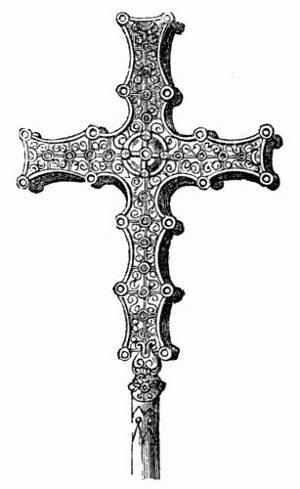
This cross was made at Roscommon, by native Irishmen, about the year 1123, in the reign of Turlogh O'Connor, father of Roderick, the last monarch of Ireland, and contains what was supposed to be a piece of the true cross, as inscriptions in Irish, and Latin in the Irish character, upon two of its sides record. The engraving affords a correct idea of the original, as the extremely minute and elaborate ornaments with which it is completely covered, and a portion of which is worked in pure gold, could not possibly be expressed on so reduced a scale. The ornaments generally consist of tracery and grotesque animals fancifully combined, and similar in character to the decorations found upon crosses of stone of about the same period. A large crystal, through which a portion of the wood which the cross was formed to enshrine is visible, is set in the centre.
FOOT-RACING IN 1699.
A remarkable foot-race was run about the year 1699, which is thus described in the manuscript journal of a lady who was one of the spectators:—"I drove through the forest of Windsor to see a race run by two footmen, an English and a Scotch, the former a taller bigger man than the other. The ground measured and cut even in a round was about four miles; they were to run it round so often as to make up twenty-two miles, which was the distance between Charing Cross and Windsor Cross, that is, five times quite round, and so far as to make up the odd miles and measure. They ran a round in twenty-five minutes. I saw them run the first three rounds and half another in an hour and seventeen minutes, and they finished it in two hours and a half. The Englishman gained the start the second round, and kept it at the same distance the five rounds, and then the Scotchman came up to him and got before him to the post. The Englishman fell down within a few yards of the post. Many hundred pounds were won and lost about it. They ran both very neatly, but my judgment gave it to the Scotchman, because he seemed to save himself to the last push."
THE CHERRY TREE.
The Cherry Tree was introduced into Great Britain before A.D. 53. The earliest mention of the fruit being exposed to sale by hawkers in London is in Henry the Fifth's reign, 1415. New sorts were introduced from Flanders, by Richard Haines, Henry the Eighth's fruiterer, and being planted in Kent were called "Flanders," or "Kentish Cherries," of which Gerard (1597) says, "They have a better juice, but watery, cold, and moist." Philips says, "There is an account of a cherry-orchard of thirty-two acres in Kent, which, in the year 1540, produced fruit that sold in those early days, for 1,000l.; which seems an enormous sum, as at that period good land is stated to have let at one shilling per acre." Evelyn tells us, that in his time (1662) an acre planted with cherries, one hundred miles from London, had been let at 10l. During the Commonwealth (1649), the manor and mansion of Henrietta Maria, Queen of Charles I., at Wimbledon, in Surrey, were surveyed previously to being sold, and it appears that there were upwards of two hundred cherry trees in the gardens. Since that time the cherry tree has found universal admission into shrubberies, gardens, and orchards.
INSTRUCTIONS TO A CHAPLAIN.
The following, and we believe they are unique, are Sir John Wynne of Gwedir's instructions to his chaplain, the Rev. John Pryce. "First, you shall have the chamber I showed you in my gate, private to yourself, with lock and key, and all necessaries. In the morning, I expect you should rise, and say prayers in my hall, to my household below, before they go to work, and when they come in at night, that you call before you all the workmen, specially the youth, and take account of them of their belief, and of what Sir Meredith taught them. I beg you to continue for the most part in the lower house: you are to have onlye what is done there, that you may inform me of any disorder there. There is a bayliff of husbandry and a porter, who will be commanded by you. The morning after you be up, and have said prayers, as afore, I would you to bestow in study on any commendable exercise of your body. Before dinner you are to come up and attend grace or prayers, if there be any publicke; and to sit up if there be not greater strangers above the chyldren, who you are to teach in your own chamber. When the table from half downwards is taken up, then you are to rise and to walk in the alleys near at hand until grace time, and to come in then for that purpose. After dinner, if I be busy, you may go to bowles, shuffel bord, or any other honest, decent recreation, until I go abroad. If you see me void of business, and go to ride abroad, you shall command a gelding to be made ready by the grooms of the stable, and to go with me. If I go to bowles or shuffel bord, I shall lyke of your company, if the place be not made up with strangers. I would have you to go every Sunday in the year to some church hereabouts, to preache, giving warnynge to the parish, to bring the yowths at after noon to the church to be catechysed; in which poynt is my greatest care that you should be paynfull and dylygent. Avoyd the alehouse, to sytte and keepe drunkard's company ther, being the greatest discredit your function can have."
TWO MISERS.
In the year 1778 died, at a village near Reading, John Jackson, aged ninety-three, and James Jackson, aged eighty-seven. These two brothers were old bachelors, and afforded a striking instance of the insufficiency of wealth to create happiness. Though these old men had been blest with great riches ever since they were twenty years of age, they absolutely denied themselves the common necessaries of life; and lived in the village for fifty years past as poor men, and often accepted of charity from rich persons who resided near them. They never suffered any woman or man to come into their apartment (which was only one shabby room), and were both taken ill, and languishing a short time, they expired on the same day, within one hour of each other. It is computed, by the writings left behind them, that they died worth £150,000.
ANECDOTE OF THE HOUSE OF BRUNSWICK.
The following anecdote relating to the august House of Brunswick is taken from the "Annual Register" of 1765:—"The late Duchess of Blakenburgh, great grandmother to the hereditary prince, who died some years since in a very advanced age, had the singular happiness to reckon amongst her posterity, sixty-two princes and princesses; (fifty-three of whom she saw at one time alive;) and amongst them three emperors, two empresses, two kings, and two queens; a circumstance that, probably, no sovereign house but that of Brunswick ever produced anything like it."
AMUSEMENTS OF SOME LEARNED AUTHORS.
Tycho Brahe polished glass for spectacles, and made mathematical instruments. D'Andilly delighted, like our Evelyn, in forest-trees; Balzac, with the manufacturing of crayons; Pieresc, with his medals and antiques; the Abbé de Marolles, with engravings; Rohault's greatest recreation was in seeing different mechanics at their labour; Arnauld read the most trashy novels for relaxation; as did our Warburton, the late Lords Loughborough and Camden; Montaigne fondled his cat; Cardinal Richelieu, in jumping and leaping. Grumm informs us that the Chevalier de Boufflers would crow like a cock, and bray like an ass; in both of which he excelled, not metaphorically but literally.
EARLY GERMAN DRINKING CUP.
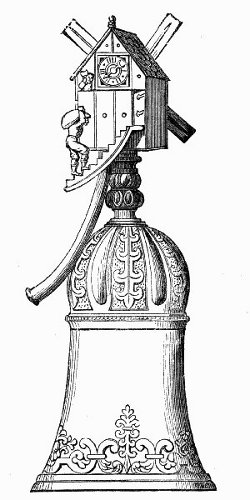
The above, taken from the Londesborough collection, is a good example of the German drinking cups of fanciful shape, which were so much in fashion in that country in the sixteenth and seventeenth centuries. The specimen before us is of silver, and dated 1619. The mill and scroll ornament on the cup are gilt. It was held in the hand to be filled, and could not be set down until emptied; the drinker, blowing through the tube into the mill, set the sails in motion, and reversed the cup on the table.
THE KING'S STONE.
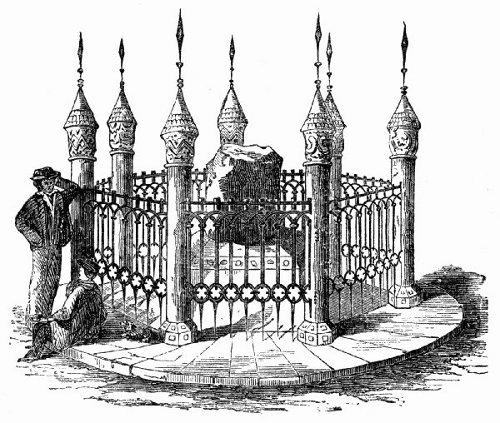
Kingston-on-Thames is among the oldest of English towns; and is said to have been "the metropolis of the Anglo-Saxon kings:" certainly it was a famous place when the Romans found and conquered the Britons in this locality: there are indeed arguments for believing that the "ford" which Cæsar crossed was here, and not at Walton; and indications of barrows, fosses, and ramparts of Roman origin, are to be found in many places in the neighbourhood. It is more than probable that a bridge was constructed by the Romans here, and that a fortress was erected for its protection. The Saxons followed in due course, and here they had many contests with their enemies the Danes; but A.D. 838, Egbert convened at Kingston an assembly of ecclesiastics and nobles in council, and here, undoubtedly, many of the Saxon kings were crowned: "The townish men," says Leland, "have certen knowledge that a few kinges were crounid afore the Conqueste." Its first charter was from King John, and many succeeding sovereigns accorded to it various grants and immunities. During the war between Charles I. and the Parliament, Kingston was the scene of several "fights," being always on the side of the king. The town is now populous and flourishing, although without manufactures of any kind. Since the establishment of a railway, villa residences have largely increased in the neighbourhood; and the two suburbs, Surbiton and Norbiton, are pretty and densely-crowded villages of good houses. The church has suffered much from mutilation and restoration; it is a spacious structure, and was erected about the middle of the fourteenth century, on the site of an earlier edifice. Amongst the monuments is a fine brass, to a civilian and his wife, of the year 1437. Of existing antiquities there are but few: county historians, however, point out the sites of the ancient Saxon palace, "the castle," the Jews' quarter, and the Roman town, Tamesa; and the game of "foot-ball," it is said, is still practised by the inhabitants on Shrove Tuesday, in commemoration of the feats of their ancestors, by whom the head of a king-assassin was "kicked" about the town. But perhaps the most interesting object now to be found in Kingston is "The King's Stone." It had long remained neglected, though not unknown, among disregarded heaps of débris in "the new court-yard," when it occurred to some zealous and intelligent antiquaries that so venerable a relic of remote ages was entitled to some show of respect. It was consequently removed from its degraded position, planted in the centre of the town, and enclosed by a "suitable" iron railing. It is now, therefore, duly and properly honoured, as may be seen by the preceding engraving.
TRANCE AT WILL.
Colonel Townsend possessed the remarkable faculty of throwing himself into a trance at pleasure. The heart ceased apparently to throb at his bidding, respiration seemed at an end, his whole frame assumed the icy chill and rigidity of death; while his face became colourless and shrunk, and his eye fixed, glazed, and ghastly. His mind itself ceased to manifest itself, for during the trance it was as utterly devoid of consciousness as his body of animation. In this state he would remain for hours, when these singular phenomena wore away, and he returned to his usual condition. Medical annals furnish no parallel to this extraordinary case. Considered whether in a physiological or metaphysical point of view, it is equally astonishing and inexplicable.
DESTRUCTIVE FORCE OF RATS.
The amount of destructive force possessed by rats cannot be better exemplified than in the report given to the French Government, relating to the removal of the horse slaughter-houses, situated at Montfaucon, to a greater distance from Paris; one great objection being the disastrous consequences which might accrue to the inhabitants of the neighbourhood, if these voracious creatures were suddenly deprived of their usual sustenance. It is well known that the mischief which they occasion is not confined to what they eat; but they undermine houses, burrow through dams, destroy drains, and commit incalculable havoc in every place and in everything.
The report states, that the carcases of horses killed one day, and amounting to thirty-five, would be found the next morning with the bones picked clean. A person of the name of Dusaussois, belonging to the establishment, made this experiment. A part of his yard was enclosed by solid walls, at the foot of which, several holes were made for the entrance and exit of the rats. Into this enclosure he put the bodies of three horses, and in the middle of the night he stopped up all the holes as quietly as he could; he then summoned several of his workmen, and each, armed with a torch and a stick, entered the yard, and carefully closed the door. They then commenced a general massacre; in doing which, it was not necessary to take aim, for wherever the blow fell it was sure to knock over a rat, none being allowed to escape by climbing over the walls. This experiment was repeated at intervals of a few days, and at the end of a month, 16,050 rats had been destroyed. In one night they killed 2,650; and yet this cannot give an entirely adequate idea of their number, for the yard in question did not cover more than a twentieth part of the space allotted to killing horses. The rats in this place have made burrows for themselves, like catacombs; and so great is their number, that they have not found room close by the slaughter-houses. They have gone farther; and the paths to and from their dwellings may be traced across the neighbouring fields.
ORDEAL OF THE CROSS.
When a person accused of any crime had declared his innocence upon oath, and appealed to the cross for its judgment in his favour, he was brought into the church before the altar. The priest previously prepared two sticks exactly like one another, upon one of which was carved a figure of the cross. They were both wrapped up, with great care and many ceremonies, in a quantity of fine wool, and laid upon the altar, or on the relics of the saints. A solemn prayer was then offered up to God, that he would be pleased to discover, by the judgment of his holy cross, whether the accused person were innocent or guilty. A priest then approached the altar, and took up one of the sticks, and the assistants unswathed it reverently. If it was marked with the cross, the accused person was innocent; if unmarked, he was guilty. It would be unjust to assert, that the judgments just delivered were in all cases erroneous; and it would be absurd to believe that they were left altogether to chance. Many true judgments were doubtless given, and, in all probability, most conscientiously; for we cannot but believe that the priests endeavoured beforehand to convince themselves by strict inquiry and a strict examination of the circumstances, whether the appellant were innocent or guilty, and that they took up the crossed or uncrossed stick accordingly. Although, to all other observers, the sticks, as enfolded in the wool, might appear exactly similar, those who enwrapped them could, without any difficulty, distinguish the one from the other.
KING JOHN AND POPE INNOCENT.
When Cardinal Langton was made Archbishop of Canterbury, by the intrigues of the Pope, whose creature he was, in despite of King John, to appease the latter, his Holiness presented him with four gold rings, set with precious stones, and enhanced the value of the gift (mark that, jewellers!) by informing him of the many mysteries implied in it. He begged of him (John) to consider seriously the form of the rings, their number, their matter, and their colour. Their form, he said, being round, shadowed out eternity, which had neither beginning nor end, and he ought thence to learn the duty of aspiring from earthly objects to heavenly, from things temporal to things eternal. The numbers four, being a square, denoted steadiness of mind, not to be subverted either by prosperity or adversity, fixed for ever in the basis of the four cardinal virtues. Gold, which is the matter, being the most precious of metals, signified wisdom, which is the most precious of all accomplishments, and justly preferred by Solomon to riches, power, and all exterior attainments. The blue colour of the sapphire represented faith; the verdure of the emerald hope; the richness of the ruby charity; and the splendour of the topaz good works.
DRUID'S SEAT.
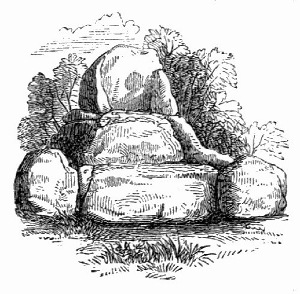
The singular pile of stones which we have sketched here is popularly called the "Druid's Judgment Seat," and stands near the village of Killiney, not far from Drogheda, near the Martello Tower. It was formerly enclosed within a circle of great stones and a ditch. The former has been destroyed, and the latter so altered that little of its ancient character remains. The "Seat" is composed of large, rough, granite blocks, and if really of the period to which tradition refers it, an unusual degree of care must have been exercised for its preservation. The following are its measurements: Breadth, at the base, eleven feet and a half; depth of the seat, one foot nine inches; extreme height, seven feet.
BOOTS AN OBJECT OF HONOUR.
Among the Chinese no relics are more valuable than the boots which have been worn by an upright magistrate. In Davis's interesting description of the empire of China, we are informed, that whenever a judge of unusual integrity resigns his situation, the people all congregate to do him honour. If he leaves the city where he has presided, the crowd accompany him from his residence to the gates, where his boots are drawn off with great ceremony, to be preserved in the hall of justice. Their place is immediately supplied by a new pair, which, in their turn, are drawn off to make room for others before he has worn them five minutes, it being considered sufficient to consecrate them that he should have merely drawn them on.
SAINT LAWRENCE.
In the south aisle of the church at Tuxford, beneath a flowery arch is a very rude relief of St. Lawrence placed on the gridiron. By him is a fellow with a pair of bellows, blowing the fire, and the executioner going to turn him. The zealous Fox, in his "Martyrology," has this very thought, and makes the martyr say, in the midst of his sufferings, "This side is now roasted; turn me, O tyrant dear."
PARIS GARDEN AT BLACKFRIARS.
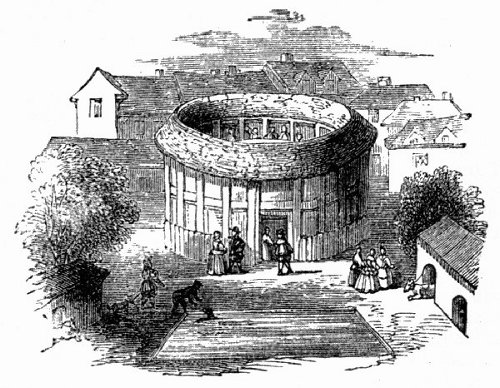
The Blackfriar's Road now passes over the site of Paris Garden where, in the sixteenth century, bear and bull-baiting rejoiced the citizens, the gala days being usually Sundays. Our cut is copied from the rare woodcut map in the time of Henry VIII., in the library at Guildhall, and exhibits in the foreground the kennels for the dogs, and the tanks in which they were washed. A graphic description of the place has been left by Paul Hentzner, a German, who visited it in 1598. He says it was "built in the form of a theatre, for the baiting of bulls and bears: they are fastened behind, and then worried by great English bull-dogs; but not without great risk to the dogs, from the horns of the one and the teeth of the other; and it sometimes happens they are killed upon the spot: fresh ones are immediately supplied in the place of those that are wounded or tired. To this entertainment there often follows that of whipping a blinded bear, which is performed by five or six men, standing circularly with whips, which they exercise upon him without any mercy, as he cannot escape from them because of his chain. He defends himself with all his force and skill, throwing down all who come within his reach, and are not active enough to get out of it, and tearing the whips out of their hands, and breaking them. At these spectacles, and everywhere else, the English are constantly smoking tobacco. Fruits, such as apples, pears, and nuts, according to the season, are carried about to be sold, as well as ale and wine."
CANVASS OF AN INSURANCE AGENT.
The Manchester agent of an Insurance Company, gives the following curious results of a personal canvass at 1,349 houses, in seventy streets in the district of Hulme and Charlton, chiefly rentals from £12 to £24 per annum. The inquiry showed that there were 29 insured; 8 persons too old; 11 who never heard of life assurances, and who were anxious to have it explained to them; 471 who had heard of it, but did not understand it; 419 who were disinclined to assure; 19 favourable, if their surplus incomes were not otherwise invested; 89 persons who had it under consideration, with a view to assure, as soon as their arrangements were completed, and who appointed times for the agent to call again; 21 refused the circulars, or to allow an explanation; 175 doors not answered; 102 houses empty; 3 had sufficient property not to require it; 1 favourable, but afraid of litigation; 1 preferred the saving's bank; 1 used abusive language; 2 would trust their families to provide for themselves; and 1 had been rejected by an office, although he never was unwell, and was consequently afraid to try again, although very anxious.
TERRA-COTTA WRITINGS.
The Assyrians, unlike any other nation of antiquity, employed pottery for the same objects, and to the same extent as papyrus was used in Egypt. Thus bulletins recording the king's victories, and even the annals of his reign, were published on terra-cotta cylinders, shaped like a rolling-pin, and usually hollow, and on hollow hexagonal prisms. These are of a remarkably fine material, sometimes unpolished or unglazed, and at others covered with a vitreous siliceous glaze, or white coating. On the cylinders the inscriptions are engraved lengthwise; on the prisms they are in compartments on each face. Each wedge is about one-eighth of an inch long, and the complicity with which the characters (a cuneiform writing-hand) are arranged is wonderful, and renders them extremely difficult for a tyro to read. Those hitherto published or known, contain the annals of the reign of Sennacherib, and the précis of the reign of another king.
There are the Shergat cylinder, containing the History of Tiglath Pileser; a cylinder of Sargon; Sennacherib's cylinders; Esarhaddon's cylinder.
Sales of land and other title-deeds were also incised on pieces of this polished terra-cotta, and, in order to prevent any enlargement of the document, a cylinder was run round the edges, leaving its impression in relief; or if the names of witnesses were affixed, each impressed his oval seal on the wet terra-cotta, which was then carefully baked in the kiln. The celebrated cylinders of carnelian, chalcedony, and other substances, were in fact the official or private seals by which the integrity of these documents was attested. These title-deeds are portable documents of four or five inches square, convex on each side, and occasionally also at the edges. Their colour varies, being a bright polished brown, a pale yellow, and a very dark tint, almost black. The paste of which they are made is remarkably fine and compact. The manner in which the characters were impressed on the terra-cotta barrels and cylinders is not known; those on the bricks used for building were apparently stamped from a mould, but those on the deeds and books were separately incised, perhaps with a prismatic stick, or rod, or, as others have conjectured, with the edge of a square rod of metal. In some instances, where this substance was used for taking accounts, it seems just possible that the moist clay, rolled up like paste, may have been unrolled and incised with rods. The characters are often so beautifully and delicately made, that it must have required a finely constructed tool to produce them.
Some small fragments of a fine reddish-grey terra-cotta which have been found among the ruins, appear to contain calculations or inventories, whilst others are perhaps syllabaries or vocabularies, to guide the Assyrian readers of these difficult inscriptions. A large chamber, or library, of these archives, comprising histories, deeds, almanacks, and spelling-books, was found in the palace of Sennacherib at Kouyunjik. It is supposed that altogether about 20,000 of these clay tablets or ancient books of the Assyrians, containing the literature of the country, have been discovered. Some of the finer specimens are covered with a pale straw-covered engobe, over which has been thrown a glaze. Some horoscopes have been already found on stone, and careful examination has now detected the records of some astronomer royal of Babylon or Nineveh inscribed on a brick. Thus, while the paper and parchment learning of the Byzantine and Alexandrian schools has almost disappeared after a few centuries, the granite pages of Egypt, and the clay leaves of Assyria, have escaped the ravages of time and the fury of barbarism.
In Egypt some receipts and letters have been discovered written on fragments of tile, and on the fine porcelain of the Chinese are often found extracts of biographical works, snatches of poetry, and even whole poems; but the idea of issuing journals, title-deeds, inventories, histories, prayers, and poems, not from the press, but from the kiln, is startling in the nineteenth century.
WONDERFUL FORMATION OF THE EYE IN INSECTS.
The perfection which is bestowed on the organs of sense in insects, especially when we consider their minuteness, is calculated to fill us with adoring admiration of the skill of "the Great Workmaster." Take an example from the eyes, which are of several kinds, evidently designed for distinct modes of vision, of which we, who have but one sort of eyes, can form no adequate notion. The bee and many other insects have on the crown of the head a number, usually three, of simple glassy eyes, set like "bull's-eyes" in a ship's deck; and besides these a great compound eye on each side, consisting of a multitude of lenses aggregated together upon the same optic nerve. The microscope reveals to us that the compound eye of an ant contains fifty lenses; that of a fly, four thousand; that of a dragon-fly, twelve thousand; that of a butterfly, seventeen thousand; and that of a species of Mordella (a kind of beetle), the amazing number of twenty-five thousand. Every one of these regular, polished, and many-sided lenses; is the external surface of a distinct eye, furnished with its own iris and pupil, and a perfect nervous apparatus. It will thus be seen that each hexagonal facet forms a transparent horny lens, immediately behind which is a layer of pigment diminishing to a point in the centre, where it forms a pupil; that behind this a long six-sided prism, answering to the crystalline and vitreous humours in the human eye, extends, diminishing to its lower extremity, where it rests upon the retina, or network expansion of the optic nerve. Some of the minuter details of this exquisite organisation are still matters of conflicting opinion; but these we omit, as our purpose is rather to convey to our readers a general idea of the structure of this complex organ of vision. "This also cometh forth from the Lord of Hosts, which is wonderful in counsel and excellent in working."
FIRST COIN WITH BRITANNIA ON IT.
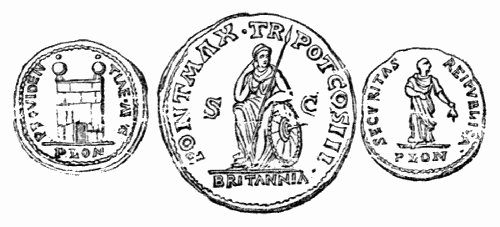
In process of clearing away the foundations of Old London Bridge many antiquities were discovered; it had been the great highway over the Thames from the Roman era, and numerous relics were obtained, varying in date from that period to our own. We here engrave such specimens of Roman coins that were found as belong to the Britannic series. The large central coin is one struck by Hadrian, and remarkable for the figure of Britannia, the first time impersonated as an armed female seated on a rock. It is the prototype of the more modern Britannia, reintroduced by Charles II., and which still appears on our copper money. The smaller coins are such as were struck, during the reign of Constantine the Great, in the City of London, and are marked with the letters P. LON., for "Pecunia Londinensis," money of London.
EXTRAORDINARY FORMATION OF THE TWIN-WORM.
An extraordinary creature was discovered by Dr. Nordman, infesting the gills of one of our commonest river fishes—Cyprinus Brama—and to which he gave the appropriate appellation of the Twin-worm (Diplozoon paradoxum). It is not more than one-fourth of an inch in length, but consists of two bodies, precisely resembling each other, united by a central band, exactly in the manner of the Siamese youths, whose exhibition excited so much attention in England and America a few years ago. We might have supposed that, like the human monstrosity in question, the Twin-worm was formed by the accidental union of two individuals, if abundant observation had not proved that this is the common mode of life belonging to the species.
Each portion of the animal is complete in all its organs and economy; possessing its own sets of suckers, its own mouth, its own digestive canal, with its tree-like ramifications, its own perfect generative system, and its own elaborate series of vascular canals,—every organ or set of organs in the one-half finding its exact counterpart in the other.
It scarcely detracts from the marvellous character assumed by this "Twin-worm," that, according to recent observations, the two halves have already enjoyed a phase of existence as distinct individuals. The organic union, or "fusion" of two such individuals, is necessary to the development of the generative system, which, up to that event, is wanting in each constituent half.
MILL AT LISSOY.
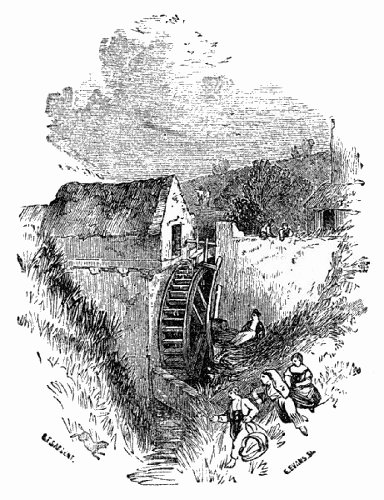
The above picturesque sketch represents the "busy mill" at Lissoy, better known as "Sweet Auburn—loveliest village of the plain"—the scene of Goldsmith's beautiful poem of the "Deserted Village." Lissoy, about six miles from Athlone, stands on the summit of a hill at the base of which is the mill that forms the subject of our sketch. The wheel is still turned by the water of a small rivulet, converted, now and then, by rains, into a sufficient stream. The mill is a mere country cottage, used for grinding the corn of the neighbouring peasantry, and retains many tokens of age. Parts of the machinery are, no doubt, above a century old, and are probably the very same that left their impress on the poet's memory.
A CASTLE BUILT FOR A GROAT.
The castle of Monkstown, near Cork, is reported by popular tradition to have been built in 1636, at the cost of only a groat. To explain the enigma, the following story is told:—Anastatia Goold, who had become the wife of John Archdeken, determined, while her husband was abroad, serving in the army of Philip of Spain, to give him evidence of her thrift on his return, by surprising him with a noble residence which he might call his own. Her plan was to supply the workmen with provisions and other articles they required, for which she charged the ordinary price; but, as she had made her purchases wholesale, upon balancing her accounts, it appeared that the retail profit had paid all the expenses of the structure except fourpence! The Archdekens were an Anglo-Irish family, who "degenerating" became "Hibernices quam Hiberniores"—more Irish than the Irish themselves—and assumed the name of Mac Odo, or Cody. They "forfeited," in 1688, having followed the fortunes of James II.
BATTLE OF WATER-SNAKES.
The following story is narrated by Mr. St. John, in his "Letters of an American Farmer." After describing the size and strength of some hemp-plants, around which a wild vine had formed natural arbours, he thus proceeds:—"As I was one day sitting, solitary and pensive, in this primitive arbour, my attention was engaged by a strange sort of rustling noise at some paces distance. I looked all around without distinguishing anything, until I climbed up one of my great hemp-stalks; when, to my astonishment, I beheld two snakes of a considerable length, the one pursuing the other with great celerity through a hemp-stubble field. The aggressor was of the black kind, six feet long; the fugitive was a water snake, nearly of equal dimensions. They soon met, and in the fury of their first encounter, appeared in an instant firmly twisted together; and whilst their united tails beat the ground, they mutually tried, with open jaws, to lacerate each other. What a fell aspect did they present! Their heads were compressed to a very small size; their eyes flashed fire; but, after this conflict had lasted about five minutes, the second found means to disengage itself from the first, and hurried towards the ditch. Its antagonist instantly assumed a new posture, and, half-creeping, half-erect, with a majestic mien, overtook and attacked the other again, which placed itself in a similar attitude, and prepared to resist. The scene was uncommon and beautiful; for, thus opposed, they fought with their jaws, biting each other with the utmost rage; but, notwithstanding this appearance of mutual courage and fury, the water snake still seemed desirous of retreating towards the ditch, its natural element. This was no sooner perceived by the keen-eyed black one, than, twisting its tail twice round a stalk of hemp, and seizing its adversary by the throat, not by means of its jaws, but by twisting its own neck twice round that of the water snake, he pulled it back from the ditch. To prevent a defeat, the latter took hold likewise of a stalk on the bank, and, by the acquisition of that point of resistance, became a match for his fierce antagonist. Strange was this to behold; two great snakes strongly adhering to the ground, mutually fastened together by means of the writhings which lashed them to each other, and stretched at their full length; they pulled, but pulled in vain; and in the moments of greatest exertion, that part of their bodies which was entwined seemed extremely small, while the rest appeared inflated, and now and then convulsed with strong undulations rapidly following each other. Their eyes appeared on fire, and ready to start out of their heads. At one time the conflict seemed decided; the water snake bent itself into great folds, and by that operation rendered the other more than commonly outstretched; the next minute the new struggles of the black one gained an unexpected superiority; it acquired two great folds likewise, which necessarily extended the body of its adversary in proportion as it had contracted its own. These efforts were alternate; victory seemed doubtful, inclining sometimes to one side, sometimes to the other, until at last the stalk to which the black snake was fastened suddenly gave way, and, in consequence of this accident, they both plunged into the ditch. The water did not extinguish their vindictive rage, for by their agitations I could still trace, though I could not distinguish, their attacks. They soon reappeared on the surface, twisted together, as in their first onset; but the black snake seemed to retain its wonted superiority, for its head was exactly fixed above that of the other, which it incessantly pressed down under the water, until its opponent was stifled, and sank. The victor no sooner perceived its enemy incapable of further resistance, than, abandoning it to the current, it returned to the shore and disappeared."
FATES OF THE FAMILIES OF ENGLISH POETS.
It is impossible to contemplate the early death of Byron's only child without reflecting sadly on the fates of other females of our greatest poets. Shakspeare and Milton, each died without a son, but both left daughters, and both names are now extinct. Shakspeare's was soon so. Addison had an only child—a daughter, a girl of some five or six years at her father's death. She died, unmarried, at the age of eighty or more. Farquhar left two girls, dependant on the friendship of his friend Wilkes, the actor, who stood nobly by them while he lived. They had a small pension from the Government, and having long outlived their father, and seen his reputation unalterably established, both died unmarried. The son and daughter of Coleridge both died childless. The two sons of Sir Walter Scott died without children—one of two daughters died unmarried, and the Scotts of Abbotsford and Waverley are now represented by the children of a daughter. How little could Scott foresee the sudden failure of male issue? The poet of the "Fairie Queen" lost a child when very young by fire, when the rebels burned his house in Ireland. Some of the poets had sons and no daughters. Thus we read of Chaucer's son,—of Dryden's sons,—of the sons of Burns,—of Allan Ramsey's son,—of Dr. Young's son,—of Campbell's son,—of Moore's son,—and of Shelley's son. Ben Johnson survived all his children. Some, and those amongst the greatest, died unmarried—Butler, Cowley, Congreve, Otway, Prior, Pope, Gay, Thompson, Cowper, Akenside, Shenstone, Collins, Gray, Goldsmith, and Rogers, who lately died. Some were unfortunate in their sons in a sadder way than death could make them. Lady Lovelace has left three children—two sons and a daughter. Her mother is still alive to see, perhaps, with a softened spirit, the shade of the father beside the early grave of his only child. Ada's looks, in her later years—years of suffering, borne with gentle and womanly fortitude—have been happily caught by Mr. Henry Phillips, whose father's pencil has preserved to us the best likeness of Ada's father.
JEFFERY HUDSON, THE DWARF OF THE COURT OF CHARLES I.
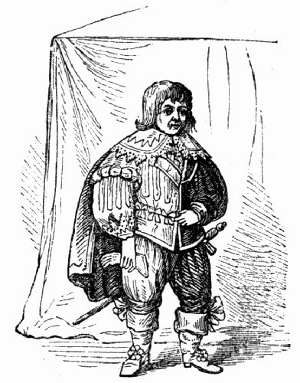
The celebrated dwarf of whom we here give a sketch, was born at Oakham in Rutlandshire in 1619, and about the age of seven or eight, being then but eighteen inches high, was retained in the service of the Duke of Buckingham, who resided at Burleigh-on-the-Hill. Soon after the marriage of Charles I., the king and queen being entertained at Burleigh, little Jeffery was served up at table in a cold pie, and presented by the duchess to the queen, who kept him as her dwarf. From seven years of age till thirty he shot up to three feet nine inches, and there fixed. Jeffery became a considerable part of the entertainment of the court. Sir William Davenant wrote a poem on a battle between Jeffery and a turkey cock, and in 1638 was published a very small book, called a "New Year's Gift," presented at court by the Lady Parvula to the Lord Minimus (commonly called Little Jeffery) her Majesty's servant, &c. &c., written by Microphilas, with a little print of Jeffery prefixed. Before this period Jeffery was employed on a negotiation of great importance; he was sent to France to fetch a midwife for the queen; and on his return with this gentlewoman and her majesty's dancing-master, and many rich presents to the queen from her mother, Mary de Medicis, he was taken by the Dunkirkers. This was in 1630. Besides the presents he was bringing for the queen, he lost to the value of £2,500 that he had received in France on his own account from the queen-mother and ladies of that court.
Jeffery thus made of consequence, grew to think himself really so. He had borne with little temper the teasing of the courtiers and domestics, and had many squabbles with the king's gigantic porter. At last, being provoked by Mr. Crofts, a young gentleman of family, a challenge ensued; and Mr. Crofts coming to the rendezvous armed only with a squirt, the little creature was so enraged that a real duel ensued; and the appointment being on horseback, with pistols, to put them more on a level, Jeffery, with the first fire, shot his antagonist dead on the spot. This happened in France, whither he had attended his royal mistress in the troubles.
He was again taken prisoner by a Turkish rover, and sold into Barbary. He probably did not long remain in slavery; for at the beginning of the civil war, he was made a captain in the royal army, and in 1644 attended the queen to France, where he remained till the restoration.
At last, upon suspicion of his being privy to the Popish Plot, he was taken up in 1682 and confined in the Gate-house, Westminster, where he ended his life in the sixty-third year of his age.
CHURCH AT NEWTON, IRELAND.
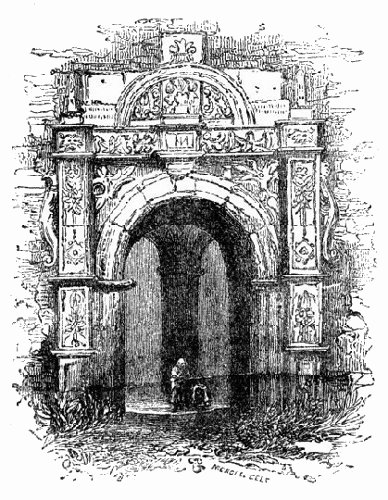
The ancient doorway, of which, on account of its singular beauty, we give a sketch, belongs to the church which was built by the first of the Montgomeries at Newtown in Ireland. Though the church is a fine and beautiful example of architecture, no attempt whatever has been made to preserve it from sinking into ruin. The Montgomeries, ancient lords of this district, were the descendants of that Montgomery who accidentally killed Henry II., of France, at a tournament. Some years after the sad event, which was confessedly a mischance, he was taken by Catherine of Medicis, put to the torture and beheaded; with the additional penalty of having his children degraded to villeinnage; on his way to execution, he pronounced this noble and memorable sentence, in reference to the punishment inflicted on his children, "If they have not the virtue to raise themselves again, I consent to their degradation."
INTERESTING CALCULATION.
Some years ago, an eminent zoologist gave the following table as his estimate of the probable number of existing species of animals, deduced from facts and principles then known. Later discoveries tend to increase rather than to diminish the estimate.
Quadrupeds 1,200 Worms 2,500
Birds 6,800 Radiata 1,000
Reptiles 1,500 Polypes, etc. 1,530
Fishes 8,000 Testacea 4,500
Insects 550,000 Naked Testacea 600
making an aggregate of 577,600 species.
VITALITY OF SUPERSTITION.
In the "Annual Register" for 1760, an instance of the belief in witchcraft is related, which shows how superstition lingers. A dispute arose in the little village of Glen, in Leicestershire, between two old women, each of whom vehemently accused the other of witchcraft. The quarrel at last ran so high that a challenge ensued, and they both agreed to be tried by the ordeal of swimming. They accordingly stripped to their shifts—procured some men, who tied their thumbs and great toes together, cross-wise, and then, with a cart-rope about their middle, suffered themselves to be thrown into a pool of water. One of them sank immediately, but the other continued struggling a short time upon the surface of the water, which the mob deeming an infallible sign of her guilt, pulled her out, and insisted that she should immediately impeach all her accomplices in the craft. She accordingly told them that, in the neighbouring village of Burton, there were several old women "as much witches as she was." Happily for her, this negative information was deemed sufficient, and a student in astrology, or "white-witch," coming up at the time, the mob, by his direction, proceeded forthwith to Burton in search of all the delinquents. After a little consultation on their arrival, they went to the old woman's house on whom they had fixed the strongest suspicion. The poor old creature on their approach locked the outer door, and from the window of an upstairs room asked what they wanted. They informed her that she was charged with being guilty of witchcraft, and that they were come to duck her; remonstrating with her at the same time upon the necessity of submission to the ordeal, that, if she were innocent, all the world might know it. Upon her persisting in a positive refusal to come down, they broke open the door and carried her out by force, to a deep gravel-pit full of water. They tied her thumbs and toes together and threw her into the water, where they kept her for several minutes, drawing her out and in two or three times by the rope round her middle. Not being able to satisfy themselves whether she were a witch or no, they at last let her go or more properly speaking, they left her on the bank to walk home by herself, if she ever recovered. Next day they tried the same experiment upon another woman, and afterwards upon a third; but fortunately, neither of the victims lost her life from this brutality. Many of the ringleaders in the outrage were apprehended during the week, and tried before the justices at quarter-sessions. Two of them were sentenced to stand in the pillory and to be imprisoned for a month; and as many as twenty more were fined in small sums for the assault, and bound over to keep the peace for a twelvemonth.
SMALL FEET OF THE CHINESE LADIES.
The compression of ladies' feet to less than half their natural size is not to be regarded as a mark, or as a consequence, of the inferiority of the sex; it is merely a mark of gentility. Various accounts are given of the origin of this custom. One is, that an emperor was jealous of his wife, and to prevent her from gadding abroad, put her feet in iron stocks. Another is, that a certain empress, Tan-ke (B.C. 1100), was born with club-feet, and that she caused the emperor to issue an edict, adopting her foot as the model of beauty, and requiring the compressing of female infants' feet so as to conform to the imperial standard. While a third account is, that the Emperor Le-yuh (A.D. 961) was amusing himself one day in his palace, when the thought occurred to him that he might improve the appearance of the feet of a favourite concubine. He caused her feet to be so bent as to raise the instep into an arch, to resemble the new moon. The figure was much admired by the courtiers, who soon began to introduce it into their families. It is said that another emperor, two hundred years later, placed a stamp of the lotus-flower (water-lily) on the sole of the small shoe of his favorite concubine, so that at every step she took she left on the ground the print of the flower; hence girls with small feet are complimented at the present day as "the golden lilies." The operation of bandaging and compressing the feet is very painful; children cry very much under it. Mortification of the feet has been known to result from the cruel practice. Custom, however, imposes it as a necessary attraction in a woman. An old gentleman at Canton, being asked the reason why he had bandaged his daughter's feet, replied, that if she had large feet she could not make a good marriage.
WONDERFUL CONSTRUCTION OF THE SEA-URCHIN.
Professor Forbes informs us that in a moderate-sized Urchin there are sixty-two rows of pores in each of the ten avenues, and as there are three pairs of pores in each row, the total number of pores is 3,720; but as each sucker occupies a pair of pores, the number of suckers is 1,860. He says, also, that there are above three hundred plates of one kind, and nearly as many of another, all dovetailing together with the greatest nicety and regularity, bearing on their surfaces above 4,000 spines, each spine perfect in itself, and of a complicated structure, and having a free movement in its socket. "Truly," he adds, "the skill of the Great Architect of Nature is not less displayed in the construction of a Sea-urchin than in the building up of a world!"
IVORY SCEPTRE OF LOUIS XII.
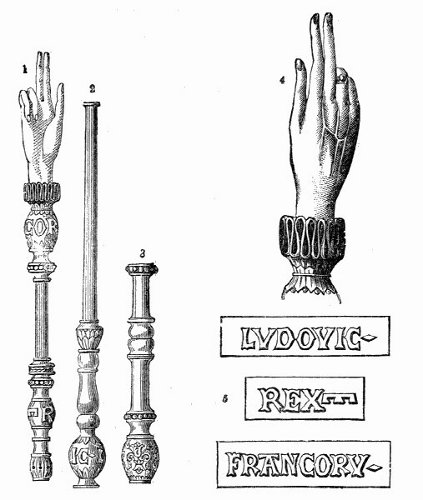
The above engraving represents an ivory sceptre, or Main de Justice, which was made at the early part of the sixteenth century for Louis XII., King of France. The three parts 1, 2, 3, screw together and form the sceptre. Fig. 4 is the hand on the top of the sceptre, given on a larger scale, showing the ring set with a small pearl, worn on the third finger. Fig. 5 is the inscription on the sceptre; it is engraved in relievo upon three of the convex decorations, and commences on the lowest one.
TOMB OF CÆCILIA METELLA.
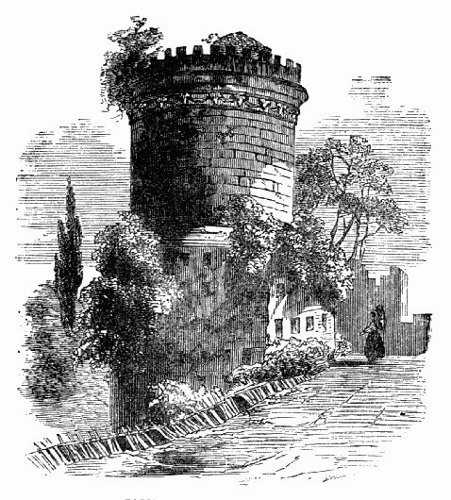
Of the tombs of Consular Rome nothing remains except perhaps the sarcophagus of Scipio; and it is only on the eve of the Empire that we meet with the well-known one of Cæcilia Metella, the wife of Crassus, which is not only the best specimen of a Roman tomb now remaining to us, but the oldest building of the imperial city of which we have an authentic date. It consists of a bold square basement about 100 ft. square, which was originally ornamented in some manner not now intelligible. From this rose a circular tower about 94 ft. in diameter, of very bold masonry, surmounted by a brace of ox-skulls with wreaths joining them, and a well-profiled cornice: 2 or 3 courses of masonry above this seem to have belonged to the original work; and above this, almost certainly, in the original design rose a conical roof, which has perished. The tower having been used as a fortress in the middle ages, battlements have been added to supply the place of the roof, and it has been otherwise disfigured, so as to detract much from its beauty as now seen. Still we have no tomb of the same importance so perfect, nor one which enables us to connect the Roman tombs so nearly with the Etruscan. The only addition in this instance is that of the square basement or podium, though even this was not unknown at a much earlier period, as for instance in the tomb of Aruns. The exaggerated height of the circular base is also remarkable. Here it rises to be a tower instead of a mere circular base of stones for the earthen cone of the original sepulchre. The stone roof which probably surmounted the tower was a mere reproduction of the original earthen cone.
POGONIAS.
These vocal fish differ from the umbrinas in having their jaws tagged laterally with many, in place of carrying but one barbel at the symphysis. Schœff reports of them that they will assemble round the keel of a vessel at anchor, and serenade the crew; and Mr. John White, lieutenant in the navy of the United States, in his voyage to the seas of China, relates to the same purpose, that being at the mouth of the river of Cambodia, the ship's company were "astonished by some extraordinary sounds which were heard around the bottom of the vessel. They resembled," he says, "a mixture of the bass of the organ, the sound of bells, the guttural cries of a large frog, and the tones which imagination might attribute to an enormous harp; one might have said the vessel trembled with it. The noises increased, and finally formed a universal chorus over the entire length of the vessel and the two sides. In proportion as we went up the river the sounds diminished, and finally ceased altogether." As the interpreter told Captain White, the ship had been followed by a "troop of fish of an oval and flattened form," they were most probably pogonias. Humboldt met with a similar adventure in the South Sea, but without suspecting its cause. "On February 20th, 1803, at seven P.M., the whole crew was astounded by a very extraordinary noise, resembling drums beaten in the air; we at first attributed it to the breakers; speedily it was heard all over the vessel, especially towards the poop, and was like the noise which escapes from fluid in a state of ebullition; we began to fear there might be some leak in the bottom. It was heard synchronously in all parts of the vessel, but finally, about nine P.M., ceased altogether." How these fish manage to purr in the deep, and by means of what organ they communicate the sound to the external air, is wholly unknown. Some suppose it to proceed from the swim-bladder; but if that be the drum, what is the drumstick that beats upon it? And cushioned as it is in an obese envelope and without issue, the swim-bladder cannot be a bagpipe or wind instrument.
CURIOUS ADVERTISEMENT.
The following appeared in the public papers of January 24th, 1737:—"Whereas Frances, wife of the Right Honourable the Lord Viscount Vane, has, for some months past, absented herself from her husband, and the rest of her friends:—I do hereby promise to any person or persons who shall discover where the said lady Vane is concealed, to me, or to Francis Hawes, esq. her father, so that either of us may come to the speech of her, the sum of £100, as a reward, to be paid by me on demand at my lodgings in Piccadilly. I do also promise the name of the person, who shall make such discovery, shall be concealed, if desired. Any person concealing or lodging her after this advertisement, will be prosecuted with the utmost rigour; or, if her ladyship will return to me, she may depend upon being kindly received. She is about twenty-two years of age, tall, well-shaped, has light-brown hair, is fair-complexioned, and has her upper teeth placed in an irregular manner. She had on, when she absented, a red damask French sacque, and was attended by a French woman, who speaks very bad English.
"Vane."
THE EYE OF THE CHAMELEON.
A most extraordinary aspect is communicated to chameleons by the structure and movements of their eyes. In the first place, the head is enormous, and, being three-sided, with projecting points and angles, makes a sufficiently uncouth visage; but the eyes which illuminate this notable head-piece must, indeed, to borrow for the nonce the phraseology of Barnum, "be seen to be appreciated." There is on each side an immense eye-ball, full and prominent, but covered with the common shagreened skin of the head, except at the very entre, where there is a minute aperture, corresponding to the pupil. These great punctured eye-balls roll about hither and thither, but with no symmetry. You cannot tell whether the creature is looking at you or not; he seems to be taking what may be called a general view of things—looking at nothing in particular, or rather, to save time, looking at several things at once. Perhaps both eyes are gazing upwards at your face; a leaf quivers behind his head, and in a moment one eye turns round towards the object, while the other retains its upward gaze: presently a fly appears; one eye rapidly and interestedly follows all its movements, while the other leisurely glances hither and thither, or remains steady. Accustomed as we are to see in almost all animals the two eyes move in unison, this want of sympathy produces an effect most singular and ludicrous.
DIVING FOR A WIFE.
In many of the Greek islands, the diving for Sponge forms a considerable part of the occupation of the inhabitants, as it has done from the most remote antiquity. Hasselquist says:—"Himia is a little, and almost unknown island directly opposite Rhodes. It is worth notice, on account of the singular method the Greeks, inhabitants of the island, have to get their living. In the bottom of the sea the common Sponge is found in abundance, and more than in any other place in the Mediterranean. The inhabitants make it a trade to fish up this Sponge, by which they get a living far from contemptible, as their goods are always wanted by the Turks, who use an incredible number of Sponges at their bathings and washings. A girl in this island is not permitted by her relations to marry before she has brought up a certain quantity of Sponges, and before she can give proof of her agility by taking them from a certain depth." In other islands the same custom prevails, but with reversed application, as in Nicarus, where the father of a marriageable daughter bestows her on the best diver among her suitors,—"He that can stay longest in the water, and gather the most Sponges, marries the maid."
KNIGHT'S COSTUME OF THE THIRTEENTH CENTURY.
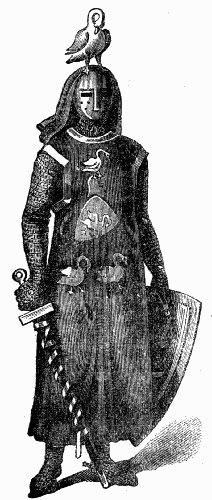
The engraving represents a knight's costume of the year 1272, taken from the library of MSS. at Paris. It is that of a Count Hohenschwangen, of the family of Welf, and depicts the wearer in a long sleeveless, dark blue surcoat, with his armorial device; a white swan on a red field with a light red border. Under his coat he wears a cap-a-pié suit of mail. The helmet is original, very like the Greek, with the furred mantle as we see it in the seal of Richard King of England, of the date of 1498. This helmet does not appear to be a tilting helmet, which usually rests upon the shoulders; but this kind of helmet would be fastened, like the vizor with the mailed hood, by an iron throat-brace, and a leather thong. Upon the covered helmet he wears the swan as a crest. The sword-hilt is of gold, the sheath black, the girdle white, the furred mantle is red, lined with white.
Chivalry began in Europe about A. D. 912. From the twelfth to the fifteenth century it had considerable influence in refining the manners of most of the nations of Europe. The knight swore to accomplish the duties of his profession as the champion of God and the ladies. He devoted himself to speak the truth, to maintain the right, to protect the distressed, to practise courtesy, to fulfil obligations, and to vindicate in every perilous adventure his honour and character. Chivalry, which owed its origin to the feudal system, expired with it. The origin of the title of knight, as a military honour, is said to be derived from the siege of Troy, but this solely depends on a passage or two in Homer, and the point is disputed by several learned commentators.
CURIOUS CIRCUMSTANCE.
Button, in his Life, tells us of one of his ancestors, a trooper, who, seeing a young girl at the river-side, lading water into her pail, cast a large stone with design to splash her; but not being versed in directing a stone so well as a bullet, he missed the water, and broke her head; he ran off. Twelve years afterwards, he settled at Derby, courted a young woman, and married her. In the course of their conversations he proved to be the very man who had cast the stone, and she the girl with the broken head.
FUNEREAL JAR.
The term "funereal" has been erroneously applied to all pottery found in tombs, even where the utensils have no relation to funereal purposes, but were probably in common use. There have been found, however, in Corsica vessels of earthenware, which may strictly be called "funereal."
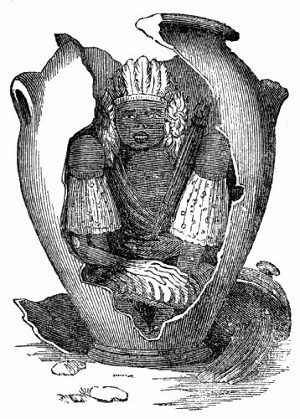
Though the precise period of the fabrication of the funereal vessels found in Corsica is not ascertained, they must be considered of very ancient date. These vessels, when found entire, at first appear completely closed up, and no trace of joining can be discovered. But it has been ascertained that they are composed of two equal parts, the end of one fitting exactly into the other, and so well closed that the body, or at least the bones which they contain, appear to have been placed within them before they were baked upon the kiln. Diodorus Siculus, in speaking of the usages of the Balearic Isles, states that these people were in the habit of beating, with clubs, the bodies of the dead which, when thus rendered flexible, were deposited in vessels of earthenware. This practice of the Corsicans coincides singularly with that of the Coroados Indians, who inhabit a village on the Paraïba river, near Campos, in the Brazils. They use large earthen vessels, called camucis, as funereal urns. The bodies of their chiefs, reduced to mummies, are placed in them in a bent posture, decked with their ornaments and arms, and are then deposited at the foot of the large trees of the forest.
The cut which we here give speaks for itself. It represents the funereal jar containing the chief as described; the animal at his feet appears to be a panther or tiger cat.
WRITING MATERIALS.
The materials used for writing on have varied in different ages and nations. Among the Egyptians slices of limestone, leather, linen, and papyrus, especially the last, were universally employed. The Greeks used bronze and stone for public monuments, wax for memorandums and papyrus for the ordinary transactions of life. The kings of Pergamus adopted parchment, and the other nations of the ancient world chiefly depended on a supply of the paper of Egypt. But the Assyrians and Babylonians employed for their public archives, their astronomical computations, their religious dedications, their historical annals, and even for title-deeds and bills of exchange, tablets, cylinders, and hexagonal prisms of terra-cotta. Two of these cylinders, still extant, contain the history of the campaign of Sennacherib against the kingdom of Judah; and two others, exhumed from the Birs Nimroud, give a detailed account of the dedication of the great temple by Nebuchadnezzar to the seven planets. To this indestructible material, and to the happy idea of employing it in this manner, the present age is indebted for a detailed history of the Assyrian monarchy; whilst the decades of Livy, the plays of Menander and the lays of Anacreon, confided to a more perishable material, have either wholly or partly disappeared amidst the wreck of empires.
CURIOUS DISPUTE AND APPROPRIATE DECISION.
Fuller, in his 'Holy State,' p. 170, gives a very apposite story; a poor man in Paris, being very hungry, went into a cook shop, and staid there so long, (for the master was dishing-up meat,) that his appetite being lessened by the steam, he proposed to go without his meal; the cook insisted upon payment all the same. At length, the altercation was agreed to be referred to the first person that passed the door; that person happened to be a notorious idiot. Having heard the complaint, he decreed that the poor man's money should be placed between two empty dishes, and that the cook should be recompensed with the jingling of his cash, as the other was with the fumes of the meat; and this little anecdote is literally matter of fact.
THE TEA-POT.
No specimen of the ceramic art possesses greater variety of form than the tea-pot. On none has the ingenuity of the potter been more fully exercised, and it is worthy of remark, that the first successful production of Böttcher in hard porcelain was a tea-pot. The so-called Elizabethan tea-pots must be of a later date, for tea was not known in England until the time of Charles II; but it is interesting to trace the gradual increase in the size of the tea-pot, from the diminutive productions of the Elers, in the time of Queen Anne and George I., when tea was sold in apothecaries' shops, to the capacious vessel which supplied Dr. Johnson with "the cup that cheers but not inebriates."
Mr. Croker, in his edition of Boswell's Life, mentions a tea-pot that belonged to Dr. Johnson which held two quarts; but this sinks into insignificance compared with the superior magnitude of that in the possession of Mrs. Marryat, of Wimbledon, who purchased it at the sale of Mrs. Piozzi's effects at Streatham. This tea-pot, which was the one generally used by Dr. Johnson, holds more than three quarts. It is of old Oriental porcelain, painted and gilded, and from its capacity was well suited to the taste of one "whose tea-kettle had no time to cool, who with tea solaced the midnight hour, and with tea welcomed the morn." George IV. had a large assemblage of tea-pots, piled in pyramids, in the Pavilion at Brighton. Mrs. Elizabeth Carter was also a collector of tea-pots, each of which possessed some traditionary interest, independently of its intrinsic merit; but the most diligent collector of tea-pots was the late Mrs. Hawes. She bequeathed no less than three hundred specimens to her daughter, Mrs. Donkin, who has arranged them in a room appropriated for the purpose. Among them are several formerly belonging to Queen Charlotte. Many are of the old Japan; one with two divisions, and two spouts for holding both black and green tea; and another of a curious device, with a small aperture at the bottom to admit the water, there being no opening at the top, atmospheric pressure preventing the water from running out. This singular Chinese toy has been copied in the Rockingham ware.
PROTRACTED SLEEP.
One of the most extraordinary instances of excessive sleep is that of the lady at Nismes, published in 1777, in the "Memoirs of the Royal Academy of Sciences at Berlin." Her attacks of sleep took place periodically, at sunrise and about noon. The first continued till within a short time of the accession of the second, and the second continued till between seven and eight in the evening—when she awoke, and continued so till the next sunrise. The most extraordinary fact connected with this case is, that the first attack commenced always at daybreak, whatever might be the season of the year, and the other always immediately after twelve o'clock. During the brief interval of wakefulness which ensued shortly before noon, she took a little broth, which she had only time to do when the second attack returned upon her, and kept her asleep till the evening. Her sleep was remarkably profound, and had all the character of complete insensibility, with the exception of a feeble respiration, and a weak but regular movement of the pulse. The most singular fact connected with her remains to be mentioned. When the disorder had lasted six months, and then ceased, the patient had an interval of perfect health for the same length of time. When it lasted one year, the subsequent interval was of equal duration. The affection at last wore gradually away; and she lived, entirely free of it, for many years after. She died in the eighty-first year of her age, of dropsy, a complaint which had no connexion with her preceding disorder.
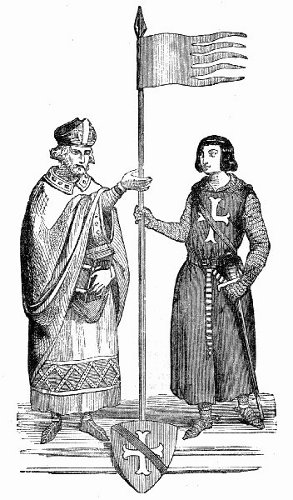
ANCIENT SUIT OF MAIL.
The two figures depicted on next page represent Henry of Metz receiving the oriflamme from the hands of St. Denis, derived from a painted window in the church of Nôtre Dame de Chartres. The oriflamme was a red banner attached to a staff, and cut in the manner shown in our engraving. Henry of Metz was Marshal of France, and is here represented in a complete suit of mail, his hood being thrown back upon his shoulders. This suit is perfect, even to the extremities; and it is to be remarked that the defence for the hands is divided in the manner of a common glove. Over the mail is worn a loose surcoat, on which is emblazoned the cross, traversed by a red baton—the type of his high office.
THE POISON CUP.
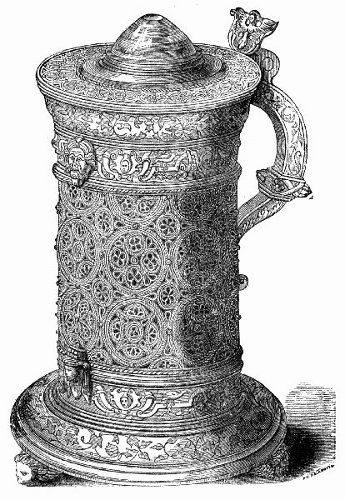
In the time of James I. poison was too frequently resorted to, especially on the Continent, as a means of getting rid of individuals who had rendered themselves obnoxious to certain parties who were prosecuting their own private ends; and so extensively did this infamous practice prevail that there was a class of persons who were known to have studied the art of secret poisoning, and whose services could be engaged for a high reward. In order to counteract the operations of the poisoners, various devices were employed, and among them was the art which the pretended magicians of those days professed to have discovered, of making a kind of glass which would fly in pieces if poison was poured into any vessel that was formed of it. The cut at the head of our article represents a tankard of this sort, in which the glass is mounted in silver gilt arabesque and silver filagree. It was believed that the large crystal which is seen standing out at the centre of the lid would become discoloured at the approach of poison. The tankard is a work of the sixteenth century, and was presented to Clare Hall, Cambridge—where it is still preserved—by Dr. William Butler, an eminent physician in the time of James I.
PORCELAIN FINGER-RINGS.
The porcelain finger-rings of ancient Egypt are extremely beautiful; the band of the ring being seldom above one-eighth of an inch in thickness. Some have a plate on which, in bas-relief, is the god Set, or Baal, full face, or playing on the tambourine, as the inventor of Music; others have their plates in the shape of the right symbolical eye, the emblem of the Sun; of a fish, of the perch species; or of a scarabæus, which is said to have been worn by the military order. Some few represent flowers. Those which have elliptical plates with hieroglyphical inscriptions, bear the names of Amen-Ra, and of other gods and monarchs, as Amenophis III., Amenophis IV., and Amenanchut, of the Eighteenth and Nineteenth dynasties. One of these rings has a little bugle on each side, as if it had been strung on the beaded work of a mummy, instead of being placed on the finger. Blue is the prevalent colour, but a few white and yellow rings, and some even ornamented with red and purple colours are found. It is not credible that these rings, of a substance finer and more fragile than glass, were worn during life. Neither is it likely that they were worn by the poorer classes, for the use of the king's name on sepulchral objects seems to have been restricted to functionaries of state. Some larger rings of porcelain of about an inch diameter, seven-eighths of an inch broad, and one-sixteenth of an inch thick, made in open work, represent the constantly repeated lotus flowers, and the god Ra, or the Sun, seated, and floating through the heaven in his boat. Common as these objects were in Egypt, where they were employed as substitutes for the hard and precious stones, to the Greeks, Etruscans, and Italian Greeks they were articles of luxury, just as the porcelain of China was to Europeans some centuries ago. The Etruscans set these bugles, beads, and amulets in settings of their exquisite gold filigree work, intermixed with gold beads and precious stones. Strung as pendants they hung round the necks of the fair ones of Etruria. In one of the tombs already alluded to at the Polledrara, near Vulci, in Italy, was found a heap of annular and curious Egyptian bugles, which had apparently formed a covering to some bronze objects, but the strings having given way, the beads had dropped to pieces. These, as well as the former, had been obtained from some of the Egyptian markets, like that at Naucratis: or from the Phoenician merchants, in the same manner as the flasks. One of the most remarkable of these personal ornaments is a bracelet, composed of small fish strung together and secured by a clasp.
PIGEON CATCHING NEAR NAPLES.
Between La Cava and Naples, about half a mile from the town, are certain Bluebeard-looking towers, several centuries old, erected for the purpose of snaring wood-pigeons; with which view the gentlemen of the neighbourhood, who are generally expert and practised slingers, assemble and man the towers in May. A long line of nets, some quarter of a mile in circuit, held up in a slanting position by men concealed in stone sentry-boxes placed here and there along the enceinte, is spread in front. As the pigeons are seen advancing (the time of their approach is generally looked for at early dawn, when they are making for the woods), the nearest slingers commence projecting a succession of white stones in the direction of the nets. These the birds no sooner behold, then attracted, or alarmed (for the motive does not certainly appear), they swoop down upon them, and when sufficiently near to fall within reach of the nets, the persons holding let go, rush from their ambush, and secure the covey. Thousands of wood-pigeons are thus, we have been told by a proprietor, annually taken, and transmitted for presents to distant friends; as we used to send out game, before the sale of it was legalised. Thus birds, as well as fish, and fish as well as man, often get entangled and caught in their headlong pursuit of a pleasure that still eludes them.
FRAME REQUISITE TO SUPPORT THE DRESS.
James I., and his subjects who wished to clothe themselves loyally, wore stupendous breeches. Of course the "honourable gentleman" of the House of Commons were necessarily followers of the fashion. But it led to inconveniences in the course of their senatorial duties. It was an old mode revived; and at an earlier day, when these nether garments were ample enough to have covered the lower man of Boanerges, the comfort of the popular representative was thus cared for:—"Over the seats in the parliament-house, there were certain holes, some two inches square, in the walls, in which were placed posts to uphold a scaffold round about the house within, for them to sit upon who used the wearing of great breeches stuffed with hair like wool-sacks, which fashion being left the eighth year of Elizabeth, the scaffolds were taken down, and never since put up." So says Strutt; but doubtless the comforts of the members were not less cared for when the old fashion again prevailed.
PRICES OF SÈVRES PORCELAIN.
As one of the curiosities of luxury and taste it is worth while to note the high prices for which some portions of the very choice collection of Sèvres porcelain at Stowe were sold:—A small coffee cup, which weighed scarcely three ounces, realised 46 guineas; and another, similar, but somewhat inferior, sold for 35 guineas. A chocolate cup and saucer, Bleu de Roi, with beautiful miniatures of two ladies of the Court of Louis XV., and four paintings of Cupids, though slightly injured during the view, realised 45 guineas. The prices obtained for most of the cups and saucers were from 10 to 12 guineas. A beautiful specimen of a Bleu de Roi cup, saucer and cover, jewelled in festoons, cameos, and imitation of pearls, sold for £35 10s.; and another, somewhat inferior, for 21 guineas. A salver, mounted in a table with ormolu ornaments, sold for 81 guineas; the companion piece for £100.
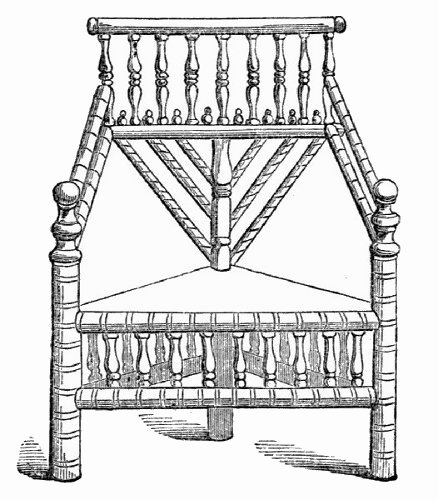
HENRY THE EIGHTH'S CHAIR.
In the earlier half of the sixteenth century a large proportion of the furniture used in this country, as well as of the earthenware and other household implements during the greater part of that century, was imported from Flanders and the Netherlands. Hence, in the absence of engravings at home, we are led to look at the works of the Flemish and German artists for illustrations of domestic manners at this period. The seats of that day were termed joint (or joined) stools and chairs. A rather fine example of a chair of this work, which was, as was often the case, three-cornered, is preserved in the Ashmolean museum, at Oxford, where it is reported to have been the chair of Henry VIII. We here annex a sketch of it.
MULLET AND TURBOT WITH THE ROMANS.
The Romans were enthusiastic for the mullet. It was for them the fish, par excellence. It was sometimes served up six pounds in weight, and such a fish was worth £60 sterling. It was cooked on the table, for the benefit and pleasure of the guests. In a glass vessel filled with brine made from water, the blood of the mackerel, and salt, the live mullet, stripped of all its scales, was enclosed; and as its fine pink colour passed through its dying gradations, until paleness and death ensued, the convives looked on admiringly, and lauded the spectacle.
The turbot was next in estimation, but as, occasionally, offending slaves were flung into the turbot preserves for the fish to feed upon, some gastronomists have affected to be horror-stricken at the idea of eating a turbot a la Romaine; quite forgetting that so many of our sea-fish, in their domain, feed largely on the human bodies which accident, or what men call by that name, casts into the deep.
"TOO LATE," QUOTH BOICE.
The history of the ancient castle of Maynooth is one of much interest; abounding in incidents akin to romance. In the reign of Henry the Eighth, during the rebellion of "Silken Thomas," one of the bravest and most heroic of the Geraldines, it was taken by treachery. In the absence of its lord, the governorship was entrusted to "Christopher Parese," his foster-brother. This "white-livered traitor resolved to purchase his own security with his lord's ruin;" and therefore sent a letter to the lord-deputy, signifying that he would betray the castle, on conditions; "and here the devil betrayed the betrayer, for in making terms for his purse's profit, he forgot to include his person's safety." The lord-deputy readily accepted his offer, and, accordingly, the garrison having gained some success in a sally, and being encouraged by the governor in a deep joyous carouse, the ward of the tower was neglected—the traitorous signal given, and the English scaled the walls. They obtained possession of the strong-hold, and put the garrison to the sword—"all except two singing men, who, prostrating themselves before the deputy, warbled a sweet sonnet called dulcis amica, and their melody saved their lives." Parese, expecting some great reward, with impudent familiarity presented himself before the deputy, who addressed him as follows:—"Master Parese, thou hast certainly saved our lord the king much charge, and many of his subjects' lives, but that I may better know to advise his highness how to reward thee, I would ascertain what the Lord Thomas Fitzgerald hath done for thee?" Parese, highly elevated at this discourse, recounted, even to the most minute circumstance, all the favours that the Geraldine, even from his youth up, had conferred on him, to which the deputy replied, "And how, Parese, couldst thou find it in thy heart to betray the castle of so kind a lord? Here, Mr. Treasurer, pay down the money that he has covenanted for; and here, also, executioner, without delay, as soon as the money is counted out, cut off his head!" "Oh," quoth Parese, "had I known this, your lordship should not have had the castle so easily." Whereupon Mr. Boice, a secret friend of the Fitzgerald, a bystander, cried out "Auntraugh," i. e. "too late," which occasioned a proverbial saying, long afterwards used in Ireland—"Too late, quoth Boice." The castle is said by Archdall to have been erected by John, the sixth Earl of Kildare, early in the fifteenth century; but in that case it must have been preceded by some other defensive structure; for it is certain that the Kildare branch of the Geraldines resided at Maynooth at a much earlier period. The first Earl of Kildare, John Fitz Thomas, was created by patent, dated 14th May, 1316.
SUPPRESSED BIBLES.
1538.—An English Bible, in folio, printed at Paris, unfinished.
1542.—Dutch Bible by Jacob Van Leisvelt. The sixth and best edition given by Leisvelt, and famous as being the cause of this printer being beheaded.
1566.—French Bible by Rene Benoist, Paris, 1566, folio, 3 vols. completed.
1622.—Swedish Bible, printed at Lubeck, in 4to., very defective.
1666.—A German Bible, printed at Helmstedt, in part only, 4to.
1671.—A French Bible, by Marolles, in folio, containing only the books of Genesis, Exodus, and the first twenty-three chapters of Leviticus.
EXTRAORDINARY REPRODUCTIVE POWER OF THE HYDRA.
One of the fresh-water Polypes, from its power of perpetual reproduction, has received the name of Hydra, by which it is known among naturalists: as if it realised the ancient monster of fabulous story, whose heads sprouted anew as fast as they were cut off by Hercules.
Most curious monstrosities were produced by the experiments of philosophers on these animals, especially by partial separations. If a polype be slit from the summit to the middle, one will be formed having two heads, each of which will capture and swallow food. If these again be slit half-a-dozen times, as many heads will be formed surmounting the same body. If now all these be cut off, as many new ones will spring up in their place, while each of the severed heads becomes a new polype, capable of being, in its turn, varied and multiplied ad infinitum;—so that in every respect our little reality exceeds its fabulous namesake.
The polypes may be grafted together. If cut-off pieces be placed in contact, and pushed together with a gentle force, they will unite and form a single one. The head of one may be thus planted on the trunk of another.
Another method of uniting them, perhaps still more wonderful, is by introducing one within the other; the operator forced the body of the one into the mouth of the other, pushing it down so that the heads were brought together. After forcibly keeping it for some time in this state, the two individuals at length united, and a polype was formed, distinguishable only by having twice the usual number of tentacles.
There is one species which can actually be turned inside out like a glove, and yet perform all the functions of life as before, though that which was the coat of the stomach is now the skin of the body and vice versâ. If it should chance that a polype so turned had young in the act of budding, these are, of course, now within the stomach. If they have arrived at a certain degree of maturity, they extend themselves towards the mouth of the parent, that they may thus escape when separated. But those which are less advanced turn themselves spontaneously inside out, and thus place themselves again on the exterior of the parent.
A multitude of other variations, combinations, and monstrosities, have been, as it were, created by the ingenuity of philosophers; but these are sufficient to give a notion of the extraordinary nature of these animals; and to account for the wonder with which they were regarded.
EGYPT.
Egypt was the land visited by Abraham in search of food, when there was a famine in his own country;—the land to which Joseph was carried as a slave, and which he governed as prime minister. From Egypt, Moses led the Israelites through the waters of the Red Sea. Here Jeremiah wrote his Lamentations. Here Solon, Pythagoras, Plato, and many other Greek philosophers, came to study. Here Alexander the Great came as conqueror; and here the Infant Saviour was brought by his parents to avoid the persecution of Herod. Egyptian hieroglyphics, in which the characters are taken from visible objects, are the earliest form of writing; and the Hebrew and Greek alphabets were both borrowed from them. Egypt taught the world the use of paper—made from its rush, the papyrus. In Egypt was made the first public library, and first college of learned men, namely, the Alexandrian Museum. There Euclid wrote his Elements of Geometry, and Theocritus his Poems, and Lucian his Dialogues. The beauty of Cleopatra, the last Egyptian Queen, held Julius Cæsar, and then Marc Antony, captive. In Egypt were built the first monasteries; the Christian fathers, Origen and Athanasius, lived there. The Arien and Athanasian controversy began there.
The buildings which now remain are the oldest buildings in the world, and the largest in the world. On the banks of its great river may be seen the oldest arch, and the oldest column. Up this noble river sailed Herodotus, the most entertaining of travellers, and Strabo, the most judicious. Indeed, as the country is little more than the narrow strip that is watered by the Nile's overflow, from the river may be seen almost all its great cities and temples.
ABYSSINIAN LADIES.
The women of Abyssinia are dressed quite as decently as any women in the world, without having a particle of the trouble of the ladies of more civilised nations. There is a distinguishing costume for young girls, and for those who, from being married or otherwise, are no longer considered as such. The dress of the former is indeed rather slight, though far more picturesque than that of the latter. In one part of the country (about Shiré) the girls merely wear a piece of cotton stuff wrapped round the waist and hanging down almost to the knee, and another (or the end of the former, if it be long enough) thrown over the left shoulder, so as to leave the right arm and breast exposed. In other parts of Tigrè, a black goat-skin, ornamented with cowries, is often substituted for this latter. An ordinary woman wears a large loose shirt down to the feet, with sleeves made tight towards the wrist. This, with a "quarry" similar to those of the men, but worn rather differently, and a parasol when out of doors, is a complete suit. A fine lady, however, as in our engraving, has a splendid "mergeff quarry," and her shirt is made probably of calico from Manchester, instead of the country fabric, and richly embroidered in silk of divers colours and various patterns round the neck, down the front, and on the cuffs. She will also, of course, own a mule; and then may choose to wear (alas, that it should be so, even in Abyssinia!) the inexpressibles. These are made of calico, and rather loose, but getting gradually tighter at the ankle, where they are embroidered like the shirt.
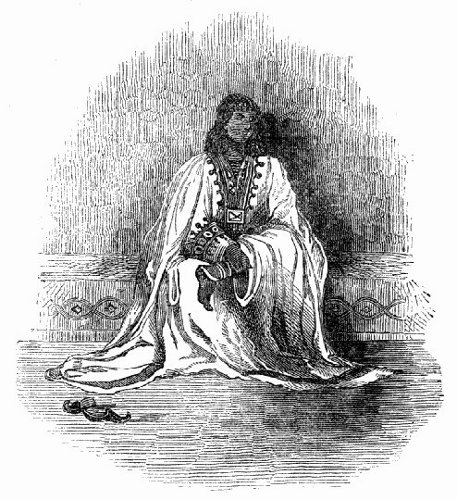
The fair sex all over the world are fond of ornaments. In Abyssinia they wear a profusion of silver, in the shape of chains, bracelets, &c., or, to be more explicit, a well-dressed lady will hang three or four sets of amulets about her neck, as well as her blue cord, and a large flat silver case (purporting to contain a talisman, but more often some scented cotton) ornamented with a lot of silver bells hanging to the bottom edge of it, and the whole suspended by four chains of the same metal. Three pairs of massive silver and gilt bracelets are on her wrists, and a similar number of "bangles" on her ankles; while over her insteps and to her heels are a quantity of little silver ornaments, strung like beads on a silk cord. Her fingers (even the upper joints) are covered with plain rings, often alternately of silver and silver-gilt, and a silver hair-pin, something similar to those now worn by English ladies, completes her decoration. Women of the poorer class, and ladies on ordinary occasions, wear ivory or wooden pins neatly carved in various patterns, and stained red with henna-leaves. The Abyssinian ladies, like those of most Eastern nations, stain their hands and feet with henna, and darken their eyelids with antimony.
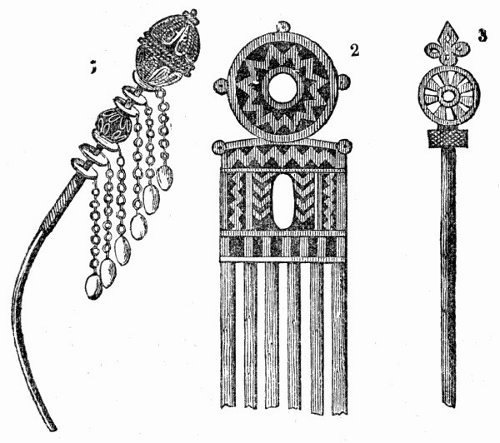
1, 2. Hair-pins made of hard wood, and stained with henna. 3. Ditto, of silver and fil-et-grain work. (About one-half usual size.)
TREATMENT OF LEPERS IN ENGLAND.
According to the tenor of various old civil codes and local enactments, when a person became affected with leprosy, he was looked upon as legally and politically dead, and lost the privileges belonging to his right of citizenship. By the laws of England, lepers were classed with idiots, madmen, outlaws, &c., as incapable of being heirs. But it was not by the eye of the law alone that the affected was looked upon as defunct, for the church also took the same view, and performed the solemn ceremonials of the burial of the dead over him, on the day on which he was separated from his fellow creatures, and confined to a lazar house. The various forms and ceremonies which were gone through on this occasion are described by French authors; but it is highly probable that the same observances were common in our own country.
A priest, robed with surplice and stole, went with the cross to the house of the doomed leper. The minister of the church began the necessary ceremonies, by exhorting him to suffer, with a patient and penitent spirit, the incurable plague with which God had stricken him. He then sprinkled the unfortunate leper with holy water, and afterwards conducted him to the church, the usual burial services being sung during their march thither. In the church, the ordinary habiliments of the leper were removed; he was clothed in a funeral pall, and, while placed before the altar, between trestles, the libera was sung, and the mass for the dead celebrated over him. After this service he was again sprinkled with holy water, and led from the church to the house or hospital destined for his future abode. A pair of clappers, a barrel, a stick, cowl, and dress, &c., were given him. Before leaving the leper, the priest solemnly interdicted him from appearing in public without his leper's garb,—from entering inns, churches, mills, and bakehouses,—from touching children, or giving them ought he had touched,—from washing his hands, or any thing pertaining to him, in the common fountains and streams,—from touching, in the markets, the goods he wished to buy, with any thing except his stick,—from eating and drinking with any others than lepers,—and he specially forbade him from walking in narrow paths, or from answering those who spoke to him in roads and streets, unless in a whisper, that they might not be annoyed with his pestilent breath, and with the infectious odour that exhaled from his body,—and last of all, before taking his departure, and leaving the leper for ever to the seclusion of the lazar house, the official of the church terminated the ceremony of his separation from his living fellow-creatures, by throwing upon the body of the poor outcast a shovelful of earth, in imitation of the closure of the grave.
According to the then customary usage, Leper Hospitals were always provided with a cemetery for the reception of the bodies of those who had died of the malady.
LUMINOUS APPEARANCE OF THE RED SEA.
All who have frequented the Red Sea, have observed the luminous appearance or phosphorescence of its waters. "It was beautiful," says a picturesque writer, who sailed from Mocha to Cosseir, "to look down into this brightly transparent sea, and mark the coral, here in large masses of honeycomb-rock, there in light branches of a pale red hue, and the beds of green seaweed, and the golden sand, and the shells, and the fish sporting round the vessel, and making colours of a beauty to the eye which is not their own. Twice or thrice we ran on after dark for an hour or two; and though we were all familiar with the sparkling of the sea round the boat at night, never have I seen it in other waters so superlatively splendid. A rope dipped in it and drawn forth came up as a string of gems; but with a life, and light, and motion, the diamond does not know." Those sea-lights have been explained by a diversity of causes; but the singular brilliancy of the Red Sea seems owing to fish spawn and animalculæ, a conjecture which receives some corroboration from the circumstance that travellers who mention it visited the gulf during the spawning period—that is, between the latter end of December and the end of February. The coral-banks are less numerous in the southern parts. It deserves notice, that Dr. Shaw and Mr. Bruce have stated—what could only be true, so far as their own experience went—that they observed no species of weed or flag; and the latter proposes to translate Yam Zuph "the Sea of Coral"—a name as appropriate as that of Edom.
RECENT PRICES OF SLAVES.
Prices of course vary at Constantinople according to the vigilance of Russian cruisers, and the incorruptibility of Russian agents at Trebizond, Samsoon, and Sinope. The following is the average price in Circassia:—
A man of 30 years of age, £10
" 20 " 10 to £30
" 15 " 30 " 70
" 10 " 20 " 50
" 5 " 10 " 30
A woman of 50 years of age, £10 to £30
" 40 " 30 " 40
" 30 " 40 " 70
" 20 to 25 " 50 " 100
" 14 " 18 " 50 " 150
" 8 " 12 " 30 " 80
" 5 " 20 " 40