TEN THOUSAND WONDERFUL THINGS. (continued 19)
Reading edition
On a large antique marble in the chancel at Great Harrowden, Northamptonshire, are the portraits of a man in armour, and his wife in a winding sheet. The man stands on a greyhound, and the woman has at her feet two little dogs looking upwards, with bells on their collars. This monument is that of William Harwedon and Margery, daughter of Sir Giles St. John of Plumpton. She died in the twentieth year of Henry VI.
THE FATE OF THE LAST MAY-POLE IN THE STRAND.
The May-pole, which had been set up in 1641, having long been in a state of decay, was pulled down in 1713, and a new one, with two gilt balls and a vane on the top of it, was erected in its stead. This did not continue long in existence; for, being in 1718 judged an obstruction, to the view of the church then building, orders were given by the parochial authorities for its removal. Sir Isaac Newton begged it of the parish, and it was conveyed to Wanstead Park, where it long supported the largest telescope in Europe, belonging to Sir Isaac Newton's friend, Mr. Pound, the rector of Wanstead. It was 125 feet long; and presented to Mr. Pound by Mr. Huson, a French member of the Royal Society.
MEANS OF ATTRACTING CUSTOM.
Before houses were numbered, it was a common practice with tradesmen not much known, when they advertised, to mention the colour of their next neighbour's door, balcony, or lamp, of which custom the following copy of a handbill will present a curious instance:—
"Next to the Golden Door, opposite Great Suffolk Street, near Pall Mall, at the Barber's Pole, liveth a certain person, Robert Barker, who having found out an excellent method for sweating or fluxing of wiggs; his prices are 2s. 6d. for each bob, and 3s. for every tye wigg and pigtail, ready money."
MUSIC OF THE HINDOOS.
Among the fine arts of India, music holds a distinguished place; and although its cultivation has declined, and but few are now found who have attained to eminence either in the science or art of this unequalled source of recreation, refinement, and pleasure, yet no people are more susceptible of its charms than the Hindoos. Reading is with them invariably, as with the Arabians and other Eastern nations, a species of recitativo, a sort of speaking music, delivered in dulcet though not measured tones. The recitation of lessons in a school or academy always takes this form. The man at the oar, women beating lime, the labourer engaged in irrigation, alike accompany their toil with song.
The word sangíta, symphony, as applied to music by the Hindoos, conveys the idea of the union of voices, instruments, and action. Musical treatises accordingly treat of gáná, vádya, uritya, or song, percussion, and dancing; the first comprising the measures of poetry; the second, instrumental sounds; and the third, theatrical representation. The ancient dramas of the Hindoo exhibited the union of these in their unequalled poetry, modulated with the accompaniments of voice, and instruments, and the attractions of appropriate scenery.
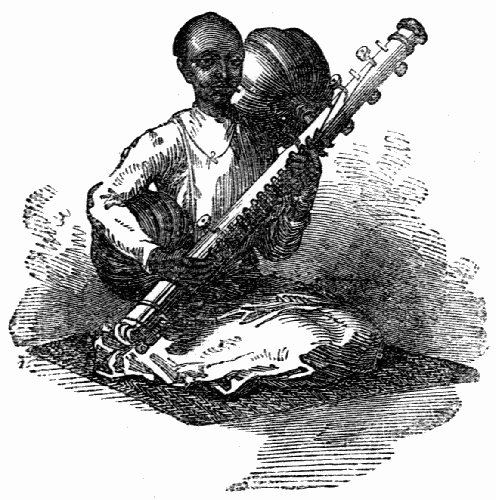
The music of the Hindoos includes eighty-four modes, each supposed to have a peculiar expression, capable of moving some particular sentiment or affection. The modes take their denomination from the seasons, or from the hours of day or night. Musical composition is supposed capable of adaptation to the different periods of the day, and therefore its provisions are regulated by the hours. The ideas of the Hindoos on music, as promoting the pleasures of imagination, may be inferred from the names applied by ancient authors to their musical treatises. One is called Rágárnava, the Sea of the Passions; another, Rágaderpana, the Mirror of Modes; and a third, Sóbhavinóda, the Delight of Assemblies; a fourth, Sangítaderpana, the Mirror of Song; and another, Rágavibódha, the Doctrine of Musical Modes. Some of these works explain the law of musical sounds, their divisions and succession, variations of scales by temperament, and the enunciation of modes; besides a minute description of the different vínás (lute), and the rules for playing them. This is a fretted instrument of the guitar kind, usually having seven wires or strings, and a large gourd at each end of the finger-board. Its extent is two octaves, and its invention is attributed to Náredá, the son of Brahma. There are many varieties, named according to the number of their strings. Of one of them we give an engraving below.
Music, like everything else connected with India, is invested with divine attributes. From the sacred Veda was derived the Upaveda, or subsidiary Veda of the Gandharbas, the heavenly choristers. The art was communicated to mortals by Sarasvati, the consort of Brahma. She, as before stated, is the patroness of the fine arts, the goddess of speech. Their son, an ancient lawgiver and astronomer, invented the Víná. The first inspired man, Bherat, invented the Drama.
PRINTED BY WILLIAM CLOWES AND SONS, LIMITED, LONDON AND DECCLES.