TEN THOUSAND WONDERFUL THINGS. (continued 3)
Reading edition
A SEA ABOVE THE SKY.
This belief is curiously illustrated by two legendary stories preserved by Gervase of Tilbury. "One Sunday," he says, "the people of a village in England were coming out of church on a thick cloudy day, when they saw the anchor of a ship hooked to one of the tombstones; the cable, which was tightly stretched, hanging down from the air. The people were astonished, and while they were consulting about it, suddenly they saw the rope move as though some one laboured to pull up the anchor. The anchor, however, still held fast by the stone, and a great noise was suddenly heard in the air, like the shouting of sailors. Presently a sailor was seen sliding down the cable for the purpose of unfixing the anchor; and when he had just loosened it, the villagers seized hold of him, and while in their hands he quickly died, just as though he had been drowned. About an hour after, the sailors above, hearing no more of their comrade, cut the cable and sailed away. In memory of this extraordinary event, the people of the village made the hinges of the church doors out of the iron of the anchor, and 'there they are still to be seen.'—At another time, a merchant of Bristol set sail with his cargo for Ireland. Some time after this, while his family were at supper, a knife suddenly fell in through the window on the table. When the husband returned, he saw the knife, declared it to be his own, and said that on such a day, at such an hour, while sailing in an unknown part of the sea, he dropped the knife overboard, and the day and hour were known to be exactly the time when it fell through the window. These accidents, Gervase thinks, are a clear proof of there being a sea above hanging over us."—St. Patrick's Purgatory. By Thos. Wright. 1844.
THE PAPYRUS.
Paper as we now have it, that is to say, paper made of the pulp of fibrous materials, pressed into thin sheets, dried, and, when intended for writing or printing purposes, sized, is of comparatively modern introduction to Europe and Western Asia; although the Chinese appear to have formed paper out of silk pulp, mixed with the inner pith of the bamboo, as early at least as 95 A.D.:—not from time immemorial, as some authors have stated, because the circumstance is well attested, that in the time of Confucius, the Chinese wrote with a style on the inner bark of trees.
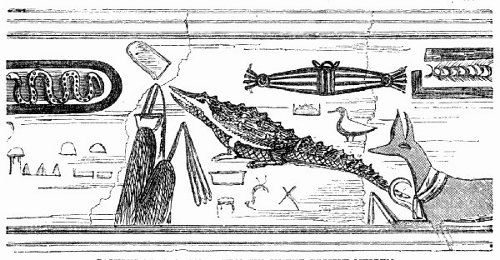
PAPYRUS ROLL, FROM A SPECIMEN IN THE BRITISH MUSEUM.
Before the invention of paper, the surfaces employed for writing upon were numerous. Surfaces of lead or other metal; tables covered with wax, skins of animals,—(parchment in fact)—all were used; but no one of these was ever so extensively employed as the Egyptian papyrus, whenever the latter material could be obtained. So soon, however, as the Saracens in the seventh century conquered Egypt, the exportation of papyrus was at an end; and writing surfaces became so scarce in Europe that many ancient documents of great value were erased in order to render them adapted for being written on once more. Thus perished many treasures of antiquity.
As the Saracens closed the avenue of supply for the ancient papyrus, so they compensated to Europe for this deprivation by discovering the manufacture of ordinary paper—at least paper made in the ordinary modern fashion,—though the material was cotton, not linen. This discovery was made some time anterior to the year 706 A.D., for at that period a manufactory of paper existed at Samarcand. In the eighth century the Saracens conquered Spain, and introduced into the Peninsula, amongst other arts, that of the manufacture of paper, which art was a long time finding its way into other parts of Europe,—in Italy not until the eleventh or twelfth century. The vast amount of papyrus which must have been employed in Italy, may be inferred from the number of rolls or scapi of this substance discovered in Herculaneum and Pompeii; also from a perusal of many existing documents bearing directly or indirectly on this branch of commerce. Even so late as the commencement of the sixth century, Cassiodorus congratulated the world on the abolition, by King Theodoric, of the high duty on papyrus from Egypt; and he spoke in high flown terms of the great utility of the material. The latest papyrus roll known is of the twelfth century, containing a brief of Pope Paschal II., in favour of the Archiepiscopal see of Ravenna.
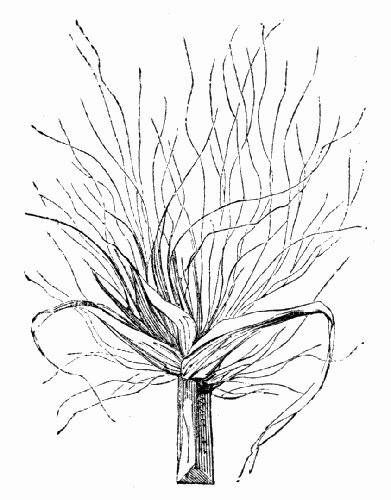
SYRIAN PAPYRUS WITHOUT FLOWERS.
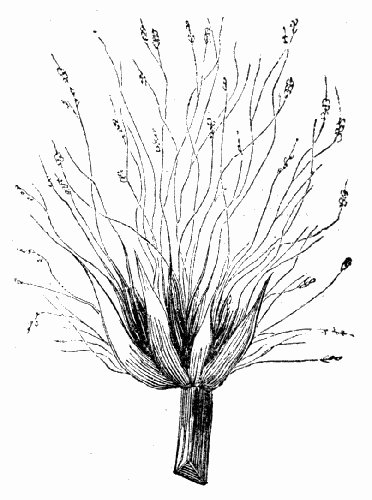
SYRIAN PAPYRUS WITH FLOWERS.
The various species of papyrus plants belong to the natural order "Cyperaceæ," or sedges, of botanists; a main characteristic of which is a certain triangularity of stem. The method of constructing a writing surface from these stems was as follows:—The available portion being cut off (it was seldom more than twelve inches in length), and split, or, more properly speaking, unfolded into thin sheets, which were glued together transversely in such a manner that the original length of the papyrus stem became the breadth of the future sheet; the length of which might be increased at the pleasure of the operator. Frequently the manufactured scrolls were more than thirty feet long. As different methods prevail in the manufacture of our ordinary paper, so in like manner there were different processes of fashioning the papyrus into shape. The rudest manufacture appears to have been that of Egypt, and the best papyrus sheets appear to have been made in Rome during the Augustine Æra. The preceding sketch represents a papyrus roll, copied from a specimen in the Egyptian Room of the British Museum.
Considering the numerous pieces entering into the composition of the roll, of which our illustration represents a portion, the lines of juncture are remarkably well concealed, only a sort of grain being visible. The surface, moreover, is smoothed, and its colour very much like that of India paper. The hieroglyphics are coloured as is usual, red is the predominant tint, and the colours are no less well demarcated and separate than they would have been on glazed paper.
Our preceding wood-cuts represent the Sicilian or Syrian papyrus, hitherto termed cyperus papyrus, in two states of development—one with flowers, the other without. In order that inflorescence may take place, the plant requires to be well supplied with water.
EXECUTION IN 1733.
Friday, March 9—Was executed at Northampton, William Alcock, for the murder of his wife. He never own'd the fact, nor was at all concerned at his approaching death; refusing the prayers and assistance of any persons. In the morning he drank more than was sufficient, yet sent and paid for a pint of wine, which being deny'd him, he would not enter the cart before he had his money return'd. On his way to the gallows he sung part of an old song of "Robin Hood," with the chorus, "Derry, derry, down," &c., and swore, kick'd, and spurn'd at every person that laid hold of the cart; and before he was turn'd off, took off his shoes, to avoid a well known proverb; and being told by a person in the cart with him, it was more proper for him to read, or hear somebody read to him, than so vilely to swear and sing, he struck the book out of the person's hands, and went on damning the spectators and calling for wine. Whilst psalms and prayers were performing at the tree he did little but talk to one or other, desiring some to remember him, others to drink to his good journey, and to the last moment declared the injustice of his case.
DOG FRIENDSHIP.
At Bishops Stortford there were two dogs, which belonged to nobody, and lived upon the quay of the river or canal there. They took the greatest delight in rat hunting, and when the maltsters went about at night to see that all was safe, these dogs invariably followed them. Their mode of proceeding was very ingenious. As soon as the door of the malt-house was unlocked, one rushed in and coursed round the warehouse, not chasing any rat which might start, but pursuing its way among the malt. The other stood at the door and snapped at the rats as they endeavoured to escape. The one standing at the door was known to kill six rats, all of which had rushed to the door at the same time. The next room they came to, they would change posts; the one which hunted before, now standing at the door and seizing the prey. By this means the dogs killed in the malting-houses of one maltster alone, upwards of 2,000 rats in the course of one year. One of them on one occasion killed sixty-seven in less than five minutes. They seemed to pursue the sport simply for their amusement.
ALL HUMBUGS.
Just as a strolling actor at Newcastle had advertised his benefit, a remarkable stranger, no less than the Prince Annamaboo, arrived, and placarded the town that he granted audiences at a shilling a-head. The stroller, without delay, waited on the proprietor of the Prince, and for a good round sum prevailed on him to command his Serene Highness to exhibit his august person on his benefit night. The bills of the day announced that between the acts of the comedy Prince Annamaboo would give a lively representation of the scalping operation, sound the Indian war-whoop in all its melodious tones, practice the tomahawk exercise, and dine à la cannibal. An intelligent mob were collected to witness these interesting exploits. At the conclusion of the third act, his Highness marched forward flourishing his tomahawk, and shouting, "Ha, ha!—ho, ho!" Next entered a man with his face blacked, and a piece of bladder fastened to his head with gum; the Prince, with an enormous carving-knife, began the scalping part of the entertainment, which he performed in a truly imperial style, holding up the piece of bladder as a token of triumph. Next came the war-whoop, an unearthly combination of discordant sounds; and lastly, the banquet, consisting of raw beef-steaks, which he rolled up into rouleaus, and devoured with right royal avidity. Having finished his delicate repast, he wielded his tomahawk in an exulting manner, bellowed "Ha, ha!—ho, ho!" and made his exit. The bénéficiaire strolling through the market-place the following-day, spied the most puissant Prince Annamaboo selling penknives, scissors, and quills, in the character of a Jew pedlar. "What!" said the astonished Lord Townley, "my Prince, is it you? Are you not a pretty circumcised little scoundrel to impose upon us in this manner?" Moses turned round, and with an arch look, replied, "Princh be d—d! I vash no Princh; I vash acting like you. Your troop vash Lords and Ladies last night; and to-night dey vil be Kings, Prinches, and Emperor! I vash humpugs, you vash humpugs, all vash humpugs!"
REDUCING WEIGHT.
A gentleman, of great respectability in the mercantile world, who weighed thirty-two stone nine pounds, put himself upon a strict diet of four ounces of animal food, six ounces of bread, and two pounds of liquid, in twenty-four hours. In one week he lost thirty pounds weight, and in six months he was diminished the astonishing quantity of one hundred and thirty-four pounds. His health and spirits were much improved, and considering his remaining size of twenty-three stone, he was very active.
ANECDOTE OF A SERPENT.
Lord Monboddo relates the following singular anecdote of a serpent:—"I am well informed of a tame serpent in the East Indies, which belonged to the late Dr. Vigot, once kept by him in the suburbs of Madras. This serpent was taken by the French, when they invested Madras, and was carried to Pondicherry in a close carriage. But from thence, he found his way back again to his old quarters, though Madras was above one hundred miles distant from Pondicherry."
ENGLAND BEFORE THE ROMANS.
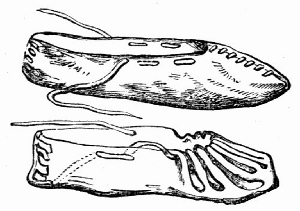
Before the Roman invasion, the dress of its chieftains consisted of a close coat or covering for the body, called by Dio a tunic, and described as checkered with various colours in divisions. It was open before, and had long close sleeves to the wrist. Below were loose pantaloons, called by the Irish brigis, and by the Romans brages and bracæ; whence the modern term "breeches." Over their shoulders was thrown the mantle or cloak, called by the Romans sagum, and derived from the Celtic word saic, which signified a skin or hide, and which was the original cloak of the country. Diodorus tells us that it was of one uniform colour, generally either blue or black, the predominating tint in the checkered trousers and tunic being red. On their heads they wore a conical cap, which derived its name from the "cab," or hut of the Briton, which was of similar form. On their feet were shoes made of raw cow-hide, that had the hair turned outward, and which reached to the ankles. Shoes so constructed were worn within the last few years in Ireland; and we engrave two from specimens in the Royal Irish Academy. One is of cow-hide, and drawn together by a string over the foot; and the other has a leather thong, which is fastened beneath the heel inside, and, passing over the instep, draws the shoe like a purse over the foot. It is of untanned leather.
ROMANS IN BRITAIN—DRESS OF NATIVE FEMALES AT THAT PERIOD.
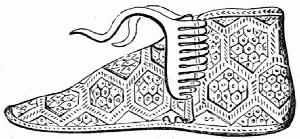
The British gwn, from whence comes the modern "gown," descended to the middle of the thigh, the sleeves barely reaching to the elbows: it was sometimes confined by a girdle. Beneath this a longer dress reached to the ancles. The hair was trimmed after the Roman fashion; and upon the feet, when covered, were sometimes worn shoes of a costly character, of which we know the Romans themselves to have been fond. An extremely beautiful pair was discovered upon opening a Roman burial-place at Southfleet in Kent, in 1802. They were placed in a stone sarcophagus, between two large glass urns or vases, each containing a considerable quantity of burnt bones. They were of superb and expensive workmanship, being made of fine purple leather, reticulated in the form of hexagons all over, and each hexagonal division worked with gold, in an elaborate and beautiful manner.
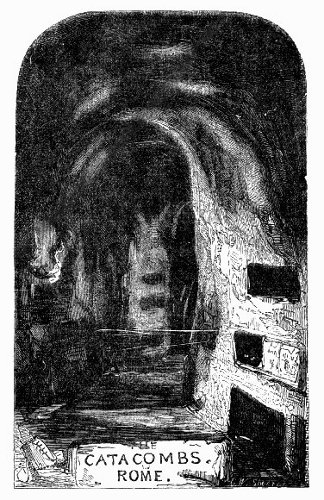
THE CATACOMBS. ROME.
Amid the ruins of stately temples, and numerous remains of the "Eternal City," there are no objects which have such great and general interest as the subterranean churches, dwellings, and places of sepulchre of the early Christians, which perforate, by a network of excavations, the neighbourhood of Rome.
The great increase in the extent and magnificence of Rome during the times of the Republic, led to the formation of quarries in the surrounding parts. The peculiar nature of the soil has caused the excavations to be made in a manner similar to that used in the working of coal, iron, stone, lime, &c. The useful material has, in fact, been cleared away, leaving long ranges of dark caves and passages. After the stone had been removed from these underground quarries, it was, for many centuries, customary to work out the sand for the purpose of making cement. Vitruvius has stated that the sand obtained from the Esquiline pits was preferable to any other. Ultimately the quarries and sandpits extended to a distance of upwards of fifteen miles on one side of Rome. Parts of this large range of excavations were from time to time used as burial-grounds by such of the Romans as could not afford the cost of burning the bodies of their dead relations. And, in addition, the Esquiline hills became infested by banditti, and was from these various causes rendered almost impassable.
In these excavations, it is said, that not only persons, but cattle, contrived to support existence; and although it was well known that large numbers were lodged in these dismal dwellings, their intricacy and numberless entrances rendered them a comparatively secure retreat. It is related that attempts were made to cover the galleries with earth, in order to destroy those who were concealed within.
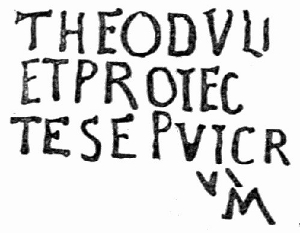
In course of time the catacombs became, with the exception of one or two, neglected and filled up with rubbish, and remained for a period of upwards of one thousand years untouched and almost unknown. In the sixteenth century the whole range of the catacombs were reopened, and numerous inscriptions and other matters connected with the struggles and hardships of the early Christians brought to light. The annexed brief memorial will show the general style of the lettering.
OBSOLETE MODES OF PUNISHMENT.
Ante page 60, we gave representations of some ancient instruments of punishment and torture, all more or less terrible in their character, the use of which, for many a long year, has been happily abandoned. As a companion to this group, we have engraved a few of the instruments of punishment by which criminals of a vulgar character were sought to be reformed. The first of these is the felon's brand, the mark of which rendered a man infamous for life. Figure 1, p. 90 represents the instrument itself. Figure 2, the mark branded in, which latter has been engraved the exact size. The device, which is deeply cut into the metal, is a gallows, such as was used before the invention of the Drop and the Wheel for Execution and torture.
The Stocks and Whipping-post, although long since removed from London Bridge, may be met with in retired country places. We have noticed some characteristic examples in the Forest of Dean, Gloucestershire, where some of the may-poles, day-wheels, and other curious relics, may still be seen. [2] In some instances the Stocks and Whipping-posts were richly carved, and clamped with iron work of an ornamental character. We remember seeing the stocks used within the last thirty years, once at Newcastle-on-Tyne, and once at Gateshead, the adjoining town. The culprit in the one instance was an elector, who, in the excess of zeal and beer, during an old-fashioned contested election, rushed into one of the churches during the Sunday's service, and shouted out, "Bell (one of the candidates) for ever." He was speedily taken hold of, and placed for several hours in the stocks in the churchyard; and, as the stimulating effect of the strong drink passed away, he looked a deplorable object, decked as he was with numerous cockades, the "favours" of the candidate, whose cause he so indiscreetly supported.
The punishment of the barrel we should think to have been adapted for drunkards who could preserve a perpendicular position.
In the histories of London, it is mentioned that bakers and other dealers caught giving false weight, or in any other ways cheating the poor, were exhibited occasionally in this manner; but more frequently they were placed in the parish dung-cart, and slowly drawn through the streets of the district.
The Whirligig, a circular cage which could be moved swiftly round on a pivot, was, in bygone days, in use for offenders in the English army. There was another instrument used for the same purpose called the Horse, which was made in rude resemblance of the animal whose name it bore. The body was composed of planks of wood, which formed a sharp angle along the back. On this the soldier was seated, and his legs fastened below to several heavy muskets. This is said to have been a very severe and dangerous punishment. In addition to the above, and flogging, imprisonment, &c., there were three ancient methods of punishment in the English army—viz., beheading, hanging, and drowning. The latter of these, according to Grose, was in use only in the reign of Richard I. This author observes that, some centuries ago, capital punishment was rare in our army, the men having generally property, which was confiscated in case of ill conduct. He, however, refers to some terrible means which were resorted to for the purpose of preserving discipline. Hanging was chiefly confined to spies; who were taken to a tree in sight of the camp, and yet sufficiently distant, and there hung up. In many instances, when a corps or a considerable body of men were guilty of crime, for which the established punishment was death, to prevent too great a weakening of the army, the delinquents, Grose says, "were decimated, that is, only every tenth man was taken. A number of billets, equal to that of the body to be decimated, were put into a helmet, every tenth billet being marked with the letter D, or some other character signifying death; the helmet was then shaken, in order to mix them, and the soldiers, filing off singly from the right, passed by the commanding officers, before whom, on a table, stood the helmet; as they passed, each drew a billet and presented it to an officer placed to receive them. If the billet had the fatal mark; the soldier was seized and marched into the rear."
This wholesale method of capital punishment must have been a solemn affair. At times, it was customary to punish the man at the right hand of companies; without giving them the chance of the billet—on the principal that these were the most influential persons, and must, from their companionship with the others, have been acquainted with and have possessed the means of checking or giving information, which would prevent dangerous offences.
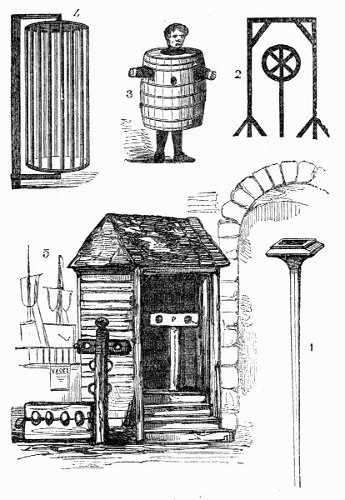
1. Brand for Marking Felons. 2. Impression of Brand. 3. Punishment for Drunkards, formerly in use at Newcastle-on-Tyne. 4. The Whirligig, a military method of punishment. 5. Pillory, Stocks, and Whipping Post, formerly on London Bridge.
The regulations of the English army during the time of Henry VIII., and previous reigns, may be met with in "Grose's Military Antiquities."
ORIGIN OF THE TERM "HUMBUG."
This, now, common expression, is a corruption of the word Hamburgh, and originated in the following manner:—During a period when war prevailed on the Continent, so many false reports and lying bulletins were fabricated at Hamburgh, that at length, when any one would signify his disbelief of a statement, he would say, "You had that from Hamburgh;" and thus, "That is Hamburgh," or Humbug, became a common expression of incredulity.
MARRIAGE LOTTERY.
It has often been said figuratively that marriage is a lottery; but we do not recollect to have met with a practical illustration of the truth of the simile, before the following, which is a free translation of an advertisement in the Louisiana Gazette:—"A young man of good figure and disposition, unable, though desirous to procure a wife, without the preliminary trouble of amassing a fortune, proposes the following expedient to attain the object of his wishes. He offers himself as the prize of a lottery to all widows and virgins under 32. The number of tickets to be 600, at 50 dollars each. But one number to be drawn from the wheel, the fortunate proprietor of which is to be entitled to himself and the 30,000 dollars."
CHINESE DAINTIES.
The common people of the country seem to fare hardly and sparingly enough, but one of our envoys praises much of the good cheer he found at the tables of the great men. They had pork, fish, and poultry, prepared in a great variety of ways, and very nice confectionery in abundance. The feasts, moreover, were served up in a very neat and cleanly manner. But there was one dainty which much offended their nostrils, and nearly turned their stomachs when it was named to them. It was not stewed dog or fricaséed pup. No; it consisted of three bowls of hatched eggs! When the Englishmen expressed some surprise at the appearance of this portion of the repast, one of the native attendants observed that hatched eggs formed a delicacy beyond the reach of the poor—a delicacy adapted only for persons of distinction! On inquiry, it was found that they cost in the market some thirty per cent. more than fresh eggs. It seems that they always form a distinguished part of every great entertainment, and that it is the practice, when invitations are sent out, to set the hens to hatch. The feast takes place about the tenth or twelfth day from the issuing the invitations,—the eggs being then considered as ripe, and exactly in the state most agreeable and pleasant to the palate of a Chinese epicure.
RECEIPTS FROM ALBERTUS MAGNUS.
"Bubo a shrick owle, is a byrd wel inough knowen, which is called Magis of the Chaldes, and Hysopus of the Greekes. There bee maruaylous vertues of this Fowle, for if the hart and ryght foote of it be put upon a man sleeping, hee shall saye anone to thee whatsoever thou shalt aske of him. And thys hath beene prooued of late tyme of our brethren. And if any man put thys onder his arme hole, no Dog wyll barke at hym, but keepe silence. And yf these thynges aforesayde ioyned together with a wyng of it be hanged up to a tree, byrdes wyl gather together to that tree."
"When thou wylt that thy wyfe or wenche shewe to thee all that shee hath done, take the hart of a Doove, and the heade of a Frog, and drye them both, and braie them vnto poulder, and lay them vpon the brest of her sleeping, and shee shall shew to thee all that shee hath done, but when shee shall wake, wipe it awaye from her brest, that it bee not lifted vp."
"Take an Adders skyn, and Auri pigmentum, and greeke pitch of Reuponticum, and the waxe of newe Bees, and the fat or greace of an Asse, and breake them all, and put them all in a dull seething pot full of water, and make it to seeth at a slowe fire, and after let it waxe cold, and make a taper, and euery man that shall see light of it shall seeme headlesse."—The Secreetes of Nature, set foorth by Albertus Magnus in Latine, newlye translated into English. Imprinted at London by me Wyllyam Copland. No date. Black letter, very old.
THE MAGPIE STONING A TOAD.
There is a story told of a tame magpie, which was seen busily employed in a garden, gathering pebbles, and with much solemnity, and a studied air, dropping them in a hole, about eighteen inches deep, made to receive a post. After dropping each stone, it cried, Currack! triumphantly, and set off for another. On examining the spot a poor toad was found in the hole, which the magpie was stoning for his amusement.
ADAPTATION OF BONES TO AGE IN THE HUMAN FRAME.
Growth produces in the species a somewhat remarkable change in the mechanical qualities of the bones. This important part of our organism consists of three constituents—fibre, cartilage, and the earthy matter already mentioned called phosphate of lime. From the fibre they derive their toughness; from the cartilage their elasticity; and from the lime their hardness and firmness. Nothing can be more admirable in the economy of our body than the manner in which the proportion of these constituents adapts itself to the habitudes of age. The helpless infant, exposed by a thousand incidents to external shocks, has bones, the chief constituents of which being gristly and cartilaginous, are yielding and elastic, and incur little danger of fracture. Those of the youth, whose augmented weight and increased activity demand greater strength, have a larger proportion of the calcareous and fibrous elements, but still enough of the cartilaginous to confer upon the solid framework of his body the greatest firmness, toughness, and elasticity. As age advances, prudence and tranquil habits increasing, as well as the weight which the bones have to sustain, the proportion of the calcareous constituent increases, giving the requisite hardness and strength, but diminishing the toughness and elasticity.
While the bones thus change their mechanical qualities as age advances, they diminish in number, the frame consequently having fewer joints and less flexibility. The bones of a child, whose habits require greater bodily pliability, are more numerous than those of an adult, several of the articulations becoming ossified between infancy and maturity. In like manner, the bones at maturity are more numerous than in advanced age, the same progressive ossification of the joints being continued.
It has been ascertained by anatomists that, on attaining the adult state, the number of bones constituting the framework of the human body is 198; of which 52 belong to the trunk, 22 to the head, 64 to the arms, and 60 to the legs.
TOWER OF THE THUNDERING WINDS.
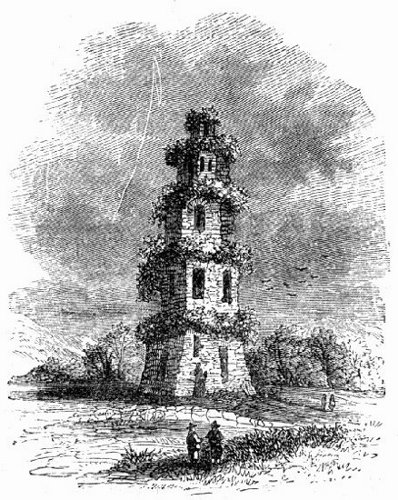
The Great Wall is certainly a wonderful monument of ancient times; but it is almost the only one that we read of in China, except a famous Temple, or Tower, partly in ruins, which stands on an eminence in the neighbourhood of Hang-chow-foo. It is called the "Tower of the Thundering Winds," and is supposed to have been built about 2,500 years ago.
DR. MONSEY BEQUEATHS HIS OWN BODY.
This eccentric person died at the great age of 96, and was for half a century, physician to Chelsea Hospital. He left his body for dissection, and a few days before he died, wrote to Mr. Cruikshanks, the Anatomist, begging him to know, whether it would suit his convenience to do it, as he felt he could not live many hours, and Mr. Forster, his surgeon, was then out of town. He died as he predicted, and his wishes with respect to his body, were strictly attended to.
TEA.
A folio sheet of the time of Charles II. entitled "An Exact Description of the Growth, Quality, and Virtues of the Leaf Tea, by Thomas Garway, in Exchange Alley, near the Royal Exchange, in London, Tobacconist, and Seller and Retailer of Tea and Coffee," informs us that "in England it hath been sold in the leaf for six pounds, and sometimes for ten pounds the pound weight; and in respect of its former scarceness and dearness, it hath been only used as a regalia in high treatments, and entertainments, and presents made thereof to princes and grandees till the year 1657. The said Thomas Garway did purchase a quantity thereof, and first publikely sold the said Tea in leaf and drink, made according to the direction of the most knowing merchants and travellers in those eastern countries: and upon knowledge and experience of the said Garway's continued care and industry, in obtaining the best Tea, and making drink thereof, very many noblemen, physicians, merchants, and gentlemen of quality, have ever since sent to him for the said leaf, and daily resort to his house, in Exchange Alley, to drink the drink thereof."
IT'S MUCH THE SAME NOW.
The following lines, from the Gentleman's Magazine of 1733, will give us some idea of what fashionable life was at that period:—
The Town Lady's Answer to,—"What tho' I am a Country Lass."
What tho' I am a London dame, And lofty looks I bear, a? I carry, sure, as good a name, As those who russet wear, a. What tho' my cloaths are rich brocades? My skin it is more white, a Than any of the country maids That in the fields delight, a. What tho' I to assemblies go, And at the Opera's shine, a? It is a thing all girls must do, That will be ladies fine, a: And while I hear Faustina sing, Before the king and queen, a By Eyes they are upon the wing, To see, if I am seen, a. My Peko and Imperial Tea Are brought me in the Morn, a. At Noon Champaign and rich Tokay My table do adorn, a. The Evening then does me invite To play at dear Quadrille, a: And sure in this there's more delight, Than in a purling rill, a. Then since my Fortune does allow Me to live as I please, a; I'll never milk my father's cow Nor press his coming cheese, a. But take my swing both night and day, I'm sure it is no sin, a: And as for what the grave ones say, I value not a pin, a.
BARBERS.
The barber's pole, one of the popular relics of Merrie England, is still to be seen in some of the old streets of London and in country towns, painted with its red, blue, and yellow stripes, and surmounted with a gilt acorn. The lute and violin were formerly among the furniture of a barber's shop. He who waited to be trimmed, if of a musical turn, played to the company. The barber himself was a nimble-tongued, pleasant-witted fellow. William Rowley, the dramatist, in "A Search for Money, 1609," thus describes him:—"As wee were but asking the question, steps me from over the way (over-listning us) a news-searcher, viz. a barber: hee, hoping to attaine some discourse for his next patient, left his baner of basons swinging in the ayre, and closely eave-drops our conference. The saucie treble-tongu'd knave would insert somewhat of his knowledge (treble-tongu'd I call him, and thus I prove't: hee has a reasonable mother-tonger, his barber-surgions tongue; and a tongue betweene two of his fingers, and from thence proceeds his wit, and 'tis a snapping wit too). Well, sir, hee (before hee was askt the question,) told us that the wandring knight (Monsier L'Argent) sure was not farre off; for on Saterday-night hee was faine to watch till morning to trim some of his followers, and its morning they went away from him betimes. Hee swore hee never clos'd his eyes till hee came to church, and then hee slept all sermon-time; (but certainly hee is not farre afore, and at yonder taverne showing us the bush) I doe imagine hee has tane a chamber." In ancient times the barber and the tailor, as news-mongers, divided the crown. The barber not only erected his pole as a sign, but hung his basins upon it by way of ornament.
BEES OBEDIENT TO TRAINING.
Though it is customary in many rural districts of England, when bees are swarming, to make a clanging noise with metal implements, under the impression—an erroneous one we believe—that it will induce the swarm to settle, it is not generally supposed that bees are susceptible of being trained to obey in many respects the orders of their teacher. Such, however, is the fact, and an instance of it occurs in the following advertisement, which we have copied from an old newspaper. We give it as we find it, but it is not very clear what locality is meant by "their proper places":—
"At the Jubilee Gardens, Dobney's, 1772. Daniel Wildman rides, standing upright, one foot on the saddle, and the other on the horse's neck, with a curious mask of bees on his face. He also rides, standing upright on the saddle, with the bridle in his mouth, and, by firing a pistol, makes one part of the bees march over a table, and the other part swarm in the air, and return to their proper places again."
A MAN SELLING HIS OWN BODY.
Anatomists and surgeons have frequently incurred the odium of being precipitate in their post mortem examinations. It has been charged upon the illustrious Vessalius, and, in more modern times, on Mons. de Lassone, and others; nay, credulity has gone so far, as to suppose, that subjects have occasionally been kept till wanted; nor is such a notion altogether extravant, when we find an article of this kind offered to Joshua Brookes, the anatomical lecturer, in the following terms:—
"Mr. Brooke, i have taken it into consideration to send this poor man to you, being greatly in distress, hopeing you will find sum employment for him in silling the dead carcases; and if you can find him no employment, the berer of this wishes to sill himself to you, as he is weary of this life. And I remain your humble servant,
"John Davis."
THE FIRST LOCOMOTIVES.
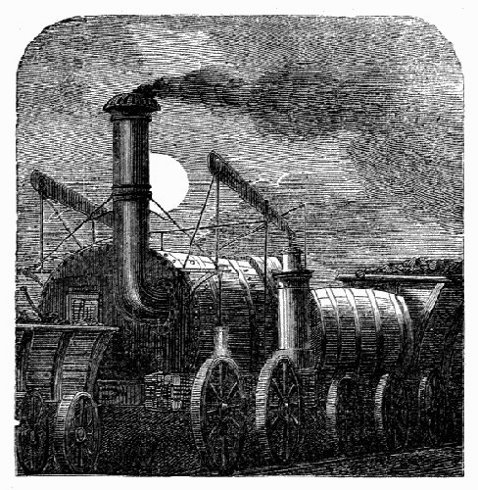
THE FIRST LOCOMOTIVE.
It is little more than thirty years ago, when, on the river Tyne, a large fleet of peculiarly-formed vessels was to be seen daily employed in the carriage of coals to the ships from the "staiths," which projected into the river from the various colliery tramways. At that period, there was only one very small and ill-constructed steam-packet for the conveyance of passengers between Newcastle and Shields, and against which so much prejudice existed, that the majority of persons preferred the covered wherries, which, for some centuries before, had been in use; yet so slow and uncertain was this means of transit between the two towns, that persons in a hurry often found it advisable to walk the intervening distance, which is about eight miles.
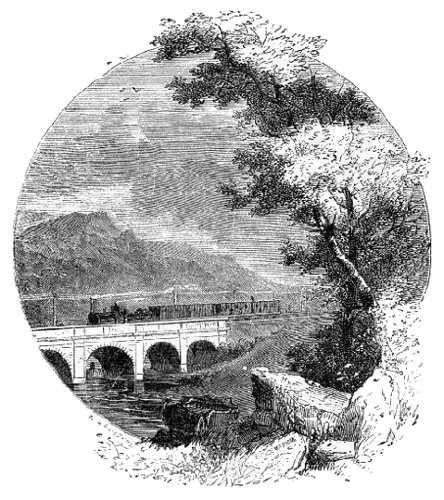
THE PRESENT LOCOMOTIVE AND TRAIN.
The collieries situated away from the river had tramways of wood let into the ordinary roads, in such a manner as to form wheel-tracks for carriages. These, drawn by horses, were the only means thought of for bringing the coals to the river bank. Some of these tramways were nearly as old as the times of Queen Elizabeth or James I., when the increase of London and other causes began to overcome the prejudice against the use of "sea-coal." Many of the tramways passed amid green and shadowy woods and other pleasant places, and we have often thought when wandering through them, of the difficulties that beset travellers at that time. Even at a more recent date, in 1673, day coaches were considered dangerous, and it was suggested that the multitude of them in London should be limited, and not more than one be allowed to each shire, to go once a week backwards and forwards, and to perform the whole journey with the same horses they set out with, and not to travel more than thirty miles a day in summer, and twenty-five in winter. The arguments advanced in favour of these proposals were, that coaches and caravans were mischievous to the public, destructive to trade, and prejudicial to the land—because, firstly, they destroyed the breed of good horses, and made men careless of horsemanship; secondly, they hindered the breed of watermen, who were the nursery of seamen; thirdly, they lessened the revenue.
In 1703, the road from Petworth to London (less than 50 miles) was so bad that the Duke of Somerset was obliged to rest a night on the road.
In March, 1739 or 1740, Mr. Pennant, the historian, travelled by the stage, then no despicable vehicle for country gentlemen, and in the first day, with "much labour," got from Chester to Whitechurch—twenty miles; and, after a "wondrous effort," reached London before the commencement of the sixth night.
Without entering into an account of the rapid improvement of the English roads soon after the time of Pennant, we may mention that, at about the date 1765, the colliery tramways underwent considerable improvement, by plating the wooden rails in many parts with iron: stone-ways were tried in some instances, but were not found successful; and in course of time the old tramways were covered with cast-iron rails laid on the old foundations. Inclined planes, with fixed steam-engines, also came into use; and at the same time the idea of a locomotive engine was attracting attention in various directions. In 1805 a machine was used on a tramway near Merthyr Tydvil, and soon after this the "Iron Horse," shown in the engraving, was placed upon the wagon way of the Wylam Colliery, from Wylam to Newburn, on the Tyne, near Newcastle, and greatly astonished all who saw it drawing along, at the rate of three miles and a half per hour, from fifteen to twenty wagons of coals, making all the while a horrible and snorting noise, difficult to describe, and sending forth at the same time fire and dense clouds of black smoke. George Stephenson was then beginning to make way, and had provided several improved locomotives for Heaton Colliery. In 1816-1817, patents for improvements in locomotives were taken out by George Stephenson, in connexion with Messrs. Dodd and Losh; and in 1825 the projection of the Liverpool and Manchester Railway afforded a further opportunity for their development. The opposition to the use of steam-engines on this line of railway seems singular enough at the present day; still it was very great. The use of horses was, however, found to be too expensive, and George Stephenson having stated that he could work a locomotive with safety at a rate of from six to eight miles an hour ("I knew," said he, "that if I told them more than that, they would look upon me as more fit for a lunatic house than to give evidence in the House of Commons"), a reward of 500l. was offered for the best locomotive engine. A trial took place in October, 1829—only twenty-seven years ago!—of the steam locomotive engines which were offered in competition. Of these, one was withdrawn at the commencement of the experiment. The "Novelty," by Braithwait and Ericsson, met with an accident; and the "Sanspareil," by Hackworth, attained a velocity of fifteen miles an hour, with a gross load of nineteen tons, but at length gave way, owing to an accident; the remaining engine, constructed by Robert Stephenson and Mr. Booth, succeeded in performing more than was stipulated.
The contrast between the date mentioned at the commencement of our article and the present time is remarkable: the old and clumsy fleet has vanished from the Tyne; a railway carries passengers from Newcastle to Shields in a few minutes; numerous steam vessels sail upon the river, some of large size; which travel to various and distant ports. On the colliery railway hundreds of locomotives are at work, and hundreds of thousands of miles of iron rails spread over a wide extent of the civilized world; and, in addition to other wonders, the electric telegraph will, ere long, outrival the power of Puck, the fairy, and "put a girdle round the world in (less than) forty minutes."
SIR WILLIAM WALLACE THE HERO OF SCOTLAND.
1305.—This year was marked by the capture of Sir William Wallace. It appears that the King of England had anxiously sought to discover his retreat, and that, tempted by the prospects of the rewards his baseness might earn for him, Ralph de Haliburton, one of the prisoners taken a short time previously at Sterling, had proffered his services for that purpose. Upon being seized, he was conveyed to the castle of Dumbarton, and thence to England. He was brought to London, "with great numbers of men and women," says Stow, "wondering upon him. He was lodged in the house of William Delect, a citizen of London, in Fenchurch-street. On the morrow, being the eve of St. Bartholomew, he was brought on horseback to Westminster, John Segrave and Geoffrey, knights, the mayor, sheriffs, and aldermen of London, and many others, both on horseback and on foot, accompanying him; and in the great hall at Westminster, he being placed on the south bench, crowned with laurel—for that he had said in times past that he ought to bear a crown in that hall, as it was commonly reported—and being appeached for a traitor by Sir Peter Malorie, the king's justice, he answered, that he was never traitor to the king of England, but for other things whereof he was accused, he confessed them." These circumstantial and minute details, inartificially as they are put together, and homely or trivial as some of them may be thought, are yet full of interest for all who would call up a living picture of the scene. Wallace was put to death as a traitor, on the 23rd of August, 1305, at the usual place of execution—the Elms in West Smithfield. He was dragged thither at the tails of horses, and there hanged on a high gallows, after which, while he yet breathed, his bowels were taken out and burnt before his face. The barbarous butchery was then completed by the head being struck off, and the body being divided into quarters. The head was afterwards placed on a pole on London-bridge; the right arm was sent to be set up at Newcastle, the left arm to Berwick, the right foot and limb to Perth, and the left to Aberdeen.
AN ELEPHANT DETECTS A ROBBER.
An officer in the Bengal army had a very fine and favourite elephant, which was supplied daily in his presence with a certain allowance of food, but being compelled to absent himself on a journey, the keeper of the beast diminished the ration of food, and the animal became daily thinner and weaker. When its master returned, the elephant exhibited the greatest signs of pleasure; the feeding time came, and the keeper laid before it the former full allowance of food, which it divided into two parts, consuming one immediately, and leaving the other untouched. The officer, knowing the sagacity of his favourite, saw immediately the fraud that had been practiced, and made the man confess his crime.
MAY-POLES.
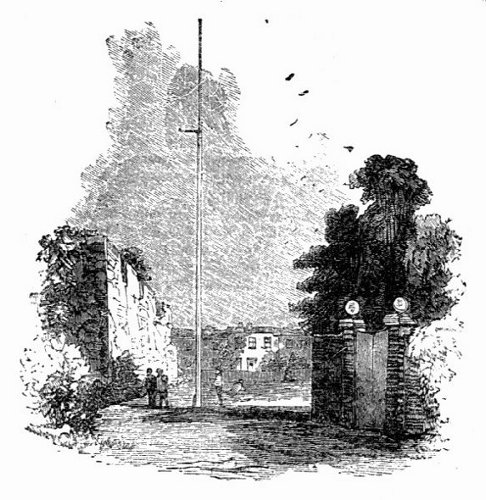
The May-pole, decked with garlands, round which the rustics used to dance in this month, yet stands in a few of our villages through the whole circle of the year. A May-pole formerly stood in the Strand, upon the site of the church by Somerset House, but was taken down in 1717. The village May-pole we engrave still remains by the ruins of St. Briavel Castle, Forest of Dean, Gloucestershire, and forms an object of considerable interest to the visitor. Several in the village could remember the May-day dancers, and the removal and setting up of the May-pole. No notice whatever of this old English festival has, however, been taken for some years. The May-pole is about sixty feet high; about half-way up is the rod to which it was usual to fasten the garlands and ribbons. Let us observe, that in many parts of Dean Forest, those who love to trace the remains of old manners and customs will find ample employment. The people are civil and hospitable; their manner of address reminds us of the wording of the plays of Shakspere's times; and in most houses, if a stranger calls, cider and bread are offered, as in the olden time.
THE OLD DOG WHEEL.
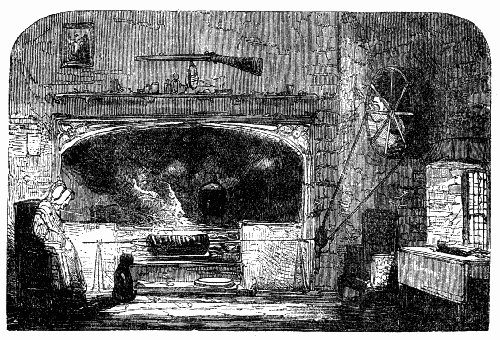
About a century and a half ago, the long-backed "turnspit" dog, and the curious apparatus here shown, yclept the "Old Dog Wheel," were to be found in most farm houses; simple machinery has, however, now been substituted for the wheel which the dog was made to turn round, like the imprisoned squirrels and white mice of the present day; and not only the dog wheels, but also the long-backed "turnspit" dog have almost disappeared. That which we engrave, however, still exists, and may be seen by the curious, at the Castle of St. Briavel, which stands on the borders of the Forest of Dean, in Gloucestershire.
ABRAHAM AND SARAH.
The Talmudists relate that Abraham, in travelling to Egypt, brought with him a chest. At the custom-house the officers exacted the duties. Abraham would have readily paid them, but desired they would not open the chest. They first insisted on the duties for clothes, which Abraham consented to pay; but then they thought by his ready acquiescence that it might be gold. Abraham consents to pay for gold. They now suspect it might be silk. Abraham was willing to pay for silk, or more costly pearls—in short, he consented to pay as if the chest contained the most valuable of things. It was then they resolved to open and examine the chest; and, behold, as soon as the chest was opened, that great lustre of human beauty broke out which made such a noise in the land of Egypt—it was Sarah herself! The jealous Abraham, to conceal her beauty, had locked her up in this chest.
AGES OF CELEBRATED MEN.
Hippocrates, the greatest physician the world has ever seen, died at the age of one hundred and nine, in the island of Cos, his native country. Galen, the most illustrious of his successors, reached the age of one hundred and four. The three sages of Greece, Solon, Thales, and Pittacus, lived for a century. The gay Democritus outlived them by two years. Zeno wanted only two years of a century when he died. Diogenes ten years more; and Plato died at the age of ninety-four, when the eagle of Jupiter is said to have borne his soul to heaven. Xenophon, the illustrious warrior and historian, lived ninety years. Polemon and Epicharmus ninety-seven; Lycurgus eighty-five; Sophocles more than a hundred. Gorgias entered his hundred and eighth year; and Asclepiades, the physician, lived a century and a half. Juvenal lived a hundred years; Pacuvius and Varro but one year less. Carneades died at ninety; Galileo at sixty-eight; Cassini at ninety-eight; and Newton at eighty-five. In the last century, Fontenelle expired in his ninety-ninth year; Buffon in his eighty-first; Voltaire in his eighty-fourth. In the present century, Prince Talleyrand, Goethe, Rogers, and Niemcewicz are remarkable instances. The Cardinal du Belloy lived nearly a century; and Marshal Moncey lately terminated a glorious career at eighty-five.
EFFECT OF A NEW NOSE.
Van Helmont tells a story, of a person who applied to Taliacotius to have his nose restored. This person, having a dread of an incision being made in his own arm, for the purpose of removing enough skin therefrom for a nose, got a labourer, who, for a remuneration, suffered the skin for the nose to be taken from his arm. About thirteen months after, the adscitious nose suddenly became cold, and, after a few days, dropped off, in a state of putrefaction. The cause of this unexpected occurrence having been investigated, it was discovered that, at the same moment in which the nose grew cold, the labourer at Bologna expired.
FRENCH DRESS.
Sigebert was buried in St. Medrad's church, at Soissons, where his statue is still seen in long clothes, with the mantle, which the Romans called chlamys. This was the dress of Colvil's children, whether as more noble and majestic, or that they looked on the title of Augustus as hereditary in their family. However it be, long clothes were, for several ages, the dress of persons of distinction, with a border of sable, ermine, or miniver. Under Charles V. it was emblazoned with all the pieces of the coat of arms. At that time, neither ruffs, collars, nor bands were known, being introduced by Henry II. 'Till this time the neck of the French king was always quite bare, except Charles the Wise, who is everywhere represented with an ermin collar. The short dress anciently worn in the country and the camp, came to be the general fashion under Louis XI. but was laid aside under Louis XII. Francis I. revived it, with the improvement of flashes. The favourite dress of Henry II. and his children was a tight, close doublet, with trunk hose, and a cloak scarce reaching the waist. The dress of French ladies, it may be supposed, had likewise its revolutions. They seem for nine hundred years, not to have been much taken up with ornament. Nothing could require less time or nicety than their head-dress, and the disposition of their hair. Every part of their linen was quite plain, but at the same time extremely fine. Laces were long unknown. Their gowns, on the right side of which was embroidered their husband's coat of arms, and on the left that of their own family, were so close as to shew all the delicacy of their shape, and came up so high as to cover their whole breast, up to their neck. The habit of widows was very much like that of the nuns. It was not until Charles VI. that they began to expose their shoulders. The gallantry of Charles the VII.'s Court brought in the use of bracelets, necklaces, and ear-rings. Queen Anne de Bretagne despised those trinkets; and Catherine de Medicis made it her whole business to invent new.
A LAST CHANCE.
John Jones and Jn. Davis, condemn'd for robberries on the highway, were executed at Tyburn. Davis feign'd himself sick, and desir'd he might not be ty'd in the cart: But when he came to the tree, while the hangman was fastening the other's halter, he jumpt out of the cart, and ran over two fields; but being knock'd down by a countryman, was convey'd back and hang'd without any more ceremony. Jones confessed he had been confederate in several robberies with Gordon, lately executed.—Gentleman's Magazine 1733.
A convict running away over two fields at Tyburn, and then being caught by a countryman! How strange this seems, when we look at the streets and squares which now cover the locality, and when the only countrymen now seen there are those who come up from the rural districts!
YELLOW HAIR IN THE TIME OF THE PLANTAGENETS.
Yellow hair was at this time esteemed a beauty, and saffron was used by the ladies to dye it of a colour esteemed "odious" by modern ladies. Elizabeth also made yellow hair fashionable, as hers was of the same tint. In the romance of King Alisaunder, we are told of Queen Olympias:—
"Hire yellow hair was fair atyred With riche strings of gold wyred, And wryen hire abouten all To hire gentil myddel small."
THE CITY OF THE SULTAN.
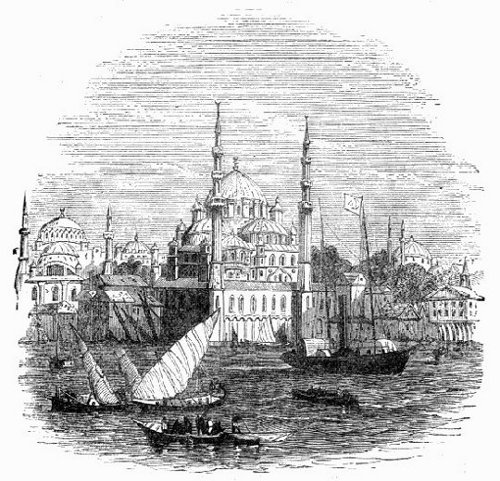
THE MOSQUE OF ST. SOPHIA.
The Mosques of Constantinople are the most wonderful objects of that renowned city. More than 300 are picturesquely distributed in conspicuous parts, and form a most attractive feature to the eye of the traveller. The city itself is built upon seven gentle hills, which is the main cause not only of its grandeur of appearance, but also of its salubrity and comparative cleanliness. There are fourteen chief or imperial mosques, all lofty, and magnificent in their general dimensions, and built from base to dome, of enduring materials, chiefly of white marble, slightly tinged with grey. Some of these have two, some four, and one (that of Sultan Achmet) has even six of those light, thin, lofty, arrowy, and most graceful towers called minarets. The mosque of Santa Sophia was once a Christian cathedral, and is rich in historical recollections. This mosque ranks as one of the grandest edifices. The ridge of the first hill on which the city stands, setting out from the north eastern part, is covered by the Serai or palace of the Sultan, behind which, a little on the reverse of the hill, the dome of Santa Sophia shows itself. The colleges and hospitals, which are generally attached to or near the great mosques, offer no striking architectural features; but some of the detached chapels or sepulchres (turbés), where sultans, viziers, and other great personages repose, are handsome.
GOLD MASK FROM THE BANKS OF THE EUPHRATES.
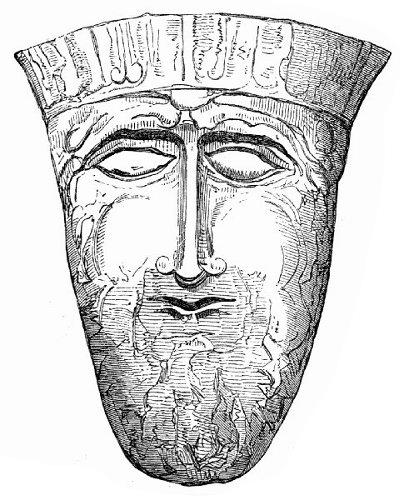
MASK OF NEBUCHADNEZZAR.
This interesting relic of remote antiquity is at present preserved in the Museum of the East India Company. It was found by Colonel Rawlinson while engaged in prosecuting the discoveries commenced by Layard and Botta, at Nineveh and Babylon; and is supposed to have belonged to King Nebuchadnezzar. In exhuming from the mounds of these long-lost rival cities, the instructive remains of this once gigantic Power, the Colonel discovered, in a perfect state of preservation, what is well believed to be the mummy of Nebuchadnezzar. The face of the rebellious monarch of Babylon, covered by one of those gold masks usually found in Assyrian tombs, is described as very handsome—the forehead high and commanding, the features marked and regular. The mask is of thin gold, and independent of its having once belonged to the great monarch, has immense value as a relic of an ancient and celebrated people.
The Arab tribes encamping about Wurka and other great mounds search in the loose gravel with their spears for coffins. Gold and silver ornaments, which have been buried in these graves for centuries, are worn by the Arab women of the present day; and many a rare object recovered from them is sold and melted by the goldsmiths of the East. The Arabs mention the discovery, by some fortunate shepherd, of Royal tombs, in which were crowns and sceptres of solid gold.
FROST FAIR ON THE THAMES.
"I went crosse the Thames," says Evelyn, January 9, 1683-4, "on the ice, which now became so thick as to bear not only streetes of boothes, in which they roasted meate, and had divers shops of wares, quite acrosse as in a towne, but coaches, carts, and horses passed over. So I went from Westminster Stayres to Lambeth, and din'd with the Archbishop. I walked over the ice (after dinner) from Lambeth Stayres to the Horseferry.
"The Thames (Jany 16) was filled with people and tents, selling all sorts of wares as in a citty. The frost (Jany 24) continuing more and more severe, the Thames before London was still planned with boothes in formal streetes, all sorts of trades and shops furnished and full of commodities, even to a printing-presse, where the people and ladyes took a fancy to have their names printed on the Thames. This humour took so universally, that 'twas estimated the printer gained £5 a-day, for printing a line only, at sixpence a day, besides what he got by ballads, &c. Coaches plied from Westminster to the Temple, and from several other staires to and fro, as in the streetes, sleds, sliding with skeates, a bull-baiting, horse and coach races, puppet playes and interludes, cookes, tipling, and other lewd places, so that it seem'd to be a bacchanalian triumph, or carnival on the water."
"It began to thaw (Feb. 5), but froze againe. My coach crossed from Lambeth to the Horseferry at Millbank, Westminster. The booths were almost all taken down; but there was first a map, or landskip, cut in copper, representing all the manner of the camp, and the several actions, sports, and pastimes thereon, in memory of so signal a frost."
THE CHARACTER OF THE MOUTH.
We give the following extract from a very old work; not only because it contains several shrewd observations, but also because it is a good specimen of the spelling and diction which prevailed in the sixteenth century, at which period there is internal evidence that the book was written, though it bears no date on the title page:—
"The mouth greate and wyde betokeneth wrath, boldnes and warre. And such men are commonly glottons. A wyde mouth withoute meesure, as thought it were cutte and stretched out, sygnifieth ravening inhumanitie, wickednes, a warlyke hart and cruell, like unto beastes of the sea. Such men are greate talkers, boasters, babblers, enuious, lyars, and full of follye. The mouthe that hathe but a lyttle closynge and a lyttle openynge, sygnyfyeth a fearful man, quyet, and yet unfaithfull. The mouthe that is verye apparent and rounde with thycknes of lyppes, sygnyfyeth vnclenlynes, follye, and cruelltye. The mouth whyche hath a quantitie in his sytuation with a lyttle shutting, and smylynge eyes wyth the reste of the face, sygnyfyeth a carnall man, a lover of daunces, and a greate lyar. When the mouthe turneth in speakinge it is a sygne that it is infected with some catarre or murre as is manyfest ynough. The long chynne declareth the man to be very lyttle subiecte to anger, and of a good complexion: and yet he is somewhat a babbler and a boaster of hymselfe. They that have a lyttle chinne, are much to be avoyded and taken heede of, for besydes all vices with the whyche they are fylled they are full of impietye and wyckednes and are spyes, lyke unto serpents. If the ende of the chynne be round it is a sygne of feminine maners and also it is a sygne of a woman. But the chynne of a man muste be almoste square."—"The most excellent, profitable, and pleasant booke of the famous doctour and expert Astrologien Arcandam or Aleandrin." ***. Now ready turned out of French into our vulgare tonge, by Will. Warde. Black letter. No date. Printed by J. Rowbothum.
EXECUTION OF EARL FERRERS FOR MURDER, 1760.
Lord Ferrers was hung for the deliberate and cruel murder of his steward, Mr. Johnson, and his execution at Tyburn furnishes a curious instance of the exhibition of egregious vanity in a man who was just about to meet an ignominious death, and of misplaced pride in his family who could actually decorate the scaffold with the emblems of respectful mourning.
His lordship was dressed in his wedding-clothes, which were of light colour, and embroidered in silver. He set out from the Tower at nine o'clock, amidst crowds of spectators. First went a large body of constables, preceded by one of the high constables; next came a party of grenadiers and a party of foot; then the sheriff, in a chariot and six, the horses dressed with ribbons; and next, Lord Ferrers, in a landau and six, escorted by parties of horse and foot. The other sheriff's carriage followed, succeeded by a mourning-coach and six, conveying some of the malefactor's friends; and lastly, a hearse and six, provided for the purpose of taking the corpse from the place of execution to Surgeons' Hall.
The procession was two hours and three-quarters on its way. Lord Ferrers conversed very freely during the passage. He said, "the apparatus of death, and the passing through such crowds of people, are ten times worse than death itself; but I suppose they never saw a lord hanged, and perhaps they will never see another." He said to the sheriff. "I have written to the king, begging that I might suffer where my ancestor, the Earl of Essex, the favourite of Elizabeth, suffered, and was in great hopes of obtaining that favour, as I have the honour of being allied to his Majesty, and of quartering part of the royal arms. I think it hard that I must die at the place appointed for the execution of common felons."
The scaffold was hung with black by the undertaker, at the expense of Lord Ferrers' family. His lordship was pinioned with a black sash, and was unwilling to have his hands tied, or his face covered, but was persuaded to both. On the silken rope being put round his neck, he turned pale, but recovered instantly. Within seven minutes after leaving the landau, the signal was given for striking the stage, and in four minutes he was quite dead. The corpse was subjected to dissection.
STRANGE FUNERAL OBSEQUIES.
The following, taken from an old magazine, is a singular manifestation of eccentricity in a person who, from the books he selected to be buried with him, was evidently a man of an educated and refined mind:—
Died, May 4, 1733, Mr. John Underwood, of Whittlesea, in Cambridgeshire. At his burial, when the service was over, an arch was turn'd over the coffin, in which was placed a small piece of white marble, with this inscription, "Non omnis moriar, 1733." Then the six gentlemen who follow'd him to the grave sung the last stanza of the 20th Ode of the 2d book of Horace. No bell was toll'd, no one invited but the six gentlemen, and no relation follow'd his corpse; the coffin was painted green, and he laid in it with all his cloaths on; under his head was placed Sanadon's "Horace," at his feet Bentley's "Milton;" in his right hand a small Greek Testament, with this inscription in gold letters, "eimientôbaus [Greek: ei mi en tô bausa], J. U," in his left hand a little edition of "Horace" with this inscription, "Musis Amicus, J. U.;" and Bentley's "Horace" under his back. After the ceremony was over they went back to his house, where his sister had provided a cold supper; the cloth being taken away the gentlemen sung the 31st Ode of the 1st Book of "Horace," drank a chearful glass, and went home about eight. He left about 6,000l. to his sister, on condition of her observing this his will, order'd her to give each of the gentlemen ten guineas, and desir'd they would not come in black cloaths. The will ends thus, "Which done I would have them take a chearful glass, and think no more of John Underwood."
QUICK TRAVELLING IN OLD TIMES.
Saturday, the seventeenth day of July, 1619, Bernard Calvert, of Andover, about three o'clock in the morning, tooke horse at St. George's Church in Southwarke, and came to Dover about seaven of the clocke the same morning, where a barge, with eight oares, formerly sent from London thither, attended his suddaine coming: he instantly tooke barge, and went to Callice, and in the same barge returned to Dover, about three of the clocke the same day, where, as well there as in diverse other places, he had layed sundry swift horses, besides guides: he rode back from thence to St. George's Church in Southwarke the same evening, a little after eight o'clock, fresh and lusty.—Stow's Annals.
EDDYSTONE LIGHTHOUSE.
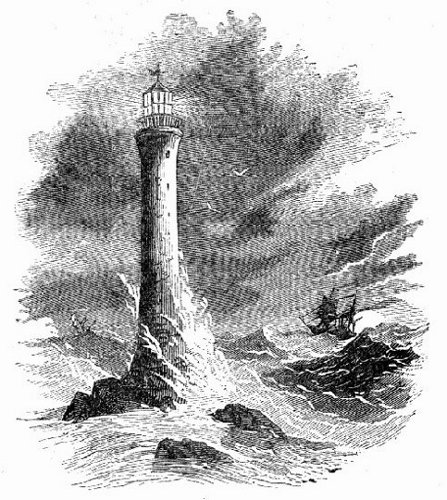
THE EDDYSTONE LIGHTHOUSE.
As the arts and sciences improved, so did the construction of Lighthouses, until one of the greatest accomplishments of engineering skill, ever attempted upon such works, was exhibited in the construction of the Eddystone Lighthouse, which is, indeed, much more entitled than the Pharos of Alexandria to be considered one of the wonders of the world. The rock on which this tower is built is placed about twelve miles south-west of Plymouth, and consists of a series of submarine cliffs, stretching from the west side (which is so precipitous that the largest ship can ride close beside them) in an easterly direction, for nearly half a mile. At the distance of about a quarter of a mile more is another rock, so that a more dangerous marine locality can hardly be imagined. Both these rocks had proved the cause of many fatal shipwrecks, and it was at last resolved to make an attempt to obviate the danger. In the year 1696, a gentleman of Essex, named Winstanley, who had a turn for architecture and mechanics, was engaged to erect a lighthouse upon the Eddystone rock, and in four years he completed it. It did not, however, stand long, for while some repairs were in progress under his direction in 1703, on the 26th November, a violent hurricane came on which blew the lighthouse down, and Mr. Winstanley and all his workmen perished—nothing remaining of the edifice but a few stones and a piece of iron chain.
In the spring of 1706 an Act of Parliament was obtained for rebuilding the lighthouse, and a gentleman named Rudyerd, a silk mercer, was the engineer engaged. He placed five courses of heavy stones upon the rock and then erected a superstructure of wood. The lighthouse on the Bell Rock, off the coast of Fife, and the one placed at the entrance of the Mersey on the Black Rock, are similarly constructed, so that there seemed to be good reason for adopting the principle. Mr. Smeaton thought that the work was done in a masterly and effective manner; but in 1755 the edifice was destroyed by fire, and he was next retained as the engineer for this important building.
The result of his labours has justly been considered worthy of the admiration of the world, for it is distinguished alike for its strength, durability, and beauty of form. The base of the tower is about twenty-six feet nine inches in diameter, and the masonry is so formed as to be a part of the solid rock, to the height of thirteen feet above the surface, where the diameter is diminished to nineteen feet and a half. The tower then rises in a gradually diminishing curve to the height of eighty-five feet, including the lantern, which is twenty-four feet high. The upper extremity is finished by a cornice, a balustrade being placed around the base of the lantern for use as well as ornament.
The tower is furnished with a door and windows, and the whole edifice outside bears the graceful outline of the trunk of a mighty tree, combining lightness with elegance and strength. Mr. Smeaton commenced his labours in 1756, and completed the building in four years. Before commencing operations he took accurate drawings of the exterior of the rock, and the stones, which were brought from the striking and romantic district of Dartmoor, were all formed to fit into its crevices, and so prepared as to be dovetailed together, and strung by oaken plugs. When put into their places, and then firmly cemented, the whole seemed to form, and does indeed constitute, a part of the solid rock.
SWEATING SICKNESS.
The Sweating Sickness first visited England Anno Dom. 1483, and repeated its visitations 1485, 1506, 1517, 1528, and last of all, 1551.
This epidemic disease raged with such peculiar violence in England, and had so quick a crisis, that it was distinguished by the name of Ephemera Britannica. This singular fever seems to have been of the most simple, though of the most acute kind, and notwithstanding princes and nobles were its chief victims, the physicians of the day never agreed upon the method of treating it.
The splendid French embassy, which arrived in England in 1550, found the court-festivities damped by a visitation of that strange and terrific malady.
"This pestilence, first brought into the island by the foreign mercenaries who composed the army of the Earl of Richmond, afterwards Henry VII., now made its appearance for the fourth and last time in our annals. It seized principally, it is said, on males, on such as were in the prime of their age, and rather on the higher than the lower classes: within the space of twenty-four hours, the fate of the sufferer was decided for life or death. Its ravages were prodigious; two princes died of it; and the general consternation was augmented, by a superstitious idea which went forth, that Englishmen alone were the destined victims of this mysterious minister of fate, which tracked their steps, with a malice and sagacity of an evil spirit, into every distant country of the earth whither they might have wandered, whilst it left unassailed all foreigners in their own."
AN AMERICAN ADVERTISEMENT.
The following is an early specimen of that system of poetical advertising which in recent times has become so common. It is always interesting to note the origin of customs with which we subsequently become familiar:—
Notice to the Public, and especially to Emigrants, who wish to settle on Lands.—The Subscriber offers for Sale, several Thousand Acres of Land, situated in well settled Front Townships, in Lots to suit Purchasers.
Particulars about Location, May be known by application. For quality of soil, and so forth, Buyers to see, on Nag must go forth. This much I'll tell ye plainly, Of big trees ye'll see mainly. 'Bout Butter Nut and Beach, A whole week I could preach; But what the plague's the use of that? The lands are nigh, low, round, and flat. There's rocks and stumps, no doubt enough, And bogs and swamps, just quantum-suff To breed the finest of Musquitoes; As in the sea are bred Bonitos, No lack of fever or of ague; And many other things to plague you. In short, they're just like other people's, Sans houses, pigsties, barns, or steeples What most it imports you to know, 'S the terms on which I'll let 'em go. So now I offer to the Buyer, A Credit to his own desire, For butter, bacon, bread, and cheese, Lean bullocks, calves, or ducks and geese, Corn, Tates, flour, barley, rye, Or any thing but Punkin-Pie. In three, four years, Aye, five or six, If that won't do, why let him fix. But when once fix'd, if payment's slack, As sure as Fate, I'll take 'em back.
THOMAS DALTON. Kingston Brewery, (Canada,) Nov. 2, 1821.
MAGNIFICENCE OF FORMER TIMES.
Account how the Earl of Worcester lived at Ragland Castle in Monmouthshire, before the Civil Wars, which began in 1641.
At eleven o'clock in the forenoon, the Castle gates were shut, and the tables laid; two in the dining-room; three in the hall; one in Mrs. Watson's apartment, where the chaplains are, (Sir Toby Mathews being the first;) and two in the housekeeper's room for the lady's women.
The Earl came into the dining-room attended by his gentlemen. As soon as he was seated, Sir Ralph Blackstone, Steward of the house, retired. The Comptroller, Mr. Holland, attended with his staff, as did the Sewer, Mr. Blackburne; the daily waiters, Mr. Clough, Mr. Selby, and Mr. Scudamore; with many gentlemen's sons, from two to seven hundred pounds a year, bred up in the Castle; my Lady's Gentleman Usher, Mr. Harcourt; my Lord's Gentlemen of the Chamber, Mr. Morgan and Mr. Fox.
At the first table sat the noble family, and such of the nobility as came.
At the second table, in the dining-room, sat Knights and Honourable Gentlemen, attended by footmen.
In the hall, at the first table sat Sir Ralph Blackstone, Steward; the Comptroller, Mr. Holland; the Secretary; the Master of the Horse, Mr. Delewar; the Master of the Fish Ponds, Mr. Andrews; my Lord Herbert's Preceptor, Mr. Adams; with such Gentlemen as came there under the degree of a Knight, attended by footmen, and plentifully served with wine.
At the second table in the hall, (served from my Lord's table, and with other hot meats,) sat the Sewer, with the Gentlemen Waiters and Pages, to the number of twenty-four.
At the third table in the hall, sat the Clerk of the Kitchen, with the Yeomen Officers of the House, two Grooms of the Chamber, &c.
Other Officers of the Household were, Chief Auditor, Mr. Smith; Clerk of the Accounts, Mr. George Wharton; Purveyor of the Castle, Mr. Salsbury; Ushers of the Hall, Mr. Moyle and Mr. Croke; Closet Keeper, Gentleman of the Chapel, Mr. Davies; Keeper of the Records; Master of the Wardrobe; Master of the Armoury; Master Groom of the Stable for the War Horses; Master of the Hounds; Master Falconer; Porter and his man.
Two Butchers; two Keepers of the Home Park; two Keepers of the Red Deer Park.
Footmen, Grooms, and other menial Servants, to the number of 150. Some of the footmen were brewers and bakers.
Out Officers.—Steward of Ragland, William Jones, Esq.; the Governor of Chepstow Castle, Sir Nicholas Kemys, Bart.; Housekeeper of Worcester House, in London, James Redman, Esq.
Thirteen Bailiffs.
Two Counsel for the Bailiffs to have recourse to.
Solicitor, Mr. John Smith.
SADLER'S WELLS.
"T. G., Doctor in Physic," published, in 1684, a pamphlet upon this place, in which he says:—"The water of this well, before the Reformation, was very much famed for several extraordinary cures performed thereby, and was thereupon accounted sacred, and called Holywell. The priests belonging to the priory of Clerkenwell using to attend there, made the people believe that the virtue of the water proceeded from the efficacy of their prayers; but at the Reformation the well was stopped, upon the supposition that the frequenting of it was altogether superstitious; and so by degrees it grew out of remembrance, and was wholly lost until then found out; when a gentleman named Sadler, who had lately built a new music-house there, and being surveyor of the highways, had employed men to dig gravel in his garden, in the midst whereof they found it stopped up and covered with an arch of stone." After the decease of Sadler, Francis Forcer, a musician of some eminence in his profession, became proprietor of the well and music-room; he was succeeded by his son, who first exhibited there the diversions of rope-dancing and tumbling, which were then performed in the garden. The rural vicinity of the "Wells," long made it a favourite retreat of the pleasure-seeking citizens.
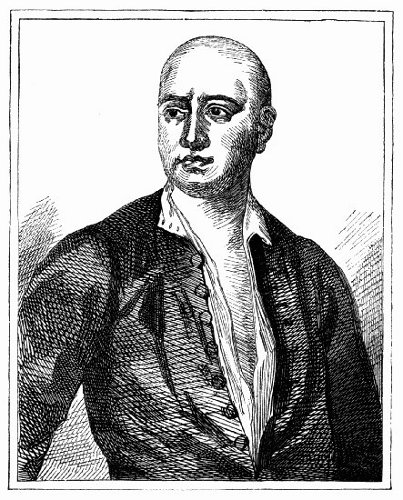
CHAMPION FIGG.
James Figg, a native of Thame, in Oxfordshire, was a man of remarkable athletic strength and agility, and signalized himself greatly over any of his country competitors in the art of cudgel-playing, single-stick, and other gymnastic exercises. Having acquired a considerable knowledge of the broadsword, he came to London, and set up as master in that science, undertaking to teach the nobility and gentry of his day the noble art of self defence; and championed himself against all comers. He took a waste piece of ground, the corner of Wells and Castle-streets, Oxford-road, and erected a wooden edifice, which, in imitation of the Romans, he denominated an amphitheatre; and established here a regular academy, to train pupils in the practice of cudgeling, broadsword, &c. &c., as well to use it, on fixed occasions, for the exhibition of prizefighting. He had many followers, and we find him commemorated and praised by most of the wits of his time. "The Tattler," "Guardian," and "Craftsman," have equally contributed to preserve his memory, as have several writers. Bramstone, in his "Man of Taste" tells us:—
"In Figg the prize-fighter by day delight, And sup with Colley Cibber every night."
Another writer notices him in the following lines:—
"To Figg and Broughton he commits his breast, To steel it to the fashionable test."
Sutton, the pipe-maker of Gravesend, was his rival, and dared the mighty Figg to the combat. Twice they fought, with alternate advantage; but, at the third trial, a considerable time elapsed before victory decided for either party; at length the palm of victory was obtained by Figg. In short, neither Ned Sutton, Tom Buck, nor Bob Stokes, could resist, or stand against his skill and valour. He was never defeated but once, and then by Sutton, in one of their previous combats, and that was generally supposed to have been in consequence of an illness he had on him at the time he fought.
When Faber engraved his portrait from a painting by Ellys, he was at a loss what he should insert, as an appropriate motto, and consulting with a friend what he should put, was answered, "A Figg for the Irish." This was immediately adopted, and the print had a rapid sale.
Figg died in 1734. William Flander a noted scholar of his, fought at the amphitheatre, in 1723, with Christopher Clarkson, from Lancashire, who was called the Old Soldier. The fashion of attending prizefighting matches had attained its highest zenith in Figg's time, and it was looked upon as a very great proof of self-denial in an amateur if he failed a meeting on those occasions.
From Figg's theatre he will not miss a night, Though cocks, and bulls, and Irish women, fight.
Figg left a widow and several children; so recently as 1794 a daughter-in-law of his was living, and resided in Charles-street, Westminster, where she kept a house, and supported herself very decently by letting lodgings, aided by a very small income.
DRESS IN 1573.
The wardrobe of a country gentleman is thus given from a will, dated 1573, in the Prerogative Court of Canterbury, in Brayley and Britton's Graphic Illustrator—"I give unto my brother Mr. William Sheney my best black gown, garded and faced with velvet, and my velvet cap; also I will unto my brother Thomas Marcal my new shepe colored gowne, garded with velvet and faced with cony; also I give unto my son Tyble my shorte gown, faced with wolf (skin), and laid with Billements lace; also I give unto my brother Cowper my other shorte gowne, faced with foxe; also I give unto Thomas Walker my night gown, faced with cony, with one lace also, and my ready (ruddy) colored hose; also I give unto my man Thomas Swaine my doublet of canvas that Forde made me, and my new gaskyns that Forde made me; also I give unto John Wyldinge a cassock of shepes colour, edged with ponts skins; also I give unto John Woodzyle my doublet of fruite canvas, and my hose with fryze bryches; also I give unto Strowde my frize jerkin with silke buttons; also I give Symonde Bisshoppe, the smyth, my other frize jerkyn, with stone buttons; also I give to Adam Ashame my hose with the frendge (fringe), and lined with crane-coloured silk; which gifts I will to be delivered, immediately after my decease."
ORIGIN OF THE CREST OF THE PRINCE OF WALES.
The loss of the French at the battle of Creçy was immense. There fell 1,200 knights; 1,400 esquires; 4,000 commissioned officers; 30,000 rank and file; Dukes of Lorraine and Bourbon; Earls of Flanders, Blois, Harcourt, Vaudemont, and Aumale; the King of Bohemia; the King of Majorca. The English lost one esquire, three knights, and less than one hundred rank and file. Here did they first use field artillery; and on this battle-field did the young Prince of Wales adopt the ostrich plumes and motto of the slain King of Bohemia, who, being blind, desired to be led at a gallop between two knights into the thick of the fight, and thus met death. Those feathers and the two words "Ich dien," "I serve," are to this day the heraldic bearings of the Prince of Wales, whom God preserve! So much for Creçy or Cressy!
SINGULAR DISCOVERY OF A THIEF IN 1822.
On February 20, as a servant in the employ of J. L. King, Esq., of Stogumber, was entering a field, his attention was attracted by a magpie, which appeared to have escaped from a neighbouring house. The bird spoke so uncommonly plain that the man was induced to follow it. "Cheese for Marget, Cheese for Marget," was its continual cry, as it hopped forward, till it stopped behind a hay-stack, and began to eat. On inspection, a number of hams, a quantity of cheese, &c., were discovered, which had been stolen, a short time previously, from Mr. Bowering, of Williton. The plunder was deposited in sacks, on one of which was marked the name of a person residing in the neighbourhood, which led to the apprehension of four fellows, who have been committed to Wilton gaol.
EFFECT OF VINEGAR ON THE SKIN.
By the use of vinegar the Spanish General Vitellis, made his skin hang about him like a pelisse; but of the wonderful dilatability of the skin, no instance equals the Spaniard who showed himself to Van-Horn, Silvius, Piso, and other learned men at Amsterdam. Taking up with his left hand the skin of his right shoulder, he would bring the same up to his mouth: again he would draw the skin of his chin down to his breast like a beard, and presently put it upwards to the top of his head, hiding both his eyes therewith; after which, the same would return orderly and equally to its proper place.
ADVERTISEMENT OF A DYING SPEECH BOOK IN 1731.
Newgate literature was more popular in the last century than it is now. The following is an advertisement in the Gentleman's Magazine of the above date:—
"A General History of Executions for the year, 1730. Containing the lives, actions, dying speeches, confessions and behaviour, of sixty malefactors executed at Tyburn, and elsewhere; particularly three unfortunate young gentlemen, viz., Mr. Goodburn, a Cambridge scholar, Mr. Johnston, and Mr. Porter, son to the late Lord Mayor of Dublin: and of several notorious highwaymen, foot-pads, street-robbers, and housebreakers, as Dalton, Everet, Doyle, Newcomb, &c., and of the five young highwaymen taken at Windsor, said to have formed a design to rob the Queen there. To which is added, the trial of William Gordon at Chelmsford for a robbery on the highway; an account of the incendiaries at Bristol, and the apprehending John Power, for sending threatening letters, and firing Mr. Packer's house; also the life of Col. Ch—s. Together with an alphabetical list of all the persons indicted or tried at the Old Bailey, the year past. With the judgment of the court respectively passed upon each, referring to the pages in the session books for the trials at large. Printed for R. Newton at St. John's Gate, and sold by the booksellers price bound 2s. 6d."
ADVERTISEMENT OF A FLEET PARSON.
In the last century, when marriages were allowed to be transacted—we cannot say solemnized—in the Fleet Prison, and the adjacent taverns, the profligate wretches who disgraced their sacred profession by taking part in such iniquities, were obliged to bid against one another for custom—here is one of their advertisements:—
G. R. At the true Chapel at the old Red Hand and Mitre, three doors from Fleet Lane and next Door to the White Swan; Marriages are performed by authority by the Reverend Mr. Symson educated at the University of Cambridge, and late Chaplain to the Earl of Rothes. N.B. Without Imposition.
THE ASS.
In all countries, this sure-footed and faithful animal is adopted as an emblem of stupidity, from the patience with which it submits to punishment and endures privation. A pair of ass's ears is inflicted upon a child in reproof of his duncehood; and through life we hear every blockhead of our acquaintance called an ass. Whereas the ass is a beast of great intelligence; and we often owe our safety to its sure and unerring foot beside the perilous precipice, where the steps of the man of science would have faltered.
The Fathers of the Church, and the Disciples of the Sorbonne, persuaded of the universal influence of the Christian faith, believed the dark cross on the back of the ass to date only from the day on which our Saviour made his entry into Jerusalem. The ass of the desert was an animal of great price. Pliny mentions that the Senator Arius paid for one the sum of four hundred thousand sesterces. Naturalists have frequently remarked the extraordinary dimensions of an ass's heart, which is thought an indication of courage; and it is the custom of the peasantry of some countries to make their children wear a piece of ass's skin about their person. The ass's skin is peculiarly valuable, both for the manufacture of writing-tablets and drums; which may be the reason why a dead ass is so rarely seen. It is too valuable to be left on the highway. In many places, the ass serves as a barometer. If he roll in the dust, fine weather may be expected; but if he erect his ears, rain is certain. Why should not these animals experience the same atmospheric influences as man? Are we not light-hearted in the sunshine, and depressed in a heavy atmosphere?
CHOICE RECEIPTS FROM "PHYSICK FOR THE POOR. LONDON, 1657."
To make any one that Sleepeth answer to whatsoever thou ask.—Take the heart of an oul, and his right legg, and put them upon the breast of one that sleepeth, and they shall reveal whatsoever thou ask them.
To know any Man or Woman's minde when they are Asleep.—Take the hart of a dove, and the legg of a frog, dry it well, and beat them to powder in a morter, put this up in a linnen cloth, with three or four round pibble stones, as big as wallnuts, then lay this upon the parties pit of their stomach, and they shall tell you all things that they have done, if there is anything remarkable that troubles them.
To make the Nose Bleed.—Take the leaves of yerrow, put it up in thy nose; this will make the nose bleed immediately.
To make a Tooth Drop out.—Mizaldus saith that if you make a powder of earth-worms and put it in the hollow of a rotten tooth, it will immediately drop out.
How strange must have been the education and intelligence of the period, when people could write, publish, and practice such incredible trash!
SHOCKING DEPRAVITY.
The following account, from an old magazine, affords a strange and lamentable instance of a wretch just about to die, being only intent with his latest breath to defame his own mother:—
Mary Lynn, condemn'd last Assizes for the County of Norfolk, was burnt to ashes at a stake, for being concern'd in the murder of her mistress; and Smith, the principal, was hang'd for the same fact. She deny'd her being guilty, and said Smith could clear her if he would. She behaved with decency, and died penitent. Smith was drunk at the gallows; and seem'd to have but little sense either of his crime or punishment; however, desired all masters to pay their servants' wages on Saturday night, that they might have money to spend, and not run in debt. Said, "My mother always told me I should die in my shoes, but I will make her a liar;" so threw them off.
PERSONAL CHARMS DISCLAIMED.
If any human being was free from personal vanity, it must have been the second Duchess d'Orleans, Charlotte Elizabeth of Bavaria. In one of her letters (dated 9th August, 1718), she says, "I must certainly be monstrously ugly. I never had a good feature. My eyes are small, my nose short and thick, my lips broad and thin. These are not materials to form a beautiful face. Then I have flabby, lank cheeks, and long features, which suit ill with my low stature. My waist and my legs are equally clumsy. Undoubtedly I must appear to be an odious little wretch; and had I not a tolerable good character, no creature could endure me. I am sure a person must be a conjuror to judge me by my eyes that I have a grain of wit."
CADER IDRIS.
On the very summit of Cader Idris there is an excavation in the solid rock, resembling a couch; and it is said that whoever should rest a night in that seat, will be found in the morning either dead, raving mad, or endued with supernatural genius.
OLD LONDON SIGNS.
Some notion of the houses and shops of old London may be gathered by a visit to Bell Yard, near Temple Bar; Great Winchester Street, near the Bank; the wooden houses near Cripplegate Church; and a few other districts which were spared by the Great Fire of 1666. In Bell Yard, for instance, the national feeling for improvement has from time to time effected changes; the lattices of diamond-shaped lead-work, carved pendants, and the projecting signs of the various tradesmen, have disappeared, and here and there sheets of plate glass have been used, to give a somewhat modern appearance to the places of business. Still the projecting and massive wood-work of the shops, and the peculiar picturesque appearance of the houses, cannot be altogether disguised; and if any of our readers, who may be curious in such matters, will walk up Bailey's Court, on the west side of Bell Yard, he will there see a group of wooden buildings exactly like the great mass which was cleared by the fire. In some of the pictures of London of about this time, the shops of the various tradesmen were chiefly unglazed, and above the door of each was suspended the silver swans; the golden swans; the chained swans; the golden heads; mitres; bells—black, red, white, and blue; rising and setting suns; moons of different phases; men in the moon; sceptres; crowns, and many other devices, which, even at that time, were necessary to distinguish one shop from another. The chequers; St. George and the dragon; royal oaks; king's heads; and double signs, such as the horseshoe and magpie; bell and crown; bell and horns, and such like, were more particularly set apart for the use of the various hostelries. Everyone, however, who had a London shop of any kind or consequence, had his sign. Many of them were well carved in wood, and ornamented with emblazonry and gilding.
No doubt if it were possible to find at the present time the same picturesque architectural displays as were to be met with in London in Queen Elizabeth's days, our artistic friends would be able to pick up many a nice subject for their pencils, but in those days there were plenty of drawbacks; the pavement was bad, the drainage was worse, and from the eaves of the houses and pents of the shops, streams of water ran down in wet weather upon the wayfarers, and, by lodging in the thoroughfares, made the London streets something in the same state as those of Agar Town and some other neglected parts of the metropolis. We must not forget that in the days to which we allude there were no flagged footpaths, and that the only distinction from the horse and cart roads, and that for the foot passengers, was a separation by wooden posts, which, in genteel places, were made supports for chains. People, however, got tired of this bad state of things, and measures were taken to put a stop to the streams of water from the roofs, &c. After the Great Fire, an enactment was made for an alteration in the spouts, &c.; all barbers poles, and projecting signs, and other projections were to be done away with, and other changes made for the better. Up to the reign of Queen Anne, we find, by reference to views of Cheapside and the neighbourhood of the Monument, that the projecting signs were still in use; and that even at that recent date, many of the London shops in the important neighbourhoods above mentioned were without glazing, and looked much like some of the greengrocers' sheds in use now in Bermondsey and some other places.
Severe measures seem to have been at length taken against the projecting signs, and most of them disappeared, and then it became a most difficult matter either to address letters, or find a man's shop. In Dr. Johnson's day, he and other persons gave the address "over against" a particular sign, or so many doors from such a sign. In consequence of this uncertainty, many houses in London, which from their association with eminent men would possess much interest now, cannot be pointed out; and it was a wonderful benefit to the metropolis when the plan of numbering the houses in each street was hit upon. But for this, considering that the population has doubled in the last fifty years, it is difficult to know how the genius of Rowland Hill would have worked his plan of London post-office delivery, or business could be carried on with any kind of comfort.
The booksellers and publishers seem to have been the last, with the exception of the tavern-keepers, to give up the old signs. After the Great Fire, some of the ancient signs which were cut in stone, and which had escaped the conflagration, were got out of the ruins, and afterwards placed in the front of the plain, yet solid, brick buildings which were erected after that event. Some of these—the "Chained Bear," the "Collared Swan," the "Moon and Seven Stars," and "Sun," in Cheapside, and some others which we now engrave—are still preserved. The carved wooden sign of the "Man in the Moon," in Wych Street, Strand, is a rare example; and the "Horse-shoe and Magpie," in Fetter Lane, is one of the last of the suspended signs to be now found in the City.
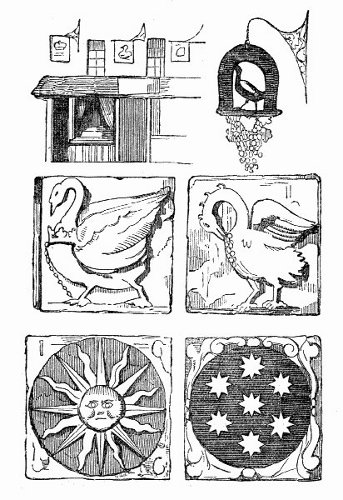
Amongst the painted signs of London taverns worth notice, is one in Oxford-street (nearly opposite Rathbone-place), said to have been painted by Hogarth. The subject is "a man loaded with mischief." He has a stout woman on his shoulders, together with a monkey, magpie, etc. The male figure shown in this street picture seems to bear up pretty well under his burden.
NARROW ESCAPE.—CALM RELIANCE ON PROVIDENCE.
In the year 1552, Francis Pelusius, of sixty-three years old, digging a well forty foot deep in the hill of St. Sebastian, the earth above him fell in upon him to thirty-five foot depth; he was somewhat sensible before of what was coming, and opposed a plank, which by chance he had with him, against the ruins, himself lying under it; by this means he was protected from the huge weight of earth, and retained some room and breath to himself, by which he lived seven days and nights without food or sleep, without any pain or sorrow, being full of hope, which he placed in God only. Ever and anon he called for help, as being yet safe, but was heard by none, though he could hear the motion, noise and words of those that were above him, and could count the hours as the clock went. After the seventh day, he being all this while given for dead, they brought a bier for his corpse, and when a good part of the well was digged up, on a sudden they heard the voice of one crying from the bottom. At first they were afraid, as if it had been the voice of a subterranean spirit; the voice continuing, they had some hope of his life, and hastened to dig to him, till at last, after they had given him a glass of wine, they drew him up living and well, his strength so entire that to lift him out he would not suffer himself to be bound, nor would use any help of another. Yea, he was of so sound understanding, that, jesting, he drew out his purse and gave them money, saying He had been with such good hosts, that for seven days it had not cost him a farthing.