TEN THOUSAND WONDERFUL THINGS. (continued 18)
Reading edition
THE HOUSE OF HEN'S FEATHERS.
There exists at Pekin a phalanstery which surpasses in eccentricity all that the fertile imagination of Fourier could have conceived. It is called Ki-mao-fan—that is, "House of the Hen's Feathers." By dint of carrying out the laws of progress, the Chinese have found means to furnish to the poorest of the community a warm feather-bed, for the small consideration of one-fifth of a farthing per night. This marvellous establishment is simply composed of one great hall, and the floor of this great hall is covered over its whole extent by one vast thick layer of feathers. Mendicants and vagabonds who have no other domicile come to pass the night in this immense dormitory. Men, women, and children, old and young, all without exception, are admitted. Communism prevails in the full force and rigour of the expression. Every one settles himself and makes his nest as well as he can for the night in this ocean of feathers; when day dawns he must quit the premises, and an officer of the company stands at the door to receive the rent of one sapeck each for the night's lodging. In deference no doubt to the principle of equality, half-places are not allowed, and a child must pay the same as a grown person.
On the first establishment of this eminently philanthropic and moral institution, the managers of it used to furnish each of the guests with a covering, but it was found necessary to modify this regulation, for the communist company got into the habit of carrying off their coverlets to sell them, or to supply an additional garment during the rigorous cold of winter. The shareholders saw that this would never do, and they should be ruined, yet to give no covering at all would have been too cruel, and scarcely decent. It was necessary therefore to find some method of reconciling the interests of the establishment with the comfort of the guests, and the way in which the problem was solved was this. An immense felt coverlet, of such gigantic dimensions as to cover the whole dormitory, was made, and in the day time suspended from the ceiling like a great canopy. When everybody had gone to bed, that is to say, had lain down upon the feathers, the counterpane was let down by pulleys; the precaution having been previously taken to make a number of holes in it for the sleepers to put their heads through, in order to escape the danger of suffocation. As soon as it is daylight, the phalansterian coverlet is hoisted up again, after a signal has been made on the tam-tam to awaken those who are asleep, and invite them to draw their heads back into the feathers, in order not to be caught by the neck and hoisted into the air with the coverlet. This immense swarm of beggars is then seen crawling about in the sea of dirty feathers, and inserting themselves again into their miserable rags, preparatory to gathering into groups, and dispersing about the various quarters of the town to seek by lawful or unlawful means their scanty subsistence.
THE USEFUL AND THE BEAUTIFUL.
The tomb of Moses is unknown; but the traveller slakes his thirst at the well of Jacob. The gorgeous palace of the wisest and wealthiest of monarchs, with cedar, and the gold, and ivory, and even the great Temple of Jerusalem, hallowed by the visible glory of the Deity himself, are gone; but Solomon's reservoirs are as perfect as ever. Of the ancient architecture of the Holy City, not one stone is left upon another, but the Pool of Bethsaida commands the pilgrim's reverence, at the present day. The columns of Persepolis are mouldering into dust; but its cistern and aqueducts remain to challenge our admiration. The golden house of Nero is a mass of ruins, but the Aqua Claudia still pours into Rome its limpid stream. The Temple of the Sun, at Tadmore, in the wilderness, has fallen, but its fountain sparkles in its rays, as when thousands of worshippers thronged its lofty colonnades. It may be that London will share the fate of Babylon, and nothing be left, to mark it, save mounds of crumbling brickwork. The Thames will continue to flow as it does now. And if any work of art should rise over the deep ocean, time, we may well believe, that it will be neither a palace nor a temple, but some vast aqueduct or reservoir; and if any name should flash through the mist or antiquity, it would probably be that of the man, who in his day, sought the happiness of his fellow men, rather than glory, and linked his memory to some great work of national utility or benevolence. This is the true glory which outlives all others, and shines with undying lustre from generation to generation, imparting to works some of its own immortality, and in some degree rescuing them from the ruin which overtakes the ordinary monument of historical tradition or mere magnificence.
CROMWELL'S BRIDGE AT GLENGARIFF.
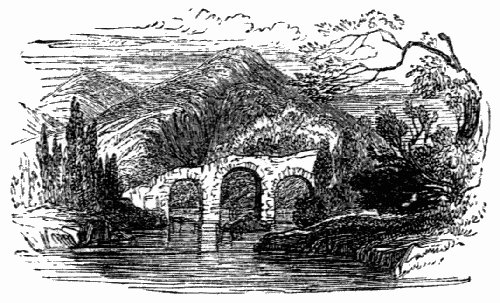
The village of Glengariff, near Bantry Bay, consists of but a few houses. The only "antiquity" in the immediate neighbourhood is the old bridge, now a picturesque ruin, which, in ancient times, was on the high road to Berehaven; it is called "Cromwell's Bridge." It is accurately represented in the above engraving. History being silent as to the origin of the name, we must have recourse to tradition. When Oliver was passing through the glen, to "visit" the O'Sullivans, he had so much trouble in getting across the narrow but rushing river, that he told the inhabitants, if they did not build him a bridge by the time he returned, he would hang up a man for every hour's delay he met with. "So the bridge was ready agin he come back," quoth our informant; "for they knew the ould villian to be a man of his word."
THE TURBAN IN ARABIA.
A fashionable Arab will wear fifteen caps one above another, some of which are linen, but the greater part of thick cloth or cotton. That which covers the whole is richly embroidered with gold, and inwrought with texts or passages from the Koran. Over all there is wrapped a sash or large piece of muslin, with the ends hanging down, and ornamented with silk or gold fringes. This useless encumbrance is considered a mark of respect towards superiors. It is also used, as the beard was formerly in Europe, to indicate literary merit; and those who affect to be thought men of learning, discover their pretensions by the size of their turbans. No part of Oriental costume is so variable as this covering for the head. Niebuhr has given illustrations of forty-eight different ways of wearing it.
STONEWARE.
Stoneware was made at a very early period in China, and is much used as a basis on which a paste of porcelain is laid, to save the expenditure of the latter material, as well as to give strength and solidity to the piece. Most of the larger pieces of Oriental production are found to be thus formed. The red Japan ware is a very fine unglazed stoneware, and has raised ornaments, which are sometimes gilt. A curious coffee-pot of this ware, imitating a bundle of bamboo canes, and not unlike the Chinese musical instrument called a mouth-organ, from the collection of the late Mr. Beckford, is here represented.
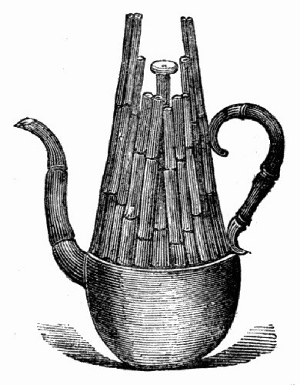
Stoneware is supposed to have been made at a very early period in England by Dutch and German workmen; and from this circumstance it is almost impossible to distinguish the earlier fabrics of these respective countries. The discovery, in 1690, of an economical process of glazing this ware by means of common salt, which made it impermeable to liquids, soon brought it into general use, and displaced all the manufactures of the Delft and soft paste fabrics. A mottled-brown stoneware, known to collectors, is stated to be the manufacture of the age of Edward VI., in consequence of some of the specimens having a silver mounting of the make and fashion of the period of Elizabeth's reign. There is also a large flagon in the Museum of Economic Geology, ornamented with the royal arms of Elizabeth in relief, with the date 1594. These specimens cannot, however, be deemed conclusive of so early a manufacture in England. The first-mentioned specimens, though the mounting is English, may have been of German manufacture, as pieces of similar description of ware are to be seen in various collections of German pottery abroad. The latter specimen may either have been made at Cologne for the use of the Queen's household, or if of English manufacture, it must, in the opinion of a very eminent manufacturer, have been made at a much later period than the date upon it. In a letter received, he states "that it is a common practice even now among potters to use moulds of all dates and styles, which have been got up originally for very different kinds of ornamental work, and that he is strongly inclined to think that the mould from which the devices on this vessel have been pressed, was modelled many years before the vessel was made, and that the vessel itself is comparatively modern." Stoneware, ornamented with devices in white clay, was made in the seventeenth century at Fulham, also at Lambeth, and subsequently at Staffordshire; but there is no satisfactory evidence of any earlier manufactory in England.
Towards the end of the seventeenth century, some specimens of red Japan ware were imported into Europe. Both Dutch and English manufacturers attempted to imitate them, but failed for want of the proper clay. About this period, two brothers of the name of Elers, from Nuremberg, discovered at Bradwell, only two miles distant from Burslem, a bed of fine compact red clay, which they worked in a small manufactory, established in a retired situation upon the bed itself. They took every precaution to prevent any one seeing their process or learning their secret. They went so far as to employ none but the most ignorant and almost idiot workmen they could find. Astbury, the elder, had the talent to counterfeit the idiot, and, moreover, the courage to persevere in this character for some years during which he continued in their employ. From memory he made notes of the processes, and drawings of the machinery used. In consequence of the secret being thus discovered, numerous establishments arose in competition with that of the Elers, and, owing to the general prejudice against them as foreigners, they were finally compelled, in 1720, to quit their establishment. They retired to the neighbourhood of London, and, it is supposed, contributed by their skill and industry to the establishment of the Chelsea Porcelain Manufactory.
GREAT BELL OF ROUEN.
The grand entrance to the cathedral of Rouen is flanked by two towers, the one was erected by St. Romain; the expense for constructing the other, which bears the whimsical name of Tour-de-beurre, was raised by the product arising from permissions granted to the more wealthy and epicurean part of the inhabitants of the city, to eat butter in Lent. It was in this tower that the celebrated bell, the largest in the world, was erected; it weighed 40,000 lbs.; it was converted into cannon in the year 1793. The founder of this bell died of joy on seeing its completion. It went by his name, that of George D'Amboise, and round it was the following distich in gothic characters:—
"Je suis nomme George d'Amboise, Qui bien trente-six-mille poise, Et celui qui bien me pesera, Quarante mille trouvera."
VARIATIONS IN THE COINAGE.
Henry VIII. greatly debased both his gold and silver coins, which he alloyed with copper to a great extent. The proportions of the pound, indeed, in 1546, amounted to 8 oz. of alloy to 4 oz. of silver, which constituted, a positively base coin, the old allowance having been but 18 pennyweights of alloy to 11 oz. and 2 pennyweights of silver. His depreciations were equally daring, for out of the pound of silver he now coined 576 pennies or 48s. The gold coins of this monarch were sovereigns, half-sovereigns or rials, half and quarter rials, angels, half and quarter angels, George nobles, and forty-penny pieces. In this reign the immemorial privileges of the sees of Canterbury, York, and Durham, for coining small money, was abandoned, the last Bishop that used it being Wolsey's successor, Edward Lee.
Edward VI. carried both depreciation and debasement still farther; but towards the close of his reign he was obliged to restore the currency to something like the ancient standard. He was the first that issued crowns, half-crowns, and sixpences. Little alterations were made by Mary, beyond striking coins with her husband's head as well as her own; but under Elizabeth the coinage was, at length, completely recovered from its debasement, the old proportion of 18 pennyweights of alloy being restored, which has continued to the present day. The number of shillings struck out of a pound of silver was not lessened, however, for it continued to be sixty, as in the preceding reign, till 1601, when it was increased to sixty-two, at which rate it went on to 1816, when it was raised to sixty-six, at which it now remains. Her gold coins are much the same as before, but are distinguished by having the edges milled for the first time. Shortly before her death she had intended to coin farthings and other small pieces of copper, a metal which had not yet been made use of in this country.
CHAFFINCH CONTEST.
At the town of Armentières, in France, there is a fête du pays, called hermesse, or ducasse d'Armentières, in which the chaffinch and its fellows are the chief actors and objects of attraction. Numbers of these birds are trained with the greatest care, and no small share of cruelty, for they are frequently blinded by their owners, that their song may not be interrupted by any external object. The point upon which the amusement, the honour, and the emolument rests, is, the number of times which a bird will repeat his song in a given time. A day being fixed, the amateurs repair to the appointed place, each with his bird in a cage. The prize is then displayed, and the birds are placed in a row. A bird-fancier notes how many times each bird sings, and another verifies his notes. In the year 1812, a chaffinch repeated his song seven hundred times in one hour. Emulated by the songs of each other, they strain their little "plumed throats," as if conscious that honour was to result from their exertions.
EXPENSIVENESS OF DRESS IN THE TIME OF JAMES I.
Dress, indeed, must have swallowed up almost every thing at a time when James and his courtiers set the fashion of appearing in a new garb almost every day. When the Duke of Buckingham was sent to France to bring over Henrietta Maria, he provided, amongst others, one suit of white uncut velvet, and a cloak set all over with diamonds, valued at £80,000; besides a feather made of great diamonds, and sword, girdle, hat-band, and spurs, thick set with the same. Another suit of purple satin, embroidered all over with pearls, was valued at £20,000. At the marriage of the Princess Elizabeth with the Palatine, Lady Wotton wore a gown profusely ornamented with embroidery that cost £50 a yard; and Lord Montague spent £1,500 on the dresses of his two daughters for that occasion. By this account it would seem that the ladies were, at all events, not more expensive in their attire than gentlemen.
INGENUITY OF THE TUNISIANS.
A stranger visiting a city like Tunis, cannot but be struck with the various peculiarities, which present themselves to his view, wherever he turns. In their government, mercantile pursuits, professions and trades, the Tunisians are centuries behind. But, with all their disadvantages, the traveller, in traversing their crowded sooks (market places) and serpentine streets, finds numerous illustrations of the proverb, "Necessity is the mother of invention." In every workshop some tool, or implement, presents itself, which is as curious in its formation as it is strange to see the peculiar use for which it is intended, and the manner in which it is employed. We may illustrate this by a sketch of a turner.
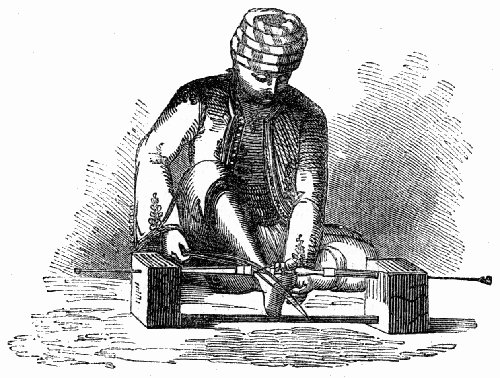
The extraordinary ingenuity here exhibited by the remarkable use which the artisan makes of his feet and toes, as well as of his hands, cannot fail to attract attention; and the display of his lathe and tools is equally curious.
SHÁNÁR MUSICAL INSTRUMENT.
Two acts seem essential to the demon worship of the Shánárs of Tin-nevelly (a portion of the aborigines of India)—dancing and bloody sacrifices. They have no priest. The person who conducts the ceremony, which is undertaken from choice, is called the rotator of the demon. The head man of the village, or any other person, male or female, may officiate. The dress is grotesque, consisting of a sort of coat of various colours, a cap, and other vestments, arranged so as to strike the spectators with their comic appearance. In this service several musical instruments are used, but the most notable among them is one called a bow. It consists of a bow strung and ornamented with bells. This is placed on a brazen vessel of a globular form. The bow is struck with a plectrum, and the bass is produced by the application of an instrument to the brazen pot, another person keeping time by playing a pair of cymbals, as seen in the annexed cut.
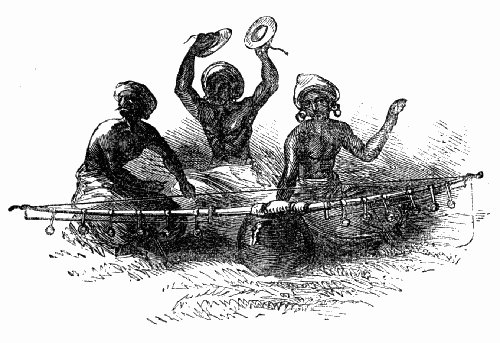
The jarring, discordant, uproarious and cacophonous character of this musical accompaniment exceeds description, and when the parties are vieing with each other for pre-eminence, it is indeed the most horrid din that can be produced. At first the movements of the dancer may be slow, but as the music waxes louder and takes effect, he becomes gradually more excited, urging himself to phrenzy by striking himself violently, and applying his mouth to the neck of the decapitated sacrificial victim, he drinks its blood, and possibly a potation of ardent spirits. The afflatus thus acquired, its effects become visible in the frantic glare and the convulsive gesticulations of the possessed. This is greeted by the spectators with the loudest acclamations. The dancer is now deified or demonized, and he is consulted by the eager and delighted worshippers who do him homage. Each one puts his questions as his fancy or his needs may dictate. The possessed or demonized dancer, being more like a maniac than aught else, and subject to various contortions of body, utters his oracles with much indistinctness, rendering it necessary that some one initiated into these mysteries should interpret his wild and incoherent utterances. His ambiguous sayings and curious innuendos are so indefinite as to need interpretation.
SINGULAR LOCAL CUSTOMS.
In the department of the Hautes Alpes of France, in the commune of Guillaume-Perouse, at the village of Andrieux, where the inhabitants are deprived during one hundred days of the bright beams of the sun, there is a fête, called Le retour du soleil, on the 10th of February. At the dawn of day, four shepherds announce, to the sound of fifes and trumpets, the commencement of this joyous day. Every cottager having prepared an omelette, the eldest inhabitant of the village, to whom the title of Vénérable is given, leads the way to the square; here they form a chain and dance the ferandola round him: after the dance is concluded, he leads the way to a stone bridge at the entrance of the village, the shepherds playing upon their rural instruments the while. Every one having deposited his omelette on the stone coping, they repair to a neighbouring meadow, where the dancing re-commences and continues until the first rays of the sun gleam athwart the velvet turf: the dance then instantly ceases, each one hastens for his pancake, and holding it up, presents it as an offering to the god of day; the Vénérable holds his up with both his hands. As soon as the sun shines upon the village the procession returns to the square, where the party separates, and every one repairs to his own home, to eat his pancake with his family. This ceremony cannot fail to recal the heathen mythology to the reader, who must see in it the offerings made to Apollo; or, perhaps, it may be the remains of some Druidical superstition, as the Druids paid particular devotion to the sun; at any rate, it is a curious vestige of some religion long since gone by. In some of the communes of this department the dead are wrapped in a winding-sheet, but are not inclosed in a coffin. In the valleys of Queyras and of Grave, the dead are suspended in a barn during five months in the winter, until the earth be softened by the sun's rays, when the corpse is consigned to its native element. All funereal ceremonies are closed by eating and drinking. In some communes the people carry a flagon of wine to the churchyard; and on the return of the guests to the home of the deceased, it becomes a scene of bacchanalian revels, in which the groans and sighs of the mourners mingle with the songs and jests of the inebriated guests. At Argentiere, after the burial, the tables are set out round the churchyard; that of the curate and the mourning family over the grave itself. The dinner concluded, the nearest relation takes a glass; his example is followed by the rest, repeating with him, A la santé du pauvre mort.
SEVERITY OF RUSSIAN PUNISHMENTS.
The Russians are remarkable for the severity and variety of their punishments, which are both inflicted and endured with a wonderful insensibility. Peter the Great used to suspend the robbers upon the Wolga, and other parts of his dominions by iron hooks fixed to their ribs, on gibbets, where they writhed themselves to death, hundreds, nay thousands, at a time. The single and double knoute were lately inflicted upon ladies, as well as men of quality. Both of them are excruciating, but in the double knoute, the hands are bound behind the prisoner's back; and the cord being fixed to a pulley, lifts him from the ground, with the dislocation of both his shoulders, and then his back is in a manner sacrificed by the executioner, with a hard thong, cut from a wild ass's akin. This punishment has been so often fatal, that a surgeon generally attends the patient to pronounce the moment that it should cease. Another barbarous punishment practised in Russia is, first boring the tongue of the criminal through with an hot iron, and then cutting it out: and even the late Empress Elizabeth, though she prohibited capital punishments, was forced to give way to the necessity of those tortures. From these particulars, many have concluded that the feelings of the Russians are different from those of mankind in general.
FIRST RHINOCEROS IN EUROPE.
The first rhinoceros ever seen in Europe was that of which Pliny speaks as having been presented by Pompey to the Roman people. According to Dion Cassius, Augustus caused another to be killed in the Roman circus, when celebrating his triumph over Cleopatra. Strabo states that he saw one at Alexandria, and he has left a description of it. All these were of the one-horned species. At a later period the two-horned species were introduced, as appears from medals bearing their effigies struck in the reign of Domitian. During the time known as the dark ages, investigations in natural history and every other department of science and learning were utterly neglected, and the rhinoceros was as mythical to Europe as the phœnix or the salamander. On the revival of letters, however, and the extension of maritime discovery, a lively interest was manifested in the productions of foreign countries. In 1513 the king of Portugal presented the Roman Pontiff with a rhinoceros captured in India; but, unfortunately, the ship was wrecked on its way to Italy: the pope lost his present, and the rhinoceros his life. All that was preserved was a rough sketch, engraved by Albert Durer; and down to a very recent date, nearly all our representations were taken from this rough draft.
In 1685 a rhinoceros was captured and brought to England. In 1739 and 1741 two others were exhibited in various parts of Europe. In 1800 a young one was brought from India, intended for a menagerie at Vienna, but died at London on the way, and was dissected by Mr. Thomas, who published the results of his investigations, and thus gave the public a better idea of the animal than they ever had before.
TURKISH CARRIAGE.
The curiously-shaped vehicle which we have engraved on the next page, is a Turkish araba, a carriage chiefly used by ladies. An account of one of them is pleasantly introduced by Mr. Albert Smith in his "Month at Constantinople" when describing the visit of the Sultan to one of the mosques:—
"Every Friday the Sultan goes to mosque publicly. It is not known until the very morning which establishment he means to patronise; but your dragoman has secret channels of information, and he always informs you in time to 'assist' at the ceremony.
"The first time I went, Abdul Medjid had selected for his devotions the mosque of Beglerbeg, a village on the Asiatic side of the Bosphorus, the temple of which stands in the same relation and bearing to St. Sophia—to use a very familiar simile—as Rotherhithe Church does to St. Paul's. It was a perfect English morning—foggy and cold (Oct. 7) with muddy streets and spitting rain. I crossed into Asia—one learns to speak of Asia, at Constantinople, as he would do of the borough—in a two-oared caique, and on landing went up to the mosque, which is close to the shore.
A crowd of people, consisting principally of females, had collected before the mosque, and a square space was kept by the soldiers. Some little courtesy was shown to visitors, as the Franks were permitted to cross this enclosure to a corner close to the door, by which the Sultan was to enter.
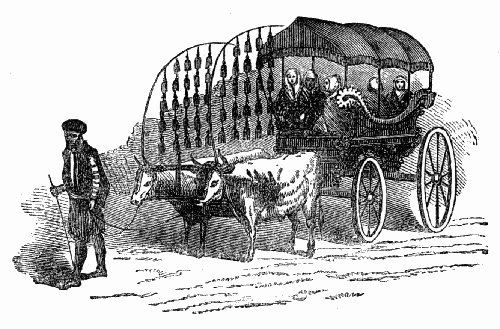
He was not very punctual to his time, but there was enough to amuse the visitors; more especially in the arrival of the women, who came up as near as they could to the building, in all sorts of odd vehicles. Several were like those I had seen on the bridge at Pera, but one was very fine indeed. It was more like a waggon than a carriage, and painted bright blue, with red wheels and awning. In it were five ladies of the Sultan's harem, very gaily dressed, and laughing loudly as the vehicle shook them about over the rugged road. It was drawn by two buffaloes, and they had a singular arrangement of worsted tufts over their heads, of various bright colours. This was the first waggon of the kind I had seen, but I afterwards found them very common. Other women were on foot, and a number of these had collected upon a hillock under a tree, where they talked and quarrelled incessantly. One very pale and handsome girl arrived alone, in a car, preceded by two or three attendants: and, whilst trying to pass a narrow thoroughfare amongst the other vehicles, the wheel of her own got smashed to pieces. She was then close to the Frank visitors, and, as she appeared likely to be overturned, two or three gentlemen from Misseri's hotel, ran forward to offer their assistance. In a minute they were put back by the attendants, who could not think of allowing their mistress to be touched, even from chance, by a Christian. The carriage was propped up, as well as it could be; and its inmate, who had remained perfectly tranquil during the accident, fixed her large eyes on the enclosure, and never moved them again, to the right or left."
CURIOUS INDIAN COMB.
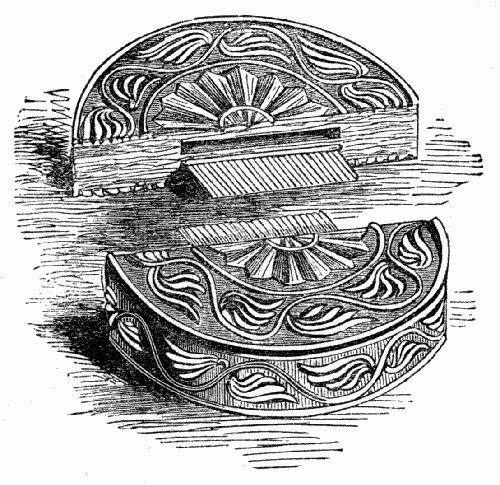
At the foot of the Himalayas, and not far from the European station of Darjeeling, there is a tract of country which is still inhabited by a tribe of very ancient origin, called the Mechs; they are rapidly degenerating, and indeed may be said to be even now almost worn out as a distinct tribe. They are but rarely visited by Europeans; but Dr. Hooker inspected their district in 1850, and gives the following brief description of its appearance:—
"We arrived on the third day at the Mechi river, to the west of which the Nepal Morung begins, whose belt of Sal forest loomed on the horizon, so raised by refraction as to be visible as a dark line, from the distance of many miles. It is, however, very poor, all the large trees having been removed. We rode for several miles into it, and found the soil dry and hard, but supporting a prodigious undergrowth of gigantic harsh grasses that reached to our heads, though we were mounted on elephants. Tigers, wild elephants, and the rhinoceros are said to be found here; but we saw none.
"The old and new Mechi rivers are several miles apart, but flow in the same depression, a low swamp many miles broad, which is grazed at this season, and cultivated during the rains. The grass is very rich, partly owing to the moisture of the climate, and partly to the retiring waters of the rivers; both circumstances being the effects of proximity to the Himalayas. Hence cattle (buffaloes and the common humped cow of India) are driven from the banks of the Ganges 300 miles to these feeding grounds, for the use of which a trifling tax is levied on each animal. The cattle are very carelessly herded, and many are carried off by tigers."
We give a sketch on previous page of a pocket-comb which Dr. Hooker obtained from one of the natives: it is, at all events, much more tasteful in its form and ornamentation than the usual run of English pocket-combs.
SINGULAR HINDOO VOW.
The following extraordinary vow is performed by some of the Hindoo at their festival of Charak Puja:—Stretching himself on the earth on his back, the devotee takes a handful of moist earth, and placing this on his under lip, he plants in it some mustard-seed, and exposes himself to the dews of the night and the heat of the day till the seed germinates. In this posture the man must lie in a fixed motionless condition, without food or drink, till the vegetable process liberates him, which will generally be about the fourth day.
THE ARRANGEMENT OF ABBEY BUILDINGS.
At the dissolution of the Abbeys in England, under King Henry VIII., 190 were dissolved, of from £200 to £35,000 a year; amounting to an aggregate sum of £2,853,000 per annum. The principal buildings of an Abbey, were, first, the church, differing little from one of the cathedrals of the present day. Attached to one side of the nave, commonly the southern, was, secondly, the great cloister, which had two entrances to the church, at the eastern and western ends of the aisles of the nave, for the greater solemnity of processions. Over the western side of the cloister, was, thirdly, the dormitory of the monks; a long room, divided into separate cells, each containing a bed, with a mat, blanket, and rug, together with a desk and stool, and occupied by a monk. This apartment had a door, which opened immediately into the church, on account of midnight offices. Attached to the side of the cloister, opposite to the church, was fourthly, the refectory, where the monks dined; near to which, was the locutorium, or parlour, an apartment answering to the common room of a college, where in the intervals of prayer and study, the monks sat and conversed. Beyond, was the kitchen and its offices; and, adjoining to it, the buttery, &c. On the eastern side of the cloisters was, in the centre, the chapter-house, where the business of the Abbey was transacted; and near it, the library, and scriptorium, where the monks employed themselves in copying books. On this side, also, was the treasury, where the costly plate and church ornaments were kept. The abbot and principal officers of the convent, had all separate houses, to the eastward of the cloister; in which part of the building, were usually the hostelry and question hall—rooms for the entertainment of strangers; and, also, the apartment of novices. Westward of the cloister was an outward court, round which was the monks' infirmary, and the almery. An embattled gatehouse led to this court, which was the principal entrance of the Abbey. The whole was surrounded with a high wall, including in its precincts, gardens, stables, granary, &c. Some of the great Abbeys—as Glastonbury, and Furness—covered sixty acres of ground. The situation chosen for the site of an Abbey was as different from that of the castle as the purpose to which it was applied. The one meant for defence stands boldly on the hill; the other, intended for meditation, is hid in the sequestered valley. The abbots were originally laymen and subject to the bishop.
TAME FISH.
In sailing down the river Irawadi, in the neighbourhood of Amarapoora, the capital of the empire of Burmah, Captain Yule met with some tame fish, which he thus describes:—
"Having gone over the little island, I returned to my boat, where a sight awaited me, that I confess astonished me more than anything I have ever seen before.
"On nearing the island as we descended the river, the headman in the boat had commenced crying out tet-tet! tet-tet! as hard as he could, and on my asking him what he was doing, he said he was calling the fish. My knowledge of Burmese did not allow me to ask him further particulars, and my interpreter was in the other boat, unwell. But, on my coming down to the boat again, I found it surrounded on both sides with large fish, some three or four feet long; a kind of blunt-nosed, broad-mouthed dog-fish. Of these there were, I suppose, some fifty. In one group, which I studied more than the others, there were ten. These were at one side of the boat, half their bodies, or nearly half, protruded vertically from the water, their mouths all gaping wide. The men had some of the rice prepared for their own dinners, and with this they were feeding them, taking little pellets of rice, and throwing these down the throats of the fish. Each fish, as he got something to eat, sunk, and having swallowed his portion, came back to the boatside for more. The men continued occasionally their cry of tet-tet-tet! and, putting their hands over the gunnel of the boat, stroked the fish on the back, precisely as they would stroke a dog. This I kept up for nearly half an hour, moving the boat slightly about, and invariably the fish came at call, and were fed as before. The only effect which the stroking down or patting on the back of the fish seemed to have, was to cause them to gape still wider for their food. During March, I am told, there is a great festival here, and it is a very common trick for the people to get some of the fish into the boat, and even to gild their backs by attaching some gold leaf, as they do in the ordinary way to pagodas, &c. On one of these fish remains of the gilding were visible. I never was so amused or astonished. I wished to have one of the fish to take away as a specimen, but the people seemed to think it would be a kind of sacrilege, so I said nothing more on the point. The Phoongyis are in the habit of feeding them daily, I was informed. Their place of abode is the deep pool formed at the back of the island, by the two currents meeting round its sides. And it is, it appears, quite a sight, which the people from great distances come to see, as well as to visit the Pagoda, which is said to be very ancient and much venerated."
ANCIENT WEAPON.
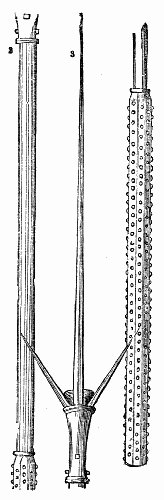
The formidable weapon which we here engrave, is a concealed ranseur of the time of Henry VIII., from Genoa. It forms one long instrument, but our limits have compelled us to divide into three parts. 1, is the butt: 2, the middle; and 3, the point. The upper part is an iron cylinder, with a cap on the top. This is opened by touching the bolt seen a little below it in front, and then, by giving the weapon a jerk forwards, the blades fly out, and produce the form of the partisan. Upon those, on each side, is written, "Al Segno Del Cor"—"To the mark of the heart." When in the state seen in the engraving, the blades are held so firmly that they cannot be thrust back; and the only mode of returning them into the cylinder is by striking the butt end against the ground, when they instantly fall in.
This weapon, we apprehend, must have been more formidable in appearance than useful in action. Once let a man get a fair thrust with it at his enemy, and, it is true, the effect of that one stroke would be fatal, but in battle it would most probably prove fatal also to the man who wielded the weapon, for before he could have time to draw it back, a comrade of the wounded man would have plenty of opportunity to rush in and cut the striker of the blow down. On seeing this and other clumsy weapons which were so much in vogue in former times, we cannot be surprised that none of them have continued in use to the present day. Weapons such as the one we here engrave, have long been thrown aside, and short weapons are now only used for all hand to hand encounters.
THE BABES OF BETHLEHEM.
It is an ancient custom at Norton, near Evesham, Worcestershire, on the 28th of December (Innocents' Day) to ring a muffled peal, in token of sorrow for the slaughter of the hapless "babes of Bethlehem," and, immediately afterwards, an unmuffled peal, in manifestation of joy for the deliverance and escape of the infant Saviour.
GAUNTLET OF HENRY PRINCE OF WALES.
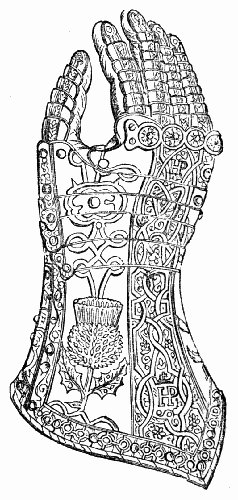
The highly interesting relic of which we here give a sketch is of a russet colour, engraved and gilt, the ornamental parts being sunk lower than the surface. The initials of the owner, surmounted by a coronet, occur in two places, as do also the rose and thistle. Henry was born on the 19th of February, 1594 and was nine years of age when his father ascended the throne of England. When seven, he commenced the acquirement of martial exercises—as the use of the bow, pike, firearms, and the art of riding; and at ten applied to Colonel Edmondes to send him a suit of armour from Holland. On the discovery of the Gunpowder Plot, Lord Spencer made him a present of a sword and target; and, in 1607, Louis, the Dauphin, son of Henry IV. of France, sent him a suit of armour, well gilt and enamelled, together with pistols and a sword of the same kind, and the armour for a horse. His martial and romantic disposition displayed itself on the occasion of his being created Prince of Wales in 1610, when he caused a challenge to be given to all the knights in Great Britain, under the name of Mæliades, Lord of the Isles; and on the day appointed, the Prince, assisted only by the Duke of Lenox, the Earls of Arundel and Southampton, Lord Hay, Sir Thomas Somerset, and Sir Richard Preston, who instructed his Highness in arms, maintained the combat against fifty-six earls, barons, knights, and esquires. Henry himself gave and received thirty-two pushes of the pike, and about three hundred and sixty strokes of the sword, not being yet sixteen years of age. From the size of the gauntlet, the initials H. P., and a prince's coronet, if not made on this occasion, it could not have been much anterior; and, from most of his armour being sent from abroad, the impression would be that it is of foreign manufacture. Yet there is in the State Paper Office an original warrant ordering the payment of £200, the balance of £340, for a rich suit of armour made for Henry Prince of Wales, dated July 11, 1614, he having died on the 6th of November, 1612. This document is directed by King James I. to the Commissioners for the exercise of the office of High Treasurer of England, and states that, "Whereas there was made, in the office of our armory of Greenwich, by William Pickeringe, our master workman there, one rich armour with all peeces compleate, fayrely gilt and graven, by the commaundement of our late deere sonne Prince Henry, which armour was worth (as we are informed) the somme of three hundred and forty poundes, whereof the said William Pickeringe hath receaved of our said late deere sonne the somme of one hundred and forty poundes only, soe as there remayneth due unto him the somme of two hundred poundes"—therefore they are ordered to discharge the same forthwith.
THE SIMOOM.
Arabia is frequently visited by the terrible simoom, called by the natives shamiel, or the wind of Syria, under whose pestilential influence all nature seems to languish and expire. This current prevails chiefly on the frontiers, and more rarely in the interior. It is in the arid plains about Bussora, Bagdad, Aleppo, and in the environs of Mecca, that it is most dreaded, and only during the intense heats of summer. The Arabs, being accustomed to an atmosphere of great purity, are said to perceive its approach by its sulphureous odour, and by an unusual redness in the quarter whence it comes. The sky, at other times serene and cloudless, appears lurid and heavy; the sun loses his splendour, and appears of a violet colour. The air, saturated with particles of the finest sand, becomes thick, fiery, and unfit for respiration. The coldest substances change their natural qualities; marble, iron, and water, are hot, and deceive the hand that touches them. Every kind of moisture is absorbed; the skin is parched and shrivelled; paper cracks as if it were in the mouth of an oven. When inhaled by men or animals, the simoom produces a painful feeling as of suffocation. The lungs are too rarefied for breathing, and the body is consumed by an internal heat, which often terminates in convulsions and death. The carcases of the dead exhibit symptoms of immediate putrefaction, similar to what is observed to take place on bodies deprived of life by thunder, or the effect of electricity.
When this pestilence visits towns or villages, the inhabitants shut themselves up, the streets are deserted, and the silence of night everywhere reigns. Travellers in the desert sometimes find a crevice in the rocks; but if remote from shelter, they must abide the dreadful consequences. The only means of escaping from these destructive blasts, is to lie flat on the ground until they pass over, as they always move at a certain height in the atmosphere. Instinct teaches even animals to bow down their heads, and bury their nostrils in the sand. The danger is most imminent when they blow in squalls, which raise up clouds of sand in such quantities, that it becomes impossible to see to the distance of a few yards. In these cases the traveller generally lies down on the lee side of his camel; but as the desert is soon blown up to the level of its body, both are obliged frequently to rise and replace themselves in a new position, in order to avoid being entirely covered. In many instances, however, from weariness, faintness, or sleepiness, occasioned by the great heat, and often from a feeling of despair, both men and animals remain on the ground, and in twenty minutes they are buried under a load of sand. Caravans are sometimes swallowed up; and whole armies have perished miserably in these inhospitable deserts.
BOILING TO DEATH.
One Rouse, who had attempted to poison Fisher, Bishop of Rochester, who was afterwards murdered in his 77th year, (by Henry VIII.)—was actually boiled to death in Smithfield, for his offence. The law which thus punished him, was afterwards repealed.
SIKKIM PRIESTS.
The Sikkim country is situated on the frontiers of Thibet and Nepal and on a portion of the Himalayas. Dr. Hooker, who visited it a few years ago, gives the following account in his Journal of some of its scenery:—"January 1st, 1849.—The morning of the new year was bright and beautiful, though much snow had fallen on the mountains; and we left Sunnook for Pemiongchi, situated on the summit of a lofty spur on the opposite side of the Ratong.
"The ascent to Pemiongchi was very steep, through woods of oaks, chesnuts, and magnolias, but no tree-fern, palms, pothos, or planntain, which abound at this elevation on the moister outer ranges of Sikkim. The temple is large, eighty feet long, and in excellent order, built upon the lofty terminal point of the great east and west spur, that divides the Kulhait from the Ratong and Rungbee rivers; and the great Changachelling temple and monastery stands on another eminence of the same ridge, two miles further west.
"The view of the snowy range from this temple is one of the finest in Sikkim; the eye surveying at once glance the vegetation of the tropics and the poles. Deep in the valleys the river beds are but 3,000 feet above the sea, and are choked with fig-trees, plantains, and palms; to these succeed laurels and magnolias; and still higher up, oaks, chesnuts, birches, &c.; there is, however, no marked line between the limits of these two last forests, which form the prevailing arboreous vegetation between 4,000 and 10,000 feet, and give a lurid hue to the mountains. Fir forests succeed for 2,000 feet higher, when they give place to a skirting of rhododendron and barberry. Among these appear black naked rocks, between which are gulleys, down which the snow now descended to 12,000 feet. The mountain flanks are much more steep and rocky than those at similar heights on the outer ranges, and cataracts are very numerous, and of considerable height, though small in volume.
"Pemiongchi temple, the most ancient in Sikkim, is said to be 400 years old; it stands on a paved platform, and is of the same form and general character as that of Tassisuding. Inside, it is most beautifully decorated, especially the beams, columns, capitals, and architraves, but the designs are coarser than those of Tassisuding. The square end of every beam in the roof is ornamented either with a lotus flower, or with a Tibetan character, in endless diversity of colour and form, and the walls are completely covered with allegorical paintings of Lamas and saints with glories round their heads, mitred, and holding the dorje and jewel.
"The principal image is a large and hideous figure of Sakya-thoba in a recess under a blue silk canopy, contrasting with a calm figure of the late Rajah, wearing a cap and coronet.
"Pemiongchi was once the capital of Sikkim, and called the Sikkim Durbar: the Rajah's residence was on a curious flat to the south of the temple, and a few hundred feet below it, where are the remains of (for this country) extensive walls and buildings. During the Nepal war, the Rajah was driven east across the Teesta, whilst the Ghorkas plundered Tassisuding, Pemiongchi, Changachelling, and all the other temples and convents to the west of that river. It was then that the famous history of Sikkim, compiled by the Lamas of Pemiongchi, and kept at this temple, was destroyed, with the exception of a few sheets, with one of which Dr. Campbell and myself were each presented. We were told that the monks of Changachelling and those of this establishment had copied what remained, and were busy compiling the rest from oral information, &c.: whatever value the original may have possessed, however, is irretrievably lost. A magnificent copy of the Buddhist Scriptures was destroyed at the same time; it consisted of 400 volumes, each containing several hundred sheets of Daphne paper."
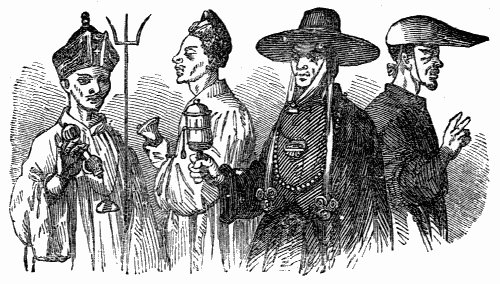
Of the figures given in our article, the one on the extreme left is a Lama, or Sikkim priest, having in his hand a dorge, or double-headed thunderbolt; next to him, a monk; next to the monk, a priest, with a praying cylinder; and at the extreme right, another monk.
A HEAD-BREAKER.
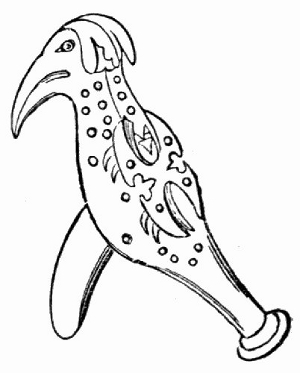
With many savage nations it is a custom when prisoners have been captured in war, to keep them in confinement for some time, till the preparations for a grand festival have been completed, and then to put them to death in the presence of the great men and chief priests of the country. They were slaughtered, sometimes as offerings to the gods, sometimes as sacrifices to the spirits of those slain in the war in which they were captured, and at other times as incentives to the young warriors who were to be the future defenders of the nation. In all these cases, appropriate and peculiar ceremonies were prescribed, and the victims were generally despatched by a particular official, whose especial duty it was to perform the bloody deed. A particular weapon was also used, and one of these is sketched at the head of our article. It was used by one of the tribes which inhabit the shores of Nootka Sound. It is intended to represent the sacred bird of their nation, and is made of wood, inlaid with mother-of-pearl, with a blade of basalt. The lower end is hollow for the insertion of a handle.
ANCIENT STONE COLLARS.
Perhaps the most singular relics of that Pagan period in Scotland when the use of metals was in a great measure unknown, are two stone collars, found near the celebrated parallel roads of Glenroy, and now preserved at the mansion of Tonley, Aberdeenshire. We here give an engraving of them.
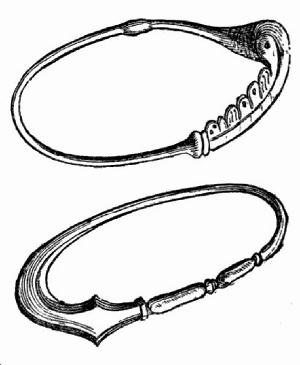
They are each of the full size of a collar adapted to a small Highland horse; the one formed of trap or whin-stone, and the other of a fine-grained red granite. They are not, however, to be regarded as the primitive substitutes for the more convenient materials of later introduction; on the contrary, a close imitation of the details of a horse collar of common materials is attempted, including the folds, the leather, nails, buckles, and holes for tying particular parts together. They are finished with much care and a high degree of polish, and are described as obviously the workmanship of a skilful artist. Mr. Skene, who first drew attention to these remarkable relics, suggests the peculiar natural features of Glenroy having led to the selection of this amphitheatre for the scene of ancient public games, and that these stone collars might commemorate the victor in the chariot race, as the tripods, still existing, record the victor in the Choragic games of Athens. But no circumstances attending their discovery are known which could aid conjecture either as to the period or purpose of their construction.
THE OFFSPRING OF DRUNKENNESS.
From an interesting lecture on drunkenness, and on popular investments, recently delivered by the Rev. J. B. Owen, M.A., of Bilston, we select this impressive enumeration of the crimes mainly springing from drunkenness. Drink was the desolating demon of Great Britain. They had spent in intoxicating drinks during the present century as much as would pay the national debt twice over! There were 180,000 gin drinkers in London alone, and in that city three millions a year are spent in gin! In thirteen years 249,006 males and 183,921 females were taken into custody for being drunk and disorderly. In Manchester no less than a million a-year were spent in profligacy and crime. In Edinburgh there were 1,000 whisky shops—160 in one street—and yet the city contained only 200 bread shops. Of 27,000 cases of pauperism, 20,000 of them were traceable to drunkenness. In Glasgow the poor rates were £100,000 a-year. "Ten thousand," says Alison, "get drunk every Saturday night—are drunk all day Sunday and Monday, and not able to return to work till Tuesday or Wednesday." Glasgow spends £1,200,000 annually in drink, and 20,000 females are taken into custody for being drunk. And what were some of the normal results of such appalling statistics? insanity, pauperism, prostitution, and crime. As to the insanity affiliated on drink, the Bishop of London stated, that of 1,271 maniacs, whose previous histories were investigated, 649, or more than half of them, wrecked their reason in drinking. As to its pauperism, it is estimated that not less than two-thirds of our paupers were the direct or indirect victims of the same fatal vice. As to its prostitution, its debauching influence was remotely traceable in the 150,000 harlots of London, and in their awful swarms in all our large towns and cities. Its relation to crime was equally conclusive. In Parkhurst prison, it was calculated, that 400 out of 500 juvenile prisoners, were immured there, as the incidental results of parental debauchery. The Chaplain of the Northampton County Gaol, lately informed the lecturer, that, "of 302 prisoners in this gaol, during the last six months, 176 attributed their ruin to drunkenness; 64 spent from 2s. 6d. to 10s. a week in drink; 15 spent from 10s. to 17s.; and 10 spent all their savings. Is it not remarkable," he added, "that out of 433 prisoners in this gaol, I have not had one that has had one sixpence in a saving's bank, nor above six that ever had sixpence in one? On the contrary, I have many members of friendly societies, of course of unsound ones, which with two or three exceptions, all met at public houses; and there they learned to drink, and became familiarised with crime." Judge Erskine declared at the Salisbury Assizes in 1844, that 96 cases out of every 100 were through strong drink. Judge Coleridge added, at Oxford, that he never knew a case brought before him, which was not directly or indirectly connected with intoxicating liquors; and Judge Patteson capped the climax, at Norwich, by stating to the grand jury, "If it were not for this drinking, you and I should have nothing to do!" Of the 7,018 charges entered at Bow Street Police Office, in the year 1850, half of them were for being drunk and incapable; and if they added to these the offences indirectly instigated by intoxication, the proportion rose at least to 75 per cent.
AN OLD PIKE.
In the year 1497 a giant "Jack-killer" was captured in the vicinity of Mannheim, with the following announcement in Greek appended to his muzzle:—"I am the first fish that was put into this pond by the hands of the Emperor Frederic the Second, on this 3rd day of October, 1262." The age of the informant, therefore, if his lips spoke truth (and the unprecedented dimensions of the body left little doubt on that point), was more than two hundred and thirty-five years. Already he had been the survivor of many important changes in the political and social world around, and would have swam out perhaps as many more had the captors been as solicitous to preserve his life as they were to take his portrait. This, on the demise of the original, was hung up in the castle of Lautern, and the enormous carcase (which, when entire, weighed three hundred and fifty pounds, and measured nineteen feet) was sent to the museum at Mannheim, where, deprived of its flesh, and caparisoned de novo, it hung, and haply yet hangs, a light desiccated skeleton, which a child might move.
BURMESE BOAT.
The curious boat which is here depicted in full sail is one of those which is used by the Burmese on the river Irawadi. They are called hnau, and Captain Yule gives the following description of them in his "Mission to Ava:"—
"The model is nearly the same for all sizes, from the merest dinghy upwards. The keel-piece is a single tree hollowed out, and stretched by the aid of fire when green, a complete canoe, in fact. From this, ribs and planking are carried up. The bow is low with beautiful hollow lines, strongly resembling those of our finest modern steamers. The stern rises high above the water, and below the run is drawn out fine to an edge. A high bench or platform for the steersman, elaborately carved, is an indispensable appendage. The rudder is a large paddle lashed to the larboard quarter, and having a short tiller passing athwart the steerman's bench.
"The most peculiar part of the arrangement of these vessels is in the spars and rigging. The mast consists of two spars; it is, in fact, a pair of shears, bolted and lashed to two posts rising out of the keel-piece, so that it can be let down, or unshipped altogether, with little difficulty. Above the mainyard the two pieces run into one, forming the topmast. Wooden rounds run as ratlines from one spar of the mast to the other, forming a ladder for going aloft.
"The yard is a bamboo, or a line of sliced bamboos, of enormous length, and, being perfectly flexible, is suspended from the mast-head by numerous guys or halyards, so as to curve upwards in an inverted bow. A rope runs along this, from which the huge mainsail is suspended, running on rings like a curtain outwards both ways from the mast. There is a small topsail of similar arrangement.
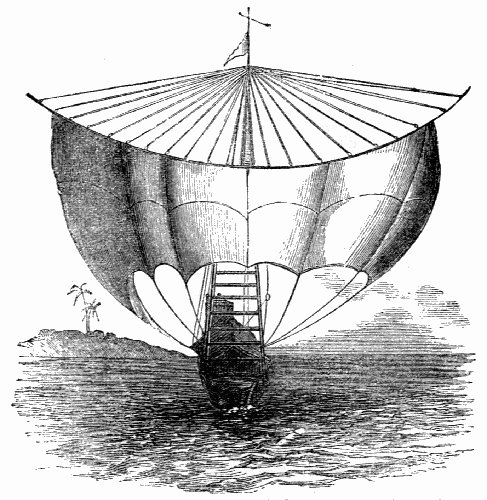
"The sail-cloth used is the common light cotton stuff for clothing. Of any heavier material it would be impossible to carry the enormous spread of sail which distinguishes these boats. At Menh'lá one vessel was lying so close to the shore that I was enabled to pace the length of the half-yard. I found it to be 65 feet, or for the length of the whole spar, neglecting the curve, 130 feet. The area of the mainsail in this case could not have been very much less than 4,000 square feet, or one-eleventh of an acre.
"These boats can scarcely sail, of course, except before the wind. But in ascending the Irawadi, as on the Ganges during the rainy season, the wind is almost always favourable. A fleet of them speeding before the wind with the sunlight on their bellying sails has a splendid though fantastic appearance. With their vast spreading wings and almost invisible hulls, they look like a flight of colossal butterflies skimming the water."
DANCING DERVISHES.
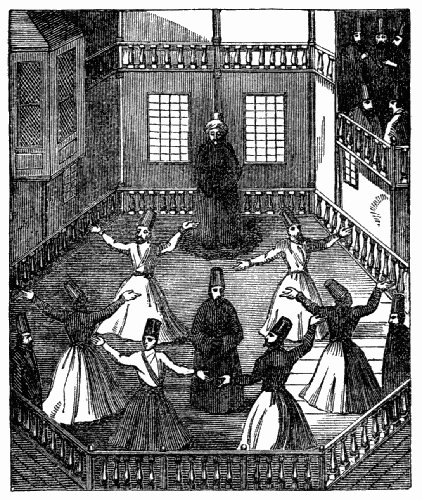
The Dancing Dervishes at Constantinople are a remarkable instance of the lengths to which superstition and credulity will proceed. The saltatory ceremony which they perform at their religious services is thus admirably described by Mr. Albert Smith in his "Month at Constantinople:"—
"I have said it was Friday; and so, on my return, I had an opportunity of seeing the Dancing Dervishes at Pera. They exhibit—for it is rather a sight than a solemnity—on this day, as well as on Tuesday, in every week. Their convent is facing the scrap of burying-ground on the road from Galata to Pera, and any one may witness their antics. Having put off our shoes, we entered an octagonal building, with galleries running round it, and standing places under them, surrounding the railed enclosure in which the Dervishes were to dance, or rather spin. One division of this part of the building was put aside for Christians, the others were filled with common people and children. When I arrived, one old Dervish, in a green dress, was sitting at one point of the room, and twenty-four in white, were opposite to him. A flute and drum played some very dreary music in the gallery. At a given signal they all fell flat on their faces, with a noise and precision that would have done honour to a party of pantomimists; and then they all rose and walked slowly round, with their arms folded across their breasts, following the old green Dervish, who marched at their head, and bowing twice very gravely to the place where he had been sitting, and to the spot opposite to it. They performed this round two or three times. Then the old man sat down, and the others, pulling off their cloaks, appeared in a species of long petticoat, and one after the other began to spin. They commenced revolving precisely as though they were waltzing by themselves; first keeping their hands crossed on their breast, and then extending them, the palm of the right hand and the back of the left being upwards. At last they all got into play, and as they went round and round, they put me in mind of the grand party we have seen on the top of an organ, where a cavalier seul revolves by himself, and bows as he faces the spectators.
"They went on for a long time without stopping—a quarter of an hour, perhaps, or twenty minutes. There was something inexpressibly sly and offensive in the appearance of these men, and the desire one felt to hit them hard in the face became uncomfortably dominant. At the end of their revolutions they made another obeisance to the old man, and all this time the players in the orchestra howled forth a kind of hymn. This ceremony was repeated three or four times, and then they all sat down again and put their cloaks on, whilst another Dervish, who had walked round and round amongst the dancers, whilst they were spinning, sang a solo. During this time their faces were all close to the ground. This done, they rose and marched before the old green Dervish once more, kissing his hand as they passed, and the service concluded, occupying altogether about three-quarters of an hour."
EXTRAORDINARY MALADY.
Digne, the principal town in the department of the Basses Alpes in France might be passed by the traveller without exciting one observation, its walks and its warm mineral waters being the only objects worthy of notice. Its inhabitants do not now exceed 3,500; but, in the year 1629, 10,000 industrious citizens followed their numerous avocations within its precincts. At that period, however, an extraordinary plague broke out, in the month of June, which lasted till October, committing the most awful ravages, so that in that short space of time the wretched inhabitants were reduced to the number of 1,500, among whom six only had escaped this very singular malady, the effects of which are thus described by a French writer:—"This malady strangely affected the invalids; some fancied they could fly; others, climb from one object to another like squirrels; some sunk into a profound lethargy, even for so long a time as six days; and one young woman who had been hastily interred in a vineyard, rose three days afterwards, for the grave-diggers were content just to cover the bodies. During these four months the town was covered with a thick fog: the heat was suffocating, accompanied by frequent and dreadful storms; and in order to complete the horrors of such a situation, the parliament forbade any of the inhabitants to quit the city, or the small territory belonging to it. Guards placed upon the Bléonne fired upon those who attempted to escape. The magistrates abandoned their functions; the clocks no longer sounded the hours; the neighbouring springs dried up, so that the mills could not work; and famine began to add its fearful horrors to the miseries which already desolated the city, now become a living sepulchre, for the dead bodies lay in the streets unburied, and the few remaining persons who still paraded the streets appeared more like the spectres of those departed than living beings. Many persons not only prepared but put on the habiliments of death, and quietly awaited the approach of the king of terrors. A new edict condemned the pestilential city to the flames; but this inhuman decree was countermanded, after the destruction of one country house, with all its inhabitants. The disease having somewhat abated in the surrounding villages, humanity at length dictated the necessity of making some efforts to save the remaining few, who had escaped the contagion, from the no less frightful evil of famine. The scene that presented itself was appalling; several little children, whose parents were dead, were found sucking goats; in short, the desolation was so great that, although two centuries have passed away since this fatal scourge devastated the country, Digne has never recovered its effects."
QUACKERY IN THE OLDEN TIME.
In the reign of Henry VIII. many of the medical practitioners were mere horse-farriers. A distinguished patient, the great Lord Burghley, secretary of state to Queen Elizabeth, was addressed by one Audelay, on a certain occasion, in this wise, "Be of goode comfort, and plucke up a lustie, merrie hearte, and then shall you overcome all diseases: and because it pleased my good Lord Admiral lately to praise my physicke, I have written to you such medicines as I wrote unto him, which I have in my boke of my wyffe's hand, proved upon herselfe and mee both: and if I can get anything that may do you any goode, you may be well assured it shall be a joye unto me to get it for you." "A good medicine for weakness or consumption:—Take a pig of nine days olde, and slaye him, and quarter him, and put him in a skillat, with a handfull of spearment, and a handfull of red fennell, a handfull of liverwort, half a handfull of red neap, a handfull of clarge, and nine dates, cleaned, picked, pared, and a handful of great raisins, and picke out the stones, and a quarter of an ounce of mace, and two stickes of goode cinnamon, bruised in a mortar, and distill it with a soft fire, and put it in a glass, and set it in the sun nine days, and drinke nine spoonfulls of it at once when you list!" "A compost:—item—take a porpin, otherwise called an English hedgehog, and quarter him in pieces, and put the said beast in a still, with these ingredients: item—a quart of redde wyne, a pinte of rose-water, a quarter of a pound of sugar—cinnamon and two great raisins." "If thore be any manner of disease that you be aggrieved withal, I pray you send me some knowledge thereof, and I doubt not but to send you an approved remedie. Written in haste at Greenwiche, ye 9 of May, 1553, by your trewe heartie friend, John of Audelay."
A POISON WEAPON.
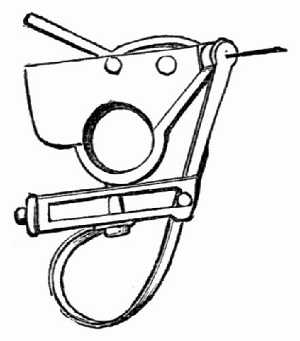
The instrument sketched forms one of the curiosities in the splendid museum of the late Sir S. R. Meyrick, and is a singular instance of that refinement of cruelty which is too prominent a characteristic of the sixteenth century. It is a weapon for throwing poisoned needles among a crowd. Where the lid at the top is seen lifted up, is the chamber in which the needles are kept stuck into a cork at the bottom. On the opposite side a needle is seen put through a hole in a strong spring, held in its place by a catch above, which, when pressed by the thumb disengages it and ejects the needle with considerable force. As the fore-finger goes through the centre ring, and the thumb is at the top, the weapon is almost entirely concealed by the hand. The spring can be adjusted by a screw at the side. This cruel instrument was used by men on horseback, or from a window, and as the needles were poisoned, many painful injuries must have been inflicted without the sufferers being able to discover by whom their wounds were caused.
ANCIENT SWORD-BREAKER.
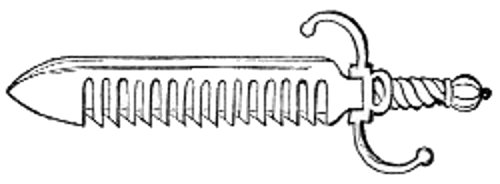
The immense two-handed swords of former times were most fearful weapons, and far more easily used than the appearance of them would lead us to suppose. They were admirably poised, and the position in which they were held may be learned from various writers of their times. One hand was placed close to the cross-bar, while the other held the pommel. De Grassi, in 1594, tells us that those who use them contrive to "amase with the furie of the sword, and deliver great edge blows down-right and reversed, fetching a full circle or compass therein with exceeding great swiftness, staying themselves upon one foote, sometimes on the other, utterlie neglecting to thrust, and persuading themselves that the thrust serveth to amaze one man onlie, but those edge blows are of force to incounter many. The hand towards the enemie must take hold fast of the handle neere the crosse and underneath, the other hand above and near the pomell."
Silver, in his "Paradox" gives the following as the proportions of a two-handed sword in his day: "The perfect length of your two-handed sword is the blade to the length and hilt of your single sword."
The instrument which we have sketched on previous page, was used in the time of Henry VIII., for the purpose, not only of defence against one of those "great edge-blows down-right" but of catching the blade between the teeth, and then breaking it by a sharp turn of the wrist.
ORIGIN OF THE BALLOT.
The origin of electing members by balls may be traced to the Grecians. When a member was to be elected, every one threw a little pellet of bran, or crumb of bread into a basket, carried by a servant on his head round the table, and whoever dissented flattened their pellet at one side.
ANCIENT DAGGER.
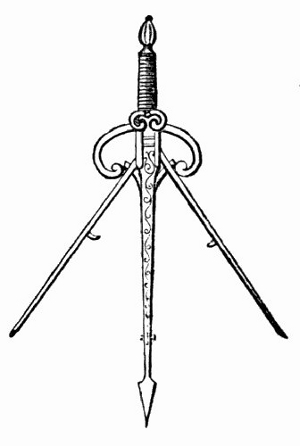
The weapon which forms the subject of the woodcut is a dagger of the time of Philip and Mary, ornamented with engraving. After being thrust into a person, by pulling a little catch, it is made to open within him, and the prolongation of the blade allows means for a second blow. The two small hooks at the inner side of the two blades would admit of the dagger being thrust deeper in, but would prevent its being drawn out.
At the period these daggers were most in vogue, personal combats were very sanguinary and determined, seldom terminating without the death of one, and in some cases of both, of the parties engaged. They first used the long sword, and when that weapon was broken, they closed with one another, and used their daggers by stabbing at the most mortal part of their foe they could manage to reach.
THE TEMPLE OF POU-TOU.
Pou-tou is an island of the great archipelago of Chusan, on the coasts of the province of Tche-kiang. More than 100 monasteries, more or less important, and two of which were founded by Emperors, are scattered over the sides of the mountains and valleys of this picturesque and enchanting island, which nature and art have combined to adorn with their utmost magnificence. All over it you find delightful gardens, full of beautiful flowers,—grottoes cut in the living rock, amidst groves of bamboo and other trees, with aromatic banks. The habitations of the Bonzes are sheltered from the scorching rays of the sun by umbrageous foliage, and scattered about in the prettiest situations imaginable. Thousands of winding paths cross the valleys in various directions, and the brooks and rivulets, by means of pretty bridges of stone or painted wood, and for the communications between the scattered dwellings. In the centre of the island rise two vast and brilliant edifices—Buddhist temples—the yellow bricks of which announce that their construction is due to imperial munificence. The religious architecture of the Chinese does not at all resemble ours. They have no idea of the majestic, solemn, and perhaps somewhat melancholy style, that harmonizes so well with the feelings which ought to be inspired by a place devoted to meditation and prayer. When they wish to build a pagoda, they look out for the most gay and smiling site they can find on the declivity of a mountain or in a valley; they plant it with great trees of the evergreen species; they trace about it a number of paths, on the sides of which they place flowering shrubs, creeping plants, and bushes. It is through these cool and fragrant avenues you reach the building, which is surrounded by galleries, and has less the air of a temple than of a rural abode charmingly situated in the midst of a park or garden.
The principal temple of Pou-tou is reached by a long avenue of grand secular trees, whose thick foliage is filled with troops of crows with white heads; and their cawings and flapping of wings keep up a continual clamour. At the end of the avenue is a magnificent lake, surrounded with shrubs that lean over its waters like weeping willows. Turtle and gold-fish gleam through them; and mandarin-ducks, in their gaily-coloured plumage, play over their surface, amidst the splendid water-lilies whose rich corollas rise majestically upon tender green stalks spotted with black. Several bridges of red and green wood are thrown over this lake, and lead to flights of steps, by which you ascend to the first of the temple buildings—a kind of porch, supported upon eight enormous granite columns. On the right and left are stationed, like sentinels, four statues of colossal size, and two side gates lead to the vestibule of the principal nave, where is enthroned a Buddhist Trinity, representing the Past, the Present, and the Future. These three statues are entirely gilt, and, although in a crouching posture, of gigantic dimensions—at least twelve feet high. Buddha is in the midst, his hands interlaced, and gravely placed on his majestic abdomen. He represents the Past, and the unalterable and eternal quiet to which it has attained; the two others, which have the arm and the right hand raised, in sign of their activity, the Present and Future. Before each idol is an altar covered with little vases for offerings, and cassolets of chiselled bronze, where perfumes are constantly burning.
A crowd of secondary divinities are ranged round the hall, the ornaments of which are composed of enormous lanterns of painted paper or horn—square, round, oval—indeed, of all forms and colours; and the walls are hung with broad strips of satin, with sentences and maxims.
The third hall is consecrated to Kouang-yu, whom the greater number of accounts of China persist in regarding as a goddess of porcelain, and sometimes also of fecundity. According to the Buddhist mythology, Kouang-yu is a person of the Indian Trimourti, or Triune God, representing the creative power.
Finally, the fourth hall is a pantheon, or pandemonium, containing a complete assortment of hideous idols, with ogres' and reptiles' faces. Here you see, huddled together pell-mell, the gods of heaven and earth; fabulous monsters, patrons of war, of the silk manufacture, of agriculture, and of medicine; the images of the saints of antiquity, philosophers, statesmen, warriors, literary men—in a word, the most heterogeneous and grotesque assembly conceivable.
ORACLES OF APOLLO IN FRANCE.
Towards the frontiers of Auvergne and Velay, upon the high rock of Polignac, there was formerly a temple of Apollo, famous for its oracles. The time of its foundation ascends to the first years of the Christian era, since, in the year 47, the Emperor Claudius came hither in great pomp, to acknowledge the power of the god; and he left proofs of his piety and munificence. The débris and mysterious issues that are found even now upon the rock, in the heart of its environs, reveal the secret means employed by the priests to make their divinities speak, and to impose upon the people. At the bottom of the rock was an ædicula: it was on this spot that the pilgrims took up their first station, and deposited their offerings and made their vows. A subterranean passage communicated from this ædicula to the bottom of a great excavation, pierced, in the form of a tunnel, from the base to the summit of the rock. It was by this enormous opening that the vows, the prayers and questions, pronounced in the very lowest voice by the pilgrims, reached instantly the top of the rock, and were there heard and collected by the college of priests; the answers were then prepared, while the believers, by a sinuous and long path, slowly arrived at the end of their pilgrimage. The answers being ready, the priests commissioned to transmit them repaired to profound and deep apartments, contiguous to a well, the orifice of which terminated in the temple. This well, crowned by an altar, being enclosed by a little hemispherical roof, supported in its external parts the colossal figure of Apollo; the mouth of this statue being half open, in the middle of a large and majestic beard, appeared always ready to pronounce the supreme decrees. It was also through this opening, by the means of a long speaking-trumpet, that the priests at the bottom of this den of mystery and superstition made known those famous oracles so imposing and so powerful in their effects upon the human soul as to impede for centuries the substitution of the more pure and holy precepts of the gospel.
BEST POSITION FOR SMOKING OPIUM.
Opium is not smoked in the same manner as tobacco. The pipe is a tube of nearly the length and thickness of an ordinary flute. Towards one end of it is fitted a bowl of baked clay or some other material, more or less precious, which is pierced with a hole communicating with the interior of the tube. The opium, which before smoking is in the form of a blackish viscous paste, is prepared in the following manner:—A portion, of the size of a pea, is put on a needle, and heated over a lamp until it swells and acquires the requisite consistence. It is then placed over the hole in the bowl of the pipe, in the form of a little cone that has been previously pierced with a needle so as to communicate with the interior of the tube. The opium is then brought to the flame of the lamp, and after three or four inspirations the little cone is entirely burnt, and all the smoke passes into the mouth of the smoker, who then rejects it again through his nostrils. Afterwards the same operation is repeated, so that this mode of smoking is extremely tedious. The Chinese prepare and smoke their opium lying down, sometimes on one side, sometimes on the other, saying that this is the most favourable position; and the smokers of distinction do not give themselves all the trouble of the operation, but have their pipes prepared for them.
EXECUTIONER'S SWORD.
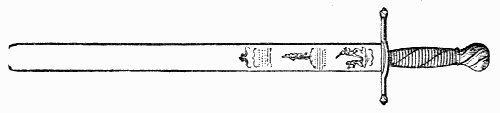
The weapon engraved below forms one of the curiosities in the superb collection of ancient armour belonging to the late Sir Samuel R. Meyrick, at Goodrich Court, Herefordshire. It is the sword of an executioner, having on it the date 1674. The blade is thin, and exceeding sharp at both edges; and engraved on it is a man impaled, above which are the words, in German, of which the following is a translation:—
"Let every one that has eyes Look here, and see that To erect power on wickedness Cannot last long:"
a man holding a crucifix, his eyes bandaged, and on his knees; the executioner, with his right hand on the hilt, and his left on the pommel, is about to strike off his head; above is written—
"He who ambitiously exalts himself, And thinks only of evil, Has his neck already encompassed By punishment."
On the other side, a man broken on the wheel; over which is—
"I live, I know not how long; I die, but I know not when:"
and a man suspended by the ribs from a gibbet, with the inscription—
"I move, without knowing whither; I wonder I am so tranquil."
ORIGIN OF EXCHEQUER BILLS.
In the year 1696 and 1697, the silver currency of the kingdom being by clipping, washing, grinding, filing, &c., reduced to about half its nominal value, Acts of Parliament were passed for its being called in and recoined, and whilst the recoinage was going on, Exchequer bills were first issued to supply the demands of trade.
ANCIENT ETRURIAN BUST.
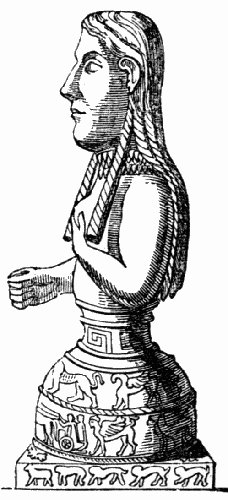
If we look backwards to the most remote times of Greek industry, we find that long before fire-casting became customary, almost every kind of work was carried out by the simple means of the hammer and tongs, wielded by skilful hands. Even products of art were created in this manner; and as statues, vases, and the like could not be put together by the process of soldering, nails were used for the purpose, as we learn not only from ancient writers, but even from monuments which have lately been discovered in Etruria, and the most important specimens of which are now possessed by the British Museum. In one of the tombs belonging to the vast necropolis of Vulci were discovered, about twenty years ago, a great many bronzes of this very ancient workmanship; one of them represents a bust placed on a basement covered with thin copper plates, and adorned by a row of figures, which are likewise chased; long curls fall down over the neck and shoulders, and these parts especially are formed in the most simple manner: one would be tempted to call it child-like, did not the whole composition show a certain character which enables the experienced eye of the art-philosopher to distinguish in these rude attempts at plastic metal work the very germ of those wonderfully-styled productions of a later period. The engraving here annexed, giving a side view of this remarkable, and as yet unique monument, is intended to show the arrangement of the hair, which, in spite of its simple treatment, presents as a whole some trace of grace, and principles of fine proportions. We perceive that the curls are formed by rolling and twining together small strips of bronze plate, connected with the head itself by the mechanical means we have alluded to. There is no trace of soldering; and we may be sure that we possess in this figure a good specimen of those hammer-wrought sculptures of old which were spoken of by the Greeks themselves as belonging to a fabulous period.
THE HAIRY WOMAN OF BURMAH.
The following account of this remarkable freak of nature is taken from Captain Yule's "Mission to Ava." Writing from the city of Amarapoora, the capital of Burmah, the Captain says:—
"To-day we had a singular visitor at the residency. This was Maphoon, the daughter of Shwé-maong, the "Homo hirsutus" described and depicted in Crawfurd's narrative, where a portrait of her, as a young child, also appears. Not expecting such a visitor, one started and exclaimed involuntarily as there entered what at first-sight seemed an absolute realization of the dog-headed Anubis.
"The whole of the Maphoon's face was more or less covered with hair. On a part of the cheek, and between the nose and mouth, this was confined to a short down, but over all the rest of the face was a thick silky hair of a brown colour, paling about the nose and chin, four or five inches long. At the alea of the nose, under the eye, and on the cheek-bone, this was very fully developed, but it was in and on the ear that it was most extraordinary. Except the extreme upper tip, no part of the ear was visible: all the rest was filled and veiled by a large mass of silky hair, growing apparently out of every part of the external organ, and hanging in a dependent lock to a length of eight or ten inches. The hair over her forehead was brushed so as to blend with the hair of the head, the latter being dressed (as usual with her countrywomen) à la Chinoise. It was not so thick as to conceal altogether the forehead.
"The nose, densely covered with hair so as no animal's is that I know of, and with long fine locks curving out and pendent like the wisps of a fine Skye terrier's coat, had a most strange appearance. The beard was pale in colour, and about four inches in length, seemingly very soft and silky.
"Poor Maphoon's manners were good and modest, her voice soft and feminine, and her expression mild and not unpleasing, after the first instinctive repulsion was overcome. Her appearance rather suggested the idea of a pleasant-looking woman masquerading than that of anything brutal. This discrimination, however, was very difficult to preserve in sketching her likeness, a task which devolved on me to-day in Mr. Grant's absence. On an after-visit, however, Mr. Grant made a portrait of her, which was generally acknowledged to be most successful. Her neck, bosom, and arms appeared to be covered with fine pale down, scarcely visible in some lights. She made a move, as if to take off her upper clothing, but reluctantly, and we prevented it. Her husband and two boys accompanied her. The elder boy, about four or five years old, had nothing abnormal about him. The youngest, who was fourteen months old and still at the breast, was evidently taking after his mother. There was little hair on the head, but the child's ear was full of long silky floss, and it could boast a moustache and beard of pale silky down that would have cheered the heart of many a cornet. In fact, the appearance of the child agrees almost exactly with what Mr. Crawford says of Maphoon herself as an infant. This child is thus the third in descent exhibiting this strange peculiarity; and in this third generation, as in the two preceding, this peculiarity has appeared only in one individual. Maphoon has the same dental peculiarity also that her father had—the absence of the canine teeth and grinders, the back part of the gums presenting merely a hard ridge. Still she chews pawn like her neighbours.
Mr. Camaretta tells some story of an Italian wishing to marry her and take her to Europe, which was not allowed. Should the great Barnum hear of her, he would not be so easily thwarted.
According to the Woundouk, the King offered a reward to any man who would marry her, but it was long before any one was found bold enough or avaricious enough to venture. Her father, Shwé-maong, was murdered by robbers many years ago."
A TRAVELLER'S PASSPORT.
The following document, included among the rolls, is dated 1680, from Whitehall:—
"Dame Mary Yate, having asked his majesty's permission to pass beyond the seas, for the recovery of her health, his majesty was most graciously pleased to grant her request, under the usual clauses and provisoes, according to which ye said Dame Mary Yate having given security not to enter into any plott or conspiracy against his majesty or his realms, or behave herself in any such manner as may be prejudicial to his majesty's government, or the religion here by law established, and that she will not repaire to the city of Roome, or return unto this kingdome without first acquainting one of his majesty's principal secretaries of state, and obtaining leave for the same, in pursuance of his majesty's commands in council hereby will and require you to permit and suffer the said Dame Mary Yate to imbarque with her trunkes of apparel and other necessaries not prohibited at any port of this kingdom, and from thence to pass beyond the seas, provided that shee departe this kingdom within 14 days after the date hereof."—April 14.
If the above refers to the celebrated Lady Mary Yate (a daughter of the house of Pakington) who is commemorated on a monument in Chaddesley Church, Worcestershire, as having died in 1696, at the age of 86, she must have been 70 years old when these precautions were taken by the Government against the poor old lady attempting to invade the country, or to comfort the Pope with her presence and support. Dame Mary Yate was no doubt a Roman Catholic, and the permission above referred to was granted under the seventh section of the statute 3rd James I, chap. 5, which was virtually repealed by the statute 33rd George III, chap. 30, which exempted Roman Catholics from all the penalties and restrictions mentioned and enjoined in the older acts, if in one of the Courts at Westminster or at the Quarter Sessions they made a declaration which to them was unobjectionable.
CURIOUS PROVINCIAL DANCE IN FRANCE.
The inhabitants of Roussillon are passionately fond of dancing; they have some dances peculiar to themselves. The men generally commence the country dance by a contre-pas, the air of which is said to be of Greek origin; the women then mingle in the dance, when they jointly perform several figures, passing one among the other, and occasionally turning each other round. At a particular change in the air, the male dancer must dexterously raise his partner and place her on his hand in a sitting posture. Accidents sometimes happen upon these occasions, and the lady falls to the ground amidst the jokes and laughter of her companions. One of these dances, called lo salt, is performed by four men and four women. At the given signal, the cavaliers simultaneously raise the four ladies, forming a pyramid, the caps of the ladies making the apex. The music which accompanies these dances consists of a lo flaviol, a sort of flageolet, a drum, two hautboys, prima and tenor, and the cornemuse, called in the country lo gratla: this instrument, by its description, must somewhat resemble the bagpipes. The dance called Segadilles is performed with the greatest rapidity: at the end of every couplet, for the airs are short and numerous, the female dancers are raised, and seated on the hands of their partners.
ANCIENT INSTRUMENT OF PUNISHMENT.
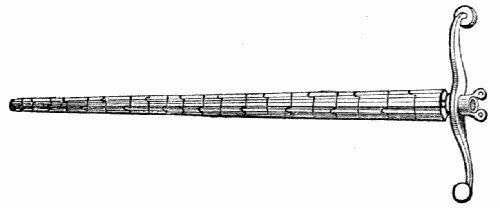
The instrument which we here engrave is a whip of steel that was made and used as an engine of punishment and torture about the middle of the sixteenth century. It is composed of several truncated cones, grooved with sharp edges, and held in opposite directions, so as to give sufficient oscillation without rising so far as to strike the hand of the executioner. It seems to have been held by a strap; but its barbarity is evident.
PUNISHING BY WHOLESALE.
Henry VIII. is recorded, in the course of his reign, to have hanged no fewer than 72,000 robbers, thieves, and vagabonds. In the latter days of Elizabeth scarcely a year passed without 300 or 400 criminals going to the gallows. In 1596, in the county of Somerset alone, 40 persons were executed, 35 burnt in the hand, and 37 severely whipped.
MONKS AND FRIARS.
There was a distinction between the Monks and Friars, which caused the latter to become the object of hatred and envy. Both the monastic, or regular, and parochial clergy, encouraged the attacks made upon them. The Monks were, by most of their rules, absolutely forbidden to go out of their monasteries, and, therefore, could receive only such donations as were left to them. On the contrary, the Friars, who were professed mendicants, on receiving notice of the sickness of any rich person, constantly detached some of their members, to persuade the sick man to bequeath alms to their convent; thus often, not only anticipating the Monks, but, likewise the parochial clergy. Besides, as most of them were professed preachers, their sermons were frequently compared with those of the clergy, and in general, not to the advantage of the latter. In these sermons, the poverty and distress of their order, were topics that, of course, were neither omitted, nor slightly passed over. Considering the power of the Church, before the Reformation, it is not to be supposed that any of the Poets, as Chaucer, &c., would have ventured to tell those rediculous stories of the Friars, with which their works abound, had they not been privately protected by the superior clergy.
CURIOUS TURKISH CONTRIVANCE.
Wonderful are the appliances by which ingenuity contrives to supply the evasions of idleness. We give one of them, as described by Mr. Albert Smith, in his "Month at Constantinople."
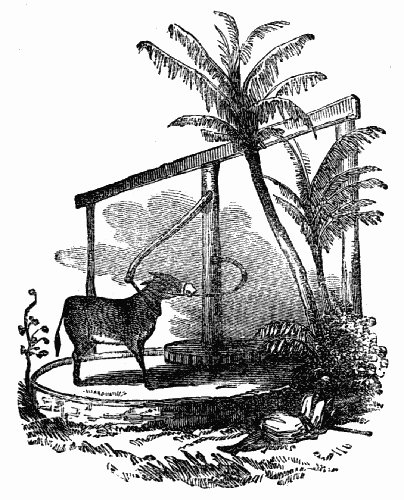
"Passing some cemeteries and public fountains, we came to the outskirts of the city, which consist chiefly of gardens producing olives, oranges, raisins and figs, irrigated by creaking water-wheels worked by donkeys. To one of these the droll contrivances which attracted our notice was affixed. The donkey who went round and round was blinded, and in front of him was a pole, one end of which was fixed to the axle and the other slightly drawn towards his head-gear and there tied: so that, from the spring he always thought somebody was pulling him on. The guide told us that idle fellows would contrive some rude mechanism so that a stick should fall upon the animal's hind quarters at every round, and so keep him at work whilst they went to sleep under the trees."
FIGURES OF DOGS ON ANCIENT TOMBS.
In attempting to assign a reason for the frequent occurrence of dogs at the feet of tombs, we shall most probably be right if we simply attribute the circumstance to the affection borne by the deceased for some animal of that faithful class. That these sculptured animals were sometimes intended for likenesses of particular dogs is evident. Sir Bryan Stapleton, on his brass at Ingham, Norfolk, rests one foot on a lion, the other on a dog; the name of the latter is recorded on a label, Jakke. Round the collar of a dog at the feet of an old stone figure of a knight, in Tolleshunt Knight's Church, Essex, letters were formerly traced which were supposed to form the word Howgo.
In a dictionary of old French terms, we find that the word Gocet means a small wooden dog, which it was customary to place at the foot of the bed. Now it has been thought that something of this kind was intended in the representation of dogs on tombs, and that this support of the feet merely indicates the old custom of having that sort of wooden resting-place for the feet when in a recumbent position. But our first supposition appears the more natural, and is supported by the fact that a large proportion of these sculptured dogs, instead of being placed beneath the feet, are seated on the robe or train, looking upwards with the confidence of favourite animals. Judith, daughter of the Emperor Conrad, is represented on her tomb (1191) with a little dog in her right hand.
On the tomb of Sir Ralph de Rochford, in Walpole Church, Norfolk, his lady is by his side, dressed in a reticulated head-dress and veil, a standing cape to her robe, long sleeves buttoned to her wrists, a quatrefoil fastens her girdle, and a double necklace of beads hangs from her neck. At her feet is a dog looking up, and another couchant. In the chancel at Shernborne, Norfolk, the figure of Sir Thomas Shernborne's lady (1458) has at the right foot a small dog sitting, with a collar of bells.