TEN THOUSAND WONDERFUL THINGS. (continued 12)
Reading edition
SACRED GARDENS.
The origin of sacred gardens among the heathen nations may be traced up to the garden of Eden. The gardens of the Hesperides, of Adonis, of Flora, were famous among the Greeks and Romans. "The garden of Flora," says Mr. Spence (Polymetis, p. 251), "I take to have been the Paradise in the Roman mythology. The traditions and traces of Paradise among the ancients must be expected to have grown fainter and fainter in every transfusion from one people to another. The Romans probably derived their notions of it from the Greeks, among whom this idea seems to have been shadowed out under the stories of the gardens of Alcinous. In Africa they had the gardens of the Hesperides, and in the East those of Adonis, or the Horti Adonis, as Pliny calls them. The term Horti Adonides was used by the ancients to signify gardens of pleasure, which answers to the very name of Paradise, or the garden of Eden, as Horti Adonis does to the garden of the Lord."
ANCIENT CHAIR OF DAGOBERT.
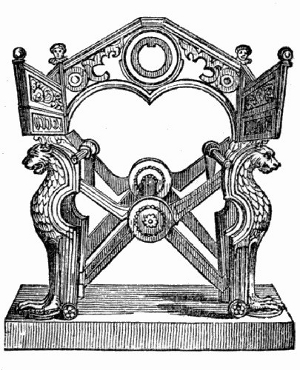
The chair which we here engrave claims to be regarded as a great curiosity, on two separate grounds: it is the work of an artist who was afterwards canonized, and it was used by Napoleon I. on a most important occasion. Towards the close of the sixth century the artists of France were highly successful in goldsmith's work, and Limoges appears to have been the principal centre of this industry. It was at this time that Abbon flourished—a goldsmith and mint-master, with whom was placed the young Eloy, who rose from a simple artizan to be the most remarkable man of his century, and whose virtues were rewarded by canonization. The apprentice soon excelled his master, and his fame caused him to be summoned to the throne of Clotaire II., for whom he made two thrones of gold, enriched with precious stones, from a model made by the king himself, who had not been able to find workmen sufficiently skilful to execute it. The talents and probity of St. Eloy also gained him the affection of Dagobert I., who entrusted him with many important works, and among them, with the construction of the throne, or chair of state which is the subject of this article. It is made of bronze, carved and gilded, and is a beautiful specimen of workmanship. The occupant of the chair would sit upon a cloth of gold suspended from the two side bars. For a long time it was preserved in the sacristy of the royal church of St. Denis, at Paris; but it was subsequently removed to the Great Library, where it now is. It was upon this chair that Napoleon I., in August, 1804, distributed the crosses of the Legion of Honour to the soldiers of the army assembled at Boulogne for the invasion of England. Napoleon caused the chair to be brought from Paris for the express purpose.
ST GEORGE'S CAVERN.
Near the town of Moldavia, on the Danube, is shown the cavern where St. George slew the Dragon, from which, at certain periods, issue myriads of small flies, which tradition reports to proceed from the carcass of the dragon. They respect neither man nor beast, and are so destructive that oxen and horses have been killed by them. They are called the Golubacz's fly. It is thought when the Danube rises, as it does in the early part of the summer, the caverns are flooded, and the water remaining in them, and becoming putrid, produces this noxious fly. But this supposition appears to be worthless, because, some years ago, the natives closed up the caverns, and still they were annoyed with the flies. They nearly resemble mosquitoes. In summer they appear in such swarms as to look like a volume of smoke; and they sometimes cover a space of six or seven miles. Covered with these insects, horses not unfrequently gallop about until death puts an end to their sufferings. Shepherds anoint their hands with a decoction of wormwood, and keep large fires burning to protect themselves from them. Upon any material change in the weather the whole swarm is destroyed thereby.
ENGLISH LETTER BY VOLTAIRE.
The subjoined letter is copied literally from the autograph of Voltaire, formerly in the possession of the Rev. Mr. Sim, the editor of Mickle's Poems:—
"Sir,
"j wish you good health, a quick sale of yr burgundy, much latin, and greeke to one of yr Children, much Law, much of cooke, and littleton, to the other. quiet and joy to mistress brinsden, money to all. when you'll drink yr burgundy with mr furneze pray tell him j'll never forget his favours.
But dear john be so kind as to let me know how does my lady Bollingbroke. as to my lord j left him so well j dont doubt he is so still. but j am very uneasie about my lady. if she might have as much health as she has Spirit and witt, sure She would be the strongest body in england. pray dear sr write me Something of her, of my lord, and of you. direct yr letter by the penny post at mr Cavalier, Belitery Square by the R. exchange. j am sincerely and heartily yr most humble most obedient rambling friend
"Voltaire.
"to "john Brinsden, esq. "durham's yard "by charing cross."
THE GOLDEN CHALICE OF IONA.
A chalice, as used in sacred ceremonies, is figured on various early Scottish ecclesiastical seals, as well as on sepulchral slabs and other medieval sculptures. But an original Scottish chalice, a relic of the venerable abbey of St. Columba, presented, till a very few years since, an older example of the sacred vessels of the altar than is indicated in any existing memorial of the medieval Church. The later history of this venerable relic is replete with interest. It was of fine gold, of a very simple form, and ornamented in a style that gave evidence of its belonging to a very early period. It was transferred from the possession of Sir Lauchlan MacLean to the Glengarry family, in the time of Æneas, afterwards created by Charles II. Lord Macdonell and Arross, under the circumstances narrated in the following letter from a cousin of the celebrated Marshal Macdonald, Duke of Tarentum, and communicated by a clergyman (Rev. Æneas M'Donell Dawson), who obtained it from the family of the gentleman to whom it was originally addressed:—
"The following anecdote I heard from the late bishop, John Chisholm, and from Mr. John M'Eachan, uncle to the Duke of Tarentum, who died at my house at Irin Moidart, aged upwards of one hundred years:—
"Maclean of Duart, expecting an invasion of his lands in Mull, by his powerful neighbour the Earl of Argyll, applied to Glengarry for assistance. Æneas of Glengarry marched at the head of five hundred men to Ardtornish, nearly opposite to Duart Castle, and crossing with a few of his officers to arrange the passage of the men across the Sound of Mull, Maclean, rejoicing at the arrival of such a friend, offered some choice wine in a golden chalice, part of the plunder of Iona. Glengarry was struck with horror, and said, folding his handkerchief about the chalice, 'Maclean, I came here to defend you against mortal enemies, but since, by sacrilege and profanation, you have made God your enemy, no human means can serve you.' Glengarry returned to his men, and Maclean sent the chalice and some other pieces of plate belonging to the service of the altar, with a deputation of his friends, to persuade him to join him; but he marched home. His example was followed by several other chiefs, and poor Maclean was left to compete, single-handed, with his powerful enemy."
Such was the last historical incident connected with the golden chalice of Iona, perhaps, without exception, the most interesting ecclesiastical relic which Scotland possessed. Unfortunately its later history only finds a parallel in that of the celebrated Danish golden horns. It was preserved in the charter-chest of Glengarry, until it was presented by the late Chief to Bishop Ronald M'Donald, on whose demise it came into the possession of his successor, Dr. Scott, Bishop of Glasgow. Only a few years since the sacristy of St. Mary's Roman Catholic Church in that city, where it was preserved was broken into, and before the police could obtain a clue to the depredators, the golden relic of Iona was no longer a chalice. Thus perished, by the hands of a common felon, a memorial of the spot consecrated by the labours of some of the earliest Christian missionaries to the Pagan Caledonians, and which had probably survived the vicissitudes of upwards of ten centuries. In reply to inquiries made as to the existence of any drawing of the chalice, or even the possibility of a trustworthy sketch being executed from memory, a gentleman in Glasgow writes:—"I have no means of getting even a sketch from which to make a drawing. Were I a good hand myself, I could easily furnish one, having often examined it. It was a chalice that no one could look on without being convinced of its very great antiquity. The workmanship was rude, the ornamental drawings or engravings even more hard than medieval ones in their outlines, and the cup bore marks of the original hammering which had beaten it into shape."
NEW MODE OF REVENGE.
Monkeys in India are more or less objects of superstitious reverence, and are, consequently, seldom or ever destroyed. In some places they are even fed, encouraged, and allowed to live on the roofs of the houses. If a man wish to revenge himself for any injury committed upon him, he has only to sprinkle some rice or corn upon the top of his enemy's house, or granary, just before the rains set in, and the monkeys will assemble upon it, eat all they can find outside, and then pull off the tiles to get at that which falls through the crevices. This, of course, gives access to the torrents which fall in such countries, and house, furniture, and stores are all ruined.
CURIOUS SUPERSTITION.
The ring of which we here give a sketch has been selected by us as a subject for engraving and comment, because it embodies a curious superstition which was very prevalent in England in the fifteenth and sixteenth centuries.
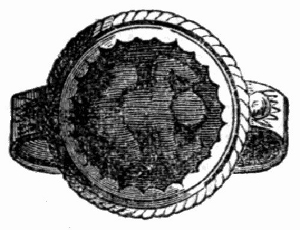
The setting is of silver, and the jewel which it carries is called a toadstone. This stone was popularly believed to be formed in the heads of very old toads, and it was eagerly coveted by sovereigns, and by all persons in high office, because it was supposed to have the power of indicating to the person who wore it the proximity of poison, by perspiring and changing colour. Fenton, who wrote in 1569, says—"There is to be found in the heads of old and great toads a stone they call borax or stelon;" and he adds—"They, being used as rings, give forewarning against venom." Their composition is not actually known; by some they are thought to be a stone—by others, a shell; but of whatever they may be formed, there is to be seen in them, as may be noticed in the engraving, a figure resembling that of a toad, but whether produced accidentally or by artificial means is not known, though, according to Albertus Magnus, the stone always bore the figure on its surface, at the time it was taken out of the toad's head. Lupton, in his "1000 Notable Things," says—"A toadstone, called crepaudina, touching any part envenomed, hurt, or stung with rat, spider, wasp, or any other venomous beast, ceases the pain or swelling thereof." The well known lines in Shakespeare are doubtless in allusion to the virtue which Lupton says it possesses:—
"Sweet are the uses of adversity; Which like a toad, ugly and venomous, Wears yet a precious jewel in his head."
Ben Jonson also in the Fox, has,—
"Were you enamoured on his copper rings, His saffron jewel, with the loadstone in't?"
And Lyly, in his Euphues—
"The foule toad hath a faire stone in his head."
The ring we have engraved is a work of the fifteenth century; it forms one of the many rare curiosities of the Londesborough Collection, and is considered to be a very perfect specimen.
ANCIENT ARMLET.
In May, 1840, some workmen were employed at Everdale, near Preston, in carrying earth to replace the soil which had been washed away from behind a wall formerly built to protect the banks of the river Ribble. In digging for this purpose, they discovered, at a distance of about forty yards from the banks, a great number of articles, consisting of ingots of silver, a few ornaments, some silver armlets, and a large quantity of coins. An attentive examination of all these, and especially of the coins, leads to the conclusion that this mass of treasure was deposited about the year 910, and the articles must be considered such as were worn at the time of King Alfred, or perhaps somewhat earlier.
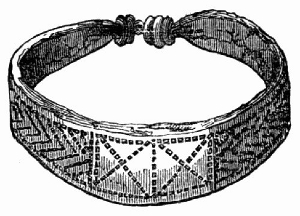
The armlets, which were all of silver, vary in breadth from a quarter of an inch to an inch and a quarter, and perhaps more. They are generally ornamented, and almost all the ornaments are produced by punching with tools of various forms. The patterns are numerous, but the forms of the punches are very few, the variations being produced by combining the forms of more punches than one, or by placing the same or differently-formed punches at a greater or less distance from each other, or by varying their direction. In the specimen which we have here engraved the punch has had a small square end, and the ornament is formed by a series of blows in transverse or oblique lines. Patterns of the period and localities to which these ornaments belong are scarcely ever found finished by casting or chasing. It would appear, also that the use of solder to unite the various parts of objects was either little known or little practised; for the ends of these ornaments are tied together, and, upon other occasions where union is necessary, rivets are employed.
CHINESE MIRRORS.
There is a puzzling property in many of the Chinese mirrors which deserves particular notice, and we may give it, together with the solution furnished by Sir David Brewster:—"The mirror has a knob in the centre of the back, by which it can be held, and on the rest of the back are stamped in relief certain circles with a kind of Grecian border. Its polished surface has that degree of convexity which gives an image of the face half its natural size; and its remarkable property is, that, when you reflect the rays of the sun from the polished surface, the image of the ornamental border and circles stamped upon the back, is seen distinctly reflected on the wall," or on a sheet of paper. The metal of which the mirror is made appears to be what is called Chinese silver, a composition of tin and copper, like the metal for the specula of reflecting telescopes. The metal is very sonorous. The mirror has a rim (at the back) of about 1-4th or 1-6th of an inch broad, and the inner part, upon which the figures are stamped, is considerably thinner.
"Like all other conjurors (says Sir David Brewster), the artist has contrived to make the observer deceive himself. The stamped figures on the back are used for this purpose. The spectrum in the luminous area is not an image of the figures on the back. The figures are a copy of the picture which the artist has drawn on the face of the mirror, and so concealed by polishing, that it is invisible in ordinary lights, and can be brought out only in the sun's rays. Let it be required, for example, to produce the dragon as exhibited by one of the Chinese mirrors. When the surface of the mirror is ready for polishing, the figure of the dragon may be delineated upon it in extremely shallow lines, or it may be eaten out by an acid much diluted, so as to remove the smallest possible portion of the metal. The surface must then be highly polished, not upon pitch, like glass and specula, because this would polish away the figure, but upon cloth, in the way that lenses are sometimes polished. In this way the sunk part of the shallow lines will be as highly polished as the rest, and the figure will only be visible in very strong lights, by reflecting the sun's rays from the metallic surface."
THE CADENHAM OAK.
Amongst the many remarkable trees in the New Forest in Hampshire, is one called the Cadenham Oak, which buds every year in the depth of winter. Gilpin says, "Having often heard of this oak, I took a ride to see it on the 29th of December, 1781. It was pointed out to me among several other oaks, surrounded by a little forest stream, winding round a knoll on which they stood. It is a tall straight plant, of no great age, and apparently vigorous, except that its top has been injured, from which several branches issue in the form of pollard shoots. It was entirely bare of leaves, as far as I could discern, when I saw it, and undistinguishable from the other oaks in its neighbourhood, except that its bark seemed rather smoother, occasioned, I apprehended, only by frequent climbing. Having had the account of its early budding confirmed on the spot, I engaged one Michael Lawrence, who kept the White Hart, a small alehouse in the neighbourhood, to send me some of the leaves to Vicar's Hill, as soon as they should appear. The man, who had not the least doubt about the matter, kept his word, and sent me several twigs on the morning of the 5th of January, 1782, a few hours after they had been gathered. The leaves were fairly expanded, and about an inch in length. From some of the buds two leaves had unsheathed themselves, but in general only one. One of its progeny, which grew in the gardens at Bulstrode, had its flower buds perfectly formed so early as the 21st of December, 1781.
"This early spring, however, of the Cadenham oak, is of very short duration. The buds, after unfolding themselves, make no further progress, but immediately shrink from the season and die. The tree continues torpid, like other deciduous trees, during the remainder of the winter, and vegetates again in the spring, at the usual season. I have seen it in full leaf in the middle of the summer, when it appeared, both in its form and foliage, exactly like other oaks."
Dean Wren, speaking of this tree, says, "King James could not be induced to believe the [Greek: to toi] (reason) of this, till Bishop Andrewes, in whose diocese the tree grew, caused one of his own chaplaines, a man of known integritye, to give a true information of itt, which he did; for upon the eve of the Nativitye he gathered about a hundred slips, with the leaves newly opened, which he stuck in claye in the bottom of long white boxes, and soe sent them post to the courte, where they deservedly raised not only admiration, but stopt the mouth of infidelitye and contradiction for ever. Of this I was both an eye-witness, and did distribute many of them to the great persons of both sexes in court and others, ecclesiastical persons. But in these last troublesome times a divelish fellow (of Herostratus humour) having hewen itt round at the roote, made his last stroke on his own legg, whereof he died, together with the old wondrous tree; which now sproutes up againe, and may renew his oakye age againe, iff some such envious chance doe not hinder or prevent itt; from which the example of the former villaine may perchance deterr the attempt. This I thought to testifie to all future times, and therefore subscribe with the same hand through which those little oakye slips past."
SCHOOL EXPENSES IN THE OLDEN TIME.
Of the expenses incurred for schoolboys at Eton early in the reign of Elizabeth, we find some curious particulars in a manuscript of the time: the boys were sons of Sir William Cavendish, of Chatsworth, and the entries are worth notice, as showing the manners of those days. Among the items, a breast of roast mutton is charged ten-pence; a small chicken, fourpence; a week's board, five shillings each; besides the wood burned in their chamber; to an old woman for sweeping and cleaning the chamber, twopence; mending a shoe, one penny; three candles, nine-pence; a book, Esop's Fables, fourpence; two pair of shoes, sixteen-pence; two bunches of wax lights, one penny; the sum total of the payments, including board paid to the bursars of Eton College, living expenses for the two boys and their man, clothes, books, washing, &c., amounts to twelve pounds twelve shillings and seven-pence. The expense of a scholar at the university in 1514 was but five pounds annually, affording as much accommodation as would cost sixty pounds, though the accommodation would be far short of that now customary at Eton.
AN EVENTFUL LIFE.
It is much to be feared that on the field of battle and naval actions many individuals, apparently dead, are buried or thrown overboard. The history of François de Civille, a French captain, who was missing at the siege of Rouen, is rather curious. At the storming of the town he was supposed to have been killed, and was thrown, with other bodies, in the ditch, where he remained from eleven in the morning to half-past six in the evening; when his servant, observing some latent heat, carried the body into the house. For five days and five nights his master did not exhibit the slightest sign of life, although the body gradually recovered its warmth. At the expiration of this time, the town was carried by assault, and the servants of an officer belonging to the besiegers, having found the supposed corpse of Civille, threw it out of the window, with no other covering than his shirt. Fortunately for the captain, he had fallen upon a dunghill, where he remained senseless for three days longer, when his body was taken up by his relatives for sepulture, and ultimately brought to life. What was still more strange, Civille, like Macduff, had "been from his mother's womb untimely ripp'd," having been brought into the world by a Cæsarean operation, which his mother did not survive; and after his last wonderful escape he used to sign his name with the addition of "three times born, three times buried, and three times risen from the dead by the grace of God."
FIRST BRIDGE OVER THE THAMES.
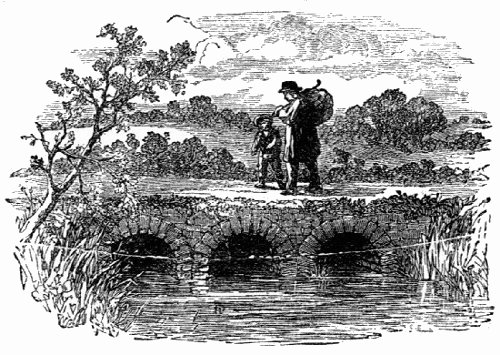
The humble village bridge which we here engrave is well deserving of a place in our pages as being the first of that grand series of bridges whose last member is London-bridge. What a contrast between the first bridge over the Thames and the last! Thames Head, where the river rises, is in the county of Gloucester, but so near to its southern border, that the stream, after meandering a mile or two, enters Wiltshire, near the village of Kemble. On leaving this village, and proceeding on the main road towards the rustic hamlet of Ewen, the traveller passes over the bridge which forms the subject of our woodcut. It has no parapet, and is level with the road, the water running through three narrow arches. Such is the first bridge over the mighty Thames.
THE VENETIANS.
The Venetians were the first people in Italy who had printed books. They originated a Gazette in the year 1600, and the example was followed at Oxford in 1667, and at Vienna in 1700. They also undertook the discovery of America, and the passage to India by the Cape of Good Hope.
MEDMENHAM ABBEY.
On descending the river Thames, from Henley, after passing Culham Court and Hambledon Lock, the adjacent country become exceedingly beautiful, varied by alternate mills, islands, meadows, and hills, with every now and then ornamental forest trees hanging over the stream, and giving pleasant shade to the current on its downward flow. The wood of Medmenham soon comes in sight; the ruined Abbey is seen among the trees, and close beside it is a pretty ferry, with the pleasant wayside inn of Mrs. Bitmead—a domicile well known to artists, her frequent guests, one of whom, who has since become famous, painted a sign-board which hangs over the door, and is of so good a quality that it might grace the exhibition of the Royal Academy. The Abbey has been pictured a hundred times, and is a capital subject seen from any point of view; the river runs close beside it; there is a hill adjacent—Dane's Hill; dark woods and green meadows are at hand; gay boats and traffic barges are continually passing; the ferry is always picturesque, and the artist is constantly supplied on the spot with themes for pictures; especially he has before him the venerable ruin—"venerable," at least, as far as the eye is concerned. Time has touched it leniently; some of its best "bits" are as they were a century ago, except that the lichens have given to them that rich clothing of grey and gold which the painter ever loves, and added to it, here and there, a green drapery of ivy.
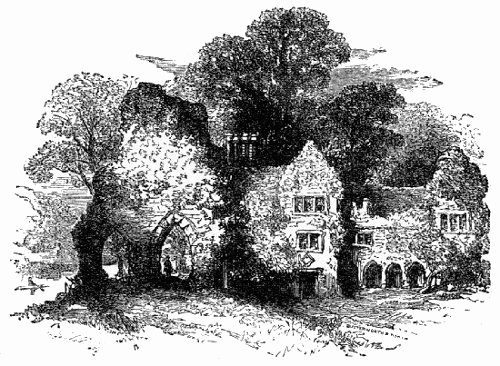
The manor of Medmenham was, in the reign of King Stephen, given by its lord, Walter de Bolebec, to the Abbey of Cistercian Monks he had founded at Woburn in Bedfordshire; and in 1204 the monks placed some of their society here, on this pleasant bank of the Thames. Here arose a small monastery, being rather—as the writers of the order express themselves—"a daughter than a cell to Woburn." In 1536 it was annexed to Bisham. At the Dissolution, according to returns made by the commissioners, "the clear value of this religious house was 20l. 6s.; it had two monks designing to go to houses of religion; servants, none; woods, none; debts, none; its bells worth 2l. 1s. 8d.; the value of its moveable goods 1l. 3s. 8d.; and the house wholly in ruin." It must have undergone considerable repair early in the sixteenth century, and probably very little of the original structure now exists, although relics of antiquity may be traced in many of its remains. That portion which fronts the Thames is kept in proper repair, and a large room is used for the convenience of pleasure parties. The property belongs to the Scots of Danesfield, a mansion that crowns a neighbouring hill. Medmenham derives notoriety from events of more recent date than the occupation of its monks, without goods and without debt. Here, about the middle of the last century, was established, a society of men of wit and fashion, who assumed the title of the Monks of St. Francis, and wore the habit of the Franciscan order. Although it is said that the statements contained in a now forgotten but once popular novel—"Chrysal; or the Adventures of a Guinea,"—were exaggerated, the character which the assumed monks bore in the open world was sufficiently notorious to justify the worst suspicions of their acts in this comparative solitude. Their principal members were Sir Francis Dashwood (afterwards Lord Le Despencer), the Earl of Sandwich, John Wilks, Bubb Doddington, Churchill, and Paul Whitehead, the poet. The motto—"Fay ce que voudras," indicative of the principle on which the society was founded—still remains over the doorway of the Abbey House. Tradition yet preserves some anecdotes illustrative of the habits of the "order," and there can be little doubt that this now lonely and quiet spot was the scene of orgies that were infamous.
PERSECUTION.
Grotius, an historian celebrated for moderation and caution, has computed that in the several persecutions promoted by Charles V., no less than a hundred thousand persons perished by the hands of the executioner. In the Netherlands alone, from the time that his edict against the reformers was promulgated, he states that there had been fifty thousand persons hanged, beheaded, buried alive, or burned, on account of their religion. Indeed, during the reign of Philip the Second, the Duke of Alva boasted that in the space of nine years he had destroyed, in the Low Countries, 36,000 persons by the hands of the executioner alone. At the massacre of Paris, on the feast of St. Bartholomew, King Charles the Ninth of France assisted in person, and boasted that he had sacrificed in one night 10,000 of his subjects; for that massacre the Pope had "Te Deum" sung in the chapel of the Vatican and issued a bull for a jubilee to be celebrated throughout France on the 7th December, 1512, in commemoration of what he termed the happy success of the king against his heretic subjects, and concluded by writing with his own hand a letter to Charles the Ninth, exhorting him to pursue this salutary and blessed enterprise. In the short reign of Queen Mary, there were in this realm burned at the stake one archbishop, four bishops, twenty-one ministers, and nearly three hundred persons of all classes, of whom fifty-five were women, and four were children, one of whom sprang from its mother's womb while she was consuming, and was flung into the flames by the spectators. In 1640 the same spirit of papal bigotry occasioned in Ireland the butchery of 40,000 Protestants, under circumstances of aggravated atrocity which a Christian will shudder to peruse. Lewis XIV., the most Christian king and eldest son of the church, starved a million Huguenots at home, and sent another million grazing in foreign countries.
INNKEEPER'S BILL IN 1762.
The following innkeeper's bill was sent in to the Duke de Nivernois, who supped and breakfasted at an inn in Canterbury, in 1762; and considering the value of money at that time, must be deemed extremely moderate:—
£ s. d.
Tea, coffee, and chocolate 1 4 0
Supper for self and servant 15 10 0
Bread and beer 3 0 0
Fruit 2 15 0
Wine and punch 10 8 8
Wax candles and charcoal 3 0 0
Broken glass and china 2 10 0
Lodging 1 7 0
Tea, coffee, and chocolate 2 0 0
Chaise and horse, for next stage 2 16 0
There were only twelve persons in the whole company.
SPONTANEOUS COMBUSTION.
Joseph Battaglia, a surgeon of Ponte Bosio, relates the following case: Don. G. Maria Bertholi, a priest of Mount Valerius, went to the fair of Filetto, and afterwards visited a relation in Fenilo, where he intended to pass the night. Before retiring to rest, he was left reading his breviary; when, shortly afterwards, the family were alarmed by his loud cries and a strange noise in his chamber. On opening the door, he was lying prostrate on the floor, and surrounded by flickering flames. Battaglia was immediately sent for, and on his arrival the unfortunate man was found in a most deplorable state. The integuments of the arms and the back were either consumed or detached in hanging flaps. The sufferer was sufficiently sensible to give an account of himself. He said that he felt, all of a sudden, as if his arm had received a violent blow from a club, and at the same time he saw scintillations of fire rising from his shirt-sleeves, which were consumed without having burned the wrists; a handkerchief, which he had tied round his shoulders, between the shirt and the skin, was intact. His drawers were also sound; but, strange to say, his silk skull-cap was burnt while his hair bore no marks of combustion. The unfortunate man only survived the event four days. The circumstances which attended this case would seem to warrant the conclusion that the electric fluid was the chief agent in the combustion.
SHOOTING FISH.
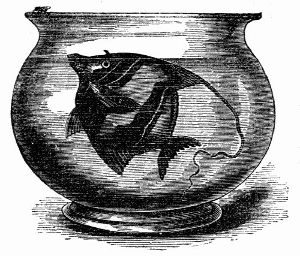
HORNED CHÆTODON.
Our shores have produced a few specimens of a richly-coloured fish called Ray's Sea Bream (Brama Rayi), interesting because it represents a family, almost confined to the tropical seas, of very singular forms and habits. The family is named Chætodontidæ, from the principal genus in it. They are very high perpendicularly, but thin and flattened sidewise; the mouth in some projects into a sort of snout, the fins are frequently much elevated, and send off long filaments. They are generally adorned with highly-contrasted colours, which run in perpendicular bands. They are often called scaly-finned fishes, because the dorsal and anal are clothed, at least in part, with scales, so as not to be distinguished from the body. The tubular snout of some, as of a little species which we here represent, is applied to an extraordinary use, that of shooting flies! The fish approaches under a fly which it has discovered, resting on a leaf or twig, a few feet above the water, taking care not to alarm it by too sudden a motion; then, projecting the tip of its beak from the surface, it shoots a single drop at the insect with so clever an aim, as very rarely to miss it, when it falls into the water and is devoured. Being common in the Indian seas, it is often kept by the Chinese in vases, as we keep golden-fish, for the amusement of witnessing this feat. A fly is fastened at some distance, at which the fish shoots, but, disappointed of course, and wondering that its prey does not fall, it goes on to repeat the discharge for many times in succession, without seeming to take in a fresh stock of ammunition, and scarcely ever missing the mark, though at a distance of three or four feet.
EXTRAORDINARY EARTHQUAKES.
Around the Papandayang, one of the loftiest mountains in Java, no less than forty villages were reposing in peace. But in August 1772, a remarkable luminous cloud enveloping its top aroused them from their security. But it was too late; for at once the mountain began to sink into the earth, and soon it had disappeared, with the forty villages and most of the inhabitants, over a space fifteen miles long and six broad. Still more extraordinary, the most remarkable on record was an eruption in Sumbawa, one of the Molucca islands, in 1815. It began on the fifth day of April, and did not cease till July. The explosions were heard in one direction nine hundred and seventy miles, and in another seven hundred and twenty miles. So heavy was the fall of ashes at the distance of forty miles that houses were crushed and destroyed. The floating cinders in the ocean, hundreds of miles distant, were two feet thick, and vessels were forced through with difficulty. The darkness in Java, three hundred miles distant, was deeper than the blackest night; and, finally, out of the twelve thousand inhabitants of the island, only twenty-six survived the catastrophe.
BEAUTIFUL ARCH.
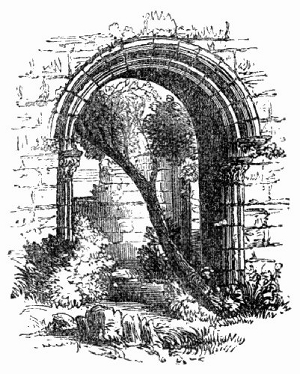
One of the rarities of architecture is the beautiful arch in the choir of Cannistown Church, not far from Bective, near Trim, in Ireland. Down to the very latest period of Gothic architecture, the original plan of a simple nave, or nave and chancel, was followed, and the chief or only difference observable in churches of very late date, from those of the sixth and seventh centuries, consists in the form of the arch-heads, the position of the doorway, the style of the masonry, which is usually much better in the more ancient examples, and the use of bell-turrets, the cloigeteach, or detached round tower, having answered this purpose during the earlier ages. A beautiful and highly characteristic example of an early pointed church is that at Cannistown. As usual, it consists of a nave and chancel, and there are the remains of a bell-turret upon the west gable, the usual position. The choir arch is represented in the annexed cut.
There are numerous examples of churches of this style scattered over Ireland, but they are usually plain, and the choir arch is generally the plainest feature in the building. As example, we can refer our readers to the churches of Kilbarrack, Dalkey, Kinsale, and Rathmichael, all in the immediate neighbourhood of Dublin.
THOMAS CONECTE.
There was a Carmelite friar, Thomas Conecte, who, previous to his being burnt as a heretic at Rome, in 1434, excited the admiration of all Flanders by his vehement sermons against the luxury of the women. His satire was chiefly levelled against their head-dresses, which rose to so enormous a height, that the most exalted head-dresses of a late day were but dwarfs to them. Juvenal des Ursins, who lived at that period, declares that, notwithstanding the troubles of the times, the maidens and married ladies rose to prodigious excess in their attire, and wore hair of a surprising height and breadth, having on each side two ears of so unaccountable a size, that it was impossible for them to pass through a door. Their dresses were the hennins of Flanders, which the worthy Carmelite was so inveterate against. He made them dress themselves in a more modest manner. But, alas no sooner had Friar Thomas left the country than the head-dresses shot up to a greater height than ever. They had only bowed their heads like bullrushes during the storm. Poor Thomas attacked the infallible church itself, and they, in default of better arguments, burnt him.
CURIOUS COINCIDENCES.
On the 21st of April, 1770, Lewis XVI. was married.
21st of June, 1770, fifteen hundred people were trampled to death at the fête.
21st of January, 1782, fête for the birth of the Dauphin.
21st of June, 1791, the flight to Varennes.
21st of September, 1792, the abolition of royalty.
21st of January, 1793, the unfortunate monarch's decapitation.
AMPHITHEATRES.
The deficiency of theatres erected by the Romans is far more than compensated by the number and splendour of their amphitheatres, which, with their baths, may be considered as the true types of Roman art. It seems almost certain that they derived this class of public buildings from the Etruscans. At Sutri there is a very noble one cut out of the tufa rock, which was no doubt used by that people for festal representations long before Rome attempted anything of the kind. It is uncertain whether gladiatorial fights or combats of wild beasts formed any part of the amusements of the arena in those days, though boxing, wrestling, and contests of that description certainly did; but whether the Etruscans actually proceeded to the shedding of blood and slaughter is more than doubtful.
Even in the remotest parts of Britain, in Germany, and Gaul, wherever we find a Roman settlement, we find the traces of their amphitheatres. Their soldiery, it seems, could not exist without the enjoyment of seeing men engage in doubtful and mortal combats—either killing one another, or torn to pieces by wild beasts. It is not to be wondered at that a people who delighted so much in the bloody scenes of the arena should feel but very little pleasure in the mimic sorrows and tame humour of the stage. It fitted them, it is true, to be a nation of conquerors, and gave them the empire of the world, but it brought with it feelings singularly inimical to all the softer arts, and was perhaps the great cause of their debasement.
As might be expected, the largest and most splendid of these buildings is that which adorns the capital; and of all the ruins which Rome contains, none have excited such universal admiration as the Flavian amphitheatre. Poets, painters, rhapsodists, have exhausted all the resources of their arts in the attempt to convey to others the overpowering impression this building produces on their own minds. With the single exception, perhaps, of the Hall at Karnac, no ruin has met with such universal admiration as this. Its association with the ancient mistress of the world, its destruction, and the half-prophetic destiny ascribed to it, all contribute to this. Still it must be confessed that
"The gladiator's bloody circus stands A noble wreck in ruinous perfection,"
and worthy of all or nearly all the admiration of which it has been the object. Its interior is almost wholly devoid of ornament, or anything that can be called architecture—a vast inverted pyramid. The exterior does not possess one detail which is not open to criticism, and indeed to positive blame. Notwithstanding all this, its mass, its form, and its associations, all combine to produce an effect against which the critic struggles in vain.
The length of the building, measured along its greatest diameter, is 620 ft., its breadth 513, or nearly in the ratio of 6 to 5, which may be taken as the general proportion of these buildings, the variations from it being slight, and apparently either mistakes in setting out the work in ancient times, or in measuring it in modern days, rather than an intentional deviation. The height of the 3 lower stories is 120 ft.; the total height as it now stands, 157 ft. The arena itself measures 287 ft. in length by 180 in breadth, and it is calculated that the building would contain 80,000 spectators; 50,000 or 60,000 would be much nearer the truth, at least according to the data by which space is calculated in our theatres and public places.
HUNDRED FAMILIES' LOCK.
A common Chinese talisman is the "hundred families' lock," to procure which a father goes round among his friends, and, having obtained from a hundred different parties a few of the copper coins of the country, he himself adds the balance, to purchase an ornament or appendage fashioned like a lock, which he hangs on his child's neck, for the purpose of locking him figuratively to life, and making the hundred persons concerned in his attaining old age.
THE DUKE DE REICHSTADT.
At the Imperial Palace of Schönbrun, about five English miles from Vienna, is shown the window fractured by the bullet of the enthusiastic student who shot at Napoleon while he was reviewing the Imperial Guard, and also the apartment he occupied when he made this his head-quarters, instead of entering the city. An additional interest is imparted to the place, by the circumstance of the Duke de Reichstadt having, when taken ill, chosen the identical chamber and spot in which his father Napoleon had slept, to close his mortal career: and by a singular coincidence, the remains of the young prince were subjected to a post-mortem examination upon the same table at which the Emperor had held his councils. In imitation of the military hardihood of his sire, the young duke was in the habit of exposing himself to all weathers, and keeping guard during successive nights, a practice which often called forth from his surgeon, Dr. Malfati, the expressive words, 'Rappelez vous, mon Prince, que vouz avez un Cœur de Fer dans un Corp de Verre.'
MARY QUEEN OF SCOTS' CANDLESTICK.
Almost every article, however trifling its intrinsic value, and however homely its appearance, which once belonged to a celebrated individual, is always regarded as an object of interest, and we have, therefore, no hesitation in presenting our readers with the annexed engraving of one of a pair of candlesticks which were once the property of the unfortunate Mary, Queen of Scots.
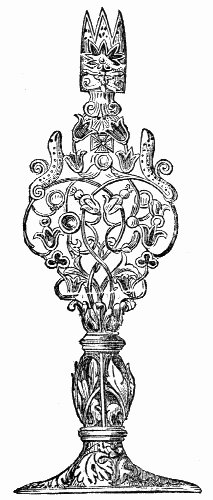
They are made of brass, each of them of eleven and a-half inches in height. They are of French manufacture; the sunk parts are filled up with an inlay of blue, green, and white enamel, very similar to that done at Limoge. These extremely elegant and curious articles are the property of Lord Holland, and are preserved at Holland House, Kensington.
Holland House is associated "with the costly magnificence of Rich, with the loves of Ormond, the councils of Cromwell, and the death of Addison." It has been for nearly two centuries and a-half the favourite resort of wits and beauties, of painters and poets, of scholars, philosophers, and statesmen. In the lifetime of the late Lord Holland, it was the meeting-place of "the Whig Party;" and his liberal hospitality made it "the resort, not only of the most interesting persons composing English society—literary, philosophical, and political, but also to all belonging to those classes who ever visited this country from abroad."
EXTRAORDINARY INSTANCES OF INHUMANITY.
In 1534, in the wars of Edward III. with France, Fordun relates that a Frenchman purchased from the Scots several English prisoners, and that he beheaded them to avenge the death of his father. This sentimental cruelty can perhaps be paralleled by that of Coccinas, who, at the massacre of Paris, bought many Huguenots, that he might torture them to death for his private satisfaction. Philip Galeas Visconti, Duke of Milan, was a man of a nature so timid, that thunder threw him into agonies; yet was he so inhuman, that he could enjoy the shrieks of a female stretched upon a rack. Wenceslaus, the German Emperor, say Mezeray, Voltaire, and others, roasted his cook alive, for dressing his dinner amiss; and never had so intimate a friend in Prague as the common executioner; and even him he put to death at last, for not taking him at his word, when he once had bid him cut his head off, and actually knelt down to receive the stroke.
ANCIENT ROMAN LAMPS.
The earliest lamps fabricated by the potters of ancient Rome have an open circular body, with a curved projecting rim to prevent the oil from spilling, and occur both in terra-cotta, and also in the black glazed ware found in the sepulchres of Nola. Many have a projecting hollow pipe in the centre, in order to fix them to a stick on the top of a candelabrum. These lamps have no handles. They may have been placed in the sacella or lararia, and were turned on the potter's wheel.
The shoe-shaped is the most usual, with a round body, a projecting spout or nozzle having a hole for the wick, and a small annular handle, which is more or less raised.
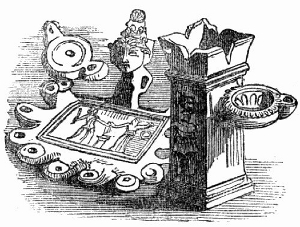
A singular variety of lamp, well adapted for a table, was fitted into a kind of small altar, the sides of which were ornamented with reliefs. Several however, from their unusual shape, maybe considered as fancy ware, the upper part, or the whole lamp, being moulded into the resemblance of some object. Such are lamps in the British Museum in the shape of a female head surmounted by a flower, or of the head of a negro or Nubian with open jaws, through which the wick was inserted.
Most of these lamps appear to have been made between the age of Augustus and that of Constantine. The style, of course best at the earlier period of the empire, degenerates under the later emperors, such as Philip and Maximus, and becomes at last Byzantine and bad.
Most lamps had only one wick, but the light they afforded must have been feeble, and consequently some have two wicks, the nozzle for which project beyond the body of the lamp. In the same manner were fabricated lamps of three, five, and seven wicks. If more were required the nozzles did not project far beyond the body of the lamp, which was then moulded in a shape adapted for the purpose, and especially the favourite one of a galley. Sometimes a conglomeration of small lamps was manufactured in a row, or in a serrated shape, which enabled the purchaser to obtain what light he required; still the amount of illumination must have been feeble. As many as twenty wicks have been found in some lamps.
The greater number average from three to four inches long, and one inch high; the walls are about one-eighth of an inch thick, and the circular handles not more than one inch in diameter. Some of the larger lamps, however, are about nine inches or a foot long, with handles eight or nine inches high.
AN ECCENTRIC ENGLISHMAN.
Mr. Henry Hastings, a most singular character, and genuine sportsman lived in the time of James and Charles I. Mr. Hastings was second son to the Earl of Huntingdon; and inherited a good estate in Dorsetshire from his mother. He was one of the keepers of New Forest, Hampshire; and resided in the lodge there during a part of every summer season. But his principal residence was at Woodlands, in Dorsetshire, where he had a capital mansion. One of his nearest neighbours, was the Lord Chancellor Cooper, first Earl of Shaftesbury. Two men could not be more opposite in their disposition and pursuits. They had little communication therefore; and their occasional meetings were rendered more disagreeable to both from their opposite sentiments in politics. Lord Shaftesbury, who was the younger man, was the survivor; and the following account of Mr. Hastings is said to have been the production of his pen. "Mr. Hastings was low of stature, but very strong, and very active; of a ruddy complexion, with flaxen hair. His clothes were always of green cloth. His house was of the old fashion; in the midst of a large park, well stocked with deer, rabbits, and fish-ponds. He had a long narrow bowling-green in it; and used to play with round sand-bowls. Here, too, he had a banqueting-room built, like a stand in a large tree. He kept all sorts of hounds, that ran buck, fox, hare, otter, and badger; and had hawks of all kinds, both long and short-winged. His great hall was commonly strewed with marrow-bones; and full of hawk-perches, hounds, spaniels, and terriers. The upper end of it was hung with fox-skins of this and the last year's killing. Here and there a pole-cat was intermixed; and hunter's poles in great abundance. The parlour was a large room, completely furnished in the same style. On a broad hearth, paved with bricks, lay some of the choicest terriers, hounds, and spaniels. One or two of the great chairs had litters of cats in them, which were not to be disturbed. Of these, three or four always attended him at dinner; and a little white wand lay by his trencher, to defend it, if they were too troublesome. In the windows, which were very large, lay his arrows, cross-bows, and other accoutrements. The corners of the room were filled with his best hunting and hawking poles. His oyster-table stood at the lower end of the room, which was in constant use twice a day, all the year round; for he never failed to eat oysters both at dinner and supper; with which the neighbouring town of Poole supplied him. At the upper end of the room stood a small table with a double desk; one side of which held a church Bible; the other, the Book of Martyrs. On different tables of the room lay hawks' hoods; bells, old hats with their crowns thrust in, full of pheasants' eggs, tables, dice, cards, and a store of tobacco pipes. At one end of this room was a door, which opened into a closet, where stood bottles of strong beer and wine, which never came out but in single glasses, which was the rule of the house; for he never exceeded himself, nor permitted others to exceed. Answering to this closet was a door into an old chapel, which had been long disused for devotion; but, in the pulpit, as the safest place, was always to be found a cold chine of beef, a venison pasty, a gammon of bacon, or a great apple-pie with thick crust, well baked. His table cost him not much, though it was good to eat at. His sports supplied all but beef and mutton, except on Fridays, when he had the best of fish. He never wanted a London pudding; and he always sang it in with, "My part lies therein-a." He drank a glass or two of wine at meals; put syrup of gilly-flowers into his sack; and had always a tun-glass of small-beer standing by him, which he often stirred about with rosemary. He lived to be an hundred; and never lost his eyesight, nor used spectacles. He got on horseback without help; and rode to the death of the stag, till he was past fourscore."
PERFUMED BANQUETS OF THE ANCIENTS.
A very remarkable peculiarity in the banquets of the ancients was, their not confining the resources of the table to the gratification of one sense alone. Having exhausted their invention in the confection of stimulants for the palate, they broke new ground, and called in another sense to their aid; and by the delicate application of odours and richly-distilled perfumes, these refined voluptuaries aroused the fainting appetite, and added a more exquisite and ethereal enjoyment to the grosser pleasures of the board. The gratification of the sense of smelling (a sense held by us in very undeserved neglect, probably on account of its delicacy) was a subject of no little importance to the Romans. However this may be, it is certain that the Romans considered flowers as forming a very essential article in their festal preparations; and it is the opinion of Bassius, that at their desserts the number of flowers far exceeded that of fruits. When Nero supped in his Golden House, a mingled shower of flowers and odorous essences fell upon him; and one of Heliogabalus' recreations was to smother his courtiers with flowers, of whom it may be said, they "died of a rose in aromatic pain." Nor was it entirely as an object of luxury that the ancients made use of flowers; they were considered to possess sanative and medicinal qualities. According to Pliny, Athenæus, and Plutarch, certain herbs and flowers were of sovereign power to prevent the approaches of ebriety, or, as Bassius less clearly expresses it, clarify the functions of the brain.
CHINESE BRIDGES.
Of Chinese bridges, some have been very much exaggerated in the accounts by Du Halde and the missionaries, as it appears from the later reports concerning the bridge at Foo-chow-foo, visited during the unsuccessful commercial voyage of the ship "Amherst," in 1832, and since the war become familiar to our countrymen. This same bridge, which proved a very poor structure after all, had been extolled by the Jesuits as something quite extraordinary. A bridge of ninety-one arches, being in fact a very long causeway, was passed by Lord Macartney between Soo-chow and Hang-chow, and near the Lake called Tae-hoo. The highest arch, however, was supposed to be between twenty and thirty feet in height, and the whole length of the causeway half a mile. It was thrown across an arm of the lake, on the eastern side of the canal. The late Sir George Staunton observed a bridge between Peking and Tartary, built across a river which was subject to being swelled by mountain floods. This was erected upon caissons of wattles filled with stones. It appeared to have been built with expedition, and at small cost, where the most solid bridge would be endangered by inundations. The caissons were fixed by large perpendicular spars, and over the whole were laid planks, hurdles, and gravel. It was only in Keâng-nan that solid bridges were observed to be thrown over the canal, being constructed of coarse grey marble, or of a reddish granite. Some of the arches were semicircular, others the transverse section of an ellipse, and others again approached the shape of a horseshoe, or Greek Ω, the space being widest at top. In the ornamental bridges that adorn gardens and pleasure-grounds, the arch is often of height sufficient to admit a boat under sail, and the bridge is ascended by steps.
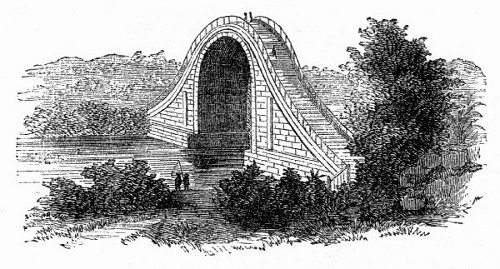
All the stones of a Chinese arch are commonly wedge-shaped, their sides forming radii which converge towards the centre of the curve. It is observable that, according to the opinion of Captain Parish, who surveyed and made plans of the Great Wall, no masonry could be superior to it. The arched and vaulted work was considered by him as exceedingly well turned. The Chinese, therefore, must have understood the construction and properties of the arch long before the Greeks and Romans, whose original and most ancient edifices consisted of columns, connected by straight architraves, of bulk sufficient to support the incumbent pressure of solid masonry.
SOCIABLE WEAVER-BIRD.
There are some birds whose social instinct impels them to live in company, and to unite their powers in the construction of a common edifice: in this respect resembling the Beaver among quadrupeds, and the Bee among insects. Among these we may mention the Ani (Crotophaga ani) of the West Indies; the Pensile Grosbeak (Loxia pensilis) of West Africa; and the Bottle-nested Sparrow of India: but more remarkable than any of these is the Sociable Grosbeak (Loxia socialis) of South Africa, whose habits are described by Le Vaillant.
"Figure to yourself," says this enterprising traveller, "a huge, irregular, sloping roof, with all the eaves completely covered with nests, crowded close together, and you will have a tolerably correct idea of these singular edifices." The birds commence this structure by forming the immense canopy of a mass of grass, so compact and firmly basketed together as to be impenetrable to the rain. This sometimes surrounds a large tree, giving it, but for the upper branches, somewhat the form of a mushroom. Beneath the eaves of this canopy the nests are formed; the upper surface is not used for this purpose, but as it is sloping, with a projecting rim, it serves to let the rain-water run off, and preserves each little dwelling from the wet. Le Vaillant procured one of these great shelters, and cut it in pieces with a hatchet: the chief portion consisted of Boshman's grass, so compact as to be impenetrable by rain. Each nest is three or four inches in diameter, which is sufficient for the bird; but, as they are all close together around the eaves, they appear to the eye to form but one building, and, in fact, are distinguishable from each other only by a little external aperture, which serves as an entrance to the nest. This large nest contained 320 inhabited cells.
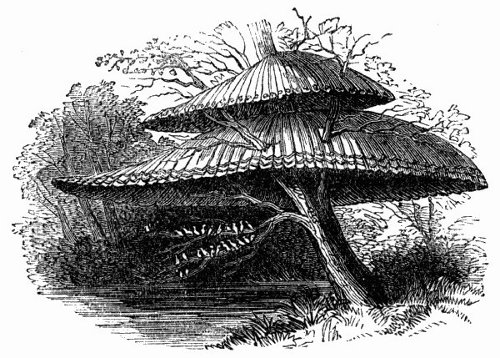
NEST OF SOCIABLE WEAVER BIRD.
WOLVES IN ENGLAND.
King Edward the First commissioned Peter Corbet to destroy the wolves in the counties of Gloucester, Worcester, Hereford, Salop, and Stafford; and ordered John Gifford to hunt them in all the forests of England.
The forest of Chiltern was infested by wolves and wild bulls in the time of Edward the Confessor. William the Conqueror granted the lordship of Riddesdale, in Northumberland, to Robert de Umfraville, on condition of defending that part of the country against enemies and wolves. King John gave a premium of ten shillings for catching two wolves.
In the reign of King Henry the Third Vitalis de Engaine held the manors of Laxton and Pitchley, in the county of Northampton, by the service of hunting the wolf, whenever the king should command him. In the reign of Edward the First, it was found by inquisition that John de Engaine held the manor of Great Gidding, in the county of Huntingdon, by the service of hunting the hare, fox, wild cat, and wolf, within the counties of Huntingdon, Northampton, Buckingham, Oxford, and Rutland. In the reign of Edward the Third, Thomas de Engaine held certain manors by the service of finding, at his own proper cost, certain dogs for the destruction of wolves, foxes, martins, and wild cats in the counties of Northampton, Rutland, Oxford, Essex, and Buckingham.
TEMPLES OF BRAMBANAM.
In the island of Java, and not far from the ruins of Boro Buddor, are situated the Buddhist temples of Brambanam; certainly one of the most extraordinary groups of buildings of its class, and very unlike anything we now find in India; though there can scarcely be a doubt but that the whole is derived from an Indian original now lost.
The great temple is a square building above 45 ft. square, and 75 ft. high, terminating upwards in an octagonal straight-lined pyramid. On each face of this is a smaller temple of similar design joined to the great one by corridors; the whole five thus constituting a cruciform building. It is raised upon a richly ornamented square base. One of the smaller temples serves as an entrance-porch. The building itself is very curiously and richly ornamented with sculpture; but the most remarkable feature of the whole group is the multitude of smaller temples which surround the central one, 239 in number. Immediately beyond the square terrace which supports the central temple stand 28 of these, forming a square of 8 on each side, counting the angular ones both ways. Beyond these, at a distance of 35 ft., is the second square, 44 in number; between this and the next row is a wide space of above 80 ft., in which only 6 temples are situated, two in the centre of the north and south faces, and one on each of the others. The two outer rows of temples are situated close to one another, back to back, and are 160 in number, each face of the square they form being about 525 ft. All these 239 temples are similar to one another, about 12 ft. square at the base, and 22 ft. high, all richly carved and ornamented, and in every one is a small square cell, in which was originally placed a cross-legged figure, probably of one of the Jaina saints, though the drawings which have been hitherto published do not enable us to determine whom they represent—the persons who made them not being aware of the distinction between Buddhist and Jaina images.
The date given to these monuments by the natives is about the 9th or 10th century, at which time the Jains were making great progress at Guzerat and the western parts of India; and if the traditions are to be relied upon, which bring the Hindu colonists of Java from that quarter, it is almost certain that they would have brought that religion with them. If the age, however, that is assigned to them be correct, they are specimens of an earlier date and form than anything we now find in India, and less removed from the old Buddhist type than anything that now remains there.
GRAHAM ISLAND.
The most recent instance of subaqueous eruption, with which we are acquainted is that which produced Hotham or Graham Island, in the year 1831. This island was thrown up in the Mediterranean, between the south-west coast of Sicily and the African coast, in latitude 37° 8' 30" north, and longitude 12° 42' 15" east. The eruption seems to have been first observed by John Corrao, the captain of a Sicilian vessel, who passing near to the spot on the 10th of July, observed an immense column of water ejected from the sea to the height of sixty feet, and about eight hundred yards in circumference.
On the 16th of July, Corrao again passed the same spot, and he found that a small island had been formed, twelve feet high, with a crater in the centre, from which immense columns of vapour and masses of volcanic matter were ejected.
The island was afterwards visited by several scientific gentlemen, and is said to have been two hundred feet high, and three miles in circumference, on the 4th of August. But from this time the island decreased in size; for being composed of loose scoriæ and pumice, it was rapidly acted upon by the water; and on the 3rd of September, when carefully measured by Captain Wodehouse, was only three-fifths of a mile in circumference, and one hundred and seven feet high. At the end of October the island had entirely disappeared, except one small point composed of sand and scoriæ. Captain Swinburne examined the spot in the beginning of the year 1832, and found an extensive shoal to occupy the place where the island had once been. In 1833 there was a dangerous reef, of an oval form, three-fifths of a mile in circumference.
A ROYAL SPORTSMAN.
When the King of Naples (the greatest sportsman in Europe) was in Germany, about the year 1792, it was said in the German papers, that in the different times he had been shooting in Austria, Bohemia, and Moravia, he had killed 5 bears, 1,820 wild boars, 1,968 stags, 13 wolves, 354 foxes, 15,350 pheasants, 1,121 rabbits, 16,354 hares, 1,625 she-goats, 1,625 roebucks, and 12,435 partridges.
LIFE IN DEATH.
The wife of the consul of Cologne, Retchmuth, apparently died of the plague, in 1571; a ring of great value, with which she was buried, tempted the cupidity of the grave-digger, and was the cause of many future years of happiness. At night the purloiner marched to his plunder, and she revived. She lived to be the mother of three children, and, when deceased in reality, was re-buried in the same church, where a monument was erected, reciting the particulars above stated in German verse. A woman of Poictiers, being buried with four rings, tempted the resurrection-man, who awoke the woman in the attempt, as he was rather rude in his mode of possessing them. She called out; he, being frightened, fled. The lady walked home, recovered, and had many children afterwards.
ROCK-CUT MONUMENTS OF ASIA MINOR.
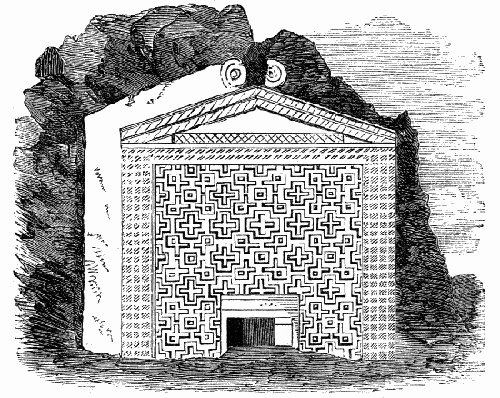
The engraving below represents an example of rock-cut monuments which are found at Doganlu, in Asia Minor. They are placed on the rocky side of a narrow valley, and unconnected apparently with any great city or centre of population. Generally they are called tombs, but there are no chambers nor anything about them to indicate a funereal purpose, and the inscriptions which accompany them are not on the monuments themselves, nor do they refer to such a purpose. Altogether, they are certainly among the most mysterious remains of antiquity, and, beyond a certain similarity to the rock-cut tombs around Persepolis, it is not easy to point out any monuments that afford even a remote analogy to guide us in our conjectures. They are of a style of art clearly indicating a wooden origin, and consist of a square frontispiece, either carved into certain geometric shapes, or prepared apparently for painting; at each side is a flat pilaster, and above a pediment terminating in two scrolls. Some, apparently the more modern, have pillars of a rude Doric order, and all indeed are much more curious than beautiful. When more of the same class are discovered, they may help us to some historic data: all that we can now say of them is, that, judging from their inscriptions and the traditions in Herodotus, they seem to belong to some Indo-Germanic race from Thessaly, or thereabouts, who had crossed the Hellespont and settled in their neighbourhood; and their date is possibly as far back as 1000, and most probably before 700 B.C.
ARCH OF TRAJAN AT BENEVENTUM.
Triumphal arches were among the most peculiar forms of art which the Romans borrowed from those around them, and used with that strange mixture of splendour and bad taste which characterises all their works.
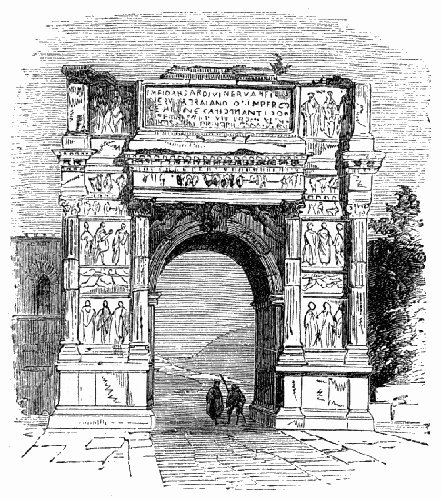
These were in the first instance no doubt borrowed from the Etruscans, as was also the ceremony of the triumph with which they were ultimately associated. At first they seem rather to have been used as festal entrances to the great public roads, whose construction was considered as one of the most important benefits a ruler could confer on his country. There was one erected at Rimini in honour of an important restoration of the Flaminian Way by Augustus; another at Susa in Piedmont, to commemorate a similar act of the same Emperor. Trajan built one on the pier at Ancona, when he restored that harbour, and another at Beneventum, when he repaired the Via Appia, represented in the woodcut here given. It is one of the best preserved as well as most graceful of its class in Italy. The arch of the Sergii at Pola in Istria seems also to have been erected for a like purpose. That of Hadrian at Athens, and another built by him at Antinoë in Egypt, were monuments merely commemorative of the benefits which he had conferred on those cities by the architectural works he had erected within their walls. By far the most important application of these gateways, in Rome at least, was to commemorate a triumph which may have passed along the road over which the arch was erected beforehand, for the triumphal procession to pass through, of which it would remain a memorial.
JUDGES' SALARIES.
In the reign of Henry III. the King's Justices enjoyed a salary of ten marks per annum, which, in the twenty-third year of that King, was augmented to twenty pounds, and soon after to more. Under Henry IV. the Chief Justices of the King's Bench and Common Pleas had forty pounds, and one of the judges of Common Pleas had fifty-five marks. In 1466, the salary of Thomas Littleton, judge of the King's Bench, amounted to £136 13s. 4d. modern money; besides about £17 7s. for his fur-gown, robes, &c.
EXTRAORDINARY OAK.
Gilpin, in his "Forest Scenery," says, "Close by the gate of the water-walk at Magdalen College, in Oxford, grew an oak, which perhaps stood there a sapling when Alfred the Great founded the university. This period only includes a space of nine hundred years, which is no great age for an oak. It is a difficult matter indeed to ascertain the age of a tree. The age of a castle or abbey is the object of history; even a common house is recorded by the families that built it. All these objects arrive at maturity in their youth, if I may so speak. But the tree, gradually completing its growth, is not worth recording in the early part of its existence. It is then only a common tree; and afterwards, when it becomes remarkable for its age, all memory of its youth is lost. This tree, however, can almost produce historical evidence for the age assigned to it. About five hundred years after the time of Alfred, William of Wainfleet, Dr. Stukely tells us, expressly ordered his college to be founded near the Great Oak; and an oak could not, I think, be less than five hundred years of age to merit that title, together with the honour of fixing the site of a college. When the magnificence of Cardinal Wolsey erected that handsome tower which is so ornamental to the whole building, this tree might probably be in the meridian of its glory, or rather, perhaps, it had attained a green old age. But it must have been manifestly in its decline at that memorable era when the tyranny of James gave the fellows of Magdalen so noble an opportunity of withstanding bigotry and superstition. It was afterwards much injured in Charles the Second's time, when the present walks were laid out. Its roots were disturbed, and from that period it declined fast, and became reduced by degrees to little more than a mere trunk. The oldest members of the university can scarcely recollect it in better plight. But the faithful records of history have handed down its ancient dimensions. Through a space of sixteen yards on every side from its trunk, it once flung its boughs, and under its magnificent pavilion could have sheltered with ease three thousand men, though in its decayed state it could for many years do little more than shelter some luckless individual whom the driving shower had overtaken in his evening walk. In the summer of 1788, this magnificent ruin fell to the ground, alarming the college with its rushing sound. It then appeared how precariously it had stood for many years. Its grand tap-root was decayed, and it had hold of the earth only by two or three roots, of which none was more than a couple of inches in diameter. From a part of its ruins a chair has been made for the President of the College, which will long continue its memory."
ECCENTRIC ADVERTISEMENT.
The following strange advertisement is copied from the Harleian MSS.: "In Nova fert Animus. These are to give notice, (for the benefit of the public,) that there is newly arrived from his travels, a gentleman, who, after above forty years' study, hath, by a wonderful blessing on his endeavours, discovered, as well the nature as the infallible cure of several strange diseases, which (though as yet not known to the world) he will plainly demonstrate to any ingenious artist, to be the greatest causes of the most common distempers incident to the body of man. The names of which take as follow:
The strong fives The marthambles The moon-pall The hockogrocle.
"Now, though the names, natures, symptoms, and several cures of these diseases, are altogether unknown to our greatest physicians, and the particular knowledge of them would (if concealed) be a vast advantage to the aforesaid person; yet, he well knowing that his country's good is to be preferred to his private interest, doth hereby promise all sorts of people, a faithful cure of all or any of the diseases aforesaid, at as reasonable rates as our modern doctors have for that of any common distemper.
"He is spoken with at the ordinary hours of business, at the Three Compasses, in Maiden-lane."
MODERN EGYPTIAN FEMALE ORNAMENTS.
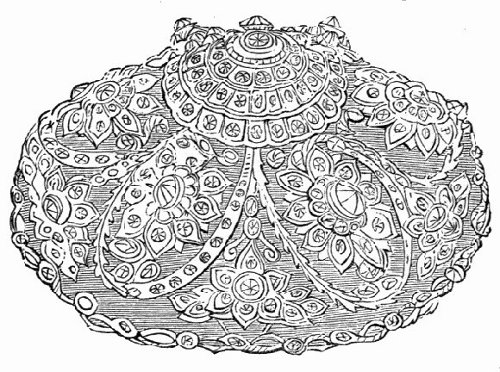
Among the many ornaments which the women of Egypt in modern times are so fond of wearing, none is more curious or more generally worn than the Ckoo'r. It is a round convex ornament, commonly about five inches in diameter, of which there are two kinds. The first that we shall describe, and which is the only kind worn by ladies, or by the wives of tradesmen of moderate property, is the ckoor's alma's, or diamond ckoor's. This is composed of diamonds set generally in gold; and is open work, representing roses, leaves, &c. The diamonds are commonly of a very poor and shallow kind; and the gold of this and all other diamond ornaments worn in Egypt is much alloyed with copper. The value of a moderately handsome diamond ckoor's is about a hundred and twenty-five, or a hundred and fifty pounds sterling. It is very seldom made of silver; and I think that those of gold, when attached to the deep red turboo'sh, have a richer effect, though not in accordance with our general taste. The wives even of petty tradesmen sometimes wear the diamond ckoor's: they are extremely fond of diamonds, and generally endeavour to get some, however bad. The ckoor's, being of considerable weight, is at first painful to wear; and women who are in the habit of wearing it complain of headache when they take it off: hence they retain it day and night; but some have an inferior one for the bed. Some ladies have one for ordinary wearing, another for particular occasions, a little larger and handsomer; and a third merely to wear in bed. The other kind of ckoor's, ckoor's dah'ab (or, of gold), is a convex plate of very thin embossed gold, and almost always a false emerald (a piece of green glass), not cut with facets, set in the centre. Neither the emerald nor the ruby are here cut with facets: if so cut, they would generally be considered false. The simple gold ckoor's is lined with a thick coat of wax, which is covered with a piece of paper. It is worn by many women who cannot afford to purchase diamonds; and even by some servants.
ANTIQUE ROMAN MEDICINE STAMP.
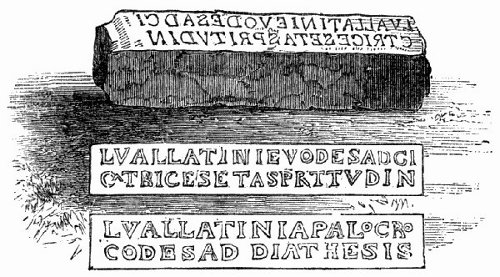
By far the most remarkable of the recently discovered remains of the Roman occupants of Scotland is a medicine stamp, acquired by the Society of Antiquaries of Scotland, along with a very valuable collection of antiquities, bequeathed to them by E. W. A. Drummond Hay, Esq., formerly one of the secretaries of the society. From his notes it appears that it was found in the immediate vicinity of Trenent Church, East Lothian, in a quantity of débris, broken tiles, and brick-dust, which may not improbably have once formed the residence and laboratory of Lucius Vallatinus, the Roman oculist, whose name this curious relic supplies. It consists of a small cube of pale green stone, two and three-fifth inches in length, and engraved on two sides as in the annexed woodcut; the letters being reversed for the purpose of stamping the unguents or other medicaments retailed by its original possessor. The inscriptions admit of being extended thus on the one side: L. VALLATINI EVODES AD CICATRICES ET ASPRITUDINES, which may be rendered—The evodes of Lucius Vallatinus for cicatrices and granulations. The reverse, though in part somewhat more obscure, reads: L. VALLATINI A PALo CRoCODES AD DIATHESES—The crocodes, or preparation of saffron, of L. Vallatinus, of the Palatine School, (?) for affections of the eyes. Both the Euodes and the Crocodes are prescriptions given by Galen, and occur on other medicine stamps. Several examples have been found in England, and many in France and Germany, supplying the names of their owners and the terms of their preparations. Many of the latter indicate their chief use for diseases of the eye, and hence they have most commonly received the name of Roman oculists' stamps. No example, however, except the one figured here, has ever occurred in Scotland; and amid legionary inscriptions, military votive altars, and sepulchral tablets, it is peculiarly interesting to stumble on this intelligent memento, restoring to us the name of the old Roman physician who ministered to the colonists of the Lothians the skill, and perchance also the charlatanry, of the healing art.
CANDLES IN THE CHURCH.
In the formulæ of Marculphus, edited by Jerome Bignon, he tells us, with respect to lights, that the use of them was of great antiquity in the church; that the primitive Christians made use of them in the assemblies which they held before day out of necessity; and that afterwards they were retained even in daylight, as tokens of joy, and in honour of the Deity. Lactantius says, speaking of the absurdities of the wax lights in Romish churches, "They light up candles to God, as if he lived in the dark; and do they not deserve to pass for madmen who offer lamps and candles to the author and giver of light?" It is really astounding to our ideas that wax candles as long as serjeants' pikes should be held as necessary in the worship of God. That it is so held, and that by a large class of Christians, every one must allow, for they may have occular demonstration of the singular fact. The show is however extremely imposing. Thirty-five thousand seven hundred and fifty pounds of wax lights were burned every year, for nine hundred masses said in the castle of Wittemburgh! Philip Melancthon speaks of a Jesuit who said that "he would not extinguish one taper, though it were to convert all the Huguenots" (Protestants).
A RICH AND CRUEL CRIMINAL.
John Ward, Esq. of Hackney, Member of Parliament, being prosecuted by the Duchess of Buckingham, and convicted of forgery, was first expelled from the House, and then stood on the pillory on the 17th of March, 1727. He was suspected of joining in a conveyance with Sir John Blount, to secrete £50,000 of that director's estate, forfeited to the South Sea Company by Act of Parliament. The Company recovered the £50,000 against Ward; but he set up prior conveyances of his real estate to his brother and son, and concealed all his personal, which was computed to be £150,000. These conveyances being also set aside by a bill in chancery, Ward was imprisoned, and hazarded the forfeiture of his life, by not giving in his effects till the last day, which was that of his examination. During his confinement, his amusement was to give poison to dogs and cats, and see them expire by slower or quicker torments. To sum up the worth of this man, at the several eras of his life; at his standing in the pillory, he was worth above £200,000; at his commitment to prison, he was worth £150,000.
FOOD OF THE ANCIENTS.
The diversity of substances which we find in the catalogue of articles of food is as great as the variety with which the art or the science of cookery prepares them. The notions of the ancients on this most important subject are worthy of remark. Their taste regarding meat was various. Beef they considered the most substantial food: hence it constituted the chief nourishment of their athletæ. Camels' and dromedaries' flesh was much esteemed, their heels most especially. Donkey-flesh was in high repute: Mæcenas, according to Pliny, delighted in it; and the wild ass, brought from Africa, was compared to venison. In more modern times we find Chancellor Dupret having asses fattened for his table. The hog and the wild boar appear to have been held in great estimation; and a hog was called "animal propter convivia natum;" but the classical portion of the sow was somewhat singular—"vulvâ nil dulcius amplâ." Their mode of killing swine was as refined in barbarity as in epicurism. Plutarch tells us that the gravid sow was actually trampled to death, to form a delicious mass fit for the gods. At other times, pigs were slaughtered with red-hot spits, that the blood might not be lost. Stuffing a pig with assafœtida and various small animals, was a luxury called "porcus Trojanus;" alluding, no doubt, to the warriors who were concealed in the Trojan horse. Young bears, dogs, and foxes, (the latter more esteemed when fed upon grapes,) were also much admired by the Romans; who were also so fond of various birds, that some consular families assumed the names of those they most esteemed. Catius tells us how to drown fowls in Falernian wine, to render them more luscious and tender. Pheasants were brought over from Colchis, and deemed at one time such a rarity, that one of the Ptolemies bitterly lamented his never having tasted any. Peacocks were carefully reared in the island of Samos, and sold at such a high price, that Varro informs us they fetched yearly upwards of £2,000 of our money.
THE EARLIEST ENGLISH BIBLE.
The first translation of any part of the Holy Scriptures into English that was committed to the press was the New Testament, translated from the Greek, by William Tyndale, with the assistance of John Foye and William Roye, and printed first in 1526, in octavo.
Tyndale published afterwards, in 1530, a translation of the Five Books of Moses, and of Jonah, in 1531, in octavo. An English translation of the Psalter, done from the Latin of Martin Bucer, was also published at Strasburgh in 1530, by Francis Foye, in octavo. And the same book, together with Jeremiah and the Song of Moses, were likewise published in 1534, in duodecimo, by George Joye, sometime Fellow of Peter-House in Cambridge.
The first time the whole Bible appeared in English was in the year 1535, in folio. The translator and publisher was Miles Coverdale, afterwards Bishop of Exeter, who revised Tyndale's version, compared it with the original, and supplied what had been left untranslated by Tyndale. It was printed at Zurich, and dedicated to King Henry the Eighth. This was the Bible, which by Cromwell's injunction of September, 1536, was ordered to be laid in churches.
GREAT ERUPTION OF MOUNT ETNA.
One of the most remarkable eruptions of this mountain was that which occurred in the year 1669, which was so violent that fifteen towns and villages were destroyed, and the stream was so deep that the lava flowed over the walls of Catania, sixty feet in height, and destroyed a part of the city. But the most singular circumstance connected with this eruption was the formation of a number of extensive fissures, which appeared as though filled with intumescent rock. At the very commencement of the volcanic excitement, one was formed in the plain of St. Lio, twelve miles in length and six feet broad, which ejected a vivid flame, and shortly after five others were opened. The town of Nicolosi, situated twenty miles from the summit of Etna, was destroyed by earthquake; and near the place where it stood two gulfs were formed, from which so large a quantity of sand and scoriæ was thrown, that a cone, called Mount Rossi, four hundred and fifty feet high, was produced in about three months.
AMULETS WORN BY MODERN EGYPTIAN FEMALES.
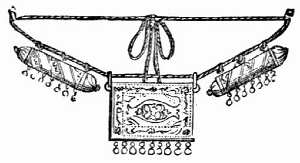
One of the most remarkable traits in modern Egyptian superstition is the belief in written charms. The composition of most of these amulets is founded upon magic, and occasionally employs the pen of almost every village schoolmaster in Egypt. A person of this description, however, seldom pursues the study of magic further than to acquire the formulæ of a few charms, commonly consisting, for the greater part, of certain passages of the Koran, and names of God, together with those of spirits, genii, prophets, or eminent saints, intermixed with combinations of numerals, and with diagrams, all of which are supposed to have great secret virtues. The amulet thus composed, or hhega'b, as it is called, is covered with waxed cloth, to preserve it from accidental pollution, and enclosed in a case of thin embossed gold or silver, which is attached to a silk string, or a chain, hung on the right side, above the girdle, the string or chain being passed over the left shoulder. Sometimes these cases bear Arabic inscriptions, such as "Ma´sha-lla´h" ("God's will") and "Ya´cha´dee el-hhaga´t" ("O decreer of the things that are needful!") We here insert an engraving of three hhega'bs of gold, attached to a string, to be worn together. The central one is a thin, flat case, containing a folded paper: it is about a third of an inch thick; the others are cylindrical cases, with hemispherical ends, and contain scrolls: each has a row of burck along the bottom. Hhega´bs such as these, or of a triangular form, are worn by many children, as well as women; and those of the latter form are attached to a child's head-dress.
PERSONAL ORNAMENTS OF THE ANCIENT EGYPTIANS.
The passion of the Egyptians for decorative jewellery was indeed excessive. Men as well as women delighted thus to adorn themselves; and the desire was not confined to the higher ranks, for though the subordinate classes could not afford the sparkling gems and precious metals which glowed upon the persons of their superiors, their vanity was gratified by humbler imitations, of bronze, glass, and porcelain.
"Costly and elegant ornaments," observes Professor Rosselini, "abounded in proportion as clothing in general was simple and scarce among the Egyptians. Girdles, necklaces, armlets, ear-rings, and amulets of various kinds suspended from the neck, are found represented in the painting, and in fact still exist on the mummies. Figures of noble youths are found entirely devoid of clothing, but richly ornamented with necklaces and other jewels."
An immense number of these "jewels of silver and jewels of gold" have been found in the tombs, and on the persons of mummies, and are deposited in profusion in every museum. The accompanying engravings will give an idea of the style and form of some of them.
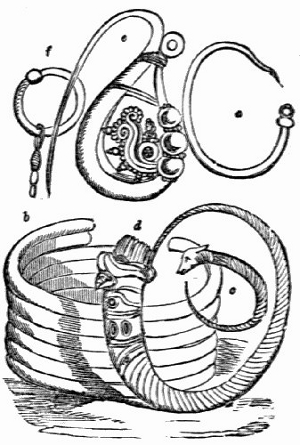
The ear-rings generally worn by the ladies were large, round, single hoops (as a) from 1½ inches to 2-1/3 inches in diameter; and frequently of a still greater size; or made of six rings soldered together (as b); sometimes an asp, whose body was of gold, set with precious stones, was worn by persons of rank as a fashionable caprice. Figures c, d, of gold bear the heads of fanciful animals; e, also of gold, is remarkable for its singularity of form, and for the delicacy of its workmanship; and f for its carrying two pearls and being double in its construction.
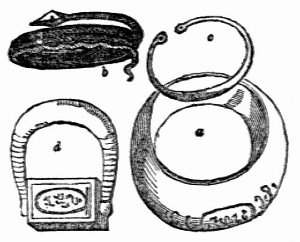
Bracelets, armlets, and anklets were worn by men as well as by women; they were usually of gold, frequently set with precious stones, or inlaid with enamel. The one marked a in the annexed cut is now in the Leyden Museum: it is of gold, 3 inches in diameter, and 1½ inches in height, and is interesting, because it belonged to the Pharaoh whom we conclude to have been the patron and friend of Joseph, Thothmes III., whose name it bears. The armlet b is of gold, and represents a snake; the other, c, is of bronze. Rings were worn in profusion, gold being the material chiefly selected. Some resemble watch seals of the present day—sometimes the stone having four flat sides, all engraved, turned on a pivot, like some seals seen at present. One of this character, which Sir J. G. Wilkinson estimates to contain 20l. worth of gold, is represented at d in the above engraving. It consists of a massive ring of gold, bearing an oblong plinth of the same metal, an inch in length, and more than half an inch in its greatest width. On one side is engraved the hieroglyphic name of Storus, the successor of Amunoph III.; the three others contain respectively a scorpion, a crocodile, and a lion.
GREAT PEAR TREE.
The most remarkable pear tree in England stands on the glebe of the parish of Holme Lacy, in Herefordshire. When the branches of this tree, in its original state, became long and heavy, their extremities drooped till they reached the ground. They then took root; each branch became a new tree, and in its turn produced others in the same way. Eventually it extended itself until it covered more than an acre of ground, and would probably have reached much further if it had been suffered to do so. It is stated in the church register, that "the great natural curiosity, the great pear tree upon the glebe, adjoining to the vicarage-house, produced this year (1776) fourteen hogsheads of perry, each hogshead containing one hundred gallons." Though now much reduced in size, it is still healthy and vigorous, and generally produces from two to five hogsheads. The liquor is not of a good quality, being very strong and heating. An idea of the superior size of this tree, when in its prime, over others of the same kind, may be formed from the fact, that in the same county, an acre of ground is usually planted with thirty trees, which, in a good soil, produce annually, when full grown, twenty gallons of perry each. So large a quantity as a hogshead from one tree is very unusual. The sorts principally used for perry are such as have an austere juice.
LAW OF THE MOZCAS.
A very remarkable law prevailed among the Mozcas, one of the tribes of the Nuevo Reyno de Granada. There, as among more advanced nations, the king could do no wrong; but the subordinate chiefs could. These chiefs were men, the people reasoned, like themselves; they could not be punished by their vassals, for there would be a natural unfitness in that; the king, it seems, was not expected to interfere, except in cases of state offences; the power of punishment, therefore, was vested in their wives; and a power it was, says Piedrahita, which they exercised famously whenever it fell to them to be judges of their poor husbands. The conqueror Quesada calling one morning upon the chief of a place called Suesca, found him under the hands of his nine wives, who were tying him, and having done so, proceeded, in spite of Quesada's intercession, to flog him one after the other. His offence was, that some Spaniards the night before had lodged in his house, and he had partaken too freely of their Spanish wine. Drunkenness was one of the sins which fell under the cognizance of his wives: they carried him to bed that he might sleep himself sober, and then awoke him in the morning to receive the rigour of the law.
LARGEST METAL STATUE IN THE WORLD.
Arona is an island on the Lago Maggiore, and has a strong castle. Upon an eminence is a statue of bronze to St. Charles Borromeo, from whom the hill is called, Monte di S. Carlo. The statue was erected by the Pope in 1624, in memory of the Saint, who was Archbishop of Milan. The pedestal of the statue is thirty-six feet high. It is the largest metal statue in existence; and the height of the statue itself is seventy-two feet, making a total of 108 feet. Fifteen persons may get into the saint's head, which will also accommodate four persons and a table on which they can dine. The cost is said to have been one million one hundred Milanaise livres.
THE OAK OF MAMRE.
In one remarkable instance the Jews, the Christians, and the pagan Arabs united in religious feelings. This was in their reverence for the Oak of Mamre, where the angels appeared to Abraham: for Abraham's sake the Jews held the place holy; the Arabs for the angels'; the Christians, because, in their ignorance of their Scriptures, they affirmed that the Son of God had accompanied those angels to destroy Sodom and Gomorrah. An annual fair was held there, and every man sacrificed after the manner of his country; nor was the meeting ever disgraced by any act of intemperance or indecency. Nothing had been done to injure the venerable antiquity of the place. There was nothing but the well which Abraham had dug, and the buildings which he had inhabited, beside the oak. These remains were destroyed by order of Constantine, in abhorrence of the impious toleration exhibited there! A church was built upon the spot, and Mamre, so interesting to the poet, the philosopher, and the pious man, became a mere den of superstition.
STRANGE ADVERTISEMENT.
The following appeared in the Evening Post, May 23rd, 1730:—
"I, Elizabeth, duchess dowager of Hamilton, acknowledge I have for several months been ill in my health, but never speechless, as certain penny authors have printed; and so, to confute these said authors and their intelligence, it is thought by my most intimate friends, it is the very last thing that will happen to me. I am so good an Englishwoman, that I would not have my countrymen imposed upon by purchasing false authors; therefore, have ordered this to be printed that they may know what papers to buy and believe, that are not to be bribed by those who may have private ends for false reports. The copy of this is left in the hands of Mr. Berington, to be shown to any body who has a curiosity to see it signed with my own hand.
"E. Hamilton."
INTERMITTENT SPRINGS.
One of the most remarkable of these is at Bolder-Born in Westphalia. After flowing for twenty-four hours, it entirely ceases for the space of six hours. It then returns with a loud noise, in a stream sufficiently powerful to turn three mills very near its source. Another spring of the same nature occurs at Bihar in Hungary, which issues many times a day, from the foot of a mountain, in such a quantity as in a few minutes to fill the channel of a considerable stream.
The Lay Well near Torbay, ebbs and flows sixteen times in an hour: and in Giggleswick Well in Yorkshire, the water sometimes rises and falls in ten or fifteen minutes.
St. Anthony's Well, on Arthur's Seat, near Edinburgh, has a similar movement, but on a smaller scale.