TEN THOUSAND WONDERFUL THINGS. (continued 16)
Reading edition
PERSONAL APPEARANCE OF MAHOMET.
For the personal appearance and private life of Mahomet, we must rely on the Arabian writers, who dwell with fond and proud satisfaction on the graces and intellectual gifts with which nature had endowed him. He was of a middle stature, of a clear, fair skin, and ruddy complexion. His head and features, though large, were well proportioned; he had a prominent forehead, large dark-brown eyes, an aquiline nose, and a thick bushy beard. His mouth, though rather wide, was handsomely formed, and adorned with teeth white as pearls, the upper row not closely set, but in regular order—which appeared when he smiled, and gave an agreeable expression to his countenance. He had a quick ear, and a fine sonorous voice. His dark eyebrows approached each other without meeting. His hair fell partly in ringlets about his temples, and partly hung down between his shoulders. To prevent whiteness, the supposed effect of Satanic influence, he stained it, as the Arabs often do still, of a shining reddish colour. His frame was muscular and compact—robust rather than corpulent. When he walked, he carried a staff, in imitation of the other prophets, and had a singular affectation of being thought to resemble Abraham. The assertion of the Greeks and Christians, that he was subject to epilepsy, must be ascribed to ignorance or malice.
STIRRUPS.
From every information we have been able to collect, we believe that the appendage of stirrups were not added to saddles before the sixth century. It is said, that previous to the introduction of stirrups, the young and agile used to mount their horses by vaulting upon them, which many did in an expert and graceful manner; of course, practice was essential to this perfection. That this should be afforded, wooden horses were placed in the Campus Martius, where this exercise was performed of mounting or dismounting on either side; first, without, and next with arms. Cavalry had also occasionally a strap of leather, or a metallic projection affixed to their spears, in or upon which the foot being placed, the ascent became more practicable. Respecting the period of this invention, Montfaucon has presumed that the invention must have been subsequent to the use of saddles; however, opposed to this opinion, an ingenious argument has been offered, that it is possible they might have been anterior to that invention; because, it is said, they might have been appended to a girth round the body of the horse. Both Hippocrates and Galen speak of a disease to which the feet and ancles were subject, from long riding, occasioned by suspension of the feet without a resting-place. Suetonius, the Roman, informs us that Germanicus, the father of Caligula, was wont to ride after dinner, to strengthen his ancles, by the action of riding affording the blood freer circulation in the part.
THE GREAT SHOEMADOO PAGODA.
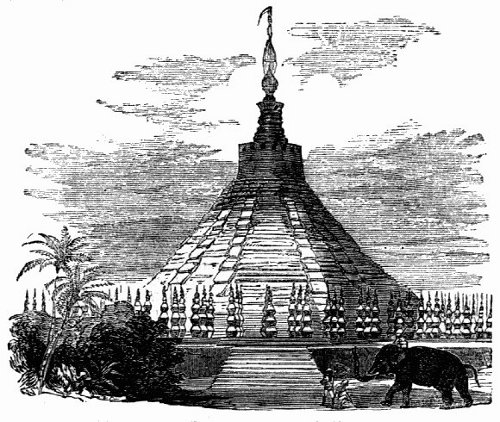
The Buddhist temple of which we here give an engraving is the great Shoëmadoo Pagoda at Pegu. Among other things it is interesting as being one of the earliest attempts at that class of decoration, which consists in having at the base of the building a double range of small pagodas, a mode of ornamentation that subsequently became typical in Hindu architecture; their temples and spires being covered, and indeed composed of innumerable models of themselves, clustered together so as to make up a whole.
The building stands on two terraces, the lower one about 10 ft. high, and 1391 ft. square: the upper one, 20 ft. in height, is 684 ft. square; from the centre of it rises the pagoda, the diameter of whose base is 395 ft. The small pagodas are 27 ft. high, and 108 or 110 in number; while the great pagoda itself rises to the height of 331 ft. above its terrace, or 361 ft. above the country, thus reaching a height nearly equal to St. Paul's Cathedral; while the side of the upper terrace is only 83 ft. less than that of the great Pyramid.
Tradition ascribes its commencement to two merchants, who raised it to the height of 12 cubits at an age slightly subsequent to that of Buddha himself. Successive kings of Pegu added to this from time to time, till at last it assumed its present form, most probably about three or four centuries ago.
PEST HOUSE DURING THE PLAGUE IN TOTHILL FIELDS.
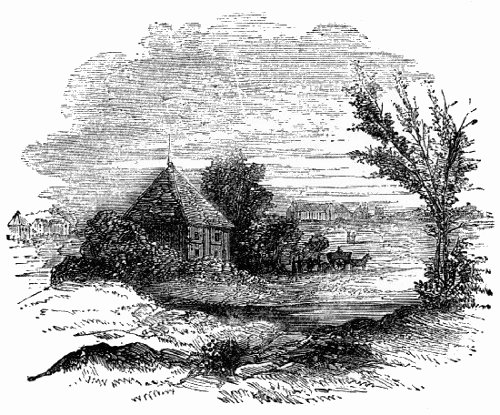
Tothill Fields, a locality between Pimlico and the Thames, was anciently the manor of Tothill, belonging to John Maunsel, chancellor, who in 1256, entertained here Henry III. and his court at a vast feast in tents and pavilions. Here were decided wagers of battle and appeals by combat. Necromancy, sorcery and witchcraft were punished here; and "royal solemnities and goodly jousts were held here." In Culpeper's time the fields were famous for parsley. In 1642 a battery and breastwork were erected here. Here also were built the "Five Houses," or "Seven Chimneys," as pest-houses for victims of the plague. One of these pest-houses is given in the above engraving, taken from an old print. In the plague time of 1665, the dead were buried "in the open Tuttle Fields." In Queen Anne's reign here was William Well's head garden on the site of Vincent-square. The Train Bands were drawn out here in 1651. In the last century the fields were a noted duel-ground, and here, in 1711, Sir Cholmeley Deering, M.P., was killed by the first shot of Mr. Richard Thornhill, who was tried for murder and acquitted, but found guilty of manslaughter and burnt in the hand.
THE THUGS.
The following account of these horribly extraordinary men is taken from Dr. Hooker's Himalayan Journals; writing at Mirzapore, he says:—"Here I had the pleasure of meeting Lieutenant Ward, one of the suppressors of Thuggee (Thuggee, in Hindostan, signifies a deceiver; fraud, not open force, being employed). This gentlemen kindly showed me the approvers, or king's evidence of his establishment, belonging to those three classes of human scourges, the Thug, Dakoit, and Poisoner. Of these the first was the Thug, a mild-looking man, who had been born and bred to the profession: he had committed many murders, saw no harm in them, and felt neither shame nor remorse. His organs of observation and destructiveness were large, and the cerebellum small. He explained to me how the gang waylay the unwary traveller, enter into conversation with him, and have him suddenly seized, when the superior throws his own girdle round the victim's neck and strangles him, pressing the knuckles against the spine. Taking off his own girdle, he passed it round my arm, and showed me the turn as coolly as a sailor once taught me the hangman's knot. The Thug is of any caste, and from any part of India. The profession have particular stations, which they generally select for murder, throwing the body of their victim into a well.
"Their origin is uncertain, but supposed to be very ancient, soon after the Mahommedan conquest. They now claim a divine original, and are supposed to have supernatural powers, and to be the emissaries of the divinity, like the wolf, the tiger, and the bear. It is only lately that they have swarmed so prodigiously—seven original gangs having migrated from Delhi to the Gangetic provinces about 200 years ago, from whence all the rest have sprung. Many belong to the most amiable, intelligent, and respectable classes of the lower and even middle ranks: they love their profession, regard murder as sport, and are never haunted with dreams, nor troubled with pangs of conscience during hours of solitude, or in the last moments of life. The victim is an acceptable sacrifice to the goddess Davee, who by some classes is supposed to eat the lifeless body, and thus save her votaries the necessity of concealing it.
"They are extremely superstitious, always consulting omens, such as the direction in which a hare or a jackal crosses the road; and even far more trivial circumstances will determine the fate of a dozen of people, and perhaps of an immense treasure. All worship the pickaxe, which is symbolical of their profession, and an oath sworn on it binds closer than on the Koran. The consecration of this weapon is a most elaborate ceremony, and takes place only under certain trees. The Thugs rise through various grades: the lowest are scouts; the second, sextors; the third, are holders of the victim's hands; the highest, stranglers.
"Though all agree in never practising cruelty, or robbing previous to murder—never allowing any but infants to escape (and these are trained to Thuggee), and never leaving a trace of such goods as may be identified—there are several variations in their mode of conducting operations: some tribes spare certain castes, others none; murder of woman is against all rules; but the practice crept into certain gangs, and this it is which led to their discountenance by the goddess Davee, and the consequent downfall of the system. Davee, they say, allowed the British to punish them, because a certain gang had murdered the mothers to obtain their daughters to be sold to prostitution.
"Major Sleeman has constructed a map demonstrating the number of 'bails,' or regular stations for committing murder, in the kingdom of Oude alone, which is 170 miles long by 100 broad, and in which are 274, which are regarded by the Thug with as much satisfaction and interest as a game preserve is in England; nor are these 'bails' less numerous than in other parts of India. Of twenty assassins who were examined, one frankly confessed to having been engaged in 931 murders, and the least guilty of the number in 24. Sometimes 150 persons collected into one gang, and their profits have often been immense, the murder of six persons on one occasion yielding 82,000 rupees, upwards of £8,000."
ENGLISH EARTHENWARE AND SHAKSPEARE'S JUG.
Much uncertainty exists regarding the period when the manufacture of fine earthenware was first introduced into England. Among the documents in the Fœdera, occur various lists of articles, ordered to be purchased in England for several foreign potentates, and permitted to be exported for their use without paying the Custom duties. One of these lists, dated in 1428, enumerates many objects as then shipped for the use of the King of Portugal and the Countess of Holland, among which are "six silver cups, each of the weight of six marks (or four pounds), a large quantity of woollen stuffs, and 2000 plates, dishes, saucers, and other vessels of electrum."
As these articles were, no doubt, the produce of the country, it would appear that utensils for domestic use were then made of metal, and not of pottery; and it was not till some time afterwards that the latter was introduced by the Dutch, whose manufactory at Delft probably existed as early as the fifteenth century, and who sent large quantities of their ware to England. The skill and excellence of the English artizans consisted in the manufacture of silver and other metals. Of this, instances are recorded in the correspondence of La Mothe Fénelon, the French ambassador at the Court of Queen Elizabeth; and in the travels of Hentzner, who visited England in 1598. Both describe in glowing colours the silver plate which adorned the buffets, as well as the magnificent furniture and decorations of the palaces of that sumptuous queen.
Still Elizabeth, who so highly prided herself upon the state and splendour of her establishment, and who was in constant intercourse with the Court of France and the Low Countries, was not likely to have remained altogether satisfied without possessing, among the manufactures of her own kingdom, something similar to the fine Fayence then in use in every foreign court. Though it is probable that Delft ware procured from Holland was first used, it may reasonably be presumed that the ware called by her name was afterwards manufactured, under her immediate patronage, for the use of the court and the nobility; and although there is no record of the fact, it is supposed that Stratford-le-Bow was the site of the manufactory.
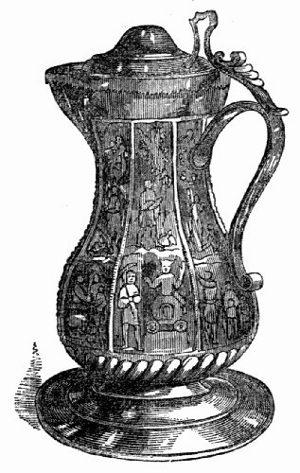
Shakspeare's Jug, of which we here give an engraving, which has been carefully preserved by the descendants of the immortal bard since the year 1616, is, perhaps, the most remarkable example of the Elizabethan pottery now existing. The shape partakes very much of the form of the old German or Dutch ewer, without, however, the usual top or cover; the one now attached to the jug being a modern addition of silver, with a medallion bust of the poet in the centre, beautifully executed and inscribed "Wm. Shakspeare, at the age of forty." It is about ten inches high, and sixteen inches round at the largest part, and is divided lengthwise into eight compartments, having each a mythological subject in high relief. All of these, although executed in the quaint style of the period, possess considerable merit. Some of them, indeed, manifest much masterly grouping of both human figures and animals; and such is the admirable state of preservation of this very interesting old English relic, that as correct a judgment may be formed of its workmanship, as in the days of its first possessor; at all events, as regards the degree of perfection to which English Pottery had attained in the Elizabethan age; an inspection of this jug will justify the presumption, that her Court was not less tastefully provided in that respect than those of the Continent, notwithstanding the obscurity in which the precise locality and extent of the manufactory is unfortunately involved.
PRICE OF MACKAREL.
The price of mackarel, in May, 1807, in the Billingsgate market, was as follows:—Forty guineas for every hundred of the first cargo, which made the fish come to seven shillings apiece! The next supplies were also exorbitant, though much less so than the first, fetching thirteen pounds per hundred, or two shillings apiece. The very next year the former deficiencies were more than made up, for it appears that during the season 1808, mackarel were hawked about the streets of Dover, at sixty for a shilling, or five for a penny; whilst they so blockaded the Brighton coast that on one night it became impossible to land the multitudes taken, and at last both fish and nets went to the bottom together.
POPE'S CHAIR.
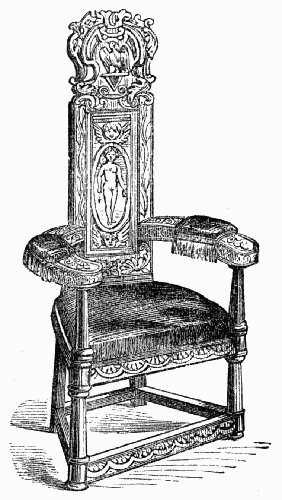
In one of the rooms at that stately and picturesque baronial hall, Audley End, the seat of Lord Braybrooke, there is preserved the interesting relic which forms the subject of the annexed engraving. Its history is thus told on a brass plate inserted in the back—"This chair, once the property of Alexander Pope, was given as a keep-sake to the nurse who attended him in his illness; from her descendants it was obtained by the Rev. Thomas Ashley, curate of the parish of Binfield, and kindly presented by him to Lord Braybrooke, in 1844, nearly a century after the poet's decease." It is apparently of Flemish workmanship, and of rather singular design; in the centre medallion is a figure of Venus holding a dart in her right hand, and a burning heart in her left. The narrow back and wide-circling arms give a peculiarly quaint appearance to this curious relic of one of our greatest poets.
FIRST WIND-MILLS.
Mabillon mentions a diploma of the year 1105, in which a convent in France is allowed to erect water and windmills, molendina ad ventum.
Bartolomeo Verde proposed to the Venetians in 1332, to build a wind-mill. When his plan had been examined, he had a piece of ground assigned him, which he was to retain if his undertaking succeeded within a specified time. In 1373, the city of Spires caused a wind-mill to be erected, and sent to the Netherlands for a person acquainted with the method of grinding by it. A wind-mill was also constructed at Frankfort, in 1442; but it does not appear to have been ascertained whether there were any there before.
About the twelfth century, in the pontificate of Gregory, when both wind and water-mills became more general, a dispute arose whether mills were titheable or not. The dispute existed for some time between the persons possessed of mills and the clergy; when neither would yield. At length, upon the matter being referred to the pope and sacred college, the question was (as might have been expected when interested persons were made the arbitrators) determined in favour of the claims of the church.
THE "HAPPY DISPATCH" IN JAPAN.
The Hari-kari, or "Happy Dispatch," consists in ripping open their own bowels with two cuts in the form of a cross—after the artistic dissector's fashion. Officials resort to it under the fear of the punishment which they may expect; for it is a leading principle that it is more honourable to die by one's own hand than by another's. Princes and the high classes receive permission to rip themselves up as a special favour, when under sentence of death: their entire family must die with the guilty. Sometimes, by favour, the nearest relative of the condemned is permitted to perform the function of executioner in his own house. Such a death is considered less dishonourable than by the public executioners, aided by the servants of those who keep disreputable houses.
But the Japanese, for the most part, always ask permission to rip themselves; and they set about it with astonishing ease, and not without evident ostentation. The criminal who obtains this favour assembles all his family and his friends, puts on his richest apparel, makes an eloquent speech on his situation, and then, with a most contented look, he bares his belly, and in the form of a cross rips open the viscera. The most odious crimes are effaced by such a death. The criminal thenceforward ranks as a brave in the memory of men. His family contracts no stain, and his property is not confiscated.
It is curious that the Romans and the Japanese should hit upon crucifixion as a mode of punishment. These coincidences often startle us in reviewing the manners and customs of men. Vainly we strive to conjecture how such a mode of punishment could have suggested itself to the mind of man. The in terrorem object scarcely accounts for it. Constantine abolished it amongst the Romans, in honour of Him who was pleased to make that mode of dying honourable in the estimation of men.
The Hari-kari, or happy dispatch, is still more incomprehensible. We shudder at the bare idea of it. To commit suicide by hanging, by drowning, by poison, by firearms, by a train in rapid motion—all these modes are reasonable in their madness; but to rip open our bowels!—and with two cuts! We are totally at a loss to imagine how such a mode of self-murder could have been adopted; we cannot but wonder at the strength of nerve which enables it to be accomplished: but we feel no doubt of the everlasting force of national custom—especially amongst the Orientals—in the continuance of this practice. Montesquieu said, "If the punishments of the Orientals horrify humanity, the reason is, that the despot who ordains them feels that he is above all laws. It is not so in Republics, wherein the laws are always mild, because he who makes them is himself a subject." This fine sentiment, thoroughly French, is evidently contradicted by the institutions of Japan, where the Emperor himself, the despot, is a subject: besides, Montesquieu would have altered his antithesis had he lived to see the horrors of the Reign of Terror in the glorious French Republic.
PURITAN ZEAL.
The following is a copy of the order issued by Government for the destruction of Glasgow Cathedral:—"To our traist friendis,—Traist friendis, after most hearty commendacion, we pray you fail not to pass incontinent to the kirk, (of Glasgow, or elsewhere, as it might be) and tak down the hail images thereof, and bring furth to the kirk-zyard, and burn them openly. And sicklyke cast down the altaris, and purge the kirk of all kynd of monuments of idolatrye. And this ze fail not to do, as ze will do us singular emplesure; and so commitis you to protection of God.
(Signed)Ar. Argyle. James Stewart. Ruthven.
From Edinburgh the XII. of Aug. 1560.
"Fail not, but ze tak guid heyd that neither the dasks, windows, nor duris, be ony ways hurt or broken, uthe glassin wark, or iron wark."
FREDERICK THE GREAT AT TABLE.
The table of the great Frederic of Prussia was regulated by himself. There were always from nine to a dozen dishes, and these were brought in one at a time. The King carved the solitary dish, and helped the company. One singular circumstance connected with this table was, that each dish was cooked by a different cook, who had a kitchen to himself! There was much consequent expense, with little magnificence. Frederic ate and drank, too, like a boon companion. His last work, before retiring to bed, was to receive from the chief cook the bill of fare for the next day; the price of each dish, and of its separate ingredients, was marked in the margin. The monarch looked it cautiously through, generally made out an improved edition, cursed all cooks as common thieves, and then flung down the money for the next day's expenses.
ARTIFICIAL SWEETS.
Professor Playfair, in an able lecture delivered in the Great Exhibition, and since published, has raised a curtain, which displays a rather repulsive scene. He says, the perfume of flowers frequently consists of oils and ethers, which the chemist can compound artificially in his laboratory. Singularly enough these are generally derived from substances of an intensely disgusting odour. A peculiarly fetid oil, termed the "fusel" oil, is formed in making brandy. This fusel oil distilled with sulphuric acid and acetate of potass, gives the oil of pears (?). The oil of apples is made from the same fusel, by distillation with the same acid and chromate of potass. The oil of pineapples is obtained from the product of the action of putrid cheese on sugar! or by making a soap with butter. The artificial oil of bitter almonds is now largely employed in perfuming soap confectionary; extracted by nitric acid and the fetid oil of gas tar. Many a fair forehead is damped with eau de mille fleurs without the knowledge that its essential ingredient is derived from the drainage of cow-houses!
TEUTONIC HUT-SHAPED VASES.
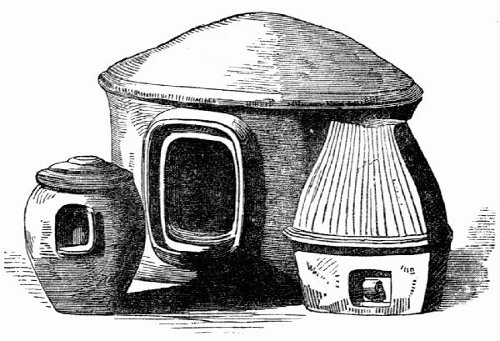
Some remarkable sepulchral urns, of which we give a sketch, resembling those of the early inhabitants of Alba Longa, in Italy, have been found in Germany, and are distinctly Teutonic. They occur in the sepulchres of the period when bronze weapons were used, and before the predominance of Roman art. One found at Mount Chemnitz, in Thuringen, had a cylindrical body and conical top, imitating a roof. In this was a square orifice, representing the door or window, by which the ashes of the dead were introduced, and the whole then secured by a small door fastened with a metal pin. A second vase was found at Roenne; a third in the island of Bornholm. A similar urn exhumed at Parchim had a shorter body, taller roof, and door at the side. Still more remarkable was another found at Aschersleben, which has its cover modelled in shape of a tall conical thatched roof, and the door with its ring still remaining. Another, with a taller body and flatter roof, with a door at the side, was found at Klus, near Halberstadt. The larger vases were used to hold the ashes of the dead, and are sometimes protected by a cover, or stone, or placed in another vase of coarser fabric. The others are the household vessels, which were offered to the dead filled with different viands. Some of the smaller vases appear to have been toys.
Extraordinary popular superstitions have prevailed amongst the German peasantry as to the origin and nature of these vases, which in some districts are considered to be the work of the elves,—in others, to grow spontaneously from the ground like mushrooms—or to be endued with remarkable properties for the preservation of milk and other articles of food. Weights to sink nets, balls, discs, and little rods of terra-cotta, are also found in the graves.
LYNCH'S CASTLE, GALWAY.
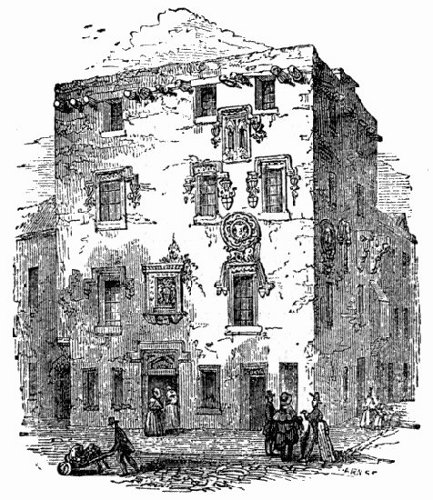
The house in the town of Galway, still known as "Lynch's Castle," although the most perfect example now remaining, was at one period by no means a solitary instance of the decorated habitations of the Galway merchants. The name of Lynch, as either provost, portreve, sovereign, or mayor of Galway, occurs no fewer than ninety-four times between the years 1274 and 1654; after that year it does not appear once. The house here pictured was the residence of the family for many generations. It had, however, several branches, whose habitations are frequently pointed out by their armorial bearings, or their crest, a lynx, over the gateway. One of its members is famous in history as the Irish Junius Brutus. The mere fact is sufficiently wonderful without the aid of invention; but it has, as may be supposed, supplied materials to a host of romancers. The story is briefly this:—
James Lynch Fitzstephen was mayor or warden of Galway in 1493; he traded largely with Spain, and sent his son on a voyage thither to purchase and bring back a cargo of wine. Young Lynch, however, spent the money entrusted to him, and obtained credit from the Spaniard, whose nephew accompanied the youth back to Ireland to be paid the debt and establish further intercourse. The ship proceeded on her homeward voyage, and as she drew near the Irish shore, young Lynch conceived the idea of concealing his crime by committing another. Having seduced, or frightened, the crew into becoming participators, the youth was seized and thrown overboard. The father and friends of Lynch received the voyager with joy; and the murderer in a short time became himself a prosperous merchant. Security had lulled every sense of danger, and he proposed for a very beautiful girl, the daughter of a wealthy neighbour, in marriage. The proposal was accepted; but previous to the appointed day, one of the seamen became suddenly ill, and in a fit of remorse summoned old Lynch to the dying-bed, and communicated to him a full relation of the villany of his only and beloved son. Young Lynch was tried, found guilty, and sentenced to execution—the father being his judge. The wretched prisoner, however, had many friends among the people, and his relatives resolved with them that he should not die a shameful death. They determined upon his rescue. We copy the last act of the tragedy from "Hardiman's History of Galway." "Day had scarcely broken when the signal of preparation was heard among the guards without. The father rose, and assisted the executioner to remove the fetters which bound his unfortunate son. Then unlocking the door, he placed him between the priest and himself, leaning upon an arm of each. In this manner they ascended a flight of steps lined with soldiers, and were passing on to gain the street, when a new trial assailed the magistrate for which he appears not to have been unprepared. His wretched wife, whose name was Blake, failing in her personal exertions to save the life of her son, had gone in distraction to the heads of her own family, and prevailed on them, for the honour of their house, to rescue him from ignominy. They flew to arms, and a prodigious concourse soon assembled to support them, whose outcries for mercy to the culprit would have shaken any nerves less firm than those of the mayor of Galway. He exhorted them to yield submission to the laws of their country; but finding all his efforts fruitless to accomplish the ends of justice at the accustomed place, and by the usual hands, he, by a desperate victory over parental feeling, resolved himself to perform the sacrifice which he had vowed to pay on its altar. Still retaining a hold of his unfortunate son, he mounted with him by a winding stair within the building, that led to an arched window overlooking the street, which he saw filled with the populace. Here he secured the end of the rope—which had been previously fixed round the neck of his son—to an iron staple, which projected from the wall, and after taking from him a last embrace, he launched him into eternity. The intrepid magistrate expected instant death from the fury of the populace; but the people seemed so much overawed or confounded by the magnanimous act, that they retired slowly and peaceably to their several dwellings. The innocent cause of this sad tragedy is said to have died soon after of grief, and the unhappy father of Walter Lynch to have secluded himself during the remainder of his life from all society except that of his mourning family. His house still exists in Lombard Street, Galway, which is yet known by the name of 'Dead Man's Lane;' and over the front doorway are to be seen a skull and cross-bones executed in black marble, with the motto, 'Remember Deathe—vaniti of vaniti, and all is but vaniti.'"
The house in which the tragedy is said to have occurred was taken down only so recently as 1849; but the tablet which contains the "skull and cross-bones" bears the date 1624—upwards of a century after the alleged date of the occurrence.
WASHINGTON.
It is something singular, that Washington drew his last breath, in the last hour, of the last day, of the last week, of the last month, of the last year, of the last century. He died on Saturday night, twelve o'clock, December 31st, 1799.
ANCIENT BANNERS AND STANDARDS.
Banners have been in use from the earliest ages. Xenophon gives us the Persian standard as a golden eagle, mounted on a pole or spear. We find banners very early in use among the nations of Europe. In this country the introduction of banners was clearly of a religious origin. Venerable Bede says, that when St. Augustin and his companions came to preach Christianity in Britain in the latter part of the sixth century, and having converted Ethelbert, the Bretwalda of the Anglo-Saxons (his Queen Bertha had already embraced the Christian faith) the monk and his followers entered Canterbury in procession, chanting, "We beseech thee O Lord, of thy mercy, let thy wrath and anger be turned away from this city, and from thy Holy Place, for we have sinned. Hallelujah." And they carried in their hands little banners on which were depicted crosses. The missionaries were allowed to settle in the Isle of Thanet, and Canterbury became the first Christian church.
The raven has been regarded from very early ages as an emblem of God's providence, no doubt from the record in Holy Writ of its being employed to feed Elijah the Prophet, in his seclusion by the brook Cherith; and it was the well-known ensign of the Danes, at the time of their dominion in this country. In the year 742, a great battle was fought at Burford, in Oxfordshire, and the Golden Dragon, the standard of Wessex, was victorious over Ethelbald, the King of Mercia. The banners of several of the Saxon kings were held in great veneration, especially those of Edmund the Martyr, and of Edward the Confessor. The latter king displayed as an ensign a cross flory between five martlets gold, on a blue field, and which may still be seen on a very ancient shield in the south aisle of Westminster Abbey. When William the Norman set out to invade England he had his own ensign, the two lions of Normandy, depicted on the sails of his ships; but on the vessel in which he himself sailed, besides some choice relics, he had a banner at the mast-head with a cross upon it, consecrated by the Pope, to give sanctity to the expedition. Indeed it has been the practice in every age for the Pope to give consecrated banners wherever he wished success to any enterprise, numerous instances of which might be cited in very recent times. And in our own army down to the present day, whenever any regiment receives new banners (or colours, as the modern term is), the regiment is drawn out in parade, the colours are then blessed by the prayers of several clergymen of the Church of England, and afterwards presented to the regiment by the fair hand of a lady of rank.
Cæsar has recorded a fine example of patriotism, to the credit of one of his own officers, when he attempted to land his Roman forces on our shores, and meeting with a warmer reception than they anticipated from the Britons, considerable hesitation arose among his troops; but the standard-bearer of the Tenth Legion, with the Roman eagle in his hand, invoking the gods, plunged into the waves, and called on his comrades to follow him, and do their duty to their general and to the republic; and so the whole army made good their landing.
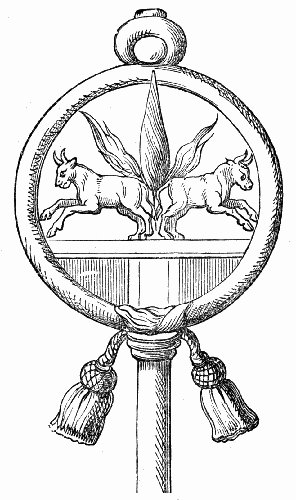
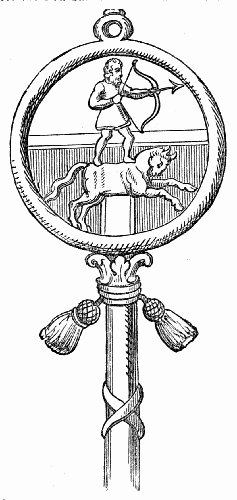
We have in the Nineveh sculptures some highly interesting specimens of the ancient Assyrian standards, consisting principally of two varieties, which are here given. The principal archer appears to be drawing his bow, while the standard-bearer elevates the standard in front of the chariot.
ANCIENT MANNERS OF THE ITALIANS.
About the year 1238, the food of the Italians was very moderate, or, rather scanty. The common people had meat only three days a week. Their dinner consisted of pot-herbs, boiled with meat; their supper, the cold meat left from dinner. The husband and wife eat out of the same dish; and they had but one or two cups in the house. They had no candles made of wax or tallow; but, a torch, held by one of the children, or a servant, gave them light at supper. The men, whose chief pride was in their arms and horses, wore caps made with iron scales, and cloaks of leather, without any other covering. The women wore jackets of stuff, with gowns of linen, and their head-dresses were very simple. Those who possessed a very small sum of money, were thought rich; and the homely dress of the women required only small marriage portions. The nobles were proud of living in towers; and thence the cities were filled with those fortified dwellings.
AMUSEMENTS OF THE LOWER ORDERS IN THE FIFTEENTH CENTURY.
The most popular amusements of the lower orders were wrestling, bowling, quoit and ninepin playing, and games at ball. In wrestling the Cornwall and Devonshire men excelled, and a ram, or sometimes a cock, was the prize of the victor. Bowling alleys were commonly attached to the houses of the wealthy, and to places of public resort. Among the games at ball we find tennis, trap-ball, bat and ball, and the balloon-ball, in which a large ball filled with air was struck from one side to the other by two players with their hands and wrists guarded by bandages. Archery was now on the decline, owing to the introduction of firearms; nor could all the legislative enactments of the day revive its constant use. The quarter-staff was also a favourite weapon of sportive fence, which was a staff about five or six feet long, grasped in the middle with one hand, while the other slid up and down as it was required to strike or to ward a blow.
The citizens of London enjoyed themselves in winter by skating on the Thames, (the old shankbones of sheep having now been superseded by regular skates, probably introduced from the Netherlands,) and in summer with sailing and rowing. Dice and cards, prisoner's base, blind man's buff, battledoor and shuttlecock, bull-baiting, and cock-fighting, a rude species of mumming, the dancing of fools at Christmas, and other games, completed the gratifications of the populace.
NOVEL MODE OF TAKING VENGEANCE.
The Chinese have a book entitled Si-yuen, that is to say, "The Washing of the Pit," a work on medical jurisprudence, very celebrated all over the empire, and which should be in the hands of all Chinese magistrates. It is impossible to read the Si-yuen without being convinced that the number of attempts against life in this country is very considerable, and especially that suicide is very common. The extreme readiness with which the Chinese are induced to kill themselves, is almost inconceivable; some mere trifle, a word almost, is sufficient to cause them to hang themselves, or throw themselves to the bottom of a well; the two favourite modes of suicide. In other countries, if a man wishes to wreak his vengeance on an enemy, he tries to kill him; in China, on the contrary, he kills himself. This anomaly depends upon various causes, of which these are the principal:—In the first place, Chinese law throws the responsibility of a suicide on those who may be supposed to be the cause or occasion of it. It follows, therefore, that if you wish to be revenged on an enemy, you have only to kill yourself to be sure of getting him into horrible trouble; for he falls immediately into the hands of justice, and will certainly be tortured and ruined, if not deprived of life. The family of the suicide also usually obtains, in these cases, considerable damages; so that it is by no means a rare case for an unfortunate man to commit suicide in the house of a rich one, from a morbid idea of family affection. In killing his enemy, on the contrary, the murderer exposes his own relatives and friends to injury, disgraces them, reduces them to poverty, and deprives himself of funeral honours, a great point for a Chinese, and concerning which he is extremely anxious. It is to be remarked also, that public opinion, so far from disapproving of suicide, honours and glorifies it. The conduct of a man who destroys his own life, to avenge himself on an enemy whom he has no other way of reaching, is regarded as heroic and magnanimous.
PERSECUTION IN THE REIGN OF QUEEN MARY.
The total number of persons who perished in the flames for their religion during this reign has been variously reckoned at 277 and 288, amongst whom were 5 bishops, 21 divines, 8 gentlemen, 84 artificers, 100 husbandmen, servants, and labourers, 26 wives, 20 widows, 9 unmarried women, 2 boys, and 2 infants, of which last one was whipped to death by the savage Bonner, and the other, springing out of its mother's womb, at the stake, was mercilessly thrown back into the fire. The number of those that died in prison was also very great. Yet England may be considered as comparatively free from persecution during this period, for all over the continent the victims of bigotry were reckoned, not by hundreds, but by thousands, and in the Netherlands alone 50,000 persons are said to have lost their lives in the religious wars of the Spaniards.
WAYSIDE MONUMENTS.
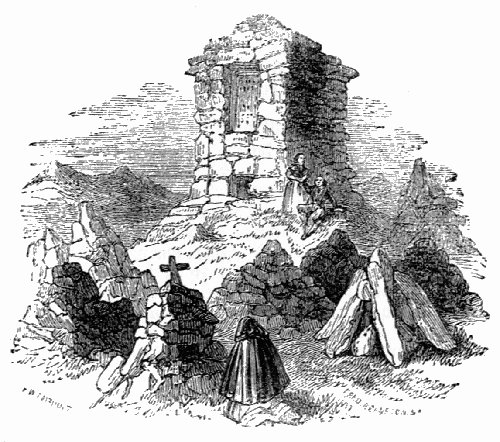
The sketch on next page represents a curious custom which still prevails in the neighbourhood of Cong, near Oughterard in Ireland. It is well described in the following account of their tour by Mr. and Mrs. S. C. Hall:—"On the way to Joyce's Country we saw heaps of piled-up stones on either side of the road; these heaps continuing for above a mile, after their commencement a short distance from the western entrance to the town. The artist may convey a better notion of their peculiar character than any written description can do. We left our car to examine them minutely; and learned they were monuments to the memory of "deceased" persons, "erected" by their surviving friends. Upon death occurring, the primitive tumulus is built,—if that may be called building which consists in placing a few large stones upon a spot previously unoccupied. Each relative of the dead adds to the heap; and in time it becomes a "mountain" of tolerable size. Each family knows its own particular monument; and a member of, or a descendant from it, prays and leaves his offering only at that especial one. The custom has endured for many generations: some of the heaps bore tokens of great age; and one was pointed out to us of which there were records, in the transferred memories of the people, for at least 500 years. The bodies are in no instance buried here—it is not consecrated earth; the monuments are merely memorials, and no doubt originated at a period when a Roman Catholic was, according to the provisions of a law equally foolish and cruel, interred, without form or ceremony, in church ground—the ground that had been the property of their ancestors. None of these stone cairns have any masonwork, and they are generally of the rudest forms, or rather without any form, the stones having been carelessly cast one upon another. Upon one of them only could we discover any inscription—this one is introduced into the print; it is built with far more than the usual care; it contained an inscription; "Pray for ye soule of John Joyce, & Mary Joyce, his wife, died 1712;" some of them, however, seem to have been constructed with greater care than others, and many of them were topped with a small wooden cross. We estimated that there were at least 500 of these primitive monuments—of all shapes and sizes—along the road. In each of them we observed a small hollow, which the peasants call a "window;" most of these were full of pebbles, and upon inquiry we learned that when one of the race to whom the deceased belonged kneels by the side of this record to his memory and offers up a prayer for the repose of his soul, it is customary to fling a little stone into this "cupboard;" the belief being that gradually as it fills, so, gradually, the soul is relieved from punishment in purgatory; when completely full the soul has entered paradise. We have prolonged our description of this singular and interesting scene, because it seems to have been altogether overlooked by travellers, and because we believe that nothing like it is to be met with in any other part of Ireland; although similar objects are to be found in several other places about Connemara, none of them, however, are so extensive as this which adjoins Cong."
HINDOO ADORATION OF THE SÁLAGRÁM.
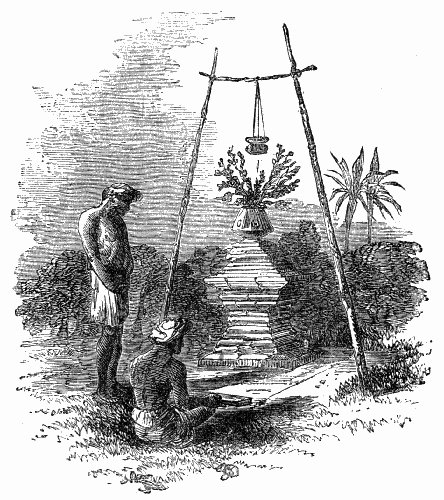
Among the many forms which Vishnu is believed by his Hindoo worshippers to have assumed is that of the Sálagrám—an ammonite-stone, found in the river Gandaká and other streams flowing from the Himalayas. The reason for the worship of this is stated in one of the sacred books. "Vishnu created the nine planets to preside over the fates of men. Sani (Saturn) proposed commencing his reign by taking Brahma under his influence for twelve years. The matter was referred to Vishnu, who being equally averse to be placed under the inauspicious influence of this planet, requested him to call the next day. The next day Saturn could nowhere discover Vishnu, but perceived that he had united himself to the mountain Gandaká; he entered the mountain in the form of a worm called Vajrakita (the thunderbolt worm). He continued to afflict the mountain-formed Vishnu for twelve years, when Vishnu assumed his proper shape, and commanded that the stones of this mountain should be worshipped, and become proper representatives of himself; adding that each should have twenty marks in it, similar to those on his body, and that its name should be Sálagrám."
The Sálagrám is usually placed under a tulasi-tree, which is planted on the top of a pillar in the vicinity of a temple of Vishnu, or near a house. Tulasi, a female, desired to become Vishnu's wife, but was metamorphosed by Lakshmi into a tree, a small shrub, called therefore Tulasi, or holy basil (Ocymum Sanctum). Vishnu, however, promised to assume the form of a Sálagrám, and always continue with her. The Vaishnaya priests, therefore, keep one leaf of the shrub under and another over the Sálagrám, and thus pay their adorations to the stone and the tree. In the evening a lamp is placed near it. In the month of May it is watered from a pot suspended over it, as appears in the engraving, which represents a person engaged in the worship at this singular shrine.
TOMB OF THE EMPEROR MAXIMILIAN AT INSPRUCK.
This majestic tomb is placed in the centre of the middle aisle of the church, upon a platform approached by steps of red marble. The sides of the tomb are divided into twenty-four compartments, of the finest Carrara marble, on which are represented, in bas-relief, the most interesting events of the emperor's warlike and prosperous career. The workmanship of the tablets is exquisite; and, taken in connexion with the lofty deeds they record, they form the most princely decorations ever seen. Each of the tablets contributing to this splendid lithobiography is in size 2 feet 4 inches by 1 foot 8 inches; and every object contained therein is in the most perfect proportion, while the exquisite finish of the heads and draperies requires a magnifying glass to do it justice. The tomb is surmounted by a colossal figure in bronze of the emperor, kneeling in the act of prayer; and around it are four allegorical figures, of smaller size, also in bronze.
But, marvellous as is the elaborate beauty of this work, it is far from being the most remarkable feature of this imperial mausoleum. Ranged in two long lines, as if to guard it, stand twenty-eight colossal statues in bronze, of whom twenty are kings and princes, alliances of the house of Hapsburg, and eight their stately dames. Anything more impressive than the appearance of these tall dark guardians of the tomb, some clad in regal robes, some cased in armour, and all seeming animated by the mighty power of the artist, it would be difficult to imagine.
In the death-like stillness of the church, the visitor who, for the first time, contemplates this tomb and its gloomy guard, is struck by a feeling of awe, approaching to terror. The statues, with life-like individuality of attitude and expression—each solemn, mournful, dignified, and graceful; and all seeming to dilate before the eye into enormous dimensions, and, as if framed to scare intruders, endowed by a power more than mortal, to keep watch and ward round the mighty dead. They appear like an eternal procession of mourners, who, while earth endures, will cease not to gaze on, mourn over, and protect the relics of him who was the glory of their noble, long since fallen race.
THE FAYENCE OF HENRY II. OF FRANCE.
The earliest known fabric of this earthenware is that mysterious and unique manufacture of the "Renaissance," the fine Fayence of Henry II. The manufacture of this ware, which was at once carried to a high degree of perfection, seems to have been suddenly and unaccountably lost, without leaving any record of where or by whom it was produced. By many it is supposed to be of Florentine manufacture, and to have been sent by some of the relations of Catherine de Medicis as a present to Henry II.; but it differs too essentially from Italian Majolica, both in the paste of which it is composed, and in the style in which it is decorated, to warrant such a conjecture. Italy does not possess in her museums a single specimen of this ware, and of the thirty-seven pieces extant, twenty-seven have been traced as coming from Touraine and La Vendée. Many antiquaries, therefore, infer that the manufacture was at Thouars, in Touraine, although the Fayence may have been the work of an Italian artist.
But if the place of its manufacture is unknown, the pieces extant clearly attest the period of its fabrication. The Salamander, and other insignia of Francis I., are met with on the earlier specimens of this pottery; but upon the majority of pieces, upon those more pure in design and more beautiful in execution than the preceding, we find the arms of Henry II., with his device, the three crescents, or his initial H, interlaced with the two D's of the Duchesse de Valentinois. Indeed, so constantly do her emblems appear upon the pieces, that the ware, though usually designated as "Faïence de Henri II.," is sometimes styled "Faïence de Diane de Poitiers." Even her widow's colours, black and white, are the two which are employed in some of the finest pieces. They were the fashionable colours of the court, Henry wore no others during his life, and was attired in them in the fatal tournament in which he fell. Her impresa, the crescent of Diana, is conspicuous on his palaces, and he even caused it to be engraved upon his coins. From these circumstances we must, therefore, conclude that the manufacture of this ware began at the end of the reign of Francis I., was continued under that of Henry II., and, as we find upon it the emblems of these two princes only, we may naturally infer that it is of French origin.
The paste of which this Fayence is composed is equally distinct from Majolica and Palissy ware. The two latter are both soft, whereas this, on the contrary, is hard. It is a true pipeclay, very fine, and very white, so as not to require, like the Italian Fayence, to be concealed by a thick enamel, and the ornaments with which it is enriched are simply covered with a thin, transparent, yellowish varnish.
The style of decoration in this ware is unique. Patterns or arabesques, are engraved on the paste, and the indentures filled with coloured pastes, so as to present an uniform, smooth surface, of the finest inlaying, or resembling, rather, a model of Cellini's silver work, chiselled and worked in niello. Hence it is sometimes styled "Faïence a niellure." These patterns are sometimes disposed in zones of yellow ochre, with borders of dark brown, sometimes of a pink, green, violet, black, or blue; but the dark yellow ochre is the predominant colour.
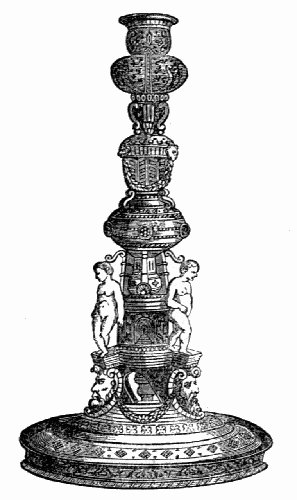
The collection of the late M. Préaux was the richest in the world in the most beautiful examples of Fayence; it was disposed of by auction about twelve years ago, in consequence of the death of the proprietor, and the choicest specimen in it was the candlestick, of which we give a figure, and which was purchased by Sir Anthony de Rothschild for about £220, duty included. The surface is exquisitely enriched with arabesque patterns, either in black upon a white ground, or in white upon a black. The form is monumental, and in the finest style; three figures of genii support escutcheons, bearing the arms of France, and the double D. These genii stand upon masks, which are united by garlands enamelled in green. The top of the candlestick terminates in the form of a vase, and bears inscribed the fleurs-de-lys and the monogram of our Saviour. This piece, for delicacy of detail and beauty of execution, is unequalled by any specimen known of this exquisite Fayence. Sir Anthony de Rothschild also purchased at M. Préaux's sale a small cup, decorated in the same style, with the descents interlaced, for which he gave 1300 francs. He, therefore, now is fortunate in having the finest collection known of this ware, as, in addition to the specimens already mentioned, he possesses two exquisite ewers of the Henry II. Fayence. One he purchased at the sale of the Comte de Monville for 2300 francs; the other, with a curious handle of elaborate workmanship, he bought for nineteen guineas at Strawberry Hill, where he also purchased a tripod salt-cellar, supported with scroll ornaments for £21.
REFRESHMENTS FOR THE PULPIT.
In the books of Darlington parish church, the following items appear, showing that, in the olden time, provision was made for comforting the inner man: "Six quarts of sack to the minister who preached when he had no minister to assist, 9s. For a quart of sack bestowed on Jillett, when he preached, 2s. 6d. For a pint of brandy when Mr. George Bill preached here, 1s. 4d. For a stranger who preached, a dozen of ale. When the Dean of Durham preached here, spent in a treat in the house, 3s. 6d." This would hardly be considered orthodox at the present day.
BEDESMEN IN THE TIME OF HENRY VII.
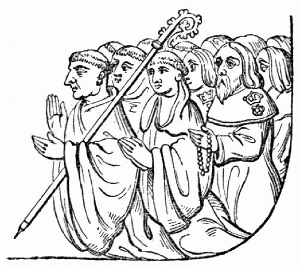
Most of the monasteries in former times had hospitals of poor men and women attached to them; generally either within the precincts or near adjoining. Thus, at St. Edmund's Bury, there was St. John's Hospital, or God's House, without the South Gate, and St. Nicholas' Hospital without the East Gate, and St. Peter's Hospital without the Risby Gate, and St. Saviour's Hospital without the North Gate,—all founded by abbots of St. Edmund's. At Reading there was the Hospital of St. Mary Magdalene for twelve leprous persons and chaplains, and the Hospital of St. Lawrence for twenty-six poor people, and for the entertainment of strangers and pilgrims, both founded by abbots of Reading. One at the gate of Fountains' Abbey for poor persons and travellers; one at Glastonbury, under the care of the almoner, for poor and infirm persons. Thirteen was a favourite number for the inmates of a hospital. From the initial letter of a deed in the British Museum (Harl. 1498), by which King Henry VII. founded a fraternity of thirteen poor men in Westminster Abbey, who were to be under the governance of the monks, we take the accompanying illustration, which represents the abbot and monks before the king, with a group of the king's bedesmen, each of whom has the royal badge, a rose surmounted by a crown, on the shoulder of his habit.
CHINESE GAMBLERS PLAYING FOR FINGERS.
The following strange account is taken from Hue's "Chinese Empire:—
"The Chinese are industrious and economical, but their cupidity, their immoderate love of lucre, and their decided taste for stockjobbing and speculation, easily tempts them to gambling, when they are not engaged in traffic. They seek eagerly for strong excitements, and when once they have got into the habit of gambling they seldom or never recover from it. They cast aside every obligation of station, duty, and family, to live only for cards and dice; and this fatal passion gains such an empire over them, that they proceed even to the most revolting extremities. When they have lost all their money they will play for their houses, their land, and their wives even, whose destiny often depends on a cast of the dice. Nay, the Chinese gambler does not stop here, for he will stake the very clothes he has on for one game more, and this horrible custom gives rise to scenes that would not be credible, did we not know that the passions always tend to make men cruel and inhuman.
"In the northern provinces, especially in the environs of the Great Wall, you may sometimes meet, during the most intense cold of winter, men running about in a state of complete nudity, having been driven pitilessly from the gaming-houses when they had lost their all. They rush about in all directions like madmen to try and save themselves from being frozen, or crouch down against the chimneys, which in those countries are carried along the walls of the houses, on a level with the ground. They turn first one side towards the warmth, then the other, while their gambling companions, far from trying to help them, look on with ferocious and malignant hilarity. The horrible spectacle seldom lasts long, for the cold soon seizes the unfortunate creatures, and they fall down and die. The gamblers then return to their table, and begin to play again with the most perfect composure. Such facts as these will appear fabulous to many persons, but having resided several years in the north of China, we can testify to their perfect authenticity.
"These excesses seem surprising enough, but the truth is, that Chinese gamblers have invented still more extraordinary methods of satisfying their passion, which is really carried to absolute madness. Those who have nothing more to lose will collect round a table and actually play for their fingers, which they will cut off reciprocally with frightful stoicism. We had thought to pass over these revolting particulars, for we do not like to put the confidence of our readers to too great a trial. We have a strong objection to relating things that, although we know them to be strictly true, have an improbable appearance. But these facts concerning Chinese gamblers were known, and commented upon, by the Arab travellers in the ninth century. Here is a passage on the subject from the 'Chain of Chronicles,' from which we have already quoted more than once:—
"'Amongst men of a volatile and boastful character, those who belong to the lower classes, and who have no money, will sometimes play for the fingers of their hands. During the game, they keep by them a vase containing nut, or sesame oil, for olive oil is not known in this country. A fire is kept burning under it, and between the two players is placed a small but very sharp hatchet. The one who wins then takes the hand of the loser, places it on a stone and cuts off one of his fingers with the hatchet; the piece falls, and the vanquished party immediately dips his hand into the hot oil, which cauterises the wound. This operation does not prevent the players from beginning again. Some will take a match, dip it in oil, place it on their arms, and set fire to it; the match burns, and you can smell the odour of the consuming flesh, but the man goes on with his game, and exhibits no sign of pain.'"
ENTRY OF THE FRENCH AMBASSADOR INTO LONDON, IN 1698.
The following is an extract from the "Flying Post," of May 17, 1698:—
"Yesterday, (Monday, May 16,) in the afternoon, Count Tallard, the French Ambassador, made his public entry. The Earl Marshal's men came first, then followed the Earl of Macclesfield's footmen, after them twenty of the Ambassador's footmen, in red liveries with gold lace; then came two of the Ambassador's gentlemen and six pages on horseback; next came two heralds before His Majesty's coach, in which His Excellency the Ambassador, the Earl of Macclesfield, and some others of quality: after them came three of His Royal Highness the Prince of Denmark's coaches, and next, three of the Ambassador's coaches, the first of them very rich, and drawn by eight horses; then followed His Grace the Duke of Norfolk's coach, with about forty-seven more, drawn by six horses each. There was a splendid entertainment prepared for His Excellency at Ossulston House, in St. James's Square."
EXPENSES AT CORONATIONS.
The quantity of provisions consumed at the feasts given by some of our early Kings, was extraordinarily great. For that of King Edward I. February 10th, 1274, the different Sheriffs were ordered to furnish butcher meat at Windsor, in the following proportions:—
Oxen. Swine. Sheep. Fowls.
Sheriff of Gloucester, 60 101 60 3,000
" Bucks and Bedford 40 66 40 2,100
" Oxford 40 67 40 2,100
" Kent 40 67 40 2,100
" Surrey and Sussex 40 67 40 2,100
" Warwick and Leicester 60 98 40 3,000
" Somerset and Dorset 100 176 110 5,000
" Essex 60 101 60 3,160
—— —— —— ——
Total, twelve counties 440 743 430 22,560
In the year 1307, King Edward II. issued an order to the seneschal of Gascony, and constable of Bordeaux, to provide a thousand pipes of good wine, and send them to London, to be used at the approaching coronation. The purchase and freight were to be paid by a company of Florentine merchants, who farmed the revenues of Gascony. The coronation oath was first taken by Ethelred II., A. D. 979; that now used in 1377. It was amended in 1689. The first coronation sermon was preached in 1041. The following statement of the prices given for seats, to obtain a view of passing objects during the coronations of former times, may, perhaps, prove interesting:—
The price of a good place at the coronation of William the Conqueror, was a blank; at that of his son, William Rufus, the same. At Henry I's., it was a crocard; at Stephen's and Henry II.'s, it was a pollard. At Richard's, and King John's, it was a fuskin. It rose at the 3d. Henry's, to a dodkin. In the reign of Edward, the coin begins to be more intelligible; and we find that, for a seat, to view his coronation, a Q was given, or the half of a ferling, or farthing, the fourth part of a sterling, or penny. At the 2d. Edward's, it was a farthing; and at his son's, Edward III. a halfpenny. At Richard II.'s it was a penny, and continued the same to that of Henry IV. inclusive. At the 5th Henry's, it was two pennies; and similar prices were paid at the coronations of Henry VI., Edward IV., Edward V., Richard III., and Henry VII. At that of Henry VIII. it was a grossus, or groat; and the same was paid at that of Edward VI. and Queen Mary's. At Queen Elizabeth's, it rose to a testoon, or tester. At those of James I. and Charles I. a shilling was given; which was advanced to half-a-crown, at those of Charles II. and James II. At King William's and Queen Anne's it was a crown, and the same at that of George I. At George II.'s half-a-guinea, and, afterwards, at George III.'s a guinea was the common charge. But, at that of George IV, as high as forty guineas were given for a single seat.
CURIOUS ANTIQUE SWORD.
The engraving which accompanies this article is a sketch of the upper part of an antique Danish sword, which was found, together with several other weapons, by the labourers who were engaged in the construction of the railway from Dublin to Cashel.
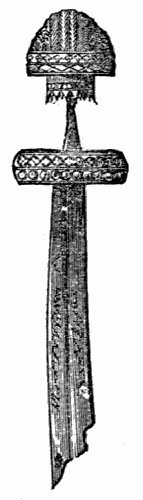
The discovery of the weapons was made at a locality called Island Bridge, and many of them were fortunately secured for the Museum of the Royal Irish Academy, where they may now be seen. The swords are long and straight, formed for cutting as well as thrusting, and terminate in points formed by rounding off the edge towards the back of the blade. The hilts are very remarkable in form, and in one or two instances, like the example we have engraved, are highly ornamented. The mountings are generally of a kind of brass, but several richly plated with silver were found, and it is said that one of them had a hilt of solid gold. The spears are long and slender, and similar in form to the lance-heads used in some of the cavalry corps.
All these weapons, with one exception, are composed of a soft kind of iron. Many of the swords were found doubled up, a circumstance for which it is difficult to assign a reason, as they had evidently been purposely bent. The sword we have represented in our engraving, is remarkable for the unusual degree of ornament which appears upon its hilt, and also for its material, steel.
DINNER IN CHINA.
It is certain that a real Chinese dinner would be a very odd thing in the eyes of a stranger, especially if he were one of those who think, as some people do, that there is only one way of living. To begin dinner with the dessert, and end it with the soup; to drink the wine smoking hot, out of little china cups, and have your food brought to you ready cut up into small pieces, and to be presented with a couple of sticks, instead of a knife and fork, to eat it with; to have, instead of napkins, a provision of little bits of silk paper by the side of your plate, which, as you use, the attendants carry off; to leave your place between the courses, to smoke or amuse yourself; and to raise your chop-sticks to your forehead, and then place them horizontally upon your cup, to signify that you have finished your dinner;—all these things would doubtless seem very odd, and create the curiosity of Europeans. The Chinese, on the other hand, can never get over their surprise at our way of dining. They ask how we can like to drink cold fluids, and what can have put it into our heads to make use of a trident to carry food to our mouths, at the risk of pricking our lips or poking our eyes out. They think it very droll to see nuts put on the table in their shell, and ask why our servants cannot take the trouble to peel the fruit, and take the bones out of the meat. They are themselves certainly not very difficult in the nature of their food, and like such things as fried silkworms and preserved larvæ, but they cannot understand the predilection of our epicures for high game, nor for cheese that appears to belong to the class of animated beings.
CISTERN OF MAJOLICA WARE.
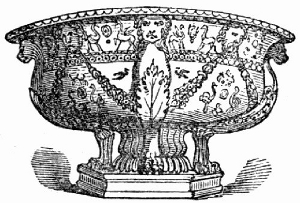
We have engraved the annexed, as it affords at once both a beautiful specimen of the potter's art, and also an example of the taste and luxury of the present day in articles of expensive ornament. It is a cistern made of Majolica, or the enamelled pottery of Italy, the most beautiful specimens of which were made in the sixteenth century. The one before us came to England from the collection of the Borghese Palace; and at the great sale at Stowe, the seat of the Duke of Buckingham, was disposed of by auction for sixty-four guineas, and this although it was much broken.
THEATRES IN THE TIME OF SHAKSPEARE.
In Blackfriars was a theatre, the memory of which with the one or the other shore of the river at Bankside, enjoys the honour of having been used for the first representations of many of Shakspeare's plays, and where the bard himself performed in them. The whole district becomes classic, from the remembrance. The following interesting description of the theatres in London at that time, and which applies to the Blackfriars' theatre as we well as the rest, is taken from a short memoir of Shakspeare, by the Rev. Alexader Dyce, prefixed to the Aldine edition of Shakspeare's poems: "Nearly all these buildings, it is probable, were constructed of wood. Those which, for some undiscovered reason, were termed private theatres, were entirely roofed in from the weather, while the public theatres were open to the sky, except over the stage and galleries. On the outside of each was exhibited a sign indicative of its name; and on the roof, during the time of performance, was hoisted a flag. The interior arrangements resemble those of the present day. There were tiers of galleries or scaffolds; beneath these the boxes or rooms, intended for persons of the higher class, and which at the private theatres were secured with locks, the keys being given to the individuals who engaged them; and there was the centre area, (separated, it seems, from the stage by pales), at the private theatres, termed the pit, and furnished with seats; but at the public theatres, called the yard, and affording no such accommodation. Cressets, or large open lanterns, served to illuminate the body of the house; and two ample branches, of a form similar to those now hung in churches, gave light to the stage. The band of musicians, which was far from numerous, sat, it is supposed, in an upper balcony, over what is now called the stage box: the instruments chiefly used were trumpets, cornets, hautboys, lutes, recorders, viols, and organs. The amusements of the audience previous to the commencement of the play, were reading, playing at cards, smoking tobacco, drinking ale, and eating nuts and apples. Even during the performance it was customary for wits, critics, and young gallants, who were desirous of attracting attention, to station themselves on the stage, either lying on the rushes or seated on hired stools, while their pages furnished them with pipes and tobacco. At the third sounding, or flourish of trumpets, the exhibition began. The curtain, which concealed the stage from the audience, was then drawn, opening in the middle, and running upon iron rods. Other curtains, called traverses, were used as a substitute for scenes. At the back of the stage was a balcony, the platform of which was raised about eight or nine feet from the ground; it served as a window, gallery, or upper chamber. From it a portion of the dialogue was sometimes spoken, and in front of it curtains were suspended to conceal, if necessary, those who occupied it, from the audience. The internal roof of the stage, either painted blue or adorned with drapery of that colour, was termed the heavens. The stage was generally strewed with rushes, but on extraordinary occasions was matted. There is reason to believe that, when tragedies were performed, it was hung with black. Moveable painted scenery there was assuredly none. A board, containing the name of the place of action in large letters, was displayed in some conspicuous situation. Occasionally, when some change of scene was necessary, the audience was required to suppose that the performers, who had not quitted the boards, had retired to a different spot. A bed thrust forth showed that the stage was a bed-chamber; and a table, with pen and ink, indicated that it was a counting-house. Rude contrivances were employed to imitate towers, walls of towns, hell-mouths, tombs, trees, dragons, &c. Trap-doors had been early in use; but to make a celestial personage ascend to the roof of the stage was more than the machinists of the theatre could always accomplish. The price of admission appears to have varied according to the rank and estimation of the theatres. A shilling was charged for a place in the best boxes; the entrance-money to the pit and galleries was the same—sixpence, twopence, and a penny. The performance commenced at three in the afternoon."
OLD CUSTOM RELATING TO CRIMINALS.
The custom of offering doomed criminals a last earthly draught of refreshment is undoubtedly one of considerable antiquity. The right of offering wine to criminals, on their passage to the scaffold, was often a privilege granted to religious communities. In Paris, the privilege was held by the convent of Filles-Dieu, the nuns of which kept wine prepared for those who were condemned to suffer on the gibbet of Montfaucon. The gloomy procession halted before the gate of the monastery, the criminal descended from the cart, and the nuns, headed by the Lady Abbess, received him on the steps with as much, perhaps more, heartfelt ceremony than if he had been a king. The poor wretch was led to a crucifix near the church door, the feet whereof he humbly kissed. He then received, from the hands of the Superior, three pieces of bread (to remind him of the Trinity), and one glass of wine (emblem of Unity). The procession then resumed its dread way to the scaffold.
ALE TOO STRONG.
A memorial signed by nineteen inhabitants of Bayton, in Worcestershire, was sent to the Sessions in the year 1612, setting forth "that John Kempster and John Byrd do not sell their ale according to the law, but doe sell a pynte for a penny, and doe make ytt soe extraordynarye strong that itt draweth dyvers ydle p'sons into the said alehouses, by reason whereof sondrye assaults, affrayes, blodshedds, and other misdeameanors, are there daylie comytted by idle and dronken companie which doe thither resort and there contineue in their dronckenes three days and three nights together, and also divers men's sonnes and servants do often resort and contineue drinking in the said houses day and night, whereupon divers disorders and abuses are offered to the inhabitants of Bayton aforesaid, as in pulling down styles, in carrying away of yertes, in throwing men's waynes, plowes, and such like things, into pooles, wells, and other bye places, and in putting their yokes for their oxen into lakes and myery places, &c." A nice picture of young England in the seventeenth century.
A CHAPTER-HOUSE IN THE TIME OF HENRY VII.
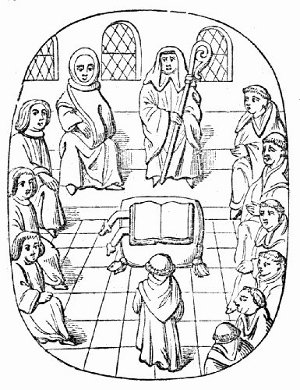
In abbey-churches of the olden time the Chapter-house was always on the east side of the court. In establishments of secular canons it seems to have been always multisided, with a central pillar to support its groining, and a lofty, conical, lead-covered roof. In these instances it is placed in the open space eastward of the cloister, and is usually approached by a passage from the east side of the cloister court. In the houses of all the other orders the chapter-house is rectangular, even where the church is a cathedral. Usually, then, the chapter-house is a rectangular building on the east side of the cloister, and frequently its longest apsis is east and west—at Durham it has an eastern apsis. It was a large and handsome room, with a good deal of architectural ornament; often the western end of it is divided off as a vestibule or ante-room; and generally it is so large as to be divided into two or three aisles by rows of pillars. Internally, rows of stalls or benches were arranged round the walls for the convent; there was a higher seat at the east end for the abbot or prior, and a desk in the middle from which certain things were read. Every day after the service called Tierce, the convent walked in procession from the choir to the chapter-house, and took their proper places. When the abbot had taken his place, the monks descended one step and bowed; he returned their salutation, and all took their seats. A sentence of the rule of the order was read by one of the novices from the desk, and the abbot, or in his absence, the prior, delivered an explanatory or hortatory sermon upon it; then, from another portion of the book was read the names of brethren, and benefactors, and persons who had been received into fraternity, whose decease had happened on that day of the year; and the convent prayed a requiescat in pace for their souls, and the souls of all the faithful departed this life. Then members of the convent who had been guilty of slight breaches of discipline confessed them, kneeling upon a low stool in the middle, and on a bow from the abbot, intimating his remission of the breach, they resumed their seats. If any had a complaint to make against any brother, it was here made and adjudged. Convent business was also transacted. The woodcut gives an example of the kind. Henry VII. had made grants to Westminster Abbey, on condition that the convent performed certain religious services on his behalf; and in order that the services should not fall into disuse, he directed that yearly, at a certain period, the chief justice, or the king's attorney, or the recorder of London, should attend in chapter, and the abstract of the grant and agreement between the king and the convent should be read. The grant which was thus to be read still exists in the British Museum; it is written in a volume superbly bound, with the royal seals attached in silver cases; it is from the illuminated letter at the head of one of the deeds that our woodcut is taken. It rudely represents the chapter-house, with the chief-justice and a group of lawyers on one side, the abbot and convent on the other, and a monk reading the grant from the desk in the midst.
ANNE BOLEYN's GLOVES.
Anne Boleyn was marvellously dainty about her gloves. She had a nail which turned up at the side, and it was the delight of Queen Catharine to make her play at cards, without her gloves, in order that the deformity might disgust King Hal. The good Queen Bess was extravagant, fastidious, and capricious in the extreme, about her gloves. She used to display them to advantage in playing the virginal, and gloves at that time were expensive articles.
DELLA ROBBIA WARE.
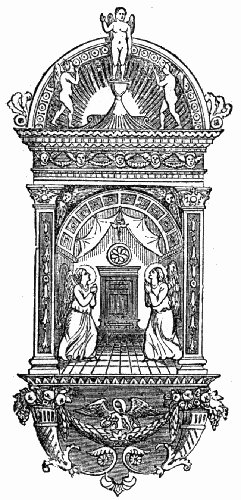
Luca della Robbia, born in 1388, was an eminent sculptor in marble and bronze, and worked both at Florence and at Rimini. Having abandoned his original employment for that of modelling in terra cotta, he succeeded, after many experiments, in making a white enamel, with which he coated his works, and thus rendered them durable. Vasari writes of him, "che faceva l'opere di terra quasi eterne." His chief productions are Madonnas, Scripture subjects, figures, and architectural ornaments: they are by far the finest works ever executed in pottery. He adorned the Italian churches with tiles, as well as with altar-pieces, in terra cotta enamelled; and he is the founder of a school which produced works not much inferior to his own. The "Petit Château de Madrid," in the Bois de Boulogne, near Paris, received the appellation of "Château de Fayence," from having been ornamented with enamelled tiles, the work of an Italian artist, named Girolamo della Robbia, a grand nephew of Luca, whom Francis I. brought from Italy. This château is now wholly destroyed. The tiles seem to have been introduced into portions of the architectural composition, rather as accessory ornaments than as a "lining" or revêtement of the walls. Analogous ornaments, the work of Luca de Maiano, 1521, were to be seen in the old gate, Whitehall, and at Hampton Court.
Luca della Robbia sometimes, though rarely, used a coloured instead of white enamel in his compositions. The above cut represents the altar-piece of San Miniato, near Florence, by him. The ground is blue, the figures white, the fruits, &c., gold colour, and the garlands green.
VOLCANIC ERUPTION IN JAPAN.
The peninsula of Wountsendake, and the greater part of Kewsew, bristle with volcanic mountains, some extinct, others still acting as safety-valves to the incomprehensible excitements of mother Earth; but of all the manifestations of her internal throes and torment, and their consequent desolation inflicted on the habitations of her children, that of 1792 was the most terrible for ages before.
"On the eighteenth day of the first month of that year," says the Annals of Japan, "the summit of the mountain was seen to crumble suddenly, and a thick smoke rose in the air. On the sixth of the following month there was an eruption in a spur on the eastern slope of the mountain. On the second of the third month an earthquake shook the whole island. At Simabara, the nearest town to the mountain, all the houses were thrown down, amidst a general terror and consternation, the shocks following each other with frightful rapidity. Wountsendake incessantly sent forth a hail-storm of stones, showers of ashes, and streams of lava, which devastated the country for many leagues round. At length, on the first day of the fourth month, there was a new commotion, which increased in intensity from moment to moment.
"Simabara was now a vast heap of ruins. Enormous blocks of rock, tumbling from the top of the mountain, crushed and ground to atoms all beneath them. Thunder rolled overhead, and dreadful sounds rumbled beneath the feet at one and the same time. All of a sudden, after an interval of calm, when men thought the scourge had passed over, the northern spur of Wountsendake, the Moikenyamma, burst forth with a tremendous detonation. A vast portion of that mountain was blown into the air. Colossal masses fell into the sea. A stream of boiling water rushed forth foaming from the cracks of this new volcano, and sped to the ocean, which at the same time advanced and flooded the land."
Then was seen a sight never seen before, intensifying the terror of the innumerable witnesses of that terrible day, which might well seem a Day of Judgment come. From the conflict of the boiling waters of the volcano with the cold waters of the tempestuous ocean, suddenly mingled, there arose waterspouts which ravaged the land in their devouring gyrations.
The disasters caused by this accumulation of catastrophes, earthquakes, volcanic eruptions, waterspouts, inundations, united together, exceed belief. Not a single house of Simabara and its environs was spared: only the citadel remained, whose Cyclopean walls were formed of gigantic blocks of stone. The convulsions of nature on that day so changed the coast-line, that the most experienced mariners could not recognise its once familiar shape and bendings.
Fifty-three thousand persons perished on that fatal day.
ORIGIN OF THE HOUSE OF MULGRAVE.
The first diving bell was nothing but a very large kettle, suspended by ropes, with the mouth downwards, and planks to sit on fixed in the middle of its concavity. The Greeks at Toledo, in 1588, made an experiment before the Emperor Charles V. with it, when they descended with a lighted candle to a considerable depth. In 1683 William Phipps, the son of a blacksmith, formed a project for unloading a rich Spanish ship, sunk at Hispaniola; Charles II. gave him a ship, with every necessary for the undertaking; but being unsuccessful, Phipps returned in great poverty. He then endeavoured to procure another vessel, but failing, he got a subscription, to which the Duke of Albemarle contributed. In 1687, Phipps set sail in a ship of 200 tons, having previously engaged to divide the profits according to the twenty shares of which the subscription consisted. At first all his labours proved fruitless, but at length, when he seemed almost to despair, he was fortunate enough to bring up so much treasure that he returned to England with £200,000 sterling. Of this sum he got about £20,000, and the Duke of Albemarle £90,000. Phipps was knighted by the king, and laid the foundation of the present house of Mulgrave.
SHRINE OF ST. SEBALD AT NUREMBURG.
The city of Nuremberg—the birthplace of Albert Durer—is enriched with many works of high art. The most remarkable is the bronze shrine of St. Sebald, the work of Peter Vischer and his five sons, which still stands in all its beauty in the elegant church dedicated to the saint. The sketch on next page is a correct representation of it.
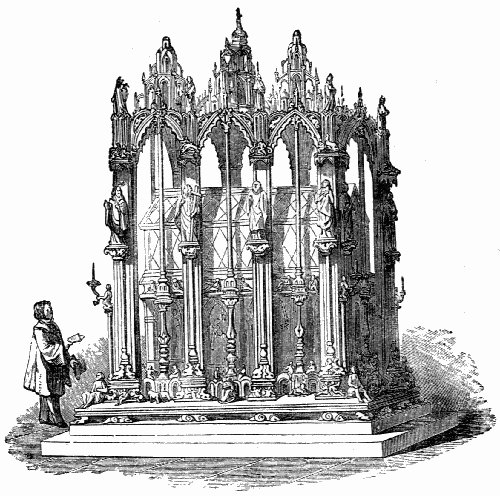
The shrine encloses, amid the most florid Gothic architecture, the oaken chest encased with silver plates, containing the body of the venerated saint: this rests on an altar decorated with basso-relievos, depicting his miracles. The architectural portion of this exquisite shrine partakes of the characteristics of the Rennaissance forms engrafted on the mediæval, by the influence of Italian art. Indeed, the latter school is visible as the leading agent throughout the entire composition. The figures of the Twelve Apostles and others placed around it, scarcely seem to belong to German art; they are quite worthy of the best Transalpine master. The grandeur, breadth, and repose of these wonderful statues, cannot be excelled. Vischer seems to have completely freed his mind from the conventionalities of his native schools: we have here none of the constrained, "crumpled draperies," the home studies for face and form so strikingly present in nearly all the works of art of this era, but noble figures of the men elevated above the earthly standard by companionship with the Saviour, exhibiting their high destiny by a noble bearing, worthy of the solemn and glorious duties they were devoted to fulfil. We gaze on these figures as we do on the works of Giotto and Fra Angelico, until we feel human nature may lose nearly all of its debasements before the "mortal coil" is "shuffled off," and that mental goodness may shine through and glorify its earthly tabernacle, and give an assurance in time present of the superiorities of an hereafter. Dead, indeed, must be the soul that can gaze on such works unmoved, appealing, as they do, to our noblest aspirations, and vindicating humanity from its fallen position, by asserting its innate, latent glories. Here we feel the truth of the scriptural phrase—"In his own image made he them."
The memory of Peter Vischer is deservedly honoured by his townsmen. The street in which his house is situated, like that in which Durer's stands, has lost its original name, and is now only known as Peter Vischer's Strasse; but these two artists are the only ones thus distinguished. Vischer was born in 1460, and died in 1529. He was employed by the warden of St. Sebald's, and magistrate of Nuremberg, Sebald Schreyer, to construct this work in honour of his patron saint; he began it in 1506, and finished it in 1519. Thirteen years of labour were thus devoted to its completion, for which he received seven hundred and seventy florins. "According to this tradition, Vischer was miserably paid for this great work of labour and art; and he has himself recorded, in an inscription upon the monument, that 'he completed it for the praise of God Almighty alone, and the honour of St. Sebald, Prince of Heaven, by the aid of pious persons, paid by their voluntary contributions.'" The elaboration of the entire work is marvellous; it abounds with fanciful figures, seventy-two in number, disposed among the ornaments, or acting as supporters to the general composition. Syrens hold candelabra at the angles; and the centre has an air of singular lightness and grace. It is supported at the base by huge snails. At the western end there is a small bronze statue of Vischer; he holds his chisel in his hand, and in his workman's dress, with capacious leather apron, stands unaffectedly forth as a true, honest labourer, appealing only to such sympathies as are justly due to one who laboured so lovingly and so well.
A GREAT RESULT FROM TRIVIAL CIRCUMSTANCES.
That magnificent institution of active benevolence, Guy's Hospital, is one among a numerous list of instances where trifling events have produced most disproportionate consequences.
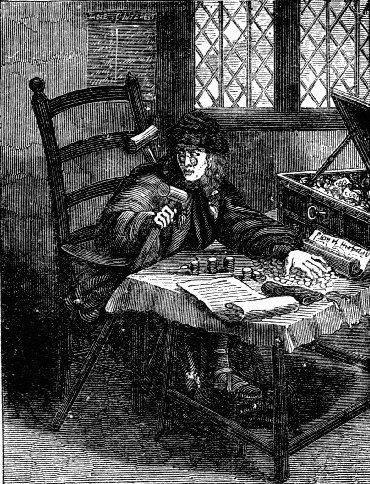
Thomas Guy, of whom the above is a sketch, taken from an old print, was the son of Thomas Guy an Anabaptist, lighterman and coal-dealer, in Horsleydown, Southwark. He was put apprentice in 1660 to a bookseller in the porch of Mercer's Chapel, and set up trade with a stock of about two hundred pounds, in the house that forms the angle between Cornhill and Lombard-street. The English Bibles being at that time very badly printed, Mr. Guy engaged with others in a scheme for printing them in Holland and importing them; but this being put a stop to, he contracted with the University of Oxford for their privilege of printing them, and carried on a great Bible trade for many years to considerable advantage. He thus began to accumulate money, and his gains rested in his hands, for being a single man, and very penurious, his expenses were very trifling. His custom was to dine on his shop counter, with no other table-cloth than an old newspaper; he was also as little nice in regard to his dress. The bulk of his fortune, however, was acquired by the less reputable purchase of seamen's tickets during Queen Anne's wars, and by the South Sea stock in the memorable year 1720.
In proof of what we said at the outset, it is a fact that the public are indebted to a most trifling incident for the greatest part of his immense fortunes being applied to charitable uses. Guy had a maid-servant whom he agreed to marry; and preparatory to his nuptials he had ordered the pavement before his door to be mended as far as a particular stone which he marked. The maid, while her master was out, innocently looking on the paviours at work, saw a broken place they had not repaired, and mentioned it to them; but they told her that Mr. Guy had desired them not to go so far. "Well," says she, "do you mend it; tell him I bade you, and I know he will not be angry." It happened, however, that the poor girl presumed too much on her influence over her wary lover, with whom the charge of a few shillings extraordinary turned the scale against her, for Guy, enraged to find his orders exceeded, renounced the matrimonial scheme, and built hospitals in his old age. In 1707 he built and furnished three wards on the north side of the outer court of St. Thomas's Hospital, and gave one hundred pounds to it annually for eleven years preceding the erection of his own hospital.
Sometime before his death he erected the stately gate with the large houses on each side, at the expense of about three thousand pounds. He was seventy-six years of age when he formed the design of building the hospital near St. Thomas's, which bears his name. The charge of erecting this vast pile amounted to £18,793, besides £219,499 which he left to endow it, and he just lived to see it roofed in.
He erected and endowed an almshouse and library at Tamworth, the place of his mother's nativity, and which he represented in Parliament. It contains fourteen poor men and women, and the fund provides also for the apprenticing of poor children. He also bequeathed four hundred pounds a-year to Christ's Hospital.
Mr. Guy died December 17th, 1724 in the eighty-first year of his age, and his will bears date September 4th, in the same year.
PHAROS AT ALEXANDRIA.
To render the harbour safe of approach at all times, Ptolemy Soter, who, on the death of Alexander, obtained the government of Egypt, determined on erecting a lighthouse on the eastern extremity of the isle of Pharos, the celebrity of which has given the same name to all other lighthouses.
This "pharos" was in height 450 feet, and could be seen at a distance of 100 miles. It was built of several stories, decreasing in dimension towards the top, where fires were lighted in a species of lantern. The ground-floor and the two next above it were hexagonal; the fourth was a square with a round tower at each angle; the fifth floor was circular, continued to the top, to which a winding staircase conducted. In the upper galleries some mirrors were arranged in such a manner as to show the ships and objects at sea for some considerable distance. On the top a fire was constantly kept, to direct sailors into the bay, which was dangerous and difficult of access.
The whole of this masterpiece of art was exquisitely wrought in stone, and adorned with columns, balustrades, and ornaments, worked in the finest marble. To protect the structure from the ocean storms, it was surrounded entirely by a sea wall. Ancient writers say the building of this tower cost 800 talents, which is equivalent to £165,000, if Attic talents; but if Alexandrian, double that sum.
The building was not completed during the reign of the first Ptolemy, but was finished in the reign of his son Ptolemy Philadelphus, who put this inscription upon it:—
"King Ptolemy, to the Gods the Saviours, for the benefit of sailors."
Sostratus the architect, wishing to claim all the glory of the building, engraved his own name on the solid marble, and afterwards coated it with cement. Thus, when time had decayed the mortar Ptolemy's name disappeared, and the following inscription became visible:—
"Sostratus the Cnidian, to the Gods the Saviours, for the benefit of sailors."
Of this remarkable tower not a vestige remains, and history gives us no further information than we have here: of its gradual decay or of its violent destruction we have no record; but that such a structure as described stood there, there can be not a shadow of doubt, from the fact that all buildings for like purposes among the Greeks and Romans derive their designation from this.
SEPULCHRAL VASES OF ANCIENT EGYPT.
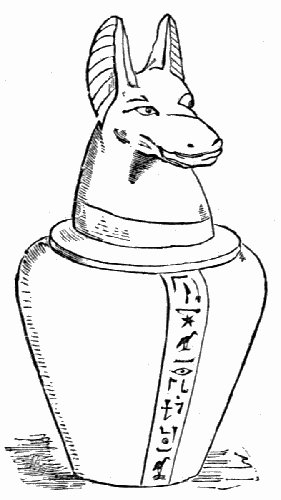
In ancient Egypt terra-cotta pottery was extensively made use of for vases or jars to hold the entrails of the dead. In order to preserve the body effectually, it was necessary to remove the softer portions, such as the thoracic and abdominal viscera, and these were embalmed separately. In some instances they were returned into the stomach, with wax models of four deities, commonly called the four genii of the Ament or Hades. It was, however, usual in the embalmment of the wealthier classes to soak them carefully in the requisite preparations, tie them up in neat cylindrical packets, and deposit them in vases having the shape of the four genii. The bodies of these deities, which were usually represented as mummied, formed the bodies of the vases, and were cylindrical below and rounded above. The mouths of the jars were sometimes countersunk to receive the lower part of the covers which fitted into them like a plug. The jar of the first genius, whose name was Am-set, "the devourer of filth," held the stomach and large intestines, and was formed at the top like a human head. This genius typified, or presided over the southern quarter of the compass. He was the son of Osiris or of Phtha Socharis Osiris, the pygmean god of Memphis. The second vase of the series was in the shape of the genius Hapi, the "concealed." Its cover was shaped like the head of a cynocephalus, and it held the smaller viscera. This genius presided over the north, and was also the son of Osiris. The third vase was that of the genius Trautmutf, "the adorer of his mother." We here annex an engraving of it. It had a cover in shape of the head of a jackal, and held the lungs and heart. This genius presided over the East, and was brother of the preceding. The last was that of the genius Kebhsnuf, the refresher of his brethren. It had a cover shaped like the head of a sparrow-hawk, and held the liver and gall-bladder. This genius presided over the west, and was also brother of the preceding. Three vases of a set, in the British Museum, have all human-shaped heads, and are provided with handles at the sides of the bodies. Specimens of a very unusual kind are also to be found in the same collection, having the whole body formed without a cover, in the shape of a dome above, and surmounted by a rudely modelled figure of a jackal, couchant upon a gateway, formed of a detached piece. The entrails were introduced by the rectangular orifice in the upper part. In some other instances the covers appear to have been secured by cords passing through them to the body of the vase. When secured, the vases were placed in a wooden box, which was laid on a sledge and carried to the sepulchre, where they were often taken out and placed, two on each side of the coffin. It was only the poorer classes that used pottery for these purposes. The viscera of high officers of state were embalmed in jars of fine white limestone, and the still more valuable oriental alabasters or arragonite, obtained from the quarries of Tel El Amarna, or the ancient Alabastron.
THE SACRO CATINO.
The celebrated "Sacro Catino," part of the spoil taken by the Genoese at the storming of Cesarea, which was believed to be cut from a single emerald, and had, according to tradition, been presented by the Queen of Sheba to Solomon, was for ages the pride and glory of Genoa, and an object of the greatest devotional reverence at the yearly exhibitions, which were attended with great pomp and ceremony. Such was the opinion of its intrinsic value, that on many occasions the republic borrowed half a million of ducats upon the security of this precious relic. When the French armies, during the first Revolution, plundered Italy of its treasures, it was sent with other spoils to Paris. Upon examination, it was, instead of emerald, proved to be composed of glass, similar to that found in the Egyptian tombs, of which country it was, no doubt, the manufacture. At the Restoration the Sacro Catino was returned in a broken state, and now lies shorn of all its honours, a mere broken glass vessel, in the sacristy of the Church of San Lorenzo.